

Introduction
Nonhuman primate (NHP) studies are crucial in biomedical research. Since great apes like chimpanzees are not used in biomedical experiments conducted in captivity, baboons and macaques are the closest model NHP species to humans available for study. One vital area of research in which NHPs are studied is developmental programming, which investigates how challenges early in life influence development, with impacts on health for the entire lifespan. This area of study is expanding the understanding of the mechanisms and outcomes that determine predisposition to a wide variety of important diseases, such as diabetes and cardiovascular disease, as well as response and resilience in normal processes like growth and aging. NHPs are excellent translational models of developmental programming because they are much more similar to humans than are rodents in terms of body size, brain size, lifespan, gestation length, singleton births, hormonal profiles, and complex social behavior.
Determination of the sample size needed in whole animal physiological investigations is essential in planning animal research investigations. One of the first steps is to conduct a power analysis, if possible, to determine sample size and assess work scope, budget, and timeline. However, a power analysis requires preliminary data related to the actual endpoints studied. Performing a power analysis on unrelated data, such as different physiological systems or distinct gene or protein expression where the target outcome differs from proposed work, does not robustly address the specific endpoint that the hypothesis addresses. It is particularly difficult to meet power analysis requirements when starting studies in a new area for which preliminary data do not exist to guide the investigator. This is especially true for studies involving NHP, where related studies often do not exist or assembling a few animals to get preliminary data can be costly and present practical problems. Therefore, lack of parallel preliminary data that adequately address similar questions represents a major challenge.
We thus felt that it would be helpful to NHP investigators – and those evaluating the value of the various NHP studies in the literature – if we reviewed and summarized sample sizes in published studies. To this end, we review here published investigations of developmental programming by maternal under- and over-nutrition, areas with which we are familiar. Due to the scarcity of regression analyses in the literature, we focused on categorical analyses of offspring developmental programming by maternal nutrition, limited to studies involving tissue collection or imaging. Investigations that only studied mothers or placentas, or in which the only fetal measure reported was morphometric, were excluded.
The aims of this review of the literature were to determine typical sample sizes reported, consider the challenges, identify areas needing further work, and address future goals of NHP studies of developmental programming by maternal nutrition.
Methods
We sought to identify NHP studies of developmental programming by maternal nutrition. We performed a literature search using GoogleScholar and PubMed. Keywords used in combination were maternal high-fat diet, maternal obesity, intrauterine growth restriction, developmental programming, maternal nutrition, maternal nutrient reduction, maternal nutrient restriction, maternal western style diet, primate, baboon, macaque, marmoset, and vervet. We also searched for works by specific authors we have known over the years to publish NHP studies of developmental programming by maternal nutrition. The bibliography of each identified paper was also analyzed. The last literature search was performed on August 1, 2018.
Studies of fetal and postnatal offspring were included. Studies that only investigated mothers or placentas were excluded. Studies were limited to those involving tissue collection or imaging, excluding studies in which the only offspring measures were morphometric. We planned to exclude studies with nonsignificant findings, but no papers were identified that solely reported nonsignificant findings.
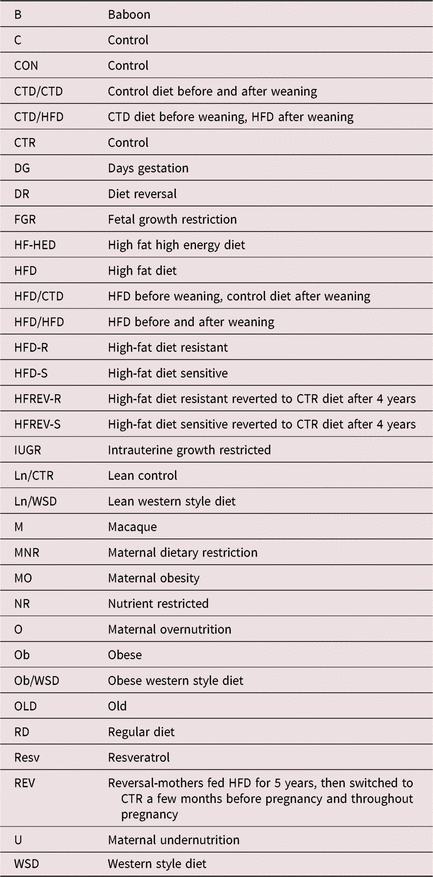
Minimum and maximum sample sizes and number of groups studied were investigated separately in studies that pooled or separated sexes. One study that reported sex-based results did not report number of animals per sex, so this study was included in calculations for studies that pooled sexes, since only total sample size was known, rather than sample size per sex.Reference Sullivan, Rivera and True1 Primary outcomes were considered those reported in the abstract. Data given as mean ± SEM. Abbreviations are defined in Table 1.
Abbreviations. Abbreviations kept consistent with use in sourced papers

Results
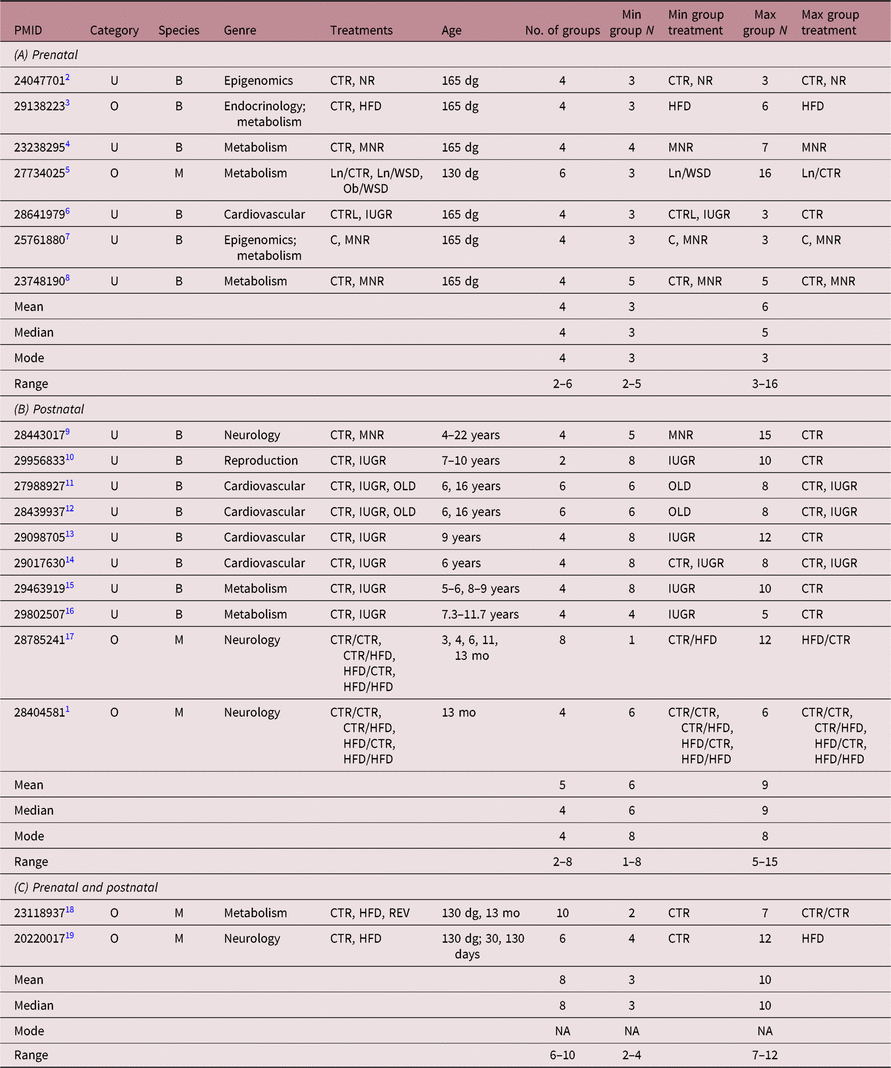
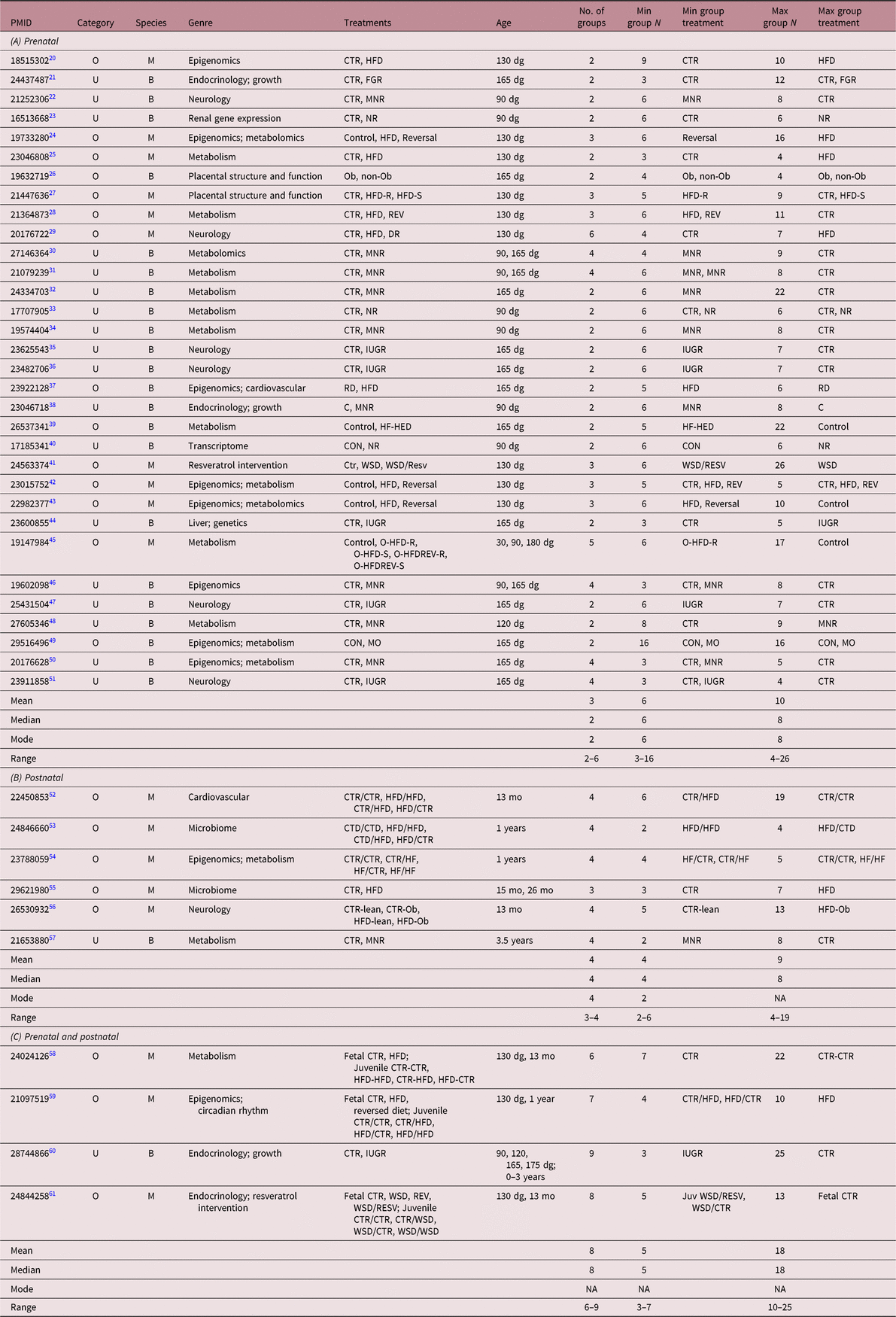
Sixty-one studies were identified, published between 2006 and 2018, including 28 that investigated maternal over-nutrition and 33 maternal under-nutrition (Tables 2 and 3). Twenty-three studies were conducted in Japanese macaques (Macaca fuscata) at the Oregon National Primate Research Center (ONPRC) and 38 in olive baboons (Papio hamadryas anubis) at the Southwest National Primate Research Center (SNPRC). No marmoset or vervet studies meeting the inclusion criteria were identified. Fetal offspring were investigated in 39 studies, postnatal in 16 studies, and both pre- and postnatal in 6 studies. The most frequently studied topic was metabolism and/or metabolomics, with 26 studies performed. Twelve studies focused on epigenomics, 11 on neurological outcomes, 7 on cardiovascular outcomes, 3 on endocrinology of growth, 2 on the microbiome, and 2 on placental structure and function (with additional data on fetal parameters). Only two studies explored interventions to counteract the effects of developmental programming, both involving resveratrol.
Studies with analysis by sex

Studies without analysis by sex. Sample sizes include both sexes

Studies including analysis by sex
Analysis by sex was performed in 19 studies (Table 2). The number of experimental groups studied ranged from 2 to 10 (mean 4.9 ± 0.43, median 4, mode 4). Minimum group size ranged from 1 to 8 (mean 4.7 ± 0.52, median 4, mode 3). Maximum group size ranged from 3 to 16 (mean 8.3 ± 0.93, median 8, mode 8). Seven papers studied fetal animals, 10 studied postnatal animals, and 2 both fetal and postnatal. Descriptive statistics by age group studied are presented in Table 2.
Studies that pooled sexes
Forty-two studies pooled sexes for analyses (Table 3). Only 12 of these reported the numbers of males and females per pooled group. Number of experimental groups studied ranged from 2 to 9 (mean 3.4 ± 0.26, median 3, mode 2). Minimum group size ranged from 2 to 16 (mean 5.3 ± 0.35, median 6, mode 6). Maximum group size ranged 4–26 (mean 10.2 ± 0.92, median 8, mode 8). Twenty-nine papers studied fetal animals, six studied postnatal animals, and four both fetal and postnatal. Descriptive statistics by age group studied are presented in Table 3.
Discussion
Summary of sample size findings
A typical study with sex-based analyses involved four groups, with average minimum group size of 4 and average maximum group size of 8 per sex. Among studies that pooled sexes for analyses, the average number of groups was 2, with average minimum group size of 6 and average maximum group size of 8. Studies that performed sex-based analyses tended to involve more groups since males and females constituted separate groups on top of experimental treatments. Most often the groups consisted of a single experimental treatment compared against controls, although 15 studies of maternal over-nutrition investigated dietary reversal, with over-nutrition and control diets alternated at different timepoints.Reference Sullivan, Rivera and True1,Reference Thompson, Valleau and Barling17,Reference Grant, Nicol, Thorn, Grove, Friedman and Marks18,Reference Cox, Williams, Grove, Lane and Aagaard-Tillery24,Reference Grant, Gillingham and Batra28,Reference Roberts, Pound and Thorn41–Reference Suter, Chen and Burdine43,Reference McCurdy, Bishop and Williams45,Reference Fan, Lindsley and Comstock52–Reference Suter, Takahashi, Grove and Aagaard54,Reference Comstock, Pound and Bishop58,Reference Suter, Bocock and Showalter59,Reference Pound, Comstock and Grove61 The maximum sized group in a study was most frequently the control group. Few studies that pooled sexes reported the numbers of males and females – only 12 of 42.
All studies reported significant differences between groups. It would be useful to review sample sizes in studies that produced significance between groups versus those that did not. However, this is impossible given that very few papers report nonsignificant findings. This publication bias is well known.Reference Dwan, Gamble, Williamson and Kirkham62 Readers may wonder why we do not report outcome means, effect sizes, or levels of significance in the tables to pinpoint sample sizes needed for adequate statistical power in each of these specific outcomes. There are two reasons: (1) Each study reported numerous different outcomes, and the minimum and maximum sample sizes often applied to multiple outcomes per study. (2) More importantly, outcomes reported in all the different studies were mostly unique, with almost no replication of work by other investigators. NIH expressly requests studies addressing reproducibility. Conducting a power analysis typically requires prediction of sample means. The studies reported herein could be used for preliminary data, but since there is no replication of findings, we cannot generate predicted means across multiple studies to enhance power analyses. In other words, because of the relative scarcity of data, there are few replicative studies that can be compared, so assembling these data at this point would not advance the results of this paper. Given the lack of replication, the best we can do currently is to report typical sample sizes across multiple outcomes to give investigators a clue as to how many animals have been used before to produce successful studies. As the body of research grows and work is replicated, more sophisticated approaches to sample size determination will become possible. For the same reasons, meta-analysis is not possible at this stage.
It is reassuring that the studies we investigated produced a wide variety of significant findings with sample sizes of 4–8 animals per group. Our own experience and discussions with other investigators in the field have indicated that peer-reviewers often criticize these numbers as too small and disapprove the lack of power analysis. We document here that sample sizes of 4–8 are not small but instead average (and often successful) for this type of research, as well as the legitimate reasons for not conducting power analyses.
Challenges of NHP developmental programming studies
NHP studies present challenges not present in studies of smaller common laboratory animal models like rodents, including body size, lifespan, and gestation length. All investigations reported here studied particularly large-bodied primates, Japanese macaques, and olive baboons. Both Japanese macaquesReference Paterson63 and olive baboonsReference Coelho and Watts64 complete skeletal growth at 7 years in females and 8 years in males; at these ages, young adult captive olive baboons at SNPRC weigh on average 29 kg in males and 17 kg in females,Reference Coelho and Watts64 while young adult captive Japanese macaques at ONPRC weigh on average 16 kg in males and 12 kg in females.Reference Paterson63 Lifespan of captive olive baboons at SNPRC is 21 years on average, with a maximum lifespan of 33 years.Reference Bronikowski, Alberts, Altmann, Packer, Carey and Tatar65 In the semi-free ranging colony of Japanese macaques of Arashiyama West, mean lifespan is 25 years and maximum lifespan 33 years.Reference Pavelka and Fedigan66 Gestation length in Japanese macaques is approximately 173 days and in olive baboons 180 days.Reference Harvey and Clutton-Brock67 Both species typically give birth to single offspring.Reference Harvey and Clutton-Brock67 The life history features of baboons and macaques make them costly to raise in captivity; they require a large amount of space due to their large body size, must be housed for many years to study development and aging, and reproduce slowly. Typical grant periods of 2–5 years are therefore insufficient to conduct even short-term studies, much less longitudinal analyses, so researchers must be prepared to seek many years of new funding and renewals. Despite these practical hurdles, baboons and macaques remain the nearest NHP to humans since great apes are not used in biomedical research. They are also excellent translational models of developmental programming precisely because of their body size, lifespan, gestation length, and singleton births, which make them much more similar to humans than are rodents. Moreover, their hormonal profiles, complex social behavior, and brain size exhibit a high degree of similarity to humans, indeed because they are the animals most closely related to humans other than apes. It would be useful if studies described in greater detail how the animals were housed, environmental enrichment procedures, selection of animals, preparation of animals for study, veterinary care employed, and metrics of health assessed to evaluate animal well-being. These specifics would be valuable for planning future studies.
As referred to above, given the sociality of NHPs, they ideally are kept in social groups requiring large enclosures. This leads to another obstacle: controlling food intake. This is most challenging in studies of maternal under-nutrition, since animals must be fed individually. Feeding in social groups does not allow modification of quantity of diet because even if less food is provided to the group, some individuals will monopolize food access, leading to dominant individuals eating more and subordinate individuals eating less, if at all. Special provisions are needed to control feed access. We have addressed this issue at SNPRC by building a facility that allows for social housing but separation during feeding time.Reference Schlabritz-Loutsevitch, Howell and Rice68 Large social cages are connected to chutes leading to individual feeding cages. Baboons are easily trained to run through the chutes to and from the feeding cages, where intake can be closely monitored. This system is much better for animal welfare than individual indoor housing, since animals receive the great benefits of social outdoor lives. New technology is transforming ability to control intake. Research Diets has developed the BioDAQ NHP system, which consists of a feeding station that records feeding bouts with RFID microchips implanted into the monkeys. The system identifies individuals and then weighs and dispenses food accordingly, recording date, time, and amount taken by each monkey. BioDAQ NHP is in use at Yerkes National Primate Research Center with rhesus macaques.
The strength of all studies depends on a homogenous experimental subject base. This is particularly true with regard to programming, where features of the parental phenotype – such as maternal BMI, age, previous obstetric history, and even now it is believed paternal phenotype – can differentially affect outcomes in offspring and constitute a major reason for uniformity of subjects. Variance in the mothers produces greater variance in the offspring. Thus, ensuring uniformity of the parental generation prior to any experimental manipulations is a crucial hurdle.
All 61 studies discussed herein appear to have been performed in two laboratories, one using macaques as a model at ONPRC and one using baboons as a model at SNPRC. Based on ages studied and the need for tissue collection at each age, each laboratory bred at least five groups of offspring. The ONPRC-based group studied fetal macaques at gestational days 30, 90, 130, and 180, as well as postnatal macaques. In the baboon experiments based at SNPRC, animals were studied at gestational days 90, 120, 165, and 175, as well as postnatally. This point highlights both a challenge and strength of NHP studies. Given all the requirements of NHPs discussed above, such as long length of studies and complex housing, NHPs are quite costly to study, presenting a challenge that few laboratories have been able to embrace. However, this is also a strength since breeding animals under the same or highly similar conditions enhances uniformity of the studies, allowing researchers to build a comprehensive phenotype integrating several physiological systems in the similar cohorts of animals. This strength is further enhanced when the same animals are used for studies on different systems, such as brain,Reference Franke, Clarke and Dahnke9 carbohydrate metabolism,Reference Choi, Li, McDonald, Comuzzie, Mattern and Nathanielsz57,Reference Kuo, Li and Mattern15 and cardiovascular system,Reference Kuo, Li, Li, Huber, Nathanielsz and Clarke11,Reference Kuo, Li, Huber, Schwab, Nathanielsz and Clarke12 thereby allowing rigorous integration within a cohort as opposed to integrating data on different systems from different cohorts whose individuals may differ in other confounds.
Deficiencies in the literature and directions for future work
The challenges of longitudinal studies have led to deficiencies in the current literature of NHP developmental programming by maternal nutrition. Studies are overwhelmingly categorical, rather than regression-based, since regression analyses require larger sample sizes and longer time frames to investigate different stages of development. Categorical studies provide less statistical power and lower ability to understand changes over the course of development and aging. There is also a lack of a wide range of ages studied, with most studies focusing on gestational days 90, 130, and 165. Only 22 of the 62 studies reported here investigated postnatal animals; of these, just 7 studies involved offspring older than 7 years, the age at which female macaques and baboons complete skeletal growth.Reference Paterson63,Reference Coelho and Watts64 There is growing interest in interactions of developmental programming and aging,Reference Franke, Clarke and Dahnke9,Reference Kuo, Li, Li, Huber, Nathanielsz and Clarke11,Reference Salmon, Dorigatti, Huber, Li and Nathanielsz16,Reference Huber, Kuo and Li69,Reference Kuo, Huber, Li, Li, Nathanielsz and Clarke70 so future work must involve study of adult aging and aged NHPs from different developmental backgrounds. No studies have investigated F2, so inter-generational effects are entirely unstudied in NHPs. The importance of inter-generational studies is shown by the multiple reports of intergenerational and transgenerational epigenetic and non-epigenetic transfer in guinea pigs,Reference Bertram, Khan, Ohri, Phillips, Matthews and Hanson71 rodents,Reference Aiken and Ozanne72–Reference Burdge, Slater-Jefferies, Torrens, Phillips, Hanson and Lillycrop75 and sheep.Reference Pankey, Walton and Odhiambo76,Reference Shasa, Odhiambo, Long, Tuersunjiang, Nathanielsz and Ford77
Another major weakness in the literature to date is investigation of sex as a biological variable. Twice as many studies reported here pooled sexes for analysis rather than tested for differences between sexes. Although studies often state that sexes were pooled because no sex-based differences were found, it is unlikely that sample sizes were large enough per sex for determination of the potential existence of sex-based differences, given the mean minimum sample size of 6 and mean maximum sample size of 8, which leaves only 3–4 individuals per sex, assuming the number per sex was equal. It is impossible to know from most of these studies whether the number per sex was equal because less than a third of studies reported the numbers of males and females per pooled group. There is substantial evidence of differential vulnerability to effects of programming between males and females,Reference Zambrano and Nathanielsz78,Reference Aiken and Ozanne79 with males seen as more prone to negative effects of prenatal stress and females as more adaptable.Reference Sandman, Glynn and Davis80 However, studies have shown that both sexes are sensitive but in different ways, especially in susceptibility to cardiovascular diseaseReference Dasinger and Alexander81–Reference Ojeda, Intapad and Alexander83 and dysregulated metabolism.Reference Dearden, Bouret and Ozanne84
An additional challenge of sex as a biological variable in NHP programming studies is the possibility that maternal nutrition biases the birth sex ratio.Reference Huber, Bartlett, Smith, Li, Jenkins and Nathanielsz85 If one sex is born more often than the other in NHP programming studies, it becomes difficult to balance the sexes well enough for incorporation of sex as a biological variable, leading to a need for even larger sample sizes. In both baboons and macaques, but especially so in baboons, males are much larger than females. In species in which males are substantially larger than females, male growth and development may be faster and energetic costs higher.Reference Clutton-Brock, Albon and Guinness86 In circumstances of resource scarcity (e.g., maternal under-nutrition), the higher costs of raising the larger sex may result in differential perinatal mortality between sexes, leading to fewer males being born to mothers in poorer physical condition.Reference Clutton-Brock, Albon and Guinness86 An alternative hypothesis is that it is more costly to raise the sex with stricter inheritance of the dominance hierarchy, which is females in both baboons and macaques.Reference van Schaik and Hrdy87,Reference Silk and Brown88 Investigation of birth sex ratio in developmental programming by maternal nutrition is also fraught with challenges of sample size. According to one analysis, a sample size of over 2000 animals would be needed to have adequate power to detect birth sex ratio effects of developmental programming by maternal nutrition.Reference Huber, Bartlett, Smith, Li, Jenkins and Nathanielsz85 This study presents a good example of how preliminary data are used for power analysis. The researcher first assembled data on sex produced by 319 births to mothers on three different diets (under-nourished, over-nourished, and control). Then, using the determined level of difference in numbers of males and females born to each group, a power analysis could be conducted to determine power of the current study (15%) as well as sample size needed for a higher powered (80%) future study. It was only after the initial study was conducted that the data necessary for the power analysis were available.
Another goal of future work should be incorporation of more diverse topics. Metabolism and metabolomics have been by far the best studied, undoubtably due to the high level of interest in predisposition to obesity and metabolic disease. Epigenomics, neurological outcomes, and cardiovascular outcomes have received moderate attention. Endocrinology of growth, microbiome, and reproduction have been little studied, and therefore there are no data for power analysis. A promising method that has been little used to date is telemetry. Implanting small telemeters (<60 g) into NHP allows for continuous remote collection of a wide range of data (e.g., blood pressure, activity levels, glucose levels, temperature, respiration, electromyography, electrocardiography) while allowing animals to live in social groups with minimal sedations. Once a greater diversity of studies is achieved, as well as replication of studies, it will be possible to perform meta-analyses. Meta-analysis is highly desirable to determine variability in outcomes and true effect sizes.
A major objective of translational developmental programming studies is development of interventions to ameliorate undesirable outcomes. However, only two studies of NHP programming by maternal nutrition have reported effects of an intervention, in both cases, maternal resveratrol supplementation to counteract the effects of an obesogenic Western-style diet.Reference Roberts, Pound and Thorn41,Reference Pound, Comstock and Grove61 The results of resveratrol supplementation were mixed, with one study finding improvements to maternal and placental phenotype and to fetal liver development, but inexplicable and potentially harmful changes to fetal pancreatic development.Reference Roberts, Pound and Thorn41 The other study reported that the Western-style diet led to decreased pancreatic islet capillary density; diet reversal normalized islet vascularization, while resveratrol supplementation resulted in hypervascularization beyond the level of controls, which could have detrimental consequences.Reference Pound, Comstock and Grove61 In neither of these studies was amount of resveratrol consumed reported. As discussed above, controlling and measuring food intake is a major challenge in NHP research due to the need to feed individually in a species where dominance rank can prevent animals from receiving their portion. One of the studiesReference Roberts, Pound and Thorn41 calculated blood resveratrol concentrations during an intravenous infusion of resveratrol in a subset of animals. In rodent studies, resveratrol,Reference Vega, Reyes-Castro and Rodríguez-González89,Reference Zou, Chen and Yang90 maternal and offspring exercise,Reference Vega, Reyes-Castro, Bautista, Larrea, Nathanielsz and Zambrano91,Reference Santos, Rodríguez-González, Ibáñez, Vega, Nathanielsz and Zambrano92 and coenzyme Q10Reference Tarry-Adkins, Fernandez-Twinn and Madsen93,Reference Tarry-Adkins, Fernandez-Twinn and Hargreaves94 have shown promising results in mitigating the effects of less-than-ideal maternal diet during pregnancy. Future NHP work should aim to further explore similar interventions and treatments, especially given the potential for interventions like resveratrol to lead to both advantageous and damaging outcomes.
Rodent models of developmental programming have been highly valuable due to the ease of complex manipulations to genetics and diet, fast reproduction, and shorter lifespans when compared to NHPs. However, rodent models are limited in capacity for translation to humans. Some examples of the differences between humans and rodents that are important to programming studies include that rodent lipid metabolism is such that atherosclerosis is usually achieved with knocking out of genes and dietary manipulation, rodents give birth to litters of offspring with the added complication of within-womb competition between litter-mates, rodents are so small that tissue collection is inherently limited, and rodents lack the extended childhood period seen in humans and NHPs.Reference Rabadán-Diehl and Nathanielsz95 For these reasons and many more, NHP models are necessary to bridge the gap between rodent and human developmental programming.
Conclusions
We conclude that studies of developmental programming by maternal nutrition with group sizes of 4–8 have sufficient ability to detect differences in many key physiological variables between groups at the level of P < 0.05. To address deficiencies in the literature, future goals for this body of work include increasing the age range of study subjects particularly into adulthood, more frequently considering sex as a biological variable, expanding the topics investigated, replicating studies, exploring inter-generational effects, and examining interventions. Study of sample sizes of developmental programming by stress (e.g., synthetic glucocorticoids, estrogen deprivation, and maternal maltreatment) also needs to be addressed in the future.
Acknowledgements
Thanks to Karen Moore for administrative and technical assistance.
Financial support
This study was supported by NIH through grants R24 RR021367, P01 HD21350, R24 OD011183, and U19 AG057758. We are grateful to the Office of Research Infrastructure Programs (ORIP) for its dedicated support to NHP studies to our Center and others.
Conflicts of interest
None.
Ethical standards
The research conducted for this review paper did not involve animal or human experimentation.