


Introduction
The ecological consequences of fear are far-reaching. Predators play a dual role in affecting prey populations, by not only causing direct effects on prey density through consumption but also fear-mediated indirect effects (Brown et al. Reference Brown, Laundre and Gurung1999; Zanette and Clinchy Reference Zanette and Clinchy2019). After detecting a threat, individual prey can avoid predation through behavioural, physiological, and morphological adaptations, which may lead to trait-mediated, cascading effects on community level (Daversa et al. Reference Daversa2021; Zanette and Clinchy Reference Zanette and Clinchy2019). This phenomenon is referred to as ‘ecology of fear’ (Brown et al. Reference Brown, Laundre and Gurung1999; Zanette and Clinchy Reference Zanette and Clinchy2019). Using playbacks of predator vocalisations, experimental studies have provided direct evidence that the perception of predation risk alone can affect wildlife population dynamics. For instance, the fear inspired by such playbacks caused a reduction in the number of offspring produced per year by 40% in wild female song sparrows ( Melospiza melodia ) (Zanette et al Reference Zanette, White, Allen and Clinchy2011).
While the concept of ‘ecology of fear’ originally considered predator-prey relationships, it has subsequently been broadened to include the non-consumptive effects on hosts exhibiting avoidance behaviour towards parasites (Allan et al Reference Allan, Varns and Chase2010; Daversa et al Reference Daversa2021; Fritzsche and Allan Reference Fritzsche and Allan2012). Contrary to predation, parasitic infections are less often immediately fatal but can impose a substantial cost on host fitness, e.g., reducing survival or reproductive output (Allan et al Reference Allan, Varns and Chase2010; Rohr et al Reference Rohr, Swan, Raffel and Hudson2009). This should favour the evolution of behavioural parasite avoidance strategies, provided that the cost of avoidance is lower than that of infection (Behringer et al Reference Behringer, Karvonen and Bojko2018; Hart 1990; Poulin Reference Poulin1995; Sarabian et al Reference Sarabian, Curtis and McMullan2018).
This study experimentally assessed the effect of avoidance behaviour in the mussel-trematode model system, where blue mussel ( Mytilus edulis ) serves as the second intermediate host of trematodes of the species Himasthla elongata and Renicola roscovita (Werding Reference Werding1969). Both trematode species use common periwinkles ( Littorina littorea ) as their first intermediate host, in which the larval stages (rediae or sporocysts) engage in asexual reproduction, and from where free-swimming transmission stages (cercariae) are subsequently emitted. Cercariae of H. elongata predominantly infect the foot and mantle of the bivalve host, thereby reducing byssal thread production (Lauckner Reference Lauckner and Kinne1983), while R. roscovita predominantly infects the gills and palps, with a negative effect on filtration and growth (Stier et al Reference Stier, Drent and Thieltges2015; Thieltges Reference Thieltges2006). The resulting metacercarial resting stages are subsequently transferred to shorebirds, the definitive hosts, through trophic transmission (Werding Reference Werding1969). Fear of parasitism has been documented in blue mussels, where mussels were found to react to the presence of H. elongata cercariae in the surrounding water by rapidly contracting their inhalant siphon and subsequently closing their shells (Selbach and Mouritsen Reference Selbach and Mouritsen2020; Mouritsen et al Reference Mouritsen, Dalsgaard, Flensburg, Madsen and Selbach2022, Figure 1). This implies that filter-feeding is disrupted in the presence of these parasites, which may have a negative impact on individual mussels as well as affect their potential as ecosystem engineers (Mouritsen et al Reference Mouritsen, Dalsgaard, Flensburg, Madsen and Selbach2022; Selbach et al Reference Selbach, Marchant and Mouritsen2022; Selbach and Mouritsen Reference Selbach and Mouritsen2020). While blue mussels are known to downregulate their filtration in the presence of trematode cercariae, the pathways underlying parasite detection – whether via tactile or chemical cues – and their ability to distinguish between different parasite species remain unknown.
Photo series of blue mussel Mytilus edulis reacting to Himasthla elongata cercariae in the water observed under laboratory conditions. (a) Blue mussel actively filtering with wide open exhalant siphon (dark blue arrow). (b) Cercariae of H. elongata (light yellow arrows) swarming around the mantle and exhalant siphon of the mussel. (c) Blue mussel retracting exhalant siphon and ceasing filtration activity.

Figure 1. Long description
Panel a, at the left, shows a blue mussel with its exhalant siphon fully open, indicated by a dark blue arrow pointing to the wide opening. Panel b, in the center, displays the same mussel with two light yellow arrows highlighting cercariae of Himasthla elongata swarming near the mantle and siphon, while a dark blue arrow marks the siphon. Panel c, at the right, shows the mussel with its exhalant siphon retracted and nearly closed, again marked by a dark blue arrow. The sequence demonstrates the mussel's behavioral change from active filtration to siphon closure in response to cercariae presence.
Sessile, filter-feeding organisms, like blue mussels, rely on mechanosensory and chemosensory cues. They have evolved to discriminate between filtered particles in a complex mixture regarding their feeding (Ben-Horin et al Reference Ben-Horin, Allen, Small and Proestou2018) and presumably their parasite detection. Since efficient avoidance behaviour comes at the cost of reduced filtration, selection pressure should favour the ability to adjust the avoidance response in relation to the actual threat level (Behringer et al Reference Behringer, Karvonen and Bojko2018; Selbach et al Reference Selbach, Marchant and Mouritsen2022). For instance, the ability to distinguish between species of trematodes is presumably beneficial in coastal habitats, where mussels may encounter trematodes that do not pose a risk to them. That includes also common cercariae of Cryptocotyle lingua, which shares the first intermediate and definitive hosts with H. elongata and R. roscovita but parasitises fish as their second intermediate host rather than bivalves (Werding Reference Werding1969). By perceiving tactile cues, blue mussels might be able to distinguish C. lingua from H. elongata and R. roscovita by its strikingly different swimming pattern and recognise it as a non-threatening trematode.
As trematodes penetrate the tissue of their gastropod host and, in turn, feed and develop inside them, changes in the chemical cues emitted by these hosts likely occur (Friesen and Detwiler Reference Friesen and Detwiler2021). Complex chemosensory systems have developed, allowing aquatic organisms to detect such changes in the chemical composition of the surrounding water (Behringer et al Reference Behringer, Karvonen and Bojko2018), e.g., chemosensory-driven parasite avoidance has been documented in Bufo americanus tadpoles actively avoiding infected snails and cercariae of Echinostoma trivolvis (Rohr et al Reference Rohr, Swan, Raffel and Hudson2009). Although some species of bivalves have been found to detect and react to chemical cues from predators as well as alarm cues from conspecifics (Dzierżyńska-Białończyk et al Reference Dzierżyńska-Białończyk, Jermacz, Zielska and Kobak2019; Kobak and Ryńska Reference Kobak and Ryńska2014), chemosensory-driven avoidance behaviour due to parasites has yet to be studied in blue mussels. Mussels might be able to detect chemical cues of cercariae or parasite-induced changes in the chemical cues of snail hosts and react accordingly by launching their defensive measures.
Two series of microcosm filtration experiments were designed to separately address the following research questions regarding avoidance behaviour in blue mussels: (I) Do blue mussels distinguish between species of trematodes by launching species-specific avoidance behaviour? (II) Do blue mussels respond with avoidance behaviour to the chemical cues from trematodes or snail hosts? Insight into these matters is of great interest since the non-consumptive effects of parasites on blue mussels’ filtration activity could have important ecological implications, e.g., by reducing their potential as ecosystem engineers.
Materials and methods
Collection of hosts
Blue mussels (Mytilus edulis) were provided by Blå Biomasse A/S. The mussels were cultivated in the deeper sublittoral zone where common periwinkles (Littorina littorea) do not occur, and therefore, have not been exposed to their shared trematode parasites (Buck et al Reference Buck, Thieltges, Walter, Nehls and Rosenthal2005). To confirm that the mussels were uninfected prior to experimentation, a subsample of mussels (n = 40) was screened to confirm the absence of metacercariae. The periwinkles were collected in the intertidal zone at Nappedam, Djursland, Denmark (56°16′33.7″N, 10°30′05.9″E). The snails were stored under dry conditions at approximately 18°C until the beginning of the experiments. All samples were brought to Marine Biological Station, Rønbjerg harbour, Limfjorden, Denmark, where the experiments were conducted.
Experiment I – Cercarial effect
Collection of cercariae
To obtain free-swimming cercaria, snails were placed individually in glass jars. The jars were filled to the brim with filtered seawater (salinity: 26 PSU) and placed under a light source in a heated room to reach a water temperature of approximately 25°C, which induces cercarial shedding (Selbach et al Reference Selbach, Marchant and Mouritsen2022; Thieltges and Rick Reference Thieltges and Rick2006). After 2.5-h incubation, each jar was screened for the presence of emerged cercariae of Himasthla elongata, Renicola roscovita, or Cryptocotyle lingua. The morphological identification of cercariae was based on Werding (Reference Werding1969).
When sporocysts of R. roscovita and rediae of H. elongata and C. lingua undergo asexual reproduction inside the snail, genetically identical cercariae are produced (Esch et al Reference Esch, Barger and Joel Fellis2002; Werding Reference Werding1969). Within each species of trematodes, the emerged cercariae from several different snails were therefore pooled together to average potential variation in behaviour and infectivity among clones. The freshly emitted cercariae were moved into separate 10-mL containers using a transfer pipette to prepare five distinct treatments: (1) 200 H. elongata cercariae, (2) 200 R. roscovita cercariae, (3) 200 C. lingua cercariae, (4) 200 H. elongata + 200 R. roscovita cercariae, and (5) control treatment without cercariae.
Experimental design
A filtration experiment was performed to determine the effect of different parasite treatments on the filtration performance of blue mussels. In a climate chamber at 18°C, blue mussels were individually exposed to one of the five treatments described above. The experiment was performed over four consecutive years following standard protocol. Each year, the experimental series spanned 1–4 consecutive days, with 10–40 mussels used each day, divided among the five treatments to reach a total of replicates: H. elongata (n = 51), R. roscovita (n = 25), C. lingua (n = 46), H. elongata + R. roscovita (n = 16), and Control (n = 48). Mussels of similar size were selected for the experiment to avoid size being a confounding factor (see Table 1 for specifications of each year of the experiment).
Number of experimental days, mean shell length ± S.D. of experimental mussels (Mytilus edulis) and number of replicates for each of the four experimental treatments and the control; H. elongata = Himastla elongata, R. roscovita = Renicola roscovita, H. elongata + R. roscovita = Himastla elongata and Renicola roscovita combined, or C. lingua = Cryptocotyle lingua

Table 1. Long description
Beginning at the top row, the table lists four years: 2021, 2022, 2023, and 2024. For each year, columns display number of experimental days, mean shell length plus or minus standard deviation in millimeters, and number of replicates for five treatments: Control, H. elongata, R. roscovita, H. elongata plus R. roscovita, and C. lingua. In 2021, 1 day, mean shell length 37.8 plus or minus 1.10, 10 replicates each for Control, H. elongata, R. roscovita, H. elongata plus R. roscovita, and 0 for C. lingua. In 2022, 2 days, mean shell length 34.5 plus or minus 0.50, 8 for Control, 8 for H. elongata, 7 for R. roscovita, 0 for H. elongata plus R. roscovita, 8 for C. lingua. In 2023, 4 days, mean shell length 35.1 plus or minus 0.35, 18 for Control, 27 for H. elongata, 7 for R. roscovita, 6 for H. elongata plus R. roscovita, 10 for C. lingua. In 2024, 2 days, mean shell length 35.0 plus or minus 0.28, 12 for Control, 6 for H. elongata, 1 for R. roscovita, 0 for H. elongata plus R. roscovita, 28 for C. lingua. Treatments are defined as H. elongata for Himastla elongata, R. roscovita for Renicola roscovita, H. elongata plus R. roscovita for both parasites combined, and C. lingua for Cryptocotyle lingua.
Three hours prior to the filtration experiment, each mussel was placed in its assigned 2-L bucket with 1 L of filtered seawater (salinity = 26 PSU) and an air stone providing air supply and mixture of the water, to allow the mussel to acclimate and start forming byssus threads for attachment. During the acclimation period, the buckets were examined to confirm that all mussels were actively filtering and producing faeces and/or pseudofaeces. At the onset of the filtration experiment, the buckets were gently emptied and then refilled with 1.5 L of algae solution containing 20 million algae cells/L (Tetraselmis 3600 TM), to induce their filtration activity, along with their randomly assigned treatment. After 2 h of exposure to the treatments, the mussels were removed from the buckets before a 0.5-L water sample was collected from each experimental unit and analysed for chlorophyll-a content. The mussels were stored in the climate room for 2–4 days to allow the establishment of metacercarial cysts in their tissue. Subsequently, to quantify infection intensity, the soft tissue of each experimental mussel was placed on a glass compressorium. The compressed tissue was examined under a stereomicroscope, and present metacercariae of H. elongata and R. roscovita were identified according to Werding (Reference Werding1969) and counted. Additionally, a subsample of experimental mussels (n = 10) exposed to C. lingua was examined to determine if free-swimming cercariae of C. lingua were found in the soft tissue of the mussels shortly after the end of the experiment.
Experiment II – Exudate effect
Collection of cercariae
To obtain water samples containing H. elongata and L. littorea exudates, snails were placed individually in glass jars. The jars were filled to the brim with filtered seawater (salinity = 26 PSU) and placed under a light source in a heated room to reach a water temperature of approximately 25°C, which induces cercarial shedding (Selbach et al Reference Selbach, Marchant and Mouritsen2022; Thieltges and Rick Reference Thieltges and Rick2006). The snails were incubated for 6.5 h to allow the release of exudates, before each jar was analysed for the presence of emerged cercariae of H. elongata. The morphological identification of cercariae was based on Werding (Reference Werding1969). On each experimental day, 30 jars containing infected snails and H. elongata cercariae were visually examined to record the number of emitted cercariae to the nearest 50, in order to estimate the density of cercariae in the resulting experimental water (mean = 2.1 cercariae/mL). The water was filtered through an 80-μm sieve to remove both snails and cercariae from the water while retaining their exudates. This resulted in 2 L of water containing only the exudates of H. elongata and infected snails. Another 30 jars containing non-shedding snails were filtered through an 80-μm sieve, resulting in 2 L of water containing only exudates of non-shedding snails. Three experimental treatments were then prepared: (1) water containing exudates from both H. elongata cercariae and L. littorea, (2) water containing exudates from L. littorea only, and (3) a control treatment containing filtered seawater without exudates.
Experimental design
A filtration experiment was performed to determine the effect of H. elongata exudates on the filtration performance of blue mussels. In a climate chamber at 18°C, blue mussels were individually exposed to one of the three treatments mentioned above. The experiment was performed over two consecutive days, each day using 30 mussels, 10 per treatment. Mussels of similar size were selected for the experiment to avoid size being a confounding factor (mean shell-length ± S.D. = 35.1 ± 0.50 mm, n = 60). Five hours prior to the filtration experiment, a single mussel was placed in its assigned 2-L bucket with 1 L of filtered seawater (salinity = 26 PSU) and an air stone providing air supply and mixture of the water, to allow the mussel to acclimate and start forming byssus threads for attachment. During the acclimation time, the buckets were examined to confirm that all mussels were actively filtering and producing faeces and/or pseudofaeces. At the onset of the filtration experiment, the buckets were gently emptied, and each was provided with 0.75 L of algae solution containing 40 million cells/L (Tetraselmis 3600 TM), to induce their filtration activity, along with 0.75 L of filtered seawater containing their randomly assigned treatment. This resulted in a total volume of 1.5 L with an algae concentration of 20 million cells/L in each bucket. After 2 h of exposure to the treatments, the mussels were removed from the buckets, and a 0.5-L water sample was retrieved from each experimental unit and analysed for chlorophyll-a content.
Chlorophyll-a measurement
The 0.5-L water samples from each experimental unit were vacuum filtered individually through 0.45-μm glass microfiber filters (Whatman). The filters were immediately covered in aluminium foil and stored in a freezer at −18°C until later analyses. The filters were then individually placed in a dark Eppendorf tube together with 5 mL 96% ethanol for 24 h prior to the spectrophotometric analyses. Subsequently, the tubes were placed in an ultrasonic cleaner for 5 min and then placed on a shaker for 20 sec before being centrifugated for 10 min (4000 rpm). The supernatant of each tube was then analysed in a spectrophotometer, measuring the absorbance at 665 and 750 nm.
Data analyses
The statistical analyses were performed in RStudio version 2023.03.0 for Windows (RStudio, Posit Software, PBC). Calculations of the chlorophyll-a concentration (μg/L−1) were based on Riemann et al. (Reference Riemann, Simonsen and Stensgaard1989). The clearance rate (CR, L hour−1) of the experimental blue mussels served as an approximation for the mussels’ filtration activity (Coughlan Reference Coughlan1969) and was used as a response variable in the statistical analyses. The level of significance was set to 0.05.
Experiment I – Cercarial effect
To increase the statistical power of the experiment, datasets from four experimental years were included. Data from 2021 (Greve Reference Greve2021), 2022 (Strange Reference Strange2022), 2023, and 2024 each spanned 1–4 experimental days and included 4–5 experimental treatments (see Table 1 for specifications). The same experimental protocol was applied in all four years to obtain comparable results.
The analysis of the four datasets as a whole was preceded by a full-model three-way ANOVA test of the effect of experimental year, experimental day, and treatment as fixed factors on rank-transformed clearance rate as the dependent variable. The assumption of homogeneity of variances was not met (Levene’s test); however, the full model ANOVA showed no significant two- or three-way interactions. Interactions that were found not to be statistically significant were excluded in the preceding analyses (Underwood Reference Underwood1996). To determine if experimental day could be excluded as a significant factor, two-way ANOVA tests were performed on data from experimental years 2022, 2023, and 2024 separately, with experimental day and treatment as fixed factors and rank-transformed clearance rate as the dependent variable. The two-way ANOVA tests showed no significant effect of experimental day on clearance rate as well as no interaction between experimental day and treatment in experimental years 2022, 2023, and 2024. Hence, the models of the following analyses were reduced by excluding experimental day as a fixed factor. A full-model two-way ANOVA on all four datasets was then performed with experimental year and treatment as fixed factors on rank-transformed clearance rate as the dependent variable. There were variations in the overall level of clearance rate between experimental years, and the assumption of homogeneity of variances was not met (Levene’s test). However, the full model ANOVA showed no significant interactions between experimental year and treatment, and the analysis was preceded by including only treatment as a fixed factor. Finally, differences in clearance rate among treatments were analysed using analysis of variance (one-way ANOVA) and post-hoc calculations were performed with Fisher’s Least Significant Difference (LSD) test as presented in the results section.
Data on infection success from post-experimental dissection was only available from the experimental dataset collected in 2023.
Experiment II – Exudate effect
The clearance rates were log-transformed to meet the assumption of homogeneity of variances (Levene’s test). Differences in clearance rate among treatments were analysed using two-way ANOVA and post-hoc calculations were performed with Fisher’s Least Significant Difference (LSD) test.
Results
Experiment I – Cercariae effect
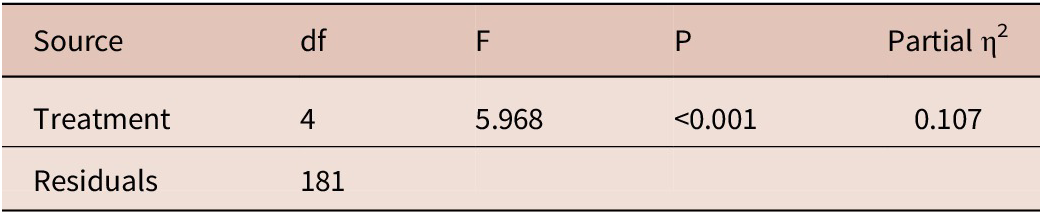
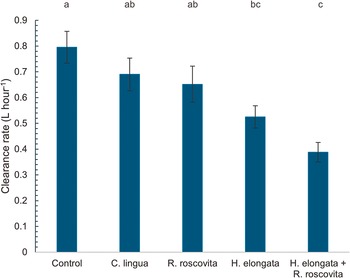
A significant relationship between experimental treatment as a fixed factor and rank-transformed mussel clearance rate as the dependent variable was established through a one-way ANOVA (Table 2). The LSD post hoc tests showed that the clearance rate was significantly lower in M. edulis treated with H. elongata and R. roscovita cercariae combined and M. edulis treated with H. elongata cercariae alone than in control mussels (a reduction of 51.2% and 34.0%, respectively). The test revealed no statistical difference between the clearance rate of M. edulis treated with H. elongata cercariae alone and M. edulis treated with H. elongata and R. roscovita cercariae combined. Although the C. lingua treatment was numerically closest to the control, the large variation within the C. lingua treatment group caused it to be statistically similar to all but the combined H. elongata and R. roscovita treatment (Figure 2).
Summary statistics of one-way ANOVA including rank-transformed clearance rate (l h−1) of Mytilus edulis as dependent variable and treatment (control, Himasthla elongata, Renicola roscovita, Himasthla elongata and Renicola roscovita combined, and Cryptocotyle lingua) as fixed factors. Partial η2 denotes effect size

Table 2. Long description
The header row lists Source, d f, F, P, and partial eta-squared. The first row, Treatment, has d f 4, F 5.968, P less than 0.001, partial eta-squared 0.107. The second row, Residuals, has d f 181, with remaining cells blank. Treatments include control, Himasthla elongata, Renicola roscovita, Himasthla elongata and Renicola roscovita combined, and Cryptocotyle lingua. Partial eta-squared denotes effect size.
Clearance rate (mean L hour−1 ± SE) of experimental blue mussels Mytilus edulis in absence of (control, n = 48) and exposed to parasitic cercariae of C.l = Cryptocotyle lingua (n = 46), R.r = Renicola roscovita (n = 25), H.e = Himasthla elongata (n = 51), and H.e + R.r = Himasthla elongata and Renicola roscovita combined (n = 16). Different letters above columns denote statistically significant differences between treatments (significance level of α = 0.05; LSD post hoc test).

Figure 2. Long description
The chart displays five vertical bars from left to right, each representing a treatment group: Control, C dot lingua, R dot roscovita, H dot elongata, and H dot elongata plus R dot roscovita. The y-axis is labeled Clearance rate in liters per hour, ranging from 0 to 0 point 9. The Control group has the highest mean clearance rate, approximately 0 point 8, with an error bar extending above and below the bar. C dot lingua and R dot roscovita groups have slightly lower means, around 0 point 7, with overlapping error bars. H dot elongata shows a further decrease, near 0 point 5, and H dot elongata plus R dot roscovita has the lowest mean, about 0 point 35. Above each bar, statistical groupings are indicated by letters: ‘a’ for Control, ‘a b’ for C dot lingua and R dot roscovita, ‘b c’ for H dot elongata, and ‘c’ for H dot elongata plus R dot roscovita, denoting significant differences between treatments. All bars include standard error bars.
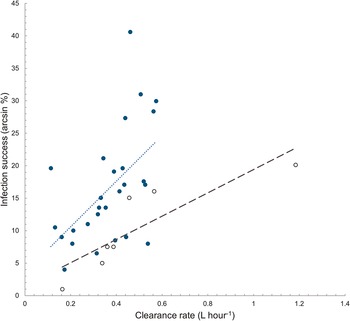
Post-experimental dissection of M. edulis showed the successful establishment of H. elongata metacercaria in all mussels exposed to the H. elongata treatment (range = 7–79, mean = 32 metacercaria per mussel, n = 27) and of R. roscovita metacercaria in all mussels exposed to the R. roscovita treatment (range = 2–40, mean = 21 metacercaria per mussel, n = 7). A positive relationship between infection success and mussel clearance rate could be established for both H. elongata and R. roscovita (Figure 3). Mussels with a high clearance rate associated with active filtration acquired more metacercariae, suggesting that both parasite species use the filtration current to infect their host.
Relationship between the infection success (arcsin %) of experimentally added cercariae of Himasthla elongata (n = 27): filled blue circles and Renicola roscovita (n = 7): open circles, as a function of the clearance rate (L hour−1) of their second intermediate host Mytilus edulis. Linear regression; H. elongata: y = 0.463x + 0.235, r227 = 0.303, p = 0.003, and R. roscovita: y = 0.310x + 0.155, r27 = 0.655, p = 0.027.

Figure 3. Long description
The x axis is labeled Clearance rate in liters per hour, ranging from 0 to 1.4. The y axis is labeled Infection success in arcsin percent, ranging from 0 to 45. Filled blue circles represent Himasthla elongata data points, and open black circles represent Renicola roscovita. The blue dotted regression line for Himasthla elongata has the equation y equals 0.463 x plus 0.235, with r squared 0.303 and p equals 0.003. The black dashed regression line for Renicola roscovita has the equation y equals 0.310 x plus 0.155, with r squared 0.655 and p equals 0.027. Both regression lines show a positive linear trend, with Himasthla elongata data clustered at lower clearance rates and higher infection success compared to Renicola roscovita.
Experiment II – Exudate effect
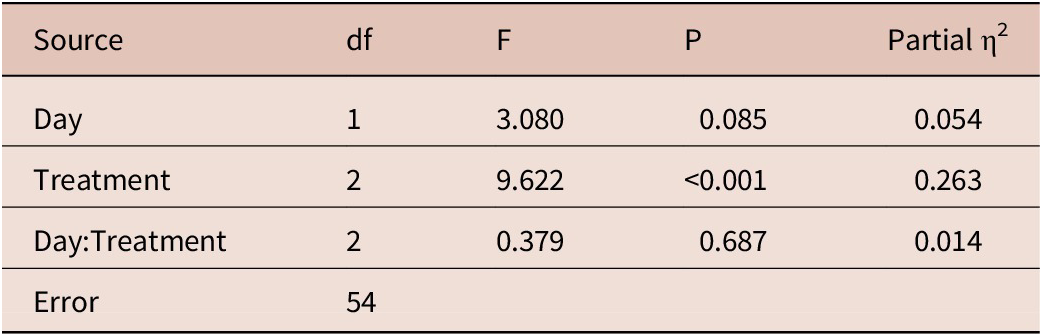
The two-way ANOVA test on the effect of experimental day and exudate treatment as fixed factors, and log-transformed clearance rate as the dependent variable, revealed that mussels’ clearance rate was significantly affected by experimental treatment, explaining 26% of the variation. No statistically significant interactions were evident between the two independent factors (Table 3). The effect of exposure to exudates of non-shedding snails alone had a stronger effect than exposure to exudates of parasites combined with infected snails, decreasing the clearance rate by 41.6% and 34.7%, respectively, compared to control mussels. However, the LSD post hoc test showed no significant difference between the two exudate treatments (Figure 4). Experimental day, on the other hand, had no significant impact (Table 3).
Summary statistics of a full-model two-way ANOVA including log-transformed clearance rate (l h−1) of Mytilus edulis as dependent variable and experimental day (1 or 2) and treatment (control, parasites + infected snail exudates, or non-shedding snail exudates) as fixed factors. Day:Treatment denotes the 2-way interaction term, whereas partial η2 denotes effect size

Table 3. Long description
Column headers from left to right are Source, d f, F, P, Partial eta-squared. The first row, Day, has d f 1, F 3.080, P 0.085, Partial eta-squared 0.054. The second row, Treatment, has d f 2, F 9.622, P less than 0.001, Partial eta-squared 0.263. The third row, Day colon Treatment, has d f 2, F 0.379, P 0.687, Partial eta-squared 0.014. The final row, Error, has d f 54 with no values for F, P, or Partial eta-squared. Day colon Treatment indicates the interaction term. Partial eta-squared values represent effect sizes for each source.
Clearance rate (mean L hour−1 ± SE) of experimental blue mussels Mytilus edulis in absence of parasites and exudates (control, n = 20), exposed to exudates of both infected Littorina littorea and parasitic Himasthla elongata cercariae (parasite + snail exudates, n = 20) or exposed to exudates of non-shedding L. littorea only (snail exudates, n = 20). Asterisks above columns denote statistically significant differences between treatments (**p < 0.01; ***p < 0.001; n.s = not significant; LSD post hoc test).

Figure 4. Long description
The X axis lists three groups from left to right: Control, Parasite plus snail exudates, and Snail exudates. The Y axis is labeled Clearance rate in liters per hour, ranging from 0 to 1. The Control group bar is the tallest, with a mean clearance rate near 0.85. Parasite plus snail exudates and Snail exudates bars are shorter, both near 0.55. Error bars are present on all bars. A double asterisk bracket connects Control and Parasite plus snail exudates, indicating p less than 0.01. A triple asterisk bracket connects Control and Snail exudates, indicating p less than 0.001. A bracket labeled n.s. connects Parasite plus snail exudates and Snail exudates, indicating not significant. The chart demonstrates that exposure to parasite plus snail exudates significantly reduces clearance rate compared to control, while snail exudates alone do not differ significantly from parasite plus snail exudates.
Discussion
This study examined the ability of blue mussels (Mytilus edulis) to discriminate between different trematode species in their environment and to detect parasites based solely on chemical cues. Our results showed numerical differences in the avoidance behaviour of blue mussels exposed to three different species of trematodes (Himasthla elongata, Renicola roscovita and Cryptocotyle lingua), however, these were not statistically significant. Additionally, we found that the avoidance behaviour of blue mussels can be triggered by chemical cues alone. Our study extends previous research on ‘ecology of fear’ in the mussel-trematode model system by providing insight into the underlying mechanisms of parasite detection.
In the field, blue mussels may encounter a variety of trematode species that differ in the level of threat they pose, making the ability to distinguish among them potentially advantageous. Although previous studies have demonstrated that mussels can detect trematodes (Mouritsen et al Reference Mouritsen, Dalsgaard, Flensburg, Madsen and Selbach2022; Selbach and Mouritsen Reference Selbach and Mouritsen2020), it remained unclear whether they can discriminate between different species and adapt their responses according to perceived risk, thereby minimizing the costs associated with defensive responses. In this study, we found numerical differences in mussels’ avoidance behaviour towards three different species of trematodes. Although not statistically significant, the differences may suggest that mussels can distinguish between trematode species to a certain degree and adjust their avoidance behaviour accordingly. Mussels exhibited the strongest responses to the treatments containing infective cercariae of H. elongate, both alone and in combination with R. roscovita, with both treatments significantly reducing mussels’ clearance rate. This is consistent with previous observations of shell closure and reductions in clearance rate in blue mussels exposed to cercariae of H. elongata (Mouritsen et al Reference Mouritsen, Dalsgaard, Flensburg, Madsen and Selbach2022; Selbach et al Reference Selbach, Marchant and Mouritsen2022; Selbach and Mouritsen Reference Selbach and Mouritsen2020). Given that H. elongata and R. roscovita infect blue mussels via similar pathways, it has been suggested that learning to defend against one species might help to avoid the other (Selbach et al Reference Selbach, Marchant and Mouritsen2022). While our results indicate that downregulation of filtration is an efficient avoidance mechanism against both species, it appears that R. roscovita alone does not trigger avoidance behaviour to the same degree as H. elongata. This might be due to the markedly smaller size of cercariae of R. roscovita compared to that of H. elongata (Werding Reference Werding1969), which likely renders them harder to detect and therefore avoid. As expected, the numerically smallest reduction in clearance rate was caused by C. lingua, suggesting that mussels either recognise this species as non-threatening or, alternatively, fail to detect it. The results showed substantial variation in clearance rate among mussels within each treatment group, which likely contributed to the lack of statistically significant differences. Having no prior experience with trematodes, the experimental mussels likely rely on an innate fear of parasites. Hence, the large variation might be caused by an unrefined ability to distinguish between cercariae, causing a mismatch between actual and perceived risk. Another possible explanation for the variation is that some mussels might downregulate filtration if avoidance comes at a low cost, e.g., if the mussel has recently fed. Additionally, the naturally occurring phenotypic variation in filtration rate among individual mussels likely contributes (Khosravi et al Reference Khosravi, Thieltges, Díaz-Morales, Bommarito and Vajedsamiei2023).
The negative effect on clearance rate is ascribed to the mechanism of siphon and shell closure, since a pathological effect can be excluded by the short experimental period of two hours. It has been suggested that this mechanism is likely induced by tactile cues (Mouritsen et al Reference Mouritsen, Dalsgaard, Flensburg, Madsen and Selbach2022); hence, the observed differences in clearance rate between treatment groups could be the result of mussels responding to species-specific mechanosensory cues from cercariae. It remained, however, to be studied if chemical cues, from or induced by trematodes, also trigger avoidance behaviour in blue mussels. Our results suggest that the significant reductions in clearance rate of mussels exposed to chemical cues were caused by exudates of common periwinkles (Littorina littorea) and that the presence of parasite exudates had no significant additive effect on the filtration activity. This finding was unexpected, since periwinkles do not pose a direct threat towards blue mussels and have even been found to have a positive effect on mussels through removal of epigrowth (Buschbaum Reference Buschbaum2000). Heterospecific avoidance behaviour, however, could be relevant when species serve as intermediate hosts of common parasites (Curtis Reference Curtis2014; Sarabian et al Reference Sarabian, Curtis and McMullan2018). In populations of L. littorea, the infection prevalence is often high, reaching 40–50% (Mouritsen Reference Mouritsen2017; Mouritsen and Halvorsen Reference Mouritsen and Halvorsen2015); hence, avoidance behaviour towards the first intermediate host potentially benefits blue mussels by reducing their risk of infection. Due to the economic implications of parasite-induced growth impairment in blue mussels, subtidal offshore or intertidal sites without L. littorea have previously been recommended for their cultivation (Buck et al Reference Buck, Thieltges, Walter, Nehls and Rosenthal2005; Thieltges Reference Thieltges2006). Our results further support this recommendation, since the presence of periwinkles appears to have a negative effect on mussels’ filtration activity and potentially growth.
By changing the level of mussels’ filter-feeding activity, the perceived functional abundance of the host is altered (Mouritsen and Poulin Reference Mouritsen and Poulin2002). Suspension feeding blue mussels facilitates the coupling of pelagic primary and benthic secondary production (Norling and Kautsky Reference Norling and Kautsky2007; Stier et al Reference Stier, Drent and Thieltges2015), and the formation of mussel beds provides food, refuges, and substrate for attachment for many species (Borthagaray and Carranza Reference Borthagaray and Carranza2007; Norling and Kautsky Reference Norling and Kautsky2007). A downregulation of filtration can be expected to slow the rate of biodeposition and nutrient regeneration while mussels possibly reach their prey size refuge later due to growth impairment (Mouritsen et al Reference Mouritsen, Dalsgaard, Flensburg, Madsen and Selbach2022). Hence, through their phenotypic alterations of the mussel host, trematodes are indirectly involved in ecosystem engineering processes (Thomas et al Reference Thomas, Poulin, de Meeüs, Guégan and Renaud1999) and may influence energy transfer in coastal ecosystems (Stier et al Reference Stier, Drent and Thieltges2015). Our results further substantiate the capacity of parasites to manipulate host behaviour, as the reductions we observed in clearance rate were comparable to those recorded in blue mussels with a feeding apparatus heavily infected by R. roscovita (Stier et al Reference Stier, Drent and Thieltges2015). This suggests that the non-consumptive effect of parasites is comparable to the pathological impact regarding filtration activity.
In the field, mussels are often infected by both H. elongata and R. roscovita. Infection by H. elongata facilitates trophic transmission by limiting byssal thread production, rendering mussels more vulnerable to predation by shore birds (Lauckner Reference Lauckner and Kinne1983). This increases the chance of transmission of the manipulative parasite H. elongata and, in turn, the co-occurring non-manipulative parasite R. roscovita (Lafferty Reference Lafferty1999; Thomas et al Reference Thomas, Renaud and Poulin1998). While R. roscovita benefits from this shared interest in parasite-induced trophic transmission, the significantly stronger response to R. roscovita in the presence of H. elongata, relative to R. roscovita alone, indicates that R. roscovita may benefit from infecting blue mussels separately from H. elongata. This could drive a change in the transmission dynamics of trematode species, e.g., when species co-occur, a temporal separation in the cercarial emergence would allow for cercariae of different species to infect the hosts independently. Due to the study design, however, it is not possible to distinguish whether the observed difference between the H. elongata treatment and the combined treatment is driven by sympatry or the larger number of cercariae in the combined treatment.
Given the temperature dependence of the different stages of trematode transmission, the effect of climate change on host-parasite interactions should not be overlooked. Global warming might, for instance, cause a shift in the season of high trematode activity (Díaz-Morales et al Reference Díaz-Morales2022), if temperatures suitable for trematode transmission occur earlier or for longer periods. A warming trend may also lead to enhanced transmission in coastal habitats, which is partly due to an expected increase in the filtration activity of mussels at rising water temperature (Thieltges and Rick Reference Thieltges and Rick2006). Our results are consistent with this theory, since an increase in filtration activity will render the mussels more vulnerable to parasites that use the filtration current as an entryway.
Overall, our findings suggest that filtration activity of blue mussels varies with the composition of trematode species in the water column and the occurrence of chemical cues emitted by first intermediate hosts. Considering the magnitude of the reductions in clearance rate demonstrated in this study and the widespread occurrence of trematodes, it is possible that non-consumptive effects of parasites have an impact on mussels beyond the season of cercarial emissions. The extent to which these non-consumptive effects may translate into ecosystem effects will, in turn, depend on the ability of mussels to compensate for the cost of avoidance behaviour. Since the concentration of parasites in the water column varies considerably in space and time, it is possible that the temporal flexibility in feeding behaviour of mussels may compensate for lost feeding opportunities induced by parasites to some extent (Ben-Horin et al Reference Ben-Horin, Allen, Small and Proestou2018). However, since community clearance rate of undisturbed bivalves in the field may vary from that of experimental mussels in a laboratory setting (Hansen et al Reference Hansen, Dolmer and Vismann2011), future research should include in situ measurements to uncover the full scope of ‘ecology of fear’ in the mussel-trematode system.
Acknowledgements
We would like to express our gratitude to Patricia Strange and Annika Greve for the opportunity to incorporate their data into the statistical analyses, and Olivia S. Matthiesen for the good cooperation in the initial phase of the project. We also thank Blå Biomasse A/S for providing the experimental blue mussels. Finally, we are grateful to the anonymous reviewer for their constructive feedback.
Author contribution
Pernille Kibak and Kim N. Mouritsen conceptualized the study and determined the scope. Pernille Kibak collected the main data, performed the data analysis, and drafted the main manuscript. Kim N. Mouritsen supervised the project.
Financial support
This research received no specific grant from any funding agency, commercial or not-for-profit sectors.
Competing interests
The authors declare there are no conflicts of interest.
Ethical standard
Not applicable.




 Open access

