INTRODUCTION
Advanced democracies today balance two conflicting pressures. Societies are increasingly diverse, as states depend on immigration to meet labor market needs in the context of low population growth. At the same time, fears of diversity—manifesting in anti-immigrant attitudes but also outright hostility and violence—proves pivotal in shaping some of the most contentious political events of the day, from the rise of populist parties across Europe, to Brexit, and to the election and policies of Donald Trump. One way for states to mitigate potential ingroup–outgroup conflict is multiculturalism—the recognition and accommodation of ethnocultural diversity in society. The underlying logic of multiculturalism is that immigrant and national minority groups are more likely to participate in and identify with society when they are able to preserve cultural and religious differences. To this end, multicultural policies craft ways for groups to access certain institutions and services without compromising these differences, e.g., supporting education of one's mother tongue or providing state funding for ethnic group organizations.
Yet multiculturalism is not without its detractors. After the Paris terrorist attacks, French President Nicolas Sarkozy decried “France is not a supermarket, it's a whole…There is no French identity, no happy identity in a multicultural society.” In the midst of Germany's refugee crisis, Chancellor Angela Merkel labeled the multicultural project a “grand delusion.” Despite these critiques, multicultural policies themselves endure (Banting and Kymlicka Reference Banting and Kymlicka2013) and remain broadly popular among the public. For example, though British multiculturalism was declared a failure by elites in 2005 (described as “sleepwalking to segregation” by creating “parallel lives”), a 2018 poll shows the majority of the public (58%) find a wide variety of backgrounds has strengthened British culture (Booth Reference Booth2018).
Looking at public opinion provides insight into this divergence between political rhetoric and policy practice, as well as a larger role of public opinion more generally. It is not only through elections that the public sets the political agenda. Public opinion influences social policy (Wilensky Reference Wilensky2002), and directly shapes immigrant integration outcomes, especially among Muslim minorities (Blinder, Ford, and Ivarsflaten Reference Blinder, Ford and Ivarsflaten2019; Wright et al. Reference Wright, Johnston, Citrin and Soroka2017; Zolberg and Woon Reference Zolberg and Woon1999). Accordingly, negative attitudes toward immigrant accommodation can erode confidence and trust in public institutions (Citrin, Levy, and Wright Reference Citrin, Levy and Wright2014; McLaren Reference McLaren2015, Reference McLaren2017). For this reason, Irene Bloemraad and Matthew Wright suggest “multiculturalism works best in places where both minorities and majority residents see it as part of a common national project.”
Our contribution unpacks this proposition by placing ingroup processes—in this case, conceptions of national belonging—at the center of analysis. Although national belonging and multiculturalism may seem similar concepts, they are analytically distinct in ways that motivate our inquiry. National identity norms define the boundary between insiders and outsiders, which can be somewhere between fully permissive and joinable (“achievable”) or fully impermeable (through a set of “ascriptive” characteristics). By contrast, multicultural policies facilitate the relationship between majority and minority members. As inclusion in one does not always correspond to inclusion in the other; deciphering where individuals set boundaries is valuable.
Recent research into determinants of public multiculturalism attitudes largely focuses on the role of outgroup assessments (Blinder, Ford, and Ivarsflaten Reference Blinder, Ford and Ivarsflaten2019; Citrin, Levy, and Wright Reference Citrin, Levy and Wright2014; Stolle et al. Reference Stolle, Harell, Soroka and Behnke2016; Wright et al. Reference Wright, Johnston, Citrin and Soroka2017), but do not fully exploring how ingroup identity can shape support, especially in a cross-national context. Within the context of the United States, there is a growing body of literature that contends it is not just this strength of ingroup affinity but the way the ingroup is constructed that affects public political attitudes and policy preferences (Jardina Reference Jardina2019; Petrow, Transue, and Vercellotti Reference Petrow, Transue and Vercellotti2018; Sides, Tesler, and Vavreck Reference Sides, Tesler and Vavreck2018). Comparative research reflects this idea: not only do different countries maintain different conceptions of the national ingroup, but this variation accounts for a variety of outcomes, including perception of cultural threat (Wright Reference Wright2011a), political trust (McLaren Reference McLaren2017), support for welfare policies (Johnston et al. Reference Johnston, Banting, Kymlicka and Soroka2010), and even support for democracy (Neundorf, Gerschewski, and Olar Reference Neundorf, Gerschewski and Olar2019).
We join these insights and literatures together to zoom out from specific national contexts or target populations to look at first principles. In this paper, we examine how self-understandings of the national ingroup (“national belonging”) shape attitudes toward outgroup incorporation through multicultural policy, looking at both costless recognition (i.e., philosophical commitments to the value of maintaining diverse cultural traditions) and potentially costly policies of accommodation (i.e., receiving government assistance to preserve traditions). We expect support for multicultural positions will be greatest among those who see their national identity as something achievable and inclusive, as opposed to ascriptive and exclusive. Further, by operationalizing national belonging as a spectrum of achievable characteristics (e.g., respecting institutions and laws, learning the host language, “feeling” like a national)—as opposed to a dichotomous ingroup/outgroup—we explore the ways in which variation of national identity within a country can shape policy attitudes. The closest contributions to our work is Kunovich's (Reference Kunovich2009) study of the consequences of national identification and Verkuyten's (Reference Verkuyten2009) study of national identification on support for recognition and rights among Dutch adolescents and adults. We depart from Kunovich in looking at multicultural policy, where his study looks at immigration attitudes, citizenship policy, and assimilation. Contra Verkeuyten's nationally specific study, we identify patterns in public opinion that generalize across time and space.
To test how conceptions of national belonging shape multicultural preferences, we provide an analysis of 35 democracies, ranging in immigrant experience and multicultural policy. Drawing on the 1995, 2003, and 2013 International Social Survey Programme (ISSP) Nationality Identity (NI) survey waves, we find mixed support for our arguments: inclusive conceptions of national belonging are related to (1) support for multicultural ideals (i.e., philosophical support) yet (2) more negative attitudes for multicultural implementation (i.e., government assistance). We support these findings with a series of alternative modeling strategies, inclusion criteria, and measurement considerations. A robustness check further reveals nationalism alone cannot explain these patterns or predict support for multiculturalism. In other words, these patterns are specific to the content, rather than the strength, of one's national identity.
The findings of this paper centrally contribute to understanding the role of national qua ingroup identity on policy support, including but not limited to multiculturalism. Public opinion often presents a multifaceted challenge to establishing social solidarity in contemporary immigrant-receiving societies. We conclude that comprehending these differences in attitudes toward ingroup membership versus outgroup accommodation is particularly urgent in light of current politics, where illiberal, populist actors readily exploit confusion over these as a tool to advocate for stronger and exclusive nationalism.
EXPLANATIONS OF MULTICULTURAL SUPPORT
Multicultural policies are defined by clusters of institutional arrangements including affirming the idea of diversity in constitutions, having minority consultative bodies, implementing multicultural lesson plans in a school curriculum, and funding bilingual education. In principle, these cultural recognition and accommodative practices can extend to immigrants, national minorities, and indigenous populations.Footnote 1 Importantly, multiculturalism is not synonymous with demographic multiethnicism, as multiculturalism positions the recognition of diversity as a normative part of national belonging (Kymlicka Reference Kymlicka1995) and proposes varying degrees of assistance and accommodation to make that possible. This range is described as the difference between “soft” and “hard” multiculturalism, in which a soft version “focuses on the symbolic recognition of different groups” (Citrin and Sears Reference Citrin and Sears2014), while the hard version “explicitly calls on the state, although not the state alone, to undertake the preservation of cultural differences” through concrete, institutionalized measures (Citrin et al. Reference Citrin, Sears, Muste and Wong2001).
Notably, some individuals may support soft (i.e., principled) versions of multiculturalism while rejecting harder (i.e., programmatic) versions. In fact, this is exactly what Citrin and Sears (Reference Citrin and Sears2014) find with regard to the U.S. case, namely that “substantial acceptance of cultural pluralism and the value of ethnic minorities' retaining ties to their original culture…[while] a majority of Americans in all the main ethnic groups also repudiate the proposals of hard multiculturalism for allocating positions based on ethnic background, not wanting to prioritize ethnicity or race in this way” (p. 142). Second, individuals can support components of multiculturalism without rejecting the idea of whole cloth. Sobolewska, Galandini and Lessard-Phillips (Reference Sobolewska, Galandini and Lessard-Phillips2017) find in their comparison of UK and Dutch integration that support is multidimensional, where multicultural support is possible as a second choice if assimilationist or cultural integration goals cannot be reached.
Who supports multiculturalism? Studies have shown that support for multiculturalism is influenced by negative outgroup attitudes (Citrin et al. Reference Citrin, Sears, Muste and Wong2001; Citrin, Levy, and Wright Reference Citrin, Levy and Wright2014; Wright et al. Reference Wright, Johnston, Citrin and Soroka2017). Perceived threat also reduces support for migrant rights (Scheepers, Gijsberts, and Coenders Reference Scheepers, Gijsberts and Coenders2002). Conversely, building on the insight that cultural diversity is good for intergroup relations and thus its individual members (Berry Reference Berry2001), motivation to control prejudice (Blinder, Ford, and Ivarsflaten Reference Blinder, Ford and Ivarsflaten2019) as well as direct contact (Brewer Reference Brewer1996; Pettigrew Reference Pettigrew1998; Pettigrew and Tropp Reference Pettigrew and Tropp2000) is shown to reduce prejudice levels and increase support for multicultural policy.
Moving to individual correlates, the young and college educated (Citrin and Sears Reference Citrin and Sears2014) as well as women (Verkuyten and Martinovic Reference Verkuyten and Martinovic2006) are more likely to favor multiculturalism. Support for policies seen as equal-opportunity promoting is also predicted by a series of political attitudes, including “egalitarianism, views of welfare claimants, satisfaction with democracy and political influence” (Ford and Kootstra Reference Ford and Kootstra2017) as well as racial equality norms (Blinder, Ford, and Ivarsflaten Reference Blinder, Ford and Ivarsflaten2013). We also observe high support for multiculturalism among immigrants and minority groups (Citrin and Sears Reference Citrin and Sears2014; Dandy and Pe-Pua Reference Dandy and Pe-Pua2010; Verkuyten Reference Verkuyten2005; Verkuyten and Brug Reference Verkuyten and Brug2004). But this literature overlooks the key role of ingroup definitions in shaping outgroup recognition and multicultural accommodation. To address this omission, we turn to the concept and identity of membership itself.
NATIONAL BELONGING AND DIVERSITY RECOGNITION
We place normative understandings of national identity at the center of our analysis of multiculturalism. Specifically, these normative understandings relate to how individuals view the boundaries and content of one's identity. National belonging is a social identity (Theiss-Morse Reference Theiss-Morse2009), a boundary made out of cultural concerns (Heizmann Reference Heizmann2016) and, in contemporary nation-states, an instrument and object of social closure, constructed through citizenship (Brubaker Reference Brubaker1992).
Historically, political science understood conceptions of national belonging as defined by civic or ethnic criteria, carrying forward a framework informed by early nationalism (e.g., Kohn Reference Kohn1944) and sociological work (e.g., Brubaker Reference Brubaker1992). Without re-litigating the civic versus ethnic identity debate, recent research has decisively moved beyond this dichotomy, recognizing gradations (Goodman Reference Goodman2015; Wright Reference Wright2011b), overlaps (Brubaker Reference Brubaker2004), and idiosyncrasies to national belonging (e.g., Bertossi and Duyvendak Reference Bertossi and Duyvendak2012). Today, scholars employ nuanced approaches to national belonging, in which the meaning of national identity qua social identity is based on content (Abdelal et al. Reference Abdelal, Herrera, Iain Johnston and McDermott2009) and within-case variation (Bonikowski and DiMaggio Reference Bonikowski and DiMaggio2016). Formal national rules of citizenship and inclusion notwithstanding (Goodman Reference Goodman2014), members of each national public possess their own images of what traits and behaviors are constitutive of national members. Some may prioritize cultural markers and language skills while others may favor immutable characteristics like place of birth. Moreover, an individual's definition of national identity may contain a combination of ascriptive and achievable traits (Wright Reference Wright2011b). These criteria for group membership can range between exclusive and inclusive poles.Footnote 2
Ingroup preferences—however defined—inform support for rules that then shape the contours of the national political community. In other words, how individuals think about their national identity and criteria for ingroup membership affects how they think about diversity and accommodation of the outgroup (e.g., Sniderman, Hagendoorn, and Prior Reference Sniderman, Hagendoorn and Prior2004). There are some important, single-case studies illuminating how civic views of nationalism increase support for multiculturalism, including in Great Britain (Heath and Tilley Reference Heath and Tilley2005) and the United States (Schildkraut Reference Schildkraut2010), particularly in terms of soft multiculturalism (Citrin and Sears Reference Citrin and Sears2014). Building on these findings, we argue that if achievable conceptions of national belonging lead to individual support for multiculturalism, then more exclusive and ascriptive (née ethnic) conceptions should lead to less support for multiculturalism.
To understand why conceptualizations of national identity affect support for multiculturalism, we draw on social identity theory (SIT). At its most basic level, SIT argues humans are social animals driven to categorize our surrounding world (Brewer and Roccas Reference Brewer and Roccas2001). To fulfill this intrinsic need, individuals represent the world as a series of prototypes containing nebulous connections of attributes individually ascribed to each specific group or category. These attributes distinguish members of the group or category to which a person belongs as unique from other groups. Furthermore, people are strongly predisposed to favor their ingroup as this has intrinsic emotional benefits (Tajfel Reference Tajfel1978). As such, these attributes help us form an identity whereby an individual possesses more positive attitudes toward those one perceives as members of their own group (i.e., identity). A large body of research reproduces findings of ingroup favoritism among those who strongly identify with a given group (Hjerm Reference Hjerm1998; Huddy and Khatib Reference Huddy and Khatib2007; Mayda Reference Mayda2006).
Connecting this insight to the role of national (ingroup) definitions of belonging, therefore, we propose that individuals who perceive belonging as achievable (i.e., inclusive, join-able) are more likely to hold positions (and support policies) that help outsiders achieve it. Furthermore, the less inclusive one's conception of national belonging, the less tolerant they will be toward policies like multiculturalism that recognize diversity.
There is significant variation when it comes to understandings of national belonging, and whether individuals emphasize, e.g., language or Christian tradition as meaningful markers of belonging. This variation matters because it informs different types of boundary negotiations between newcomers and a host, i.e., whether incorporation requires boundary crossing, blurring, or shifting (Alba Reference Alba2005; Zolberg and Woon Reference Zolberg and Woon1999). In reality, people maintain complex understandings of national identity, beyond dichotomous categories to often include a mix of ascriptive and achievable characteristics. Thus, an aggregate approach that weights relative importance of a variety of attributes can reflect this complexity. Where the public maintains rigid boundaries and identity is defined by ascriptive markers, support for multiculturalism may be lower. Conversely, when individuals see boundaries as porous and identity defined by achievable characteristics, they may look to multicultural policy as a gateway to incorporation. In other words, can expect that as we move down the continuum from mostly ascriptive criteria to mostly civic criteria, support for multiculturalism policies should increase.
We are also mindful that national belonging—while conventionally marked by citizenship status—often requires different norms or attributes than those required for naturalization. For example, an individual may prioritize English speaking as a marker for national identity, but a formal language requirement may not be part of the naturalization process (e.g., Ireland). To be sure, the overlap between status and belonging is sizable but not synonymous. Hence, we expect the driving force for attitudes toward multicultural support is the inclusive quality of one's conception of national belonging regardless of state citizenship policy or one's knowledge of citizenship policy (i.e., belonging as compliance). This requires looking at individual attitudes as opposed to policy as proxies.
To summarize, we test the following hypotheses:
H1
Individuals who hold national identity to be defined by achievable rather than ascriptive characteristics will be more likely to support soft (i.e., principled) multiculturalism.
H2
Achievably identified individuals will be more likely to support hard (i.e., programmatic) multiculturalism.
DATA, MEASUREMENT, AND METHODS
To outline trends and examine the potential relationships between national identity conceptions and multicultural support, we draw upon the 1995, 2003, and 2013 ISSP NI survey waves. The ISSP is a representative multinational survey, providing data for our study's purpose on attitudes across 35 countriesFootnote 3 and three years—resulting in a total of 31,028 participants.Footnote 4 In particular, this allows us to assess attitudes toward both philosophical and programmatic aspects of multiculturalism across time and space. This is specifically valuable as extant knowledge about civic attitudes and multicultural support are derived from Western Europe and North America. Yet globally, we observe myriad practices of recognition, including “tolerance without liberalism” (Menchik Reference Menchik2016) in countries like Indonesia. These questions of immigration and accommodation are important political issues in democracies worldwide.Footnote 5
ISSP data is not only desirable for its scope, but it also provides us with a robust indicator of the strength of one's attitude toward national belonging. This enables us to build a comparative indicator across contexts and compare our findings to those of the nationalism literature. Finally, the three snapshots are particularly illuminating for studying multicultural support. The 1990s are considered the heyday of multiculturalism and the mid-2000s the period of its precipitous decline, where multiculturalism is positioned in a post-9/11 world as a direct threat to national security. If those predictions are correct, its nadir should be evident by 2013.
We investigate two dimensions of multicultural support: preservation of traditions as compatible to national belonging as an idea (i.e., supporting the idea of preserving cultural difference) and government assistance to preserve tradition. The first (“philosophical”) item is measured by asking respondents to rank on a five-point scale whether “It is impossible for people who do not share [country's] customs and traditions to become fully [country's nationality].” This item is reverse-coded for ease of interpretation, so that positive scores indicate support for (or lack of opposition to) multiculturalism.Footnote 6 We thus interpret support for maintaining traditions as coinciding with an endorsement for the idea of multiculturalism (i.e., recognition). The second (“programmatic”) item asks respondents to rate whether “Ethnic minorities should be given government assistance to preserve their customs and traditions.”
Some reservations need to be mentioned at the outset. First, we acknowledge the aforementioned items are only partial proxies for the core concepts of interest. They are imperfect in that they do not distinguish between national minorities (e.g., African-Americans) and immigrants, nor do they probe differences within groups (e.g., Muslim versus other immigrant groups). Instead, responses indicate generic support for government assistance to preserve minority customs and traditions and evaluate minorities with different traditions and customs. We also acknowledge the potential for response bias, where individuals feel more comfortable stating a negative position toward government policy accommodating diverse traditions than they do against the principle itself. These problems are unavoidable when using cross-national survey data such as these. Yet we maintain that these two variables reflect core features of the multiculturalism debate, and that the patterns revealed in the subsequent descriptive analysis give us a unique—if imperfect—window into how conceptions of national identity shape support for multiculturalism.
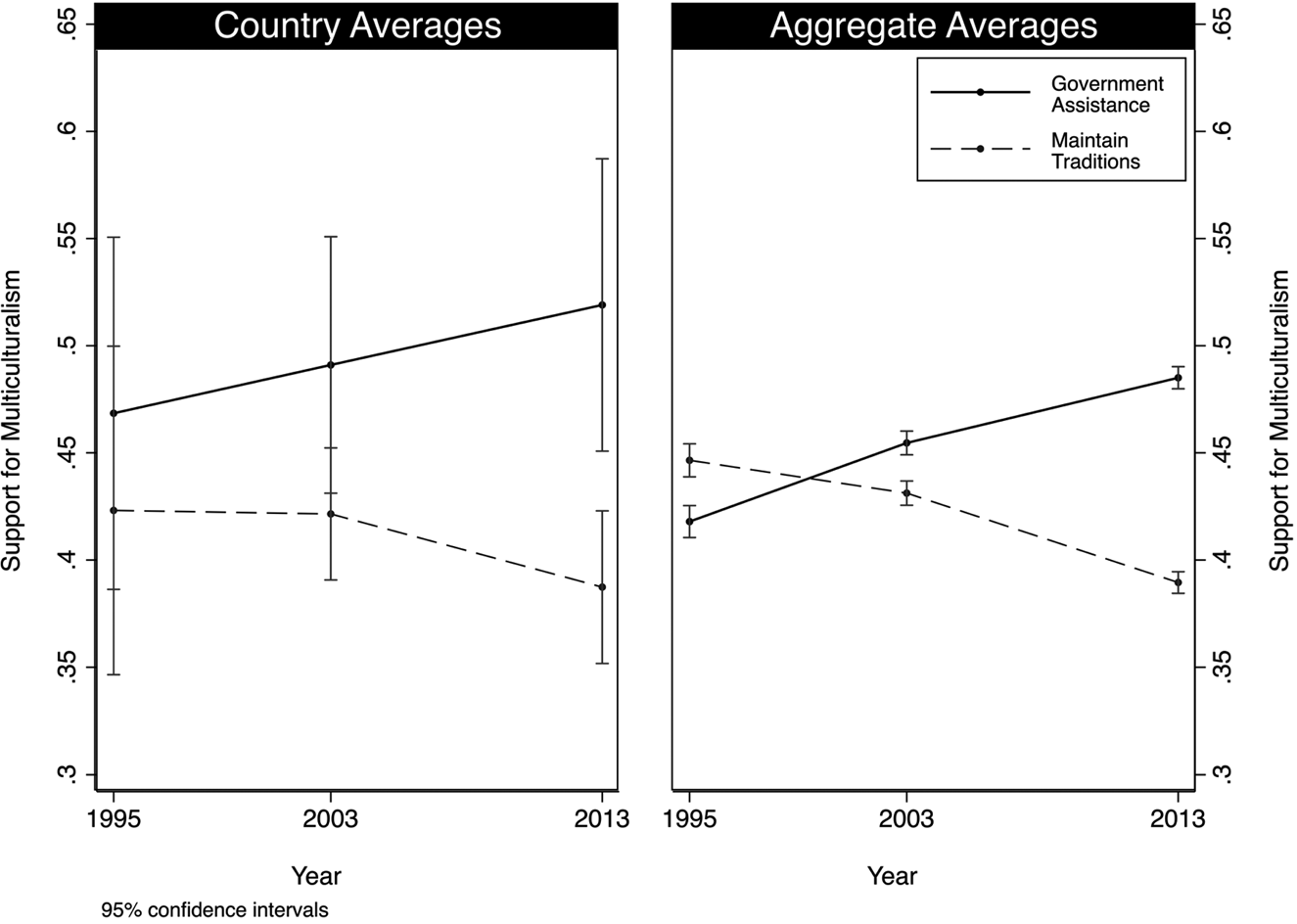
As a first examination of these multicultural attitudes, we compare averages at the aggregate and country level over time (Figure 1). Across both estimates, we observe a clear disjuncture between the principle and implementation of multiculturalism. First, in clustering average support for multiculturalism by country, we see that attitudes concerning tradition maintenance are markedly less positive than those for government assistance over time. These average country attitudes, however, are fairly similar to one another between 1995 and 2003. Yet where 2003 saw a slight increase in average support for government assistance (i.e., 4.8%), attitudes toward tradition maintenance remained relatively stable (i.e., decreasing .38%). By 2013, these trends further diverge as support for government assistance continues to grow, yielding moderate support on average. Conversely, average attitudes regarding tradition maintenance continue to skew negative. These trends persist when considering multiculturalism attitudes in aggregate collapsed across countries—support for providing government assistance (i.e., programmatic multiculturalism) grows over time while attitudes toward tradition maintenance diminish (i.e., principled multiculturalism). Thus, we see these two items as capturing distinct components of multicultural support over time.
Average support for multiculturalism across 35 countries.

To differentiate between those with strongly ascriptive/exclusive and achievable/inclusive national identities, we use Wright's scaled value-ranking to calculate a “standardized” national belonging index across multiple items for each survey wave.Footnote 7 We combine six items into a standardized index ranging from ascriptive (−1) to achievable (1) identities. All items ask respondents to evaluate their perceived importance across multiple traits of belonging, including language, religion, country of birth, citizenship status, ingroup attachment, and respect for institutions. These attributes provide insight into an individual's relative interpretation of national belonging as achievable—such as respecting the host state's institutions, learning the host language, and laws or “feeling” like a national—or expressly unattainable (i.e., born in the host state) or conceived of in “ethnic” terms (e.g., retaining citizenship, sharing the majority religion). Those individuals who are either apathetic, conflicted, or ambivalent (e.g., all components are equally important) populate the middle of the index (i.e., 0) enabling meaningful distinctions across national identities.Footnote 8
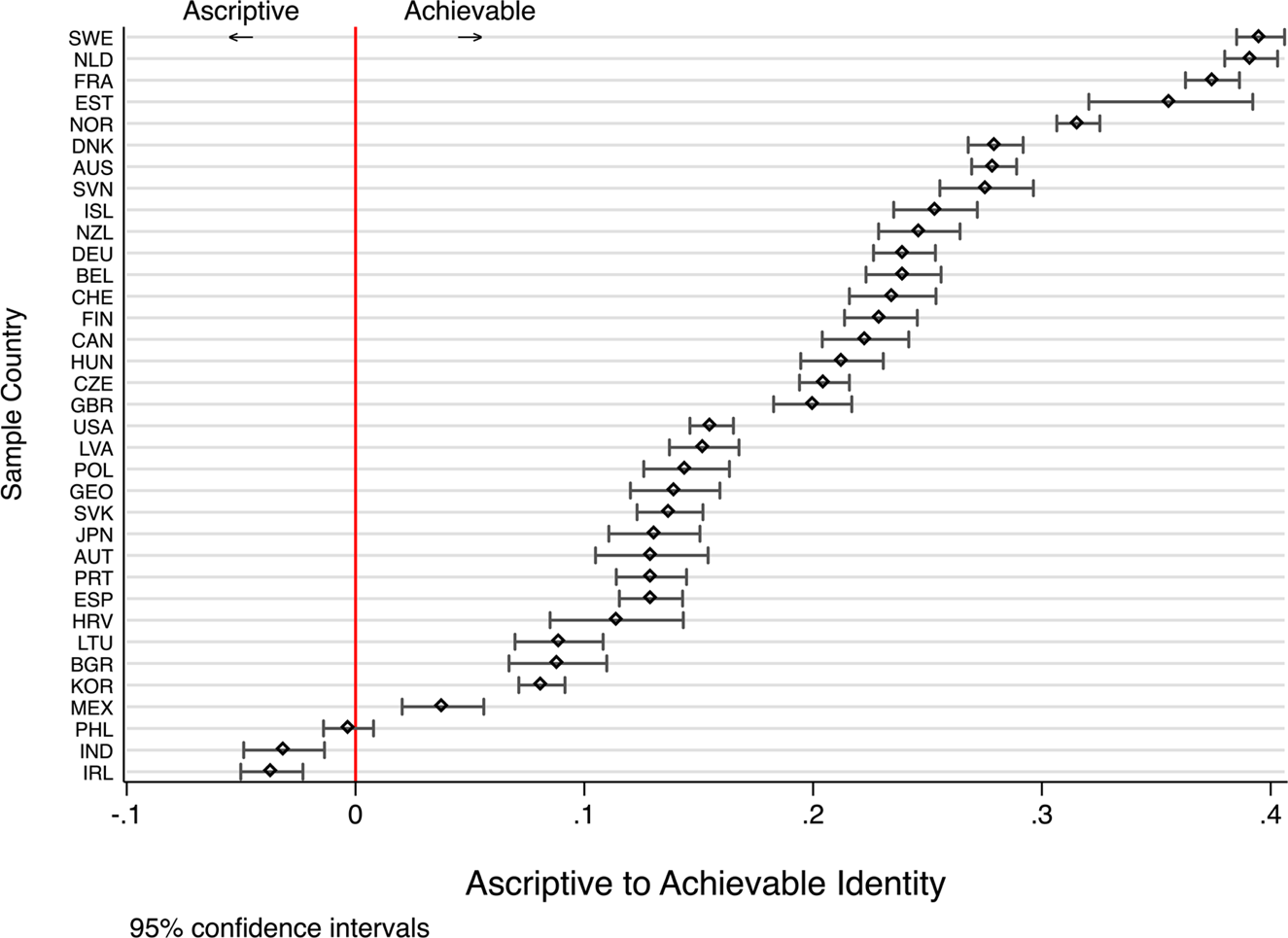
How do national identity conceptions vary across countries? Figure 2 below depicts these average attitudes ranging from ascriptive to achievable by country. As seen here, most respondents consider belonging to be achievable, with Sweden as the highest achievable conception on average and Ireland as the lowest (i.e., the most ascriptive on average).Footnote 9 It is worth pausing to reflect on this finding. On balance, most individuals globally maintain moderate, achievable conceptions of national belonging.Footnote 10 This is a poignant reminder that neither national ideal types (cf. Brubaker Reference Brubaker1992), nor dichotomized conceptualizations of identity, capture the diversity of mass understandings of belonging. As a result, our interpretation of the results is focused on the relative degree of achievability of one's identity rather than ascription.
Mean national identity by country.

Next, we include a measure of immigrant attitudes as both a meaningful attitudinal control and a hard test of our theory of the importance of conceptions of national identity. These attitudes toward immigrant outgroups, for many, are key drivers of opposition to multiculturalism. Although certainly attitudes toward immigrants correspond with one's conception of national identity, these two attitudes remain conceptually distinct from one another. Hence an individual may support immigration without also viewing one's national identity as one which accommodates migrants. Conversely, individuals may view national belonging as inclusive but be opposed to the realities of migration. This may be the case in the United States, for instance, where national identity often adopts the “nation of immigrants” mythos despite waning support for immigration itself.
Evidence further shows multicultural policies are associated with lower levels of anti-immigrant sentiment (Hooghe and de Vroome Reference Hooghe and de Vroome2015) and minority prejudice (Weldon Reference Weldon2006), while pro-immigrant publics are either “untroubled by multicultural policies and may even increase their support for government in response to their implication” (Citrin, Levy, and Wright Reference Citrin, Levy and Wright2014). Given the wealth of literature and attention dedicated to outgroup attitudes, it is possible that one's attitudes toward immigrants (i.e., outsiders), rather than the content of one's identity (i.e., attitudes about one's in-group), drives multicultural support.
In an effort to address this possibility, we include a four-item scale assessing attitudes toward immigrants.Footnote 11 Each item requires respondents to indicate their level of agreement with “opinions” of immigrants to their country. The scale—which henceforth we refer to as the xenophobia scale—represents the average attitudes toward immigrants across items (α = .705).Footnote 12 Specifically, strong agreement with xenophobic attitudes (i.e., negative attitudes toward immigrants) corresponds with a score of 1 and positive immigrant attitudes correspond to scores closer to 0.Footnote 13 Overall, respondents possessed fairly moderate attitudes toward migrants (i.e., Mean = .489), with participants across countries most often endorsing the idea that immigrants increase crime rates (Mean = .573, SD = .292) and less likely to believe immigrants deteriorate the country's nationality (Mean = .424, SD = .266).Footnote 14
In addition to xenophobia, we include a series of individual controls known to affect attitudes toward multiculturalism. These indicators available within the ISSP data include gender, age, residence, employment, marriage, immigration history, degrees of religiosity, and political ideology.Footnote 15 All variables are self-reported, and dummy-coded to reflect binaries when possible, including gender, residence location, employment, marital status, and personal immigrant status. Parental immigrant history includes three interval categories where 1 reflects both parents as native-born, .5 indicates one native-born parent, and 0 includes those with two immigrant parents. Religiosity is derived from the survey item, “How often do you attend religious services?” with response options ranging from 1 (i.e., Once a week or more) to 0 (i.e., Never).Footnote 16 Lastly, political ideology comes from an ISSP derived indicator of a respondent's last vote choice. Where elections were upcoming, this question referred to intention in the next national election. This indicator is compiled from national specific survey items to indicate where one's selected party resides on a left (i.e., 0) to right (i.e., 1) political spectrum.
Two specific limitations of our analysis warrant discussion. Importantly, we exclude ethnic identity from our analysis, which is likely to predict support for multiculturalism. This omission is due to the ISSP measurement of the ethnic identity. This measurement, unfortunately, varies by country and year and renders cross-national analysis impossible. Theoretically, this would only limit our ability to test self-interest/maximization theory (where self-identified minorities benefit from minority-oriented policies (e.g., Verkuyten and Martinovic Reference Verkuyten and Martinovic2006)). But as we are primarily interested in majority attitudes and include immigrant background indicators in the subsequent analyses, we do not foresee this limitation of the data as a concern.Footnote 17 A related limitation arises out of ISSP measurement and coding of political ideology. This sole variable categorizes all respondents who are either unable to or opted to not participate within their country's last national election, as well as those who indicated no party preference in a future election as missing cases.Footnote 18 To address this limitation of our survey measurement, we include these individuals in additional robustness checks by first including a mid-point substitution for these cases and second omitting political ideology as a control altogether. As discussed below, our findings are robust to these alternative measurement and inclusion strategies.
RESULTS
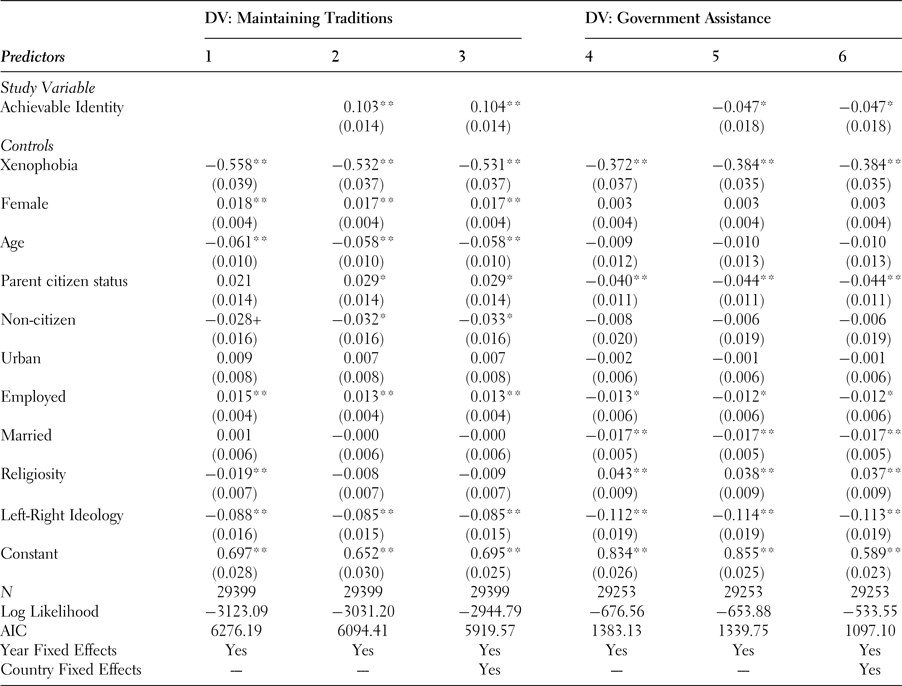
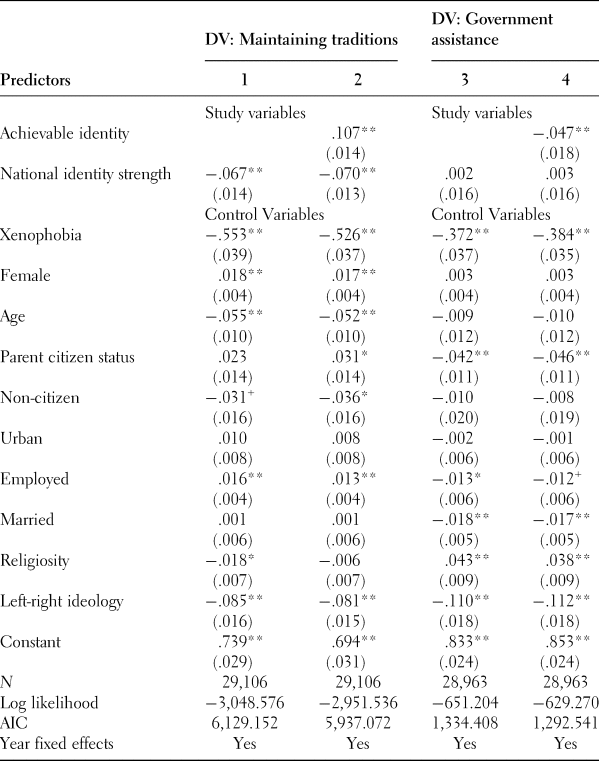
To examine the hypothesized relationships between conceptions of national identity and support for multiculturalism, we predict both multicultural measuresFootnote 19 independently in a series of multi-level models, clustering robust standard errors by country, and including country-level random intercepts and year fixed effects.Footnote 20 Table 1 presents the results predicting support for maintaining traditions in Models 1–3, and predicting support for government assistance in Models 4–6. Models 0a and 0b are null models for the hierarchical component for each multicultural proxy. Models 1 and 4 as baseline models, upon which we add our achievable identity measure (Models 2 and 4). Our final models (i.e., Models 3 and 6) include a country-level fixed effect. To summarize our findings, we find evidence that the content of one's identity is related to support for multiculturalism across these models: inclusive national identities correspond with support for the principle but not the practice of multiculturalism.
Identity predicting support for maintaining traditions and government assistance

Unstandardized β coefficients with robust standard errors clustered by country in parentheses. +p < .10, *p < .05,**p < .01.
Looking first at maintaining traditions, our baseline model reveals many of our control variables significantly predict support in the expected directions. In particular, women, the employed, and youth are significantly more likely—while the religious, those with citizen parentage, and the ideologically right leaning are less likely—to support symbolic recognition. Further as expected, support for such policies declines alongside negative attitudes toward immigrants. Model 2 presents our main results: respondents who view national identity as achievable are more likely to support minorities maintaining their customs and traditions (H1). This result holds in Model 3, which includes a fixed effect at the country level.
Turning to government assistance, our baseline model (Model 4) reveals slight variations between the control variables and support for multiculturalism—adding further support that these two items tap into two distinct elements of multiculturalism. Where women were more likely to espouse positive support toward tradition maintenance, we fail to find any significant gender difference in estimating attitudes toward government assistance. This is similar for the prior positive relationship for youth and those with immigrant parentage. Further, where marital status did not appear to significantly alter attitudes toward tradition maintenance, it does appear relevant for government assistance attitudes whereby those who identify as living within a legal, married partnership appear to espouse less support. Additionally, we find evidence that those who may benefit from governmental assistance (e.g., those with immigrant parentage, religious minorities, unemployed) are more likely to endorse government assistance for minority groups. We do, however, find some relative consistency across our multicultural baseline models revealing negative relationships between support for government assistance and xenophobia and right-leaning political ideology.
Similar to the reversal of many of our control variables of interest, Model 5 indicates achievable conceptions of identity—where previously positively related to multiculturalism—negatively predicts support for government assistance. This finding—robust to the inclusion of country fixed effects (Model 6)—indicates the relationship between national identity and multicultural support is more complex than previously hypothesized (i.e., H2). This is specifically surprising given the consistent relationship between attitudes toward outsiders (i.e., xenophobia) and multicultural support. Together, these findings suggest that individuals who view their identity as more “joinable” may support the principle of multiculturalism in theory but not necessarily in practice. This could be for several reasons. Individuals who maintain achievable views might perceive government assistance as undermining individualism and, therefore, inclusion. This would be consistent with the new policies of civic integration, which pivot away from group-based integration needs and instead emphasize individual autonomy and self-sufficiency (Goodman Reference Goodman2014). In other words, government assistance may be viewed as undermining integration, instead of facilitating it. This, of course, is relevant for multiculturalism as it applies to immigrants. Broadening to include other beneficiaries of multiculturalism (e.g., national and ethnic minorities, indigenous), a more general explanation for the puzzling relationship between achievable national identity and low support for programmatic multiculturalism in individuals may perceive government assistance as a finite resource. The strains of resource competition may facilitate the mass public to retain one set of views about belonging but apply rules of allocation more sparingly (Burgoon Reference Burgoon2014). Conversely, those who view their national identity as ascriptive may support governmental assistance but only for those with shared ascriptive traits. These insights imply the relative inclusivity of national identity may condition dimensions of governance, policy, and nationalism within democratic settings.
In the next section, we examine this robustness of these initial findings carefully to ensure the validity of the complicated relationships between identity and multicultural support.
Robustness
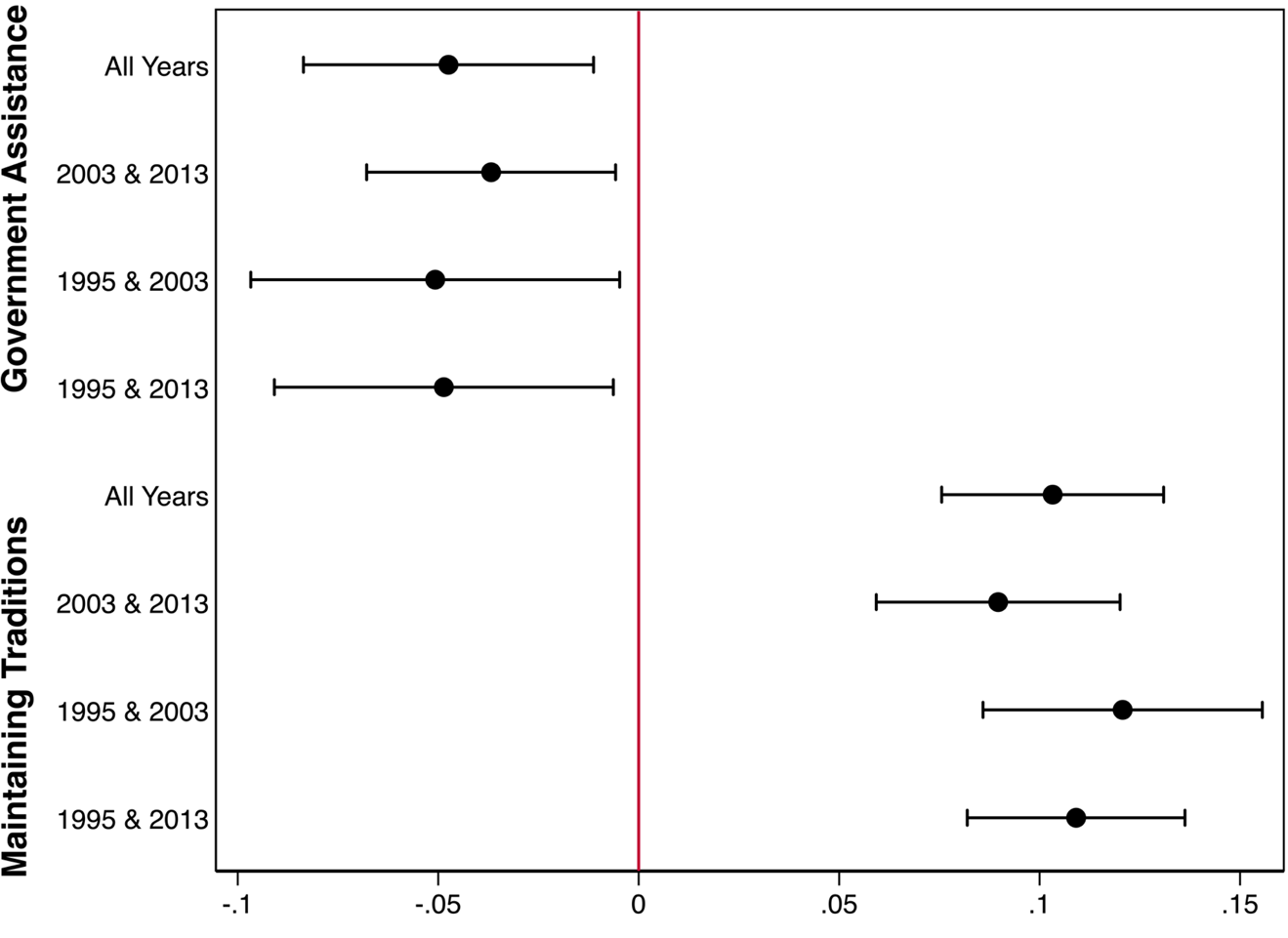
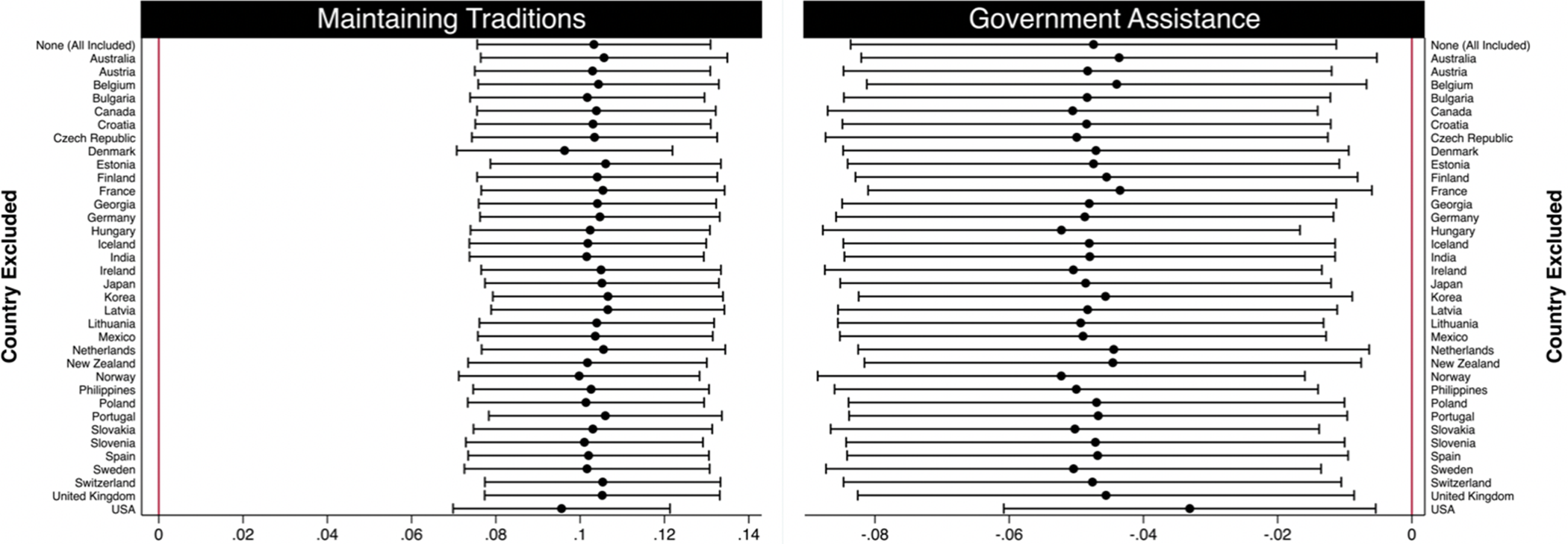
Although the initial models include a variety of individual-level controls in addition to year and country fixed effects, several other model specifications should be made to determine the validity of these results. First, it remains possible these results are driven by a specific country or year included in the analysis. As demonstrated above in Figures 1 and 2, identity and multicultural attitudes vary across both country and year surveyed. In an effort to explore this possibility, we run a series of models with the identical modeling strategy excluding each year and country. The unstandardized β coefficients with 95% confidence intervals are presented in Figures 3 and 4 below. Both figures include our initial model as a reference (i.e., Models 2 and 4). Across each model configuration, all point estimates reach significance and are within initial confidence interval bounds for both attitudes toward government assistance and traditions maintenance. This, in addition to our initial models including country fixed effects, provides relative confidence in the robustness of these patterns between achievable national identification and support for multiculturalism.
Year inclusion robustness: unstandardized β coefficients with 95% confidence intervals for each variable and year inclusion.

Country inclusion robustness: unstandardized β coefficients with 95% confidence intervals for each variable and country exclusion.

In addition to concerns of country or year heterogeneity, a second set of potential concerns relates to survey measurement. As mentioned above, the ISSP measurement of political ideology is of primary concern as it excludes nearly half of the available. As an example, these ISSP coding decisions lead to nearly 59% of all survey respondents in Switzerland to be coded as missing. It is therefore plausible these results are biased to only be relevant for the politically surveyed and identified. To test for this possibility, we conduct two additional models for each variable—first substituting the midpoint (i.e., .5 or liberal, center) for those who indicated 6 or 7 (i.e., other party, or invalid ballot, vote blank, or no party affiliation) in the initial survey. Second, we remove this variable entirely to include all individuals within our 35 country sample regardless of their exclusion due to item non-response. This analysis reveals identical relationships between conceptions of identity and multiculturalism (see Appendix D). We thereby can conclude the initial results extend beyond the confines of those who reported political identification—achievable national identity persists to be related with variant support for multiculturalism.
Related, one survey item included in the xenophobia scale (i.e., “immigrants deteriorate the country's nationality”), may have been viewed by survey participants as related itself to ideas of national identity. In an effort to address this concern, we recalculate our xenophobia scale with solely items assessing attitudes toward immigrants as related to crime, the economy, and employment. As viewed in Appendix E, there is no effect on either xenophobia or achievable identity in predicting support for multiculturalism without this survey item. Next, we move to address any concern that these relationships are complicated by the inclusion of those with a personal background of immigration (e.g., minority members). In doing so, we limit our analysis to solely those who reported both parents were born within the current boarders of the country and possessing citizenship. While again inferences pertaining solely toward majority members should be interpreted conservatively due to our inability to disentangle actual ethnic minority status, we find patterns identical to our initial models with this limited sample (see Appendix F). We thereby find these patterns cannot be explained away by excluding those who—to the best of our available knowledge—may be considered as belonging to a minority group.
As a last point of concern, it remains possible these relationships are not unique to the conception of national identity but rather national identity strength (i.e., “how close do you feel to your country?”). Similarly, achievable identity's somewhat puzzling association with different effects for tradition maintenance and government assistance may not be unique to the conception of one's national membership but also extend to one's affinity to one's identity. This is to say that it may not be the boundaries of one's identity but the conviction which one places in this membership. Thus, we conduct an additional analysis to examine whether it is truly the quality of one's identity (e.g., achievability) or simply the degree to which feels attached to one's country that is related to attitudinal support for multiculturalism.
As can be viewed in Table 2 below, national identity strength and the content of one's identity possess unique relationships with both concepts of multiculturalism. First, national identity strength is negatively related to support for minority tradition maintenance. This is similar to the literature of nationalism, indicating national identification is likely to correspond with intolerance toward immigrants and minorities. This relationship is both distinct from the relationship between achievable identity and tradition maintenance revealed in our original model and unable to explain the relationship when included as a covariate (i.e., Model 2). Even more, the relationship between identity and programmatic multiculturalism is not present with this indicator of national closeness. The main effect of the achievable nature of one's national identity further persists even with the inclusion of national closeness. This tells us the content of one's national identification is a unique and crucial component in understanding multicultural support above and beyond to one's affinity to a national identity. In other words, quality or content—rather than the strength—of one's national identity lends insight to our understanding of multicultural preferences. Thus, we risk miss relationships between national identity and policy attitudes when we consider only the strength of rather than for the content of one's national identity.
Robustness of national identity: predicting support for multiculturalism by national identity strength and achievability

Unstandardized β coefficients with robust standard errors clustered by country in parentheses. +p < .10, *p < .05, **p < .01.
Finally, it is also worth pausing to reflect on several of the observed covariate differences in multicultural attitudes. For one, recent research on the racial right requires a critical engagement within the gender differences in the support for far-right political parties especially when these parties endorse anti-immigration and nationalistic sentiment (Coffé Reference Coffé2018; Givens Reference Givens2004). While our findings support previous research revealing female-identifying respondents express higher support on average for a “soft” form of multiculturalism (Verkuyten and Martinovic Reference Verkuyten and Martinovic2006), it remains possible the observed patterns between national identities and multicultural attitudes may vary by gender identity. To account for this possibility, we run two models for each dependent variable separate for female- and male-identifying participants (see Appendix G). Again, we find similar patterns of results for both male and female respondents providing further confidence in our initial pattern of results: the content of one's identity corresponds with varietal support for multiculturalism.
DISCUSSION
How do conceptions of national identity shape support for multiculturalism? Focusing empirically on two dimensions of multiculturalism—respecting the preservation of distinct national traditions and government assistance to preserve these differences—we find that the more achievable one's self-conception of national belonging, the more likely they are to support philosophical—and reject programmatic—multiculturalism. These “achievablists” may hold a very narrow conception of who can be recognized. That is, this is not resounding evidence that tolerance for diversity prevails; rather, majority members may view national belonging as possible for only a sample of potential members. Conversely, “ascriptivists” may truly be uncomplicated by multicultural intervention as their boundaries of inclusion may be limited to those with native, ascribed characteristics. This is particularly relevant in the context of recent scholarship indicating individuals who spent their formative years in exclusionary autocracies are more supportive of democracy than those who were raised in more inclusive autocratic arrangements (Neundorf, Gerschewski, and Olar Reference Neundorf, Gerschewski and Olar2019). Extending this insight implies the boundaries of these identities can be influenced by political, economic, and institutional arrangements. Thus, policymakers keen to drum up support for multiculturalist policies might not only move to shift the perception of who belongs but also what belonging entails. Hence, short of observing a demise of inclusive policies or a “restrictive” turn in citizenship, policymakers can think of initiatives such as mandatory cultural requirements, like language and civic orientation classes, as an “innovative ways of linking multiculturalism and nationhood” (Kymlicka Reference Kymlicka, Meeer, Modood and Zapata-Barrero2016).
Future research could integrate these insights into developing more sensitive tests for studying multiculturalism.Footnote 21 Already, we see work focusing on Muslim accommodation (Blinder, Ford, and Ivarsflaten Reference Blinder, Ford and Ivarsflaten2019; Collingwood, Lajevardi, and Oskooii Reference Collingwood, Lajevardi and Oskooii2018; Wright et al. Reference Wright, Johnston, Citrin and Soroka2017). While we were unable to gauge support for Muslim accommodation specifically, we suspect distinguishing among potential beneficiaries of multiculturalism policies will vary our findings (cf., Arora Reference Arora2019). Such concerns do not undermine the validity of our general, global analysis of multiculturalism, but do suggest that future work can provide more precision on additional variables of concern (e.g., ideological and ethnic identification) as well as increasing precision on the concept and costs of multiculturalism. For example, an individual could support the idea of multiculturalism but hold more libertarian political views, which in turn could lead them to reject a role for government support.
We conclude by taking a step back to consider the consequences of public support for (or rejection of) multiculturalism. First, there is no shortage of international migration crises: refugee emergencies in the Mediterranean and the Bay of Bengal, debates about the future of DACA in the United States, the migrant caravan, Venezuela, and others. As such, ordinary, everyday citizens are increasingly forming opinions about immigrants but also about the way in which immigrants will adapt (or not) within one's society. These opinions matter at election time but also, crucially, in the local, day-to-day interactions of increasingly diverse communities. This includes immigrant integration but also social solidarity, and hence democratic quality (Banting and Kymlicka Reference Banting and Kymlicka2017).
Here is where our findings of popular support for multiculturalism are so important. Without solidarity, society may fall prey to welfare chauvinism, division, and even outgroup violence. In light of evidence that outgroup attitudes can override otherwise inclusive predispositions, policymakers need to proactively construct positive images of immigration to reap the benefits of achievable conceptions of national identity. Our findings contribute further evidence to an already-large literature on the benefits of immigrant integration, and extend it by illustrating the distinct but conditional role of national belonging in supporting integration policies. Thus, steps that ameliorate outgroup antipathy buttress multicultural support in particular and solidarity in general. Most pressing for democracy today, such efforts can serve as a bulwark against a rising populism, a force propelled by ethnonationalism and opposed to cultural recognition at any cost.
SUPPLEMENTARY MATERIAL
To view supplementary material for this article, please visit https://doi.org/10.1017/rep.2019.52.