INTRODUCTION
The success of a pathogen depends in part on its ability to invade and persist within a host. A pathogen must become sufficiently numerous inside a host's body to ensure dissemination to new hosts. Indeed, for many pathogens, greater within-host population size results in greater transmission (Ebert, 1994; Frank, 1996; Ebert and Mangin, 1997; Lipsitch and Moxon, 1997; Mackinnon and Read, 2004; Matthews et al. 2006). However, a colonizing pathogen may exert pathological effects (often equated with virulence) on its host (Costerton et al. 1987) which can, in some cases, interfere with transmission to new hosts (Lenski, 1988; Ewald, 1983, 1993; Herre, 1993; Ebert, 1994). Within-host dynamics therefore lie at the heart of two fundamental aspects of infection and disease: pathology (virulence) and transmission.
Several interacting factors may influence the proliferation of a pathogen inside its host. These include the quantity of infective particles to which a host is exposed (Dye and Hasibeder, 1986; Woolhouse et al. 1991; Williams, 2001), the reproductive rate of the pathogen (De Roode et al. 2004), and the ability of the host to mount an effective immune response (Haydon et al. 2003). Consequently, patterns of infection are not fixed; host susceptibility, infection intensity, and host response may vary depending on the individual host (Druilhe et al. 2002). Although mathematical models have provided insights into the within-host dynamics of pathogens (Anderson and May, 1991; Frank, 1996; Molineaux and Dietz, 1999), empirical work has focused on a few diseases of humans (malaria, Hetzel and Anderson, 1996; trypanosomiasis, Tyler et al. 2001). Only a small number of studies have traced pathogen populations as they develop inside non-human hosts. The experiments of Kollien and Schaub (2000, 2002, 2003), for example, show that populations of trypanosomatid pathogens (Blastocrithidia triatomae and Trypanosoma cruzii) change substantially in density and composition as they colonize the intestines of assassin bugs (Triatoma infestans). Such studies on insects and their pathogens can serve as valuable models of disease dynamics and allow empirical investigations that are difficult or impossible in other organisms (Myers and Rothman, 1995; Kollien and Schaub, 2000).
We studied infection of the bumble bee Bombus impatiens Cresson (Hymenoptera, Apidae) by the trypanosomatid pathogen Crithidia bombi Gorbunov (Kinetoplastida, Trypanosomatidae). This flagellate protozoan is a monoxenic pathogen that has been studied extensively in Europe, where it infects 10–30% of bumble bees on average (Schmid-Hempel, 1998, 2001). In Canada, C. bombi is not as prevalent, but spread from commercially-reared to wild bumble bees has recently produced pockets of infection in certain areas (Colla et al. 2006). Bees become infected with C. bombi when they ingest food (e.g. nectar) contaminated by the feces of infectious bees. Pathogen cells pass through the host's gut and undergo rapid division along the walls of the posterior intestine (Gorbunov, 1996). As early as 2 days after infection, new C. bombi cells are discharged with the host's feces and may be picked up by related bees inside the hive (Schmid-Hempel and Schmid-Hempel, 1993; Imhoof and Schmid-Hempel, 1998) or by unrelated bees at flowers (Durrer and Schmid-Hempel, 1994).
Both the number and infectivity of C. bombi in a bee may vary during the course of an infection. When isolated bees are inoculated with C. bombi, the average number of infective cells in their feces increases for about 10 days, after which fecal pathogen load saturates (Schmid-Hempel and Schmid-Hempel, 1993). The quantity of C. bombi in a bee's feces probably relates to the dynamics of infection within its gut; however, even when bees ingest a similar number of C. bombi, fecal pathogen load differs substantially between individuals (Logan et al. 2005). Within-host dynamics of C. bombi might reflect the activity of a bee's immune system during infection (Brown et al. 2003) or genotypic interactions between host and pathogen (Shykoff and Schmid-Hempel, 1991a,b). Alternatively, small differences in exposure may explain variation in fecal pathogen load. In any case, the growth of C. bombi within a bee will have an important influence on transmission if the number of infective cells shed in a bee's feces relates to the number in its gut. Schmid-Hempel et al. (1999) showed that C. bombi that replicate quickly in a bee's gut are more infective to new hosts, suggesting that within-host processes and transmission are indeed connected. Further, C. bombi infections have pathological effects on bee foraging, which might affect transmission between hosts at flowers (Gegear et al. 2005; Otterstatter et al. 2005).
In this paper, we examine the within-host dynamics of C. bombi infections in bumble bees and explore the consequences of these dynamics for between-host transmission at flowers. We used laboratory experiments to determine the relations between (i) exposure and infection, (ii) infection and immune response, and (iii) infection (gut pathogen load) and infectiousness (fecal pathogen load). We also used laboratory colonies of bumble bees to determine (iv) how infection levels of individual workers change over time in the normal social environment, and (v) how infection alters aspects of bee foraging that influence between-host transmission of pathogens at flowers.
MATERIALS AND METHODS
Quantification of pathogen load
In the following experiments, we quantified infection and infectiousness by estimating the number of C. bombi cells (all life stages) that bees harboured in their gut tracts and feces, respectively. A greater number of C. bombi in the gut indicates a more severe infection, whereas a greater number in the feces indicates a greater potential to infect new hosts. For our gut counts, we first chilled each bee at 5 °C and then dissected out its entire gut tract, excluding the honeycrop. We crushed each gut tract in a 1·5 ml microcentrifuge tube containing 100 μl of distilled water. We allowed samples to settle for 24 h at 5 °C and then transferred 10 μl of supernatant from each tube to an improved Neubauer haemacytometer for counting. We present our results in terms of the number of cells/μl counted with the haemacytometer. Our method of quantifying C. bombi differs from certain previous studies (e.g. Baer and Schmid-Hempel, 1999), which have obtained gut counts from well-mixed samples rather than samples that have settled overnight. However, we have found that counts taken on settled samples after 24 h are highly correlated with (r=0·91, P<0·001, n=15), and on average indistinguishable from (paired t-test, t=0·68, P=0·51), those taken on the same samples immediately after dissection, when the samples are well mixed. Settled samples have the added benefit of not containing excessive debris (e.g. crushed gut tissue), which hinders accurate counting. For our feces counts, we housed bees individually in clean plastic vials and collected feces droplets from the vials using graduated 5 μl microcapillary tubes. We recorded the volume of feces collected and then diluted samples to 10 μl. Diluted samples were then transferred to a haemacytometer and the number of C. bombi cells was counted. We present the data as estimates of concentration, i.e. the number of C. bombi/μl of feces. For all bees, we measured the length of the radial cell on the right forewing with an ocular micrometer (25×magnification) as an index of body size (Schiestl and Barrows, 1999).
Exposure and infection
We investigated the dose-response relation for gut infections in bumble bees by inoculating susceptible worker bees with varying doses of C. bombi. We removed 16 randomly chosen workers from 2 uninfected Bombus impatiens colonies that we reared in the lab from uninfected spring queens collected in Toronto, Canada. We starved workers for 2 h and then randomly assigned them to receive either 10 μl, 20 μl or 30 μl of sugar water containing an estimated 2125 C. bombi cells/μl. We randomly assigned a dose to each bee in order to balance across treatments any unknown differences, such as host age, condition, immunocompetence, which might have confounded our results. We monitored each bee to verify that it consumed the entire dose. In this way, bees ingested either 21250, 42500 or 63750 pathogen cells, which spans the typical range of C. bombi cells that are released in the feces of infected bees (see data for pollen-fed bees reported by Logan et al. 2005). Thus, our doses simulated the quantity of pathogen cells that a susceptible bee might be exposed to if it had ingested feces or fed on heavily contaminated nectar. After dosing, we housed bees in individual 30 ml vials in the dark at 27 °C. A bee's diet can have substantial effects on the development C. bombi, and may obscure any relation between exposure and infection; therefore, we provided bees with 30% sugar water only. Although bees in different treatments received different volumes of contaminated sugar water, it is unlikely that this influenced the buildup of infection as bees fed freely on sugar water immediately after dosing. After 7 days, we sacrificed each bee and counted the number of C. bombi in its gut. Regardless of colony, bees carried similar numbers of C. bombi in their guts (F1,15=0·05, P=0·83); therefore, we pooled data for both colonies for further analysis. The relation between infection intensity and dose size, including bee size as a covariate, was analysed using ANCOVA (Sokal and Rohlf, 1995). Infection intensity was square root transformed to satisfy the assumption of normally distributed residuals.
Infection and immune response
We determined the relation between immune-system activation and infection intensity by measuring the phenoloxidase (PO) activity of artificially infected and healthy bees. PO is the primary component of the innate immune defence in bumble bees and causes the melanization and encapsulation of foreign invaders (Schmid-Hempel, 2005). Further, the PO response is activated by C. bombi infections (Brown et al. 2003). We removed 28 newly-emerged B. impatiens workers from 3 source colonies (provided by a commercial supplier) and randomly assigned them to receive either 122000 C. bombi cells in 20 μl of sugar water (Infected group, n=18) or 20 μl plain sugar water (Control group, n=10). A dose of this size produces infection intensities similar to those in naturally infected colonies (unpublished data), but does not overwhelm the bee's immune system (Allander and Schmid-Hempel, 2000). We were unable to inoculate all bees within 1 day of emergence; Control bees and half of the Infected bees were 4 days old at the time of dosing. However, bee age at the time of dosing had no effect on phenoloxidase activity (F1,12=2·08, P=0·18). After the sugar water was ingested, all bees were placed in individual plastic vials with feeders supplying 30% sugar water ad libitum. To determine the effect of food stress on the interaction between immune function and infection intensity, half (n=9) of the Infected group were randomly chosen to receive pollen every 3 days, whereas the remaining half of the bees were deprived of pollen. All Control bees received pollen every 3 days. We allowed infections to build up for 14 days and then measured infection intensity and PO activity for all 28 bees. We assessed PO activity according to the protocol of Brown et al. (2003), with minor modifications. Each bee was chilled on ice and haemolymph was extracted with a pre-chilled, graduated 5 μl microcapillary tube from a puncture made between the 5th and 6th sternite. We recorded the volume of haemolymph (some bees contained less than 5 μl), flushed the sample into a 1·5 ml microcentrifuge tube containing 50 μl of cold phosphate buffered saline (PBS, EMD Chemicals, Inc.), and then froze the sample overnight in liquid nitrogen. The intensity of C. bombi infection in the gut of each bee was determined as described previously. The following day, we thawed the haemolymph samples in an ice bath, added cold PBS to each tube (we corrected for variation in the initial volume of haemolymph by bringing each sample to 1/22 dilution), and then centrifuged them (3800 g, 4 °C) for 15 min. We transferred 20 μl of supernatant from each sample to clean microcentrifuge tubes, vortexed the tubes, and then pipetted the samples into a microplate well containing 140 μl of distilled water and 20 μl of PBS. We added 20 μl of L-Dopa solution (3·98 mg/ml of distilled water) to each well with a multidispenser and allowed the reaction to proceed at 30 °C in a microplate reader (PowerWaveX, Bio-Tek Instruments Inc.) for 45 min. Readings were taken every 10 sec at 480 nm and analysed for PO activity (Kineticalc for Windows, Bio-Tek Instruments Inc.). We measured PO activity as the maximum slope (Vmax) of the reaction curves. Five Control bees and 8 Infected bees were excluded from the statistical analysis because their haemolymph samples were too small (<2 μl) to produce reaction curves. Compared to the bees we included in the analyses, the excluded bees did not differ in terms of age (mean±S.E. age in days: 16·4±0·5 vs. 17·1±0·5; t=−0·94, P=0·36) or infection intensity (mean ± S.E. number of C. bombi/μl of gut fluid: 5802·5±1928·3 vs. 2503·1±595·9; t=1·63, P=0·13), but were significantly smaller (mean±S.E. radial cell length in millimeters: 2·8±0·05 vs. 2·6±0·05; t=3·34, P=0·003). Thus, our conclusions regarding the effects of infection and pollen deprivation on immune function may not be applicable to small-bodied bees. We analysed Vmax as a function of infection intensity using linear regression (Sokal and Rohlf, 1995) and included bee size as a covariate.
Infection and infectiousness
We determined the relation between a bee's intensity of infection (number of pathogen cells in the gut) and its infectiousness (number of pathogen cells in the feces) by correlating the quantity of C. bombi found in the gut with the quantity of C. bombi shed in the feces. We removed 79 randomly selected worker bees from 4 new B. impatiens colonies (provided by a commercial supplier) and placed them in individual plastic vials until they defecated. We counted the number of C. bombi in the feces of each bee and then counted the number of C. bombi cells in the gut using the methods described previously. We related the number of C. bombi in the feces with the number in the gut using linear regression and included bee size as a covariate (Sokal and Rohlf, 1995). It was not feasible for us to track the ages of all individuals; consequently, differences among hosts in terms of age may have caused some unexplained variation in fecal pathogen load.
Short-term dynamics of infection
In order to track the short-term dynamics of gut infections within bees, we repeatedly screened the feces of naturally infected workers that we held in isolation and quantified the number of C. bombi cells that they shed. We removed 12 randomly chosen, naturally infected workers from 3 B. impatiens colonies (provided by a commercial supplier) and placed them in individual plastic vials containing feeders (30% sucrose). Although the exact age of the workers was unknown, based on the ages of the colonies they were between 2 and 3 weeks old. We chose bees of this age because we were interested in observing the ‘steady state’ dynamics of C. bombi infections, which seem to occur about 2 weeks after exposure (Schmid-Hempel and Schmid-Hempel, 1993). Variation in pollen consumption can cause C. bombi infections to differ substantially between bees (Logan et al. 2005), potentially masking any short-term changes in pathogen load. We therefore allowed bees free access to nectar, but deprived them of pollen for the duration of the experiment. Bees were placed in the dark at 27 °C and their vials were inspected for fresh feces every 1–2 h from 9:30am–5:30pm over 6–12 consecutive days. We provided clean vials at each inspection period for all bees. For each feces sample, we counted the number of C. bombi using the methods described previously and recorded the time of collection. Bees from different colonies showed the same patterns in their fecal pathogen loads; therefore, we pooled all 12 bees for our analyses. The average number of C. bombi in the feces of bees did not correlate with their body size (r=−0·12, P=0·78); therefore we dropped body size from all further analyses. To assess whether fecal pathogen load changed significantly over time, we averaged the fecal counts for each day for each bee and regressed these mean counts (treated as a Poisson-distributed dependent variable) against time (‘Day’, treated as a continuous explanatory variable). We included ‘Bee’ as both an explanatory variable, to account for differences in fecal pathogen load among individuals, and as the repeated subject to account for the non-independence of repeated observations on the same individuals (repeated-measures Poisson regression, SAS Institute, 1999).
Long-term dynamics of infection
We examined the long-term progress of gut infections within bees living in an intact colony by quantifying infection intensity at differing ages for individuals that either acquired infection naturally from their nestmates or artificially from an inoculum. This lab-reared B. impatiens colony contained approximately 50 workers and harboured a C. bombi infection upon arrival from a commercial supplier. Preliminary screening revealed that approximately one third of nest-working bees and one quarter of foraging bees were infected prior to the experiment. We connected the colony to a flight cage containing sugar water feeders (30% sucrose) and allowed workers to forage at will. We regularly added pollen to the hive to allow normal colony growth and development. In all respects, the colony appeared healthy and grew rapidly, producing 6–7 new workers per day on average. We removed newly emerged workers daily from the colony and marked each with a uniquely numbered tag for identification. After tagging, each bee was randomly assigned to 1 of 3 treatments: (i) ‘Artificially Infected’ – each worker was fed a dose of C. bombi in a drop of 50% sucrose solution before being returned to the colony, (ii) ‘Naturally Infected’ – each worker was fed an uncontaminated drop of 50% sucrose solution and returned to the colony to acquire infection naturally from its nestmates, (iii) ‘Control’ each worker was fed an uncontaminated drop of 50% sucrose solution and then placed near the hive in an individual plastic vial with a sugar-water feeder (30% sucrose). Very little is known about the spread of C. bombi within colonies or how many infective cells a worker might naturally ingest. We therefore chose a wide range of doses: Artificially Infected workers were randomly assigned to receive 1·9×104, 6·5×104, 2·0×105 or 3·1×105C. bombi. The C. bombi doses were prepared from the guts of naturally infected workers from the same colony. We allowed infections to incubate for at least 7 days and then, over the course of 15 days, retrieved from the colony 27 of our marked bees (14 Artificially Infected and 13 Naturally Infected foragers), ranging in age from 9 to 23 days, and counted the number of C. bombi in their guts (treatment and infection status of each bee was unknown at the time of screening). During this same period, we also quantified the intensity of infection in our Control bees, which ranged in age from 7 to 12 days. We did not extend the incubation period of Control bees beyond 12 days because we only wished to determine if they acquired an infection or not (even the lightest infections by C. bombi can be detected after 10 days). We analysed the relationship between infection intensity and host age among within-colony bees using multiple regression (Sokal and Rohlf, 1995). We square-root transformed intensity to normalize the residuals and included bee size as an explanatory variable in our model.
Infection and morbidity effects on foraging proficiency
Although C. bombi infections typically increase host mortality rate only if the host is food-deprived (Brown et al. 2000), infected bees forage less efficiently than healthy bees (Otterstatter et al. 2005). In order to quantify the relationship between morbidity and infection, and assess the implications for pathogen transmission at flowers (Durrer and Schmid-Hempel, 1994), we allowed naturally-infected bees to visit artificial flowers in the laboratory and then correlated their foraging performance with their intensity of C. bombi infection. The design of our experiment was based on the methods of Gegear and Thomson (2004) and Otterstatter et al. (2005). All bees were from 2 infected colonies provided by a commercial supplier. For the duration of the experiment, we connected each colony to a screened enclosure (approx. 1·5 m3) and supplemented them with pollen and nectar. We gave each forager a unique mark with coloured correction fluid. The screened enclosure contained an array of artificial flowers constructed from 1·5 ml microcentrifuge tubes with circular acetate ‘corollas’ around the entrance of each tube. These flowers were designed to simulate natural open-tube flowers (Laverty, 1994) and required bees to land on the corolla and crawl to the bottom of the tube to obtain nectar. The array consisted of 10 flowers, each stocked with approximately 1 ml of 30% sucrose solution. We trained bees to visit flowers by allowing them several hours of free foraging on the array. Immediately prior to testing a bee, we allowed it to forage for 3 trips on the training array to ensure that it had recent experience with our artificial flowers. We then presented each bee (n=13) with an array of 60 flowers arranged in 10 rows of 6 with each row separated by 6 cm and alternating rows offset by 6 cm. Flowers were spaced by 12 cm within rows and contained 3 μl of 30% sucrose each. We videotaped several complete foraging bouts (over 100 flower visits) for each bee. This design allowed us to determine the number of flowers that bees visited per unit time. We also conducted a second experiment in order to more closely observe and measure the amount of time that foraging bees spent in physical contact with flowers. We gave each of 19 bees the same training as above but then videotaped them for 50 visits on 3 flowers arranged in an equilateral triangle (measuring 25 cm on a side). Each flower contained 3 μl of 30% sucrose. In both experiments, we refilled flowers between visits using a micro-dispenser, and gave each test bee new flowers. We quantified the intensity of C. bombi in the gut of each bee following the protocol described previously. We reviewed the video recordings at 1/3rd playback speed and, for the first experiment, counted the number of flowers that bees visited during the last 5 min of foraging. We counted a visit each time a bee crawled into the flower and obtained nectar. For both experiments, we measured the time that bees spent in contact with flowers using a stopwatch, starting from the point at which all 6 legs touched the flower during landing and ending when all 6 legs left the flower during take-off. We compared the foraging rate and flower contact time (both log transformed to satisfy the assumption of normality) of bees with their intensity of C. bombi infection using linear regression (Sokal and Rohlf, 1995). In both analyses, we included body size as an explanatory variable. Although we did not know the exact age of each forager, previous work has shown that age does not alter the behaviour of bees as they forage on artificial flowers (Otterstatter et al. 2005).
Spreading potential
Between-colony transmission of C. bombi occurs when susceptible bees forage on flowers that were previously visited by infected bees (Durrer and Schmid-Hempel, 1994). Given that foraging bumble bees defecate on flowers in the lab (personal observation), and previous work has found C. bombi in the nectar of wild flowers (Durrer and Schmid-Hempel, 1994), it seems likely that infected bees contaminate floral nectar with their feces while visiting flowers. In this situation, an infected bee's potential for spreading C. bombi is likely a function of its infectiousness (i.e. the quantity of C. bombi shed in its feces) and the number of flowers it visits per unit time. We therefore estimated the potential of a bee to spread C. bombi at flowers using the following: Spreading Potential, SP=IF, where I is a bee's infectiousness in terms of C. bombi cells expelled/μl of feces (determined from our regression of fecal pathogen load on intestinal pathogen load) and F is a bee's foraging rate in flowers visited per min (determined from our regression of foraging rate on intestinal pathogen load). We calculated SP for a series of gut infection levels between 1000 and 50000 cells/μl (the full range of infection intensities observed in this study) and, in this way, estimated the maximum number of C. bombi cells (/μl of feces) that a bee could leave at flowers in 1 min of foraging as a function of the intensity of infection in its gut. This model assumes that the quantity of C. bombi a bee leaves at flowers is related to the quantity in its feces. Based on our observations of foraging bees, we assume that the amount of time an infected bee spends on a flower does not alter the volume of feces (and therefore the quantity of C. bombi) it expels at that flower. Although SP may be influenced by the frequency with which bees defecate while foraging, our observations do not suggest that heavily infected bees defecate more often than lightly infected bees.
RESULTS
Exposure and infection
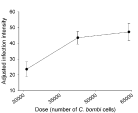
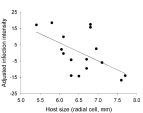
Among bees that were isolated and exposed to a single dose of C. bombi, the intensity of infection that developed in their gut tract increased as a saturating function of dose size (Fig. 1). Comparing low and moderate doses, infection intensity roughly doubled as dose doubled (F1,13=10·58, P=0·007). However, further increases in dose did not significantly increase infection intensity (F1,13=0·29, P=0·60). Independent of dose, infection intensity declined with host body size (F1,13=8·09, P=0·015; Fig. 2). Dose and bee size explained approximately 50% and 20%, respectively, of the variation in infection intensity. Uncontrolled differences among hosts in age, condition, and immunocompetence, may have contributed to the remaining, unexplained, variation in intensity.

Fig. 1. Dose-response relationship for isolated Bombus impatiens workers inoculated with varying quantities of the pathogen Crithidia bombi. Values (mean±S.E. concentration of pathogen cells in the hosts' guts, 7 days post-inoculation) have been adjusted for the significant effect of host size on infection intensity.

Fig. 2. Relation between infection intensity (concentration of pathogen cells in a bee's gut) and host size among isolated Bombus impatiens workers inoculated with varying doses of the pathogen Crithidia bombi. Values have been adjusted for the significant effect of dose on infection intensity (see Fig. 1).
Infection and immune response
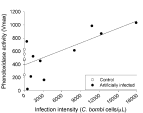
The activity of a bee's innate immune system, as determined by phenoloxidase levels, increased with the intensity of C. bombi infection in its gut (F1,13=13·33, P=0·003; Fig. 3). Further, phenoloxidase activity increased significantly with bee body size (F1,12=6·72, P=0·03). The immune activity of infected bees was highly variable, however, and did not differ on average from that of control (uninfected) bees (F1,12=0·38, P=0·55). The variation we observed in infection levels among our artificially infected bees (who all received the same initial dose) resulted primarily from whether or not we deprived them of pollen (mean±S.D. C. bombi cells/μl gut fluid, pollen deprived: 837±471; pollen fed: 9113±5825; t=−3·46, D.F.=5·1, P=0·024). However, after accounting for the effect of infection intensity on immune response, pollen deprivation had no effect on immune response (F1,12=0·23, P=0·64). The absence of an independent effect of pollen on immune response was not due to multi-colinearity between infection intensity and pollen status (variance inflation factor=1·13).

Fig. 3. Relation between innate immune activity (maximum rate of phenoloxidase reaction, Vmax) and infection intensity (concentration of pathogen cells in a bee's gut) for Bombus impatiens workers that were uninfected or artificially infected with Crithidia bombi.
Infection and infectiousness
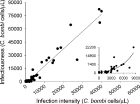
Among the 4 colonies that we used to examine the relation between infection and infectiousness, 27% (n=33), 75% (n=28), 89% (n=9), and 100% (n=9) of the workers we randomly chose had C. bombi present in either their gut or their feces. Differences between colonies in terms of age and genotype likely explain the variation we observed in C. bombi prevalence. Fecal screening for C. bombi was a highly sensitive (proportion of infected individuals correctly identified=0·93) and specific (proportion of non-infected individuals correctly identified=0·94) test for an active infection as confirmed by dissection of the gut. For light infections (0–9000 cells/μl), infectiousness (as indicated by the number of C. bombi shed in the feces of bees) increased exponentially with infection intensity (number of C. bombi in the guts of bees); however, overall, infectiousness was best described as a linear function of infection (F1,41=268·93, P<0·001; Fig. 4). Although fecal pathogen load differed significantly among colonies (F3,41=7·36, P<0·001), the relation between infection and infectiousness did not vary between colonies (non-significant infection×colony interaction, F3,37=2·0, P=0·12). The body size of a bee had no effect on the quantity of C. bombi in its gut (F1,40=0·31, P=0·58) or feces (F1,40=0·15, P=0·70). The intensity of infection in a bee's gut and colony of origin together explained 94% of the variation in fecal pathogen load, suggesting that uncontrolled factors such as bee age have little direct influence on infectiousness.

Fig. 4. Relation between infection intensity (concentration of pathogen cells in a bee's gut) and infectiousness (concentration of pathogen cells shed in a bee's feces) for Bombus impatiens workers infected with Crithidia bombi. Inset figure shows a magnified view of the points near the origin (i.e. for infection intensities between 0 and 9000 pathogen cells/μl).
Short-term dynamics of infection
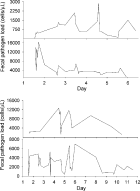
Over the course of hours, the infectiousness (quantity of C. bombi cells in the feces) of isolated bees was highly variable. Within a 24-h period, infectiousness often differed by a factor of 4 in each of the 12 bees (Fig. 5). Over the course of several (6–12) days, infectiousness declined significantly (G=6·62, P=0·01) in all bees (non-significant Bee×Day interaction, G=11·43, P=0·41), after controlling for differences in infectiousness among bees.

Fig. 5. The dynamics of infectiousness (concentration of pathogen cells shed in a bee's feces) for Bombus impatiens workers infected by Crithidia bombi. Four representative infections are shown; the remaining 8 bees in this experiment showed similar patterns of infectiousness.
Long-term dynamics of infection
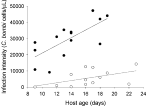
When bees were allowed to interact naturally with their nestmates inside a colony, their intensity of infection by C. bombi increased linearly with time (F1,24=15·53, P<0·001; Fig. 6), regardless of whether they were naturally infected by their nestmates or artificially inoculated with C. bombi (homogeneity of slopes, F1,24=0·25, P=0·62). Overall, bees that were artificially inoculated harboured more severe infections than bees that were naturally infected (F1,24=97·89, P<0·001). The size of the inoculum did not significantly affect a bee's intensity of infection (F1,11=2·03, P=0·18); however, each dose was represented by only a few bees (4 received 6·5×104C. bombi, whereas the remaining doses, 6·5×104, 2·0×105, 3·1×105C. bombi each had 3 bees). After controlling for the effect of bee age and treatment, there was no evidence that infection intensity varied with body size (F1,21=0·02, P=0·88). Workers that were naturally infected by their nestmates did not have measurable infections until 12 days of age, whereas artificially inoculated bees had substantial infections by 9 days of age. Three of the 14 bees that we removed from the colony and isolated at emergence (Control treatment) developed very light infections (≈250 cells/μl) by 10 days of age; the rest remained uninfected (all Control bees were sacrificed by 12 days of age). Several years of study have shown that newly emerged workers never harbour C. bombi, even if they originate from an infected colony (personal observation). Therefore, the Control bees that became infected must have been exposed to C. bombi (by feeding on contaminated pollen or nectar, or by interacting with infected nestmates) in the brief period between when they emerged as adults and when we removed them from the hive.

Fig. 6. Relation between infection intensity (concentration of pathogen cells in a host's gut) by Crithidia bombi and host age (days since eclosion) among colony-dwelling Bombus impatiens foragers that were either artificially inoculated (closed circles) or allowed to acquire infection naturally from their nestmates (open circles).
Infection and morbidity
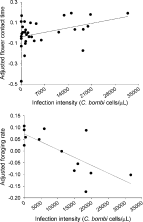
The average time a foraging bee spent in contact with flowers increased with the intensity of infection in its gut (F1,28=6·52, P=0·016; Fig. 7A). Overall, infected bees spent 14% longer on flowers than uninfected bees (5·02±0·17 sec. vs. 4·41±0·45 sec.). The number of flowers a bee visited/min declined with the intensity of C. bombi in its gut (F1,11=11·05, P=0·008; Fig. 7B). On average, infected bees visited 10% fewer flowers/min than uninfected bees (8·2±0·2 vs. 9·1±0·3).

Fig. 7. Relation between (A) average time spent in contact with flowers, or (B) number of flowers visited/min, and intensity of infection (concentration of pathogen cells in a bee's gut) for Bombus impatiens foragers infected by Crithidia bombi. Values have been adjusted for the significant effect of colony (A) and bee size (A and B).
Spreading potential
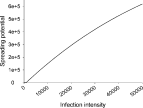
Based on the results described above, we constructed a simple model of the potential a bee has for dispersing C. bombi at flowers, and hence between colonies. In this model, spreading potential increased with the intensity of infection in a bee's gut (Fig. 8). Bees carrying the most severe infections should contribute the most to horizontal transmission at flowers: although they visit fewer flowers/min than bees with light infections, they shed extremely large quantities of C. bombi in their feces.

Fig. 8. The predicted relation between a bee's potential to spread Crithidia bombi cells at flowers and the intensity of infection in its gut. Spreading potential is estimated as the number of C. bombi cells/μl of feces that a bee could deposit/min on flowers while foraging (see Materials and Methods section).
DISCUSSION
Standard approaches to understanding pathogen spread focus on dynamics occurring above the level of the individual host (Kermack and McKendrick, 1927; Anderson and May, 1991). These methods compartmentalize the host population into disease states (e.g. susceptible, infected, and recovered) and model the epidemiology of the pathogen by tracking the number of hosts in each state over time. One drawback is that this approach overlooks variation in infectiousness by treating all infected individuals equally. At the level of the individual, infectiousness may vary with host age (Grenfell and Anderson, 1985), immunocompetence, or aspects of host behaviour such as the number of contacts they make with susceptible individuals (hence the concept of high-contact ‘core groups’ in sexually transmitted infections (May and Anderson, 1987; Lloyd-Smith et al. 2004)). Within a host, the dynamics of a pathogen (such as those generated through interaction with the host's immune system (Haydon et al. 2003)) may cause infectiousness to vary over the course of a single infection. Consequently, for real diseases, some hosts may be only slightly infectious and generate no new cases, while others are highly infectious and produce many new cases (Woolhouse et al. 1997; Lloyd-Smith et al. 2005; Matthews et al. 2006). In this study, we found that within-host dynamics generate substantial variation in infectiousness among bumble bees harbouring the intestinal pathogen C. bombi. Our results show that such variation in the severity of infection alters bee foraging and is expected to influence the probability of between-host transmission of C. bombi at flowers.
After invading a host, many microparasites multiply rapidly and eventually reach a state characterized by fluctuations in parasitaemia (Hetzel and Anderson, 1996; Hoshen et al. 2000; Vizoso and Ebert, 2004). Crithidia bombi infections in bumble bees conform to this pattern. Previous work has shown that infectiousness (number of C. bombi cells shed with a bee's feces) increases rapidly in the first few days after exposure and then, although there is considerable variation (Logan et al. 2005), appears to level out (Schmid-Hempel and Schmid-Hempel, 1993). We show here that infectiousness correlates closely with the intensity of infection (number of pathogen cells) in a bee's gut and that the rate of initial increase of C. bombi is dependent upon both dose and the body size of the host. In particular, the quantity of infective cells shed with a bee's feces at the beginning of an infection (7 days post-inoculation) increased as a saturating function of dose size, which is consistent with studies on enteric pathogens in vertebrates (Williams, 2001). The primary explanation for this phenomenon, at least in vertebrates, has been that the amount of intestinal epithelium initially available for colonization decreases with greater pathogen uptake (‘crowding effect’, Williams, 1998). This sort of density-dependent competition is also thought to occur for pathogens of invertebrates (Ebert et al. 1998). In bumble bees, C. bombi attach to the intestinal epithelium and produce dense mats of developing pathogen cells (personal observation), which suggests that crowding could be an important constraint on a host's pathogen load.
Even after parasitaemia reaches its peak and begins to decline, infectiousness (quantity of C. bombi in a bee's feces) oscillates widely over the course of hours. In theory, such oscillations may arise from the destruction of pathogen cells by the host's immune system (Antia et al. 1996). Although we observed a clear increase in immune activity (phenoloxidase response) among infected bees, we could not determine whether this response suppressed the proliferation of C. bombi and contributed to variation in infectiousness. However, destruction of C. bombi by the bumble bee immune system is supported by the fact that larger bees had greater phenoloxidase activity and less intense infections than smaller bees. Further, previous work (Nigam et al. 1997) has shown that inhibiting the phenoloxidase response results in a rapid increase in the number of Trypanosoma brucei, a gut pathogen closely related to C. bombi, in the intestines of tsetse flies (Glossina palpalis palpalis). We measured only the most general component of a bee's immune system; it is possible that other defence molecules produced specifically in the host's gut (e.g. Lehane et al. 1997; Nakajima et al. 2005) are responding to C. bombi. Such molecules might be analogous to agents of mucosal immunity in humans (Teitelbaum and Walker, 2005) and be more abundant in larger bees, which have larger gut tracts. In other systems, the destruction of pathogens by the host's immune system can produce dynamics similar to those of predators and their prey (Hellriegel, 1992; Wodarz, 2006). Similar dynamics might occur if pathogens compete for limited host resources (e.g. competition among Plasmodium parasites for host erythrocytes (Gravenor et al. 1995)); however, it is unlikely that the epithelial cells which C. bombi compete for are able to replenish fast enough (i.e. over a few hours) to explain the short-term dynamics we observed in pathogen load. A simpler explanation is that short-term variation in infectiousness results from bees occasionally (rather than continuously) ingesting nectar, and thereby sporadically washing C. bombi from their intestines.
Within a bee's natural social environment (i.e. the colony), C. bombi infections became progressively more intense as bees aged. One possible explanation is that the natural decline of a bumble bee's immune system with age (Doums et al. 2002) allows C. bombi to proliferate in older bees. It is not yet known, however, whether a bee's immune system can control a C. bombi infection in the first place (Brown et al. 2003). Alternatively, the continuous replication of C. bombi in a bee's gut, or repeated exposure to infective cells inside a colony, may drive the observed increase with age, rather than by effects of ageing per se. When an infected bumble bee is removed from its colony, C. bombi levels in its gut will gradually decline (as we observed in the ‘short-term dynamics’ experiment) and the infection will eventually be cleared (Imhoof Schmid-Hempel, 1998). This suggests that the replication rate of C. bombi in the guts of our bees is not sufficient to cause the increase in intensity we observed. Repeated exposure to C. bombi inside a colony, which occurs through contaminated food or by interacting with infected nestmates (Otterstatter and Thomson, unpublished data), is therefore the most likely cause of the elevated infections we observed in older bees. Repeated exposure to C. bombi inside the hive may also explain why infection levels among our artificially infected bees did not vary with dose. Another contributing factor may be dietary pollen, which was freely available to our colony bees but not our isolated bees, and which is known to facilitate the replication of C. bombi in bumble bees (Logan et al. 2005). Although we cannot determine how many C. bombi naturally infected bees ingested inside their colony, they developed substantially less intense infections than our artificially infected bees, which received a minimum dose of 19000 cells. Yet, in other experiments (Otterstatter, unpublished data), naturally infected bees eventually developed C. bombi infections that were as intense as those of the artificially infected bees in this study, suggesting that a wide range of infection intensities might naturally occur.
Pathogen dynamics are typically studied from either a ‘between-host’ perspective (Anderson and May, 1991), which focuses on the number of secondary cases an infected individual generates in a susceptible population, or a ‘within-host’ perspective, which seeks to understand factors affecting pathogen populations inside infected individuals (Antia et al. 1996; Ganusov et al. 2002; Klinkenberg and Heesterbeek, 2005). Combining these perspectives has shown that the relation between within-host processes and between-host transmission can be complex (Taylor et al. 1997; Roberts and Heesterbeek, 1998). Nevertheless, for many pathogens, between-host transmission and the pathological effects that arise from within-host dynamics (virulence) are closely linked. Higher densities of the myxoma virus, for example, may lead to increased formation of lesions in rabbit hosts and an associated increase in transmission to susceptible rabbits (Fenner and Ratcliffe, 1965). For the pathogen C. bombi, host-to-host transmission can occur either between related bees within a colony (Schmid-Hempel, 2001) or between unrelated bees at flowers (Durrer and Schmid-Hempel, 1994). The latter process probably explains the rapid spread of C. bombi between bumble bee colonies in the field (Imhoof and Schmid-Hempel, 1999) and the spillover of pathogens from commercial to wild bumble bees (Colla et al. 2006). Intriguingly, the dynamics of C. bombi within and between hosts may be linked if host pathology alters the flower-visiting behaviour of bees. Recent studies have shown that infection by C. bombi diminishes the motor learning (Gegear et al. 2005), associative learning (Gegear et al. 2006), and efficiency (Otterstatter et al. 2005) of foraging bees. Here, we show that two particular aspects of bee foraging, the number of flowers visited/min and the amount of time spent in contact with each flower, vary with infection intensity. Our data suggest that C. bombi may experience a trade-off between within-host replication and between host transmission at flowers: bees that harbour more intense infections, and are therefore more infectious, visit fewer flowers per unit time than lightly infected bees. That fact that infected bees are less efficient at foraging does not necessarily support the conclusion that C. bombi is manipulating the behaviour of its hosts to increase transmission, however. A more straightforward explanation is that infection imposes physiological costs, perhaps by reducing a host's energy stores (Siva-Jothy and Plaistow, 1999), or by diverting host resources away from foraging to immune activity (Sheldon and Verhulst, 1996), which diminish a bee's ability to make economic foraging decisions. Nevertheless, if we assume that the quantity of C. bombi an infected bee leaves at flowers relates to the quantity it sheds with its feces, bees with the heaviest infections should have the greatest potential to spread C. bombi at flowers. Based on our data from colony-dwelling bees (‘Long-term dynamics’ experiment), these ‘super-spreaders’ will most likely be the oldest foragers as these individuals carry the most C. bombi. Young bees probably contribute little to between-colony spread of C. bombi because they seldom leave the nest to forage (O'Donnell et al. 2000) and, as we observed, harbour minimal infections, if any. In temperate regions, bumble bees may not begin foraging until they are 10 days old (O'Donnell et al. 2000), and only about 10% survive beyond 3 weeks of age (Rodd et al. 1980). Therefore, a small proportion of bees may be responsible for the majority of the between-colony spread of C. bombi. Because the quantity of C. bombi shed with a bee's feces can vary greatly over the course of hours, even lightly infected bees might occasionally leave a large number of infective cells at flowers. Heterogeneity in infectiousness is common to many diseases; in such cases, persistence of a pathogen may depend on the fate of a few heavily infected hosts (Woolhouse et al. 1997; Lloyd-Smith et al. 2005; Matthews et al. 2006). In the bumble bee-Crithidia system, further work is needed to determine the exact relation between a bee's intensity of infection and the quantity of pathogen cells it deposits on a flower, as well as the probability of infection for subsequent visitors to that flower.
The authors would like to thank Troy Day, Peggy Millson, and two anonymous reviewers for helpful comments on the manuscript. This project was supported by funding from the Natural Sciences and Engineering Research Council (NSERC).