INTRODUCTION
Nouns and verbs in child language
Nouns and verbs have long been treated as two basic parts of speech (Lyons, Reference Lyons1968; Robins, Reference Robins1979); these two categories are universal across languages (Robins, Reference Robins1952) and constitute basic units of grammar. Nouns include words that normally denote individuated concrete objects, whereas verbs typically refer to imageable actions and reference to events situated in time (O'Grady, Reference O'Grady1997), although these semantic associations are not restrictive (Hopper & Thompson, Reference Hopper and Thompson1984). Notably, nouns and verbs appear to follow different courses in ontogeny.
In a benchmark study of early lexical development in six different languages, Gentner (Reference Gentner and Kuczaj1982) proposed a universal disposition in children to acquire nouns before verbs (the so-called ‘noun bias’). In each language, concrete nouns constituted the largest and earliest class of words learned by children, with verb acquisition beginning later. Since then, noun dominance has been replicated in many different languages (see Bornstein et al., Reference Bornstein, Cote, Maital, Painter, Sung-Yun, Pascual and Vyt2004), including English (Bates et al., Reference Bates, Marchman, Thal, Fenson, Dale, Reznick and Hartung1994; Fenson, Dale, Reznick, Bates, Thal & Pethick, Reference Fenson, Dale, Reznick, Bates, Thal and Pethick1994), French (Bassano, Reference Bassano2000), Dutch (De Houwer & Gillis, Reference De Houwer, Gillis, Gillis and De Houwer1998), Greek (Papailiou & Rescorla, Reference Papailiou and Rescorla2011), Hebrew (Maital, Dromi, Sagi & Bornstein, Reference Maital, Dromi, Sagi and Bornstein2000), Spanish (Jackson-Maldonado, Thal, Marchman, Bates & Gutierrez-Clellen, Reference Jackson-Maldonado, Thal, Marchman, Bates and Gutierrez-Clellen1993), and Chintang (Stoll et al., Reference Stoll, Bickel, Lieven, Paudyal, Banjade, Bhatta and Ray2012). By contrast, Korean, Mandarin-Chinese, and Japanese have provided both internally and externally conflicting results, some investigators reporting that children produce equal proportions of nouns and verbs (Choi & Gopnik, Reference Choi and Gopnik1995; Ogura, Dale, Yamashita, Murase & Mahieu, Reference Ogura, Dale, Yamashita, Murase and Mahieu2006) and others that children produce more verbs than nouns (Tardif, Gelman & Xu, Reference Tardif, Gelman and Xu1999; Tardif, Shatz & Naigles, Reference Tardif, Shatz and Naigles1997; see also Brown, Reference Brown1998, for evidence of early verb dominance in the Mayan language Tzeltal). These discrepancies, at least in part, have been explained by differences in the structural characteristics of languages, the methods employed to evaluate children's vocabulary (checklists versus spontaneous production), and the types of context in which language samples are derived (toy play versus book reading; Ogura et al., Reference Ogura, Dale, Yamashita, Murase and Mahieu2006; Salerni, Assanelli, D'Odorico & Rossi, Reference Salerni, Assanelli, D'Odorico and Rossi2007; Tardif et al., Reference Tardif, Gelman and Xu1999).
There are many possible reasons for why noun learning may generally outstrip verb learning (see Bornstein et al., Reference Bornstein, Cote, Maital, Painter, Sung-Yun, Pascual and Vyt2004; Gentner & Boroditsky, Reference Gentner, Boroditsky, Bowerman and Levinson2001, Reference Gentner, Boroditsky and Gathercole2009; Waxman, Fu, Arunachalam, Leddon, Geraghty & Song, Reference Waxman, Fu, Arunachalam, Leddon, Geraghty and Song2013, for reviews). In the present study, we focused on two prominent input factors that are thought to influence children's acquisition of nouns and verbs: frequency and positional salience. frequency is the sheer number of words or word classes in adult speech. Several authors have proposed that input frequency may partially account for the relative proportions of nouns and verbs produced by young children in different languages (Bornstein et al., Reference Bornstein, Cote, Maital, Painter, Sung-Yun, Pascual and Vyt2004; Choi & Gopnik, Reference Choi and Gopnik1995; Ogura et al., Reference Ogura, Dale, Yamashita, Murase and Mahieu2006; Tardif et al., Reference Tardif, Shatz and Naigles1997). The general finding is that the more frequently words occur in the input, the earlier children learn them (Goodman, Dale & Li, Reference Goodman, Dale and Li2008; Huttenlocher, Haight, Bryk, Seltzer & Lyons, Reference Huttenlocher, Haight, Bryk, Seltzer and Lyons1991). positional salience asserts that language acquisition is influenced by the order of words in input utterances. Specifically, Gentner (Reference Gentner and Kuczaj1982) proposed that words that appear at the beginning or at the end of utterances are learned more quickly than those appearing in medial positions, perhaps because they are segmented and recognized more easily (Golinkoff & Alioto, Reference Golinkoff and Alioto1995). Primacy and recency effects might also operate (Cornell & Bergstrom, Reference Cornell and Bergstrom1983).
Several studies have profitably focused on these two properties. With respect to frequency of input, some researchers have correlated the total numbers of words produced by caregivers with their children's vocabulary sizes (Vibbert & Bornstein, Reference Vibbert and Bornstein1989). For instance, Huttenlocher et al. (Reference Huttenlocher, Haight, Bryk, Seltzer and Lyons1991) correlated parental input and vocabulary growth in twenty-two children from 1;2 to 2;2. The overall quantity of maternal speech accounted for a substantial portion of variance in the trajectory of children's vocabulary growth. Likewise, Hoff and Naigles (Reference Hoff and Naigles2002) reported that two properties of maternal language (the frequency of word types and tokens and the maximum length of utterances) correlated with the number of word types produced by children between 1;6 and 2;5. Although these studies rely on correlations (leaving open the question of direction of effects) and focus on vocabulary rather than parts of speech, jointly they suggest that the overall frequency of caregivers' speech may be an important source of individual differences in children's early language development.
Even more specific research has focused on relations between maternal and child language within specific lexical classes. In these studies, the frequency of semantic categories and the characteristics of the syntactic environment in which words appear in maternal speech are correlated with the frequency of the same categories in children's vocabulary. For example, Naigles and Hoff-Ginsberg (Reference Naigles and Hoff-Ginsberg1998) examined which characteristics of parental input accounted for the order of acquisition of a set of twenty-five verbs in children from 1;4 to 2;1. They found that age of acquisition was predicted by the total number of verb tokens in maternal language and by the variety of syntactic environments (i.e. the type of postverbal elements) in which those verbs appeared (see also the MOSAIC model developed by Freudenthal, Pine & Gobet, Reference Freudenthal, Pine and Gobet2009, which explains the acquisition of root infinitives in terms of the salience and frequency patterns observed in the input in English, French, Dutch, and Spanish). Blackwell (Reference Blackwell2005) later showed that, for two children (Adam and Sarah) between 1;11 and 4;2, the age of acquisition of English adjectives was predicted by the cumulative number of adjective tokens in maternal speech and by the diversity of syntactic environments in which those adjectives appeared. Goodman et al. (Reference Goodman, Dale and Li2008) also evaluated the correspondence between age of acquisition (estimated from the normative database of the MacArthur Communicative Development Inventories) and input frequency (estimated by counting every use of CDI items in twenty-eight CHILDES corpora) for 562 words divided in six categories – common nouns, people words, verbs, adjectives, closed-class, and others. For the whole set of words, the correlation was (surprisingly) negative, because closed-class words, verbs, and adjectives occurred frequently in input but tended to be learned last, whereas nouns were produced less often by mothers but tended to be learned earlier. However, when the authors analyzed individual lexical categories, the expected positive relation emerged (except for closed-class words), with higher input frequency being related to earlier acquisition. For common nouns, the effect of frequency varied with the level of vocabulary development; the correlation with age of acquisition was reliable only for words learned after the first 100. As for comprehension, the only significant correlation occurred between maternal frequency and the age of acquisition of common nouns. Taken together, these findings suggest that input frequency influences vocabulary acquisition, but that their relation may be moderated by several factors, including lexical category, language modality (production or comprehension), and developmental stage.
Relatively fewer studies have investigated the role of input positional salience in child language acquisition. An early indication came from Golinkoff and Alioto (Reference Golinkoff and Alioto1995), who examined English-speaking adults' ability to learn individual words embedded in sentences in an unfamiliar, non-Western language (Chinese). Study participants who heard infant-directed speech with target words in utterance-final position demonstrated significant learning in a later recognition task, whereas there was no learning for target words located in utterance-medial position. Similarly, Shady and Gerken (Reference Shady and Gerken1999) found that children at 2;0 were better able to identify target words when placed in final as opposed to medial positions. More convincing experimental evidence indicates that children are particularly sensitive to words occurring in both the initial and final positions of maternal utterances. Seidl and Johnson (Reference Seidl and Johnson2006) had infants from 0;7 to 0;8 listen to speech passages containing novel words placed in initial, medial, or final positions. Using the Headturn Preference Procedure (Jusczyk & Aslin, Reference Jusczyk and Aslin1995), the authors found that children recognized words that appeared in initial and final positions significantly better than in medial position. Amidst these findings, Naigles and Hoff-Ginsberg (Reference Naigles and Hoff-Ginsberg1998) reported that the frequency of verbs in the final position of maternal utterances was a negative predictor of children's subsequent verb flexibility of use (but not of their total frequency of verb use), and they hypothesized that most input verbs in utterance-final position occurred in null syntactic frames, which contain little syntactic information for children to construct their own frames. This result stands in contrast with that of Tardif et al. (Reference Tardif, Shatz and Naigles1997), who reported that children tend to produce more verbs than nouns in languages, like Mandarin, in which utterance-final position is often filled with verbs. However, because Tardif et al. (Reference Tardif, Shatz and Naigles1997) did not report correlational indices, it is difficult to draw direct comparisons between the two studies.
Properties of the Italian language
According to Waxman and colleagues (Reference Waxman, Fu, Arunachalam, Leddon, Geraghty and Song2013), cross-linguistic evidence comparing the acquisition of nouns and verbs in infant word learners is essential to make progress in understanding in this field. Within this research area, the Italian language provides a compelling test case of the correspondence between characteristics of maternal speech and the composition of children's early vocabulary. This is because contrasting predictions can be drawn from an analysis of the structural features of Italian.
With respect to frequency, Italian-speaking mothers (like Chinese and Korean mothers) produce more verb than noun types and tokens (Camaioni & Longobardi, Reference Camaioni and Longobardi2001; Tardif et al., Reference Tardif, Shatz and Naigles1997). If input frequency has a strong effect on the composition of early vocabulary, then Italian children should acquire more verbs than nouns. With respect to positional salience, Italian is a PRO-DROP language that allows null subjects in SVO sentences; as a consequence, verbs appear at the beginning of utterances more frequently than nouns in the infant-directed speech of Italian mothers, and nouns occur in final position more often than verbs (Camaioni & Longobardi, Reference Camaioni and Longobardi2001). If initial position is salient for young children (Seidl & Johnson, Reference Seidl and Johnson2006), Italian children should learn more verbs than nouns. If final position is more salient for young children (Golinkoff & Alioto, Reference Golinkoff and Alioto1995), Italian children should learn more nouns than verbs. Thus, input frequency and initial position salience arguments about Italian favor children learning verbs before nouns, but final position salience in Italian favors children learning nouns before verbs.
To date, the corpus of findings on Italian child data is not completely straightforward. Noun dominance has been reported in several studies that examined early vocabulary development in Italian using parent-report questionnaires (Caselli et al., Reference Caselli, Bates, Casadio, Fenson, Fenson, Sanderl and Weir1995; D'Odorico, Carubbi, Salerni & Calvo, Reference D'Odorico, Carubbi, Salerni and Calvo2001; D'Odorico & Fasolo, Reference D'Odorico and Fasolo2007; Salerni et al., Reference Salerni, Assanelli, D'Odorico and Rossi2007). The overall pattern of noun advantage was also confirmed in a study aimed at investigating individual differences in the style of language acquisition, although the mean proportion of nouns produced by Italian children was lower than the corresponding values obtained in English-language studies (Camaioni & Longobardi, Reference Camaioni and Longobardi1995). By contrast, Tardif et al. (Reference Tardif, Shatz and Naigles1997) reported that six Italian children between 1;7 and 1;10 produced equal numbers of nouns and verbs in naturalistic speech samples, a finding that might reflect a small sample size. To date, no study has reported a clear pattern of verb dominance in Italian.
Aims of the present study
The main aim of the present investigation was to examine the influence of two specific aspects of maternal speech (frequency and positional salience of nouns and verbs) on the growth of early vocabulary in Italian children. To this end, the spontaneous language of a sample of twenty-six mother–child dyads was assessed longitudinally at 1;4 and at 1;8 months, a time that is generally acknowledged as developmentally crucial for the analysis of individual differences in language acquisition (Bates et al., Reference Bates, Marchman, Thal, Fenson, Dale, Reznick and Hartung1994; Tamis-LeMonda, Bornstein, Baumwell & Damast, Reference Tamis-LeMonda, Bornstein, Baumwell and Damast1996). In undertaking this study, we hoped that our results would clarify and extend the mixed findings obtained by previous studies in three ways. First, although characteristics of the speech of Italian children (Camaioni & Longobardi, Reference Camaioni and Longobardi1995; D'Odorico & Fasolo, Reference D'Odorico and Fasolo2007; Tardif et al., Reference Tardif, Shatz and Naigles1997) and mothers (Camaioni & Longobardi, Reference Camaioni and Longobardi2001; Tardif et al., Reference Tardif, Shatz and Naigles1997) have been analyzed previously, no study has investigated the predictive validity of maternal input to child language. Second, the examination of languages other than English is likely to offer relevant information about what input factors affect lexical learning in the same way in different languages, and what factors are unique to vocabulary development in Italian-speaking children (Ogura et al., Reference Ogura, Dale, Yamashita, Murase and Mahieu2006). More specifically, the structural properties of Italian provide a valuable contrast for cross-linguistic hypotheses, with particular reference to the relative roles of input frequency and positional salience. As the child-directed speech of Italian mothers contains more verbs than nouns, but they compete for favorable positional salience, the present study should help to ascertain which of the two variables plays a greater role in child language acquisition between 1;4 and 1;8. Third, few studies in the literature have examined the role of maternal input for the production of both nouns and verbs in the same sample, or have used observational data obtained from the same participants and coded for the same variables as we do here. One relevant exception is Goodman et al. (Reference Goodman, Dale and Li2008); however, their frequency estimates were computed from CHILDES samples of maternal speech directed to children between 0;7 and 7;5, and normative data on age of acquisition were obtained from the MacArthur Communicative Development Inventories (CDI). Furthermore, those authors took into account only the total frequency of the CDI lexical categories in maternal speech, but did not examine the role of positional salience.
Our statistical analyses were therefore performed with two purposes in mind. First, we analyzed the properties of mothers' and children's speech by means of repeated-measures analyses of variance (ANOVA). For maternal language, we expected to replicate earlier findings (Camaioni & Longobardi, Reference Camaioni and Longobardi2001; Tardif et al., Reference Tardif, Shatz and Naigles1997) showing that: (i) verb types are produced more frequently than noun types in the speech of Italian mothers; (ii) verb types appear more often than nouns in utterance-initial position; and (iii) noun types occur more frequently than verbs in utterance-final position. For children's language, we expected to confirm the typical advantage of noun over verb types (Caselli et al., Reference Caselli, Bates, Casadio, Fenson, Fenson, Sanderl and Weir1995; D'Odorico et al., Reference D'Odorico, Carubbi, Salerni and Calvo2001; D'Odorico & Fasolo, Reference D'Odorico and Fasolo2007; Salerni et al., Reference Salerni, Assanelli, D'Odorico and Rossi2007).
Second, we investigated concurrent and predictive associations between maternal and child language at 1;4 and 1;8. Predictive relations were examined with respect to different measures of children's language: the percentages of noun and verb types produced at 1;8 and the rates of noun and verb growth from 1;4 to 1;8 (Bates et al., Reference Bates, Marchman, Thal, Fenson, Dale, Reznick and Hartung1994; D'Odorico & Fasolo, Reference D'Odorico and Fasolo2007). Here, the primary aim was to ascertain whether the input frequency of noun and verb types at 1;4 and their occurrence in initial, medial, and final positions of maternal utterances at 1;4 predicted children's acquisition of these lexical categories at 1;8. To this end, correlational analyses were followed by hierarchical regressions that estimated the unique and additive contributions of these two variables to the development of child language.
Summarizing, the present study aimed to address the following questions:
(i) Does the speech of Italian mothers contain more verb than noun types when children are about 1;4 and 1;8?
(ii) Are nouns preferentially located in the final position of maternal utterances? Do verbs occur more frequently than nouns in the initial and medial positions of maternal utterances?
(iii) Is there a noun advantage in the spontaneous speech of Italian children at the ages of 1;4 and 1;8?
(iv) Do input frequency and positional salience of nouns and verbs at 1;4 predict children's production and growth rates of these two lexical categories at 1;8?
METHOD
Participants
Twenty-six Italian monolingual full-term children (12 boys and 14 girls) and their mothers participated in the study. All families were Italian native speakers, of middle socioeconomic status, and lived in Rome. Sixteen children were first-born, and the remaining ten children were later-born. Families were recruited from daycare nurseries or pediatricians' offices and had no health or linguistic risk conditions.
Procedure
Mother–child dyads were video-recorded at home when children were approximately 1;4 (M = 1;4·8; range = 1;3·05–1;4·29) and 1;8 (M = 1;8·7; range = 1;7·10–1;8·18). Each session lasted about 45 min and included three contexts of 15 min each occurring in the same order: play with familiar toys, play with new toys (provided by the researcher), and a mealtime.
Measures of maternal and child language
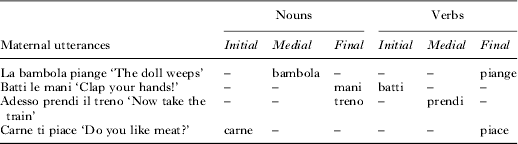
Measures of maternal and child language were derived from transcripts of the recorded sessions. For each mother, the first 100 consecutive utterances of at least two words produced in the first context (play with familiar toys) were identified. This context was chosen to be comparable to typical contexts observed in naturalistic studies of language development (Bornstein, Haynes, Painter & Genevro, Reference Bornstein, Haynes, Painter and Genevro2000; Camaioni & Longobardi, Reference Camaioni and Longobardi2001). Only multiword utterances of at least two words were included to obtain consistent data about the positions of nouns and verbs in the context of input sentences. The use of a fixed set of 100 utterances ensured that parental measures were not affected by variation in the overall talkativeness of the mothers (Hoff-Ginsberg, Reference Hoff-Ginsberg1992; Naigles & Hoff-Ginsberg, Reference Naigles and Hoff-Ginsberg1998; we return to this issue in the ‘Results’ section). Maternal language was coded for: (i) the total frequency of noun and verb types, and (ii) the percentages of utterances containing noun and verb types in the initial, medial, and final positions (Tardif et al., Reference Tardif, Shatz and Naigles1997). Nouns and verb types were defined by the form of their stems – e.g. the verbs metti ‘you put’ and mettiamo ‘we put’ were counted as two different verb types; likewise, the nouns macchina ‘car’ and macchine ‘cars’ were counted as two different noun types (see Camaioni & Longobardi, Reference Camaioni and Longobardi2001). We analyzed only types (and not tokens) because the primary debate in the literature has focused on the predominance of noun versus verb types in children's early vocabulary (Tardif et al., Reference Tardif, Gelman and Xu1999) and because the conclusions reached using tokens were substantially unchanged. For the initial and final positions, percentages were computed on the entire set of selected utterances, including two-word utterances; in contrast, for the medial position only utterances with at least three words were taken into account – because this position cannot be defined for two-word utterances. Within the selected sets of 100 utterances, 66·2% of utterances contained three or more words at 1;4 and 65·1% at 1;8. Nouns and verbs were counted as in initial and final position if they were not preceded or followed, respectively, by any other word, including articles and function words. For instance, in the utterance La bambola piange ‘The doll weeps’, the noun bambola was assigned to the medial position, and the verb piange was assigned to the final position. Thus, nouns and verbs were considered to occur in medial position if they were placed anywhere between the first and the last word of a given three or more word utterance. At least two other studies in the literature adopted the same procedure, one of which also analyzed Italian input (Au, Dapretto & Song, Reference Au, Dapretto and Song1994; Tardif et al., Reference Tardif, Shatz and Naigles1997). Some examples of the coding procedure are illustrated in Table 1.
Examples of the coding procedure

A caveat is in order, however, regarding the coding of nouns in initial position. As discussed by Au et al. (Reference Au, Dapretto and Song1994), most nouns are preceded by an unstressed article in Italian (as in English and other languages), so that nouns in the second position might be as salient as those in the first position for young children. In the present study, 7·9% of maternal utterances began with the combination ‘article + noun’ at 1;4 and 7·5% at 1;8. Therefore, we replicated all analyses using this alternative coding, but the conclusions were unchanged. Only the results obtained with the original coding procedure are reported.
Considering that the amount of speech produced by children at 1;4 and 1;8 is highly variable and that in this age range children are still learning to combine words (Bates & Dick, Reference Bates and Dick2002), measures of child language were computed on all utterances (i.e. both single- and multiword utterances). Children's productive speech was then coded for the frequency of noun and verb types. Following Tardif (Reference Tardif1996), a strict criterion was employed for the analyses of both maternal and child language, counting only common nouns and main verbs, and excluding proper nouns, auxiliaries, and copulas. Coding was carried out by two independent trained coders who were Italian native speakers and had backgrounds in linguistics. Any cases of disagreement (<1%) were discussed with the first author to reach perfect agreement on all measures.
RESULTS
Maternal speech
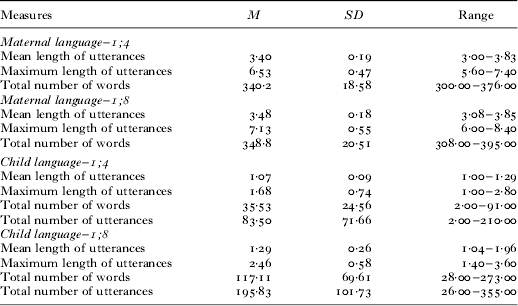
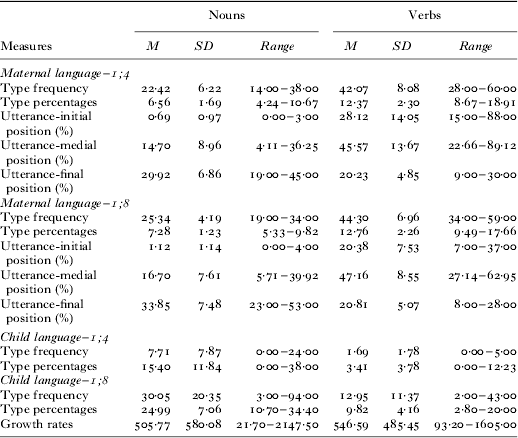
Tables 2 and 3 present descriptive statistics for the noun and verb measures of maternal language at 1;4 and 1;8. We first analyzed type frequencies to ascertain whether maternal speech was characterized by verb predominance and whether this pattern remained stable between the ages of 1;4 and 1;8 (Camaioni & Longobardi, Reference Camaioni and Longobardi2001; Tardif et al., Reference Tardif, Shatz and Naigles1997). Then, we analyzed the percentages of utterances containing noun or verb types in the initial, medial, and final positions. Here, the primary purpose was to confirm previous findings indicating that, in the input language of Italian-speaking mothers, verbs are preferentially located in initial and medial positions, whereas nouns occur more often in final position (Camaioni & Longobardi, Reference Camaioni and Longobardi2001; Tardif et al., Reference Tardif, Shatz and Naigles1997). Separate analyses were performed for the initial/final and medial positions because the corresponding percentages were computed from different numbers of input utterances.
General measures of maternal and child language at 1;4 and 1;8: mean and maximum length of utterances and total number of words produced

Measures of maternal and child language at 1;4 and 1;8: noun and verb types (percentages and mean number of occurrences) and percentages of utterances containing nouns and verbs in initial, medial, and final positions
note: All values are reported before the arcsine transformation.
General measures
As shown in Table 2, the mean length of maternal utterances at 1;4 and at 1;8 were not different (t(25) = −1·64, p = .11). Likewise, the mean number of words produced by mothers at 1;4 and at 1;8 were not different (t(25) = −1·63, p = ·12). In contrast, the maximum length of maternal utterances increased from 1;4 to 1;8 (t(25) = −3·77, p ⩽ ·001).
Type frequency
The percentages of noun and verb types produced by mothers (obtained by dividing type frequencies by the total number of words produced by each mother and then multiplying by 100; see Table 3) were analyzed with a two-way repeated-measures ANOVA, considering age (2: 1;4 vs. 1;8) and lexical category (2: nouns vs. verbs) as within-subjects factors. For the purpose of analysis, these percentages were arcsine transformed. There was a significant main effect of lexical category (F(1,25) = 322·65, MSE = ·0007, p < ·001, η 2 = ·93), indicating that Italian-speaking mothers produced more verb than noun types (untransformed means: M = 12·6% vs. M = 6·9%), and a marginal main effect of age (F(1,25) = 3·70, MSE = ·0008, p = ·066, η 2 = ·12), indicating that type percentages slightly increased from 1;4 to 1;8 (M(1;4) = 9·4% vs. M(1;8) = 10·0%). The interaction between Age and Lexical category did not reach significance (F(1,25) = 0·67, MSE = ·0008, p = ·42, η 2 = ·02), suggesting that the prevalence of verbs over nouns held at both ages – 1;4 (t(25) = 12·97, p < ·001) and 1;8 (t(25) = 9·65, p < ·001).
Position in the utterance
The percentages of maternal utterances containing nouns and verbs in the initial and final positions (Table 3) were first arcsine transformed and then analyzed with a repeated-measures Utterance position (2: initial vs. final) × Lexical category (2: nouns vs. verbs) × Age (2: 1;4 vs. 1;8) ANOVA. The results revealed significant main effects of utterance position (F(1,25) = 419·86, MSE = ·007, p < ·001, η 2 = ·94) and lexical category (F(1,25) = 172·58, MSE = ·007, p < ·001, η 2 = ·87), which were qualified by a two-way interaction between Utterance position and Lexical category (F(1,25) = 336·04, MSE = ·012, p < ·001, η 2 = ·93). A follow-up analysis of simple effects showed that verb types occurred much more frequently than noun types in utterance-initial position (untransformed means: M = 24·2% vs. M = 0·9%) (F(1,25) = 365·12, p < ·001, η 2 = ·94), whereas noun types were located more often than verb types in the utterance-final position (M = 31·8% vs. M = 20·5%) (F(1,25) = 73·22, p < ·001, η 2 = ·74).
The main effect of age did not reach significance (F(1,25) = 0·13, MSE = ·005, p = ·71, η 2 = ·005), but the two-way interactions between Utterance position and Age and between Lexical category and Age did (F(1,25) = 8·26, MSE = ·005, p = ·008, η 2 = ·25) and (F(1,25) = 10·75, MSE = ·007, p = ·003, η 2 = ·30). Follow-up analyses showed that: (i) the percentages of maternal utterances containing noun types increased between 1;4 and 1;8 (M = 15·3% vs. M = 17·4%) (F(1,25) = 8·53, p = ·007, η 2 = ·26), whereas the percentages of utterances containing verb types decreased (M = 24·1% vs. M = 20·5%) (F(1,25) = 5·03, p = ·034, η 2 = ·16); and (ii) the percentages of utterances containing noun and verb types in utterance-initial position decreased from 1;4 to 1;8 (M = 14;4% vs. M = 10·7%) (F(1,25) = 3·59, p = ·007, η 2 = ·12), whereas the percentages of utterances containing noun and verb types in utterance-final position slightly increased (M = 25·1% vs. M = 27·3%) (F(1,25) = 4·59, p = ·042, η 2 = ·16).
Regarding the medial position, a repeated-measures Lexical category (2: nouns vs. verbs) × Age (2: 1;4 vs. 1;8) ANOVA found only a significant main effect of lexical category (F(1,25) = 399·34, MSE = ·008, p < ·001, η 2 = ·94), indicating that verb types occurred in medial position more frequently than noun types (M = 46·3% vs. M = 15·7%). Neither the main effect of age nor the interaction between Lexical category and Age reached significance (F(1,25) = 1·15, MSE = ·013, p = ·29, η 2 = ·04) and (F(1,25) = 0·39, MSE = ·005, p = ·53, η 2 = ·001).
Overall, these results are consistent with those reported by Tardif et al. (Reference Tardif, Shatz and Naigles1997) and by Camaioni and Longobardi (Reference Camaioni and Longobardi2001) showing that, in the child-directed speech of Italian mothers, nouns occur more frequently than verbs in utterance-final position, whereas verbs are preferentially located in utterance-initial position. In addition, verbs occurred more often than nouns in medial position (which was not examined in previous studies), consistent with the SVO structure of Italian.
Children's language
Tables 2 and 3 (bottom panels) present descriptive statistics for the noun and verb measures of child language at the ages 1;4 and 1;8.
General measures
A series of paired-samples t-tests showed significant increases between the two age points for the mean length of utterances (t(25) = −4·43, p < ·001), the maximum length of utterances (t(25) = −5·51, p < ·001), and the total numbers of words produced (t(25) = −7·03, p < ·001).
Type frequency
Type frequencies were transformed into percentages by dividing by the total number of words produced by each child and then multiplying by 100. These values were then arcsine transformed. Preliminary analyses showed that, at both 1;4 and 1;8, children's type percentages were not influenced by gender (−1·27 < t(24) < 0·51, p > ·21) or birth order (−.77 < t(24) < 1·11, p > ·28). Thus, data were collapsed across these two variables.
As expected, a repeated-measures Age (2: 1;4 vs. 1;8) × Lexical category (2: nouns vs. verbs) ANOVA revealed significant main effects of both factors, lexical category (F(1,25) = 136·69, MSE = ·008, p < ·001, η 2 = ·85) and age (F(1,25) = 38·09, MSE = ·021, p < ·001, η 2 = ·60), indicating that children produced more noun than verb types (M = 18·8% vs. M = 7·3%) and that type frequency increased from 1;4 to 1;8 (M = 4·7% vs. M = 21·4%). The interaction between lexical category and age was not significant (F(1,25) = 0·001, MSE = ·010, p = ·97, η 2 = ·000), suggesting that the prevalence of noun over verb types held at both ages – (t(25) = 6·38, p < ·001) at 1;4, and (t(25) = 9·10, p < ·001) at 1;8.
The finding of a noun advantage in early language development in the spontaneous speech of Italian children replicates previous results obtained with parent-report questionnaires (Caselli et al., Reference Caselli, Bates, Casadio, Fenson, Fenson, Sanderl and Weir1995; D'Odorico et al., Reference D'Odorico, Carubbi, Salerni and Calvo2001; D'Odorico & Fasolo, Reference D'Odorico and Fasolo2007; Salerni et al., Reference Salerni, Assanelli, D'Odorico and Rossi2007) and extends them to the assessment of spontaneous production (Camaioni & Longobardi, Reference Camaioni and Longobardi1995). This advantage was observed despite the fact that mothers produced more verbs than nouns, which is particularly supportive of a noun bias in early language acquisition (Bornstein et al., Reference Bornstein, Cote, Maital, Painter, Sung-Yun, Pascual and Vyt2004; Gentner, Reference Gentner and Kuczaj1982).
Concurrent and predictive relations between maternal and child language
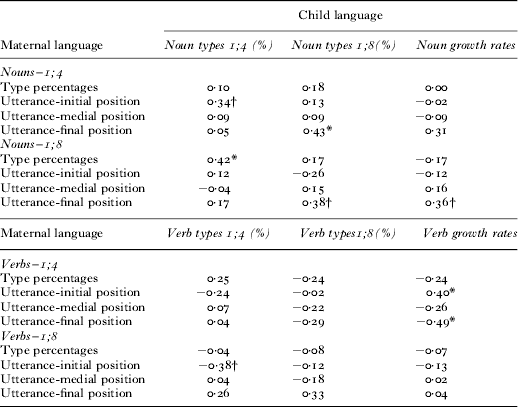
Table 4 illustrates concurrent and predictive correlations between the noun and verb measures of maternal and child language. For maternal speech, the variables taken into account are the percentages of noun and verb types at 1;4 and 1;8 and the percentages of noun and verb types occurring in the initial, medial, and final positions in maternal speech. For child language, the measures considered were the percentages of noun and verb types at 1;4 and 1;8 and the rates of noun and verb growth between the two ages. The latter were computed using a formula first described by Bates et al. (Reference Bates, Marchman, Thal, Fenson, Dale, Reznick and Hartung1994; reported in D'Odorico & Fasolo, Reference D'Odorico and Fasolo2007), which measures the mean percentage increase of each lexical class between two sampling points: [(type frequency at 1;8 – type frequency at 1;4)/type frequency at 1;4]*100. It should be noted that growth rates were always computed from the raw numbers of noun and verb types produced at ages 1;4 and 1;8. A paired-samples t-test indicated no difference in the growth rates of nouns and verbs (t(25) = −0·38, p = ·70).
Concurrent and predictive correlations between noun and verb measures of maternal and child language at 1;4 and 1;8
notes: † ·05 < p < ·10; * p < ·05.
Before computing Pearson correlations, all measures were arcsine transformed. As shown in Table 4, there were significant positive correlations between the percentages of maternal utterances containing noun types in final position at 1;4 and children's percentages of noun types at 1;8. Additionally, the concurrent correlation between the percentages of maternal utterances containing noun types in final position and children's percentages of noun types was marginally significant at 1;8. Regarding verbs, Table 4 shows that children's rates of verb growth were positively correlated with the percentages of input utterances containing verb types in initial position at 1;4, but negatively correlated with the percentages of maternal utterances containing verb types in final position at the same age (1;4).
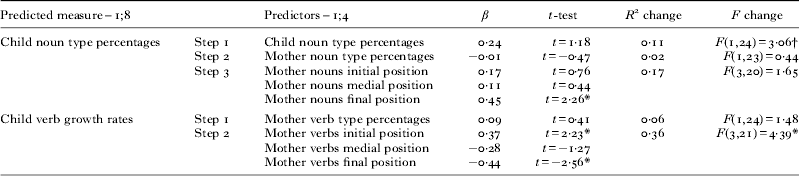
Because the above zero-order correlations may be influenced by variations in the child measures at 1;4, separate hierarchical regression analyses were performed to evaluate whether the two critical properties of maternal input, total frequency, or positional salience predicted children's acquisition of noun and verb types at 1;8. In the first model, children's percentages of noun types at 1;8 were predicted by: (i) the children's percentages of noun types at 1;4 (entered at the first step); (ii) the input percentages of noun types at 1;4 (entered at the second step); and (iii) the percentages of maternal utterances containing noun types in initial, medial, and final positions at 1;4 (entered at the third step). For verbs, a model was evaluated in which children's rates of verb growth were predicted by: (i) the input percentages of verb types at 1;4 (entered at the first step); and (ii) the percentages of maternal utterances containing verb types in initial, medial, and final positions at 1;4 (entered at the second step). In the latter analysis, children's percentages of verb types at 1;4 were not included in the model because, by definition, the influence of this variable is already taken into account when computing the rates of verb growth. Only the rates of verb growth (and not type frequency) were analyzed, because none of the properties of maternal input at 1;4 showed significant correlations with verb type frequency at 1;8. Similarly, for nouns, regression analyses were limited to type frequency because there were no significant correlations between input language at 1;4 and noun growth rates (Table 4).
The results, reported in Table 5, confirmed that, although the overall model was not significant (F(5,20) = 1·77, MSE = ·007, p = ·16), the percentages of maternal utterances containing noun types in the final position at 1;4 significantly predicted children's percentages of noun types at 1;8, above and beyond the effects due to the child and maternal percentages of noun types at 1;4 – a simplified model including as predictors only the children's percentages of noun types at 1;4 (step 1), the input percentages of noun types at 1;4 (step 2), and the percentages of maternal utterances containing nouns in the final position at 1;4 (step 3) approached significance (F(3,22) = 2·96, MSE = ·006, p = ·05). Likewise, the children's rates of verb growth were predicted by the percentages of maternal utterances containing verb types in initial (positive relation) and final position (negative relation) at 1;4, even when the variance explained by the input percentages of verb types at 1;4 was removed.
Hierarchical regressions predicting children's percentages of noun types at 1;8 and children's rates of verb growth
notes: † ·05 < p < ·10; * p ⩽ ·05.
DISCUSSION
The present study investigated relations between maternal and child language in twenty-six mother–child dyads using samples of spontaneous production at 1;4 and 1;8. The structural properties of the speech of Italian mothers allowed us to contrast predictions about the relative dominance of nouns or verbs in children's lexicons. Some characteristics of maternal language (like total frequency) should favor verb learning, whereas other features (like positional salience) should promote noun acquisition. Therefore, our primary aim was to examine the distinctive roles of these input properties in the early development of noun and verb categories.
The analysis of parental language confirmed and extended previous results (Camaioni & Longobardi, Reference Camaioni and Longobardi2001; Tardif et al., Reference Tardif, Shatz and Naigles1997) showing that the child-directed speech of Italian mothers contains more verb than noun types. Nouns occurred more often than verbs in utterance-final position, whereas verbs were located more frequently than nouns in utterance-initial and -medial positions. As concerns children's language, our data replicated the typical pattern of noun advantage (Bornstein et al., Reference Bornstein, Cote, Maital, Painter, Sung-Yun, Pascual and Vyt2004; Camaioni & Longobardi, Reference Camaioni and Longobardi1995; Caselli et al., Reference Caselli, Bates, Casadio, Fenson, Fenson, Sanderl and Weir1995; D'Odorico & Fasolo, Reference D'Odorico and Fasolo2007; Salerni et al., Reference Salerni, Assanelli, D'Odorico and Rossi2007). We then analyzed temporally causal relations between the properties of maternal input at 1;4 and two measures of children's language: the percentages of noun and verb types at 1;8 and the rates of noun and verb growth between 1;4 and 1;8. Correlational analyses and hierarchical regressions showed that the percentages of noun types located in the final position of maternal utterances at 1;4 positively predicted children's production of noun types at 1;8. For verb growth rates, the results indicated a positive association with the percentages of input verb types occurring in utterance-initial position and a negative relation with the percentages of verb types occurring in the final position of maternal utterances.
The present findings have important implications for the question of whether the early primacy of nouns in child language is attributable to environmental factors or to linguistic constraints in the child. Our data clearly show that, between the ages of 1;4 and 1;8, Italian-speaking children acquire more nouns than verbs, even though the input language of their mothers contains a greater number of verbs than noun types. This result is consistent with the hypothesis that, in the earliest phases of lexical development, children of most cultures have a predisposition to acquire nouns before verbs; more importantly, it indicates that this noun advantage occurs regardless of differences in the total numbers of nouns vs. verbs produced by mothers (Au et al., Reference Au, Dapretto and Song1994; Bornstein et al., Reference Bornstein, Cote, Maital, Painter, Sung-Yun, Pascual and Vyt2004; Gentner, Reference Gentner and Kuczaj1982). The asymmetry between the patterns of noun/verb dominance in maternal and child speech is supported by a cross-cultural comparison with languages like Korean and Japanese, in which the input is also characterized by a prevalence of verbs over nouns. For instance, Ogura et al. (Reference Ogura, Dale, Yamashita, Murase and Mahieu2006) and Kim, McGregor, and Thompson (Reference Kim, McGregor and Thompson2000; see also Au et al., Reference Au, Dapretto and Song1994) found that Japanese and Korean mothers (like Italian mothers) use more verbs than nouns. Moreover, in these languages verbs were more likely than nouns to be located in the favorable utterance-final position. Yet, children's language was noun-dominant at the presyntactic stage (i.e. at the 50-word mark), even though the proportions of acquired verbs were significantly greater for Japanese- and Korean- than for English-speaking children. Taken together, these data suggest that, in the earliest phases of vocabulary acquisition, children show a strong preference for learning nouns, not only in those languages (like English) in which mothers produce more nouns than verbs, but also in those languages (like Italian, Japanese, and Korean) in which mothers use more verbs than nouns. Notably, the noun advantage over verbs was found in one study to extend to three- and five-year-old monolingual children acquiring English, Japanese, or Mandarin (Imai, Haryu & Okada, Reference Imai, Haryu and Okada2005; Imai et al., Reference Imai, Li, Haryu, Okada, Hirsh-Pasek, Golinkoff and Shigematsu2008).
However, there might be exceptions. Tardif et al. (Reference Tardif, Shatz and Naigles1997) reported that a small sample of ten Mandarin-Chinese children whose spontaneous language was assessed at about 2;0 produced more verb than noun types and tokens. There may be several reasons for this discrepancy. In particular, in Tardif et al. (Reference Tardif, Shatz and Naigles1997), Mandarin-speaking children were recorded for about one hour in a wide range of contexts, including indoor and outdoor toy play, mealtime, dressing, social interchanges, and book reading. The nature of contexts in which spontaneous speech is recorded plays an important role in determining the magnitude of the noun bias (Ogura et al., Reference Ogura, Dale, Yamashita, Murase and Mahieu2006; Tardif et al., Reference Tardif, Gelman and Xu1999), because both English- and Mandarin-speaking children produce more nouns than verbs when engaged in book reading, whereas they tend to produce similar proportions of nouns and verbs when playing with toys. Thus, subtle differences in the amount of time spent in each context may partially account for contrasting findings. In addition, Tardif et al. (Reference Tardif, Shatz and Naigles1997) analyzed samples of spontaneous speech, whereas other studies used vocabulary checklists (Au et al., Reference Au, Dapretto and Song1994; Bornstein et al., Reference Bornstein, Cote, Maital, Painter, Sung-Yun, Pascual and Vyt2004; Goodman et al., Reference Goodman, Dale and Li2008) or maternal diaries (Kim et al., Reference Kim, McGregor and Thompson2000). Given that mothers are more likely to forget the verbs than the nouns produced by their children (Tardif et al., Reference Tardif, Gelman and Xu1999), the use of different sampling methods might also lead to discrepant conclusions. Regarding these issues, the present study relies on transcripts of spontaneous mother–child interactions in a play context, two factors that are supposed to mitigate noun bias. Still, a significant noun advantage was obtained at both ages, a finding that further supports the predisposition to acquire nouns before verbs (Bornstein et al., Reference Bornstein, Cote, Maital, Painter, Sung-Yun, Pascual and Vyt2004; Gentner, Reference Gentner and Kuczaj1982).
As for the input factors that facilitate lexical learning, our data replicate previous results underscoring the salience of input utterance-final position for children's production of noun types. In line with the present findings, it has been shown that both infants (Seidl & Johnson, Reference Seidl and Johnson2006; Shady & Gerken, Reference Shady and Gerken1999) and adults acquiring a new language (Golinkoff & Alioto, Reference Golinkoff and Alioto1995) recognize words appearing in final position better than those appearing in medial positions of sentences. In contrast, verb growth rates were negatively predicted by the percentages of verb types occurring in the final position of maternal utterances. Naigles and Hoff-Ginsberg (Reference Naigles and Hoff-Ginsberg1998) reported a similar result: the more often a verb appeared in utterance-final position in input speech, the lower the flexibility with which it was used in child language (i.e. the lower the number of different syntactic frames in which children employed the verb). One possible explanation for this effect is that most sentences in which verbs were located in final position did not specify the agents and/or the referents of the actions (e.g. Vuoi giocare? ‘Do you want to play?’; Vai a vedere ‘Go see’). It is conceivable that these kinds of utterance do not facilitate early verb acquisition because the absence of explicit referents makes it more difficult for young children to understand relational meaning (Golinkoff & Hirsh-Pasek, Reference Golinkoff and Hirsh-Pasek2008); additionally, they often require the comprehension of infinitival complements, a complex syntactic structure whose mastery is not well established until 3;0 (Bloom, Tackeff & Lahey, Reference Bloom, Tackeff and Lahey1984). Whatever the correct account, it appears that, for children between 1;4 and 1;8, the salience of utterance-final position has different effects on the acquisition of nouns (positive) and verbs (negative).
That the predictive effects of utterance position vary across lexical categories can be reasonably inferred from the descriptive data reported in Table 3. Indeed, the vast majority of nouns occurred in the final position of maternal utterances, whereas the distribution of verbs was more variable across the three positions. A strong asymmetry was also observed for initial position, because Italian-speaking mothers tended to begin their sentences with a verb more often than with a noun. Consequently, the frequency of verbs in the initial position of maternal utterances positively predicted the percentage increase in children's verb types between the ages of 1;4 and 1;8. In her original hypothesis, Gentner (Reference Gentner and Kuczaj1982) proposed that words appearing at both edges (initial and final) of input sentences should be acquired more easily than those located in medial positions. However, at present, data supporting the saliency of the initial position encompass almost entirely learning closed-class words (Richards & Robinson, Reference Richards and Robinson1993), and most researchers would concur that utterance-final position is more salient than initial position (Aslin, Woodward, LaMendola & Bever, Reference Aslin, Woodward, LaMendola, Bever, Morgan and Demuth1996; Bornstein et al., Reference Bornstein, Cote, Maital, Painter, Sung-Yun, Pascual and Vyt2004). Our findings for noun learning are not inconsistent with this position, but they also indicate that the frequency of verbs at the beginning of maternal utterances plays a relevant role in predicting children's rates of verb growth. At least part of this beneficial influence may be ascribable to the fact that the initial positions of input verbs were often imperatives, which are fully comprehended by children in the second year of life (Babelot & Marcos, Reference Babelot and Marcos1999). Pertinently, facilitating effects of utterance-initial position have been reported for copulas (Richards & Robinson, Reference Richards and Robinson1993) and auxiliary verbs (Newport, Gleitman & Gleitman, Reference Newport, Gleitman, Gleitman, Snow and Ferguson1977), and Seidl and Johnson (Reference Seidl and Johnson2006) found that infants aged between 0;7 and 0;8 segmented words from utterance-final position as readily as they did from utterance-initial position.
Besides frequency and positional salience investigated here, many other reasons have been proposed for why nouns may have prominence over verbs in child language acquisition. For example, infants are likely to bring a number of innate constraints to language acquisition. According to Markman's (Reference Markman and Neisser1987) whole object constraint, children initially presume that new words refer to objects and to whole objects rather than to object parts, attributes, motion, or other properties. Similarly, the natural partitions hypothesis (Gentner, Reference Gentner and Kuczaj1982, Reference Gentner, Hirsh-Pasek and Golinkoff2006) states that perceptually and conceptually concrete and stable objects, normally corresponding to nouns, are easier to identify in the world, and therefore easier to label, than are action or event relational referents, normally corresponding to verbs (as well as adjectives and prepositions). Another possible reason for the early noun advantage might be represented by linguistic requirements underlying verb learning. It has been argued that, because verbs (and adjectives) necessitate the use of nouns as arguments for their meanings, the acquisition of grammatical forms for verbs (and adjectives) must necessarily be grounded in the prior learning of nouns (Gleitman, Cassidy, Nappa, Papafragou & Trueswell, Reference Gleitman, Cassidy, Nappa, Papafragou and Trueswell2005; Golinkoff & Hirsh-Pasek, Reference Golinkoff and Hirsh-Pasek2008; Waxman et al., Reference Waxman, Fu, Arunachalam, Leddon, Geraghty and Song2013). Finally, developmental neurocognitive factors might underlie the noun advantage (Bornstein, De Houwer & Putnick, Reference Bornstein, De Houwer and Putnick2013). Shapiro, Moo, and Caramazza (Reference Shapiro, Moo and Caramazza2006), using event-related functional MRI, identified separate cortical regions that were active when English speakers produced nouns or verbs in the context of short phrases. Noun production coincided with greater activation in the left middle fusiform gyrus, whereas verb production was correlated with selective activation in part of the left middle frontal gyrus, the left superior temporal gyrus, and superior regions in the posterior parietal cortices bilaterally. Supporting this regional analysis are studies of patients with brain damage in these areas who appear to have selective difficulties in producing nouns or verbs, respectively (Caramazza & Hillis, Reference Caramazza and Hillis1991; Damasio & Tranel, Reference Damasio and Tranel1993; Daniele, Giustolisi, Silveri, Colosimo & Gainotti, Reference Daniele, Giustolisi, Silveri, Colosimo and Gainotti1994; Laiacona & Caramazza, Reference Laiacona and Caramazza2004; Miceli, Silveri, Villa & Caramazza, Reference Miceli, Silveri, Villa and Caramazza1984; Tranel, Adolphs, Damasio & Damasio, Reference Tranel, Adolphs, Damasio and Damasio2001). It is possible that different brain regions follow different developmental trajectories (Bornstein et al., Reference Bornstein, De Houwer and Putnick2013), since recent work shows that infants already know the meanings of several common nouns from the age of 0;6 (Bergelson & Swingley, Reference Bergelson and Swingley2012).
The foregoing factors may hold equally well for (almost) all languages. Other explanations are more sensitive to linguistic variations (Bornstein et al., Reference Bornstein, Cote, Maital, Painter, Sung-Yun, Pascual and Vyt2004; Bornstein et al., Reference Bornstein, Tal, Rahn, Galperín, Pêcheux, Lamour and Tamis-LeMonda1992), because they posit that several characteristics of child-directed speech play a role in children's prevalence of nouns over verbs. The present research focused on two input factors (frequency and positional salience). However, three other properties have been examined: morphology, pragmatics, and prosody. Morphology refers to the regularity of words as assessed by the number of possible inflections of their roots. Slobin (Reference Slobin, Ferguson and Slobin1973) proposed that morphological complexity might hinder lexical acquisition. Because morphology appears to be more irregular for verbs than for nouns in many languages (Bornstein et al., Reference Bornstein, Cote, Maital, Painter, Sung-Yun, Pascual and Vyt2004; Kim et al., Reference Kim, McGregor and Thompson2000; Tardif et al., Reference Tardif, Shatz and Naigles1997), including Italian (Camaioni & Longobardi, Reference Camaioni and Longobardi2001), morphology should favor noun over verb learning. Pragmatics entails the extent to which caregivers highlight nouns and verbs during interactions with their children. Empirical research has revealed strong cultural differences in pragmatics: for instance, English- and American-English-speaking mothers tend to emphasize object-oriented utterances (Bornstein, Haynes & Painter, Reference Bornstein, Haynes and Painter1998; Goldfield, Reference Goldfield1993; Tamis-LeMonda, Bornstein, Cyphers, Toda & Ogino, Reference Tamis-LeMonda, Bornstein, Cyphers, Toda and Ogino1992), whereas Korean mothers are more likely to stress activity-oriented utterances (Choi & Gopnik, Reference Choi and Gopnik1995). For Italian, D'Odorico, Salerni, Cassibba, and Jacob (Reference D'Odorico, Salerni, Cassibba and Jacob1999) found that the percentages of maternal utterances referring to objects and actions in which the child was already engaged at 0;9 was significantly related to infants' word production at 1;0: however, it is impossible from this study to estimate the relative proportions of object- and action-oriented utterances because they were included in the same category. Lastly, prosody implies children's ability to use the rhythm, stress, and intonation of maternal language to identify grammatical units (Kemler, Hirsh-Pasek, Jusczyk & Cassidy, Reference Kemler, Hirsh-Pasek, Jusczyk and Cassidy1989). Typically, child-directed speech is characterized by short utterances, isolated words (see Brent & Siskind, Reference Brent and Siskind2001, for the role of the frequency of isolated words in vocabulary development), and large numbers of questions (Soderstrom, Blossom, Foygel & Morgan, Reference Soderstrom, Blossom, Foygel and Morgan2008); moreover, utterance-final vowels are lengthened and undergo exaggerated pitch changes (Fisher & Tokura, Reference Fisher, Tokura, Morgan and Demuth1996). Shady and Gerken (Reference Shady and Gerken1999) showed that children effectively use caregiver prosodic cues in locating and distinguishing linguistic units in fluent speech by 2;0. They found that infants better identified words when they were inserted into sentences with natural pauses occurring early (Find/the dog for me) or late (Find the dog/for me), than in sentences with unnatural pauses (Find the/dog for me).
Thus, other factors may be conflated with the position effects reported in the present study, especially for the final position. Prosody is a candidate (Golinkoff & Hirsh-Pasek, Reference Golinkoff and Hirsh-Pasek2008). It is sometimes reported that words in the utterance-final position are lengthened, especially in child-directed speech (Fernald & Mazzie, Reference Fernald and Mazzie1991; for Italian see D'Odorico & Jacob, Reference D'Odorico and Jacob2006), and so nouns would be lengthened more often than verbs. However, Sorensen, Cooper, and Paccia (Reference Sorensen, Cooper and Paccia1978) reported that, when both nouns and verbs were placed in phrase-final position, their duration was equivalent. A second possibly confounding factor may reside in distributional regularities in child-directed speech. Several studies show that frequent frames, defined as two words that bracket one intervening word (Mintz, Newport & Bever, Reference Mintz, Newport and Bever2002; Weisleder & Waxman, Reference Weisleder and Waxman2010), potentially offer to young children reliable cues to the discovery of grammatical categories, particularly nouns and verbs. In this line of thinking, Weisleder and Waxman (Reference Weisleder and Waxman2010) identified several end-frames that, in both English (e.g. the__) and Spanish (e.g. te __), carry robust distributional cues to grammatical form class (both nouns and verbs). In the present study, the proportion of nouns located in utterance-final position slightly increased from 1;4 to 1;8 (from 29% to 33%), whereas the percentages of verbs remained fairly stable (about 20%). To the extent that children are sensitive to the frequency regularities of syntactic frames, these developmental differences might also contribute to an explanation of why final position is more helpful for nouns than for verbs. To our knowledge, no study has investigated the role of frequent frames in Italian: along with the examination of initial-frames (Mintz et al., Reference Mintz, Newport and Bever2002, and Weisleder and Waxman, Reference Weisleder and Waxman2010, only focused on mid- and end-frames), frame frequency may be an important avenue for future research.
Contrary to the conclusions reported by other researchers (Goodman et al., Reference Goodman, Dale and Li2008; Huttenlocher et al., Reference Huttenlocher, Haight, Bryk, Seltzer and Lyons1991; Naigles & Hoff-Ginsberg, Reference Naigles and Hoff-Ginsberg1998), but consonant with others (Bornstein, Tamis-LeMonda & Haynes, Reference Bornstein, Tamis-LeMonda and Haynes1999), the total frequency of noun and verb types in maternal speech at 1;4 did not predict either children's production of noun types at 1;8 or their rates of verb growth. However, a direct comparison with previous studies may not be entirely appropriate because of methodological differences. For instance, both Goodman et al. (Reference Goodman, Dale and Li2008) and Naigles and Hoff-Ginsberg (Reference Naigles and Hoff-Ginsberg1998) employed age of acquisition as their primary dependent variable (using a between-items analysis), whereas we focused on type production and rates of vocabulary growth (using a between-subjects analysis). Furthermore, both age ranges and sampling methods varied across studies. Goodman et al. (Reference Goodman, Dale and Li2008), for example, assessed children aged 0;8 to 2;6 and used acquisition data derived from the MacArthur CDI, rather than samples of spontaneous speech (see also Maital et al., Reference Maital, Dromi, Sagi and Bornstein2000, who developed and used a Hebrew CDI). Clearly, additional studies employing similar procedures and same-age children are needed to further characterize these potential cross-linguistic differences between English and Italian. It would also be helpful to investigate the relation between input and child language in different contexts (we only examined toy play) to ascertain the generalizability of our results (see Bornstein et al., Reference Bornstein, Tamis-LeMonda and Haynes1999).
In conclusion, the present study suggests that positional salience is a relevant variable in the early vocabulary development of Italian-speaking children and that the roles of utterance-initial and -final positions are different for nouns and verbs. Specifically, we found that the majority of noun types in the child-directed speech of Italian mothers occurred in utterance-final position, a factor that facilitated children's acquisition of noun types. In contrast, children's rates of verb growth showed a positive association with the percentages of verb types in the initial position of maternal sentences, but a negative relation with their percentages in utterance-final position. Thus, although the total frequency of verbs in maternal speech was greater than that of nouns, all factors taken together seem to benefit noun learning more than verb learning, possibly because nouns are more saliently located and their frequency in utterance-final position increases with age.