Introduction
For decades, researchers have investigated violence perpetrated by persons with severe mental illness. This research is heavily based on patient and offender samples (Eronen et al. Reference Eronen, Angermeyer and Schulze1998; Choe et al. Reference Choe, Teplin and Abram2008). Studies that included patients show a consistently elevated risk of committing violent acts for those suffering from major mental disorders (i.e. various forms of functional psychoses), specifically schizophrenia, compared with the general population. The risk of violent behaviour was even higher among patients with substance use disorders compared to those with schizophrenia or other major mental disorders. Studies that examined homicide offenders show a similar picture (Eronen et al. Reference Eronen, Angermeyer and Schulze1998). However, research based on patient or offender samples run the risk of selection bias because most people with mental disorders are not hospitalized and most violent individuals are not in fact convicted of a violent crime.
General population studies in this area are less numerous, but show a fairly consistent picture that largely corresponds with the above findings. First, most people with mental disorders are not violent (Arseneault et al. Reference Arseneault, Moffitt, Caspi, Taylor and Silva2000; Silver & Teasdale, Reference Silver and Teasdale2005; Coid et al. Reference Coid, Yang, Roberts, Ullrich, Moran, Bebbington, Brugha, Jenkins, Farrell, Lewis and Singleton2006; Copeland et al. Reference Copeland, Miller-Johnson, Keeler, Angold and Costello2007; Elbogen & Johnson, Reference Elbogen and Johnson2009; Whiting et al. Reference Whiting, Simmons, Havens, Smith and Oka2009; van Dorn et al. Reference van Dorn, Volavka and Johnson2012). Second, people with mental disorders are more likely to be violent than those with no mental disorders, but this does not apply for all disorder types. It is especially true for substance use disorders (Arseneault et al. Reference Arseneault, Moffitt, Caspi, Taylor and Silva2000; Silver & Teasdale, Reference Silver and Teasdale2005; Coid et al. Reference Coid, Yang, Roberts, Ullrich, Moran, Bebbington, Brugha, Jenkins, Farrell, Lewis and Singleton2006; Copeland et al. Reference Copeland, Miller-Johnson, Keeler, Angold and Costello2007; Casiano et al. Reference Casiano, Belik, Cox, Waldman and Sareen2008; O'Leary et al. Reference O'Leary, Tintle, Bromet and Gluzman2008; Elbogen & Johnson, Reference Elbogen and Johnson2009; Whiting et al. Reference Whiting, Simmons, Havens, Smith and Oka2009; Miller et al. Reference Miller, Breslau, Petukhova, Fayyad, Green, Kola, Seedat, Stein, Tsang, Viana, Andrade, Demyttenaere, de Girolamo, Haro, Hu, Karam, Kovess-Masfety, Tomov and Kessler2011b ; van Dorn et al. Reference van Dorn, Volavka and Johnson2012) and psychotic-like experiences (Arseneault et al. Reference Arseneault, Moffitt, Caspi, Taylor and Silva2000; Kessler et al. Reference Kessler, Molnar, Feurer and Appelbaum2001; Mojtabai, Reference Mojtabai2006). Third, even though mental disorders are related to violence, other factors contribute more strongly to violent acts (Copeland et al. Reference Copeland, Miller-Johnson, Keeler, Angold and Costello2007; van Dorn et al. Reference van Dorn, Volavka and Johnson2012), suggesting that having a mental disorder marks only one of various paths to violent behaviour. This conclusion is based on findings of a modest, yet significant, relationship between mental disorders and violence and the potential roles in violence played by substance use (Arseneault et al. Reference Arseneault, Moffitt, Caspi, Taylor and Silva2000; Leonard, Reference Leonard2005; van Dorn et al. Reference van Dorn, Volavka and Johnson2012), familial factors (Elbogen & Johnson, Reference Elbogen and Johnson2009; van Dorn et al. Reference van Dorn, Volavka and Johnson2012), childhood adversities (Miller et al. Reference Miller, Breslau, Joanie Chung, Green, McLaughlin and Kessler2011a ; van Dorn et al. Reference van Dorn, Volavka and Johnson2012), clinical features such as unusual perceptual experiences, paranoid ideations (Mojtabai, Reference Mojtabai2006) and threat perception (Arseneault et al. Reference Arseneault, Moffitt, Caspi, Taylor and Silva2000; van Dorn et al. Reference van Dorn, Volavka and Johnson2012), recent criminal victimization (Elbogen & Johnson, Reference Elbogen and Johnson2009), stressful life events and impaired social support (Silver & Teasdale, Reference Silver and Teasdale2005).
Although several researchers have shown that people with mental disorders have an increased risk of being a victim of violence (Silver et al. Reference Silver, Arseneault, Langley, Caspi and Moffitt2005; Teplin et al. Reference Teplin, McClelland, Abram and Weiner2005; Maniglio, Reference Maniglio2009; Fuller-Thomson & Brennenstuhl, Reference Fuller-Thomson and Brennerstuhl2012; Hart et al. Reference Hart, de Vet, Moran, Hatch and Dean2012), few studies have examined perpetration and victimization in the same sample (Hiday et al. Reference Hiday, Swanson, Swartz, Borum and Wagner2001; Choe et al. Reference Choe, Teplin and Abram2008; Silver et al. Reference Silver, Arseneault, Langley, Caspi and Moffitt2005, Reference Silver, Piquero, Jennings, Piquero and Leiber2011). A plausible reason is that the link between mental disorder and violence is a controversial subject. On the one hand, many researchers highlight the importance of examining the role of mental illness in the perpetration of violence (e.g. as a result of the deinstitutionalization of mental health care, the occurrence of a recent mass murder or debate on firearms licenses). On the other hand, others try to avoid potentially unwarranted stigmatization of people with mental disorders by focusing on their victimization experiences. No matter whether the focus is on violent offending by or violent victimization of people with mental disorders, both experiences often overlap (Silver et al. Reference Silver, Piquero, Jennings, Piquero and Leiber2011) or occur in similar social contexts (Hiday, Reference Hiday1995), and therefore need to be studied together.
The papers that have been published on the link between mental disorders and violence based on general population studies are not only small in number but also have some limitations. First, all papers focused on physical violence in general or in current marital and cohabitating relationships, ignoring the fact that violence is also likely to occur after separation or divorce (Fergusson et al. Reference Fergusson, Horwood and Ridder2005) and against children during their upbringing (Afifi et al. Reference Afifi, Brownridge, MacMillan and Sareen2010). Second, other forms of violence such as psychological abuse were not assessed, whereas these can also be regarded as a major public health problem. Moreover, there may be other associations with mental disorders than physical violence. Third, the majority of papers paid relatively little attention to contextual indicators of violence, in particular recent violent victimization and stressful life events, whereas such experiences can induce anger or feelings of being threatened, resulting in reactive violence or violent behaviour as self-protection (Hiday et al. Reference Hiday, Swanson, Swartz, Borum and Wagner2001).
The current study attempts to fill this gap by analysing data from the first two waves of the Netherlands Mental Health Survey and Incidence Study-2 (NEMESIS-2), a nationally representative survey of the general population aged 18–64 years. Four questions are addressed: (1) What is the prevalence of violence in the general population? (2) To what extent are sociodemographic characteristics and contextual indicators, such as prior victimization, negative life events and low levels of social support, associated with violence? (3) Which types of common mental disorders are associated with violence, after adjustment for sociodemographic characteristics? (4) To what extent are these relationships influenced by contextual indicators? In answering these questions, violent behaviour was differentiated into physical and psychological family violence, that is violence against an individual's current or former intimate partner(s) (IPV) or children, and physical and psychological violence against any person(s) in general.
Method
NEMESIS-2 is a psychiatric epidemiological cohort study of the Dutch general population aged 18–64 years. It is based on a multistage, stratified random sampling of households, with one respondent randomly selected in each household.
In the first wave (T0), performed from November 2007 to July 2009, a total of 6646 persons were interviewed (response rate 65.1%; average interview duration 95 min). This sample was nationally representative, although younger subjects were somewhat under-represented (de Graaf et al. Reference de Graaf, ten Have and van Dorsselaer2010). The interviews were laptop computer assisted and almost all were held at the respondent's home.
All T0 respondents were approached for follow-up, 3 years after T0 from November 2010 to June 2012. Of this group, 5303 persons were interviewed again (response rate 80.4%, excluding those deceased; average interview duration 84 min). Attrition was not significantly linked to all main categories and individual 12-month mental disorders at baseline, after controlling for sociodemographic characteristics (de Graaf et al. Reference de Graaf, van Dorsselaer, Tuithof and ten Have2013). The mean period between both interviews was 3 years and 7 days.
The study was approved by a medical ethics committee. After having been informed about the study aims, respondents provided written informed consent. A more comprehensive description of the design is provided in de Graaf et al. (Reference de Graaf, ten Have and van Dorsselaer2010).
Violence
At T0, respondents were asked about lifetime violent behaviour towards one of their current or former intimate partners and about lifetime violent behaviour towards any of their children during their upbringing. At the second wave (T1), all respondents were asked about violent behaviour between both waves towards any person(s) in general, and if so, towards whom (i.e. partner, ex-partner, family member, acquaintance, stranger). To increase the likelihood of these acts being reported, they were not mentioned as such but were listed in a booklet (lists A and B) and referred to by number. The items on list A referred to psychological violence and included name-calling, offending, belittling, punishing unjustly, blackmailing and threatening. The items on list B concerned physical violence and included kicking, biting, hitting, trying to wound with an object (gun, knife, piece of wood, pair of scissors, other object) or hot water. Psychological violence was present if it occurred on two or more occasions, and physical violence on one or more occasions (consistent with Kessler et al. Reference Kessler, Molnar, Feurer and Appelbaum2001; Miller et al. Reference Miller, Breslau, Petukhova, Fayyad, Green, Kola, Seedat, Stein, Tsang, Viana, Andrade, Demyttenaere, de Girolamo, Haro, Hu, Karam, Kovess-Masfety, Tomov and Kessler2011b ).
Victimization
The questions about violence against an individual's current or former intimate partner(s) and any person(s) in general, assessed at T0 and T1 respectively, were followed by similar questions about victimization, using the same experiences listed in the booklet (lists A and B) and referred to by number. The above-mentioned definitions of violent behaviour were applied to assess victimization.
Victimization in childhood was assessed at T0 and refers to whether an individual had experienced psychological abuse on two or more occasions, and physical abuse or sexual abuse on one or more occasions before the age of 16.
Diagnostic instrument
DSM-IV diagnoses were made using the Composite International Diagnostic Interview Version 3.0 (CIDI 3.0), a fully structured lay-administered diagnostic interview. This instrument was developed and adapted for use in the World Mental Health (WMH) Survey Initiative (Kessler & Üstün, Reference Kessler and Üstün2004). The CIDI 3.0 version used in NEMESIS-2 was an improvement on the one used in the WMH initiative.
The disorders considered in this paper include: mood disorders (major depression, dysthymia, bipolar disorder), anxiety disorders [panic disorder, agoraphobia without panic disorder, social phobia, specific phobia, generalized anxiety disorder (GAD)], substance use disorders (alcohol/drug abuse and dependence) and impulse-control disorders [attention deficit hyperactivity disorder (ADHD), conduct disorder, oppositional defiant disorder (ODD)]. Antisocial personality disorder (ASP) was measured with questions from the International Personality Disorder Examination (IPDE; Loranger et al. Reference Loranger, Sartorius, Andreoli, Berger, Buchheim, Channabasavanna, Coid, Dahl, Diekstra, Ferguson, Jacobsberg, Mombour, Pull, Ono and Regier1994), which are part of CIDI 3.0 (Lenzenweger et al. Reference Lenzenweger, Lane, Loranger and Kessler2007; Huang et al. Reference Huang, Kotov, de Girolamo, Preti, Angermeyer, Benjet, Demyttenaere, de Graaf, Gureje, Karam, Lee, Lépine, Matschinger, Posada-Villa, Suliman, Vilagut and Kessler2009). All disorders were determined among all respondents, except impulse-control disorders, which were limited to those aged 18–44 years because of concerns about recall bias in older respondents (Kessler et al. Reference Kessler, Angermeyer, Anthony, de Graaf, Demyttenaere, Gasquet, de Girolamo, Gluzman, Gurejo, Haro, Kawakami, Karam, Levinson, Medina Mora, Oakley Browne, Posada-Villa, Stein, Adley Tsang, Anguilar-Gaxiola, Alonso, Lee, Heeringa, Pennell, Berglund, Gruber, Petukhova, Chatterji and Ustün2007).
Clinical calibration studies in various countries (Haro et al. Reference Haro, Arbabzadeh-Bouchez, Brugha, de Girolamo, Guyer, Jin, Lepine, Mazzi, Reneses, Vilagut, Sampson and Kessler2006) found that the CIDI 3.0 assesses mood, anxiety and substance use disorders with generally good validity in comparison to blinded clinical reappraisal interviews. A clinical reappraisal interview carried out in a subsample of the National Comorbidity Survey Replication performed in the USA also found a valid assessment of ADHD in the CIDI 3.0 (Fayyad et al. Reference Fayyad, de Graaf, Kessler, Alonso, Angermeyer, Demyttenaere, de Girolamo, Haro, Karam, Lara, Lépine, Ormel, Posada-Villa, Zaslavsky and Jin2007).
For this study, we used lifetime and 12-month prevalences of mental disorders assessed at T0.
Negative life events
At T0, the presence of 10 negative life events in the previous 12 months was measured, based on the Brugha life events categories (Brugha et al. Reference Brugha, Bebbington, Tennant and Hurry1985). Examples are: death of a relative or friend, divorce or separation, and major financial difficulties. The number of events were categorized as 0, 1 and ⩾2, to achieve three more or less equal groups.
Social support
At T1, social support from three resources (partner, family or friends, neighbours) was measured with two questions on instrumental and emotional support from each of these resources in the close network. These referred to the extent respondents could rely on them for help if they had a problem and could open up to them if they needed to talk about worries. The four response categories ranged from ‘not at all’ to ‘a lot’. The mean score on both questions was used to indicate the social support perceived from a resource, taking the respondent's evaluation of it into account. Any social support was calculated as the mean score on the social support perceived from at least two resources because not all respondents had a partner at the time of interview.
Sociodemographic characteristics
At T0, sex, age, education, ethnicity, living situation, employment status and household income were assessed.
Statistical analysis
All analyses were performed with Stata version 11 (Stata Corporation, USA), using weighted data to correct for differences in the response rates in several sociodemographic groups at both waves and differences in the probability of selection of respondents within households at baseline. Robust standard errors were calculated to obtain correct 95% confidence intervals and p values (Skinner et al. Reference Skinner, Holt and Smith1989).
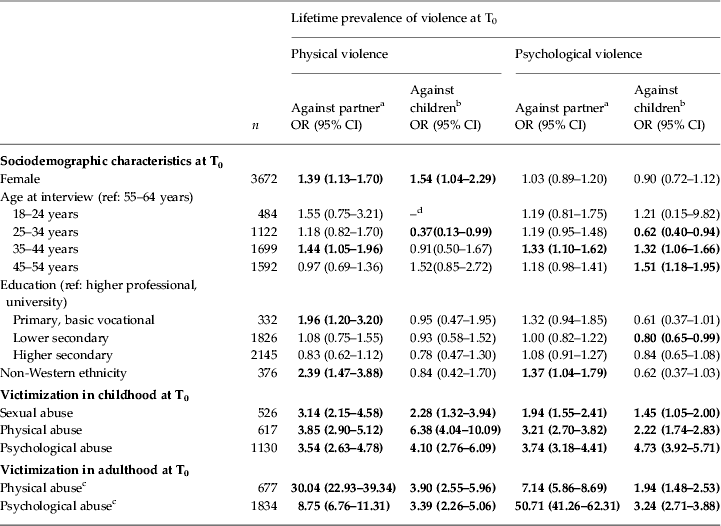
First, lifetime prevalence rates of family violence (i.e. against an individual's intimate partner or children) in the general population were calculated. Second, bivariate logistic regression analyses were used to examine sociodemographic characteristics and victimization as correlates of family violence (Table 1). Third, multivariate logistic regression analyses were performed to examine the association between common mental disorders and family violence (Tables 2 and 3), adjusted for sociodemographic characteristics (model 1) and additionally for victimization (model 2). For each disorder that was significantly associated with violence in model 2, the population attributable risk proportion (PARP) was calculated in addition to an interaction effect of gender using an additive model (comparably to a previous study; ten Have et al. Reference ten Have, Vollebergh, Bijl and Ormel2002). PARP takes into account the disorder prevalence and shows how much of the violence in the general population can be attributed to the specific disorder. One of the assumptions of valid estimations of the PARP includes a causal relationship between the risk factor and the dependent variable (Rockhill et al. Reference Rockhill, Newman and Weinberg1998). Although the data used for these analyses were examined only at T0, by calculating PARPs we assume a causal relationship between disorders and violence. Fourth, 3-year prevalence rates of violence against any person(s) in general were calculated. Fifth, this type of violence assessed at T1 could be related to more sociodemographic characteristics and also to contextual indicators. As a result, logistic regression analyses were used to examine sociodemographic characteristics, negative life events, social support and victimization as correlates of violence in general (Table 4). These results were adjusted for the number of days between respondents' interviews at both waves. Sixth, multivariate logistic regression analyses were performed to examine the association between common mental disorders and violence in general (Table 5), adjusted for sociodemographic characteristics and the number of days between respondents' interviews at both waves (model 1) and additionally for negative life events, social support and victimization (model 2). In these analyses, 12-month disorders at T0 were used to examine the cumulative incidence of violence between both waves. For each disorder that was significantly associated with violence in model 2, the PARP was calculated along with an interaction effect of gender.
Sociodemographic characteristics and victimization as correlates of family violence in the general population, in unweighted numbers (n) and weighted unadjusted odds ratios (ORs) with 95% confidence intervals (CIs)

T0, Wave 1; Ref, reference category.
Bold type indicates significant OR at the 0.05 level, two-sided test.
a Violence against current or former intimate partner(s) (n = 6210).
b Violence against own child(ren) during their upbringing (n = 4579).
c Victimization experienced by current or former intimate partner(s).
d OR could not be calculated because no respondent in this age category had used physical violence against their child(ren). In other words, there were not enough cases to calculate the OR.
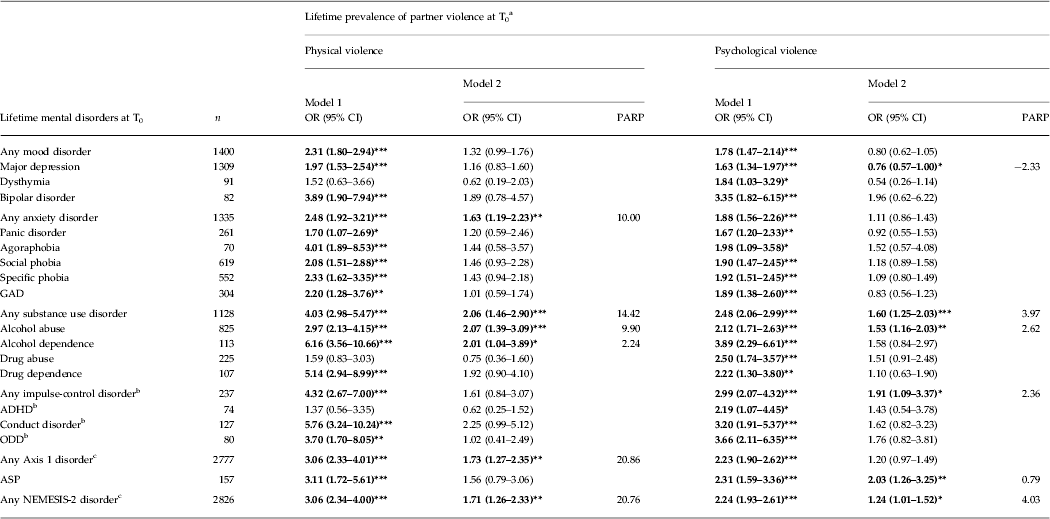
Association between common mental disorders and partner violence in the general population, in unweighted numbers (n), weighted adjusted odds ratios (ORs) with 95% confidence intervals (CIs) and weighted population attributable risk proportions (PARPs)

T0, Wave 1; GAD, generalized anxiety disorder; ADHD, attention deficit hyperactivity disorder; ODD, oppositional defiant disorder; ASP, antisocial personality disorder; NEMESIS-2, Netherlands Mental Health Survey and Incidence Study-2.
Bold type indicates significant OR at the * 0.05, ** 0.01 and *** 0.001 level, two-sided test.
a Violence against current or former intimate partner(s) (n = 6210).
b ADHD, conduct disorder and ODD measured for subjects aged 18–44 years only.
c For ‘Any Axis-1 disorder’ and ‘Any NEMESIS-2 disorder’, ADHD, conduct disorder and ODD were coded as absent among subjects aged 45–64 years who were not assessed for these disorders.
Model 1: Adjusted for sociodemographic characteristics (sex, age, education, ethnicity).
Model 2: Adjusted for sociodemographic characteristics (sex, age, education, ethnicity), victimization in childhood (sexual abuse, physical abuse, psychological abuse) and victimization in adulthood experienced by current or former intimate partner(s) (physical abuse, psychological abuse).
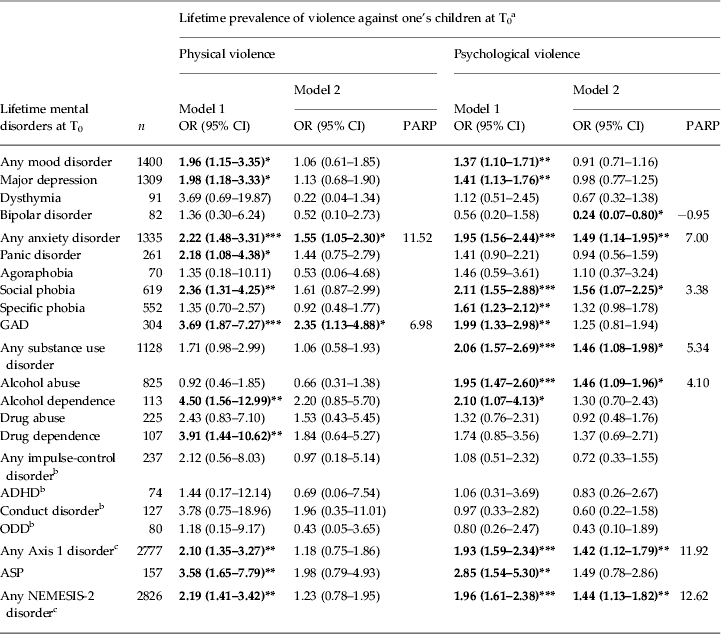
Association between common mental disorders and violence against one's children in the general population, in unweighted numbers (n), weighted adjusted odds ratios (ORs) with 95% confidence intervals (CIs) and weighted population attributable risk proportions (PARPs)

T0, Wave 1; GAD, generalized anxiety disorder; ADHD, attention deficit hyperactivity disorder; ODD, oppositional defiant disorder; ASP, antisocial personality disorder; NEMESIS-2, Netherlands Mental Health Survey and Incidence Study-2.
Bold type indicates significant OR at the * 0.05, ** 0.01 and *** 0.001 level, two-sided test.
a Violence against own child(ren) during their upbringing (n = 4579).
b ADHD, conduct disorder and ODD were measured for subjects aged 18–44 years only.
c For ‘Any Axis-1 disorder’ and ‘Any NEMESIS-2 disorder’, ADHD, conduct disorder and ODD were coded as absent among subjects aged 45–64 years who were not assessed for these disorders.
Model 1: Adjusted for sociodemographic characteristics (sex, age, education, ethnicity).
Model 2: Adjusted for sociodemographic characteristics (sex, age, education, ethnicity), victimization in childhood (sexual abuse, physical abuse, psychological abuse) and victimization in adulthood experienced by current or former intimate partner(s) (physical abuse, psychological abuse).
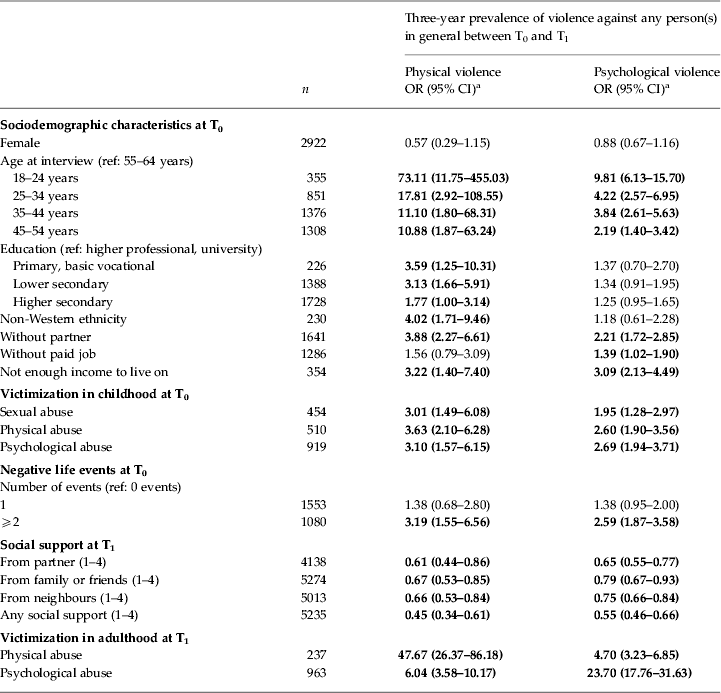
Sociodemographic characteristics, negative life events, social support and victimization as correlates of violence against any person(s) in general (n = 5303), in unweighted numbers (n) and weighted adjusted odds ratios (ORs) with 95% confidence intervals (CIs)

T0, Wave 1; T1, wave 2; Ref, reference category.
Bold type indicates significant OR at the 0.05 level, two-sided test.
a Adjusted for the number of days between respondents' interviews at both waves.
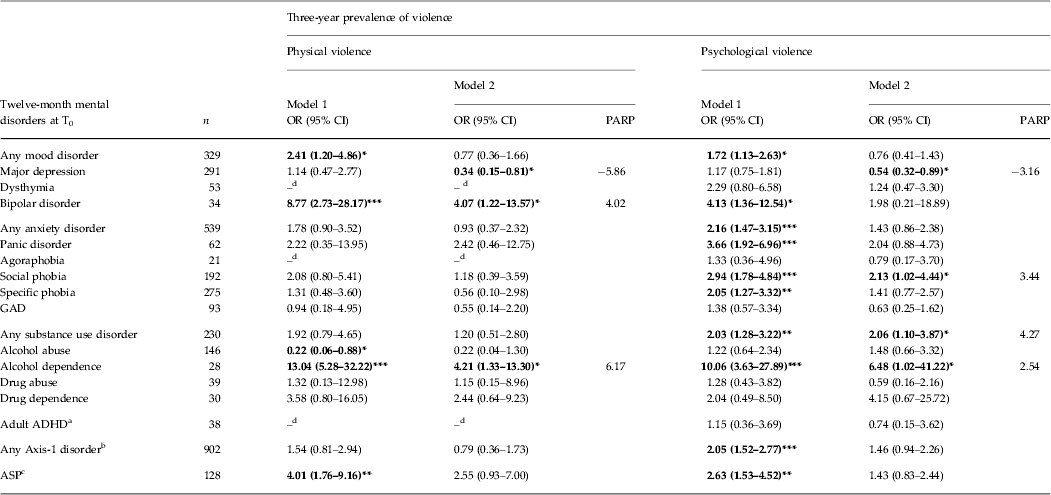
Association between common mental disorders assessed at T0 and violence against any person(s) in general assessed between T0 and T1 (n = 5303), in unweighted numbers (n), weighted adjusted odds ratios (ORs) with 95% confidence intervals (CIs) and weighted population attributable risk proportions (PARPs)

T0, Wave 1; T1, wave 2. GAD, generalized anxiety disorder; ADHD, attention deficit hyperactivity disorder; ASP, antisocial personality disorder.
Bold type indicates significant OR at the * 0.05, ** 0.01 and *** 0.001 level, two-sided test.
a Adult ADHD was measured for subjects aged 18–44 years only.
b For ‘Any Axis-1 disorder’, adult ADHD was coded as absent among subjects aged 45–64 years who were not assessed for this disorder.
c ASP was assessed on a lifetime basis.
d Not enough cases to calculate the OR.
Model 1: Adjusted for sociodemographic characteristics (sex, age, education, ethnicity, living situation, employment situation, household income) and the number of days between respondents' interviews at both waves.
Model 2: Adjusted for sociodemographic characteristics (sex, age, education, ethnicity, living situation, employment situation, household income), victimization in childhood (sexual abuse, physical abuse, psychological abuse), number of negative life events, any social support, victimization in adulthood experienced by any person(s) in general (physical abuse, psychological abuse) and the number of days between respondents' interviews at both waves.
Two-tailed testing procedures were used with 0.05 α levels in all analyses except for the tests for interaction effects, where an α of 0.001 was used. This was decided because of the large number of calculated interaction effects of gender on the associations between mental disorders and violence.
Results
Prevalence rates of violent behaviours
Lifetime prevalence rates of IPV were 5.9% (physical) and 24.3% (psychological). Lifetime violence rates against one's children during upbringing were 2.6% (physical) and 15.0% (psychological). Three-year prevalence rates of violence against any person(s) in general, reported over the period between both waves, were 2.4% (physical) and 9.2% (psychological). The physical acts against any person(s) in general were most often aimed at a stranger (53.9%) and the psychological acts at an acquaintance (32.9%).
Sociodemographic and victimization correlates of family violence
Remarkably, females were more likely to report having used physical IPV than males (Table 1). Respondents in early middle-age (35–44 years), those with primary or basic vocational education only, of non-Western ethnicity, and who had experienced victimization in childhood or by an intimate partner were also more likely to have ever used physical IPV. The strongest association was found for physical abuse in adulthood, which increased the odds 30-fold.
Similar, but slightly less strong, associations were found for psychological IPV. However, female gender and education were not significantly related to this type of violence, and psychological abuse in childhood or adulthood was more strongly correlated to psychological IPV. The strongest association was found for psychological intimate partner abuse, which increased the odds of ever having used psychological IPV 51-fold.
The most consistent predictors of physical violence against one's children were again victimization in childhood or adulthood. The strongest association was found for physical child maltreatment: respondents who had experienced physical abuse before the age of 16 were six times more likely to have ever used this same type of violence against their own children. The same phenomenon arose with psychological abuse against one's children: respondents who had experienced psychological abuse before the age of 16 showed the strongest association with ever having used this same type of violence against their own children.
Mental disorders associated with family violence
Respondents with any lifetime mental disorder were significantly more likely to have ever used physical IPV after adjustment for sociodemographic characteristics (Table 2). This also held for all the main categories of mental disorders and all individual disorders, except for dysthymia, drug abuse and ADHD. After additional adjustment for victimization in childhood or by an intimate partner, the majority of diagnostic correlates lost their significance. Any mental disorder was still associated with physical IPV and this also applied to any anxiety disorder and somewhat more strongly to any substance use (in particular alcohol) disorder. Table 2 shows that any Axis 1 disorder yielded the highest PARP for physical IPV, indicating that the lifetime prevalence of this type of violence in the population would be reduced by 20.86% if the adverse effects of having any Axis 1 disorder could be completely blocked. Elimination of the adverse effects of any substance use disorder would help to reduce the prevalence of physical IPV by 14.42%.
A similar picture was found for psychological IPV in which all individual disorders were significant after adjustment for sociodemographic characteristics. After additional adjustment for victimization, the majority of diagnostic correlates lost their significance. Any mental disorder was still associated with psychological IPV and this also held for any substance use disorder (in particular alcohol) and somewhat more strongly for any impulse-control disorder and ASP. By contrast, those with a lifetime major depression were slightly less likely to have ever used psychological IPV after adjustment for demographics and victimization. Any NEMESIS-2 disorder yielded the highest PARP for psychological IPV, indicating that the lifetime prevalence of this type of violence in the population would be reduced by 4.03% if the adverse effects of having any NEMESIS-2 disorder could be completely blocked. Elimination of the adverse effects of ASP would help to reduce the prevalence of psychological IPV by only 0.79%.
Child maltreatment was also associated with a variety of mental disorders. Respondents with any lifetime mental disorder were significantly more likely to have ever used physical violence against their children after adjustment for sociodemographic characteristics (Table 3). This also held for two main categories of mental disorders (mood, anxiety) and for substance use dependence and ASP. After additional adjustment for victimization, only any anxiety disorder (in particular GAD) was still significantly associated with physical violence against one's children. The corresponding PARPs were 11.52% and 6.98% respectively.
With regard to psychological child maltreatment, a somewhat greater number of diagnostic correlates kept their significance in the fully adjusted model. Respondents with any lifetime mental disorder were still more likely to have ever used psychological violence against their children. This was also seen for any anxiety disorder (in particular social phobia) and any substance use disorder (in particular alcohol abuse). By contrast, parents with bipolar disorder were less likely to have ever used psychological violence against their children after adjustment for demographics and victimization. Any NEMESIS-2 disorder yielded the highest PARP for psychological child maltreatment, indicating that the lifetime prevalence of this type of violence in the population would be reduced by 12.62% if the adverse effects of having any NEMESIS-2 disorder could be completely blocked.
None of the significant associations in the fully adjusted model presented in Tables 2 and 3 between mental disorders and family violence differed between men and women (data not shown).
Sociodemographic and contextual correlates of later violence in general
Violence against any person(s) in general between both waves was found to be related to more sociodemographic characteristics assessed at T0 (Table 4). In contrast to family violence, younger age was a very strong predictor of physical violence against any person(s) in general. Respondents with lower education, of non-Western ethnicity, without a partner, without enough income to live on, with childhood trauma, with two or more negative life events, and who perceived low social support were also more likely to have used physical violence in the following years. After age, the next strongest association was found for physical abuse by any person(s) in general, which increased the odds 48-fold.
Similar, but slightly less strong, associations were found for psychological violence against any person(s) in general. However, education and ethnicity were not significantly related to this type of violence, and psychological abuse between both waves was more strongly correlated with psychological violence. The strongest association was found for psychological abuse by any person(s) in general, which increased the odds 24-fold.
Mental disorders associated with later violence in general
Respondents with bipolar disorder, alcohol dependence or ASP in the 12 months preceding T0 were significantly more likely to have used physical violence against any person(s) in general in the following 3 years after adjustment for sociodemographic characteristics (Table 5). By contrast, those with alcohol abuse were less likely to have used physical violence. After additional adjustment for negative life events, social support and violent victimization, half of the diagnostic correlates lost their significance. Bipolar disorder was still associated with subsequent physical violence and this also held for alcohol dependence. Major depression now became negatively associated with physical violence. Table 5 shows that alcohol dependence yielded the highest PARP for physical violence in general, indicating that the 3-year cumulative incidence rate of this type of violence in the population would be reduced by 6.17% if the adverse effects of having alcohol dependence could be completely blocked. Elimination of the adverse effects of bipolar disorder would help to reduce the 3-year cumulative incidence rate of physical violence by 4.02%.
An initially different picture was found for psychological violence in general in which all main (any, mood, anxiety, substance use) diagnostic correlates were significant after adjustment for sociodemographic characteristics. The highest chances were found for subjects with alcohol dependence and bipolar disorder. In the fully adjusted model, again most of these correlates lost their significance. Any substance use disorder (in particular alcohol dependence) was still significantly associated with psychological violence against any person(s) in general in the following years and this also applied to social phobia. Major depression was again negatively associated with psychological violence in the fully adjusted model. Any substance use disorder yielded the highest PARP for psychological violence in general, indicating that the 3-year cumulative incidence rate of this type of violence in the population would be reduced by 4.27% if the adverse effects of having any substance use disorder could be completely blocked. Elimination of the adverse effects of social phobia would help to reduce the 3-year cumulative incidence rate of psychological violence by 3.44%.
None of the above-described significant associations in the fully adjusted model between mental disorders and violence against any person(s) in general differed between men and women (data not shown).
Discussion
This study confirms earlier findings that people with mental disorders are more likely to be violent compared to those without mental disorders. It also shows that other, in particular contextual, factors make an even greater contribution to violent acts. This is especially true for prior victimization; an experience that is common among violent people (Silver et al. Reference Silver, Piquero, Jennings, Piquero and Leiber2011) but that has been relatively less examined in previous studies on the link between mental disorders and violent behaviour. After adjustment for contextual factors and sociodemographic characteristics, the majority of the diagnostic correlates lost their significance, whereas substance use (in particular alcohol) disorders were still associated with most types of violence. This implies that the increased risk of violent offending among people with common mental disorders other than substance use disorders can be attributed to their higher rates of negative life events, low social support and violent victimization.
Limitations
Although the NEMESIS-2 sample was representative of the Dutch population on most parameters, people with an insufficient mastery of Dutch, those with no fixed address and institutionalized people were under-represented. Hence, our findings are not generalizable to these groups.
In NEMESIS-2, the most common Axis I mental disorders were assessed. Schizophrenia and personality disorders (except for ASP) were not recorded in the dataset. This means that the risk of violence associated with these disorders could not be studied. However, research based on patient and offender samples shows that both of these major mental disorders are often related to violence (Eronen et al. Reference Eronen, Angermeyer and Schulze1998; Moran et al. Reference Moran, Walsh, Tyrer, Burns, Creed and Fahy2003; Choe et al. Reference Choe, Teplin and Abram2008). Given the co-morbidity (Huang et al. Reference Huang, Kotov, de Girolamo, Preti, Angermeyer, Benjet, Demyttenaere, de Graaf, Gureje, Karam, Lee, Lépine, Matschinger, Posada-Villa, Suliman, Vilagut and Kessler2009) between personality disorders and the common mental disorders assessed in this study, it could imply that the associations found are partly the result of the link between co-morbid personality disorders and violence in the general population.
The assessments of the different types of violence were each determined by using one or two items, thereby restricting the amount of information gathered about violence. Although the assessment of physical violence closely resembles that used in previous studies on this topic (Kessler et al. Reference Kessler, Molnar, Feurer and Appelbaum2001; Miller et al. Reference Miller, Breslau, Petukhova, Fayyad, Green, Kola, Seedat, Stein, Tsang, Viana, Andrade, Demyttenaere, de Girolamo, Haro, Hu, Karam, Kovess-Masfety, Tomov and Kessler2011b ), no information was available about the seriousness of violent acts and the circumstances in which violence occurred, that is whether it was unprovoked or in self-defence.
Under-reporting and recall problems might conceivably have compromised respondents' estimations of their symptoms of mental disorders and violent acts, especially when these occurred a long time ago (Moffitt et al. Reference Moffitt, Caspi, Taylor, Kokaua, Polanczyk and Poulton2010). However, it is difficult to gauge how this might have influenced the results of our study. Any recall bias would probably have weakened the correlates' effects on violent behaviour.
Despite the strong focus on adjusting for possible confounders, there is still the possibility that any association found between mental disorders and violence could be due to non-observed sources of confounding.
Research findings
The prevalence rates of violence in the general population clearly show that IPV is more often reported than violence against one's children; that violence against any person(s) in general is most often aimed at a stranger or an acquaintance; and that psychological violence is considerably more commonplace than physical violence. Previous research focused almost solely on the link between mental disorders and physical violence.
Women were more likely to have used physical violence against their children and intimate partner(s) but not against any person(s) in general. It is unknown whether these rates reflect real differences or whether women are more likely to report violent acts against their children and intimate partner(s) than men. Both women and men were equally likely to have used psychological violence.
Younger adults were considerably more likely to have used violence against any person(s) in general. Additional analyses showed that this association remained significant after adjustment for other demographics and for alcohol abuse. The most plausible explanation for this age–violence association is that within-person change over the life course leads to a reduction either in actual violence or in willingness to admit violence (Kessler et al. Reference Kessler, Molnar, Feurer and Appelbaum2001).
Parents who had experienced physical or psychological abuse during their childhood were much more likely to have used the same type of violence against their children. A frequently cited explanation is that violent parents learned this behaviour as a result of being the victim of violent behaviour as a child (Winkel, Reference Winkel2007).
Respondents who had experienced physical or psychological abuse by an intimate partner were also considerably more likely to have used the same type of violence against their partner. A plausible reason is that victimization experiences can induce anger or feelings of being threatened, resulting in reactive violence or violent behaviour as self-protection (Riggs et al. Reference Riggs, Dancu, Gershuny, Greenberg and Foa1992; Winkel, Reference Winkel2007; Orth et al. Reference Orth, Cahill, Foa and Maercker2008). However, it is also possible that the use of violence resulted in abuse, because the direction of the association between intimate partner victimization and violence could not be assessed.
Respondents who had two or more negative life events were more likely to have used violence in the subsequent 3 years. This is in line with previous research (Silver & Teasdale, Reference Silver and Teasdale2005). The events that were most strongly associated with violence were relational problems (divorce or separation; serious problem with a close friend, family member or neighbour) and major financial difficulties, as revealed by additional analyses. These results underscore the finding that mutual conflict and stressors can precede violence.
In line with previous research (Silver & Teasdale, Reference Silver and Teasdale2005), low social support was associated with violence. Different explanations are conceivable: low social support can go hand in hand with low social control or may point to conflicts, thus increasing the risk of violent behaviour. However, it is also possible that the use of violence resulted in low social support, because both variables were assessed at T1.
In keeping with previous research (van Dorn et al. Reference van Dorn, Volavka and Johnson2012), most violent acts were not committed by people with mental disorders, despite their elevated risk of using violence. Physical and psychological violence showed similar associations with mental disorders. After adjustment for sociodemographic characteristics, a variety of common mental disorders were associated with violence. The strongest associations were found for externalizing disorders (substance use, impulse-control, ASP). The increased risk of violence among people with substance use disorders can be attributed to the common view that alcohol facilitates disinhibiting aggressive impulses (Arseneault et al. Reference Arseneault, Moffitt, Caspi, Taylor and Silva2000; Haggård-Grann et al. Reference Haggård-Grann, Hallqvist, Långström and Möller2006). The association between violent behaviour and conduct disorder in childhood or ASP in adulthood is partly inherent in the definition of these disorders. The criteria for diagnosing ASP, for example, emphasize overt violations of social rules. After additional adjustment for contextual indicators, most diagnostic correlates lost their significance, whereas substance use (in particular alcohol) disorders were still associated with most types of violence. This implies that the increased risk of violence among people with common mental disorders other than substance use disorders can be attributed to factors other than their mental illness.
In the fully adjusted models, of all individual disorders the strongest, yet still modest, associations with IPV were found for alcohol disorder and ASP with odds ratios (ORs) varying between 1.53 and 2.07, whereas the strongest associations with child maltreatment were found for anxiety disorder (GAD, social phobia) and alcohol abuse with ORs varying between 1.46 and 2.35. It is possible that anxious parents more often lack control, feel limited in their daily activities or more often abuse alcohol, and as result more often use violence against their children. The strongest associations with violence in general based on all individual disorders were found for alcohol dependence, bipolar disorder and social phobia, with ORs varying between 2.13 and 6.48. If the adverse effects of one of these disorders were completely blocked, the 3-year cumulative incidence rate of violence in the population would be reduced by 3–6%. Again, any co-morbidity between these disorders was not ruled out as a possible explanation. The increased risk of violence among people with bipolar disorder can be attributed to some clinical features during manic or mixed episodes such as impaired judgement and impulsiveness, delusions and hallucinations, agitation and irritability.
Conclusions
The findings in this study indicate that care providers should question patients about their living situation (having children and a close relationship) and also any previous violent victimization experiences (in childhood, by an intimate partner, or someone else). They should further discuss the way parents who were abused during childhood raise their children, find out what problems they face, and how they can deal with these problems in a more adequate manner. Patients who were abused by an intimate partner should also be asked about any problems in their current relationship and, if necessary, should receive help to learn how to cope better with problems. During their upbringing and education, adolescents and young adults should further be encouraged to reflect on the way they handle problems and how they can prevent these from escalating into a fight or abusive behaviour. Parents and the wider community should seek to prevent them from abusing alcohol by setting clear rules about safe levels of drinking.
Acknowledgements
NEMESIS-2 is conducted by The Netherlands Institute of Mental Health and Addiction (Trimbos Institute) in Utrecht. Financial support has been received from the Ministry of Health, Welfare and Sport, with supplementary support from The Netherlands Organization for Health Research and Development (ZonMw) and the Genetic Risk and Outcome of Psychosis (GROUP) investigators.
Declaration of Interest
None.