Implications
Geese are grazing birds that could be used for improving the animal protein supply in developing countries because of low cost of production. Geese could be raised under traditional, confinement or semi-confinement systems, but the effect of different husbandry systems on productive and reproductive traits and blood plasma biochemical and reproductive hormones needs to be documented in the literature. The results indicate that the SIS system resulted in a superior productive and reproductive performance of geese and the amount of meat produced per goose per year while improving feed utilization and reducing feeding costs.
Introduction
Egyptian geese were considered sacred by the ancient Egyptians, and appeared in much of their artwork. They have been raised in Egypt since 1500 BC and have been used as a source of meat, fatty liver and down. The Egyptian Goose (Alopochen aegyptiacus) is a member of the duck, goose and swan family Anatidae. It is in the shelduck subfamily Tadorninae, and is the only extant member of the genus Alopochen. Compared with other poultry species, geese present unquestionable advantages, especially under harsh rearing and environmental conditions. Geese are good meat producers, produce valuable by-products such as feather and down and higher added value processed products such as foie gras (Branckaret, Reference Branckaret1995). Consumption of waterfowl meat is low in Egypt, about 1.12 kg duck and 0.57 kg geese/person per year (El-Sayad, Reference El-Sayad1999) although the data from Food and Agriculture Organization of the United Nations (FAO, 2010) indicate that Egypt ranked third worldwide in the top 10 leading countries in production of geese. In Europe, geese are raised both for meat production and for fatty livers (Pingel, Reference Pingel1992).
The development of the geese industry has been constrained by their low reproductive performance compared with other commonly utilized fowl (Shi et al., Reference Shi, Tian, Wu and Wang2008). In general, waterfowl have considerably lower egg production rates and higher levels of embryonic mortality than chickens (Rosinski and Bednarczyk, Reference Rosinski and Bednarczyk1997). Decreased fertilization capacity of ganders is sometimes observed in the second half of the breeding season and this phenomenon in the IS system is caused by their decreased sexual activity (Pingel, Reference Pingel1992). In addition, semen volume, spermatozoa concentration and percentage live spermatozoa of ganders is relatively low (Łukaszewicz, Reference Łukaszewicz2000).
Geese are traditionally grazing animals that can utilize green forages, and typically eat seeds, leaves, grasses and plant stems. Occasionally, they will eat locusts, worms or other small animals. Knowledge of the fiber digestion of green forages by geese is largely indirect and some authors reported that the degradation of plant cells in geese is primarily mechanical (Vetesi and Mezes, Reference Vetesi and Mezes1992). Nutrient supply for breeding geese exerts a considerable effect on reproduction performance (Bcgenfurst, Reference Bcgenfurst1999).
In Egypt, geese are produced mainly in a backyard system and information about commercial geese production and performance is needed (Kosba, Reference Kosba1999). There is a lack of information about the productive and reproductive performance of geese under different managerial and husbandry systems. Therefore, the main objective of the present study was to determine the effect of different managerial systems on productive and reproductive traits, egg quality traits, blood plasma hormones and serum biochemical constituents of the Egyptian geese.
Material and methods
Birds, experimental design and management
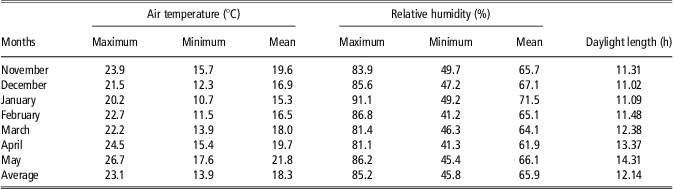
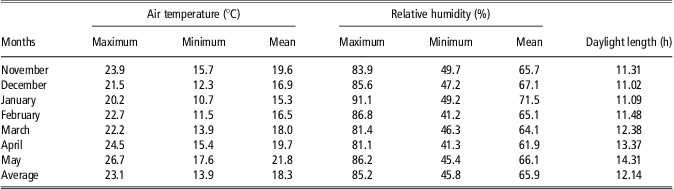
This experiment was conducted at a private commercial farm near Abou Homos City, Beheira Governorate, Egypt from November 2009 until May 2010 and lasted for 30 weeks. A flock of 117, 10-month-old Egyptian geese, comprising 90 females and 27 males were used in this experiment. Birds were randomly divided into three treatment groups of 30 females and 9 males each, in three replicates of 10 females and 3 males each. Birds were housed in windowless houses furnished with wood shaving as a litter, and contained nine pens of 2 × 3 m2. Each pen was provided with five nests. During the daytime, geese were exposed to natural light. The length of daylight, average maximum and minimum temperature and relative humidity during the experimental period are presented in Table 1.
Maximum, minimum and average air temperature (°C) and percentages of relative humidity (%) and daylight length hours during the experimental periods
Natural mating was practiced during the breeding season from November to the end of May. During the experiment, laying birds of the first group (pasture system, PS) were allowed access to water ducts for swimming during daytime. On pasture, geese ate green forages, seeds, leaves, grasses, plant stems, locusts, worms and other small animals. Geese can also eat natural protein sources like small fish, snails and crabs while swimming in the water ducts. The geese were supplied with home leftover foods from the farmer's house. The composition of leftover foods given to PS geese was 12% CP and 2000 kcal metabolizable energy (ME)/kg diet, 8% crude fiber and 2% ether extract and 12% crude ash (Association Official Analytical Chemists (AOAC), 1995). The second group of birds (intensive system (IS)) was kept in confinement in a house without access to swimming water and was fed a commercial feed ad libitum containing 16% CP, 2750 kcal ME/kg, 3% Ca and 0.35% non-phytate phosphorus, 0.60% total sulfur amino acids and 0.70% lysine. The third group of geese (semi-intensive system (SIS)) was herded to the pasture and given access to the same forage and water ducts during daytime as the PS geese for 6 h/day (0900 to 1500 h). In the remaining hours, they were kept in the barn and were given access to the aforementioned feed. The light–dark cycle was natural, from sunrise to sunset (Table 1). At the beginning of the experiment, all birds were vaccinated against avian influenza.
BW, feed intake and egg production measurements
BW of females, number of eggs laid per year (eggs/goose per year), individual egg weight (g) and egg mass per year (egg number × egg weight) were recorded. Feed intake (g feed/goose per day) and feed conversion ratio (FCR; g concentrated feed per egg) of commercial feed were recorded only for the IS and SIS groups. Males in all groups were weighed at the same time as the females.
Geese were allowed to incubate and hatch their eggs, although part was collected and broken for egg quality measurements and part was collected as they laid and incubated in a storage room for 7 days at 24°C and 60% relative humidity. Fertility and hatchability were determined naturally for each goose within each experimental system 4 weeks after initiation of the experiment. A total of 15 hatches per system were used in five replicates each. Fertilization of eggs was defined macroscopically on the 7th day of incubation. Percentage hatchability of fertile eggs was defined as the number of hatched goslings divided by the number of fertilized eggs per goose × 100.
A total of 10 eggs per replicate (30 eggs per treatment) were collected in each group during December, February and April to measure egg quality traits according to Attia et al. (Reference Attia, Burke and Yamani1994). Eggs were weighed and broken open. Yolk, albumen and eggshell were separated and weighed and expressed as a percentage of total egg weight. In addition, shell thickness (mm) and egg shape index [(egg width/egg length) × 100] were estimated.
Hormones and biochemical constituents
Blood samples were collected from two randomly chosen females and two males per replicate (six females and six males per treatment). Blood samples of 6 ml were collected at 15 months of age in the morning before access to feed of hens that had a hard shell egg in the uterus. One aliquot of blood from each bird was placed into a heparinized tube and the other into a non-heparinized tube. Plasma and serum were obtained by centrifugation of samples at 1500 × g for 20 min, and were stored at −18°C until the analyses.
Concentrations of plasma testosterone, estradiol-17 (E2) and progesterone (P4) were assayed by radioimmunoassay (RIA) using DSL Kits DSL-4000, DSL-43100 and DSL-3900, respectively (Diagnostic systems Laboratories Inc, TX, USA) according to Abraham (Reference Abraham1977). The RIA was done on two replicates per sample. Testosterone concentration in plasma was measured using immunoassay commercial kits (Biosource-Europe S.A. 8, rue de L'lndustrie, B-1400 Nivelles, Belgium). The sensitivity of the testosterone assay of 10 replicates of the 0 ng/ml of the testosterone standard is 0.08 ng/ml. The intra-assay coefficient of variation (CV) ranged from 7.8% to 9.6% of the mean of 10 replicates each. The CV for the inter-assay ranged from 8.4% to 9.1% of the average of duplicates for 10 separate runs.
The sensitivity of the E2 assay is 11.0 pg/ml at 95% confidence level. The intra-assay CV ranged from 2.01% to 5.17% from the mean of 12 replicates each. The CV for the inter-assay ranged from 6.59% to 7.93% of the average of duplicates for 24 separate runs.
The sensitivity of the P4 assay of 12 replicates of the 0 ng/ml P4 standard is 0.12 ng/ml. The intra-assay CV ranged from 4.8% to 8.0% of the mean of 10 replicates each. The CV for the inter-assay ranged from 9.2% to 13.1% of average duplicates for 10 separate runs.
Concentrations of serum total proteins (Armstrong and Carr, Reference Armstrong and Carr1964), total lipids (Fringes et al, Reference Fringes, Fendly, Dunn and Queen1972), calcium and phosphorus (Sarkar and Chauhan, Reference Sarkar and Chauhan1967) and alkaline phosphatase (Richmond, Reference Richmond1973) were estimated.
Semen quality
At 15 months of age, males were separated from females and trained for semen collection using the manual massage method. Semen was collected three times a week for 6 weeks. There were 50 ejaculates per husbandry system. Immediately after semen collection, a part of the freshly collected semen was used for determining semen quality traits according to Attia et al. (Reference Attia, Al-Hanoun and Bovera2011). Semen quality factor (SQF) values were calculated according to Liu et al. (Reference Liu, Zheng and Yang2008) using the following equation: SQF = ejaculate volume (ml) × sperm concentration (×106/ml) × live and morphologically normal spermatozoa (%) as reported by Łukaszewicz and Kruszynski (Reference Łukaszewicz and Kruszynski2003).
Growth and carcass quality of gosling
Goslings hatched from each management system were raised in the same system as the parents until 20 weeks of age. The growth performance was recorded between 4 and 20 weeks of age. At 20 weeks of age, five goslings were randomly chosen from each treatment and slaughtered for evaluation of carcass and organ traits. The weight of meat produced per year per goose (kg) was calculated using the following equation:
 $$\begin{array}{l} {\rm{Meat}}\,{\rm{produced}}\,{\rm{per year per goose (kg)}}\,{\rm{ = }}\,{\rm{Number of goslings produced by geese per year}} \\ \,\times \,{\rm{BW of goslings (kg) at 20 weeks of age}}{\rm{.}} \\ \end{array}$$
Statistical analysis
Data were analyzed by the GLM procedure (Statistical Analysis System (SAS), 1996) using one-way ANOVA with the following model:
 $${{Y}_{ij}}\,{\rm{ = }}\,\mu \,{\rm{ + }}\,{{D}_i}\,{\rm{ + }}\,{{e}_{ij}}$$
where Y is the dependent variable; μ the general mean; D the management system; e the random error.
Before analysis, all percentages were subjected to logarithmic transformation (log10x + 1) to normalize data distribution. The difference among means was determined using Duncan's new multiple range test (Duncan, Reference Duncan1955) at P ⩽ 0.05.
Results
Productive and reproductive performance of geese
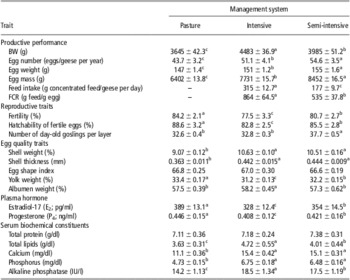
Results for productive traits are presented in Table 2. BW of geese was significantly (P ⩽ 0.05) greater in the IS than in the PS and SIS systems. Egg number, egg weight and mass were significantly (P ⩽ 0.05) greater in the SIS than in the PS and IS systems. Egg number and mass were significantly greater by 6.84% and 24.9% and 17.2% and 24.3% in the SIS than in the IS and PS systems, respectively.
Productive and reproductive performance, egg quality traits, plasma hormone and serum biochemical constituents of the Egyptian geese under different management systems (mean ± s.e.)

FCR = feed conversion ratio; BW = body weight.
Means within a row having different superscripts are significantly different (P < 0.05).
Concentrate feed consumption and FCR (which did not include grazing intake) were significantly higher in IS geese than SIS geese. Fertility and hatchability of fertile eggs were significantly (P ⩽ 0.05) greater in the PS than the IS and SIS systems. Number of day-old gosling produced per goose was significantly (P ⩽ 0.05) greater in the SIS than in the PS and IS systems.
Egg quality traits
The effects of different management systems on egg quality traits are presented in Table 2. Eggshell weight (%) and eggshell thickness produced by geese in the IS and SIS systems were significantly (P ⩽ 0.05) greater than those in the PS system. No significant (P ⩾ 0.05) difference among different husbandry systems was observed for egg shape index. Egg yolk weight (%) of geese in the PS system was significantly (P ⩽ 0.05) greater than those in the IS and SIS systems, but albumen weight (%) was significantly (P ⩽ 0.05) greater in the IS than in the PS and SIS systems.
Blood plasma hormones and serum biochemical constituents of geese
Data presented in Table 2 shows the effect of different managerial systems on blood plasma hormones and serum biochemical constituents. The PS geese showed significantly (P ⩽ 0.05) greater E2 and P4 concentration than SIS and IS geese. In addition, SIS geese exhibited significantly (P ⩽ 0.05) greater P4 than IS geese. No significant difference (P ⩾ 0.05) among different systems was shown in the total serum protein concentration, but IS geese had significantly greater serum total lipid concentration than the PS and SIS geese. In addition, SIS geese exhibited greater total lipid concentration compared with PS geese. Serum calcium, phosphorous and alkaline phosphatase concentrations of IS and SIS geese were significantly (P ⩽ 0.05) greater than those of the PS geese.
Blood plasma testosterone, serum biochemical constituents and semen quality
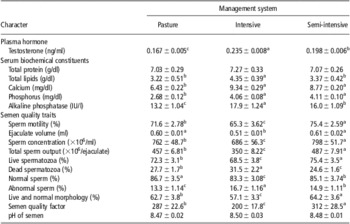
The effects of management system on blood plasma testosterone, serum biochemical constituents and semen quality of geese are shown in Table 3. Testosterone of the IS geese was significantly (P ⩽ 0.05) greater than that of the other two groups and that of the SIS geese was significantly (P ⩽ 0.05) greater than that of the PS geese.
Blood plasma testosterone, serum biochemical constituents and semen quality of the male Egyptian geese under different management systems (mean ± s.e.)

Means within a row having different superscripts are significantly different (P < 0.05).
Semen quality factor = ejaculate volume (ml) × sperm concentration (×106/ml) × live and morphologically normal spermatozoa (%).
There were no significant differences in total serum protein among males of the different husbandry groups but IS geese had significantly (P ⩽ 0.05) more serum total lipid concentration than the PS and SIS geese. Serum calcium and phosphorus of IS and SIS geese were significantly (P ⩽ 0.05) greater than those of PS geese. Serum alkaline phosphatase exhibited a similar trend but differences between SIS and IS geese were significantly (P ⩽ 0.05) in favor of SIS geese.
Ganders in the SIS system produced sperm with significantly (P ⩽ 0.05) greater motility than those in the IS and PS systems and motility of spermatozoa from the latter group was significantly (P ⩽ 0.05) greater than that of the IS system. There were no significant differences between PS and SIS in ejaculate volume, but ganders on both systems produced significantly (P ⩽ 0.05) greater ejaculate volume than those in the IS system. Sperm concentration and total sperm output of ganders in the SIS system was significantly (P ⩽ 0.05) greater than those on the other systems. In addition, ganders in the PS system had (P ⩽ 0.05) greater sperm concentration and total sperm output than those in the IS system.
Geese in the SIS system produced significantly (P ⩽ 0.05) greater percentage of live sperm and live and normal morphological sperm than those in the PS and IS systems, whereas the latter group showed the smallest values but fewer dead spermatozoa. In addition, PS geese produced significantly (P ⩽ 0.05) more normal sperm than the other husbandry systems, but less abnormal sperm.
SQF was significantly (P ⩽ 0.05) greater in SIS geese than in PS and IS geese. The latter group exhibited the smallest value. Semen pH was not significantly (P ⩽ 0.05) different among various husbandry systems.
Goslings growth performance and carcass traits
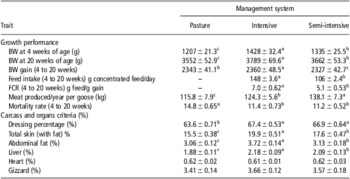
The results of productive performance and carcass criteria of goslings as affected by the managerial system are presented in Table 4. There were significant (P ⩾ 0.05) differences in BW among the three husbandry systems at 4 and 20 weeks of age. Concentrated feed intake and FCR of IS and SIS were significantly (P ⩽ 0.05) different between the two groups in favor of the SIS system.
Growth performance and carcass and organs criteria of the gosling under different management systems (mean ± s.e.)

FCR = feed conversion ratio; BW = body weight.
Means within a row having different superscripts are significantly different (P < 0.05).
Meat produced/year per goose (kg) = number of goslings produced by geese per year × BW of goslings (kg) at 20 weeks of age.
There were no significant (P ⩽ 0.05) differences between IS geese and SIS geese in mortality rate during 4 to 20 weeks of age, but birds in both systems exhibited significantly (P ⩽ 0.05) less mortality than those in the PS system.
Dressed carcass weight (%) was significantly greater in IS and SIS than in PS goslings (Table 4). Total skin with fat of PS birds was significantly smaller than that of SIS and IS goslings and that of the IS goslings was, in turn, greater than that of the SIS birds. A similar trend was shown in abdominal fat percentage. In addition, liver percentage of IS was significantly (P ⩽ 0.05) greater than that of birds in the other systems. Differences among husbandry practices were not significant (P ⩾ 0.05) for heart and gizzard percentage. The total amount of meat produced per goose was significantly greater in the SIS than that in the other systems, and greater in IS geese than in PS geese.
Discussion
The productive performance in terms of number, weight and mass of eggs, number of day-old gosling and total amount of meat produced per goose of SIS geese was greater than that of PS and IS geese, and this could be attributed to a more favorable husbandry practice and availability of feed and animal protein supply. The egg number and egg mass in SIS geese was greater by 6.84% and 24.9% and 17.2% and 24.3% than in IS and PS geese, respectively. Similar results were reported by Bielinska et al. (Reference Bielinska, Pakulska and Bielinski1993) who found no adverse effect of low-energy feed mixture (8.95 MJ ME/kg) on reproductive performance, health condition of birds, feed consumption and BW in white Italian geese. However, greater egg production (up to 70 eggs per layer) and hatchability were favored during the reproductive period by ad libitum consumption of layer feed having a nutritive value of 8.9 MJ ME/kg, 14.6% CP, 0.5% lysine and 0.5% methionine with cystine. Thus, nutrient requirements of geese during the egg production period is dependent upon climatic conditions and green forage supply and complete omission of the latter. When a diet of increased protein content was fed, an increase in egg production was found only in 1-year-old geese but fertility and number of hatched day-old goslings decreased (Bogenfürst et al., Reference Bogenfürst, Karakas, Palmai and Taraszenkó1997; Bogenfürst, Reference Bogenfürst1998). Geese show a poor capacity to maintain their energy intake at a constant level when dietary energy content increases (Bogenfürst, Reference Bogenfürst1998). On the other hand, Nageswara et al. (Reference Nageswara, Ravindra Reddy, Ramasubba Reddy and Eshwaraiah Acharya1999), found that duck egg production was lower in traditional husbandry than in the IS system as a result of inadequate and unbalanced feed. In addition to availability of concentrated feeds besides pasture, the increase in E2 and P4 in the SIS system could provide a further explanation for the increased laying performance, due to stimulating of ovaries during swimming as a result of a 44% increase in the total systemic conductance, a 30% increase in the blood flow to the heart and a 70% increase in the cardiac output (Butler et al., Reference Butler, Turner, Al-Wassia and Bevan1988).
Geese in the SIS system could satisfy about 44% of their feed from scavenging (green forages, seeds, leaves, grasses, plant stems, locusts, worms and other small animals), which resulted in a 38% improvement of commercial feed utilization and thus reduced feed costs as compared to the IS system, although there was no measurement of actual FCR as grazing intake was not included in the SIS system. Obviously, when birds were totally dependent on scavenging (PS system) to satisfy their nutrient requirements, growth, egg number and egg weight were dramatically declined by 18.7% and 8.5%, 14.5% and 20% and 3.1% and 5.4% compared with IS and SIS geese, respectively. This indicates that SIS resulted in optimal productive performance of geese. Fertility and hatchability values under natural incubation was the greatest in the PS geese. There may be a relation between the negative effect on fertility and hatchability caused by the omission of green forage in the IS system and to lesser extent in SIS husbandry regimens, and deficiency of one or more vitamins or possibly trace elements (Kovács, Reference Kovács1972). Kovács (Reference Kovács1972) demonstrated that non-differentiated vitamin supplementation can improve fertility by 5% to 14%. Geese in the PS system produced eggs with lower shell quality, which could be attributed to inadequate availability of minerals, particularly Ca and P. Excessive calcification may lead to poor hatchability (Sonbol et al., Reference Sonbol, Abdella, Yamani and Attia1991) due to geese egg characteristics during incubation, which need special transaction to break the crust (Pingel, Reference Pingel1992; Branckaret, Reference Branckaret1995). The decrease in serum Ca and P in the PS system was due to a decrease in feed intake and thus Ca and P intake and this could explain the lower shell quality of PS geese. Serum calcium, phosphorus and alkaline phosphatase of IS and SIS geese were significantly higher by 29.7% and 28.9% for calcium and by 11.7% and 10.1% for phosphorus than the PS geese, respectively.
Semen with greater quality was produced by geese in the SIS system than by those in the other systems and this agrees with their productive performance. However, fertility was optimal in the PS group and the highest testosterone concentration was found in IS geese. Records for semen volume in this experiment were lower than those reported by Kacheva et al. (Reference Kacheva, Nikolon, Koleva and Gerzilov2004). The difference in volume agrees with the report of Setioko and Hetzel (Reference Setioko and Hetzel1984) who found that housing system affects semen volume of drakes. In addition, Etuk et al. (Reference Etuk, Ojewola and Nwachukwu2006) found that semen volume, sperm motility and sperm count were significantly higher in Muscovy drakes raised in SIS and IS systems with wallow than an IS system without wallow. Similarly, the availability of swimming water may have an effect on semen quality considering the fact that drakes in PS and SIS with access to swimming water tend to produce better semen characteristics than drakes in an IS system (Etuk et al., Reference Etuk, Ojewola and Nwachukwu2006). The lack of agreement in the results of SQF or testosterone concentration and fertility of geese could be attributed to multi-factors affecting fertility besides semen quality traits, such as copulation, hygienic condition and pre-incubation mortality (Attia et al., Reference Attia, Burke, Yamani and Jensen1995).
The growth of goslings in the IS was also greater than that of goslings in the other husbandry systems and this could be attributed to the increased intake of concentrated feed and a decrease in energy expenditure during grazing. In addition, goslings in the confinement system supplied with balanced and adequate feed showed increased fat content of the carcass and liver but the contrary was shown in gosling in the PS system. The latter effect may be due to a higher dietary fiber level and lower digestibility of pasture feeds and a consequently a lower nutrient availability (Hsu and Hsu, Reference Hsu and Hsu1992); this parallels the changes in serum total lipid concentration of geese. However, geese have an outstanding capacity for the utilization of grass types (Cowan, Reference Cowan1980), although its digestion of fiber is no better than that of other poultry species. The present results are in agreement with those reported by Meulen et al. (Reference Meulen, Van der and Dikken1999) and El-Hammady et al. (Reference El-Hammady, Abdelnabi, Youssef and Abou El-ezz2007), who reported that growth of geese depends on the way they are kept and fed, but FCR was better in the SIS geese. In addition, goslings kept in confinement and semi-confinement systems suffered lower mortality rates than those kept in a traditional system and this may be because of exposure to certain diseases such as avian mkhaltatha during grazing (Pingel, Reference Pingel1992).
Conclusion
Semi-intensive management of Egyptian geese resulted in improved egg production, feed conversion of commercial feed, number of gosling per hen and total amount of meat produced per hen. The decreased feed costs of the PS and SIS compared with that of the IS may be because of adequate and balanced feeds and lower energy expenditure. However, the PS resulted in improved fertility and hatchability of breeding geese.