Introduction
Commelina benghalensis L. (Commelinaceae), a perennial herb, is a weed of 25 crops in 28 countries (Wilson, Reference Wilson1981; Caton et al., Reference Caton, Mortimer, Hill and Johnson2010). It was first reported from the USA during 1928 and was recognized as a noxious weed in 1983 (Faden, Reference Faden1993; Webster et al., Reference Webster, Burton, Culpepper, Flanders, Grey and York2006). It has become a major weed in the southeastern coastal plain of the USA in various crops such as cotton (Gossypium sp.) and peanut (Arachis hypogaea L.) (Webster et al., Reference Webster, Burton, Culpepper, Flanders, Grey and York2006). It is listed as a Federal Noxious weed in Florida and Georgia in cotton, peanut, maize (Zea mays L.), soybean [Glycine max (L.) Merr.], nursery stock and orchards (Webster et al., Reference Webster, Burton, Culpepper, Flanders, Grey and York2006). In the South Burnett region of south-eastern Queensland, the weed is found extensively in cultivation and is associated with peanut, navy or dry bean (Phaseolus vulgaris L.), sorghum [Sorghum bicolor (L.) Moench] and maize (Walker & Evenson, Reference Walker and Evenson1985). Commelina benghalensis is considered as a major weed of rice, maize, sorghum, soybean, mung bean [Vigna radiata (L.) R. Wilczek] and peanut in Southeast Asia (Holm et al., Reference Holm, Plucknett, Pancho and Herberger1977). It is also one of the most noxious weeds of rice in India (Wilson, Reference Wilson1981). It is currently controlled by applying herbicides such as Axiom® (flufenacet + metribuzin), Dual Magnum®Canopy SP® (metribuzin +chlorimuron) during pre-emergence, while herbicides such as Basagran®, Classic® (acetochlor) and Pursuit® (Imazethapyr) are used during post-emergence. But, it has been reported that applying herbicides with soil residual activity is crucial for the management of C. benghalensis (Webster et al., Reference Webster, Burton, Culpepper, Flanders, Grey and York2006; Issac et al., Reference Issac, Gao, Li, Price and Kelton2013).
Murdannia nudiflora (L.) Brenan (Commelinaceae) is also a perennial herbaceous weed in Indian rice-fields (Moody, Reference Moody1989; Waterhouse, Reference Waterhouse1993). It infests 16 crops in 23 countries (Holm et al., Reference Holm, Plucknett, Pancho and Herberger1977), and has been reported from China, Bangladesh, Nepal, Sri Lanka, Pakistan, Thailand, Vietnam, Philippines, Japan, Africa, Central, North and South America (Holm et al., Reference Holm, Plucknett, Pancho and Herberger1977; Waterhouse, Reference Waterhouse1993). It has also been reported as a weed in cocoa (Theobroma cacao L.) and rubber (Hevea brasiliensis Müll. Arg.) in Malaysia, tea [Camellia sinensis (L.) Kuntze] in Indonesia, pineapples [Ananas comosus (L.) Merr.] in Guinea, Hawaii and the Philippines, sugarcane (Saccharum spp.) in Angola, Hawaii, Indonesia, Brazil, Philippines and Taiwan, and coffee (Coffea arabica L.) in Venezuela (Holm et al., Reference Holm, Plucknett, Pancho and Herberger1977). It has become an invasive species in the USA from Texas to North Carolina, where it is common in cotton and soybean. It is also recorded as a weed in peanut, maize, banana (Musa sp.), citrus [Citrus limon (L.) Burm. f] (Ahmed et al., Reference Ahmed, Opena and Chauhan2015). It is well adapted to wet-dry climates typical of tropical and subtropical Asian regions and is abundant throughout the year. Growers apply herbicides (bentazone, metribuzin, triazines and 2,4-D) to control it (Wilson, Reference Wilson1981).
The insect Lema praeusta (Fab.) (Coleoptera: Chrysomelidae) is broadly distributed in India, Sri Lanka, South China, Indochina, Indonesia (Sumatra), Hainan Island and Taiwan (Warchałowski, Reference Warchałowski2011). Sengupta & Behura (Reference Sengupta and Behura1957) recorded L. praeusta from Orissa, India as a minor pest on turmeric and stated that it also fed on eggplants and cucurbits, but Kalaichelvan et al. (Reference Kalaichelvan, Verma and Sharma2003) recorded L. praeusta on Commelina species. We observed that first and second instar L. praeusta larvae feed on the undersides of C. benghalensis and M. nudiflora leaves, which gives the leaves a net-like appearance. Third and fourth instar larvae completely defoliate both weeds (personal observation). Adults feed on leaves of both C. benghalensis and M. nudiflora (fig. 1). After defoliating plants, third and fourth instar larvae and adults of L. praeusta will also feed on stems of both weeds (personal observation).
Adults of Lema praeusta engaged in feeding on Commelina benghalensis (a) and Murdannia nudiflora (b) leaves.

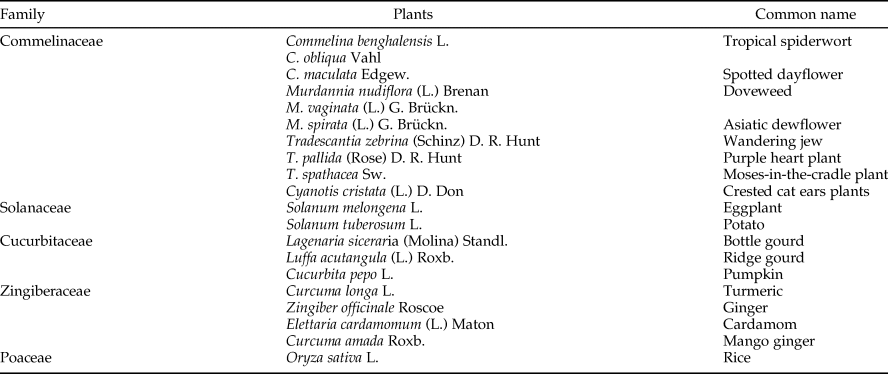
In the current study, we offered leaves of Zingiberaceae (turmeric, cardamom, ginger and mango ginger), Solanaceae (potato and eggplant) and Cucurbitaceae (bottle gourd, ridge gourd and pumpkin) to observe feeding damage by larvae and adults of L. praeusta. We tested ten species of Commelinaceae plants as hosts, and also studied the biology, fecundity table and life table parameters of L. praeusta on C. benghalensis and M. nudiflora to understand its potential as a biological control agent against both these weeds.
Materials and methods
Plant and insect materials
All plants were sourced from the vicinity of the University of Burdwan (23°16′ N & 87°54′ E), West Bengal, India (table 1). Each uninfested plant (table 1) was 1 week old (ca. 12 cm height) and was planted separately in pots containing ~1500 cm3 of soil. Each whole plant (ca. 12 cm height) and the pot was covered with a fine mesh nylon net cage [80 cm (height) × 60 cm (diameter)] to prevent insect attack. Plants that were 3–4 weeks old (ca. 45 cm height) were used for the host-specificity study.
Plants used for the host-specificity study (no-choice tests) of Lema praeusta.

Lema praeusta was identified by Dr J. Poorani, Principal Scientist, National Research Centre for Banana, Tamilnadu and confirmed by following the keys of Warchałowski (Reference Warchałowski2011) and Lee & Matsumura (Reference Lee and Matsumura2013).
Two separate cultures of L. praeusta (one reared on C. benghalensis leaves and the other on M. nudiflora) were maintained at 27 ± 1°C, 65 ± 5% RH and 12L:12D photoperiod in a biological oxygen demand incubator (ADS instruments and Tech., Calcutta, India) for five generations. Sixth generation males and females were used to study developmental duration and construct fecundity and life table parameters.
Host-specificity studies
The host-specificity study was performed by exposing first instar larvae and adults of L. praeusta on plants mentioned in table 1. In no-choice and choice tests, light trap collected L. praeusta adults were starved for 24 h before use. Newly emerged first instar larvae were used in no-choice tests.
In no-choice tests, 20 L. praeusta adults were placed separately on each of five plants per plant species (table 1). Ten first instar larvae of L. praeusta were also placed separately on each of five plants per species (table 1). The plants were examined 24 h after the experiment began, and feeding was recorded on a subjective visual scale.
In choice tests, light trap collected L. praeusta females engaged in copulation were used to observe egg laying preference as females begin laying eggs 24 h after they have finished mating. After mating, 20 females were placed in a net cage (1.52 m length, 1.52 m breadth and 1.22 m height) containing C. benghalensis and M. nudiflora plants in separate pots placed 0.61 m apart to record the oviposition preference of L. praeusta. Numbers of eggs laid by L. praeusta on C. benghalensis and M. nudiflora leaves were observed after 24 h of mating (each replicate contained 20 adults, N = 5). After each replicate, plants and insects were discarded.
Fecundity table
This experiment was conducted by taking newly emerged sixth generation virgin male and female L. praeusta adults that had been reared on either C. benghalensis or M. nudiflora. For egg laying, a pair of newly emerged virgin male and female were kept together in a 15 cm (length) × 8 cm (diameter) sterilized glass jar containing leaves of the same plant species on which they had been reared (N = 20). The petioles of fresh mature leaves were inserted into a moist piece of cotton, which was wrapped with aluminium foil to prevent moisture loss, and provided daily both for feeding and egg laying. Data were collected as pre-oviposition, oviposition and post-oviposition periods of L. praeusta fed on either C. benghalensis or M. nudiflora leaves. During the oviposition period, the number of eggs laid was recorded at 24 h intervals. Fecundity tables of L. praeusta fed on each host plant were separately constructed following Krebs (Reference Krebs1999) and Smith & Smith (Reference Smith and Smith2001). The fecundity table includes x = the age categories, l x = age-specific survivorship from the female life table, m x =age-specific productivity and the mean number of female young produced by each female of age x = l xmx, which is m x weighted by survivorship. Further, xl xmx was obtained by multiplying the l xmx by the appropriate age. The eggs laid by L. praeusta of a particular age class and the survivorship of females in that age class were used to calculate the net reproductive rate (R o = Σ l xmx), mean generation time (T c = Σ xl xmx/R o), intrinsic rate of increase (r m = logeR o/T c), finite rate of increase (λ = er by using Euler r), and doubling time (D.T. = loge 2/r m).
Growth duration of L. praeusta
The larval development of L. praeusta was conducted using 100 eggs laid on the same day by 20 different sixth generation females that had been reared on either C. benghalensis or M. nudiflora. Larvae were reared at 27 ± 1°C, 65 ± 5% RH and 12L:12D in a biological oxygen demand incubator on the same species of plant leaves and on which oviposition had occurred. One hundred eggs were randomly divided into ten batches to record total larval and pupal duration, and male and female longevity on each type of leaf. During development time, dead larvae were replaced with same age larvae from rearing stock that had been fed on the same plant species. Larval length, breadth and head capsule width for all the instars along with pupal length and breadth of L. praeusta were measured for each type of leaf separately. Furthermore, length and breadth including fresh and dry weights of newly emerged adults were recorded. Date of death of the adult males and females were recorded.
Life table study
Eggs (N = 250) laid within a 12 h period by 30 L. praeusta females were collected randomly for separate life table studies on C. benghalensis and M. nudiflora. The larvae were fed on the same species of plant leaves on which adults had been reared for five generations and on which oviposition had occurred. Twenty-five eggs from each plant species were kept in each of ten glass jars (15 cm length × 8 cm diameter) and maintained at 27 ± 1°C, 12L:12D and 65 ± 5% RH. The larvae surviving in each instar were counted at 24 h intervals until they pupated, and mortality of pupae and adults was also recorded at 24 h intervals. Data obtained from egg hatch to adult death of L. praeusta on each type of leaf were collectively used to construct the life tables following Southwood & Henderson (Reference Southwood and Henderson2000). The life table parameters considered were: x = age interval of age class, n x = number of survivors at the start of age interval x, l x = proportion of organisms surviving to start age interval x, d x = number or proportion dying at age interval x to x + 1, q x = rate of mortality during the age interval x to x + 1, L x = number of individuals alive on the average during the age interval x to x + 1, T x = total number of individuals of stage units beyond stage x, and e x (life expectancy) = T x/l x.
Statistical analysis
Student's t test was applied to compare data on life history parameters of L. praeusta (each instar, total larval and pupal duration, and longevity of males and females) and length, breadth and head capsule width of all instars of L. praeusta (Zar, Reference Zar1999). The net reproductive rate (R o), the intrinsic rate of increase (r m), the generation time (T c), Euler equation, Euler r (r – adjusted), the doubling time (DT) and the finite rate of increase (λ) were also estimated using jackknife and bootstrap (m > 1000) techniques (Meyer et al., Reference Meyer, Ingersoll, McDonald and Boyce1986; Efron & Tibshirani, Reference Efron and Tibshirani1993).
Results
Host-specificity
Twenty-four hours after placing first instar larvae on Zingiberaceae (turmeric, cardamom, ginger and mango ginger), Solanaceae (potato and eggplant), Cucurbitaceae (bottle gourd, ridge gourd and pumpkin) and rice plants, all the larvae died. No feeding damage was noticed on any of the plants tested in this study. However, adults laid eggs on the upper side of the leaves of C. benghalensis and M. nudiflora.
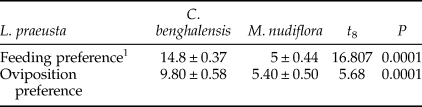
In choice assays between C. benghalensis and M. nudiflora plants, significantly more adults were engaged in feeding on C. benghalensis leaves compared with M. nudiflora (table 2). Mated females laid significantly more eggs after 24 h of release on C. benghalensis compared with M. nudiflora leaves (table 2). In the laboratory, mated females generally started to lay eggs 3–4 days after mating began. Some females laid eggs after 24 h of release on the leaves, suggesting that light trap collected females had already mated in the field.
Feeding (number of insects engaged in feeding) and egg laying preference (number of eggs laid ± SE) of light trap collected Lema praeusta adults (n = 20) 24 h after being released in net cages containing Commelina benghalensis and Murdannia nudiflora plants (n = 5 per species).

1 For feeding preference, males and females were released in equal numbers.
Fecundity table
Newly emerged L. praeusta males and females started to mate after 1 or 2 days. On average, one female mated three times during its life span, and a few females also mated a fourth time. The preoviposition period of newly emerged L. praeusta females varied between 3 and 10 days (6.1 ± 0.23 days, mean ± SE) when fed on C. benghalensis and M. nudiflora leaves. A single mating for C. benghalensis- and M. nudiflora-fed L. praeusta continued for 44.95 ± 1.03 (mean ± SE) minutes.
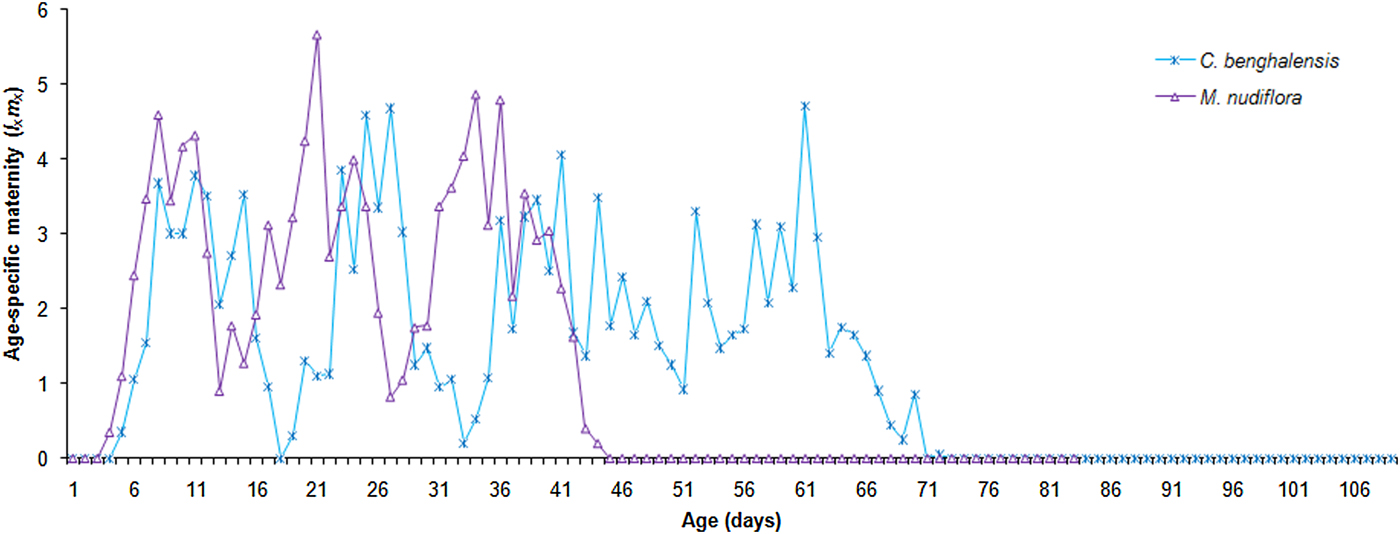
The period of reproductivity of C. benghalensis-fed L. praeusta females varied between 5 and 72 days (58.45 ± 1.01, mean ± SE days), whilst the period of reproductivity of M. nudiflora-fed females continued from 4 to 44 days (33.85 ± 0.66, mean ± SE days). Females fed on C. benghalensis and M. nudiflora leaves laid an average of 272.95 ± 2.39 (mean ± SE) eggs (range 245–284) and 224 ± 1.74 (mean ± SE) eggs (range 209–235) during their life time, respectively. The postoviposition period of females fed on C. benghalensis and M. nudiflora leaves was 38.9 ± 0.71 (mean ± SE) days. Fecundity of L. praeusta was age-dependent when they were fed on either C. benghalensis or M. nudiflora. Most of the C. benghalensis-fed females began to lay eggs when they were 8 days old, and there were eggs laying peaks at 8–12, 23–28, 36–41 and 57–62 days (fig. 2). Most M. nudiflora-fed females began to lay eggs when they were 8 days old, and there were eggs laying peaks at 6–12, 17–24 and 31–40 days (fig. 2). The mean number of eggs laid per day per C. benghalensis- and M. nudiflora-fed female over their lifetime was 2.76 ± 0.03 (mean ± SE) (range 0–29). Freshly laid eggs were yellow and sticky but later turned brown. Just before hatching, one end of the egg turned dark brown, indicating the cephalic side of the emerging larva.
Age-specific maternity (l xmx) of Lema praeusta fed on Commelina benghalensis and Murdannia nudiflora leaves calculated under laboratory conditions (27 ± 1°C, 65 ± 5% RH and 12L:12D).

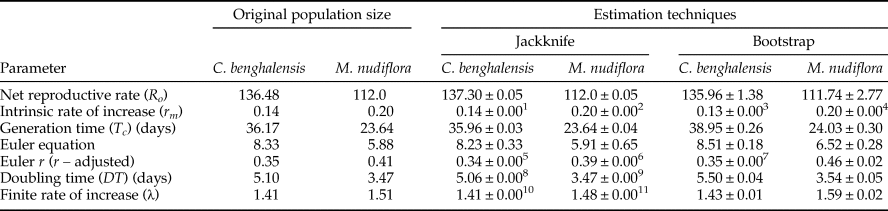
The age-specific maternity (l xmx) of L. praeusta on C. benghalensis and M. nudiflora is shown in fig. 2. The net reproductive rate (R o), generation time (T c), intrinsic rate of increase (r m), doubling time (DT) and the finite rate of increase (λ) of C. benghalensis- and M. nudiflora-fed L. praeusta population are presented in table 3. The means and standard errors of R o, T c, r m, DT and λ of C. benghalensis- and M. nudiflora-fed L. praeusta estimated by jackknife and bootstrap methods are also presented in table 3. The R o, T c and DT were higher both in jackknife or bootstrap estimates for L. praeusta when fed on C. benghalensis compared with M. nudiflora, whereas r m and λ of L. praeusta were higher both in jackknife or bootstrap estimates when fed on M. nudiflora compared with C. benghalensis (table 3).
Life table parameters estimated with jackknife and bootstrap techniques (mean ± SE) calculated for Lema praeusta on Commelina benghalensis and Murdannia nudiflora leaves under laboratory conditions (27 ± 1°C, 65 ± 5% RH and 12L:12D).

1 0.0001.
2 0.0003.
3 0.0009.
4 0.0027.
5 0.0005.
6 0.0013.
7 0.0077.
8 0.0036.
9 0.0058.
10 0.0007.
11 0.0019.
The means of population parameters of C. benghalensis and M. nudiflora under jackknife or bootstrap were significantly different (P < 0.01) using the Mann–Whitney U test using SPSS software.
Growth duration of L. praeusta
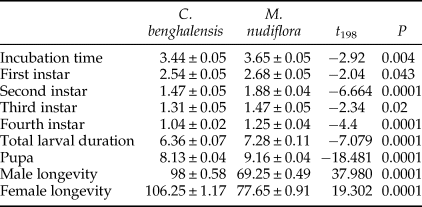
The development of 100 L. praeusta larvae on C. benghalensis and M. nudiflora leaves are separately reported. The incubation period and duration of each of the four instars and total larval developmental period of L. praeusta were higher on M. nudiflora compared with C. benghalensis (table 4). Before pupation, late fourth instar larvae left the plant and moved down plant stems in search of moist soil where pupation took place over 8–9 days. The pupal period was longer on M. nudiflora compared with C. benghalensis (table 4). Generally, adult females lived longer on both types of leaves compared with adult males (table 4). Longevity of L. praeusta males and females were higher on C. benghalensis compared with M. nudiflora (table 4).
Development time (mean ± SE, day) of eggs, larvae, pupae and longevity of Lema praeusta on Commelina benghalensis and Murdannia nudiflora leaves under laboratory conditions (27 ± 1°C, 65 ± 5% RH and 12L:12D).

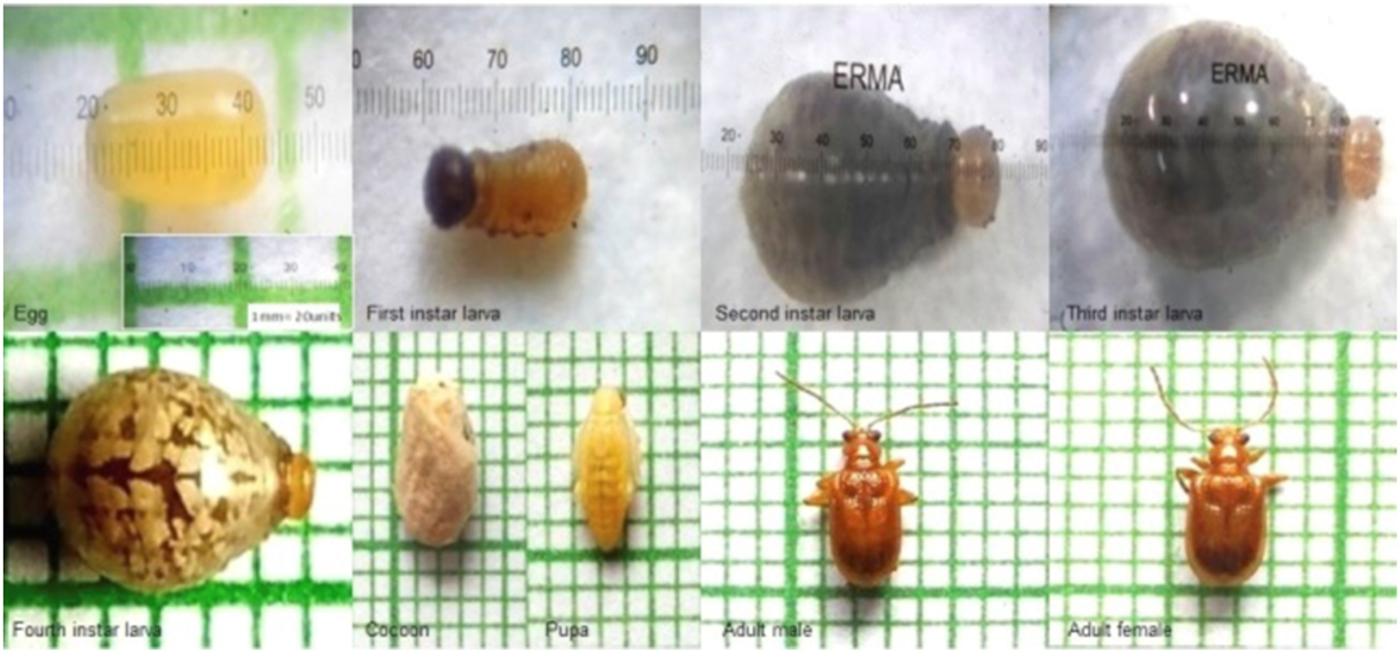
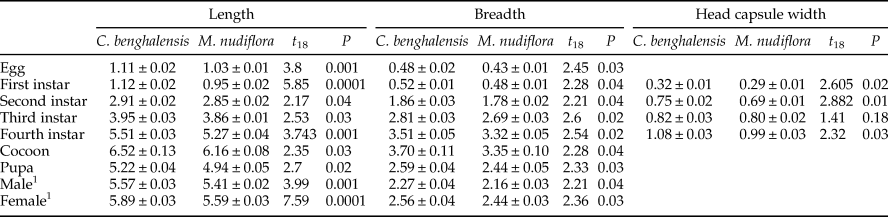
The length and breadth of the egg were significantly greater on C. benghalensis compared with M. nudiflora (table 5). The first instar larvae were yellow, second and third instars larvae were black, while fourth instar larvae were white (fig. 3). Except for third instar larvae where larval head capsule width did not significantly differ between the two plant species, the length, breadth and head capsule widths of all four instars of L. praeusta larvae fed on C. benghalensis were greater compared with larvae fed on M. nudiflora (table 5). The cocoon was creamy white and the pupa was pale yellow (fig. 3). The cocoon and pupal length and breadth of L. praeusta were longer when fed on C. benghalensis compared with M. nudiflora (table 5). The sex ratio of newly emerged males and females on both the plant species was 1 male : 2 females. The length and breadth of newly emerged females were greater compared with males when fed on both types of leaves, but the length and breadth of newly emerged males and females were higher on C. benghalensis compared with M. nudiflora (table 5). Generally, newly emerged females were heavier compared with males on both C. benghalensis and M. nudiflora (table 6). The fresh and dry weights of newly emerged males and females of L. praeusta fed on C. benghalensis were heavier compared with males and females that emerged from M. nudiflora (table 6).
Different stages of Lema praeusta from egg to adult emergence.

Length, breadth and head capsule width of Lema praeusta (mm ± SE) larval instars and length and breadth of egg, pupa, newly emerged male and female of L. praeusta feeding on Commelina benghalensis and Murdannia nudiflora under laboratory conditions (27 ± 1°C, 65 ± 5% RH and 12L:12D).

1 Means: newly emerged.
Fresh weight and dry weight (mg ± SE) of a newly emerged male and female Lema praeusta fed on Commelina benghalensis and Murdannia nudiflora under laboratory conditions (27 ± 1°C, 65 ± 5% RH and 12L:12D).

Life table study of L. praeusta
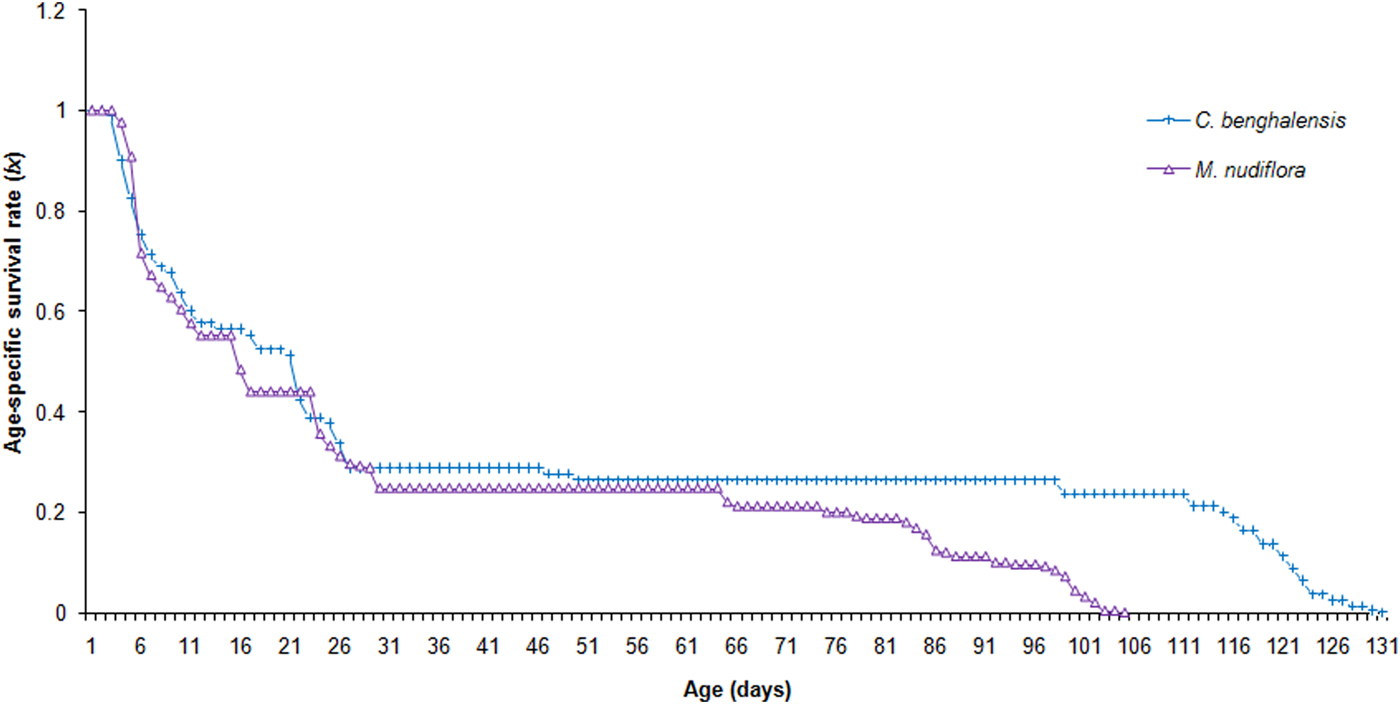
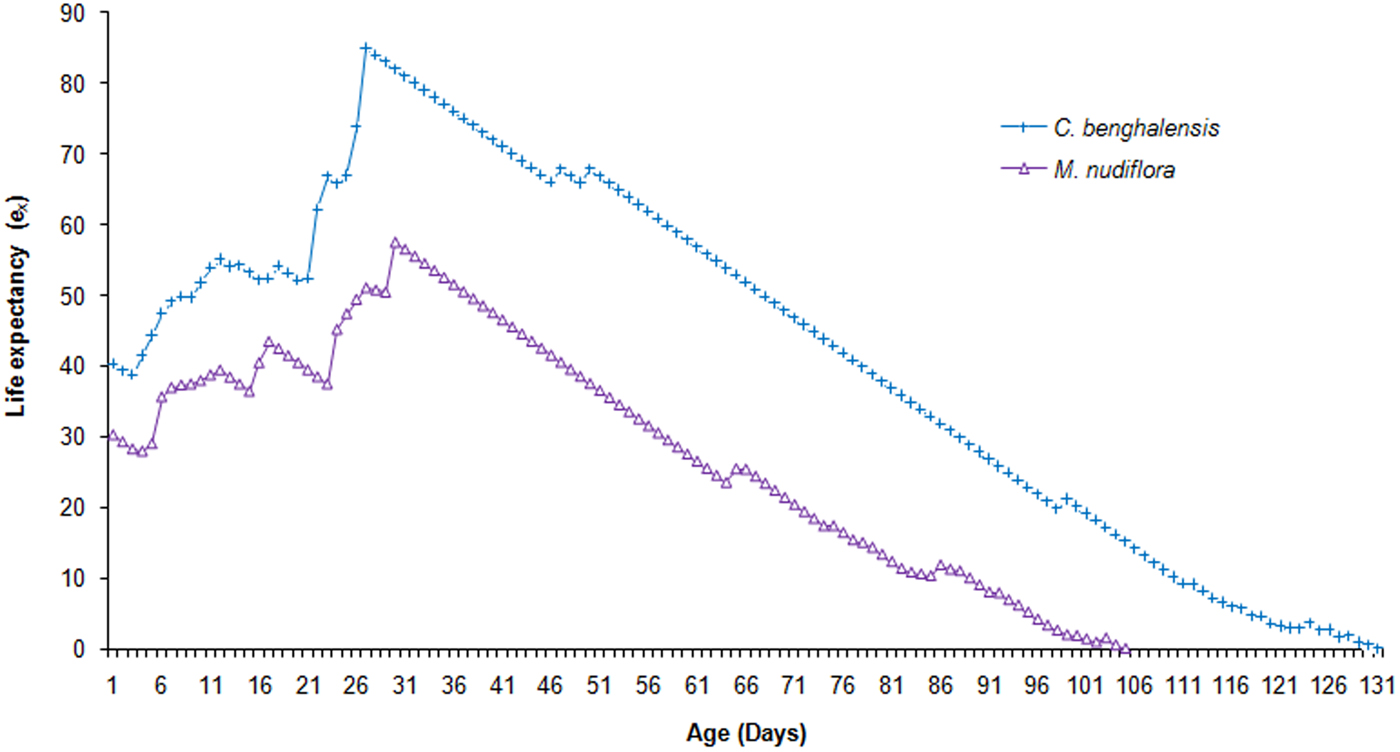
Commelina benghalensis-fed L. praeusta survived up to 129 days, whilst M. nudiflora-fed L. praeusta survived up to 103 days. The survival rate of C. benghalensis-fed L. praeusta from egg to adult was 38.8%, whereas 33.2% adults emerged from eggs when L. praeusta were fed on M. nudiflora. The l x (age-specific survival rate) of C. benghalensis-fed L. praeusta were 51.2% at day 20, 28.8% at day 30, 26.4% from day 50 to 90, 23.6% at day 103, 11.2% at day 120 and last adult died on day 129 (fig. 4). The l x of M. nudiflora-fed L. praeusta was 44% at day 20, 24.8% from day 30 to 50, 18.8% at day 80, 11.2% at day 90 and last adult died on day 103 (fig. 4). Twenty-nine females and 21 males were alive at day 114 when L. praeusta were fed on C. benghalensis, but at day 122 all males were dead and 16 females were still alive. Eighteen females and 12 males were alive at day 86 when L. praeusta were fed on M. nudiflora, at day 98 all males were dead, but all 18 females were still alive. The life expectancy (e x) of L. praeusta when fed on C. benghalensis and M. nudiflora are shown in fig. 5.
Age-specific survivorship (l x) of Lema praeusta fed on Commelina benghalensis and Murdannia nudiflora leaves calculated under laboratory conditions (27 ± 1°C, 65 ± 5% RH and 12L:12D).

Life expectancy (e x) of Lema praeusta fed on Commelina benghalensis and Murdannia nudiflora leaves calculated under laboratory conditions (27 ± 1°C, 65 ± 5% RH and 12L:12D).

Discussion
Our observations and data conflict with published accounts of L. praeusta as a minor pest on turmeric in Orissa (Sengupta & Behura, Reference Sengupta and Behura1957) because we did not observe any feeding damage by larvae and adults of L. praeusta on turmeric leaves. We did not notice L. praeusta larvae and adults on leaves of eggplant, bottle gourd, ridge gourd and pumpkin in the Crop Research Farm of our University during 2 years of observation, but we observed both larvae and adults of L. praeusta feeding on C. benghalensis and M. nudiflora in rice-fields. Eggplant, bottle gourd, ridge gourd and pumpkin plants were within 9 m of both weeds, suggesting that the previous report of L. praeusta as a pest of eggplant, bottle gourd, ridge gourd and pumpkin was wrong (Sengupta & Behura, Reference Sengupta and Behura1953, Reference Sengupta and Behura1957). The developmental time and biology of the insect on which Sengupta & Behura (Reference Sengupta and Behura1957) worked also differed from our observations. Sengupta & Behura (Reference Sengupta and Behura1957) reported that the full-grown larva pupated under the covering of the excreta, whereas, we observed that full-grown larvae of L. praeusta pupate under white salivary froth. Further, Sengupta & Behura (Reference Sengupta and Behura1957) reported L. praeusta to be bicolorous, but identification keys of Warchałowski (Reference Warchałowski2011) and Lee & Matsumura (Reference Lee and Matsumura2013) suggest that bicolorous species belong to a different group of Lema species (Auxiliary group E); L. signatipennis is in this group and it feeds on turmeric (Warchałowski, Reference Warchałowski2011). In contrast, the species we studied has key characters consistent with those of L. praeusta: ‘elytra unicolorous’ and ‘pronotum differently coloured than elytra, reddish, fulvous, brownish or black with hind part reddish’ (Warchałowski, Reference Warchałowski2011). Also, the length of L. signatipennis is 5 mm, whereas L. praeusta is between 5.3 and 6.7 mm long (Warchałowski, Reference Warchałowski2011). Sengupta & Behura (Reference Sengupta and Behura1957) specimens were about 5 mm long, which also suggests that their identification was wrong. Most importantly, we did not observe feeding damage by larvae and adults of L. praeusta on the leaves of cardamom, ginger, mango ginger and potato in the laboratory.
Lema praeusta appears to have potential as a biocontrol agent of C. benghalensis and M. nudiflora in the field. Lema praeusta had four larval instars and is a multivoltine species. Larvae and adults of L. praeusta fed on other species of Commelinaceae in the laboratory such as C ommelina obliqua, C ommelina maculata, M urdannia vaginata, M urdannia spirata, T radescantia zebrina, T radescantia pallida, T radescantia spathacea and C yanotis cristata. Kalaichelvan et al. (Reference Kalaichelvan, Verma and Sharma2003) noted L. praeusta on several Commelina species. The short development time and oviposition behavior of L. praeusta on both C. benghalensis and M. nudiflora will likely lead to overlapping generations in the field. The current study indicates that the biology of L. praeusta was similar to other chrysomelid species such as Altica cyanea on the rice-field weed Ludwigia adscendens (Nayek & Banerjee, Reference Nayek and Banerjee1987), Agasicles hygrophila on Alternanthera philoxeroides (Buckingham, Reference Buckingham1996; Pemberton, Reference Pemberton1999), Gratiana graminea on Solanum viarum (Medal et al., Reference Medal, Bustamante, Vitorino, Beal, Overholt, Diaz and Cuda2010), Galerucella birmanica on Trapa natans (Ding et al., Reference Ding, Blossey, Du and Zheng2006) and G. placida on Polygonum orientale (Malik et al., Reference Malik, Das and Barik2016).
Our results suggested that C. benghalensis has better nutritional quality for L. praeusta than M. nudiflora. Insects fed C. benghalensis had shorter developmental times of immatures and higher fecundity. Further, the mortality of L. praeusta adults was greater on M. nudiflora compared with C. benghalensis. It is widely known that host plants serve an important role in regulating insect development, survival and reproduction (Awmack & Leather, Reference Awmack and Leather2002; Schoonhoven et al., Reference Schoonhoven, van Loon and Dicke2005; Roy & Barik, Reference Roy and Barik2012, Reference Roy and Barik2013).
The net reproductive rate (R o, the total female offspring produced per female) of L. praeusta was higher when fed on C. benghalensis compared with M. nudiflora. Lema praeusta laid eggs between day 5 and 72 when fed on C. benghalensis, and produced an average of 272.95 ± 2.39 (mean ± SE) eggs, whereas M. nudiflora-fed L. praeusta laid eggs between day 4 and 44, and produced an average of 224 ± 1.74 (mean ± SE) eggs. This is the reason for the higher Σl xmx of L. praeusta on C. benghalensis compared to M. nudiflora. A population of C. benghalensis-fed L. praeusta will multiply 136 times, while the population of M. nudiflora-fed L. praeusta will multiply 112 times, which suggests that more L. praeusta will be available to consume C. benghalensis compared with M. nudiflora in a biocontrol program. The generation time (T c) (the mean age of the mothers in a cohort at the birth of female offspring) of C. benghalensis-fed and M. nudiflora-fed L. praeusta were 36 and 24 days, respectively, which indicates that M. nudiflora-fed L. praeusta will produce female offspring at an earlier age than C. benghalensis-fed L. praeusta. The explanation is that the Σxl xmx of L. praeusta on C. benghalensis is greater due to higher Σl xmx and longer survivability of adult females, which influenced higher T c.
The intrinsic rate of natural increase (r m) indicates how fast the L. praeusta population can increase on either C. benghalensis or M. nudiflora. The r m for L. praeusta on C. benghalensis (0.14) is lower compared with M. nudiflora (0.20), which suggests that a L. praeusta population will increase faster on M. nudiflora, but this is due to the higher T c of L. praeusta on C. benghalensis compared with M. nudiflora. The higher r m for L. praeusta on M. nudiflora compared with C. benghalensis influenced the greater finite rate of increase (λ, number of females per female per day) on M. nudiflora (1.51) compared with C. benghalensis (1.41). The DT (number of days required by a population to double) of C. benghalensis-fed and M. nudiflora-fed L. praeusta were 5.1 and 3.47 days, respectively. However, this is only due to the lower r m of L. praeusta on C. benghalensis compared with M. nudiflora.
The higher intrinsic rate of increase (r m) and finite rate of increase (λ), and lower generation time (T c) and doubling time (DT) of L. praeusta on M. nudiflora compared with C. benghalensis suggests that L. praeusta will perform better as a biological control agent on M. nudiflora compared with C. benghalensis. But the Σxl xmx of L. praeusta on C. benghalensis is greater due to higher Σl xmx and longer survivability of adult females, which influenced higher T c and DT, and lower r m and λ of L. praeusta on C. benghalensis compared with M. nudiflora. The longer survival and higher fecundity of adult females on C. benghalensis compared to M. nudiflora will result in more feeding damage and the production of more females in the next generation on C. benghalensis. Thus, L. praeusta should be a better candidate for biocontrol of C. benghalensis than M. nudiflora. Moreover, our fecundity life table results will help to predict the population dynamics of L. praeusta in any future weed biocontrol program (Medeiros et al., Reference Medeiros, Ramalho, Lemos and Zanuncio2000). Our fecundity life tables may also be helpful for estimating potential production of L. praeusta on C. benghalensis and M. nudiflora in mass rearing and release programs.
We conclude that L. praeusta is not a pest of turmeric, cardamom, ginger, mango ginger, eggplant, potato, bottle gourd, ridge gourd and pumpkin plants, but is an excellent candidate for biological control of C. benghalensis and M. nudiflora in rice, maize, sorghum, soybean, mung bean, peanut and cotton. Future research is needed for a more complete evaluation of the potential of L. praeusta such as searching behaviour, intraguild predation and development on different host plants.
Acknowledgments
The authors thank Dr Craig Phillips and anonymous reviewers for their comments and suggestions on earlier versions of the manuscript. They are thankful to Dr Janakiraman Poorani, Principal Scientist, National Research Centre for Banana, Tamilnadu for identifying the insect, and Professor Ambarish Mukherjee and Dr Asok Ghosh, Department of Botany, The University of Burdwan for identification of these plants. The financial assistance from the University of Burdwan as a JRF to Swati Das is gratefully acknowledged. The authors are also thankful to DST PURSE Phase-II for providing necessary instrumental facilities.