




No CrossRef data available.
Article contents
- Abstract
- COLHA, BELIZE
- COLHA CULTURE HISTORY
- RITUAL TERMINATION
- ATTRIBUTES OF MAYA WARFARE
- STONES
- CROWDED PLAZAS
- BONES I: THE SKULL PIT
- BONES II: THE OPERATION 2012 SAMPLE
- MASS DEPOSITS OF HUMAN REMAINS IN SOUTHERN MESOAMERICA
- DISCUSSION: WARFARE VERSUS RITUAL AT TERMAINAL CLASSIC COLHA
- SUMMARY AND CONCLUSIONS
- RESUMEN
- ACKNOWLEDGMENTS
- References
STONES, BONES, AND CROWDED PLAZAS: Evidence for Terminal Classic Maya warfare at Colha, Belize
Published online by Cambridge University Press: 19 July 2005
Article contents
- Abstract
- COLHA, BELIZE
- COLHA CULTURE HISTORY
- RITUAL TERMINATION
- ATTRIBUTES OF MAYA WARFARE
- STONES
- CROWDED PLAZAS
- BONES I: THE SKULL PIT
- BONES II: THE OPERATION 2012 SAMPLE
- MASS DEPOSITS OF HUMAN REMAINS IN SOUTHERN MESOAMERICA
- DISCUSSION: WARFARE VERSUS RITUAL AT TERMAINAL CLASSIC COLHA
- SUMMARY AND CONCLUSIONS
- RESUMEN
- ACKNOWLEDGMENTS
- References
Abstract
This study provides a synthetic review of the Terminal Classic collapse of the Maya site of Colha, Belize, based on new data drawn from recent lithic and osteological studies and previously reported information. The well-known Colha skull pit has figured prominently in previous hypotheses of the site's collapse, which focus on either warfare or ritual termination. In this review, these two hypotheses are reexamined using data from: (1) shifts in settlement patterns; (2) transitions in lithic production; and (3) the death en masse of at least 55 individuals coincident with the site's abandonment. Based on the evidence presented here, we argue that warfare precipitated Colha's collapse. In light of Colha's role as a secondary site that functioned primarily as a lithic-production locality, the Terminal Classic destruction of the site illustrates the significance of material motivations in Maya warfare and accents the diversity of collapse processes in the Maya Lowlands.
Information
- Type
- Research Article
- Information
- Copyright
- © 2005 Cambridge University Press
In this paper we argue that the demise of Terminal Classic Maya site of Colha, Belize, was brought about as the result of devastating hostile entradas during a period of heightened social conflict in the southern lowlands of Mesoamerica. Archaeological evidence associated with this period drawn from lithic research, settlement studies, and recently analyzed skeletal data is employed to better understand this enigmatic period in the site's history. Colha had been a regional producer of utilitarian stone tools for more than seven centuries but escalated the production of weaponry in the final decades before its collapse. In the end, many people met a violent death, and the site was destroyed and abandoned.
The nature of Colha's eighth-century collapse continues to be an elusive issue. Previous research at Colha has identified evidence of abrupt occupational termination associated with violence and destruction (Hammond 1982; Massey and Steele 1997; Mock 1998a). To understand the dynamics of the Terminal Classic collapse of Colha better, we first examine the processes of ritual termination and warfare as they are currently understood, providing criteria for their material recognition. To determine the processes that underlay Colha's Terminal Classic demise, we examine three lines of evidence: (1) changes in Colha's lithic production; (2) Terminal Classic settlement strategies; and (3) human osteological remains. By synthesizing these diverse lines of evidence, and by taking into account the broader historical context of this dynamic period in lowland Maya history, a more holistic interpretation of Colha's late-eighth-century demise is offered. This exploration of Colha's abandonment yields intriguing new information on detecting prehistoric warfare in the archaeological record and contributes to our understanding of the motivations and strategies of warfare among the Classic Maya.
COLHA, BELIZE
The archaeological site of Colha is located in north-central Belize, approximately 53 km north–northwest of Belize City and 24 km from the Caribbean coast (Figure 1). The central area of the site is about 2 km2 and contains the remains of one ballcourt, a modest monumental center, seven formal plazas, at least 27 plazuela groups, and upward of 100 individual house mounds (Eaton 1982a). Settlement surveys have recorded structures extending over a 7.5-km2 area, though the total extent of the site is currently undetermined (King 2000).

Map of southern Mesoamerica showing the location of archaeological sites mentioned in the text.
Weathering of chert-bearing marls and limestones in the environs of Colha has resulted in the surface availability of large, high-quality chert nodules (Tobey et al. 1994:268). Similar conditions on a larger scale have resulted in the occurrence of a generalized northern Belize chert-bearing soil zone (NBCZ), though this zone is decidedly heterogeneous with respect to the quality, size, and accessibility of chert nodules (Cackler et al. 1999; Wright et al. 1959:Provisional Soil Map, Sheet 1). Colha is situated within the exceptionally productive northern portion of this zone, and intensive lithic craft production has been identified at Colha workshops extending from the Late Preclassic period through the Postclassic (Hester and Shafer 1984:158–161).
An extensive estuary network connects Colha to the Northern River Lagoon and from there to the Caribbean (Michaels 1987:45; Mock 1997). This interconnected systems of waterways served as a commercial transportation corridor, facilitating the movement of craft items to other major sites in northern Belize, as well as up and down the Caribbean coast (Hester and Shafer 1991, 1994; McSwain 1991; Santone 1997). Archaeological evidence suggests that numerous sites throughout the lowlands participated in an extensive exchange sphere, moving raw-material resources and craft items to far distant consumption zones. Many such sites have yielded large quantities of stone tools that were almost certainly the products of Colha workshops (Barrett 2004; Dockall and Shafer 1993; Gibson 1986; Hester and Shafer [editors] 1991; McAnany 1991; McKillop 1996).
Colha was first recorded in 1973 by the Corozal Project (Cambridge University and British Museum) under the direction of Norman Hammond (Hammond 1973). In both 1973 and 1976, limited test excavations and surface collecting were carried out under the direction of Richard Wilk (Wilk 1973; see also Pring et al. 1975). The Colha Project, under the direction of Thomas Hester and Harry Shafer, was initiated in 1979 as a response to the recognition by the Belize Field Symposium on Lithic Studies of deficiencies in lowland Maya lithic analyses (Hester and Hammond 1976). Research at Colha was directed toward demonstrating evidence for lithic craft specialization, although data recovered from the site have made substantial contributions to many diverse avenues of Maya research (Hammond 1982; Jacob 1995; Massey and Steele 1997; Mock 1994a; White et al. 2001; Wright 1991).
COLHA CULTURE HISTORY
Major periods of occupation at Colha include Middle to Late Preclassic (ca. 1000 b.c.–a.d. 250; Hester et al. 1983; King 2000:98–101), Early Classic (ca. a.d. 250–600; King 2000:102; Shafer and Hester 1983:529), Late to Terminal Classic (ca. a.d. 600–800; King 2000:103; Shafer and Hester 1983:529), and Early Postclassic (ca. a.d. 900–1200; King 2000:106). The site was finally abandoned by the early part of the Late Postclassic (ca. a.d. 1400; King 2000:108). These temporal designations are based on radiocarbon dates, architectural styles, stratigraphic interpretation, obsidian-hydration dates, and ceramic complexes as defined by Fred Valdez and Richard Adams (Valdez 1987; Valdez and Adams 1982). In this paper, we use the term Terminal Classic to denote the final phases of the Late Classic-period sequence. Pinpointing a specific date for the transition between the Late and Terminal Classic periods at the site is difficult, as the divide has been identified by ceramic sequences and lithic production patterns rather than radiocarbon assays.
Excavations within the central precinct at Colha revealed that Terminal Classic and Early Postclassic deposits were separated by a soil lens, suggesting that the site was abandoned between the late eighth and early tenth centuries a.d. (Michaels 1994; Shafer and Hester 1996; but see King 2000:107). Material-culture characteristics of the new Postclassic inhabitants at Colha differ markedly from those of the Terminal Classic inhabitants (Eaton 1980a:50, 1980b, 1982a; Hester 1982; Michaels and Shafer 1994:130; Shafer 1982, 1985; Valdez 1994; Valdez and Adams 1982:28). Ceramic and architectural traditions at the site contrast significantly between the two periods (Eaton 1982b; Valdez 1987), as does lithic manufacturing technology and design morphology (Barrett 2000; Shafer 1979), with Postclassic traditions having few if any Late Classic antecedents (Hester 1982). Purposeful abandonment following ritual termination has been offered as an explanation for Colha's desertion (Mock 1994a, 1998a), as have class conflict and warfare (Eaton 1982b; Hammond 1982). However, neither the unique cultural patterns of the Terminal Classic period nor the markedly differing cultural traditions of the Postclassic have yet been adequately explained by these theories.
RITUAL TERMINATION
The ritual termination of objects, structures, and places in Mesoamerica coincident with their abandonment has become a growing focus of scholarly discourse, with explanations ranging from the devastating entradas of hostile outsiders to the ritual obligations of pious insiders (Becker 1992; D. Chase and A. Chase 1998; Freidel and Schele 1989; Garber 1983; Grove 1984; Hammond 1982; Mock 1998b; Sharer 1978; Smith 1972; Valdez 1987). The comprehensive treatment of such features has been inhibited for a long time by definitional inconsistencies and the casual treatment of cognitive processes on the part of archaeologists. William Coe (1965) made an early distinction between what he defined as true “caches” and what he thought were better labeled “terminal” deposits. Defining terminal deposits, Coe wrote that they “may have been simply left in a whole or fragmentary state on the surface of an obsolete structure or superficially intruded into it” (Coe 1965:462). While portable objects are often the primary constituents of such deposits, architectural elements may also be included. Termination actions at the site of Yaxuna during the Late Classic period included placing caches of smashed vessels at liminal areas such as doorways and scattering smashed vessels and architectural elements from building facades throughout the North Acropolis (Arden et al. 1994:4). Shirley Mock has recently readdressed the nature of such deposits, stating that “termination actions, although difficult to separate in all instances and often embedded in dedication events, generally include the defacement, mutilation, breaking, burning, or alteration of portable objects (such as pottery, jade, or stone tools), sculptures, stelae, or buildings” (Mock 1998b:5).
As these deposits are ritual in nature, their pattern of deposition often follows prescribed conventions. Of dedicatory and termination deposits, Mock (1998b:6) states that they are typically encountered at indices on structures, including stairways, axial centers, portals, or interior and exterior corners. Termination deposits are, then, intentionally destroyed material objects that are typically scattered or otherwise deposited in areas that are culturally perceived as liminal or transitional. Although originally limited to deposits created at or near the time of new architectural construction, termination deposits, often labeled “problematic deposits,” more recently have come to include midden-like accumulations of artifacts and collapse debris associated with the final abandonment of structures and sites (Houk 2000). The relocation of midden materials and intentional destruction of structures in association with processes of abandonment is a pattern with well-defined archaeological corollaries in the American Southwest (Lightfoot 1993; Montgomery 1993).
ATTRIBUTES OF MAYA WARFARE
Alternatively, deposits characterized by material destruction may represent violent acts associated with warfare rather than reverence. After David Webster (1993), the view of warfare employed here involves organized groups with oppositional political, religious, and/or economic ideologies. The hostile actions undertaken by these groups involved planned offensives with clearly defined objectives and may have involved the killing, capture, and sacrifice of enemy personnel, as well as the destruction of the enemy's assets. While several authors have speculated that Colha's eighth-century abandonment may have resulted from political and economic power struggles within the region (Eaton 1982b; Hammond 1982), a synthesis of site data in support of this argument has yet to be offered.
The goals and motives of Maya warfare are not currently well understood. Various authors have proposed that warfare objectives likely included the legitimate sanctioning of political authority (Hassig 1992; Schele and Freidel 1990), competitive rivalries over access to office (Houston 1993; Martin and Grube 2000; Webster 1998), conquest and subordination for regional dominance (Andrews and Robles C. 1985; A. Chase and D. Chase 1998; Demarest 1997; Martin and Grube 1995) and the acquisition of critical resources made necessary though increased environmental degradation resulting from exponential population expansion (Culbert 1988; Sharer 1994). While the processes of Maya warfare were undoubtedly sanctioned through religious ideology, and likely were never wholly devoid of cosmological relevance, material motivations should be distinguished whenever possible (cf. Webster 2000).
What is becoming increasingly obvious is that no one motivation effectively explains the nature of warfare across the Maya Lowlands (A. Chase and D. Chase 1998; Martin and Grube 2000; Webster 1998). While never losing a broader contextual framework that is sensitive to temporal sociopolitical trends on a regional scale, it is essential to examine and attempt to understand evidence of war events as responses to specific circumstances. Thus, if we are to understand the motives and goals of Maya warfare, we must consider the specific qualities or attributes possessed by sites during the period in which they were engaged in military activities.
The archaeological evidence of warfare ranges from the overt and distinct to the speculative and vague. Webster (1993:422) includes fortifications, epigraphy, art, weaponry, paleopathology, violence and destruction, and the disruption of cultural patterns as archaeologically detectable evidence of warfare. The disruption of cultural patterns is defined as “any rapid, drastic, and unexpected alteration in fundamental pattern of an archaeologically known cultural sequence” (Webster 1993:422). Such disruptions include the abandonment of sites; shifts in site or regional settlement regimes; the abrupt, wholesale replacement of ceramic traditions; drastic changes in artistic conventions; and the presence of architectural forms that lack local antecedent traditions.
In comparing patterns of material culture at Colha during the Terminal Classic and Early Postclassic periods, one can accurately view the latter period as one in which the cultural patterns of the past had undergone severe disruption. While some ceramics of the Colha Postclassic may arguably have Late Classic antecedents among exotic import commodities, there are no apparent antecedents within the local tradition (Valdez 1987; Valdez and Adams 1982). Social patterns at Colha in the late eighth century show a notable redirection of human and material resources. There was a marked increase in ritual activity and architectural construction at that time, as well as a change in the focus of stone-tool manufacture. We agree with previous researchers that the evidence for the disruption of cultural patterns at Colha following the Terminal Classic is suggestive of a violent end to the Classic period of the site (Eaton 1982b; Hammond 1982). We now turn to lithic, settlement, and osteological data to illuminate further the evidence for warfare at Colha during the Terminal Classic and critique previous hypotheses, which suggested that the evidence of destruction at Colha was indicative of termination ritual.
STONES
While a diversified production strategy continued at Colha through the Late and Terminal Classic periods, characterized by the consistent and intensive production of several different tool morphologies, an exponential increase in the volume of small stemmed blades occurred in the latter period (Figure 2 and Table 1). This change in emphasis is observed through a dramatic increase in the overall number of production workshops manufacturing stemmed blades (Hester 1982:48; Hester and Shafer 1984:166; King and Potter 1994:178; Masson 1989, 2001:41–42; Roemer 1984), as well as a general increase in the proportion of stemmed blades being produced in contrast to other tool morphologies at nearly all extant lithic workshops (Masson 2001; Roemer 1984). Although Eleanor King and Daniel Potter (1994:178) show conclusively that not all workshops at the site focused either primarily or exclusively on the production of stemmed blades during the Late to Terminal Classic periods, their data illustrate the dominance of blade production compared to all other tool forms during this period (Figure 3 and Table 1).

Blade core and stemmed blades recovered from Terminal Classic production contexts at Colha, Belize. Stemmed blades are the most prolific production morphology in most workshops at Colha during this time period and have been recovered at several consumer sites throughout northern Belize and southern Quintana Roo, Mexico (photo by Harry J. Shafer, enhanced by Jason W. Barrett).
Comparison of tool inventories from Late to Terminal Classic workshop deposits at Operation 2007, Colha, Belize


Super-positioning of 20-cm excavation levels corresponds to the transition from Late Classic to Terminal Classic period (ca. a.d. 600–800). Blades represent 44.4% of the tool forms produced during the Late Classic period and 96% in the Terminal Classic period. Conversely, bifaces represent 55.6% of the tool forms produced in the Late Classic and 4% in the Terminal Classic. The dramatic increase in the percentage of blades produced in the Terminal Classic period is the result of an exponential intensification in blade production (a), whereas there is no significant change in the volume of bifaces produced (b).
Small stemmed blades are the most overt weapon form among the corpus of tool morphologies manufactured at Colha. In light of other evidence, it would seem that their intensive production signals a response to changes in the social environment rather than a change in subsistence practices. An analysis of faunal remains from Colha has not been carried out for all time periods, and a meaningful dietary comparison using these data is not currently possible. However, the analysis of dental caries and calculus on skeletal remains at nearby Kichpanha suggests that Late and Terminal Classic diets in the area were characterized by a greater reliance on refined carbohydrates (Magennis 1999:144). At nearby Altun Ha, dietary stable-isotope evidence suggests that the exploitation of terrestrial faunal resources remained constant throughout the Classic period (White et al. 2001). Taken together, these studies suggest that there is no evidence for an increase in faunal exploitation in northern Belize during the Late and Terminal Classic periods. Thus, an increase in stemmed-blade production predicated in changing subsistence patterns does not appear well supported.
Stemmed blades produced at Colha were both used at the site and distributed among consumer sites, quite possibly as weaponry at this time of marked social tension and increasing political dissolution (Masson 2001:42). Sites from which stemmed blades have been recovered in Terminal Classic deposits, and where material descriptions either appear to match those of NBCZ cherts or have been directly identified as such, include Ambergris Cay (Hult and Hester 1994), Becan (Rovner et al. 1997), Chicanna (Rovner et al. 1997), El Pozito (Hester and Shafer 1994; Hester et al. 1991), Nohmul (Hester and Shafer 1994), Northern River Lagoon (Hester and Shafer 1994; Kelly 1980; Mock 1994b), Placencia (Shafer 1991), Potts Landing (Hester and Shafer 1994), and San Jose (Thompson and Shepard 1939). These sites and many others received stone tools produced in northern Belize workshops throughout the Classic period (Guderjan 1995; Hester and Shafer 1994; McKillop 1996; McKillop and Healy 1989; Santone 1997), suggesting an extensive network of sites linked economically and possibly politically through exchange relationships. In no case were stemmed blades found at consumer sites in primary contexts that postdated their period of manufacture at northern Belize production sites. This exemplifies the interdependent relationship that existed between consumer sites in Belize and southern Quintana Roo and manufacturing nodes in outlying areas such as Colha and other, less important NBCZ production sites (Hester and Shafer 1994; cf. Dockall and Shafer 1993; McAnany 1989).
Escalated production of stemmed blades during the Terminal Classic period at Colha correlates well with a local reflection of the social turmoil occurring contemporaneously in other areas of the southern Maya Lowlands during the mid- to late eighth century (cf. Cackler and Methner 1998; Martin and Grube 1994, 1995, 2000; Schele and Mathews 1998; Webster 1993). Due to cessation in the construction of monumental architecture and apparent abandonment of sites in the Peten at this time (Culbert 1991; Culbert and Rice 1990), and coupled with indices of settlement expansion in northern Belize and the Yucatan Peninsula (Dunning and Kowalski 1994; Eaton 1982b; Rice and Rice 1990), some researchers have suggested that migrations out of the Peten resulted in a population influx into adjacent areas (cf. Barrera Vásquez and Morley 1949; Cowgill 1964; Culbert 1988; Santley 1990; Willey and Shimkin 1973). The Terminal Classic increase in weapons production in northern Belize may have been the result of attempts to quell the influx of refuges into this area, as competition for critical resources would have been increasing. Alternatively, heightened stemmed-blade production could signify a defensive initiative aimed at combating hostile military entradas during this period of marked sociopolitical unrest in neighboring regions.
CROWDED PLAZAS
Architectural expansion in the eighth century at Colha differs from that of previous periods both in terms of the amount of labor invested and the degree to which restricted access is emphasized. Operation 2025 excavations at Colha, Belize, focused on a large plaza group approximately 500 m south of the site's monumental center. Investigations at this locality revealed the construction of expedient domestic structures and population aggregation within the enclosed plaza sometime during the Terminal Classic period (Eaton 1982b:134; Figure 4). At least two to three rooms appear to have been added onto the plaza floor at the base of Structure VI. These rooms were defined by the presence of several linear alignments of base stones, interior hearth features, and dense floor middens. Artifact assemblages recovered from these ephemeral structures were redundant and comparable to those assemblages recovered from the more formal superstructures located atop the adjacent platform (Eaton 1982b). This suggests that these plaza rooms were not special-function facilities but, rather, domestic residences. We do not believe that these rooms represent a natural expansion of the plaza group but, instead, the building of temporary, expedient living areas.

Colha settlement zone showing the location of the site's monumental center (main group) and the Operation 2025 plaza group. Inset illustrates ephemeral architectural features located within the enclosed Operation 2025 plaza that date to the Terminal Classic period.
The residential nucleation observed at Colha suggests that its inhabitants may have taken a defensive posture at a time that many southern lowland centers were experiencing collapse. Clearly, some stimuli influenced the inhabitants of Colha to shift from the relatively dispersed settlement characteristic of much the Classic period to a nucleated occupation by the end of the Terminal Classic. As suggested by Jack Eaton, expedient structures on plaza floors may represent “the gathering of kin within the restricted access compound for group safety and protection in a troubled time” (Eaton 1982b:138). We believe it likely that the expedient structures observed within the Operation 2025 plaza would have been established and inhabited for only a brief period of time, just prior to the sites' eventual destruction and abandonment.
An analogous pattern of population aggregation within defendable areas can be observed on a grander scale at the site of Dos Pilas in the Petexbatun region of Guatemala. At Dos Pilas, a system of concentric walls was erected around the center's main ceremonial square. The walls, built at the end of the Late Classic period, were constructed in part from masonry blocks torn from standing architecture, and they served to protect a nucleated population from invaders (Demarest et al. 1997). Such defenses proved inadequate at Dos Pilas, as the site was eventually razed and abandoned. Although no permanent fortifications have been identified at Colha, it is possible that palisades constructed out of perishable materials existed that would not have been detected by surface survey. Regardless of the presence of such defensive systems at Colha, the movement of people to within the confines of restricted-access plazas argues for a realized sense of urgency similar to that observed at Dos Pilas, culminating in a similar outcome. Based on this material evidence, it would appear that Colha's resident population perceived an atmosphere of hostility and prepared the best they could for their defense.
BONES I: THE SKULL PIT
The most dramatic feature of late-eighth-century Colha dates to, and is likely directly associated with, the actual collapse of the site. In Operation 2011 excavations, a cache was discovered intruding into the plaster floor of a midlevel terrace adjacent to the main stairway of a Late Classic monumental structure (Eaton 1980b; Massey and Steele 1997; Steele et al. 1980). The cache contained the cranial remains of thirty individuals (Figure 5). Bone from the feature was used in radiocarbon assays, yielding a date range calibrated at 2-sigma of a.d. 659–782 (King 2000:105). We favor the later part of this date range, as Terminal Classic ceramics were also discovered within the feature (Eaton 1980b). Several of the skulls showed articulated cervical vertebrae, suggesting that the victims were beheaded immediately before their placement in the pit (Massey 1989; Massey and Steele 1997; Steele et al. 1980). In addition, cut marks present on the skulls indicate that soft facial tissue was flayed from the individuals prior to their interment within the deposit (Massey and Steele 1997). According to Virginia Massey and D. Gentry Steele (1997:72), the cut marks were located “around the skull vault and shorter marks around the orbital rims and the external nasal aperture. Other marks appear on the inside of the mandibular ramus, on the lower edge of the zygomatic, and on the lower edge of the mandible.” This pattern of cut marks has been observed elsewhere in the world, where researchers provide a similar interpretation (Olsen and Shipman 1994:381). Flaying of skin from the face prior to interment is atypical of normal Maya mortuary practices and in need of further exploration.

Cache of thirty human skulls discovered in Operation 2011 excavations at Colha, Belize (photograph by Harry J. Shafer, enhanced by Jason W. Barrett).
Cranial and dental modification are evident on a number of the skulls, which has been suggested as evidence of elite status (Coe 1959; Massey 1989; Steele et al. 1980:167), although the direct correlation between such modification and social status is problematic (Haviland 1997:9; Haviland and Moholy-Nagy 1992:56; Romero 1970:58). Viewed from the perspective of the offering being composed of the site's elite, Mock (1994a:227) has suggested that flaying may be symbolic of a stripping or reversal of status or persona of those sacrificed. The only significant relationship in the organization of remains within the skull pit is that of age, with individuals being progressively older toward the top of the deposit. One may imagine a conquered ruler being made to watch as his progeny is beheaded and flayed before him prior to his own execution.
It seems unlikely that the skull-pit remains from Colha represent a secondary burial deposit. First, the fact that articulated mandibles and cervical vertebrae were recovered along with the skulls indicates that the skulls were interred at least partially articulated. Also, if we were to follow the interpretation suggesting that the human remains represent a deposit of revered ancestors, we are left with the question of whether the children found within the deposit would have warranted such treatment. In a recent analysis of the royal tomb of a ch'ok ajaw (young or unripe lord), James Fitzsimmons and colleagues (2003) argue that the royal adolescent interred in the tomb received a similar, but fundamentally different, interment relative to the adult ajaws buried elsewhere at Piedras Negras. Finally, the direct association between the feature and destruction debris from the surrounding structure indicates that it is contemporaneous with the abandonment of the site (Steele et al. 1980).
BONES II: THE OPERATION 2012 SAMPLE
A second deposit of human remains dating to the late eighth century was uncovered at Colha by Daniel Potter. His investigations (Operation 2012) centered on a stepped pyramid and platform on the western margin of the site's main ceremonial plaza, just west of the Operation 2011 platform where the skull pit was discovered (Potter 1980, 1982; Figure 6). The remains were recovered from a scattered deposit within a 3- × 3-m excavation unit near the base of the structure's central stairway. Based on their similar association with terminal collapse debris, and on the inclusion of Palmar Orange polychrome ceramic sherds within each of the deposits, the human remains recovered from Operations 2011 and 2012 are interpreted as being contemporaneous. Palmar Orange polychrome is part of the Masson Complex at Colha, dating to approximately a.d. 680–850 based on radiocarbon assays (Valdez 1987:190). Colha's Masson Complex coincides temporally with Tepeu 2 and Tepeu 3 at Uaxactun (Smith 1955) and Spanish Lookout at Barton Ramie (Gifford 1976). The first osteological analysis of the Operation 2012 human remains was recently conducted (Scherer 2001), and the results offer significant new insights on the dynamics of Colha's eighth-century demise.

Colha, Belize, site center showing the location of the Operation 2011 and 2012 platforms (after Hester and Shafer 1994).
The osteological analysis of the skeletal remains from Operation 2012 revealed the presence of at least 25 individuals, an impressive number for such a small area. The remains were found commingled and highly fragmented, precluding an analysis on an individual-by-individual basis. Despite being highly fragmented, the remains were generally well preserved. The majority of all skeletal fragments were no larger than 5 cm, and few complete bones were found in the entire deposit. The skeletal remains were thus analyzed independently by lot number. Information recorded for each bone fragment included type of bone, side, sex, age, and the percentage of the bone present whenever possible. In addition, the presence or absence of pathology, cut marks, and any other notable features were noted for all of the bones. The most frequently duplicated skeletal element, the petrous portion of the left temporal, was used to calculate a minimum number of individuals (MNI) of 25 for the sample.
One of the most striking features of the sample is the disparity between cranial and postcranial elements. The number of individuals represented by cranial elements (MNI = 25) far outnumbers those represented by postcranial elements (MNI = 3), which is based on the presence of three duplicated first cervical vertebrae. Further, when the total number of cranial fragments (N = 2,033) versus postcranial fragments (N = 385) is considered, the cranial remains clearly outnumber the postcranial remains. Based on Andrew Scherer's experience with burial excavation at Piedras Negras, postcranial remains, especially long bones, are generally better preserved than cranial remains in Maya mortuary deposits. Thus, poor tropical preservation alone is unlikely to account for the high number of cranial remains in the Operation 2012 deposit. Rather, their prevalence must be attributable to the cultural context of the deposit.
When the identifiable postcranial fragments are considered (Figure 7), it is apparent that there is no preference within the sample for any type of bone, with the possible exception of the bones of the hands and feet and the vertebrae. This information is relevant for a number of points. First, it does not appear that we are dealing with a secondary burial context as was originally speculated (Potter 1982). In secondary burials, where human remains have been redeposited from their primary context, cranial remains and long bones typically predominate, whereas smaller bones, such as those of the hands and feet, are commonly left behind in their primary context (Middleton et al. 1998). Although there is a clear emphasis on cranial remains in the deposit, there is no corresponding preference for long bones among the postcranial remains.

Distribution of identifiable postcranial elements among the human remains recovered in Operation 2012 excavations at Colha, Belize. The relatively high volume of small bones from the hands and feet suggest that the deposit is not the result of secondary reburial.
It was impossible to determine sex for the vast majority of the skeletal remains from Operation 2012, although when estimations were possible, the human remains appeared to be male. This contrasts with the human remains from the Operation 2011 skull pit, where an equal number of males and females were identified (Massey and Steele 1997). Three mandibular fragments were identified as probably male based on the morphology of the mental eminence and gonial regions. Notably, all of the mandibular fragments tended toward robustness rather than gracility. In addition, a femoral fragment recovered was very large and robust, suggesting that the individual was male. Nevertheless, as it was impossible to assess sex for the majority of the skeletal elements, we cannot definitively rule out the presence of females in the sample.
All of the skeletal elements observed within the Operation 2012 sample appear to be from either adults or adolescents (age 12–18). This contrasts with the skull-pit sample, which included adults and children but no adolescents (Massey and Steele 1997). It can be argued that these results may simply reflect poor preservation of smaller, more fragile subadult remains. However, the age distribution of dental remains in the sample, which preserve better than bone, would suggest otherwise. Of the dental sample, which is represented by a total of 176 teeth, the only evidence for children is a single deciduous molar and a single developing first permanent molar. Thus, we believe that the skewed age distribution of Operation 2012 is a direct reflection of ancient events and not simply a product of differential preservation of skeletal remains.
A notable number of cranial elements in the Operation 2012 skeletal sample showed cut marks. The overall pattern of cut marks observed follows that reported for the cranial fragments in the Operation 2012 skull-pit sample (Figure 8). However, cut marks were not limited to cranial remains. For instance, a weathered humeral shaft fragment showed excessive cutting around the circumference of the bone (Figure 9). In regard to the humerus, it is possible to speculate that the excessive cutting may be the result of “scoring” to facilitate breaking of the diaphysis.

Distribution of cut marks observed on human crania recovered from Operation 2011 (top; after Massey and Steele 1997:Figures 5.9, 5.10) and Operation 2012 (bottom) at Colha, Belize.

Humeral shaft fragment recovered in Operation 2012 excavations. Arrows point to cut marks noted around the circumference of the bone.
As with the skull pit, we do not believe that the Operation 2012 deposit of human remains represents a typical Maya mortuary deposit. First, the number of individuals present is dramatically different from “typical” Maya burials, which commonly consist of a single individual interred within an architectural platform (Welsh 1988). Second, if the remains represented a secondary mortuary deposit, a greater number of long-bone elements are likely to have been present, particularly in light of the number of small postcranial elements (hands, feet, vertebra, etc.) recovered, which are typically absent from secondary burial deposits (Middleton et al. 1998). Further, the age distribution of the Operation 2012 sample does not follow what is expected of a typical Maya mortuary sample. For instance, at Piedras Negras, 24.2% of the sample was under age 12, and the least represented age group was the adolescents (age 13–18), consisting of 8.6% of the total burial sample (Scherer et al. 2005). The Piedras Negras demographics are representative of a typical Maya mortuary sample, where it is common for as much as a third of the burial population to be infants and children. This “typical” age distribution is the result of the combined effects of high fertility and high early-childhood mortality, both of which are characteristic of ancient agricultural populations such as the Maya (Larsen 1997). As infants and children were all but absent in the Operation 2012 deposit, some form of intentional age structure in the deposit is indicated. Finally, the context of the deposit is inconsistent with secondary burials, which are often dedicatory in nature and are typically included within structural caches. The Operation 2012 deposit, by contrast, was found resting on the surface of the Terminal Classic platform (Figure 10). Based on this analysis of the Operation 2012 remains, we believe that the deposit represents a collection of intentionally desecrated human remains, possibly individuals who were sacrificed, executed, or killed during battle.1
It is worth noting that a Preclassic deposit of disarticulated human remains with cut marks has also been found at Colha. In this case, however, the deposit of disarticulated skeletal elements matches what is expected for a secondary deposit; it is represented primarily by complete skulls and long bones. Thus, this disarticulated interment of human remains is not interpreted as reflecting an episode of violence, but is treated as evidence for an honorary mortuary rite (Wright 1991). This interpretation is in line with the Maya practice of ancestor veneration proposed by Patricia McAnany (1995, 1998).

Profile of Operation 2012, Suboperation 3, Colha, Belize illustrating the concentration of human remains above the terminal platform surface (Floor 1; after Potter 1980:Figure 2).
MASS DEPOSITS OF HUMAN REMAINS IN SOUTHERN MESOAMERICA
There are very few instances of mass deposits of human remains in the Maya Lowlands, and of the few examples that are reported in the literature, interpretations of such deposits remain problematic. By mass deposits of human remains, we refer specifically to single-episode deposits. We recognize multi-episode deposits of primary and secondary burials, as at Preclassic Colha (Wright 1991) and Cuello (Robin 1989) and Classic-period Caracol (Chase and Chase 1996), as the products of a fundamentally different mortuary process. In these examples, collections of disarticulated human remains are the result of the repeated use of a mortuary site for the ongoing interment of venerated ancestors. Similarly, we identify the interment of multiple, articulated individuals in royal tombs, a common practice at Early Classic Tikal (Coe 1990), as a different phenomenon. In such instances, multiple individuals, presumably sacrifices, accompany the tomb's primary occupant—typically an ajaw—all of whom are interred at the same time.
At Yaxuna in the northern lowlands, excavators located the remains of eleven individuals who they believe were murdered and entombed within the site's northern acropolis (Suhler and Freidel 1998). The principal occupant of the tomb had been decapitated, and many of the other bodies were found in contorted positions. In this particular case, Charles Suhler and David Friedel (1998:29) suggest that their inclusion within the deposit was the result not of ritual sacrifice but, rather, of violent execution. Artifacts discovered among the remains allude to the elite status of the individuals, and their execution is currently thought to have been associated with politically motivated intersite warfare (Suhler and Freidel 1998:34). Yaxuna occupied an important strategic position in an overland trade network that connected sites in the central lowlands to the peninsula's coastal resource zones (Suhler and Freidel 1998:29). Thus, the site became a magnet of adversity between political and economic antagonists and yields evidence of having been razed several times between the fourth and thirteenth centuries. However, the identification of the Yaxuna deposit as definitive evidence of mass execution is problematic in that evidence for cut marks (positive or negative) on the skeletal remains is not reported in the literature, and the interment of multiple individuals in tombs, disarticulated through episodes of burial reentry as opposed to violent activities, is a common phenomenon in the Maya Lowlands (Chase and Chase 1996; Fitzsimmons 1998; McAnany 1998; Stuart 1998).
The commingled and largely articulated remains of 24 individuals were found interred within a small earthen mound in the center court of Group A at the site of Miramar in Chiapas (Agrinier 1978). The deposit dates to the mid- to late sixth century and appears to have been the result of a single, dramatic event. This mass interment has been interpreted as a ritually sanctioned act deeply associated with cosmological beliefs and obligations coinciding with significant celestial occurrences during a period of social instability (Agrinier 1978:21). However, mass deposits of human remains lack precedent within known ritual deposits in the Maya Lowlands, with a possible exception recovered during the Proyecto Nacional Tikal excavations of the Mundo Perdido complex of Tikal (Lori Wright, personal communication 2002). As rituals are legitimized through their adherence to a culturally prescribed set of formal, institutionalized actions (Rappaport 1971, 1975; Tambiah 1985), it is unlikely that the deposit at Miramar, which drastically deviates from Classic Maya norms, could represent an institutionally sanctioned ritual deposit.
The utter paucity of mass deposits of human remains in the Maya Lowlands is somewhat surprising, considering the prominence given to warfare and sacrifice in the epigraphic record (A. Chase and D. Chase 1998; Martin and Grube 1995, 2000; Webster 2000, 2002). This is in contrast to other regions of the New World where the iconographic and archaeological records offer compelling evidence for the contemporaneous sacrifice or execution of large numbers of individuals. At Teotihuacan, the recently excavated Temple of the Feathered Serpent has revealed the remains of a mass sacrifice of 200–250 individuals (Cabrera Castro and Serrano 1999; Cabrera Castro et al. 1991; Sugiyama 1989). In Peru, a wide range of mass deposits of human remains have been excavated at Moche sites such as Huaca de la Luna and El Brujo. Many of these deposits have been interpreted as representing the intentional sacrifice and mutilation of war victims (Verano 2001a, 2001b).
What accounts for the paucity of mass deposits of human remains in the Maya Lowlands? Is this phenomenon due to an actual lack of such deposits, or is it a sampling issue? Clearly, when we turn to the archaeological and iconographic evidence, there is a clear indication that the Maya practice of warfare and sacrifice was widespread, particularly during the Late Classic period. For instance, Room 2 of the well-known Bonampak murals depicts numerous acts of execution and mutilation, including decapitation and the removal of either captives' fingernails or the entire distal phalanx (Miller 2001). Similarly, in a recently deciphered portion of the hieroglyphic stairway of Dos Pilas, there is a description of Tikal's defeat at the hands of Dos Pilas, followed by a major sacrifice event during which “mountains of skulls were piled up, and blood flowed” (Fahsen 2002). Yet there are only a handful of Classic Maya mass deposits of human remains, and there is no parallel (with the possible exception of the Yaxuna example noted earlier) that we are aware of for ritual entombment, as seen in the Temple of the Feathered Serpent at Teotihuacan. Rather, it is more likely that we will find such deposits outside of architecture, either buried in plazas or simply scattered on the surface of abandoned structures, similar to Operation 2011 at Colha.
DISCUSSION: WARFARE VERSUS RITUAL AT TERMAINAL CLASSIC COLHA
Caches of human skulls have been reported from other contexts in Mesoamerica. Lip-to-lip vessel caches with human skulls placed within have been located at several sites in the central Peten (Coe 1962; Ricketson and Ricketson 1937; Shook 1958; Smith 1950). Such deposits appear to be dedicatory in nature and are often found interred below the floors of buildings, plazas, and ballcourts. For example, a pit feature containing the skulls of twelve individuals was discovered within the plaza in front of Mound 2 at Nebaj, Guatemala (Smith and Kidder 1951). The feature was dated through stratigraphic positioning to the Late Classic or Early Postclassic periods, though all associated artifacts were Early Classic. This, together with the fact that mandibles present within the pit did not match the skulls they were found with, led investigators to conclude that the deposit was secondary in nature and likely represented the reverential reinterment of human remains disturbed through architectural expansion (Smith and Kidder 1951:19).
In her discussion of the Operation 2011 skull pit, Mock (1994a:227) suggests that soft-tissue flaying indicates energy expenditure in the form of perimortem ceremonial treatment. Further, she suggests that the layering of the skulls within the feature, combined with the presence of pottery and the deposit's placement along the center axis of the plaza, may denote the presence of a degree of order and ceremonialism (Mock 1994a, 1998a). This argument offers that the attributes of these unique deposits may be the result of sanctioned ceremonial actions and possibly reverential in character. The temporal association of these deposits with the destruction and abandonment of the site would then suggest that they are causally related to ritual acts associated with purposeful termination. However, Mesoamerica offers numerous iconographic and ethnohistorical examples of the flayed faces or decapitated heads of individuals being worn in ritual or being carried as war trophies (Clavigero [in Tozzer 1941:123]; Kerr 1989:1:206; Mock 1994a, 1998a; Moser 1973; Figure 11).

Roll-out of Maya polychrome vessel showing bound captives and the presentation of a trophy head. Such ritual acts frequently accompanied warfare and may have produced the traumas noted on the human skeletal remains recovered in operation 2011 and 2012 excavations at Colha (© Justin Kerr, Vase file 680).
The Operation 2012 sample in particular is much more indicative of ritualized violence than of reverence. Rather than being an intentional burial or reburial, the relatively shallow depth of the deposit, and the fact that it was not interred below a floor or within a cache, makes it most likely to have resulted from the mass, unstructured accumulation of bodies on the Terminal Classic platform surface. The skeletal material was intermixed with an enormous volume of smashed Palmar Orange polychrome ceramics; numerous chert tools; a single fragment of a carved jade bead; and a small amount of obsidian, shell, and faunal material, leading excavators to propose that the deposit represented a midden (Potter 1986). Indeed, there is little to suggest that the deposit was created with any level of formality or through an act of reverence. In sum, we argue that the human remains recovered in excavations at Operations 2011 and 2012 are the end products of a violent act carried out against the Colha population. Identifying precisely who is represented in these deposits is not possible, given the current body of evidence. Nevertheless, we do not believe that these deposits, when considered in conjunction with one another, represent a reverential act. Rather, they are intentional acts of violence, coeval with the Terminal Classic razing of Colha.
In attempting to understand the possible motivations for warfare at Colha, it is significant that the site was a specialized lithic-production locality that provided other polities in resource-poor areas with stone tools for utilitarian and ceremonial purposes (Dockall and Shafer 1993; Hester and Shafer 1994; McAnany 1989, 1991). Tool assemblages often vary among consumer localities, likely reflecting relative or absolute differences in economic activities occurring at each site (McAnany 1989:342). The relative volume of imported lithic material also varied, reflecting both the local availability of raw-material alternatives and the contrasting levels of dependence on imports among consumer sites. As tools from northern Belize workshops have been recovered from regions as distant as the central Peten, Río Bec, and northern Yucatan (Gibson 1986; Hester and Shafer 1991, 1994; Rovner et al. 1997), it is likely that Colha enjoyed wide renown as a producer and supplier of ceremonial and utilitarian lithic products, including weaponry. Their defeat would then have been a key tactical move for an enemy not only wishing to disrupt the flow of weaponry, but also wishing to disrupt a vital component of the regional economic structure. The fact that there was an occupational hiatus at the site lasting for as much as a century suggests that, if foreign invaders were responsible for the resident population's abandoning Colha, they certainly were not immediately motivated to take direct control of the site's prolific lithic resources. Although it is beyond the scope of this paper to explore fully the possible identity of Colha's eighth-century adversary, it is useful to note that Colha's demise coincides remarkably well with the rise of the Chichen Itza state in the northern lowlands (Andrews et al. 2003). Nevertheless, it is unclear what role, if any, the ascendancy of Chichen Itza may have had on the events resulting in the collapse of Colha.
While the northern Belize region has not yielded evidence for the centuries of episodic conflict and destruction observed in other areas of the southern lowlands, it seems not to have escaped the increasing entropy in macro-regional organizational structures that plagued the southern Maya Lowlands during the eighth and ninth centuries. Taken together, the human remains from the Colha Operation 2011 skull pit and Operation 2012 deposit represent at least 55 individuals who were killed coincident with the site's destruction and abandonment. The mass killing of individuals in this fashion is inconsistent with ritually sanctioned sacrifice and termination as it has been reported elsewhere for the Maya (Boone 1984; Coe 1965; McAnany 1995; Mock [editor] 1998; Moser 1973). The magnitude of human and material destruction observed at Colha, as well as the marked disruption of cultural patterns leading up to and following the site's abandonment, seems well aligned with the processes and outcomes of war events (Tozzer 1941:216; Webster 1993:418).
SUMMARY AND CONCLUSIONS
Near the close of the eighth century, the Maya lithic-production center of Colha, Belize, was razed and abandoned. This outcome seems certain to have resulted from an intense episode of warfare at the site. It cannot be said, however, that these events were entirely unexpected by the inhabitants of Colha. During the Terminal Classic period, a planned redirection of human and material resources toward the intensive production of weaponry occurred, and residents moved to within the confines of enclosed, defensible plazas. In the end, however, these efforts seem to have been inadequate, as observed through the destruction of monumental architecture, the mass execution of a significant number of individuals, and the site's abandonment. This period of warfare, culminating in Colha's collapse and century-long abandonment, effectively ended the flow of stone tools to consumer sites, likely causing a significant disruption in regional economies that depended on imported lithics to varying degrees.
If the human remains discovered in Operations 2011 and 2012 do in fact represent Colha's elite, it is logically evident from the present data that they were not executed following a period of internal disharmony in the manner of a peasant revolt. It is unlikely that such an event would have been preceded by a period of architectural expansion and fortification, or that it would be accompanied by the intensive production of weaponry over an extended period of time. It is more likely that Colha's eighth-century demise came as the direct result of its role in supplying regional economic demands and its possible role as a regional producer of weaponry. If accurate, this suggests that the motives of Maya warfare included very intelligent strategy and were more complicated and materially motivated than currently imagined.
RESUMEN
En este trabajo, afirmamos que el colapso del sitio maya del período clásico terminal de Colha, Belice, se provocó durante el siglo VIII como el resultado de una invasión extranjera hostil durante un período de conflicto social elevado en las tierras bajas del sur de Mesoamérica. Colha había sido un productor regional de herramientas de piedra por más de siete siglos, pero se concentró en la producción de armas en las décadas finales antes de su derrota. Al final, muchas personas conocieron una muerte violenta y el sitio fue destruido y abandonado.
La derrota de Colha durante el siglo VIII continúa siendo un problema dificil. Las investigaciones del pasado har identificado evidencias de una terminación abrupta asociada con violencia y destrucción, la cual fue interpretado por arqueólogos como evidencias para una guerra o una terminación ritual. Nosotros examinamos los procesos de la terminación ritual y la guerra. Tambien evaluamos varios criterios para un reconocimiento material en un esfuerzo para entender la dinámica sobre el derrumbamiento enigmático de Colha en el periódo clásico terminal. En nuestro análisis, investigamos tres líneas de evidencias arqueológicas, (1) los cambios en la producción lítica de Colha, (2) las estrategias del establecimiento de Colha en el periódo clásico terminal y (3) los restos oseos humanos. Una interpretación más holística sobre el fallecimiento de Colha está presentado a través de una síntesis de estas diversas líneas de evidencia y una consideración del contexto histórico más ancho de este período turbulento en la historia de los mayas.
La destrucción y abandono de Colha parecen haber sido el resultado de un intenso episodio de guerra en el sitio. No se puede decir, sin embargo, que estos eventos eran completamente inesperados por los habitantes de Colha. Un cambio de dirección de recursos humanos y materiales hacia la intensa producción de armas ocurrió durante el periódo clásico terminal. Los residentes se mudaron hacia plazas cerradas y seguras. Sin embargo, estos esfuerzos parecen haber sido inadecuados, es evidente en la destrucción de la arquitectura monumental y la ejecución de un número significante de individuos. Se mataron, por lo menos, 55 individuos durante la destrucción y abandonamiento del sitio. Muchas víctimas fueron decapitadas y la piel desollada de sus caras. Éste periódo de guerra, culminó con en el derrumbamiento y adandono de Colha. Como consequencia, terminó el flujo de herramientas de piedra a los sitios consumidores, rompiendo economías regionales que dependían de las lítics importadas.
Ésta exploración del abandono de Colha provee nueva información sobre el descubrimiento de la guerra prehistórica en el registro arqueológico y contribuye a nuestra comprensión sobre las motivaciones y estrategias de guerra entre el periódo clásico maya. Es probable que la derrota de Colha fuera el resultado de su papel en la distribución de las demandas económicas regionales y como productor regional de armas. De ser cierto, las motivaciones de la guerra maya incluyeron una estrategia muy inteligente y complicada ya que los mayas estaban materialmente mas motivados de lo que imaginábamos.
ACKNOWLEDGMENTS
We are indebted to Thomas Hester and Harry Shafer for the opportunity to study the human remains and lithic artifacts from Colha, Belize, and for generously providing support and advice throughout the course of this research. Dan Potter graciously provided unpublished field notes from his excavations at Operation 2012. We also thank Marilyn Masson and Lori Wright for critical comments on earlier versions of this report and Amador Minjares for his editorial assistance. In addition, we are grateful for the suggestions and encouragement offered by David Freidel, Eleanor King, and Shirley Mock. While we appreciate the guidance and support of these many scholars, we accept full responsibility for any oversights or deficiencies within this work. Excavations at Colha were supported in large part by the Centro Studi Ricerche Ligabue (Venice), the National Geographic Society, the National Endowment for the Humanities, the National Science Foundation, and Earthwatch.
References
REFERENCES
Agrinier, Pierre
1978
A Sacrificial Mass Burial at Miramar, Chiapas, Mexico.
Papers of the New World Archaeological Foundation No. 42.
Brigham Young University,
Provo, UT.
Andrews, Anthony P., and
Fernando Robles C.
1985
Chichen Itza and Coba: An Itza–Maya Standoff in Early
Postclassic Yucatan. In
The Lowland Maya Postclassic, edited by
Arlen F. Chase and
Diane Z. Chase, pp.
62–84.
University of Texas Press,
Austin.
Andrews, Anthony P.,
E. Wyllys Andrews, and
Fernando Robles C.
2003
The Northern Maya Collapse and Its Aftermath.
Ancient Mesoamerica
14:151–156.Google Scholar
Arden, Traci,
David Johnstone,
Sharron Bennett,
Charles Suhler, and
David A. Freidel
1994
The Selz Foundation Yaxuna Project: Final Report of the 1993 Field
Season.
Southern Methodist University Press,
Dallas.
Barrera Vásquez, Alfredo, and
Sylvanus G. Morley
1949
The Maya Chronicles.
Carnegie Institution of Washington Publication 585.
Carnegie Institution of Washington,
Washington, DC.
Barrett, Jason W.
2000
Warfare or Welfare: Postclassic Stone Tool Production and Its Social
Context.
Paper presented at the 65th Annual Meeting of the Society for
American Archaeology,
New Orleans.
Barrett, Jason W.
2004
Constructing Hierarchy through Entitlement: Inequality in Lithic
Resource Access among the Ancient Maya of Blue Creek, Belize.
Unpublished Ph.D. dissertation,
Department of Anthropology, Texas A&M University,
College Station.
Becker, Marshall J.
1992
Burials as Caches, Cashes as Burials: A New Interpretation of the
Meaning of Burial Deposits among the Classic Period Lowland Maya.
In
New Theories on the Ancient Maya, edited by
Elin C. Danien and
Robert J. Sharer, pp.
185–196.
University Monograph 77, University Museum Symposium Series, Vol.
3.
University Museum, University of Pennsylvania,
Philadelphia.
Boone, Elizabeth H.
1984
Ritual Human Sacrifice in Mesoamerica: A Conference at Dumbarton
Oaks, October 13th and 14th, 1979.
Dumbarton Oaks Research Library and Collection,
Washington, DC.
Cabrera Castro, Rubén, and
Carlos Serrano
1999
Los entierros de la Pirámide del Sol y del Templo de
Quetzalcóatl, Teotihuacan. In
Prácticas funerarias en la Ciudad de Los Dioses: Los
enterramientos humanos de la antigua Teotihuacan, edited by
Linda Manzanilla and
Carlos Serrano, pp.
345–397.
Universidad Nacional Autónoma de México,
Mexico City.
Cabrera Castro, Rubén,
Saburo Sugiyama, and
George L. Cowgill
1991
The Templod de Quetzalcoatl Project at Teotihuacan: A Preliminary
Report.
Ancient Mesoamerica
2:77–92.Google Scholar
Cackler, Paul R., and
Brett Methner
1998
The Evolution of Maya Warfare.
Paper presented at the 63rd Annual Meeting of the Society for
American Archaeology,
Seattle.
Cackler, P.R.,
M.D. Gascock,
H. Neff,
H. Iceland,
K.A. Pyburn,
D. Hudler,
Thomas R. Hestor, and
B.M. Chiarulli
1999
Chipped Stone Artefacts, Source Areas, and Provenance Studies of the
Northern Belize Chert-bearing Zone.
Journal of Archaeological Science
26:389–397.Google Scholar
Chase, Arlen F., and
Diane Z. Chase
1998
Late Classic Maya Political Structure, Polity Size, and Warfare
Arenas. In
Anatonia de una civilizacion, edited by
A.C. Ruiz,
Y.F. Marquinez,
J.M.G. Campillo,
J.I. Ponce de Leon,
A.L. Garcia-Gallo, and
L T. Sanz Castro, pp.
11–29.
Sociedad Espanola de Estudios Mayas,
Madrid.
Chase, Diane Z., and
Arlen F. Chase
1996
Maya Multiples: Individuals, Entries, and Tombs in Structure A34 of
Caracol, Belize.
Latin American Antiquity
7:61–71.Google Scholar
Chase, Diane Z., and
Arlen F. Chase
1998
The Architectural Context of Caches, Burials, and Other Ritual
Activities for the Classic Period Maya (as Reflected at Caracol,
Belize). In
Function and Meaning in Classic Maya Architecture, edited by
Stephen D. Houston, pp.
333–372.
Dumbarton Oaks Research Libarary and Collection,
Washington DC.
Coe, William R.
1959
Piedras Negras Archaeology: Artifacts, Caches, and Burials.
University Museum,
University of Pennsylvania, Philadelphia.
Coe, William R.
1962
A Summary of Excavation and Research at Tikal, Guatemala:
1956–1961.
American Antiquity
27:479–507.Google Scholar
Coe, William R.
1965
Caches and Offertory Practices of the Maya Lowlands. In
Handbook of Middle American Indians, vol. 2, no. 1, edited by
R. Wauchope, pp.
462–468.
University of Texas Press,
Austin.
Coe, William R.
1990
Excavations in the Great Plaza, North Terrace, and North
Acropolis. University Museum Monograph 61 (Tikal Report
14).
University Museum, University of Pennsylvania,
Philadelphia.
Cowgill, George L.
1964
The End of Classic Maya Culture: A Review of Recent Evidence.
Southwestern Journal of Anthropology
20(2):145–159.Google Scholar
Culbert, T. Patrick
1988
The Collapse of the Classic Maya Civilization. In
The Collapse of Ancient States and Civilizations, edited by
Norman Yoffee and
G.L. Cowgill, pp.
69–101.
University of Arizona Press,
Tucson.
Culbert, T. Patrick (editor)
1991
Classic Maya Political History: Hieroglyphic and Archaeological
Evidence.
Cambridge University Press,
Cambridge.
Culbert, T. Patrick, and
Don S. Rice
1990
Precolumbian Population History in the Maya Lowlands.
University of New Mexico Press,
Albuquerque.
Demarest, Arthur A.
1997
The Vanderbilt Petexbatun Regional Archaeological Project
1989–1994.
Ancient Mesoamerica
8:209–227.Google Scholar
Demarest, Arthus A.,
M. O'Mansky,
C. Woolley,
D. Van Tuerenhout,
T. Inomata,
J. Palka, and
Héctor Escobedo
1997
Classic Maya Defensive Systems and Warfare in the Petexbatun Region:
Archaeological Evidence and Interpretations.
Ancient Mesoamerica
8:229–254.Google Scholar
Dockall, John E., and
Harry J. Shafer
1993
Testing the Producer–Consumer Model for Santa Rita Corozal,
Belize.
Latin American Antiquity
4:158–179.Google Scholar
Dunning, Nicholas P., and
Jeff K. Kowalski
1994
Lords of the Hills: Classic Maya Settlement Patterns and Political
Iconography in the Puuc Region, Mexico.
Ancient Mesoamerica
5:63–95.Google Scholar
Eaton, Jack D.
1980a
Architecture and Settlement at Colha. In
The Colha Project, Second Season: 1980 Interim Report, edited
by
Thomas R. Hestor,
Jack D. Eaton, and
Harry J. Shafer, pp.
41–50.
Center for Archaeological Research,
University of Texas, San Antonio.
Eaton, Jack D.
1980b
Operation 2011: Investigations within the Main Plaza of the
Monumental Center at Colha. In
The Colha Project, Second Season: 1980 Interim Report, edited
by
Thomas R. Hestor,
Jack D. Eaton, and
Harry J. Shafer, pp.
145–162.
Center for Archaeological Research,
University of Texas, San Antonio.
Eaton, Jack D.
1982a
Colha: An Overview of Architecture and Settlement. In
Archaeology at Colha, Belize: The 1981 Interim Report, edited
by
Thomas R. Hestor,
Harry J. Shafer, and
Jack D. Eaton, pp.
11–20.
Center for Archaeological Research,
University of Texas, San Antonio.
Eaton, Jack D.
1982b
Operation 2025: An Elite Residential Group at Colha. In
Archaeology at Colha, Belize: The 1981 Interim Report, edited
by
Thomas R. Hestor,
Harry J. Shafer, and
Jack D. Eaton, pp.
123–140.
Center for Archaeological Research,
University of Texas, San Antonio.
Fahsen, Federico
2002
Rescuing the Origins of Dos Pilas Dynasty: A Salvage of Hieroglyphic
Stairway #2, Structure L5-49.
Report submitted to the Foundation for the Advancement of
Mesoamerican Studies,
Crystal River, FL.
Fitzsimmons, James L.
1998
Classic Maya Mortuary Anniversaries at Piedras Negras.
Ancient Mesoamerica
9:271–278.Google Scholar
Fitzsimmons, James L.,
Andrew Scherer,
Stephen D. Houston, and
Héctor Escobedo
2003
Guardian of the Acropolis: The Sacred Space of a Royal Burial at
Piedras Negras, Guatemala.
Latin American Antiquity
14(4):449–468.Google Scholar
Freidel, David A., and
Linda Schele
1989
Dead Kings and Living Temples: Dedication and Termination Rituals
among the Ancient Maya. In
Word and Image in Maya Culture: Explorations in Language, Writing,
and Representation, edited by
W.F. Hanks and
Don S. Rice, pp.
233–243.
University of Utah Press,
Salt Lake City.
Garber, James F.
1983
Patterns of Jade Disposal and Consumption at Cerros, in Northern
Belize.
American Antiquity
48:800–807.Google Scholar
Gibson, Eric C.
1986
Diachronic Patterns of Lithic Production, Use and Exchange in the
Southern Maya Lowlands.
Unpublished Ph.D. dissertation,
Department of Anthropology, Harvard University,
Cambridge, MA.
Gifford, James C.
1976
Prehistoric Pottery Analysis and the Ceramics of Barton Ramie in the
Belize Valley.
Memoirs of the Peabody Museum of Archaeology and Ethnology, Vol.
18.
Harvard University,
Cambridge, MA.
Grove, David
1984
Chalcatzingo, Excavations on the Olmec Frontier.
Thames and Hudson,
New York.
Guderjan, Thomas H.
1995
Maya Settlement and Trade on Ambergris Caye, Belize.
Ancient Mesoamerica
6:147–159.Google Scholar
Hammond, Norman
1973
British Museum–Cambridge University Corozal Project 1973
Interim Report.
Center for Latin American Studies,
Cambridge University.
Hammond, Norman
1982
Colha in Context. In
Archaeology at Colha, Belize: The 1981 Interim Report, edited
by
Thomas R. Hestor,
Harry J. Shafer, and
Jack D. Eaton, pp.
65–74.
Center for Archaeological Research,
University of Texas, San Antonio.
Hassig, Ross
1992
War and Society in Ancient Mesoamerica.
University of California Press,
Berkeley.
Haviland, William A.
1997
The Rise and Fall of Sexual Inequality: Diet and Gender at Tikal,
Guatemala.
Ancient Mesoamerica
8:1–12.Google Scholar
Haviland, William A., and
Hattula Moholy-Nagy
1992
Distinguishing the High and Mighty from the Hoi Polloi at Tikal,
Guatemala. In
Mesoamerican Elites: An Archaeological Assessment, edited by
Arlen F. Chase and
Diane Z. Chase, pp.
50–60.
University of Oklahoma Press,
Norman.
Hester, Thomas R.
1982
The Maya Lithic Sequence in Northern Belize. In
Archaeology at Colha, Belize: The 1981 Interim Report, edited
by
Thomas R. Hestor,
Harry J. Shafer, and
Jack D. Eaton, pp.
39–59.
Center for Archaeological Research,
University of Texas, San Antonio.
Hester, Thomas R., and
Norman Hammond (editors)
1976
Maya Lithic Studies: Papers from the 1976 Belize Field
Symposium.
Center for Archaeological Research Special Report No. 4.
University of Texas,
San Antonio.
Hester, Thomas R., and
Harry J. Shafer
1984
Exploitation of Chert Resources by the Ancient Maya of Northern
Belize, Central America.
World Archaeology
16:157–173.Google Scholar
Hester, Thomas R., and
Harry J. Shafer
1991
Lithic Craft Specialization and Product Distribution at the Site of
Colha, Belize.
World Archaeology
23:79–97.Google Scholar
Hester, Thomas R., and
Harry J. Shafer
1994
The Ancient Maya Craft Community at Colha, Belize and Its External
Relationships. In
Village Communities in Early Complex Societies, edited by
G.M. Schwartz and
S.E. Falconer, pp.
121–139.
Smithsonian Institution Press,
Washington, DC.
Hester, Thomas R., and
Harry J. Shafer (editors)
1991
Maya Stone Tools: Selected Papers from the Second Maya Lithic
Conference.
Monographs in World Archaeology No. 1.
Prehistory Press,
Madison, WI.
Hester, Thomas R.,
Harry J. Shafer, and
Thena Berry
1991
Technological and Comparative Analyses of the Chipped Stone
Artifacts from El Pozito, Belize. In
Maya Stone Tools: Selected Papers from the Second Maya Lithic
Conference, edited by
Thomas R. Hestor and
Harry J. Shafer.
Monographs in World Archaeology No. 1.
Prehistory Press,
Madison, WI.
Hester, Thomas R.,
Harry J. Shafer,
Jack D. Eaton, and
Giancarlo Ligabue
1983
Colha's Stone Tool Industry.
Archaeology
36(6):46–52.Google Scholar
Houk, Brett A.
2000
Life, the Universe, and Everything: Re-evaluating Problematic
Deposit 2 from Dos Hombres, Belize. In
The 1998 and 1999 Seasons of the Chan Chich Archaeological
Project, edited by
Brett A. Houk, pp.
141–150.
Papers of the Chan Chich Archaeological Project No. 4.
Mesoamerican Archaeological Research Laboratory, University of
Texas,
Austin.
Houston, Stephen D.
1993
Hieroglyphs and History at Dos Pilas: Dynastic Politics of the
Classic Maya.
University of Texas Press,
Austin.
Hult, Weston, and
Thomas R. Hester
1994
The Lithics of Ambergris Caye, Belize. In
Maritime Trade, Settlement, and Population on Ambergris Caye,
Belize, edited by
Thomas H. Guderjan and
James F. Garber, pp.
139–162.
Labyrinthos Press,
Culver City, CA.
Jacob, John S.
1995
Ancient Maya Wetland Agricultural Fields in Cobweb Swamp,
Belize—Construction, Chronology, and Function.
Journal of Field Archaeology
22:175–190.Google Scholar
Kelly, Thomas C.
1980
The Colha Regional Survey. In
The Colha Second Season: 1980 Interim Report, edited by
Thomas R. Hester,
Jack D. Eaton, and
Harry J. Shafer, pp.
51–70.
Center for Archaeological Research,
University of Texas, San Antonio.
Kerr, Justin
1989
The Maya Vase Book, Volume 1.
Kerr Associates,
New York.
King, Eleanor M.
2000
The Organization of Late Classic Lithic Production at the
Preshistoric Maya Site of Colha, Belize.
Unpublished Ph.D. dissertation,
Department of Anthropology, University of Pennsylvania,
Philadelphia.
King, Eleanor M., and
Daniel R. Potter
1994
Small Sites in Prehistoric Maya Socioeconomic Organization: A
Perspective from Colha, Belize. In
Archaeological Views from the Countryside: Village Communities in
Early Complex Societies, edited by
G.M. Schwartz and
S.E. Falconer.
Smithsonian Institution Press,
Washington, DC.
Larsen, Clark S.
1997
Bioarchaeology: Interpreting Behavior from the Human
Skeleton.
Cambridge University Press,
Cambridge.
Lightfoot, Ricky R.
1993
Abandonment Processes in Prehistoric Pueblos. In
Abandonment of Settlements and Regions: Ethnoarchaeological and
Archaeological Approaches, edited by
C.M. Cameron and
S.A. Tomka, pp.
165–177.
Cambridge University Press,
Cambridge.
Magennis, Ann L.
1999
Dietary Change at the Lowland Maya Site of Kichpanha,
Belize. In
Reconstructing Ancient Maya Diet, edited by
C.D. White, pp.
133–150.
University of Utah Press,
Salt Lake City.
Martin, Simon, and
Nikolai Grube
1994
Warfare and Political Organization in the Late Classic Central
American Lowlands. Paper presented at the 10th Texas Symposium on Ancient
Maya Writing and Culture, University of Texas, Austin.
Martin, Simon, and
Nikolai Grube
1995
Maya Superstates: How a Few Powerful Kingdoms Vied for Control of
the Maya Lowlands During the Classic Period (A.D. 300–900).
Archaeology
48(6):41–43.Google Scholar
Martin, Simon, and
Nikolai Grube
2000
Chronicle of the Maya Kings and Queens: Deciphering the Dynasties of
the Ancient Maya.
Thames and Hudson,
New York.
Massey, Virginia K.
1989
The Skull Remains from a Terminal Classic Skull Pit at Colha,
Belize.
Papers of the Colha Project No. 3.
Texas Archaeological Research Laboratory, University of
Texas,
Austin, and
Department of Anthropology, Texas A&M University,
College Station.
Massey, Virginia K., and
D. Gentry Steele
1997
A Maya Skull Pit from the Terminal Classic Period, Colha,
Belize. In
Bones of the Maya: Studies of Ancient Skeletons, edited by
Stephen L. Whittington and
David M. Reed, pp.
62–77.
Smithsonian Institution Press,
Washington, DC.
Masson, Marilyn A.
1989
Lithic Production Changes in Late Classic Maya Workshops at Colha,
Belize: A Study of Debitage Variation.
Unpublished M.A. thesis,
Florida State University,
Gainesville.
Masson, Marilyn A.
2001
The Economic Organization of Late and Terminal Classic Period Maya
Stone Tool Craft Specialist Workshops at Colha, Belize.
Lithic Technology
26:29–49.Google Scholar
McAnany, Patricia A.
1989
Stone-Tool Production and Exchange in the Eastern Maya Lowlands: The
Consumer Perspective from Pulltrouser Swamp, Belize.
American Antiquity
54:332–346.Google Scholar
McAnany, Patricia A.
1991
Structure and Dynamics of Intercommunity Exchange. In
Maya Stone Tools: Selected Papers from the Second Maya Lithic
Conference, edited by
Thomas R. Hester and
Harry J. Shafer, pp.
271–293.
Monographs in World Archaeology No. 1.
Prehistory Press,
Madison, WI.
McAnany, Patricia A.
1995
Living with the Ancestors: Kinship and Kingship in Ancient Maya
Society.
University of Texas Press,
Austin.
McAnany, Patricia A.
1998
Ancestors and the Classic Maya Built Environment. In
Function and Meaning in Classic Maya Architecture, edited by
Stephen D. Houston, pp.
271–298.
Dumbarton Oaks Research Library and Collection Washington,
DC.
McKillop, Heather I.
1996
Ancient Maya Trading Ports and the Integration of Long-Distance and
Regional Economies: Wild Cane Cay in South-Coastal Belize.
Ancient Mesoamerica
7:49–62.Google Scholar
McKillop, Heather I., and
Paul F. Healy (editors)
1989
Coastal Maya Trade.
Occasional Papers in Anthropology Vol. 8.
Trent University,
Peterborough.
McSwain, Rebecca
1991
A Comparative Evaluation of the Producer–Consumer Model for
Lithic Exchange in Northern Belize, Central America.
Latin American Antiquity
2:337–351.Google Scholar
Michaels, George H.
1987
A Description and Analysis of Early Postclassic Lithic Technology at
Colha, Belize.
Unpublished M.A. thesis,
Department of Anthropology, Texas A&M University,
College Station.
Michaels, George H.
1994
The Early Postclassic at Colha, Belize: A Summary Overview and
Directions for Future Research. In
Continuing Archaeology at Colha, Belize, edited by
Thomas R. Hester,
Harry J. Shafer, and
Jack D. Eaton, pp.
129–136.
Texas Archaeological Research Laboratory,
University of Texas, Austin.
Michaels, George H., and
Harry J. Shafer
1994
Excavations at Operation 2037 and 2040. In
Continuing Archaeology at Colha, Belize, edited by
Thomas R. Hester,
Harry J. Shafer, and
Jack D. Eaton, pp.
117–128.
Texas Archaeological Research Laboratory,
University of Texas, Austin.
Middleton, William D.,
Gary M. Feinman, and
Guillermo Molina Villegas
1998
Tomb Use and Reuse in Oaxaca, Mexico.
Ancient Mesoamerica
9:297–308.Google Scholar
Miller, Mary
2001
Life at Court: The View from Bonampak. In
Royal Courts of the Ancient Maya, Volume 2: Data and Case
Studies, edited by
T. Inomata and
Stephen D. Houston, pp.
201–222.
Westview Press,
Boulder, CO.
Mock, Shirley B.
1994a
Destruction and Denouement during the Late-Terminal Classic: The
Colha Skull Pit. In
Continuing Archaeology at Colha, Belize, edited by
Thomas R. Hester,
Harry J. Shafer, and
Jack D. Eaton, pp.
221–232.
Texas Archaeological Research Laboratory,
University of Texas, Austin.
Mock, Shirley B.
1994b
The Northern River Lagoon Site (NRL): Late to Terminal Classic Maya
Settlement, Salt Making, and Survival on the Northern Belize Coast.
Unpublished Ph.D. dissertation,
Department of Anthropology, University of Texas,
Austin.
Mock, Shirley B.
1997
Monkey Business at Northern River Lagoon: A Coastal–Inland
Interaction Sphere in Northern Belize.
Ancient Mesoamerica
8:165–183.Google Scholar
Mock, Shirley B.
1998a
The Defaced and the Forgotten: Decapitation and
Flaying/Mutilation as a Termination Event at Colha, Belize. In
The Sowing and the Dawning: Termination, Dedication, and
Transformation in the Archaeological and Ethnographic Record of
Mesoamerica, edited by
Shirley B. Mock, pp.
113–123.
University of New Mexico Press,
Albuquerque.
Mock, Shirley B.
1998b
Prelude. In
The Sowing and the Dawning: Termination, Dedication, and
Transformation in the Archaeological and Ethnographic Record of
Mesoamerica, edited by
Shirley B. Mock, pp.
3–18.
University of New Mexico Press,
Albuquerque.
Mock, Shirley B. (editor)
1998
The Sowing and the Dawning: Termination, Dedication, and
Transformation in the Archaeological and Ethnographic Record of
Mesoamerica.
University of New Mexico Press,
Albuquerque.
Montgomery, Barbara K.
1993
Ceramic Analysis as a Tool for Discovering Processes of Pueblo
Abandonment. In
Abandonment of Settlements and Regions: Ethnoarchaeological and
Archaeological Approaches, edited by
C.M. Cameron and
S.A. Tomka, pp.
157–164.
Cambridge University Press,
Cambridge.
Moser, Christopher L.
1973
Human Decapitation in Ancient Mesoamerica.
Studies in Pre-Columbian Art and Archaeology No.11.
Dumbarton Oaks,
Washington, DC.
Olsen, Sandra L., and
Pat Shipman
1994
Cutmarks and Perimortem Treatment of Skeletal Remains on the
Northern Plains. In
Skeletal Biology in the Great Plains: Migration, Warfare, Health,
and Subsistence, edited by
D.W. Owsley and
R.L. Jantz, pp.
377–387.
Smithsonian Institution Press,
Washington, DC.
Potter, Daniel R.
1980
Archaeological Investigations at Operation 2012. In
The Colha Project, Second Season: 1980 Interim Report, edited
by
Thomas R. Hester,
Jack D. Eaton, and
Harry J. Shafer, pp.
173–184.
Center for Archaeological Research,
University of Texas, San Antonio.
Potter, Daniel R.
1982
Some Results of the Second Year of Excavation at Operation
2012. In
Archaeology at Colha, Belize: The 1981 Interim Report, edited
by
Thomas R. Hester,
Harry J. Shafer, and
Jack D. Eaton, pp.
98–122.
Center for Archaeological Research,
University of Texas, San Antonio.
Potter, Daniel R.
1986
Unpublished field notes. On file, Department of Anthropology, Texas
A&M University, College Station.
Pring, Duncan,
M. Walton, and
Richard R. Wilk
1975
Survey and Excavations at Colha. In
Archaeology of Northern Belize: British Museum–Cambridge
University Corozal Project 1974–1975 Interim Report, edited
by
Norman Hammond, pp.
152–183.
Center for Latin American Studies,
Cambridge University.
Rappaport, Roy A.
1971
Ritual Sanctity and Cybernetics.
American Anthropologist
73:59–76.Google Scholar
Rice, Don S., and
Prudence M. Rice
1990
Population Size and Population Changes in the Central Peten Lakes
Region, Guatemala. In
Precolumbian Population History in the Maya Lowlands, edited
by
T. Patrick Culbert and
Don S. Rice, pp.
123–148.
University of New Mexico Press,
Albuquerque.
Ricketson, Oliver G., and
Edith B. Ricketson
1937
Uaxactun, Guatemala, Group E. 1926–1931.
Carnegie Institution of Washington, Publication 477.
Carnegie Institution of Washington,
Washington, DC.
Robin, Cynthia
1989
Preclassic Maya Burials at Cuello, Belize.
BAR International Series 480.
British Archaeological Reports,
Oxford.
Roemer, Erwin
1984
A Late Classic Maya Lithic Workshop from Colha, Belize.
Unpublished M.A. thesis,
Department of Anthropology, Texas A&M University,
College Station.
Romero, Javier
1970
Dental Mutilation, Trephination, and Cranial Deformation.
In
Physical Anthropology, edited by
T. Dale Stewart, pp.
50–67.
Handbook of Middle American Indians, vol. 9,
Robert Wauchope, general editor.
University of Texas Press,
Austin.
Rovner, Irwin,
Suzanne M. Lewenstein, and
Fred W. Nelson
1997
Maya Stone Tools of Dzibilchaltún, Yucatán, and
Becán and Chicanná, Campeche.
Middle American Research Institute,
Tulane University, New Orleans.
Santley, Robert S.
1990
Demographic Archaeology in the Maya Lowlands. In
Precolumbian Population History in the Maya Lowlands, edited
by
T. Patrick Culbert and
Don S. Rice, pp.
325–343.
University of New Mexico Press,
Albuquerque.
Santone, Lenore
1997
Transport Costs, Consumer Demand, and Patterns of Intraregional
Exchange—A Perspective on Commodity Production and Distribution from
Northern Belize.
Latin American Antiquity
8:71–88.Google Scholar
Schele, Linda, and
David A. Freidel
1990
A Forest of Kings: The Untold Story of the Ancient Maya.
William Morrow,
New York.
Schele, Linda, and
Peter Mathews
1998
The Code of Kings: The Language of Seven Sacred Maya Temples and
Tombs.
Scribner,
New York.
Scherer, Andrew K.
2001
Report on the Investigation of Human Skeletal Remains from Operation
2012, Lot 3, Colha, Belize.
Unpublished manuscript on file,
Department of Anthropology, Texas A&M University,
College Station.
Scherer, Andrew K.,
Lori E. Wright, and
Cassady J. Yoder
2005
A Bioarchaeological Perspective on Human Adapatation in the
Usumacinta River Valley. In
In the Land of the Turtle Lords, edited by
Stephen D. Houston and
Héctor Escobedo.
University of Oklahoma Press,
Norman,
in press.
Shafer, Harry J.
1979
A Technologic Study of Two Maya Lithic Workshops at Colha,
Belize. In
The Colha Project, 1979: A Collection of Interim Papers,
edited by
Thomas R. Hester, pp.
28–78.
Center for Archaeological Research,
University of Texas, San Antonio.
Shafer, Harry J.
1982
Maya Lithic Craft Specialization in Northern Belize. In
Archaeology at Colha, Belize: The 1981 Interim Report, edited
by
Thomas R. Hester,
Harry J. Shafer, and
Jack D. Eaton, pp.
31–38.
Center for Archaeological Research,
University of Texas, San Antonio.
Shafer, Harry J.
1985
A Technological Study of Two Maya Workshops at Colha,
Belize. In
Stone Tool Analysis: Essays in Honor of Don E. Crabtree,
edited by
M.G. Plew,
J.C. Woods, and
M.G. Pavesic, pp.
277–315.
University of New Mexico Press,
Albuquerque.
Shafer, Harry J.
1991
Preliminary Analysis of the Placencia Project Lithics.
Unpublished manuscript on file,
Department of Anthropology, Texas A&M University,
College Station.
Shafer, Harry J., and
Thomas R. Hester
1983
Ancient Maya Chert Workshops in Northern Belize.
American Antiquity
48:519–543.Google Scholar
Shafer, Harry J., and
Thomas R. Hester
1996
The Postclassic Community at Colha, Belize.
Paper presented at the 61st Annual Meeting of the Society of
American Archaeology,
New Orleans.
Sharer, Robert J.
1978
Special Deposits. In
The Prehistory of Chalchuapa, El Salvador, Vol. I, edited by
Robert J. Sharer, pp.
180–194.
University of Pennsylvania Press,
Philadelphia.
Sharer, Robert J.
1994
The Ancient Maya,
5th ed.
Stanford University Press,
Palo Alto, CA.
Shook, Edwin M.
1958
Tikal Reports.
University of Pennsylvania Press,
Philadelphia.
Smith, A. Ledyard
1950
Uaxactun, Guatemala: Excavations of 1931–1937.
Carnegie Institution of Washington, Publication 588.
Carnegie Institution of Washington,
Washington, DC.
Smith, A. Ledyard
1972
Excavations at Altar de Sacrificios: Architecture, Settlement,
Burials, and Caches.
Papers of the Peabody Museum of Archaeology and Ethnology No.
62.
Harvard University,
Cambridge, MA.
Smith, A. Ledyard, and
Alfred V. Kidder
1951
Excavations at Nebaj, Guatemala.
Carnegie Institution of Washington, Publication 594.
Carnegie Institution of Washington,
Washington, DC.
Smith, Robert E.
1955
Ceramic Sequence at Uaxactun, Guatemala.
Middle American Research Institute,
Tulane University, New Orleans.
Steele, D. Gentry,
Jack D. Eaton, and
A.J. Taylor
1980
The Skulls from Operation 2011 at Colha: A Preliminary
Examination. In
The Colha Project, Second Season: 1980 Interim Report, edited
by
Thomas R. Hester,
Jack D. Eaton, and
Harry J. Shafer, pp.
163–172.
Center for Archaeological Research,
University of Texas, San Antonio.
Stuart, David
1998
“The Fire Enters His House”: Architecture and Ritual in
Classic Maya Texts. In
Form and Meaning in Classic Maya Architecture, edited by
Stephen D. Houston, pp.
373–425.
Dumbarton Oaks,
Washington, DC.
Sugiyama, Saburo
1989
Burials Dedicated to the Old Temple of Quetzalcoatl at Teotihuacan,
Mexico.
American Antiquity
54:85–106.Google Scholar
Suhler, Charles, and
David A. Freidel
1998
Life and Death in the Maya War Zone.
Archaeology
51(3):28–34.Google Scholar
Tambiah, Stanley J.
1985
Culture, Thought, and Social Action: An Anthropological
Perspective.
Harvard University Press,
Cambridge, MA.
Thompson, J. Eric S., and
Anna O. Shepard
1939
Excavations at San Jose, British Honduras.
Carnegie Institution of Washington,
Washington, DC.
Tobey, Mark H.,
Harry J. Shafer, and
Marvin W. Rowe
1994
Trace Element Investigations of Chert from Northern Belize.
In
Continuing Archaeology at Colha, Belize, edited by
Thomas R. Hester,
Harry J. Shafer, and
Jack D. Eaton, pp.
267–276.
Texas Archaeological Research Laboratory,
University of Texas, Austin.
Tozzer, Alfred M.
1941
Landa's Relacion de Las Cosas de Yucatan: A Translation.
Peabody Museum of Archaeology and Ethnology, Paper 28.
Harvard University,
Cambridge, MA.
Valdez, Fred J.
1987
The Prehistoric Ceramics of Colha, Belize.
Unpublished Ph.D. dissertation,
Department of Anthropology, Harvard University,
Cambridge, MA.
Valdez, Fred J.
1994
The Colha Ceramic Complexes. In
Continuing Archaeology at Colha, Belize, edited by
Thomas R. Hester,
Harry J. Shafer, and
Jack D. Eaton, pp.
9–26.
Texas Archaeological Research Laboratory,
University of Texas, Austin.
Valdez, Fred J., and
Richard E.W. Adams
1982
The Ceramics of Colha after Three Field Seasons:
1979–1981. In
Archaeology at Colha, Belize: The 1981 Interim Report, edited
by
Thomas R. Hester,
Harry J. Shafer, and
Jack D. Eaton, pp.
21–30.
Center for Archaeological Research,
University of Texas, San Antonio.
Verano, John W.
2001a
War and Death in the Moche World: Osteological Evidence and Visual
Discourse. In
Moche Art and Archaeology in Ancient Peru, edited by
Joanne Pillsbury, pp.
111–125.
Studies in the History of Art 63.
National Gallery of Art,
Washington, DC.
Verano, John W.
2001b
The Physical Evidence of Human Sacrifice in Ancient Peru.
In
Ritual Sacrifice in Ancient Peru, edited by
E. Benson and
A. Cook, pp.
165–184.
University of Texas Press,
Austin.
Webster, David L.
1993
The Study of Maya Warfare: What It Tells Us about the Maya and What
It Tells Us about Maya Archaeology. In
Lowland Maya Civilization in the Eighth Century A.D., edited
by
Jeremy A. Sabloff and
John S. Henderson, pp.
415–444.
Dumbarton Oaks,
Washington, DC.
Webster, David L.
1998
Warfare and Status Rivalry: Lowland Maya and Polynesian
Comparisons. In
Archaic States, edited by
Gary M. Feinman and
Joyce P. Marcus, pp.
311–352.
School of American Research,
Santa Fe, NM.
Webster, David L.
2000
The Not So Peaceful Civilization: A Review of Maya War.
Journal of World Prehistory
14:65–119.Google Scholar
Webster, David L.
2002
The Fall of the Ancient Maya: Solving the Mystery of the Maya
Collapse.
Thames and Hudson,
London.
Welsh, W.B.M.
1988
An Analysis of Classic Lowland Maya Burials.
BAR International Series, Vol. S409.
British Archaeological Reports,
Oxford.
White, Christine D.,
David M. Pendergast,
Fred J. Longstaffe, and
Kimberley R. Law
2001
Social Complexity and Food Systems at Altun Ha, Belize: The Isotopic
Evidence.
Latin American Antiquity
12:371–393.Google Scholar
Wilk, Richard R.
1973
Operation 4, Colha. In
British Museum–Cambridge University Corozal Project 1973
Interim Report, edited by
Norman Hammond, pp.
55–60.
Center for Latin American Studies,
Cambridge, MA.
Willey, Gordon R., and
Demitri B. Shimkin
1973
The Maya Collapse: A Summary View. In
The Classic Maya Collapse, edited by
T. Patrick Culbert, pp.
457–501.
School of American Research,
University of New Mexico Press, Albuquerque.
Wright, A.C.S.,
D.H. Romney,
R.H. Arbuckle, and
V.E. Vial
1959
Land in British Honduras, Report of the British Land Use Survey
Team.
Colonial Research Publications 24.
Her Majesty's Stationery Office,
London.
Wright, Lori E.
1991
Interpreting Maya Mortuary Complexity: An Example from Colha.
Paper presented at the 90th Annual Meeting of the American
Anthropological Association,
Chicago.
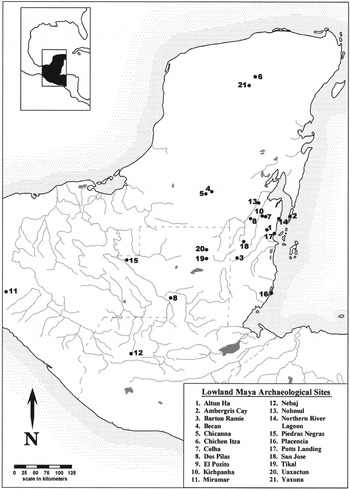
Map of southern Mesoamerica showing the location of archaeological sites mentioned in the text.
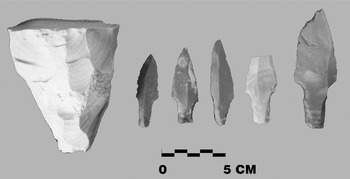
Blade core and stemmed blades recovered from Terminal Classic production contexts at Colha, Belize. Stemmed blades are the most prolific production morphology in most workshops at Colha during this time period and have been recovered at several consumer sites throughout northern Belize and southern Quintana Roo, Mexico (photo by Harry J. Shafer, enhanced by Jason W. Barrett).
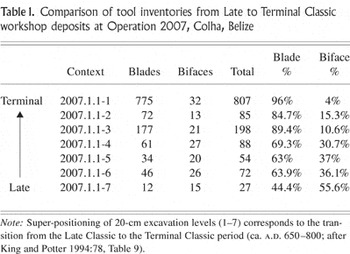
Comparison of tool inventories from Late to Terminal Classic workshop deposits at Operation 2007, Colha, Belize
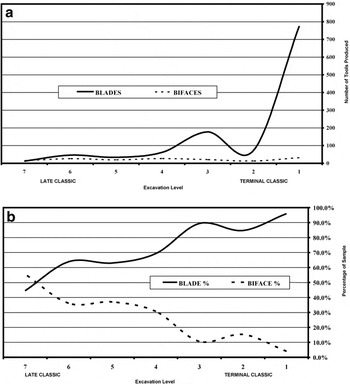
Super-positioning of 20-cm excavation levels corresponds to the transition from Late Classic to Terminal Classic period (ca. a.d. 600–800). Blades represent 44.4% of the tool forms produced during the Late Classic period and 96% in the Terminal Classic period. Conversely, bifaces represent 55.6% of the tool forms produced in the Late Classic and 4% in the Terminal Classic. The dramatic increase in the percentage of blades produced in the Terminal Classic period is the result of an exponential intensification in blade production (a), whereas there is no significant change in the volume of bifaces produced (b).
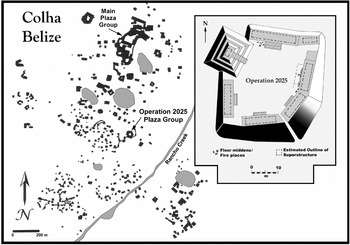
Colha settlement zone showing the location of the site's monumental center (main group) and the Operation 2025 plaza group. Inset illustrates ephemeral architectural features located within the enclosed Operation 2025 plaza that date to the Terminal Classic period.
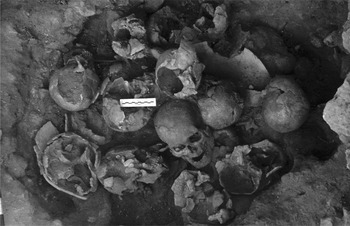
Cache of thirty human skulls discovered in Operation 2011 excavations at Colha, Belize (photograph by Harry J. Shafer, enhanced by Jason W. Barrett).
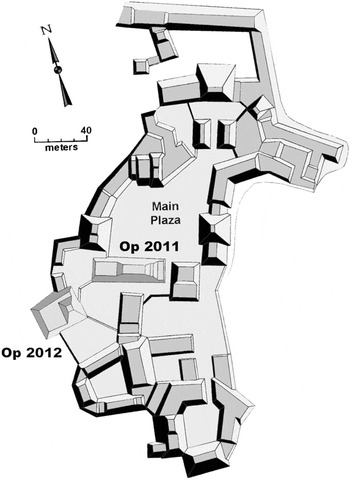
Colha, Belize, site center showing the location of the Operation 2011 and 2012 platforms (after Hester and Shafer 1994).
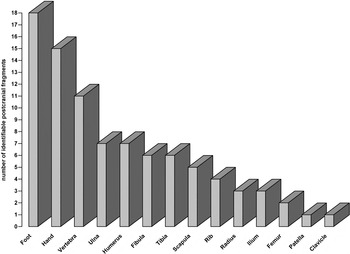
Distribution of identifiable postcranial elements among the human remains recovered in Operation 2012 excavations at Colha, Belize. The relatively high volume of small bones from the hands and feet suggest that the deposit is not the result of secondary reburial.
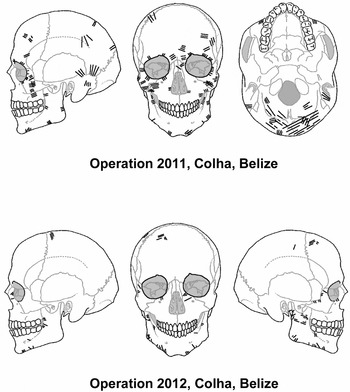
Distribution of cut marks observed on human crania recovered from Operation 2011 (top; after Massey and Steele 1997:Figures 5.9, 5.10) and Operation 2012 (bottom) at Colha, Belize.
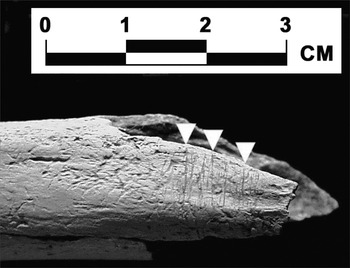
Humeral shaft fragment recovered in Operation 2012 excavations. Arrows point to cut marks noted around the circumference of the bone.
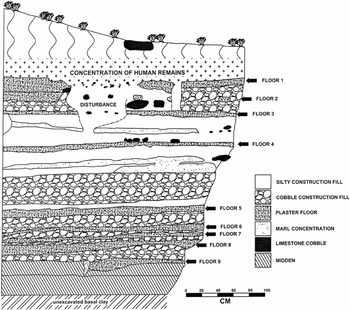
Profile of Operation 2012, Suboperation 3, Colha, Belize illustrating the concentration of human remains above the terminal platform surface (Floor 1; after Potter 1980:Figure 2).
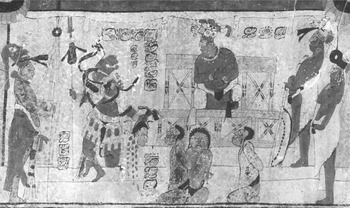
Roll-out of Maya polychrome vessel showing bound captives and the presentation of a trophy head. Such ritual acts frequently accompanied warfare and may have produced the traumas noted on the human skeletal remains recovered in operation 2011 and 2012 excavations at Colha (© Justin Kerr, Vase file 680).
 You have
Access
- 33
- Cited by