Introduction
The integration of palliative care is recommended at an early stage in the cancer trajectory (National Consensus Project, 2009). One of the main palliative care mandates is to assist the patient and family in advanced care planning and medical decision-making. Indeed, in a context of incurable cancer, the patient has to make particularly sensitive decisions. These decisions refer to the reduction or even the cessation of curative treatments and the increase of palliative care. Patients must sometimes make choices between treatments to prolong life and others mainly to improve quality of life. Decision-making regarding palliative care is a difficult process, mainly because of the emotional charge associated with it and the sometimes complex medical information that patients receive. Furthermore, several studies suggest that healthcare professionals have difficulty in involving the patient in decision-making concerning palliative care (Craft et al., Reference Craft, Burns and Smith2005; Heyland et al., Reference Heyland, Tranmer and O'Callaghan2003; Sizoo et al., Reference Sizoo, Pasman and Buttolo2012; Tattersall et al., Reference Tattersall, Gattellari and Voigt2002). The shared decision-making approach aims to overcome these difficulties.
Indeed, the shared decision-making approach promotes greater collaboration between doctor and patient. It is defined as a relationship among the patient, family, and one or more healthcare professionals in which participants identify a decision to be made, discuss several options, identify the values and preferences of the patient, and help the patient be involved according to his or her wishes in decision-making (Murray et al., Reference Murray, Miller and Fiset2004). Its clinical application, however, faces many obstacles (Bélanger et al., Reference Bélanger, Rodriguez and Groleau2011; Brédart et al., Reference Brédart, Bouleuc and Dolbeault2005; Gaston & Mitchell, Reference Gaston and Mitchell2005; Lloyd et al., Reference Lloyd, Joseph-Williams and Edwards2013).
The use of decision support tools (DSTs) may facilitate implementation of shared decision-making. According to the International Patient Decision Aid Standards (IPDAS) Collaboration (2017) website, DSTs are “tools designed to help people participate in decision making about health care options. They provide information on the options and help patients clarify and communicate the personal value they associate with different features of the options.” There are several tools for patients with cancer. Most often, these tools target patients whose disease is at an early stage and who are considering a specific medical treatment. These are mainly for patients with prostate, breast, or colon cancer (Herrmann et al., Reference Herrmann, Mansfield and Hall2016). DST developed for cancer screening, genetic testing, and cancer prevention are also prevalent (Leighl et al., Reference Leighl, Butow and Tattersall2004). Thus, a large majority of these tools are designed for a healthier and ambulatory population (Austin et al., Reference Austin, Mohottige and Sudore2015). There are also DSTs for the palliative care population, but they are much fewer in number (Leighl et al., Reference Leighl, Butow and Tattersall2004). Also, they focus primarily on decisions regarding intensive care, such as the use of cardiac resuscitation, and do not address cancer treatments. These tools are also intended for a general population and are seldom specific to cancer patients. Moreover, these tools are not adapted to the unique reality of patients with cancer as they face treatment decisions in relation to palliative care. Similarly, the DSTs for patients with cancer at an early stage may not meet the needs of patients with incurable cancer because their experience is different. There are a few reviews of the literature on DSTs for a population in palliative care, but none are more specifically related to cancer treatments. Consequently, little is known about the availability and quality of DST within an oncologic population for decision-making about palliative care. To overcome these limitations, the goal of this literature review is to: (1) identify DST related to palliative care for an oncology population and (2) assess the quality of these tools using the criteria of the IPDAS Collaboration instrument (version 3). This will help, first, to specify the availability and quality of DSTs specific to this population. This critical analysis will then lead us to identify avenues for developing and improving DSTs related to palliative care offered to the oncological population.
Method
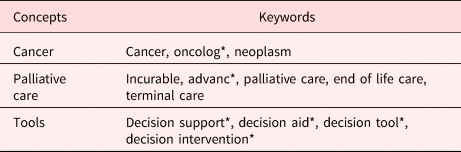
An integrative literature review of DST for an oncological population in palliative care was performed. This review adopted many of the strategies associated with systematic reviews without including all the required criteria (Grant & Booth, Reference Grant and Booth2009). To conduct this review, four databases were searched: PsycINFO, EMBASE, MEDLINE, and CINAHL. Also, the inventory of tools to assist the decisions of the Ottawa Hospital Research Institute (OHRI) and the Cochrane trials database were consulted to complete tool selection. Key concepts were identified to initiate the retrieval process in the four databases. Indeed, DST designed for a specific population (patients with cancer) in a particular context (palliative care) were targeted. Key words associated with different concepts were then identified, which helped to develop a structured and systematic literature search plan. The identification of keywords was conducted using one hundred articles related to the topic as well as through the thesaurus term bank databases. A librarian was consulted to help identify relevant keywords and concepts (Table 1). Different keywords were connected by the usual operators “OR” and “AND”. To optimize results, the asterisk (*) was used for the truncation of keywords (e.g. Oncolog*).
Search strategy

Inclusion and exclusion criteria were determined according to the research objectives. The inclusion criteria were: the publications had to focus on DST for an oncological population, targeting the patient's role in the decision-making process and a decision in connection with the planning of palliative care. In addition, the following tools were excluded: those exclusively targeting decisions in connection with life support measures (cardiopulmonary resuscitation, intubation, etc.), those targeting mainly the role of caregivers in decision making, and tools targeting exclusively cultural minorities. DST developed for cultural minorities were excluded because of the great variability of preferences and needs of patients in medical decision making according to cultural origins (Alden et al., Reference Alden, Friend and Schapira2014).
In the literature, particular attention was given to randomized controlled trials and observational studies. Conference abstracts were selected initially, strictly in order to identify relevant DST. Masters and doctoral theses were excluded but could be used to identify scientific articles. In addition to predefined exclusion criteria, the search was limited to studies published between 1980 and 2016 because the 1980s marked the beginning of the concept of shared decision making. Also, the search was limited to studies written in English and French with an interest for the adult population.
Selection of scientific articles
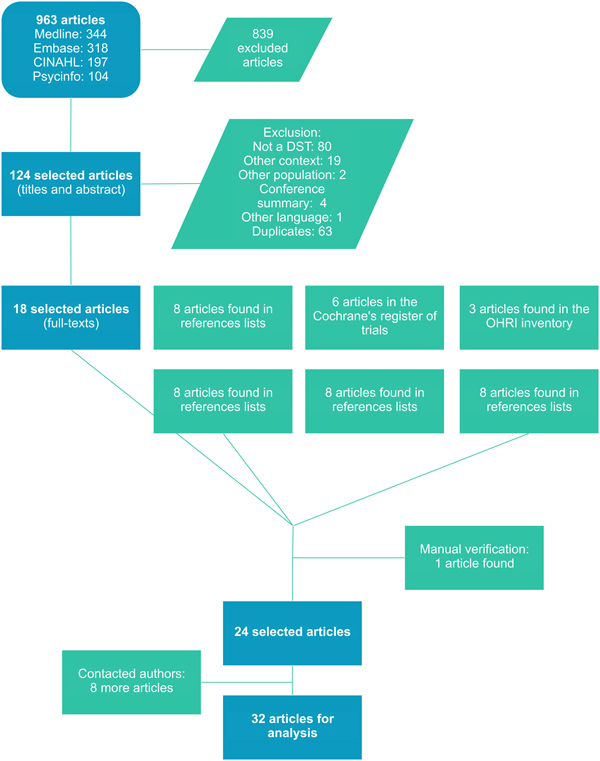
A total of 963 articles from the literature were initially identified (literature search done on March 18, 2016). This number fell to 187 after the first round of removal of articles not directly related to the research topic. Once duplicates were deleted, the number of articles dropped to 124. The articles obtained after this first step of the selection process were carefully examined by one member of the research team while taking into account inclusion and exclusion criteria.
During the second selection process, conducted by the third author, 106 articles were discarded. Of these, 80 articles were not related to a DST, but were mainly clinical tools for doctors, addressed decision-making regarding a medical decision, or were communication tools. Other articles (n = 26) were also excluded due to the fact that they did not focus on palliative care (n = 7), targeted life support measures (n = 12), were tailored to the pediatric population (n = 2), were brief conference abstracts (n = 4) or were written in a language other than English or French (n = 1). This selection process therefore led to the identification of 18 relevant scientific articles according to the inclusion and exclusion criteria. Three other relevant articles from the reference lists of these articles were included. Two additional papers were identified through the Ottawa Hospital Research Institute (OHRI) and none through the trials of the Cochrane Library. Finally, the completeness of our article sample was counterverified by a manual search carried out by a member of our research team. A literature review of 21 active authors in the field showed that all relevant articles had already been selected, except for one. Figure 1 illustrates the results of each stage of the review process.
Flow Chart.

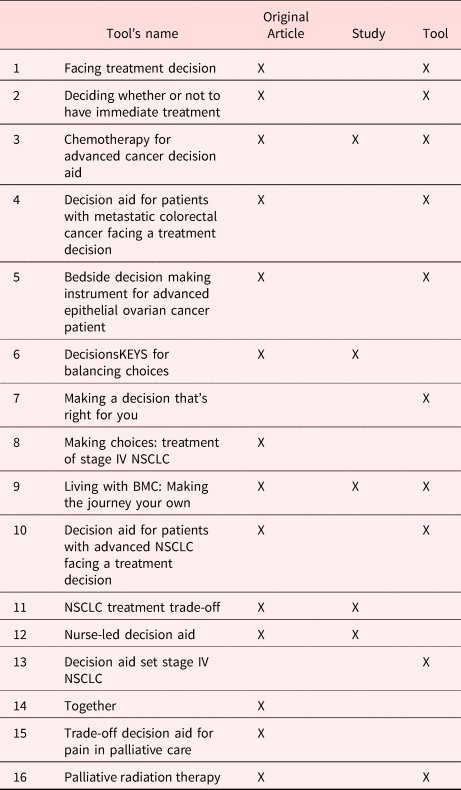
The literature review process therefore led to the selection of 24 publications, in which 16 DSTs were identified. Because these publications do not necessarily provide access to the DSTs themselves or the original articles reporting their development, 10 authors were contacted to gather electronic versions of tools and/or missing original items. Thus, eight additional publications were collected. However, some are still missing in the absence of authors’ replies. After the selection process, a sample of 16 DSTs targeting the oncological population in relation to palliative care options was thoroughly evaluated. Table 2 presents the documentation related to each DST.
Tools and related documentation

NSCLC, non-small cell lung cancer.
DST evaluation process
To proceed with the evaluation of the DSTs identified, the third version of the IPDASi instrument (IPDASi) was used. This most recent instrument developed by the IPDAS Collaboration has a strong theoretical and empirical basis (Elwyn et al., Reference Elwyn, O'Connor and Bennett2009). Among the 10 IPDASi dimensions, nine were used for this review. The tenth dimension was omitted because it concerns disease screening and diagnosis only. DST evaluation was thus based on 38 items divided into nine dimensions from the IPDASi, which are: information, probabilities, values, decision guidance, development, evidence, disclosure, plain language, and DST evaluation.
According to IPDASi instructions, each DST tool was rated on each item using a 4-point scale, with possible responses varying from strongly agree = 4 (the issue is addressed clearly and comprehensively), agree = 3 (the issue is addressed but with room for improvement), disagree = 2 (the DST fails to clearly address the issue), and strongly disagree = 1 (the DST totally fails to address the issue). However, we had to make a change to the scoring system to reduce bias and inaccurate scoring related to situations when only one part of the tool or only the scientific article was available. Therefore, when the evaluation of certain items in the data extraction grid was impossible because of missing data (for example, only a part of the tool was available), a value of 0 was assigned to these items.
To determine the total score for the evaluation of each DST, the values assigned to each IPDASi item were first added. The amount obtained was then reported over the maximum total possible score determined according to the number of items that could be assessed. If all 38 items were evaluated, the sum of the values assigned to the 38 items was reported over a total of 152 points (38 items × 4 points). If, for example, only 24 items were evaluated, the sum of the values assigned to the 24 items was reported over a total of 96 points (24 items × 4 points). To facilitate the reading of the results, all of the total scores were then calculated as a percentage (100). Logically, the higher the score allocated to a DST, the higher its documented quality; however, the IPDASi does not specify the score from which the quality of a tool is considered sufficient. Because an average rating of 3/4 for each item means that the issue is at least addressed in the DST, we set the satisfaction threshold at 75%, corresponding to a score of 114/152.
In addition, the average score of all the tools on each of the items was calculated to identify the degree to which items are included in the DST. This in particular makes it possible to identify the dimensions of the IPDASi that are best and least well integrated among the assessed tools. Finally, the reliability of the extraction grid data was verified through interrater agreement analysis. The two authors and a member of the research team independently evaluated three DST. This led to clarification of the interpretation of 22 items, resulting in an interrater agreement rate of 100%.
Results
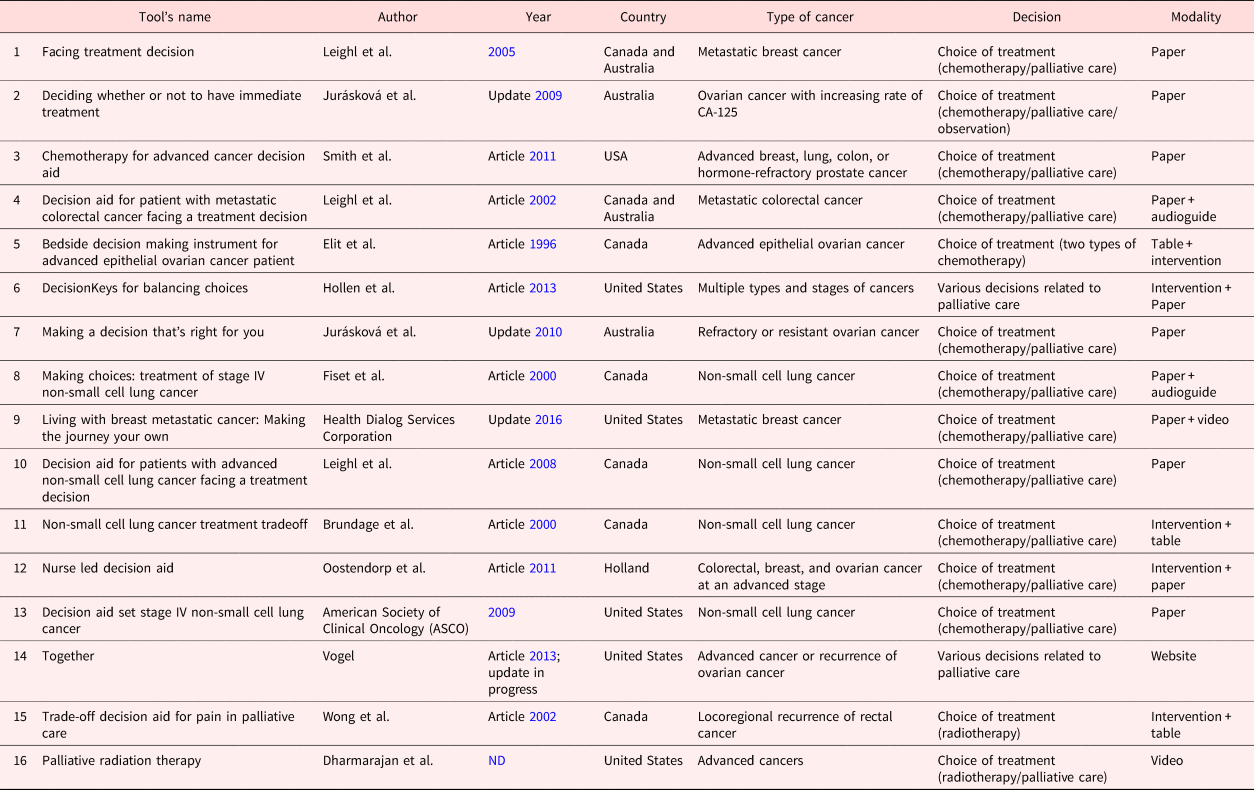
A total of 32 publications was compiled during the literature search. Ten are excerpts from a DST or complete DST; 13 are empirical articles in which an DST is used. Of these 32 publications, 16 were related to a DST for oncological and palliative populations. Table 3 provides information about the tools and the different features of the articles.
Decision support tools for an oncology population regarding palliative care

Types of cancer and decisions targeted by the DST
The articles targeted mainly five types of cancer, namely breast cancer, prostate, ovarian, colorectal, and lung. One tool more broadly addressed patients with advanced cancer (n = 1; 6.25%). Furthermore, most tools (n = 10; 62.5%) were related to the decision to use chemotherapy. Three tools (n = 3; 18.75%) pointed out multiple decisions that patients face during the course of the disease, rather than a specific decision. Other tools focused on the decision to receive radiation treatment (n = 1; 6.25%), the choice between two chemotherapy curative treatments (n = 1; 6.25%) and the choice between two radiotherapy protocols (n = 1; 6.25%).
Assessing the quality of the DST
Background information collected on eight of the 16 DSTs was comprehensive and could be evaluated on all the items included in the IPDASi; however, documentation associated with the eight other DSTs remains partial despite attempts to reach their authors. For these tools, evaluation of several items from the IPDASi checklist was not possible because of missing data. The following section presents the results of the eight tools for which a full evaluation was possible.
Total scores of the DSTs

Total scores for the DST
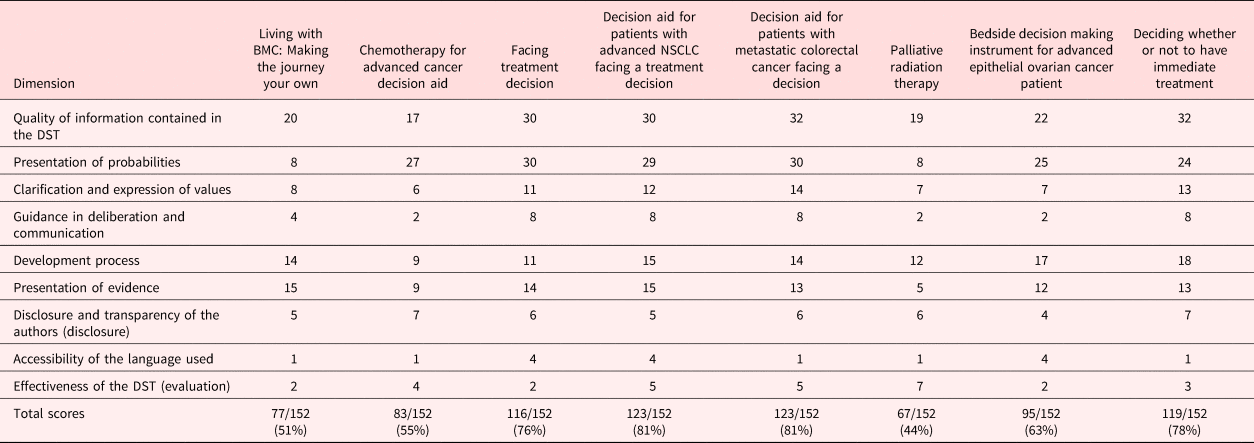
The scores of the eight tools whose integral evaluation was possible vary widely, ranging from 67/152 to 123/152 (44 to 81%) with a mean of 100.38/152 (66%). Among the tools identified and assessed in full, four obtained a total score at or above the satisfactory threshold of 75%. In addition, the tool “Making a decision that's right for you” was not evaluated in full, but seems promising, with a total score of 92/104 (88%). The latter was also developed by the same team as the one that developed the tool “Deciding whether or not to have immediate treatment” whose total score was 119/152 (78%). The following section presents the findings for each of the nine IPDASi dimensions. The different scores are also shown in Table 4.
Quality of information contained in the DST
The tools’ scores for this dimension vary between 17 and 32 (the highest possible score), which indicates a great disparity in the quality of information contained within these tools. Overall, this dimension is the one for which the results associated with each item were the highest. Therefore, it is the dimension in which the tools demonstrated the highest level of quality. The item that had the highest ratings on this dimension is “describes the options available for the index decision” (1.3); the two items with the weakest results were “describes the decision that needs to be considered (the index decision)” (1.2) and “describes negative features (harms, side effects or disadvantages) of each option” (3.1.6).
Presentation of probabilities
The highest possible score on this dimension is 32. This is the dimension where the greatest disparity was observed among the evaluated tools, with scores ranging from 8 to 30. The tools Living with Breast Metastatic Cancer: Making the journey your own and Palliative radiation therapy were given the lowest possible score on this dimension (8 points) because no information regarding this item was reported. The items corresponding to the highest results for this dimension were “allows the user to compare outcome probabilities across options using the same denominator and time period” (2.5), “provides more than one way of viewing the probabilities (e.g., words, numbers, and diagrams)” (2.7) and “provides balanced information about event or outcome probabilities to limit framing biases” (2.8). The item corresponding to the lowest results was “specifies the defined group (reference class) of patients for which the outcome probabilities apply” (2.2), with an average score of 1.88/4.
Clarification and expression of values
The highest possible score on this dimension is 16. The scores obtained vary between 6 and 14. The item “describes the features of options to help patients imagine what it is like to experience the physical effects” (3.1) was associated with better outcomes on this dimension. However, the items “describes the features of options to help patients imagine what it is like to experience the psychological effects” (3.2) and “describes the features of options to help patients imagine what it is like to experience the social effects” (3.3) were associated with equally lower results. The four tools whose total scores were the highest consistently had the highest scores for this dimension. Conversely, the four tools whose total scores were the lowest also had all the lowest scores for this dimension.
Guidance in deliberation and communication
The scores for this criterion vary between 2 and 8 (the highest possible score). Again, the four tools whose total score was highest consistently had the highest scores for this dimension. The same logic also conversely applies for the four tools with the lowest total scores.
Development process
The tools’ scores ranged between nine and 18 over a possible score of 24 on this dimension. The results varied greatly from one item to another on this dimension. The item associated with higher scores was “was field tested with patients who were facing the decision” (5.5). The lowest results were obtained on the item “was field tested with practitioners who counsel patients who face the decision” (5.6). The average rating for this item was 1.38/4, which means that almost no tool included it. Moreover, two of the six items of the evaluation grid that obtained the lowest ratings belong to this dimension.
Presentation of evidence
The highest possible score on this dimension was 20. The scores varied between 5 and 15. The item associated with higher scores was “provides a production or publication date” (6.3) and the one associated with the lowest results was “provides information about the proposed update policy” (6.4). As for the latter item, the average rating was 1.38/4, which indicates that almost no tool included it. Moreover, two of the six items of the evaluation grid associated with the lowest scores belong to this dimension.
Disclosure and transparency of the authors (disclosure)
In this dimension, which includes only two items, the score of the tools varied between 4 and 7. All tools except one (n = 7) achieved satisfactory results on the item “provides information about the funding used for development” (7.1). In contrast, one-half of the tools (n = 4) received low scores on the item “includes author/developer credentials or qualifications” (7.2).
Accessibility of the language used (plain language)
The highest possible score on this dimension was 4. The majority of tools (n = 5) achieved a score of 1 on this item, whereas the others obtained a score of 4 (n = 3). This means that most authors did not measure the level of language contained in their tool or, if this verification was made, the authors did not specify so. This is the second dimension showing the weakest results.
Effectiveness of the DST (evaluation)
This is the dimension for which the tools obtained the lowest scores. The highest possible score on this dimension was 8 and the scores vary between 2 and 7. The item “There is evidence that the decision support technology improves the match between the features that matter most to the informed patient and the option that is chosen” (9.1) was associated with an average score of 1.5/4; the item “There is evidence that the patient decision support technology helps patients improve their knowledge about options’ features” (9.2) was associated with an average score of 2.25/4. If the scores are low on this dimension, it is largely because the necessary steps to demonstrate the effectiveness of the tools were simply not conducted or not completed. Therefore, there may be an inconsistency between the score of a tool on this dimension and its total score. This is the case, for example, for the tool “Palliative radiation therapy,” whose total score was the lowest (44%), but yet had the highest score on this dimension. In return, “Facing treatment decision tool: Decision aid for patients with metastatic breast cancer chemotherapy” had a total score of 76% but obtained the lowest score on this dimension.
Discussion
The goal of this literature review was to identify DST related to palliative care for an oncological population and to assess the quality of these tools using the IPDASi criteria. Using the study inclusion and exclusion criteria, 16 tools were identified that had variable levels of quality. After detailed evaluation of the DSTs, the total score of four tools were at or above the desired level of satisfaction. Thus, from among the 16 DSTs assessed, four tools could be recommended for use in the context of medical decision making in palliative care. These tools are: (1) Facing treatment decision: Decision aid for patients with metastatic breast cancer chemotherapy, (2) Decision aid for patients with advanced non-small cell lung cancer facing a treatment decision, (3) Decision aid for patients with metastatic colorectal cancer facing a treatment decision, and (4) Deciding whether or not to have immediate treatment. These tools target an adult oncological population and an accurate decision. They also offer clear and detailed medical information. Moreover, they present different options in equivalent detail and help patients clarify their values and guide them through the decision process. The patient is thus encouraged to get involved in decision making and has the necessary information to do so, allowing for shared decision making (Kane et al., Reference Kane, Halpern and Squiers2014).
The other tools may also be useful in clinical settings. They indeed offer relevant information about medical conditions, treatment options, patient-physician communication, or psychosocial resources. However, the goal of decision support tools is to go beyond offering information. DSTs help patients to participate in medical decisions and to clarify and communicate personal values, in addition to presenting information on different options (IPDAS, 2017). Thus, the majority of these other tools cannot be considered as DST and should be strictly used as informational tools. The société canad clinician who wishes to make use of such tools must distinguish between DST and an information tool. Information tools often target a particular option, can direct the patients' decisions, and prevent them from choosing from among several options in an informed manner. In other words, informational tools do not support the patient during the decision-making process. Not making the difference and using information tools as DST may represent a risk for the patient.
The first objective of this literature review was to identify DSTs for an oncological population in palliative care. With 16 tools, this sample appears small compared with the number of tools available for patients with cancer at early stages. Indeed, for comparison purposes, in one literature review, Trikalinos et al. (Reference Trikalinos, Wieland and Adam2014) identified 55 DSTs dealing with the detection and treatment of cancer at an early stage. Also, in a Cochrane review, Stacey et al. (Reference Stacey, Légaré and Col2014) identified 25 DSTs available for people considering screening for colorectal cancer and prostate cancer. Moreover, among the 16 tools listed in our study, at least four (two of which are Bedside decision-making instrument for advanced epithelial ovarian cancer patient and Making choices: treatment of stage IV non-small cell lung cancer) have not been updated for 15 years. Besides having a different structure from that recommended by the IPDAS Collaboration, the information presented in these four tools may be outdated. The utility of these is limited for cancer patients planning their palliative care.
In addition, the reviewed DST targeted a small number of cancer sites, namely colorectal, breast, ovarian, lung, and prostate; however, several other types of cancer are associated with somber prognosis statistics and consequently are likely to require palliative care. This is particularly the case for pancreatic cancer, esophagus cancer, liver cancer, multiple myeloma, and leukemia, whose survival rates are among the lowest (Statistics Canada, 2016). Yet none of the listed tools support people with these diagnoses in decisions relating to their palliative care.
Moreover, the vast majority of tools pertain to the decision to use or not chemotherapy in addition to palliative care. This refers to a critical step in the care trajectory in which the patient is faced with the choice of reducing cancer treatments and increasing palliative care. This is one of the most complex decisions the oncology patient will have to make; however, the oncological patient must make several decisions, some of which are little or not covered by current DST. In this regard, only the Palliative radiation therapy tool deals with the choice of whether to receive palliative radiotherapy, which nevertheless constitutes a therapeutic option available to many patients with advanced cancer (Lutz et al., Reference Lutz, Jones and Chow2014). It is also a complex decision because of potential side effects. For example, preventive radiotherapy treatments in the brain can cause long-term neurological conditions and are often offered to patients with lung cancer (Canadian Cancer Society, 2016). The oncology patient whose medical knowledge is limited, may have difficulty making an informed decision in this regard. Moreover, no tool among those listed addresses the decision to use palliative surgery, which can be complex and include a benefit/risk ratio sometimes difficult to assess (Sun & Krouse, Reference Sun and Krouse2014). Finally, no tool addresses the specific decision to choose a place to receive palliative care.
The second objective of this study was to evaluate the quality of these tools using the criteria of the IPDASi. Because of missing data, the full assessment of eight of the 16 tools could not be performed; therefore, this section focuses on the results of the tools evaluated in full. The average total scores of these tools is 66%. This suggests that, overall, tools related to palliative care for the oncological population do not sufficiently integrate the IPDASi quality criteria. One dimension of IPDASi, corresponding to the quality of information, is sufficiently integrated into all of these tools. In contrast, the most weakly integrated dimension is the documentation of the effectiveness of the tools. This dimension refers to the existence of evidence indicating that the DST tangibly helps the patient to understand the medical options available and helps him or her make a decision that is consistent with his or her values and preferences. This is a particularly important dimension because it indicates whether the tool produces the expected results. However, the effectiveness of any of the four “best” tools was not fully demonstrated. Indeed, the effectiveness of the tools Decision aid for patients with advanced non-small cell lung cancer facing treatment decision and Decision aid for patients with metastatic colorectal cancer facing a treatment decision were only partially reported. According to IPDASi items, the efficacy of tools Facing treatment decision and Deciding whether or not to have immediate treatment has been demonstrated. The evidence supporting the effectiveness of the tools are rare because few controlled trials are conducted. In their literature review, Herrmann et al. (Reference Herrmann, Mansfield and Hall2016) also found that the effectiveness of DST is rarely studied.
This literature review has several strengths. First, the evaluation process has allowed a rigorous and thorough analysis of several DST. Other recensions of DST are limited to user satisfaction or the evidence related to the effectiveness of tools to measure quality. In addition, interrater agreement was reached for three of the eight tools evaluated in full. This is a first review of this kind that deals specifically with DST for oncological populations in a palliative context. This study also has limitations. The most important is likely the subjectivity of the instrument used to carry out the evaluation of DST. Indeed, IPDASi (version 3) is sensitive to the subjectivity of the evaluator, particularly because of the vagueness of its rating system. Our satisfactory threshold did not ensure that each tool was given a satisfactory score (3 or 4) for every item; therefore, some tools may have highly performed on some dimensions and completely neglected the others. Also, the original article associated with the instrument reported a relatively low interrater agreement. A double-blind evaluation process of all the tools would have increased the reliability of our results. Finally, this literature review was limited to tools in English and French and therefore targeted only some of the existing DST.
More studies on the effectiveness of existing DST should be performed. This would clarify the quality of available DST for the oncology population in relation to palliative care. Moreover, it could define the characteristics of tools that are associated with better results. It could also provide useful information for the development of new tools and eventually the refinement of IPDASi criteria. Moreover, it would be necessary to develop DST for palliative care patients with cancers other than breast, ovarian, lung, and colorectal. Similarly, the establishment of tools targeting decisions other than the use of chemotherapy would be important. Researchers interested in doing so should first be familiar with the theoretical model of the IPDAS Collaboration.
Conclusion
Finally, it is surprising to note that DSTs with such varying levels of quality are available on the web. Without some quality control, tools that are inaccurate, inappropriate or outdated, or that contain undeclared conflicts of interest could be detrimental to the patient. To ensure better consistency among DST and to limit the risk that patients use an inadequate tool, a control or certification process could be considered.