I. INTRODUCTION
Thin films deposited on a substrate are applied to wide fields such as electronic devices,Reference Sze1 optoelectronic devices,Reference Maranowski, Kish, Caracci, Holonyak, Dallesasse, Bour and Treat2 structural devices,Reference Hsueh and Evans3 etc. Because the thermal expansion coefficient of the thin film differs from that of the substrate, residual stresses will be built up after temperature change. Alternatively, when the lattice constant of the thin film mismatches that of the substrate, residual stresses will be also established in the thin film/substrate system. When the residual stress is over the elastic limit, the plastic deformation or fracture occurred in the thin film/substrate system results in the degradation of its electronic, optoelectronic, and/or mechanical properties. Therefore, the residual stresses in the thin film/substrate system were studied by many researchers,Reference Hsueh and Evans3–Reference Shiue, Lin, Shen and Ouyang7 and they analyzed the residual stresses based on linear elasticity.
When the temperature is sufficiently high, stress relaxation due to viscous flow appears in various thin film/substrate systems.Reference EerNisse8–Reference Rosenberg, Wong and Miaoulis13 Therefore, the viscoelastic stresses in the thin film/substrate systems were also extensively studied based on viscoelasticity.Reference Hsueh and Lee14–Reference Hsueh, Chiang and Lee18 However, a general exact closed-form solution of residual stresses in a viscoelastic thin film deposited on a viscoelastic substrate is not available. Thus, the objective of this study is first to propose an exact solution for the Maxwell modeling of viscoelastic stresses in a bilayer system due to thermal and/or lattice mismatch. Then, if the thickness of one layer is much larger than that of the other layer, the viscoelastic stress in the bilayer system is reduced to that of thin film/substrate system. Finally, the accuracies of the solutions of the zeroth-order approximation, first-order approximation, and Huseh and Lee modelReference Hsueh and Lee14 in the thin film/substrate system are compared.
II. ANALYSIS
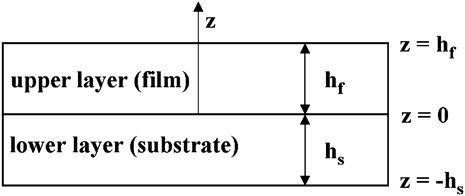
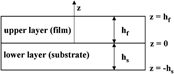
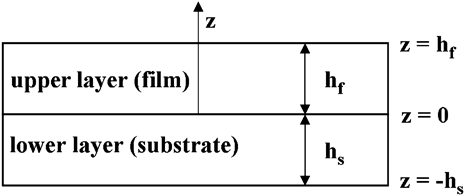
Figure 1 depicts the schematic of a bilayer system. The bilayer system is initially stress free and is then subjected to a temperature change ΔT. Since the thermal expansion coefficient of the upper layer is different from that of the lower layer, residual stresses will be built up after a temperature change. Symbols σ, h, α, E, and η represent the residual stress, thickness, effective thermal expansion coefficient, Young’s modulus, and shear viscosity coefficient, respectively, and subscripts “f” and “s” indicate the upper layer and the lower layer, respectively. In this study, the Young’s modulus and the shear viscosity coefficient are assumed to be constant, whereas the effective thermal expansion coefficient is defined as the average value of the thermal expansion coefficient during the range of temperature change. As the upper layer and the lower layer are elastic materials, a general closed-form solution for the stresses in the bilayer system with strip geometry had been derived.Reference Hsueh19 In this study, the bilayer system is planar. The elastic stress in a bilayer system with planar shape can be adopted from that of a bilayer system with strip shape, in which the Young’s modulus E in a bilayer system with strip shape is replaced with the biaxial modulus B (B = E/1−ν, where ν is Poisson’s ratio). Accordingly, the residual stress in the lower layer at a position z can be obtained from Eq. (15a) of Ref. Reference Hsueh19 as

Schematic of the bilayer (thin film/substrate) system.
where −h s≦z≦0; similarly, the residual stress in the upper layer can be obtained from Eq. (15b) of Ref. Reference Hsueh19 as

where 0≦z≦h f.
To understand the viscoelastic stresses in the bilayer system, it is a simple and reasonable model to assume that the upper layer and the lower layer behave as Maxwell materials.Reference Hsueh and Lee14, Reference Witvrouw, Volkert and Spaepen20–Reference Sutardja and Oldham26 As a result, long-term residual stresses in the upper layer and the lower layer can be determined by viscoelastic theory as follows.Reference Flugge27, Reference Shames and Cozzarelli28 First, the biaxial modulus B given in Eqs. (1a) and (1b) is replaced with the bulk modulus K and shear modulus G, i.e., B = 18KG/(3KG + 4G). Second, according to the Laplace transformation for Maxwell materials, 3K and 1/(2G) are replaced by 3K and 1/(2G) + 1/(2ηs), respectively. Consequently, the residual stresses in the substrate in the s space can be obtained as

where





Similarly, the residual stress in the thin film in the s space can be obtained as

where


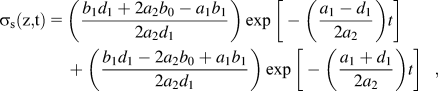
Finally, Eqs. (2) and (4) are transformed from s space to t domain by use of the inverse Laplace transformation and the long-term stresses in the substrate and thin film become
and
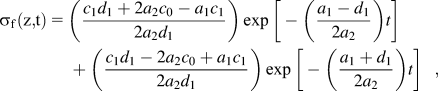
respectively, where

Notably, the summation of forces and moments on the upper layer and lower layer should be zero, respectively. Therefore, the following equations are satisfied


Substituting Eqs. (6a) and (6b) into Eqs. (8a) and (8b), we find that the force and moment equilibrium conditions are satisfied at any time.
The stress in the lower layer is linearly dependent on the position z, so the average stress in the lower layer is equal to the stress at the middle position of the lower layer. Therefore, the average stress  in the lower layer is
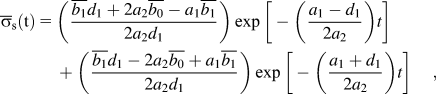
where


Similarly, the average stress  in the upper layer can be obtained as
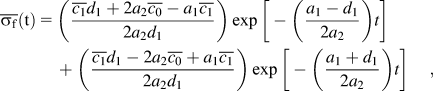
where


Notably, if both the shear viscosity coefficients η of the upper layer and lower layer approach infinity, the upper layer and lower layer behave as elastic materials and the solution obtained by viscoelastic theory is reduced to that solved by elastic theory.
When the thickness of the upper layer is much smaller than that of the lower layer (h f ≪h s), the bilayer system can be reduced to the thin film/substrate system. In this case, the exact average stresses in Eqs. (9) and (11) can be reduced to the first-order approximate solutions as
\Delta T\exp \bigg({{ - B_{\rm{f}} t} \over {6\eta _{\rm{f}} }}\bigg),$$](https://static.cambridge.org/binary/version/id/urn:cambridge.org:id:binary:20151019054958722-0561:S0884291411001002_eqn23.gif?pub-status=live)
and
\Delta T\exp \bigg({{ - B_{\rm{f}} t} \over {6\eta _{\rm{f}} }}\bigg),$$](https://static.cambridge.org/binary/version/id/urn:cambridge.org:id:binary:20151019054958722-0561:S0884291411001002_eqn24.gif?pub-status=live)
respectively. Furthermore, as the second terms on the right-hand side of Eq. (13a) is omitted, the exact average stress in the substrate is reduced to its zeroth-order approximate solution. Similarly, as the second terms on the right-hand side of Eq. (13b) is omitted, the exact average stress in the thin film is reduced to its zeroth-order approximate solution.
In this study, the bilayer system is assumed to be the planar shape. In the case of strip shape (or beam), the residual elastic stresses in the system solved by elastic theory are the same as those shown in Eqs. (1a) and (1b) with the exception that the biaxial modulus B should be replaced by the Young’s modulus E. Therefore, the residual viscoelastic stresses in the bilayer system with strip shape will be also the same as those revealed in Eqs. (6a) and (6b) with the exception that the biaxial modulus B and viscosity coefficient in biaxial tension 6η should be replaced by the Young’s modulus E and viscosity coefficient in uniaxial tension 3η, respectively.
Furthermore, in the above study, the upper layer is subjected to thermal strain, (α f − α s)ΔT, relative to the lower layer. Nevertheless, the formula in the above study can be easily applied to the bilayer system subjected to lattice mismatch strain Δε. As the bilayer system is subjected to lattice mismatch, the residual stresses in the system solved by elastic theory are the same as those shown in Eqs. (1a) and (1b) with the exception that the thermal strain (α f − α s)ΔT is replaced by the lattice mismatch strain Δε. Therefore, the residual stress in the system solved by viscoelastic theory will be also the same as that revealed in Eqs. (6a) and (6b) with the exception that the thermal strain (α f − α s)ΔT is replaced by the lattice mismatch strain Δε.
III. RESULTS AND DISCUSSION
The material properties of viscoelastic amorphous Si film on elastic crystalline Si substrate and elastic Si film on viscoelastic Ge substrate are used as two examples to calculate the residual stresses.
A. Viscoelastic film/elastic substrate
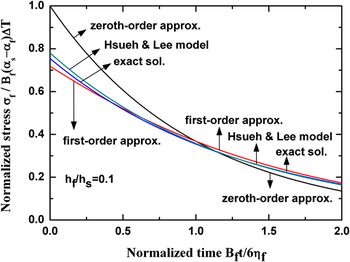
For amorphous Si/crystalline Si system, the biaxial modulus ratio of amorphous Si to crystalline Si is 0.7.Reference Hsueh and Lee14 The average film stress  as a function of the normalized time B ft/6η f is shown in Fig. 2 for the relative film thickness h f/h s = 0.1. The average film stresses of the zeroth-order approximation, first-order approximation, Hsueh and Lee model,Reference Hsueh and Lee14 and exact solution of this study are plotted in Fig. 2 to evaluate their accuracies. Hsueh and LeeReference Hsueh and Lee14 studied the viscoelastic stresses in thin film/substrate systems due to lattice mismatch. Accordingly, the exact average elastic stresses in the film [that was shown in Eq. (7a) of Ref. Reference Hsueh and Lee14] is the same as that shown in Eq. (1b) with the exception that the thermal strain (α f − α s)ΔT and position z are replaced by the lattice mismatch strain Δε and h f/2, respectively. Hsueh and Lee subsequently got an approximate solution of average elastic stresses in the film [see Eq. (8a) of Ref. Reference Hsueh and Lee14] by neglecting the high-order (larger than first-order) terms of h f in the numerator and denominator of the exact solution, and eventually, they obtained the approximate solution of average viscoelastic stresses in the film [See Eq. (14) of Ref. Reference Hsueh and Lee14] following the procedures of viscoelastic theoryReference Flugge27, Reference Shames and Cozzarelli28 as mentioned above. The solution of Hsueh and Lee model used in this study can be adopted from Eq. (14) of Ref. Reference Hsueh and Lee14 with the exception that the lattice mismatch strain Δε is replaced by the thermal strain (α f − α s)ΔT, and that is

The average film stress  of the zeroth-order approximation, first-order approximation, Hsueh and Lee model,Reference Hsueh and Lee14 and exact solution of this study in the viscoelastic film/elastic substrate system as a function of the normalized time B ft/6η f for the relative film thickness h f/h s = 0.1.

Figure 2 reveals that the average film stress decreases with increasing the normalized time and finally equals zero as the normalized time B ft/6η f approaches infinity. This is consistent with the behavior of Maxwell materials. This figure also shows that the accuracies of the zeroth-order approximation, first-order approximation, and Hsueh and Lee modelReference Hsueh and Lee14 are dependent on the normalized time B ft/6η f.
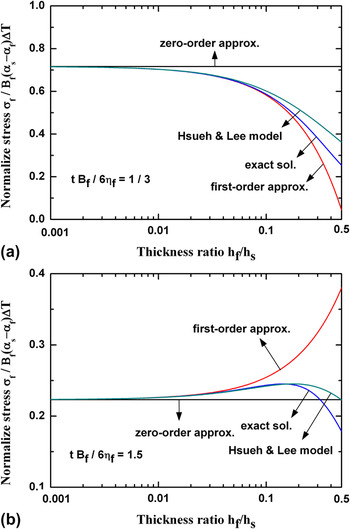
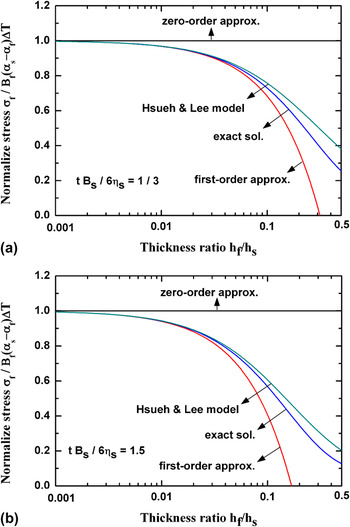
To know the effect of the relative film thickness on the film stress, the average film stresses  as a function of the relative film thickness h f/h s at B ft/6η f= 1/3 and 1.5 are shown in Figs. 3(a) and 3(b), respectively. Figures 3(a) and 3(b) show that the average film stress for the zeroth-order approximation is independent of the relative film thickness. Nevertheless, the average film stresses for first-order approximation, Hsueh and Lee model,Reference Hsueh and Lee14 and exact solution of this study vary with the relative film thickness. As the relative film thickness h f/h s is equal to or less than 0.001, the average film stresses for the zeroth-order approximation, first-order approximation, and Hsueh and Lee model are close to that of exact solution. Alternatively, as the relative film thickness h f/h s is larger than 0.001, the accuracies of the zeroth-order approximation, first-order approximation, and Hsueh and Lee modelReference Hsueh and Lee14 are dependent on the relative film thickness h f/h s.
The average film stress  in the viscoelastic film/elastic substrate system as a function of the relative film thickness h f/h s at (a) B ft/6η f = 1/3 and (b) B ft/6η f = 1.5.

B. Elastic film/viscoelastic substrate
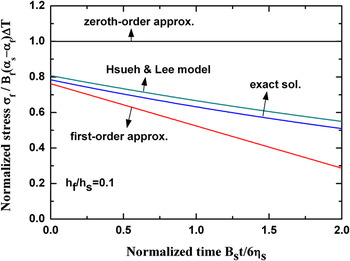
For elastic Si film on viscoelastic Ge substrate system, the biaxial moduli are B f = 107 GPa and B s = 180 GPa (i.e., B f/B s = 0.6).Reference Hsueh and Lee14 The average film stress  as a function of the normalized time B st/η s are shown in Fig. 4 for the relative film thickness h f/h s = 0.1. The average film stresses of the zeroth-order approximation, first-order approximation, Hsueh and Lee model, and exact solution of this study are plotted in Fig. 4 to evaluate their accuracies. The solution of Hsueh and Lee model are adopted from Eq. (20) of Ref. Reference Hsueh and Lee14 with the exception that the lattice mismatch strain Δε is replaced by the thermal strain (α f − α s)ΔT. The solution of Hsueh and Lee modelReference Hsueh and Lee14 is

The average film stress  in the elastic film/viscoelastic substrate system as a function of the normalized time B st/6η s for the relative film thickness h f/h s = 0.1.

Figure 4 shows that the average film stress of the zeroth-order approximation is independent of the normalized time, but the average film stresses of first-order approximation, Hsueh and Lee model, and exact solution decrease with increasing the normalized time. This figure also shows that the accuracy of Hsueh and Lee model is better than that of the zeroth-order approximation and first-order approximation. The reason why the accuracy of Hsueh and Lee is greater than the first-order approximation is that, in addition to the zeroth-order and the first-order terms, Hsueh and Lee model includes the second-order and high-order terms. Using Taylor’s series expansion, one can rewrite Eq. (15) as

As shown in Eq. (15), it is evident that the accuracy of Hsueh and Lee model is better than that of first-order approximation. It is also found that the second-order term is not neglected for the long time and/or large thickness ratio h f/h s.
The average film stresses  as a function of the relative film thickness hf/hs at B st/6η s = 1/3 and 1.5 are shown in Figs. 5(a) and 5(b), respectively. Figures 5(a) and 5(b) show that the average film stress for the zeroth-order approximation is independent of the relative film thickness, but the average film stresses for first-order approximation, Hsueh and Lee model, and exact solution decrease with increasing the relative film thickness. As the relative film thickness h f/h s is equal to or less than 0.001, the average film stresses for the zeroth-order approximation, first-order approximation, and Hsueh and Lee model are close to that of exact solution. Nevertheless, as the relative film thickness h f/h s is larger than 0.001, the accuracy of Hsueh and Lee modelReference Hsueh and Lee14 is better than that of the zeroth-order approximation and first-order approximation. The explanation was described in the preview paragraph.
The average film stress  in the elastic film/viscoelastic substrate system as a function of the relative film thickness h f/h s at (a) B st/6η s = 1/3 and (b) B st/6η s = 1.5.

IV. CONCLUSIONS
The exact solution of viscoelastic stresses in the bilayer system is derived if both layers are Maxwell materials. As the thickness of one layer is much smaller than that of the other layer, the viscoelastic stress in the bilayer system can be reduced to that of the thin film/substrate system. The relative film thickness and the position in the thin film/substrate system are included in this solution. The analytic result shows that the average film stress decreases with increasing the normalized time and finally equals zero in a long time. This is consistent with the behavior of Maxwell materials. As the relative film thickness is equal to or less than 0.001, the average film stresses of the zeroth-order approximation, first-order approximation, and Hsueh and Lee model are close to that of exact solution. In viscoelastic film/elastic substrate system, as the relative film thickness is larger than 0.001, the accuracies of the zeroth-order approximation, first-order approximation, and Hsueh and Lee model are dependent on the normalized time and relative film thickness. In elastic film/viscoelastic substrate system, as the relative film thickness is larger than 0.001, the accuracy of Hsueh and Lee model is better than that of the zeroth-order approximation and first-order approximation.
ACKNOWLEDGMENT
This work was supported by National Science Council, Taiwan.