INTRODUCTION
Beef from grass-fed cattle is becoming increasingly popular as it supports trends towards more extensive land use, and there is profit in terms of a favourable fatty acid profile regarding human health such as elevated proportions of conjugated linoleic acid and n-3 fatty acids (Daley et al. Reference Daley, Abbott, Doyle, Nader and Larson2010). Opportunities for grazing also include pastures on steep slopes in mountainous areas. This might affect muscle metabolism, carcass and meat quality via the extra physical activity required for grazing. The effect of physical activity on meat quality was investigated by Dunne et al. (Reference Dunne, O'Mara, Monahan, French and Moloney2005), who walked steers daily on a 4·4 km stretch. Dunne et al. (Reference Dunne, Rogalski, Moreno, Monahan, French and Moloney2008) housed steers in pens of different sizes and beddings (4 v. 18 m2/steer). Steinshamn et al. (Reference Steinshamn, Höglind, Havrevoll, Saarem, Lombnæs, Steinheim and Svendsen2010) kept suckling calves on either mountain rangelands or lowland pastures. In these studies, some differences in meat colour in response to enhanced physical activity occurred, but results were not consistent across studies (cf. Dunne et al. Reference Dunne, Monahan and Moloney2011). Meat tenderness (simulated by physical shear force measurement or determined by panel assessment) was either not investigated or apparently not influenced by the respective physical activity. Still, an influence of physical activity on meat tenderness could be expected in cases where the muscle metabolism is affected. The actual relationship between muscle metabolism and beef quality is still largely unclear (Renand et al. Reference Renand, Picard, Touraille, Berge and Lepetit2001; Chriki et al. Reference Chriki, Renand, Picard, Micol, Journaux and Hocquette2013), although recent studies using biomarkers have shown promising results (Gagaoua et al. Reference Gagaoua, Terlow, Micol, Boudjellal, Hocquette and Picard2015). All available studies have in common that it was difficult to discriminate the effect of physical activity from that of the diet and other possible factors of influence.
In the present experiment, specific attention was put on investigating the effects of elevated physical activity on muscle metabolism and meat quality in a setting largely excluding the effects of other factors of influence. The difference in anticipated physical activity strain was maximized by using substantially differing slopes on high altitude pastures where hypoxic conditions would increase the efforts necessary for locomotion. The hypotheses tested were that: (i) steep pastures force cattle to exert a more elevated physical activity, (ii) this has a negative influence on growth and carcass quality, and (iii) muscle fibre type proportions, protein degradation during ageing and physicochemical as well as sensory quality of the meat are concomitantly modified.
MATERIALS AND METHODS
Experimental animals and pastures
All procedures involving the animals were approved by the Swiss Cantonal Committee for Animal Care and Use (approval no. ZG 58/12). Suckling calves were chosen as experimental animals, as suckler beef production is a common use of extensive pastures in Europe. Twenty-four calves (13 steers castrated shortly after birth and 11 heifers) from F1 Angus × Holstein (n = 19) or Limousin × Holstein (n = 5) dams in their 2nd to 6th lactation, all mated with the same Angus sire (Eldorado, CH 120·0728·8751·3), were involved in the present study. The calves weighed 185 ± 22 kg and were 18 ± 2·5 weeks old at the beginning of the experiment. Twelve calves, with their dams, were each allocated to two groups as balanced as possible for the calves’ sex, live weight (LW) and age, and the dams’ genotype and lactation number.
Before the experiment, calves and their dams had been grazing for 1 month on flat pastures of the winter station at 1000 m above sea level (a.s.l.). The experiment started on 20 June 2013 with the transport of animals to the ETH alpine research station Alp Weissenstein, canton of Grisons. From arrival on the alpine research station onwards, the animals were either kept on steep pastures with 35–40% inclination (S-calves with dams; area situated between 1920 and 2040 m a.s.l.) or on flat pastures with 0% inclination (F-calves with dams; 2030 m a.s.l.). The experimental period lasted for approximately 11 weeks, equivalent to the typical duration of the grazing season on high altitude seasonal alpine pastures (Swiss Federal Office of Agriculture 2014). The LW was measured weekly on each calf over the whole period. The two groups were subjected to a rotational pasture management (fenced paddocks of 1–2 ha) in order to avoid substantial changes in forage quality over time. Apart from the intention to generate a large difference in inclination, the sites selected as experimental pastures were anticipated to offer swards with a similar forage quality in order to avoid confounding of physical activity with forage quality. During the experiment, forage samples were collected every week or, alternatively, just before the animals entered a new paddock. The available biomass 20 mm above ground level in three to four strips with an area of 80 × 1200 mm2 was selected to be representative of the paddock. It was harvested using a grass shear (ComfortCut Gardena, Husqvarna AB, Stockholm, Sweden). Samples were oven-dried for 48 h at 60 °C, ground to 1 mm and pooled per pasture and sampling date. The pooled forage samples were analysed for contents of dry matter (DM) and ash using a TGA-701 (Leco Corporation, St. Joseph, Michigan, USA) and nitrogen (N) using a C/N analyser Typ FP-2000 (Leco Instrumente GmbH, Kirchheim, Germany). Additionally, neutral detergent fibre (NDF), acid detergent fibre (ADF) and acid detergent lignin (ADL) were analysed according to Van Soest et al. (Reference Van Soest, Robertson and Lewis1991) using the Fibertec System M (Tecator 1020 Hot Extraction, FOSS GmbH, Hamburg, Germany) excluding residual ash content. For NDF analysis, α-amylase was used.
Locomotive and feeding behaviour measurements
Calves were equipped with pedometers (IceTag, IceRobotics Ltd, Edinburgh, Scotland, UK) and rumination sensors (MSR data logger, Seuzach, Switzerland) to assess locomotive activity and feeding behaviour, respectively. Four calves per group carried a pedometer for 3 weeks, and the procedure was carried out three times, using different calves each time. This schedule meant that each calf carried a pedometer for 3 weeks. In total, pedometer data on the locomotive activity of 22 calves for an average of 15 days per calf could be used to calculate times lying down and the number of steps per 24 h. From that, the relationship between the number of total steps per unit of time the calves were standing or walking within the day was computed. With the equipment used, standing and walking could not be satisfactorily separated. Six rumination sensors were available, which were carried alternatively by one experimental group of calves or the other over 5 days. With this setting, each calf carried the rumination sensor at least twice. Finally, a total of 32 datasets of, on average, 4·8 days of recording from 20 different calves could be used for data analysis. From the rumination sensor data, the daily ruminating and eating times (the latter including both grazing and suckling) as well as the number of ruminated boluses were calculated using the software Viewer 2 provided by MSR data logger.
Slaughter procedure, measurements on the carcasses and sampling techniques
In order to allow sufficient time for data recording and sampling at a commercial abattoir, the calves were slaughtered in two sub-groups on 2 and 5 September 2013. For that, each experimental group was split into two sub-groups of six calves, balanced for sex, LW and age at slaughter. The transport from the alpine research station to the abattoir lasted 3 h. The calves were slaughtered within 1 h after arrival. Stunning was performed by percussion using a captive bolt. Blood was taken at exsanguination, preserved in blood sampling tubes containing heparin (Vacuette, Greiner Bio-One GmbH, Kremsmünter, Austria). The haemoglobin concentration was measured within 6 h after slaughter (Hemocue 201+ device, Hemocue AB, Ångelholm, Sweden). Each ventricle of the heart was cut open to let the residual blood drip out, and then the hearts were weighed. Hot carcasses were weighed within 30 min after slaughter. The ratio of the hot carcass weight to the LW measured prior to slaughter was defined as dressing percentage. For each calf, carcass merit was evaluated by an experienced staff member according to the CH-TAX classification applied in Switzerland, which resembles the EUROP classification. In brief, a 7-point scale was applied for carcass conformation (1 = lowest muscularity, 7 = highest muscularity) and a five-point scale for carcass fat cover (1 = too lean, 3 = optimal, 5 = too fat; Proviande 2015).
Samples for determining fibre types and post mortem (p.m.) proteolysis were taken from the left side of the carcass from the longissimus thoracis (LT) muscle between the 8th and the 9th rib and from the biceps femoris muscle (BF) within 40 mm of its cranial extremity. The samples subjected to fibre typing were obtained 1 h p.m. and those to be used for proteolysis analysis were taken 1, 3, 24 h and 7 days p.m. The latter was obtained from a sample harvested from the chilled carcasses at 24 h and stored for a further 6 days in a vacuumed bag at 4 °C. All samples were preserved at –80 °C until analysis. For accuracy of the sampling time, the samples taken at 1 and 3 h p.m. were first frozen in liquid N. The pH was recorded at 1, 3 and 24 h p.m. at a depth of about 20 mm inside the muscle, at the same point where the samples were taken. Samples for meat quality analysis were collected 24 h p.m. and included the LT from the 8th to the 12th rib and the BF from between 40 and 120 mm away from the cranial extremity of the muscle. The cross-sectional area of the LT was assessed with the ImageJ software (http://imagej.net) using a scaled photograph of the transversal cut of the muscle, which was still attached to the rib and spine to avoid deformation, at the level of the 13th rib. This was not possible in the BF as this type of assessment is only reliable when the muscle is supported by a bone to avoid deformation.
A 10 mm-thick slice from both BF and LT of each calf was homogenized in a blender (Moulinette type 643, Moulinex, Ecully, France) and frozen at –20 °C until chemical analysis was performed. The rest of the meat was vacuum packaged and aged for 21 days at 4 °C, which is a common period of ageing in Switzerland (F.J. Steiner, Managing Director of Pro Beef GmbH, personal communication, 2014). After this period, the meat was subjected to determination of physicochemical meat quality. Two 20 mm-thick slices were prepared from the cranial side of the LT after 21 days’ ageing and preserved frozen at –20 °C for later sensory analysis.
Muscle fibre typing and assessment of post mortem proteolysis
Transverse serial sections (10 µm thick) of the LT and BF were prepared using a Cryotome (Shandon Inc., Pittsburgh, USA). Muscle fibres were differentiated as slow-twitch (type I), fast-twitch (type IIX/B) and intermediate (type IIA) by their myosin ATPase activity based on the method described by Solomon & Dunn (Reference Solomon and Dunn1988). Each section was first incubated at pH 9·4 and then at pH 4·6. Three stained sections (containing at least 100 muscle fibres) per muscle and calf were analysed. Fibres were differentiated by type, counted and their area was measured with the software AnalySIS 5·0 (Olympus Europa GmbH, Hamburg, Germany).
The degradation of metavinculin, vinculin, desmin and integrin beta-1D, and the proportion of intact (80 kDa) μ-calpain were used as indicators of p.m. muscle proteolysis. The relative quantity of myofibrillar proteins was determined by chemiluminescence as previously described by Bee et al. (Reference Bee, Biolley, Guex, Herzog, Lonergan and Huff-Lonergan2006) and Berard et al. (Reference Berard, Kreuzer and Bee2008). The proportion of intact μ-calpain was determined by Western blot (procedure described in Bee et al. Reference Bee, Biolley, Guex, Herzog, Lonergan and Huff-Lonergan2006) using a specific μ-calpain antibody (9A4H8D3, Thermo Fisher Scientific, Rockford, Illinois, USA). Metavinculin and vinculin degradation were assessed by the decrease in intensity of the 150 and 117 kDa bands, respectively. For desmin, integrin beta-1D, metavinculin and vinculin, the degradation ratio was calculated as the intensity of each corresponding immunoreactive band over the intensity of the respective bands in a reference sample loaded on each gel and values were then normalized over the 1 h sample intensity. The results for μ-calpain were expressed as a proportion of unautolysed 80 kDa of the total peak area of the calpain bands (80, 78 and 76 kDa). For all other traits, values were related to those obtained 1 h p.m.
Meat analysis
Samples of BF and LT were subjected to the same analytical programme. Meat DM, ash and protein (6·25 × N) contents were analysed as described for forage analysis. Intramuscular fat content was determined by petroleum ether extraction using a Soxhlet extractor (B-811, Büchi, Flawil, Switzerland). Colour was measured on 10 mm-thick slices of fresh meat which had been allowed to bloom for 1 h in the dark at 4 °C. A Chroma Meter (model 300-CR, Minolta, Dietikon, Switzerland) was positioned at three locations on the meat slice to assess the CIE L* a* b* (lightness, redness and yellowness, respectively) colour space with D65 as light source. In addition, chroma and hue were calculated (Warris Reference Warris2010). For later statistical analysis, colour trait measurements were pooled to one dataset per muscle and calf. Drip loss was assessed according to the method of Honikel (Reference Honikel1998) where a 15 mm-thick meat slice was positioned to hang in a net in a sealed plastic bag at 4 °C for 48 h (in duplicate for LT, because there was more material available from this muscle). Cooking loss was measured on a 24 mm-thick meat slice in a vacuumed plastic bag cooked in a water bath for 45 min at 72 °C. Thereafter, the meat was cooled to room temperature for 2 h and weighed. Drip loss and cooking loss were calculated as the weight loss during hanging or cooking, respectively. Shear force was measured in the cooked and cooled meat as well. A Warner–Bratzler shear blade mounted on a texture analyser (TAXT2, Stable Micro System, Surrey, UK) was used for that purpose. Cross head speed was set to 2 mm/s. At least four meat cores of 12·7 mm diameter were obtained perpendicular to the meat slice by cutting with a drilling machine on which a sharp round knife was mounted. The results obtained with individual cores were pooled to one shear force value per muscle and calf. Due to technical problems, shear force values with the LT meat cooked in the water bath are not available. For that reason, shear force in this muscle was determined on LT meat cooked on a grill plate, which was also used for the sensory analysis (see below). In the BF, collagen properties were also determined. The collagen content was calculated from the hydroxyproline content multiplied by eight, according to method 318·1 of the Swiss Food Manual (Swiss Federal Office of Health and Food Commission 1999). Hydroxyproline content was determined by spectrophotometry as described by Loetscher et al. (Reference Loetscher, Albiker, Stephan, Kreuzer and Messikommer2015) and according to the method 317·1 of the Swiss Food Manual (Swiss Federal Office of Health and Food Commission 1999).
Eight experienced panellists performed the sensory analysis. They were first trained during two sessions for the criteria to be assessed during the analysis. These were flavour, juiciness, tenderness and overall liking graded from 0 (minimum grade) to 10 (highest grade). Three sessions with eight samples per session were carried out to analyse the 24 samples of the LT. Each session consisted of two services of four grilled samples each (two samples from S-calves and two samples from F-calves). Samples were prepared from frozen 20 mm-thick slices thawed overnight at 4 °C. The slices were cooked on a preheated (195 °C) aluminium grill plate (Beer Grill AG, Zurich, Switzerland) to an internal temperature of 69 °C as measured with a temperature probe inserted into the core of the meat slice. Just after grilling, each slice was cut into cubes of about 10 × 10 × 20 mm3. Two to three warm cubes per sample were served immediately on pre-warmed plates to each panellist.
Statistical analysis
Proximate forage analyses were compared by analysis of variance with the GLM model of SAS (version 9.3, SAS Institute, Cary, North Carolina, USA). Further statistical analyses were performed by analysis of variance with the MIXED model of SAS. Data were analysed with group as fixed effect, slaughter date as random effect and individual calves as experimental units. As for meat pH and muscle fibre proteolysis, the effect of time of sampling p.m. was not of primary interest for the present experiment, so time p.m. was not included in the model and each time point was analysed independently. Data from pedometers and rumination sensors were analysed considering group, date of measurement and their interaction as fixed effects. Date of measurement was treated as a repeated factor (animals nested within groups). For sensory analysis data, panellist was added as a random effect. Significance was considered at P < 0·05.
RESULTS
The proximate analysis of the samples collected during the 11 weeks from the experimental pastures revealed a mostly similar nutritional composition of the forage available at the two sites. In detail, the composition of the forage (g/kg DM; means ± standard deviation; n = 10) on the steep and flat pastures, respectively, was: N, 19 ± 2·9 and 22 ± 3·1; organic matter, 927 ± 8·2 and 929 ± 12·9; NDF, 487 ± 41·6 and 541 ± 58·3; ADF, 295 ± 20·9 and 287 ± 20·6; ADL, 56 ± 5·9 and 46 ± 5·6. Differences were not statistically significant except for NDF (P = 0·043) and ADL values (P = 0·002).
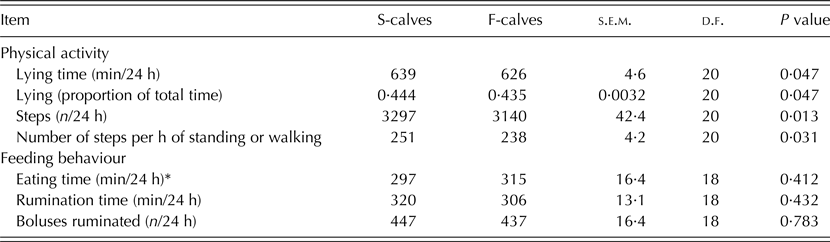
Physical activity, as recorded with the pedometers, differed between groups (Table 1). S-calves spent 2·1% more time (13 min/day; P = 0·047) lying down than F-calves. S-calves took 5% more (P = 0·013) steps than F-calves, resulting in more (P = 0·031) steps/h taken in the time when the calves were not lying down. Eating time (suckling and grazing), rumination time, and the number of boluses ruminated daily did not differ between groups.
Physical activity and feeding behaviour of suckling calves during grazing either on steep (S-calves) or flat (F-calves) pastures

s.e.m., standard error of mean; d.f., degrees of freedom.
* Suckling or grazing.
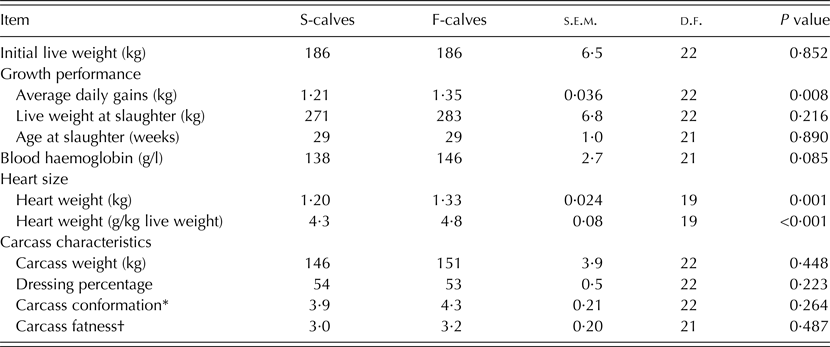
Starting at the same LW, S-calves had 10·3% smaller daily gains (P = 0·008) than F-calves which, however, did not result in a significantly different LW at slaughter (Table 2). At slaughter, there was a trend (P = 0·085) towards a smaller blood haemoglobin concentration in S-calves compared with F-calves. Absolute heart weight and heart weight as proportion of LW were smaller (P = 0·001 and P < 0·001, respectively) in S-calves than in F-calves. Carcass weight, dressing percentage and carcass grading for conformation and fatness did not differ significantly between groups.
Growth performance and traits measured at slaughter of suckling calves kept either on steep (S-calves) or flat (F-calves) pastures

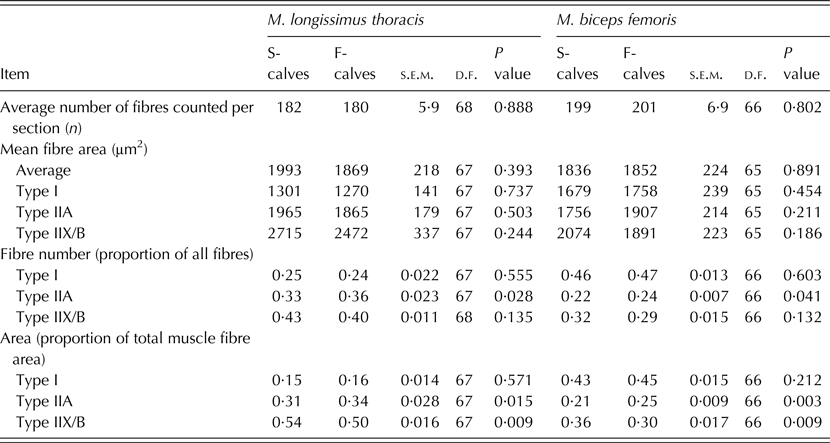
Total fibre counts and fibre areas did not differ between S- and F-calves in both LT and BF (Table 3). There were proportionately fewer type IIA fibres and less surface covered in S-calves than in F-calves in LT and BF. With respect to proportionate fibre area, this was compensated by the type IIX/B fibres (P = 0·009 for both muscles).
Muscle fibre characteristics in suckling calves kept either on steep (S-calves) or flat (F-calves) pastures

s.e.m., standard error of mean; d.f., degrees of freedom.
Ultimate pH at 24 h p.m. did not differ between S- and F-calves in LT and BF (Table 4). The lowest individual animal ultimate pH was 5·67 in the LT and 5·55 in the BF (in two different animals from F-calves), whereas the highest individual ultimate pH was 6·02 in the LT and 6·03 in the BF (in two different animals from S-calves). At 3 h p.m. the pH was greater (P = 0·004) in the LT of S-calves compared to that of F-calves.
Post mortem change in muscle pH in suckling calves kept either on steep (S-calves) or flat (F-calves) pastures

s.e.m., standard error of mean; d.f., degrees of freedom.
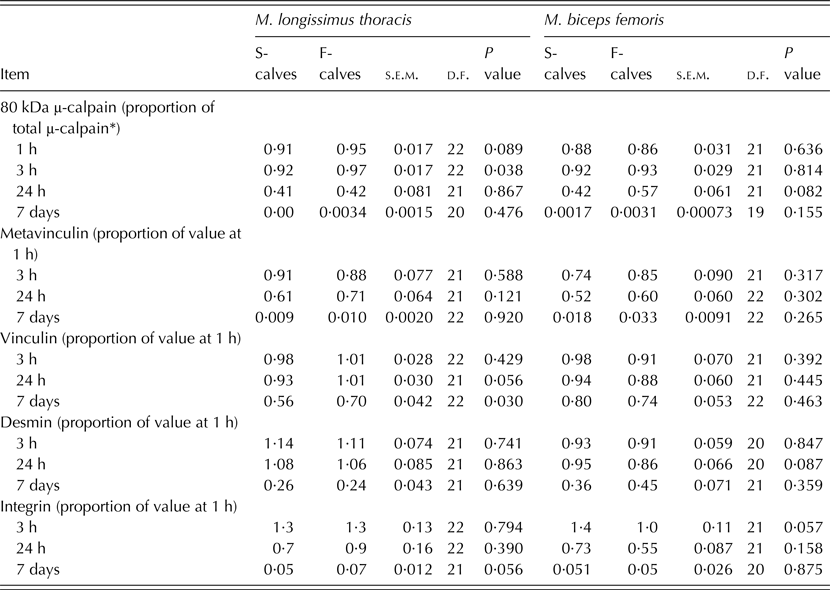
In the LT, S-calves had less intact μ-calpain 3 h p.m. (P = 0·038) and less vinculin at 7 days p.m. (P = 0·030) than F-calves (Table 5). There was a trend that the BF of S-calves had less intact μ-calpain (P = 0·082) and more intact desmin (P = 0·087) at 24 h p.m. than that of F-calves. No difference between S- and F-calves was observed for other traits and time points.
Post mortem degradation of intact enzymatic and structural muscle proteins in suckling calves kept either on steep (S-calves) or flat (F-calves) pastures

s.e.m., standard error of mean; d.f., degrees of freedom.
* Sum of 80, 78 and 76 kDa μ-calpain detected.
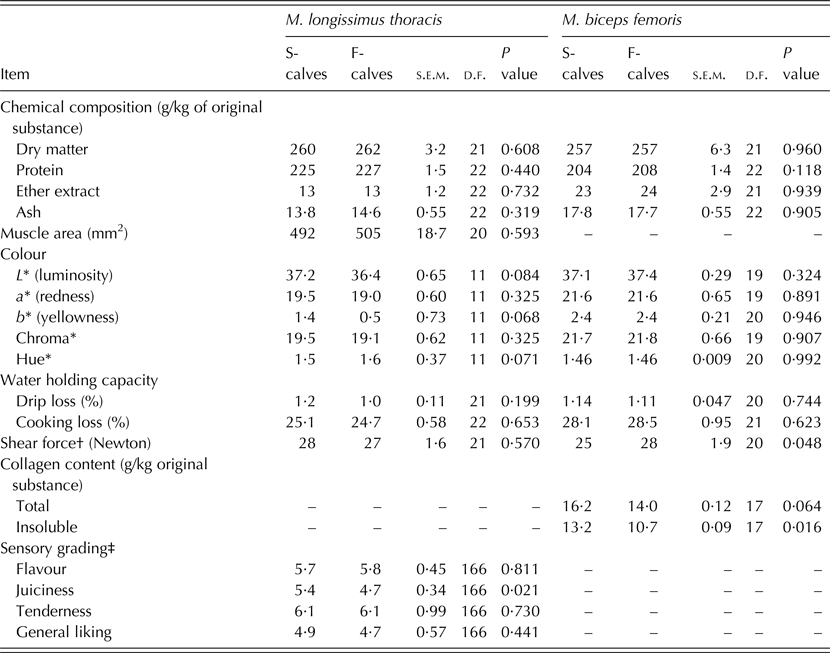
The contents of dry matter, protein, ash and intramuscular fat were not affected by treatment in the two muscles studied (Table 6). There was a trend for greater L* (P = 0·084) and b* (P = 0·068) of the LT of S-calves compared with that of F-calves, a phenomenon which was not observed in the BF. This resulted in a trend for a stronger hue (P = 0·071) in the LT of S-calves compared with F-calves, whereas the other traits describing colour were not affected. The water-holding capacity of the meat, measured as drip loss and cooking loss, was not different between groups in either muscle. Shear force of the BF was smaller (P = 0·048) by 11% in S-calves than in F-calves, a difference which was not observed in the LT. There was a trend (P = 0·064) towards greater total collagen content and greater (P = 0·016) insoluble collagen content in the BF of S-calves compared with that of F-calves. The panellists perceived grilled LT of S-calves to be juicier (P = 0·021) than that of F-calves. They could not distinguish between treatments in terms of flavour, tenderness and general liking.
Quality of the meat from suckling calves kept either on steep (S-calves) or flat (F-calves) pastures

s.e.m., standard error of mean; d.f., degrees of freedom.
* As defined by Warris (Reference Warris2010).
† M. biceps femoris cooked in the water bath; M. longissimus thoracis cooked on a grill plate to a core temperature of 69 °C.
‡ Scores are defined as 0 = absent/low/tough and 10 = strong/high/tender.
DISCUSSION
Suitability of the experimental setup for selectively influencing physical activity
The main objective of the experimental design was to induce differences in the level of physical activity between S- and F-calves using the natural pasture topography. The steep pasture selected was not only of considerable inclination but it was also free of flat areas, except for a small area where cows could lie down, which was necessary to secure animal welfare. The data obtained from the pedometers confirm an influence of the pasture inclination on physical activity. Despite the much higher strain of walking on slopes, which was found by Lachica et al. (Reference Lachica, Prieto and Aguilera1997) and Brosh et al. (Reference Brosh, Henkin, Ungar, Dolev, Shabtay, Orlov, Yehuda and Aharoni2010) to result in a two- to eightfold greater energy expenditure than walking on a flat terrain, S-calves performed significantly more steps per 24 h. The effects of the steep pasture were probably aggravated by the hypoxic conditions. The calves spent the first 18 weeks of their life at 1000 m a.s.l. and the subsequent 11 weeks of the experiment at 2000 m a.s.l. The oxygen partial pressure at 2000 m a.s.l. (about 80 kPa) is considerably lower than at 1000 m a.s.l. (about 90 kPa), which might have stimulated a response from the cardiorespiratory system of the calves (Hays et al. Reference Hays, Bianca and Näf1978).
Unexpectedly, the hearts (absolute and proportionate to LW) of S-calves were lighter at slaughter than those of F-calves. In addition, the blood haemoglobin concentration showed a trend to be lower in S- than in F-calves. This suggests a less pronounced adaptation of S-calves to an aerobic type of exercise compared to F-calves (Blomqvist & Saltin Reference Blomqvist and Saltin1983). It is, therefore, hypothesized that S-calves, on a terrain with 40% inclination, walked only in small bouts in an attempt to save energy. This behaviour, although still being demanding for the locomotor muscles due to the slope, would be less demanding for the cardiorespiratory system because of the shorter duration (described for sprint activity by Venckunas et al. Reference Venckunas, Raugaliene, Mazutaitiene and Ramoskeviciute2008). By contrast, F-calves could afford continuous exercise on their flat paddocks (endurance activity in Venckunas et al. Reference Venckunas, Raugaliene, Mazutaitiene and Ramoskeviciute2008).
However, there are strong indicators that S-calves were exposed to an overall greater physical strain and extra energy expenditure compared with F-calves. One is the larger amount of time per day spent lying down, which suggests that S-calves had a greater need to recover from physical strain. Another is the 10% difference in daily gains, which was probably not the result of any difference in the quality and availability of feed. It is known from previous studies (Willems et al. Reference Willems, Kreuzer and Leiber2013) that both the steep and the flat pastures grazed in the present experiment offered grass of favourably high nutritional value for this altitude, and even the variation in fibre contents remained within the small range reported by Willems et al. (Reference Willems, Kreuzer and Leiber2013) for high-quality alpine pastures. Also, there were no group differences in eating and rumination behaviour. As the experimental calves were still suckling, potential remaining differences in forage quality were considered to have been further equalized by giving the calves the opportunity to balance nutrient supply with milk intake, or at least dilute any forage quality effect by the intake of milk. Carcass quality, described by carcass weight, dressing percentage, and grading of meatiness and fatness, was similar between groups. Either the differences in physical activity and growth rate were not large enough to cause clear effects or the number of animals (n = 12 per treatment) was too low to obtain statistical differences in these traits.
Effects of grazing steep pastures on muscle fibre characteristics
Both muscles of the calves grazing on the steep slopes showed a greater relative proportion of fast twitch fibres (type IIX/B) at the expense of the intermediate fibres (type IIA), as opposed to the muscles of the calves grazing on flat pastures. As reviewed by Fry (Reference Fry2004) for human muscles, type IIB fibres can convert into type IIA fibres provided the physical activity is of sufficient intensity and is routinely performed. For the present study, this means that the physical activity of S-calves, compared with F-calves, could have been of smaller intensity or repeated less often, or both. This is congruent with the indications given by blood haemoglobin concentration and heart weights concerning sprint (anaerobic) v. endurance (aerobic) type of activity and the attempt to save energy as mentioned earlier. Few studies have investigated the effect of physical activity on various indicators of muscle metabolism in cattle. No empirical research exists, to our knowledge, which specifically addresses the effect of physical activity on muscle fibre types in cattle without confounding factors arising from dietary and environmental differences. Jurie et al. (Reference Jurie, Ortigues-Marty, Picard, Micol and Hocquette2006) reported a greater activity of oxidative enzymes (citrate synthase and β-hydroxyacyl-CoA dehydrogenase) in muscles of beef cattle exercised daily on a 5·2 km walk compared with sedentary beef cattle housed in pens. This indicates that bovine muscles may adapt to physical activity. This is confirmed by the differences observed in the present study between S- and F-calves in the relative proportions of different muscle fibre types in both muscles. However, in the present study the switch to more oxidative fibres (IIA fibres), expected in S-calves from previous human (Fry Reference Fry2004) and cattle studies (Jurie et al. Reference Jurie, Ortigues-Marty, Picard, Micol and Hocquette2006), was not observed. This was perhaps also related to insufficient duration of the exposure to increased physical activity. The present results demonstrate a specific adaptation of muscle fibres to the physical activity of grazing on steep and flat pastures, but not the form of adaptation that was expected.
Effects of grazing on steep pastures on post mortem changes in the muscles
The levels of ultimate pH of both BF and LT did not differ between groups and were within a normal range (Heinz & Hautzinger Reference Heinz and Hautzinger2007) with an ultimate pH ⩽ 6·0 in each individual.
Two kinds of proteins were considered in the present study. The first was represented by a calcium-activated enzymatic protein, the μ-calpain, which is concentrated in the Z-disc of the sarcomere and plays a major role in meat tenderization in interplay with its inhibitor calpastatin (Koohmaraie & Geesink Reference Koohmaraie and Geesink2006; Huff Lonergan et al. Reference Huff Lonergan, Zhang and Lonergan2010). The second kind comprised structural proteins such as metavinculin, vinculin, desmin and integrin, which are the substrates for proteolytic activity caused by calpain. Their degradation is similarly considered not only to play a role in meat tenderization but also in water holding capacity (Zhang et al. Reference Zhang, Lonergan, Gardner and Huff-Lonergan2006; Huff Lonergan et al. Reference Huff Lonergan, Zhang and Lonergan2010). There was no difference between groups in the proportion of intact μ-calpain, except at 3 h p.m. in the LT. However, the proportion of intact structural proteins differed between S- and F-calves for several p.m. time points and several proteins, although this happened without showing any consistent trend. Therefore, it is unlikely that p.m. proteolysis was responsible for the differences in meat quality traits observed between S- and F-calves after 21 days of ageing.
Effects of grazing steep pastures on meat quality
Consistent with the unchanged carcass fatness, the intramuscular fat content did not differ between groups in either BF or LT. Also, there was no difference in dry matter, protein and ash contents of the meat. However, the colour of the meat aged for 21 days showed an inclination for a muscle-type dependent response to physical activity. There was a trend for LT meat to be lighter and more yellow in S-calves than in F-calves. This would be advantageous since the typically dark colour of pasture beef (Muir et al. Reference Muir, Smith, Wallace, Cruickshank and Smith1998; Vestergaard et al. Reference Vestergaard, Oksbjerg and Henckel2000; Priolo et al. Reference Priolo, Micol and Agabriel2001) is less favoured by consumers (Killinger et al. Reference Killinger, Calkins, Umberger, Feuz and Eskridge2004). The trend observed in meat colour is consistent with the results of an evaluation of studies imposing physical activity made by Dunne et al. (Reference Dunne, Monahan and Moloney2011). Steinshamn et al. (Reference Steinshamn, Höglind, Havrevoll, Saarem, Lombnæs, Steinheim and Svendsen2010) also observed a lighter and yellower meat for calves grazing extensive mountain rangelands (>2700 ha) compared with calves grazing lowland pastures. Although physical activity was not quantified in Steinshamn et al. (Reference Steinshamn, Höglind, Havrevoll, Saarem, Lombnæs, Steinheim and Svendsen2010), the size of the rangeland suggests that calves grazing in the mountain area actually expressed a greater physical activity than calves on lowland pastures. In contrast to that, Dunne et al. (Reference Dunne, O'Mara, Monahan, French and Moloney2005) did not observe any differences in lightness and yellowness of the LT 48 h after slaughter between long-term exercised (4·4 km walking distance/day for 18 weeks) and non-exercised (sedentary) 18-month old steers. The authors argued that the meat colour of the animals investigated was too dark (L* value 31–32; older animals) to detect a response to the activity stimulus in terms of meat lightness. This restriction was not relevant with suckling calves in the present study where the L* value was at 36–37 and in that of Steinshamn et al. (Reference Steinshamn, Höglind, Havrevoll, Saarem, Lombnæs, Steinheim and Svendsen2010) with L* values from 39 to 42. The lighter colour of the LT in S-calves in the present study could have been due to the greater proportion of glycolytic fibres (IIX/B) in this muscle compared with F-calves (Vestergaard et al. Reference Vestergaard, Oksbjerg and Henckel2000). Type IIX/B fibres are not consistently associated with a glycolytic enzymatic metabolism (Young Reference Young1984; Pette et al. Reference Pette, Peuker and Staron1999) but, if so, the relatively larger surface covered by type IIX/B fibres in the same muscle in S-calves compared to F-calves would support this trend in L*. Another reason for the lighter LT colour found in the S- v. F-calves could have been a smaller myoglobin concentration. The latter would be consistent with the observed trend towards smaller haemoglobin concentrations, which points towards a smaller aerobic capacity, and therefore a greater glycolytic muscle metabolism (Vestergaard et al. Reference Vestergaard, Oksbjerg and Henckel2000). No such trend in muscle colour was observed in the BF, although the same differences in muscle fibre profile occurred between S- and F-calves as in the LT. The BF has a more oxidative and less glycolytic metabolism than the LT (Talmant et al. Reference Talmant, Monin, Briand, Dadet and Briand1986), even under the present hypoxic conditions (Lin et al. Reference Lin, Wang, Feng, Huang, Xu, Jin, Li, Jiang and Zheng2011). It is hypothesized that this metabolic difference rendered the LT more sensitive or more capable to adapt to the systemic adaptation of the calves to hypoxia than the BF.
A muscle-dependent response to pasture inclination was also obtained in shear force which was smaller in the BF of S-calves compared to that of F-calves. In the LT, no such effect occurred for either shear force or sensory tenderness impression. The differences in shear force of the BF cannot be explained by changes in collagen concentration and solubility, or by consistent differences in p.m. muscle fibre proteolysis. If the shear force difference were due to the changes in proportion of each fibre type, the smaller shear force would therefore be likely to occur in the LT too. Other reasons may include the fact that the BF has a more oxidative-oriented metabolism than the LT (Talmant et al. Reference Talmant, Monin, Briand, Dadet and Briand1986) and is intensively involved in locomotion, while the LT is primarily a muscle of support and posture maintenance. In addition, in the present study an extensive ageing period was applied, which is common for high-quality beef (Renand et al. Reference Renand, Picard, Touraille, Berge and Lepetit2001; Velik et al. Reference Velik, Gangnat, Kitzer, Finotti and Steinwidder2013). As a consequence, the possibility cannot be excluded that the difference in shear force may have been more pronounced before ageing.
The greater juiciness of the LT from S-calves compared with F-calves was not accompanied by greater tenderness, flavour or general liking scores in the sensory evaluation. This is in opposition to the correlations reported by Thompson (Reference Thompson2004).
Various researchers, among them Rusman et al. (Reference Rusman, Soeparno, Setiyono and Suzuki2003), reported that the LT and the BF have a different meat quality. The present experiment goes a step further by suggesting that these two muscles respond differently to the stimulus created by physical activity on steep slopes, with consequently different results for meat colour and shear force. The explanation for this phenomenon may lie in metabolic and functional differences between muscles.
CONCLUSION
The present experiment showed that steep pastures actually changed the strain and the type of physical activity carried out by the calves. The extra energy required for this was gained at the expense of growth. The comparably short stay of 11 weeks on pastures of different topographies was sufficient to induce a specific adaptation of the muscle fibre profile and to cause differences in the physicochemical characteristics of the meat even after 21 days of ageing had passed. Still, considering the large differences in physical strain, these changes were limited in magnitude. Further studies have to show whether older animals would also show such changes in such a short period.
The authors gratefully acknowledge the help provided by Hans-Rudolf Wettstein and his staff at the ETH research stations, by the ETH laboratory staff and by Dora Flament (Master's student). Further thanks go to Claudine Biollay and Bernard Dougoud from Agroscope and to the employees of the slaughterhouse SBAG St. Gallen for their assistance during slaughter, and to Jessica Messadène for conducting the sensory analysis.