Implications
Bruises are subcutaneous lesions that become visible after the skin has been removed during the dressing of a carcass, and they are indicators of sub-optimal welfare conditions during the pre-slaughter period. Characteristics of bruises such as size, colour, shape and grade may provide information about the extent of sub-optimal welfare. In our study, we compared bruises on the carcasses of cows obtained from two types of sources: either sourced from a livestock market (M-carcasses) or coming from the farms (F-carcasses). The results show that most carcasses have bruises and that M-carcasses have more bruises than F-carcasses; however, the bruise characteristics were not significantly different between the M-carcasses and the F-carcasses. The results suggest that the pre-slaughter handling of the cows was not optimal and further research should be undertaken into the causes of bruising.
Introduction
Bruises are subcutaneous lesions that may vary in number, distribution, severity, extent, colour and shape. Because of the type of hair coat and the thickness of the skin, bruises in cattle are only clearly visible after slaughter and de-hiding. Bruises are important in relation to carcass quality (meat quality), and therefore, carcasses are classified according to the severity of the lesions on the slaughter-line. In Chile, when a bruise affects muscle tissue and the damage is considerable, the bruised area is trimmed and the carcass is downgraded, leading to economic losses.
Bruises are also an important source of information about animal welfare, and they are described as such in pigs (de Koning, Reference Koning1985; Faucitano et al., Reference Faucitano, Marquardt, Oliveira, Sebastiany Coelho and Terra1998; Lambooij, Reference Lambooij2000), poultry (Mayes, Reference Mayes1980; Gregory, Reference Gregory1994; Nijdam et al., Reference Nijdam, Arens, Lambooij, Decuypere and Stegeman2004; Broom and Reefmann, Reference Broom and Reefmann2005), rabbits (Liste et al., Reference Liste, Villarroel, Chacón, Sañudo, Olleta, García-Belenguer, Alierta and María2009), deer (Jago et al., Reference Jago, Hargreaves, Harcourt and Matthews1996; Matthews, Reference Matthews2000), sheep (Cockram and Lee, Reference Cockram and Lee1991; Jarvis and Cockram, Reference Jarvis and Cockram1994; Tarumán and Gallo, Reference Tarumán and Gallo2008) and horses (Grandin et al., Reference Grandin, McGee and Lanier1999). In cattle, the observation of bruising is used to determine whether animal welfare is sub-optimal (Strappini et al., Reference Strappini, Metz, Gallo and Kemp2009). For carcass evaluation, identification of only severe bruises is sufficient; however, for welfare assessment, an accurate quantification of the number of bruises, their location on the carcass and the diversity of bruise characteristics is required to identify the impact on welfare and, potentially, to unravel the cause and the moment of infliction of the bruise.
The shape of a bruise is often directly associated with the causative event. For instance, circular shaped bruises, which are deep and small in extent, are most likely caused by horns (Grandin, Reference Grandin2000); parallel red bruises with a tramline appearance are most likely caused by sticks (Weeks et al., Reference Weeks, McNally and Warriss2002) and mottled bruises can be the result of the use of pointed sticks (Gallo, Reference Gallo2009).
Although the colour of a bruise is associated with the time of occurrence of the bruise, there is no general agreement among authors as to the exact age associated with each colour and the sequence of colour changes. Rough estimates are provided by Gracey and Collins (Reference Gracey and Collins1992), who reported that a bright red bruise is likely to be up to 10 h old, a dark red bruise is approximately 24 h old and a yellow bruise is more than 3 days old. Hamdy et al. (Reference Hamdy, Kunkle, Rheins and Deatherage1957) reported a different sequence of colour changes in cattle bruises: red colouration from 15 min to 2 days, green from days 3 to 4 and yellow and orange from days 4 to 6. McCausland and Dougherty (Reference McCausland and Dougherty1978) found that a yellow colouration appeared by 48 h.
The severity of a bruise is related to the force applied and the part of the body that was damaged. Bruises inflicted over the gluteus muscles of cows are deeper than those inflicted over the lumbo-dorsal fascia (Hamdy et al., Reference Hamdy, Kunkle, Rheins and Deatherage1957). Overall, the severity of a bruise depends greatly on the thickness and density of the affected tissue and its vascularity.
The method of animal selling is commonly associated with the number of bruises and their distribution on the carcass (Eldridge et al., Reference Eldridge, Barnett, McCausland, Millar and Vowles1984; McNally and Warriss, Reference McNally and Warriss1996; Weeks et al., Reference Weeks, McNally and Warriss2002). Higher numbers of bruised carcasses are reported for marketed animals than for animals transported directly from the farm (Weeks et al., Reference Weeks, McNally and Warriss2002; Strappini et al., Reference Strappini, Metz, Gallo and Kemp2009). Marketed animals present more bruises on the hip, buttocks and rump-loin than animals transported directly from farms to the slaughterhouse (Wythes et al., Reference Wythes, Arthur and Meischke1982; Blackshaw et al., Reference Blackshaw, Blackshaw and Kusano1987; Jarvis et al., Reference Jarvis, Selkirk and Cockram1995). These animals are exposed to extra loading and unloading procedures and to group mixing, which is likely associated with more bruises. A recent epidemiological study carried out in Chile has shown that animals from markets are at higher risk of being bruised than animals coming directly from farms (odds ratio (OR) of 1.4; Strappini et al., Reference Strappini, Frankena, Gallo, Metz and Kemp2010b). In that study, bruises on carcasses were recorded by the Chilean grading system (Instituto Nacional de Normalización (INN), 2002), in which only the most severe bruise per carcass is considered, and information about other bruises, further characterisation of bruises and their anatomical location was missing.
The aim of this study was to provide a detailed description of the number and characteristics of bruises on cattle carcasses and to relate these parameters to the source of the animals, that is, directly transported from the farm to the slaughterhouse, or passing through a livestock market first.
Material and methods
Data collection
The study was carried out at a slaughterhouse in Valdivia, Chile, between February and April 2009. The carcasses of cows were used in our study because of the relatively high bruise prevalence (18.8%) within this category (Strappini et al., Reference Strappini, Frankena, Gallo, Metz and Kemp2010b). The cows were of the dairy type, and they were defined as mature female bovines with four, six or eight permanent incisor teeth. Maximum transport distance travelled by the animals – from the market or the farm to the slaughterhouse – was 200 km. General handling conditions for cattle at this slaughterhouse considered a lairage time between 12 and 18 h; groups of cattle were driven by personnel trained in animal handling from the lairage pens through a curved race to the stunning box. The animals were stunned using a non-penetrating captive bolt pistol, immediately chained by their left hind leg, shackled onto the slaughter-line and exsanguinated. The slaughterhouse processes are, on average, 350 cattles per day, and the average slaughter-line speed is 50 animals per hour.
A total of 265 cow carcasses were intermittently inspected on the slaughter-line over 11 days. The carcasses were selected from the daily slaughter programme of the slaughterhouse in consideration with information reported by the Chilean Ministry of Agriculture (ODEPA, 2009): that about 40% of the cows come directly from farms, and about 60% are traded through a livestock market before arrival at the meat plant. Seven carcasses had incomplete data, leaving 258 carcasses for analysis, of which, 111 were from animals transported directly from the farm (F-carcasses) to the slaughterhouse and 147 were from animals that had passed through a livestock market (M-carcasses).
For each individual cow carcass included in our study, the following information was available:
Age: ‘young’ having four or six permanent incisor teeth and ‘old’ having eight permanent incisor teeth (INN, 2002).
Hot carcass weight (HCW): carcass weight (kg) after slaughter and removal of the hide, head and legs at the metacarpus (foreleg) and metatarsus (hind leg) phalange joints and of all internal organs, but before chilling.
Fat coverage: degree of thickness of external fat on the carcass, assessed by visual appraisal according to INN (2002); grade 0: absence of fat; grades 1, 2 and 3: scarce, abundant and excessively abundant fat coverage, respectively.
Protocol for bruise evaluation
The evaluation of cow carcasses for the presence of bruises and bruise characteristics was carried out by a meat grader and veterinarian with 5 years of experience. This observer was positioned after the de-hiding point and before the carcass-splitting point along the slaughter-line, allowing the entire carcass – hanging by both hind legs – to be easily observed.
The protocol for the post-mortem evaluation was based on the Australian Carcass Bruising Scoring System (ACBSS; Anderson and Horder, Reference Anderson and Horder1979) and the Chilean bruising carcass-grading standard (INN, 2002). The parameters of the shape and colour of bruises were added. We defined a bruise as a lesion where tissues were crushed with a rupture of vascular supply and an accumulation of blood and serum without discontinuity of the skin (Anderson and Horder, Reference Anderson and Horder1979; INN, 2002).
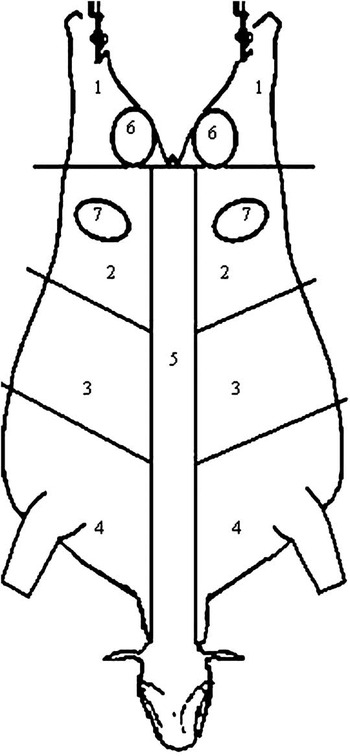
For each carcass, the presence of bruises (yes or no) was recorded first. If bruises were present, the number of bruises per carcass and the number of bruises per anatomical site were assessed. Next, each bruise present on the carcass was evaluated by registering its anatomical site, size, severity, shape and colour. The original ACBSS score sheet for half a carcass was extended to allow the complete registration of bruises for the entire carcass. The anatomical site of the bruise was recorded according to the ACBSS, and the carcass was divided into seven sites as codes 1 to 7 (Figure 1):
Bruise scoring sheet, numbers indicate the location (sites) of the bruises on the carcass being 1, butt; 2, rump-loin; 3, ribs; 4, forequarter; 5, back; 6, pin and 7, hip.

1. Butt: hindquarter distal, Mm. gluteobiceps, semitendinosus, gluteus medius;
2. Rump-loin: Mm. obliquus externus abdominis, transversus abdominis;
3. Rib: Mm. intercostalis externi and interni, tranversus thoracis;
4. Forequarter: Mm. trapezius, latissimus dorsi, infraspinatus, supraspinatus, deltoideus;
5. Back: the spinal column and adjacent muscles from the neck to the butt of the tail;
6. Pin: tuber isquiadicum, insertion of Mm. semitendinosus and gluteobiceps;
7. Hip: tuber coxae of ilium, insertion of muscles Mm. gluteus profundus and tensor fasciae latae.
If a bruise covered more than one site, it was indicated as ‘multiple site’.
The size of the bruise was assessed on the basis of its diameter according to the ACBSS: small: ⩾2 and ⩽8 cm; medium: >8 and ⩽16 cm; large: >16 cm. When a bruise was not circular, the diameter was measured as the longest length of the lesion. To assist with the visual appraisal of the bruises, a disc indicating circular areas of 2, 8 and 16 cm was used.
The severity of the bruise was scored by the observer according to the Chilean bruising grading classification (INN, 2002): grade 1: only subcutaneous tissue affected; grade 2: as grade 1, but with muscle tissue affected; grade 3: as grades 1 and 2, but with the presence of broken bones.
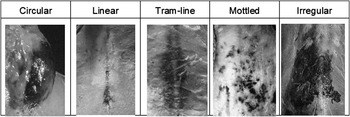
The shape of the bruise, defined as the characteristic pattern or form of a bruise, was classified according to previous studies (Grandin, Reference Grandin2000; Weeks et al., Reference Weeks, McNally and Warriss2002; Strappini, Reference Strappini Asteggiano2010a). The following shapes were distinguished: circular: a bruise shaped like or nearly like a circle; linear: a non-circular bruise with one dimension (length) longer than the other (width); tramline: two parallel linear bruises separated by a paler undamaged area; mottled: the bruised area appears spotted or blotched; and irregular: a bruise without clear dimensions and with uneven margins (Figure 2).
Shape of bruises as defined in this study.

The colour of the bruise was scored as follows: ‘red’, corresponding to a fresh bruise; ‘bluish or dark’ for an old bruise; and ‘yellowish/orange’ for a very old bruise. Bruises smaller than 2 cm, blemished injection sites and reddening lesions that looked like bruises, located on the left hind leg – more likely caused after stunning by the tightening of the shackle chain – were not recorded.
Statistical analysis
Differences between carcasses arriving via markets or directly from farms were tested using GLM (Gaussian distribution) for the number of bruises per carcass and by generalised estimated equations (GEE), which specified a binomial distribution with a logit link function for the number of bruises per site and the bruise characteristics (grade, size and colour). As we were not interested in carcass-specific estimates, but in the total population of all carcasses, we preferred a population-average model (GEE) over a subject-specific model (MIXED). In all GEE models, the carcass was included as a random effect because multiple bruises per carcass might not be independent; the exchangeable correlation structure was specified. The main independent variable was origin of the carcass (from farm or market). The covariates were the age of the cow, the HCW and the degree of fat coverage. Initially, all of these variables were included in the model. The covariates were removed one by one, the order being on the basis of the highest P-value, until all variables were significant or were deemed a confounder for the main effect. Confounding was defined to be present when the removal of a covariate resulted in a change of the estimate for the origin of the animal of more than 25%. Finally, two-way interaction terms for the remaining variables were evaluated. Combinations of bruise characteristics (colour, shape, severity grade and size) and their relation to the origin of the carcass were evaluated similarly. Fitting of the GLM models was performed by graphical inspection of the residuals. The fit of the binary models was determined by assessing the Hosmer–Lemeshow (HL) statistic using ordinary logistic regression. All analyses were performed using SAS (SAS Institute Inc., Cary, NC, USA).
Results
Origin of carcasses
A total of 258 carcasses were assessed with regard to bruises, 147 arrived from markets and 111 from farms. For 140 carcasses, it was known from which market (n = 4, ranging from 18 to 55) they arrived and for 109 carcasses, it was known from which farm (n = 16, ranging from 1 to 24) they arrived. Number of bruises per carcass did not differ significantly between the four markets (P = 0.15) and also not significantly between the 16 farms (P = 0.17). Therefore, we considered both populations of carcasses, coming either from the M-carcasses or from the F-carcasses, to be homogeneous. Information about transport conditions (i.e. distance, stocking density, duration of the journey and truck characteristics) was incomplete and was excluded from the analysis.
Carcass and bruise characteristics
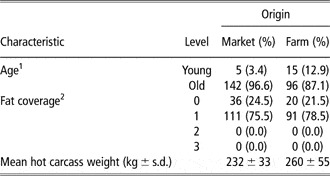
Table 1 presents the characteristics of the M- and F-carcasses. The age (young, old) differed significantly between the carcass origins, showing that a greater percentage of the cows classified as ‘old’ were sourced from a market than directly from a farm (χ 2, P < 0.01). Animals with abundant or excessively abundant fat coverage (grades 2 or 3) were not observed. For grades 0 and 1, the fat coverage was not significantly different between the M- and F-carcasses (χ 2, P = 0.23). For HCW, the F-carcasses were, on average, 28.3 kg heavier than the M-carcasses (GLM, linear regression, P < 0.001).
Baseline characteristics of dairy-type cows arriving from market (n = 147) or directly from the farm (n = 111)

1Young: animal with four or six permanent incisor teeth; old: animal with eight permanent incisor teeth.
2Fat coverage 0: denotes absence; 1: scarce; 2: abundant and 3: excessive.
Number and location of bruises
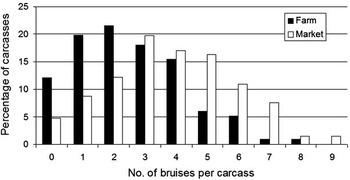
There were 846 bruises on the 258 inspected carcasses, 238 (92.2%) of the carcasses were bruised and 20 carcasses (7.8%) were recorded as non-bruised. The carcasses sourced directly from farms were more often free of bruises (n = 13/111, 11.7%) than the carcasses sourced from a livestock market (n = 7/147, 4.8%; the Fisher exact P-value: 0.058). The frequency distribution of the number of bruises per carcass is shown in Figure 3. Carcasses from animals that had passed through a livestock market showed, in total, 563 bruises (mean 3.8 bruises per carcass (s.d. 2.0); median 4.0; ranging from 0 to 9), whereas carcasses from animals transported directly from farms had, in total, 283 bruises (mean 2.5 bruises per carcass (s.d. 1.8); median 2.0; ranging from 0 to 8). The number of bruises per carcass was significantly related to the origin of the carcass, with M-carcasses showing an average of 1.4 more bruises than F-carcasses (GLM, P < 0.001, residuals normally distributed).
Number of bruises per carcass of cows from markets (n = 147) or arriving directly from the farm (n = 111).

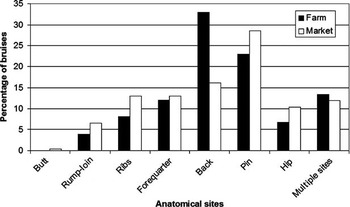
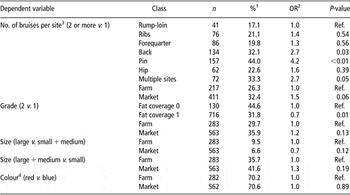
The distribution of the bruises over the carcass sites (Figure 4) shows that the pin of the carcass was the most frequently bruised area (26.5% of all bruises) followed by the back (21.8%), whereas the butt was the least affected site (0.4%). The back of F-carcasses had a 2 times greater probability of being bruised than M-carcasses (32.9% and 16.2%, respectively), whereas bruises in the rib area were more frequently observed in M-carcasses (13.1% and 8.1%, respectively; Figure 4). The 846 bruises on the 238 bruised carcasses were distributed over 630 sites. The majority of these sites showed one bruise (n = 440); 167 showed two bruises; and 23 sites showed three or more bruises. For the analysis (Table 2), the number of bruises per site was recorded as one bruise per site or two or more bruises per site. The final GEE model included only the site and source of the carcass; the OR of having two or more bruises per site was 1.5 (95% CI: 1.0 to 2.1, P-value: 0.06) for M-carcasses compared with F-carcasses. The ORs of having two or more bruises in a site were significantly higher for ‘back’, ‘pin’ and ‘multiple sites’, compared with the ‘rump-loin’ area. The exchangeable working correlation was 0.04, and the HL-statistic in the ordinary logistic regression showed sufficient fit (P-value: 0.85).
Number of bruises per site of cow carcasses from markets (n = 147) or arriving directly from the farm (n = 111).

Final models estimates (GEE) for number of bruises per site and bruise characteristics

GEE = generalised estimated equations; OR= odds ratio.
1% indicates the % of sites/bruises showing the first level of the dependent variable.
2OR estimates were adjusted for presence of more than one bruise per carcass.
3Butt excluded from the analysis as only two bruises were observed on all butts.
4Two yellow bruises excluded from the analysis.
Bruise characteristics
All models using binary data showed sufficient fit as determined by the HL-statistic (P > 0.05).
Grade
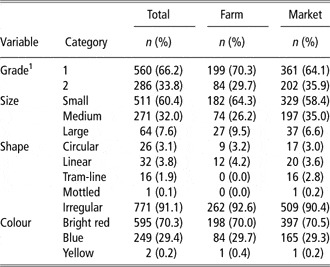
Superficial bruises of grade 1 were most frequently observed (66.2% of all bruises; Table 3). Bruises of grade 2 – muscular damage – were observed in 142 carcasses, totalling 286 bruises (33.8% of all bruises). There were no cows presenting severe bruises of grade 3 with the presence of broken bones. In the GEE model, fat coverage was the only significant variable related to grade (OR for fat coverage 1 compared with 0 was 0.7, 95% CI 0.5 to 0.9, P-value 0.01; Table 2). The OR for M-carcasses v. F-carcasses was 1.2 (95% CI 0.9 to 1.6, P-value 0.13, exchangeable working correlation 0.17).
Frequencies of the bruise characteristics according to the source of the cows (n = 846)

1Grade score 1: subcutaneous tissue damaged; grade 2: subcutaneous and muscular tissue damaged.
Size
Of the 846 bruises, 64 (7.6%) were classified as large, 271 (32.0%) as medium and 511 (60.4%) as small (Table 3). One or more large bruises were observed on 54 carcasses: 23 (20.7%) were on F-carcasses and 31 (21.1%) were on M-carcasses. In the GEE analysis of this ordinal variable, the proportional odds assumption did not hold, and two separate analyses were performed comparing large v. small or medium bruises and large or medium v. small bruises, respectively. In the first GEE model, the odds for showing large bruises v. not large (small or medium) were lower for M-carcasses compared with F-carcasses, although they were not statistically significant (OR = 0.7, 95% CI 0.4 to 1.1, P-value 0.12, exchangeable working correlation <0.01). In the second model, the odds of showing large- or medium-sized bruises were increased for M-carcasses compared with F-carcasses, but they were also not significant (OR = 1.3, 95% CI 0.9 to 1.8, P-value 0.19, exchangeable working correlation was 0.09).
Shape
Irregularly shaped bruises were by far the most frequent (91.1%, n = 771), followed by linear (3.8%, n = 32), circular (3.1%, n = 26) and tramline bruises (1.9%, n = 16; Table 3). Mottled bruises were observed only once, and were therefore excluded from further analyses. Tramline-shaped bruises were noticed only in M-carcasses. The shapes of the bruises were significantly associated with the origin of the carcasses (Fisher's exact test, P = 0.019). The significance was entirely because of the absence of tramline-shaped bruises in F-carcasses. No further multivariable statistics were performed for this nominal variable.
Colour
The majority of bruises (n = 595, 70.3%) had a bright red colour; 29.4% (n = 249) were bluish and two bruises (0.2%) were yellow (Table 3). A multivariable analysis using the GEE models revealed no significant variables. The OR of M-carcasses v. F-carcasses using the colour ‘red’ (yes/no) as a dependent variable was 1.0 (95% CI 0.7 to 1.4, P-value 0.89; Table 2).
Combinations of characteristics
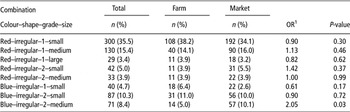
The most frequent combination was small, red and irregular bruises grade 1 (n = 300, 35.5%), followed by medium, red and irregular bruises grade 1 (n = 130, 15.4%; Table 4). Only combinations of characteristics that were observed at least 10 times or more were analysed further. The final GEE model showed that the OR for presenting medium, blue and irregular bruises of grade 2 was significantly higher for M-carcasses (OR = 2.05, P-value 0.03; Table 4) than for F-carcasses.
Frequency of combinations of bruise characteristics according to the source of the cows (n = 846)

OR = odds ratio.
1F-carcasses were taken as reference.
Discussion
In Chile, a large number of cows (228 386 cows in 2009) are sold through livestock markets (ODEPA, 2009). This type of sale involves extra transport, (un)loading, handling and mixing with unfamiliar animals, thus increasing the risk for bruising. This study investigated the effect of the source of cows for slaughter (via market or directly from farm) on the number and characteristics of bruises on their carcasses.
Our data show that carcasses from animals sourced from markets and those sourced directly from farms, both have a high probability of having bruises (95.2% and 88.3%, respectively). These findings are in line with those reported by Weeks et al. (Reference Weeks, McNally and Warriss2002), who found that 71.0% of the animals that had passed through a market had a bruised carcass compared with 53.7% of the animals from farms. The average number of bruises per carcass was also significantly (P < 0.001) higher in M-carcasses (3.8) than in F-carcasses (2.6). The high number of bruised carcasses and the number of bruises per carcass indicates sub-optimal welfare conditions (Strappini et al., Reference Strappini, Metz, Gallo and Kemp2009). The higher number of bruises found in M-carcasses than in F-carcasses could be associated with the quality of the human–animal relationship in the livestock markets, the multiple journeys, extra (un)loadings and an extra period of animal handling (Knowles, Reference Knowles1999). However, further research is required to unravel the specific causes.
There were significant differences between F- and M-carcasses in the distribution of bruises over the carcass. Animals from farms more often presented bruises on the back, whereas animals from markets more often presented bruises on the ribs, hip and the pin site (Figure 4). In the United Kingdom, Jarvis et al. (Reference Jarvis, Selkirk and Cockram1995) and Weeks et al. (Reference Weeks, McNally and Warriss2002) reported more bruises on the hip, back, shoulders and butt in market animals. The differences in the distribution of bruises on the carcasses in Chile compared with those in the United Kingdom are probably because of differences in the design of facilities, handling procedures and the type of animals used. The distribution of the bruises can provide information about their causes. According to Grandin (Reference Grandin2000), back bruises are most likely caused by equipment problems such as collisions with structures and they could be an indicator of rough handling. Pin and rib bruises may be attributable to hitting against structures such as races, corners and badly maintained sides of vehicles, but also to the use of driving instruments such as sticks, which are commonly observed to be used at Chilean markets (Gallo, Reference Gallo2005). Tramline bruises were observed only on M-carcasses in the rib area. This type of bruise resembles the object that inflicted the lesion, as in the case of wooden sticks (McNally and Warriss, Reference McNally and Warriss1996; Weeks et al., Reference Weeks, McNally and Warriss2002). Our results suggest that the market animals in Chile have more bruises that are inflicted by handling and the use of driving instruments than the farm animals.
Bruises are a source of pain (Gregory, Reference Gregory2007), and therefore, the degree of damage may be indicative of how much the animal has suffered. The average distribution of bruises over grading categories was similar for animals from the market and from the farm. However, the severity of bruises was associated with the fat coverage of the animal, regardless of origin. Animals with a poor body condition score without fat coverage had a higher risk of presenting severe bruises with muscular damage. The presence of some fat coverage seems to protect the animal from the occurrence of severe bruises. Therefore, animals with a poor body condition score should be handled with extra care.
In this study, most bruises had a bright red colour (Tables 2 and 3), which is characteristic of the so-called fresh bruises (Grandin, Reference Grandin2000). This colour confirms that most bruises were recent and were produced during the ante-mortem period, probably caused during transit, at unloading or during lairage at the slaughterhouse. However, the determination of the age of a bruise based solely on colour is a subjective assessment and can be inaccurate. Considering that in Chile a common practice is to deliver the animals at the livestock market in the morning, that auction takes place in the afternoon and that the premises have to be cleared of animals before the end of the same day, all the above-mentioned handlings could have occurred between 24 and 48 h before slaughter of animals from both sources. Therefore, a more precise estimation of the age of the bruises combined with the timing of pre-slaughter events would provide better information on where and when the welfare conditions of the animal were sub-optimal.
Bruises appear on the carcass as a combination of colour, shape, extent and severity. Red, irregular, small and grade 1 bruises were recorded most often; however, their occurrence was not affected by the source of the cows. Blue, irregular, medium and grade 2 bruises were found more often in M-carcasses than in F-carcasses (Table 4). This result suggests that M-carcasses present more severe, older and larger bruises than F-carcasses, which is consistent with the extra handling of the cattle passing through the markets and extra time being exposed to bruising events. However, as we analysed eight characteristic combinations of bruises, this result should be taken with caution because multiple testing of a single significant result could be coincidental.
The prevalence of bruises contrasts with previous studies (Gallo et al., Reference Gallo, Caro, Villarroel and Araya1999; Strappini et al., Reference Strappini, Frankena, Gallo, Metz and Kemp2010b) – performed in the same area of the country – using the Chilean bruising protocol (INN, 2002), where only 7.7% and 12.3% of the carcasses were reported as bruised, respectively. This large difference is because of the Chilean system, in which only the most severe bruise is reported when there are multiple bruises, whereas in the ACBSS, all bruises observed are reported. In practice, small bruises of grade 1 are rarely reported at Chilean slaughterhouses (Strappini et al., Reference Strappini, Frankena, Gallo, Metz and Kemp2010b), as they are of no consequence for the final price of the carcass. Because of this practice, the Chilean system presents constraints to the identification of problems linked to the welfare of the animal.
In conclusion, this study shows that animals sourced directly from farms or through markets, both have a high level of bruising as compared with findings reported previously in Chile using the official Chilean bruise protocol. These results also raise the question of the causes of these bruises and their relationship with animal welfare. As bruises were more prevalent in M-carcasses than in F-carcasses, this suggests that at least part of the reason for the difference in the prevalence of bruising is because of a higher exposure to handling procedures, as cows from markets are likely to have been handled more than those sourced directly from farms. Further studies are required to elucidate whether the causes of the higher prevalence of bruising in cows passing through markets are only related to extra handling (repeated loading, unloading, transportation, mixing), or also to inadequate design of market facilities (loading/unloading pens, races, holding pens, weighing points) and to the way in which animals are handled at the market. The gross characteristics of the bruises are a valuable tool to identify and evaluate potential sub-optimal welfare conditions during the pre-slaughter period. Therefore, it is advisable that a detailed evaluation of bruises be included in animal welfare assessment protocols.
Acknowledgements
The authors thank Procesadora de Carnes del Sur for their collaboration during data collection. The authors are also grateful to Grisel Navarro, Ricardo Valenzuela and Ronald Vargas for their assistance.