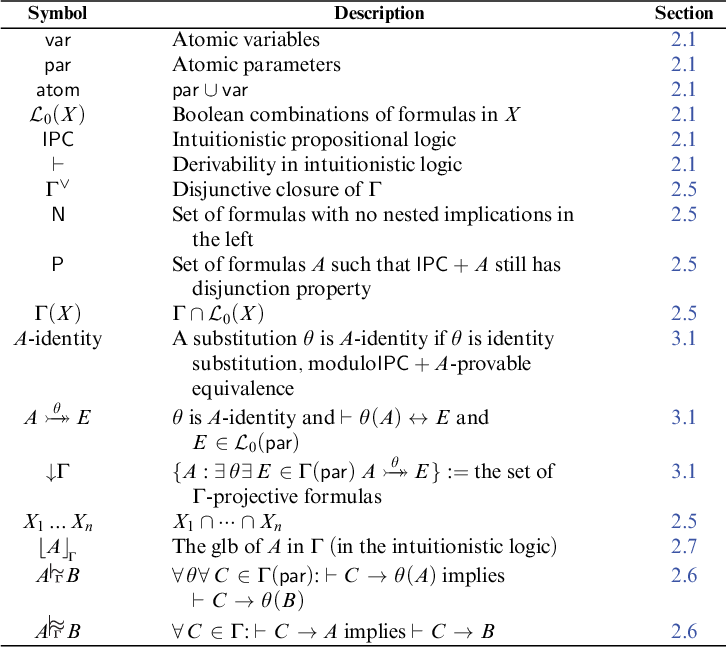
1 Introduction
Silvio Ghilardi [Reference Ghilardi3, Reference Ghilardi4] studies unification in propositional logics. More precisely, he describes all solutions for
 $ A(x_1,\ldots ,x_n)\leftrightarrow \top $
with respect to a background logic like intuitionistic logic
 $\mathsf {IPC}$
or a modal logic containing
 $\mathsf {K4}$
. By a solution we mean a substitution
 $\theta $
such that
 $\theta (A \leftrightarrow \top )$
holds.
On the other hand, we have a related question for decidability/characterization of admissible rules of
 $\mathsf {IPC}$
. A rule
 $A/B$
is admissible for a logic
 $\mathsf {L}$
if
 $\mathsf {L}\vdash \theta (A)$
implies
 $\mathsf {L}\vdash \theta (B)$
for every substitution
 $\theta $
. In contrast to the case of classical logic, in which every admissible rule is also derivable, the cases of modal logic and intuitionistic logic are not trivial. Probably the first such underivable admissible rule for
 $\mathsf {IPC}$
is the following [Reference Harrop6]:

Using the tools and results in [Reference Ghilardi3], Rosalie Iemhoff proves the completeness of a base for all admissible rules of
 $\mathsf {IPC}$
[Reference Iemhoff7, Reference Iemhoff8], which was previously conjectured by de Jongh and Visser. Decidability of admissibility for
 $\mathsf {IPC}$
was already known [Reference Rybakov18–Reference Rybakov20]. There are similar results for some modal logics extending
 $\mathsf {K4}$
both for unification [Reference Ghilardi4] and admissibility [Reference Iemhoff and Metcalfe12, Reference Jeřábek14].
There is yet another related notion, preservativity, an intuitionistic alternate for the classical notion of interpretability or conservativity [Reference Iemhoff9, Reference Visser23]. Preservativity is a binary relation
 $A$

 $B$
defined as “for every
 $E\in \Gamma $
,
 ${\varLambda }\vdash E\to A$
implies
 ${\varLambda }\vdash E\to B$
”. Albert Visser in [Reference Visser23] shows that
 $\mathsf {N}$
-preservativity and admissibility are tightly related, in which
 $\mathsf {N}$
, is the class of No Nested Implications to the Left, introduced in [Reference Visser, van Benthem, de Jongh and de Lavalette24] and elaborated further in [Reference Visser23]. This class of formulas proves to be helpful in the realm of intuitionistic logic. A crucial result concerning
 $\mathsf {N}$
appeared in [Reference Visser23]. He provides an algorithm that takes
 $A\in \mathcal {L}_{0}$
and returns its best
 $\mathsf {N}$
approximation
 $A^*$
from below, i.e.,
 $ \vdash A^*\rightarrow A$
and for all
 $\mathsf {N}$
formulas B such that
 $ \vdash B\rightarrow A$
, we have
 $ \vdash B\rightarrow A^*$
. Later in Section 4.5 we also provide an algorithm which computes
 $A^\star $
, the best
 ${\mathsf {N}(\mathsf {par})}$
-approximation of A from below.
The main work of the current article is to extend [Reference Ghilardi3, Reference Iemhoff7] and prove their results relative in
 ${\mathsf {N}}$
formulas, the class of No Nested Implications to the Left [Reference Visser, van Benthem, de Jongh and de Lavalette24] in the parametric language. First we imitate [Reference Ghilardi3] and study projectivity and extendibility relative in
 ${\mathsf {N}}$
(Theorem 3.16). This will lead us to a relativised version of projective approximations (Theorem 3.30). Then we take a route similar to [Reference Iemhoff7] and provide a base called
 ${\mathsf {AR}_{\mathsf {par}}}\!\,$
, for
 ${\mathsf {N}}$
-admissibility of
 $\mathsf {IPC}$
and prove its completeness (Theorem 4.15). This last result together with [Reference Ardeshir and Mojtahedi1, Reference Mojtahedi15], lead us to the characterization and decidability of provability logic of Heyting arithmetic
 $\mathsf {HA}$
, which is contained in [Reference Mojtahedi16].
Finally we axiomatize two interesting preservativity predicates  : first when
 $\Gamma $
is considered as the set of
 ${\mathsf {N}}$
-projective formulas (this is same as projectivity relative in
 ${\mathsf {N}}$
, as defined in Section 3.1), and second when
 $\Gamma :={\mathsf {N}(\mathsf {par})}$
.
2 Preliminary definitions and facts
This section is devoted to preliminaries and conventions. Among other well-known notions, we define
 $\mathsf {N}$
formulas, admissibility, preservativity, and greatest lower bounds.
2.1 Propositional language
The propositional language
 $ \mathcal {L}_{0} $
includes connectives
 $ \vee $
,
 $ \wedge $
,
 $ \to $
, and
 $ \bot $
. Negation
 $ \neg $
is defined as
 $ \neg A:= A\to \bot $
and
 $\top :=\neg \bot $
. We assume that
 $ \mathcal {L}_{0} $
includes a set of atomic variables
 $ \mathsf {var} $
and also a set of atomic parameters
 $ \mathsf {par} $
. The union
 $ \mathsf {var}\cup \mathsf {par} $
is annotated as
 $ \mathsf {atom} $
, the set of atoms. Unless said otherwise, we assume that the
 $\mathsf {atom}$
is finite. We use
 and
 as a finite set or list of parameters and
 and
 for a finite set or list of variables. Finite lists or sets of atoms are annotated by
 and
 . We use x,
 $y,$
and z (possibly with subscripts) as meta-variables for variables and also p,
 $q,$
and r (possibly with subscripts) for parameters. Also a,
 $b,$
and c (again possibly with subscripts) are used for both atomic variables and parameters.
Let  be a list of atoms and
 . Then
 indicate the simultaneous substitution of
 $B_i$
for
 $a_i$
in A.
We also use the notation
 $ \mathcal {L}_{0}(X) $
to indicate the language of all Boolean combinations of formulas in
 $ X $
. We use
 $ \mathsf {IPC} $
for intuitionistic propositional logic [Reference Troelstra and van Dalen21] and
 $\vdash $
indicates derivability in
 $\mathsf {IPC}$
.
2.2 Substitutions
A substitution
 $\theta $
is a function on propositional language
 $\mathcal {L}_{0}$
which commutes with all connectives, i.e.,
-
•
 $\theta (B\circ C)=\theta (B)\circ \theta (C)$
for every
$\circ \in \{\vee ,\wedge ,\to \}$
.
-
•
$\theta (\bot )=\bot $
.


By default we assume that all substitutions are identity on the set
 $\mathsf {par}$
of parameters. We say that a substitution is general, if we relax this condition on
 $\mathsf {par}$
and allow the parameters to be substituted as well.
A propositional logic is a set
 ${\varLambda }\subseteq \mathcal {L}_{0}$
containing all theorems of intuitionistic logic and closed under intuitionistic derivability and general substitutions, i.e.,
 ${A\in {\varLambda }}$
implies
 $\theta (A)\in {\varLambda }$
for every general substitution
 $\theta $
and
 ${\varLambda }\vdash A$
implies
 $A\in {\varLambda }$
. We always reserve
 ${\varLambda }$
as a meta-variable for logics. Furthermore, for a given logic
 ${\varLambda }$
, we define
 $\Gamma$

 $A$
as a shorthand for
 $\Gamma \cup {\varLambda }\vdash A$
.
2.3 Kripke models for intuitionistic logic
A Kripke model for intuitionistic logic is a triple
 $ \mathcal {K}=(W,\prec ,\mathrel {V}) $
with the following properties:
-
•
. -
•
$ (W, \prec ) $
is a partial order (transitive and irreflexive). We write
$ \preccurlyeq $
for the reflexive closure of
$ \prec $
. -
•
$ \mathrel {V} $
is the valuation on atoms, i.e.,
$ V\subseteq W\times \mathsf {atom} $
. -
•
$ w\preccurlyeq u $
and
$ w\mathrel {V} a $
implies
$ u\mathrel {V} a $
for every
$ w,u\in W $
and
$ a\in \mathsf {atom} $
.
 .


The valuation
 $ \mathrel {V} $
may be extended to include all formulas as follows:
-
•
$ \mathcal {K},w\Vdash a $
iff
$ w\mathrel {V} a $
, for
$ a\in \mathsf {atom} $
. -
•
$ \mathcal {K},w\Vdash A\wedge B $
iff
$ \mathcal {K},w\Vdash A $
and
$ \mathcal {K},w\Vdash B $
. -
•
$ \mathcal {K},w\Vdash A\vee B $
iff
$ \mathcal {K},w\Vdash A $
or
$ \mathcal {K},w\Vdash B $
. -
•
$ \mathcal {K},w\Vdash A\to B $
iff for every
$ u\succcurlyeq w $
if we have
$ \mathcal {K},w\Vdash A $
then
$ \mathcal {K},w\Vdash B $
.


We also define the following notions for Kripke models:
-
• Finite: If
$ W $
is a finite set. -
• Rooted: If there is some node
$ w_0\in W $
such that
$ w_0\preccurlyeq w $
for every
$ w\in W $
. -
• Tree: If for every
$ w\in W $
the set
$ \{u\in W: u\preccurlyeq w\} $
is finite linearly ordered (by
$ \preccurlyeq $
) set.


By default we assume that all Kripke models of
 $\mathsf {IPC}$
in this article are finite, rooted, and tree. As we will see in Section 4.2, some other sort of Kripke semantics are used, called
 ${\mathsf {AR}_{\mathsf {par}}}\!\,$
-models, which might not be finite or tree. Given
 $A\in \mathcal {L}_{0}$
, we define
 $\text {Mod}(A)$
as the class of all (finite rooted tree) Kripke models of A.
2.4 No nested implications in the left
The class of No Nested Implications to the Left,
 $\mathsf {N}$
formulas, was discovered by Albert Visser and first published in [Reference Visser, van Benthem, de Jongh and de Lavalette24], and more explored in [Reference Ilin, de Jongh and Yang13, Reference Visser23]. For simplicity of notations, we may write
 $\mathsf {N}$
for
 $\mathsf {N}$
. The crucial result of [Reference Visser23] is to provide an algorithm that takes
 $A\in \mathcal {L}_{0}$
and returns its best
 $\mathsf {N}$
approximation
 $A^*$
from below, i.e.,
 $ \vdash A^*\rightarrow A$
and for all
 $\mathsf {N}$
formulas B such that
 $ \vdash B\rightarrow A$
, we have
 $ \vdash B\rightarrow A^*$
. Later in this article we define another algorithm
 $A^\star $
which calculates the best
 ${\mathsf {N}(\mathsf {par})}$
-approximation of A from below (Section 4.5). The classes
 $\mathsf {N}$
and
 $ \mathsf {NI} $
of formulas in
 $\mathcal {L}_{0}$
are defined inductively:
-
•
$ a\in \mathsf {N} $
and
$a\in \mathsf {NI} $
for every
$ a\in \mathsf {atom} $
. -
•
$ B\circ C\in \mathsf {N} $
if
$ B,C\in \mathsf {N} $
. Also
$ B\circ C\in \mathsf {NI} $
if
$ B,C\in \mathsf {NI} $
(
$ \circ \in \{\vee ,\wedge \} $
). -
•
$ B\to C\in \mathsf {N} $
if
$ B\in \mathsf {NI} $
and
$ C\in \mathsf {N} $
.


2.5 Notations on sets of formulas
In rest of the article we deal with several sets of formulas and following notations make life easier (see Appendices) . Given
 $A\in \mathcal {L}_{0}$
, let
 $ \mathsf {sub}(A) $
be the set of all subformulas of
 $ A $
. For simplicity of notations, we write
 ${ X_1\ldots X_n}$
for
 ${ X_1}\cap \dots \cap { X_n}$
, when
 ${ X_i}$
are sets of formulas. For a set
 $\Gamma $
of formulas define
-
•
(
$X\subseteq _{\text {fin}} Y$
indicates that X is a finite subset of Y). -
•
$ \Gamma (X) $
indicates the set
$ \Gamma \cap \mathcal {L}_{0}(X) $
. -
•
$ {{\downarrow }^{\!{\varLambda }}\Gamma }:= $
the class of all
$\Gamma $
-projective formulas in
${\varLambda }$
. We say that a formula
$ A $
is
$ \Gamma $
-projective in
${\varLambda }$
, if there is some substitution
$ \theta $
and
$ B\in \Gamma (\mathsf {par}) $
such that
$ {\varLambda }\vdash \theta (A)\leftrightarrow B $
and
$A$
$x\leftrightarrow \theta (x) $
for every
$ x\in \mathsf {var} $
(see Section 3.1). Remember that all substitutions are identity on
$\mathsf {par}$
and hence this definition implies that
$A$
$a\leftrightarrow \theta (a) $
for every
$ a\in \mathsf {atom} $
. Whenever
${\varLambda }=\mathsf {IPC}$
, we may omit the superscript
$ {\varLambda } $
and simply write
$ {\downarrow }{\Gamma }$
. Also note that with this definition we have
${\Gamma (\mathsf {par})}\subseteq {{\downarrow }^{\!{\varLambda }}\Gamma }$
, as witnessed by identity substitution.
 (


Also define
-
•
$ \mathsf {N}:= $
as defined in Section 2.4. -
•
$\mathsf {P}^X:=\mathsf {Prime}^X:=$
the set of all X-prime formulas, i.e., the set of formulas A such that for every
$B,C$
with
$X\vdash A\to (B\vee C)$
either we have
$X\vdash A\to B$
or
$X\vdash A\to C$
. Whenever , we may omit the X from notations.


 , we may omit the X from notations.
And finally we assume that
 $ (.)^\vee $
has the lowest precedence after
 $ {\downarrow }{(.)} $
. This means that
 $$ \begin{align*}{\downarrow}{XY}^\vee:=\left({\downarrow}{\left(XY\right)}\right)^\vee.\end{align*} $$
2.6 Admissibility and preservativity
Given a logic
 ${\varLambda }$
, the binary relation
 is defined to hold for those pairs A and B such that the inference rule
 $A/B$
is admissible. More precisely
 $A$

 $B$
iff for every substitution
 $\theta $
,
 ${\varLambda }\vdash \theta (A)$
implies
 ${\varLambda }\vdash \theta (B)$
. The admissibility relationship is trivial when one considers classical propositional logic, since every admissible
 $A/B$
is also derivable. However this relationship is highly nontrivial when one considers a modal logic or intuitionistic logic. Probably the first known non-derivable admissible rule is the following rule [Reference Harrop6]:

Harvey Friedman asked in 1975 for decidability of admissibility in the intuitionistic propositional logic. Then [Reference Rybakov18–Reference Rybakov20] answers to this question positively. Although it was shown that no finite base exists for all admissible rules of intuitionistic logic
 $\mathsf {IPC}$
[Reference Rybakov17], de Jongh and Visser introduced a recursive base and conjectured it to generate all admissible rules of
 $\mathsf {IPC}$
. Then Iemhoff proved this conjecture [Reference Iemhoff7, Reference Iemhoff8].
Here in this article, we consider a relativised version of admissibility. Given a logic
 ${\varLambda }$
and a set
 $\Gamma $
of formulas define the
 $\Gamma $
-admissibility relation in
 ${\varLambda }$
as follows:

Note that there is a hidden role for the language
 $\mathcal {L}_{0}$
in the definition of
 , when we consider substitution
 $\theta $
. However since almost everywhere in the article we fix the language
 $\mathcal {L}_{0}$
, by default we assume substitutions over this fixed language and we do not explicitly mention
 $\mathcal {L}_{0}$
.
There is also another binary relation on formulas, called preservativity. The
 $\Gamma $
-preservativity relation in
 ${\varLambda }$
is defined as follows:

Preservativity could be considered as intuitionistic analogue of classical interpretability or conservativity. This notion for the intuitionistic propositional logic, well studied in [Reference Iemhoff9, Reference Visser23], provided Kripke semantics for it. [Reference Iemhoff, De Jongh and Zhou11, Reference Zhou25] include some more elaboration on preservativity and provability, including fixed-point theorem and Beth property.
The following theorem says that  and
 are descending on
 $\Gamma $
. All over this article we may use this fact without mentioning.
Theorem 2.1. If
 $\Gamma \subseteq \Gamma '$
then

 and

 .
Proof. Left to the reader.
Theorem 2.2.
 $AB$

 $B$
implies
 $AB$

 $B$
.
Proof. Let
 $A$

 $B$
and
 $E\in {{\downarrow }^{\!{\varLambda }}\Gamma }$
such that
 ${\varLambda }\vdash E\to A$
. Since
 $E\in {{\downarrow }^{\!{\varLambda }}\Gamma }$
there is some
 $\theta $
and
 $E^\dagger \in {\Gamma (\mathsf {par})}$
such that
 $E$

 $\theta (a)\leftrightarrow a$
for every
 $a\in \mathsf {atom}$
and
 ${{\varLambda }\vdash \theta (E)\leftrightarrow E^\dagger }$
. Hence by
 ${\varLambda }\vdash E\to A$
we have
 ${\varLambda }\vdash \theta (E)\to \theta (A)$
and thus
 ${{\varLambda }\vdash E^\dagger \to \theta (A)}$
. Since
 $E^\dagger \in \mathcal {L}_{0}(\mathsf {par})$
we have
 $\theta (E^\dagger )=E^\dagger $
and thus we may conclude
 ${\varLambda }\vdash \theta (E^\dagger \to A)$
. Then by
 $A$

 $B$
we get
 ${\varLambda }\vdash \theta (E^\dagger \to B)$
and thus
 $E$

 $\theta (E^\dagger \to B)$
. Since
 $E$

 $\theta (a)\leftrightarrow a$
, we may conclude
 $E$

 $E^\dagger \to B$
. Then since
 ${\varLambda }\vdash \theta (E)\leftrightarrow E^\dagger $
, we have
 $E$

 $\theta (E)\to B$
. Again from
 $E$

 $\theta (a)\leftrightarrow a$
we may conclude
 $E$

 $E\to B$
and thus
 ${\varLambda }\vdash E\to B$
.
Question 1. What can be said about the other direction of Theorem 2.2?
Later in this article we axiomatize  and
 for several pairs
 $({\varLambda },\Gamma )$
. Before we continue with this, let us see some basic axioms.
Let
 ${\varLambda }$
be a logic. The logic
 $ [{\varLambda }] $
proves statements
 $ A\rhd B $
for
 $A,B\in \mathcal {L}_{0}$
and has the following axioms and rules:
Axioms:
-
Ax:
$A\rhd B$
, for every
$ {\varLambda }\vdash A\to B$
.


Rules:

The above mentioned axiom and rules are not interesting, because
 $[{\varLambda }]\vdash A\rhd B$
iff
 ${\varLambda }\vdash A\to B$
. However we define several interesting additional rules:

Remember (Section 2.5) that A is called X-prime, if
 $X\vdash A\to (B\vee C)$
implies either
 $X\vdash A\to B$
or
 $X\vdash A\to C$
for every
 $B,C$
. Moreover a set
 $\Gamma $
of formulas is called X-prime, if every
 $A\in \Gamma $
is X-prime. Also we say that
 $\Gamma $
is closed under
 $\Delta $
-conjunctions, if
 $A\in \Gamma $
and
 $B\in \Delta $
implies
 $A\wedge B\in \Gamma $
(up to
 ${\varLambda }$
-provable equivalence).
Theorem 2.3 (Soundness).
 $[{\varLambda }]$
is sound for relative admissibility interpretations, i.e.,
 $[{\varLambda }]\vdash A\rhd B$
implies
 $A$

 $B$
for every set
 $\Gamma $
of formulas and every logic
 ${\varLambda }$
. Moreover
-
1. if
$\Gamma $
only includes
${\varLambda }$
-prime formulas then Disj is also sound; -
2. if
$\Gamma $
is closed under
$\Delta $
-conjunctions, then
$\text {Mont}(\Delta ) $
is sound.


Proof. Easy induction on the complexity of proof
 $[{\varLambda }]\vdash A\rhd B$
and left to the reader.
Theorem 2.4. 
 and

 .
Proof. We only show
 $A$

 $B$
iff
 $A$

 $B$
and leave the similar argument for
 $A$

 $B$
iff
 $A$

 $B$
to the reader. The right-to-left direction holds since
 $\Gamma \subseteq \Gamma ^\vee $
. For the other direction assume that
 $A$

 $B$
and let
 $E\in \Gamma ^\vee $
such that
 ${\varLambda }\vdash E\to A$
. Then
 $E=\bigvee _i E_i$
with
 $E_i\in \Gamma $
. Hence for every i we have
 ${\varLambda }\vdash E_i\to A$
. Then
 $A$

 $B$
implies
 ${\varLambda }\vdash E_i\to B$
. Thus
 ${\varLambda }\vdash E\to B$
, as desired.
Notation. Whenever
 ${\varLambda }=\mathsf {IPC}$
we may omit the
 ${\varLambda }$
form notations
 and
 and simply write
 and
 for them. Also if
 $\Gamma :=\{\top ,\bot \}$
we may omit
 $\Gamma $
from notations.
2.7 Greatest lower bounds
Given a set
 $\Gamma \cup \{A\}$
of formulas, and a logic
 ${\varLambda }$
, we say that B is a lower bound for A w.r.t.
 $(\Gamma ,{\varLambda })$
, if the following conditions met:
-
1.
$B\in \Gamma $
; -
2.
${\varLambda }\vdash B\to A$
.


Moreover we say that B is the greatest lower bound (glb) for A w.r.t.
 $(\Gamma ,{\varLambda })$
, if it is a lower bound for A w.r.t.
 $(\Gamma ,{\varLambda })$
and for every lower bound
 $B'$
for A w.r.t.
 $(\Gamma ,{\varLambda })$
we have
 ${\varLambda }\vdash B'\to B$
. Note that if such glb exists, up to
 ${\varLambda }$
-provable equivalence, it is unique and we annotate it as
 $\lfloor {A}\rfloor ^{^{\!{\varLambda }}}_{_{\!{\Gamma }}}$
.
We say that
 $ (\Gamma ,{\varLambda }) $
is downward compact, if every
 $A\in \mathcal {L}_{0}$
has glb w.r.t.
 $ (\Gamma ,{\varLambda }) $
.
Theorem 2.5.
B is the glb for
 $ A $
w.r.t.
 $(\Gamma ,{\varLambda })$
, iff
-
•
$B\in \Gamma $
; -
•
${\varLambda }\vdash B\to A$
; -
•
$A$
$B$
.


Hence we have
 $A$

 $\lfloor {A}\rfloor ^{^{\!{\varLambda }}}_{_{\!{\Gamma }}}$
.
Proof. Left to the reader.
Question 2. As we saw in Theorem 2.5, the glb may be expressed via preservativity relation  . One may think of
 $\Gamma $
-conservativity relation:

[Reference Visser23, Corollary 7.2] axiomatizes  for
 ${\varLambda }=\mathsf {IPC}$
and
 $\Gamma =\mathsf {N}$
. We ask for an axiomatization for
 when we let
 $ {\varLambda }=\mathsf {IPC} $
and
 $ \Gamma =\mathsf {N} $
.
Corollary 2.6. If
 $\lfloor {A}\rfloor ^{{}^{\!{\varLambda }}}_{_{\!{\Gamma }}}$
exists, then for every
 $B\in \mathcal {L}_{0}$
we have

Proof. First assume that
 ${\varLambda }\vdash \lfloor {A}\rfloor ^{{}^{\!{\varLambda }}}_{_{\!{\Gamma }}} \to B$
. Also let
 $E\in \Gamma $
such that
 ${\varLambda }\vdash E\to A$
. Theorem 2.5 implies
 $A$

 $\lfloor {A}\rfloor ^{{}^{\!{\varLambda }}}_{_{\!{\Gamma }}}$
and hence
 ${\varLambda }\vdash E\to \lfloor {A}\rfloor ^{{}^{\!{\varLambda }}}_{_{\!{\Gamma }}}$
. Then by
 ${\varLambda }\vdash \lfloor {A}\rfloor ^{{}^{\!{\varLambda }}}_{_{\!{\Gamma }}}\to B$
we get
 ${\varLambda }\vdash E\to B$
, as desired.
For the other direction let
 $A$

 $B$
. By definition we have
 $\lfloor {A}\rfloor ^{{}^{\!{\varLambda }}}_{_{\!{\Gamma }}}{\kern-1.2pt}\in{\kern-1.2pt} \Gamma $
and
 ${{\varLambda }\vdash {\kern-1.2pt}\lfloor{\kern-1.2pt} {A}\rfloor ^{{}^{\!{\varLambda }}}_{_{\!{\Gamma }}}{\kern-1.2pt}\to A}$
. Hence by
 $A$

 $B$
we get
 ${\varLambda }\vdash \lfloor {A}\rfloor ^{{}^{\!{\varLambda }}}_{_{\!{\Gamma }}}\to B$
, as desired.
3
${\mathsf {N}}$
-fication: Unification to
$\mathsf {N}$


Silvio Ghilardi [Reference Ghilardi3] characterizes projective formulas in the language
 $\mathcal {L}_{0}(\mathsf {var})$
with the aid of Kripke semantics. Then he uses this characterization to prove that the unification type of
 $\mathsf {IPC}$
is finitary. Afterwards, Rosalie Iemhoff [Reference Iemhoff7, Reference Iemhoff8] uses this result together with a special sort of Kripke models, called AR-models, to characterize the admissible rules of
 $\mathsf {IPC}$
. In this section we consider a relativised version of those results. The difference from the previous version is that we are not allowed substitute for parameters (a reserved set of atoms), and also instead of unification, we expect to simplify the formula to an
 ${\mathsf {N}}$
formula, called
 ${\mathsf {N}}$
-fication. In fact, previous results will be special cases of ours when
 and hence
 ${\mathsf {N}(\mathsf {par})}=\{\top ,\bot \}$
. The methods of our proof follow main roads taken in [Reference Ghilardi3, Reference Iemhoff7].
We start with a relativised version of projective unification (Section 3.1) and the extension property (Section 3.2). Then (Section 3.3) we prove a correspondence between relativised projectivity and extendibility. Having such a Kripke semantical characterization in hand, then we prove that every formula has a finitary projective approximation (Section 3.4). Actually we prove something more: every formula has a finitary projective resolution (Definition 3.18). Finally at the end of this section (Section 3.5), we prove that in the specific case, when
 $A\in \mathsf {N}$
, this finitary projective resolution takes an elegant form.
3.1 Relative projectivity
Given
 $A\in \mathcal {L}_{0}$
, a substitution
 $\theta $
is called A-identity (in
 $\mathsf {IPC}$
) if
 $$ \begin{align} \text{For all atomic } a \text{ we have } \quad A\vdash a\leftrightarrow \theta(a). \end{align} $$
When one considers unification for propositional logics, projectivity is proved to be of great help [Reference Ghilardi2]. As we will see, our study is not an exception.
If
 $\Gamma \subseteq {\mathcal {L}_{0}}$
, a substitution
 $\theta $
is a
 $\Gamma $
-fier (as a generalization for uni-fier) for A, if
 $$ \begin{align*}\vdash \theta(A)\in{\Gamma(\mathsf{par}),} \quad \text{i.e., } \theta(A) \text{ is } \mathsf{IPC}\text{-equivalent to some } E\in{\Gamma(\mathsf{par})}. \end{align*} $$
In this case we use the notation  .
 $\theta $
is a unifier for A if it is
 $\{\top \}$
-fier for A. We say that a substitution
 $ \theta $
projects
 $ A $
to
 $ \Gamma $
(notation:
 ) if
 $ \theta $
is
 $ A $
-identity and
 $ \Gamma $
-fier. We say that
 $ A $
is
 $ \Gamma $
-projective (notation
 ) if there is some
 $ \theta $
such that
 . We say that A is projective, if it is
 $\{\top \}$
-projective. Also
 ${\downarrow ^{\!\!^{\,}}}{\Gamma }$
indicates the set of all formulas which are
 $\Gamma $
-projective. In all above notations, when the set
 $\Gamma $
is a singleton set
 $\{B\}$
, we may skip braces and simply write B for
 $\Gamma $
. For example
 means that
 $\theta $
is A-identity and
 $B\in \mathcal {L}_{0}(\mathsf {par})$
and
 $\vdash \theta (A)\leftrightarrow B$
.
3.1.1 Uniqueness of
$\Gamma $
-projections.

Let  and
 . Since
 $\theta $
and
 $\tau $
are both A-identity, for every atomic
 $a $
we have
 $A\vdash \theta (a) \leftrightarrow \tau (a)$
. Hence
 $A\vdash \theta (A)\leftrightarrow \tau (A)$
and then
 $A\vdash A'\leftrightarrow A"$
. By applying
 $\theta $
to both sides of this derivation, we have
 $\theta (A)\vdash \theta (A')\leftrightarrow \theta (A")$
. Since
 $\theta $
is identity over parameters and
 $A',A"\in \mathcal {L}_{0}(\mathsf {par})$
, we have
 $A'\vdash A'\leftrightarrow A"$
. Hence
 $ \vdash A'\to A"$
. Similarly we have
 $ \vdash A"\to A'$
, and hence
 $ \vdash A'\leftrightarrow A"$
. This argument shows that for every
 $\Gamma $
-projective A, there is a unique (modulo
 $\mathsf {IPC}$
-provable equivalence)
 $A^\dagger \in \Gamma $
such that for some A-identity
 $\theta $
we have
 $ \vdash \theta (A)\leftrightarrow A^\dagger $
. Such unique
 $A^\dagger $
is called the
 $\Gamma $
-projection of A.
Given a formula in A, the uniform post-interpolant of A with respect to the set
 $\mathsf {par}$
of atomic formulas is a formula
 $B\in \mathcal {L}_{0}(\mathsf {par})$
with the following properties:
-
•
$\vdash A\to B$
; -
• for every
$C\in \mathcal {L}_{0}(\mathsf {par})$
such that
$\vdash A\to C$
we have
$\vdash B\to C$
.


This means that B is the least upper bound for A in
 $\mathcal {L}_{0}(\mathsf {par})$
. The existence of such formula is non-trivial, however for the intuitionistic logic it always exists [Reference Visser22].
Theorem 3.1. Let A be
 $\Gamma $
-projective. Then
 $ A^\dagger $
is the uniform post-interpolant of A with respect to the set
 $\mathsf {par}$
of atomic formulas.
Proof. Let
 $\theta $
be the A-identity
 $\Gamma $
-fier for A, i.e.,
 $A\vdash B\leftrightarrow \theta (B)$
for every B, and
 $ \vdash \theta (A)\leftrightarrow A^\dagger $
. Hence we have
 $A\vdash A\leftrightarrow \theta (A)$
and thus
 $A\vdash A\leftrightarrow A^\dagger $
. This implies
 $\vdash A\to A^\dagger $
. Next assume that
 $E\in \mathcal {L}_{0}(\mathsf {par})$
such that
 $\vdash A\to E$
. Then
 $\vdash \theta (A\to E)$
and hence
 $\vdash A^\dagger \to \theta (E)$
. Since
 $E\in \mathcal {L}_{0}(\mathsf {par})$
we get
 $\theta (E)=E$
and thus
 $\vdash A^\dagger \to E$
. Hence we may conclude that
 $A^\dagger $
is the uniform post interpolant of A with respect to
 $\mathsf {par}$
.
Lemma 3.2. If  and
 $ B $
is an arbitrary formula, then we have
 $$ \begin{align*}\vdash A\to B \quad \text{ iff } \quad \vdash A^\dagger\to\theta( B).\end{align*} $$
Proof. The left-to-right direction is obvious. For other direction, let
 $\vdash A^\dagger \to \theta ( B)$
. Hence
 $A\vdash \theta (A^\dagger \to B)$
and then
 $A\vdash A^\dagger \to B$
. Theorem 3.1 implies
 $\vdash A\to A^\dagger $
and thus
 $\vdash A\to B$
.
3.2 Relative extendibility
Given a Kripke model
 $\mathcal {K}=(W,\preccurlyeq ,\mathrel {V})$
and
 $w\in W$
,
 $\mathcal {K}_w$
indicates the restriction of
 $\mathcal {K}$
to the nodes
 $u\succcurlyeq w$
. For a set
 and
 $\mathcal {K}'=(W',\preccurlyeq ',\mathrel {V}')$
and
 $\mathcal {K}=(W,\preccurlyeq ,\mathrel {V})$
, define
 , if there exists a relation
 $R\subseteq W'\times W$
such that:
-
•
$\mathcal {K}',w'\Vdash a$
iff
$\mathcal {K},w\Vdash a$
, for every and
$(w',w)\in R$
. -
•
$v'\succcurlyeq 'w'\mathrel {R} w$
implies
$\exists \, v{\kern-1pt}\in{\kern-1pt} W\ (v'\mathrel {R}v{\kern-1pt}\succcurlyeq{\kern-1pt} w)$
, for every
$w{\kern-1pt}\in{\kern-1pt} W$
and
${w',v'{\kern-1pt}\in{\kern-1pt} W'}$
. -
•
$\forall \, w'\in W'\exists \, w\in W(w'\mathrel {R} w)$
.


 and


Also we say that  if the above relation R is a function. In this case the second condition takes a more readable face:
-
•
$w'\preccurlyeq ' v'$
implies
$f(w')\preccurlyeq f(v')$
.


Moreover we say that
 $\mathcal {K}'$
is a
 -submodel of
 $\mathcal {K}$
, denoted as
 , if the above function f is injective. Also
 for a class
 $\mathscr {C}$
of Kripke models and a Kripke model
 $\mathcal {K}$
indicates that for every
 $\mathcal {K}'\in \mathscr {C}$
we have
 . We have similar notations for
 and
 . Furthermore, we define
 -bisimilarity
 as follows.
 if the following conditions hold:
-
• For every
,
$\mathcal {K}\Vdash a$
iff
$\mathcal {K}'\Vdash a$
. -
• For every
$w\in W$
other than the root, there is some
$w'\in W'$
such that . -
• For every
$w'\in W'$
other than the root, there is some
$w\in W$
such that .
 ,


 .


 .
For  , it can be easily proved by induction on complexity of a formula
 that
 $\mathcal {K}\Vdash A$
iff
 $\mathcal {K}'\Vdash A$
.
Since we only consider Kripke models with finite rooted tree frames, we have the equivalency of  and
 .
Lemma 3.3.
 is equivalent to
 .
Proof. We only reason for the left-to-right direction. Let  and R is a relation with the above mentioned properties. We define
 $f (w')$
by induction on the distance of a
 $w'\in W'$
from the minimal elements such that
 $w'\mathrel {R} f(w')$
and for every
 $v'\preccurlyeq ' w'$
we have
 $f(v')\preccurlyeq f(w')$
.
For every
 $\preccurlyeq '$
-minimal node
 $w'\in W'$
, define
 $f(w')$
an arbitrary
 $w\in W$
with
 $w' \mathrel {R} w$
. Note that such a w always exists and satisfies all required properties.
Then we define
 $f(w')$
for
 $w'\in W'$
, which is not minimal. As induction hypothesis, we assume that for every
 $u'\prec ' w'$
we already defined
 $f(u')\in W$
such that
 $u' \mathrel {R} f(u')$
and
 $v'\preccurlyeq ' u'$
implies
 $f(v')\preccurlyeq f(u')$
. Since
 $\mathcal {K}'$
is tree, there is a unique predecessor
 $u'\prec ' w'$
. Then by the induction hypothesis and properties of R, there is some
 $w\in W$
such that
 $f(u')\preccurlyeq w $
and
 $w'\mathrel {R}w$
. For some such w, define
 $f(w'):=w$
.
Although  is not equivalent to
 , we have the following correspondence.
Lemma 3.4.
 iff
 .
Proof. We first prove the left-to-right direction. The proof is almost identical to the proof of Theorem 6.9 in [Reference Visser, van Benthem, de Jongh and de Lavalette24] and we refer the reader to it for more details. Let
 $\mathcal {K}_i=(W_i,\preccurlyeq _i,\mathrel {V}_i)$
for
 $i\in \{0,1\}$
and
 $f:W_0\to W_1$
be the embedding of
 $\mathcal {K}_0$
in
 $\mathcal {K}_1$
. Moreover we may assume that f is surjective, otherwise we add a copy of
 $\mathcal {K}_1$
to
 $\mathcal {K}_0$
with a fresh root in beneath of them and then extend the embedding to the new nodes.
Define
 $\mathcal {K}_2:=(W_2,\preccurlyeq _2,\mathrel {V}_2)$
as follows:
-
•
$W_2:=\{ (w_0, w_1): w_0\in W_0 \text { and } f(w_0)\preccurlyeq _1 w_1\in W_1\}$
. -
•
$(w_0, w_1)\preccurlyeq _2 (w^{\prime }_0, w^{\prime }_1)$
iff either of the following holds:-
–
$w_0\preccurlyeq _0 w^{\prime }_0$
and
$w_1=f(w_0)$
; -
–
$w_0=w^{\prime }_0$
and
$w_1\preccurlyeq _1 w^{\prime }_1$
.
-
-
•
$(w_0, w_1)\mathrel {V}_2 a$
iff
$w_1\mathrel {V}_1 a$
.


It is straightforward to show that
 $\mathcal {K}_2$
is a finite rooted tree-frame Kripke model with root
 $(\rho , f(\rho ))$
in which
 $\rho $
is the root of
 $\mathcal {K}_0$
. Also
 $\mathcal {K}_1$
and
 $\mathcal {K}_2$
are bisimilar. Moreover one may easily show that
 $g,$
as defined in the following, is an injective embedding of
 $\mathcal {K}_0$
into
 $\mathcal {K}_2$
:
 $g(w_0):=(w_0, f(w_0))$
.
For the proof of other direction, assume that  and
 ${\mathcal {K}_i=(W_i,\preccurlyeq _i,\mathrel {V}_i)}$
for
 $i\in \{0,1,2\}$
. Let
 $f:W_0\longrightarrow W_2$
be the injective function witnessing
 . By induction on
 $w\in W_2$
ordered by
 $\prec _2$
, we also define the function
 $g:W_2\longrightarrow W_1$
such that
 for every
 $w\in W_2$
.
-
• As the basic step of induction, for the root w of
$W_2$
, define
$g(w)$
as the root of
$W_1$
. -
• For any
$w\in W_2$
other than the root, we do as follows. Let w be the immediate successor of
$v\in W_2$
. This means that
$v\prec _2 w$
and there is no
$v'$
such that
$v\prec _2 v'\prec _2 w$
. By induction hypothesis,
$g(v)$
is already defined and . Hence there is some
$u\in W_1$
such that . Define
$g(w)$
as some such u.


 . Hence there is some

 . Define

Then it can easily observed that the composition function
 $g\circ f:W_0\longrightarrow W_1$
is a function witnessing
 .
Remember that  indicates formulas in
 $\mathsf {N}$
which are Boolean combinations of atomic formulas in
 . The following theorem is a Kripke semantical characterization of
 $\mathsf {N}$
formulas [Reference Visser, van Benthem, de Jongh and de Lavalette24].
Theorem 3.5. Given  , we have
 iff the class of Kripke models of A is closed under
 .
Proof. See [Reference Visser, van Benthem, de Jongh and de Lavalette24] or [Reference Visser23].
Lemma 3.6. Modulo
 $\mathsf {IPC}$
-provable equivalence,
 is finite.
Proof. Observe that each formula can be written as
 $\bigvee \bigwedge C$
in which C is an atomic or implication, which we call it a component. We assume that disjunction and conjunction over empty set of formulas are defined as
 $\bot $
and
 $\top $
, respectively. Observe that the number of formulas in n atoms,
 $f(n)$
, is less than or equal to
 $2^{2^{g(n)}}$
, in which
 $g(n)$
is the number of components in n atoms. Then observe that
 $g(n+1)\leq (n+1)f(n)+ n+1$
, because one may assume that each component is either of the form
 $p\to A$
for some atomic p and some A in n atoms, or it is atomic. Hence the following recursive function is an upper bound for the number of all formulas in n atoms:
 $$\begin{align*}f(0):=2,\quad \quad \quad \quad f(n+1):=2^{2^{(n+1)(f(n)+1)}}.\\[-33pt] \end{align*}$$
Define
 $[{\kern-1pt}[{\mathcal {K}}]{\kern-1pt}]_{_\Gamma }:=\{A\in \Gamma : \mathcal {K}\Vdash A\}.$
Theorem 3.7. Let
 $\mathcal {K},\mathcal {K}'$
be two Kripke models and
 . Then
 iff
 .
Proof. See [Reference Visser, van Benthem, de Jongh and de Lavalette24, Theorem 7.1.2].
Given a substitution
 $\theta $
and a Kripke model
 $\mathcal {K}=(W,\preccurlyeq ,\mathrel {V})$
, we define
 $\theta (\mathcal {K}):=(W,\preccurlyeq ,\mathrel {V}')$
as follows. For every atomic a, define
 $w\mathrel {V}' a$
iff
 $\mathcal {K},w\Vdash \theta (a)$
.
Lemma 3.8. Given a general substitution
 $\theta $
, Kripke model
 $\mathcal {K,}$
and
 $A\in \mathcal {L}_{0}$
, we have
 $$ \begin{align*}\mathcal{K},w\Vdash \theta(A) \quad \quad \text{iff} \quad \quad \theta(\mathcal{K}),w\Vdash A. \end{align*} $$
Proof. Use induction on the complexity of A.
Remark 3.9. Let
 $\theta $
and
 $\tau $
be two general substitutions and
 $(\theta \tau )$
is their composition. The above lemma implies that
 $(\theta \tau )(\mathcal {K})=\tau (\theta (\mathcal {K}))$
. This conflicts with our standard notation for the composition of functions. This confliction could be resolved by choosing another name, e.g.,
 $\theta ^*$
for the operation on Kripke models corresponding to
 $\theta $
. However, for the simplicity of notations, we prefer not to do so.
In the rest of this section (Section 3.2), we define some notions for the Kripke semantics. The rationale behind them becomes clearer when one looks at the proof of Theorem 3.16.
Given Kripke models
 $\mathcal {K}$
and
 $\mathcal {K}'$
, we say that
 $\mathcal {K}'$
is an
 -variant of
 $\mathcal {K}$
, if
 $\mathcal {K}'$
and
 $\mathcal {K}$
share the same frame and the same atomic valuations, except possibly at the root and only for atoms not in
 , for which we may have different valuations. In other words,
 -variant Kripke models should have the same valuation for atomics in
 . We also say that
 $\mathcal {K}'$
is a variant of
 $\mathcal {K}$
, if it is
 -variant of
 $\mathcal {K}$
. Moreover for a Kripke model
 $\mathcal {K}$
with the root
 $w_0$
we define
 $\mathcal {K}\Vdash ^{^{\!\!-}} A$
iff
 $\mathcal {K},w\Vdash A$
for every
 $w\neq w_0$
.
We say that a formula A is  -subextendible if for every Kripke model
 $\mathcal {K}\Vdash A$
and every
 with
 $\mathcal {K}'\Vdash ^{^{\!\!-}} A$
there is an
 -variant
 $\mathcal {K}"$
of
 $\mathcal {K}'$
such that
 $\mathcal {K}"\Vdash A$
.
Example 3.10. Every  is
 -subextendible. Furthermore, for
 $p\in \mathsf {par}$
and
 $x\not \in \mathsf {par}$
, the formula
 $B:=p\wedge x$
is
 $\mathsf {par}$
-subextendible while
 $C:=\neg \neg p \wedge x$
is not.
Proof. The first statement is due to this fact that the validity of  -formulas is preserved under
 -submodels (see Theorem 3.5).
To see why B is
 $\mathsf {par}$
-subextendible, let
 $\mathcal {K}\Vdash A$
and
 $\mathcal {K}'\subseteq _{}^{{\mathsf {par}}} \mathcal {K}$
and
 $\mathcal {K}'\Vdash ^{^{\!\!-}} B$
seeking to find some
 $\mathcal {K}"\Vdash B$
which is
 $\mathsf {par}$
-variant of
 $\mathcal {K}'$
. Since
 $\mathcal {K}'\subseteq _{}^{{\mathsf {par}}} \mathcal {K}\Vdash p$
, we get
 $\mathcal {K}'\Vdash p$
. However, it might not be the case that
 $\mathcal {K}'\Vdash x$
, in which case we define
 $\mathcal {K}"$
by changing the valuation of
 $\mathcal {K}'$
on x at the root. Since
 $\mathcal {K}'\Vdash ^{^{\!\!-}} B$
, the resulted model
 $\mathcal {K}"$
is a Kripke model indeed (in the sense of having monotonicity of truth on atomics). Moreover obviously
 $\mathcal {K}"$
is a
 $\mathsf {par}$
-variant of
 $\mathcal {K}'$
and
 $\mathcal {K}"\Vdash B$
. This finishes showing
 $\mathsf {par}$
-subextendibility of B.
Finally to see why C is not
 $\mathsf {par}$
-subextendible, consider
 $\mathcal {K}:=(W,\prec ,\mathrel {V})$
as follows. Define
 $W:=\{0,1\}$
with
 $0\prec 1$
as the only accessibility relation. Also
 $1\mathrel {V} p$
and
 $0,1\mathrel {V} x$
are only valuations for atomics. Then we have
 $\mathcal {K}\Vdash C$
. Moreover the model
 $\mathcal {K}':=(W',\prec ',\mathrel {V}')$
defined as
 $W':=\{0\}$
and
 and
 $0\mathrel {V} x$
as only atomic valuation. Then
 $\mathcal {K}'\Vdash ^{^{\!\!-}} C$
(actually
 $\mathcal {K}'\Vdash ^{^{\!\!-}} D$
for every D) while there is no
 $\mathsf {par}$
-variant
 $\mathcal {K}"$
of
 $\mathcal {K}'$
such that
 $\mathcal {K}"\Vdash C$
(note that any
 $\mathsf {par}$
-variant of
 $\mathcal {K}'$
should validate
 $\neg p$
and hence not validating
 $\neg \neg p$
).
For later applications in this article it is helpful to define  -subextendibility also for a class of Kripke models. Let
 $\mathscr {C}$
be a set of Kripke models. Define the Kripke model
 $\sum (\mathscr {C})$
as the disjoint union of all Kripke models in
 $\mathscr {C}$
with a fresh root
 $w_0$
such that for every atomic a we have
 $\sum (\mathscr {C}),w_0\Vdash a$
iff
 $\mathscr {C}\Vdash a$
. Also for a Kripke model
 $\mathcal {K}$
with
 (see Section 3.2) define
 $\sum (\mathscr {C},\mathcal {K})$
as disjoint union of the Kripke models in
 $\mathscr {C}$
with a fresh root
 $w_0$
and the following valuation for atoms
 :
 $$ \begin{align*}\sum(\mathscr{C},\mathcal{K}),w_0\Vdash a\quad \text{iff}\quad \mathcal{K}\Vdash a.\end{align*} $$
We say that
 $\mathscr {C}$
is
 -subextendible, if for every finite
 $\mathscr {C}'\subseteq \mathscr {C}$
with
 , there is an
 -variant of
 $\sum (\mathscr {C}',\mathcal {K})$
which belongs to
 $\mathscr {C}$
. We say that
 $\mathscr {C}$
is extendible if it is nonempty and
 -subextendible. One may easily observe that A is
 $\mathsf {par}$
-subextendible iff
 $\text {Mod}(A)$
is so.
We have the following correspondence between two notions of  -subsextendibility.
Lemma 3.11.
 $A\in \mathcal {L}_{0}$
is
 -subextendible iff
 $\mathrm {Mod}(A)$
is so.
Proof. For the left-to-right direction: let  and
 $\mathscr {C}$
is a finite set of models of A. Then obviously
 $\sum (\mathscr {C},\mathcal {K})\Vdash ^{^{\!\!-}} A$
and hence by
 -subextendibility of A, there is an
 -variant of
 $\sum (\mathscr {C},\mathcal {K})\Vdash ^{^{\!\!-}} A$
which validates A.
For the right-to-left direction: let
 $\mathcal {K}\Vdash A$
and
 and
 $\mathcal {K}'\Vdash ^{^{\!\!-}} A$
. Without loss of generality, we also may assume that
 $\mathcal {K}$
and
 $\mathcal {K}'$
have the same valuations for atomics in
 , otherwise we may replace
 $\mathcal {K}_{f(w')}$
for
 $\mathcal {K}$
with f as the function witnessing
 and
 $w'$
as the root of
 $\mathcal {K}'$
. Obviously, we also have
 $\mathcal {K}_{f(w')}\Vdash A$
and
 . Let
 $w_i$
for
 $0\leq i\leq n$
be all the immediate successorsFootnote
1
of the root of
 $\mathcal {K}'$
. Define
 $\mathscr {C}:=\{\mathcal {K}^{\prime }_{w_i}: 0\leq i\leq n\}$
. Then
 and
 $\mathscr {C}\Vdash A$
. Hence by
 -subextendibility of
 $\text {Mod}(A)$
, there is an
 -variant
 $\mathcal {K}"$
of
 $\sum (\mathscr {C},\mathcal {K})$
such that
 $\mathcal {K}"\Vdash A$
. Since
 $\mathcal {K}'$
and
 $\mathcal {K}$
validate the same atomics in
 , this implies that
 $\mathcal {K}"$
is also an
 -variant of
 $\mathcal {K}'$
.
There is a well-known another notion in the literature [Reference Ghilardi3] for extendibility. It says that A is extendible if “for every Kripke model
 $\mathcal {K}$
such that
 $\mathcal {K}\Vdash ^{^{\!\!-}} A$
there is a variant
 $\mathcal {K}'$
of
 $\mathcal {K}$
such that
 $\mathcal {K}'\Vdash A$
”. The following remark shows the relationship between our notion of
 -subextendibility and extendibility.
Remark 3.12. A formula A is extendible iff it is satisfiable and  -subextendible.
Proof. First assume that A is extendible. It is obvious that then A is  -subextendible. It remains only to show that A is satisfiable. Let
 $\mathcal {K}$
be an arbitrary single-node Kripke model. Then obviously
 $\mathcal {K}\Vdash ^{^{\!\!-}} A$
and hence by extendibility, there is a variant
 $\mathcal {K}'$
of
 $\mathcal {K}$
such that
 $\mathcal {K}'\Vdash A$
. Thus A is satisfiable.
For the other direction, assume that A is satisfiable and  -subextendible. Also assume that
 $\mathcal {K}'$
is a Kripke model such that
 $\mathcal {K}'\Vdash ^{^{\!\!-}} A$
. Define the Kripke model
 $\mathcal {K}$
as follows.
 $\mathcal {K}$
and
 $\mathcal {K}'$
share the same frame and the atomic valuation of
 $\mathcal {K}$
at all nodes is the same and equal to the valuation which classically validates A (which is guaranteed by satisfiability condition on A). Then we have
 and hence by
 -subextendibility of A we get some variant
 $\mathcal {K}"$
of
 $\mathcal {K}'$
such that
 $\mathcal {K}"\Vdash A$
.
3.3
${\mathsf {N}}$
-projectivity and
$\mathsf {par}$
-extendibility


In this section we will prove Theorem 3.16, an extension of Ghilardi’s characterization of projective formulas via the notion of extendibility (see Theorem 3.13).
For a formula A and a set  , define the substitution
 as follows:

Let  be a list of all subsets of
 $\mathsf {var}$
such that
 implies
 $i\leq j$
. Finally define

The following theorem is the main preliminary tool provided in [Reference Ghilardi3] to characterize the unification type of
 $\mathsf {IPC}$
. We refer the reader to [Reference Ghilardi3, Theorem 5] for its proof. We will prove a generalization of this in Theorem 3.16.
Theorem 3.13. For
 $A\in \mathcal {L}_{0}$
, the following conditions are equivalent:
-
1.
${\theta ^{}_{\!\!A}}$
is a unifier for A, i.e.,
$ \vdash {\theta ^{}_{\!\!A}}(A)$
; -
2. A is projective;
-
3. A is extendible.


Lemma 3.14. If
 ${\theta ^{}_{\!\!A}}(\mathcal {K})\Vdash ^{^{\!\!-}} A$
and A is valid in a
 $\mathsf {par}$
-variant of
 ${\theta ^{}_{\!\!A}}(\mathcal {K})$
then
 ${\theta ^{}_{\!\!A}}(\mathcal {K})\Vdash A$
.
Proof. See the proof of Theorem 5 in [Reference Ghilardi3].
Before we continue with a generalization of the above theorem, let us give another definition, which is essentially a calculation of
 ${\mathsf {N}}$
-projection of A (see Section 3.1). Let
 $\mathcal {K}$
be a Kripke model and
 . Then define
 $A^\ddagger $
as follows:

Note that since by Lemma 3.6 the set
 ${\mathsf {N}(\mathsf {par})}$
is finite and
 $[{\kern-1pt}[{\mathcal {K}}]{\kern-1pt}]_{_{{\mathsf {N}(\mathsf {par})}}}\subseteq {\mathsf {N}(\mathsf {par})}$
, the conjunction
 $\bigwedge [{\kern-1pt}[{\mathcal {K}}]{\kern-1pt}]_{_{{\mathsf {N}(\mathsf {par})}}}$
is a formula and also the disjunction may considered as a finite disjunction.
Remember that previously we defined
 $ A^\dagger $
for
 $ {\mathsf {N}} $
-projective
 $ A $
as the unique
 $ A'\in {\mathsf {N}} $
such that
 . We will see in Theorem 3.16 that these two definitions are the same up to
 $ \mathsf {IPC} $
-provable equivalence. Hence by Theorem 3.1
 $A^\ddagger $
is the best
 ${\mathsf {N}(\mathsf {par})}$
-approximation of A from above.
Remark 3.15. Note that by the above definition, if
 $ \vdash A\to B $
then
 $ \vdash A^\ddagger \to B^\ddagger $
.
Theorem 3.16. For
 $A\in \mathcal {L}_{0} $
, the following conditions are equivalent:
-
1.
; -
2.
; -
3. A is
$\mathsf {par}$
-subextendible.
 ;
 ;

Proof.
 $1\to 2$
: From the definitions of
 $A^\ddagger $
, evidently
 $A^\ddagger \in {\mathsf {N}(\mathsf {par})}$
. Also observe that
 is A-identity. Then since A-identity substitutions are closed under composition,
 ${\theta ^{}_{\!\!A}}$
is A-identity.
 $2\to 3$
: Let
 and
 $\mathcal {K}\Vdash A$
and
 $\mathcal {K}'\subseteq _{}^{{\mathsf {par}}} \mathcal {K}$
and
 $\mathcal {K}'\Vdash ^{^{\!\!-}} A$
. We are seeking some variant
 $\mathcal {K}"$
of
 $\mathcal {K}'$
such that
 $\mathcal {K}"\Vdash A$
. Let
 $\mathcal {K}"=\theta (\mathcal {K}')$
. First note that since
 $\theta $
is A-identity,
 $\mathcal {K}"$
is a
 $\mathsf {par}$
-variant of
 $\mathcal {K}'$
. Since
 $\mathcal {K}\Vdash A'$
,
 $A'\in {\mathsf {N}(\mathsf {par})}$
and
 $\mathcal {K}'\subseteq _{}^{{\mathsf {par}}}\mathcal {K}$
, Theorem 3.5 implies that
 $\mathcal {K}'\Vdash A'$
. Hence
 $\mathcal {K}'\Vdash \theta (A)$
, and by Lemma 3.8 we have
 $\mathcal {K}"\Vdash A$
.
 $3\to 1$
: Let A be
 $\mathsf {par}$
-subextendible. We show
 $ \vdash A^\ddagger \leftrightarrow {\theta ^{}_{\!\!A}}(A)$
. We use induction on the height of the Kripke model
 $\mathcal {K}$
and show
 $\mathcal {K}\Vdash A^\ddagger \leftrightarrow {\theta ^{}_{\!\!A}}(A)$
. Suppose that
 $w_0$
is the root of
 $\mathcal {K}$
. By the induction hypothesis
 $\mathcal {K}\Vdash ^{^{\!\!-}} A^\ddagger \leftrightarrow {\theta ^{}_{\!\!A}}(A)$
, and since
 $A^\ddagger $
does not have any atomic variables, we have
 $\mathcal {K}\Vdash ^{^{\!\!-}} {\theta ^{}_{\!\!A}}(A^\ddagger \leftrightarrow A)$
. Then by Lemma 3.8,
 ${\theta ^{}_{\!\!A}}(\mathcal {K})\Vdash ^{^{\!\!-}} A^\ddagger \leftrightarrow A$
. We show
 ${\theta ^{}_{\!\!A}}(\mathcal {K})\Vdash A^\ddagger \leftrightarrow A$
. If
 ${\theta ^{}_{\!\!A}}(\mathcal {K})\nVdash ^- A^\ddagger $
, then
 ${\theta ^{}_{\!\!A}}(\mathcal {K})\nVdash ^- A$
and hence
 ${\theta ^{}_{\!\!A}}(\mathcal {K}),w_0\nVdash A^\ddagger $
and
 ${\theta ^{}_{\!\!A}}(\mathcal {K}),w_0\nVdash A$
. Then
 ${\theta ^{}_{\!\!A}}(\mathcal {K}),w_0\Vdash A^\ddagger \leftrightarrow A$
and we are done. So assume that
 ${\theta ^{}_{\!\!A}}(\mathcal {K})\Vdash ^{^{\!\!-}} A\wedge A^\ddagger $
. It is sufficient to show the following items:
-
•
${\theta ^{}_{\!\!A}}(\mathcal {K}),w_0\Vdash A$
implies
${\theta ^{}_{\!\!A}}(\mathcal {K}),w_0\Vdash A^\ddagger $
. We use the definition of
$A^\ddagger $
. Consider some . Also assume that for some node w of
$\mathcal {K}$
. Then since and
${\theta ^{}_{\!\!A}}(\mathcal {K}),w\Vdash A$
, the following formula is one of the disjuncts in the definition of
$A^\ddagger $
: in which
$$ \begin{align*} \bigwedge [{\kern-1pt}[{{\theta^{}_{\!\!A}}(\mathcal{K})_w}]{\kern-1pt}]_{_{{\mathsf{N}(\mathsf{par})}}}, \end{align*} $$
${\theta ^{}_{\!\!A}}(\mathcal {K})_w$
is the restriction of
${\theta ^{}_{\!\!A}}(\mathcal {K})$
to w and its upward nodes. Obviously
${\theta ^{}_{\!\!A}}(\mathcal {K}),w\Vdash \bigwedge [{\kern-1pt}[{{\theta ^{}_{\!\!A}}(\mathcal {K})_w}]{\kern-1pt}]_{_{{\mathsf { N}(\mathsf {par})}}}$
and hence
${\theta ^{}_{\!\!A}}(\mathcal {K}),w_0\Vdash A^\ddagger $
.
-
•
${\theta ^{}_{\!\!A}}(\mathcal {K}),w_0\Vdash A^\ddagger $
implies
${\theta ^{}_{\!\!A}}(\mathcal {K}),w_0\Vdash A$
. Let
${\theta ^{}_{\!\!A}}(\mathcal {K}),w_0\Vdash A^\ddagger $
. Also assume that
${\theta ^{}_{\!\!A}}(\mathcal {K})$
is -model, i.e., and . Since
${\theta ^{}_{\!\!A}}(\mathcal {K}),w_0\Vdash A^\ddagger $
, for some
$\mathcal {K}_1\in \text {Mod}(A)$
with we have
${\theta ^{}_{\!\!A}}(\mathcal {K})\Vdash [{\kern-1pt}[{\mathcal {K}_1}]{\kern-1pt}]_{_{{\mathsf {N}(\mathsf {par})}}}$
. Theorem 3.7 implies that
${\theta ^{}_{\!\!A}}(\mathcal {K}) \preceq ^{{\mathsf {par}}}\mathcal {K}_1$
. Then Lemma 3.3 implies
${\theta ^{}_{\!\!A}}(\mathcal {K}) \preceq _1^{{\mathsf {par}}}\mathcal {K}_1$
and thus by Lemma 3.4 there is some
$\mathcal {K}_2\Vdash A$
such that
${\theta ^{}_{\!\!A}}(\mathcal {K}) \subseteq _{}^{{\mathsf {par}}}\mathcal {K}_2$
. Since A is
$\mathsf {par}$
-subextendible, there is a
$\mathsf {par}$
-variant
$\mathcal {K}'$
of
$ {\theta ^{}_{\!\!A}}(\mathcal {K})$
such that
$\mathcal {K}'\Vdash A$
. Thus Lemma 3.14 implies
${\theta ^{}_{\!\!A}}(\mathcal {K})\Vdash A$
.


 . Also assume that
 for some node w of

 and


 -model, i.e.,
 and
 . Since


 we have


Corollary 3.17.
 ${\mathsf {N}}$
-projectivity is decidable. In other words, given
 $A\in \mathcal {L}_{0}$
, one may algorithmically decide
 $A\in {{{\downarrow ^{\!\!^{\,}}}\mathsf {N}}}$
.
Proof. Given A, by Theorem 3.16 it is sufficient to decide
 $\mathsf {IPC}\vdash {\theta ^{}_{\!\!A}}(A)\leftrightarrow A^\ddagger $
, which is decidable since
 $\mathsf {IPC}$
is decidable.
3.4 Projective resolution
The main result in [Reference Ghilardi3] is that the unification type of
 $\mathsf {IPC}$
is finitary. It means that for every
 $A\in \mathcal {L}_{0}(\mathsf {var})$
, there exists a finite complete set of unifiers for A, i.e., a finite set
 $\Theta $
of unifiers for A such that every unifier of A is less general than some
 $\theta \in \Theta $
. We say that
 $\theta $
is less general than
 $\gamma $
if there is some substitution
 $\lambda $
such that for every
 $x\in \mathsf {var}$
we have
 $$ \begin{align*} \vdash \theta(x)\leftrightarrow\lambda(\gamma(x)). \end{align*} $$
The proof of the above mentioned fact is based on projective approximations. Later [Reference Ghilardi5] provides a resolution/tableaux method for computation of the projective approximations. The aim for this section is providing a relativised version of projective approximations in Theorem 3.30.
Definition 3.18. Given
 $\Gamma ,\Pi \subseteq \mathcal {L}_{0}$
and
 $A\in \mathcal {L}_{0}$
, we say that
 $\Pi $
is
 $\Gamma $
-projective resolution for A if:
-
•
$ \Pi $
is a finite set of independent formulas, i.e., for
$ B,C\in \Pi $
,
$ \vdash B\to C $
implies
$ B=C $
. -
• Every
$B\in \Pi $
is
$\Gamma $
-projective. -
•
$A$
$\bigvee \Pi $
. -
•
$ \vdash \bigvee \Pi \to A$
.


A
 $\{\top \}$
-projective resolution is also called projective resolution.
Note that  is a projective resolution for a formula which is not unifiable. The glb for a formula A is defined in Section 2.7. Intuitively a glb for A w.r.t.
 $(\Gamma ,{\varLambda })$
is the best
 $\Gamma $
-approximation from below inside the logic
 ${\varLambda }$
.
Remark 3.19. If
 $\Pi $
is
 $\Gamma $
-projective resolution of A then
 $\bigvee \Pi $
is a glb for A w.r.t.
 $({{\downarrow }\Gamma ^\vee },\mathsf {IPC})$
.
Proof. By Theorem 2.2 we have
 $A$

 $\bigvee \Pi $
and hence by Theorem 2.4 we have
 $A$

 $\bigvee \Pi $
. Thus Theorem 2.5 implies the desired result.
Theorem 3.20. Whenever  , every
 $A\in \mathcal {L}_{0} $
has projective resolution.
Proof. See [Reference Ghilardi3, Theorem 5]. We will also prove a generalization of this result in Theorem 3.30.
First some preliminary definitions. We refer the reader to [Reference Ghilardi3] for more information on these notions.
Let
 $\mathcal {K}=(W,\preccurlyeq ,\mathrel {V})$
and
 $\mathcal {K}'=(W',\preccurlyeq ',\mathrel {V}')$
are two Kripke models with the roots
 $w_0$
and
 $w^{\prime }_0$
. Also let
 $\mathcal {K}(w):=\{a\in \mathsf {atom} : \mathcal {K},w\Vdash a\} $
and
 $\mathcal {L}_{0}(\mathcal {K})$
be defined as
 $\mathcal {L}_{0}(\bigcup _{w\in W}\mathcal {K}(w))$
. We say that
 $\mathcal {K}$
has finite valuations if for every
 $w\in W$
we have
 $\mathcal {K}(w)$
is finite. Also define:
 $$ \begin{align*} \mathcal{K}\sim_0 \mathcal{K}' \quad &\text{iff}\quad \mathcal{K}(w_0)=\mathcal{K}'(w_0'),\\ \mathcal{K}\sim_{n+1} \mathcal{K}' \quad &\text{iff}\quad \forall\, w\in W\,\exists\, w'\in W' (\mathcal{K}_w\sim_n\mathcal{K}^{\prime}_{w'}) \text{ and vice versa,}\\ \mathcal{K}\leq_0\mathcal{K}' \quad &\text{iff} \quad \mathcal{K}(w_0)\supseteq \mathcal{K}'(w^{\prime}_0),\\ \mathcal{K}\leq_{n+1}\mathcal{K}' \quad &\text{iff} \quad \forall\, w\in W\,\exists\, w'\in W' (\mathcal{K}_w\sim_n\mathcal{K}^{\prime}_{w'}). \end{align*} $$
Evidently
 $\sim _n$
is an equivalence relation and
 $\leq _n$
is reflexive transitive. One may easily observe by induction on n that
 $\mathcal {K}\sim _{n+1}\mathcal {K}'$
implies
 $\mathcal {K}\sim _n\mathcal {K}'$
. Hence
 $\mathcal {K}\sim _n\mathcal {K}'$
(
 $\mathcal {K}\leq _n\mathcal {K}'$
) implies
 $\mathcal {K}\sim _m\mathcal {K}'$
(
 $\mathcal {K}\leq _m\mathcal {K}'$
) for every
 $m\leq n$
.
Let
 $c_{\!_\to \!}(A)$
indicate the maximum number of nested implications in A:
-
•
$c_{\!_\to \!}(a)=c_{\!_\to \!}(\top )=c_{\!_\to \!}(\bot )=0$
for atomic a. -
•
$c_{\!_\to \!}(A\circ B):=\max \{c_{\!_\to \!}(A),c_{\!_\to \!}(B)\}$
, for
$\circ \in \{\vee ,\wedge \}$
. -
•
$c_{\!_\to \!}(A\to B):=1+\max \{c_{\!_\to \!}(A),c_{\!_\to \!}(B)\}$
.


Remember that by default we assume the set
 $\mathsf {atom}$
to be a finite set.
Remark 3.21. Modulo
 $\mathsf {IPC}$
-provable equivalence, there are finitely many formulas
 $A\in \mathcal {L}_{0}$
with
 $c_{\!_\to \!}(A)\leq n$
.
Proof. By induction on n, we define an upper bound
 $f(n)$
for the number of formulas
 $A\in \mathcal {L}_{0}$
with
 $c_{\!_\to \!}(A)\leq n$
.
-
1.
$f(0):$
Observe that any A with
$c_{\!_\to \!}(A)=0$
is
$\mathsf {IPC}$
-equivalent to a disjunction of conjunctions of atoms. Hence
$f(0)=2^{2^m}$
is an obvious upper bound, in which m is the number of atoms in
$\mathsf {atom}$
. -
2.
$f(n+1):$
For every implication
$B\to C$
with
$c_{\!_\to \!}(B\to C)\leq n+1$
, we have
$c_{\!_\to \!}(B),c_{\!_\to \!}(C)\leq n$
, and hence
$f(n)^2$
is an upper bound for the number of inequivalent such formulas. Then since modulo
$\mathsf {IPC}$
-provable equivalence every formula is a disjunction of conjunctions of atoms or implications, the following definition is an upper bound:
$$ \begin{align*} f(n+1):=2^{2^{[m+f(n)^2]}}.\\[-51pt] \end{align*} $$


Lemma 3.22. Every
 $A\in \mathsf {N}$
has an
 $\mathsf {IPC}$
-provable equivalent
 $A'\in \mathsf {N}$
with
 $c_{\!_\to \!}(A')\leq \#\mathsf {atom}$
.
Proof. First we show that every
 $A\in \mathsf {N}$
has an
 $\mathsf {IPC}$
-equivalent
 $B\in \mathsf {N}$
such that in B only atoms of A are appeared and
 $B=\bigwedge _i\bigvee _j B_i^j$
and every implication in
 $B^j_i$
is of the form
 $a\to C$
, with
 $a\in \mathsf {atom}$
and C does not contain a. We will prove the above claim by induction on complexity of A. The cases for atomic, conjunction, and disjunction are easy and left to the reader. So assume that
 $A=E\to F$
. Since
 $A\in \mathsf {N}$
, E does not have implications. Hence it is equivalent to some formula of the form
 $\bigvee \Gamma $
such that every
 $D\in \Gamma $
is of the form
 $\bigwedge \Delta _D$
and
 $\Delta _D$
is a non-empty set of atomic formulas for every
 $D\in \Gamma $
. Thus A is equivalent to
 $\bigwedge _{D\in \Gamma }(\bigwedge \Delta _D\to F)$
. For every
 $D\in \Gamma $
, fix some
 $p_D\in \Delta _D$
and let
 $\Delta ^{\prime }_D:=\Delta _D\setminus \{p_D\}$
. Hence A is equivalent to
 $\bigwedge _{D\in \Gamma }(p_D\to (\bigwedge \Delta ^{\prime }_D\to F[p_D:\top ]))$
, in which
 $F[p_D:\top ]$
is the replacement of
 $\top $
for
 $p_D$
in F. This formula is of required shape and we are done.
Then one may easily prove the statement of this lemma by induction on the number of elements in
 $\mathsf {atom}$
: by induction hypothesis, for every
 $B^i_j=p\to C$
, we have
 $c_{\!_\to \!}(C)\leq \#\mathsf {atom} -1$
and hence
 $c_{\!_\to \!}(B^i_j)\leq \#\mathsf {atom}$
. This implies
 $c_{\!_\to \!}(B)\leq \# \mathsf {atom}$
.
Lemma 3.23. For every Kripke model
 $\mathcal {K}$
, there exists a formula
 ${[{\kern-1pt}[{\mathcal {K}}]{\kern-1pt}]_{n}}\in \mathcal {L}_{0}$
with the following properties:
-
•
$\mathcal {K}'\Vdash {[{\kern-1pt}[{\mathcal {K}}]{\kern-1pt}]_{n}}$
iff
$\mathcal {K}'\leq _n \mathcal {K}$
. -
•
$c_{\!_\to \!}({[{\kern-1pt}[{\mathcal {K}}]{\kern-1pt}]_{n}})\leq n$
.


Proof. Here we only give the definition of
 ${[{\kern-1pt}[{\mathcal {K}}]{\kern-1pt}]_{n}} $
by induction on n, and refer the reader to [Reference Ghilardi3, Proposition 1] for its proof.
Let
 $\mathcal {K}=(W,\preccurlyeq ,\mathrel {V})$
and define
 ${[{\kern-1pt}[{\mathcal {K}}]{\kern-1pt}]_{0}}:=\bigwedge \mathcal {K}(w_0)$
and
 $$ \begin{align*} {[{\kern-1pt}[{\mathcal{K}}]{\kern-1pt}]_{n+1}}:=\bigwedge_{\{\mathcal{K}':\forall\, w\in W(\mathcal{K}'\nsim_n\mathcal{K}_w)\}} \left( {[{\kern-1pt}[{\mathcal{K}'}]{\kern-1pt}]_{n}}\to \bigvee_{\{\mathcal{K}": \mathcal{K}'\nleq_n\mathcal{K}"\}} {[{\kern-1pt}[{\mathcal{K}"}]{\kern-1pt}]_{n}} \right) .\\[-51pt] \end{align*} $$
Corollary 3.24. For every Kripke models
 $\mathcal {K}$
and
 $\mathcal {K}'$
, we have
 $\mathcal {K}'\leq _n\mathcal {K}$
iff for every
 $A\in \mathcal {L}_{0}$
with
 $c_{\!_\to \!}(A)\leq n$
we have
 $\mathcal {K}\Vdash A$
implies
 $\mathcal {K}'\Vdash A$
.
Proof. For the left-to-right direction, use induction on n. For the right-to-left direction, use Lemma 3.23.
Corollary 3.25.
 $\mathcal {K}'\sim _n\mathcal {K}$
iff for every A with
 $c_{\!_\to \!}(A)\leq n$
we have
 $$ \begin{align*} \mathcal{K}\Vdash A iff \mathcal{K}'\Vdash A. \end{align*} $$
Proof. First observe that
 $\mathcal {K}\sim _n \mathcal {K}'$
is equivalent to
 $\mathcal {K}\leq _n\mathcal {K}'\leq _n\mathcal {K}$
and then use Corollary 3.24.
Lemma 3.26. A class
 $\mathscr {C}$
of Kripke models is of the form
 $\mathrm {Mod}(A)$
with
 $c_{\!_\to \!}(A)\leq n$
, iff
 $\mathscr {C}$
is
 $\leq _n$
-downward closed, i.e., for every Kripke model
 $\mathcal {K}'$
with
 $\mathcal {K}'\leq _n\mathcal {K}\in \mathscr {C}$
we have
 $\mathcal {K}'\in \mathscr {C}$
.
Proof. For the left-to-right direction, let
 $\mathcal {K}'\leq _n\mathcal {K}\in \text {Mod}(A)$
for some A with
 $c_{\!_\to \!}(A)\leq n$
. Since
 $\mathcal {K}\Vdash A$
, Corollary 3.24 implies
 $\mathcal {K}'\Vdash A$
and hence
 $\mathcal {K}'\in \text {Mod}(A)$
.
For the other direction, let
 $\mathscr {C}$
be
 $\leq _n$
-downward closed and define
 $$ \begin{align*} A:=\bigvee_{\mathcal{K}\in\mathscr{C}}{[{\kern-1pt}[{\mathcal{K}}]{\kern-1pt}]_{n}}. \end{align*} $$
By Remark 3.21, the disjunction is finite and hence A is indeed a formula. One may easily observe that Lemma 3.23 implies that
 $c_{\!_\to \!}(A)\leq n$
and
 $\mathscr {C}=\text {Mod}(A)$
.
Lemma 3.27. If a class of Kripke models
 $\mathscr {C}$
is
 $\mathsf {par}$
-subextendible and
 $\theta $
is a substitution, then
 $\theta (\mathscr {C})$
is also
 $\mathsf {par}$
-subextendible.
Proof. Easy and left to the reader.
We say that a class
 $\mathscr {C}$
of Kripke models is stable, if for every
 $\mathcal {K}\in \mathscr {C}$
and every node w in
 $\mathcal {K}$
we have
 $\mathcal {K}_w\in \mathscr {C}$
.
Remark 3.28. A class
 $\mathscr {C}$
of Kripke models is
 $\mathsf {par}$
-subextendible iff for every finite stable class of models
 $\mathscr {C}'$
which is
 $\mathsf {par}$
-submodel of some
 $\mathcal {K}\in \mathscr {C}$
, a
 $\mathsf {par}$
-variant of
 $\sum (\mathscr {C}',\mathcal {K})$
belongs to
 $\mathscr {C}$
.
Proof. Easy and left to the reader.
Define
 $\langle \mathscr {C}\rangle _n:=\{\mathcal {K}: \exists \,\mathcal {K}'\in \mathscr {C}\ (\mathcal {K}\leq _n\mathcal {K}')\text { and } \mathcal {K} \text { is a Kripke model}\}$
.
Lemma 3.29. If
 $\mathscr {C}$
is
 $\mathsf {par}$
-subextendible stable class of Kripke models, then so is
 $\langle \mathscr {C}\rangle _n$
, for every
 $n> \#\mathsf {par}$
. (
 $\#\mathsf {par}$
indicates the number of elements in
 $\mathsf { par}$
.)
Proof. We only prove here the
 $\mathsf {par}$
-subextendibility of
 $\langle \mathscr {C}\rangle _n$
and leave other properties to the reader.
Let
 $\mathscr {F}'=\{\mathcal {K}^{\prime }_i\}_i$
be a finite set of models in
 $\langle \mathscr {C}\rangle _n$
, which are
 $\mathsf {par}$
-submodels of some
 $\mathcal {K}'\in \langle \mathscr {C}\rangle _n$
. By Remark 3.28 we may also assume that
 $\mathscr {F}'$
is stable. We must show that a
 $\mathsf {par}$
-variant of
 $\sum (\mathscr {F}',\mathcal {K}')$
belongs to
 $\langle \mathscr {C}\rangle _n$
. Since
 $\mathcal {K}'\in \langle \mathscr {C}\rangle _n$
and
 $\mathscr {C}$
is stable, there is some
 $\mathcal {K}\in \mathscr {C}$
such that
 $\mathcal {K}'\sim _{n-1}\mathcal {K}$
. Similarly, since
 $\mathcal {K}^{\prime }_i\in \langle \mathscr {C}\rangle _n$
, there is some
 $\mathcal {K}_i\in \mathscr {C}$
such that
 $\mathcal {K}^{\prime }_i\sim _{n-1}\mathcal {K}_{i}$
. Let
 $\mathscr {F}:=\{\mathcal {K}_i\}_i$
.
First we show that
 $\mathscr {F}$
is a
 $\mathsf {par}$
-submodel of
 $\mathcal {K}$
. Since
 $\mathscr {F}'$
is a
 $\mathsf {par}$
-submodel of
 $\mathcal {K}'$
, by Theorem 3.7 we have
 $\mathcal {K}^{\prime }_i\Vdash [{\kern-1pt}[{\mathcal {K}'}]{\kern-1pt}]_{_{{\mathsf {N}(\mathsf {par})}}}$
. From
 $\mathcal {K}^{\prime }_i\sim _{n-1}\mathcal {K}_i$
, Lemma 3.22, and Corollary 3.25 we get
 $\mathcal {K}_i\Vdash [{\kern-1pt}[{\mathcal {K}'}]{\kern-1pt}]_{_{{\mathsf {N}(\mathsf {par})}}}$
. Also since
 $\mathcal {K}'\sim _{n-1}\mathcal {K}$
, by Lemma 3.22 and Corollary 3.25 we have
 $ [{\kern-1pt}[{\mathcal {K}'}]{\kern-1pt}]_{_{{\mathsf {N}(\mathsf {par})}}}=[{\kern-1pt}[{\mathcal {K}}]{\kern-1pt}]_{_{{\mathsf {N}(\mathsf {par})}}}$
. Hence
 $\mathcal {K}_i\Vdash [{\kern-1pt}[{\mathcal {K}}]{\kern-1pt}]_{_{{\mathsf {N}(\mathsf {par})}}}$
, and by Theorem 3.7 we have
 $\mathcal {K}_i$
is a
 $\mathsf {par}$
-submodel of
 $\mathcal {K}$
. Hence
 $\mathscr {F}$
is a
 $\mathsf {par}$
-submodel of
 $\mathcal {K}$
.
We go back to the main proof. Since
 $\mathscr {F}$
is a
 $\mathsf {par}$
-submodel of
 $\mathcal {K}$
, by extendibility of
 $\mathscr {C}$
, there exists a
 $\mathsf {par}$
-variant
 $\hat {\mathcal {K}}$
of
 $\sum (\mathscr {F},\mathcal {K})$
in
 $\mathscr {C}$
. Let
 $w_0$
be the root of
 $\mathcal {K,}$
which is also the root of
 $\hat {\mathcal {K}}$
and let
 $w^{\prime }_0$
be the root of
 $\mathcal {K}'$
. Define the
 $\mathsf {par}$
-variant
 $\hat {\mathcal {K}}'$
of
 $\sum (\mathscr {F}',\mathcal {K}')$
for atomic
 $x\not \in \mathsf {par}$
as follows:
 $$ \begin{align*} \hat{\mathcal{K}}',w^{\prime}_0\Vdash x \quad \Longleftrightarrow \quad \hat{\mathcal{K}},w_0\Vdash x. \end{align*} $$
It is sufficient to show that
 $\hat {\mathcal {K}}'\in \langle \mathscr {C}\rangle _n$
. For this aim it is sufficient to show
 $\hat {\mathcal {K}}'\leq _n \hat {\mathcal {K}}$
. From the definition of
 $\hat {\mathcal {K}}$
and
 $\hat {\mathcal {K}}'$
, it is clear that it is sufficient to show that
 $\hat {\mathcal {K}}'\sim _{n-1}\hat {\mathcal {K}}$
. We use induction on
 $k\leq n-1$
and show
 $\hat {\mathcal {K}}'\sim _{k}\hat {\mathcal {K}}$
.
If
 $k=0$
, we must show that for every atomic a we have
 $$ \begin{align*} \hat{\mathcal{K}}',w^{\prime}_0\Vdash a \quad \Longleftrightarrow \quad \hat{\mathcal{K}},w_0\Vdash a. \end{align*} $$
For atomic variables x, by definition of
 $\hat {\mathcal {K}}'$
, we already have this. Also since
 $\hat {\mathcal {K}}$
is a
 $\mathsf {par}$
-variant of
 $\sum (\mathscr {F},\mathcal {K})$
,
 $\hat {\mathcal {K}}'$
is a
 $\mathsf {par}$
-variant of
 $\sum (\mathscr {F}',\mathcal {K}')$
and
 $\mathcal {K}\sim _{0}\mathcal {K}'$
, for every
 $p\in \mathsf {par}$
we also have
 $$ \begin{align*} \hat{\mathcal{K}}',w^{\prime}_0\Vdash p \quad \Longleftrightarrow \quad \hat{\mathcal{K}},w_0\Vdash p. \end{align*} $$
Then let
 $0<k<n$
and show
 $\hat {\mathcal {K}}'\sim _k\hat {\mathcal {K}}$
. We have the following items to prove:
-
• For every node
$w'$
in
$\hat {\mathcal {K}}'$
, there is some w in
$\hat {\mathcal {K}}$
such that
$\hat {\mathcal {K}}^{\prime }_{w'} \sim _{k-1}\hat {\mathcal {K}}_w$
. If
$w'$
is the root of
$\hat {\mathcal {K}}'$
, take w also the root of
$\hat {\mathcal {K}}$
and we have the desired result by induction hypothesis. If
$w'$
is not the root of
$\hat {\mathcal {K}}'$
, since
$\mathscr {F}'$
is stable, we may let
$w'$
as a root
$w^{\prime }_i$
of some
$\mathcal {K}^{\prime }_i$
. Take
$w=w_i$
. Then by definition of
$\mathcal {K}_i$
, we have Since
$$ \begin{align*} \hat{\mathcal{K}}^{\prime}_{w'}=\mathcal{K}^{\prime}_i\sim_{n-1}\mathcal{K}_i=\hat{\mathcal{K}}_{w}. \end{align*} $$
$k-1\leq n-1$
, we have the desired result.
-
• For every node w in
$\hat {\mathcal {K}}$
, there is some
$w'$
in
$\hat {\mathcal {K}}'$
such that
$\hat {\mathcal {K}}^{\prime }_{w'} \sim _{k-1}\hat {\mathcal {K}}_w$
. Again if w is the root, take
$w'$
also the root and we are done by induction hypothesis. If w is not the root, there is some i such that w is a node of
$\mathcal {K}_i$
. Since
$\mathcal {K}_i\sim _{n-1}\mathcal {K}^{\prime }_i$
, there is some
$w'$
in
$\mathcal {K}^{\prime }_i$
such that
$(\mathcal {K}^{\prime }_i)_{w'}\sim _{n-2}(\mathcal {K}_i)_w$
. Since
$k-1\leq n-2$
, we have as desired.
$$ \begin{align*} \hat{\mathcal{K}}^{\prime}_{w'}=(\mathcal{K}^{\prime}_i)_{w'}\sim_{k-1}(\mathcal{K}_i)_w =\hat{\mathcal{K}}_w, \end{align*} $$


Theorem 3.30. Every
 $A\in \mathcal {L}_{0}$
has
 ${\mathsf {N}}$
-projective resolution
 $\Pi $
. Moreover for every
 $B\in \Pi $
we have
 $c_{\!_\to \!}(B)\leq \max \{c_{\!_\to \!}(A),1+\#\mathsf {par}\}$
and
 $\Pi $
is a computable function of A.
Proof. Given a substitution
 $\theta $
and
 $A'\in {\mathsf {N}(\mathsf {par})}$
such that
 $ \vdash A'\to \theta (A)$
, we will find some
 $B^{A'}_\theta \in \mathcal {L}_{0}$
, with the following properties:
-
1.
$B^{A'}_\theta $
is
${\mathsf {N}}$
-projective. -
2.
$ \vdash A'\leftrightarrow \theta (B^{A'}_\theta )$
. -
3.
$ \vdash B^{A'}_\theta \to A$
. -
4.
$c_{\!_\to \!}(B^{A'}_\theta )\leq n$
for
$n:=\max \{c_{\!_\to \!}(A),1+\#\mathsf {par}\}$
(
$\#\mathsf {par}$
indicates the number of atoms in
$\mathsf {par}$
).


Then by items 1–3 (an independent subset of) the following set is an
 ${\mathsf {N}}$
-projective resolution for A:
 $$ \begin{align*} \Pi:=\{ B^{A'}_\theta: A'\in{\mathsf{N}(\mathsf{par})} \text{ and } \theta \text{ is a substitution such that } \vdash A'\to \theta(A) \}. \end{align*} $$
Moreover Remark 3.21 and item (4) imply that
 $\Pi $
is finite, as desired. So it remains to find
 $B^{A'}_\theta $
with mentioned properties. Define
 $$ \begin{align*} \mathscr{C}:=\theta(\text{Mod}(A')):=\{\theta(\mathcal{K}): \mathcal{K}\in\text{Mod}(A')\}. \end{align*} $$
Since
 $\langle \mathscr {C}\rangle _n$
has downward
 $\leq _n$
-closure condition, we may apply Lemma 3.26 and find some formula, e.g.,
 $B^{A'}_\theta $
, such that
 $c_{\!_\to \!}(B^{A'}_\theta )\leq n$
(so item 4 is satisfied) and
 $\langle \mathscr {C}\rangle _n=\text {Mod}(B^{A'}_\theta )$
. Since
 $A'\in {\mathsf {N}(\mathsf {par})}$
, evidently it is
 ${\mathsf {N}}$
-projective. Hence by Theorem 3.16,
 $A'$
is
 $\mathsf {par}$
-subextendible. Hence by Lemma 3.27,
 $\mathscr {C}$
is
 $\mathsf {par}$
-subextendible. Since
 $\mathscr {C}$
is stable and
 $n> \#\mathsf {par}$
, Lemma 3.29 implies that
 $\langle \mathscr {C}\rangle _n$
is also
 $\mathsf {par}$
-subextendible. Hence
 $B^{A'}_\theta $
is
 $\mathsf {par}$
-subextendible and by Theorem 3.16,
 $B^{A'}_\theta $
is
 ${\mathsf {N}(\mathsf {par})}$
-projective. So item (1) is satisfied.
To show item 3 for
 $B^{A'}_\theta $
, it is sufficient to show
 $\mathcal {K}\Vdash B^{A'}_\theta \to A$
for every finite rooted model
 $\mathcal {K}$
. If
 $\mathcal {K}\Vdash B^{A'}_\theta $
, we have
 $\mathcal {K}\in \langle \mathscr {C}\rangle _n$
. Hence
 $\mathcal {K}\leq _n \mathcal {K}'$
for some
 $\mathcal {K}'\in \mathscr {C}$
. Then
 $\mathcal {K}'=\theta (\mathcal {K}")$
for some finite rooted
 $\mathcal {K}"$
such that
 $\mathcal {K}"\Vdash A'$
. Since
 $\vdash A'\to \theta (A)$
, we have
 $\mathcal {K}"\Vdash \theta (A)$
, and by Lemma 3.8 we get
 $\theta (\mathcal {K}")\Vdash A$
, whence
 $\mathcal {K}'\Vdash A$
. Since
 $c_{\!_\to \!}(A)\leq n$
and
 $\mathcal {K}\leq _n\mathcal {K}'$
, Corollary 3.24 implies that
 $\mathcal {K}\Vdash A$
, as desired.
It remains to show that item 2 holds. It is sufficient to show
 $\mathcal {K}\Vdash A'\leftrightarrow \theta (B^{A'}_\theta )$
for arbitrary finite rooted
 $\mathcal {K}$
. If
 $\mathcal {K}\Vdash A'$
, then
 $\theta (\mathcal {K})\Vdash A'$
and hence
 $\theta (\mathcal {K})\in \mathscr {C}\subseteq \langle \mathscr {C}\rangle _n=\text {Mod}(B^{A'}_\theta )$
. Then
 $\theta (\mathcal {K})\Vdash B^{A'}_\theta $
and hence
 $\mathcal {K}\Vdash \theta (B^{A'}_\theta )$
. For the other direction, let
 $\mathcal {K}\Vdash \theta (B^{A'}_\theta )$
. Hence
 $\theta (\mathcal {K})\Vdash B^{A'}_\theta $
and then
 $\theta (\mathcal {K})\in \text {Mod}(B^{A'}_\theta )=\langle \mathscr {C}\rangle _n$
. So there is some
 $\mathcal {K}'\in \mathscr {C}$
such that
 $\theta (\mathcal {K})\leq _n\mathcal {K}'$
. Since
 $\mathcal {K}'\in \mathscr {C}$
, there is some
 $\mathcal {K}"$
such that
 $\mathcal {K}'=\theta (\mathcal {K}")$
and
 $\mathcal {K}"\Vdash A'$
. Since
 $A'=\theta (A')$
, we have
 $\mathcal {K}"\Vdash \theta (A')$
and hence
 $\mathcal {K}'\Vdash A'$
. By Lemma 3.22 we have
 $c_{\!_\to \!}(A')<n$
; and hence Corollary 3.24 implies
 $\mathcal {K}\Vdash A'$
.
Finally we provide an algorithm which computes
 $\Pi $
. Given A, compute the finite set
 $$ \begin{align*} \Pi':=\{B\in\mathcal{L}_{0}: c_{\!_\to\!}(B)\leq\max\{c_{\!_\to\!}(A),1+\#\mathsf{par}\} \text{ and } \vdash B\to A \text{ and } B\in{{{\downarrow^{\!\!^{\,}}}\mathsf{N}}}\}. \end{align*} $$
Note that
 $\Pi '$
is computable since
 $\mathsf {IPC}$
is decidable and by Corollary 3.17 we can decide
 $B\in {{{\downarrow ^{\!\!^{\,}}}\mathsf {N}}}$
. Finally one may easily find
 $\Pi \subseteq \Pi '$
, which includes pairwise
 $\mathsf {IPC}$
-independent formulas, as required for projective resolutions.
3.5 Projective resolution for N
In this section, we will see that projective resolution of an
 $\mathsf {N}$
-formula gets a more elegant form. We will use this form later for characterization of
 ${\mathsf {N}}$
-admissible rules of
 $\mathsf {IPC}$
, specifically for the validity of disjunction rule. By Theorem 3.20 or equivalently Theorem 3.30 with empty
 $\mathsf {par}$
, there is a finite projective resolution for every formula A, i.e., a set
 $\{A_1,\ldots ,A_n\}$
, with the following properties:
-
• Every unifier of A is also a unifier of some
$A_i$
, in other words . -
•
$ \vdash \bigvee A_i\to A$
. -
•
$A_i$
is projective for every
$i\leq n$
.

 .


We will prove here that if
 $A\in \mathsf {N}$
, the projective resolution can be chosen such that every
 $A_i$
is
 $\mathsf {N}$
and moreover
 $ \vdash A\leftrightarrow \bigvee A_i$
.
Given
 $A\in \mathsf {N}$
and a set X of formulas, we say that A is an X-component if
 $A=\bigwedge \Gamma \wedge \bigwedge \Delta $
with the following properties:
-
• Every
$B\in \Gamma $
is atomic. -
• Every
$B\in \Delta $
is an implication
$C\to D$
for some atomic C such that
${X\nvdash \bigwedge \Gamma \to C}$
.


For simplicity reasons,  -components are also called components.
Lemma 3.31. Given a set
 $X\subseteq \mathcal {L}_{0}$
, every
 $A\in \mathsf {N}$
can be decomposed to X-components, i.e., there is a finite set of X-components
 $\Gamma _A$
such that
 $X\vdash A\leftrightarrow \bigvee \Gamma _A$
. Moreover, if
 then
 .
Proof. We use induction on
 ${\mathsf {atom}}(A)$
(the set of atomic formulas in A) ordered by
 $\supset $
and find some finite set
 $\Gamma _A$
of X-components with
 ${\mathsf {atom}}(\Gamma _A)\subseteq {\mathsf {atom}}(A)$
and
 $X\vdash \bigvee \Gamma _A\leftrightarrow A$
. As induction hypothesis assume that for every
 ${\varLambda }$
and
 $B\in \mathsf {N}$
with
 ${\mathsf {atom}}(B)\subset {\mathsf {atom}}(A)$
there is a finite set
 $\Gamma _B$
of X-components such that
 $X\vdash B\leftrightarrow \bigvee \Gamma $
and
 ${\mathsf {atom}}(\Gamma _B)\subseteq {\mathsf {atom}}(B)$
. For the induction step, assume that
 $A\in \mathsf {N}$
is given. Using derivation in
 $\mathsf {IPC}$
one may easily find finite sets
 $\Gamma _i$
and
 $\Delta _i$
for
 $1\leq i\leq n$
such that:
-
•
$\mathsf {IPC}\vdash A\leftrightarrow \bigvee _{i=1}^n A_i$
, in which
$A_i:=\bigwedge \Gamma _i\wedge \bigwedge \Delta _i$
. -
•
$\Delta _i$
includes only atomic formulas. -
•
$\Gamma _i$
includes implications with atomic antecedents. -
•
${\mathsf {atom}}(\Gamma _i\cup \Delta _i)\subseteq {\mathsf {atom}}(A)$
.


It is sufficient to decompose every
 $A_i$
to X-components. If
 $X\nvdash \bigwedge \Delta _i\to E$
for every antecedent E of an implication in
 $\Gamma _i$
, then
 $A_i$
is already an X-component and we are done. Otherwise, there is some
 $E\to F\in \Gamma _i$
such that
 $X\vdash \bigwedge \Delta _i\to E$
. Then let
 $A_i':=A_i[E:\top ]$
, i.e., the replacement of every occurrences of E in
 $A_i$
with
 $\top $
. Also let
 $X':=X\cup \{E\}$
. Hence
 ${\mathsf {atom}}(A^{\prime }_i)\subsetneqq {\mathsf {atom}}(A)$
and by induction hypothesis we may decompose
 $A^{\prime }_i$
to
 $X'$
-components:
 $$ \begin{align*} X'\vdash A^{\prime}_i\leftrightarrow \bigvee_j B_j. \end{align*} $$
It is not difficult to observe that if
 $B_j$
is an
 $X'$
-component then
 $B^{\prime }_j:=E\wedge B_j$
is an X-component. Moreover
 $X\vdash E\wedge A^{\prime }_i\leftrightarrow \bigvee _j B^{\prime }_j$
and since
 $\mathsf {IPC}\vdash (E\wedge A^{\prime }_i)\leftrightarrow (E\wedge A_i) $
and
 $X\vdash A_i\to E$
, we get
 $$ \begin{align*} X\vdash A_i\leftrightarrow \bigvee_j B^{\prime}_j. \end{align*} $$
Hence we have decomposed
 $A_i$
to X-components
 $B^{\prime }_j$
with
 ${\mathsf {atom}}(B^{\prime }_j)\subseteq {\mathsf {atom}}(A)$
, as desired.
Lemma 3.32. Components are extendible.
Proof. Let
 $B=\bigwedge B_i$
is a component and
 $\mathscr {C}$
be a finite set of finite rooted Kripke models for B. We must show that a variant of
 $\sum (\mathscr {C})$
is a model of B. Let
 $w_0$
be the root of
 $\sum (\mathscr {C})$
and define a variant
 $\mathcal {K}$
of
 $\sum (\mathscr {C})$
as follows.
 $\mathcal {K},w_0\Vdash a$
iff
 $a=B_i$
for some i. Then it is easy to observe that
 $\mathcal {K},w_0\Vdash B$
.
Corollary 3.33. For
 $A\in \mathsf {N}$
there is a finite set
 $\Delta $
of projective and
 $\mathsf {N}$
formulas with
 $$ \begin{align*} \vdash A\leftrightarrow \bigvee \Delta. \end{align*} $$
Lemma 3.34. Every extendible A is prime, i.e., if
 $ \vdash A\to (B\vee C)$
, then either
 $ \vdash A\to B$
or
 $ \vdash A\to C$
.
Proof. We prove this by contraposition. Let
 $ \nvdash A\to B$
and
 $ \nvdash A\to C$
. Then there are some Kripke models
 $\mathcal {K}_1 $
and
 $\mathcal {K}_2$
such that
 $\mathcal {K}_1\Vdash A$
,
 $\mathcal {K}_1\nVdash B$
,
 $\mathcal {K}_2\Vdash A,$
and
 $\mathcal {K}_2\nVdash B$
. Since A is extendible, there is some variant
 $\mathcal {K}'$
of
 $\sum (\{\mathcal {K}_1,\mathcal {K}_2\})$
such that
 $\mathcal {K}\Vdash A$
. Since
 $\mathcal {K}_1\nVdash B$
we have
 $\mathcal {K}\nVdash B$
. Similarly
 $\mathcal {K}\nVdash C$
. Hence
 $\mathcal {K}\nVdash B\vee C$
and then
 ${\mathcal {K}\nVdash A\to (B\vee C)}$
.
Theorem 3.35. Given
 $A\in \mathsf {N}$
, the following are equivalent:
-
1. A is a component (modulo
$\mathsf {IPC}$
-provable equivalence); -
2. A is extendible;
-
3. A is prime.

Proof.
 $1\Rightarrow 2$
: Lemma 3.32.
 $2\Rightarrow 3$
: Lemma 3.34.
 $3\Rightarrow 1$
: Let A be prime. By Lemma 3.31 it can be decomposed to components
 $\Gamma _A$
. Thus
 $\vdash A\leftrightarrow \bigvee \Gamma _A$
and by primality of A we have
 $\vdash A\to B$
for some
 $B\in \Gamma _A$
. Then
 $\vdash A\leftrightarrow B$
and hence A is
 $\mathsf {IPC}$
-equivalent to some component.
Remember that
 $\mathsf {P}\mathsf {N}(\mathsf {par})$
indicates the set of prime and
 ${\mathsf {N}(\mathsf {par})}$
-formulas.
Corollary 3.36. Up to
 $\mathsf {IPC}$
-provable equivalence, we have
 $\mathsf {N}=\mathsf {P}\mathsf {N}^\vee $
and
 ${{\mathsf {N}(\mathsf {par})}=\mathsf {P}\mathsf {N}(\mathsf {par})^\vee }3$
.
Proof. By Lemma 3.31 every
 $A\in \mathsf {N}$
can be decomposed to components
 $ \Gamma _A$
such that
 $A\in {\mathsf {N}(\mathsf {par})}$
implies
 $\Gamma _A\subseteq {\mathsf {N}(\mathsf {par})}$
. Then Theorem 3.35 implies that every
 $E\in \Gamma _A$
is prime. Hence
 $\bigvee \Gamma _A\in \mathsf {P}\mathsf {N}^\vee $
and moreover
 $A\in {\mathsf {N}(\mathsf {par})}$
implies
 $\bigvee \Gamma _A\in \mathsf {P}\mathsf {N}(\mathsf {par})^\vee $
.
Corollary 3.37.
 .
A consequence of the results in this section is that now we have uniqueness of the projective resolutions.
Theorem 3.38 (Projective Resolution).
Every
 $A\in \mathcal {L}_{0}$
has a
 $ {\mathsf {P}\mathsf {N}} $
-projective resolution. Moreover this resolution is computable and unique up to
 $ \mathsf {IPC} $
-provable equivalency, i.e., for every two
 $ {\mathsf {P}\mathsf {N}} $
-projective resolutions
 $ \Delta =\{B_1,\ldots ,B_m\}$
and
 $\Delta '=\{C_1,\ldots ,C_n\} $
for
 $ A $
, we have
 $ m=n$
and there is some permutation
 $\sigma $
such that for every
 $ i $
,
 $ \vdash B_i\leftrightarrow C_{\sigma (i)} $
.
Proof. Given A, by Theorem 3.30 there is an
 ${\mathsf {N}}$
-projective resolution
 $\Delta $
for A. Then define
 $$ \begin{align*} \Pi_0:=\{E\wedge E': E\in \Delta\text{ and } E'\in \Gamma_{E^\dagger}\}, \end{align*} $$
in which
 $E^\dagger \in {\mathsf {N}(\mathsf {par})}$
is the
 ${\mathsf {N}}$
-projection of E and
 $\Gamma _{E^\dagger }$
is the decomposition of
 $E^\dagger $
to components, as provided by Lemma 3.31. Finally let
 $\Pi \subseteq \Pi _0$
be some
 $\subseteq $
-minimal set with
 $\vdash \bigvee \Pi _0\leftrightarrow \bigvee \Pi $
. Then by Corollary 3.37 and the following fact one may easily observe that
 $\Pi $
is a
 ${\mathsf {P}\mathsf {N}}$
-projective resolution for A: if
 and
 $ E'\in \mathsf {P}\mathsf {N}(\mathsf {par}) $
, then
 .
For the uniqueness, it is sufficient to show that for every
 $ {\mathsf {P}\mathsf {N}} $
-projective
 $ E $
, if
 $E$

 $\bigvee _i F_i$
then for some
 $ i $
we have
 $ \vdash E\to F_i $
. Let
 . Then by
 $E$

 $\bigvee _i F_i$
we have
 $ \vdash \theta (E^\dagger \to \bigvee _iF_i) $
. Hence
 $ \vdash E^\dagger \to \bigvee _i\theta (F_i) $
and since
 $E^\dagger $
is prime, we have
 $ \vdash E^\dagger \to \theta (F_i) $
for some
 $ i $
. Thus Lemma 3.2 implies
 $ \vdash E \to F_i$
, as desired.
4
${\mathsf {N}(\mathsf {par})}$
-admissible rules of
$\mathsf {IPC}$


In [Reference Iemhoff8], the admissibility relation  is characterized by means of preservation relation
 $\rhd $
and its Kripke semantics, called
 $\mathsf {AR}$
-models. In this section we will characterize and prove the decidability of
 , the
 ${\mathsf {N}}$
-admissible rules of
 $\mathsf {IPC}$
(see Section 2.6). For this end, we imitate the route in [Reference Iemhoff8], i.e., we define a system
 ${\mathsf {AR}_{\mathsf {par}}}\!\,$
for the
 ${\mathsf {N}}$
-admissible rules of
 $\mathsf {IPC}$
and also introduce a Kripke semantic for it and prove the soundness and completeness. Finally using this and the results in Section 3 we prove that
 ${\mathsf {AR}_{\mathsf {par}}}\!\,$
is sound and complete for both
 ${\mathsf {N}}$
-admissibility and
 ${{\downarrow ^{\!\!^{\,}}}{\mathsf {N}}}$
-preservativity, i.e.,
 ${\mathsf {AR}_{\mathsf {par}}}\!\,\vdash A\rhd B$
iff
 $A$

 $B$
iff
 $A$

 $B$
.
4.1 The system
${\mathsf {AR}_{\mathsf {par}}}\!\,$

 ${\mathsf {AR}_{\mathsf {par}}}\!\,$
is a system which proves formulas in the form
 $A\rhd B$
, and
 $A,B\in \mathcal {L}_{0}$
. Before we continue with the axioms and rules of the system
 ${\mathsf {AR}_{\mathsf {par}}}\!\,$
, let us first define a notation:
 $$ \begin{align*} ({A}\xrightarrow{\mathsf{par}}{B}):=\begin{cases} B \quad &: B\in\mathsf{par}\cup\{\bot\}\\ A\to B &: \text{otherwise.} \end{cases} \end{align*} $$
Then
 ${\mathsf {AR}_{\mathsf {par}}}\!\,$
is defined as
 $[\mathsf {IPC}]$
(as defined in Section 2.6) plus the following axiom and rules:
-
V AR par :
$B\to C\rhd \bigvee _{i=1}^{n+m} ({B}\xrightarrow {\mathsf {par}}{E_i})$
, in which
$B=\bigwedge _{i=1}^n (E_i\to F_i)$
and
$C=\bigvee _{i=n+1}^{n+m} E_i$
.


Remark 4.1. The system
 $\mathsf {AR}$
, as defined in [Reference Iemhoff8], is
 ${\mathsf {AR}_{\mathsf {par}}}\!\,$
with
 . The Visser rule
 $\mathsf {V}^{\mathsf {par}}_{\textsf {AR}}$
in this case is proved to be of central importance [Reference Iemhoff10].
Remark 4.2. As we will see in Corollary 4.16, the following extension of Montagna’s rule is admissible in
 ${\mathsf {AR}_{\mathsf {par}}}\!\,$
:

Remark 4.3.
 ${\mathsf {AR}_{\mathsf {par}}}\!\,$
is closed under general substitutions
 $\theta $
with
 $\theta (p)\in \{\top ,\bot \}\cup {\mathsf {par}}$
for every
 $p\in \mathsf {par}$
, i.e.,
 ${\mathsf {AR}_{\mathsf {par}}}\!\,\vdash A\rhd B$
implies
 ${\mathsf {AR}_{\mathsf {par}}}\!\,\vdash \theta (A)\rhd \theta (B)$
.
Proof. Use induction on the complexity of proof
 ${\mathsf {AR}_{\mathsf {par}}}\!\,\vdash A\rhd B$
. All cases are easy and left to the reader.
The following theorem is from [Reference Iemhoff8].
Theorem 4.4.
 iff
 $\mathsf {AR}\vdash A\rhd B$
.
Lemma 4.5.
 ${\mathsf {AR}_{\mathsf {par}}}\!\,\vdash A\rhd B$
implies
 $A$

 $B$
.
Proof. We use induction on the complexity of the proof
 ${\mathsf {AR}_{\mathsf {par}}}\!\,\vdash A\rhd B$
. All cases are easy except for the axiom
 $\mathsf {V}^{\mathsf {par}}_{\textsf {AR}}$
and the rules
 ${\text {Mont}(\mathsf {par})}$
and Disj.
-
•
$\mathsf {V}^{\mathsf {par}}_{\textsf {AR}}$
: Let
$C=\bigwedge _{i=1}^n (E_i\to F_i)$
and
$D=\bigvee _{i=n+1}^{n+m} E_i$
. We show
$C\to D$
$\bigvee _{i=1}^{n+m}({C}\xrightarrow {\mathsf {par}}{E_i})$
. So assume that
$\theta $
is a substitution and
$G\in \mathsf {P}\mathsf {N}(\mathsf {par})$
and show that
$ \vdash G\to \theta (C\to D)$
implies
$ \vdash G\to \theta (\bigvee _{i=1}^{n+m}({C}\xrightarrow {\mathsf {par}}{E_i}))$
. We reason by contraposition. Let
$ \nvdash G\to \theta (\bigvee _{i=1}^{n+m}({C}\xrightarrow {\mathsf {par}}{E_i}))$
. Hence for every
${i\leq n+m}$
we have
$ \nvdash G\to \theta (({C}\xrightarrow {\mathsf {par}}{E_i}))$
. Then for every i there is some Kripke model
$\mathcal {K}_i$
with the root
$w_i$
such that
$\mathcal {K}_i\Vdash G$
and
$\mathcal {K}_i\nVdash \theta ({E_i})$
and moreover for every i with
$E_i\not \in \mathsf {par}\cup \{\bot \}$
we have
$\mathcal {K}_i\Vdash \theta (C)$
. Then Theorem 3.35 implies that G is extendible. Let
$\mathcal {K}$
be a variant of
$\sum (\{\mathcal {K}_i\}_i)$
such that
$\mathcal {K}\Vdash G$
and let
$w_0$
be its root. Also define
$\mathcal {K}'$
as follows: for every i such that
$E_i\in \mathsf {par}\cup \{\bot \}$
, eliminate
$\mathcal {K}_i$
(we mean its nodes) from
$\mathcal {K}$
. Then evidently
$\mathcal {K}'$
is a submodel of
$\mathcal {K}$
. Since G is
$\mathsf {N}$
, by Theorem 3.5, we have
$\mathcal {K}'\Vdash G$
. It is sufficient to show that
$\mathcal {K}'\Vdash \theta (C)$
and
$\mathcal {K}'\nVdash \theta (D)$
. Since for every node w in
$\mathcal {K}'$
other than
$w_0$
, we have
$\mathcal {K}',w\Vdash \theta (C)$
, if we show
$\mathcal {K}',w_0\nVdash \theta (E_i)$
for every i, we have both
$\mathcal {K}'\Vdash \theta (C)$
and
$\mathcal {K}'\nVdash \theta (D)$
and we are done. We have two cases. (1)
$E_i\in \mathsf {par}\cup \{\bot \}$
. In this case we have
$\theta (E_i)=E_i$
, and since
$\mathcal {K},w_i\nVdash E_i$
we have
$\mathcal {K},w_0\nVdash E_i$
and hence
$\mathcal {K}',w_0\nVdash E_i$
. (2)
$E_i\not \in \mathsf {par}\cup \{\bot \}$
. Since
$w_i$
in this case is a node of
$\mathcal {K}'$
and
$\mathcal {K}',w_i\nVdash \theta (E_i)$
, we have
$\mathcal {K}',w_0\nVdash \theta (E_i)$
. -
•
$\text {Mont}(\mathsf {par})$
: Let
$A$
$B$
and show
$p\to A$
$p\to B$
for every
$p\in \mathsf {par}$
. Let
$\theta $
be a substitution and such that
$ \vdash E\to \theta (p\to A)$
. Hence
$ \vdash (E\wedge p)\to \theta (A)$
. Then by
$A$
$B$
we have
$ \vdash (E\wedge p)\to \theta (B)$
and hence
$ \vdash E\to \theta (p\to B)$
, as desired. -
• Disj: Let
$B$
$A$
and
$C$
$A$
and show
$B\vee C$
$A$
. Corollary 3.37 and
$B$
$A$
and
$C$
$A$
imply
$C$
$A$
and
$A$
. Let and let
$\theta $
be a substitution such that
$ \vdash E\to \theta (B\vee C)$
. Since E is prime, either we have
$ \vdash E\to \theta (B)$
or
$ \vdash E\to \theta (C)$
. In either of the cases, by
$B$
$A$
and
$C$
$A$
we have
$ \vdash E\to \theta (A)$
. So by this argument we may conclude that
$(B\vee C)$
$A$
and then by Corollary 3.37 we have
$(B\vee C)$
$A$
.


 such that


 and let


Corollary 4.6.
 ${\mathsf {AR}_{\mathsf {par}}}\!\,\vdash A\rhd B$
implies
 $A$

 $B$
.
Corollary 4.7. For every
 $A\in {\mathsf {N}(\mathsf {par})}$
and
 $B\in \mathcal {L}_{0}$
, if
 ${\mathsf {AR}_{\mathsf {par}}}\!\,\vdash A\rhd B$
then
 $ {\vdash A\to B}$
.
Proof. Let
 ${\mathsf {AR}_{\mathsf {par}}}\!\,\vdash A\rhd B$
. Then by Corollary 4.6, we have
 $A$

 $B$
. Let
 $\theta $
be identity substitution. Then we have
 $ \vdash A\to \theta (A)$
. Hence
 $ \vdash A\to \theta (B)$
, which implies
 $ \vdash A\to B$
, as desired.
4.2
${\mathsf {AR}_{\mathsf {par}}}\!\,$
-models

Before we define
 ${\mathsf {AR}_{\mathsf {par}}}\!\,$
-models, the Kripke models for which
 ${\mathsf {AR}_{\mathsf {par}}}\!\,$
is sound and complete, let us present some definitions. Let
 $\mathcal {K}=(W,\preccurlyeq ,\mathrel {V})$
be a Kripke model, not necessarily finite tree. All over the rest of this section we assume that in general a Kripke model is not necessarily finite tree. Given a set
 $\Gamma $
of formulas, two nodes
 $v,w\in W$
are called
 $\Gamma $
-similar, notation
 $v\equiv _\Gamma w$
, if for every
 $A\in \Gamma $
we have
 $\mathcal {K},v\Vdash A$
iff
 $\mathcal {K},w\Vdash A$
. Let
 $W'\subseteq W$
be a set of nodes and
 $w\in W$
. The notation
 $w\preccurlyeq W'$
, means
 $w\preccurlyeq w'$
for every
 $w'\in W'$
. We say that
 $w\in W$
is a tight predecessor of
 $W'$
, if
 $w\preccurlyeq W'$
and for every
 $u\succcurlyeq w$
, either
 $u=w$
or
 $u\succcurlyeq v$
for some
 $v\in W'$
. A node w is called a base, if for every finite set
 $W'\subseteq W$
such that
 $w\preccurlyeq W'$
, there is some
 $w'\in W$
such that:
 $w\preccurlyeq w'\preccurlyeq W'$
and
 $w\equiv _{\mathsf {par}} w'$
and
 $w'$
is a tight predecessor of
 $W'$
. And finally, a Kripke model
 $\mathcal {K}=(W,\preccurlyeq ,\mathrel {V})$
is an
 ${\mathsf {AR}_{\mathsf {par}}}\!\,$
-model if it is rooted (let
 $w_0$
be its root) and there is some set
 ${W}^{\mathfrak {b}}\subseteq W$
with the following properties:
-
•
$w_0\in {W}^{\mathfrak {b}}$
; -
• every
$w\in {W}^{\mathfrak {b}}$
is a base; -
• for every
$w'\in {W}^{\mathfrak {b}}$
and
$w\succcurlyeq w'$
, there is some
$v\in {W}^{\mathfrak {b}}$
such that
$v\equiv _{\mathsf {par}} w$
and
$w'\preccurlyeq v\preccurlyeq w$
.


Such
 ${W}^{\mathfrak {b}}$
is called a base-set for
 $\mathcal {K}$
.
We say that
 $\mathcal {K}$
is good, if for every finite set of nodes
 $W'$
, and every
 $X\subseteq \mathsf {par}$
such that
 $\mathcal {K},W'\Vdash X$
, there is some
 $w'\in {W}^{\mathfrak {b}}$
such that
 $w'\preccurlyeq W'$
and
 $\mathcal {K}(w')\cap \mathsf {par}= X$
.
Remark 4.8. Let
 $\mathcal {K}=(W,\preccurlyeq ,\mathrel {V})$
be an
 ${\mathsf {AR}_{\mathsf {par}}}\!\,$
-model with a base-set
 ${W}^{\mathfrak {b}}$
, and
 $w\in {W}^{\mathfrak {b}}$
. Then
 $\mathcal {K}_w$
is also an
 ${\mathsf {AR}_{\mathsf {par}}}\!\,$
-model with the base-set
 ${W}^{\mathfrak {b}}_w:=\{v\in {W}^{\mathfrak {b}}: v\succcurlyeq w\}$
.
Theorem 4.9 (Soundness).
 ${\mathsf {AR}_{\mathsf {par}}}\!\,\vdash A\rhd B$
implies
 $\mathcal {K}\Vdash B$
, for every
 ${\mathsf {AR}_{\mathsf {par}}}\!\,$
-model
 $\mathcal {K}$
with
 $\mathcal {K}\Vdash A$
.
Proof. We use induction on the proof
 ${\mathsf {AR}_{\mathsf {par}}}\!\,\vdash A\rhd B$
. All cases are trivial except for the axiom
 $\mathsf {V}^{\mathsf {par}}_{\textsf {AR}}$
and the rule
 $\text {Mont}$
. First we treat Montagna’s Rule. As induction hypothesis, let
 $\mathcal {K}\Vdash A$
imply
 $\mathcal {K}\Vdash B$
, for every
 ${\mathsf {AR}_{\mathsf {par}}}\!\,$
-model
 $\mathcal {K}$
. Also let
 $\mathcal {K}\Vdash p\to A$
for some
 $p\in \mathsf {par}$
and
 ${\mathsf {AR}_{\mathsf {par}}}\!\,$
-model
 $\mathcal {K}=(W,\preccurlyeq ,\mathrel {V})$
with the base-set
 ${W}^{\mathfrak {b}}$
. We will show
 $\mathcal {K}\Vdash p\to B$
. Let
 $w\in W$
such that
 $\mathcal {K},w\Vdash p$
. Since
 $\mathcal {K}$
is an
 ${\mathsf {AR}_{\mathsf {par}}}\!\,$
-model, there is some
 $w'\in {W}^{\mathfrak {b}}$
such that
 $w\equiv _{\mathsf {par}} w'$
and
 $w'\preccurlyeq w$
. Then
 $\mathcal {K},w'\Vdash p$
and hence
 $\mathcal {K},w'\Vdash A$
. Observe that
 $\mathcal {K}_{w'}$
is also an
 ${\mathsf {AR}_{\mathsf {par}}}\!\,$
-model and
 $\mathcal {K}_{w'}\Vdash A$
. Hence by induction hypothesis
 $\mathcal {K}_{w'}\Vdash B$
, which implies
 $\mathcal {K},w\Vdash B$
, as desired.
Next we show
 $\mathcal {K}\Vdash \mathsf {V}^{\mathsf {par}}_{\textsf {AR}}$
for every
 ${\mathsf {AR}_{\mathsf { par}}}\!\,$
-model
 $\mathcal {K}=(W,\preccurlyeq ,\mathrel {V})$
with the root
 $w_0$
. Let
 $B=\bigwedge _{i=1}^n (E_i\to F_i)$
and
 $C=\bigvee _{i=n+1}^{n+m} E_i$
. Also assume that
 $\mathcal {K},w_0\nVdash \bigvee _{i=1}^{n+m} ({B}\xrightarrow {\mathsf {par}}{E_i})$
. We show that
 $\mathcal {K},w_0\nVdash B\to C$
. By definition of
 $({B}\xrightarrow {\mathsf {par}}{E_i})$
, for every
 $E_i\in \mathsf {par}\cup \{\bot \}$
, we have
 $\mathcal {K},w_0\nVdash E_i$
, and for every
 $E_i\not \in \mathsf {par}\cup \{\bot \}$
, there is some
 $w_i\succcurlyeq w_0$
such that
 $\mathcal {K},w_i\Vdash B$
and
 $\mathcal {K},w_i\nVdash E_i$
. Let
 $W':=\{w_i: E_i\not \in \mathsf {par}\cup \{\bot \} \}$
. There is some
 $w'\in {W,}$
which is a tight predecessor of
 $W'$
and
 $w'\equiv _{\mathsf {par}} w_0$
. We show that
 $\mathcal {K},w'\nVdash B\to C$
by showing
 $\mathcal {K},w'\Vdash B$
and
 $\mathcal {K},w'\nVdash C$
. Let
 $E_i$
be some disjunct in C. If
 $E_i\in \mathsf {par}\cup \{\bot \}$
, then since
 $w'\equiv _{\mathsf {par}} w_0$
and
 $\mathcal {K},w_0\nVdash E_i$
, we have
 $\mathcal {K},w'\nVdash E_i$
. Otherwise, since
 $\mathcal {K},w_i\nVdash E_i$
and
 $w'\preccurlyeq w_i$
, we have
 $\mathcal {K},w'\nVdash E_i$
. This finishes showing
 $\mathcal {K},w'\nVdash C$
. Then we show
 $\mathcal {K},w'\Vdash B$
. Let
 $E_i\to F_i$
be a conjunct in B. Consider some
 $w\succcurlyeq w'$
such that
 $\mathcal {K},w\Vdash E_i$
. Since
 $w'$
is a tight predecessor of
 $W'$
, either we have
 $w=w'$
or
 $w\succcurlyeq w_j$
for some
 $w_j\in W'$
. If
 $w\succcurlyeq w_j$
, since
 $\mathcal {K},w_j\Vdash B$
, we have
 $\mathcal {K},w\Vdash B$
and then
 $\mathcal {K},w\Vdash E_i\to F_i$
, whence
 $\mathcal {K},w\Vdash F_i$
. Also if
 $w=w'$
, then by the following argument, we have
 $\mathcal {K},w'\nVdash E_i$
, a contradiction with our first assumption
 $\mathcal {K},w\Vdash E_i$
. Finally, the argument for
 $\mathcal {K},w'\nVdash E_i$
: if
 $E_i\in \mathsf {par}\cup \{\bot \}$
, then since
 $w'\equiv _{\mathsf {par}} w_0$
and
 $\mathcal {K},w_0\nVdash E_i$
, we have
 $\mathcal {K},w'\nVdash E_i$
. Otherwise, since
 $\mathcal {K},w_i\nVdash E_i$
and
 $w'\preccurlyeq w_i$
, we have
 $\mathcal {K},w'\nVdash E_i$
.
We follow the methods in [Reference Iemhoff8] to prove the completeness theorem. This proof is almost identical to the one for [Reference Iemhoff8, Proposition 7.2.2]. First some definitions and lemmas. A set w of formulas is
 $\mathsf {IPC}$
-saturated if:
-
•
$w\vdash A$
implies
$A\in w$
; -
•
$\bot \not \in w$
; -
•
$A\vee B\in w$
implies either
$A\in w$
or
$B\in w$
.


Also w is called
 ${\mathsf {AR}_{\mathsf {par}}}\!\,$
-saturated if it is
 $\mathsf {IPC}$
-saturated and
-
• if
${\mathsf {AR}_{\mathsf {par}}}\!\,\vdash A\rhd B$
and
$A\in w$
, then
$B\in w$
.


Let
 $*(.)$
be a property on sets of formulas. We say that
 $*(.)$
is an extendible property if the following conditions hold:
-
• If
$*(w)$
and
$w\vdash A$
, then
$*(w\cup \{A\})$
. -
• If
$*(w\cup \{A\vee B\})$
then either
$*(w\cup \{A\})$
or
$*(w\cup \{B\})$
hold. -
• If
$\{w_i\}_{i\in \mathbb {N}}$
is an infinite sequence s.t.
$*(w_i)$
and
$w_i\subseteq w_{i+1}$
for every i, then
$*(\bigcup _{i\in \mathbb {N}}w_i)$
.


If also the following condition holds, we say that
 $*(.)$
is
 ${\mathsf {AR}_{\mathsf {par}}}\!\,$
-extendible property.
-
• If
$*(w)$
and
${\mathsf {AR}_{\mathsf {par}}}\!\,\vdash w\rhd A$
, then
$*(w\cup \{A\})$
.


In the above expression,
 ${\mathsf {AR}_{\mathsf {par}}}\!\,\vdash w\rhd A$
is a shorthand for
 ${\mathsf {AR}_{\mathsf {par}}}\!\,\vdash (\bigwedge _i B_i)\rhd A$
for some finite set
 $\{B_i\}_i\subseteq w$
.
Lemma 4.10. For every extendible property
 $*(.)$
, if
 $*(w)$
for some set w of formulas holds, there is some maximal
 $\mathsf {IPC}$
-saturated
 $w'\supseteq w$
such that
 $*(w')$
. Moreover if
 $*(.)$
is
 ${\mathsf {AR}_{\mathsf {par}}}\!\,$
-extendible, then
 $w'$
is also
 ${\mathsf {AR}_{\mathsf {par}}}\!\,$
-saturated.
Proof. Let
 $A_1,A_2,\ldots $
be a list of all formulas such that each formula occurs infinitely often. We define a sequence
 $w=w_0\subseteq w_1\subseteq w_2\subseteq \ldots $
and then define
 $w':=\bigcup _i w_i$
:
 $$ \begin{align*} w_{n+1}:=\begin{cases} w_n\cup\{A_n\} \quad &: *(w_n\cup\{A_n\}) \\ w_n &:\text{otherwise.} \end{cases} \end{align*} $$
It can be easily proved that this
 $w'$
satisfies all required conditions. We required that each formula appears in the list infinitely often for the following reason. It might be the case that a formula A together with
 $w_n$
at the stage n does not satisfy the property
 $*()$
, while at some future step it will. Without this infinite repetition condition, we lose the maximality of
 $w'$
.
Corollary 4.11. If
 ${\mathsf {AR}_{\mathsf {par}}}\!\,\nvdash A\rhd B$
, then there is some
 ${\mathsf {AR}_{\mathsf {par}}}\!\,$
-saturated w such that
 $A\in w$
and
 $B\not \in w$
.
Proof. Define the property
 $*(.)$
as follows:
 $$ \begin{align*} *(y): {\mathsf{AR}_{\mathsf{par}}}\!\,\nvdash y\rhd B. \end{align*} $$
Then it is straightforward to observe that
 $*(.)$
is
 ${\mathsf {AR}_{\mathsf {par}}}\!\,$
-extendible and
 $*(\{A\})$
holds. Hence Lemma 4.10 implies the desired result.
Theorem 4.12 (Completeness).
 ${\mathsf {AR}_{\mathsf {par}}}\!\,$
is complete for good
 ${\mathsf {AR}_{\mathsf {par}}}\!\,$
-models, i.e., if for every good
 ${\mathsf {AR}_{\mathsf {par}}}\!\,$
-model
 $\mathcal {K}$
, we have
 $\mathcal {K}\Vdash A$
implies
 $\mathcal {K}\Vdash B$
, then
 ${\mathsf {AR}_{\mathsf {par}}}\!\,\vdash A\rhd B$
.
Proof. As usual, we reason contrapositively. Let
 ${\mathsf {AR}_{\mathsf {par}}}\!\,\nvdash A\rhd B$
. Define the Kripke model
 $\mathcal {K}=(W,\preccurlyeq ,\mathrel {V})$
as follows. Since
 ${\mathsf {AR}_{\mathsf {par}}}\!\,\nvdash A\rhd B$
, by Corollary 4.11 there is some
 ${\mathsf {AR}_{\mathsf {par}}}\!\,$
-saturated set
 $w_0$
such that
 $A\in w_0$
and
 $B\not \in w_0$
. Then define
 $$ \begin{align*} W:=\{w\supseteq w_0: w\text{ is an } \mathsf{IPC}\text{-saturated set of formulas}\}. \end{align*} $$
Also define
 $u\preccurlyeq v$
iff
 $u\subseteq v$
. Finally define
 $w\mathrel {V} a$
iff
 $a\in w$
for atomic a. We will show that this model is a good
 ${\mathsf {AR}_{\mathsf {par}}}\!\,$
-model such that
 $\mathcal {K}\Vdash A$
and
 $\mathcal {K}\nVdash B$
. First note that by a standard argument, one may easily prove by induction on the complexity of A that
 $A\in w$
iff
 $\mathcal {K},w\Vdash A$
. Then since
 $A\in w_0$
and
 $B\not \in w_0$
, we have
 $\mathcal {K}\Vdash A$
and
 $\mathcal {K}\nVdash B$
. So it remains to show that
 $\mathcal {K}$
is a good
 ${\mathsf {AR}_{\mathsf {par}}}\!\,$
-model. Let
 ${W}^{\mathfrak {b}}$
as follows:
 $$ \begin{align*} {W}^{\mathfrak{b}}:=\{w\in W: w \text{ is } {\mathsf{AR}_{\mathsf{par}}}\!\,\text{-saturated}\}. \end{align*} $$
We will show that
 ${W}^{\mathfrak {b}}$
is a base-set, i.e., it has the following properties:
-
•
$w_0\in {W}^{\mathfrak {b}}$
; -
• every
$w\in {W}^{\mathfrak {b}}$
is a base; -
• for every
$w'\in {W}^{\mathfrak {b}}$
and
$w\succcurlyeq w'$
, there is some
$v\in {W}^{\mathfrak {b}}$
such that
$v\equiv _{\mathsf {par}} w$
and
$w'\preccurlyeq v\preccurlyeq w$
.


The first property is obvious. For the second property we will need
 $\mathsf {V}^{\mathsf {par}}_{\textsf {AR}}$
and for the third one we will use Mont’s rule.
Let
 $w\in {W}^{\mathfrak {b}}$
and
 $w\preccurlyeq \{ w_1,\ldots ,w_n\}$
. We find some tight predecessor u such that
 $u\equiv _{\mathsf {par}} w$
and
 $w\preccurlyeq u\preccurlyeq \{w_1,\ldots ,w_n\}$
. Let
 $\hat {w}:=\bigcap _i w_i$
and define
 $$ \begin{align*} \Delta:=\{ E\to F: E\to F\in \hat{w}\text{ and } (E\not\in \hat{w}\vee E\in\mathsf{par}\setminus w) \}. \end{align*} $$
Define the property
 $*(.)$
as follows:
 $$ \begin{align*} *(y): y\vdash \bigvee_i A_i \vee\bigvee_i p_i \text{ and } \forall\, i \ (p_i\in \mathsf{par}) \text{ implies } \exists\, i\ (A_i\in \hat{w}) \vee \exists\, i\ (p_i\in w). \end{align*} $$
Note that by letting the second disjunction as empty, from
 $*(y) $
we have
 $y\vdash \bigvee _i A_i$
implies
 $\exists \, i\ (A_i\in \hat {w})$
. Similarly and by considering the first disjunction as empty disjunction, from
 $*(y) $
we get
 $y\vdash \bigvee _i p_i$
implies
 $\exists \, i\ (p_i\in w)$
. It is not difficult to observe that
 $*(.)$
is an extendible property. Then we show
 $*(w\cup \Delta )$
. Let
 $w\cup \Delta \vdash \bigvee _i C_i\vee \bigvee _i p_i$
and
 $p_i\in \mathsf {par}$
. Then
 $w\vdash G \to (\bigvee _i C_i\vee \bigvee _i p_i),$
in which
 ${G=\bigwedge _i(E_i\to F_i)}$
and
 $E_i\to F_i\in \Delta $
. Since
 $w\in {W}^{\mathfrak {b}}$
, and
 $$ \begin{align*} {\mathsf{AR}_{\mathsf{par}}}\!\,\vdash \!\left(\!G\to (\bigvee_i C_i\vee \bigvee_i p_i)\!\right)\rhd \left(\! \bigvee_i ({G}\xrightarrow{\mathsf{par}}{E_i})\vee \bigvee_i({G}\xrightarrow{\mathsf{par}}{C_i})\vee\bigvee_i({G}\xrightarrow{\mathsf{par}}{p_i})\!\right) , \end{align*} $$
we have
 $w\vdash \bigvee _i ({G}\xrightarrow {\mathsf {par}}{E_i})\vee \bigvee _i({G}\xrightarrow {\mathsf {par}}{C_i})\vee \bigvee _i({G}\xrightarrow {\mathsf {par}}{p_i})$
. Since w is
 $\mathsf {IPC}$
-saturated, either
 $w\vdash ({G}\xrightarrow {\mathsf {par}}{E_i})$
or
 $w\vdash ({G}\xrightarrow {\mathsf {par}}{C_i})$
or
 $w\vdash ({G}\xrightarrow {\mathsf {par}}{p_i})$
, for some i. If
 $w\vdash ({G}\xrightarrow {\mathsf {par}}{E_i})$
, then
 $w,\Delta \vdash E_i$
and since
 $w\cup \Delta \subseteq \hat {w}$
, we have
 $E_i\in \hat {w}$
, a contradiction. So either we have
 $w\vdash ({G}\xrightarrow {\mathsf {par}}{C_i})$
or
 $w\vdash ({G}\xrightarrow {\mathsf {par}}{p_i})$
, in which we have
 $w,\Delta \vdash C_i$
or
 $w\vdash p_i$
. Hence either
 $C_i\in \hat {w}$
or
 $p_i\in w$
. This finishes showing
 $*(w\cup \Delta )$
.
Now let
 $u\supseteq (w\cup \Delta )$
be a maximal
 $\mathsf {IPC}$
-saturated set such that
 $*(u)$
, as provided by Lemma 4.10. Then we show that u satisfies all required conditions:
-
•
$w\preccurlyeq u\preccurlyeq \{w_1,\ldots , w_n\}$
. Since
$w\subseteq u$
, we have
$w\preccurlyeq u$
. Also from
$*(u)$
, we get
$u\subseteq \hat {w}$
and hence for every i we have
$u\preccurlyeq w_i$
. -
•
$w\equiv _{\mathsf {par}} u$
. Since
$w\subseteq u$
, we have
$w\cap \mathsf {par}\subseteq u\cap \mathsf {par}$
. For the other direction, let
$p\in \mathsf {par}\cap u$
. Then
$u\vdash p$
and from
$*(u)$
we have
$p\in w$
. -
• u is a tight predecessor of
$\{w_1,\ldots ,w_n\}$
. We reason by contraposition. Let
$v\supsetneqq u$
such that for every i,
$w_i\not \subseteq v$
. Then for every i there is some
$C_i\in w_i\setminus v$
and hence
$\bigvee C_i\in \hat {w}\setminus v$
. On the other hand, since u is a maximal saturated set with
$*(u)$
and
$v\supsetneqq u$
and v is
$\mathsf {IPC}$
-saturated, we have
$\neg *(v)$
. Hence
${v\vdash \bigvee _i A_i\vee \bigvee _ip_i}$
and for every i we have
$p_i\in \mathsf {par}$
and
$A_i\not \in \hat {w}$
and
$p_i\not \in w$
. From
$v\vdash \bigvee _i A_i\vee \bigvee _ip_i$
, there is some E such that either we have
$E\in v\setminus \hat {w}$
or
$E\in v\cap (\mathsf {par}\setminus w)$
. In either of the cases, by definition of
$\Delta $
we have
$E\to \bigvee C_i\in \Delta $
. Hence
$E\to \bigvee C_i\in v$
and then
$\bigvee C_i\in v$
, a contradiction.


It finishes showing the second property of base-set
 ${W}^{\mathfrak {b}}$
. Next we show that
 ${W}^{\mathfrak {b}}$
satisfies the third condition. Let
 $w'\in {W}^{\mathfrak {b}}$
and
 $w'\preccurlyeq w$
. Define the property
 $*(.)$
as follows:
 $$ \begin{align*} *(y): \text{ for every } C, \text{ if } {\mathsf{AR}_{\mathsf{par}}}\!\,\vdash y\rhd C \text{, then } C\in w. \end{align*} $$
We show that
 $*(.)$
is an
 ${\mathsf {AR}_{\mathsf {par}}}\!\,$
-extendible property and
 $*(w'\cup w_{\mathsf {par}})$
, in which
 $w_{\mathsf {par}}:=w\cap \mathsf {par}$
. First let us show why this finishes the proof. From Lemma 4.10 we get some
 ${\mathsf {AR}_{\mathsf {par}}}\!\,$
-saturated
 $v\supseteq (w'\cup w_{\mathsf {par}})$
such that
 $*(v)$
. Hence by definition
 $v\in {W}^{\mathfrak {b}}$
. Since
 $v\supseteq w'$
, we have
 $w'\preccurlyeq v$
. Then we show
 $v\preccurlyeq w$
. Let
 $C\in v$
. From
 $*(v)$
and
 ${\mathsf {AR}_{\mathsf {par}}}\!\,\vdash v\rhd C$
, we have
 $C\in w$
, as desired. So we have
 $v\preccurlyeq w$
. Finally we show
 $v\equiv _{\mathsf {par}} w$
. We must show
 $v_{\mathsf {par}}=w_{\mathsf {par}}$
, which holds because
 $v\supseteq w_{\mathsf {par}}$
and
 $v\subseteq w$
.
So it remains to show that
 $*(.)$
is an
 ${\mathsf {AR}_{\mathsf {par}}}\!\,$
-extendible property and
 $*(w'\cup w_{\mathsf {par}})$
. First we show that
 $*(.)$
satisfies all required conditions for
 ${\mathsf {AR}_{\mathsf {par}}}\!\,$
-extendibility:
-
• If
$*(y)$
and
$y\vdash E$
. We must show
$*(y\cup \{E\})$
. Let
${\mathsf {AR}_{\mathsf {par}}}\!\,\vdash y\cup \{E\}\rhd C$
. Hence
${\mathsf {AR}_{\mathsf {par}}}\!\,\vdash E\wedge \bigwedge _i F_i\rhd C$
for some finite set
$\{F_i\}_i\subseteq y$
. Then since
$y\vdash E $
, we have
${\mathsf {AR}_{\mathsf {par}}}\!\,\vdash y\rhd E\wedge \bigwedge _i F_i$
. Hence
${\mathsf {AR}_{\mathsf {par}}}\!\,\vdash y\rhd C$
. Then from
$*(y)$
we have
$C\in w$
, as desired. -
• If neither
$*(y\cup \{E\})$
nor
$*(y\cup \{F\})$
hold, then we show that
$*(y\cup \{E\vee F\})$
does not hold. Let
$C,D$
such that
${\mathsf {AR}_{\mathsf {par}}}\!\,\vdash y\cup \{E\}\rhd C$
and
${\mathsf {AR}_{\mathsf {par}}}\!\,\vdash y\cup \{F\}\rhd D$
and
$C\not \in w$
and
$D\not \in w$
. Hence by disjunction rule, we have
${\mathsf {AR}_{\mathsf {par}}}\!\,\vdash y\cup \{E\vee F\}\rhd C\vee D$
. Since w is
$\mathsf {IPC}$
-saturated, we also have
$C\vee D\not \in w$
. Hence
$*(y\cup \{E\vee F\})$
does not hold. -
• Let
$*(y)$
and
${\mathsf {AR}_{\mathsf {par}}}\!\,\vdash y\rhd E$
. We must show that
$*(y\cup \{E\})$
. Let
${\mathsf {AR}_{\mathsf {par}}}\!\,\vdash y\cup \{E\}\rhd C$
. Then from
${\mathsf {AR}_{\mathsf {par}}}\!\,\vdash y\rhd E$
we have
${\mathsf {AR}_{\mathsf {par}}}\!\,\vdash y\rhd C$
. Then from
$*(y)$
we have
$C\in w$
.








Finally we show that
 $*(w'\cup w_{\mathsf {par}})$
. Let
 ${\mathsf {AR}_{\mathsf {par}}}\!\,\vdash w'\cup w_{\mathsf {par}}\rhd C$
. Hence
 ${\mathsf {AR}_{\mathsf {par}}}\!\,\vdash \bigwedge w_{\mathsf {par}}\wedge E\rhd C$
, for some
 $E\in w'$
. Then by Montagna’s Rule we have
 ${\mathsf {AR}_{\mathsf {par}}}\!\,\vdash \bigwedge w_{\mathsf {par}}\to E\rhd \bigwedge w_{\mathsf {par}}\to C$
. Since
 $E\in w'$
, we have
 $\bigwedge w_{\mathsf {par}}\to E\in w'$
and hence by
 ${\mathsf {AR}_{\mathsf {par}}}\!\,$
-saturatedness of
 $w'$
we have
 $\bigwedge w_{\mathsf {par}}\to C\in w'$
. Since
 $w'\subseteq w$
, we have
 $\bigwedge w_{\mathsf {par}}\to C\in w$
and hence
 $C\in w$
.
It only remains to show that
 $\mathcal {K}$
is good. Let
 $w_1,\ldots ,w_n\in W$
and
 $\hat {w}:=\bigcap _iw_i$
. Also assume that
 $X\subseteq \hat {w}\cap \mathsf {par}$
. We find some
 $w\in {W}^{\mathfrak {b}}$
such that
 $ w\subseteq \hat {w}$
and
 $w\cap \mathsf {par}={X}$
. Define
 $$ \begin{align*} *(y): &\text{ For every } C_i \text{ and } p_i\in\mathsf{par}, \text{ if } {\mathsf{AR}_{\mathsf{par}}}\!\,\vdash y\rhd \bigvee_i C_i\vee\bigvee_i p_i,\\& \text{then } \exists\, i\ C_i\in \hat{w} \vee \exists\, i\ p_i\in {X}. \end{align*} $$
We show that
 $*(.)$
is an
 ${\mathsf {AR}_{\mathsf {par}}}\!\,$
-extendible property and
 $*({X})$
. Then by Lemma 4.10 we have some
 ${\mathsf {AR}_{\mathsf {par}}}\!\,$
-saturated w such that
 ${X}\subseteq w$
and
 $*(w)$
holds. From
 $*(w)$
it is clear that
 $w\subseteq \hat {w}$
. Also if
 $p\in \mathsf {par}\cap w$
, then by
 $*(w)$
we have
 $p\in {X}$
and hence
 $w\cap \mathsf {par}={X}$
. Hence w satisfies all required conditions. It remains only to show that
 $*(.)$
is
 ${\mathsf {AR}_{\mathsf {par}}}\!\,$
-extendible property and
 $*({X})$
. First the
 ${\mathsf {AR}_{\mathsf {par}}}\!\,$
-extendibility of
 $*(.)$
:
-
• If
$*(y)$
and
$y\vdash E$
. We must show
$*(y\cup \{E\})$
. Let
$C=\bigvee _i C_i\bigvee _i p_i$
and
$p_i\in \mathsf {par}$
and
${\mathsf {AR}_{\mathsf {par}}}\!\,\vdash y\cup \{E\}\rhd C$
. Hence
${\mathsf {AR}_{\mathsf {par}}}\!\,\vdash E\wedge \bigwedge _i F_i\rhd C$
for some finite set
$\{F_i\}_i\subseteq y$
. Then since
$y\vdash E $
, we have
${\mathsf {AR}_{\mathsf {par}}}\!\,\vdash y\rhd E\wedge \bigwedge _i F_i$
. Hence
${\mathsf {AR}_{\mathsf {par}}}\!\,\vdash y\rhd C$
. Then from
$*(y)$
we have
$C_i\in \hat {w}$
or
$p_i\in {X}$
, for some i. -
• If neither
$*(y\cup \{E\})$
nor
$*(y\cup \{F\})$
hold, then we show that
$*(y\cup \{E\vee F\})$
does not hold. Let
$C=\bigvee _i C_i\vee \bigvee _ip_i$
and
$D=\bigvee _iD_i\vee \bigvee _iq_i$
and
$p_i,q_i\in \mathsf {par}$
such that
${\mathsf {AR}_{\mathsf {par}}}\!\,\vdash y\cup \{E\}\rhd C$
and
${\mathsf {AR}_{\mathsf {par}}}\!\,\vdash y\cup \{F\}\rhd D$
and for all i we have
$C_i,D_i\not \in \hat {w}$
and
$p_i,q_i\not \in {X}$
. Hence by disjunction rule, we have
${\mathsf {AR}_{\mathsf {par}}}\!\,\vdash y\cup \{E\vee F\}\rhd C\vee D$
, while for all
$i $
,
$C_i,D_i\not \in \hat {w}$
and
$p_i,q_i\not \in {X}$
. Hence
$*(y\cup \{E\vee F\})$
does not hold. -
• Let
$*(y)$
and
${\mathsf {AR}_{\mathsf {par}}}\!\,\vdash y\rhd E$
. We must show that
$*(y\cup \{E\})$
. Let
$C=\bigvee _i C_i\vee \bigvee _ip_i$
and
$p_i\in \mathsf {par}$
and
${\mathsf {AR}_{\mathsf {par}}}\!\,\vdash y\cup \{E\}\rhd C$
. Then from
${\mathsf {AR}_{\mathsf {par}}}\!\,\vdash y\rhd E$
we have
${\mathsf {AR}_{\mathsf {par}}}\!\,\vdash y\rhd C$
. Then from
$*(y)$
we have
$C_i\in \hat {w}$
or
$p_i\in {X}$
for some i.


It finishes showing that
 $*(.)$
is an
 ${\mathsf {AR}_{\mathsf {par}}}\!\,$
-extendible property. Then we show
 $*({X})$
. Let
 $C=\bigvee _iC_i\vee \bigvee _ip_i$
and
 $p_i\in \mathsf {par}$
and
 ${\mathsf {AR}_{\mathsf {par}}}\!\,\vdash \mathsf {par}\cap w\rhd C$
. Then by Corollary 4.7 we have
 ${X}\vdash C$
. Since
 $\bigwedge ({X})$
is extendible, by Lemma 3.34 for some i we have
 ${X}\vdash C_i$
or
 ${X}\vdash p_i$
. Since
 ${X}\subseteq \hat {w}$
, for some i either we have
 $C_i\in \hat {w}$
or
 $p_i\in {X}$
, as desired.
4.3
${\mathsf {N}}$
-admissibility

Lemma 4.13. For every good
 ${\mathsf {AR}_{\mathsf {par}}}\!\,$
-model
 $\mathcal {K}$
and
 $n\in \mathbb {N}$
, there is some
 $\mathsf {par}$
-subextendible stable class of finite rooted models
 $\mathscr {C}$
such that for every formula A with
 $c(A)\leq n$
we have
 $\mathcal {K}\Vdash A$
iff
 $\mathscr {C}\Vdash A$
.
Proof. Given a good
 ${\mathsf {AR}_{\mathsf {par}}}\!\,$
-model
 $\mathcal {K}=(W,\preccurlyeq ,\mathrel {V})$
with
 ${W}^{\mathfrak {b}}\subseteq W$
as its base-set, we define a stable
 $\mathsf {par}$
-subextendible class
 $\mathscr {C}$
of finite rooted Kripke models as follows.
 $\mathscr {C}$
includes all Kripke models
 $\mathcal {K}'=(W',\preccurlyeq ',\mathrel {V}')$
with the following properties:
-
•
$\mathcal {K}'$
is finite rooted with tree frame. -
•
$\mathcal {K}'$
is embeddable in
$\mathcal {K}$
, i.e., there is a function
$f:W'\longrightarrow W$
such that
$w'\mathrel {V}' a$
iff
$f(w')\mathrel {V} a$
; and
$w'\preccurlyeq ' v'$
implies
$f(w')\preccurlyeq f(v')$
. -
• For all A with
$c(A)\leq n$
and for every
$w'\in W'$
we have
$\mathcal {K}',w'\Vdash A$
iff
$\mathcal {K},f(w')\Vdash A$
.


Obviously
 $\mathscr {C}$
is stable and
 $\mathcal {K}\Vdash A$
implies
 $\mathscr {C}\Vdash A$
for every A with
 $c(A)\leq n$
. It remains to show:
-
1.
$\mathscr {C}\Vdash A$
implies
$\mathcal {K}\Vdash A$
for every A with
$c(A)\leq n$
. It is sufficient to show that for a given n and
$w_0\in W$
, there is a finite rooted (with the root
$w^{\prime }_0$
) tree-frame Kripke model
$\mathcal {K}'=(W',\preccurlyeq ',\mathrel {V}')$
which is embeddable in
$\mathcal {K}$
with the embedding f such that
$f(w^{\prime }_0)=w_0$
and for every
$w'\in W'$
and A with
$c(A)\leq n$
we have
$\mathcal {K}',w'\Vdash A$
iff
$\mathcal {K},w\Vdash A$
. First we inductively define sets
$W_i$
of sequences of implications
$B\to C$
with
$c(B\to C)\leq n$
, for
$0\leq i\leq n$
and the function f from
$W_i$
to W. Then let
$W':=\bigcup _{i=0}^n W_i$
. Let
$W_0:=\{\langle \rangle \}$
and
$f(\langle \rangle ):=w_0$
. Assume that we already defined
$W_i$
and define
$W_{i+1}$
as follows. For every sequence
$\sigma \in W_i$
and implication
$B\to C$
with
$c(B\to C)\leq n$
such that
$\mathcal {K},f(\sigma )\nVdash B\vee (B\to C)$
, add the new node
$\sigma *\langle B\to C\rangle $
to
$W_{i+1}$
and define
$f(\sigma *\langle B\to C\rangle )=u$
for some u such that
$u\succcurlyeq f(\sigma )$
and
$\mathcal {K},u\Vdash B$
and
$\mathcal {K},u\nVdash C$
. This finishes definition of
$W_i$
and
$W'$
and the embedding
$f:W'\longrightarrow W$
. Finally define
$\sigma \preccurlyeq '\gamma $
iff
$\sigma $
is an initial segment of
$\gamma $
. Since there are only finitely many inequivalent formulas A with
$c(A)\leq n$
, one may easily observe that
$\mathcal {K}'$
is finite. The other required properties for
$\mathcal {K}'$
are easy and left to the reader. -
2.
$\mathscr {C}$
is
$\mathsf {par}$
-subextendible. Let
$\mathscr {C}':=\{\mathcal {K}_{1},\ldots ,\mathcal {K}_{n}\} \subseteq \mathscr {C}$
be finite such that
$\mathscr {C}'$
is a -submodel of some
$\mathcal {K}_{0}\in \mathscr {C}$
and
$w^{\prime }_i$
be the root of
$\mathcal {K}_i$
. Let
$f_i$
be the embedding of
$\mathcal {K}_i$
in
$\mathcal {K}$
and
$w_i:=f_i(w^{\prime }_i)$
. Since
$\mathcal {K}$
is good, there is some
$u\in W$
such that
$u\equiv _{\mathsf {par}} w_0$
and
$u\preccurlyeq w_1,\ldots ,w_n$
and
$u\in {W}^{\mathfrak {b}}$
. Since u is a base, there is some tight predecessor
$v\in W$
for the set
$\{w_1,\ldots ,w_n\}$
such that
$u\equiv _{\mathsf {par}} v$
and
$u\preccurlyeq v\preccurlyeq w_1,\ldots ,w_n$
. Define a -variant
$\mathcal {K}"$
of
$\mathcal {K}':=\sum (\mathscr {C}',\mathcal {K}_0)$
in this way:
$\mathcal {K}",w^{\prime }_0\Vdash a$
iff
$\mathcal {K},v\Vdash a$
, for every atomic a. Then it is not difficult to observe that
$\mathcal {K}"\in \mathscr {C}$
.








 -submodel of some


 -variant


Lemma 4.14. If
 $A$

 $B$
and
 $\mathscr {C}\subseteq \text {Mod}(A)$
is
 $\mathsf {par}$
-subextendible and stable, then
 $\mathscr {C}\Vdash B$
.
Proof. Let
 $A$

 $B$
and let
 $\mathscr {C}$
be a stable class of finite rooted models with tree frames. Let
 $\mathscr {C}'$
be the restriction of
 $\mathscr {C}$
to the atoms appeared in
 $A,B,\mathsf {par}$
. Obviously
 $\mathscr {C}'\subseteq \text {Mod}(A)$
is also a
 $\mathsf {par}$
-subextendible stable class. Let
 $n:=\max \{c(A),\#\mathsf {par}\}$
. Then Lemma 3.29 implies that
 $\langle \mathscr {C}'\rangle _n$
is also a
 $\mathsf {par}$
-subextendible stable class of finite rooted models with tree frames. Lemma 3.26 implies
 $\langle \mathscr {C}'\rangle _n=\text {Mod}(C)$
for some C with
 $c(C)\leq n$
. Moreover, by Theorem 3.16, there is a substitution
 $\theta $
and
 $C'\in {\mathsf {N}(\mathsf {par})}$
such that
 $ \vdash C'\leftrightarrow \theta (C)$
and
 $C\vdash E\leftrightarrow \theta (E)$
for every formula E. On the other hand, Corollary 3.24 implies
 $\langle \mathscr {C}'\rangle _n\Vdash A$
. Hence A is valid in
 $\text {Mod}(C)$
, which implies
 $ \vdash C\to A$
. Hence
 $ \vdash \theta (C)\to \theta (A)$
and then
 $ \vdash C'\to \theta (A)$
. From
 $A$

 $B$
infer
 $ \vdash C'\to \theta (B)$
, or equivalently
 $ \vdash \theta (C\to B)$
. Hence for every
 $\mathcal {K}$
, and of course for every
 $\mathcal {K}\in \langle \mathscr {C}'\rangle _n$
we have
 $\mathcal {K}\Vdash \theta (C\to B)$
. Let
 $\mathcal {K}$
be a model in
 $\langle \mathscr {C}'\rangle _n$
. Since
 $\mathcal {K}\Vdash C$
and
 $\theta $
is C-identity, we have
 $\mathcal {K}\Vdash C\to B$
, and hence
 $\mathcal {K}\Vdash B$
. Thus we have
 $\langle \mathscr {C}'\rangle _n\Vdash B$
. Since
 $\mathscr {C}'\subseteq \langle \mathscr {C}'\rangle _n$
, we also have
 $\mathscr {C}'\Vdash B$
. Whence
 $\mathscr {C}\Vdash B$
, as desired.
Theorem 4.15. The following statements are equivalent:
-
1.
${\mathsf {AR}_{\mathsf {par}}}\!\,\vdash A\rhd B$
. -
2.
$A$
$B$
. -
3. B is valid in every
$\mathsf {par}$
-subextendible stable class of Kripke models of A. -
4. B is valid in every good
${\mathsf {AR}_{\mathsf {par}}}\!\,$
-model of A.


Proof.
 $1\to 2$
: Corollary 4.6.
 $2\to 3$
: Lemma 4.14.
 $3\to 4$
: Lemma 4.13.
 $4\to 1$
: Theorem 4.12.
Corollary 4.16. The following rule is admissible in
 ${\mathsf {AR}_{\mathsf {par}}}\!\,$
:
 .
Proof. Since
 $\rhd =$
 and
 we have the desired result.
4.4
${{\downarrow ^{\!\!^{\,}}}{\mathsf {N}}}$
-preservativity logic

In the following theorem we show that the other direction of Theorem 2.2 holds when
 $ \Gamma ={\mathsf {N}} $
:
Theorem 4.17.
 .
Proof. Theorem 2.2 implies that if
 $A$

 $B$
then
 $A$

 $B$
. For the other direction, assume that
 $A$

 $B$
seeking to show
 $A$

 $B$
. By Corollary 3.37 it is sufficient to show
 $A$

 $B$
. Let
 $E\in \mathsf {P}\mathsf {N}(\mathsf {par}) $
and substitution
 $ \theta $
such that
 $ \vdash E\to \theta (A) $
. Let
 $ \Pi _A $
be the
 $ \mathsf {P}\mathsf {N}(\mathsf {par}) $
-projective resolution for
 $ A $
, as guarantied by Theorem 3.38. Since
 $A$

 $\bigvee \Pi _A$
we have
 $\vdash E\to \bigvee \theta (\Pi _A) $
and hence by primality of E, for some
 $ F\in \Pi _A $
we have
 $\vdash E\to \theta (F)$
. On the other hand, since
 $\Pi _A$
is a projective resolution for A we have
 $ \vdash F\to A $
. Then by
 $A$

 $B$
we get
 $ \vdash F\to B $
. Hence
 $ \vdash \theta (F)\to \theta (B) $
, which implies
 $ \vdash E\to \theta (B) $
, as desired.
Remark 4.18. For every
 $\Gamma $
and a logic
 ${\varLambda }\supseteq \mathsf {IPC,}$
which admits
 $\Gamma $
-projective resolutions, i.e., every
 $A\in \mathcal {L}_{0}$
has a
 $\Gamma $
-projective resolution in
 ${\varLambda }$
, the above proof works and we have

 $=$
 . Hence we have
 .

4.5
${\mathsf {N}(\mathsf {par})}$
-preservativity logic

In this section we axiomatize the
 ${\mathsf {N}(\mathsf {par})}$
-preservativity and show

 $= {\mathsf {AR}^+_{\mathsf {par}}}\!\, $
, in which
 $ {\mathsf {AR}^+_{\mathsf {par}}}\!\, $
is defined as
 $ {\mathsf {AR}_{\mathsf {par}}}\!\, $
plus the following axiom schema (the substitution axiom):
 $$ \begin{align*} \mathsf{sub}: A\rhd \theta(A) \text{ for every substitution } \theta \text{ (which by default is identity on parameters)}. \end{align*} $$
The main point of the axiom
 $ \mathsf {sub} $
is that we may annihilate occurrences of atomic variables, and together with other axioms of
 $ {\mathsf {AR}_{\mathsf {par}}}\!\, $
we may simplify formulas to
 $ {\mathsf {N}(\mathsf {par})} $
-formulas.
Important notice. In this section we assume that the set
 $\mathsf {var}$
is infinite. We require this condition for the proof of Lemma 4.23 and its consequent theorems and lemmas.
Before we continue with providing such simplifying algorithm, let us define
 ${A}\mathrel {\xrightarrow {\mathsf {par}}{\!'}}{B}$
and
 ${A}\mathrel {\xrightarrow {\mathsf {par}}{\!"}}{B}$
, two variants of
 ${A}\xrightarrow {\mathsf {par}}{B}$
:
 $$ \begin{align*} {A}\mathrel{\xrightarrow{\mathsf{par}}{\!'}}{B}:=\begin{cases} B\quad &: B\text{ is } \bot \text{ or parameter}\\ A \to B &: B\in\mathsf{var}\\ ({A}\mathrel{\xrightarrow{\mathsf{par}}{\!'}}{C})\circ({A}\mathrel{\xrightarrow{\mathsf{par}}{\!'}}{D}) &: B=C\circ D\text{ and }\circ\in\{\vee,\wedge\}\\ (C\wedge{A{\downarrow}C})\to {(D{\downarrow}C)} &: B=C\to D \end{cases} \end{align*} $$
 $$ \begin{align*} {A}\mathrel{\xrightarrow{\mathsf{par}}{\!"}}{B}:=\begin{cases} B\quad &: B\text{ is } \bot \text{ or parameter}\\ A \to \bot &: B\in\mathsf{var}\\ ({A}\mathrel{\xrightarrow{\mathsf{par}}{\!"}}{C})\circ({A}\mathrel{\xrightarrow{\mathsf{par}}{\!"}}{D}) &: B=C\circ D\text{ and }\circ\in\{\vee,\wedge\}\\ (C\wedge {A{\downarrow}C})\to {(D{\downarrow}C)} &: B=C\to D. \end{cases} \end{align*} $$
In which
 $A{\downarrow }C$
is defined as follows: start from A and replace every occurrence of an implication
 $C\to E$
with its consequent. More precisely,
 $A{\downarrow }C$
is defined by induction on the complexity of A:
-
• A is atomic or
$A=\bot $
:
$A{\downarrow }C:=A$
. -
•
$(A_1\circ A_2){\downarrow }C:=(A_1{\downarrow }C)\circ (A_2{\downarrow }C)$
for
$\circ \in \{\vee ,\wedge \}$
. -
•
$(A_1\to A_2){\downarrow }C:=\begin {cases} (A_1{\downarrow }C)\to (A_2{\downarrow }C)\quad &: A_1\neq C\\ A_2{\downarrow }C &: A_1=C \end {cases}$
.


Then define the following variants of Visser rule:
-
V AR ′:
$B\to C\rhd \bigvee _{i=1}^{n+m} ({B}\mathrel {\xrightarrow {\mathsf {par}}{\!'}}{E_i})$
, in which
$B=\bigwedge _{i=1}^n (E_i\to F_i)$
and
$C=\bigvee _{i=n+1}^{n+m} E_i$
.


-
V AR ′′:
$B\to C\rhd \bigvee _{i=1}^{n+m} ({B}\mathrel {\xrightarrow {\mathsf {par}}{\!"}}{E_i})$
, in which
$B=\bigwedge _{i=1}^n (E_i\to F_i)$
and
$C=\bigvee _{i=n+1}^{n+m} E_i$
.


Lemma 4.20.
 ${\mathsf {AR}_{\mathsf {par}}}\!\,\vdash \mathsf {V}^{\prime }_{\textsf {AR}}$
.
Proof. Let B and C and
 $E_i$
and
 $F_i$
as in
 $\mathsf {V}^{\prime }_{\textsf {AR}}$
. Define
 $X:=\{E_i: 1\leq i\leq n\}$
and
 $Y:=\{E_i: n+1\leq i\leq n+m\} $
and
 $Z:=\{E_i\to F_i: 1\leq i\leq n\}$
. We say that E is a basic phrase if it is either
 $\bot $
, atom, or implication. Also we say that E is a phrase if it is a finite conjunction of basic phrases. We prove the statement of this lemma in the following steps:
-
1. For every formula E, we can inductively define a finite set
$X_E$
of phrases such that
$\vdash E\leftrightarrow \bigvee X_E$
and
$\vdash ({B}\mathrel {\xrightarrow {\mathsf {par}}{\!'}}{E})\leftrightarrow \bigvee _{F\in X_E}({B}\mathrel {\xrightarrow {\mathsf { par}}{\!'}}{F})$
as follows:-
•
$X_E:=\{ E\}$
if E is
$\bot $
or atomic or implication (E is a basic phrase). -
•
$X_E:=X_F\cup X_G$
if
$E=F\vee G$
. -
•
$X_E:=\{F'\wedge G':F'\in X_F \text { and } G'\in X_G\}$
for
$E=F\wedge G$
.
-
-
2. If
$\vdash B\leftrightarrow B'$
then
$\vdash ({B}\mathrel {\xrightarrow {\mathsf {par}}{\!'}}{E})\leftrightarrow ({B'}\mathrel {\xrightarrow {\mathsf {par}}{\!'}}{E})$
: The proof is by straightforward induction on the complexity of E. For the case of
$E=F\to G$
, note that
$(F\wedge B'{\downarrow }F)\to (G{\downarrow }F)$
is equivalent to
$B'\to E$
. -
3.
$\vdash A\to A'$
implies
${\mathsf {AR}_{\mathsf {par}}}\!\,\vdash A\rhd A'$
. This holds by the definition of
${\mathsf {AR}_{\mathsf { par}}}\!\,$
. -
4. Without loss of generality, we may assume that every
$E\in X$
is a phrase:Let
$B':=\bigwedge _{E\to F\in Z}\bigwedge _{E'\in X_E}(E'\to F)$
. Item 1 implies
$\vdash B\leftrightarrow B'$
. Let
$X':=\bigcup _{E\in X}X_E$
. Clearly, every
$E\in X'$
is a phrase. Then by assuming that
${\mathsf {AR}_{\mathsf {par}}}\!\,\vdash (B'\to C)\rhd \bigvee _{E\in X'\cup Y}({B'}\mathrel {\xrightarrow {\mathsf { par}}{\!'}}{E})$
, items 2 and 3 imply
${\mathsf {AR}_{\mathsf {par}}}\!\,\vdash (B\to C)\rhd \bigvee _{E\in X'\cup Y}({B}\mathrel {\xrightarrow {\mathsf { par}}{\!'}}{E})$
. On the other hand, by item 1 the formula
$\bigvee _{E\in X'\cup Y}({B}\mathrel {\xrightarrow {\mathsf {par}}{\!'}}{E})$
is equivalent (in the intuitionistic logic) to
$\bigvee _{E\in X\cup Y}({B}\mathrel {\xrightarrow {\mathsf {par}}{\!'}}{E})$
. Thus by item 3 we have
${\mathsf {AR}_{\mathsf {par}}}\!\,\vdash (B\to C)\rhd \bigvee _{E\in X\cup Y}({B}\mathrel {\xrightarrow {\mathsf {par}}{\!'}}{E})$
, as desired. -
5. Without loss of generality we may also assume that every
$E\in Y$
is a phrase:Let
$Y':=\bigcup _{E\in Y}X_E$
and
$C':=\bigvee Y'$
. Clearly, every
$E\in Y'$
is a phrase. Also assume that
${\mathsf {AR}_{\mathsf {par}}}\!\,\vdash (B\to C')\rhd \bigvee _{E\in X\cup Y'}({B}\mathrel {\xrightarrow {\mathsf {par}}{\!'}}{E})$
. Then by items 1 and 3 we have
${\mathsf {AR}_{\mathsf {par}}}\!\,\vdash (B\to C)\rhd \bigvee _{E\in X\cup Y}({B}\mathrel {\xrightarrow {\mathsf {par}}{\!'}}{E})$
, as desired. -
6. By items 4 and 5, we may now assume that
$E_i$
is a phrase for every
$i\leq n+m$
. So let
$X_i$
be the set of basic phrases such that
$E_i=\bigwedge X_i$
. We claim that for every
$i\leq n+m$
if we pick some
$E^{\prime }_i\in X_i$
, then we have First note that
$$ \begin{align*} {\mathsf{AR}_{\mathsf{par}}}\!\,\vdash B\to C\rhd \bigvee_{i=1}^{n+m}({B}\mathrel{\xrightarrow{\mathsf{par}}{\!'}}{E^{\prime}_i}). \end{align*} $$
${\mathsf {AR}_{\mathsf {par}}}\!\,\vdash B\to C\rhd \bigvee _{i=1}^{n+m}({B}\xrightarrow {\mathsf {par}}{E_i})$
. On the other hand, by definition we have
$\vdash ({B}\xrightarrow {\mathsf {par}}{E_i})\to ({B}\xrightarrow {\mathsf {par}}{E^{\prime }_i})$
. Thus by item 3 we get
${\mathsf {AR}_{\mathsf {par}}}\!\,\vdash B\to C\rhd \bigvee _{i=1}^{n+m}({B}\xrightarrow {\mathsf {par}}{E^{\prime }_i})$
. Then since for every basic phrase E we have
$\mathsf {IPC}\vdash ({B}\xrightarrow {\mathsf {par}}{E})\leftrightarrow ({B}\mathrel {\xrightarrow {\mathsf {par}}{\!'}}{E})$
, we get the desired result.
-
7. By previous item we have
in which the conjunction in the right hand varies over all choices
$$ \begin{align*} {\mathsf{AR}_{\mathsf{par}}}\!\,\vdash B\to C\rhd \bigwedge\bigvee_{i=1}^{n+m}({B}\mathrel{\xrightarrow{\mathsf{par}}{\!'}}{E^{\prime}_i}), \end{align*} $$
$E^{\prime }_i$
’s from
$X_i$
’s for
$1\leq i\leq n+m$
. Then since
$({B}\mathrel {\xrightarrow {\mathsf {par}}{\!'}}{E})$
commutes with
$\wedge $
in its consequent, we get
${\mathsf {AR}_{\mathsf {par}}}\!\,\vdash B\to C\rhd \bigvee _{i=1}^{n+m}({B}\mathrel {\xrightarrow {\mathsf {par}}{\!'}}{E_i}),$
as desired.


Lemma 4.21. Given
 $B,E\in \mathcal {L}_{0}$
, let
 $\theta $
be the substitution which replaces every variable
 $x\in \mathsf {sub}(B)\cup \mathsf {sub}(E)$
with
 $x'\vee x"$
in which
 $x'$
and
 $x"$
are fresh atomic variables. Then
 $$ \begin{align*} {\mathsf{AR}^+_{\mathsf{par}}}\!\,\vdash ({\theta(B)}\mathrel{\xrightarrow{\mathsf{par}}{\!'}}{\theta(E)})\rhd ({B}\mathrel{\xrightarrow{\mathsf{par}}{\!"}}{E}). \end{align*} $$
Proof. By induction on the complexity of E:
-
• E is a parameter or
$E=\bot $
. Then by definition we have
$({\theta (B)}\mathrel {\xrightarrow {\mathsf { par}}{\!'}}{\theta (E)})=E=({B}\mathrel {\xrightarrow {\mathsf {par}}{\!"}}{E})$
. -
•
$E=x\in \mathsf {var}$
. Then by definition we have
${\theta (B)}\mathrel {\xrightarrow {\mathsf {par}}{\!'}}{\theta (E)}=(\theta (B)\to x')\vee (\theta (B)\to x")$
. Then define the substitution
$\gamma '$
and
$\gamma "$
as follows:-
–
$\gamma '(x'):=\bot $
and
$\gamma '(x"):=x$
. -
–
$\gamma "(x'):=x$
and
$\gamma "(x"):=\bot $
.
Then we have
${\mathsf {AR}^+_{\mathsf {par}}}\!\,\vdash (\theta (B)\to x')\rhd \gamma '\theta (B)\to \gamma '(x')$
and
${\mathsf {AR}^+_{\mathsf {par}}}\!\,\vdash (\theta (B)\to x")\rhd \gamma "\theta (B)\to \gamma "(x")$
. Obviously
$\vdash \gamma '\theta (B)\leftrightarrow B$
and
$\vdash \gamma "\theta (B)\leftrightarrow B$
. Thus
${\mathsf {AR}^+_{\mathsf {par}}}\!\,\vdash (\theta (B)\to x')\rhd B\to \bot $
and
${\mathsf {AR}^+_{\mathsf {par}}}\!\,\vdash (\theta (B)\to x")\rhd B\to \bot $
. Hence by disjunction rule in
${\mathsf {AR}^+_{\mathsf {par}}}\!\,$
we have
${\mathsf {AR}^+_{\mathsf {par}}}\!\,\vdash ({\theta (B)}\mathrel {\xrightarrow {\mathsf {par}}{\!'}}{\theta (E)})\rhd B\to \bot $
. On the other hand, by definition we have
$({B}\mathrel {\xrightarrow {\mathsf {par}}{\!"}}{E})=B\to \bot $
. Thus
${\mathsf {AR}^+_{\mathsf {par}}}\!\,\vdash ({\theta (B)}\mathrel {\xrightarrow {\mathsf {par}}{\!'}}{\theta (E)})\rhd ({B}\mathrel {\xrightarrow {\mathsf {par}}{\!"}}{E})$
, as desired. -
-
• E is a conjunction or disjunction. Use induction hypothesis.
-
•
$E=F\to G$
. Let
$B':=\theta (B)$
and
$F':=\theta (F)$
and
$G':=\theta (G)$
. Then by definition we have
$({\theta (B)}\mathrel {\xrightarrow {\mathsf {par}}{\!'}}{\theta (E)})=(F'\wedge B'{\downarrow }F')\to (G'{\downarrow }F')$
and
$({B}\mathrel {\xrightarrow {\mathsf {par}}{\!"}}{E})=(F\wedge B{\downarrow }F)\to (G{\downarrow }F)$
. Let
$\gamma $
be a substitution with
$\gamma (x'):=\gamma (x"):=x$
. Then by substitution axiom in
${\mathsf {AR}^+_{\mathsf {par}}}\!\,$
we have
${\mathsf {AR}^+_{\mathsf {par}}}\!\,\vdash \big ((B'{\downarrow }F')\to (F'\to G')\big )\rhd \gamma \big ((B'{\downarrow }F')\to (F'\to G')\big )$
. By induction on B, one may easily observe that
$\vdash \gamma (B'{\downarrow }F') \leftrightarrow (B{\downarrow }F)$
. Thus
${\mathsf {AR}^+_{\mathsf {par}}}\!\,\vdash \big ((B'{\downarrow }F')\to (F'\to G')\big )\rhd \big ((B{\downarrow }F)\to (F\to G)\big )$
and
${\mathsf {AR}^+_{\mathsf {par}}}\!\,\vdash ({\theta (B)}\mathrel {\xrightarrow {\mathsf {par}}{\!'}}{\theta (E)})\rhd ({B}\mathrel {\xrightarrow {\mathsf {par}}{\!"}}{E})$
, as desired.


Remark 4.22. A closer look at the proof of Lemma 4.21 shows that the other direction also holds:
 $$ \begin{align*} {\mathsf{AR}^+_{\mathsf{par}}}\!\,\vdash ({B}\mathrel{\xrightarrow{\mathsf{par}}{\!"}}{E})\rhd ({\theta(B)}\mathrel{\xrightarrow{\mathsf{ par}}{\!'}}{\theta(E)}). \end{align*} $$
Lemma 4.23.
 ${\mathsf {AR}^+_{\mathsf {par}}}\!\,\vdash \mathsf {V}^{\prime \prime }_{\textsf {AR}}$
.
Proof. The idea is that we must show that another variant of Visser’s rule holds in
 ${\mathsf {AR}^+_{\mathsf {par}}}\!\,$
, in which the variables must be annihilated (replaced by falsity). However it looks easy to directly use axiom
 $\mathsf {sub}$
to achieve this, there is a difficulty which prevents us doing it in a straightforward way: annihilating a variable, might cause damage to other occurrences of the variable.
Let B and C as in
 $\mathsf {V}^{\prime }_{\textsf {AR}}$
. Lemma 4.20 implies
 ${\mathsf {AR}^+_{\mathsf {par}}}\!\,\vdash (B\to C)\rhd \bigvee _{i=1}^{n+m} ({B}\mathrel {\xrightarrow {\mathsf {par}}{\!'}}{E_i})$
. Let
 $X:=\{ E_i\in \mathsf {var}: 1\leq i\leq n+m\} $
and
 $Y:=\{E_i\not \in \mathsf {var}: 1\leq i\leq n+m\} $
. Then obviously we have
 ${\mathsf {AR}^+_{\mathsf {par}}}\!\,\vdash (B\to C)\rhd \bigvee _{x\in X}B\to {x}\vee \bigvee _{E\in Y}({B}\mathrel {\xrightarrow {\mathsf {par}}{\!'}}{E})$
. By the following argument, on the other hand we have
 $$ \begin{align} {\mathsf{AR}^+_{\mathsf{par}}}\!\,\vdash \bigvee_{x\in X}(B\to x)\rhd\big(B\to \bot\vee\bigvee_{E_i\in Y \& i\leq n} ({B}\mathrel{\xrightarrow{\mathsf{par}}{\!"}}{E_i})\big). \end{align} $$
Then since for
 $E\in X$
we have
 $({B}\mathrel {\xrightarrow {\mathsf {par}}{\!"}}{E})=B\to \bot $
, we may conclude
 $$ \begin{align*} {\mathsf{AR}^+_{\mathsf{par}}}\!\,\vdash (B\to C)\rhd \bigvee_{i=1}^{n+m}({B}\mathrel{\xrightarrow{\mathsf{par}}{\!"}}{{E_i}}),\text{ as desired}. \end{align*} $$
So it remains only to show Equation (4.1). Let
 $\theta $
be a substitution such that
 ${\theta (x)=x'\vee x"}$
for every atomic variables x, and such that
 $x',x"\in \mathsf {var}$
are some fresh variables. Note that since the set
 $\mathsf {var}$
is assumed to be infinite, we can freely pick such fresh variables. Then for every atomic variable x by axiom
 $\mathsf {sub}$
we have
 ${\mathsf {AR}^+_{\mathsf {par}}}\!\,\vdash B\to x\rhd \theta (B)\to (x'\vee x")$
. By Lemma 4.20 we have
 $$ \begin{align*} {\mathsf{AR}^+_{\mathsf{par}}}\!\,\vdash \theta(B)\to (x'\vee x")\rhd \theta(B)\to x' \vee \theta(B)\to x"\vee \bigvee_{i=1}^n({\theta(B)}\mathrel{\xrightarrow{\mathsf{par}}{\!'}}{\theta(E_i)}). \end{align*} $$
Then thanks to the axiom
 $\mathsf {sub}$
we have (by replacing
 $\bot $
for
 $y'$
and y for
 $y"$
for every variable y)
 ${\mathsf {AR}^+_{\mathsf {par}}}\!\,\vdash \theta (B)\to x'\rhd B\to \bot $
. Similarly, we also have
 ${\mathsf {AR}^+_{\mathsf {par}}}\!\,\vdash \theta (B)\to x"\rhd B\to \bot $
. Then with the aid of Lemma 4.21 we may infer desired result in Equation (4.1).
Definition 4.24. Define the complexity number
 $\mathfrak {o}(A)\in \mathbb {N}^3$
as follows:
-
•
${\mathfrak {I}}(:)=\{E\to F: E\to F\in \mathsf {sub}(A) \}$
. (Remember that
$A\in \mathsf {sub}(A)$
.) -
•
$\bar {\mathfrak {i}}(A):=\max \{\#{\mathfrak {I}}(B):B\in {\mathfrak {I}}(A)\}$
. (
$\#X$
indicates the number of elements in the set X.) -
•
$\mathfrak {c}(A)$
is defined as the number of occurrences of connectives
$\{\vee , \wedge ,\to \}$
in A. -
•
$\bar {\mathfrak {c}}(A):=\max \{\mathfrak {c}(B): B\in {\mathfrak {I}}(A)\}$
. -
•
$\mathfrak {v}(A) $
is defined as the number of occurrences of variables in A. -
•
$\mathfrak {o}(A):=(\bar {\mathfrak {i}}(A),\bar {\mathfrak {c}}(A), \mathfrak {v}(A) ,\mathfrak {c}(A))$
. Finally, we let
$\leq $
be the lexicographic order on tuples in
$\mathbb {N}^4$
.


Lemma 4.25. For every
 $A\in \mathcal {L}_{0}$
one may effectively compute
 $A^\star \in {\mathsf {N}(\mathsf {par})}$
such that:
-
1.
$ \mathsf {IPC}\vdash A^\star \to A $
; -
2.
$ {\mathsf {AR}^+_{\mathsf {par}}}\!\,\vdash A\rhd A^\star $
; -
3.
${\mathsf {atom}}(A^\star )\subseteq {\mathsf {atom}}(A)$
.


Proof. First by recursion on
 $\mathfrak {o}(A)$
we define
 $A^\star $
. Then by induction on
 $\mathfrak {o}(A)$
we show that this
 $A^\star $
satisfies the required properties. So assume that for every B with
 $\mathfrak {o}(B)< \mathfrak {o}(A)$
we already defined
 $B^\star \in {\mathsf {N}(\mathsf {par})}$
satisfying:
-
1.
$ \mathsf {IPC}\vdash B^\star \to B $
; -
2.
$ {\mathsf {AR}^+_{\mathsf {par}}}\!\,\vdash B\rhd B^\star $
; -
3.
${\mathsf {atom}}(B^\star )\subseteq {\mathsf {atom}}(B)$
.


Then we have the following cases for A. The required properties for
 $A^\star $
are evident in many cases below and we skip the argument for them, except for few cases/properties which we do provide some additional argument right after the definition.
-
•
$A\in \mathsf {var}$
: Define
$A^\star :=\bot $
. Note that by the substitution axiom
$\mathsf {sub}$
, we have
${\mathsf {AR}^+_{\mathsf {par}}}\!\,\vdash A\rhd A^\star $
. -
•
$A\in \mathsf {par}$
: Define
$A^\star :=A$
. -
•
$A=A_1\wedge A_2$
: Define
$A^\star :=A_1^\star \wedge A_2^\star $
. Observe that
$\bar {\mathfrak {i}}(A_i)\leq \bar {\mathfrak {i}}(A)$
and
$\bar {\mathfrak {c}}(A_i)\leq \bar {\mathfrak {c}}(A)$
and
$\mathfrak {v}(A_i)\leq \mathfrak {v}(A)$
and finally
$\mathfrak {c}(A_i)<\mathfrak {c}(A)$
. Thus
$\mathfrak {o}(A_i)<\mathfrak {o}(A)$
for
${i=1,2}$
, and we have a legitimate inductive definition. -
•
$A=A_1\vee A_2$
: Define
$A^\star :=A_1^\star \vee A_2^\star $
. Observe that
$\bar {\mathfrak {i}}(A_i)\leq \bar {\mathfrak {i}}(A)$
and
$\bar {\mathfrak {c}}(A_i)\leq \bar {\mathfrak {c}}(A)$
and
$\mathfrak {v}(A_i)\leq \mathfrak {v}(A)$
and finally
$\mathfrak {c}(A_i)<\mathfrak {c}(A)$
. Thus
$\mathfrak {o}(A_i)<\mathfrak {o}(A)$
for
${i=1,2}$
, and we have a legitimate inductive definition. -
•
$A=B\to C$
: We have several sub-cases:-
– B has an outer disjunction, i.e., a disjunction
$E\vee F$
which is not in the scope of
$\to $
. Then, there is some formula
$B_0(x)$
with the following properties: (1) x is a variable not appearing in B, (2) x occurs only once in
$B_0$
, (3) x has an outer occurrence in
$B_0$
, i.e., x is not in the scope of arrows, and (4)
$B=B_0[x: E\vee F]$
. Then, we define
$B_1:=B_0[x:E]$
and
$B_2:=B_0[x:F]$
and let
$$ \begin{align*} A^\star:=A_1^\star\wedge A_2^\star \quad \text{with} \quad A_i:=(B_i\to C)\quad \text{for } i=1,2. \end{align*} $$
In the following items, we show that
$\mathfrak {o}(A_i)<\mathfrak {o}(A)$
for
$i=1,2$
.-
*
$\bar {\mathfrak {i}}(A_i)\leq \bar {\mathfrak {i}}(A)$
. It is enough to define a 1-to-1 function f mapping the set of implications in
${A_i}$
to implications in A. Let D be an implication in
$A_i$
. Then either
$D=A_i$
or it is an implication in
$B_i$
or an implication in C. In the first case we define
$f(D)=A$
. In the second and third cases, we define
$f(D):=D$
. Note that since
$E\vee F$
is an outer occurrence of disjunction in B, D cannot include that occurrence of
$E\vee F$
and thus D is also a subformula of B. -
*
$\bar {\mathfrak {c}}(A_i)<\bar {\mathfrak {c}}(A)$
. Note that since
$A_i$
and A are both implications, then
$\bar {\mathfrak {c}}(A_i)=\mathfrak {c}(A_i)$
and
$\bar {\mathfrak {c}}(A)=\mathfrak {c}(A)$
. So we must only show
$\mathfrak {c}(A_i)<\mathfrak {c}(A)$
, which is obvious by definition of
$A_i$
: it has at least one occurrence
$\vee $
less than A.
-
-
– C has an outer conjunction, i.e., a conjunction
$E\wedge F$
which is not in the scope of
$\to $
. Then there is some formula
$C_0(x)$
with the following properties: (1) x is a variable not appearing in C, (2) x occurs only once in
$C_0$
, (3) x has an outer occurrence in
$C_0$
, i.e., x is not in the scope of arrows, and (4)
$C=C_0[x: E\wedge F]$
. Then, we define
$C_1:=C_0[x:E]$
and
$C_2:=C_0[x:F]$
and let Then, with an argument similar to the previous case, we can show that
$$ \begin{align*} A^\star:=A_1^\star\wedge A_2^\star \quad \text{ with } \quad A_i:=B\to C_i. \end{align*} $$
$\mathfrak {o}(A_i)<\mathfrak {o}(A)$
.
-
–
$B=\bigwedge ^n_{i=1}B_i$
and
$C=\bigvee ^{n+m}_{j=n+1}E_j$
in which every
$B_i$
and
$E_j$
is either atomic or implication. Again we have several sub-cases:-
*
$B_i=\bot $
for some i. Then define
$A^\star :=\top $
. -
*
$B_i\in \mathsf {var}$
for some i. Let
$\theta $
be a substitution such that
$\theta (B_i):=\top $
and
$\theta $
is identity elsewhere. Then define
$A_1:=\theta (A)$
and
$A^\star :=A_1^\star $
. We must show first that
$\mathfrak {o}(A_1)<\mathfrak {o}(A)$
. The important point here is that
$\top =\bot \to \bot $
and hence this replacement includes addition of new implication to the formula, possibly resulting in bigger
$\bar {\mathfrak {i}}(A_1)$
. However, it is not a real issue, since our definition of
$\bar {\mathfrak {i}}(A_1)$
does not count
$\bot \to \bot $
. Hence we have
$\bar {\mathfrak {i}}(A_1)\leq \bar {\mathfrak {i}}(A)$
. On the other hand since A and
$A_1$
both are implications,
$\bar {\mathfrak {c}}(A_1)=\mathfrak {c}(A_1)$
and
$\bar {\mathfrak {c}}(A)=\mathfrak {c}(A)$
. Furthermore,
$A_1$
and A have a bijection of occurrences of
$\vee $
and
$\wedge $
, resulting in
$\mathfrak {c}(A)=\mathfrak {c}(A_1)$
. Finally note that
$\mathfrak {v}(A_1)<\mathfrak {v}(A)$
and hence
$\mathfrak {o}(A_1)<\mathfrak {o}(A)$
.To show that
${\mathsf {AR}^+_{\mathsf {par}}}\!\,\vdash A\rhd A^\star $
, by the induction hypothesis and cut rule in
${\mathsf {AR}^+_{\mathsf {par}}}\!\,$
, it is enough to show that
${\mathsf { AR}^+_{\mathsf {par}}}\!\,\vdash A\rhd A_1$
, which itself is an instance of the axiom
$\mathsf {sub}$
. -
*
$B_i\in \mathsf {par}$
for some i. Let
$B'$
be the result of removing
$B_i$
from the conjunction B and define Then obviously
$$ \begin{align*} A_1:=B'\to C \quad \text{ and }\quad A^\star:=B_i\to A_1^\star. \end{align*} $$
$\bar {\mathfrak {i}}(A_1)=\bar {\mathfrak {i}}(A)$
and
$\bar {\mathfrak {c}}(A_1)=\mathfrak {c}(A_1)<\mathfrak {c}(A)=\bar {\mathfrak {c}}(A)$
. This finishes showing that
$\mathfrak {o}(A_1)<\mathfrak {o}(A)$
.Then, by the induction hypothesis, we have
${\mathsf {AR}^+_{\mathsf {par}}}\!\,\vdash A_1\rhd A_1^\star $
, and thus, by Montagna’s rule,
${\mathsf {AR}^+_{\mathsf {par}}}\!\, \vdash (B_i\to A_1)\rhd (B_i\to A_1^\star )$
. This obviously implies
${\mathsf {AR}^+_{\mathsf {par}}}\!\,\vdash A\rhd A^\star $
, as desired.
-
*
$B_i=E_i\to F_i$
, for every
$1\leq i\leq n$
and there is some
$1\leq i\leq n+m$
and
$E,F,F'$
such that
$E\to F\in {\mathfrak {I}}(E_i)$
and
$E\to F'\in {\mathfrak {I}}(F)$
. In this case, then define -
*
$B_i=E_i\to F_i$
, for every
$1\leq i\leq n$
and there is not any
$1\leq i\leq n+m$
and
$E,F,F'$
such that
$E\to F\in {\mathfrak {I}}(E_i)$
and
$E\to F'\in {\mathfrak {I}}(F)$
. Then, we define
$ B{\downarrow }E_i:=F_i\wedge \bigwedge _{j\neq i}(E_j\to F_j)$
and
$$ \begin{align*} G_i&:=(B{\downarrow}E_i) \to C \quad \text{and} \quad H_i:=({B}\mathrel{\xrightarrow{\mathsf{par}}{\!"}}{E_i}) \quad \text{and}\\ A^\star&:=(\bigwedge_{i=1}^n G_i^\star\wedge \bigvee_{i=1}^{n+m}H_i^\star). \end{align*} $$
-
-


For the last case, we reason for the following facts:
-
•
$\mathfrak {o}(G_i)<\mathfrak {o}(A)$
for every
$0\leq i\leq n$
. Observe that
$\bar {\mathfrak {i}}(G_i)=\#{\mathfrak {I}}(G_i)\leq \#{\mathfrak {I}}(A)=\bar {\mathfrak {i}}(A)$
. Note that equality cannot be excluded, since it still could be the case that
$E_i\to F_i\in \mathsf {sub}(G_i)$
. Furthermore,
$\bar {\mathfrak {c}}(G_i)=\mathfrak {c}(G_i)<\mathfrak {c}(A)=\bar {\mathfrak {c}}(A)$
, and thus
$\mathfrak {o}(G_i)<\mathfrak {o}(A)$
. -
•
$\mathfrak {o}( H_i)<\mathfrak {o}(A)$
for every
$1\leq i\leq n+m$
. We have the following cases for
$E_i$
:-
–
$E_i\in \mathsf {var}$
: Then we have
$H_i=B\to \bot $
. Hence obviously
$\bar {\mathfrak {i}}( H_i)\leq \bar {\mathfrak {i}}(A)$
and
$\bar {\mathfrak {c}}(H_i)=\mathfrak {c}(H_i)\leq \mathfrak {c}(A)=\bar {\mathfrak {c}}(A)$
and
$\mathfrak {v}( H_i)<\mathfrak {v}(A)$
. Thus
$\mathfrak {o}( H_i)<\mathfrak {o}(A)$
, as desired. -
–
$E_i\in \mathsf {par}$
or
$E_i=\bot $
. Then we have
$H_i=E_i$
and then obviously
$\bar {\mathfrak {i}}(H_i)=0< \bar {\mathfrak {i}}(A)$
. Thus
$\mathfrak {o}(H_i)<\mathfrak {o}(A)$
. -
–
$E_i=E\circ F$
and
$\circ \in \{\vee ,\wedge \}$
: Then Lemma 4.26 implies
$\bar {\mathfrak {i}}(H_i)\leq \bar {\mathfrak {i}}(A)$
. On the other hand, by definition we have
$H_i=({B}\mathrel {\xrightarrow {\mathsf {par}}{\!"}}{E})\circ ({B}\mathrel {\xrightarrow {\mathsf {par}}{\!"}}{F})$
and obviously
$\bar {\mathfrak {c}}(B\to E),\bar {\mathfrak {c}}(B\to F)< \bar {\mathfrak {c}}(A)$
. Hence Lemma 4.26 implies
$\bar {\mathfrak {c}}({B}\mathrel {\xrightarrow {\mathsf { par}}{\!"}}{E}),\bar {\mathfrak {c}}({B}\mathrel {\xrightarrow {\mathsf {par}}{\!"}}{F})<\bar {\mathfrak {c}}(A)$
. Thus
$\bar {\mathfrak {c}}(H_i)<\bar {\mathfrak {c}}(A)$
and
$\mathfrak {o}(H_i)<\mathfrak {o}(A)$
, as desired. -
–
$E_i=E\to F$
. Then
$H_i:=(E\wedge {B{\downarrow }E})\to (F{\downarrow }E)$
. It is enough to show
$\bar {\mathfrak {i}}(H_i)<\bar {\mathfrak {i}}(B\to (E\to F))$
. For this aim, we define a one-to-one function
$f:{\mathfrak {I}}(H_i)\longrightarrow \big ({\mathfrak {I}}(B\to (E\to F))\setminus \{ E\to F\}\big )$
. We define
$f(G)$
for every
$G\in {\mathfrak {I}}(H_i)$
as follows:-
i.
$G=H_i$
. Then define
$f(G):=(B\to (E\to F))$
. Obviously, in this case we do have
$E\to F\neq f(G)$
. -
ii.
$G\in {\mathfrak {I}}(E)\cup {\mathfrak {I}}(F{\downarrow }E)\cup {\mathfrak {I}}(B{\downarrow }E)$
. Then there must exist some
$G'\in {\mathfrak {I}}(E)\cup {\mathfrak {I}}(F)\cup {\mathfrak {I}}(B)$
such that
$G= (G'{\downarrow }E)$
. Then define
$f(G):=G'$
for some such
$G'$
with minimum length. Note that in this case also we cannot have
$f(G)=E\to F$
; otherwise, we could have defined
$f(G):=F$
, since
$(E\to F){\downarrow }E=F{\downarrow }E$
, which contradicts the minimality of the length of
$f(G)$
.
Since
$G^{\prime }_1=G^{\prime }_2$
implies
$(G^{\prime }_1{\downarrow }E)=(G^{\prime }_2{\downarrow }E)$
, the above-defined function f is injective. -
-
-
•
${\mathsf {AR}^+_{\mathsf {par}}}\!\,\vdash A\rhd A^\star $
: Note that
$\vdash A\to G_i$
for every
$i\leq n$
. This implies
${\mathsf {AR}^+_{\mathsf {par}}}\!\,\vdash A\rhd G_i$
for every
$i\leq n$
. On the other hand, Lemma 4.23 implies
${\mathsf {AR}^+_{\mathsf {par}}}\!\,\vdash A\rhd \bigvee _{i=1}^{n+m}H_i$
. Finally, by induction hypothesis we have the desired conclusion. -
•
$\mathsf {IPC}\vdash A^\star \to A$
: By induction hypothesis, it is sufficient to show for every
$$ \begin{align*} \mathsf{IPC}\vdash (\bigwedge_{i=1}^n G_i\wedge ({B}\mathrel{\xrightarrow{\mathsf{par}}{\!"}}{E_j}))\to A \end{align*} $$
$1\leq j\leq n+m$
. So we reason inside
$\mathsf {IPC}$
. Assume
$\bigwedge _{i=1}^n G_i$
and
${B}\mathrel {\xrightarrow {\mathsf { par}}{\!"}}{E_j}$
and B. We want to derive C. If
$j>n$
, then by definition we have
$({B}\mathrel {\xrightarrow {\mathsf {par}}{\!"}}{E_j})\to C$
and we are done. If
$j\leq n$
, by
$G_j$
we have
$(B{\downarrow }E_j)\to C$
and, hence, it is sufficient to show
$B{\downarrow }E_j$
. Then, by B, it is sufficient to show
$E_j$
, which holds by B and
${B}\mathrel {\xrightarrow {\mathsf {par}}{\!"}}{E_j}$
.


Lemma 4.26. Given
 $B,E\in \mathcal {L}_{0}$
and
 $\bar {\mathfrak {i}}(.)$
and
 $\bar {\mathfrak {c}}(.)$
as defined in Definition 4.24, we have
-
1.
$\bar {\mathfrak {i}}({B}\mathrel {\xrightarrow {\mathsf {par}}{\!"}}{E})\leq \bar {\mathfrak {i}}(B\to E)$
; -
2.
$\bar {\mathfrak {c}}({B}\mathrel {\xrightarrow {\mathsf {par}}{\!"}}{E})\leq \bar {\mathfrak {c}}(B\to E)$
.


Proof. The proof is by induction on the complexity of E. We only reason for the following case and only for the first item and leave the rest to reader.
If E is an implication
 $C\to D$
. Then
 $({B}\mathrel {\xrightarrow {\mathsf {par}}{\!"}}{E}) := (C\wedge B{\downarrow }C)\to (D{\downarrow }C)$
. It is enough to define an injective function
 $f:{\mathfrak {I}}((C\wedge B{\downarrow }C)\to (D{\downarrow }C))\longrightarrow {\mathfrak {I}}(B\to (C\to D))$
. We define
 $f((C\wedge B{\downarrow }C)\to (D{\downarrow }C)):=B\to (C\to D)$
and for every
 $G\in {\mathfrak {I}}(C)\cup {\mathfrak {I}}(B{\downarrow }C)\cup {\mathfrak {I}}(D{\downarrow }C)$
, there exist some
 $G'\in {\mathfrak {I}}(C)\cup {\mathfrak {I}}(B)\cup {\mathfrak {I}}(D)$
such that
 $G=G'{\downarrow }C$
. Define
 $f(G)$
as any such
 $G'$
. Then it is obvious that this f is injective.
Theorem 4.27. For every
 $A,B$
, the following items are equivalent:
-
1.
$ {\mathsf {AR}^+_{\mathsf {par}}}\!\,\vdash A\rhd B $
; -
2.
$A$
$B$
; -
3.
$\vdash A^\star \to B $
.


Proof. We show
 $1 \Rightarrow 2 \Rightarrow 3\Rightarrow 1$
:
-
•
$1\Rightarrow 2$
: By Lemma 4.30. -
•
$2\Rightarrow 3$
: Let
$A$
$B$
. By Lemma 4.25 we have
$ A^\star \in {\mathsf {N}(\mathsf {par})} $
and
$ \vdash A^\star \to A $
. Then by
$A$
$B$
we get
$ \vdash A^\star \to B $
. -
•
$3\Rightarrow 1$
: From
$ \vdash A^\star \to B $
we get
$ {\mathsf {AR}^+_{\mathsf {par}}}\!\,\vdash A^\star \rhd B $
. Also by Lemma 4.25 we have
${\mathsf {AR}^+_{\mathsf {par}}}\!\,\vdash A\rhd A^\star $
and then Cut implies the desired result.


Lemma 4.28.

 $ = $
 .
Proof. Use Corollary 3.36 Footnote 2 and Theorem 2.4.Footnote 3
Lemma 4.29.
 $B\to C$

 $\bigvee _{i=1}^{n+m} ({B}\xrightarrow {\mathsf {par}}{E_i})$
, in which
 $B=\bigwedge _{i=1}^n (E_i\to F_i)$
and
 $C=\bigvee _{i=n+1}^{n+m} E_i$
.
Proof. We reason by contraposition. Let
 $E\in {\mathsf {N}(\mathsf {par})}$
be such that
 $\nvdash E\to (\bigvee _{i=1}^{n+m} ({B}\xrightarrow {\mathsf {par}}{E_i}))$
. Hence there is some finite rooted
 $\mathcal {K}=(W,\preccurlyeq ,\mathrel {V})$
such that
 $\mathcal {K},w_0\Vdash E$
and
 $\mathcal {K},w_0\nVdash \bigvee _{i=1}^{n+m} ({B}\xrightarrow {\mathsf {par}}{E_i})$
. Let I be the set of indexes i such that
 $E_i\in \mathsf {par}$
or
 $E_i=\bot $
. Also let J be the complement of I. Thus for every
 $i\in I$
we have
 $\mathcal {K},w_0\nVdash E_i$
and for every
 $j\in J$
, there is some
 $w_j\succcurlyeq w_0$
such that
 $\mathcal {K},w_j\Vdash B$
and
 $\mathcal {K},w_j\nVdash E_j$
. Let
 $W'$
defined as follows:
 $$ \begin{align*} W':=\{w_0\}\cup \{v\in W: \exists j\in J(w_j\preccurlyeq v)\} \end{align*} $$
and define
 $\mathcal {K}':=(W',\preccurlyeq ,\mathrel {V})$
. Then since
 $E\in \mathsf {N}$
, Theorem 3.5
Footnote
4
implies
 ${\mathcal {K}',w_0\Vdash E}$
. Moreover, it is not difficult to observe that
 $\mathcal {K}',w_0\Vdash B$
and
 $\mathcal {K}',w_0\nVdash C$
. Thus
 $\mathcal {K}',w_0\nVdash E\to (B\to C)$
and then
 $ \nvdash E\to (B\to C) $
.
Lemma 4.30.
 ${\mathsf {AR}^+_{\mathsf {par}}}\!\,\vdash A\rhd B$
implies
 $A$

 $B$
.
Proof. We use induction on complexity of the proof
 $ {\mathsf {AR}^+_{\mathsf {par}}}\!\,\vdash A\rhd B $
. All steps trivially hold except:
-
•
$\mathsf {sub}$
: This axiom holds because
$\mathsf {IPC}$
is closed under substitutions and
$ \theta (E)=E $
for every
$ E\in {\mathsf {N}(\mathsf {par})} $
. -
•
$\mathsf {V}^{\mathsf {par}}_{\textsf {AR}}$
: Lemma 4.29. -
• Disj: Let
$A$
$C$
and
$B$
$C$
seeking to show
$A\vee B$
$C$
. By Lemma 4.28 it is sufficient to show
$A\vee B$
$C$
. Let
$E\in \mathsf {P}\mathsf {N}(\mathsf {par})$
such that
$\vdash E\to (A\vee B)$
. Since E is prime, either we have
$\vdash E\to A$
or
$\vdash E\to B$
. Then by
$A$
$C$
and
$B$
$C$
, in either of the cases we have
$\vdash E\to C$
.


Appendices
In Table A1, we assume that X,
 $X_1,X_2,\ldots , X_n$
are arbitrary sets of formulas.
List of symbols and notations.

The system
 ${\mathsf {AR}_{\mathsf {par}}}\!\,$
: (see Section 4.1)
 $$ \begin{align*} ({A}\xrightarrow{\mathsf{par}}{B}):=\begin{cases} B \quad &: B\in\mathsf{par}\cup\{\bot\}\\ A\to B &: \text{otherwise.} \end{cases} \end{align*} $$
Axioms:
-
Ax:
$A\rhd B$
, for every
$ \vdash A\to B$
. -
V AR par :
$B\to C\rhd \bigvee _{i=1}^{n+m} ({B}\xrightarrow {\mathsf {par}}{E_i})$
, in which
$B=\bigwedge _{i=1}^n (E_i\to F_i)$
and
$C=$
$\bigvee _{i=n+1}^{n+m} E_i$
.


Rules:

The system
 ${\mathsf {AR}^+_{\mathsf {par}}}\!\,$
: (see Section 4.5)
All axioms and rules listed above plus the following axiom:
 $$ \begin{align*} \mathsf{sub}: A\rhd \theta(A) \text{ for every substitution } \theta \text{ (which by default is identity on parameters)}. \end{align*} $$
Acknowledgments
We extend our heartfelt gratitude to the following individuals for their valuable contributions, stimulating discussions, and communications on topics of preservativity, unification, and admissibility: Mohammad Ardeshir, Majid Alizadeh, Philippe Balbiani, Lev Beklemishev, Silvio Ghilardi, Rosalie Iemhoff, Emil Jeřábek, Dick de Jongh, Fedor Pakhomov, Konstantinos Papafilippou, and Deniz Tahmouresi. Their valuable insights have significantly enriched the quality of this research, and the author is deeply appreciative of their support.
Additionally, we would like to express our sincere appreciation to Lev Beklemishev, Albert Visser, and the anonymous remainder of the referee team, for their diligent efforts in reviewing and enhancing various sections of the article, as well as providing invaluable corrections and suggestions for improved notations. Their meticulous feedback and suggestions have played a vital role in refining this work, making it more robust and comprehensive. We are immensely thankful for their guidance.
Funding
This work is partially funded by FWO grant G0F8421N and BOF grant BOF.STG.2022.0042.01.