The scribal work of Crux de Telcz (Crux of Telč, or Kříž z Telče in modern Czech) presents a diverse and voluminous corpus of texts crucial for understandings of the literary culture of predominantly Utraquist Bohemia in the second half of the fifteenth century. A considerable portion of Crux’s spectrum of interests belonged to poetry and music. He copied mostly Latin and Czech strophic cantiones, some of them with music notation. Thanks to his diligence and taste as a collector, Crux’s manuscripts are the only sources in which several secular, sacred and love poems have survived to the present day.Footnote 1 Crux himself was Catholic, which probably prevented him from obtaining a degree at the University of Prague, strictly governed by the Utraquists from c.1460 onwards. However, he was able to pursue a career as a teacher, clerk and priest in different parts of Bohemia: either in Catholic institutions, or in less strict Utraquist institutions that did not insist on swearing on the Compacts of Basel.Footnote 2 Aged thirty-eight, he entered the Augustinian canonry in Třeboň, where he remained for the rest of his life. The peculiarity and uniqueness of Crux’s written legacy consists in the volume of diverse material we can connect to a single person, whose life can be drawn in unusual detail. This stands in contrast to the typical anonymity of medieval scribes, especially those copying hymnological repertoire before 1500. We can thus not only define a body of works specifically associated with Crux but also observe how his relation to songs evolved during his life.
For the past few years, the scribal work of Crux de Telcz has been an object of intense focus for a team of Czech medievalists, centred on Lucie Doležalová and Michal Dragoun. The results of their research activity include two monographs about Crux and a three-volume catalogue of manuscripts from the Augustinian libraries in Třeboň and Borovany and of sources with a major or minor share of Crux’s contributions.Footnote 3 This study addresses a topic that was not explored in detail by Doležalová and Dragoun, examining the specifically musical aspects of Crux’s complication and copying: pieces with accompanying musical notation as well as texts that elsewhere receive musical settings.Footnote 4
A breakthrough discovery connected with renewed interest in Crux de Telcz was the fundamental clarification of his biography. Until recently, Crux was always erroneously referred to as ‘Oldřich Kříž z Telče’, ‘Ulricus de Telcz’ or ‘Udalricus Crux de Telcz’. This was caused by a confusion with ‘Ulricus vel Odalricus de Telcz’, who was a contemporary of Crux and, like him, an Augustinian canon in Třeboň, also appearing in necrological records from that monastery. However, analysis of all the colophons and biographical remarks concerning Crux de Telcz revealed that he never referred to himself as ‘Ulricus’, and was therefore a separate individual.Footnote 5
Researchers had, moreover, previously worked with the notion that the misidentified Crux was born at the very beginning of the fifteenth century, and was already a mature cleric and scribe by the 1450. Only Jaroslav Kadlec put forth the theory that Crux could have been born between 1435 and 1440.Footnote 6 During the recent revisions of Crux’s biography, Dragoun found proof that he was born in 1434, specifically on 24 December.Footnote 7 Crux’s output from the 1450s and early 1460s, therefore, does not represent the productions of an ageing Catholic intellectual working in monastic isolation, but rather those of an educated person at the beginning of his pedagogical, scribal and ecclesiastical career. The finding that the repertoire was written by a young teacher might indicate that it was rather destined to support an active singing practice, rather than representing merely a passive anthology of musical items that an old monk could have collected during his lifetime.
Musical contents in the manuscripts owned and used by Crux – items with or without musical notation – are the work of several different scribes from various periods. Crux’s own handwritten work is concentrated in a set of four manuscripts that have been known to Czech medievalists for a long time.Footnote 8 Three (A 4, A 7 and A 16) are now preserved in the Státní oblastní archiv (State Regional Archives) in Třeboň and the fourth (XI C 8) is in the Národní knihovna (National Library) in Prague (hereafter Třeboň A 4, A 7 and A 16, and Prague XI C 8). For the most part, the character of the contents of these manuscripts is perfunctory, with the overall impression of a low level of organisation: the script that is not easily legible and inhibits quick comprehension. Guido Maria Dreves, in the foreword to the first volume of his Analecta hymnica Medii Aevi, pointed out with some exaggeration that both of the Třeboň manuscripts he worked with (A 4 and A 7) ‘come from the pen of Frater Crux de Telcz, which – nomen est omen – is admittedly suited for crucifying the reader’.Footnote 9 Yet in spite of difficulties in their decipherability, the four key manuscripts have great testimonial value, precisely because they are highly personal and idiosyncratic. In contrast to professionally executed liturgical codices, where the personality of the scribe is often suppressed and hidden behind standardised parameters of the traditionally established book formats, these humble books in smaller format allow us to glimpse the scribe’s personality and his private and professional interests.
This article profiles and interrogates the musical repertoire recorded by Crux de Telcz: what was it for, in what ways might it have been used at the time it was copied and is it possible to associate musical items with the institutions in which Crux was active? The musical spectrum of Crux’s interests also extends to manuscripts with musical and liturgical contents that Crux evidently used and glossed but which were originally copied by someone else.
Musical records in the context of Crux’s life
Crux’s own handwritten records of diverse musical material originated mostly in the second half of the 1450s and perhaps the beginning of the 1460s, and thereafter with decreasing intensity.Footnote 10 The corresponding period of Crux’s life is therefore relevant for their assessment. If he was born on 24 December 1434, then by the middle of the 1450s he was in his early twenties. This time would also correspond to the beginning of his professional and scribal career, which can be partially reconstructed on the basis of the colophons of the texts he transcribed.Footnote 11
Crux first appears at school in his birthplace of Telč (March 1454), whether as an older pupil or already as an assistant teacher is not entirely clear. His presence is further recorded in Žďár (July–August 1454). This could be Žďár nad Sázavou with its Cistercian school, but it is not certain.Footnote 12 In Soběslav (colophons from October 1455 to July 1456), we find ourselves on surer footing. In one of the colophons connected with his Soběslav era, Crux introduces himself as an assistant teacher.Footnote 13 Remarkably, he used the term ‘socius’, which in its plural genitive form ‘sociorum’ appears in the rubrics of contemporary musical manuscripts as a designation of polyphonic compositions for equal voices, ‘ad voces equales’.
There has been a discussion in Czech musicology about the meaning of ‘sociorum’.Footnote 14 Although in earlier research it was interpreted to mean ‘compositions’ performed by the members of the so-called literary brotherhoods or citizens choirs, Martin Horyna proposed ‘sociorum’ as a synonym for ‘ad voces equales’.Footnote 15 It is possible that ‘sociorum’ in fact does not only mean ‘vocum sociorum’ (‘for the same voices’, alternatively ‘ad voces equales’), but also indicates a composition specifically for teachers, most likely young men of similar age.Footnote 16
In January 1457, Crux appeared in a school in Roudnice nad Labem. At the end of November of the same year, he moved to Prague and is documented in connection with the school at Vyšehrad. In 1459 (certainly between April and November), he studied at Prague University, but by all accounts did not obtain a degree. The reason can be found in the changing conditions at the university at the time. Following a roughly twenty-five-year period of toleration after 1434 (the military defeat of radical Hussites in the Battle of Lipany), it became increasingly difficult between 1456 and 1462 for Catholics to stay at university dominated by the Utraquists.Footnote 17 Another verifiable place of Crux’s activity was Prague Castle, where in 1463–6 he is listed as a vicar and presbyter at the Cathedral of St Vitus. At that time he was already an ordained priest. Before entering the monastery of the Canons Regular of St Augustine in Třeboň in 1478, he alternated between a few other workplaces. The extent of his direct involvement with school institutions had already weakened since the 1460s, however – and unless he showed a personal and lively interest in church music – he may have begun to disengage from practical musical responsibilities outside the framework of his priestly duties in accordance with the general career pattern of teachers at that time.Footnote 18
Throughout the medieval period, the activity of monastery schools and schools associated with parish churches was firmly bound to liturgical and devotional services. Music in the church was the responsibility of the rector, or of the cantor in larger ecclesiastical communities. Actual singing and choir direction were often entrusted to assistants or succentores. Local custom and certainly also individual talent were deciding factors.Footnote 19 In the socially and economically fluctuating situation after the Hussite wars, schools as musical institutions became basically indispensable. It was only with the increasing importance of citizens’ choirs – literary brotherhoods – just before 1500 that pupils started to be at least partially relieved of the burden of liturgical duties.Footnote 20 Some of their responsibilities nevertheless remained to them throughout the entire period up to the Thirty Years War (which began in 1618). Despite early humanist attempts to disentangle schools completely from the grasp of the church, schools associated with parish churches maintained a group of choristers and teachers dedicated to church music.Footnote 21
In this context, it is telling that the records of liturgical music and sacred songs in Crux de Telcz’s manuscripts come from the very time when he was mainly focused on teaching activities in the position of an assistant teacher. As a pupil at secular schools, he undoubtedly encountered (besides Gregorian chant) strophic mensural cantiones for the seasons of Advent, Christmas and Easter, of which some were much older than the early fifteenth century. Because the tradition of sacred songs of the fourteenth and fifteenth centuries was a living one, new compositions gradually emerged along with adaptations and contrafacta of existing and much older ones, translations into Czech, Latin paraphrases of originally Czech texts and polyphonic elaborations. A person involved in music at a school would have been confronted with the need to capture these novelties and keep the repertoire of his institution up to date.
The reasons for copying particular cantiones could be diverse. Alongside simple interest in a specific musical piece or poetic text, we must also consider the motivation to collect cantiones that could be used in school. The shape of fifteenth-century collections of cantiones, which so often gives a somewhat random and disorganised impression, could be ascribed to the dynamic character of the cantio tradition and its unflagging stream of novelties. These collections were not usually representative codices from which the whole community would sing, but rather smaller books of repertoire which partly served the needs of the choirmaster, who could retrieve a piece from his memory and gradually, through tried and tested mechanisms of oral tradition, pass it on to his singers. This was evidently the function of manuscript number 42 from the library of the Cistercian Abbey at Vyšší Brod, into whose collection of cantiones were entered pieces in two primary layers alongside a few others with little chronological distance between them.Footnote 22 Further manuscripts used in a similar way, albeit displaying their own idiosyncrasies in function and repertoire, include the St Emmeram Codex, the Silesian cantional from Neumarkt (present-day Środa Śląska) or the notebook compiled by a cantor at Benediktbeuern named Johannes Greis.Footnote 23 Close in visual appearance to Crux’s materials is another miscellany compiled and used by a contemporary ‘colleague’ of Crux in Denmark.Footnote 24 With an outline of Crux’s life in mind, this article turns its focus to the cantiones he collected, observing how Crux’s motivations to copy them shifted over the course of his career.Footnote 25
Musical content of Třeboň A 7
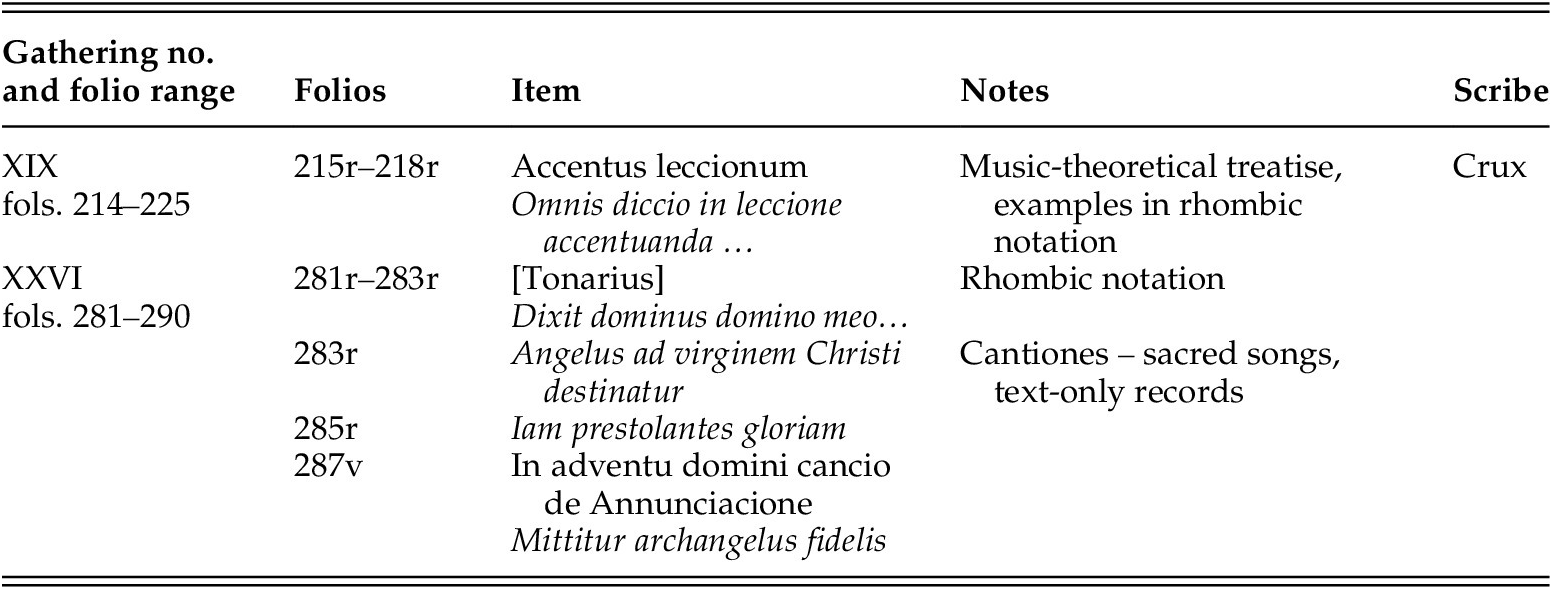
The manuscript Třeboň A 7 originated sometime between the mid-1450s and 1470s. Owing to its small format (octavo), identification of its watermarks is difficult.Footnote 26 The manuscript’s musical notation is concentrated in the nineteenth and twenty-sixth gatherings (Table 1). The treatise Accentus leccionum on fols. 215r–218r is dated to 1455, and Crux’s concluding colophon reveals that his copy originated in Soběslav. The treatise’s author is given as a certain Benedikt, a student at the university in Krakow. A further entry with musical notation is a tonary on fols. 281r–283r with psalm tones, differentiae and tones for the Magnificat in all eight modes. Tonaries are groups of selected chants arranged in ascending order according to their mode. They serve, among other things, as mnemonic-technical learning aids for mastery of the recitation forms of Gregorian chant, especially psalmody, since they record melodic models that can then be applied to different texts.Footnote 27 Though they occasionally occur independently, tonaries often form part of music theory writings, so the presence of a tonary in this manuscript written by a pedagogically active scribe is not at all surprising. With the exception of some very brief chant incipits in Accentus leccionum, this is the only item with musical notation in the manuscript, and the notation, in this instance, is rhombic.Footnote 28 The pitch/syllable alignment reveals that the text was written first and the notation was added later. Crux did not always realise that at the beginning of melodic phrases he had to leave room for clefs, or that melismas required greater spaces between words or the division of words into syllables. The melodic content of Třeboň A 7 is, however, reliable and accurate. It seems that Crux copied this tonary before the responsories in another of his manuscripts, Třeboň A 4 (on fols. 389v–390r, discussed in the next section), where he apparently thought more carefully in advance about the layout.
Items with music notation and texts of sacred songs in Třeboň A 7

Třeboň A 7’s collection of student poetry in Latin is expanded and concluded on fols. 283r, 285r and 287v by a trio of Latin sacred songs on the theme of the Annunciation: Jan of Jenštejn’s Mittitur archangelus fidelis, Angelus ad virginem Christi destinatur and Iam prestolantes gloriam. These are the only songs in this manuscript that could have been used in a strictly liturgical context. Of pre-Hussite origin and copiously represented within the Czech manuscript tradition, these songs are here recorded with their texts only. We may assume that, in the 1460s, they were generally known and orally transmitted.
Musical content of Třeboň A 4
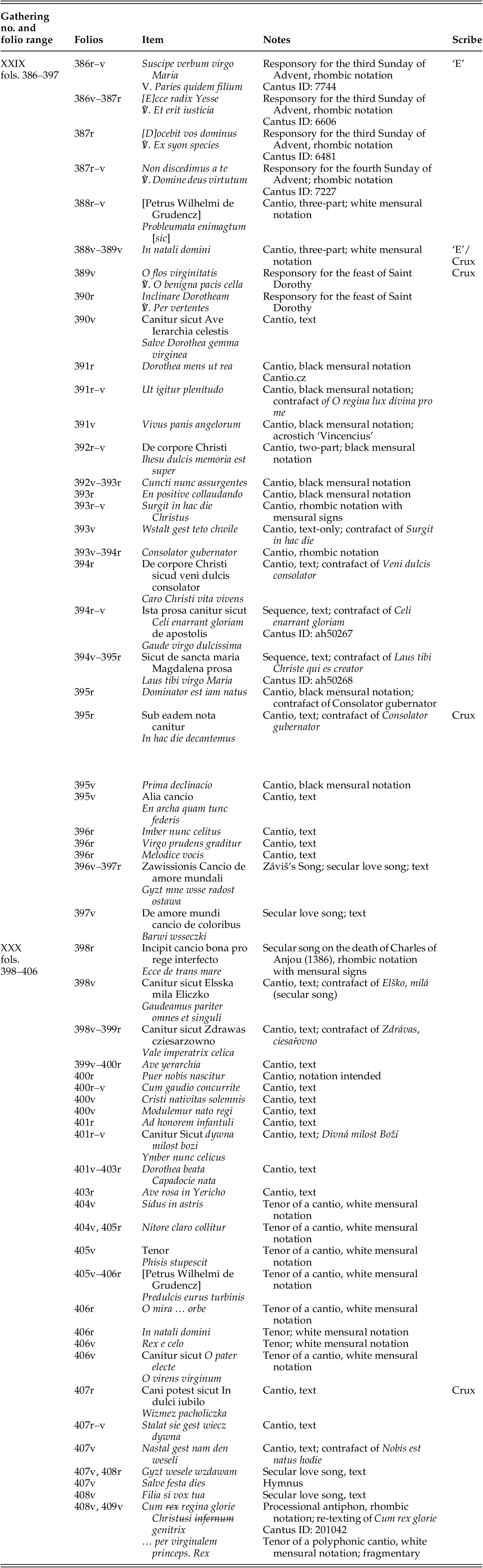
As in Třeboň A 7, musical notation in the manuscript Třeboň A 4 is concentrated in the final two gatherings: fols. 386–397 and 398–409 (Table 2). Crux had most likely used this material in the more practical form of independent quires, or libelli, which only later became part of Třeboň A 4, as indicated by the darker shade of the inner leaves of the final two sexterns. On fols. 386r–397v and 404v–409v a writing block was prepared with music staves, but these were partly used for text instead of notes. The extent of the anticipated musical notation must therefore have been greater than required by the final form of the manuscript. The music and song texts recorded in it represent a diverse collection of late medieval chant, Latin and Czech cantiones – for the most part suitable for liturgical use – and the newest additions in the form of polyphonic compositions written in white mensural notation.
Musical contents of Třeboň A 4

Liturgical chants in Třeboň A 4
The notated section of Třeboň A 4 begins with a series of responsories for Advent. Suscipe verbum, Ecce radix Yesse and Docebit nos (vos in the source) are for Matins or Vespers on the third Sunday in Advent, while Non discedimus is sung at Matins on the fourth Sunday in Advent. Except for the first of these, which is introduced with a simple red ‘S’, the chant’s planned initials were not drawn. Further chants are to be found on fols. 389v–390r, which presents a pair of responsories for Matins on the feast of St Dorothy: O flos virginitatis and Inclinare Dorotheam. The question arises as to why Crux had this specific selection of chants copied (copying some of them himself), and where exactly they were to be used.Footnote 29 In this case, the manuscript does not give a clear answer. Crux probably encountered them at an institution where the Office of Advent and the feast of St Dorothy were celebrated to a greater extent than what he was used to in schools. Roudnice with its Augustinian canonry seems, therefore, more plausible than the university in Prague.Footnote 30
The final chant entry is the processional antiphon Cum rex regina glorie. The original antiphon, Cum rex gloriae, is sung during the rites of the Easter Vigil or Easter Sunday. The record in A 4 contains a textual variant for the feast of the Assumption of Mary. Perhaps through force of custom, the beginning of the antiphon preserved the words rex and infernum from the original text, but it was not appropriate for the Marian version recorded here. Crux later replaced them with the words regina and genitrix, respectively, and put Cristus into the genitive.Footnote 31 Until another record of this unique Marian adaptation is found, Crux may be considered its author.
All chants in the manuscripts are written in rhombic notation, with use of the C clef only on the top staff. For all the chants, the melody is written at the right height and the underlaying of the notes with text is generally unproblematic. It is therefore clear that the scribes (Crux and ‘E’; Table 2) had exemplars or models of good quality, also understood what they were writing and knew how to arrange their material correctly.
Records of songs in Třeboň A 4
A great part of the musical section of manuscript A 4 is taken up by strophic cantiones in Czech and Latin. The songs are recorded both with and, in the slight majority of cases, without musical notation. In one instance – for Puer nobis nacitur on fol. 400r – we find a staff ready for notation but no notes filled in. Beyond the rare or unique records of Czech secular songs without notation including the unique pattern of preservation of Záviš’s Jižť mne všě radost ostává, the body of recorded sacred songs taken as a whole shows some remarkable characteristics.Footnote 32
Of the twenty-two songs recorded only with their texts, four can be considered rare. The remaining eighteen are very widespread and were generally known in Bohemia c.1460. Conversely, among the ten sacred songs recorded in black mensural notation or chant notation with mensural elements, the proportion of rare to well-known songs is the opposite. Only three of the sacred songs are widely transmitted while the remaining seven show a considerably smaller number of concordances or, indeed, are unique. We can therefore surmise that the decision whether to record a song with or without notation was based on that song’s currency within oral tradition c.1460: less-known or rhythmically more complicated songs could, therefore, be expected to be notated. This arrangement speaks for a function of the musical section of Třeboň A 4 as a sort of cantor’s aid in service of the leader of the schola, at least as far as the sacred songs are concerned.
‘Well-known songs’ encompass the repertoire of mensural cantiones, known to Crux and people of a similar cultural background, preserved in all but a few exceptional cases exclusively in the territory of the Czech Lands.Footnote 33 Key sources for this tradition include (in chronological order) Vyšší Brod 42 (discussed earlier), Vyšehrad 376, the Franus Gradual, the Gradual of Martin Bakalář of Vyskytná and the Latin Gradual of Chrudim.Footnote 34 Within this body of sources, there are only sporadic concordances with important collections of cantiones from Bohemia’s neighbouring regions.Footnote 35 Unica with musical notation in Třeboň A 4 include the songs Dominator est iam natus and Ihesu dulcis memoria (transcribed in Example 1).Footnote 36 The unique cantio texts in this source are Cristi nativitas solemnis, Modulemur nato regi and Dorothea beata Capadocie nata, all of whose accompanying melodies are currently unknown.
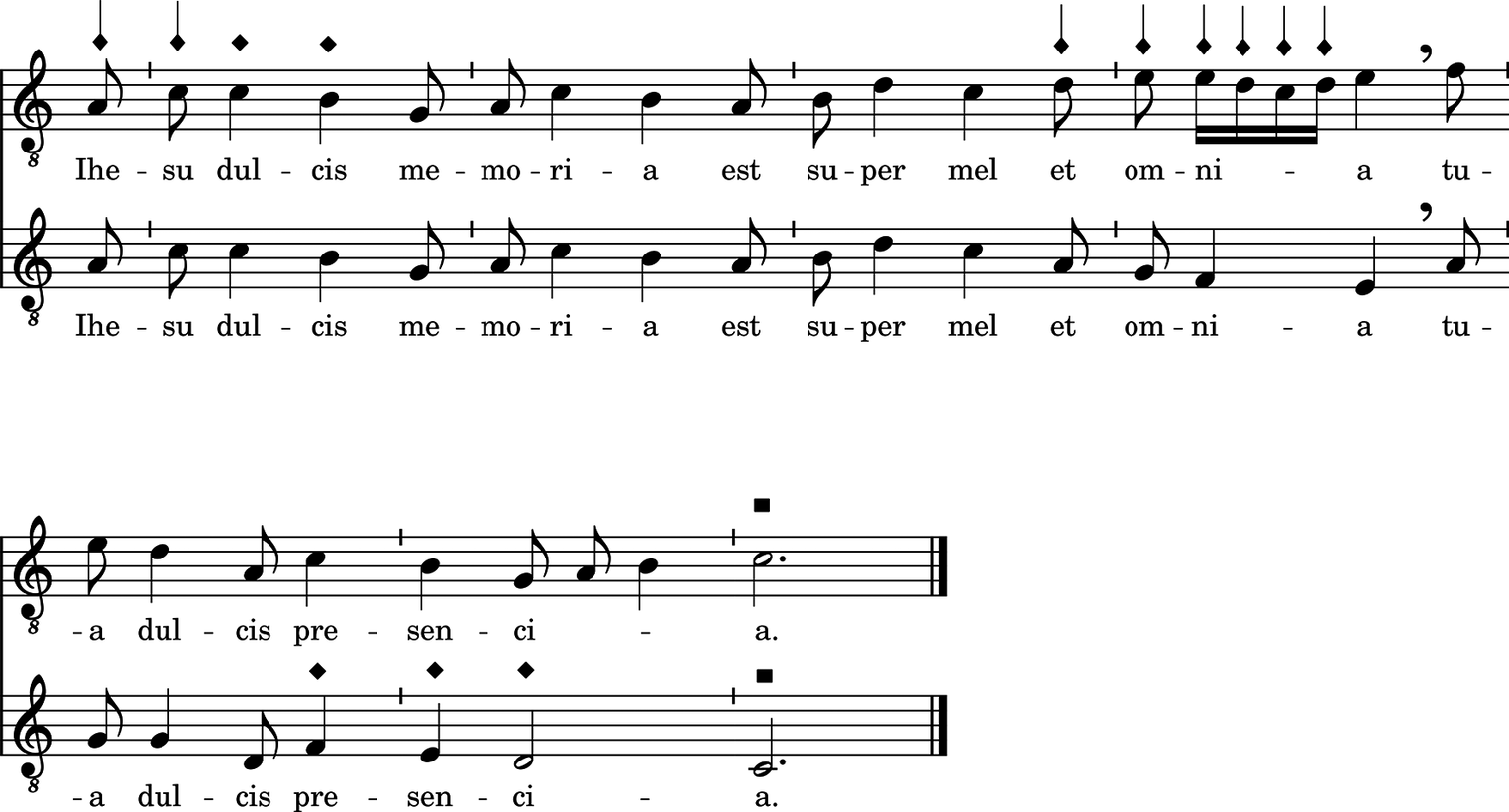
In comparison with the chant pieces, at least some records in black mensural notation give the impression of having been made aurally. Pitch is often indicated only by light touches of the tip of the pen, producing cursive uncinus-like single notes of the rhombic notation (with stems to mark a minima). For these copies, it also appears that Crux was not able to assess the amount of space needed for the piece in question, whereas with a good written exemplar, he would certainly have been able to arrange the notation in a clearer way. This is perhaps best exemplified by the copy of Ihesu dulcis memoria on fol. 392r (Figure 1). This cantio ‘de corpore Christi’ is loosely derived from the hymnus of the same name. The opening letters of the first seventeen (of thirty) strophes form the acrostic ‘Iohannes de Przibram’.Footnote 37
Třeboň A 4, fols. 391v–392r, Vivus panis angelorum and Ihesu dulcis memoria, in the hand of Crux de Telcz.

Ihesu dulcis memoria, Třeboň A 4, fol. 392r.

The melody of Ihesu dulcis memoria is concordant with two songs from the Jistebnice Cantional. In the first of these, V řečeném městě Betlémě (‘In the said town of Bethlehem’), a second voice is appended to the main (lower) voice in a very insecure way. The second, Věrní se v Bohu radujte (‘You faithful, rejoice in God’), is a monophonic song close to Crux’s copy of Ihesu dulcis memoria. Like many songs from the 1420s documented in the Jistebnice Cantional (Prague, National Museum, Library, II C 7), the rhythm of Ihesu dulcis memoria is based on the antispast pattern (with anacrusis).Footnote 38
Songs written in white mensural notation
Altogether, Třeboň A 4 contains two sections with white mensural notation: fols. 388r–389r and fols. 404v–406v, plus a portion of fol. 409v. The first section opens with Probleumata enigmatum by Petrus Wilhelmi de Grudencz (1392–after 1452). It is almost certain that Crux became acquainted with this composition at the University of Prague. Crux was probably not familiar with this music and the type of notation used for it: he let another scribe copy the text and notes of this piece and only made some textual corrections.Footnote 39
The identity of Petrus Wilhelmi de Grudencz as compositional figure was revealed by Jaromír Černý in the 1970s.Footnote 40 Petrus Wilhelmi studied at the University of Kraków in the 1420s, where the oldest manuscript containing his compositions was compiled.Footnote 41 His presence in the Viennese court of Emperor Frederick III is reliably recorded in the 1440s. From there, mainly by way of university students and graduates, his work made it into every corner of Central Europe. Some of his compositions were collected quite early by Hermann Pötzlinger, a graduate of the University of Vienna, the main scribe of the St Emmeram Codex and for some time the headmaster of the school in the Benedictine monastery in St Emmeram.Footnote 42 Newly discovered records of three of Petrus’s songs in a manuscript now preserved in Opava probably also have a connection with the musical environs of the university in Vienna.Footnote 43 Also in Vienna, at the end of the 1450s, the text Presulem ephebeatum by Petrus Wilhelmi caught the eye of the Lübeck syndicus Simon Batz of Homburg.Footnote 44 And finally, a graduate of the university in Leipzig is worthy of note: Johannes Klein, who after his studies became the director of a school in Stettin and maintained an interest in music throughout his life. Two manuscripts from Klein’s library contain a total of seven of Petrus Wilhelmi’s compositions.Footnote 45 There are also fragments now in Ústí nad Orlicí containing three compositions by Petrus Wilhelmi; we do not know for which institution they were intended, but they have recently been re-dated to the beginning of the 1450s.Footnote 46 Symptomatically, Crux obtained two of Wilhelmi’s compositions at the end of a period of around twenty-five years when Prague University was also open to Catholics and foreign students (former students from Vienna are documented).Footnote 47 Certainly, this environment encouraged a transregional exchange of repertoire. In later decades, the work of Petrus Wilhelmi spread to the urban environment and became an indispensable part of the repertoire of Bohemian literary brotherhoods.Footnote 48
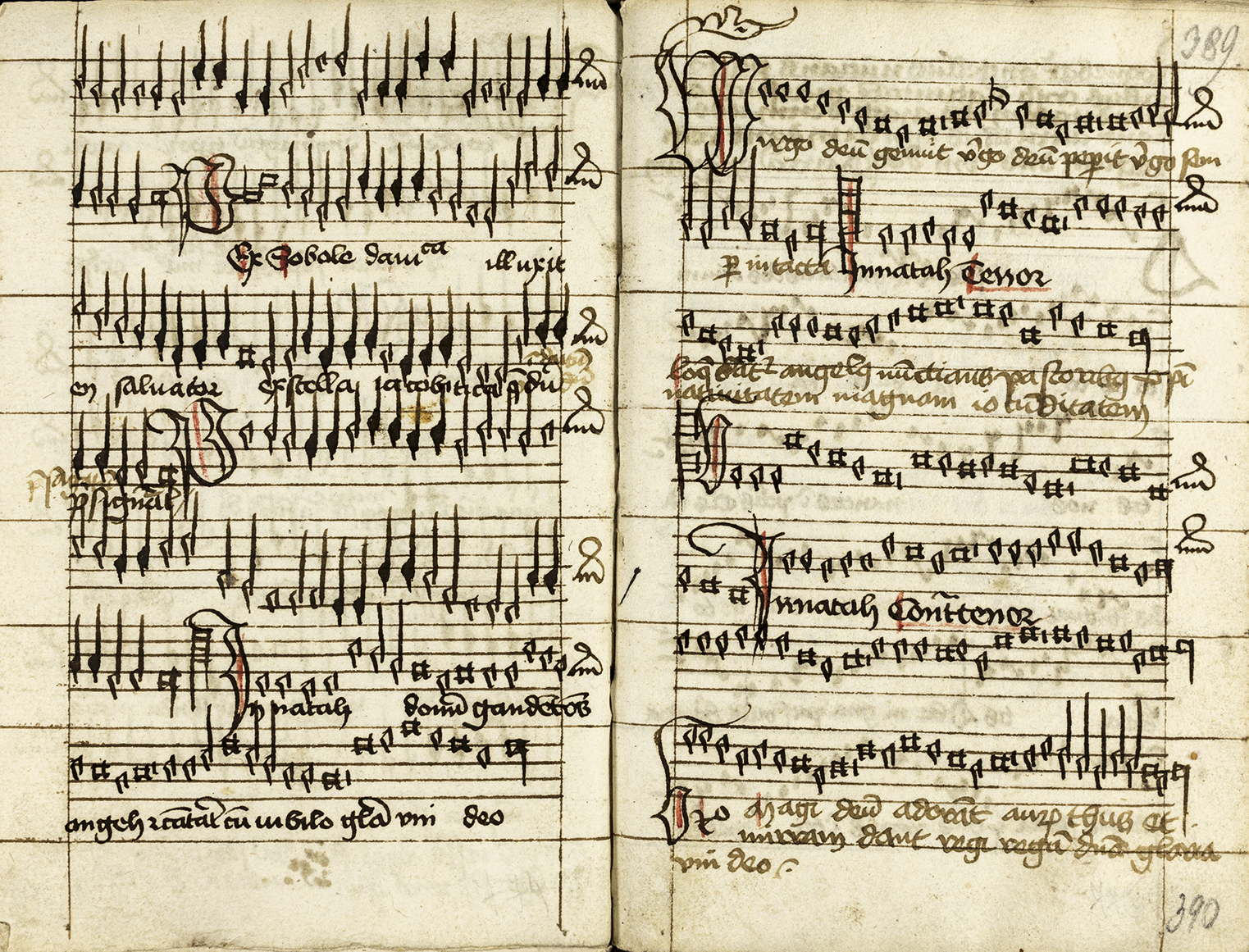
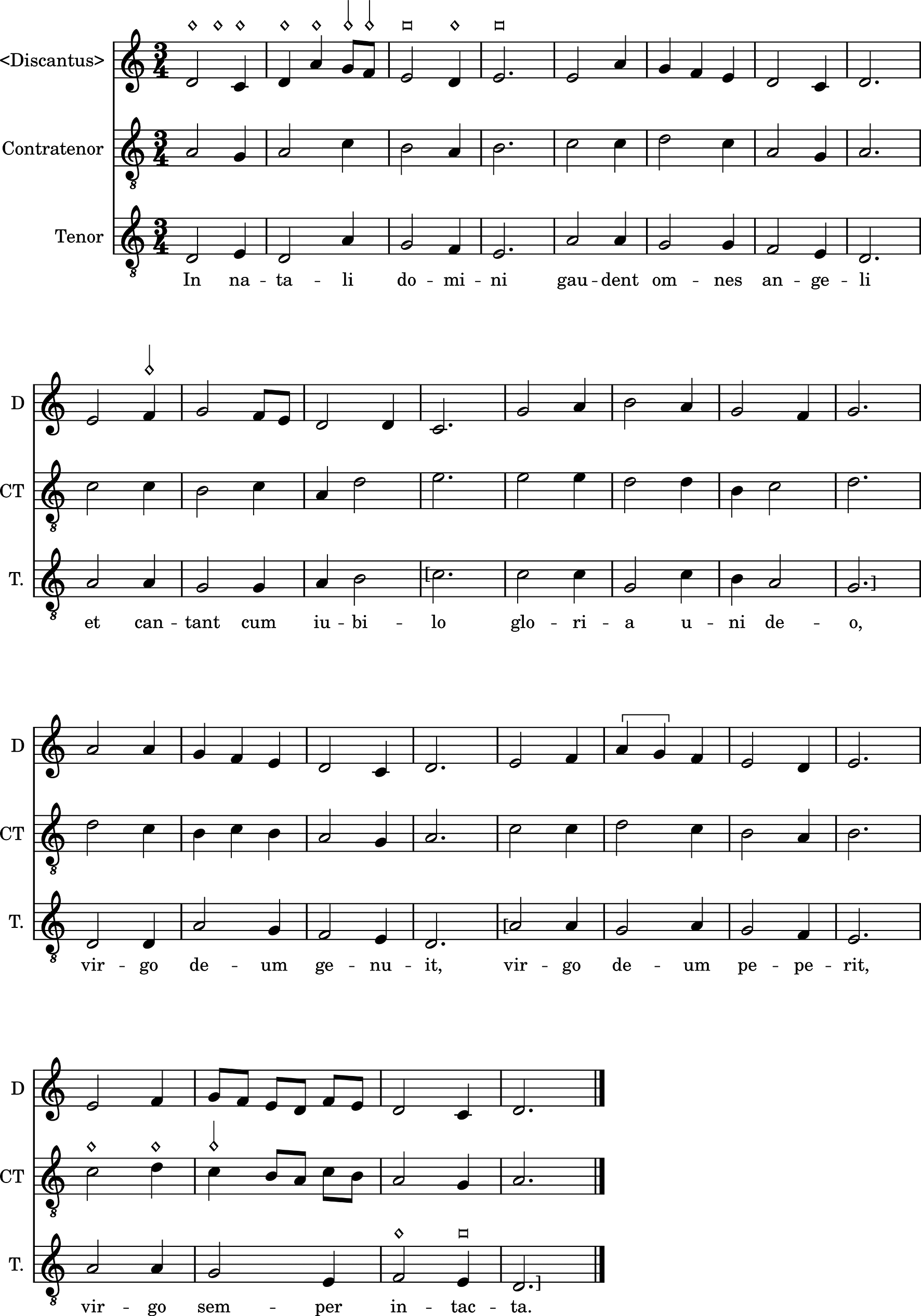
Immediately following Petrus Wilhelmi’s Probleumata enigmatum in Třeboň A 4 is one of the oldest Bohemian records of the Christmas song In natali domini in its three-part setting.Footnote 49 The popularity of this song reached its peak c.1500 and in the early sixteenth century. Details of the version in Třeboň A 4 differ from the record in the Codex Speciálník.Footnote 50 The individual voices are notated successively, one after another, on fols. 388v–389r (Figure 2). As in the case of Probleumata enigmatum, the musical notation and text of In natali domini are not in Crux’s hand. He only used some remaining space on the page to copy the text of two further strophes (corresponding to the second and fifth – and final – strophes in the Codex Speciálník). The notation seems insecure in terms of pitch and the placement of clefs is inconsistent. Without prior knowledge of how the song should sound, it would be difficult to sing it from this source. At the beginning of individual phrases, most ‘brevis-semibrevis’ groups are divided into three semibreves. The reason for this is unclear because this notation obscures both the intended ‘long-short’ pattern as well as the alignment between notes and syllables (Example 2).
Třeboň A 4, fol. 388r–v, containing three-part cantio In natali domini, with text corrections and two added strophes in the hand of Crux de Telcz.

In natali domini, Třeboň A 4, fols. 338v–389r.

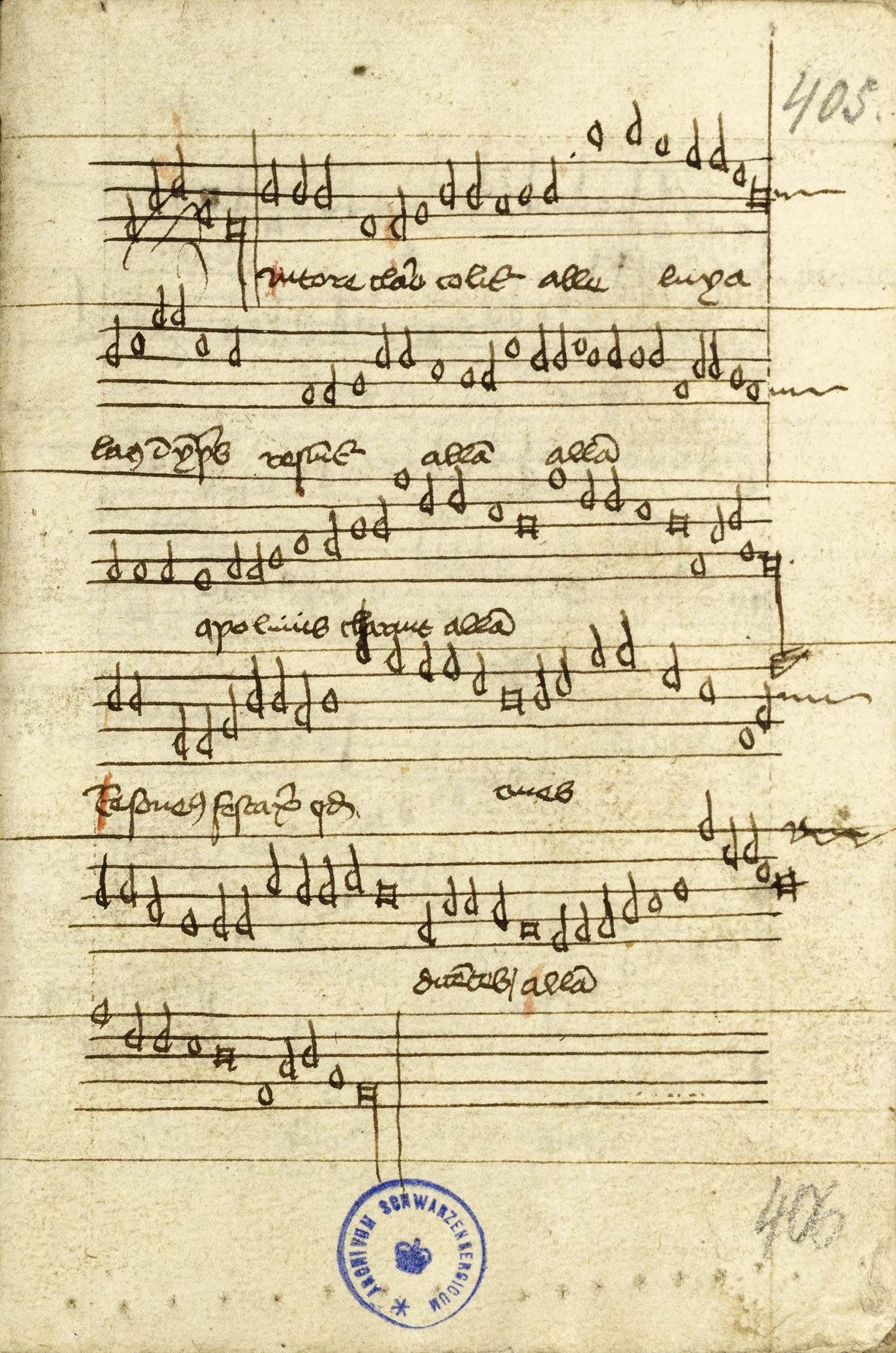
Items in white mensural notation continue on fols. 404v–406v and fol. 409v. These, by contrast, were entirely written by Crux. The character of the melodies suggest they are tenors of polyphonic songs, as confirmed by surviving complete concordances for three of them. Nitore claro colitur is recorded as a two-part cantio in the abovementioned fragments from Ústí nad Orlicí (Figure 3 for the copy in Třeboň A 4). Predulcis eurus turbinis, another work of Petrus Wilhelmi, was also originally a two-part cantio.Footnote 51 A piece with the title O virens virginum is copied in the Codex Speciálník in four voices; the tenor in the Třeboň A 4 version differs in the course of its melody.Footnote 52
Třeboň A 4, fol. 405r, cantio Nitore claro collitur, with text and probably also notation in the hand of Crux de Telcz.

The collection of tenor voices recorded in the last sextern of Třeboň A 4 suggests that it was used within a musically active community, where singers could improvise new voices over the tenors provided. If the record of tenors in Třeboň A 4 is related to similar collections in other Central European sources, it seems possible there were once further independent sexterns containing other voices that have not survived to the present day. In this case, Třeboň A 4 would be a forerunner of the partbook, a type of source that crystallised in Central Europe in the second half of the fifteenth century in connection with the developing practice of polyphonic music.Footnote 53 The appearance of partbooks documents an important moment in European music history, when the performance practice slowly shifted from improvisation towards singing from notation. Oral tradition could no longer reliably transmit through-composed three- and four-part structures, and thus the practice of singing from notation took root along within this new musical content. This phenomenon nevertheless occurred contemporaneously with the established performance practice of one- and two-part songs, which still partly depended on oral tradition.
Later song records
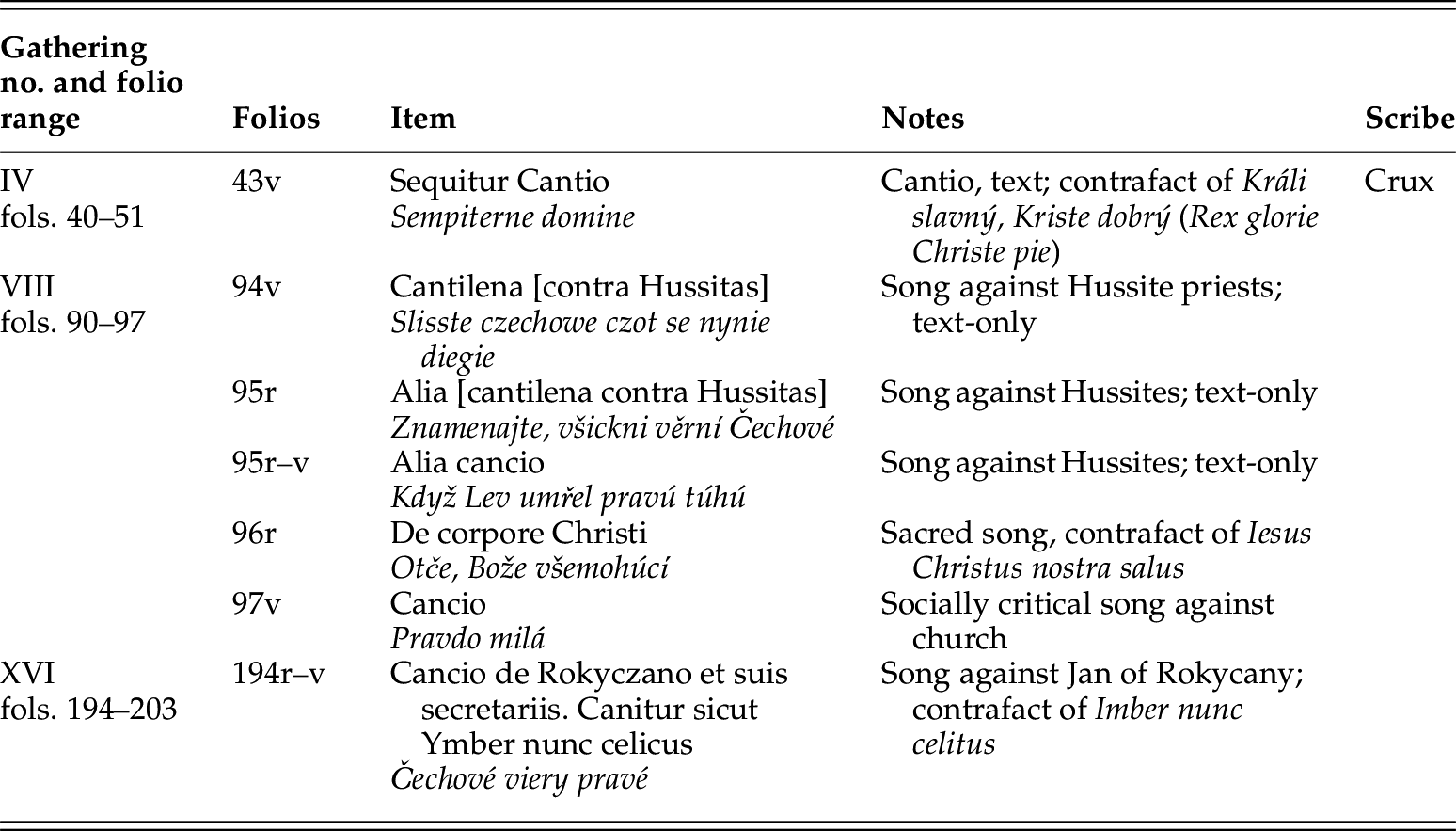
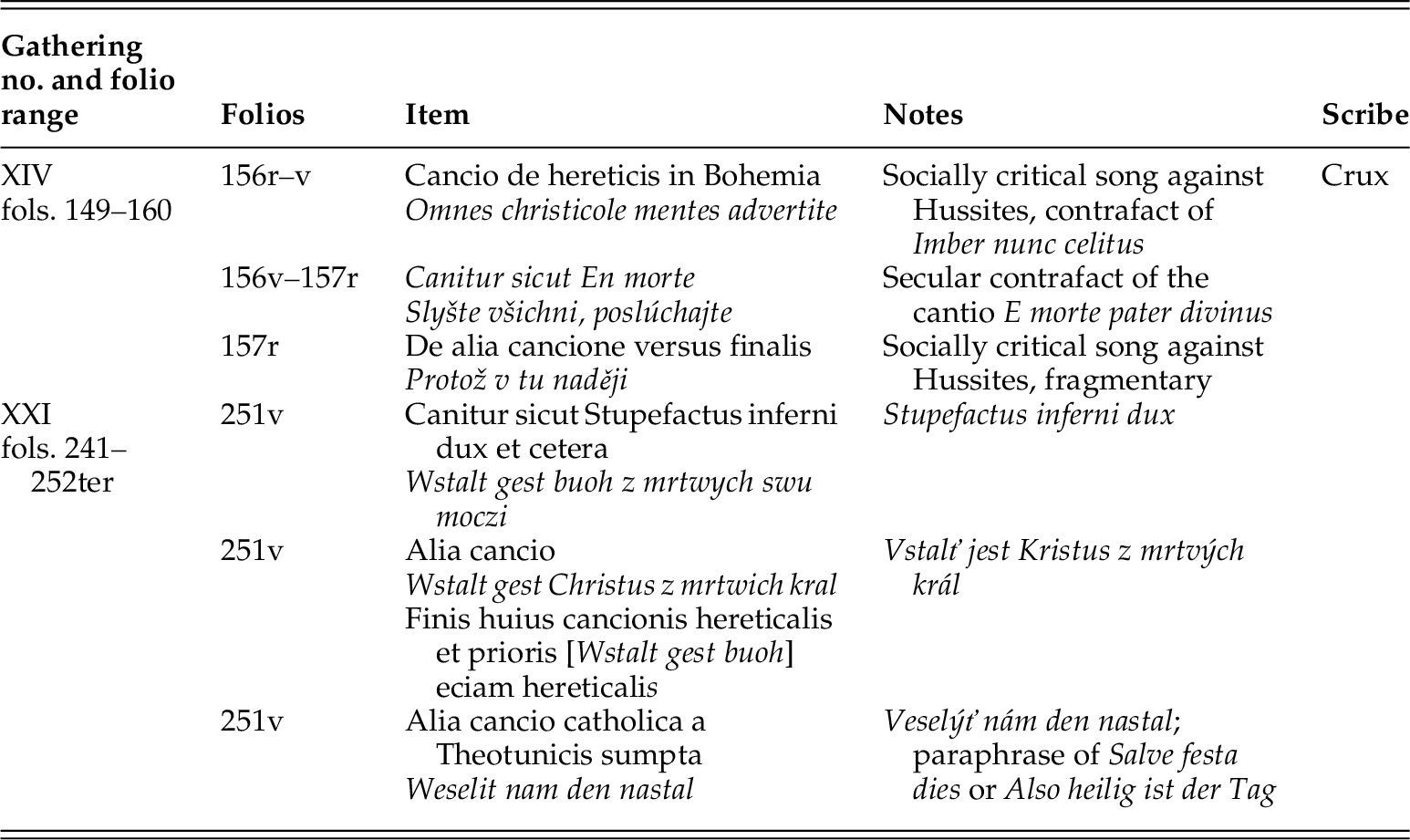
Two minor collections of songs written by the hand of Crux de Telcz can be found in Třeboň A 16 (Table 3) and Prague XI C 8 (Table 4). The volume of material preserved in these sources is small and neither of them is notated. Secular songs – which react to historical events and the confessional situation in the Czech lands of the fifteenth century – slightly predominate, but there are also some sacred texts. Copying of the songs in Třeboň A 16 cannot be dated with total precision. Dragoun suggested only an approximate range from the 1450s to the early 1470s.Footnote 54 The song section of Prague XI C 8 can, however, be dated more exactly, to the second half of the 1460s.Footnote 55 If this date can be inferred for the Třeboň manuscript as well – which the character of the manuscript seems to support – then Crux was no longer engaged in teaching duties at this point. Between 1463 and 1466 his activity is recorded at the Prague Castle (‘in castro Pragensi’), where at that time the ecclesial administration for both Catholic and Utraquist Bohemia was located. Later he worked as a priest and preacher in different places in Bohemia.Footnote 56
Texts of songs in Třeboň A 16

Texts of songs in Prague XI C 8

Song records in the younger manuscript Třeboň A 16 and Prague XI C 8 have a somewhat different character from that of Třeboň A 4 and A 7. Here we are no longer dealing with songbooks or a cantor’s handbooks. The songs attracted Crux’s attention probably because of their Hussite and anti-Hussite contents. Crux also furnished them with superscript cues indicating the melodies to which they ought to be sung. On this point it is worth mentioning that Crux marked the song Vstalť jest buóh z mrtvých svú mocí with the words ‘eciam hereticalis’ (also [sung] by heretics), even though it contains no references to Hussite theology and is first recorded sometime around 1410.Footnote 57 It is possible therefore that, for Catholics of Crux’s type, even songs from just before the Hussite period could be regarded as heretical.
Crux’s annotation beneath the song Veselýť nám den nastal is also puzzling. Crux labelled it as ‘another Catholic song, made by the Germans’. The text is a paraphrase of the Easter hymn Salve festa dies which, at latest in the fourteenth century, was also paraphrased in German-speaking environments as Also heilig ist der Tag. Footnote 58 In formulating details about the melody, Crux may have recollected a melody connected with the German text.
Musical records of other scribes in the manuscripts of Crux de Telcz
Among the many manuscripts marked by greater or lesser signs of Crux de Telcz’s activity, there are four further volumes with notable content, which are briefly described in turn here. These are the manuscripts I G 1, I E 36 and XIV D 24 from the Czech National Library, and manuscript A 17 from the State Regional Archives in Třeboň.Footnote 59 Their musical records, however, do not form coherent groups of repertoire and none was copied by Crux himself. Nevertheless, based on the presence of glosses in Crux’s hand, we can suppose that he got hold of these materials for his own use, and worked with them further.
Prague I G 1 contains primarily homiletic and theological material. Its first gathering and part of the second, though, are devoted to music theory. Fols. 1r–17r record a treatise that belongs to the Central European music-theoretical tradition connected with the name of Johannes Hollandrinus.Footnote 60 A music theorist of this name was active c.1370 at Prague University.Footnote 61 Treatises in this tradition are pragmatic handbooks for mastering the theory of the church modes and singing chant. Immediately following the Hollandrinus treatise is Accentus leccionum, a treatise of Central European origin devoted to the performance of recited genres of Latin chant such as lessons, epistles and the Gospel.Footnote 62 The manuscript as a whole was written and compiled c.1460 and almost certainly falls into the timeframe of Crux’s contact with the university in Prague.
Musical material of a completely different type is on display in Prague I E 36, which is primarily a collection of homilies compiled in the 1470s. At the top of fol. 213v, there is some carelessly written rhombic notation without staves. The original intention may have been to record the two-part trope Surrexit Christus hodie, alleluia. Footnote 63 Later, on fols. 297r–299r, a gathering from the fourteenth century, has been inserted. The appearance of its Messine-Gothic notation corresponds to the second half of the century, more precisely the 1360s to 1380s. Three folios contain a collection of late medieval Marian alleluias of Central European provenance: Salve virgo flos regalis, Salve Maria decus pietatis, Ave benedicta Maria and O gloriosa mater Christi. Footnote 64 This notated section concludes with chants from the Mass ordinary, Kyrie eleison and Gloria in excelsis Deo. Footnote 65
On fol. 258v of Prague XIV D 24 are two very brief notated incipits that belong to two antiphons for Easter Sunday: Vidi aquam egredientem and Surrexit enim sicut dixit. Some items from the collection of hymn texts on fols. 310r–311v of Třeboň A 17 are furnished with notated incipits as well, but in neither case are we looking at entries in Crux’s hand.
Conclusion
The miscellanies of Crux de Telcz offer remarkable insights into the life of a late medieval intellectual, teacher, preacher and priest. These manuscripts show how the life of such a person was interwoven with music. The analysis of song collections compiled by Crux – taking account of new biographical details about the chronology of his life – extends and enriches the established image of Crux as a diligent but sometimes unsystematic and somewhat illegible scribe of thematically diverse texts. No specific purpose but a personal interest can be detected behind occasional records of secular and love lyrics in Třeboň A 7. Yet copies of Czech and Latin sacred songs bear witness to Crux’s need to collect repertoire that was actively sung and/or to supplement existing liturgical books in the institution where he happened to be working, or perhaps even in preparation for his work in a new institution. To judge from the varied evidence contained in Crux’s notebooks, they served a practical function as teachers’ handbooks (partially in the form of loose gatherings at the time of active use). They may have been a kind of ‘portfolio’ of repertoire that every aspiring teacher would likely have collected in an attempt to increase his chances of gaining a position as a teacher or director of the school choir. In Crux’s case, specifically, he may have collected cantiones in order to lead music in a church that, if necessary, required the Utraquist liturgy.
In the case of music written in white mensural notation – as in Třeboň A 4, whose musical sections probably originated as two independent, loose sexterns – another functional possibility comes into play. This manuscript suggests that Crux most likely found himself in a community where he had colleagues with whom he could perform in polyphony the newest vocal compositions. The most likely environment is the community in the college of King Wenceslaus at Prague University, to which Crux’s scribal activity is connected. The university context is also suggested by the presence of two rather late compositions by Petrus Wilhelmi de Grudencz: from the start, Petrus Wilhelmi’s work spread almost exclusively thanks to university graduates with refined musical tastes and who, as teachers, had the opportunity to bring to life the music they had acquired.
The different functions of Crux’s musical records and musical books seem to reflect specific phases of his career. As an assistant teacher, Crux almost certainly was given responsibility for music in the liturgy, a need which would have been well served by the collection of strophic sacred songs in Třeboň A 4. When he arrived at Prague University, however, Crux seems to have relinquished such responsibilities and, by all accounts, devoted himself to music in which he was personally interested and could now practice with similarly skilled colleagues. In later years, he only occasionally collected liturgical material that he might need for his priestly duties, along with contemporarily popular songs reflecting the reality of a coexistence of the Utraquist and Catholic confessions. Crux’s manuscripts thus demonstrate, in a unique way, how the motivation to collect music could oscillate between purely personal interests and professional demands during the life of a mid-fifteenth-century teacher.