Introduction
Patients presenting with liver tumours such as hepatocellular carcinoma (HCC), intrahepatic cholangiocarcinoma or liver metastases from colorectal cancer (mCRC) generally have limited life expectancy, especially those with tumours non-amenable to surgery.1–Reference Cabbibo, Enea, Latteri, Genco, Craxì and Cammá3 Selective internal radiation therapy (SIRT) with yttrium-90 (Y-90) microspheres is a therapeutic procedure applied in the liver that allows direct delivery of high-dose radiation to liver tumours while sparing the normal liver parenchyma. SIRT offers an important treatment alternative for patients with hepatic tumours that are refractory to other treatments, or as an alternative to first-line systemic therapy in locally advanced and inoperable HCC.Reference Vilgrain, Pereira and Assenat4, Reference Chow and Gandhi5
Since the aetiology and incidence of different types of liver tumours differ between geographical regions and countries, it is important to assess local experience with SIRT in the treatment of liver tumours and to compare the findings with those reported in international clinical trials and determine the usefulness and place of SIRT in regional clinical practice. This retrospective study aimed to assess the experience with SIRT in patients presenting with various types of non-resectable hepatic tumours at the largest centre (King Fahad Specialist Hospital Dammam [KFSHD]) in the eastern province of Saudi Arabia.
Material and Methods
Study design and patients
This was a retrospective study conducted at the KFSHD, Saudi Arabia. The study population comprised all patients at the KFSHD who received SIRT with Y-90 resin microspheres (SIR-Spheres®, Sirtex, Sydney, Australia) between January 2012 and December 2016 for any type of liver tumour.
Efficacy and safety data were extracted from patients’ medical records including patient charts, laboratory results and imaging archives.
Ethical approval was obtained from the KFSHD ethics committee.
SIRT
SIR-Spheres® are microspheres of biocompatible resin, 20–60 µm in diameter, containing Y-90. Y-90 emits high-energy beta particles that have a mean depth of penetration into body tissue of 2⋅5 mm.Reference Murthy, Kamat, Nunez and Salem6, 7 The half-life of Y-90 is 64⋅1 hours. In therapeutic use, 94% of the radiation is delivered in 11 days.Reference Murthy, Kamat, Nunez and Salem6 Due to the limited penetration of beta particles through tissue and air and the short half-life of Y-90, radiation risks are low if the shielding provided with the administration device is used, and following administration the patient radiation poses very little radiation risk to healthcare professional, family or others.
SIRT technique
In SIRT, the Y-90 microspheres are implanted into hepatic tumours, by delivery through a transfemoral catheter via either the common hepatic artery or the right or left hepatic artery.7 The microspheres are distributed non-uniformly in the liver due to the physiology of hepatic arterial flow and the high degree of vascularisation of the tumours where they lodge in the tumour microvasculature.Reference Murthy, Kamat, Nunez and Salem6 Once the microspheres are lodged in the liver they are not metabolised or excreted and remain permanently in the liver.
Following SIRT, depending on local practice, patients may be discharged on the day of the procedure or may stay overnight for observation to comply with local radiation regulations.
Before starting the SIRT procedure, hepatic imaging by computed tomography (CT) or magnetic resonance imaging (MRI) of patients with liver tumours was assessed by a multidisciplinary team to determine if SIRT would be appropriate. SIRT was preceded by a full angiographic assessment of the hepatic vasculature with technetium 99m–labelled macroaggregated albumin scintigraphy for calculation of the hepatopulmonary shunt fraction.Reference Carlier, Eugène and Bodet-Milin8 Patients were deemed to be unsuitable for SIRT if their lung shunt was >20%.
Single-photon emission CT (SPECT)/CT scanning was performed, and the radiation dose was calculated by a volumetric method. Dose calculations were performed in the Nuclear Medicine department.
SIRT (using Y-90-loaded resin microspheres) was performed in a lobar, sectorial or segmental approach according to tumour size and location, 2–3 weeks after the pre-assessment described above.
Outcome measures
The primary efficacy outcome was overall survival (OS). Patients were assessed for at least 12 months and censored at 19 months or until death if this occurred earlier. The principal secondary endpoint was tumour response to treatment assessed according to the modified Response Evaluation Criteria in Solid Tumors (mRECIST).Reference Eisenhauer, Therasse and Bogaerts9 Tumour responses were categorised as progressive disease (PD), stable disease (SD), partial response (PR) or complete response (CR). Tumour control (TC) was defined as the proportion of patients with best tumour response of SD, PR or CR. Follow-up CT/MRI scans were performed 3, 6 and 12 months after SIRT. Disease-free survival (DFS) was also a secondary endpoint. Adverse events (AEs) were determined from patients’ medical records and imaging follow-ups.
Statistical analysis
Statistical analysis was performed with the SPSS® computer software. The analysis was performed by the statistical coordinator at KFSD. Means and confidence intervals (CIs) were calculated for baseline parameters, mean tumour response rates were calculated and survival curves were generated by the Kaplan-Meier technique. Follow-up for survival analyses were censored at 19 months, which was used in the estimation of median and mean values for OS and DFS.
Results
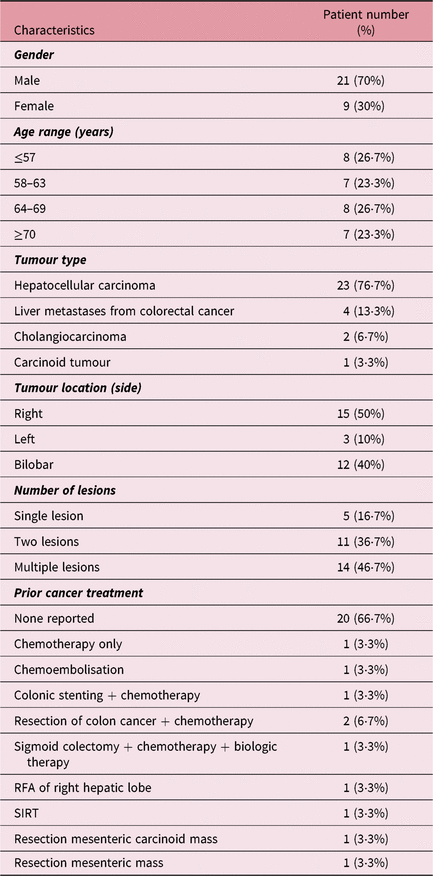
Of the 30 patients assessed retrospectively, 21 (70%) were male and 9 (30%) were female (Table 1). Twenty-three (76⋅7%) patients received SIRT for HCC, four (13⋅3%) for mCRC, two (6⋅7%) for cholangiocarcinoma and one (3⋅3%) for liver metastasis from a carcinoid neuroendocrine tumour (mNET) (Table 1). Other baseline characteristics are summarised in Table 1.
Baseline characteristics

Abbreviations: RFA, radiofrequency ablation; SIRT, selective internal radiation therapy.
Treatment
Coiling of afferent vessels to the hepatic artery to prevent the non-target deposition of Y-90 resin microspheres was required in three patients, two with HCC and one with mCRC. Dosimetry parameters are summarised in Table 2.
Dosimetry

Note: an = 29.
Efficacy analysis
OS was 88⋅1% at the final follow-up at 19 months, when the data were censored. In the 26 patients with valid survival data, mean OS time was 16⋅98 months (95% CI 14⋅8–19⋅1). Three deaths occurred, two patients with right-sided tumours and one patient with bilobar disease. All deaths were in patients with HCC; and the mean OS of these three patients was 6⋅8 months (standard deviation 4⋅7 months).
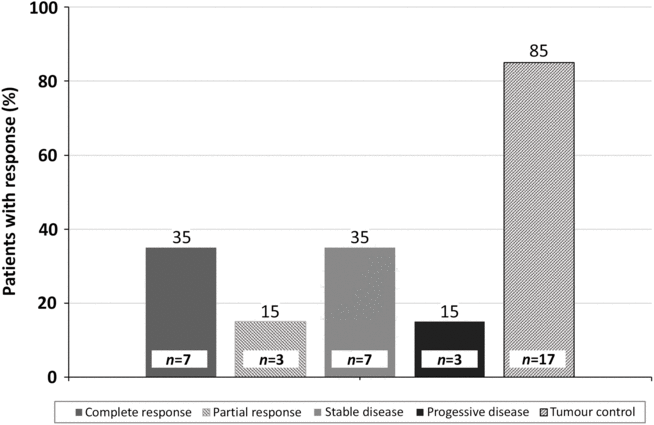
DFS at 19 months was 35⋅2%. Mean DFS was 11⋅0 months (95% CI 10⋅1–11⋅9). Among the 20 patients with available tumour response data, 17 patients (85⋅0%) showed TC (Figure 1).
Distribution of tumour response after selective internal radiation therapy in the study population.

One patient with HCC received a liver transplant within 9 months of SIRT. The purpose of SIRT in this patient had been to markedly downstage the tumour.
Safety analysis
No deaths occurred within 1 month of SIRT. Four deaths in patients with HCC occurred during the study; three of these deaths were confirmed at the KFSHD and a fourth patient’s death was confirmed by telephone. None of the deaths was considered to be related to SIRT, but were considered to be due to disease progression, or secondary to other comorbidities.
One patient developed post-procedure subcapsular haematoma of mild severity, which was managed conservatively and resolved spontaneously without surgical intervention.
No severe complications of SIRT or abnormalities in liver function tests were observed.
Discussion
Although our study included patients with different types of liver tumours, most of the patients included had unresectable HCC. Data from the recent SorAfenib Versus Radioembolization in Advanced Hepatocellular Carcinoma (SARAH) randomised clinical trial have indicated that efficacy of SIRT is similar to oral sorafenib, the standard of care for some patients with unresectable HCC.Reference Vilgrain, Pereira and Assenat4 However, the survival time observed in our study is higher than that observed in the SARAH trial or other HCC case series reporting survival durations of 7–12 months.Reference Bhangoo, Karnani and Hein10–Reference Dancey, Shepherd and Paul12 Interestingly, in case series, patients in the Barcelona Clinic Liver Cancer stage B group had a survival in the same order (15⋅1 months) as that observed in our study.Reference Bhangoo, Karnani and Hein10
In the SARAH clinical trial, SIRT was better tolerated than sorafenib.Reference Vilgrain, Pereira and Assenat4 In our cohort, SIRT appeared to have an acceptable toxicity profile in patients with different types of unresectable liver tumours. The survival outcomes achieved by this cohort of patients and the tolerability profile indicate the feasibility of the approach in our hands for patients with unresectable HCC. Since this study is retrospective and recruited a small number of patients, these results should be considered with caution.
This study included four patients with mCRC, all had previously received chemotherapy, radiotherapy or both. The data from our study are too limited to invite any comparison with previous trials of SIRT in first-line or later-lines of therapy for mCRC, but no deaths occurred among the mCRC patients in the course of this study.
Several studies have demonstrated antitumoural activity with SIRT with Y-90 resin microspheres in intrahepatic cholangiocarcinoma.Reference Saxena, Bester, Chua, Chu and Morris13, Reference Hoffmann, Paprottka and Schon14 In a recent study by Mosconi et al., in 23 intrahepatic cholangiocarcinoma patients, mean survival following SIRT was 17⋅9 months.Reference Mosconi, Gramenzi and Ascanio15 Several studies have shown that SIRT has activity against mNET.Reference Kennedy, Dezarn and McNeillie16, Reference Devcic, Rosenberg and Braat17 Again our data were not extensive enough to enable comparison with these published data; however, no deaths occurred in patients with cholangiocarcinoma or the patient with mNET over the course of the study.
One patient with HCC underwent liver transplantation after SIRT with no reported AEs related to this sequence of procedures. The P4S study suggested that liver transplantation or surgery after SIRT is feasible due to acceptable mortality and complication rates.Reference Pardo, Sangro and Lee18
The limitations of this study are inherent to its retrospective design, the small number of patients recruited, all patients recruited at a single centre and the heterogeneous patient population. This study was also non-comparative, which prevents firm comparisons on the efficacy of SIRT.
Conclusion
SIRT appears to be a feasible procedure for the treatment of liver tumours in our hospital setting. The toxicity was acceptable and the response to SIRT was satisfactory in this small cohort of patients.
Acknowledgements
We acknowledge writing support provided by Martin Gilmour and Tim Latham of ESP Bioscience.
Funding
Funding for writing support was provided by Sirtex Medical Ltd.
Conflicts of interest
None.
Ethics
The authors assert that all procedures contributing to this work comply with the Helsinki Declaration of 1975, as revised in 2008, and has been approved by the ethics committee of the KFSHD.