In a 1920 report from the Woman's Committee of the Council of National Defense (WCND), Emily Newell Blair emphasized that during World War I, the WCND had served as an intermediary between the federal government and women's voluntary associations throughout the nation. Describing women volunteers as standing “ready to obey the command from Washington,” she conveyed the eager patriotism of American women.Footnote 2 Her comment, however, obscured the way in which organized women's war activities expanded beyond mere obeisance to federal directives. For if the government used women's organizations, so, too, did women activists use the war emergency to implement their own agendas and serve their own needs. The following study of white clubwomen from Los Angeles's upper-middle and middle class suggests how women on the local level linked the war emergency to longstanding goals. During the war, Los Angeles women activists continued to stake their claim to suffrage and full citizenship. They used war-related activities to maintain the vitality of their organizations and to continue maternalist reform agendas begun in the Progressive Era. As they did so, they articulated a gendered explanation of war voluntarism that emphasized the instrumental role that women citizens played in protecting the family amidst the crisis of war.
During World War I, all the major combatants relied on coercion to suppress dissent and corral support, but in varying degrees they also turned to voluntary associations to disseminate propaganda, raise funds, and conserve food and materiel.Footnote 3 Like other American cities Los Angeles mobilized for the war effort through organizations that drew their membership into a wide variety of programs and mediated between nation and state to create support for the war effort. The Chamber of Commerce, Red Cross, Young Men's and Young Women's Christian Associations, and fraternal orders like the Freemasons, B'nai B'rith, and the Knights of Columbus all adapted their organizations to war work. These groups, as well as war-specific organizations, became instruments of the state, disseminating the messages of patriotism and national duty created by the powerful wartime propaganda office, the Committee for Public Information (or the Creel Committee).Footnote 4
Crucial to war voluntarism in Los Angeles—and the entire nation—were women's voluntary associations. Although there is some scattered evidence of activity among Japanese, Mexican, and European immigrant and African American women in Los Angeles, for the most part white middle-class and elite women dominated the volunteer effort there. It is also this group that left behind the most extensive record of their efforts. Representing only a fraction of Angeleno women, their activities nonetheless constituted a vital component of the city's mobilization to support American's military participation in World War I.Footnote 5
It is not at all surprising that affluent, educated white women would be at the center of these efforts, because they had the leisure and personal resources that enabled them to devote time to unpaid work. For all the World War I rhetorical enthusiasm for voluntarism as a means of fighting a war democratically, voluntarism was of course constrained and even defined by class. It was also shaped by gender. Although men certainly formed a significant part of the volunteer cadre during World War I, the federal government, as during the Civil War, drew heavily on the unpaid labor of white, elite, and middle-class women to implement scores of programs and drives during wartime.Footnote 6
A second reason for women's high visibility was that they were already organized in numerous clubs and organizations, including national ones like the Woman's Christian Temperance Union (WCTU) and the Young Women's Christian Association (YWCA), and local ones, such as the elite Ebell Club and the Friday Morning Club, which were part of the General Federation of Women's Clubs (GFWC). Thus, Los Angeles clubwomen already participated in a national network of like-minded women. This network is crucial to understanding the way in which women in Los Angeles and elsewhere tackled the mobilization drive.Footnote 7
In the months preceding American entry into World War I, women activists nationwide differed over what stance they should take toward the conflict. Women reformers had been central to the peace organizations that opposed the preparedness movement in the United States, but once the nation declared war, pacifists became marginalized, and many abandoned their anti-war activities. Among suffragists, the debate was over whether to endorse Alice Paul's strategy of embarrassing President Woodrow Wilson by picketing the White House to draw attention to the limits of American democracy for women or to follow the National American Woman Suffrage Association (NAWSA) in demonstrating women's loyalty and usefulness during the war crisis as a means of validating their claims to full citizenship and suffrage.Footnote 8
The federal government, for its part, initially had little interest in tapping the nation's women in its mobilization drive. Faced with the government's foot-dragging in implementing a plan for women's service, national women leaders, most notably those associated with NAWSA, pushed for creation of a national women's organization, which they hoped would parallel the Council of National Defense (CND), the male-dominated national committee instituted to coordinate civilian mobilization under the direction of the War Department. The Wilson administration finally established the WCND in April 1917, intending it purely as an advisory body.
Although these women had assumed that they would coordinate female volunteers throughout the country, they found that they had little power or decision-making authority. Federal departments—the Treasury's Liberty Loan Campaign and the Food Administration, for example—often ignored the WCND's organizational framework, creating separate bureaucratic structures that often stymied the WCND's ability to determine its own methods and organize efficiently.Footnote 9 Despite their frustrations, the women of the WCND nonetheless looked back on their record with satisfaction and felt that women had obeyed “like soldiers the word of command.” In the words of WCND participant and historian Emily Newell Blair, women “from those in the smallest sewing circle to those at the head of big civic movements, found a new conception of their relation to their Government, a new responsibility for carrying out its measures, that should long survive the war that gave them birth.”Footnote 10
Although Blair described this as a “new” idea of citizenship, in fact women reformers and suffrage activists had been framing a view of women's civic role for decades. Excluded from male-dominated political parties and patronage, and for the most part rejecting affiliation with black women reformers, white women formed a separate political culture that offered them opportunities for influence and leadership. A central part of their ideology was what scholars have termed “maternalism,” a fluid term that is used here to refer to the idea that women's nurturing roles in the home could be brought into the public arena to implement social reforms, especially those concerning poor women and children.Footnote 11
Although pre-war pacifism muted some women's enthusiasm for the war and the nationalism that accompanied it, others, including the majority of the women who headed up the WCND, could view the war and the expansion of the power of the federal government as vehicles for promoting social reform goals and women's suffrage. Thus primed for civic service and amenable to notions of a benevolent state, women working through their various organizations in communities throughout the United States seized the opportunity to demonstrate their citizenship in partnership with a suddenly more powerful and expansive federal government. While women activists indicated their willingness to follow federal directives, as the Los Angeles case will show, they also revealed a determination to define the nature of women's voluntary war service, as they cast it in gendered, maternalist terms and harnessed it to their own agendas of reform, suffrage, and organization.
World War I was a watershed in the history of Los Angeles. In 1910, Los Angeles was a regional city of 310,000 people, relying heavily on agricultural processing for its economic livelihood. The opening of the Panama Canal in 1914 signaled the city's potential importance as a shipping center, and World War I helped to consolidate that role. The war not only encouraged the migration that contributed to the city's vibrancy in the 1920s, but also helped to spark industrial development that would continue to expand dramatically in the postwar period and link Los Angeles more tightly to the national market. The city already had strong links to nearby smaller communities in Los Angeles county, such as the residential community of Pasadena and the harbor at San Pedro. The region's population included small numbers of African Americans, and 20 percent of its population was foreign-born, a relatively small percentage compared to San Francisco's 38 percent. White Protestants dominated political, cultural, and economic life, and they would dominate the local war mobilization.Footnote 12
In some aspects of its war mobilization, Los Angeles revealed the area's distinctive characteristics. Fears about the disloyalty of immigrants centered as much on Mexican immigrants, many of them associated with the radicalism of the Mexican Revolution, as it did on enemy aliens of German descent. Wartime labor relations reflected the intense anti-union sentiment on the part of the city's employers who were steadfast in resisting the National War Labor Board's efforts to mediate industrial disputes, a process that would solidify Los Angeles's reputation as an open shop city. Moreover, the growing movie industry and Hollywood stars lent glamour to many of the parades and fundraising drives. Although initially Los Angeles citizens were slow to rally behind the war, perhaps because of their geographical distance from the centers of mobilization, the city made fairly strong showings in the Liberty Loan, Red Cross, and food conservation drives and evinced little overt resistance to the war.Footnote 13
Despite the region's distinctive qualities, white women's voluntary mobilization work echoed the patterns evident in other urban areas. That their activities were not unusual is a measure of the nationalizing tendencies of American women's network of clubs and organizations, tendencies that World War I deepened. Still, the women of Los Angeles were exceptionally well-organized in their war service. Their energetic efficiency may be explained in part by the galvanizing influence of California women's enfranchisement in 1911. Similar organizational strength emerged in other states with vigorous suffrage campaigns, such as Illinois, Michigan, and Connecticut, where suffrage activists also dominated the state Councils of Defense. Equally important in Los Angeles was the vibrancy of pre-war club life that served as the basis for much of their war mobilization.Footnote 14
In the two years preceding U.S. entry into World War I, Los Angeles newspapers reported on significant conflicts among clubwomen. In 1915 a bitter controversy over whether it was appropriate for clubs to engage in partisan activity or support legislation produced tension among Los Angeles clubwomen and led Ebell Club women to secede from the California General Federation of Women's Clubs (CGFWC). Los Angeles women also divided over the issue of the European war. Whereas the Friday Morning Club, like the CGFWC, protested against militarism, other groups, including Ebell, the Daughters of the American Revolution, and the Women's Navy League, adamantly supported preparedness. Once the United States became a combatant, however, these tensions disappeared from the public record, undoubtedly a reflection of the desire to present a unified front in support of the nation's cause. Whereas some pacifists held true to their earlier sentiments, others, like Grace Simon, who had been eloquent in her anti-preparedness stance, took up war work immediately. Simon became secretary for California's state WCND.Footnote 15
California women were particularly active in the state and local branches of the WCND. In Los Angeles, published reports and private correspondence reveal a strong sense of accomplishment for their committee, which they described as “a clearing house thru which the war activities demanded by the United States government of the women of Los Angeles have been largely conducted.” The city committee, which was a subset of a Los Angeles county organization, relied on an elaborate system of door-to-door canvassing, a procedure used elsewhere in the state. In Los Angeles (as in a few other California cities), the WCND called this canvassing method its “Women's War Service Army.” One of its most ambitious projects was a city census that collected information on names, addresses, military status, and citizenship of “every man, women, and child … so that the information could be … quickly utilized for some specific services, as food conservation notice, or relief work, etc.”Footnote 16
By all accounts, the women created an impressive organizational structure. Under the direction of local WCND Chairman, Mrs. J.T. Anderson, the city was divided into 800 precincts, with a committee for each. In addition to this geographical framework, the city committee, much like the WCND, drew extensively on already-established women's clubs. The committee sent messages to 350 women's organizations, asking them to send representatives to a planning meeting. No list exists of that entire group, but the board members that were elected suggest a degree of inclusiveness. In addition to women from elite groups like the Friday Morning Club and the Ebell Club, the board represented “Catholic Women of Los Angeles,” “Jewish Women of Los Angeles,” and “Labor Organizations.” Inclusiveness had its limits, however; no women of color were part of the board, although it is possible that some were rank-and-file participants. If so, they are invisible in the historical record.Footnote 17
Scattered accounts of African American, Mexican, and Japanese immigrant women's war contributions convey a sense of their segregated nature, a phenomenon in keeping with white Angelenos' notions of racial hierarchy, which white clubwomen clearly shared.Footnote 18 The very absence of significant records concerning the war work of immigrant or black women in the Los Angeles WCND archives suggests how the leaders marginalized non-elite women. They repeatedly interpreted immigrant women's participation in food conservation and liberty bond drives, for example, as problems to be solved in the context of ongoing campaigns for Americanization. Working-class women were to be helped by programs established by elite women's organizations. African American women apparently did not organize into a separate council of defense as they did in many other cities. Two hundred black women did seek to create a YWCA branch during the war, possibly with the idea of using it to further their participation in the war effort. The local white YWCA expressed interest but claimed that because of the black women's lack of financial resources, the request would be considered at a future time. Black women did find other means to contribute, such as through their local organization, the Sojourner Truth Club, but this and other efforts were ignored by Los Angeles white women war leaders.Footnote 19 Thus the latter's invocation of war service as an opportunity for women to establish their claims to citizenship implicitly defined that citizenship as white and privileged.
The majority of over 29,000 women listed as active in the local branch of the WCND apparently participated through their club membership. The club framework was indispensible to the war mobilization of the city's women. Government agencies almost automatically viewed women's voluntary associations as the representative institutions of all female citizens, a point Emily Newell Blair made when she noted that “there seems to be a general acceptance of the idea that when you deal with women, you go to their organizations, when you deal with men you go to the governor or a legislature.” “In effect,” she added, women “could not, under the political system, function directly through the government.”Footnote 20
If the government reinforced the role of women's organizations by turning to them for home-front service, women's club officials seized the opportunity to promote and enhance the prestige of their institutions. They frequently discussed war work as a means to build interest in their organizations and eagerly sought publicity for their contributions to mobilization. Newspaper reportage was usually framed in terms of specific contributions of local women's clubs. Thus, newspapers highlighted the friendly rivalry in the “Race to Sell Bonds” in April of 1918. The Council of Jewish Women led the pack with $70,050 in bonds sold, with the Friday Morning Club coming in second, Ebell third, and the Catholic Women's Club in fourth place. Clubs were careful to make sure that their efforts received specific credit. For example, the Los Angeles Lodge No. 487, Independent Order of B'nai B'rith (male) and its women's auxiliary raised funds for an ambulance to be sent to France and took pride in the “name plate to be conspicuously placed on the ambulance so as to properly indicate the excellent spirit of the donors in asking this contribution.”Footnote 21 These group dynamics help to explain how the federal government could achieve so much success through the use of voluntary agencies in its wartime drives for citizen mobilization. In peacetime, a major role of voluntary association leaders was to maintain the membership's interest, to keep the group vital. Always eager to find meaningful work with which to associate their organizations, during wartime, officials in both men's and women's organizations promoted activities that enhanced institutional pride while stimulating patriotic service.Footnote 22
Despite these similarities, women's participation in war work and in civil life was different from men's. The recent success of women's suffrage in California (1911) notwithstanding, women's political opportunities were still circumscribed, and women activists were very conscious of the need to demonstrate their sense of civic responsibility. As Grace Simons explained it, California women, having “been granted the right and privilege of citizenship have a new thrill of pride and responsibility when they say ‘our country.’” Although the national campaign for suffrage did not play a major role in the day-to-day work of the local WCND, the club women and war volunteers who dominated the WCND supported suffrage and discussed it on a number of occasions. Women in the Los Angeles Friday Morning Club clearly saw a connection between women's active support for the war and the obligation of the nation to enfranchise them. In December of 1917, when the president of the club, Kate Lobingier, introduced a resolution calling the suffrage amendment a war measure “by which all American womanhood will be encouraged to co-operate in war service as enfranchised responsible citizens,” it was passed with only one dissenting vote. In April of the following year, Mrs. Edward Rankin Brainerd, a leader in the women's Liberty Loan campaign committee, announced that President Wilson and the nation as a whole would have an eye “fixed on California women to determine the quality of their citizenship through the Liberty Loan campaign.” Then in October, the club expressed disappointment at the U.S. Senate's failure to ratify the suffrage amendment. Nonetheless, to prove their loyalty, they sent a letter to President Wilson thanking him for his support and assuring him that they would continue to buy liberty bonds and support the war.Footnote 23
Although Los Angeles suffragists seem to have soft-pedaled their agenda during the war, the related concerns for social reform appeared repeatedly. In the years preceding World War I, liberal progressive reformers and socialists had been prominent among Los Angeles clubwomen. Their organizations had supported community property bills, women's jury bills, protective labor laws for women, child labor legislation, educational reform, Americanization programs, teacher's pensions, prohibition, red-light abatement, and numerous other state and local reforms, most of which could be considered maternalist. Their activity prompted the hostile Los Angeles Times to refer to them repeatedly as the “Lady Lobbyists of Los Angeles.”Footnote 24
During the war, many reformers maintained their commitment to expanded government social welfare measures. Such women appear to have been especially influential in the Los Angeles WCND. Both the state and local WCND, like the national organization, had a committee on “social service agencies,” charged with maintaining existing welfare programs.Footnote 25 Women leaders in Los Angeles frequently invoked the possibilities that the war offered for furthering reform. Frances P. Noel, a Los Angeles clubwoman, socialist, and member of the California's Social Insurance Commission, was also active on the Women's Committee of the state Council of Defense. She provides an excellent example of the persistent commitment to reform. At a conference of the WCND in May 1917, she insisted that during the war, efforts must be made to assure the health and well-being of the poor and of workers, specifically recommending compulsory health insurance, labor exchanges, and equal pay for equal work. She also pointed out, in maternalist fashion, that “it seems advisable that women hold themselves responsible for the welfare of women. They know best the woman's problems and needs.”Footnote 26 The major challenge for these women—and reformers throughout the country—was to sustain interest in reform when the nation's energies were so obviously otherwise engaged. Reform agendas that could be described as integral to the war effort were the ones mostly likely to receive support.Footnote 27
Given the widespread fear about “hyphenated,” and thus potentially disloyal, Americans, it is not surprising that reformers interpreted immigrant outreach programs as important to war mobilization. Unlike the anxious nativist sentiments expressed frequently in the Los Angeles Times and among businessmen of the city, these women's approach to immigrants was sympathetic, if condescending. Initially, the state's WCND had drafted an ambitious plan to facilitate immigrant education and assimilation, projects that had already been supported by California women's organizations before the war. It created an Americanization department charged to investigate “housing, industry, recreation, child welfare, education, citizenship, patriotism,” in the context of immigrant life. That the state WCND viewed Americanization work as part of a broader pattern of social reform was further indicated by its post-war report that insisted that assimilation required “industrial justice in wages, hours and sanitary surroundings, and safety conditions in shops and camps.” Moreover, in language that clearly set the WCND in opposition to conservative Los Angeles businessmen, the report concluded, “No amount of English education will overcome un-American conditions offered by employers.”Footnote 28
Although the original goal had been to improve immigrants' quality of life while encouraging them to see themselves as “part and not an adjunct of America,” the exigencies of war meant that the major attention to immigrants came in the efforts to draw the foreign-born community into support for the war. Thus, the Los Angeles WCND paid special attention to teaching English and to alerting immigrant wives to the need for food conservation, an area where according to one report, “it needed only interpretation to an intelligent conservation in which the foreign born women held their own in understanding and in the contribution of valuable suggestions.”Footnote 29 Laden with ethnocentrism and condescension, these women's approach to Americanization nonetheless supports the argument made by historian Kathleen Kennedy that many women reformers who supported the war consciously countered the illiberal nativism of the war era by portraying immigrants in a positive, although subordinate, light.Footnote 30
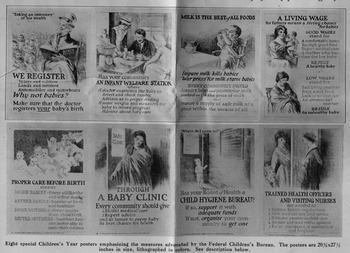
Children's Year Posters. Attention to the United States Children's Bureau's “Children's Year” campaign signifies how women reformers linked mobilization for World War I to social reform at home. This set of posters appeared in an oversized flyer entitled, “Publicity Posters and Exhibit Panels Are Essential to the Success of Your Children's Year Campaign.” Distributed by the National Child Welfare Association, the flyer also suggests the way in which reformers copied the publicity methods of the federal Committee for Public Information. Source: GC 1084, Box 2, World War I Manuscript Collection, Seaver Center for Western History Research, Los Angeles County Museum of Natural History.

The national Children's Year program of 1918, perhaps California women's most ambitious wartime reform effort, illustrates the way in which reform-minded women appropriated the war crisis to their pre-war agendas. The WCND, working in tandem with the federal government's Children's Bureau, handed down an elaborate program of child welfare measures that they successfully presented as part of the war effort. Children, as the future of the nation, needed to be protected as a patriotic measure. As one poster graphically expressed it, Uncle Sam, ledger in hand, was “taking an inventory of his wealth,” the wealth being the crowd of children clustered around him. “We Register Voters and Soldiers/Lands and incomes/Automobiles and motorboats/Why not babies?”Footnote 31 A particularly important part of the national focus of Children's Year was infant mortality. Officials drew explicit comparisons to European combatants' concerns about unnecessary deaths of children, pointing out that England, France, and Germany had embarked on campaigns to improve infant health. “These precedents of foresights added to our own investigations already mentioned were warrant for the challenge to save 100,000 babies for the nation when life must be used up on the field of honor.”Footnote 32
On the local level, the Los Angeles committee worked hard to fulfill its responsibilities: weighing and measuring children, ensuring that California's birth registration law was implemented, lobbying successfully for public health nurses, and helping to distribute the reams of information that flowed from Washington. Concerned about what they called the “Japanese problem,” they called for a “thorough standardization of Japanese midwives” and worried because Japanese children were “not up to the standards of American weights” and not adequately supplied with milk. Noting that about one-third of children under six years old were Japanese, they secured the services of Dr. James Hara and a Japanese nurse and obtained funding for the nurses' wages from the Southern California Japanese Association and Business Men's Organization. The group weighed and measured 795 Japanese children and offered “advice to the parents.”Footnote 33
Children's Year activities extended well beyond the Japanese and other immigrant communities, however, as California and Los Angeles WCND women hoped to train parents and “standardize” the child. One pamphlet distributed by the California Children's Year committee proclaimed, “Trained Mothers Develop 100 Per Cent Children … Do Your Share—Make Your Child 100 Per Cent Perfect in Body and Mind.” To further ensure infant health, the Los Angeles WCND sent names of all local expectant mothers (1,500 in the county) to the San Francisco headquarters of the state WNCD, which sent “to each mother, once a month, what is known as Prenatal Letters of Advice.” With the war emergency as justification, the WCND's Children's Year efforts brought mothers and their families into unprecedented connection with the state and federal governments.Footnote 34
The Children's Year campaign offers yet another insight into the context of these women's war effort. As Robert Westbrook and other scholars have noted, liberal states like the United States with political ideals that emphasize individual liberty and freedom from state interference face a dilemma in mobilizing for war. The necessity of citizens risking their lives to protect the state could imply that the state had failed to fulfill its fundamental obligations to safeguard individual life and liberty. Thus, as a more compelling alternative to an appeal to protect the abstract nation-state or a political community, twentieth-century Americans during wartime have been encouraged to “defend private interests and discharge private moral obligations,” and war aims have tended to be cast in terms of familial obligations. Certainly World War I propaganda invoked ideals such as democracy and freedom, but even the most casual perusal of U.S. war posters reveals the extent to which protecting women, children, and the home became defined as the preeminent goal of American victory. Even though its focus was on domestic reform, the Children's Year campaign both reflected and reinforced an understanding of the war that made it immediate and personal, rather than abstract and political.Footnote 35
These activists' engagement with family rhetoric in support of war gave a different spin to the pervasive tendency of the government and popular culture to interpret war goals as including the protection of women and children. Implicitly, women activists suggested that the war potentially endangered children and the family. Rather than portray women as passive recipients of the protection soldiers offered them, they extended the maternalistic rhetoric that justified social reform efforts to legitimate women's vital role in protecting the homefront. In the process they challenged wartime rhetoric that privileged male military service as the epitome of citizenship.Footnote 36 This is not to suggest that women reformers were engaged in some sort of counterhegemonic activity, for the thrust of their efforts reinforced the power of the state during wartime. Their emphasis on protecting the family at the homefront from the dangers of war was not a criticism of the war. Rather, because the war created disruptions, it was all the more necessary to support the government's mobilization drive to ensure victory. Women may have appropriated the war for their reform purposes, but at the same time their efforts reinforced the government's goals of engaging citizens' support for war.Footnote 37
Similar processes that blended women's reform agendas with support for mobilization based on the preservation of home and family as a war aim emerged in the activities of two major national women's organizations, the Young Women's Christian Association (YWCA) and the Woman's Christian Temperance Union (WCTU). Both re-fashioned their traditional programs in the context of the war and worked closely with the federal government in support of both moral reform and victory in Europe.Footnote 38 In Los Angeles, their local branches carried out programs that bound together patriotism and social welfare.
The national headquarters of the YWCA, through its War Work Council, quickly found a way to mesh the nation's war-time agenda with the traditional YWCA agenda of Christian service on behalf of young working women. The YWCA highlighted its role in training young women to prepare for new positions in jobs formerly occupied by men and in providing housing and recreation for “girls concentrated for Government work and in fruit and canning centers.”Footnote 39 Emphasizing that the YWCA was offering a vital service for crucial workers was a central theme in its massive fund-raising drives during the war.
The Los Angeles chapter's minutes reveal some initial tensions about the impact that the national headquarter's plans for war work might have on fundraising for ongoing local projects, especially those concerning the welfare of young working women, for example, work training, housing for single women, encouraging sexual and personal morality, and promoting “industrial standards”—the eight-hour day, prohibition of night work, equal pay for equal work, and similar progressive goals. Although the basis for the concern was not expressed, it may have been that because Los Angeles did not have a significant defense industrial sector that employed women, the national organization's focus on women war workers might hamper the local agenda. Others felt, however, that war-related activities would be “not a problem but an opportunity.”Footnote 40
In Los Angeles, the YWCA mounted a campaign to raise $55,000 for its work for young women and echoed the national organization's theme of protecting women workers. “The Conservation of her Womanhood is one of the greatest civic needs in Los Angles. It is an OBLIGATION. It is an OPPORTUNITY… . The growth in population, importance and attractions of Los Angeles make it a center to which girls and young women come in search of employment, and to prepare themselves for self-support.” Making clear the need to safeguard these women, the Los Angeles appeal continued, “Every such young woman becomes at once the ward of Los Angeles and as a community we owe her protection, encouragement and opportunities for her highest development.”Footnote 41
Two YWCA reports on the Los Angeles region confirm that women as war workers specifically were not a pressing issue in Los Angeles. A 1918–1919 survey indicated, “During the war Los Angeles women did not replace men to any great extent, nor did the actual number employed in industrial establishments increase materially.”Footnote 42 In October 1917, Evelyn Reynolds of the Pacific Coast Committee of the War Work Council prepared a detailed statement on San Pedro, site of Los Angeles's harbor and Ft. MacArthur. Reynolds detailed the largely foreign-born, working-class community of 16,500, where working women mostly were employed in canneries. Reynolds's concern was the low “home standards” of morality and young women's preoccupation with dancing and movies. Although she gave examples of improper flirtations between soldiers and young women of the town, she did not consider the war itself as the problem: “The war work proper is a permanent work here because there will always be soldiers at Ft. MacArthur and, unless a strong permanent influence for character development is very soon planted … there will be a permanent social disease as the complement to the military factor.”Footnote 43
These themes of sexual morality and the threat of sexually transmitted disease were paramount for the YWCA during World War I and led the national organization to participate in a joint nationwide campaign against venereal disease in partnership with the Young Men's Christian Association (YMCA) and the federal government. The cooperation was institutionalized in the Commission on Training Camp Activities (CTCA), a federal agency that gave official status to the work of the YMCA and the YWCA, making both associations what historian Emily Rosenberg has termed “chosen instruments” of federal policy. Although the military's focus was primarily on making soldiers “fit to fight,” others in government shared with groups like the YWCA a belief in fostering behavioral norms that would hold both men and women to the same high single sexual standard, a goal that stretched far beyond the specific wartime concern regarding disease.Footnote 44
The CTCA worked to shut down saloons and brothels near camps, while it also promoted sex education for men and women, as well as diversions of sexual energies to social events and patriotic activities. Throughout the nation, activists interested in moral reforms, specifically red-light abatement and prohibition, eagerly embraced the CTCA plan to create camp canteens for wholesome recreation and were so enthusiastic that the head of the agency, Raymond Fosdick, reported, “I confess that this canteen business is becoming a veritable nuisance … I am besieged by women's delegations and others, asking the privileges of running combination canteens and clubs in the vicinity of Army camps.” To prevent duplication, the CTCA authorized the YWCA exclusively to construct “hostess” houses adjacent to army cantonments, such as the one set up at San Pedro, to provide a chaperoned environment for men to meet with sweethearts and female relatives, where they could enjoy wholesome refreshments and modest entertainment.Footnote 45
To further what they viewed as a high standard of morality, the YWCA continued a long-standing campaign for sexual reform among young women. To promote sexual abstinence in wartime, the YWCA's National War Work Council sent out lecturers on social standards. In California, “in every War Camp community a series of talks by a physician selected for her approach to girls and young women was given to supplement the teaching of social morality to men in uniform.”Footnote 46 In Los Angeles, in common with other urban YWCAs, the organization also established a Patriotic League for young women, who paid five cents a month and signed the following oath: “I pledge myself to express my patriotism by doing better than ever before whatever work I have to do. By rendering whatever special service I can do for my community and my country. By living up to the highest standards of character and honor and help others to do the same.”Footnote 47 The aim, as a Los Angeles YWCA official explained it, was “to provide a constructive outlet for patriotism,” which was a euphemistic way of referring to the challenge of maintaining sexual morality when so many young women were “naturally stirred by the presence of so many Knights about to set forth on a crusade.”Footnote 48
The YWCA's wartime work may have had specialized war components, but it never strayed very far from the group's agenda concerning the economic and social problems of young women, especially those of the working class. The YWCA traditionally promoted moral reform, particularly the notion of a single sexual standard. Although certainly the YWCA activists worried that the war might undermine familial order, they also were optimistic that their activities could have long-term results in protecting working-class women. By eliding their reform agenda with war mobilization, the YWCA's programs dovetailed with the prevailing propaganda that interpreted the war in the context of the social and moral order of the family.
In a similar fashion, the WCTU interpreted the war in the context of the social and moral order of the family, but for the Los Angeles WCTU, the war created complex problems. On the one hand, the group's long standing commitment to moral reform—not just prohibition, but also the eradication of prostitution—was dramatically aided by wartime prohibition and the campaign against venereal disease and red-light districts, which now had the imprimatur of the War Department. In Los Angeles, the local WCTU pursued both programs, while continuing its long-standing support for a suffrage amendment. On the other hand, many women in the local WCTU were pacifists.Footnote 49 The major spokesperson of the Los Angeles WCTU, Mary Alderman Garbutt, author of the history of the local branch, was both a pacifist and a socialist. Thus, as she explained later, “The Woman's Christian Temperance Union of Southern California, in its executive meeting in September, 1917, adopted a ringing resolution against war” and called for a negotiated peace and criticized military training. Despite this persistence of anti-militarism, however, the local WCTU apparently bowed to the pervasive nationalist fervor and allied itself with the WCND. It created a Special Publicity Bureau to document its war work and reported after the war on the way it had loyally responded “to the emergency call for patriotic service.”Footnote 50
Like the YWCA, the WCTU was concerned with maintaining sexual morality. The Los Angeles branch reported that it had been “influential in securing the appointment of police women and social service workers” and that it made investigations “of the moral conditions surrounding our army camps and steps have been taken to safeguard the morals of young girls especially in localities near the camps.” It cooperated with the city's Morals Efficiency Association to help rehabilitate young girls and also created a Home Center in San Diego near a Marine base, designed to offer soldiers opportunities for wholesome relaxation.Footnote 51
As the existence of the Home Center suggests, the WCTU placed a great deal of emphasis on the welfare of soldiers. One of its major projects was to make “comfort bags” to send to the troops. In addition to the usual toiletry items, the WCTU bags contained “an evangelistic letter, … a ‘mother’ letter, a Testament, … seventeen different leaflets on temperance purity and anti-tobacco,” and the Bible. It also provided soldiers with three cards with which they could pledge their abstinence from drinking, vice, and tobacco. A sense of personal connection with soldiers was furthered by work at the Home Center, where they provided “[h]ome-made candy, flowers, individual bouquets” and wrote letters for soldiers to their “mothers and friends.”Footnote 52
The WCTU's attention to soldiers indicates the way in which women's war mobilization centered on familial concerns. As historian Susan Zeiger has shown, motherhood, specifically of soldiers, was a persistent theme in American war propaganda. She argues convincingly that this outpouring of sentimental depictions of self-sacrificing, loyal mothers and the soldiers who went to war to protect the sanctity of the family was designed in part to counter the pacifist inclinations of many women's groups in the pre-war era.Footnote 53 In the case of the WCTU, the focus on soldiers' welfare offered the WCTU a means of demonstrating patriotism, while minimizing the challenge to their own pacifist values. In contrast to the theme of protecting women and children that Zeiger notes, however, the WCTU's program focused on women nurturing young men who were called on to fight the war.
As in the case of the suffrage movement, Children's Year, the YWCA, and the WCTU, much of women's wartime activity built upon political agendas that pre-dated the war. Even so, many millions of women outside the pre-existing network of social reformers supported the war in response to immediate patriotic appeals to do their bit to win the war. Here, too, war and the protection of the family merged.Footnote 54 A major vehicle for their activity was the American Red Cross. The Red Cross was not specifically a women's organization; both men and women joined the almost 4,000 chapters located throughout the country. Although men may have dominated the leadership of the national and local organizations, women were a highly visible presence. In Los Angeles, half of the board of directors was women; they led the committees that were concerned with marshalling women's activities. Red Cross officials helped to articulate a specifically gendered vision of women's war mobilization that did not focus on reform but was in keeping with the maternal, familial thrust of the women activists already discussed.
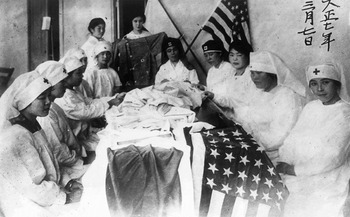
Japanese Women's Auxiliary of the Los Angeles Chapter of the American Red Cross. Although women of color generally operated in separate auxiliaries, the Red Cross of America offered a wide range of women an institutional vehicle for war service. Here, Japanese women in Los Angeles, part of an auxiliary founded in March 1918, make Red Cross supplies. They are wearing the traditional Red Cross volunteer uniform. Although the two U.S. flags might be interpreted as particular demonstrations of immigrant loyalty, such displays were common in Red Cross workrooms. This group also marched in the May 1918 Red Cross parade. Source: GC 1130, War History Committee Records (General Photo File 9052), Seaver Center for Western History Research, Los Angeles County Museum of Natural History.

The Red Cross is a stunning example of the way in which the nation relied on voluntarism in pursuit of its war aims. Rooted in both the Sanitary Commission of the U.S. Civil War and the International Red Cross established in 1864, the organization was founded in 1881 by Clara Barton “to furnish volunteer aid to the sick and wounded of armies in time of war” and to provide relief in times of disaster. In 1905, the Red Cross received a charter from Congress, which made it subject to federal supervision and a yearly audit. To further emphasize its quasi-official status as a chosen instrument, the charter made the president of the United States the organization's head.Footnote 55
In 1914, the American Red Cross mobilized to offer humanitarian assistance to all combatants in the European war, but when the United States entered the conflict, it limited its aid to the allies. At the request of the federal government, it took on the responsibility of providing base hospitals abroad, equipping them with materials and staffing them with nurses. During the war years, the Red Cross enrolled over 20 million members and raised approximately 400 million dollars through voluntary subscriptions, campaigns in which women were active participants. A 1919 Red Cross emphasized that through its organization, “one-half the nation, namely, the women can most effectively serve their country in the war emergency.”Footnote 56
Women's central presence in the Red Cross was graphically depicted in one of World War I's most ubiquitous and famous posters, featuring a Red Cross nurse and the caption, “The Greatest Mother of Them All.” This sentimental vision of a nurturing woman belied the hard, dirty work of caring for wounded near the front but captured the Red Cross's emphasis on women's maternal desires to be supportive of the nation's soldiers. Far more numerous than nurses were women on the homefront who donned Red Cross uniforms to sew or knit garments, make bandages, assemble comfort bags, or serve coffee and doughnuts at railway station canteens, such as the one at the old Los Angeles Santa Fe Station. Repeatedly Red Cross women were depicted as nurturing America's soldiers, with one account describing the bandage makers as creating “white magic that they weave to shield their men from harm, laying unnumerable [sic] folds of gauze and cotton between them and the bayonet thrusts.”Footnote 57
In Los Angeles, women joined the Red Cross chapters of the region as individuals but also allied in branches associated with their clubs and other social groups. Clubs hosted balls and other fundraisers, which became an important part of wartime social activities and a source of much heartfelt rivalry among women's groups. Although Red Cross activity was easily adaptable to the privileged world of women's clubs, it also seems to have offered a wide range of women opportunities to support the war. Japanese and Jewish women had their own auxiliaries, and Mexican women worked for the Red Cross at Brownson House, a Catholic settlement house. A report sent by the Japanese consul to Los Angeles County's war history committee after the war revealed that the majority of Japanese in Los Angeles joined the Red Cross and that the “most consistent war work … was the praiseworthy contributions of their women.” African American women organized themselves into the Harriet Tubman Red Cross auxiliary in Los Angeles and the Phillis Wheatley group in Santa Monica. Beyond fulfilling Red Cross requests for funds and sewing, these women viewed themselves as a support group for black troops. In November of 1917, African American auxiliaries organized a gala banquet and send off for “departing drafted men.”Footnote 58 None of these groups seemed to have worked with each other or with Anglo women's Red Cross chapters, and the records of their activities are scant. Still, we do know that minority women as well as working-class women participated in separate units in the May 1918 monster Red Cross parade.
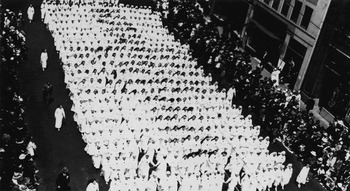
Red Cross Parade, Los Angeles, May 1918. The ubiquitous Red Cross parade was a striking example of the ways in which American women demonstrated both their patriotism and claims to citizenship. The Los Angeles Times described this 1918 parade as a “Seven Mile Tribute to Women's Work in War.” Source: Photograph 165-WW82A23, American Unofficial Collection of World War I Photographs, Records of the War Department General and Special Staffs, 1860–1952, Record Group 65, National Archives.

Red Cross parades garnered extensive publicity throughout the United States and invariably honored women's wartime service. The Los Angeles parade attracted 10,000 marchers, the majority of whom were women. The Los Angeles Times described the event as a “Seven Mile Tribute to Women's Work in War” and exulted, “Never in Los Angeles has there been a parade where its womanhood took such a conspicuous part.” The Times also reported that the Mexican Society featured seven Red Cross nurses on its float and that forty-five African American women associated with the Phyllis Wheatley branch of the Santa Monica Red Cross and others who were affiliated with the AME Church marched as well. Class interests were also represented, with men and women who marched from the “Van Nuys Building” auxiliary carrying a banner that read, “We work all day and give our evenings. Can't you Give an Hour?”Footnote 59
Just a few years before the war, it was considered radical for women to march in public. The suffrage movement began its parades in 1910, taking to the streets in a strident challenge to notions of respectability. This crossing of boundaries, this bold occupation of public space, was an important demonstration for women's legitimacy as political actors, but it was a contested one. Indeed in the Washington suffrage parade in 1914, there was widespread harassment and violence directed toward the marchers. So it is significant that women played such a visible part in patriotic parades. Possibly few of these Red Cross women would have viewed themselves as suffragists or “modern,” yet they engaged dramatically in a civic ritual that would have been largely closed to them in the past, unless they appeared dressed as Lady Liberty in a float. In doing so, they not only demonstrated support for the war and American soldiers, but also staked their claim to citizenship.Footnote 60
Moreover, the parades and Red Cross activity in general offered women a communal activity in which they, like the soldiers they supported, donned uniforms as a visible symbol of their patriotic activity. The Red Cross had a variety of official uniforms: several for nursing, one for its motor corps, another for canteen workers, and most ubiquitously, one for the Red Cross workroom volunteers, which featured a flowing white headdress with a red cross emblazoned on it. Commentators noted women volunteers' attraction to uniforms during the war, not just in the Red Cross, but in a wide range of war-related organizations. Although the appeal may have been in part a fashion fad, it also seems clear that women were attracted to uniforms because they saw it as analogous to the male military uniform. In wartime, as a number of scholars have noted, concepts of citizenship easily become hyper-masculinized, because men alone traditionally were given the right and/or obligation to die for their country in military service.Footnote 61 Nevertheless, women who marched in parades and donned uniforms were implicitly challenging this narrowed definition of citizenship and patriotism. Their actions complemented the rhetoric of women's maternal service in wartime to soldiers, the family, and the nation as a whole.
Because of its specific association with caring for soldiers, the Red Cross activity of making bandages or knitting garments also brought women symbolically close to men on the field of battle. There was nothing new about this process. It followed a longstanding tradition in the United States of women fashioning garments for the troops, first begun by Sarah Franklin Bache and Esther De Berdt Reed, who organized Philadelphia women to sew shirts for General George Washington's continental army.Footnote 62 Like women in other combatant nations, during World War I, Americans focused on knitting socks, mufflers, sweaters, and other warm items. The Red Cross alone counted a total of 24 million military items produced.
Knitting became such a central motif for women's war work that it is worth exploring at length. Knitted goods were welcomed by the military, at least initially. Tensions about the flood of socks and mufflers soon emerged, however. Was hand knitting really necessary and the best use of time and available wool? As a letter-to-the editor writer in Massachusetts taunted, “For God's sake, wake up and stop this hand-knitting by which at least 20,000 pounds of scoured wool has already been wasted at a time when the Huns are at our gates.” Other critics lampooned the knitters as socialites pursuing a fad. One feminist, frustrated by emphasis on domesticity, suggested that knitters be “legally restrained.”Footnote 63
Whether or not the army valued hand knitting, however, women kept their needles busy, and, as with other women's war activities, their efforts suggest a desire to define the nature of their war work. The papers of Pasadena clubwoman and former high school principal Virginia Hunt detail the way in which knitting became an organized and contested activity during the war. Hunt headed up the Pasadena women's Auxiliary of the Navy League, a group that, like its male counterpart, had promoted preparedness before the United States entered the war. To systematize these women's knitting, Hunt created an elaborate card file system that enabled her to report at length on the process of buying and distributing wool and keeping track of the knitted goods as they made their way to soldiers. Hunt drew on a military model, dividing her more than 2,000 knitters into squads of eight women, headed by a sergeant, with four squads to a platoon, headed by a lieutenant, and so on up to regiments headed by a general.”Footnote 64
Hunt's scheme suggests the importance of giving women a sense of direct connection to soldiers. They did not produce garments for an abstract military, but rather they assumed that they could send their socks and mufflers directly to local men. They were dismayed to discover that because men in the California National Guard who served at the front were integrated into national army units, “We will not be able to distribute to our Pasadena boys as we will have to meet the necessary red tape.”Footnote 65 A major knitting controversy in the early months of the war further revealed the way in which national priorities impinged on these local women's autonomy. In August 1917, Secretary of the Navy Josephus Daniels announced that only one agency—the Red Cross—should distribute knitted goods. The directive sent Hunt and her group into a tailspin. They wanted to give up neither their autonomy, nor their socks. In a letter to President Wilson, Hunt fumed, “As the President and the Government ask for our support and co-operation, even to the point of sending our sons to war, and the impoverishing of our purses, that we should at least receive courtesy and fair treatment from the Government in return.”Footnote 66 Despite her sense that the government was slighting women's service, Hunt and her group eventually agreed to work through the Red Cross.
Hunt's knitters reflect the eagerness of women to take up a traditional female skill to create a personal, supportive tie to the young men who were fighting for their country. By maintaining this intimate connection to local men, they were attempting not only to sustain maternal protective roles on behalf of young men, but also to combat the depersonalizing qualities of modern armies and modern warfare. Still, this nurturing occupation was transformed by the wartime cult of efficiency into the system for knitting and distributing goods of which Hunt was so proud. It was also transformed by the presence of national organization—the Red Cross—and by the intervention of Secretary Daniels. Women may have sought to define their war roles, but ultimately they faced limits imposed by the federal government.
The concern about challenges to localism and the desire to maintain more intimate connection to soldiers was evident in yet another Red Cross program. The national Red Cross articulated one of it major goals as “act[ing] in matters of voluntary relief and … as a medium of communication between the people of the United States of America and their army and navy.” This desire was reflected in a number of ways, including the decision to mount a Home Service department to help dependents of soldiers cope with the absence of their loved one through sympathetic visits and practical assistance. As the Red Cross placard displayed in the nation's railway stations put it, “We keep your home safe while you fight to keep the world safe.” To this end the organization established twenty-five institutes (one of which was in Los Angeles) for training volunteers in social work practices to make sure that “no enlisted man's family shall suffer for any essential thing that it is within its power to give.”Footnote 67
The Los Angeles Red Cross took up the Home Service responsibility in September 1917. The Los Angeles Times reported, “Financial aid, medical care and legal advice will be given, and a bond of mutual interest created between the Red Cross and the soldiers' family so that the loss of the breadwinner may be felt as little as possible.” In charge of the program was Mrs. Benjamin Goldman, who explicitly linked the Red Cross program to the threat to family order in the context of war: “The absence of a husband, father or son by reason of war service frequently throws the family life out of balance.”Footnote 68 In Los Angeles and elsewhere, the caseworkers were generally women, a point made clear in an article in the Los Angeles Times headlined “Women Wanted for Home Service Work,” which specified the need for “the co-operation of a body of competent women, who will contribute a share of their time and their best thought and effort to the visiting of soldiers' families.”Footnote 69
The examples of Red Cross volunteers, as well as clubwomen and reformers, reveal the means by which women sought to define meaningful war participation for themselves as “competent women.” A final example of ways in which women mobilized to support the war—participating in the federal government's food conservation program—entailed slightly different dynamics, as this campaign was orchestrated by the government, with women leaders in more of a reactive than inventive role. The food conservation drive was one of the most successful examples of the use of voluntary associations to mobilize for war. Herbert Hoover, who oversaw the Food Administration during the war, had a passionate commitment to voluntarism, which led him to reject the idea of food rationing and opt instead for voluntary conservation to be accomplished by a massive effort to enlist American housewives in the campaign.
Government officials characterized women's conservation efforts with mixed metaphors of “kitchen armies,” as Hoover put it. Posters routinely featured feminine women at work in their kitchens, but leaders like Hoover argued, “Women … are as much a part of the national army as are the men fighting at the front.”Footnote 70 Hoover mobilized this army by having state food commissioners create local women's committees to promote housewives' conservation efforts. The Food Administration agency issued a flood of directives, correspondence, and regulations, which for women at the bottom of the organizational ladder, meant a constant stream of posters, recipes, and letters to representatives of the WCND, women's clubs, librarians, and teachers to promote its conservation measures.Footnote 71
The national WCND had been disappointed that Hoover chose to create his own food administration and system of support committees rather than draw on the structure the WCND had already established among women in the states and localities. Nonetheless, in addressing state leaders it urged full cooperation with whomever Hoover chose as “food dictator” for their state, noting the importance of the task ahead of them, which it expressed in terms that emphasized women's equal citizenship and war role: “This war may be won or lost as much through the saving of the American housewife as through the courage and skill of her husband, her brother, or her son in the fighting armies.”Footnote 72
The Los Angeles food conservation effort enlisted the cooperation of 300 women's clubs and used their precinct system (apparently ignoring an elaborate plan suggested by California's food administrator). During a three-month period in 1917, this group reported that it had orchestrated 172 food demonstrations and ninety-four home economics lectures, distributed 24,000 pamphlets and 48,000 mimeographed recipes, and held four meetings in each of 800 precincts, with a total attendance of 128,000. It organized an “almost continuous chain of lectures and informal talks” and promoted home gardens, canning, and preserving. The food conservation network claimed that its exhaustive efforts brought the message of conservation to a wide variety of Angelenos, including immigrants and African Americans.Footnote 73
At the heart of the federal program was the drive to have housewives sign pledges that read, “I am glad to join you in the service of food conservation for our nation and I hereby accept membership in the United States Food Administration, pledging myself to carry out the advice and directions of the food administrator in my home, insofar as my circumstances permit.” In most localities the pledge drive got off to a bumpy start, occasioned, in women leaders' eyes, by poor planning and communication on the part of the government. Eventually, however, working with the WCND, the national Food Administration mobilized close to 500,000 workers who obtained 15,000,000 signed cards across the nation. In Los Angeles for the October–November 1917 campaign, 15,000 women secured 215,000 signatures. According to national headquarters, Los Angeles led “every other city in the United States in the Pledge Card Enrollment campaign.” As the local WCND proudly reported, “The windows of Los Angeles homes bore for the first time in history a card testifying to the passer-by that the inmates of this home were pledged to support the Government, the Food Administration, the cause of Americans, and the Allies at the front.”Footnote 74
The federal Food Administration expended a significant amount of energy and drew on the unpaid labor of thousands of women volunteers to implement a conservation program that did not involve legal coercion or formal rationing but was nonetheless a powerful check on the food habits of the nation's households. This enterprise resulted in an unprecedented incursion of federal power into the homes of Americans. The Food Administration relied on women to drum up support the for war effort; they were a crucial link in creating a climate of opinion that made hoarding and waste unpatriotic. Federal officials explicitly recognized that in drawing on women in this way, they could mobilize the force of public opinion rather than the force of law. As Herbert Hoover summed it up, “We are going to ask the millions of devoted women who support the Food Administration to see that our new proposals are carried out on every side. In … them we have a power for enforcement … greater than among any other people on earth.”Footnote 75
The conservation measures pushed by Hoover's Food Administration were hardly draconian, but by American standards they did represent an unprecedented though short-lived invasive presence—that included not just regulations, but door-to-door surveys, inquiries, and check-ups. Emily Newell Blair, of the WCND, acknowledged this innovation, writing after the war that “all tradition of housekeepers was against a government coming in to tell her what she should do there. Woman is suspicious of pledges of any kind, yet here she was asked to give a blanket pledge that might lead her anywhere and ask anything of her.” It might do “violence” to her motherhood obligation. Blair also pointed out that “a stranger with no official badge or standing c[a]me nosing into her private affairs which tradition had told her were not connected with the public interest.”Footnote 76 Nevertheless, housewives did respond—perhaps because the agents who brought the message to them were other women, and perhaps because the propaganda of the Food Administration so clearly offered women a meaningful role in the successful prosecution of the war, a role in keeping with their maternal obligations and their understanding of themselves as good citizens.
—————
In examining women's activities on the local level, this essay has illuminated the mechanisms by which voluntary associations mediated between the federal government and citizens and engaged white women in a sense of the immediacy of war and the necessity of their support. The WCND systematically fanned out to cover the households of Los Angeles, serving as conduits for the massive distribution of federal propaganda and information. Although they fulfilled the federal government's requests for assistance in the Liberty Loan, Red Cross, and food conservation campaigns, women leaders in the semi-official WCND, the WCTU, YWCA, Red Cross, and local organizations took the initiative in defining war work for women. As they catered to working women, infants and children, and to soldiers and their families, they cast their war activities in the context of maternal values taken into the public arena to counter disruptions to the familial order.
Women's groups engaged so wholeheartedly in war mobilization not simply from unalloyed patriotism, although certainly nationalistic patriotism formed the backdrop of war mobilization for most Americans. They had their own agendas—of enlivening their associations, supporting reform goals, and justifying women's claim to full citizenship—but these agendas dovetailed with the national priority of keeping Americans committed to a remote and not universally popular war. As they articulated an active role for American women, women's groups in Los Angeles and other cities reinforced a broader connection between war aims and the preservation of the American family. If soldiers were to fight for home, women, and children, women citizens were to mobilize to nurture the soldier at the front and preserve the family from the disorder of war.