INTRODUCTION
This article, based on a single exploratory case study, reveals how a nonprofit organisation exhibits change differently from commercial organisations from which much of the prevailing research into organisational change management (OCM) has originated. The research was based on the investigation of the change associated with the introduction and implementation of an in-house designed ‘E-Pathways’ electronic patient records management system, which was implemented across a nonprofit hospital over a 3-year period. In the context of this research, a nonprofit organisation has been defined as one that exists not for personal gain, and where ‘profits’ or surpluses are not distributed to owners or those associated with the organisation (Crampton, Woodward, & Dowell, Reference Crampton, Woodward and Dowell2001; Ball, Reference Ball2011).
This article interprets change at a single nonprofit sector hospital from the viewpoint of those who experienced it, suggesting a need to approach this from a longitudinal perspective to ensure adequate coverage (Dawson, Reference Dawson1997), viewing the process of preparing for the change, experiencing the change, and reflecting on the change, applying, in part, a processual approach to the study of change (Dawson, Reference Dawson1994). A longitudinal approach provides an opportunity to see the change unfold and deliver potentially new insights into the management of the process (Caldwell, Reference Caldwell2011). In this manner, the current article seeks to understand the change process in a domain-specific context and, by doing so, identifying attributes of the change process that may underpin future research in nonprofit-specific OCM frameworks. Consequently, this article contributes to the theory and practice of management by further informing change management practices in a sector that has been largely overlooked from such a research perspective.
CONTEXT OF RESEARCH
Australian nonprofit organisations need to address many issues that directly affect their strategic and operational capacity, which impacts their expansion capabilities. This further challenges their long-term sustainability, as well as their very reason for existence (Ball, Reference Ball2011).
Many of these challenges appear in common with international nonprofit organisations: for example, regarding issues of revenue generation models in the United States (Skloot, Reference Skloot1983); performance management difficulties in the United States (Manville & Greatbanks, Reference Manville and Greatbanks2013) and New Zealand (Macpherson, Reference Macpherson2001), the United Kingdom (Moxham & Boaden, Reference Moxham and Boaden2007) and Europe (Speckbacher, Reference Speckbacher2003); leadership and management ideological challenges in Scandinavian countries (Klausen & Selle, Reference Klausen and Selle1996); and governance-related challenges, especially within nonprofit hospitals in the United States (Amundson, Hageman, & Umbdenstock, Reference Amundson, Hageman and Umbdenstock1990). Whilst not exhaustive, this comparative list provides indicative evidence that Australian nonprofits reflect similar change tensions experienced by their global partners.
The ability to attract, maintain, and develop human resources, imposes ongoing strains and stresses on the constancy of programme and service delivery for such organisations. This issue specifically threatens those nonprofits operating in the broader human service sectors of disability, mental health, and aged care (Productivity-Commission, 2010). Additionally, the use and application of hybrid performance measurement criteria for those nonprofits operating commercial and quasi-commercial activities, in competition with for-profit organisations, test their management capabilities at both executive and board levels (Lyons, Reference Lyons2001; Ball, Reference Ball2011).
The demanding business environment that many in this sector have faced over extended periods of time, has jeopardised ongoing programme funding, and placed heavy demands on service delivery, threatening the continuity of segments of their operations (Drucker, Reference Drucker1990). This has been further compounded by a unique reliance on a diverse volunteer pool (Lyons, Reference Lyons2001), which challenges many in managerial and leadership functions within this sector, and places significant strain on their organisation’s abilities to achieve strategic and operational goals, within given timeframes. Moreover, the consequences of the economic realities of the global financial crisis of 2008 constricted public spending, whilst simultaneously redirecting service provision through the nonprofit sector largely on a default basis (Manville & Greatbanks, Reference Manville and Greatbanks2013).
The shifting regulatory framework, the product of an expanding array of government legislation (Steane, Reference Steane and Christie2008), refocusses operational planning. The resulting compliance burden potentially exposes these organisations to a duality of issues. On the one hand, there is the resulting increase in compliance costs, whilst on the other, an often widening gap between government-funding structures and actual service provision costs. This issue appears most evident in the community services sector (Productivity-Commission, 2010).
In this context, the need to understand and deal with large, varied, and dispersed external and internal stakeholder groups (Myers & Sacks, Reference Myers and Sacks2001), continues to strain nonprofit human, financial, and capital resources, placing even further management constraints on these organisations, and potentially focussing attention away from their predominant service, and programme delivery objectives. Moreover, these organisations tend to have complex revenue generation models, which reflect the varied sources of funds that need to be managed within a complex and often multiskilled environment (Lyons, Reference Lyons2001; Steane, Reference Steane2001), where their ability to attract the full gamut of skills is already under sharp focus.
Another dimension is that Australian nonprofits tend to operate within areas of human need (Steane, Reference Steane and Christie2008) that can be reactive to political bias as governments of various political persuasions deal with ever increasing demands on the social budget. This may place further pressure on their existing stretched service delivery resources. Compounding this maze of factors, the ability to effectively manage the ongoing conflict between issues of mission, and practicalities of operational and organisational sustainability (Steane, Reference Taffinder2001), within religious-based nonprofits, further extends the substantial list of challenges faced by these organisations, which in many ways differentiate them from their for-profit counterparts. In amongst these organisational issues is the multidimensional focus of management, which must have more than a unilateral view on purely bottom-line and associated shareholder value outcomes (Marcuello, Reference Marcuello2001; Bois, Jegers, Schepers, & Pepermans, Reference Bois, Jegers, Schepers and Pepermans2003).
These internal and external characteristics individually and collectively impact the broad environment of nonprofits that are embodied within a mission, rather than a market focus. Such a focus is, in part, reflected in the nature and characteristics of their workforces, which place a higher emphasis on passion for the cause, rather than personal gain (Bradach, Tierney, & Stone, Reference Bradach, Tierney and Stone2009; Manville & Greatbanks, Reference Manville and Greatbanks2013). This provides an opportunity to view such defining attributes of a particular sector and consider the resulting impacts on the study of change management and, by doing so, raise possible awareness as to how the management of change may be differentiated between the nonprofit and the for-profit sectors.
The development and application of wide-ranging aids to the management of nonprofit organisations have had as their source, the broader commercial world, from which many of these tools and techniques have originated. Yet, the publicised uniqueness of this sector, in areas of mission and values, human and financial resources, volunteering, performance evaluation, and accountabilities more generally (Lyons, Reference Lyons2001; Ott & Dick, Reference Ott and Dick2011), have meant that the nonprofit sector is heavily reliant on the for-profit sector for the development of such management aids (Lyons, Reference Lyons2001; Groeneveld & Van De Walle, Reference Groeneveld and Van De Walle2011). However, the uniqueness of the nature and challenges of the sector has not necessarily translated in sector-specific research leading to the development of sector-specific management aids (Myers & Sacks, Reference Myers and Sacks2001).
Researching the management of change, specifically in nonprofits, may lead to a broader understanding of change theory and an expansion in the practical application at the organisational level. This ongoing bridging of academic research and practitioner application is consistent with views within the established research community (Bansal, Bertels, Ewart, MacConnachie, & O’Brien, Reference Bansal, Bertels, Ewart, MacConnachie and O’Brien2012; Busi, Reference Busi2013).
The range of issues that support the view of wide-ranging strategic and operational differences between the commercial and nonprofit sectors, as identified above, underpins the conclusions reached regarding the application of OCM in the nonprofit sector.
THEORETICAL FRAMEWORK
The management of change has been widely researched with much of this research being undertaken in commercial or for-profit settings. The literature often references the challenges associated with understanding the sequencing attributes of change (Amis, Slack, & Hinings, Reference Amis, Slack and Hinings2004; Bartunek, Balogun, & Do, Reference Bartunek, Balogun and Do2011), the inability of generalising the application of change (Schaffer & McCreight, Reference Schaffer and McCreight2004), and also questions the ability to even manage change (Brewer, Reference Brewer1995; Balogun & Jenkins, Reference Balogun and Jenkins2003).
The communication of change has also been a substantial focus of many researchers (Armenakis, Harris, & Mossholder, Reference Armenakis, Harris and Mossholder1993; Armenakis & Harris, Reference Armenakis and Harris2002; Bamford & Forrester, Reference Bamford and Forrester2003; Baker, Reference Baker2007), focussing not only on the attributes of communication but also the impact of communication, as well as the skills of leaders to effectively communicate a consistent change message that adequately addresses the negative responses to change.
The structure of change has further identified a range of issues that provide insights into potential preconditions for success or failure. Viewing change as a purely top-down process (Tam, 1999; Graham, Reference Graham2003; Cunha, Clegg, Rego, & Story, Reference Cunha, Clegg, Rego and Story2013), rather than recognising the potential impact of more bottom-up mechanisms, assists in addressing the correlation between change and resistance to change. Presenting change as a completed package (Graham, Reference Graham2003) may undermine its successful implementation by building resistance levels as change recipients feel effectively left out of the process, and denying their involvement and, therefore, a sense of shared ownership.
A further element in much of the prevailing literature has sought to address the issue of change management from the perspective of the organisation. What is addressed here is the focus on organisational routines and schemata (Balogun & Jenkins, Reference Balogun and Jenkins2003; Rerup & Feldman, Reference Rerup and Feldman2011), visioning the future organisational state that directs the process of getting to the end point which encompasses that vision (Nadler & Tushman, Reference Nadler and Tushman1997) linking the application of change models to the environmental circumstances of the organisation (Dunphy & Stace, Reference Dunphy and Stace1993); and considering an often misdirected approach to resistance to change that focusses on negative organisational consequences (Chia, Reference Chia1999), rather than interpretations that, if appropriately dealt with at the individual level, can translate to positive change outcomes at the organisational level (Becker, Reference Becker2007; Bartunek, Balogun, & Do, Reference Bartunek, Balogun and Do2011).
Existing frameworks of change management have predominated in a broader worldview that change is now, and historically has been, an assumed challenge for all organisations (Beckhard & Harris, Reference Beckhard and Harris1977; Drzensky, Egold, & van Dick, Reference Drzensky, Egold and van Dick2012). It is, therefore, a presumed way of life for its employees, in the context of the vagaries of the economics of globalisation, the rampant application of information technology, and the market driven need that underpins industry consolidation (Hesselbein & Johnston, Reference Hesselbein and Johnston2002).
One key element, missing from much of the extant research, views change from the perspective of those who experience it (Oreg, Michel, & By, Reference Oreg, Michel and By2013). Recognition of a broad range of internal organisational factors, together with prevailing market and economic forces, may very well act as the trigger points for change (Crutchfield & Grant, Reference Crutchfield and Grant2012; Drzensky, Egold, & Van Dick, Reference Drzensky, Egold and van Dick2012; Lutz, Smith, & Da Silva, Reference Lutz Allen, Smith and Da Silva2013). However, the role that individual response plays to such change must not be overlooked when researching how change unfolds and determining what the key attributes of successful change may be in an organisational setting where such individual reactions are diverse, ranging from negative to positive (Fugate, Reference Fugate2013).
A further element absent from much of the prevailing research is the relevance and consequences of the uniqueness of the nonprofit sector and, therefore, the impact this may have on activities like managing change within these organisations. Such a focus has led some researchers to highlight the distinction between the corporate and the nonprofit sectors (Steane, Reference Taffinder2001).
This current research, consequently, aims to understand change from those within a nonprofit organisation who experienced it, to ascertain how processes may be differentiated from normative change management models. In essence, gaps in the prevailing research appear at two levels. On the one hand, with regard the focus on individuals and the role they play in the apparent high failure rate of change (Grady & Grady, Reference Grady and Grady2013), whilst on the other, the absence of research that informs the development of sector-specific change management models. Accordingly, the key question that this research seeks to address is what can be learned from a nonprofit longitudinal qualitative case study regarding the management of change that may point to key differentiating features of existing models?
METHODOLOGY
As this research sought to understand change management in the nonprofit sector, based on interpreting relevant processes in the context of everyday activities of those who experienced it, and within the settings of their daily routines and work programmes, more genuine grounded theory was identified as the appropriate method for pursuing these aims. The central attribute of this method is the user’s ability to provide an enhanced qualitative framework with visibility, comprehensibility, and replicability (Bryant & Charmaz, Reference Bryant and Charmaz2007). One of its key elements, namely, theoretical sampling, focusses on the derivation by the researcher, of concepts, properties, and dimensions sourced directly from the data, whilst extracting the relationships that exist between those concepts. This underpins the interplay between induction and deduction (Aminian, Kirkham, & Fenn, Reference Aminian, Kirkham and Fenn2013), supporting the uniqueness of the method and its appropriateness for this research. In line with this methodological framework, and using the Nvivo software application, dimensions from the data were extracted as an inductive process, followed by the identification of relationships between the dimensions as a deductive process, which in turn guided the researchers in an ongoing and iterative data collection and analysis process. This followed the theoretical sampling strategy that underpins grounded theory (Aminian, Kirkham, & Fenn, Reference Aminian, Kirkham and Fenn2013).
A single case study approach was adopted for this research, reflecting the desire for a rich case study and timing restrictions necessary to achieve an outcome. It was also recognised that a singular case study may provide the framework from which other studies could be advanced. As suggested by Eisenhardt ‘… building theory from case study research is most appropriate in the early stages of research on a topic or to provide freshness in perspective to an already researched topic’ (Reference Eisenhardt1989, p. 548).
In the context of Eisenhardt’s comments, change management is a well-researched topic, whilst evidence of research of change management, as indicated earlier, in the nonprofit sector, is far less prevalent and, therefore, this research provides a fresh perspective on this well-researched area.
This research is longitudinally based as it evaluates the views of staff, at many levels of the organisation, during each phase of the implementation. In doing so, it seeks to cast a wide net overstaff and obtain from them their views and responses, a rich picture of a lived change process experience. A longitudinal approach to researching change in the context of a single case study, and sourcing qualitative data from interviews and participant accounts, thereby understanding change through the lived experiences of those involved in the process, has been accepted amongst researchers (Dawson, Reference Dawson1994, Reference Dawson1997; Burgess, Reference Burgess2003).
Interviewees included representatives from all ward nursing staff, ward nursing managers, allied health professionals, managerial staff involved in designing the E-Pathways system, as well as those tasked with implementing the system, including the internally designated change agent and the change agent team. Members of the hospital’s executive team, including the chief executive officer, were also interviewed. This wide source of interviews ensured that interview data were obtained from an array of those who were impacted by the changes, directly and indirectly. In keeping with theoretical sampling principles, these interviews developed an iterative framework as data analysis informed ongoing interviews.
These interviews were conducted at three distinct stages, namely, before the change was implemented in their areas, during the rollout, and on a post-implementation basis, to assess the success factors as well as the failure points from an OCM perspective. Such a longitudinal approach was also aimed at understanding the personal feelings of the employees, how these were dealt with by the organisation, and how these impacted on the processes and outcomes of the change programme, recognising that a wide range of positive and negative emotions abound during such change processes.
During the course of the research, 56 interviews were conducted. These included 12 before-the-change, 19 during-the-change, 18 after-the-change, and seven member-checking interviews, with the latter being used for validity purposes. Data collection were undertaken over a 3-year period, with interviews conducted before, during, and after the change. Staff movements in and out of the hospital during this period resulted in varying combinations of interviews being undertaken. Of the total number of interviews, 11 staff members involved themselves in only one change phase each. A further nine staff members were involved in two change phases each, whilst eighth staff members were each involved in all three phases of the change. Whilst this reflected on one of the challenges of conducting longitudinal research within an organisation, continuity of critique was evident in the common threads of comments made and observations identified throughout the research period at the hospital.
Additionally, numerous group meetings were attended where the researcher was a nonparticipant observer. Evaluation of a broad range of hospital-based documentation enabled effective triangulation, which underpinned constructs and hypotheses drawn from the data (Eisenhardt, Reference Eisenhardt1989).
These interviews were audio recorded as a basis for developing detailed transcripts. They were approached on a semistructured and open-ended basis so as to ensure maximum engagement with the interview participants. This approach was considered most appropriate, given the principal author’s desire as the major researcher, to understand participants’ behaviours and experiences as well as actions, motives, beliefs, values, and attitudes, and how these impacted their perception of the change process. Additionally, such an approach provided the basis for a thick rich description of the interviews to support theory development. Interview questions sought to elicit a range of responses with regards their historical experiences with change in the hospital; their experiences with the current change programme; their personal reactions; their views of the organisation as a result of these experiences; issues as to aspects of the change that were positive and those that were less so; quality, frequency, and sources of communications regarding the change; their own coping mechanisms throughout the change process; levels of support sought and received from the hospital; and capacity issues of dealing with change, both from a personal and organisational perspective.
In facilitating the single case study, where a longitudinal approach could be undertaken encompassing the three stages of before-the-change, during-the-change, and after-the-change, at a time that was conducive to effective ‘real-time’ analysis, the Seventh Day Adventist Hospital (SAH), a Sydney-based nonprofit organisation was identified as appropriate to these requirements. SAH has been in existence since 1903, and, at the date of this research employed in excess of 2,200 staff in varying capacities, accounted for 700 accredited medical specialists, catered to an average of 50,000 in-patients and 160,000 out-patients/annum, in addition to some 20,000 Emergency Care admissions.
FINDINGS
Much of what was discovered at the SAH regarding the management of their change programme, relating to the implementation of the E-Pathways system, suggested close association with elements of numerous well-accepted and researched change models. These included Bullock and Battens’ (Reference Bullock and Batten1985) phase model, Dunphy and Stace’s (Reference Dunphy and Stace1988) process model, Dunphy, Griffith, and Benn’s (Reference Dunphy, Griffiths and Benn2007) 10-step transformational change programme, Kanter’s (Reference Kanter1983) building blocks of change model, Kotter’s (Reference Kotter1996) eight-step model, Rogers Everett’s (Reference Rogers Everett1995) technology adoption curve and the five stages in the innovation-decision process, and Taffinder’s (Reference Tam1998) eight-step corporate transformational model.
Whilst common attributes existed with many of the change models identified above, other characteristics were identified as being potentially unique to SAH’s approach. These characteristics have been highlighted in this research as they may underpin a refinement of existing commercial sector originated models and provide evidence of the value of further research originating from change management in the nonprofit sector.
In the context of the qualitative research undertaken at SAH, four major findings have been identified that need to be considered as having possible implications for existing OCM theory when applied to the nonprofit sector. These are presented below and their meaning in the context of implications for prevailing OCM research discussed.
The first finding suggests that the likelihood of success of change in the nonprofit sector may increase as a direct result of formal time availability for reflection, for both the internal change agents, as well as the change recipients.
The second finding suggests that the likelihood of success of change in the nonprofit sector may be directly impacted by the level of confidence that change recipients have in management’s ability to design and execute change. This, in part, is a direct consequence of the organisations past history in designing and implementing change.
The third finding suggests that the likelihood of the success of change management in the nonprofit sector may be directly impacted by the extent to which change recipients feel that management is interested in them personally during the change process. This contrasts with the primary focus being on organisational outcomes, where those experiencing the change are mere ingredients in the process.
The fourth and final finding suggests that the likelihood of the success of change in the nonprofit sector may increase as a direct result of organisational change sponsors better understanding a broad range of timing considerations that need to be applied in the planning processes leading to the change programme being implemented.
DISCUSSION
First finding: reflection
Evidence from the research indicated that reflection may be a precondition to success in the change programme, to enable adequate time for all organisational players to absorb and better understand what is happening to them and in what they are actually getting involved. In this manner, personal and group/team reflection may be a process by which this can be achieved and, therefore, becomes a formal part of the change continuum, not just at the onset of the change and not just at informal stages throughout the process, but as part of the formal-planned processes of change; pre, during, and after the change is implemented. This was supported by a range of interview comments such as:
I think these sentinel events or issues that pop up from time-to-time in the process of transition are important for us to dwell on and try and really understand them (Interview 1 with Interviewee No. 20).
Hang on; thinking about it, I’m empowered here and I think it’s really beneficial … What I feared about it was we’re going to be like a rudderless ship. Once I thought about it, It’s not actually true at all; people have risen to the occasion (Interview 2 with Interviewee No. 1).
It’s a head shift. You have to personally implement the change in your head and make that head shift, and then try and work out how it can work for you. (Interview 1 with Interviewee No. 6).
The application of reflection and reflective practices has been referenced in some of the prevailing literature. This has included its use as a strategy for revising conceptual change models (Van de Ven & Sun, 2011), as a counter to pure operational styles in managing organisations (Bamford & Forrester, Reference Bamford and Forrester2003), as a method of obtaining feedback and monitoring reactions (Lewis, Reference Lewis2011), and as a practice to enable personal growth within organisations undergoing radical change (McDermott, Reference McDermott2002).
The change programme at SAH involved reflection as part of the processes, with support provided throughout all work-teams to seek this level of engagement, to further aid their understanding of, and engagement with, the changes taking place around them. Interviewees suggested that the inclusion of elements, such as reflection time in the change programme, meant that the implementation of the change needed to be a longer process to ensure that change recipients were adequately engaged. To some extent, this underpins the process that people go through in understanding what the change means to them and allows them to consider this in the context of what is actually taking place around them (Isabella, Reference Isabella1990).
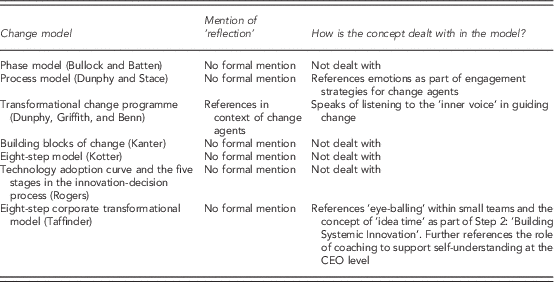
Analysis of these existing change models provides a mixed snapshot regarding the inclusion of formal reflection amongst either change recipients or change agents. Table 1 represents an analysis of each of the change models highlighted earlier and the extent to which the process of reflection is dealt within each.
How is reflection dealt with in existing change models?

By reference to the details contained in Table 1 above, it is clear that existing change models appear to give ‘reflection’ no direct mention, and in many of these models, the concepts supporting reflection has only limited support. By contrast, broader recognition of the benefits associated with formal reflection processes has been documented in research in health service-based implementations and change (Edmondson, Bohmer, & Pisana, Reference Edmondson, Bohmer and Pisano2001; Damschroder, Aron, Keith, Kirsh, Alexander, & Lowery, Reference Damschroder, Aron, Keith, Kirsh, Alexander and Lowery2009). The inclusion of such formal reflection processes appeared as one of the underpinning aspects of the change at SAH and could, therefore, be considered as a potential formal step in appropriate nonprofit-focussed change models.
Second finding – confidence as an element of trust
Evidence from the research suggested that the ability of the organisation to be open and transparent regarding its past experiences of change, including those that went well and those that did not, laid the foundations for success in the current SAH change programme. The research clearly pointed to this element of trust as a foundational element and ensured that many of the interviewees felt a degree of comfort regarding the connection between this historical element and the current change initiative. This was supported by a range of interview comments such as:
People have a level of trust in their leadership … and we attempt to communicate what’s in it for them too (Interview 1 with Interviewee 4).
Sort of walk with them a bit on the road to give them confidence (Interview 2 with Interviewee No. 6).
There was a lot of preparation, there was a lot of guidance, there was a lot of ‘You can come and learn it. You can be trained. You can do it at home. You can do it here’. So there was a lot of build up to it, whereas [… a previous change …] was just thrown on you (Interview 1 with Interviewee No. 12).
Trust has been referenced in much of the prevailing change literature, especially in the context of leadership (Lines, Selart, Espedal, & Johansen, Reference Lines, Selart, Espedal and Johansen2005; Lutz, Smith, & da Silva, Reference Lutz Allen, Smith and Da Silva2013). In this context, trust is somewhat one dimensional in that it reflects a range of personal attributes of the leader and reflects the ‘light-on-the-hill’ approach, where leaders represent the aspiration of the organisation, and the motivation for moving forward (Smith & Graetz, Reference Smith and Graetz2011).
Evidence from the SAH research suggests a wider application of trust by necessitating its existence in terms of how it has been historically applied, in the context of past changes, and the extent of openness and honesty that such leadership can evidence, as a precursor to the commencement of a new change process. In this manner, the ability of management to openly discuss past change experiences, irrespective of the degree of success or failure, however, this may have been defined, laid the groundwork for levels of trust amongst the change recipients towards the current change process. Such a linkage, between commitment to change and levels of trust in management has been recognised in previous research (Mayer & Hamilton, Reference Mayer and Hamilton2013).
Informed in this manner, trust cannot be programmed or planned; rather it is a consequence of past actions that must be managed in the present. The ability of leadership and management more generally, to reinforce views through action, as highlighted by numerous interviewees, provides the linkage between the historical basis of such trust with the realities of the current change programme.
A further point of context with regards trust is its linkage with values, especially within nonprofit organisations. Whilst the value alignment between change and the process by which it is managed has been recognised (Burnes & Jackson, Reference Burnes and Jackson2011), nonprofit employee attributes (Drucker, Reference Drucker1990; Lyons, Reference Lyons2001; Speckbacher, Reference Speckbacher2003) widen the importance of values and its linkage to successful organisational change.
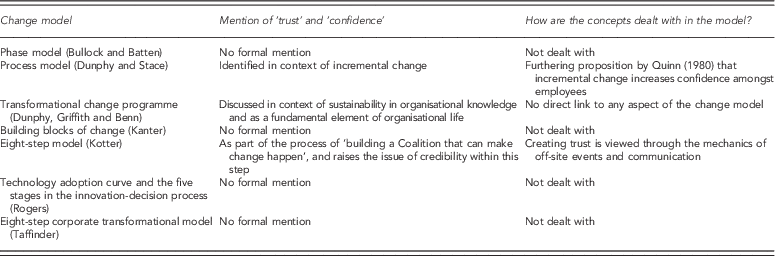
Table 2 identifies how trust has been dealt within the referenced change models, providing the basis for it being highlighted as a potential differentiating feature in the current research.
How is confidence and trust dealt with in existing change models?
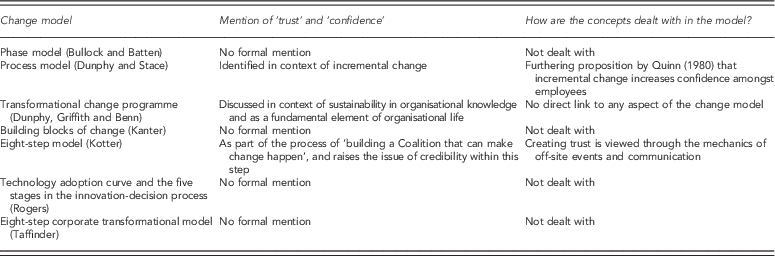
By reference to the details contained in Table 2, confidence and trust is referenced to some degree by the prevailing change models. However, its application is inconsistent in terms of its usage within each, and its underpinnings, within each of the various stages associated with these models. Based on the findings from the SAH research, it would appear that the reliance on trust and confidence by change recipients, as a precursor to the planned change, impacts the outcomes. The research further suggests that trust and confidence is multidimensional, in that the single focus of leadership must be augmented with high levels of transparency and honesty, with regards previous organisational change outcomes, opening the organisation internally to analysis of these earlier successes and failures. Such an approach has been identified in past research (Armenakis & Bedeian, Reference Armenakis and Bedeian1999).
Third finding – focussing on the individual
Evidence from the present research suggested that the focus on the individual change recipients, through the provision of extra resources during the change, the time allowed for individuals to adopt to the new technology and the new processes that followed this, the inclusion of individual staff in the identification and development of the clinical pathways that underpinned the new systems and processes, and the ability for staff emotionally affected by the changes to seek in-house assistance in guiding them through their difficulties, supported both confidence in, and support of, the changes. From a planning perspective, it had been determined that such a focus would potentially extend the timing of the change programme. The public awareness, that this was both acceptable and warranted, further enhanced the overall change outcomes. This was supported by a range of interview comments such as:
It’s interesting because I think that if you look at change from the basis that people potentially feel that they’ve lost something in the process, then it is a form of grieving. If you take the change out of the equation and just look at a grief process, nobody is going to turn around to somebody who’s grieving and say ‘Just get over it will you’, you’d be regarded as being totally callous if you did say that (Interview 1 with Interviewee No. 1).
I think it’s easy in this process to deal with the intellectual side of what’s going on, but then on the emotional side … and their self-esteem starts to go. So I think they’ve addressed those things pretty well (Interview 2 with Interviewee No. 4).
A lot of TLC … A lot of ‘We’re here all the time. Call me’, a lot of positive feedback, a lot of ‘You’re doing really well’. All of that kind of stuff. The usual of what you have to do with people. So I think it helped (Interview 1 with Interviewee No. 12).
Over the last decade or so there has been a growing awareness amongst researchers of the need to focus on the perceptions of individuals within change programmes, and the recognition that a focus on the organisation must be balanced with an appropriate focus on the individual (Bamford & Forrester, Reference Bamford and Forrester2003; Becker, Reference Becker2007; Shin, Taylor, & Seo, Reference Shin, Taylor and Seo2012). Whilst much of such research has been centred on analysis associated with levels of resistance to change and issues that either compound or support such resistance, emphasis has now also been applied in research associated with perceptions of individuals experiencing change (Lines et al., Reference Lines, Selart, Espedal and Johansen2005; Isett, Gleid, Sparer, & Brown, Reference Isett, Glied, Sparer and Brown2013).
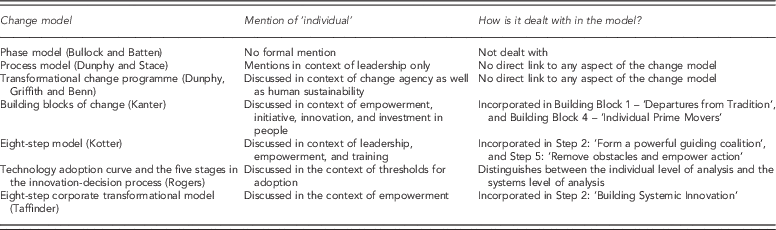
Table 3 identifies how the focus on the individual has been dealt with in the referenced change models, providing the basis for it being highlighted as a potential differentiating feature in the current research.
How is the individual dealt with in existing change models?

By reference to the details contained in Table 3, focussing on the individual has been referenced and applied in a number of the prevailing change models. Such application has been embodied in the context of leadership, the impact on, and by, change agency, the part that empowerment plays in the change process, as well as the recognition of the role that training plays as part of the change process. Based on the findings from the SAH research, it would appear that focussing on the individual as a fundamental aspect of the change process, often in parallel with the organisation-wide focus, and doing so in an overt and caring manner, positively impacts the success of the change programme. This is reflective of the cultural characteristics associated with the nonprofit sector and the people attracted to work within it (Speckbacher, Reference Speckbacher2003; Bradach, Tierney, & Stone, Reference Bradach, Tierney and Stone2009; Leiter, Reference Leiter2012).
Fourth finding – timing attributes in planning for change
Evidence from the current research indicated that some of these key planning aspects related to the focus, design, delivery, frequency, and content of communication; the development of employee–client engagement strategies evident in the visioning of the change outcomes; and the existence of responsive design and service delivery structures that evidence proactivity at the execution stage. This was supported by a range of interview comments such as:
Well of all the changes that I’ve seen here, I think this would be the one that’s been managed most efficiently because of the forewarning and the training, and because they have a dedicated team of people to assist, and they’re only a phone call away, and they’ve been very proactive. They have had a good structured process of informing people and educating people, and I guess letting people know that they will be there to support us, which hasn’t happened before (Interview 2 with Interviewee No. 15).
To me, I think it’s been slowly introduced and enough information given at the time to just get your ahead around and then give you the next bit of information, put your head around it and then now we’ve got patients … so it’s just enough to build you up to the big stuff (Interview 1 with Interviewee No. 14).
I think we’re getting better at planning and designing things. and ‘Well I’m actually quite impressed because I’ve seen improvement has been great so as a manager I actually think the way that the hospital now handles situations is a lot better’. and ‘I probably would have been a bit’ ‘Oh not another change’. Here we go again. Now you know more about it, it’s okay (Interview 1 with interviewee No. 5).
These planning attributes do not replace the wide-range planning that is prevalent in many of the existing change models. They do, however, represent either a renewed focus on some of these existing strategies or a change to the design structure within them.
Aspects of communication have been extensively covered in more recent research on change. Various design considerations have been highlighted around the need for two-way communication (Baker, Reference Baker2007), comparative assessments of formal and informal communication (Lewis, Reference Lewis2011) and the expression of management concern that can be implied in well-structured communication processes (Lines et al., Reference Lines, Selart, Espedal and Johansen2005). Content of communication has been raised by researchers in terms of addressing employee uncertainty (Bordia, Hunt, Paulsen, Tourish, & DiFonzo, Reference Bordia, Hunt, Paulsen, Tourish and DiFonzo2004), winning the hearts and minds of employees (Ghislanzoni, Heidari-Robinson, & Jermiin, Reference Ghislanzoni, Heidari-Robinson and Jermiin2010), as a tool that can convince change recipients to respond positively to change (Lewis, Reference Lewis2011), and as a link between the progress of change and employees’ goals and values (Lines et al., Reference Lines, Selart, Espedal and Johansen2005).
Engagement has been raised in different contexts in recent literature, ranging in terms of knowledge creation as part of the engagement strategy amongst change recipients (Becker, Reference Becker2007), to the development of new individual work routines (Balogun & Jenkins, Reference Balogun and Jenkins2003), through to its linking with the visioning role of leadership in organisational change (Gill, Reference Gill2003).
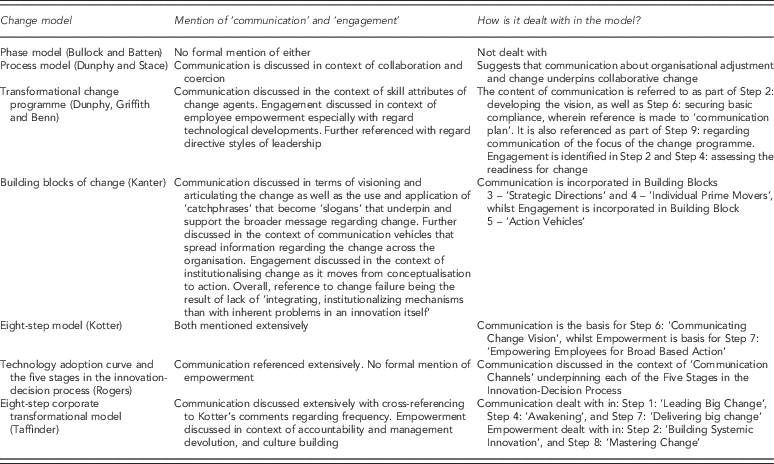
Table 4 identifies how the focus on certain communication and change recipient engagement strategies have been dealt within the referenced change models, providing the basis for it being highlighted as potential differentiating features in the current research (Gill, Reference Gill2003).
How is communication and engagement dealt with in existing change models?

By reference to the details contained in Table 4, existing change models apply concepts and processes of communication and engagement in the planning and execution processes of change with mixed application and in various ways. Whilst such considerations feature in some detail within these, few of them seek to stress these elements to the extent identified by this research, as being potentially fundamental to the success of change programmes and, thereby, a necessary focus in the planning stages. The need to ensure adequate planning and maintain a strong focus on this aspect of change and, by doing so, resisting the urge to prematurely proceed to ‘doing things’ that relate to the actual change, have been identified in earlier research (Beckhard & Harris, Reference Beckhard and Harris1977; Gill, Reference Gill2003).
RESEARCH LIMITATIONS AND IMPLICATIONS FOR FUTURE RESEARCH
Whilst a single exploratory case study has been undertaken to respond to the research question, research limitations exist which the authors have identified for inclusion in future research, aimed at addressing issues associated with the generalisability of the findings across the nonprofit sector, leading to the development of a nonprofit-specific OCM model for broader application.
One such limitation is the nature of the nonprofit sector, which contains many disparate organisations in terms of both size and industry, necessitating OCM research which can account for such diversity, further informing the limited single case study research undertaken at SAH from which an extrapolated position has been proposed.
A further limitation relates to the comparative impact of reflection and reflective practices within nonprofit organisations as they pertain to OCM. Current research has identified the potential impact that such practice has had on the outcomes within SAH, without any comparison of earlier change programmes where such practices may have been either absent or given less focus. To respond to this limitation, further research should be undertaken in a single case study setting, where comparisons are made between multiple change programmes, overtime, within the one organisation.
In relation to findings associated with trust and confidence in management with regards OCM, a limitation is determining the extent of the impact on change outcomes. Future research could involve a comparative study between multiple nonprofit organisations, where each has varying performance attributes of its senior management team as evidenced by such instruments as staff survey responses overtime, could further inform the implication of this finding in the SAH research to the broader nonprofit sector.
A further limitation relates to the for-profit and nonprofit comparison with regard OCM, from which this research is framed. Findings resulting from the SAH research could be ‘tested’ in for-profit environments to determine relative impacts. Such an approach would require controlled inclusion in a proposed change programme where designated change processes do not materially differ from an earlier change process as the organisation may have a methodology that has been previously deployed.
As a singular exploratory case study, these limitations have been highlighted as precursors for further research, aimed at strengthening the findings and the conclusions presented in this paper.
CONCLUSION
This single exploratory case study has set out to identify potential unique attributes of change management as they may apply to the nonprofit sector, thereby informing existing OCM approaches, many of which have originated from research in the commercial sector. Observations from the qualitative data, derived from a detailed grounded theory methodology that was underpinned by a theoretical sampling strategy, highlighted four key findings, each of which may hold implications for existing OCM theory.
These observations suggest that reflection, confidence and trust, a balanced focus on the individual as well as the organisation, and timing attributes, impact change outcomes within these organisations. Further research into a broader range of nonprofit organisations that is able to test these observations is necessary in order to substantiate the findings from this research.
Recommendations arising from the research as to the nonprofit characteristics that may extend existing OCM theory beyond current application include:
-
∙ The need to formally include reflection time and reflective practices for all change participants in the planning, execution, and concluding stages of change, understanding that those experiencing change react to a wide range of emotions leading up to the change, during the execution phase, as well as in the post change phase, and throughout this period, need to not only absorb the practicalities of the change and what this may mean for their own positions, but to also be able to verbalise their thoughts and discuss these in an open and supportive environment with colleagues, including internal change agents and management.
-
∙ The need for the organisation to openly reflect on both the success and failure of past change experiences as a fundamental component of the planning stages of change, reinforcing trust, and confidence in management with regards their ability to plan for, and execute change successfully.
-
∙ The need for management to maintain an adequate focus on the individuals experiencing the change rather than an organisational focus as a primary (and often sole) consideration, creating an organisation-wide view as to management’s interest in the welfare of change recipients throughout the change process and reinforcing an inclusive approach to the challenge of change within the organisation.
-
∙ The identification of appropriate timing considerations in the change-planning process, with specific reference to communication and change recipient engagement processes, underpinning a strong correlation between the level of change preparation and readiness, with actual change execution.
Research regarding change management in the nonprofit sector has been limited, with the general historical focus having been attributed to commercial sector organisations. The view amongst some organisational researchers fails to directly differentiate between sectors, and view change from the generic perspective of the organisation (Brewer, Reference Brewer1995). Others point to a range of differentiating features unique to the nonprofit sector that may impact on a range of organisational processes and challenges (Speckbacher, Reference Speckbacher2003; Lutz, Smith, & Da Silva, Reference Lutz Allen, Smith and Da Silva2013).
This research suggests that such differences may support further consideration of specific OCM models for use in the nonprofit sector.
Given the single case study approach, such conclusions are considered to be tentative and, as suggested in the research limitations earlier, additional research that explores the suggested strategies in additional nonprofit organisations, should be undertaken to confirm these findings and support their integration into the OCM body of knowledge.
ACKNOWLEDGEMENTS
The authors wish to acknowledge the staff and management at the Sydney Adventist Hospital Australia for their assistance during the gathering of interview data that was used in this research.