Introduction
Moral judgment entails considering not only the outcome of an action but also the intention with which the action was pursued. Thus, while in general harmful actions are judged more harshly than harmless actions, actions undertaken with the belief to cause harm are strongly condemned even if they fail (attempted harm), and actions undertaken with innocent intentions that accidentally result in harm are generally considered not completely immoral (accidental harm).
Recent research has investigated the neural correlates of the integration of outcome and belief information during moral reasoning. In recent functional neuroimaging (fMRI) studies, Young and colleagues have probed moral judgment in healthy subjects using scenarios in which the protagonists produced either a negative outcome or a neutral outcome based on the belief that they were causing that negative (“negative” belief) or neutral outcome (“neutral” belief) (e.g., Young, Cushman, Hauser, & Saxe, Reference Young, Cushman, Hauser and Saxe2007). Cases of attempted harm (i.e., the protagonists intended to produce a negative outcome but their false beliefs prevented harm from occurring) and accidental harm (i.e., the protagonists caused unintended harm), in which outcome and belief information are in conflict, are particularly suited to reveal the mechanisms mediating the representation and relative weighting of these different sources of information for moral judgment. The results have revealed that, in such cases, an important cognitive input to moral judgment is the attribution of mental states (beliefs and intentions) to moral agents, or “theory of mind” (ToM; e.g., Knobe, Reference Knobe2005; Schaich Borg, Hynes, Van Horn, Grafton, & Sinnot-Armstrong, Reference Schaich Borg, Hynes, Van Horn, Grafton and Sinnott-Armstrong2006). Moral reasoning, indeed, was associated with activation in a network of brain regions, including medial prefrontal cortex, temporo-parietal junction (TPJ), and precuneus (Young et al., Reference Young, Cushman, Hauser and Saxe2007; Young & Saxe, Reference Young and Saxe2008), which is related to ToM (e.g., Fletcher et al., Reference Fletcher, Happe, Frith, Baker, Dolan, Frackowiak and Frith1995; Gallagher et al., Reference Gallagher, Happe, Brunswick, Fletcher, Frith and Frith2000; Gobbini, Koralek, Bryan, Montgomery, Haxby, Reference Gobbini, Koralek, Bryan, Montgomery and Haxby2007; Jenkins & Mitchell, Reference Jenkins and Mitchell2009; Ruby & Decety, Reference Ruby and Decety2003; Saxe & Kanwisher, Reference Saxe and Kanwisher2003; Shamay-Tsoory & Aharon-Peretz, Reference Shamay-Tsoory and Aharon-Peretz2007). Importantly, activation of ventromedial prefrontal cortex (vmPFC) during judgment of attempted harm predicted the degree to which the protagonists were condemned, and activation of TPJ during judgment of accidental harm predicted the degree to which the protagonists were exculpated (Young & Saxe, Reference Young and Saxe2009), confirming the involvement of these brain regions in belief-based moral judgment.
The vmPFC is long known to be involved in moral judgment. vmPFC is recruited during consideration of material involving moral violations (Greene, Sommerville, Nystrom, Darley, & Cohen, Reference Greene, Sommerville, Nystrom, Darley and Cohen2001; Moll, de Oliveira-Souza, & Eslinger, Reference Moll, de Oliveira-Souza, Eslinger, Bramati, Mourão-Miranda, Andreiuolo and Pessoa2002; Schaich Borg et al., Reference Schaich Borg, Hynes, Van Horn, Grafton and Sinnott-Armstrong2006). Moreover, damage to vmPFC causes moral reasoning deficits (Anderson, Barrash, Bechara, & Tranel, Reference Anderson, Barrash, Bechara and Tranel2006; Barrash, Tranel, & Anderson, Reference Barrash, Tranel and Anderson2000; Eslinger & Damasio, Reference Eslinger and Damasio1985). For example, neuropsychological studies show that patients with lesions in vmPFC (vmPFC patients) are more likely to endorse personal moral violations than brain-damaged and healthy controls (Ciaramelli, Muccioli, Làdavas, & di Pellegrino, Reference Ciaramelli, Muccioli, Làdavas and di Pellegrino2007; Koenigs et al., Reference Koenigs, Young, Adolphs, Tranel, Cushman, Hauser and Damasio2007; Moretto, Làdavas, Mattioli, & di Pellegrino, Reference Moretto, Làdavas, Mattioli and di Pellegrino2010). These studies, however, did not allow determining whether the increased endorsement of moral violations in vmPFC patients depended on a failure to process the harmful outcomes of actions or the harmful intentions motivating those actions, because moral violations were in all cases perpetrated voluntarily. Therefore, outcome and belief information were aligned.
The nascent fMRI evidence that medial prefrontal cortex is activated during belief-based moral judgment (Young et al., Reference Young, Cushman, Hauser and Saxe2007, Young & Saxe, Reference Young and Saxe2008, Reference Young and Saxe2009) suggests that vmPFC may be necessary for attributing intentions to moral agents, and process this information along with outcome information during moral judgment. Here, we investigated whether vmPFC plays a crucial role in this process, probing moral judgment in vmPFC patients using scenarios that disentangle the contribution of intentions and outcomes (Experiment 1, see also Young et al., Reference Young, Bechara, Tranel, Damasio, Hauser and Damasio2010). In two additional experiments, we tested whether the findings from Experiment 1 depended on the specific format of the scenarios used, in which outcome information is available before (Experiment 2), and more salient (Experiment 3) than belief information. We also probed vmPFC patients’ understanding of intentions explicitly (Experiment 3). The logic of each experiment is explained below.
Experiment 1: Integrating Outcome And Belief Information During Moral Reasoning
vmPFC patients, control patients with lesions not involving prefrontal cortex, and normal controls considered scenarios in which the protagonists caused intentional harm, accidental harm, attempted harm, or no harm (see below), and rated the degree to which they believed the protagonist's behavior was morally permissible (see Young et al., Reference Young, Cushman, Hauser and Saxe2007). If vmPFC is crucial for integrating outcome and belief information during moral judgment, vmPFC patients should show impaired moral judgment in scenarios in which outcome and belief information conflict, namely, scenarios of attempted harm and accidental harm.
Subjects
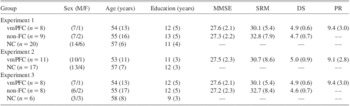
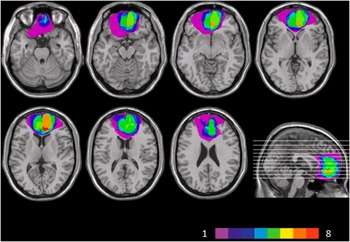
Participants included 17 patients with brain damage and 20 healthy individuals (see Table 1 for demographic and clinical information). Patients were recruited at the Centre for Studies and Research in Cognitive Neuroscience (CsrNC), Cesena, Italy, and the Spedali Riuniti, Brescia, Italy. Patients were selected on the basis of the location of their lesion evident on MRI or CT scans. Eight patients had lesions centered on the vmPFC (vmPFC patients; see Figure 1), defined as the medial one-third of the orbital surface and the ventral one-third of the medial surface of the frontal lobe (Stuss & Levine, Reference Stuss and Levine2002) and adjacent basal forebrain area. Lesions were the results of the rupture of an aneurysm of the anterior communicating artery (AcoA) in five cases, and traumatic brain injury (TBI) in three cases. Lesions were bilateral in all cases.
Participant groups’ demographic and clinical data

Note. vmPFC = patients with lesions in the ventromedial prefrontal cortex; non-FC = patients with lesions outside the vmPFC; NC = healthy controls; M = male; F = female; MMSE = Mini Mental State Examination; SRM = Standard Raven Matrices (corrected score); DS = digit span forward (corrected score); PR = Prose recall (immediate + delayed) (corrected score). The values in parentheses are standard deviations.
Location and overlap of brain lesions in the eight patients with ventromedial prefrontal cortex (vmPFC) damage involved in Experiment 1 and Experiment 3, projected on the same seven axial slices and on the mesial view of the standard Montreal Neurological Institute brain. The color bar indicates the number of overlapping lesions. Maximal overlap occurs in BA 10, BA 11, and BA 32. In axial slices, the left hemisphere is on the left side.

Most vmPFC patients exhibited a decline in social interpersonal conduct, including lack of concern for social rules (e.g., a patient repeatedly commented on a trainee's beautiful eyes, adding that he had just fallen in love), irritability (e.g., a patient was very likely to yell at trainees), and emotional blunting (e.g., patients were invariably reported as no longer interested in the personal life of their close relatives). The opportunity to appreciate vmPFC patients’ real-life moral conduct and judgment is less frequent. We discussed about a recent case of a cruise-ship sinking near Isola del Giglio with one of our vmPFC patients. The fact was extensively covered in the news, especially due to the captain's behavior, who was blamed heavily for leaving the sinking ship before all guests were saved. In commenting on such behavior, the patient said: “In theory, he did wrong, because the captain should be the last to leave the ship, after having rescued all the guests. However, when you are scared that your own life is at risk, you do not think to other people. I would have done the same.”
Nine patients were selected on the basis of having damage that did not involve the mesial orbital/ventromedial prefrontal cortex and frontal pole, and also spared the amygdala in both hemispheres (non-FC patients; see Table 1). In this group, lesions were unilateral in all cases (left: three cases: right: six cases), and caused by stroke (eight cases) or TBI (one case). Lesion sites included the lateral aspect of temporal lobe (five cases), the parietal lobe (two cases), and the lateral occipito-temporal cortex (two cases). Included patients were at least 6 months post-morbid, were not receiving psychoactive drugs, and had no other diagnosis likely to affect cognition or interfere with participation in the study (e.g., significant psychiatric disease, alcohol abuse, history of cerebrovascular disease).
Patients’ general cognitive functioning was generally preserved (see Table 1), as indicated by the scores they obtained in the Mini-Mental State Examination (Folstein, Robins, & Helzer, Reference Folstein, Robins and Helzer1983), the Raven Standard Matrices, and the digit span test, which were within the normal range in all cases (Spinnler & Tognoni, Reference Spinnler and Tognoni1987). As well, vmPFC patients’ long-term memory, although weak, was within the normal limits (Spinnler & Tognoni, Reference Spinnler and Tognoni1987; Table 1). We are confident that vmPFC patients’ memory abilities were adequate to perform the moral judgment task. First, patients had virtually unlimited time to encode the scenarios, and decided on each scenario immediately after encoding. Moreover, in a previous work investigating moral judgment in vmPFC patients using a similar experimental design and scenarios of comparable length to those in the present study, we probed memory for each scenario and found that patients remembered them accurately (Ciaramelli et al., Reference Ciaramelli, Muccioli, Làdavas and di Pellegrino2007).
The healthy control group comprised 20 individuals matched to the patients on mean age, education, and gender balance (p > .33 in all cases). Control participants were not taking psychoactive drugs, and were free of current or past psychiatric or neurological illness. Participants gave informed consent according to the Declaration of Helsinki (International Committee of Medical Journal Editors, 1991) and the Ethical Committee of the Department of Psychology, University of Bologna.
Lesion Analysis
For each patient, lesion extent and location was documented by using the most recent clinical CT or MRI. Lesions were traced by a neurologist with experience in image analysis on the T1-weighted template MRI scan from the Montreal Neurological Institute provided with the MRIcron software (Rorden & Brett, Reference Rorden and Brett2000). The scan is normalized to Talairach space. The location of the lesions was identified by overlaying the lesion area onto the Automated Anatomical Labeling template provided with MRIcron. Figure 1 shows the extent and overlap of brain lesions in vmPFC patients. Regions of maximal overlap were BA 10, 11, and 32.
Materials and Procedure
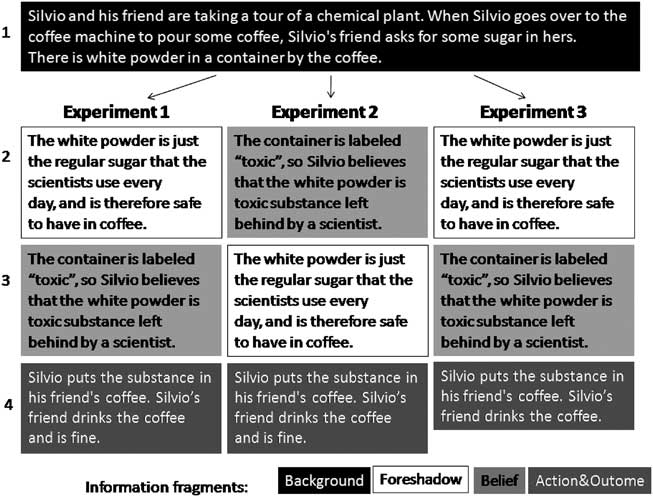
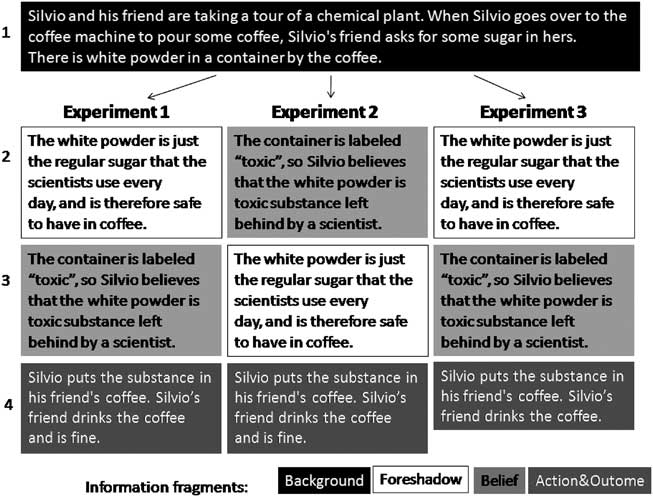
Stimuli consisted of four variations of 12 scenarios for a total of 48 scenarios, selected from a previously published set (Young et al., Reference Young, Cushman, Hauser and Saxe2007; see Figure 2 for an example), and translated to Italian. The combination of belief (neutral vs. negative) and outcome (neutral vs. negative) information yielded four types of scenarios: (1) the protagonist has a neutral belief and the outcome is neutral (No-Harm scenarios); (2) the protagonist has a negative belief but the outcome is neutral (Attempted-Harm scenarios); (3) the protagonist has a neutral belief but the outcome is negative (Accidental-Harm scenarios); (4) the protagonist has a negative belief and the outcome is negative (Voluntary-Harm scenarios).
Schematic representation of sample scenario in each of the three experiments. The sample scenario refers to an Attempted Harm scenario. In each experiment, the information presented comprised four fragments: the “Background” fragment conveys information to set the scene; the “Foreshadow” fragment foreshadows whether the action will result in a negative or neutral outcome; the “Belief” fragment states the protagonist’s belief; the “Action & Outcome” fragment states the protagonist's action and its (negative or neutral) consequences. In Experiment 2, the order of the “Foreshadow” and “Belief” fragments was reversed relative to Experiment 1. In Experiment 3, outcome information was removed from the “Action & Outcome” fragment. Adapted with permission from Young, L., Cushman, F., Hauser, M., & Saxe, R. (2007). The neural basis of the interaction between theory of mind and moral judgment. Proceedings of the National Academy of Sciences of the United States of America, 104 (20), 8235–8240. Copyright (2007) National Academy of Sciences, U.S.A.
Subjects saw four versions of each scenario. Scenarios were presented in 4 different orders, counterbalanced across subjects, and ensuring that no condition was immediately repeated. When a scenario was repeated, it contained a different protagonist (i.e., first name) from the other presentations. Word count was matched across conditions (No-Harm: 90 ± 14; Attempted-Harm: 91 ± 13; Accidental-Harm: 91 ± 15; Voluntary-Harm: 92 ± 14; F(3,44) = 0.02; p = .99).
Scenarios were presented through two screens. In the “description screen,” participants considered the scenario. The screen displayed four information segments: (1) background information to set the scene (background segment), (2) facts foreshadowing the eventual outcome (foreshadow segment), (3) the protagonist's belief, from which intentions could be inferred (belief segment), (4) the protagonist's action and its outcome (action & outcome segment) (see Figure 2). In the following “question screen,” participants made moral judgments of the protagonist's action on a scale from 1 (forbidden) to 7 (permissible). Participants read and responded at their own pace, pressing the spacebar to pass from the description to the question screen. There was no time limit for reading or responding.
Results and Discussion
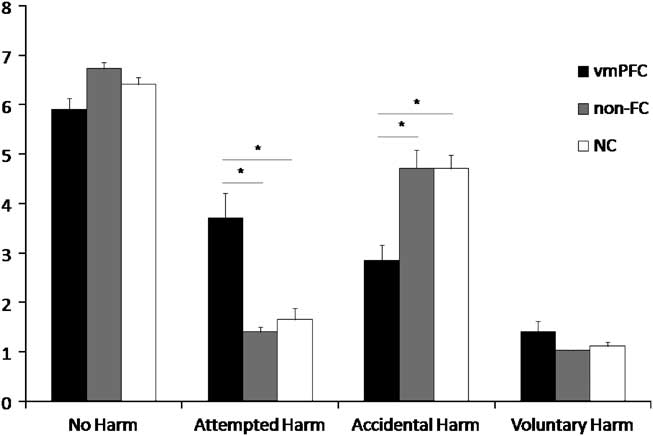
Figure 3 shows mean judgments of permissibility (on a seven-point scale) by participant group and type of scenario. A mixed analysis of variance (ANOVA) on permissibility ratings with Group (vmPFC patients, non-FC patients, healthy controls) as a between-subject factor and Type of scenario (No-Harm, Attempted-Harm, Accidental-Harm, Voluntary-Harm) as a within-subject factor yielded an effect of Type of scenario, F(3,102) = 244.00; p < .00001, which was qualified by a significant Group × Type of scenario interaction, F(6,102) = 13.70; p < .00001. Post hoc Newman-Keuls tests revealed that vmPFC patients judged attempted harm as more permissible (p < .0005 in both cases) and accidental harm as less permissible than non-FC patients and healthy controls (p < .001 in both cases). In contrast, vmPFC patients’ moral judgment of No-Harm and Voluntary-Harm scenarios did not differ significantly from those of the control groups (p > .13 in all cases). Ratings of non-FC patients were comparable to the controls’ across types of scenario (p > .45 in all cases).Footnote 1, Footnote 2
Mean permissibility scores for cases of no harm, attempted harm, accidental harm, and voluntary harm in Experiment 1, by participant group (vmPFC = patients with lesions in the ventromedial prefrontal cortex; non-FC = patients with lesions outside the frontal lobe; NC = healthy controls). The error bars indicate the standard error of the mean. *p < .05, two-tailed.
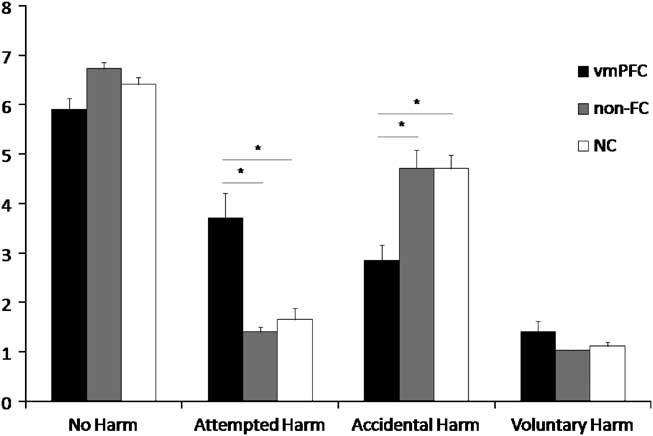
These results show that vmPFC patients gave more weight to outcome (as opposed to belief) information while making moral judgments than brain-damaged and healthy controls. For vmPFC patients, it is the outcome of an action that makes it morally permissible or not, not the intention behind that action. This suggests that vmPFC patients have problems understanding intentions, or integrating intention with outcome information during moral reasoning.
Experiment 2: Controlling For The Order Of Outcome And Belief Information
Experiment 1 showed that vmPFC patients prioritize outcome over belief information during moral judgment. In Experiment 1, however, the potential outcome of the action was the first information available to participants, who could foresee it from the foreshadow fragment before belief information was presented. It is possible, then, that vmPFC patients’ prioritizing of outcome information was related to an inability to consider additional sources of information presented after outcome information had been foresaw, that is, a deficit in cognitive flexibility (Fellows & Farah, Reference Fellows and Farah2003). To control for possible order effects, in Experiment 2 we had participants rate a new set of scenarios, in which the belief fragment preceded the foreshadow fragment. If the order of outcome and belief information was a factor driving the findings from Experiment 1, then vmPFC patients’ moral judgment should improve substantially in Experiment 2.
Subjects
Participants were 11 vmPFC patients (see Table 1), including 5 patients who had participated in Experiment 1 and 6 new patients, and 17 new healthy controls. Patients were recruited at the CsrNC, Cesena, Italy. vmPFC patients’ lesions were the results of the rupture of an AcoA aneurysm (eight cases), and TBI (three cases). Included patients were at least 6 months post-morbid, not receiving psychoactive drugs, and had no other diagnosis likely to affect cognition or interfere with the participation in the study (e.g., significant psychiatric disease, alcohol abuse, history of cerebrovascular disease). Patients’ general cognitive functioning was generally preserved (see Table 1). Control participants were not taking psychoactive drugs, and were free of current or past psychiatric or neurological illness as determined by history. The healthy controls were matched to the patients on mean age, education, and gender balance (p > .10 in all cases). Participants gave informed consent, according to the Declaration of Helsinki (International Committee of Medical Journal Editors, 1991) and the Ethical Committee of the Department of Psychology, University of Bologna.
Materials and Procedure
We used 32 scenarios, including 8 No-Harm scenarios, 8 Attempted-Harm scenarios, 8 Accidental-Harm scenarios, and 8 Voluntary-Harm scenarios. Scenarios were selected among the scenarios from a previous study (Young et al., Reference Young, Cushman, Hauser and Saxe2007) that were not used in Experiment 1, and translated to Italian. All scenarios depicted different situations. Word count was matched across conditions (No-Harm: 98 ± 6; Attempted-Harm: 104 ± 9; Accidental-Harm: 103 ± 8; Voluntary-Harm: 107 ± 14; F(3,28) = 1.14; p = .34).
Different from Experiment 1, in the description screen the belief fragment was presented immediately after the background, such that belief, and not outcome, information was the first information available to patients (see Figure 2). All other procedures were the same as in Experiment 1.
Results and Discussion
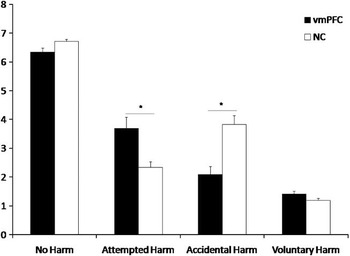
Figure 4 shows mean judgments of permissibility (on a seven-point scale) by participant group and type of scenario. The mixed ANOVA on permissibility scores with Group (vmPFC patients, healthy controls) and Type of scenario as factors yielded an effect of Type of scenario, F(3,78) = 218.39; p < .0001, which was qualified by a significant Group × Type of scenario interaction, F(3,78) = 18.63; p < .0001. Post hoc Newman-Keuls comparisons revealed that vmPFC patients judged attempted harm as more permissible and attempted harm as less permissible than normal controls (p < .01 in both cases). In contrast, ratings of permissibility for No-Harm and Voluntary-Harm scenarios did not differ significantly from those of the controls (p > .32 in both cases).Footnote 3
Mean permissibility scores for cases of no harm, attempted harm, accidental harm, and voluntary harm in Experiment 2, by participant group (vmPFC = patients with lesions in the ventromedial prefrontal cortex; non-FC = patients with lesions outside the frontal lobe; NC = healthy controls). The error bars indicate the standard error of the mean. *p < .05, two-tailed.

The results replicate those of Experiment 1 in showing that vmPFC patients weighted outcome information disproportionately more than belief information during moral judgment, and suggest that this finding is not attributable to the scenarios foreshadowing outcome information before belief information was available.
Experiment 3: Examining The Role Of Outcome Saliency And Intention Attribution
Experiment 1 and Experiment 2 showed a tendency, on the vmPFC patients’ part, to make moral judgments based on the outcome of, rather than the intent behind, actions. In the scenarios used, however, the potential outcome of actions was available to participants twice: implicitly in the foreshadow fragment (e.g., the white substance is poison) and explicitly in the action & outcome fragment (e.g., her friend dies), whereas belief information was presented once. vmPFC patients’ prioritizing of outcome information, therefore, may depend on the increased saliency of outcome (compared to belief) information.
Experiment 3 had two aims. First, to control for saliency effects, we had participants rate again the Attempted-Harm and Accidental-Harm scenarios from Experiment 1, this time presented without the final outcome information. If the increased saliency of outcome (compared to belief) information is a factor driving findings from the previous experiments, then their performance should improve substantially in Experiment 3 compared to Experiment 1. Next, we sought evidence for a role of ToM deficits on moral judgment. We asked participants to state, after each scenario, which was, in their opinion, the protagonist's intent.
Subjects
A subset of participants in Experiment 1 took part in Experiment 3 (see Table 1). These were eight vmPFC patients, eight non-FC patients, and six healthy controls. Participant groups were matched on mean age, education, and gender balance (p > .12 in all cases). Participants gave informed consent, according to the Declaration of Helsinki (International Committee of Medical Journal Editors, 1991) and the Ethical Committee of the Department of Psychology, University of Bologna.
Materials and Procedure
The Attempted-Harm (n = 12) and Accidental-Harm (n = 12) scenarios used in Experiment 1 were represented to participants with the outcome information removed from the action & outcome segment (see Figure 2). Word count was matched across conditions (No-Harm: 90 ± 14; Attempted-Harm: 91 ± 13; Accidental-Harm: 91 ± 15; Voluntary-Harm: 92 ± 14). In the “question screen,” participants made moral judgments of the protagonist's action on a scale from 1 (forbidden) to 7 (permissible), and then answered a question about the protagonist's intention: “In your opinion, were the protagonist's intentions harmless or harmful? Why?” Patients were required to make a clear choice between the option “harmless” or “harmful” and to explain it. The response “harmless” was considered correct for No-Harm and Accidental-Harm scenarios, and the response “harmful” for Voluntary-Harm and Attempted-Harm scenarios. The experimenter was not allowed to give any feedback.
Results and Discussion
Moral judgment
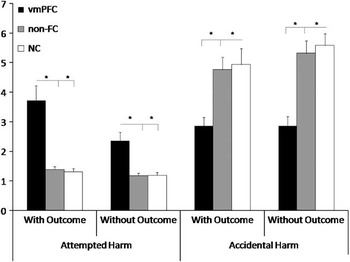
We contrasted judgments of permissibility for Attempted-Harm and Accidental-Harm attained in Experiment 1 (outcome present) with those in Experiment 3 (outcome removed) (see Figure 5). A mixed ANOVA on permissibility scores with Group, Type of scenario (Attempted-Harm, Accidental-Harm), and Outcome (present, absent) as factors revealed a significant Group × Type of scenario interaction, F(2,20) = 26.71; p < .00005. Post hoc Newman-Keuls tests confirmed that vmPFC patients judged attempted harm as more permissible and attempted harm as less permissible than non-FC patients and healthy controls (p < .005 in all cases). The Outcome × Type of scenario interaction was also significant, F(1,20) = 13.58; p < .005, revealing that outcome removal made moral judgment relatively more dependent on belief information: Judgment of attempted harm became more severe (p < .01), and judgment of accidental harm became more indulgent (p < .05) in Experiment 3 compared to Experiment 1.
Mean permissibility scores for cases of attempted harm and accidental harm by outcome information (Present, Experiment 1 vs. Absent, Experiment 3) and participant group (vmPFC = patients with lesions in the ventromedial prefrontal cortex; non-FC = patients with lesions outside the frontal lobe; NC = healthy controls). The error bars indicate the standard error of the mean. *p < .05, two-tailed.

Interestingly, a significant Outcome × Group interaction emerged, F(2,20) = 10.71; p < .001, indicating that outcome removal made moral judgment overall (i.e., collapsing across Attempted-Harm and Accidental-Harm scenarios) more severe in vmPFC patients (p < .005), but did not alter it significantly in the control groups (p > .38 in both cases). This finding indicates that in non-FC patients and healthy subjects the effects of outcome removal on Attempted-Harm scenarios (i.e., a decrease in permissibility scores) and Accidental-Harm scenarios (i.e., an increase in permissibility scores) were equivalent in absolute value, and, therefore, canceled each other. This was not the case in vmPFC patients, in which outcome removal had the largest impact on Attempted-Harm scenarios, resulting in a net decrease in permissibility scores. That outcome removal had a larger impact on judgment of attempted compared to accidental harm may suggest that vmPFC patients have more problems understanding negative (as opposed to innocent) intentions, and therefore, it is in Attempted-Harm scenarios that they resort to outcome information maximally. This issue will be explored in the following analysis. Crucially, the Group × Outcome × Type of Scenario interaction was not significant (p = .56), indicating that although outcome removal had an impact on vmPFC patients’ moral judgment, patients remained significantly impaired compared to the control groups in moral judgment of attempted and accidental harm.Footnote 4
Intention attribution
A mixed ANOVA on intention attribution accuracy (i.e., the frequency with which participants understood the protagonists’ intentions correctly) with Group and Type of scenario as factors yielded a significant effect of Type of scenario, F(1,20) = 4.76; p < .05, and a significant Group × Type of Scenario interaction, F(2,20) = 5.67; p < .05. Post hoc Newman-Keuls tests revealed that vmPFC patients were less accurate at attributing intentions to the protagonists of Attempted-Harm scenarios than healthy subjects (0.63 vs. 1.00; p < .005) and non-FC patients (0.63 vs. 0.97; p < .005). In contrast, vmPFC patients’ accuracy in Accidental-Harm scenarios was not significantly different from the control groups’ (vmPFC: 0.86, non-FC: 0.97; healthy controls: 0.99; p > .12 in both comparisons).4 vmPFC patients’ responses were consistent with a problem in belief-based moral judgment. For example, a patient, smiling, commented on an Attempted-Harm scenario: “I mean, he doesn't seem like the greatest guy on earth…but he didn't do anything wrong.” Another patient commented on an accidental harm scenario peremptorily: “Harmful. I know that is what they told him, but there is really no excuse. You must always double-check yourself, or people will die.”
Together, the results of Experiment 3 indicate that although outcome removal had an impact on vmPFC patients’ moral judgment, patients remained significantly impaired compared with the control groups, suggesting that the increased saliency of outcome (compared to belief) information did not explain vmPFC patients’ prioritizing of outcome over belief information during moral judgment. Rather, the explicit investigation of intention attribution suggested that vmPFC patients have problems attributing intentions to moral agents, especially when intentions are negative.
General Discussion
In three experiments, we showed that vmPFC patients judged attempted harm as more permissible and accidental harm as less permissible than control patients with lesions outside the frontal lobe and healthy controls. This finding indicates that, in vmPFC patients, outcome (as opposed to belief) information contributed to shape moral judgment disproportionately more than in the control groups. A previous study evinced a similar deficit in belief-based moral judgment in vmPFC patients, which was, however, limited to cases of attempted harm, and did not extend to accidental harm (Young et al., Reference Young, Bechara, Tranel, Damasio, Hauser and Damasio2010).
The results of control experiments made it unlikely that our findings were due to the specific features of the scenarios used, in which outcome information is available before (Experiment 2) and more salient (Experiment 3) than belief information. As well, the results do not seem determined by a global deficit in moral judgment: vmPFC patients did not judge all actions as either more permissible or more forbidden than controls. Patients recognized harmless actions as such, and, importantly, they condemned voluntary harmful actions as harshly as the control groups, confirming previous evidence that moral judgment may remain intact in vmPFC patients (Blair & Cipolotti, Reference Blair and Cipolotti2000; Ciaramelli et al., Reference Ciaramelli, Muccioli, Làdavas and di Pellegrino2007; Koenigs et al., Reference Koenigs, Young, Adolphs, Tranel, Cushman, Hauser and Damasio2007; Saver & Damasio, Reference Saver and Damasio1991). The vmPFC patients’ deficit in moral judgment was highly selective, restricted to the context of attempted and accidental harm. As anticipated, these are cases in which the realization of the outcome of an action is not sufficient to deliver a balanced moral judgment, and it is necessary to consider the beliefs of moral agents. Did they intend to produce harm? The fact that vmPFC patients were impaired selectively in judgment of attempted and accidental harm, therefore, suggests that processing in vmPFC is necessary when moral judgment depends on belief attribution, and the integration of belief and outcome information.
Different from the findings of Young et al. (Reference Young, Bechara, Tranel, Damasio, Hauser and Damasio2010), the present findings that vmPFC damage led to abnormal moral judgment of both attempted and accidental harm are consistent with a deficit attributing intentions to moral agents in vmPFC patients. A failure understanding the protagonist's intentions would lead vmPFC patients focus on the action's outcome. Because in cases of attempted harm the outcome is neutral, vmPFC patients’ moral judgment of such cases would be unusually lenient. Conversely, because in cases of accidental harm the outcome is negative, vmPFC patients’ moral judgment of such cases would be abnormally harsh. In contrast, a deficit attributing intentions would not hinder judgment of voluntary harms and harmless actions, which can rely on assessment of outcome information alone. This is exactly the pattern of results we observed in vmPFC patients. Understanding intentions requires ToM and perspective-taking abilities. Neuroimaging studies have implicated the medial frontal lobes as playing a critical role in ToM (Gallagher & Frith, Reference Gallagher and Frith2003). Accordingly, ToM may be impaired vmPFC patients (Eslinger, Reference Eslinger1998; Shamay-Tsoory, Tomer, Berger, & Aharon-Peretz, Reference Shamay-Tsoory, Tomer, Berger and Aharon-Peretz2003; see also Shamay-Tsoory, Aharon-Peretz, & Perry, Reference Shamay-Tsoory, Aharon-Peretz and Perry2009). More broadly, vmPFC takes part in a neural network (known collectively as the default network) enabling self-projection outside of the here-and-now, a cognitive ability at the core of complex operations such as remembering past events and imagining future events, as well as considering the mental states and perspective of others (Buckner & Carroll, Reference Buckner and Carroll2007). On this account, vmPFC patients may be unable to overcome the immediate, tangible outcome of an action and infer the intentions that are behind that action (see also Ciaramelli & di Pellegrino, Reference Ciaramelli and di Pellegrino2011). A problem with this interpretation is that an explicit test of intention attribution (Experiment 3) revealed that vmPFC patients were significantly impaired, compared to the control groups, at attributing harmful intentions (in Attempted-Harm scenarios) but not harmless intentions (in Accidental Harm scenarios). Yet, patients did not judge accidental harm normally. It is possible that exculpation for accidents demands an especially robust mental state representation to override the response to salient negative outcomes (e.g., one's death) (Young & Saxe, Reference Young and Saxe2009). Weak, though not significantly impaired, vmPFC patients’ understanding of (innocent) intentions may be insufficient to prevent vmPFC patients from condemning accidental harm.
Another possibility is that impaired moral judgment of accidental harm was not due to deficit in ToM, but in deficits affecting other processes crucial to judge accidental harm properly. fMRI evidence has revealed that, in addition to the neural circuitry involved in belief attribution activated for attempted harm, judgment of accidental harm recruited brain regions associated with cognitive conflict, including the anterior cingulate sulcus bilaterally (Young et al., Reference Young, Cushman, Hauser and Saxe2007). In the context of accidental harm, subjects need to override particularly prepotent judgments against harm to exculpate agents on the basis of their innocent intentions (Young et al., Reference Young, Cushman, Hauser and Saxe2007). vmPFC is involved in cognitive conflict resolution, especially when the conflict is emotional in nature (Egner, Etkin, Gale, & Hirsch Reference Egner, Etkin, Gale and Hirsch2008). Indeed, vmPFC patients, including patients in the present study, may have impaired cognitive control (di Pellegrino, Ciaramelli, & Làdavas, Reference di Pellegrino, Ciaramelli and Làdavas2007). Although in possess of sufficient information on moral agents’ mental states, vmPFC patients may be unable to use this information efficiently to oppose the response to negative outcomes during judgment of accidental harm. Indeed, vmPFC is particularly implicated in incorporating negative (as opposed to positive) feedback into social decision making (Grossman et al., Reference Grossman, Eslinger, Troiani, Anderson, Avants, Gee and Antani2010).
According to this second interpretation, deficits in judgment of attempted and accidental harm may be attributable to distinct problems: respectively, a problem attributing intentions, possibly more marked for negative intentions, and a deficit overriding prepotent responses to salient outcomes, both present in our vmPFC patients. Consistent with this interpretation, previous studies have suggested a specific role for vmPFC in processing affective aspects of another person's mental states, not in ToM globally (Shamay-Tsoory & Aharon-Peretz, Reference Shamay-Tsoory and Aharon-Peretz2007). It is plausible that impaired “affective” ToM (Jenkins & Mitchell, Reference Jenkins and Mitchell2009; Mitchell, Macrae, & Banaji, Reference Mitchell, Macrae and Banaji2006) disrupted processing of intentions with high emotional content, i.e., negative intentions, and, in turn, judgment of attempted harm; less so judgment of accidental harm (Young et al., Reference Young, Bechara, Tranel, Damasio, Hauser and Damasio2010). Moreover, deficits in moral judgment of attempted harm and accidental harm may come in isolation. For example, vmPFC patients in Young et al. (Reference Young, Bechara, Tranel, Damasio, Hauser and Damasio2010) exhibited deficits in judging attempted harm selectively. The patients of Young et al. (Reference Young, Bechara, Tranel, Damasio, Hauser and Damasio2010) were reported as having generally intact cognitive functioning, and may not have had the cognitive control problems possibly responsible for deficits in judgment of accidental harm in our patients. More research, however, is needed to disentangle the role of ToM, emotional processing, and cognitive control on moral judgment in vmPFC patients.
To conclude, the results from the present study indicate that vmPFC is a crucial neural correlate belief-based moral reasoning (see also Young et al., Reference Young, Bechara, Tranel, Damasio, Hauser and Damasio2010), enabling the integration of information about the outcome of actions and the intent with which actions were pursued. For vmPFC patients, it is the outcome that counts: judgments of moral permissibility depend almost exclusively on whether an action had bad consequences or not, as if intentions did not matter. The impairment in belief-based moral judgment after vmPFC lesions may arise from multiple mechanisms: A deficit in attributing intentions, possibly more marked for negative intentions, and leading to lenient judgments of attempted harms, and a problem overriding responses to salient outcomes, leading to severe judgment of accidental harm. Such deficits may or may not coexist after vmPFC damage, leading to partially different moral reasoning profiles.
Acknowledgments
We thank all patients for participating in the experiments, David Flora for his useful comments on the paper, and Catia Pelliconi for testing part of the subjects. This work was supported by a Programmi di Ricerca Scientifica di Rilevante Interesse Nazionale (PRIN) grant (no. 2008YTNXXZ) from Ministero dell'Istruzione dell'Università e della Ricerca to G.d.P., and a Marie Curie individual fellowship (OIF 40575) to E.C. The authors declare no conflict of interest.