INTRODUCTION
Information on environmental changes can be recorded in a tree in various ways. For example, valuable information can be extracted from a systematic study of tree-ring width from many individuals growing at the same site. In some cases it is possible to deduce a statistical relationship between tree-ring width and one or more environmental factors like temperature and precipitation (Fritts Reference Fritts1976; Fritts and Swetnam Reference Fritts and Swetnam1989). Once this connection is established it can be used to infer past environmental conditions from past tree-ring growth. Radiocarbon (14C) content in tree rings is also an important tool to independently confirm the dating (Hua et al. Reference Hua, Barbetti, Worbes, Head and Levchencko1999). However, the 14C content reflects global astrophysical and geophysical phenomena (solar activity, geomagnetic fields, and climatic variations) (Kairiukstis et al. Reference Kairiukstis, Shiyatov, Kocharov, Mazepa, Dubinskaite, Vaganov, Bitvinskas and Jones1990) and anthropogenic effects on the 14C atmospheric reservoir.
Errors associated with tree-ring analysis may be more difficult to recognize and can be circumvented only when a small number of trees are sampled (Fritts and Swetnam Reference Fritts and Swetnam1989). Some sources are (1) local environmental conditions causing false or absent rings in some individuals, (2) failure of increment cores to reach the center of the tree when tree cross-sections are not available, (3) inability to recognize a locally absent ring or pinching rings, compromising the tree-ring counting, and (4) estimation of the time it takes a tree to grow to the height at which samples are taken. Therefore, accurate dendrochronological dating requires tens of individuals from the same site, giving preference to cross-sections of trees exhibiting good circuity uniformity (Speer Reference Speer2010), in order to assure proper matching of tree-ring width patterns between individuals and to construct a valid tree-ring width chronology. Then other samples can be dated with the existing chronology by crossdating (Fritts Reference Fritts1976).
Estimation of calendar age of unknown samples relies on an accurate 14C calibration curve for the reservoir in which the animal or plant lived. The atmospheric reservoir is divided into the Northern Hemisphere (NH) and the Southern Hemisphere (SH). The atmospheric calibration curve in the period from 0 to 13,900 cal BP is mostly based on 14C measurements of tree-ring sequences of long-lived species (Reimer et al. 2013). Robust dendro-dated chronologies are widely available in sites throughout Europe, the United States, and Canada, whereas the SH data are from New Zealand, Tasmania, South Africa, and Chile, covering the period from 0 to 1000 cal BP. Although annual formation of rings in tropical trees has been demonstrated in some studies (Poussart et al. Reference Poussart, Evans and Schrag2004; Poussart et al. Reference Poussart, Myneni and Lanzirotti2006; Santos et al. Reference Santos, Linares, Lisi and Tomazzello-Filho2015), the prevailing perspective has been that tropical tree rings are difficult to work with, and therefore relatively few tropical tree-ring chronologies have been developed (Whitmore Reference Whitmore1990; Killmann and Hong Reference Killmann and Hong1995; Worbes Reference Worbes1995, Reference Worbes2002). This disagreement can be traced back to uncertainties in the distribution of rainfall seasonality in the tropical regions, the growth forms of tropical trees, phenomenological behaviors, and basic physiology. Besides exogenous and endogenous influences on tree growth, there is an additional limitation imposed by the large biodiversity of plants and trees characteristic of the region. About 16,000 tree species are estimated to be hosted within the Amazon rainforest (ter Steege et al. Reference ter Steege2013) from which 11,000 species are quite rare and account for less than 0.2% of total trees. Most long-lived species are among this group, which makes it difficult to find many individuals under the same micro-environment to produce reliable crossdating.
In addition, the ages of the Amazonian trees is a topic of intense debate (Worbes and Junk Reference Worbes and Junk1999) and accurate ages can provide critical information for understanding the dynamics of tree populations and for developing sustainable forestry practices. Chambers et al. (Reference Chambers, Higuchi and Schimel1998) 14C dated 20 trees harvested in a region close to the city of Manaus, Brazil, and obtained calibrated ages ranging from 200 to 1400 yr while estimates based on the breast height growth ratio give ages as old as 800 to 1000 yr (Camargo Reference de Camargo, Salomão, Trumbore and Martinelli1994).
During the 1950s and 1960s, nuclear weapon tests performed above sea level introduced a large amount of 14C into the atmosphere, known as the “bomb peak.” This signal rapidly spread over the globe and the 14C atmospheric content almost doubled compared to the pre-1950 value. After 1965, the 14C content has decreased due to a combination of oceanic uptake and fossil-fuel dilution, and currently its values are close to the pre-1950 atmosphere. The characteristic shape of the 14C bomb peak can be exploited for high-precision dating. In this way, the combination of visual analysis of tree-ring growth and 14C measurements of selected tree rings covering the 14C bomb-pulse period is a helpful tool to validate tree growth periodicity of tropical species (Worbes and Junk Reference Worbes and Junk1989; Lisi et al. Reference Lisi, Pessenda, Tomazello Filho and Rozanski2001; Andreu-Hayles et al. Reference Andreu-Hayles, Santos, Herrera-Ramirez, Martin-Fernández, Ruiz-Carrascal, Boza-Espinoza, Fuentes and Jørgensen2015; Santos et al. Reference Santos, Linares, Lisi and Tomazzello-Filho2015).
In this work, we exploit the 14C bomb peak to investigate the periodicity of the tree-ring formation in three tropical species native to Porto Trombeta, Pará, Brazil. Species analyzed in this work are Dipteryx magnifica (commonly known as Cumaru-rosa), Enterolobium maximum (commonly known as Tamboril), and Hymenolobium petraeum (commonly known as Angelim-pedra). The studied samples are from the stem of one individual of each species, all cut down in 2008. There is no tree-ring chronology established for these species and our main goal here is to pinpoint good candidates, according to their 14C signature, for a possible campaign devoted to constructing a tree-ring chronology with more individuals.
MATERIALS AND METHODS
Sampling Site
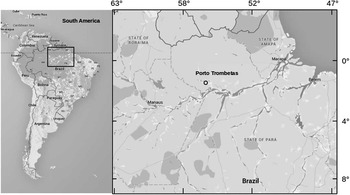
The samples analyzed in this work are from Porto Trombetas, a district of Oriximiná, Pará, Brazil (see Figure 1), located about 850 km from Belém (capital of the Pará State) and 400 km from Manaus (capital of the Amazonas State). The district, which was founded in 1974, is located along the Trombetas River, and the population is about 10,000 as estimated by local industries. Porto Trombetas is a relatively well-developed district, served by a commercial airport, with an economy heavily based on mining bauxite, which is the main raw material of the aluminum industry.
Location of the Porto Trombetas district in Oriximiná, Pará, Brazil. Trunk disks of Dipteryx magnifica, Enterolobium maximum, and Hymenolobium petraeum were collected. Map adapted from GoogleMaps.

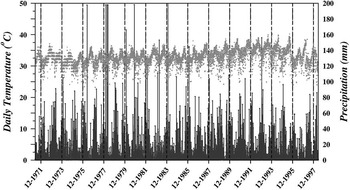
The local climate is humid equatorial characterized by convergence of trade winds. More than 80% of the precipitation over the equatorial Amazon is produced by atmospheric convection (Greco et al. Reference Greco, Swap, Garstang, Ulanski, Shipham, Harriss, Talbot, Andreae and Artaxo1990). The frequency of convection increases in the austral spring and reaches its maximum during the austral fall (Fu et al. Reference Fu, Zhu and Dickinson1999). In Figure 2 we show daily maximum temperature and precipitation in Porto Trombetas, as recorded by a local industry (Mineração Rio do Norte). A rainy period occurs in summer (December to March) with daily and annual precipitation of about 100 mm and 2500 mm, respectively. Annual temperature is about 32°C, oscillating between 26°C and almost 36°C over the entire year (see Figure 2). Both parameters exhibit annual periodicity over the period 1971–1997.
Daily maximum temperature (upper band of points) and precipitation (lower points) between 1971 and 1997 in the region around the sampling site. Units for temperature are in ºC (left scale) and for precipitation in mm (right scale). Data obtained from a local industry (Mineração Rio do Norte).

Sample Collection and Anatomical Analysis
Trunk cross-sections of each species (D. magnifica, E. maximum, and H. petraeum) were obtained, with a chainsaw, from single individuals cut down in April 2008. Approximate GPS coordinates of the collection sites are: 1°27′59′′S, 56°22′45′′W for D. magnifica and H. petraeum and 1°45′24′′S, 56°30′16′′W for E. maximum. Those species belong to the Leguminosae family and occur in northern Brazil (Lima and Lima Reference de Lima and Lima2015; Morim 2015). A complete disk of E. maximum was collected, while partial sections (radius) of D. magnifica and H. petraeum were collected because of the transport difficulties related to the size of the samples.
The samples were polished for microscopic observation and growth-ring boundary detection through an Olympus SZ11 stereomicroscope. The images were taken by a photographic camera (Olympus C5050) attached to the same stereomicroscope.
Dating Assignment of Tree Rings
According to Worbes (Reference Worbes1995), dry seasons with a length of 2–3 months are enough to induce distinct tree rings in tropical species. Such dry seasons (May–July) have been observed over the period 1971–1997 (see Figure 2). In this way, dating assignment of the rings was done from the last growth ring produced inward. Rings were dated using Schulman’s convention (Schulman Reference Schulman1956) where calendar dates are assigned to the year in which ring formation begins (earlywood). In the SH the growing season begins in the spring (September) and finishes in the next year. So, the 1970 ring started growth in the spring of 1970 and finished in 1971. As the trees were felled in April 2008, the last ring is referred to the year 2007. All species have growth-ring boundaries delimited by a fibrous zone (Fedalto et al. Reference Fedalto, Mendes and Coradin1989; Mainieri and Chimelo Reference Mainieri and Chimelo1989; Ferreira and Hopkins Reference Ferreira and Hopkins2004). For D. magnifica we analyzed only two radii due to difficulties in identification of the ring boundaries. For E. maximum and H. petraeum we analyzed the tree-ring patterns along four radii. During visual inspection, locally absent and/or false rings were identified and excluded. For D. magnifica 195 tree rings were counted, for E. maximum 126 rings, and for H. petraeum 119 rings.
14C Measurements
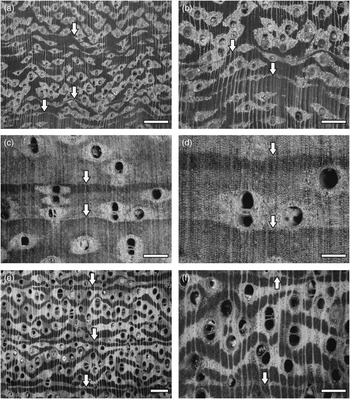
Individual tree rings of each species were selected in order to cover the overall shape of the atmospheric 14C bomb peak. We selected 11 (D. magnifica), 15 (E. maximum), and 8 (H. petraeum) single tree rings (Figure 3). These samples were collected along a radial transect and selected in order to cover the overall shape of the 14C atmospheric bomb peak. Micro-ring widths (less than 1 mm) were avoided. Only in the case of E. maximum was it possible to perform sampling along a second radial transect (4 tree rings) perpendicular to the first one, since this species provides the clearest visual identification of the rings. This was done to double-check our 14C results.
Tranverse sections (stereomicroscopy) of Dipteryx magnifica (a and b), Enterolobium maximum (c and d), and Hymenolobium petraeum (e and f). Arrows indicate growth-ring boundaries. Scale bars a, c, d=1 mm; b, d, f=0.5 mm.

Conversion of samples to graphite and measurements of their 14C contents were carried out at the Radiocarbon Laboratory of Universidade Federal Fluminense, Brazil. The holocellulose fraction was extracted from subsamples of 5–10 mg of each growth ring, following an established procedure (Southon and Magana Reference Southon and Magana2010). After bleaching, the holocellulose extract was rinsed with ultra-pure water 3 times and then dried at ~60°C for 24 hr. A 14C-free wood sample and two secondary standards (IAEA-C3 cellulose and IAEA-C5 Two Creeks standards with consensus values of 129.41±0.06 and 23.05±0.02 pMC, respectively) were added to those batches and treated in exactly the same way. After combustion, the CO2 evolved was cryogenically purified under a vacuum at lower than 1.0 mTorr. Graphitization was performed following the modified Zn and TiH2 reduction method, described in Xu et al. (Reference Xu, Trumbore, Zheng, Southon, McDuffee, Luttgen and Liu2007) and Macario et al. (Reference Macario, Oliveira, Carvalho, Santos, Xu, Chanca, Alves, Jou, Oliveira, Pereira, Moreira, Muniz, Linares, Gomes, dos Anjos, Castro, dos Anjos, Marques and Rodrigues2015). Graphites were kept in the sealed reaction tubes until being pressed into the target holders.
Graphites were measured in the single-stage accelerator mass spectrometry (SSAMS) system. During the measurements, special attention was given to the 12C+ beam current since beam emittance in the accelerator may introduce erratic fractionation corrections during the acquisition. Further details are given in Linares et al. (Reference Linares, Macario, Santos, Carvalho, Santos, Gomes, Castro, Oliveira and Alves2015). Machine background was about 0.002 Fm14C while processed blanks were about 0.008 Fm14C, both measured in the same batch of the unknown samples. Standard deviation of all accompanied blanks is 0.003 Fm14C.
RESULTS AND DISCUSSION
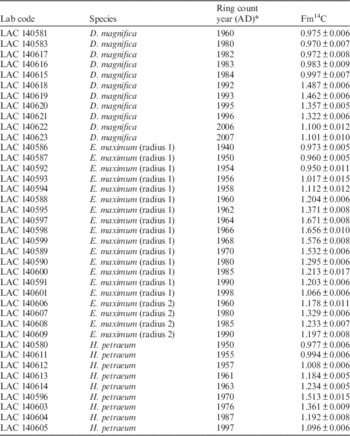
Table 1 presents the 14C results (AMS-δ13C corrected and background subtracted) for all samples analyzed in this work. Overall precision was 0.8% due to some cathodes that delivered high 12C– beam currents at the exit of the ion source. The high beam currents (>40 μA) produce erratic AMS-δ13C values due to machine fractionation at the acceleration tube (Linares et al. Reference Linares, Macario, Santos, Carvalho, Santos, Gomes, Castro, Oliveira and Alves2015). We measured the 14C content along two different radii only for E. maximum (designated radii 1 and 2) to double-check our results. In the second radius, single tree rings from 1960, 1980, 1985, and 1990 were selected. We had also selected a single tree ring corresponding to 1970, but unfortunately this sample delivered poor beam current during machine measurements. Results for radii 1 and 2 show good agreement within 2σ errors except for the year 1980, possibly due to contamination from the previous tree ring during the sampling procedure or cross-contamination during chemical pretreatment.
14C results for D. magnifica, E. maximum, and H. petraeum. Trees were collected from Porto Trombetas, Pará, Brazil. GPS coordinates of the collecting site are 1°27′59′′S, 56°22′45′′W for D. magnifica and H. petraeum and 1°45′24′′S, 56°30′16′′W for E. maximum.

* Dates assigned according to visual analysis of anatomy of the trunk.
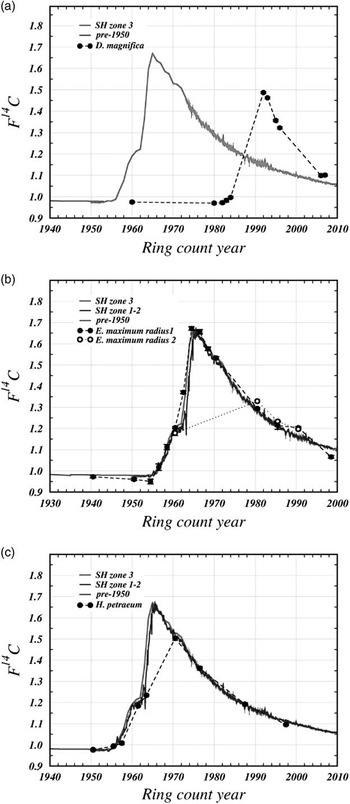
The atmospheric 14C database for the post-bomb period shows 5 distinct 14C levels with 3 zones in the Northern Hemisphere. In the SH, there might be 3 distinguishable 14C zones as well but the characteristic air-mixed atmosphere in the tropics diffuses the 14C measurement. Therefore, only 2 zones for the SH are considered according to Hua et al. (Reference Hua, Barbetti and Rakowski2013). Figure 4 depicts our dataset compared with the 14C calibration curve for the Southern Hemisphere, zone 1–2 (SH zone 1–2) and zone 3 (SH zone 3) since the sampling site lies in this zone (Hua et al. Reference Hua, Barbetti and Rakowski2013).
14C results of D. magnifica (a), E. maximum (b), and H. petraeum (c) compared with SHCal zone 1–2 14C calibration curve. Black dashed and dotted lines are visual guides only. The pre-1950 curve represents 14C results for 1920–1948 from tree rings of New Zealand and South Africa (McCormac et al. Reference McCormac, Hogg, Higham, Lynch-Stieglitz, Broecker, Baillie, Palmer, Xiong, Pilcher, Brown and Hoper1998, 2002; Hogg et al. Reference Hogg, McCormac, Higham, Reimer, Baillie and Palmer2002, Reference Hogg, Hua, Blackwell, Niu, Buck, Guilderson, Heaton, Palmer, Reimer, Reimer, Turney and Zimmerman2013).

Results for D. magnifica
14C results for tree rings of D. magnifica do not fit in the SH zone 3 due to many absent rings throughout the trunk disk, and poorly delimited or undetectable growth ring boundaries that contribute dating error. According to 14C dating, the tree ring initially assigned to the year 2007 is in fact representative of the year 2000. Therefore, there might be 7 absent rings in between. The 1992, 1993, 1995, and 1996 tree-ring set requires detailed interpretation. The 14C content measured in these rings can be either from the pre-bomb or post-bomb peak. Considering that rings were samples from the bark inward, so that the 1996 ring is outside the 1995 ring and so on, it is reasonable to consider them in the post-bomb peak region. Therefore, the tree ring initially assigned to the year 1996 provides a 14C content characteristic of a ring grown in 1978 based on the 14C atmospheric calibration curve, which means 11 absent rings in the period 1978–1996. The sequential tree rings (1982, 1983, and 1984) exhibit 14C values compatible with the pre-bomb peak. For instance, the 1984 ring has a 14C measurement that is equivalent to the SH 14C atmosphere in 1954–1955, which indicates a further 11–12 absent rings in between. This shows that a single offset correction for all 14C measurements will not improve the match to the 14C reference curve and reflects the difficulty in properly identifying the frequently indistinct parenchyma ring boundaries exhibited in this individual. On the other hand, we cannot rule out possible sample contamination in this subset during the AMS sample preparation and/or fossil fuel contamination since such a large number of absent rings is not usual. Moreover, 14C results indicate that this individual should be older than 195 yr, as estimated by counting age. Further analysis is required to elucidate the source of the deviation observed.
Results for E. maximum
The E. maximum tree shows the best match between 14C data and the SH zone 3 except for the youngest rings (1990 and 1998) and two single tree rings in 1962 (radius 1) and 1980 (radius 2). The observed deviations in recent years may be due to false (between 1998 and 2008) and absent (between 1986 and 1998) rings. One must also keep in mind anthropogenic effects triggered by the local aluminum industries based in the region, which can interfere with the 14C measurement of the single rings from 1970 (and mostly from 1980) onward. It is interesting to note that our dataset is compatible with the SH zone 3 and a little off the SH zone 1–2 reference record (see 1962–1964). The 14C records used in the SH zone 3 compilation for the period 1950–1972 are from tree rings of Muna Island, Indonesia (Hua et al. Reference Hua, Barbetti, Levchenko, D’Arrigo, Buckley and Smith2012). In South America, the boundary between SH zone 3 and SH zone 1–2 is not clear and demands reliable 14C data for this region. E. maximum seems to be a good candidate to improve the calibration database, but a complete dendrochronological study of this species is required.
Results for H. petraeum
Finally, results for tree rings from 1976 and 1987 of H. petraeum are in accordance with the decline of the 14C bomb pulse curve but the single ring from 1997 is depleted relative to the calibration curve. This can be either an effect of false rings present in the wood or an anthropogenic effect as proposed for the E. maximum. The best agreement between 14C data and the 14C SH calibration curve is achieved with the SH zone 1–2 data, although we cannot rule out a possible missing ring in the period 1964–1976, which would adjust the data to the SH zone 3 curve. Further analysis is required to check this possibility.
CONCLUSIONS
In this work we exploit the atmospheric 14C bomb peak to assess the periodicity of tree-ring formation identified in the visual inspection of the stem cross-sections from single individuals of three tropical species from the Amazon rain forest (Porto Trombetas, Pará, Brazil): D. magnifica, E. maximum, and H. petraeum. Samples were collected from trees cut down in April 2008. Based only on the tree-ring counting we measured the 14C contents of selected individual tree rings and compared with SH zone 3 calibration data.
Nowadays it is well established that some tropical species exhibit seasonal tree rings, many of which are triggered by seasonality in the precipitation distribution. However, D. magnifica exhibits some indistinct ring boundaries at the latewood, which complicate the task of tree-ring counting. Not surprisingly, the 14C results from single tree rings of this species show a complete mismatch with the 14C atmospheric calibration curve. According to our results, many rings are absent and there was no evidence for them during reexamination afterwards. E. maximum and H. petraeum, on the other hand, exhibit an overall good agreement with the 14C atmospheric calibration curve. In particular, the E. maximum rings in the period 1950–1980 are in good agreement with the SH zone 3, as in principle the sampling site is within this zone. This species provides the best anatomical features that allow for reliable identification of the growth rings and is a good candidate for further studies in dendroclimatology in the Amazonian region. Development of techniques for identifying tree-ring boundaries will help in investigations of tropical tree rings.
Acknowledgments
The authors would like to thank the Brazilian funding agencies CNPq (Conselho Nacional de Desenvolvimento Científico e Tecnológico) and FAPERJ (Fundação de Amparo à Pesquisa do Estado do Rio de Janeiro).