Introduction
A number of lichenological papers, dealing with taxonomy or biodiversity, have included lichen species inhabiting seashore habitats but only some of these have dealt with particular taxonomic groups occurring specifically on coastal cliffs, e.g. Ramalina in Sheard (Reference Sheard1978), Roccella in Tehler et al. (Reference Tehler, Dahlkild, Eldenas and Feige2004), Verrucaria in for example Brodo & Santesson (Reference Brodo and Santesson1997), Harada (Reference Harada2004) or McCarthy (Reference McCarthy1991), and Xanthoria in Lindblom & Ekman (Reference Lindblom and Ekman2005). Marine and maritime lichens are well-known in some regions, for instance in the British Isles, where some ecological and generalized studies have been made (e.g. Fletcher Reference Fletcher1973a,Reference Fletcherb, Reference Fletcher1975a,Reference Fletcherb). The genus Caloplaca has been intensively investigated on North American shores (Arup Reference Arup1992a,Reference Arupb, Reference Arup1993a,Reference Arupb, Reference Arup1994, Reference Arup1995a,Reference Arupb, Reference Arup1997b) and in Europe (e.g. Tavares Reference Tavares1956; Laundon Reference Laundon1992; Roux & Navarro-Rosinés Reference Roux and Navarro-Rosinés1992; Navarro-Rosinés & Roux Reference Navarro-Rosinés and Roux1993, Reference Navarro-Rosinés and Roux1995; Arup Reference Arup1997a). In the East Mediterranean and the Black Sea region, some papers, mainly contributions on lichen biodiversity, partially cover maritime species, including Caloplaca (e.g. Szatala Reference Szatala1943a, Reference Szatalab; Vězda Reference Vězda1975; Roux & Navarro-Rosinés Reference Roux and Navarro-Rosinés1992; Güvenc & Öztürk Reference Güvenc and Öztürk1999; Sipman & Raus Reference Sipman and Raus1999, Reference Sipman and Raus2002; Yazici Reference Yazici1999; Khodosovtsev Reference Khodosovtsev2001, Reference Khodosovtsev2002, Reference Khodosovtsev2003; Redchenko Reference Redchenko2002; Khodosovtsev et al. Reference Khodosovtsev, Kondratyuk and Kärnefelt2003, Reference Khodosovtsev, Vondrák and Šoun2007; John & Breuss Reference John and Breuss2004; Sipman et al. Reference Sipman, Raus and Scharlau2005; Vondrák & Slavíková-Bayerová Reference Vondrák and Slavíková-Bayerová2006; Vondrák et al. Reference Vondrák, Guttová and Mayrhofer2008a;), but otherwise knowledge of maritime species of this area remains sparse.
While working in the Black Sea region, one of us (JV) found that current W European literature for the identification of lichens (species in the genera Caloplaca, Candelariella, Catillaria, Lecania and Toninia) was inadequate. This was particularly true for the genus Caloplaca, which appeared to be extremely species-rich in the area. Currently, we estimate that more than 50 species occur in coastal habitats around the Black Sea. This huge, but largely unknown diversity, led us to initiate a complex project on the biodiversity of the genus Caloplaca in the Black Sea region and the present study focuses on the taxonomy of the Caloplaca citrina group in the area. Arup (Reference Arup2006a) has already clarified the taxonomy of this group in Scandinavia and his results are utilized and developed further here. This group seems to be rather species rich and according to phylogenetic studies it is closely related to the C. saxicola group, various clades of Xanthoria species and the C. holocarpa group (Arup & Grube Reference Arup and Grube1999; Gaya et al. Reference Gaya, Navarro-Rosinis, Llimona, Hladun and Lutzoni2008).This paper describes the species diversity in the C. citrina group.
The taxonomy proposed in this study is based on molecular data using the single locus, ITS nrDNA. This locus is usually well suited for taxonomic studies at the species level, and a number of published papers using only this region has given meaningful results in the genus Caloplaca (Tretiach et al. Reference Tretiach, Pinna and Grube2003; Arup Reference Arup2006a, Reference Arup2009; Arup et al. Reference Arup, Arneng and Søchting2007; Søchting & Figueras Reference Søchting and Figueras2007; Muggia et al. Reference Muggia, Grube and Tretiach2008; Vondrák et al. Reference Vondrák, Khodosovtsev and Říha2008b,Reference Vondrák, Šoun, Hrouzek, Říha, Kubásek, Palice and Søchtingc). The only study in Teloschistaceae so far using a multi-locus approach is one dealing with taxonomy at higher than species level (Søchting & Lutzoni Reference Søchting and Lutzoni2003). Our investigations have some general implications exceeding the framework of a regional taxonomic study since the molecular results have revealed several distinct groups, which are often morphologically hardly distinguishable. This phenomenon, termed semi-cryptic speciation, is discussed at the end of the paper.
Material and Methods
Material from the Atlantic coast of Europe used for comparison (mainly of Caloplaca britannica, C. littorea, C. marina, C. maritima, and C. microthallina) was obtained on loan from BM, CBFS, LD, and hb. A. Aptroot (ABL). Material from Central Europe, the Black Sea region and the Mediterranean was obtained on loan from B, BP, CBFS, GZU, KHER, PRM, SAV and W. The main part of the material from the Black Sea region was collected by the first author during field excursions in July 2004 (Bulgaria), July and November 2005 (Romania, Bulgaria, European part of Turkey), June 2006 (Ukraine: Crimea), and April, May 2007 (Romania, Bulgaria, Turkey, Georgia, Russia, Ukraine). Vouchers are deposited in CBFS (the numbers following this abbreviation are herbarium accession numbers).
Citations of specimens examined are abbreviated and for common species only selected specimens are presented. Data on additional samples and full sample information are available on the web page: http://botanika.bf.jcu.cz/lichenology/data.php.
Morphology and anatomy
A total of 20 characters was measured and used in the detailed characterization of the Caloplaca citrina group, but only 11 traits were important for species separation: width of areoles, thickness of thallus and cortex/alveolate cortex, size of vegetative diaspores, size of apothecia, exciple width, hymenium height, size of ascospores, width of spore septa, width of paraphyses tips and size of conidia.
Sections for morphological examination were cut by hand and observed in water, but paraphysis tips and cortical tissues were observed after pretreatment with KOH. Measurements were made to an accuracy of 0·5 μm for cells (e.g. ascospores, conidia and paraphyses), 1 μm for thickness of the cortex and 10 μm for larger structures (e.g. hymenium thickness and exciple width). All measurements of cells included their walls. Measurements are given as (min.–) x ± SD (–max.), where x = mean value and SD = standard deviation. The total numbers of measurements (n) are given in parentheses. At least five measurements were taken from all specimens available; in the morphologically indistinguishable species (Caloplaca confusa, C. nigromarina), only specimens confirmed by molecular data were used for measurements.
Morphological terminology follows Ryan et al. (Reference Ryan, Bungartz, Nash, Nash, Ryan, Gries and Bungartz2002) and Bungartz (Reference Bungartz, Nash, Ryan, Gries and Bungartz2002). The term ‘alveolate cortex’ is proposed here for a hyaline tissue formed by living fungal cells among dead algal cells or in gaps left by dead algal cells. It is similar to a phenocortex (sensu Ryan et al. Reference Ryan, Bungartz, Nash, Nash, Ryan, Gries and Bungartz2002: 23), but differs in fungal cells, which are living, and not dead as in a phenocortex. Being situated between algal and epinecral layers, it replaces a true cortex in some species.
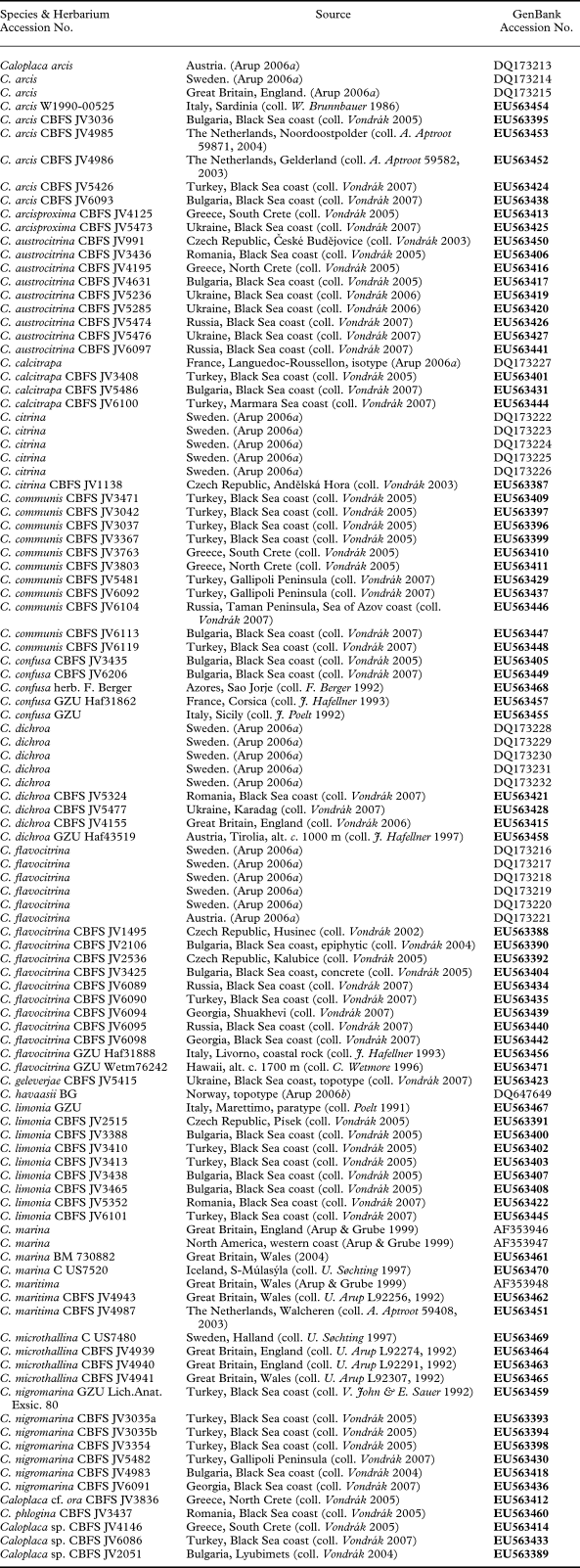
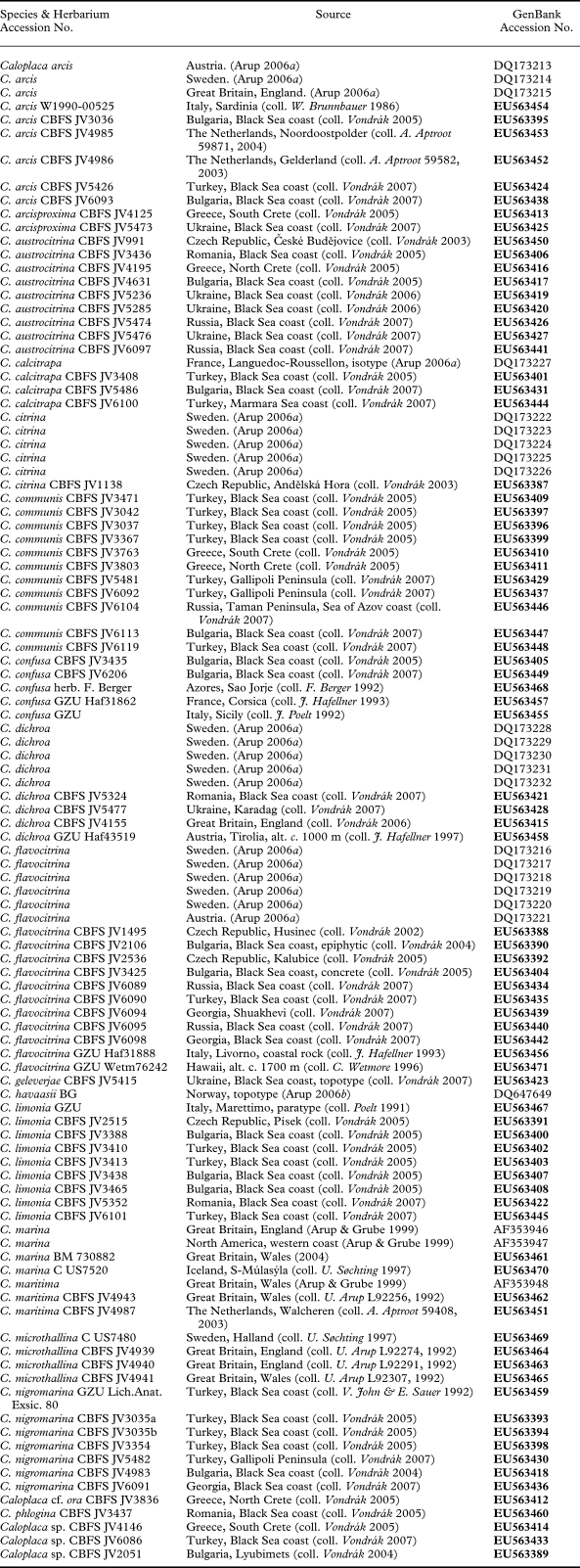
Voucher specimens and GenBank accession numbers of the ITS sequences used in the phylogenetic analysis. Accession numbers in bold represent new sequences produced during this study
DNA extraction and amplification
Direct PCR was used for DNA extraction and PCR-amplification of the nuclear ITS regions including the 5.8S region of the nuclear ribosomal DNA gene (abbreviated as ITS) following Arup (Reference Arup2006a). Primers for amplification were ITS1F (Gardes & Bruns Reference Gardes and Bruns1993) and ITS4 (White et al. Reference White, Bruns, Lee, Taylor, Innis, Gelfand, Sninsky and White1990). PCR cycling parameters followed Ekman (Reference Ekman2001).
Phylogenetic analyses
The ITS sequences used in the phylogenetic analysis are listed in Table 1. Caloplaca holocarpa was used as the outgroup. The alignment was conducted using MAFFT 6 (on-line version in the Q-INS-i mode; see Katoh et al. Reference Katoh, Kuma, Toh and Miyata2002) and manually trimmed in BioEdit 7.0 (Hall Reference Hall1999) to eliminate the unalignable ends.
Bayesian phylogenetic analysis was carried out with a Metropolis-coupled Markov chain Monte Carlo (MCMCMC) algorithm (Altekar et al. Reference Altekar, Dwarkadas, Huelsenbeck and Ronquist2004) implemented in MrBayes 3.0 (Ronquist and Huelsenbeck Reference Ronquist and Huelsenbeck2003). Prior to the analysis, Mr Modeltest 2.2 (Nylander et al. Reference Nylander, Ronquist, Huelsenbeck and Nieves-Aldrey2004) was employed to assign the best-fit likelihood settings according to the hLRT (likelihood ratio test). The general time reversible model with some invariable sites (GTR+I+Γ) was determined as the best-fitting. A flat Dirichlet prior distribution with all values set to 1·0 was used to model the prior probability densities of the substitution rates as well as the stationary nucleotide frequencies. In order to assess the stability of the MCMC process, we monitored the standard deviation of split frequencies of two simultaneous independent runs, each including six parallel chains (one ‘cold’ and five incrementally heated by a temperature of 0·3). Every 100th count of the total of 5 000 000 generations for each run was sampled and the first quarter of samples was discarded as burn-in. The resulting 75 000 trees were used for reconstruction of a 50% majority-rule consensus tree.
The heuristic parsimony search was conducted in PAUP 4.0b10 (Swofford Reference Swofford2002), assessing the credibility of branches via non-parametric bootstrapping. In order to reduce the computational demands, a two-level analysis was chosen: the treespace was examined during the first run using the nChuck=3 chuckScore=1 option for 100 replicates of the random sequence addition. The second search was performed on the stored trees and filled up the treespace thanks to the option nChuck=0 chuckScore=0. The maximum number of trees in memory was restricted to 250 000 using the maxTrees option. Bootstrap analysis encompassed 1000 resamplings and proceeded similar to the heuristic parsimony search with the exception of nChuck setting (=10) and number of RAS (=10) during the first run of analysis. The TBR algorithm was employed, all characters were equally weighted and the gaps were treated as missing data. The steepest descent option was not in effect and the analysis ran under the mulTrees option.
Chemistry
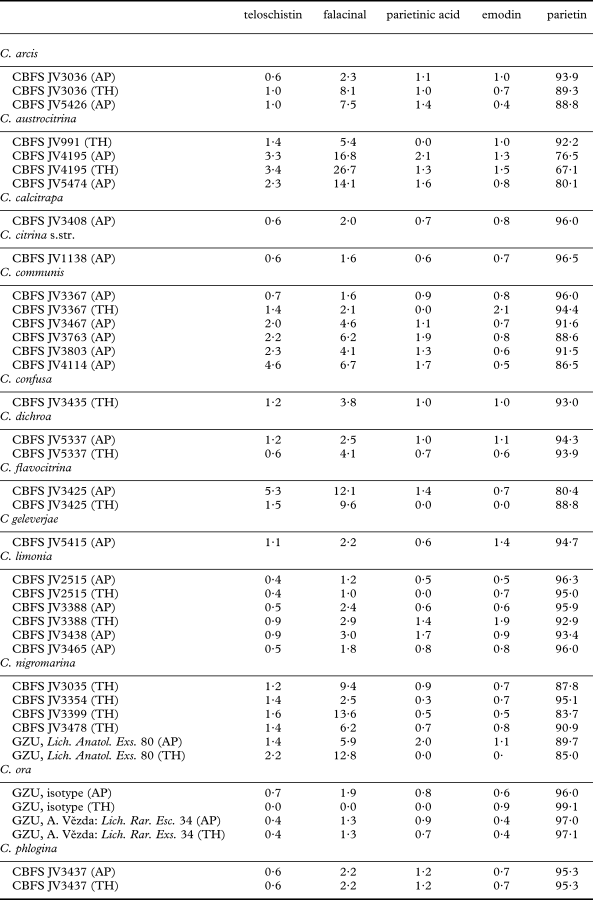
The acetone extracts of anthraquinones were subjected to high-performance liquid chromatography (HPLC) analysis. Reverse phase column (C18, 5μm, Lichrocart 250-4) was eluted with MeOH / 30%MeOH + 1%H3PO4 for 77 min and the absorbances at 270 nm were recorded (for details see Søchting Reference Søchting1997). The compounds were determined on the basis of their retention times and absorption spectra; samples examined are listed in Table 2.
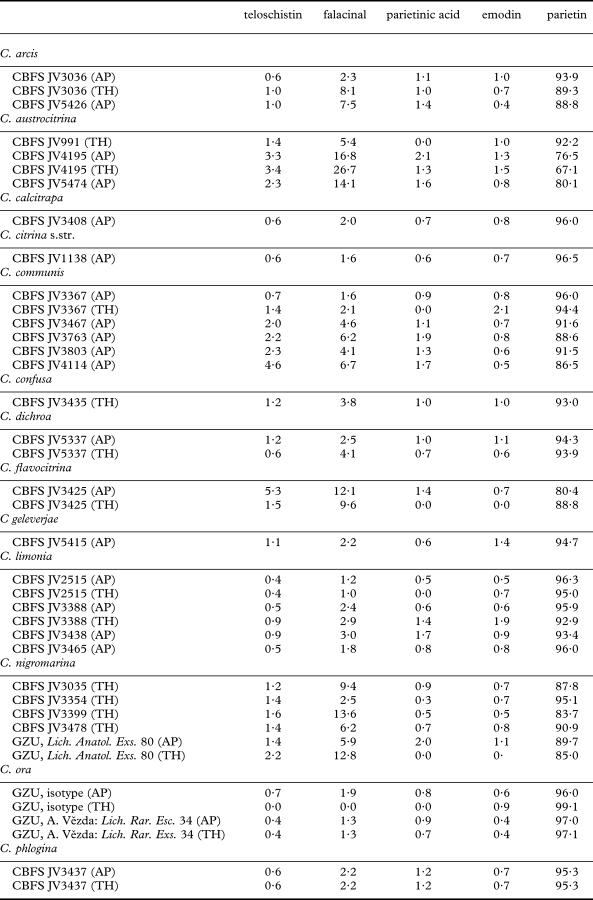
Anthraquinone contents (% concentrations) of selected species in the Caloplaca citrina clade
Results and Discussion
Phylogeny
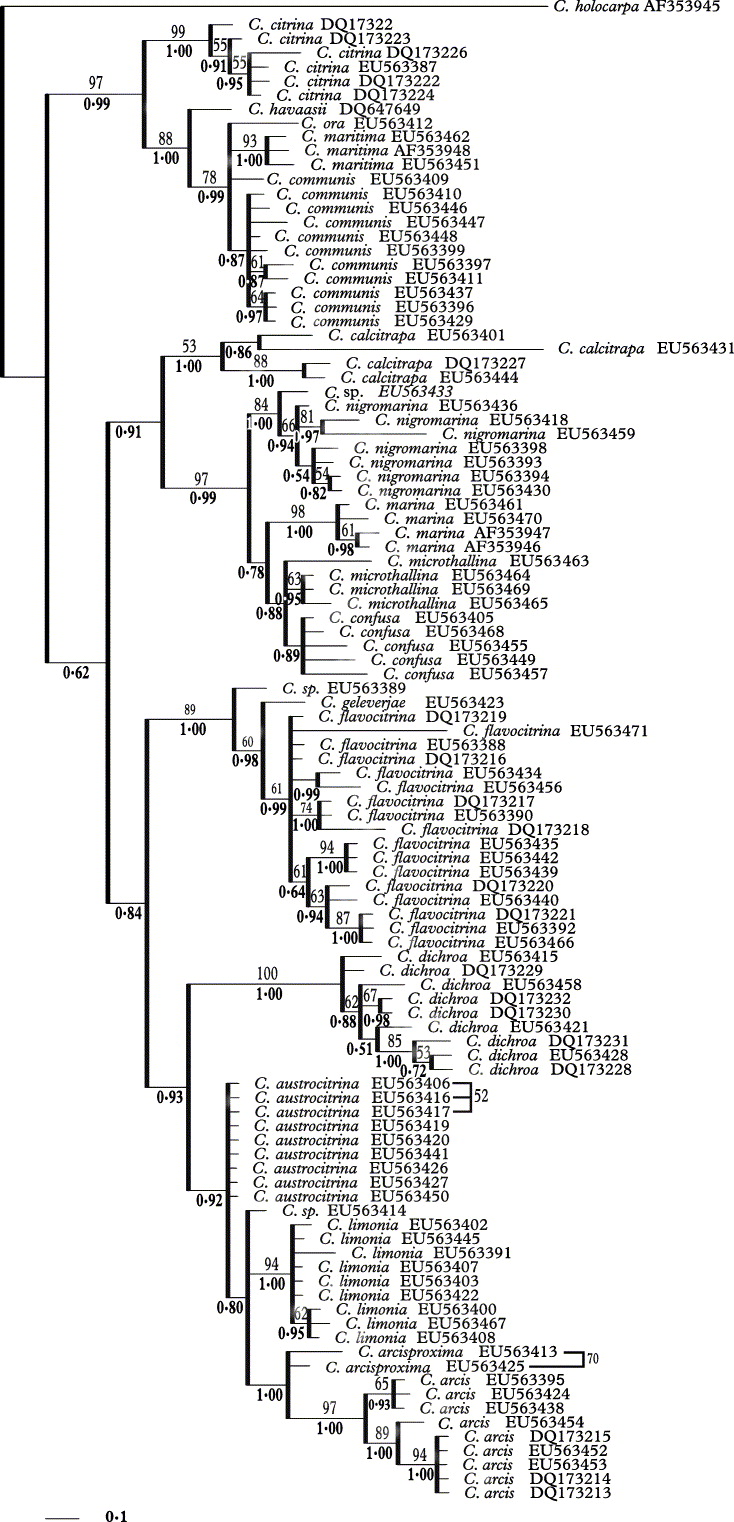
We confined the ‘Caloplaca citrina clade’ to a group of morphologically variable species, to which we found C. holocarpa as closest outgroup (Fig. 1). According to Gaya et al. (Reference Gaya, Navarro-Rosinis, Llimona, Hladun and Lutzoni2008), Caloplaca granulosa is a closer relative to the ‘Caloplaca citrina clade’, but it is probably too close to the ingroup or may even belong within it. In fact, our circumscription of the ‘Caloplaca citrina clade’ was made arbitrarily to cover the majority of taxa with the ‘Caloplaca citrina morphology’ (see Morphology below) in the Black Sea region.
The resulting dataset contained 105 terminals assigned to 20 species, of which 17 are named here. The alignment had 674 positions, of which 233 were variable and 112 were parsimony informative. The first run of parsimony analysis yielded 67 islands of equally parsimonious trees with the length of 417 steps (due to the nchuck setting, each island contains 3 trees and may in fact represent a fraction of a larger island). The consistency index (CI) of the trees was 0·695 and the retention index (RI) 0·640. The bootstrap tree showed 40 supported internodes (BS > 50%). The phylogenetic tree, based on the Bayesian inference analysis is presented here (Fig. 1) along with the posterior probabilities (PP) for the nodes. Since the parsimony bootstrap search yielded a tree topologically congruent with Fig. 1, yet less resolved (there were 52 internodes supported by the Bayesian inference), we are adopting only bootstrap values (BS) from this analysis. Two groups, recognized by the parsimony bootstrapping, but collapsed in the Bayesian inference (clade with C. arcisproxima and a grouping of three C. austrocitrina sequences), are also depicted in Fig. 1, using additional brackets. Molecular data revealed eleven, partly semi-cryptic species present in the Black Sea region, of which five (Caloplaca arcisproxima, C. austrocitrina, C. communis, C. confusa, and C. nigromarina) are proposed here as species new to science. Three specimens were classified as Caloplaca sp. because they do not fit any recognized species, but they comprise insufficient material to merit the description of new species. It seems probable that more species of Caloplaca remain to be discovered in the Black Sea region.
Bayesian consensus phylogeny of the Caloplaca citrina group inferred from 105 nuclear ITS sequences. Node support values (in black) are Bayesian posterior probabilities and numbers in grey represent bootstrap values obtained after 1000-times resampled parsimony heuristics (bootstrap values under 50% are not shown). Groupings recovered by parsimony heuristics yet not by the Bayesian inference are depicted by lines to the right of the tree.
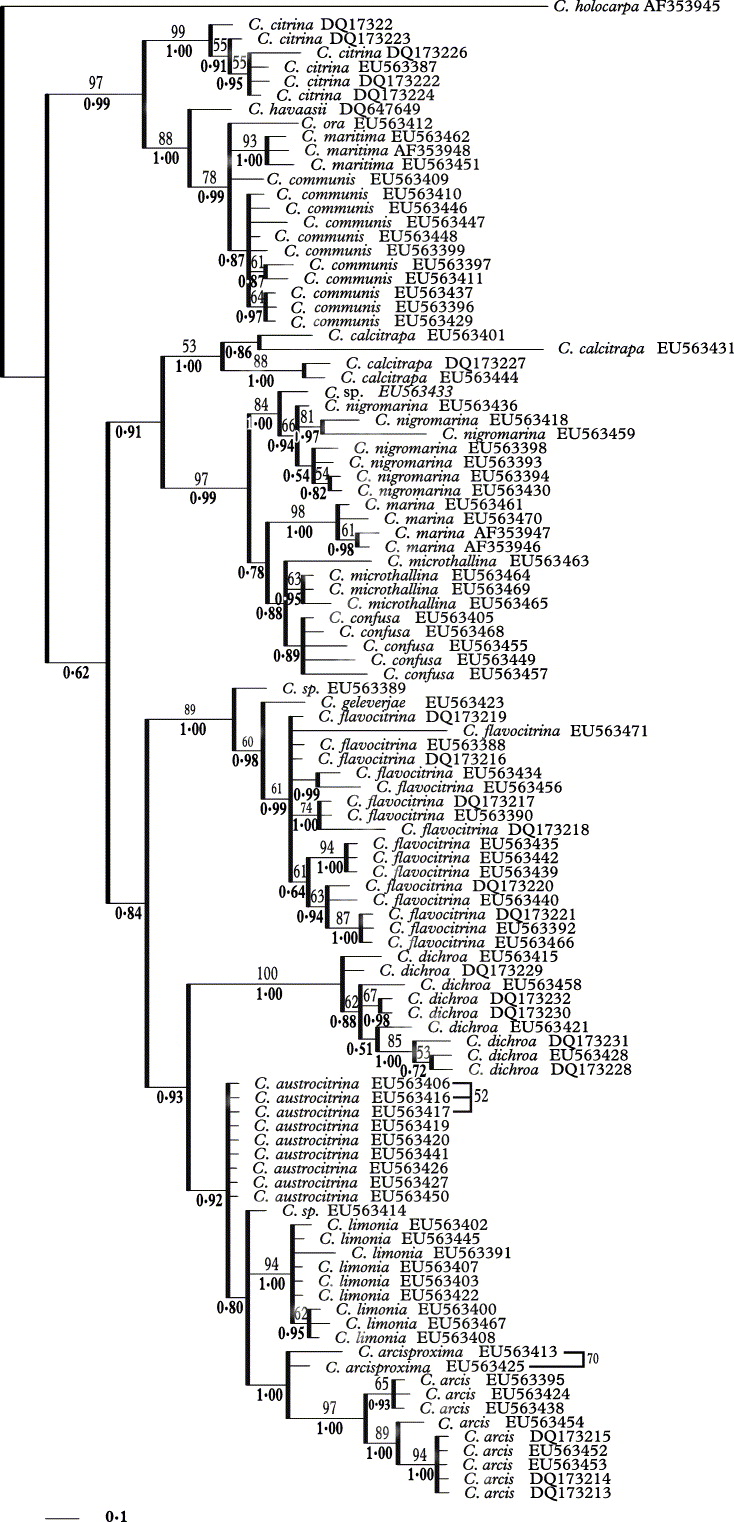
Above species level, the molecular analysis revealed four large, internally diverse groups in the ‘Caloplaca citrina clade’. The first and most basal comprises C. citrina, C. havaasii, C. ora p.p., C. maritima and C. communis (PP = 0·99 and BS = 97). The second group, formed by C. calcitrapa, C. nigromarina, C. marina, C. microthallina and C. confusa has a rather low support (PP = 0·91, BS = 37). The third group includes C. flavocitrina and C. geleverjae (PP = 1·00, BS = 89), while the fourth includes C. dichroa, C. austrocitrina, C. limonia, C. arcis and C. arcisproxima (PP = 0·93, BS = 30). The backbone of the tree is, however, not strongly supported, which is not surprising when using only the ITS sequences.
Morphology
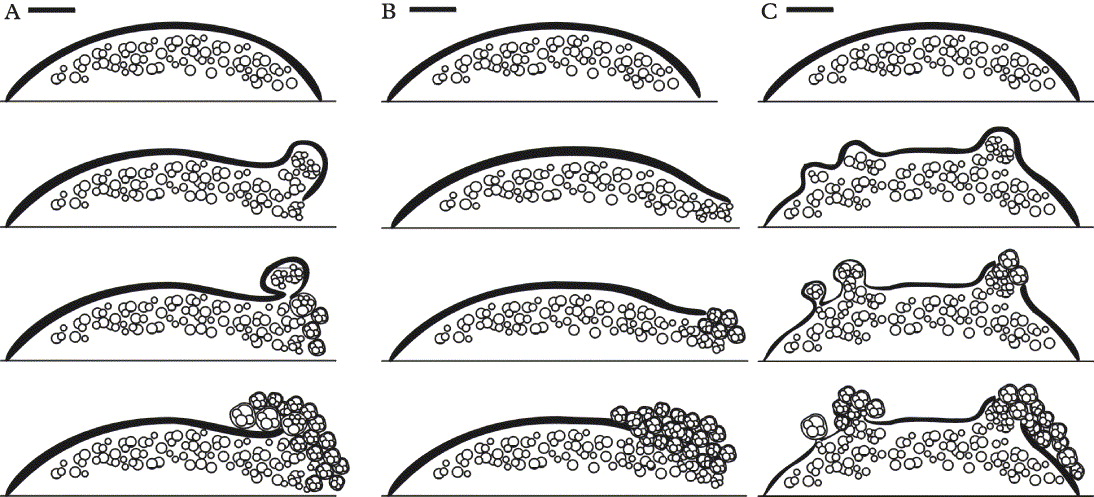
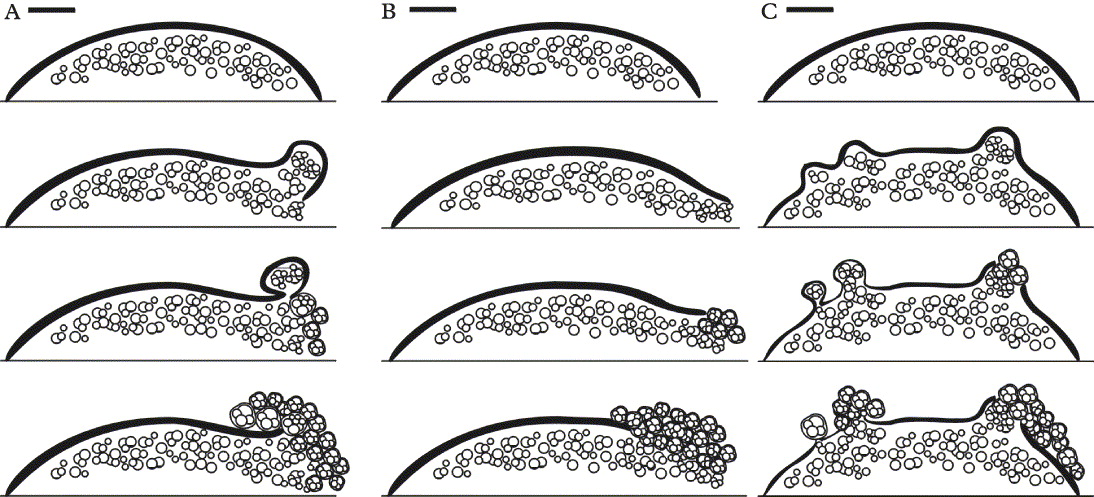
Thallus morphology of the Caloplaca citrina clade is very variable. It contains species with soredia (47% of the species examined), blastidia (12%), a granular thallus surface (12%), and a thallus without vegetative diaspores (29%). The size of soredia, blastidia or granules is a useful key character in some species (Fig. 4). The thallus is always autotrophic and lichenicolous species are probably absent from this group. It varies from yellow to orange (only exceptionally grey, in Caloplaca geleverjae) and may be continuous or formed of discrete granules, areoles or squamules, up to 550 μm thick and up to 2·7 mm diam. The true cortex is usually inconspicuous, formed of 1–2 layers of cells. The alveolate cortex (for details see Materials and Methods) is more distinctly developed, up to c. 50 μm thick, paraplectenchymatous and formed of thin-walled cells, (3·0–) 5·4 ± 1·1 (–10·0) μm diam. (n = 479). An epinecral layer is usually present, but thin, up to c. 20 μm thick. The algal layer fills most of the thallus interior and is made up of algal cells (5·0–) 11·4 ± 3·3 (–32·0) μm diam. (n = 537) as well as ± isodiametric fungal cells, (3·0–) 5·2 ± 1·2 (–9·0) μm diam. (n = 537). The medulla is mostly inconspicuous, formed of loose hyphal strands. In sorediate species, the development of the soralia differs markedly between species and provides important key characters. Three different types are described here (Fig. 2); the ‘confusa-type’, where blastidia are produced first at the margins of the areoles and ± labriform soralia develop after the blastidia have eroded or have been shed; the ‘flavocitrina-type’, where soredia are produced directly in well-delimited labriform or rarely laminal soralia; and the ‘limonia-type’, where blastidia first build up on the thallus surface, and true soralia are produced from cracked blastidia or after the blastidia have eroded. These three types of development are hardly recognizable when the thallus is too young or over mature and forming entire sorediate crusts. Soredia may be single, c. 20–60 μm diam., or grouped in consoredia.
Development of soralia in the Caloplaca citrina group. A, confusa-type; B, flavocitrina-type; C, limonia-type. Note that initial and late stages are almost identical in all types. Scales: A–C = 100 μm.
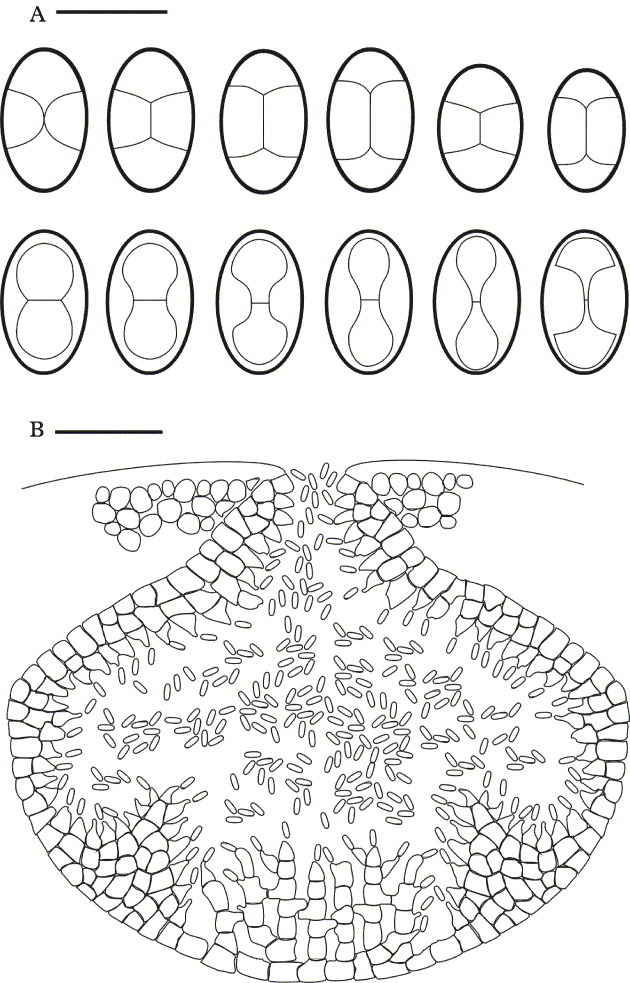
The apothecia are small, up to 1·6 mm diam., and sessile. Discs (slightly concave–) flat to slightly (or strongly) convex, ± uniformly orange. The apothecial margins c. 40–210 μm thick, ± persistent and paler than the discs, zeorine, formed of a ± prosoplectenchymatous true exciple and a thalline exciple, which may be indistinct and hidden below the true exciple in young apothecia, but raised and distinct in older ones. The hypothecium (including subhymenium) is (30–) 102 ± 31 (–230) μm thick (n = 103), formed of dense, intricate, translucent hyphae. The hymenium is c. 60–90 μm thick and the asci are of Teloschistes-type, cylindrical, (34–) 51 ± 6 (–72) × (7–) 11·5 ± 2 (–18) μm (n = 99). The ascospores are c. 9–17 × 4–8 μm large and belong to one of two types: the common, thin-walled ‘citrina-type’ or the rare, thick-walled ‘sand-clock’ type (Fig. 3). The ascospore septa are c. 3–7 μm wide. The paraphyses are simple, branched or anastomosed, c. 1–2·5 μm thick, with widened tips, up to 7 μm.
Caloplaca citrina group. A, C. calcitrapa ascospores, citrina type spores (top row) (CBFS JV5486), sand glass type spores (bottom row) (CBFS JV6112); B, C. communis, vertical section of a pycnidium (CBFS JV3369). Scales: A = 10 μm; B = 20 μm.
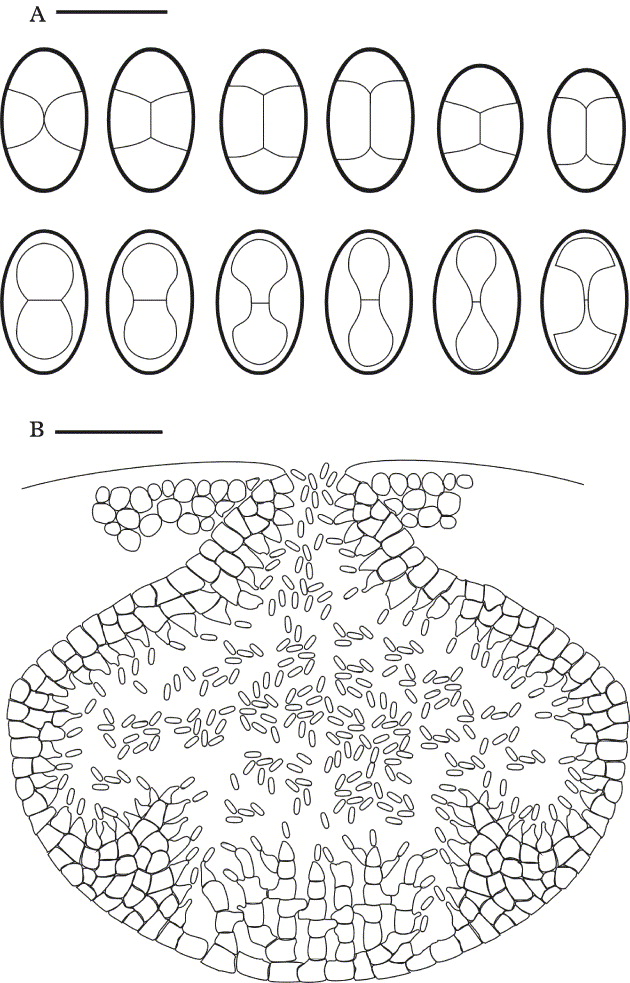
The pycnidia are inconspicuous, hardly recognizable as dots with a different tinge of yellow or orange, c. 80–130 μm diam. The conidiophores are variable in height, branched and anastomosed in parts (Fig. 3). The conidiogenous cells are variable in shape, but mostly obtuse triangular, c. 4–6 μm diam. The conidia are acro- or pleurogenous, ellipsoid to bacilliform, c. 2–4 × 1–1·5 μm.
Chemistry
All the species treated here contain anthraquinones of the chemosyndrome A (sensu Søchting Reference Søchting1997) with parietin as a dominant compound, and small amounts of emodin, fallacinal, parietinic acid and teloschistin. This chemosyndrome is the most common within Teloschistaceae. No significant differences were observed among the species treated (Table 2); some minor differences are of a quantitative nature only, such as greater amounts of fallacinal in Caloplaca arcis, C. austrocitrina, C. flavocitrina and C. nigromarina, than in the rest of species treated. The thallus cortex and the apothecia are K+ violet, C−, P−, UV± orange. In sections, the hymenium and the subhymenium are I+ blue, but the true exciple is I−. Exceptionally, in Caloplaca geleverjae, anthraquinones are absent from the K− thallus.
Phenotypic variability and the taxonomic value of the characters
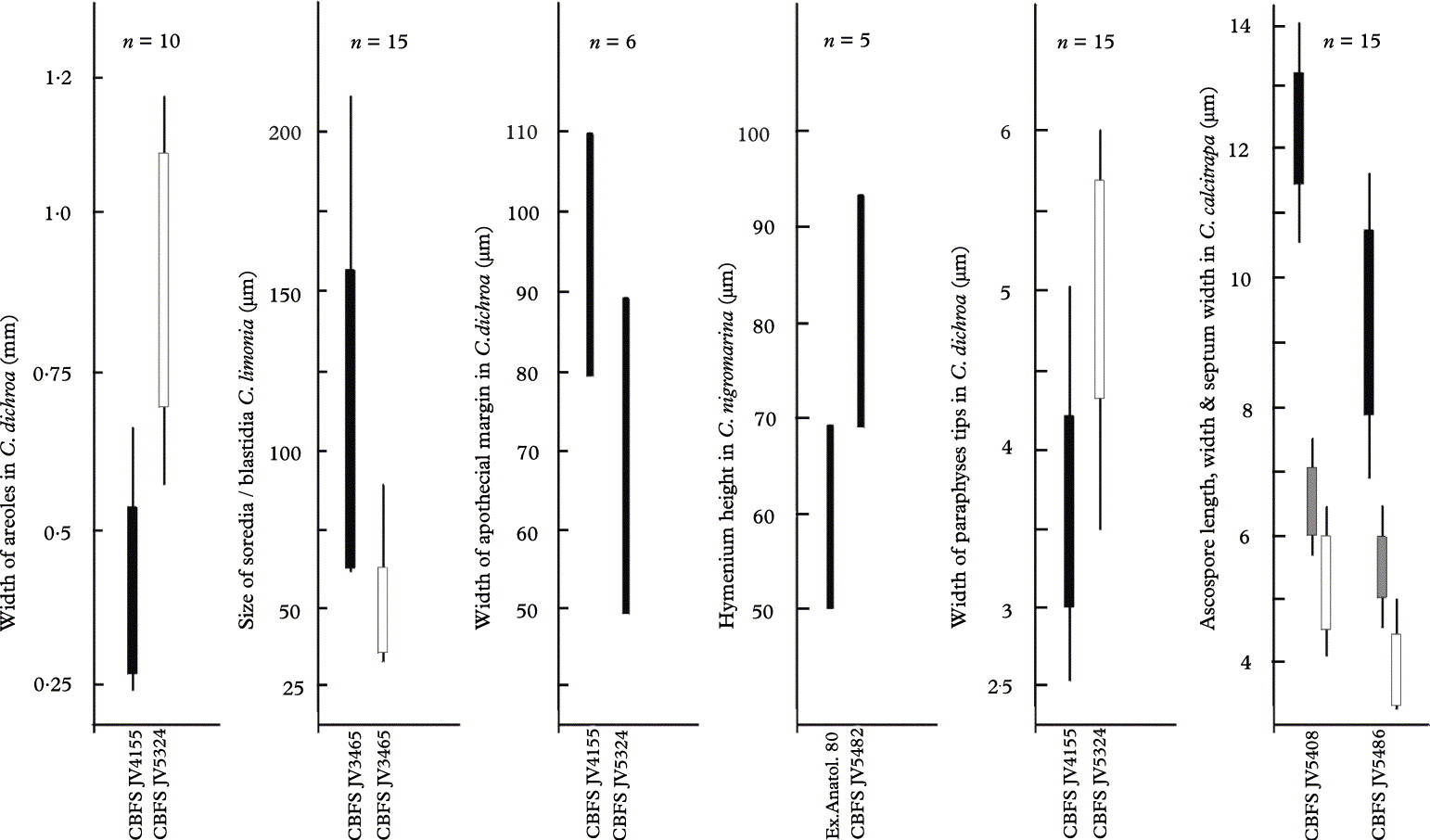
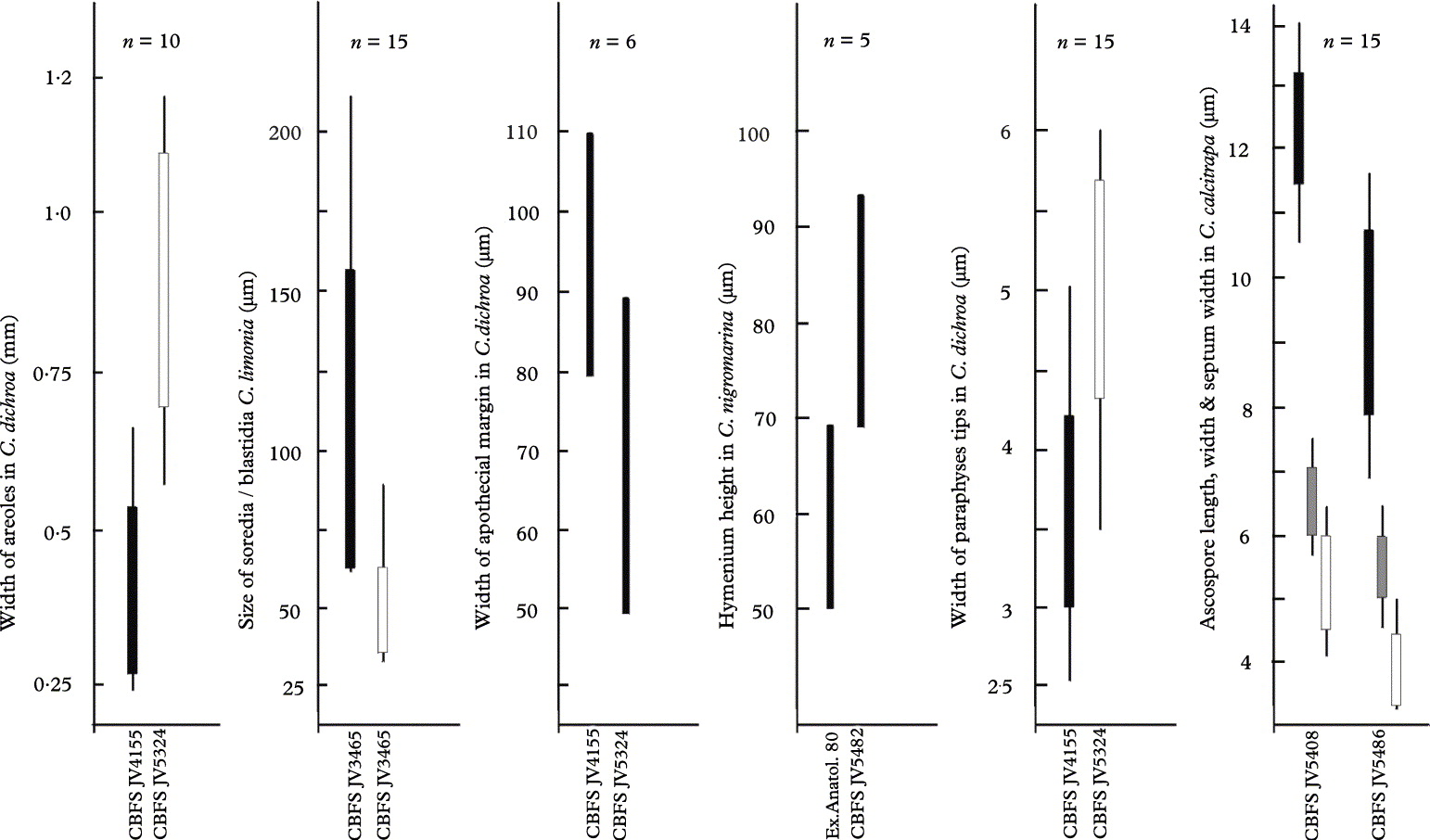
In most of the characters studied, pronounced phenotypic variability was observed. Some extreme examples of variability in width of the areoles, size of vegetative diaspores, width of the exciple, the hymenium thickness, width of paraphysis tips and ascospore characters are shown for particular species in Fig. 4. In these characters, there are no, or only small, overlaps in dimensions between different specimens of the same species making it difficult to find diagnostic morphological characters.
Intraspecific variability in selected characters in some Caloplaca species. Distributions of data are expressed as means ± SD (boxes) and extremes. Extremes depicted when n ≥ 10. Sample accession numbers and numbers of measurements are given at the bottom and top, respectively.
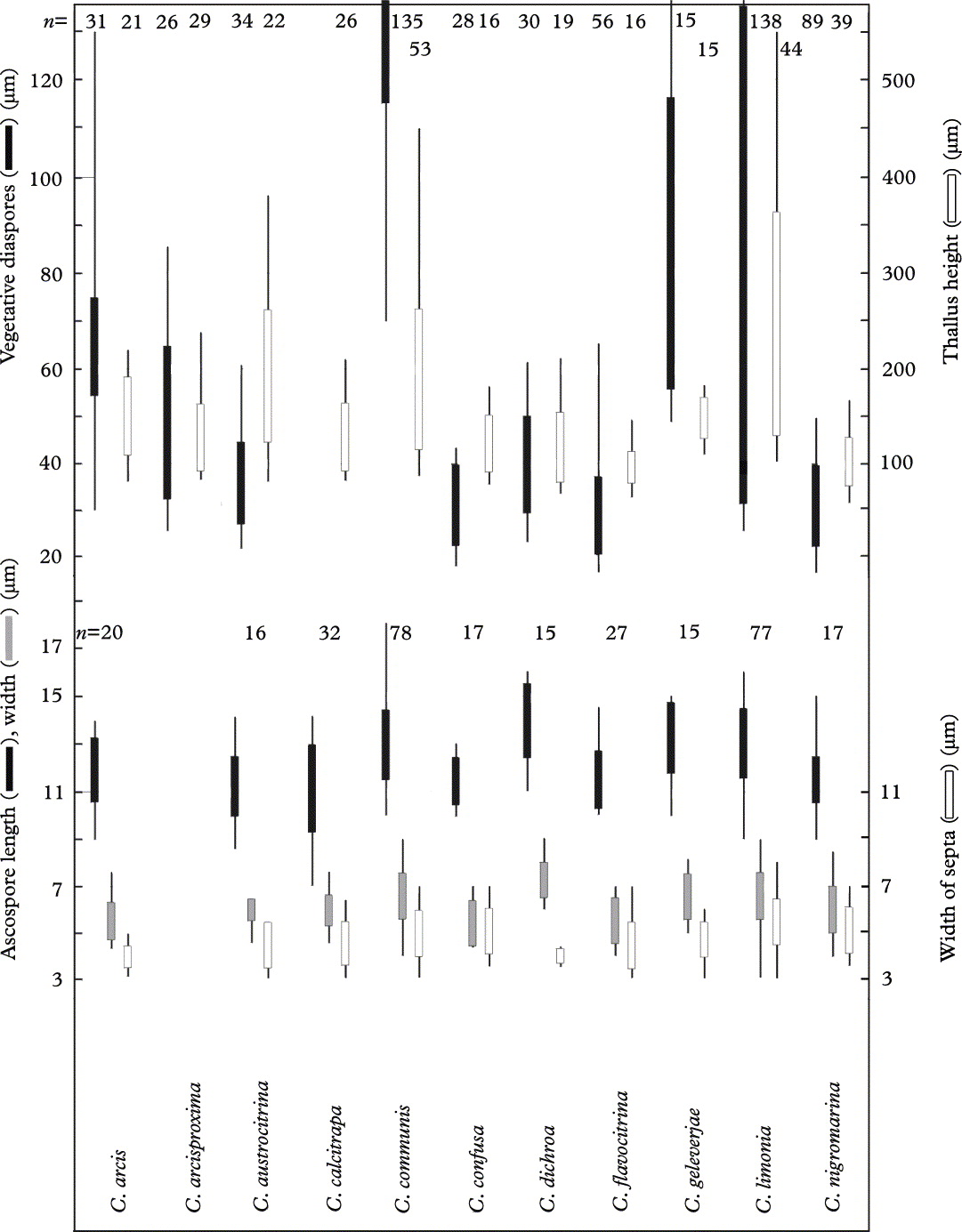
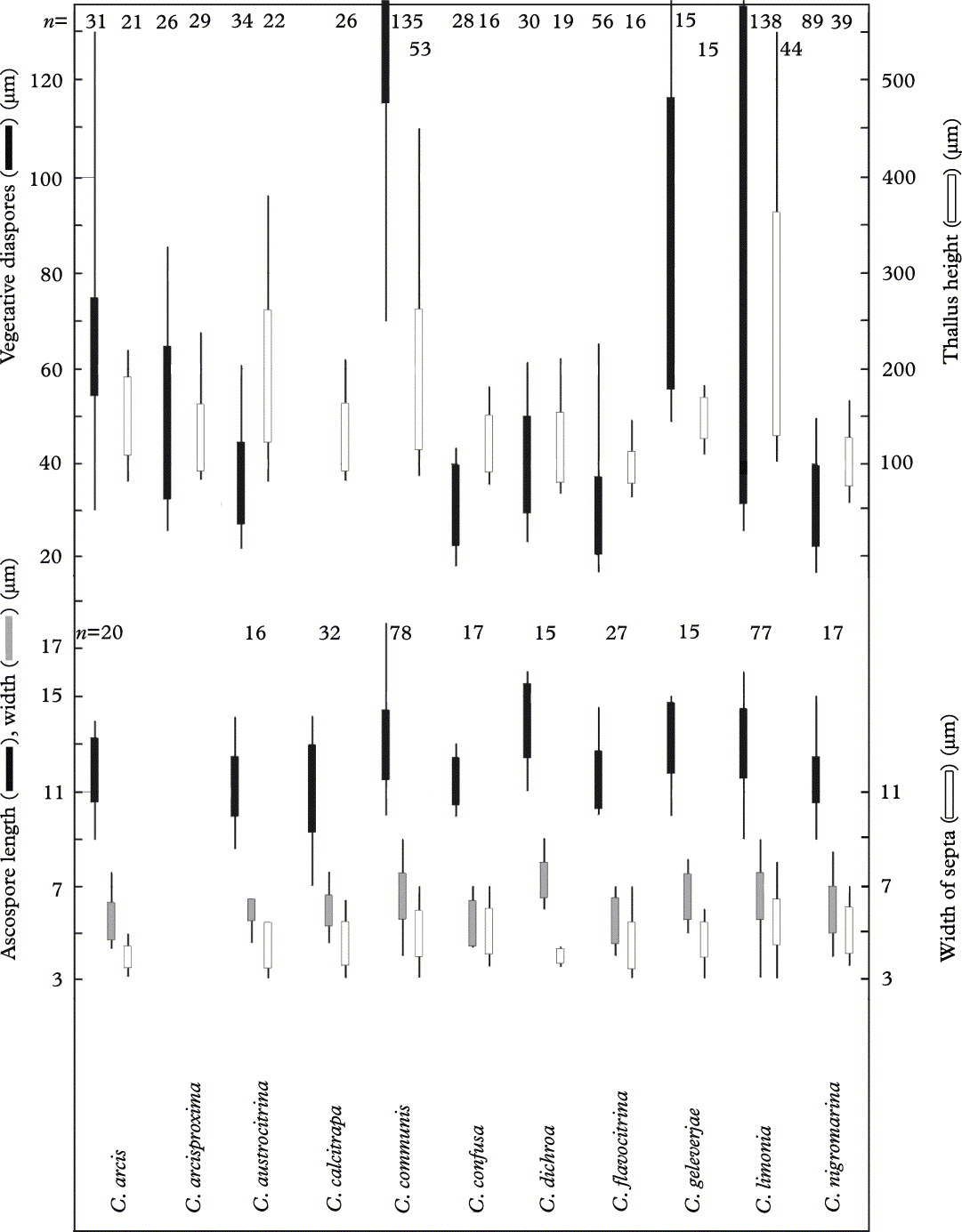
Variability in some characters among the Caloplaca species treated. Distributions of data are expressed as mean ± SD (boxes) and extremes.
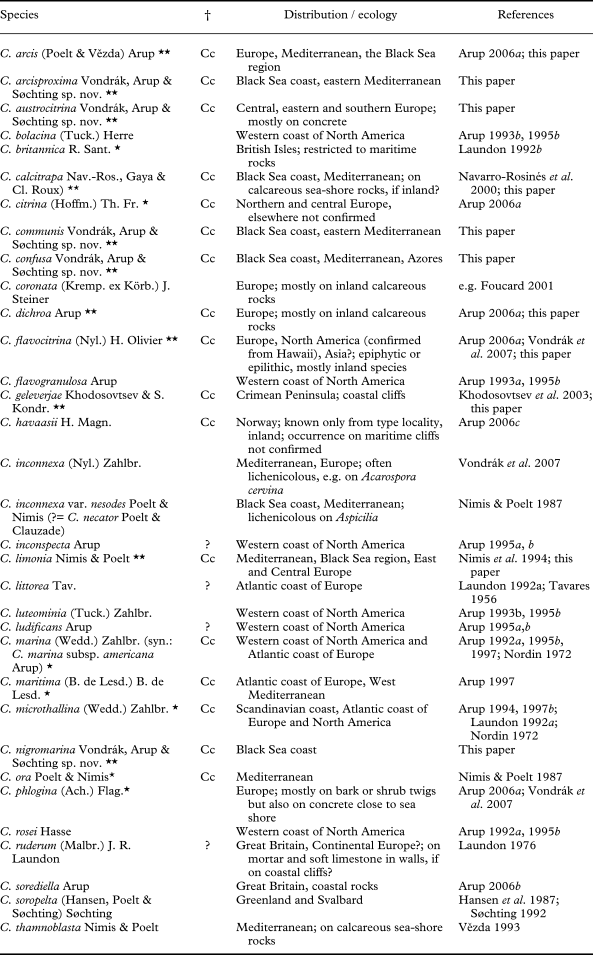
List of species with the Caloplaca citrina morphology occurring on seashore cliffs in the Northern Hemisphere with data on their distributions and references. Species marked by ** are treated here in detail; those marked by * are treated briefly under notes on other species
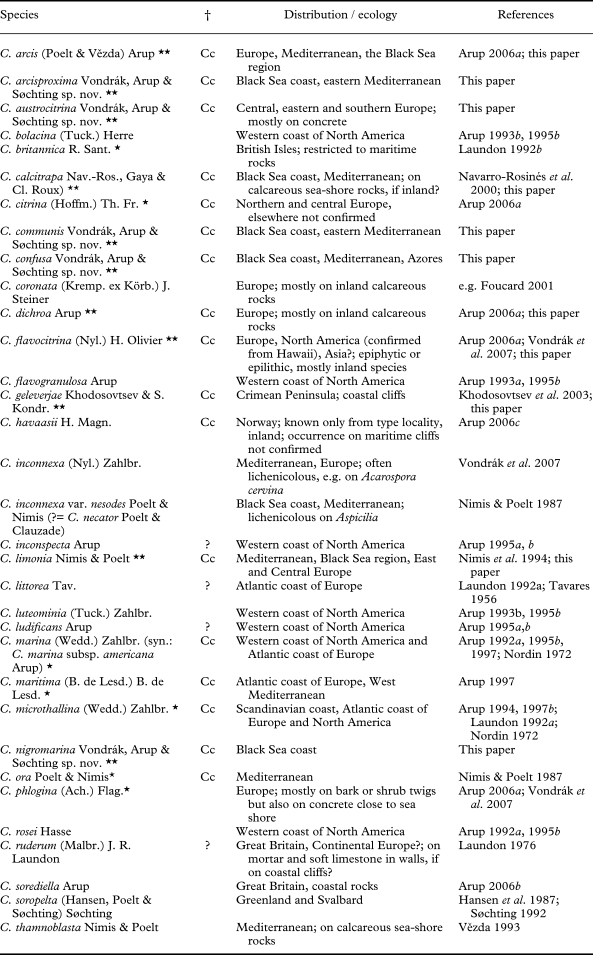
† column: Cc indicates species belonging to the Caloplaca citrina clade; ? position of species uncertain.
A comparison of the species treated using vegetative diaspore, thallus thickness and ascospore characters is shown in Fig. 5. Some species may be grouped, such as Caloplaca communis, C. geleverjae and C. limonia that have larger vegetative diaspores, or C. austrocitrina, C. communis and C. limonia that have larger areoles, whereas C. dichroa has somewhat wider ascospores and C. arcis and C. dichroa have thinner spore septa. However, the characters are much less useful in a single sample, which may possess only a part of a range of variability. For example, specimens of C. limonia from shaded places have significantly smaller soredia than samples from sun-exposed rock faces, which produce blastidia rather than soredia.
Useful key characters are mainly vegetative, such as thallus colour, presence of different vegetative diaspores of different sizes, development of soredia and thickness of the thallus and size of areoles. Apothecial characters (e.g. ascospore size and width of spore septa) where there is often strong phenotypic variability and small differences between species are less useful. Moreover, the sorediate species are rather sparingly fertile and C. arcisproxima is not known fertile.
Short diagnostic description of Caloplaca citrina group
Thallus yellow to orange (except for Caloplaca geleverjae), continuous or made up of dispersed granules, areoles or squamules. Vegetative diaspores, such as soredia and blastidia are often present. Apothecia small with orange discs and zeorine margins. True exciple of elongated cells. Ascospores thin-walled (except for some specimens in C. calcitrapa and C. dichroa), with thick septa.
Unfortunately, these morphological characters are shared with other, phylogenetically unrelated species, for example, members of the Caloplaca dolomiticola group. The position of each species must therefore be confirmed by molecular data. Some superficially similar species of the Caloplaca lactea group (e.g. C. crenulatella and C. interfulgens) and of the C. squamosa group (e.g. C. subsoluta) do not fit the ‘Caloplaca citrina morphology’. The former has large, narrow-ellipsoid ascospores with thin septa (Navarro-Rosinés & Hladun Reference Navarro-Rosinés and Hladun1996) and the latter has a paraplectenchymatous true exciple (Arup Reference Arup1992b; Wetmore Reference Wetmore2003).
Species with the ‘Caloplaca citrina morphology’ occurring on seashore cliffs are listed in Table 3. It is noted there that not all of the species belong to the Caloplaca citrina clade.
Key to the saxicolous Caloplaca species occurring on coastal cliffs in the Black Sea region
1 Thallus pale grey, rarely slightly yellow, formed of areoles ± entirely covered by blastidia. ... C. geleverjae
Thallus yellow to orange, in shaded sites pale-yellow to yellow-grey ... 2
2(1) Soredia absent, but blastidia may be present ... 3
Soredia present, thallus sometimes blastidiate only, but in well-developed populations, soredia always present where blastidia have eroded (limonia-type of soralia) ... 5
3(2) Vegetative diaspores absent, but large thallus granules may be present ... 4
Blastidia present on surface and at margins of inner areoles, (30–) 75 ± 21 (–130) μm, thallus usually with short-lobed margins ... C. arcis
4(3) Thallus variable, consisting of convex areoles, (90–) 190 ± 75 (–450) μm thick, with granular surface, or thallus formed by dispersed granules; granules (70–) 180 ± 66 (–380) μm, apothecia usually abundant, large, (0·2–) 0·6 ± 0·2 (–1·3) mm diam., often with crenulate margin; common on hard siliceous coastal rocks ... ... C. communis
Thallus of flat to convex areoles, only (80–) 129 ± 36 (–210) μm thick; surface smooth, not granular, on coastal limestone or lime-rich schistose rocks ... ... C. calcitrapa
5(2) Thallus thin, up to 200 μm thick, areolate, never squamulose, composed of a greyish-yellow to yellow sorediate crust only, soredia small (20–) 42 ± 14 (–63) μm; epiphytic or on loess and concrete; not found on rock ... C. phlogina
Thallus mainly thicker, up to 550 μm thick, soredia on average larger, 23–320 μm, of confusa, flavocitrina or limonia-type (Fig. 2); known from coastal cliffs ... 6
6(5) Soralia ± delimited, developing mainly from margins of areoles (confusa or flavocitrina-type of soralia), but old thalli may be entirely sorediate ... 8
Soralia not delimited, of limonia-type; thallus often entirely sorediate/blastidiate ... 7
7(6) Thallus (100–) 248 ± 111 (–550) μm thick, dull to bright yellow, sometimes with minute marginal lobes, sorediate; soredia coarse, (26–) 85 ± 54 (–320) μm, old thalli may form a thick, entirely sorediate crust ... C. limonia
Thallus (70–) 118 ± 36 (–210) μm thick, yellow or orange, without marginal lobes, areoles ± entirely sorediate/blastidiate, vegetative diaspores smaller, (23–) 40 ± 11 (–61) μm diam., usually both, orange and yellow thallus morphs are present in the localities ... C. dichroa
8(6) Thallus of ± umbilicate squamules, with margins divided into minute lobes ... ... C. arcisproxima
Thallus areolate or squamulose, but not with margins divided into minute lobes ... 9
9(8) Thallus areolate (rarely squamulose), (80–) 192 ± 70 (–380) μm thick, areoles (squamules) large, (0·25–) 0·74 ± 0·32 (–1·7) mm wide, old thalli usually entirely covered by soredia; mainly on concrete ... C. austrocitrina
Areoles/squamules smaller, up to 180 μm thick and up to 1·4 mm wide; thallus usually not forming entire sorediate crust ... 10(a difficult species, lacking sufficient diagnostic morphological characters)
10(9) Thallus mostly yellow, soralia of flavocitrina type predominate; if on coast, then usually on calcareous substrata (concrete, calcareous sandstones, etc.) ... ... C. flavocitrina
Thallus mostly yellow-orange (in shaded sites yellow); on siliceous coastal cliffs ... 11
11(10) Confusa, flavocitrina and limonia types of soralia present ... C. confusa
Only confusa and flavocitrina types of soralia present ... C. nigromarina
Taxonomy
Caloplaca arcis (Poelt & Vězda) Arup
Lichenologist 38: 8 (2006).—Caloplaca citrina var. arcis Poelt & Vězda in Vězda, Lichenes Selecti Exsiccati, fasc. 99 (1990); type: Austria, Styria, distr. Feldbach, Riegersburg, alt. 400 m, on andesite rock, 1990, G. Kantvilas, H. Mayrhofer & A. Vězda (A. Vězda: Lich. Sel. Exsicc. 2470, BM!, PRM!—isotypes).
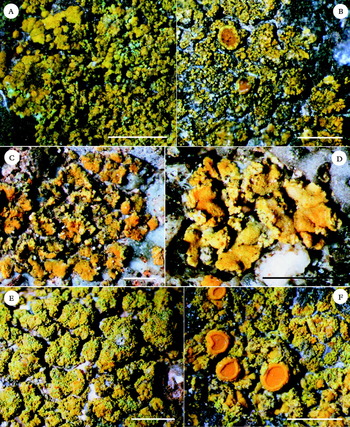
Morphology of Caloplaca species. A & B, Caloplaca arcis; C & D, C. arcisproxima; E & F, C. austrocitrina. Scales: A–F = 1 mm.

(Fig. 6A & B)
Thallus yellow, areolate or formed of tightly aggregated squamules; marginal areoles have a ± lobate character. Areoles/squamules (80–) 150 ± 39 (–220) μm thick (n = 21) and (0·3–) 1·11 ± 0·7 (–3·0) mm wide (n = 47). Thallus surface smooth or covered by granules and blastidia; in old thalli, vegetative diaspores may cover most of the thallus surface. Granules/blastidia (30–) 75 ± 21 (–130) μm diam. (n = 31). Cortex indistinct, alveolate cortex (7–) 18 ± 8 (–32) μm high (n = 18).
Apothecia present in 37% of investigated specimens, (0·41–) 0·6 ± 0·13 (–0·88) mm diam. (n = 19). Discs slightly concave to flat. Exciple (70–) 105 ± 21 (–140) μm thick (n = 15), zeorine, sometimes crenulate. The true exciple/thalline exciple ratio very variable; thalline exciple enlarged with age. Hymenium 70–100 μm thick (n = 12). Paraphyses tips widened to (3·0–) 4·4 ± 0·6 (–5·5) μm (n = 27). Ascospores (9·0–) 12·0 ± 1·25 (–14·0) × (4·5–) 5·5 ± 0·9 (–7·5) μm (n = 20); length/breadth ratio c. 2·2; ascospore septa (3·0–) 4·0 ± 0·5 (–5·0) μm thick (n = 20), c. 0·33 of ascospore length.
Conidia (1·5–) 2·4 ± 0·5 (–3·0) × (1·0–) 1·25 ± 0·25 (–1·5) μm (n = 26).
Remarks. This species is characterized mainly by its blastidiate thallus with short-lobed margins. In some cases, it is hardly distinguishable from Caloplaca limonia, but in well-developed populations, C. arcis has distinct marginal lobes, and blastidia (soredia are absent) are restricted to central parts of the thallus; whereas C. limonia often has an entirely sorediate/blastidiate thallus surface.
Phylogeny. According to the DNA analyses, Caloplaca arcis forms a well-supported monophyletic group (PP 1·00, BS = 98) with two sequences of C. arcisproxima in a sister position and C. limonia as the second closest taxon.
Ecology and distribution. Caloplaca arcis occurs mainly on inland sun-exposed, hard siliceous, but usually base-rich rock faces. Although it is also known from pure limestone (Arup Reference Arup2006a), it was not found on calcareous substrata in the Black Sea region. When it occurs on coastal rocks, it usually avoids the supralittoral zone (Kiten, Bulgaria, extremely sheltered shore: from 1 m upwards; Sinop, Turkey, extremely exposed shore: from 130 m upwards). Accompanying species: Caloplaca aff. furax, C. teicholyta, C. thracopontica, Candelariella plumbea, Catillaria chalybeia, Diplotomma alboatrum s. lat., Lecanora albescens, L. campestris, Phaeophyscia orbicularis, Verrucaria macrostoma f. furfuracea, and Xanthoria cf. calcicola. The species is widely distributed in Europe. Here, it is newly recorded from Bulgaria, Italy, the Netherlands, Slovakia, Turkey and the Canary Islands.
Specimens examined. Bulgaria: Black Sea coast: Burgas, Tsarevo, Rezovo, 2005, J. Vondrák (CBFS JV3036); Burgas, Kiten, rocks near mouth of Karaagach river S of town, 2007, J. Vondrák (CBFS JV6093).—Italy: Sardinia: Arburese, on volcanic rock alt. 320–380 m, 1986, W. Brunnbauer (GZU, sub C. citrina).— The Netherlands: Liemers, 2003, A. Aptroot 59582 (ABL); Zwartemeerdijk, 2004, A. Aptroot 59871 (ABL).—Slovakia: Muránská planina Mt:. in valley Hrdzavá, a1t. 1220–1270 m, 1999, A. Guttová, J. Halda & Z. Palice (SAV, sub C. citrina).—Spain: Canary Islands: Tenerife, Aguamansa, 1986, W. Brunnbauer (W, sub Caloplaca sp.).—Turkey: Black Sea coast: Sinop, alt. c. 100 m, 2007, J. Vondrák (CBFS JV5426, 6106).
Caloplaca arcisproxima Vondrák, Říha, Arup & Søchting sp. nov
Thallus squamulis umbilicatis (0·44–) 0·78 ± 0·21 (–1·18) mm latis contextus, margo squamularum in lobulos minutos divisus. Soralia typo C. confusae vel flavocitrinae.
Typus: Ukraine, Crimean Peninsula, Alushta, coastal rocks SW of Ribachye, 44°45′35.36″N, 34°35′10.30″E, on supralittoral diabasic rock, 27 May 2007, J. Vondrák (CBFS JV5473—holotypus; CBFS JV6038, hb. C & LD—isotypi). ITS sequence of the holotypus: EU563425.
(Fig. 6C & D)
Thallus yellow to yellow-orange, of solitary or rarely aggregated, ± umbilicate squamules. Squamules (80–) 129 ± 36 (–240) μm thick (n = 29) and (0·44–) 0·78 ± 0·21 (–1·18) mm wide (n = 22). Squamules flat, smooth, with margins divided into minute lobes. Marginal soralia of confusa or flavocitrina type. Soredia/blastidia (25–) 48 ± 16 (–86) μm diam. (n = 26). Cortex indistinct, alveolate cortex (8–) 24 ± 9 (–46) μm thick (n = 36).
Apothecia absent in specimens investigated.
Conidia (2·5–) 3·0 ± 0·3 (–4·0) × (0·5–) 1·0 ± 0·25 (–1·5) μm (n = 15).
Etymology. Arcisproxima means close to arcis. The new species is phylogenetically close to Caloplaca arcis and the species also share some morphological characters (e.g., distinct squamules).
Remarks. The species is characterized mainly by its umbilicate squamules, with margins divided into minute lobes and by the presence of soralia of confusa or flavocitrina types. The species may be confused with Caloplaca confusa, C. flavocitrina or C. nigromarina, but it differs in its ± umbilicate squamules, with somewhat raised margins. It somewhat resembles C. arcis in its squamules, which are often divided into minute lobes, but C. arcisproxima differs in the presence of confusa or flavocitrina types of soralia.
Phylogeny. The monophyly of the two sequences obtained from Caloplaca arcisproxima was not confirmed by the parsimony analysis (BS = 70%) or the Bayesian inference. However, this may be due to poor lineage sorting in a young species or to the fact that only two specimens have been analysed. A close affinity to C. arcis is shown (PP = 1·00), but the two species clearly differ from each other in their morphology.
Ecology and distribution. Based on the known localities, the species prefers base-rich, hard siliceous rocks (e.g. diabasic), but was found also on ±soft, lime-rich claystone. It is known only from maritime sites, usually from the supralittoral zone. Accompanying species: Caloplaca cf. aegea, C. biatorina s. lat., Caloplaca aff. furax, C. teicholyta, Candelariella plumbea, C. vitellina, Catillaria chalybeia, Diplotomma alboatrum s.lat., Lecanora albescens, L. dispersa s. lat., Phaeophyscia orbicularis, Verrucaria macrostoma f. furfuracea, and Xanthoria cf. calcicola. The species is so far known from the Crimean Peninsula in the Black Sea region and Crete in the eastern Mediterranean.
Specimens examined: Ukraine: Crimean Peninsula:. Cape Meganom, 2002, A. Khodosovtsev (KHER 3030, sub C. citrina).—Greece: Crete: Agios Pavlos, alt. c. 215–240 m, 1997, H. Mayrhofer (GZU); Ano Viannos, Sidonia, alt 10–50 m, 2005, J. Vondrák (CBFS JV4125); Mires, Kali Limenes, siliceous rock, alt. c. 100 m, 2005, J. Vondrák (CBFS JV3877).
Caloplaca austrocitrina Vondrák, Říha, Arup & Søchting sp. nov
Caloplacae citrinae similis, differt thallo areolato (raro squamuloso) (80–) 192 ± 70 (–380) μm crasso, areolisque (squamulis) majoribus (0·25–) 0·74 ± 0·32 (–1·7) mm latis. Soralia typo C. flavocitrinae. Praecipue in operi concreto habitat.
Typus: Ukraine, Crimean Peninsula,. Alushta (Алушта), slopes above sea c. 1 km SW of Semidvorje (Семидворье), alt. c. 100 m, 44°42′48.10″N, 034°27′12.10″E, on vertical side of concrete wall, 13 June 2006, J. Vondrák (CBFS JV5236—holotypus; CBFS JV5285, LD—isotypi). ITS sequence of the holotypus: EU563419
(Fig. 6E & F)
Thallus yellow, rarely orange (e.g. the specimen from Crete), areolate or formed of tightly aggregated squamules. Areoles/ squamules (80–) 192 ± 70 (–380) μm thick (n = 22) and (0·25–) 0·74 ± 0·32 (–1·7) mm wide (n = 51). Squamules flat, smooth, with marginal soralia of flavocitrina type; in old thalli, soralia may cover the whole thallus surface. Soredia (22–) 36 ± 10 (–61) μm diam. (n = 34), sometimes gathered to consoredia. Cortex or alveolate cortex developed, (6–) 19 ± 8 (–40) μm thick (n = 30).
Apothecia present in 50% of the specimens investigated, (0·32–) 0·46 ± 0·1 (–0·65) mm diam. (n = 16). Disc in mature apothecia flat to convex. Exciple (50–) 86 ± 20 (–130) μm thick (n = 16), zeorine; in young apothecia, the thalline exciple is hidden below the true margin while in old apothecia, the thalline exciple is well-developed and persisting. Hymenium 60–80 μm thick (n = 5). Paraphysestips widened to (3·0–) 4·4 ± 0·9 (–6·0) μm (n = 15). Ascospores (8·5–) 11·25 ± 1·5 (–140) × (4·5–) 6·0 ± 0·5 (–6·5) μm (n = 16);length/breadth ratio c. 1·88. Ascospore septa (3·0–) 4·5 ± 1·0 (–5·5) μm thick (n = 16), c. 0·4 of ascospore length.
Conidia (2·0–) 2·8 ± 0·5 (–4·0) × (1·0–) 1·2 ± 0·2 (–1·5) μm (n = 15).
Etymology. The name reflects the distribution of the species in Europe.
Remarks. This species is distinguished by its thick, areolate thallus (rarely squamulose), its large areoles (squamules), and its soralia of the flavocitrina type. Old thalli are usually entirely covered by soredia. Caloplaca flavocitrina, occurring on the same kind of substratum (predominantly concrete), differs in its thinner and smaller squamules.
Phylogeny. Although morphologically distinguishable, the specimens of C. austrocitrina do not receive any support as a monophyletic taxon, but this does not preclude possible monophyly in other genes. More work on other genes may resolve the phylogeny of C. austrocitrina, but the lineage sorting among other genes may also be poor. In the phylogenetic analysis C. austrocitrina groups with C. limonia, C. arcisproxima and C. arcis (PP = 0·92).
Ecology and distribution. Most of the records are from lime-rich artificial substrata, for example, concrete and mortar, but the species is also known from limestone. It occurs inland as well as in coastal areas and does not avoid substrata close to sea level, for example faces of concrete walls in harbours. Accompanying species: Caloplaca aurantia, C. biatorina s. lat., C. crenulatella, Candelariella aurella, Lecania leprosa, Lecanora albescens, L. dispersa, L. muralis, Rinodina pityrea, Verrucaria macrostoma f. furfuracea, and V. muralis. The species is probably common in south-eastern Europe and is also known from central Europe (Austria, Czech Republic and Germany) and the European part of Russia.
Selected specimens examined. Austria: Styria: Joglland, Miesenbach, alt. c. 1040 m, 2003, J. Hafellner (GZU, sub C. citrina).—Bulgaria: Black Sea coast: Burgas, Pomorie, 2005, J. Vondrák (CBFS JV4631).—Czech Republic: South Bohemia: České Budějovice, 2003, J. Vondrák (CBFS JV991).—Germany: Bavaria: Munich, 1978, E. Albertshofer & H. Hertel (W, Lich. Alpium 328, sub C. citrina).—Greece: Crete: Rethimno, ruin of fort Fortezza, 2005, J. Vondrák (CBFS JV4195).—Romania: Dobrogea: Romania, Tulcea, near shore of Razim Lake (Lacul Razim), 2007, J. Vondrák (CBFS JV6168).—Russia: Black Sea coast: Novorossiysk, coastal rocks near Dyurso, 2007, J. Vondrák (CBFS JV5474, dupl. in C); Sochi, coast 2 km SE of Loo, 2007, J. Vondrák (CBFS JV6097, 6166).—Slovakia: Bukovské vrchy hills: Nová Sedlica, 1989, I. Pišút (SAV, sub C. citrina). Podunajská nížina lowland: Vrakúň, 1990, I. Pišút (SAV, sub C. citrina).—Ukraine: Black Sea coast: Odessa, Czernomorskoye, 2007, J. Vondrák (CBFS JV5476, dupl. in LD).
Caloplaca calcitrapa Nav.-Ros., Gaya & Cl. Roux
Bull. Soc. linn. Provence 51: 147 (2000); type: France, Eastern Pyrenees, Languedoc Roussellon, Tautavel, alt. 400–450 m, on calcareous rock (BCC 13385, holotypus). ITS sequence of an isotype: DQ173227.
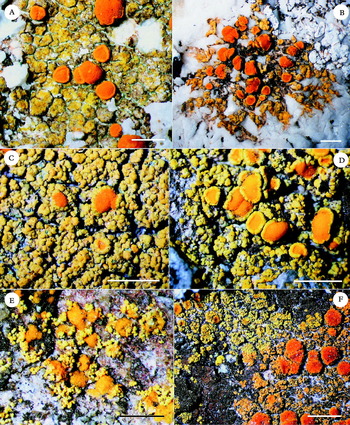
Morphology of Caloplaca species. A & B, Caloplaca calcitrapa; C & D, C. communis; E, C. confusa; F, C. dichroa. Scales: A–F = 1 mm.

(Fig. 7A & B)
Thallus yellow, rarely orange, areolate or bullate, occasionally thin with a rather endolithic character. Snail-grazed forms with flat areoles are common. Areoles (80–) 129 ±36 (–210) μm thick (n = 26) and (0·32–) 0·52 ± 0·16 (–0·97) mm wide (n = 20). Vegetative diaspores absent. Cortex indistinct, alveolate (8–) 25 ± 9 (–35) μm thick (n = 15); epinecral layer usually with intermixed crystals.
Apothecia frequent, (0·28–) 0·46 ± 0·15 (–0·75) mm diam. (n = 20). Disc flat to strongly convex in old apothecia. Exciple (40–) 100 ± 34 (–210) μm thick (n = 57), zeorine, the true exciple/thalline exciple ratio very variable; thalline exciple enlarged with age. Hymenium (60–) 68 ± 6 (–80) μm thick (n = 15). Paraphyses tips widened to (4·0–) 5·5 ± 0·75 (–7·0) μm (n = 25). Ascospores (7·0–) 11·0 ± 2·0 (–14·0) × (4·5–) 6·0 ±0·75 (–7·5) μm (n = 32); length/breadth ratio c. 1·83. Ascospores usually thin-walled (in the Black Sea region); thick-walled, sand-clock spores observed only in two samples. Ascospore septa (3·0–) 4·5 ± 1·0 (–6·5) μm thick (n = 32), c. 0·4 of ascospore length.
Conidia (2·5–) 3·3 ± 0·4 (–4·0) × (1·0–) 1·3 ± 0·25 (–1·5) μm (n = 15).
Remarks. According to Navarro-Rosinés et al. (Reference Navarro-Rosinés, Gaya and Roux2000), the species is characterized mainly by thick-walled, sand-clock ascospores, but these were only rarely observed in specimens from the Black Sea and Marmara Sea regions (CBFS JV6109 & JV6112). More common forms with thin-walled spores were confirmed by the DNA analysis (CBFS JV3408, JV5486 & JV6100).
The areolate or bullate thallus of Caloplaca calcitrapa may be confused with the inland and facultatively lichenicolous species C. inconnexa, but C. calcitrapa seems to be ± maritime and not lichenicolous.
Phylogeny. The four very divergent ITS sequences of Caloplaca calcitrapa form a monophyletic group with good PP support (1·00) but a very poor bootstrap support (BS = 53) in a sister position to a clade including C. confusa, C. marina, C. microthallina, and C. nigromarina (PP = 0·91, BS < 50).
Ecology and distribution. In the Black Sea region, the species inhabits strongly calcareous substrata, for example hard limestone and lime-rich schist. In coastal areas, it specifically occurs in the supralittoral zone (Rusalka, Bulgaria, sheltered shore: from 1 m upwards; Kamen Brjag, Bulgaria, exposed shore: from 6 m upwards). In western Mediterranean, it is also known from inland localities (Navarro-Rosinés et al. Reference Navarro-Rosinés, Gaya and Roux2000). Accompanying species: Caloplaca cf. aegea, C. biatorina s. lat., C. decipiens, C. erythrocarpa, C. ferrarii, C. limonia, C. navasiana, Candelariella aurella, Diplotomma alboatrum s. lat., Lecanora albescens, L. campestris, L. dispersa, Rinodina gennarii, Verrucaria nigrescens, and Xanthoria cf. calcicola. The species is known from Algeria, France, Italy, Morrocco and Spain (Navarro-Rosinés et al. Reference Navarro-Rosinés, Gaya and Roux2000, Roux et al. Reference Roux, Bricaud, Ménard, Gueidan, Coste and Navarro-Rosinés2003). It is recorded here for the first time from Bulgaria, Turkey and Ukraine.
Specimens examined. Bulgaria: Black Sea coast: Kavarna, limestone cliffs on seashore 1·5 km NE of Kamen Brjag, 2007, J. Vondrák (CBFS JV5486, 6117, 6130).—Turkey: Black Sea coast: Istanbul, Kemerburgaz, Karaburun, 2005, J. Vondrák (CBFS JV3408); Kandıra, coastal limestone rocks 6 km E of Cebeci, 2007, J. Vondrák (CBFS JV6112); Marmara Sea coast: Armutlu, coastal rocks 5·5 km SW of Esenköy, 2007, J. Vondrák (CBFS JV6100, 6109); Bandırma, coastal rocks near Yenice, 2007, J. Vondrák (CBFS JV6118, 6123, 6125, 6129, 6180); Gallipoli Peninsula, coastal limestone cliffs 1 km NE of Abide monument, 2007, J. Vondrák (CBFS JV6103).—Ukraine: Crimean Peninsula: Sudak, coastal rocks at W part of Cape Meganom, 2007, J. Vondrák (CBFS JV5906); Sea of Azov coast, 1995, A. Redchenko (KHER 2986, sub C. marina).
Caloplaca communis Vondrák, Říha, Arup & Søchting sp. nov
Caloplaca calcitrapae et maritimae similis, differt superficie thalli grosse granulato granulis (70–) 180 ± 66 (–380) μm latis. Habitat in rupibus maritimis tantum praecipue silcieis.
Typus: Bulgaria, The Black Sea coast, Burgas, Tsarevo, coastal rocks SE of town, near small boat-factory, 42°08′49.7″N, 27°52′48.2″E, on siliceous rock in supralittoral zone, 30 November 2005, J. Vondrák (CBFS JV4620—holotypus; isotypi will be distributed in J. Vondrák: Sel. Exs. Caloplaca, fasc. 2).
(Fig. 7C & D)
Thallus yellow (with orange tint in populations from Crete) areolate, bullate to minutely squamulose. Areoles dispersed or contiguous and then overgrowing each other, forming thick crusts in luxuriant populations, (90–) 190 ± 75 (–450) μm thick (n = 53) and (0·32–) 0·86 ± 0·43 (–2·8) mm wide (n = 121). When the thallus is well-developed, its surface is coarsely granular; granules (70–) 180 ± 66 (–380) μm diam. (n = 135). Cortex present, (5–) 17 ± 7·5 (–46) μm thick (n = 134).
Apothecia frequent, (0·2–) 0·6 ± 0·2 (–1·3) mm diam. (n = 97). Disc in mature apothecia slightly concave to flat, never distinctly convex. Exciple (40–) 100 ± 34 (–210) μm thick (n = 57), often crenulate; true exciple fills c. ⅓–½ of the exciple width, thalline exciple prominent. Hymenium (50–) 68 ± 12 (–100) μm thick (n = 48). Paraphyses tips widened to (3·0–) 5·0 ± 1·0 (–7·0) μm (n = 80). Ascospores (10·0–) 13·0 ± 1·5 (–18·0) × (4·0–) 6·5 ± 1·0 (–9·0) μm (n = 78); length/breadth ratio c. 2·0. Ascospore septa (3·0–) 5·0 ± 1·0 (–7·0) μm thick (n = 78), c. 0·4 of ascospore length.
Conidia (2·0–) 2·8 ± 0·3 (–3·5) × (1·0–) 1·2 ± 0·2 (–2·0) μm (n = 52).
Etymology. The name reflects a common occurrence of this species on siliceous sea-shore cliffs.
Remarks. The yellow thallus, covered by coarse granules, together with its occurrence restricted to coastal habitats (mainly siliceous rocks), are the main characters distinguishing Caloplaca communis from the similar C. calcitrapa and C. inconnexa. Nevertheless, some morphotypes of C. communis have a thallus with an indistinctly granular surface and if such a morphotype occurs on a calcareous substratum then it is hardly distinguishable from the likewise coastal C. calcitrapa. When the areoles/squamules are dispersed, C. communis may resemble the North and West European C. microthallina, but this species has smaller squamules, 0·3–0·5(–1·0) mm wide (Arup Reference Arup1994). Morphotypes with a more compact thallus and a less distinct granular surface resemble C. maritima, which is not confirmed from the region. Caloplaca ora, which is a heterogenous taxon, is another similar ‘species’, but with a typically orange-red thallus without a granular surface.
Phylogeny. All the sequences sampled of C. communis except one form a monophyletic group in the molecular analysis but with low support (PP = 0·87, BS < 50)). The position of the remaining sequence assigned to this species (EU563409) is controversial, appearing in a polytomy between C. communis, C. maritima and C. ora p. p. As in the case of C. austrocitrina, sampling of more loci could possibly make parts of the molecular tree more consistent. The genetic affinity of C. maritima and C. ora p. p. to C. communis is, however rather strong (PP = 0·99, BS = 78).
Ecology and distribution. Caloplaca communis is one of the commonest species in the lichen communities of the lower supralittoral zone on hard siliceous rocks. Only very rarely, it occurs on sandstone, claystone and limestone cliffs. The species is restricted to a narrow zone close to sea level; sheltered shores: 2–4 m (Tuapse, Russia), 1–2 m (Kiten, Bulgaria); exposed shores: 3–7 m (Sarp, Turkey), 4–17 m (Bulgaria, Rezovo) and 4–19 m (Sinop, Turkey). In the eastern Mediterranean, where the salinity is higher and the climate warmer and drier, the species may occur higher above sea level: c. 20–50 m (Agia Pelagia, northern Crete) and c. 100 m (Kali Limenes, southern Crete). Accompanying species: Amandinea punctata, Caloplaca cf. aegea, C. confusa, C. fuscoatroides, C. limonia, Lecanora campestris, Rinodina confragosa, R. gennarii. It is widely distributed in the Black Sea region, Marmara Sea and in the eastern Mediterranean. It is known from Bulgaria, Greece, Italy, Russia, Turkey and Ukraine.
Specimens examined: Bulgaria: Black Sea coast: Burgas, Kiten, 2007, J. Vondrák (CBFS JV6088); Burgas, Sozopol, 2007, J. Vondrák (CBFS JV6121); Burgas, Tsarevo, 2005, J. Vondrák (CBFS JV3369); Burgas, Tsarevo, Rezovo, 2005, J. Vondrák (CBFS JV3043).—Greece: Crete: Ano Viannos, Sidonia, 2005, J. Vondrák (CBFS JV4114); Iraklio, Agia Pelagia, 2005, J. Vondrák (CBFS JV3803, 3836); Mires, Kali Limenes, 2005, J. Vondrák (CBFS JV3763).— Italy: Sardinia: Planargia, 1983, W. Brunnbauer (W, sub C. microthallina).—Russia: Black Sea coast: Tuapse, coastal rocks NW of town, Tuapse, 2007, J. Vondrák (CBFS JV6108). Sea of Azov coast: Taman Peninsula, clay coast 4·5 km NW of Kuchugury, 2007, J. Vondrák (CBFS JV6104).—Turkey: Black Sea coast: Amasra, coastal rocks near Çakrazboz, 2007, J. Vondrák (CBFS JV6127); Cide, coastal rocks near Denizkonak, 2007, J. Vondrák (CBFS JV6115); Istanbul, Kemerburgaz, Kilyos, 2005, J. Vondrák (CBFS JV3367, 3467, 3471, 3472); Kandıra, sand dunes and coastal limestone rocks 6 km E of Cebeci, 2007, J. Vondrák (CBFS JV6119); Lülenburgaz, Demirköy, Limanköy, 2005, J. Vondrák (CBFS JV3037); Lülenburgaz, Vize, Kiyiköy, 2005, J. Vondrák (CBFS JV3042); Ordu, coastal rocks near Mersin, 2007, J. Vondrák (CBFS JV6128); Zonguldak, coastal rocks near Ilıksu, 2007, J. Vondrák (CBFS JV6116). Marmara Sea coast: Armutlu, coastal rocks 5·5 km SW of Esenköy, 2007, J. Vondrák (CBFS JV6114); Karabiga, 2007, J. Vondrák (CBFS JV6110, 6111, 6124).—Ukraine: Crimean Peninsula: Cape Alushtinska miska, 2000, A. Khodosovtsev (KHER 2979, sub C. microthallina); Cape Meganom, 1999 & 2002, A. Khodosovtsev (KHER 2977, 2980, 2981, sub C. microthallina); Cape Plaka, 1999, A. Khodosovtsev (KHER 2982, sub C. microthallina); Karadag, 2000, A. Khodosovtsev (KHER 2976, sub C. microthallina).
Caloplaca confusa Vondrák, Říha, Arup & Søchting sp. nov
Caloplaca flavocitrinae et nigromarinae similis, differt praesentia soraliorum typo C. confusae, flavocitrinae et limoniae. Habitat in rupibus maritimis silcieis tantum.
Typus: Bulgaria, Black Sea coast, Burgas, Kiten, rocks near mouth of Karaagach river S of town, 42°13′31.26″N, 27°46′40.46″E, on coastal, base-rich, siliceous rock, 9 April 2007, J. Vondrák (CBFS JV6206—holotypus; BM, C, GZU, LD—isotypi). ITS sequence of the holotypus: EU563449.
(Fig. 7E)
Thallus yellow to yellow-orange, of dispersed squamules, or continuous, areolate. Areoles/squamules (80–) 121 ± 28 (–180) μm thick (n = 16) and (0·2–) 065 ± 0·3 (–1·4) mm wide (n = 34). Areoles and squamules flat, smooth or covered by blastidia, with laminal or marginal soralia of confusa, flavocitrina or limonia type; soredia (18–) 31 ± 9 (–43) μm diam. (n = 28), sometimes gathered to small consoredia. Cortex poorly developed; alveolate cortex (7–) 18 ± 8·5 (–40) μm thick (n = 15).
Apothecia infrequent (25% of samples fertile), c. 04–1·0 mm in size (n = 7). Discs observed in mature apothecia ± flat. Exciple 50–110 μm thick (n = 7), zeorine, but appearing biatorine; in young apothecia, the true exciple fills the whole exciple width, as the thalline exciple is hidden below the true exciple. Hymenium 70–80 μm thick (n = 9). Paraphyses tips widened to (3·5–) 4·5 ±0·5 (–5·5) μm (n = 18). Ascospores (10·0–) 11·5 ± 1·0 (–13·0) × (4·5–) 5·5 ± 1·0 (–7·0) μm (n = 17); length/breadth ratio c. 2·1. Ascospore septa (3·5–) 5·0 ± 1·0 (–7·0) μm thick (n = 17), c. 0·43 of ascospore length.
Conidia c. 3–3·5 × 1–1·5 μm.
Etymology. The name expresses the confusing position of the new species in the phylogenetic tree; although very similar to Caloplaca flavocitrina and C. nigromarina, it is not closely related to them.
Remarks. This species may be characterized by its squamulose to areolate thallus with all three types of soralia (confusa, flavocitrina and limonia types), but in some cases, it is indistinguishable from Caloplaca flavocitrina and C. nigromarina.
Phylogeny. The sequences of Caloplaca confusa form a monophyletic group, but the support is not very strong (PP = 0·89, BS = 46). However, it is morphologically distinct from its genetically closest relative, C. microthallina, in the analyses. The support for this sister relationship is not very strong (PP = 0·88, BS = 47).
Ecology and distribution. Caloplaca confusa is restricted to hard siliceous, mainly volcanic, sea shore cliffs in the supralittoral zone; from c. 2 m upwards in sheltered shores and 5–18 m on an exposed shore (Sinop, Turkey). Accompanying species: Caloplaca cf. aegea, C. communis, C. cf. holocarpa, C. limonia, C. thracopontica, Catillaria chalybeia, Hyperphyscia adglutinata, Lecania cf. aipospila, Lecanora campestris, L. dispersa, L. cf. salina, Rinodina gennarii, and Xanthoria cf. calcicola.
It is probably widely distributed in the Black Sea region and the Mediterranean, and is also known from the Atlantic coast. Records from Azores, Bulgaria, France and Italy are confirmed by molecular data. There are also collections from Georgia, Russia, Turkey and Ukraine, but these were not confirmed by molecular data and have been omitted from this study.
Specimens confirmed by ITS data. Bulgaria: Black Sea coast: Burgas, Tsarevo, coastal rocks between Tsarevo and Ahtopol, 2005, J. Vondrák (CBFS JV3435).—France: Corsica: Ajaccio, on volcanic rock in alt. 50 m, 1993, J. Hafellner (GZU, sub C. citrina).—Italy: Sicily: Isole Pelagie, Linosa, 1992, J. Poelt (GZU, sub C. citrina).—Portugal: Azores: Sao Jorje, 1992, F. Berger (hb. Berger).
Caloplaca dichroa Arup
Lichenologist 38: 13 (2006); type: Sweden, Västergötland, Klefva infra Mösseberg. In saxis calcaris, 1914, Vrang. Malme: Lichenes suecici exsiccati 525 (LD—holotype).
(Fig. 7F)
Thallus areolate, of two colour forms, yellow and orange. Areoles (70–) 118 ± 36(–210) μm thick (n = 19) and (0·24–) 0·6 ± 0.·3 (–1.·2) mm wide (n = 20), ± entirely covered by blastidia/soredia of limonia type, (23–) 40 ± 11 (–61) μm diam. (n = 30). Cortex indistinct, composed of 1–2 layers of cells; a thicker alveolate cortex developed in spots.
Apothecia frequent, (0·42–) 0·49 ± 0·06 (–0·64) mm (n = 15). Disc in mature apothecia slightly concave to slightly convex. Exciple (50–) 83 ± 18 (–110) μm thick (n =15), zeorine, the true exciple/thalline exciple ratio very variable; thalline exciple often covered by blastidia/soredia, enlarged with age. Hymenium c. 70–80 μm thick (n = 5). Paraphyses tips swollen up to (2·5–) 4·5 ± 1·0 (–6·0) μm (n = 34). Ascospores thick-walled (walls up to 2 μm) or thin-walled (walls less than 0·5 μm), (11·0–) 14·0 ± 1·5 (–16·0) × (6·0–) 7·25 ± 0·75 (–9·0) μm (n = 15); length / width ratio c. 1·93. Ascospore septa (3·5–) 4·0 ± 0·4 (–4·5) μm thick (n = 15), c. 0·29 of ascospore length.
Conidia (1·5–) 2·5 ± 0·5 (–3·0) × (1·0–) 1·25 ± 0·25 (–1·5) μm (n = 20).
Remarks. The species is characterized by its sorediate/blastidiate thallus surface, limonia type of soralia and thin thallus without marginal lobes. The yellow and orange thallus forms, often growing side by side, are also diagnostic. It can be confused with Caloplaca austrocitrina and C. limonia, but the former has a generally thicker thallus and a different type of soralium, and the latter has a thicker thallus, larger vegetative diaspores and lacks the orange morphotype. For differences from C. citrina and C. coronata see Arup (Reference Arup2006a). The thick-walled ascospores seem to be diagnostic in the Nordic coutries (Arup Reference Arup2006a), but in the Black Sea region some specimens have thin-walled spores. A similar pattern has also been observed in some British specimens.
Phylogeny. Caloplaca dichroa forms one of the best-supported clades in our analysis; it has full support (PP = 1·00, BS = 100). This branch appears as a sister taxon to a clade of C. arcis, C. arcisproxima and C. limonia with fairly good support in the Bayesian analysis (PP = 0·93).
Ecology and distribution. Although this species is known also from concrete and mortar (Arup Reference Arup2006a; Vondrák et al. Reference Vondrák, Kocourková, Palice and Liška2007), in the Black Sea region, it has only been collected from ± sun-exposed, hard or soft calcareous stones or cliffs. It is a typical inland species avoiding maritime conditions; on coastal cliffs it grows from 6 m upwards on sheltered shores (Rusalka, Bulgaria) and from 16 m and upwards on more exposed shores (Kamen Brjag, Bulgaria). Accompanying species: Candelariella aurella, C. rhodax, Lecanora albescens, L. dispersa, Phaeophyscia nigricans, P. orbicularis, Physcia adscendens, Physconia grisea, Verrucaria macrostoma f. furfuracea, and V. nigrescens s. lat.
Selected specimens examined. Austria: Styria: Eisenerzer Alpen, Kammern im Liesingtal, 1997, J. & A. Hafellner (GZU, sub C. citrina); Grazer Bergland, Mixnitz, alt. 1620 m, 2005, J. Hafellner (GZU, sub C. citrina); Fischbacher Alpen, Rettenegg, 2002, J. Hafellner (GZU, sub C. citrina). Tirolia: Hohe Tauern Mts, Matrei, alt. 1000 m, 1998, J. Hafellner (GZU, sub C. citrina).—Bulgaria: Kavarna, Cape Kaliakra, 2007, J. Vondrák (CBFS JV6177).—Great Britain: England: V. C. 34, West Gloucestershire: Bristol, rocks on right side of Avon River near Clifton suspension bridge, 2006, J. Vondrák (CBFS JV4155).—Hungary: Mt Bakony: Hárskut, 1968, K. Verseghy (BP 75193, 75204).—Romania: Dobrogea: Jurilovca, rocky cliff at Doloşman Cape, 2007, J. Vondrák (CBFS JV5324, 5337); Tulcea, Popina Island (Insula Popina) in Razim Lake (Lacul Razim), 2007, J. Vondrák (CBFS JV6178, 6179).—Russia: Sea of Azov coast: Taman Peninsula, on soft limestone, 4·5 km NW of Kuchugury, 2007, J. Vondrák (CBFS JV6176).—Ukraine: Crimean Peninsula: Feodosia, Karadag, near village Kurortnoye, 2007, J. Vondrák (CBFS JV5477).
Caloplaca flavocitrina (Nyl.) H. Olivier
Lich. d'Europe 2: 110 (1908–1910).
Lecanora flavocitrina Nyl., Flora 69: 461 (1886); type: Great Britain, Staveley, 1886, Martindale (H-Nyl.!, lectotype selected by Wade Reference Wade1965).
(Fig. 8A)
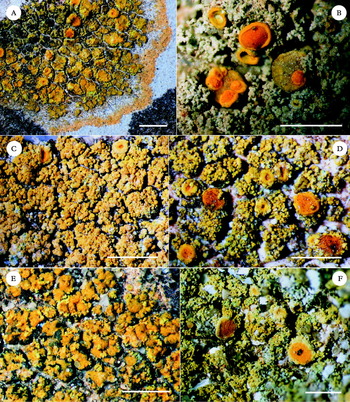
Morphology of Caloplaca species. A, Caloplaca flavocitrina; B, C. geleverjae; C & D, C. limonia; E, C. nigromarina; F, C. phlogina. Scales: A–F = 1 mm.

Thallus yellow, of dispersed squamules, rarely continuous, areolate. Squamules (70–) 96 ± 17 (–140) μm thick (n = 16) and (0·12–) 0·4 ± 0·17 (–0·75) mm wide (n = 60). Squamules flat, smooth, with marginal soralia of flavocitrina type, but the soralia sometimes expand and cover the complete surface of the squamules. Soredia (16–) 29 ± 9 (–65) μm diam. (n = 56), sometimes gathered into consoredia. Cortex thin, usually of 1–2 layers of cells; alveolate cortex (4–) 9 ± 5 (–25) μm thick (n = 44). A white or yellow fibrillar prothallus was observed on smooth substrata.
Apothecia infrequent (30% of samples fertile), (0·3–) 0·43 ± 0·1 (–0·75) mm diam. (n = 24). Disc in mature apothecia slightly concave to flat. Exciple (70–) 85 ± 13 (–110) μm thick (n = 16), zeorine, the true exciple/thalline exciple ratio very variable; thalline exciple enlarged with age. Hymenium (65–) 75 ± 6 (–80) μm thick (n = 14). Paraphyses tips swollen to (3·0–) 5·0 ± 1·0 (–7·0) μm (n = 32). Ascospores (10·0–) 11·5 ±1·25 (–14·5) × (4·0–) 5·5 ± 1·0 (–7·0) μm (n = 27); length/width ratio c. 2·1. Ascospore septa (3·0–) 4·5 ± 1·0 (–7·0) μm thick (n = 27), c. 0·39 of ascospore length.
Conidia (2·0–) 3·25 ± 0·5 (–4·0) × (1·0–) 1·15 ± 0·25 (–1·5) μm (n = 14).
Remarks. This species has a squamulose to areolate thallus with mainly flavocitrina type of soralium. It is hardly distinguishable from C. confusa and C. nigromarina, but its thallus is usually yellow and the flavocitrina type of soralium persists. It differs also in its ecology, being mainly an inland species, and is rather rare on sea-shore rocks.
Phylogeny. The sequences of Caloplaca flavocitrina form a well-supported monophyletic group in the Bayesian analysis (PP = 0·99), but the parsimonious analysis gave a weaker support (BS = 61). Together with C. geleverjae and an undescribed taxon, represented by the sequence EU563389, it forms a well supported clade (PP = 1·00, BS = 89), that appears as a sister group to a large clade with, for example, C. dichroa and C. arcis, but with rather poor support (PP = 0·84, BS < 50).
Ecology and distribution. Caloplaca flavocitrina is one of the ecologically broadest species in the C. citrina group; it occurs on bark, wood, concrete and on a variety of rocks. In maritime conditions, it is mainly restricted to concrete or calcareous rocks. It is confirmed from siliceous coastal cliffs only in the most humid part of the Black Sea region in Georgia and NE Turkey. Accompanying species in coastal localities: Caloplaca albolutescens, Candelariella aurella, Diplotomma alboatrum s. lat., Lecanora dispersa, Rinodina gennarii, and Verrucaria macrostoma f. furfuracea.
As it is known throughout Europe and from the Hawaiian Islands, it may have a circumpolar distribution. It is a new record for Georgia, Italy, Russia, and Turkey.
Specimens confirmed by ITS nrDNA data. Bulgaria: Black Sea coast: Burgas, Pomorie, on concrete, 2005, J. Vondrák (CBFS JV3425); Burgas, Tsarevo, Sinemorec, epiphytic, 2004, J. Vondrák (CBFS JV2106).—Georgia: Adjara: Batumi, valley of river Acharistskali near Shuakhevi, 2007, J. Vondrák (CBFS JV6094); Batumi, rocks near coast on S periphery of Gonio, 2007, J. Vondrák (CBFS JV6098).—Italy: Livorno, volcanic coastal rock, alt. 20–50 m, 1993, J. Hafellner (GZU, sub C. citrina).—Russia: Black Sea coast: Gelendzhik, coastal rocks W of Krinitsa (near Betta), 2007, J. Vondrák (CBFS JV6089); Sochi, coast 2 km SE of Loo, 2007, J. Vondrák (CBFS JV6095).—Turkey: Black Sea coast: Rize, coastal outcrops close to city, 2007, J. Vondrák (CBFS JV6090).—USA: Hawaii: Maui, Haleakala, volcanic rock, alt. 1700 m, 1996, C. Wetmore (GZU, sub C. citrina).
Caloplaca geleverjae Khodosovtsev & S. Kondr
Ukr. Botan. Journ. 60: 294 (2003); type: Ukraine, Crimea AR, Feodosia region, cape Meganom, on conglomerates in supralittoral zone, 2002, A. Khodosovtsev (KW—holotype; KHER!, CBFS!—isotypes). ITS sequence of a topotype: EU563423.
(Fig. 8B)
Thallus pale grey, rarely yellowish (mainly at apothecial primordia), consisting of dispersed or continuous areoles, areolate. Areoles (110–) 147 ± 18 (–180) μm thick (n = 15) and (0·34–) 0·63 ± 0·16 (–0·87) mm wide (n = 15). Squamules ± entirely covered by blastidia, (48–) 85 ± 31 (–148) μm diam. (n = 15); true soredia absent. Cortex indistinct; alveolate cortex (18–) 28 ± 9 (–50) μm thick (n = 15).
Apothecia frequent in the known population, (0·37–) 0·48 ± 0·07 (–0·62) mm diam. (n = 15). Disc in mature apothecia slightly concave to flat. Exciple (70–) 93 ± 14 (–110) μm thick (n = 14), zeorine, but thalline exciple hidden below the true exciple in young apothecia. Hymenium c. 60–80 μm thick (n = 5). Paraphyses tips swollen to (5·0–) 6·0 ± 0·75 (–7·0) μm (n = 15). Ascospores (10·0–) 13·25 ± 1·5 (–15·0) ×(5·0–) 6·5 ± 1·0 (–8·0) μm (n = 15); length/breadth ratio c. 2·04. Ascospore septa (3·0–) 4·75 ± 0·75 (–6·0) μm thick (n = 15), c. 0·36 of ascospore length.
Conidia (2·5–) 3·0 ± 0·4 (–3·5) × (1·0–) 1·3 ± 0·2 (–1·5) μm (n = 15).
Remarks. The predominantly greyish thallus colour distinguishes Caloplaca geleverjae from other related species. The blastidiate species, Caloplaca thamnoblasta, is somewhat similar in thallus structure, but its thallus is usually yellow and it does not belong to the C. citrina group (J. Vondrák & J. Šoun, unpublished molecular data).
Phylogeny. Caloplaca geleverjae (one sequence included in the analysis) is a sister species to C. flavocitrina (PP = 0·98; BS = 60).
Ecology and distribution. Caloplaca geleverjae is known only from the type locality in the Crimean Peninsula, where it occurs on ± shaded, base-rich conglomerate in the lower supralittoral zone, at altitudes below 10 m. The accompanying species in the type locality were few and included for example, Caloplaca limonia and C. cf. nigromarina.
Specimen examined. Ukraine: Crimean Peninsula: Cape Meganom, 2007, J. Vondrák & A. Khodosovtsev (CBFS JV5415—topotype).
Caloplaca limonia Nimis & Poelt
in Nimis, Poelt, Tretiach, Ottonello, Puntillo & Vězda, Bull. Soc. Linn. Provence 45: 252 (1994); type: Italy, Isole Egadi, Marettimo, 1991, J. Poelt (GZU!—holotype). ITS sequence of a paratype: EU563467.
(Fig. 8C & D)
Thallus dull to bright yellow, often white-pruinose, forming a continuous areolate crust. Areoles/squamules (100–) 248 ± 111 (–550) μm thick (n = 44) and (0·18–) 0·98 ± 0·51 (–2·6) mm wide (n = 140). Areoles and squamules flat, covered by blastidia or by laminal soralia of limonia type; soredia/blastidia (26–) 85 ± 54 (–320) μm diam. (n = 138). Cortex/alveolate cortex (4–) 15 ± 10 (–55) μm thick (n = 109).
Apothecia frequent, c. (0·25–) 0·6 ± 0·25 (–1·6) mm diam. (n = 114). Disc in mature apothecia slightly concave to flat. Exciple (70–) 121 ± 31 (–200) μm thick (n = 25), zeorine, thalline exciple prevailing in old apothecia, sometimes covered by blastidia/isidia. Hymenium (60–) 78 ± 17 (–130) μm thick (n = 50). Paraphyses tips widened to (3·0–) 4·5 ± 0·5 (–6·0) μm (n = 72). Ascospores (9·0–) 13·0 ± 1·5 (–16·0) × (3·0–) 6·5 ± 1·0 (–9·0) μm (n = 77); length/breadth ratio c. 2·0. Ascospore septa (3·0–) 5·5 ± 1·0 (–8·0) μm thick (n = 77), c. 0·42 of ascospore length.
Conidia (2·5–) 3·5 ± 0·8 (–5·5) × (1·0–) 1·15 ± 0·25 (–1·5) μm (n = 33).
Remarks. The diagnostic characters of this species are large soredia/blastidia, limonia type of soralium, ± pale yellow thallus and a thick apothecial margin often covered by blastidia/isidia. Caloplaca citrina, that has a more northern distribution, is probably the most similar species, but it differs on average in the smaller vegetative diaspores, which are often blastidia and not soredia.
Phylogeny. The sequences of Caloplaca limonia form a well-supported monophyletic group (PP = 1·00, BS = 94). It appears to be related to C. arcis along with C. arcisproxima (PP = 0·80, BS < 50) and more distantly to C. austrocitrina (PP = 0·92, BS < 50).
Ecology and distribution. Caloplaca limonia occurs mainly on coastal calcareous rocks or on base-rich, hard siliceous cliffs in dry sun-exposed to shaded and damp situations, but also on twigs of maritime shrubs or on soil. It is also known from inland localities, but it is often abundant in maritime habitats, where it occurs on sheltered shores from 2 m upwards (Rusalka, Bulgaria); on exposed shores from 20 m (Sinop, Turkey) and 21 m (Rezovo, Bulgaria). Accompanying species: Caloplaca cf. aegea, C. albolutescens, C. communis, C. confusa, C. flavescens, Caloplaca thracopontica, Catillaria chalybeia, Diploicia canescens, Diplotomma alboatrum s. lat., Lecanora albescens, L. dispersa, Physcia adscendens, Rinodina gennarii, R. pityrea, Verrucaria macrostoma f. furfuracea, and V. nigrescens s. lat.
Caloplaca limonia is so far reported from Greece (Sipman & Raus Reference Sipman and Raus2002), Italy (e.g. Nimis et al. Reference Nimis, Poelt, Tretiach, Ottonello, Puntillo and Vězda1994) and Ukraine (Khodosovtsev Reference Khodosovtsev2001), but it is a common species in the Mediterranean and the Black Sea region. New record for Bulgaria, Croatia, Czech Republic, Georgia, Morrocco, Romania, Russia, and Turkey.
Selected specimens examined. Bulgaria: Black Sea coast: Kavarna, limestone cliffs on seashore 1·5 km NE of Kamen Brjag, 2007, J. Vondrák (CBFS JV6138). —Croatia: Island of Arbe: Arbe, 1927, J. B. Kümmerte (BP 27347).—Czech Republic: South Bohemia: Písek, in town, 2005, J. Vondrák (CBFS JV2515).—Georgia: Black Sea coast: Batumi, Sarpi (Georgian-Turkish border), 2007, J. Vondrák (CBFS JV6150).—Italy: Distr. Verona, Massalongo (BP 27353, ex hb. A. Massal.).—Morocco: Rabat, 1930, Andreánszky (BP 46517).—Romania: Dobrogea. Tulcea, Jurilovca, rocky cliff at Doloşman Cape, 2007, J. Vondrák (CBFS JV5376).—Russia: Black Sea coast: Tuapse, coastal rocks NW of town, 2007, J. Vondrák (CBFS JV6160).—Turkey: Black Sea coast: Sinop, coastal rocks on E coast of peninsula, 2007, J. Vondrák (CBFS JV6143). Aegean Sea coast: Gallipoli Peninsula, coastal rocks near Güneyli, 2007, J. Vondrák (CBFS JV6148). Marmara Sea coast: Karabiga, S-exposed coastal rocks on headland E of town, 2007, J. Vondrák (CBFS JV6147).—Ukraine: Crimean Peninsula: Sudak, coastal rocks at W part of Cape Meganom, 2007, J. Vondrák (CBFS JV6019).
Caloplaca nigromarina Vondrák, Říha, Arup & Søchting sp. nov
Similis Caloplaca flavocitrinae, differt squamulis plerumque laetius flavo-aurantiacis; a C. confusae differt praesentia soraliorum typo C. confusae et flavocitrinae tantum. Habitat in rupibus maritimis silcieis tantum.
Typus: Georgia, Adjar,. Sarpi (Georgian-Turkish border), coastal cliffs N of village, 41°31′58.19″N, 41°32′58.35″E, on siliceous rock, 25 April 2007, J. Vondrák (CBFS JV6091—holotypus). ITS sequence of the holotypus: EU563436.
(Fig. 8E)
Thallus yellow-orange (in shaded sites yellow), of dispersed granules/squamules, or thallus continuous, areolate. Areoles/squamules (60–) 106 ± 25 (–170) μm thick (n = 39) and (0·18–) 0·44 ± 0·19 (–1·25) mm wide (n = 89). Areoles and squamules flat, smooth, with marginal soralia of confusa or flavocitrina type, soredia/consoredia (16–) 31 ± 9 (–50) μm diam. (n = 89). Cortex present, (5–) 17 ± 8 (–37) μm thick (n = 90).
Apothecia infrequent (40% of specimens fertile), (0·45–) 0·6 ± 0·1 (–0·8) mm diam. (n = 15). Disc in mature apothecia flat to slightly convex. Exciple (40–) 75 ± 33 (–150) μm thick (n = 15), zeorine; true exciple fills c. ½ of the exciple width. In young apothecia, thalline exciple may be hidden below the true exciple. Hymenium (50–) 70 ± 10 (–90) μm thick (n = 13). Paraphyses tips widened to (3·0–) 4·5 ± 1·0 (–6·5) μm (n = 29). Ascospores (9·0–) 11·5 ± 1·5 (–15·0) × (4·0–) 6·0 ± 1·0 (–8·5) μm (n = 17); length/ breadth ratio c. 1·9. Ascospore septa (3·5–) 5·0 ± 1·0 (–7·0) μm thick (n = 17), c. 0·43 of ascospore length.
Conidia (2·0–) 3·2 ± 0·5 (–4·5) × (1·0–) 1·25 ± 0·25 (–1·5) μm (n = 29).
Etymology. The name is derived from the distribution of the new species on shores of the Black Sea.
Phylogeny. The sequences of Caloplaca nigromarina form a fairly well-supported monophyletic group (PP = 0·94, BS = 66). At the base of this clade there is a single specimen (EU563433) that cannot be assigned to any known species, but it is apparantly related to C. nigromarina (PP = 1·0, BS = 84). However, it differs clearly in its morphology. These two taxa form a sister group to a clade consisting of C. confusa, C. marina and C. microthallina (PP = 0·99, BS = 97).
Remarks. Caloplaca nigromarina shares the squamulose thallus and marginal soralia with the very similar species Caloplaca confusa and C. flavocitrina. However, from the former species, it differs in the flavocitrina type of soralia, and from the latter, in the yellow-orange thallus and in ecology.
Ecology and distribution. This species is restricted to siliceous seashore cliffs in the lower supralittoral zone. Accompanying species are usually few only: for example, Caloplaca cf. aegea, C. fuscoatroides, Lecanora albescens, and L. dispersa. The species is so far known only from the Bulgarian, Georgian and Turkish Black and Aegean Sea coasts.
Specimens examined. Bulgaria: Black Sea coast: Burgas, Tsarevo, Sinemorec, coastal rocks, 2004, J. Vondrák (CBFS JV4983).—Turkey: Aegean Sea coast: Gallipoli Peninsula, coastal rocks near Güneyli, 2007, J. Vondrák (CBFS JV5482); Black Sea coast: Istanbul, Kemerburgaz, Kilyos, 2005, J. Vondrák (CBFS JV3354); Lülenburgaz, Vize, Kiyiköy, coastal rocks, 2005, J. Vondrák (CBFS JV3035); Zonguldag, Sazköy, 1992, V. John & E. Sauer (GZU, Lich. Anatol. Exsicc. 80, sub C. citrina).
Notes on other species with Caloplaca citrina morphology
Caloplaca britannica R. Sant
in Laundon, Lichenologist 24: 2 (1992); type: Great Britain, Caithness (UPS—holotype; GZU—isotype!).
This taxon was recently misunderstood by Aptroot & van Herk (Reference Aptroot and van Herk2004), who considered Caloplaca britannica conspecific with C. limonia, that is widely distributed in coastal as well as inland Europe; also in the Black Sea region: Crimea (Khodosovtsev Reference Khodosovtsev2001, sub C. limonia). However, C. britannica is a blastidiate-isidiate species that does not belong to the C. citrina clade (U. Arup, unpublished) and is restricted to coastal cliffs. We investigated two samples from the Netherlands, named C. britannica by A. Aptroot, and both specimens belong to C. arcis.
Caloplaca citrina (Hoffm.) Th. Fr
Acta Soc. Regiae Sci. Upsal. 3: 218 (1860).—Verrucaria citrina Hoffm. Deutschlands Flora 198 (1796); type: Lecanora citrina, Svecia (H, neotype selected by Nordin Reference Nordin1972).
According to the GBIF web site (www.gbif.org), this species is considered to be cosmopolitan. However, according to molecular data (Arup Reference Arup2006a) and this study, Caloplaca citrina may be a species with a rather restricted distribution. The species has so far been confirmed only from North and Central Europe. In the Mediterranean and the Black Sea region it is replaced by other species such as C. limonia.
Caloplaca marina (Wedd.) Zahlbr
in Du Rietz, Zur Methodologischen Grundlage der Modernen Pflanzenzociologie 170 (1921).—Lecanora marina Wedd., Mém. Soc. Nat. Sc. Cherb. 19: 275 (1875); type: France, Vendée, 1875, Weddell (PC—lectotype selected by Nordin Reference Nordin1972; TUR, hb.Vainio 7188—isotypes).
This morphologically distinct species has not been confirmed from the Black Sea region and is probably not present there. Reports from Turkey (John & Breuss Reference John and Breuss2004) and Ukraine (e.g. Redchenko Reference Redchenko2002) are probably incorrect. The Turkish material was not revised by us, but the Ukrainian specimens in KHER (collected by A. Khodosovtsev or A. Redchenko) were identified as Caloplaca calcitrapa or C. irrubescens (Arnold) Zahlbr.
Caloplaca maritima (B. de Lesd.) B. de Lesd
Rev. Bryol. Lichénol. 22, fasc. 3-4: 313 (1953).—Caloplaca citrina var. maritima B. de Lesd., Sched. ad Krypt. exsicc., Cent. 17 (1909); type: France, Dunkerque, on calcareous stone, B. de Lesdain (Krypt. exsicc. 1667, W!—lectotype selected by Arup Reference Arup1997a).
Based on molecular data, this species is closely related to Caloplaca communis. Whereas, C. communis occurs in the Black Sea region and the eastern Mediterranean, C. maritima is probably restricted to the Atlantic coast of Europe. Samples from southern France named C. maritima by Arup (Reference Arup1997a), require confirmation. Some specimens of C. communis with a smooth thallus without granules are morphologically indistinguishable from well-developed material of C. maritima from the Atlantic coast of Europe.
Caloplaca microthallina (Wedd.) Zahlbr
Cat. Lich. Univ. 7: 247 (1931).—Lecanora microthallina Wedd., Mém. Soc. Nat. Sc. Cherb. 19: 276 (1875); type: France, Vendée, 1875, Weddell (PC—lectotype selected by Nordin Reference Nordin1972).
This species may resemble morphologically some morphotypes of Caloplaca communis with minute areoles, but C. microthallina has not been confirmed from the Black Sea region by molecular data and it is probably absent there. Records from Bulgaria (Vězda Reference Vězda1975) and Ukraine (e.g. Redchenko Reference Redchenko2002) are based on C. communis and the record from Turkish Eastern Mediterranean (Pišút & Guttová Reference Pišút and Guttová2008) needs revision.
Caloplaca ora Poelt & Nimis
in Nimis & Poelt, Studia Geobotanica 7: 70 (1987); type: France, Corse, Ajaccio, on granite coastal cliff, 1969, Lambinon, Rondon & Vězda (A. Vězda: Lich. Sel. Exs. 849, hb. A. Vězda—holotype, W!—isotype).
Based on the samples from GZU and W, we consider this Mediterranean taxon to be heterogeneous. Various specimens with orange, areolate to bullate thalli, otherwise similar to Caloplaca maritima, are placed here. However, at least some specimens named as C. ora, belong to the C. citrina group (Fig. 1). This taxon requires further study.
Caloplaca phlogina (Ach.) Flag
Mém. Soc. Emulat. Doubs: 250 (1886).—Parmelia citrina var. phlogina Ach., Methodus: 180 (1803); type: Sweden. Skåne: Lund, on Ulmus, 2005, Arup L05001 (LD!—neotype selected by Arup Reference Arup2006a).
(Fig. 8F)
Although very similar to Caloplaca citrina, this species does not belong to the Caloplaca citrina clade. The species, known as an epiphyte from northern Europe (Arup Reference Arup2006a) and northern France (Sérusiaux et al. Reference Sérusiaux, Diederich, Brand and van den Boom1999), also occurs in the Black Sea region as an epiphyte, but also on loess soil and on concrete.
Specimens confirmed by ITS nrDNA data. Romania: Constanta, Mangalia, on concrete, 2005, Vondrák (CBFS JV3437, sub C. citrina, GenBank nr EU563460).—Russia: Taman Peninsula: on loess and on Salicornia shrubs, 2007, Vondrák (CBFS JV6060, 6061, 6224).
General results from the phylogenetic analysis
While this is principally a taxonomic study the results can be considered in a broader context. Some general conclusions and observations are discussed below.
Cryptic or semi-cryptic species
The results show that there were several unrecognized species among the taxa analyzed. Some of these, for example, C. communis and C. arcisproxima, can be fairly easily characterized morphologically even if they are similar to other species of the group. Others, such as C. austrocitrina and C. nigromarina, are very difficult to distinguish morphologically from C. flavocitrina and many forms of these species are indistinguishable from each other without molecular analyses. Morphological characters may provide only a hint as to which species the specimen belongs, but there is such a large overlap that these characters are very hard to use. These difficult species are more or less cryptic, but we propose to call them ‘semi-cryptic’, since there are differences in their ecology and distribution and we feel that there will be a significant loss of information if they are not described.
In addition, the species which are difficult to separate by morphology are not sister species. For example, C. austrocitrina, C. nigromarina and C. flavocitrina belong to three different phylogenetic clades (Fig. 1), mixed with several other species, which are clearly non-cryptic. If one were to lump the similar species into single taxa this would produce polyphyletic taxa, and that would not be acceptable. Therefore, we feel that the semi-cryptic species also need to be formally described. Another example of indistinguishable taxa is C. citrina and C. phlogina, which sometimes have identical morphology but belong to two separate larger clades.
Cryptic species problems have been recently referred to in several works; probably the best known are studies on phylogenetic species bounderies in Letharia (Arnerup et al. Reference Arnerup, Högberg and Thor2004; Kroken & Taylor Reference Kroken and Taylor2001). Several ‘cryptic species’ were revealed in Letharia, but some of the species differ slightly in morphology, chemistry and distribution, and could be considered to be ‘semi-cryptic’. Similarly, the new species in Parmelina quercina s. lat. (Argüello et al. Reference Argüello, del Prado, Cubas and Crespo2007) or in Parmelia saxatilis s. lat. (Crespo et al. Reference Crespo, Molina, Blanco, Schroeter, Sancho and Hawksworth2002) could also be considered to be semi-cryptic. In Caloplaca, for example, C. albopruinosa and C. alociza could be considered semi-cryptic, as they are largely indistinguishable on morphological grounds (Muggia et al. Reference Muggia, Grube and Tretiach2008).
Convergences
There are strong convergences in morphology in distantly related sorediate species. For example C. flavogranulosa, C. phlogina, C. sorediella and C. soropelta are morphologically very similar to some members of the C. citrina clade, but belong to different, unrelated groups. It is therefore sometimes not possible to assign a species to the C. citrina clade without molecular analyses. Even within this clade there are very similar species placed in distant positions of the phylogenetic tree (Fig. 1).
Changes in vegetative characters
It is surprising how frequent shifts from a sorediate to a non-sorediate state or switches between the different kinds of soralium (flavocitrina-type vs. limonia-type) seem to have taken place. Whether these shifts are due to mutations or variations in the expression of genes is not known, but it does cause problems in the understanding of the taxonomy. If we assume that the C. citrina clade evolved from a non-sorediate ancestor, there has been, for instance a single appearance of soredia followed by four independent losses of soredia.
Biodiversity
The number of species in the C. citrina clade will probably increase if this group is surveyed in other geographical areas using molecular data. This is also confirmed by new data from the British Isles (U. Arup, unpublished data).
Species distribution
Some taxa, which were considered to be wide-spread or even cosmopolitan, have in fact very restricted natural ranges. For instance, C. citrina s. str. is absent from the Black Sea region and its range may be restricted to only parts of Europe. This same pattern appears to occur for some maritime species, for example, Caloplaca marina, C. maritima, and C. microthallina, which are absent from the Black Sea region and very probably from the eastern Mediterranean.
Appraisal of taxonomic importance of some morphological characters
Our molecular data also suggest that some ascospore characters may be of less importance taxonomically than previously thought, for example, the “sand glass ascospores” with thick walls, which were used as a diagnostic character for C. calcitrapa (Navarro-Rosinés et al. Reference Navarro-Rosinés, Gaya and Roux2000) and C. dichroa (Arup Reference Arup2006a). In some specimens of both species, confirmed by molecular data, only thin-walled “citrina-type ascospores” were observed. This observation is particularly important taxonomically and further study of the phenomenon is planned.
We are grateful to André Aptroot for providing some herbarium material, Pavel Hrouzek (Třeboň, CZ) for analyzing the anthraquinones, Per Lassen (Lund) for providing Latin diagnoses and Jaroslav Šoun (České Budějovice) for his help with the molecular laboratory work. Our work was financially supported by the Grant Agency of the Academy of Sciences of the Czech Republic (KJB 601410701) and a grant from the European Commission's (FP 6) Integrated Infrastructure Initiative programme SYNTHESYS (DK-TAF).