In the mid-sixteenth century Khwāja Isḥāq (d. 1599), son of the famous Naqshbandī master Makhdūm-i Aʿẓam (d. 1542), arrived in East Turkistan, where he would catch the attention of local rulers and leave behind an ‘Isḥāqī’ lineage that would remain influential in the region for centuries to come. This well-known but little-studied figure is thus one of the most important individuals in the history of Central Asian Sufism, and the study of East Turkistan in Khwāja Isḥāq's lifetime has enjoyed some gradual growth in the last decade, as several scholars have made contributions to the field through the analysis or publication of understudied sources.Footnote 1 But our strategies for interpreting the hagiographical works that have formed the preferred body of sources for this period have advanced more slowly. These complex texts are still very often mined uncritically for apparent ‘facts’, their admixture of supernatural events and their particular discursive strategies being simply ignored in the process.Footnote 2 One of the foremost problems resulting from this manner of using hagiographical sources has been the tenacity of what may be called the ‘royal patron’ model of how certain Sufi lineages succeeded and failed in the region. This model, adopted directly from our hagiographical narratives, describes the success and failure of certain Sufi lineages as wholly dependent on the exclusive patronage of royal elites. The ‘royal patron’ model is used to explain both why the influence of Khwāja Isḥāq initially failed to gain a foothold in the region and why it ultimately succeeded. Using another type of source, this paper will take a different approach and it will reach different conclusions. I will introduce a document from Harvard University's archives which will allow us to re-envision the chronology of this saint, whose legacy in the region has persisted even into the present. This new evidence also calls into question long-held notions about his activities. I will begin by introducing the best-known hagiographical accounts of Khwāja Isḥāq's life (leaving their ‘supernatural’ narrations intact).Footnote 3 I will then introduce the document itself, which will help us to re-envision some key information provided by these hagiographies. Finally, I will offer some brief concluding comments on the ‘royal patron’ model and the benefits of employing a diverse range of sources in understanding the events of this little-studied period.
The two best-known sources on the life of Khwāja Isḥāq are the late eighteenth- or early nineteenth-century Taẕkira-i ‘azīzān of Muḥammad Ṣādiq Kāshgharī (d. 1849), in Chaghatay Turkic, and the seventeenth-century Tārīkh-i Churās by Shāh Maḥmūd Churās, in Persian.Footnote 4 Key similarities (some samples of which will be noted in this paper) allow us to conclude that the sequences related to Khwāja Isḥāq in both of these works find their origin in an early Persian hagiography, the Żiyā’ al-qulūb of Muḥammad ʿIwaz Samarqandī.Footnote 5 This latter work remains relatively unstudied.Footnote 6 The Taẕkira-i ‘azīzān, on the other hand, came to the attention of scholars as early as 1861, when Chokan Valikhanov published his Ocherki Jungarii (‘Sketches of Dzungaria’) based on an abbreviated version of the Taẕkira-i ‘azīzān known as the Taẕkira-i Khwājagān.Footnote 7 A more comprehensive sample of the Taẕkira-i ‘azīzān was published in 1897 in the form of an English-language ‘epitome’ by Robert Barkley Shaw.Footnote 8 Ney Elias commented on the text's ‘historical’ value in his original preface to Shaw's epitome: “As regards the history itself”, he wrote, “it must be confessed that it is a disappointing one. Whatever the literary attainments of the author may have been, he was evidently lacking in historical knowledge. . . Visions, prophecies, tombs and shrines pervade the pages to a depressing extent, and much space is devoted to the speeches of saintly personages and anecdotes concerning them, while history, properly so called, is relegated to a secondary place. All that there is, however, has been embodied by Mr. Shaw in the epitome, while most of the rest has been judiciously omitted”. These words were written more than a century ago, but a survey of modern literature on the Sufi lineages of East Turkistan reveals that the strategy employed by Shaw has been remarkably tenacious. The outline of Khwāja Isḥāq's life provided in even our most recent secondary literature tends to follow closely the chronology provided by his hagiographies, minus their supernatural passages. As Elias noted (with revealing dismay), Sufi hagiography in Central Asia is a genre so thoroughly suffused with supernatural episodes and motifs that if one attempts to scrub all of it from a text, one is left with relatively threadbare material with which to map out a sequence of “worldly” events. Rather than “editing” the text, then, we might redouble our efforts to comprehend the material with an eye on the discursive strategies of its genre. Unfortunately, strategies inspired by such an approach have not typically been employed in scholarship.Footnote 9
Strip-mining hagiographies for ‘factual’ clues can mislead us not only about the reliability of the resulting ‘facts’ but also about the nature of our sources. In hagiographies, Shahzad Bashir writes, “human figures, and details surrounding their interactions, acquire abstract qualities that convey established conventions rather than aspiring to a matter-of-fact realism regarding the lives of the subjects in question”.Footnote 10 One small example should suffice to illustrate this point, and I will choose an example from the early life of Khwāja Muḥammad Sharīf, as his taẕkira is among the most widely-available hagiographies for the study of East Turkistan.Footnote 11 Of Muḥammad Sharīf's early life, this source reports that his father died when he was seven years old, following which he passed into the care of his mother, who sent him to study at a maktab.Footnote 12 He proved to be a model student, bringing the customary Thursday gifts for his teachers (panjshanbalik) and studying so hard that, the text reports, “when he reached ten years old he was thoroughly educated [and] his intellect was perfected” (vaqtike on yashqa kirip savādlari khob chiqip ‘aqllari bir kamāl boldi).Footnote 13 At first these facts may seem innocent enough for the purposes of ‘historical’ narration; indeed, there is nothing evidently supernatural in this account. But when we turn back to our sources on Khwāja Isḥāq we find good reason to be hesitant about taking even the relatively modest notion of his youthful prodigality at face value. The Taẕkira-i ‘azīzān mentions—as did the Żiyā’ al-qulūb before it—that it was likewise at the age of ten years that Khwāja Isḥāq was singled out by his father, Makhdūm-i Aʿẓam, to receive particular care from one of his favoured disciples. These sources report that the disciple, Khwāja Muḥammad Qāsīm, was instructed by Makhdūm-i Aʿẓam to pay special attention to the ten-year-old child and not to neglect him, as he would come to achieve greatness in spreading their silsila.Footnote 14 We find in this coincidence of prodigal ten-year-olds a cautionary tale: while there is nothing overtly supernatural in the bare details of these two young saints’ early aptitude, it is likely that the occurrence of auspicious abilities in a ten-year-old child constitutes a motif of the hagiographical genre in East Turkistan.Footnote 15
When it comes to gleaning ‘facts’ from hagiographies, in other words, we can scarcely be too cautious. The standard of mere plausibility is hardly stringent enough. It is easy to understand, however, why the idea of utterly abandoning our hagiographical sources for ‘factual’ purposes might present itself as a frightening prospect. To deny the validity of all ‘historical’ deductions from such sources, particularly in the context of East Turkistan, would threaten to leave us almost entirely impoverished in our efforts to reconstruct the historical context of the hagiographies themselves. We are not, however, faced with an all-or-nothing scenario. We are fortunate to have a limited number of non-hagiographical sources for this period, though they have thus far been almost entirely neglected. In particular, we have a number of waqf and grant documents which provide information on specific names, dates and properties, along with lists of official titles that can help us to populate the bureaucratic structure of East Turkistani dynasties.
The Houghton Library at Harvard University has a small collection of these documents, most of which are copies (albeit antique ones); some of the apparent ‘templates’ for these copies can be found in the Lund University archives.Footnote 16 One document, however, is quite clearly an original, the seals being unmistakably so, and it is especially noteworthy for the information that it provides on this period.Footnote 17 Before we begin our appraisal of this document, however, it will be helpful to briefly sketch the commentary on the life of Khwāja Isḥāq which is provided by our better-known sources—in particular, the Taẕkira-i ‘azīzān and the Tārīkh-i Churās, because they have had the greatest impact on the vision of Khwāja Isḥāq presented in modern scholarship.Footnote 18
The account of Khwāja Isḥāq's accomplishments in the Taẕkira-i ‘azīzān begins even before his birth, as his father, Makhdūm-i Aʿẓam, is said to show a (presumably unusual) reverence before his wife, Bībī, while she is pregnant with Khwāja Isḥāq. The master explains this to his wife: “O Bībī, this humility is not meant for you, but rather it is for the child within you, as this child will disseminate the illustrious ways [silsilalar] of the khwājagān and bring great popularity to the path [ṭarīq] of the khwājagān” (ay bibi bu tawāẓuʻ sizning üchüni émas balke sizdaqi farzand üchündur ke ḥażrat-i khwājagān silsilalarini tabar étip ṭarīq-i khwājagāngha ravāj-i ‘aẓīm birur).Footnote 19
After this, we learn of Makhdūm-i Aʿẓam's above-mentioned directions to Muḥammad Qāsīm regarding the child's care when he is ten years old, followed by another story (naql) in which the Naqshbandī master predicts his son's success, saying that the boy's voice will extend to the people “of the East and the West”.Footnote 20 The young Khwāja Isḥāq is not so confident in his own abilities, however. He declares to Mullā Saʿīd, a follower of Makhdūm-i Aʿẓam: “O Mullā, there is nothing of the dervish in me. You have presumed this of me in error” (ay mullā ṣayyid darvēshlik yoqtur siz mani ghalaṭ gumān qïlïpsiz).Footnote 21 But to this Mullā Saʿīd narrates that, when he was in the service (khidmat) of Makhdūm-i Aʿẓam, the latter told him that he had perceived felicitous signs (nishāna) pertinent to the child's future: on the day of Khwāja Isḥāq's birth, for example, a warmth entered Makhdūm-i Aʿẓam's breast, and, as he relates, “every time I would look upon this child, something like the sun was manifest in my heart” (har vaqtdā bu farzandni körsäm āftābdek bir nemärsä diligha tapish qïladur).Footnote 22
Following this, the narrative shifts to a later period in Khwāja Isḥāq's youth during which he ventures to Balkh, where a khalīfa named Khurdak declines to come out and welcome him. The ruler of Balkh, Shāh Muḥammad Sulṭān (r. 1546–1567), invites Khwāja Isḥāq to go and visit the disdainful khalīfa, and the saint exacts a double vengeance: first, Khurdak is found dead; then Shāh Muḥammad Sulṭān's own son falls gravely ill and dies. Finally, Khwāja Isḥāq consents to work a miracle on the ruler's behalf and he raises the child from the dead, securing the supplication of the ruler and many of his subjects in the process.Footnote 23 After this, Khwāja Isḥāq proceeds to Bukhara, where he finally receives from Mawlānā Lutfullāh Chustī his formal permission to guide followers (rukhsat-i érshād).Footnote 24
At this point, the recently-published St. Petersburg manuscript of the Taẕkira-i ‘azīzān departs momentarily from the chronology of Khwāja Isḥāq's life to describe his auspicious appearance in the dreams of a late seventeenth-century ruler named ‘Abd al-Laṭīf Sulṭān, who pledges himself as the saint's follower.Footnote 25 Following this story, we return to the sixteenth century to find Khwāja Isḥāq setting foot for the first time in East Turkistan, having been invited there by a ruler named ‘Abd al-Karīm Khān (r. 1560–1591).Footnote 26 Having arrived, however, ‘Abd al-Karīm Khān does not approve of him and treats him discourteously (ḥażrat ishānni khān ma’qūl körmadi bī-iltifāt boldi).Footnote 27 Khwāja Isḥāq departs and, along with all of his companions, travels in the land of the Qirghiz and Qazaqs, where many miracles take place (ḥażrat ishān jam’ yārānlari [sic] bilä qirghiz qazaq diyārigha dākhil bolup anda jandan kashf karāmātlar vāq’ boldi).Footnote 28 Khwāja Isḥāq's travels among the nomads are treated with a mere mention in the Taẕkira-i ‘azīzān, but constitute a predominant subject of the Żiyā’ al-qulūb, in which it is specified, for example, that he converts some 180,000 infidels to Islam—though here we find the term “Qalmaq” used in place of “Qazaq” to identify the converts (dar vilāyat-i qirqiz va qalmaq rafte-ānd. . . va ṣad hashtād hizār kāfirat parast-rā musulmān sākhte-ānd).Footnote 29
After this, Khwāja Isḥāq returns to ‘Abd al-Karīm Khān at this ruler's request, but the latter once again acts disrespectfully and drives Khwāja Isḥāq to ally with Muḥammad Khān, a rival of ‘Abd al-Karīm who, as we will soon see, plays a central part in the Tārīkh-i Churās’ account. With Muḥammad Khān now in his sphere of influence, Khwāja Isḥāq prophecies ‘Abd al-Karīm's fall from power: as an omen, he fells a bird with one blow from his walking-stick (‘aṣā). The news of ‘Abd al-Karīm's death arrives three days later. Of the next twelve years the Taẕkira-i ‘azīzān mentions only that Khwāja Isḥāq resided in Yarkand, Khotan and Aqsu before returning to Samarqand. Back in East Turkistan, meanwhile, a disciple of Khwāja Isḥāq named Ushtur visits the grave of Sulṭān Alp Ata, a Sufi saint popular in the region. This disciple mounts the tomb (qabara), which begins to rock. The tomb opens, and a dragon (āzhdar) emerges from it. At that moment, Khwāja Isḥāq (then in Samarqand) perceives his disciple's plight, and he appears with a sword (shamshir) and slays the dragon, securing the supplication of all who witness the miracle.Footnote 30
One final miracle concludes the story of Khwāja Isḥāq in the Taẕkira-i ‘azīzān. We learn that Muḥammad Khān faced enemies from Bukhara, and he receives advice from Khwāja Isḥāq on whether or not to meet their forces on the battlefield. The shaykh advises Muḥammad Khān that if he faces them he will gain victory. At dawn, Muḥammad Khān leads 5,000 warriors on horseback and 5,000 more on foot into battle. The Bukharan forces retreat. When their general arrives home in Bukhara, he tells the Bukharan ruler, ‘Abdāllah Khān, that he and his men saw Khwāja Isḥāq on the battlefield dressed in white, mounted on a white horse, leading an army 100,000 strong. Following this episode, the source reports that Khwāja Isḥāq died in the town of Isfīduk, and concludes its comments on his life by noting some of his principal descendents.Footnote 31
From the outset, the account of Khwāja Isḥāq's activities in East Turkistan in the Tārīkh-i Churās differs from that presented in the Taẕkira-i ‘azīzān. We find Khwāja Isḥāq travelling to the region not at the behest of ‘Abd al-Karīm, but rather because he was led to Muḥammad Khān by his own apprehension of the Prophet Muhammad's will.Footnote 32 Muḥammad Khān is struck by their first meeting, and, along with two of his khalīfas, grants an audience with Khwāja Isḥāq in which he and his subordinates pledge their loyalty to the shaykh. Khwāja Isḥāq then visits Yarkand, but his initial interaction with its ruler, ‘Abd al-Karīm, is less auspicious. On the advice of a disciple, Khwāja Isḥāq hesitates to go out and meet ‘Abd al-Karīm, and the latter is offended; he leaves without meeting Khwāja Isḥāq. The shaykh occupies himself with teaching residents in Yarkand for some time, and then departs for Khotan.Footnote 33
Khwāja Isḥāq initially receives a warm welcome in Khotan, enjoying the immediate supplication of its ruler, Quraysh Sulṭān. The shaykh stays and teaches for three years in the region. Upon the death of Quraysh Sulṭān's wife, however, the ruler makes the apparently unreasonable request that Khwāja Isḥāq raise her from the dead. The shaykh is angered, telling Quraysh Sulṭān that he ought to have sought intervention sooner, and he departs for Aqsu, a territory then under the dominion of Muḥammad Khān. After leaving Khotan, he sends a letter to Quraysh Sulṭān informing him that his descendents will never ascend to the throne (ay quraysh nasl-i tū be pādshāhī naresad).Footnote 34 In Aqsu, Khwāja Isḥāq predicts that Muḥammad Khān's offspring, by contrast, would attain kingship. He gains the supplication of Qutluq Muḥammad Mīrzā Churās (the grandfather of the work's author), who, along with a khalīfa named Shutur, encourages the residents to submit to the shaykh.Footnote 35 In return for Qutluq Muḥammad Mīrzā's support, Khwāja Isḥāq aids him in securing divine favor for himself and his brother, and we learn that Khwāja Isḥāq's prayers provide Qutluq Muḥammad Mīrzā with eight sons and four daughters and his brother with five sons and seven daughters.Footnote 36
After this, Khwāja Isḥāq travels to Kusan, and he sends the khalīfa Shutur to Turfan before joining him there, where he once again enjoys the immediate submission of the local residents. As in the Taẕkira-i ‘azīzān, Shutur pays a visit to the grave of Alp Ata and mounts the tomb. In this account, it is not a dragon but rather a lion that emerges from the tomb, and here too Khwāja Isḥāq saves the life of his disciple (qabr shaqq shoda shīr ẓāhir shod hażrat-i ‘azīzān ḥimāyat karda khalīfa shutur-rā khalāṣ dādand).Footnote 37
Now the narrative turns to the death of ‘Abd al-Karīm, which is depicted here with more sympathy than in the Taẕkira-i ‘azīzān. The ruler is seen to die peacefully at 63 years of age, having ruled for 33 years. In this account, the kingdom under ‘Abd al-Karīm became “the envy of paradise” (malk be dūr u rashk-i khulud barīn gasht).Footnote 38 Following this, the narrative departs from the subject of Khwāja Isḥāq for some time. He appears again to assist Muḥammad Khān in his victory over the forces from Bukhara, an event told in less detail here than in the Taẕkira-i ‘azīzān, and to reiterate the close bonds between this ruler and the shaykh, who was then in Samarqand.Footnote 39
This, then, is much of the information on Khwāja Isḥāq provided in the two best-known works narrating his life and activities. The purpose of this paper is not to evaluate these works, but a few brief observations will be helpful. Above all, although we cannot be certain about the motivations of their authors, it should now be clear that these sources (whose ‘supernatural’ content I have chosen to leave intact in summarising them) were not intended primarily to provide us with a political history of East Turkistan. The portrait of Khwāja Isḥāq offered by both works focuses overwhelmingly on the shaykh's miracles. The historical figures (that is, the rulers and their companions) mentioned in both texts are divided cleanly into two camps: those who declare their subservience to the shaykh, and who are invariably rewarded, and those who offend him and are invariably punished. The fragmentary ‘political’ activities of these figures merely provide the context for Khwāja Isḥāq's ability to occasion deference through miraculous acts.Footnote 40 It should not come as a surprise, then, that the chronology of Khwāja Isḥāq's life remains vague. Our sources—which emphasise who deferred to the shaykh rather than when—do not agree on the order of his migrations, for example. If we wish to gain some idea of Khwāja Isḥāq's chronology, we must rely on scattered signposts: we know, for example, that ‘Abd al-Karīm ruled from 1560 to 1591, so we may be inclined to date Khwāja Isḥāq's arrival in East Turkistan to sometime after 1560—if, that is, we accept the evidence provided by the Taẕkira-i ‘azīzān that it was this figure who initially invited the shaykh to the region.
Although chronology is not emphasised in such narratives, some scholars have, on the basis of these sources, introduced the details of Khwāja Isḥāq's career with a surprising degree of confidence. From the thin narrative describing the origins of enmity between ‘Abd al-Karīm and Khwāja Isḥāq, for example, we have Oleg Akimushkin's claim—since repeated—that the shaykh and his followers failed to gain a foothold in East Turkistan until he secured the alliance and patronage of Muḥammad Khān.Footnote 41 Thus, we find the origins of one example of the ‘royal patron’ model which prevails in scholarship as a way of explaining the expansion of particular Sufi orders (often at the expense of others) in East Turkistan. Moreover, the reason (hypothesised by Akimushkin, among others) that Khwāja Isḥāq failed to gain a foothold in ‘Abd al-Karīm's domain is attributed to the presence of a ‘rival’ Sufi order—usually called the ‘Uvaysī’ order—and its success in gaining royal patronage.Footnote 42 According to this version of events, the ‘rival’ order's ascendance under their royal patron resulted in Khwāja Isḥāq's departure from the region, presumably occasioning his travels among the nomads.
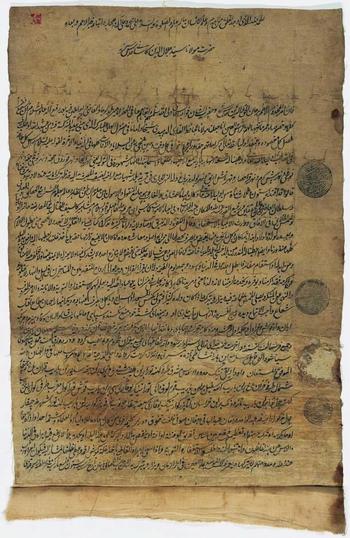
We will now introduce the waqf document held in Harvard University's archives, as the contents of this document undermine this ‘traditional’ chronology and demand that we re-envision both the chronology of Khwāja Isḥāq's career and the ‘royal patron’ model itself. The document also provides other important information that can help to expand our knowledge of Khwāja Isḥāq's activities and their context. For this reason, I will present this item's entire contents, sequentially, highlighting points of interest as I proceed.
The document declares the appointment of a shaykh to a mosque in Kucha, over whose lands and irrigation channels Khwāja Isḥāq is declared to have dominion. At the bottom, it bears the information that it was written in Samarqand in 966/1558–59. It thus dates to some sixteen years after the death of Makhdūm-i Aʿẓam, but the direct connection between this figure, Khwāja Isḥāq, and the property at hand is made explicit. The name Ḥażrat-i Mawlānā Sayyid Jalāl al-Dīn Kāsānī (that is, Makhdūm-i Aʿẓam) appears, ‘extracted’ from the text, at the head of the document, immediately beneath the formulaic invocatio. Beneath this, the main body of text begins:
After the prayer and salutation, al-Makhdūm al-Aʿẓam, the Proof of Truth and Religion (may [God] sanctify his secret), and Ḥażrat-i Ishān Khwāja Isḥāq, friend of God (may [God] grant salvation to them and their followers), in the presence of the Amir of the country of Kūjā [Kucha] and the qadi and the administrators [lit: those who work in it], ordered that [this decree] be listened to. And he read. . .Footnote 43
Following this introduction, we are introduced to the property at hand and to the individual receiving an appointment to work there:
We made Mawlānā al-Ḥāfiẓ al-Qārī al-Dahbīdī a shaykh and an imam in the sublime dwelling that was built with his [i.e. Khwāja Isḥāq’s] hand blessing it.
Notable here is the nisba of the new shaykh, revealing his connection to the lineage of Makhdūm-i Aʿẓam, who was buried at Dahbīd (modern Dahbed, Uzbekistan), near Samarqand. While the shaykh's nisba and titles are offered, it may seem curious that we learn nothing more of his name. The reason for this may be partly explained within the document itself, in a proximate segment that sheds some light on its function. Following a few lines praising the piety of Khwāja Isḥāq, we learn of the irrigation outlay that he is to receive, and we also apprehend the hint of a previous document (presumably lost) related to the present one:
[A]nd we gave him as a present nine flowing canals with their lands and their people, and the names of these canals are known in the tawliya [document appointing a shaykh]. . .
We see that the present source is not the only official document that was drafted to confirm the appointment of this shaykh; we may speculate that the tawliya mentioned here may have contained more comprehensive information.
After this, the canals irrigating the property are named, and we are given a useful hint as to their whereabouts:
. . .and for him a canal is flowing in a village of the country of Shahyār. . .
Though we have no way of knowing which village is indicated, we know that Shahyār (present-day Xayar) is located roughly 65 kilometers southwest of Kucha—thus, we have a intimation as to why the Amir of that domain was present for the deed's ratification.
The document then continues with a longer passage of praise for the accomplishments of Khwāja Isḥāq, describing him as an ‘Islamiser’, a killer of infidels, and a supernatural figure. Remarkably, it refers (albeit vaguely) to events that appear in hagiographical accounts of his life, such as those found in the Taẕkira-i ‘azīzān. Indeed, the document refers directly to a book titled Żiyā’ al-qulūb, indicating that this work was first authored in Khwāja Isḥāq's own lifetime:
His miracles became manifest at his birth. . . They said that 330 of the friends of God (exalted is He) followed his example, and that he was a leader [imam] of the eastern [lands] and western [lands]; that he was a collector of traditions and principles from among the esoteric and exoteric sciences; that he was learned in the sciences of the sharia. . . and that he revived the dead like Jesus, son of Mary (prayers and peace be upon both of them); that he was renowned like the battle-sword in conflict whether he was present or absent [at the battle];. . .that he was a killer of unbelievers and possessed sainthood; and that [he was the worker of] many miracles which are mentioned in the book Żiyā’ al-qulūb.Footnote 44
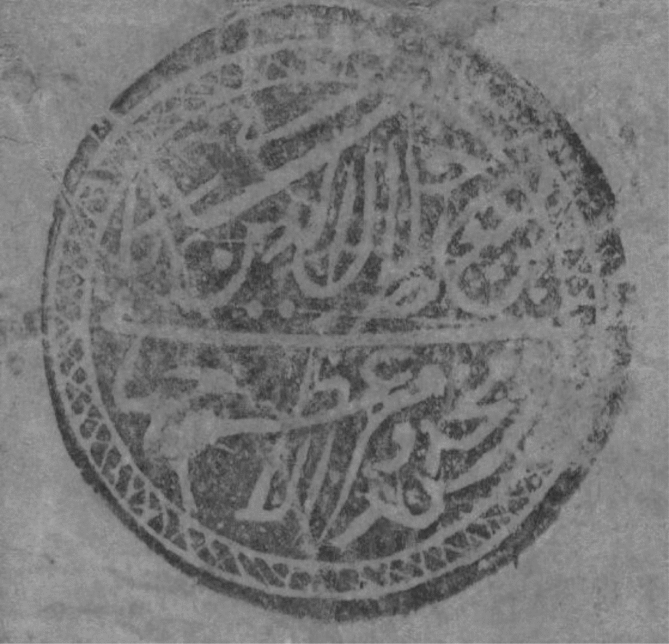
These comments on Khwāja Isḥāq's accomplishments, proclaiming his sainthood, might incline us to surmise that the present item was written after his death. But the document's seals support the earlier date provided in the text itself. One of the four seals has been badly damaged and one is unclear, but something can be made of the remaining two. The words “[Al-]Makhdūm al-Aʿẓam” and “Jalāl al-Dīn Kāsānī” are visible in the uppermost seal (fig. 1):
Figure 1.

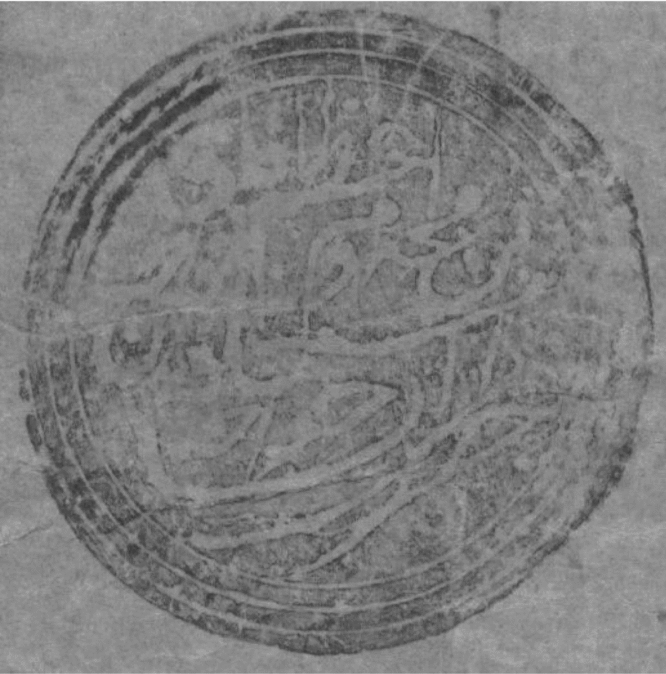
Below this, another seal appears to contain the words “Ḥażrat-i Ishān Khwāja Isḥāq ibn Makhdūm-i Aʿẓam Ghāzī” (fig. 2):
Figure 2.

These seals indicate that the document is original rather than a later copy. There are, moreover, no anachronistic names or other references in the document that would indicate a later origin.
Following this passage, the document continues summarising Khwāja Isḥāq's land-holdings, revealing that, by this time, he also held private property in an area stretching from Ferghana to the easternmost expanses of East Turkistan:
We also gave him the consecrated [land] from the country of Akhsi to the country of Qamuli [sic] as private property (khassa). . .
The distance between Akhsi and Qamul covers some 1850 kilometers, and the document gives no hint as to why these properties are mentioned or how many properties Khwāja Isḥāq controlled within that territory. The idea seems to be an extension of Khwāja Isḥāq's saintly ‘resumé’. Nor is it clear who is claiming to have given him all of this property, though we might presume that the property may once have been controlled by Makhdūm-i Aʿẓam, and is now passing into Isḥāq's hands. But, considering that Makhdūm-i Aʿẓam died some sixteen years previously, it is not clear by what mechanism this inheritance would have taken place, if in fact it was an inheritance. At the very least we learn from this document that, by 966/1558–9, Khwāja Isḥāq already controlled multiple properties between Akhsi and Qamul, including the mosque in question and its lands in Kucha, and at least one irrigation channel in Shahyār.
Following this mention of Khwāja Isḥāq's properties is a formulaic admonition that no one is to take the given property from its recipient, lest his face be blackened on the Day of Judgment.Footnote 45 After this, the focus seems to turn back to the mosque-lands, as the document specifies some of the hereditary benefits of their ownership:
[Even] if his progeny is numerous, they [all] have the right to sweep [the dust in] the mosque and fireplace and to eat [from] and use the [proceeds gained from selling the dust].Footnote 46
Here follow several apparently formulaic lines in Persian which are essentially a reiteration of the admonition against expropriating Khwāja Isḥāq's lands, threatening once again that all transgressors will suffer blackened faces on the day of resurrection. Unlike the Arabic admonition, however, the Persian one mentions its intended audience by title, providing a rare list of official titles (etc.) for the territory of Kucha.Footnote 47
After this Persian admonition comes a section in Chaghatay Turkic providing what appears to be the conventional delimitation of a specific territory—possibly the mosque-land in question, or maybe an additional canal, the rights to which are being granted in the document. The passage describes the course of a border-channel called the Dawud Canal, and the hypothesis that this canal is not connected with the Kucha mosque may be supported by the fact that none of the nine waterways listed in connection with that mosque bear the name “Dawud”. This segment provides one key piece of information worth stressing: the Dawud Canal is said to run along the south side of what seems to be a shrine dedicated to Khurāsān Ata Buzurgwār.Footnote 48
Following this Turkic passage, the document concludes with several lines of apparently hastily-written Arabic, reiterating the admonition that the property mentioned in the document not be confiscated by the Amir or the qadi (or others not specified), lest they call down divine vengeance upon themselves.Footnote 49
In sum, this document may serve as a landmark in our chronology of Khwāja Isḥāq's career, and it also adjusts our idea of how Naqshbandī Sufism spread in East Turkistan. The hypothesis, drawn directly from hagiographical literature, that Khwāja Isḥāq's activities in East Turkistan began only when he arrived at the behest of ‘Abd al-Karīm Khān can now be conclusively rejected on the grounds that ‘Abd al-Karīm did not take the throne until three years after the date of this document, which indicates that Khwāja Isḥāq already had considerable land-holdings in the region by that time. The document thus also calls into question the ‘common knowledge’ that Khwāja Isḥāq relied on the patronage and complicity of Muḥammad Khān to gain a foothold in the region. It likewise challenges the idea that Khwāja Isḥāq's early failure to capture the special favour of ‘Abd al-Karīm Khān resulted in his languishing for an unspecified number of years until he finally found a royal patron elsewhere.
We may also revise our chronology of the alleged missionary activities that Khwāja Isḥāq was said to have undertaken among the nomadic peoples of the region. While the Taẕkira-i ‘azīzān depicts Khwāja Isḥāq's ‘mission’ among the Qirghiz and Qazaqs as taking place only after his brief period of service to ‘Abd al-Karīm Khān, the present document reveals that Khwāja Isḥāq was already referred to as an inveterate “missionary” before ‘Abd al-Karīm's accession, and that a hagiography of his missionary activities already existed in some form by that time.
These are the principal points of interest in the document for the purposes of this paper, but these points do not exhaust the value of the text. Other points of interest, enumerated above, can be briefly summarised as follows. First, the text declares a particular range for Khwāja Isḥāq's landholdings as of 966/1558–59, placing his properties between Akhsi and Qamul. Second, it shows a shaykh bearing the Dahbīdī nisba being appointed to an East Turkestani mosque, a piece of evidence toward tracing the Dahbīdī ‘line’. Third, it shows that the seal of Makhdūm-i Aʿẓam was still being affixed to official documents at least sixteen years after his death. Fourth, it may be the only extant ‘grant’ document bearing the seal of Khwāja Isḥāq. Fifth, it is the only ‘grant’ document of which I am aware which describes the sainthood and miracles of a still-living landowner. Sixth, it provides some information on court titulature in Kucha in a period for which our knowledge of its administrative apparatus is slight. Seventh, it proves that the reverence of Khurāsān Ata Buzurgwār extended well into East Turkistan, a point of departure for further research into this saint's influence and a step toward diversifying our picture of the Sufi ‘pantheon’ in the region.
It is clear, above all, that we may use this document and others like it to ‘check’ evidence provided by our hagiographical sources. Such an effort may reduce our reliance on hagiography in establishing the basic chronology of the period and facilitate a renewed attention to such sources as hagiography. As we find reason to question the chronology provided by these sources, we may also question the longstanding ‘royal patron’ model supported by such a chronology. Devin DeWeese has recently called into question the very notion of the exclusive attachment of royals to one Sufi ‘order’ or another as a fundamental aspect of their early development, questioning our notions about the alleged competitions among these orders for the allegiance of particular royals.Footnote 50 Meanwhile, some scholars have placed emphasis on other paths by which Sufi groups could have developed without an inherent need for elite patronage. John Renard notes, for example, that some groups appear to have had close relations with futūwa organisations, and we can well imagine that a burgeoning Sufi ‘order’ could find both revenues and new followers by fostering such ties.Footnote 51 More compelling still is Renard's argument that the appearance of royals in hagiographical texts might profitably be read as means by which these royals’ patronage was courted, rather than as proof of existing or actual patronage.Footnote 52 This promising approach suggests nothing less than the complete inversion of the ‘royal patron’ model of development. Finally, numerous studies of Naqshbandī influence in Transoxania have abandoned the most simplistic renditions of the ‘royal patron’ model in recent years, recognising a more intricate set of interrelationships and undermining the hypothesis that the correlation between Sufism and power in Central Asia was little more than a matter of rival orders jostling for elite patronage. For example, research into the activities of Khwāja Ahrār has shown that, having accumulated a fair amount of land, a Sufi leader could manoeuvre with a remarkable degree of economic independence; far from relying on a royal ruler to consolidate authority, they could sometimes find rulers relying on them to maintain balance and order in a given domain.Footnote 53
Such intricate negotiations are typically missing from hagiographical accounts, in which they would have little place. Perhaps the most crucial thing to remember when surveying such literature is that many Central Asian Sufi hagiographies are, above all, teleological in their perspective. The importance of a royal patron in the career of a Sufi saint will often be stressed because (and, in some cases, perhaps only because) future rulers and elites, such as those who often commissioned these works, have an investment in legitimating their own lineage by connecting it to the activities of a particular saint.Footnote 54 It is no coincidence, for example, that Qutluq Muḥammad Mīrzā Churās is depicted in one of our sources as being an esteemed supporter and companion of Khwāja Isḥāq; he was, after all, the direct ancestor of that account's author. Our hagiographical literature, then, should neither be mined uncritically for ‘facts’ nor dismissed as useless ‘folklore’. Rather, these sources should be read with an attention to their particular discursive logic, and to the stakes that may be involved as they characterise each actor as either an ally or an enemy of the given saint. We may be aided in this effort by bringing evidence from other kinds of sources to bear on the portraits provided in hagiographical literature.
Figure 3.

(Transcription)