The establishment of public services in the last third of the nineteenth century aimed to guarantee the efficient functioning of cities. Such programmes expanded after 1890 and culminated throughout western Europe in a phenomenon described as municipal socialism. Cities owned and managed tramway lines, waterworks and other local utilities; they created labour exchanges and improved their school systems. Nevertheless, there were limits: with reference to building programmes for housing, for example, city authorities were generally very cautious and subsidies for private building societies were preferred to any extension of municipal ownership of residential housing. Thus a ‘public–private mix’ characterized municipal socialism in this period, generating profits for the municipality while serving specific constructions of the public good.Footnote 1 Hence, we need to examine what municipal socialism meant in different local contexts. Here, the capability approach of Amartya Sen helps to deconstruct a very general description of municipal infrastructural politics, to allow us to examine the motives, considerations and deliberations underpinning communal public action. Within this context we can discover who had access to public services and under what conditions. We can analyse the arguments employed by the decision-makers when justifying the creation of these services in the name of public interest or the common good. For what reasons did local governments try to gain control over labour exchanges, for example? What were the motivations and what objectives were attained? Finally, did such measures help the individual integrate into urban communities and gain an independent social role – and under what terms? Could those previously excluded integrate more easily, thanks to these measures?
Amartya Sen established the concept of ‘capabilities’ with regard to the development of the welfare system and the possibilities of its measurement. His approach seeks ways to measure social justice and economic development beyond quantitative figures. The concept has normative as well as analytical implications. Together with Martha C. Nussbaum's ten fundamental capabilities (among others life, bodily health and integrity, emotions, control over one's environment), the capability approach builds on the basis of the Human Development Index (HDI) used by the United Nations to measure processes of development.Footnote 2 Sen distinguishes between the ‘concept of “functioning”’ which ‘reflects the various things a person may value doing or being’ and capabilities. The former can extend ‘from elementary ones, such as being adequately nourished . . ., to very complex activities or personal states, such as being able to take part in the life of the community and having self-respect’. Individual capabilities refer ‘to the alternative combination of functionings that are feasible’ to achieve. ‘Capability is thus a kind of freedom: the substantive freedom to achieve alternative functioning combinations (or, less formally put, the freedom to achieve various lifestyles)’.Footnote 3 While Sen's concept of capabilities has not only influenced development politics but also social scientific discourses, its impact on historical study has been limited, at least in Germany. A central reason for this reticence to embrace the capability concept can be attributed to its broad macro-level approach to measure the development of whole societies. However, this article will illustrate that it is also possible to use Sen's concept at a local and very concrete level. Another obstacle is that Sen's idea of freedom equating to real choice for individuals to lead their lives according to their own values did not exist as a political strategy for decision-makers in the nineteenth century. In a class-based society those at the top were not interested in equal resources and equal opportunities. In the nineteenth century, the middle classes in (German) cities were at the forefront of liberalism and preached individual choice and success again and again. However, individual potentials on the one side and the promotion of such individual capacities on the other were structurally unbalanced in nineteenth-century cities. The capability approach can thus give insight into the discourses and practice of justice in a given historical situation. In addition, historians often have to deal with the problem of a limited transferability of modern concepts into historical contexts (consider only the debates about civil society), but still can make effective and productive use of them.Footnote 4 In the case of this article, the ‘capability approach’ will be used as an analytical tool. This offers historians the chance to detect new lines in historical development which were previously neglected, to create new frameworks of interpretation or to strengthen former interpretations.
Social policy in the German empire has long been perceived as centred on the nation-state as, compared to other European states, national insurance schemes were established in the 1880s, much earlier than elsewhere.Footnote 5 However, cities offered opportunities for local experiments. First, the long tradition of German municipal self-government gave local authorities the powers to develop new social welfare models. Secondly, the problems caused by urbanization and industrialization forced the creation of new solutions. Traditional municipal welfare based on limited help for a few individuals could not cope with the fundamental changes in the last quarter of the nineteenth century. Local authorities therefore employed a whole set of public services to address urban social problems. Here again, the capability approach comes in. Since national welfare state institutions were still only beginning and in no way sufficient, an ‘enabling community’ was necessary to guarantee the future and development of the city and give its inhabitants possibilities to participate and profit from these new institutions and services.Footnote 6 A capability approach points up potential links between the building of local infrastructure and public services and the creation of individual choice. It takes the impressive research about building a local infrastructure and providing public services in German cities in the late nineteenth and early twentieth centuries into account, but focuses more on the scope of the individuals and how they could make use of these newly available services.Footnote 7
In this case-study, the two towns of Erfurt and Frankfurt am Main were chosen as they represented different ways of dealing with the problems of urbanization within the same national context: Frankfurt was one of the precursors of a well-developed welfare regime and a stronghold of German left liberalism while Erfurt represented a politically more conservative town. Both belonged to Prussia in the nineteenth century, Erfurt from 1815 and Frankfurt from 1866. While by the late nineteenth century, Erfurt's political elites saw themselves as Prussian and acknowledged the advantages of belonging to the Prussian state, in Frankfurt resentments remained strong, as Frankfurt lost its status as a ‘Free town’, i.e. an independent city-state within the German Confederation when forcibly integrated into the Prussian state. Hence, a comparison between Erfurt and Frankfurt offers perspectives on differences as well as similarities in the provision of public services.
Erfurt's population rose from 41,760 (1867) over 72,360 (1890) to 129,785 (1914). After defortification in 1873, Erfurt developed as an industrial town and attracted labour migrants from the surrounding Thuringian states and Prussian districts. Its economy was diversified but the main focus lay in machine-making, the clothing industry (especially ladies’ coats and shoe making), gun-production and horticulture. As capital of its Prussian district, the town also had a growing tertiary sector. In 1907, about 30 per cent of all employees were working in this sector.Footnote 8 Frankfurt am Main had long been a major banking centre and became one of Europe's leading stock exchanges during the nineteenth century. Yet, the manufacturing sector played an increasingly important role, especially the chemical industry and machine building industry, established both in the suburbs and in the town itself. In 1867, about 76,000 people lived in Frankfurt, growing from 154,000 in 1885 to 444,900 by 1914.Footnote 9
In political terms, the local elite in both towns – as in all other Prussian towns – excluded many inhabitants from participating in local politics until 1918. The local electoral system was not secret, and it was unequal. Erfurt had a three-class franchise (Dreiklassenwahlrecht); this allowed the disproportionate representation of the rich and male propertied classes on the municipal council. In Frankfurt, the municipal franchise was confined to those with incomes over 1,200 Mark per annum, to house owners or to those who ran a workshop that employed at least two journeymen. Political participation as a central capability was therefore de facto limited. In Frankfurt in 1905 with a population of about 335,000 people only 31,537 male inhabitants were allowed to vote (9.4 per cent). In Erfurt in the years between 1900 and 1914 this ratio lay between 12 and 14 per cent. As a result, the labour movement was excluded from municipal politics – in Frankfurt until 1901, in Erfurt until 1912.Footnote 10
Building local infrastructure: public transport
The rising urban population and urbanization as well as new ways of living posed severe challenges. While some nineteenth-century cities, especially in the Ruhr valley, were almost overwhelmed by such developments, Frankfurt and Erfurt grew, but at a much slower pace.Footnote 11 Nevertheless, even here early urbanization was largely uncontrolled.Footnote 12 From the 1870s, however, new forms of municipal governance emerged and fundamental decisions about Erfurt's and Frankfurt's infrastructure were made in the 1870s and early 1880s.Footnote 13 During these and the following decades, such measures fostered a professional, efficient municipal bureaucracy, a process visible in all Prussian and German cities at this time albeit accompanied by great local variation; this spelt the foundation of city planning.Footnote 14 Municipal incomes and expenditure grew steadily throughout the German Kaiserreich. Economic growth sustained higher tax revenues, but paying for new amenities increased urban debt as well. For example, Frankfurt funded infrastructural development in the second period of the Kaiserreich mainly with municipal bonds, ‘for which reason the indebtedness of the city grew from 44 million Mark in 1886 to 182 million in 1905’.Footnote 15 In these years of rising debts, one fundamental innovation was continually supported: the construction of a modern mass public transport system.
Urban growth and segregation between suburban residential quarters and city areas reserved for factories created the ‘problem of distance’.Footnote 16 New forms of transport were discussed, not only in metropolises and capitals, but also in middle-size and smaller cities such as Frankfurt and Erfurt. Employees had to reach their workplaces on time, efficiently and, at least to some extent, rested in order to be able to undertake increasingly physically demanding jobs. As a Frankfurt town councillor put it: ‘The interests of industry demand the prompt completion of this line [to an industrial area of Frankfurt]’.Footnote 17 Here, local public transport enabled access to work, shopping facilities and other services; without the trams, these remained out of reach in the daily lives of urban inhabitants. Thus public transport created – in terms of a common good – a capacity for all to participate in social and economic life. Technological know-how, urban planning, social obligation and social politics could thus combine in public transport to create capabilities for the urban population.Footnote 18 Viewed from another perspective, such possibilities met the interests of industrial capitalism as well. In fact, in both Erfurt and Frankfurt, transport development was initiated by dialogue between private enterprise and the municipal authorities. Who therefore profited from the creation of the tramway? How did it develop in the decades before World War I? What conclusions can we draw from these developments with regard to the promotion of capabilities, on the one hand, and to the motives and ideas of the town government to finance and implement such infrastructure, on the other?
While both towns followed the technical development of the late nineteenth century from horse drawn tramway to electrification (Erfurt as early as 1894, Frankfurt in 1897), the ownership structures differed in a central respect. In Erfurt the tramway remained in private hands and the town profited from a levy on the gross income of the public limited company. In Frankfurt, by contrast, the municipality decided in 1897/98 to bring the tramway into public ownership.Footnote 19 Despite this fundamental difference we do not find totally divergent results. Erfurt's tramway system did not develop into a mere prestige project for middle-class leisured pursuits that secured a profit for the tram company without having to raise revenues to fund great investments. Nor did Frankfurt's municipal tramway develop into a subsidized welfare organization running permanently in deficit. The opposite was the case. Mass mobilization meant that, in both towns, the two different organizations had to adjust to market requirements. It was not feasible to allow ticket prices to rise in a manner that would have prevented workers from using trams (and so keep the status of an exclusive means of transportation for the middle classes); equally, investment in new lines to workers’ quarters or industrial areas had to be considered to make the trams attractive in both towns. For example, in Erfurt the northern part of the town with a lot of workers’ quarters and the strongly industrialized suburb Ilversgehofen were well connected with the city centre and other parts of the town. Technical innovations, market requirements, municipal awareness of the social question, political pressure from the rise of social democrats in local politics and new administrative and technical expertise in municipal government – all combined to offer new opportunities for a majority of inhabitants in both towns, including the better-paid parts of the workers.Footnote 20 As a result, the number of passengers increased steadily: in Erfurt from about 2.2 million in 1895/96 to nearly 7.6 million in 1913/14, in Frankfurt from 29.2 million (1898) to 110.2 million (1912).Footnote 21
However, differences between the two towns remained. Saddled with a long-term contract for a private tramway company, Erfurt's municipality was vulnerable to blackmail. For example, in a telegram in 1893 the tramway enterprise bluntly threatened to withdraw from the intended contract if news reported in the press were true that ‘additional burdens should be imposed on us. As soon as the traffic seems to make an enlargement of our net lines profitable, it lies in our own interest to take initiatives’.Footnote 22 This illustrates the tensions between municipal planning, where the common good is realized by public authority, and a private alternative, where commercial considerations alone determine the future action. Frankfurt's municipality was totally free of such conflicting pressures. As Frankfurt's most influential mayor, Franz Adickes, stated in his speech at the Deutsche Städtetag (Association of German Cities and Towns) in 1903: ‘After the bad experiences, which we had for a long time with our attempts at contractual control of traffic, consumption and tariffs, we believe that, with tramways, municipal ownership and operation are best for the public interest . . ., and are quite generally accepted.’ Of course, in Adickes’ view the municipality still had to resist ‘requests from suburban boroughs for extension of non-profitable lines (amusement [among the audience])’ as well as ‘popular demands for dangerous price reductions’.Footnote 23
In consequence, the results of the two tramway systems were different. Because of the different size and economic structure of the two towns, a comparison has its limits, but on the other hand the outcomes vary so evidently that we can assume that one crucial factor was the different management structures. If we take the passenger figures in Erfurt in 1900 there were 41 passengers per inhabitant, while in Frankfurt this ratio reached 143 passengers.Footnote 24 We can calculate that per day only one in five inhabitants of Erfurt used the tram in 1912/13, while in Frankfurt in 1910 it was every second inhabitant. Furthermore, statistically per one kilometre line, 365,000 persons used the tram in Erfurt. In Frankfurt it was nearly 1.4 million passengers.Footnote 25 It was thus only natural that the social democratic Erfurt newspaper Tribüne complained in 1908 that Erfurt's tramway network did not integrate the working-class neighbourhood in the eastern part of the town and that, hence, the tramway ‘is still far from being a modern means of transportation. In fact, today it is only an establishment serving for one's comfort conducted with modern means’.Footnote 26
Such figures indicate that local traffic and fare policy administered, organized and operated by the municipality contributed more towards social inclusion and urban integration than the alternative managed by private enterprise. But we cannot conclude from these differences that Frankfurt's political elite was more responsive to social problems; this would go too far. Both municipalities faced the same problem and had two choices which had their positive and negative effects. In both cities, economic and social factors, arguments and interests were taken into consideration. Frankfurt's decision-makers were especially interested in connecting the suburb with the workplace, to relieve inner-city housing problems.Footnote 27 City planning and transport policy were closely linked; but this was at least to some degree true for Erfurt's administration as well.
The attempt by Frankfurt's left liberals to win social democratic votes in municipal elections reinforced the decision to bring the trams under municipal control, an option not under consideration in Erfurt when the electrification of the tramway was discussed. This forms the key difference between the two cities. The close decisions for municipalization and improvements of mass transport were interrelated with local politics: this is also reflected in Frankfurt's pricing policy of its tramway. The price system was reformed three times between 1899 and 1904; after municipalization took place and the first social democrat was elected to the town assembly in 1901 subsidized fares for workers were introduced and suburban lines extended into working-class neighbourhoods.Footnote 28 However, Frankfurt was exceptional; Erfurt's decision against municipalization in the 1890s was not unusual. In Prussia in 1900 only 23 of all 127 tramways were under municipal control.Footnote 29
Action against unemployment: municipal job centres
Unemployment not only meant lost income but also loss of social networks and contacts.Footnote 30 It was only at the end of the nineteenth century that unemployment was accepted as a structural problem instead of a personal deficiency of the unemployed themselves. In contrast to social insurance systems introduced for old age, invalidity and illness, German insurance to cover unemployment at the national level did not materialize until 1927. The main reason lay in the complexity surrounding the issue. As long as decision-makers, politicians and public opinion (social democrats and trade unions were not free of such prejudices) regarded the unemployed as ‘work-shy’, ‘lazy’ and ‘idle’ or tried to distinguish clearly between voluntary and involuntary unemployment, social insurance was deemed too complicated.Footnote 31 Other strategies therefore became involved, initiated by trade unions and other associations and by local institutions. Protests, petitions, self-organization and action by the unemployed, participation in parties and unions and support from middle-class benefit organizations all formed part of these additional measures: civil society strategies in the fight against unemployment. In addition, the unions in particular tried to protect against the risk of joblessness with some form of insurance. As this case-study focuses on municipal politics, these measures will be put aside and this section will focus on one central aspect of locally situated public actions with regard to unemployment in Erfurt and Frankfurt: the work of local job centres between the late 1890s and 1914 – a period when the business cycle was quite unstable.Footnote 32
The early 1890s were the time for experiments in social policy. At the national level, the idea of a ‘new pathway’ (Neuer Kurs) promoted ideas of co-operation instead of confrontation. In the early years of Wilhelm II, the state implemented reforms aimed at integrating social groups which had been excluded in the earlier period under chancellor Otto von Bismarck. Social policy legislation against work on Sunday and laws aiming to improve labour protection, especially, were intended to attract working-class people and keep them away from social democrats and their political influence. This realignment at the national level influenced the local level too. Here, for example, municipal elites recognized severe deficiencies in local job placement as finding a job was still based on a very informal process. The so-called ‘look-around’ (Umschauen) had many disadvantages. The mayor of Erfurt, Paul Schneider, stated in 1893: ‘Looking for work, workers are forced to go from shop to shop, from house to house to enquire for work. This is a social evil.’ Founding a municipal job centre had advantages: ‘the many private employment agencies which result mainly from unemployment will disappear. Those unemployed who put their nest egg in swindlers’ pockets will then get job offers free of charge’.Footnote 33 Thus, municipal job centres were created in Frankfurt in 1891 and Erfurt in 1893.
The first initiatives were realized in dialogue with the social democratic trade unions. In Erfurt, the chairman of the Protestant Workers’ Association (a conservative organization) argued in a public meeting in October 1893 that ‘it would be good if social democrats were integrated since many workers were members of this party. If such integration ceased, this would cause only mistrust and the whole project would collapse.’ And members of the Erfurt social democrat association who attended the public meeting emphasized that they would ‘honour every step which promotes a job service’.Footnote 34 In Frankfurt at a meeting of metal workers in May 1891 a trade unionist stated that employers mistrusted trade union employment services and the trade unions could not offer many jobs. He therefore suggested discussing the idea of a municipal job centre whose organizational structure should adopt the model of the industrial court because it provided equal representation of workers and employers.Footnote 35 Other influential voices, especially Max Quarck, from 1901 the first SPD town councillor in Frankfurt, also sought to come to terms with the town municipality. These initiatives expanded in 1893 successfully with left-liberal Karl Flesch, spiritus rector of social reform in Frankfurt. Flesch and Quarck promoted a commission for the job centre with equal representation for employers and trade unionists.
Despite these promising beginnings in Erfurt and Frankfurt, no co-operation transpired between the labour movement and the municipality. Two reasons were pivotal. First, the labour movement in both towns was internally divided. On the one side stood reformers open to new initiatives, on the other Marxist-oriented representatives. The latter saw co-operation with the municipality as a reform too far, ‘harmonized twittery’ (Harmonieduselei) as a Frankfurt trade unionist called it in May 1892.Footnote 36 Secondly, hard-liners were also found in the municipality. In Erfurt, the mayor and the conservative majority of the town council refused to run the job centre along the lines of the industrial court because, according to the conservatives, this organization was coming gradually under social democrat domination. In Frankfurt, co-operation developed much further, but also finally failed. Here, the ‘strike clause’ was not accepted. According to this clause, the municipal employment service should not offer jobs in companies where strikes took place. The unions insisted on this paragraph to prevent strike-breaking. While the Frankfurt magistrates demonstrated their willingness to come to a compromise, among liberal and conservative town councillors opposition to this clause grew. For juridical reasons – supporters as opponents were not sure if the statute was in concordance with the Prussian Municipal Constitutional Law (Gemeindeverfassungsgesetz) – the town council sent the statute to the District Committee for Social Politics. This committee did not accept the ‘strike paragraph’ because it saw in it a ‘severe danger’ for the ‘necessary impartiality and independence’ of a municipal institution from political and party contentions.Footnote 37 In addition, trade unionists felt disadvantaged when vacancies in the administration of the job centre were offered and union candidates were rejected. In 1896, therefore, the Frankfurt trade unions withdrew from the idea of supporting a municipal labour exchange until 1903 and tried to build up a central trade union labour exchange. The withdrawal of this communal experiment was in accordance with the general line of the trade unions at the national level.Footnote 38
Such political controversies should not distract from the benefits of labour exchanges during the years 1890–1914. First of all, free municipal labour exchanges in both towns protected the unemployed from dubious, unreliable employment services and helped to abolish unsustainable conditions in job seeking. Secondly, the job centres in both towns developed as important contact points for the unemployed, securing thousands of placements, and offering other positive measures for the jobless. In the waiting room, the unemployed could read the displayed newspapers and, in Frankfurt, buy food – but not beer.Footnote 39 Here, the exchange administration made the visit more comfortable and aimed to overcome its poor reputation. In addition, local administrators established contact with other municipal labour exchanges in the Rhine–Main area and in the Thuringian neighbouring states to get an overview of the labour market as a whole. In Frankfurt, the labour exchange even excluded employers ‘who notoriously and, according to the industrial court, repeatedly do not fulfil their obligations to workers’. With this measure, the labour exchange was developing into an institution that decided which jobs were acceptable and which unacceptable, an aim which had already been stated in 1895: ‘That the public organization of the employment service will eventually control all job offers seems inevitable.’ To gain popular support, the labour exchange administration displayed posters, took out advertisements and published monthly statistical reports in some newspapers as proof of their success. In both cities, unemployment policy not only tried to solve deficiencies in job placement and to offer opportunities for the unemployed but also made efforts to consolidate public order.Footnote 40
However, prejudices and limitations became obvious in both towns. The ‘problem of maintaining order’ was, according to local officials, severe in the Frankfurt municipal labour exchange. The young unemployed especially had an ‘inclination to boisterousness and often to crudeness and cheekiness’, and were ‘not really interested in working’.Footnote 41 Conflicts persisted and were continually discussed in terms of such people being ‘work-shy’. The municipal labour exchange commission decided on 28 June 1900 to take ‘as harsh as possible course of action against work-shy people’: ‘This approach succeeded as elements of low moral value that used to hang about the employment service now nearly all keep away.’Footnote 42 And in Erfurt, job centre officials celebrated the leasing of a second waiting room as now they could separate the unemployed from the employers wanting to offer jobs.Footnote 43
Two fundamental differences between Erfurt's and Frankfurt's institutions become apparent. First, while female unemployed dominated Erfurt's job centre throughout this period, female jobless were initially integrated into Frankfurt's exchange to a much lesser extent. From the early twentieth century, women used the labour exchange more often and, from 1905 on, they dominated its placements. The main reason for this inequality stemmed from the unsatisfactory employment service for female servants who were not well integrated into Frankfurt's labour exchange before 1905. Two further reasons for rising rates of female placement were that the municipal labour exchange was the only employment service in the city that offered women occasional work and the exchange advertised such jobs with posters on the electrical tramway and in public spaces.Footnote 44
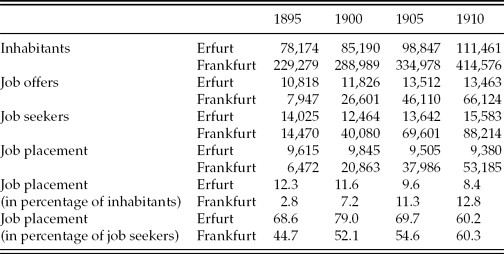
Secondly, whereas Frankfurt's placement rates started at a very low level, in terms of the city's working population, Erfurt's job centre began very successfully, but from then on failed to expand (see Table 1). To illustrate this point, in 1895 Erfurt's labour exchange placed 12.3 per cent of the unemployed successfully (in relation to the population), a rate which was not achieved in Frankfurt until 1910. If Erfurt's job centre had been able to sustain this rate, it would have been able to place 13,375 unemployed in 1910. However, even with a placement rate of 9.6 per cent in 1905, Erfurt's job centre was still the second most successful in Prussia, after Frankfurt with 11.3 per cent.Footnote 45 It would take many local in-depth studies to explore the great variety between the different cities in Prussia, but we can assume that Erfurt, as one of the first towns in Prussia to establish a job centre, profited from its long experience and its ability to integrate women into the labour exchange; and Frankfurt, with its distinctive municipal socialism, was able to transmit its progressive policy to the local labour exchange, meaning that this became widely accepted among the unemployed, employers and increasingly by women workers.
Comparison of main results in Erfurt's and Frankfurt's labour exchange, 1895–1910

Sources: Verwaltungsberichte Frankfurt, 1895–1910; Verwaltungsberichte Erfurt, 1895–1910; Silbergleit, Preußens Städte, 292ff; Roth, Gewerkschaftskartell, 169; Roth, Stadt, 47.
Despite the relative success of the labour exchanges in both cities, two constraints have to be considered. Both municipal placement agencies faced competition from other employment services for skilled workers in the early twentieth century. Trade unions never gave up their specific labour exchange for their trade or a small group of trades. Guilds (Innungen), employers’ associations and single employers boycotted the municipal service. In 1905, 40 other labour exchanges and 28 private employment services still existed in Frankfurt.Footnote 46 In addition, the officials stated that ‘especially the best qualified and most socially integrated workers’ did not use the municipal labour exchange. They were approached directly by employers or used personal networks of colleagues, friends and relatives who helped them to find a new – and appropriate – job.Footnote 47
This leads to the second restriction, the association with the unskilled unemployed.Footnote 48 Although one can find only little hints in the sources, it seems that this group was subject to discrimination and, indirectly, was blamed for the labour exchanges’ poor reputation. In addition, while the labour exchange did not check the qualifications, references and certification of the unemployed (which it left to the employers unless the employers demanded some qualification when seeking new recruits),Footnote 49 demarcation between skilled and unskilled was accompanied by spatial segregation: ‘For better maintenance of order in the waiting room’ the labour exchange administration in Frankfurt opened a second counter for the unskilled: ‘these job seekers always remain in that part of the waiting room in which the access to the new counter [for the unskilled] is, while the other part of the waiting room, situated towards the Main, is reserved to skilled workers. In this way it is possible to arrange easier service completion and ample calm without any resort to coercion.’Footnote 50 Again, the unskilled were held responsible for disorder and misbehaviour.
To conclude, relative to their inhabitants both municipal exchanges enjoyed equal success, but with different groups: Erfurt's exchange among unskilled male and female unemployed, Frankfurt's among skilled unemployed – and with a vast rise among women. At least in part, these successes indicate increased opportunities for the unemployed, particularly if we take into consideration that in Frankfurt, after April 1910, the labour exchange was combined with a municipal accommodation service. This service specialized in small flats with only one or two rooms. This integration of two fundamental social problems demonstrates how Frankfurt began to co-ordinate its social policy strategy.Footnote 51 Above all, the development of Frankfurt's labour exchange towards an institution which controlled and inspected working conditions of jobs on offer and allowed placed workers to leave if conditions were not acceptable, opened the first possibilities of free choice for the unemployed individual. However, this was true only for a minority of jobs offered. The Frankfurt example also shows that differentiations between the ‘good and willing’ and the ‘work-shy’ persisted; those classified as ‘work-shy’ had no chance to exercise choice in this matter. Limits and boundaries continued to shape outcomes. For this reason, interpretations that see in municipal labour exchanges an institution fundamental to changing attitudes towards unemployment go too far. Municipal politicians, experts and decision-makers probably were beginning to accept that unemployment ‘was to be found less in individual character than in the condition of the labour market’,Footnote 52 but they did not totally reject traditional prejudices that stressed moral faults found among jobless people.
Concluding remarks
Can we argue that, by the late nineteenth century, public services were helping to integrate formerly excluded people into the urban social fabric? In practice, the results of transport schemes and municipal job centres were ambivalent: public action imposed a social order that sustained inclusion and exclusion. Although local government did not think in terms of capabilities, we find mechanisms that show how individual interests were integrated into the general public interest. While Erfurt's politics remained quite traditional, mirroring class structures (the consequence of excluding social democrats from the town council until just before World War I), Frankfurt's political elite appeared more interested in experiments. On the one hand, left liberals had to respond to the demands of Frankfurt's labour movement if they wanted to keep their majority on the town council. On the other, the growing influence of social democracy in urban affairs after 1900 forced the mayor, magistrate and middle-class politicians to reshape public services to accommodate the common good of all urban inhabitants. These findings indicate, in addition, that the need to negotiate public services with political opponents created more opportunities. Probably the different political power structures of the local governments in the two towns played its part. While both legitimized their infrastructural measures and public services in terms of communal civic pride, in Erfurt this term had a more state-centred ‘Prussian’ inference than in Frankfurt, where it referred back to the independent approach of a former ‘Free City’. As an analytical tool therefore the capability approach opens new perspectives on social policy that go beyond national insurance schemes to evaluate critically how municipal institutions sought to mobilize city inhabitants and address social problems and with what results.
The tramway system in particular structured networks and linkages: workplace and home, leisure time and working time, suburb and city centre, living quarter and industrial area, urban planning and commercial interest. Especially in larger towns like Frankfurt, this opened new opportunities for people to go to (work) places out of reach in earlier years. That the public regime in Frankfurt fulfilled this task better than the private one in Erfurt might indicate a key difference between public and private management, but it also reflects the different size of the two towns.
With the municipal job centres we view very ambivalent institutions. They were in both towns, without question, an adequate answer to a severe problem in workers’ lives. But limited resources and fields of activity, dependency on economic cycles for offering jobs, embedded in political and class tensions within urban society and faced by frictions within the working class – all reduced the appropriation of capabilities for the unemployed. Differences between the towns became obvious, too. While the administration of Frankfurt's job centre tried to improve the working conditions of the unemployed by also stipulating rules for employers, Erfurt's job centre had no such inspiring ideas.Footnote 53 Urban public services, therefore, at the turn to the twentieth century in both towns were simultaneously reinforcing typical injustices while also trying to surmount them. The idea of capabilities in the sense of offering individuals the real possibility to choose their life was beyond consideration in the nineteenth century. Liberals still had the idea/utopia of a classless society of citizens (klassenlose Bürgergesellschaft) in mind, but focused their efforts mainly on middle-class individuals. Socialists, on the other side, thought also in categories of self-help, autonomy and improvement of social conditions and public deliberation for the workers; however, their main task was less the capabilities of an individual but rather the collective capabilities as a class. For many individuals who were reached neither by liberalism nor socialism, therefore, municipal public services opened some limited scope for self-determined decisions.
Beyond the individual effects on capabilities, the two public services, analysed in terms of urban co-ordination and city planning, produced diverse results. On the one hand, public transport opened the way to technical modernization with a growing influence of technical elites within municipal administration. Furthermore, introducing modern public transport strengthened efficiency criteria in regard to realizing profits for the municipality as well as with regard to bringing together work and workers. On the other hand, municipal labour exchanges helped to implement criteria that made it in the long run easier to decide which unemployed corresponded more to predominant values of work ethics, for local as well as national administrators. Inclusive and exclusionary processes were the result.Footnote 54 However, the value of efficiency had its positive effects, too. As the Frankfurt example (and, in part, the Erfurt case) showed, the task of filling vacancies efficiently created a municipal co-ordinating institution that helped unskilled and female workers to find access to the labour market while former institutions (trade unions or private businessmen) had neglected their interests. An increase of individual choice was, therefore, more a by-product of public services as part of urban co-ordination mechanisms than the main object of this policy – and that was the case for both towns.