Introduction
Individuals with amnestic mild cognitive impairment (aMCI) have a high risk of progression to dementia of the Alzheimer's type (Petersen et al., Reference Petersen, Roberts, Knopman, Boeve, Geda, Ivnik and Jack2009). Although exact figures vary, an annual conversion rate of 5% to 12%, as compared with 1% to 2% of cognitively healthy older adults, has been reported (Mitchell & Shiri-Feshki, Reference Mitchell and Shiri-Feshki2009). Although initially conceptualized as a purely amnestic disorder, with relative preservation of other cognitive domains and intact activities of daily living (Petersen et al., Reference Petersen, Smith, Waring, Ivnik, Tangalos and Kokmen1999), recent research into aMCI has demonstrated considerably more variation in cognitive impairment (Lonie, Herrmann, Donaghey, & Ebmeier, Reference Lonie, Herrmann, Donaghey and Ebmeier2008). Established episodic memory impairment within this population may interact with newly acknowledged, more subtle, deficits in executive attention to impact on an aspect of memory that requires both of these cognitive processes, namely, prospective memory.
Prospective memory (PM) refers to remembering to perform an intended action in the future (Einstein & McDaniel, Reference Einstein and McDaniel1990). PM comprises a retrospective component (remembering what to do) and a prospective component (remembering when to act; Ellis & Kvavilashvili, Reference Ellis and Kvavilashvili2000). Time-based PM tasks are executed at specific times, such as remembering to telephone someone at 4.30 pm, and require self-initiated strategic monitoring of the environment to recognize the appropriate time to act (Einstein & McDaniel, Reference Einstein and McDaniel2005; McDaniel & Einstein, Reference McDaniel and Einstein2000). Event-based tasks are executed in conjunction with another event, such as passing on a message the next time you see a friend, which allows for spontaneous retrieval of the PM task (McDaniel & Einstein, Reference McDaniel and Einstein2010; McDaniel, Guynn, Einstein, & Breneiser, Reference McDaniel, Guynn, Einstein and Breneiser2004). This early binary approach of categorizing PM (i.e., time vs. event) has been developed further by several research groups (e.g., Kliegel, McDaniel, & Einstein, Reference Kliegel, McDaniel and Einstein2000; McDaniel & Einstein, Reference McDaniel and Einstein2000; Smith & Bayen, Reference Smith and Bayen2004) to provide a more comprehensive model of PM which requires multiple processes including: planning the intended action; retention; monitoring and identification of focal or non-focal cues; inhibition of the ongoing activity; timely initiation and accurate execution of an intention. Furthermore, the complexity of the PM task may affect the cognitive resources required. Martin, Kliegel, and McDaniel (Reference Martin, Kliegel and McDaniel2003) found that executive functioning predicted performance on complex PM tasks but not on a simple PM task; and Kliegel, Jager, and Phillips (Reference Kliegel, Jager and Phillips2008) reported that PM was more challenging if the cue for PM was peripheral (i.e., non-focal) to the ongoing activity, as compared to a task in which the cue for PM was embedded within an ongoing task (i.e., focal cue). These findings emphasize the importance of considering the method of measuring PM as cognitive processes recruited will vary according to task demands. Nevertheless, the broad distinction of time-based versus event-based PM has provided a useful guideline for distinguishing profiles of performance in the clinical measurement of PM. For example, in other clinical populations, a time-event distinction has been useful in identifying differential impairment of time-based PM in Parkinson's disease (e.g., Raskin et al., Reference Raskin, Woods, Poquette, McTaggart, Sethna, Williams and Tröster2011) or global time and event PM deficits in schizophrenia (e.g., Wang et al., Reference Wang, Cui, Chan, Deng, Shi, Hong and Shum2009) and HIV (e.g., Carey, Woods, Rippeth, Heaton, & Grant, Reference Carey, Woods, Rippeth, Heaton and Grant2006).
Individuals with aMCI have demonstrated neuropathology in mesial temporal lobe structures, particularly entorhinal cortex and the hippocampus (Pennanen et al., Reference Pennanen, Kivipelto, Tuomainen, Hartikainen, Hanninen, Laakso and Soininen2004; Tapiola et al., Reference Tapiola, Pennanen, Tapiola, Tervo, Kivipelto, Hanninen and Soininen2008), the same structures linked to the reflexive-associative memory system that supports spontaneous retrieval of event-based PM intentions (McDaniel & Einstein, Reference McDaniel and Einstein2010; McDaniel et al., Reference McDaniel, Guynn, Einstein and Breneiser2004) and the episodic memory demands of the retrospective PM component (Goldstein et al., Reference Goldstein, Mao, Wang, Ni, Lah and Levey2009). Frontal system impairment has also been implicated in aMCI (Brandt et al., Reference Brandt, Aretouli, Neijstrom, Samek, Manning, Albert and Bandeen-Roche2009; Kume et al., Reference Kume, Hanyu, Murakami, Sato, Hirao, Kanetaka and Iwamoto2011); a neural system considered critical for strategic, systematic attention monitoring required by time-based tasks (Burgess, Scott, & Frith, Reference Burgess, Scott and Frith2003; Simons, Scholvinck, Gilbert, Frith, & Burgess, Reference Simons, Scholvinck, Gilbert, Frith and Burgess2006). Therefore, individuals with aMCI have the potential to struggle with different components and types of PM due to multiple areas of impairment.
Costa and colleagues (Reference Costa, Perri, Serra, Barban, Gatto, Zabberoni and Carlesimo2010) reported that individuals with aMCI were differentially impaired on time-based as opposed to event-based PM, which was thought to be a result of frontal involvement and the higher executive demands of time-based PM. However, McDaniel, Shelton, Breneiser, Moynan, and Balota (Reference McDaniel, Shelton, Breneiser, Moynan and Balota2011) manipulated the demands of an event-based task and found that, in the very earliest stages of dementia, focal PM (associated with more automatic retrieval processes) was differentially impaired compared to nonfocal PM (associated with strategic attentional demands). The suggested reason for this discrepancy was that the spontaneous associative retrieval processes relied on in focal, event-based PM tasks were compromised, related to early known changes in the mesial temporal systems. Other studies using aMCI populations have reported a more generalized deficit in both time- and event-based PM (Karantzoulis, Troyer, & Rich, Reference Karantzoulis, Troyer and Rich2009; Thompson, Henry, Rendell, Withall, & Brodaty, Reference Thompson, Henry, Rendell, Withall and Brodaty2010). These different findings may reflect the varying methodologies used across studies to index time- and event-based PM, the complexity of tasks and saliency of cues. Nonetheless, the findings of global PM impairment in aMCI are compatible with proposed underlying neuropathology (i.e., mesial temporal system and frontal circuits) and observed cognitive deficits (episodic and associative memory impairment as well as executive attention deficits) which have the potential to undermine both time- and event-based PM tasks.
While impairments in multiple areas of cognition are now considered important in the diagnosis of aMCI (Albert et al., Reference Albert, DeKosky, Dickson, Dubois, Feldman and Fox2011; Brandt et al., Reference Brandt, Aretouli, Neijstrom, Samek, Manning, Albert and Bandeen-Roche2009; Lonie et al., Reference Lonie, Herrmann, Donaghey and Ebmeier2008), the area of PM remains under-used diagnostically. One reason may relate to the limited availability of appropriate tests to systematically measure the construct in clinical practice. The Rivermead Behavioural Memory Test (RBMT; Wilson, Cockburn, & Baddeley, Reference Wilson, Cockburn and Baddeley1991), was an early memory battery that included PM subtests. However, the PM subtests were simple, single-trial, event-based tasks. There is an inherent difficulty in using single probes of PM with a limited scale, as it may lessen the sensitivity and reliability of the measure. Nevertheless, several researchers have successfully adapted the RBMT PM protocol. For example, Kinsella and colleagues (Reference Kinsella, Mullaly, Rand, Ong, Burton, Price and Storey2009) asked participants to remember to request an appointment card at the end of their assessments and combined this with another easily implemented single-trial PM task from Huppert, Johnson, and Nickson (Reference Huppert, Johnson and Nickson2000) in which participants needed to remember to seal and initial an envelope, unprompted, after being dictated an address. Kinsella and colleagues (Reference Kinsella, Mullaly, Rand, Ong, Burton, Price and Storey2009) found these brief PM tasks to be useful in measuring PM and assessing response to intervention in an aMCI population.
More recent developments in standardized measurement of PM for use in clinical settings have included the Memory for Intentions Screening Test (MIST; Raskin, Reference Raskin2009), which incorporates time- and event-based naturalistic PM tasks and allows for the assessment of error types. Karantzoulis et al. (Reference Karantzoulis, Troyer and Rich2009) used the MIST in individuals with aMCI and found that they performed more poorly than healthy controls. Another standardized PM measure available for clinical use is the Cambridge Assessment of Prospective Memory (CAMPROMPT; Wilson et al., Reference Wilson, Shiel, Foley, Emslie, Groot, Hawkins and Evans2005). The CAMPROMPT comprises a battery of naturalistic time- and event-based PM tasks and, to increase everyday relevance, participants are allowed to implement strategies, including taking notes. In clinical practice, the ecological validity of a measure is crucial for application to a client's day-to-day functioning. With regard to PM, permitting the use of external strategies is one way to reflect real life demands, and the CAMPROMPT is one of the few measures that allow strategies as part of the standardized administration. The CAMPROMPT has proved useful in the traumatic brain injury literature (e.g., Fleming et al., Reference Fleming, Riley, Gill, Gullo, Strong and Shum2008; Groot, Wilson, Evans, & Watson, Reference Groot, Wilson, Evans and Watson2002), but to date there have been no reports of its utility with individuals with dementia or aMCI.
The general objective of this study was to extend previous research exploring PM in aMCI, which has been largely based on experimental measures, by evaluating performance on a standardized, clinical assessment of PM that allows comparison of time- and event-based PM performance. We expected that individuals with aMCI, compared with healthy older adults, would demonstrate pervasive difficulty in both time- and event-based PM tasks, reflecting the characteristic significant impairment of episodic memory in aMCI (Albert et al., Reference Albert, DeKosky, Dickson, Dubois, Feldman and Fox2011) and the frequent compromise of the executive attention component of working memory (Brand et al., 2009; Lonie et al., Reference Lonie, Herrmann, Donaghey and Ebmeier2008). This study further explored the cognitive processes associated with PM by investigating the contribution of retrospective memory and executive attention in predicting PM performance. We expected that the reflexive-associative memory system indexed by retrospective memory skills would be sufficiently predictive of simple event-based PM when cues for action were strongly present; whereas, executive attention of working memory would additionally contribute to the more complex, time-based PM tasks, which are considered to rely heavily on strategic attention monitoring (McDaniel & Einstein, Reference McDaniel and Einstein2010). Finally, we compared performance on the two scales (time; event) of the PM battery with two simple, single-trial PM measures to evaluate their relative ability to predict and discriminate aMCI and healthy ageing. We expected the more complex, standardized PM battery to have more discriminating power than the two single-trial tasks. Furthermore, given that both time- and event- based tasks target cognitive skills impaired in aMCI, it was expected that both scales would be effective in discriminating aMCI from healthy older adults.
Method
Participants
Participants were part of a larger study investigating the effects of a memory training program. Assessments for the present study were administered before the implementation of any interventions. Ethics approval was obtained from La Trobe University and participating health services. All participants provided written informed consent. Participants comprised 136 healthy older adults (HOA) and 113 individuals with aMCI. To ensure equivalent groups, cases were selected to be matched in terms of age (within 4 years), education (within 3 years), and gender. The final HOA and aMCI groups each included 84 participants.
The aMCI participants were referred from Cognitive Dementia and Memory Services (memory clinics) and experienced aged care specialists throughout Melbourne and selected regional centers, and had been diagnosed through multidisciplinary diagnostic consensus (i.e., neurological, psychiatric, radiological, neuropsychological, and functional assessment) and satisfied Petersen's revised aMCI criteria (Petersen, Reference Petersen2004). This diagnosis was then confirmed using the following inclusion criteria: (a) subjective memory complaint (i.e., sought professional investigation or assessment due to concern about memory performance); (b) objective memory impairment evidenced by performance more than 1.5 SD below age-appropriate normative data on at least one of the four memory screening measures of delayed recall: Hopkins Verbal Learning Test – Revised (HVLT-R; Brandt, Reference Brandt1991); Logical Memory subtest from the Wechsler Memory Scale Third Edition (Wechsler, Reference Wechsler1997b); Verbal Paired Associates subtest from the Wechsler Memory Scale Fourth Edition (Wechsler, Reference Wechsler2009); and Rey Complex Figure Test (RCFT; Meyers & Meyers, Reference Meyers and Meyers1995);Footnote 1 (c) absence of, or very mild impact of impairment in basic activities of daily life as determined by a Clinical Dementia Rating (CDR; Morris, Reference Morris1993) score of no greater than 0.5; and on the Alzheimer's Disease Functional Assessment and Change Scale (ADFACS; Mohs et al., Reference Mohs, Doody, Morris, Ieni, Rogers and Perdomo2001), a score of 0 (independent) on the basic (personal) activities of daily living (ADL) scale, or scoring 1 (occasional assistance) on no more than two of the six items; (d) absence of dementia using NINCDS-ADRDA criteria (McKhann et al., Reference McKhann, Drachman, Folstein, Katzman, Price and Stadlan1984). Given that the aMCI participants were recruited from clinical services, where a diagnosis of aMCI had already been made based on multi-disciplinary clinical judgment and consensus, it was considered appropriate that aMCI participants only required impaired performance on one of the memory screening measures in this study (Petersen & Morris, Reference Petersen and Morris2005).
Healthy older adult participants were recruited via local community centers. Inclusion criteria for the HOA group were: (a) absence of a subjective memory complaint (i.e., had not sought professional investigation or assessment due to concern about memory performance); (b) performance at 1.5 SD or above age-appropriate norms on each of the four screening measures of delayed memory (HVLT-R, Logical Memory, Verbal Paired Associates, and RCFT)Footnote 2; (c) absence of impairment in basic activities of daily life as determined by a CDR score of 0; and on the ADFACS, a score of 0 (independent) on the basic (personal) ADL scale, or scoring 1 (occasional assistance) on no more than two of the six items.
Further inclusion criteria for both groups included being over 60 years of age, living in the community, and at least seven years of education. Fluency in English and adequate vision and hearing were required. Exclusion criteria were: diagnosis of any significant medical condition that might affect cognition; history of psychiatric or learning disorders; and presence of acute anxiety or depression. General inclusion and exclusion criteria were assessed in questionnaire format and clinical interview.
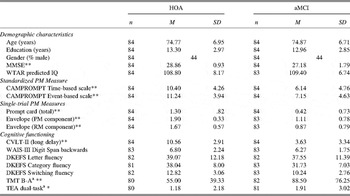
Demographic features of the participants are shown in Table 1. The aMCI and HOA groups did not differ in age (p = .93), education (p = .45), gender (p = 1.00), or predicted premorbid intelligence (p = .61), according to the Wechsler Test of Adult Reading (WTAR; Wechsler, Reference Wechsler2001). As expected, the Mini-Mental Status Examination (MMSE; Folstein, Folstein, & McHugh, Reference Folstein, Folstein and McHugh1975), used to assess current cognitive status, differentiated the groups (p < .001).
Summary statistics for the aMCI and HOA groups

Note. MMSE = Mini-Mental Status Examination; WTAR = Wechsler Test of Adult Reading; CAMPROMPT = Cambridge Prospective Memory Test; PM = prospective memory; RM = retrospective memory; CVLT-II = California Verbal Learning Test – Version II; WAIS-III = Wechsler Adult Intelligence Scale Third Edition; DKEFS = Delis-Kaplan Executive Function System; TMT B-A = Trail Making Test Part B less Part A; TEA = Test of Everyday Attention.
aMedian and interquartile range values of raw (untransformed) variables are presented in this table. Analyses were performed on the square root transformed TMT B-A means (HOA: M = 8.10, SD = 2.27; aMCI: M = 10.15, SD = 3.09), and on the log transformed TEA dual task means (HOA: M = 1.52, SD = 0.41; aMCI: M = 1.68, SD = 0.50).
*Significant value (p < .01); **Significant value (p < .001).
Measures
As part of the larger intervention study, participants underwent extensive screening and baseline assessments; only the measures relevant for the present study are described in this study.
Standardized PM measure: CAMPROMPT
The Cambridge Prospective Memory Test (Wilson et al., Reference Wilson, Shiel, Foley, Emslie, Groot, Hawkins and Evans2005) was used as a standardized measure of complex PM. The 25-min test is comprised of three time-based and three event-based (one focal and two non-focal) PM items embedded within a series of attention-demanding puzzles that serve as the ongoing task. For example, “when there are seven minutes left, remind me not to forget my keys” and “when you come to a quiz question about [television show], give me this book”. Participants are allowed to use external strategies, including taking notes, and are provided with a pen and paper (in this study, recorded dichotomously, i.e., made notes, did not make notes). A digital countdown timer and analogue clock are used. Each item is scored between 0 and 6, therefore, each scale (time; event) total is 18 and the maximum score for the test as a whole is 36, with higher scores reflecting better performance. The CAMPROMPT has a very high inter-rater reliability of 0.998 (Pearson) and moderate test–retest reliability of 0.64 (Kendall's Tau-b; Wilson et al., Reference Wilson, Shiel, Foley, Emslie, Groot, Hawkins and Evans2005). In the current study, the CAMPROMPT showed moderate inter-item reliability, with a Cronbach alpha coefficient of 0.75, indicating good internal consistency.
Single-trial PM measures: Prompt card and envelope tasks
The first single-trial PM measure was the prompt card task, as used by Kinsella et al. (Reference Kinsella, Mullaly, Rand, Ong, Burton, Price and Storey2009), adapted from a similar task in the RBMT (Wilson et al., Reference Wilson, Cockburn and Baddeley1991). During the assessment session, a prompt card was prepared listing a set of appointment times (associated with subsequent research procedures for the larger study protocol). The participant was requested to remind the assessor at the end of the testing session to provide the prompt card. A score of 2 was given if the participant spontaneously requested the card within 15 s of testing completion, 1 point if the request was made late or required prompting (i.e., was there something else you had to do?), and 0 if the participant could not remember the instructions.
The envelope task was the second single-trial PM measure (Huppert et al., Reference Huppert, Johnson and Nickson2000; Kinsella et al., Reference Kinsella, Mullaly, Rand, Ong, Burton, Price and Storey2009). Participants were instructed that later during the assessment the examiner would dictate a name and address to write on an envelope. When this happened, they were asked to remember to seal the envelope and write their initials on the back. After a 20-min delay the envelope was presented and the address dictated. Participants could receive a total of 4 points for this task: 2 points for the prospective component and 2 points for the retrospective component. For the prospective component, the participant needed to remember to do something after addressing the envelope. They received 2 points if this was within 15 s of the address being dictated, 1 point if it was done late or required a prompt, and 0 if no action was performed. For the retrospective component, 2 points were awarded if the envelope was both sealed and initialed on the back, 1 point if only one of these tasks were performed, and 0 if the wrong or no action was performed.
Cognitive functioning
The long delay, free recall trial of the Californian Verbal Learning Test – Second Edition (CVLT-II; Delis, Kramer, Kaplan, & Ober, Reference Delis, Kramer, Kaplan and Ober2000) was used as a measure of retrospective memory. The backwards trial of the Wechsler Adult Intelligence Scale Third Edition (WAIS-III; Wechsler, Reference Wechsler1997a) Digit Span subtest was used to assess working memory. To address executive attention of working memory, the verbal fluency trials (letter, category, switching) from the Delis-Kaplan Executive Function System (DKEFS; Delis, Kaplan, & Kramer, Reference Delis, Kaplan and Kramer2001) were used as these tasks reflect Baddeley's (Reference Baddeley2001) episodic buffer component of executive functioning (requiring attention monitoring and manipulation, and strategic access to long-term memory). Furthermore, the derived score subtracting Part A from Part B of the Trail Making Test (TMT B-A; Hester, Kinsella, Ong, & McGregor, Reference Hester, Kinsella, Ong and McGregor2005; Reitan & Wolfson, Reference Reitan and Wolfson1985) was used as it isolates the ability to switch attention, independent of manual dexterity (Corrigan & Hinkeldey, Reference Corrigan and Hinkeldey1987). Larger B-A scores reflect increased difficulty with switching attention. The ability to divide attention was assessed using the dual-task decrement component of the Telephone Search While Counting subtest from the Test of Everyday Attention (TEA dual-task; Robertson, Ward, Ridgeway, & Nimmo-Smith, Reference Robertson, Ward, Ridgeway and Nimmo-Smith1994).
Statistical Analyses
Two variables exhibited significant skew and kurtosis (TMT B-A; TEA dual-task). Following square root (TMT B-ASQRT) and natural logarithmic (TEA dual-taskLN) transformations, data conformed more closely to assumptions of normality. To aid interpretation, the median and interquartile ranges of the original, untransformed variables are reported in Table 1.
Group differences with respect to the CAMPROMPT (time- and event-based scales) and envelope task (prospective and retrospective components) were assessed using mixed-model analyses of variance (ANOVAs). A χ2 test was used to compare the groups on note-taking during the CAMPROMPT. For the prompt card task, a univariate ANOVA was used to compare groups. Effect size is reported as  where .01 is a small effect, .06 is a medium effect, and .14 a large effect (Cohen, Reference Cohen1988).
A one-way between-groups multivariate analysis of variance (MANOVA) was performed to investigate group differences on the seven measures of cognitive functioning. When the results for the dependent variables were considered separately, a Bonferroni adjusted alpha level of .007 was used, rather than .05. The relationship between the measures of cognitive functioning and PM was first investigated using Pearson product-moment correlation coefficients. Follow-up multiple regression analyses were conducted separately for each group using the variables that significantly correlate with PM to predict performance for CAMPROMPT time- and event-based scales. Due to the difficulty conducting multiple regression analyses on measures with a limited scale, the single-trial PM measures were not used.
To address the final aim, a logistic regression was undertaken using the PM measures (CAMPROMPT time and event scales, prompt card, and envelope tasks) and the traditional retrospective memory measure (CVLT-II, delayed free recall) to predict group membership (aMCI or HOA). The envelope task total score was used to reduce the number of analyses undertaken. To further explore the diagnostic accuracy of these measures for aMCI, a receiver operating characteristic (ROC) analysis was conducted. Using Hanley and McNeil's (Reference Hanley and McNeil1983) method, the areas under the curves (AUCs) were compared.
Results
Prospective Memory Functioning
Standardized PM measure: CAMPROMPT
The means and standard deviations for all PM measures are presented in Table 1. Comparison of performance on the CAMPROMPT showed that the HOA group performed significantly better than the aMCI group, F(1,166) = 51.82, p < .001, with large effect size,  = .24. There was also a significant main effect for subscale, F(1,166) = 6.70, p = .01; with small effect size,
 = .04. Performance for both groups was better for the event-based as opposed to the time-based scale of the CAMPROMPT. The interaction effect was not significant, F(1,166) = 0.06, p = .80,
 < .001. The aMCI and HOA groups did not differ in the number of participants that chose to use notes during the CAMPROMPT, 49% and 61%, respectively, χ2(1, N = 162) = 2.54, p = .11, φ = .13.
Single-trial PM measures: Prompt card and envelope tasks
The HOA participants performed significantly better than the aMCI group on the prompt card task, F(1,162) = 53.28, p < .001; with large effect,  = .25.
On the envelope task, participants with aMCI again performed more poorly than the HOA participants, F(1,165) = 85.74, p < .001, with large effect size,  = .34. There was also a significant main effect for task component, F(1,165) = 22.45, p < .001,
 = .12; both groups performed better on the prospective rather than the retrospective component of the task. There was no interaction effect, F(1,165) = 0.001, p = .98,
 < .001.
Cognitive Predictors of Prospective Memory
The means and standard deviations for the cognitive variables are presented in Table 1. There was a statistically significant difference between the aMCI and HOA groups on the combined cognitive variables, F(7,146) = 29.86, p < .001,  = .59. Considering the dependent variables separately, HOA participants performed significantly better than the aMCI group on the CVLT-II delayed free recall, F(1,152) = 180.78, p < .001,
 = .54; category fluency, F(1,152) = 23.83, p < .001,
 = .14; switching fluency, F(1,152) = 33.18, p < .001,
 = .18; and TMT B-ASQRT, F(1,152) = 20.93, p < .001,
 = .12. The groups did not significantly differ on digit span backward, F(1,152) = 3.15, p = .08,
 = .02; letter fluency, F(1,152) = 0.66, p = .42,
 = .004; or the TEA dual-taskLN, F(1,152) = 5.18, p = .02,
 = .03.
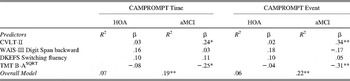
A correlation was conducted between the time- and event-based scales of the CAMPROMPT and the seven cognitive variables. For the aMCI group, CVLT-II delayed free recall (r = .33), DKEFS Switching fluency (r = .23) and TMT B-ASQRT (r = −.32) significantly correlated with CAMPROMPT time-based performance. CVLT-II delayed free recall (r = .36) and TMT B-ASQRT (r = −.30) also significantly correlated with the CAMPROMPT event scale. Digit span backwards (r = .22) was the only significant variable for the HOA group, moderately correlating with the CAMPROMPT event scale.
A multiple regression was performed for the time- and event-based CAMPROMPT scores for each group using variables that significantly correlated with PM (see Table 2). CVLT-II delayed free recall and TMT B-ASQRT were unique predictors of performance on both scales (time; event) of the CAMPROMPT for the aMCI group. For the HOA group, none of the cognitive variables significantly predicted CAMPROMPT performance. The combined cognitive variables accounted for only 6–7% of variance in performance on either scale of the CAMPROMPT for the HOA group but 19–22% for the aMCI group.
Predictors of time- and event-based PM performance for aMCI (n = 82) and HOA group (n = 80)Footnote a

Note. CAMPROMPT = Cambridge Prospective Memory Test; CVLT-II = California Verbal Learning Test – Version II, delayed free recall; WAIS-III = Wechsler Adult Intelligence Scale Third Edition; DKEFS = Delis-Kaplan Executive Function System; TMT B-A = Trail Making Test Part B less Part A; SQRT = square root transform.
a Smaller n due to missing values.
* Significant value (p < .05); **Significant value (p < .01).
Predictive and Discriminative Ability of Prospective Memory Measures
The combined PM and retrospective memory predictors reliably distinguished between the aMCI and HOA groups, χ2(5, N = 163) = 132.39, p < .001. Specifically, the significant individual predictors were the CVLT-II delayed free recall, Wald Statistic = 27.61, p < .001, odds ratio = 1.69, and the envelope task (total score), Wald Statistic = 4.58, p = .03, odds ratio = 1.93. Overall prediction success for the total model improved from 50.9% to 87.1% with the inclusion of the retrospective memory and PM measures.
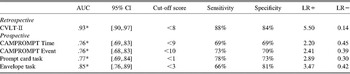
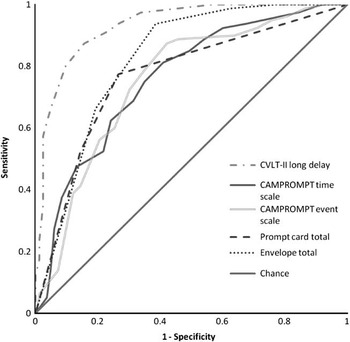
ROC analysis was significant for the retrospective memory and each of the PM measures (see Table 3). The ROC curves are presented in Figure 1. Comparison of the AUCs found that all measures were strong, although the CVLT-II delayed free recall was significantly better than the PM measures, which were not significantly different from one another. Cut-off scores and associated sensitivity, specificity, and likelihood ratios are presented in Table 3.
Summary of the ROC analyses with cut-off scores for aMCI (n = 80) vs. HOA group (n = 83)Footnote a

Note. AUC = area under the curve; LR+ = likelihood ratio positive; LR− = likelihood ratio negative; CVLT-II = California Verbal Learning Test – Version II, delayed free recall; CAMPROMPT = Cambridge Prospective Memory Test (total score).
a Smaller n due to missing values.
* Significant value (p < .001).
Receiver operating characteristic (ROC) curves for a retrospective memory measure and four prospective memory measures as diagnostic indicators of amnestic mild cognitive impairment.

Discussion
The main focus of the study was to assess the utility of clinical measures of PM in the assessment of aMCI. As expected, individuals with aMCI were impaired on both the time- and event-based scales of a comprehensive PM test battery (CAMPROMPT) when compared with healthy older adults. Both the aMCI and the HOA participants demonstrated greater difficulty with the time-based rather than event-based tasks which is consistent with previous research (e.g., Groot et al., Reference Groot, Wilson, Evans and Watson2002) and the assumption that time-based PM is generally more difficult due to higher executive demands. However, in addition to group differences on the time-based tasks, it was notable that the aMCI group were also impaired on the event-based tasks as compared to the HOA group. This should not be unexpected as effective event-based PM is considered reliant on automatic associative retrieval skills which are compromised in aMCI (McDaniel et al., Reference McDaniel, Shelton, Breneiser, Moynan and Balota2011). This impairment on event-based tasks as well as time-based tasks (Karantzoulis et al., Reference Karantzoulis, Troyer and Rich2009; Thompson et al., Reference Thompson, Henry, Rendell, Withall and Brodaty2010) may characterize the PM profile that discriminates aMCI from normal cognitive ageing, where the typical profile is differential impairment on time-based tasks reflective of diminishing cognitive resources for effective attention allocation in healthy ageing (Einstein & McDaniel, Reference Einstein and McDaniel2005). This finding also supports the concept of widespread cognitive impairment in aMCI with deficits not only in episodic memory but also aspects of the executive attention component of working memory (Lonie et al., Reference Lonie, Herrmann, Donaghey and Ebmeier2008), compounding deficits that can impair multiple processes operating in both time- and event-based PM.
As well as the CAMPROMPT, the aMCI group was compared to healthy older adults on two single-trial event-based PM tasks, both of which confirmed the global impairment of PM in individuals with aMCI, regardless of the complexity of the task. Although the envelope task is a simple single-trial task, the scoring allowed for a comparison of prospective and retrospective performance. Of interest, our findings that both groups demonstrated greater difficulty with the retrospective component of PM contradict those of Costa et al. (Reference Costa, Perri, Serra, Barban, Gatto, Zabberoni and Carlesimo2010) whose participants struggled more with the prospective component. This may be due to their sample including individuals with non-amnestic, dysexecutive MCI, a group that would be expected to have greater difficulty with the executive demands of the prospective component of PM, whereas our sample was entirely aMCI. Exploring these potential differences between MCI subtypes is an area for future development.
The cognitive processes associated with PM were also explored by investigating the contribution of retrospective memory and executive attention in predicting PM performance. Somewhat contrary to expectations, the same pattern of cognitive skills predicted both time- and event-based PM performance in the aMCI group. This may reflect the compounding deficits in aMCI affecting all aspects of PM. The significant cognitive predictors are congruous with a general model of PM based on a retrieval memory measure and a measure that isolates the individual's ability to shift and allocate attention (executive attention), which reflects the process in PM whereby an individual needs to continuously redirect attention from the ongoing task to monitor the environment for the appropriate cue and finally disengage attention from the ongoing task for execution of the PM intention (McDaniel & Einstein, Reference McDaniel and Einstein2000). The fact that the time- and event-based tasks in this study appear to use similar cognitive resources (i.e., both retrospective memory and executive attention), which are impaired in aMCI, may further explain how these individuals were globally and comparably impaired on both time and event PM. This is in contrast to individuals with Parkinson's disease, who also have noted deficits in subcortically mediated memory and executive functions but exhibit differential time-based PM deficits (Raskin et al., Reference Raskin, Woods, Poquette, McTaggart, Sethna, Williams and Tröster2011). This may relate to the memory difficulties in Parkinson's disease being linked to their frontal pathology (Braak, Ghebremedhin, Rub, Bratzke, & Del Tredici, Reference Braak, Ghebremedhin, Rub, Bratzke and Del Tredici2004), whereas in aMCI there are also underlying deficits in mesial temporal networks (Tapiola et al., Reference Tapiola, Pennanen, Tapiola, Tervo, Kivipelto, Hanninen and Soininen2008). For healthy older adult populations, on the other hand, it appears that non-cognitive factors may be playing more of a role in their PM performance in this study.
Finally, the CAMPROMPT and the single-trial PM measures were directly compared against a retrospective memory measure to determine their relative capacity in discriminating the aMCI group from the HOA group. The retrospective memory measure was found to have the highest discriminative power; however, this is not unexpected given that the retrospective measure used to predict group membership was very similar to one of the screening measures that were used to diagnose the aMCI group (i.e., two different word list learning tasks). Therefore, the apparent superiority of a traditional retrospective memory measure over PM measures should not be over-interpreted. All four PM measures showed good discriminatory ability. As expected, both the time and event scales of the CAMPROMPT were equivalent in their ability to discriminate aMCI from HOA. Surprisingly, the brief, single-trial tasks were as effective as the more complex PM battery, CAMPROMPT, in identifying aMCI group membership. Given that these tasks are quick and easy to administer, these results have significant practical implications. For example, these tasks might be used as screening tools in clinical assessment to indicate the possibility of aMCI and the need for more comprehensive neuropsychological follow-up. However, for all of the PM measures, the cut-off scores provided in this study should be used with caution as PM performance has been shown to be affected by age (Henry, MacLeod, Phillips, & Crawford, Reference Henry, MacLeod, Phillips and Crawford2004; Wilson et al., Reference Wilson, Shiel, Foley, Emslie, Groot, Hawkins and Evans2005), which is not taken into account by the study analyses in generating the cut-off scores. Although the CAMPROMPT does provide preliminary age- and IQ-adjusted normative data (Wilson et al., Reference Wilson, Shiel, Foley, Emslie, Groot, Hawkins and Evans2005), the sample size for the 70-year + age group is very limited. Further studies using large populations will be needed to broaden the utility of these PM measures in clinical assessment.
One limitation of much of the research regarding PM, including the current study, is that a simple distinction between time- and event-based PM does not encompass the potential complexity of PM performance in everyday life. Indeed, the above findings indicated that similar cognitive skills were recruited during CAMPROMPT time- and event-based performance, which did not fit with our expectations derived from the prior literature. Furthermore, the aMCI were comparably impaired on the time- and event-based PM tasks and these tasks were equivalent in their diagnostic ability. This may indicate that the CAMPROMPT scales are not adequately differentiating between the different types of PM. Experimental studies are contributing to the understanding of PM by evaluating the significance of different types of monitoring involved in a PM task (e.g., strategic vs. spontaneous; McDaniel & Einstein, Reference McDaniel and Einstein2000) and the types of cues provided (e.g., focal vs. nonfocal; Einstein & McDaniel, Reference Einstein and McDaniel2005). As the theoretical model of PM increases in complexity and the contribution of cognitive and non-cognitive factors are integrated into the model, clinical measures will need to reflect these developments. For example, the CAMPROMPT allows the use of notes during the task, thereby simulating the naturalistic environment in a way that few other neuropsychological measures permit. In this study, a record was made of whether or not participants took notes; however, the quality of their notes and the extent to which they referred to their notes was not documented. In future, this would be a valuable area to measure, not only to improve experimental control, but also to guide potential interventions.
Further to methodological limitations of this study, we have presented the CAMPROMPT as a more complex assessment of PM functioning in the context of comparison to single-trial measures. In fact, the CAMPROMPT is still limited in the number of PM trials it includes. Therefore, the reduced reliability associated with limited PM tasks (Kelemen, Weinberg, Alford, Mulvey, & Kaeochinda, Reference Kelemen, Weinberg, Alford, Mulvey and Kaeochinda2006) remains an issue for all the PM measures in this study. Similarly, with regard to the scoring systems for each of the measures used, they are to some extent arbitrary and do not necessarily reflect the theoretical constructs of concern in the PM literature. Nevertheless, these measures in their current form, with standardized administration (as would be used in a clinical setting) have still proven to be useful within this population.
In summary, although PM performance is not typically considered in the assessment of aMCI, these findings suggest that even simple measures of PM, which can easily be integrated into clinical practice, can provide additional information to the diagnosis of aMCI. Both time and event PM appear to incorporate retrospective memory retrieval skills as well as complex attention and executive abilities. The interaction between these skills may explain the global time- and event-based impairments in PM exhibited by individuals with aMCI and the good discriminative ability of these measures for diagnosing aMCI.
Acknowledgments
We are grateful to the Cognitive Dementia and Memory Services (CDAMS) at Caulfield Hospital, Melbourne Health, Austin Health, St. George's Hospital, Wantirna Hospital, Barwon Health and Bendigo Health for referring participants with MCI and for allowing use of their facilities. We thank A/Prof Michael Woodward, Dr Alasdair Mander and Bundoora Extended Care Centre CDAMS for patient referrals. Thanks to Dr Sarah Price, Nadia Petruccelli, Samuel Parsons, and Fenny Muliadi for their assistance with coordination of the study, recruitment, and data management, and to the numerous research assessors assisting with data collection. This research received funding from a National Health and Medical Research Council grant. The authors have no conflict of interest.