Introduction: from structures to ideas
Historical development of social policy has been explained from numerous perspectives. The first array of comparative research regarded the welfare state as a functional solution to big structural changes in society. Whether it was about industrialisation, economic growth, class structure or maturation of capitalism, scholars interpreted the development of social policy as an automatic functional response to these structural transformations.
The problem with these structural-functionalistic theories was that they were not able to explain differences between developed countries. As a result, researchers shifted their gaze to political power, and political actors became central for understanding national variation in social policies (Korpi, Reference Korpi1978; Korpi and Palme, Reference Korpi and Palme2003). While the power resource theory has been successfully used in comparative welfare research, lately it has been challenged by varying forms of institutionalism emphasising the role of social institutions (Steinmo et al., Reference Steinmo, Thelen and Longstreth1992; Thelen, Reference Thelen2004). A common denominator in the variants of the institutional school is that previous decisions are seen as restricting subsequent ones and putting policies on specific tracks, creating path dependencies in policy-making (Mahoney, Reference Mahoney2000; Streeck and Thelen, Reference Streeck and Thelen2004; Thelen, Reference Thelen2004).
In recent years, the emphasis has shifted from the structural view of institutions as structures towards more cultural interpretations (Cambell, Reference Cambell1998; Lieberman, Reference Lieberman2002; Schmidt, Reference Schmidt2002; Pfau-Effinger, Reference Pfau-Effinger2005). In these ‘ideational’ explanations, ideas constitute paradigms that form the basis for cognitive and ontological assumptions, meaning that political ideas can also be regarded as path dependent: we see what we are used to seeing, and in this way political discourses contribute to path dependency (de Saussure, Reference de Saussure1974; Fairclough, Reference Fairclough1989, Reference Fairclough1992).
Ideational path dependency relates to a concept of hegemony according to which certain frames or ways of thinking are ‘naturalised’ and achieve the status of common sense, and these frames become invisible even for the actors that launched them (Bourdieu, Reference Bourdieu2003). We can also speak of hegemonic discourses in the sense that if policy-makers wish to change something in society, the structures and content of thinking must be changed (Gramsci, Reference Gramsci1971; Laclau and Mouffe, Reference Laclau and Mouffe1985; Foucault, Reference Foucault1986). Therefore, the ‘struggle of interpretation’ (Pfau-Effinger, Reference Pfau-Effinger2005) preceding institutional change is of crucial importance. The actors who, at a constitutional moment (Elster, Reference Elster1993: 34), are able to establish the frame to be used exercise decisive power on the motivational basis of policy debates; they shape the political beliefs not only of the current cohorts but also of future policy-makers (Spector and Kitsuse, Reference Spector and Kitsuse1989; Lieberman, Reference Lieberman2002; Beland, Reference Beland2005). Discursive ideas can crystallise; that is, they can be interpreted as ideational structures and they may serve as intermediate variables between material socio-economic (class) structures on the one hand and policy outcomes on the other.
At the political level, a constant hegemonic battle exists, and politicians must frequently renew their discourses (Majone, Reference Majone1989: 31). In this battle, elites frame their proposals in such a way that their initiatives appear to constitute the best solution to actual social problems. Proposals must be packaged in normatively acceptable ways. Instead of referring to specific group interests, parties must refer to more widely accepted cultural values, such as freedom, social justice and equality. Actors also manipulate public sentiments to serve their own ends (Gamson and Modigliani, Reference Gamson and Modigliani1987, Reference Gamson and Modigliani1989). It is here that political framing becomes crucial. Political struggles are fought in symbolic arenas through the use of phrases, metaphors and symbols. As individual voters are unable to take into account all possible aspects and collect all possible information on different policy options, they react to these metaphors and use them as shortcuts for their political choices.
The aim of this article is to analyse whether the discourses that political actors in Finland and in Sweden have used can explain the differences in family policy outcomes: in our case, cash for child care. Our emphasis is on the framing: that is, on those verbal tricks that actors use to institutionalise their discourse into material existence. We argue that to understand differences in policy-making properly it is not enough to refer to differences in social structures or political power; instead, we must also consider the ideational framework that ruled out some options and opened possibilities for other choices. In this article, we are interested in the political usage of discourses, meaning that we do not intend to scrutinise whether cash for care de facto enhances freedom or constitutes a trap (for that discussion, see Morgan and Zippel, Reference Morgan and Zippel2003; Haataja and Nyberg, Reference Haataja, Nyberg, Ellingsæter and Leira2006).
When emphasising as we have that discourses give meaning and interpretation to social phenomena, we do not wish to refute the importance of social or class structures; our approach is dialectical (or interactionist). In other words, the ideas that can ‘become effective forces in history’ (Weber, Reference Weber1989 [1904–5]: 90) must be implemented by predominant bearers, or as Geertz succinctly writes: ideas must ‘be carried by powerful social groups to have powerful social effects; someone must revere them, celebrate them, defend them, impose them. They have to be institutionalised in order to find not just an intellectual existence in society, but, so to speak, material as well’ (1972: 314). Thus, while political discourse is linked to social structures, it is not entirely socially determined. On the other hand, although discursive frames contribute to our understanding of social structures, social structures cannot be reduced to mere discourses.
The method we use is content analysis focused on dominant political discourses. When trying to sell their message, political actors strategically choose language that supports their interpretation of social problems. In this process, symbols resonating with important cultural values and sentiments are the most effective (Geertz, Reference Geerts1972: 126–31; Giddens, Reference Giddens1991: 35–47). From our data, we were able to discern some evergreen themes that have been constantly used in both Finnish and Swedish political rhetoric (see also Leira, Reference Leira2002; Ellingsæter, Reference Ellingsæter2007): freedom, justice and equality. In the light of these core values, politicians debate about five subthemes: the women's ‘double burden’, children's welfare, cost-effectiveness, labour supply and fertility.
The structure of the article is as follows. In the next section, we give our motivations for our approach and for the choice of the two countries and data used. Thereafter follows an analysis on the struggle for hegemony and the formation of the dominant frames. The final section discusses and summarises the central findings.
The cases and data
The creation of cash-for-care (home care allowance) in Finland and Sweden offers interesting possibilities for studying the use of political discourses in promoting policy measures. First, Finland and Sweden are usually classified as countries belonging to the Nordic welfare model (Timonen, Reference Timonen2003); however, they differ with regard to child-care policies (Bergqvist et al., Reference Bergqvist, Borchorst, Christensen, Raaum and Styrkasdotter1999; Sainsbury, Reference Sainsbury1999; Hiilamo, Reference Hiilamo2002; Ferrarini, Reference Ferrarini2006; Gornick and Mayers, Reference Gornick and Meyers2003). In Sweden, while allowance for families with small children has constituted solely parents' insurance and public day care, the Reinfeldt non-socialist government (2006–) implemented care allowance in 2008. In Finland, by contrast, each child has a right to day care, but cash-for-care is payable to those parents who do not use their right to public day care (see Table 1).
Development of cash-for-care schemes (CCS) in Finland and in Sweden

Second, the relationship between discourse and social structure is dialectical. As Geertz (Reference Geerts1972: 314) argued, some strong groups must adhere to ideas in order to make ideas politically effective, or to give them ‘material existence’. At the same time, however, hegemonic discourses can fortify the power position of those who adhere to them or the initial owner of the idea. Finland and Sweden are good examples of these power struggles. In Sweden, the Social Democratic Party (SAP) took the leading position as early as the 1930s. Even though non-socialist parties have occasionally been in power, social democracy has conditioned political activity, and social democratic hegemony has framed the non-socialist political discussion (Lundberg, Reference Lundberg2003). In Finland, by contrast, the Agrarian Party (since 1965 the Centre Party) had the political upper hand up to the mid-1960s, after which the Social Democratic Party (SDP) became the senior partner in coalition cabinets. Nevertheless, the SDP never achieved the same hegemonic position that the SAP had in Sweden (Lane and Ersson, Reference Lane, Ersson and Colomer2002).
Third, due to the differences in power constellations, there were differences in the political representation of feminist ideas. While in Sweden women's labour market interests were mobilised chiefly via the SAP, in Finland many other groups were in play (Tyyskä, Reference Tyyskä1995). The interests of rural women were voiced through the Agrarian/Centre Party, while those of the urban working female labour force were voiced by a minimum of four different parties. Thus, women's voices in politics were more diversified in Finland than in Sweden: in the latter, the Social Democratic women's movement dominated the political discourse, whereas in the former the agrarian-bourgeois voice was the loudest.
Fourth, the political power differences in Finland and Sweden have had an impact upon the hegemonic frames within which family policy was debated. In principle, our story of cash-for-care could have been told from the structural-political perspective: as a result of structural factors in society, agrarian political influence has been stronger in Finland. End of story? Not quite! Structural constraints as such are not directly transformed into politics. Somebody must first define ‘structural needs’ and what is necessary to meet them, and in this ‘politics of need interpretation’ political framing becomes important.
The data we use in our analyses are partially derived from parliamentary proceedings, party programmes and other family policy publications produced by political actors. We mainly concentrate on the post-World War II discourse that the dominant political actors used. In addition to primary sources, we draw on earlier detailed historical studies on Swedish (Hinnfors, Reference Hinnfors1992; Hiilamo, Reference Hiilamo2002; Lundqvist, Reference Lundqvist2007) and Finnish (Sakaranaho, Reference Sakaranaho1992; Anttonen, Reference Anttonen1999; Hiilamo, Reference Hiilamo2002) family policies.
Before we move on to analyse the discourses, some clarification of the sequential order of policy debates and reforms is necessary. Table 1 summarises the central political constellations and lines of demarcation both between and within parties. As the table shows, in both countries there have been changes in opinions, and political parties have changed their orientations. In the subsequent sections, we show what kind of discursive frames were used for motivating those shifts.
Political discourses
Justice and freedom of choice
In the 1930s and 1940s, the Finnish Social Democrats had a positive attitude towards the ‘mother's wage’ (Sulkunen, Reference Sulkunen1989: 126–7), and the female SDP Members of Parliament introduced a bill on the subject in 1947 (Petitionary motion no. 288/1947). However, the motion did not lead to further measures and the SDP gradually lost interest in the issue, whereas the Agrarian Party started to champion the mother's wage (Tyyskä, Reference Tyyskä1995: 155–6; Nygård, Reference Nygård2003). Cash-for-care served the interests of the rural population, which traditionally cared for their children at home. However, instead of referring to the group-specific interest, the party framed its demands by references to social justice (families who do not use subsidised municipal day care should also have right to subsidies) and freedom of choice between different forms of care. The latter theme was also important for the Conservatives, for whom cash-for-care offered a possibility for subsidising those families employing a nanny at home or utilising private suppliers (Ervasti, Reference Ervasti1996).
The question of the mother's wage came up in Finland again in 1972, with the dispute over the Child Day Care Act. Although the Centrists and the Conservatives insisted on cash-for-care, they had changed their terminology: ‘care allowance’ was now under discussion instead of ‘mother's wage’. The rhetorical reasoning was that ‘care allowance’ stressed the right to choose and sounded gender-neutral, while ‘mother's wage’ was clearly gendered and emphasised women's domestic duties (Tyyskä, Reference Tyyskä1995: 111–12). The political left pursued the development of municipal day care and criticised the care allowance as merely the transfer of income from wage earners to farmers (who take care of their own children anyway) and high-income groups (who employ nannies at home), thus making the system socially unjust. In addition, according to the left, the allowance restricts rather than enhances real freedom of choice, with mothers ending up staying locked in their traditional roles.
On the non-socialist side, the concepts of justice and freedom were interpreted differently. The Finnish bourgeois parties declared that work at home either is as valuable as work outside the home, or indeed even more valuable, which the public authorities should recognise. Care allowance would be the best recognition. As for the justice principle, tax-paying families who do not use publicly supported day care would suffer in comparison to those who do. In the eyes of the non-socialists, cash-for-care was a remedy for this injustice. Perhaps their most powerful adage has been ‘freedom of choice’: parents themselves know better than the state bureaucrats what is best for their children. Freedom of choice was thus framed as a battle between the family and a heartless bureaucracy (for example, Petitionary motion no. 1493/1982). Since the socialists could not seize the bourgeois discursive frame, they had to accept cash-for-care as an alternative to municipal care. The Act on Home Care Allowance was implemented in 1982, and since then the left has been unable to challenge the dominant discourse or to give it any alternative content.
In Sweden, while the rhetorical frames were to some extent the same as in Finland, the party profiles were more volatile (Table 1). The SAP adopted care allowance in its political agenda in the early 1960s when compensation for child care being paid out to parents was discussed. With the help of this compensation, the mother could decide whether or not to care for the small child herself at home. The rationale was that cash-for-care would also allow working-class men the right to ‘a housewife’, a right the middle classes already had (Lindberg, Reference Lindberg2001). In a parliamentary discussion on cash-for-care in 1965, the chair of the SAP Women's Union supported the allowance (Preliminary debate protocol 4 20/1; 1965: 27).
In light of the present-day political constellations, the opponents of the cash-for-care scheme came from a surprising camp: the Conservatives. The ideology of the Conservative Party called for restricting the role of the public sector to a minimum. Too extensive a social sector would lead to dependence on allowances, and therefore citizens had to be guaranteed both freedom from state patronage and freedom of choice between different forms of child care. The negative concept of freedom – that is, freedom from the state – is emphasised in the party programme of 1963: ‘We find it, in principle, unpleasant that the state should pay for the natural tasks [involved] in parenthood. Such a step would mean a further step towards general socialisation.’
On certain issues, the ideology of the Swedish Centre Party resembled the ideas of the Conservative Party. The Centrists also supported a kind of minimal welfare state; however, in their vision, benefits should be flat-rate and universal. In addition to this compulsory basic security, the state should not interfere in organising social benefits (Hinnfors, Reference Hinnfors1992: 70–2) but only guarantee the basic prerequisites of the cornerstones of society: family and small entrepreneurship. Cash-for-care had an important role to play in fulfilling this task, as it would acknowledge the work of mothers. Thus, women doing different work, either in paid labour or at home, would have the same status. In this respect, the vocabularies of the Finnish and Swedish Centre Parties were the same.
In Sweden, the Conservatives' family policy was based on tax deductions until 1972, after which the party gradually started to favour subsidies for public day care while simultaneously demanding subsidies to private day care on the basis of equal treatment. Little by little, the party began to emphasise cash-for-care, and its political stance converged with that of the Centre Party. In their demands, these two parties emphasised justice among alternative forms of care: there should more than just one alternative, municipal day care supported by tax revenue. Monetary compensation should also be offered to families whose children were not in public day-care centres. This position became the parties' guiding rhetorical theme.
The SAP also totally changed both its opinions and rhetoric on allowance. Freedom of choice and justice remained, but now with a new meaning. First, the SAP depicted day-care centres as the most just alternative: by offering stimuli, these centres increased equality between children coming from different backgrounds. Second, public day care offered women real alternatives between working life and home. When hitting back against the Conservatives and Centrists, the Social Democrats argued that freedom of choice guaranteed by the cash-for-care system would pertain only to women with well-paid husbands, not to women on low income or single mothers. When the non-socialist coalition cabinet implemented cash-for-care in 1994, the SAP fiercely opposed the scheme, introducing the slogan ‘a trap for women’ (SOU, 1994: 25).
When the SAP formed a new cabinet in 1994, one of its first tasks was to abolish the cash-for-care programme established a few months earlier. At the time of writing (spring 2008), the non-socialist cabinet implemented the system anew, now named as Freedom of Choice Reform, referring to precisely the same frames as before: parents should have the right to choose, as they know better than ‘experts in Stockholm’ what is best for the family (Larsson and Hägglund, Reference Larsson and Hägglund2007). Furthermore, the Freedom of Choice Reform was motivated by municipal democracy: many municipalities wished to implement the allowance. Cleverly enough, the cabinet chose the Finnish gradual approach starting at the municipal level, meaning that if the next SAP government tries to abolish the allowance, it will have to fight resistance from local authorities.
Women's double burden
The Finnish 1947 motion recognised women's double burden and stated that the ‘mother's wage’ would help all the ‘mothers exhausted by a heavy work load’ to avoid the double responsibility. Women should be given the option of being full-time mothers. As this idea of decommodification faded away from the rhetoric of the left, it started to live its own life in the rhetoric of the Centre Party. The Christian Democrats and the Rural Party used similar arguments. The Conservative Party found a solution to women's double burden in ‘the possibility of choice’. Differences in the emphasis between the Conservatives and the other non-socialist parties can be explained by their different constituencies. The Conservatives gathered votes from the well-educated white-collar employees who had problems in combining paid work and family. In contrast, for the core voters of the Rural Party and the Centre, this issue has not been that pressing (Kangas, Reference Kangas1986).
The Rural Party vigorously emphasised women's biological role and the value of work done at home. An interesting difference between the Centre and the Rural Parties is that up to the early 1980s both parties explicitly insisted that the mother should have the possibility of staying at home. Since the mid-1980s, the Centre has changed its rhetoric, becoming more gender-neutral by demanding that one of the parents should be able to stay at home. By contrast, the Rural Party still emphasises traditional family roles and, together with the Christian Democrats, demands both the recognition (Frazer, Reference Frazer, Frazer and Honneth2003) and the rewarding of the work families are doing at home.
The traditional family model and housework done by women were also supported by the Swedish Social Democrats until the 1960s. Work inside the home was seen as at least as rewarding as work outside the home. The view was that it is not a particularly great privilege for working-class women to go to the factory and drill holes in small pieces of metal all day. By comparison, housework seemed like paradise (Eriksson, Reference Eriksson1964). However, there were variations in the opinions. Already by the 1930s, Alva Myrdal demanded policy measures to help women combine motherhood and paid work, a combination she regarded necessary for gender equality (Hirdman, Reference Hirdman, Kettunen and Eskola1997, Reference Hirdman2006; Björnberg, Reference Björnberg2002). Although her ideas did not receive an immediate response, in the 1960s and early 1970s they gradually gained a hegemonic position within the SAP that turned out to favour municipal day care.
A book published by the SAP Women's Organisation in 1972 about the family and future family policy marked a turning point in social democratic family policy (Hirdman, Reference Hirdman, Drew, Emerek and Mahon1998). It proposed a radical model for a new society that would be based on a six-hour working day, acknowledging equal rights and obligations for men and women to participate in working life and in caring for the home and children. Through its proposal, the book attempted to solve the problem of women's double role by guaranteeing both parents the possibility of fulfilling it. According to the SAP, cash-for-care was unsuitable for the vision of a new society aiming at gender equality in working life and parenthood. Home care belonged to the society of the past. Consequently, in this frame the dual-earner and dual-carer model began to materialise, and the dichotomous concept of working versus caring mother was rejected.
Both the Swedish Conservative Party and the Centre Party were dubious about the socialist family model of two wage earners, a model that they considered harmful to children, family and society at large. However, this argument appeared old-fashioned and toothless compared to the future-oriented emancipatory politics of the SAP. To increase its political appeal, the Centre therefore changed its slogan at the beginning of the 1980s. The name of the previous home care allowance (vårdnadsbidrag) was changed to home ‘care compensation’ (vårdnadsersättning) (Hinnfors, Reference Hinnfors1992: 167). The connotation of the term is different: Allowance (bidrag) is given as an addition to something – that is, a gift from the state – while ersättning is rightful compensation for something to which one is entitled. With this interpretation, cash-for-care would also be the best way to solve women's double burden: household duties would receive their status as valuable work. Thus, in both countries, the Christian Democrats and the Centre demanded the recognition of home care as a legitimate activity.
The early 1970s came to be a turning point or a kind of Elsterian (Elster, Reference Elster1993) ‘constitutional moment’ in Swedish family policy. Until that time, the SAP and the Conservatives in particular had been ambivalent in their family policy orientations. By the 1970s, party fissures had been healed. The parties both altered their stances and their in-party hegemonic concepts, the Social Democrats being supporters of public day care and the Conservatives insisting on state subsidises for alternative care forms. Subsequent political generations in their between-party campaigns on hegemony have followed these rhetorical frames.
Child welfare
Politicians thematically combine arguments on child welfare with a solution for women's double role. Usually the rhetorical frames, in which the solution to the ‘double burden’ was housework, also emphasised the favourableness of home care for children (Financial motion 569/1981). This kind of home-centred vision had more bite in Finland than in Sweden. For Finland, ‘the word’ also exerted its power: advocates of cash-for-care contrasted public institutional care with home care. This contrast implicitly linked cold, inhuman bureaucracy and rigidity to public day care, while home care represented all positive values, such as love, closeness, security and warmth. In Finland, the non-socialist parties succeeded with this framing over that of the left and, finally, the leftist vision of public day care was criticised as a DDR-kind of totalitarian education. The Swedish non-socialists tried a similar linguistic trick, and the Conservatives in particular criticised the extension of day care as a form of neglect of child welfare (Burestam Linder, Reference Burestam Linder1983).
Many arguments referring to medical problems resulting from day care were used for home care in both countries. Again, this discourse got a stronger footing in Finland, whereas the dominant Swedish frame portrayed universal and public day care as the best conditions for children's welfare and overall development. We can trace this positive view back to the social democratic idea of social engineering and the planning of a good society in which child care was arranged collectively, and trained personnel had to have the primary responsibility for the well-being of the children (Hirdman, Reference Hirdman1989). Day-care centres thus also fulfilled the objective of equality: children from different backgrounds were given equal chances. The ideas are echoed in later expert reports: ‘child care provision accessible to everybody should provide a means of compensation for children with scarce resources at home’ (SOU, 1972: 34; Lundqvist, Reference Lundqvist2007: 172–9).
In this Swedish frame, public day care combined the children's interests with equality: equality between rich and poor children or men and women (Hatje, Reference Hatje1974; Hirdman, Reference Hirdman1988). The Freedom of Choice Reform does not directly challenge this frame. It emphasises the need for well-functioning municipal day care, while at the same time indirectly finding fault with it: families must be guaranteed flexible solutions to spend more time together instead of parents being in paid labour and children in public day care.
Cost-effectiveness
The Finnish cash-for-care system was initiated gradually in the 1960s through municipal experiments. The rationale was that municipalities usually tried to avoid investments in facilities and costs for personnel. The cost issue was spelled out in the very first parliamentary motion, emphasising that the mother's wage would be a cheap alternative because ‘considerable costs for each child have to be paid in institutional settings and employees must be paid salaries’ (Petitionary motion 288/1947). While left-wing politicians later tried to push this theme into the background, it had increasing importance in the non-socialist rhetoric, which stressed that facilities and personnel are necessary for institutions; at home they are available free of charge, and therefore home care is ultimately the cheapest alternative. In addition to the direct costs, public day care also incurs a lot of indirect costs, since children in day-care centres are more prone to illness, which in turn produces health care costs and loss of production in society as a whole.
In 1990, the Finnish Conservative-SDP cabinet (1987–91) implemented the unconditional right to day care for children under the age of three. When the economic recession hit Finland in the early 1990s, the Centre-Right cabinet (1991–96) feared that the Act would considerably increase social expenses if all parents exercised their rights. In order to circumvent this, the representatives of the Centre (the leading partner in the bourgeois coalition cabinet) insisted on improving cash-for-care benefits, which would lessen the demand for day care and reduce the expenses incurred by municipalities. The depth of the recession fortified this line of reasoning, and the Centre Party proposed further improvements in cash-for-care allowances to save public resources and to reduce unemployment and the use of income support. Instead of being registered as unemployed or relying on social assistance, parents would take care of their children. In the midst of the crisis, care allowance appeared to be a good way of achieving savings ‘without any tears’. The cabinet improved the real value of the allowance by 30 per cent, but the subsequent SDP-led cabinet (1996–1999) cut allowances by more than 20 per cent in 1996 (Hiilamo, Reference Hiilamo and Ritakallio2003: 139). At that time, various social democratic initiatives questioned the whole cash-for-care system.Footnote 1 These initiatives, however, were heavily criticised by the general public, which threatened the overall popularity of the party to such an extent that the initiatives had to be abandoned within a very short time.
As with their Finnish sister parties, the Centre and the Conservatives in Sweden considered home care to be much cheaper than public day-care centres. This line of reasoning also continued post-1994 when the SAP government had abolished the cash-for-care system. Among their criticisms was the comparison between costs for different forms of care (motion no 98/1997: Ub211). Cost-effectiveness was also centrally posed in the ‘Freedom of choice’ reform, according to which a place in public child-care costs as much as SKR 100,000 a year, whereas the tax-free home allowance costs as little as SKR 3,000 a month (Socialdepartementet, 2007).
Avoiding excessive social spending has been an underlying meta-theme in Finnish politics, where two modes of policy-making have been contrasted against each other: ‘politics of distribution’ (jakopolitiikka) and ‘politics of responsibility’ (vastuupolitiikka). The former refers to a politician promising benefits without considering their costs, while the latter refers to the responsible politician who first thinks about the costs and only then decides whether to implement a reform. The bourgeois parlance portrays the SDP, in particular, as a party of distribution. In Swedish policy-making, such frames have not been as effective as these in Finland. These differences in discursive meta-frames have had important ramifications for the manoeuvrability of the Social Democrats. In Sweden, the SAP has been able to counteract the bourgeois home-care proposals by promising longer parental leave with gender-equalising legislation and by promising improvements in the income-loss compensation in the form of parental insurance (Sahlin, Reference Sahlin2007). If such an insurance were implemented, the need for cash-for-care would be nullified by a compensatory device. Meanwhile, in Finland, the ‘politics of responsibility’ frame prevented the SDP from using the corresponding strategy.
Labour supply
One important structural factor that has divided Swedish and Finnish politics and fortified the dominant national frames is the demand for and supply of labour. The supply of labour illuminates dialectical relationships between the structural context and political discourse. While the structural context supports the dominant modes of thinking, hegemonic discourse constrains the political options available for reacting to structural problems.
A committee set up in the mid-1960s to analyse the future of the Swedish national economy forecast a labour shortage in Sweden. According to the committee report (SOU, 1966: 59), a severe and long-lasting recession would threaten the economy if the problem of labour shortage could not be solved. As mothers caring for their children presented industry with a potential pool of labour, women's labour force participation and the family model of two breadwinners quickly started to expand. The change in the family model required that day care be available. The fastest and most effective solution was the public day-care centre system, whereby one pre-school teacher was able to care for several children. According to this social democratic interpretation, the liberated labour force was at the disposal of industry, creating wealth and prosperity for Sweden.
By comparison, the situation in Finland was completely different. The country had an abundance of surplus labour due to a diminishing agricultural sector, and cash-for-care was seen as a solution to the country's unemployment problem. By staying at home, those caring for their children with the help of a home care allowance not only gave other people the possibility of work but also gave them the opportunity to have an important impact on the offspring of their society. The hidden message was that if there is a shortage of work, women must give way to male employees. One can ponder what will happen in Finland if unemployment turns into a labour shortage as forecast. If that were to happen, one important element of the structural cornerstones of the hegemonic frame would disappear and begin to erode the legitimacy of the frame. Interestingly, although the abolition of work disincentives and ‘making work pay’ have been the utmost priority in the policy process since the 1990 recession, cabinets have not dared to openly discuss the work disincentives that cash-for-care creates.
Pronatalism
Pronatalism has in many countries been the most important argument for family policy. For example, in the beginning of the 1960s the Swedish Conservatives could not find anything good in cash-for-care other than its effectiveness in increasing birth rates (Hinnfors, Reference Hinnfors1992: 99). However, in Sweden, pronatalism is not strongly used in arguing for home care allowance. Yet some Swedish writers criticising the ‘Freedom of choice reform’ have emphasised the pronatalism issue and warned that the implementation of cash-for-care may have detrimental consequences for the Swedish fertility rate (Duvander et al., Reference Duvander, Ferrarini and Thalberg2008).
In Finland, especially in the rhetoric of the non-socialist parties, family policy measures that were supposed to increase birth rates traditionally have had a strong foothold (Nätkin, Reference Nätkin1997). After a slight decline in the 1970s and 1980s, pronatalism has regained its legitimacy in the wake of the global discussion on ageing populations. In the Swedish debate, the emphasis seems to have been more on the quality of care than on demographics, and solutions have been sought for better ways of combining work and employment. In the Finnish debate, the discourse has been more affected by pronatalism.
Discussion
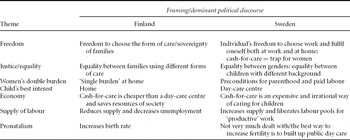
Over the past decade, we have witnessed a growing number of ‘ideational’ studies, stressing the impact of verbal concepts and discourses in the construction of social reality, and creating possibilities and hindrances for subsequent actions. Although our interest was in ideas and discourses, we did not want to neglect social structures or classes. We share Weber's (Reference Weber1989 [1904–5]: 90) and Geertz's (Reference Geerts1972: 314) notions that ideas that can become effective forces in history must be implemented by predominant actors, and someone must revere, defend and impose them. Our analysis indicates that the framing of political alternatives has played and still plays a central role in political debates on child-care policies in Sweden and Finland. Although politicians use the same basic ‘virtues’ in both countries, their content or interpretation was different. The central findings are presented in Table 2.
Freedom to choose or trap for women: hegemonic frames of cash-for-care in Finland and Sweden.

In Finland, supporters of cash-for-care (mainly the Centre and Conservative parties) managed to create a number of important positive connotations, whereas in Sweden the opponents (mainly the Social Democrats) launched the influential ‘trap for women’ slogan. In Finland, gender equality was not as clearly emphasised as in Sweden, and the recognition and value of work at home was more pronounced, whereas in Sweden allowance was interpreted as propping up the old-fashioned family model. In the dominant Finnish interpretation, care allowance is portrayed as an effective means of decreasing the dependence of families on the market. The Finnish frame is more family-oriented, while the Swedish frame stresses more individuality and, in Frazer's (Reference Frazer, Frazer and Honneth2003) terms, recognises the working citizen model.
In Finland, freedom meant the possibility for families to choose between different forms of care and to decide for themselves what they needed, while in Sweden freedom was understood as the possibility to fulfil oneself both in working life and in parenting at home. Thus in Sweden women's double burden was solved by the equal right to parenthood and work, whereas the solution in Finland was ‘either-or’.
The costs of social policy have, on the whole, been a central theme in the Finnish non-socialist rhetoric. Austerity has always been an over-arching meta-frame in the Finnish political discourse (Kosonen, Reference Kosonen1993), and cash-for-care is seen as much cheaper than institutional day care. Furthermore, because of the politics of responsibility versus politics of distribution frames, the Finnish socialists have not been able to counter-manoeuvre the bourgeois ideas by promising improvements in the parental leave scheme, which has been an effective strategy for the SAP in Sweden. According to the Swedish socialist frame, public day care is a more rational and cheaper alternative than home care. One of its advantages is also the quality of the nurturing, which would pay off the costs at some future point. What initially appears to be a cost is in the long run an investment.
In political debate, politicians constantly refer to children's best interests. However, the interpretation of what is the best for children varies substantially. According to the leftist Swedish frame, day-care centres organised by public authorities offer the most inspiring preconditions for development, and they even out inequalities caused by family backgrounds. In Finland, the issue is seen differently: the ideal for children is love and care received at home. Home care, with all its imaginable good characteristics, was contrasted against institutional care, which was suspected of being bureaucratic and completely devoid of emotion. When the three ‘good elements’ of the Finnish non-socialist parties – child welfare, justice and freedom of choice – were united with a proposal which was economically cheaper and had the effect of decreasing unemployment, child home care became a strong trump card for the parties pursuing it.
This discussion has dealt exclusively with hegemonic battles between political parties, which most welfare state analyses treat as unitary actors: Social Democrats wanted this, whereas the Conservatives wanted that. Our historical review clearly indicates that political parties have vacillated in their policy preferences and, on occasion, done complete U-turns. To a certain extent, we can challenge the ‘constant cause’ and ‘unitary actor’ explanations in comparative welfare research. These modes of explanation assume that a given causality is equally relevant for all points in time; that is, some political force, say the Social Democrats, has had the same impact and the same ideas about social policy for decades (cf. Table 1). The U-turns in political orientations indicate that political parties are not such unitary and monolithic actors as often supposed. Parties have their internal hegemonic struggles, and after the healing of these fissures ‘the constitutional moment’ paves the way for subsequent policy-making.
Acknowledgement
We would like to thank Paula Blomquist, Walter Korpi and the anonymous referees of the Journal of Social Policy.