Introduction
Explosive weaponry is frequently used in Operations Iraqi Freedom (OIF) and Enduring Freedom (OEF) and is the leading cause of death and injury in service members (Owens et al., Reference Owens, Kragh, Wenke, Macaitis, Wade and Holcomb2008; Snell & Halter, Reference Snell and Halter2010; Wallace, Reference Wallace2009). More than 79% of all injuries sustained in OEF/OIF are reportedly due to explosive devices (Owens et al., Reference Owens, Kragh, Wenke, Macaitis, Wade and Holcomb2008). With advances in protective body armor, helmet design, battlefield medical procedures, and rapid medical evacuation, more service members are surviving injuries that were otherwise fatal in past conflicts. Consequently, a larger number of service members are returning home with multiple severe concurrent blast-related impairments or polytrauma injuries (Brenner, Vanderploeg, & Terrio, Reference Brenner, Vanderploeg and Terrio2009; Jaffee & Meyer, Reference Jaffee and Meyer2009; Lew et al., Reference Lew, Otis, Tun, Kerns, Clark and Cifu2009), particularly traumatic brain injury (TBI) (Snell & Halter, Reference Snell and Halter2010).
Blast injury is typically classified into four categories: primary, secondary, tertiary, and quaternary. Primary blast injury results from the explosion or blast wave itself and is thought to cause injury by creating over- or under-pressurization at interfaces between tissues, bones and air or fluid-filled spaces. Secondary blast injury occurs when objects near the blast are thrown into the body, resulting in blunt and/or penetrating injury. Tertiary blast injury occurs when the force of the explosion throws a person into nearby objects or the ground (Bochicchio et al., Reference Bochicchio, Lumpkins, O'Connor, Simard, Schaub, Conway and Scalea2008). Quaternary blast injury refers to injuries, illness, and diseases not due to primary, secondary, or tertiary injuries (e.g., asphyxiation, thermal effects, inhalation of asbestos, etc). Although much can be extrapolated from the civilian literature regarding the effects of secondary and tertiary blast injuries due to many similarities in the mechanism of injury (Dikmen et al., Reference Dikmen, Corrigan, Levin, Machamer, Stiers and Weisskopf2009; Schretlen & Shapiro, Reference Schretlen and Shapiro2003), our understanding of the impact of primary blast exposure on the brain is limited.
There is a growing body of literature that supports the tenet that primary blast exposure is an important contributor to the etiology of TBI (Bochicchio et al., Reference Bochicchio, Lumpkins, O'Connor, Simard, Schaub, Conway and Scalea2008). Animal studies have found that the effects of primary blast alone can play a significant role in neuropathological and neurobehavioral changes (Alley, Schimizze, & Son, Reference Alley, Schimizze and Son2010; Cernak, Wang, Jiang, Bian, & Savic, Reference Cernak, Wang, Jiang, Bian and Savic2001; Cheng et al., Reference Cheng, Gu, Ma, Yang, Kuang, Li and Kang2010; Courtney & Courtney, Reference Courtney and Courtney2011; Long et al., Reference Long, Bentley, Wessner, Cerone, Sweeney and Bauman2009; Readnower et al., Reference Readnower, Chavko, Adeeb, Conroy, Pauly, McCarron and Sullivan2010; Salijo, Bolouri, Mayorga, Svensson, & Hamberger, Reference Salijo, Bolouri, Mayorga, Svensson and Hamberger2010; Salijo, Mayorga, Bolouri, Svensson, & Hamberger, Reference Salijo, Mayorga, Bolouri, Svensson and Hamberger2010; Svetlov et al., Reference Svetlov, Prima, Kirk, Gutierrez, Curley, Hayes and Wang2010). These studies have simulated blast exposure in animals using compressed air-driven shock-tube generated blasts at various levels of intensity (Cheng et al., Reference Cheng, Gu, Ma, Yang, Kuang, Li and Kang2010; Long et al., Reference Long, Bentley, Wessner, Cerone, Sweeney and Bauman2009; Readnower et al., Reference Readnower, Chavko, Adeeb, Conroy, Pauly, McCarron and Sullivan2010; Salijo, Bolouri, et al., Reference Salijo, Bolouri, Mayorga, Svensson and Hamberger2010; Salijo, Mayorga, et al., Reference Salijo, Mayorga, Bolouri, Svensson and Hamberger2010; Svetlov et al., Reference Svetlov, Prima, Kirk, Gutierrez, Curley, Hayes and Wang2010). Using this paradigm, researchers have found that exposure to blast results in a variety of neural and behavioral changes such as apnea, limb seizure, poor appetite and limpness (Cheng et al., Reference Cheng, Gu, Ma, Yang, Kuang, Li and Kang2010); disruption of the blood–brain barrier (Readnower et al., Reference Readnower, Chavko, Adeeb, Conroy, Pauly, McCarron and Sullivan2010; Svetlov, et al., Reference Svetlov, Prima, Kirk, Gutierrez, Curley, Hayes and Wang2010); oxidative stress and widespread microglial activation (Readnower et al., Reference Readnower, Chavko, Adeeb, Conroy, Pauly, McCarron and Sullivan2010); impaired neurologic and neurobehavioral performance (Long et al., Reference Long, Bentley, Wessner, Cerone, Sweeney and Bauman2009); intracranial hematomas; and brain swelling (Svetlov et al., Reference Svetlov, Prima, Kirk, Gutierrez, Curley, Hayes and Wang2010). Even low levels of blast exposure (i.e., 10–30 kPa) have been found to be associated with brain edema and related problems such as increased intracranial pressure, small brain hemorrhages, damaged nerve fibers, vascular changes, and impaired cognitive function (Cheng et al., Reference Cheng, Gu, Ma, Yang, Kuang, Li and Kang2010; Salijo, Bolouri, et al., Reference Salijo, Bolouri, Mayorga, Svensson and Hamberger2010; Salijo, Mayorga, et al., Reference Salijo, Mayorga, Bolouri, Svensson and Hamberger2010). While these studies have made significant contributions to knowledge about the potential effects of primary blast exposure, researchers acknowledge that it remains difficult to isolate specific injury mechanisms in laboratory experiments and to relate experimental conditions or findings to real-life blast conditions experienced in the military environment (Courtney & Courtney, Reference Courtney and Courtney2011).
Recent human head modeling and computational studies have attempted to characterize the mechanisms of blast-related injury to the human brain (Alley et al., Reference Alley, Schimizze and Son2010; Chafi, Karami, & Ziejewski, Reference Chafi, Karami and Ziejewski2010; Courtney & Courtney, Reference Courtney and Courtney2011; Desmoulin & Dionne, Reference Desmoulin and Dionne2009; Lockhart, Cronin, William, & Ouellet, Reference Lockhart, Cronin, William and Ouellet2010; Taylor & Ford, Reference Taylor and Ford2009). Using physical models and blast-loading devices at various explosive charges and distances, researchers have sought to predict intracranial pressure, shear stress, and strain effects on the brain (Alley et al., Reference Alley, Schimizze and Son2010; Chafi et al., Reference Chafi, Karami and Ziejewski2010; Desmoulin & Dionne, Reference Desmoulin and Dionne2009; Lockhart et al., Reference Lockhart, Cronin, William and Ouellet2010; Taylor & Ford, Reference Taylor and Ford2009). Overall, the results of these studies suggest that primary blast effects may contribute significantly to the occurrence of TBI in the military population (Alley et al., Reference Alley, Schimizze and Son2010; Chafi et al., Reference Chafi, Karami and Ziejewski2010; Desmoulin & Dionne, Reference Desmoulin and Dionne2009; Lockhart et al., Reference Lockhart, Cronin, William and Ouellet2010; Taylor & Ford, Reference Taylor and Ford2009) as a consequence of three potential injury mechanisms. First, “as a shock wave moves through a biological tissue or material, a rapid pressure spike is experienced followed by a negative pressurization resulting in the compression and expansion of brain tissue in rapid succession. These pressurization changes in the brain can cause strain and shearing of brain tissues, blood vessels and neurons, possibly accompanied by contusions, hemorrhaging, and diffuse axonal injury” (Chafi et al., Reference Chafi, Karami and Ziejewski2010; p. 491). Second, a blast wave can create a “coup-contrecoup” injury in which the head is suddenly accelerated (or decelerated) by the blast, causing “alternating anterior-posterior impacts” inside the skull (Chafi et al., Reference Chafi, Karami and Ziejewski2010; Taylor & Ford, Reference Taylor and Ford2009). Third, diffuse axonal injury may occur in the first few milliseconds of exposure to the wave front of blast overpressure, before any “larger translational or rotational motions” (Taylor & Ford, Reference Taylor and Ford2009).
However, the application of these models in humans and real-world situations has been less clear. There are only a handful of case reports (Warden et al., Reference Warden, French, Shupenko, Fargus, Riedy, Erickson and Moore2009; Yilmaz & Pekdemir, Reference Yilmaz and Pekdemir2007) that have described primary blast injury in humans. Additionally, although some have hypothesized differences in the effects of brain injury in blast versus non-blast TBI, there has been limited evidence to support the idea that neurocognitive and neurobehavioral sequelae from these two injury mechanisms are disparate, except perhaps as related to the emotional valence of the situation.
There are two studies that have compared the neurocognitive sequelae of blast versus non-blast TBI. Belanger and colleagues (Belanger, Kretzmer, Yoash-Gantz, Pickett, & Tupler, Reference Belanger, Kretzmer, Yoash-Gantz, Pickett and Tupler2009) examined OEF/OIF veterans on a brief neuropsychological test battery following mild, moderate, or severe TBI (on average 1–3 years post-injury). There were no significant differences between blast versus non-blast groups on the majority of measures (processing speed, executive functioning, and verbal learning and memory), with the exception of a measure of visual memory and learning (i.e., medium effect sizes). Better performances were found in the blast group in those veterans who sustained a MTBI (Blast > Non-blast), but the opposite was true for those veterans who sustained a moderate-severe TBI (Non-blast > Blast). In another study, Luethcke and colleagues (Luethcke, Bryan, Morrow, & Isler, Reference Luethcke, Bryan, Morrow and Isler2011) examined performance on a computerized neurocognitive test battery in military personnel and civilian contractors within 72 hr of sustaining a MTBI. There were no significant differences between blast and non-blast groups on measures of reaction time, learning, memory, and working memory.
Studies comparing the neurobehavioral sequelae following blast versus non-blast TBI are more common, though findings are mixed. While some studies have found no clear influence of mechanism of injury on neurobehavioral outcome (Luethcke et al., Reference Luethcke, Bryan, Morrow and Isler2011; Wilk et al., Reference Wilk, Thomas, McGurk, Riviere, Castro and Hoge2010), other studies have found some relationship between blast exposure and symptom reporting, particularly PTSD symptoms (Belanger et al., Reference Belanger, Kretzmer, Yoash-Gantz, Pickett and Tupler2009, Reference Belanger, Proctor-Weber, Kretzmer, Kim, French and Vanderploeg2011; Kennedy, Leal, Lewis, Cullen, & Amador, Reference Kennedy, Leal, Lewis, Cullen and Amador2010; Lippa, Pastorek, Benge, & Thornton, Reference Lippa, Pastorek, Benge and Thornton2010). Wilk and colleagues (Reference Wilk, Thomas, McGurk, Riviere, Castro and Hoge2010) examined service members 3–6 months after returning from a 12-month deployment to Iraq. Those service members who reported experiencing a blast exposure with loss of consciousness were more likely to report headaches and tinnitus than those who reported a non-blast mechanism of injury. However, there were no differences in postconcussive, PTSD, or depression symptoms, or alcohol misuse, absenteeism, or medical visits. In the above study by Luethcke et al. (Reference Luethcke, Bryan, Morrow and Isler2011), patients were asked to recall symptoms they experienced at the time of injury and at the time of evaluation (i.e., 72 hr post-injury). There were no significant differences on the majority of self-reported measures (i.e., insomnia, alertness, PTSD, global mental health, and mood [vigor, fatigue, restlessness, anxiety, depression, and anger]). A higher incidence of imbalance, nausea, and vomiting was reported by the non-blast group immediately following injury. However, at 72 hr post-injury, only headaches were reported more frequently by the non-blast group.
In two studies examining postconcussion symptom reporting in service members following MTBI, no differences were found between blast and non-blast groups for self-reported postconcussion symptoms in OEF/OIF veterans assessed on average 3 years post-injury (Lippa et al., Reference Lippa, Pastorek, Benge and Thornton2010), or service members assessed 12 to 26 months post-injury (Belanger et al., Reference Belanger, Proctor-Weber, Kretzmer, Kim, French and Vanderploeg2011). However, in both studies, postconcussion symptom reporting was related to emotional distress (i.e., PTSD symptoms) rather than blast/non-blast mechanism of injury. The blast group reported significantly higher PTSD symptoms than the non-blast exposure group in both studies.Footnote 1 The relationship between PTSD symptom reporting and blast related TBI has also been reported by other researchers who have found (a) a higher incidence of medical chart documented PTSD, on average 3 months post-injury (median = 45.5 days; range, 13–730 days), in OIF/OEF service members who sustained a TBI due to blast exposure (but not for postconcussion symptoms, pain, motor functioning, communication, or functional status) (Sayer et al., Reference Sayer, Chiros, Sigford, Scott, Clothier, Pickett and Lew2008), and (b) higher symptom reporting on the “Re-experiencing Cluster” of the PTSD Checklist Civilian Version (but not the PCLC total score) in OIF/OEF service members who had sustained a MTBI due to blast exposure, assessed on average 7–8 months post injury (range = 2 days to 5.4 years) (Kennedy et al., Reference Kennedy, Leal, Lewis, Cullen and Amador2010). In the above study by Belanger et al. (Reference Belanger, Kretzmer, Yoash-Gantz, Pickett and Tupler2009), a non-significant trend was found for the blast group to report more PTSD symptoms compared to the non-blast group. However, this finding was likely biased by sample characteristics and the presence of a positive linear relation between PTSD symptoms and time since injury (i.e., the blast group consisted of a significantly higher proportion of patients who had been evaluated later post-injury).
The purpose of this study was to further examine the influence of deployment-related blast versus non-blast mechanism of injury on neuropsychological test performance following MTBI in US military service members. It was hypothesized that those service members who sustained a MTBI resulting from a blast related mechanism of injury (i.e., primary blast plus secondary or tertiary blast injuries) will have worse neurocognitive test performance compared to those service members injured as a result of a non-blast mechanism of injury (i.e., motor vehicle accident, fall, assault, etc). It is further hypothesized that self-reported symptoms, as measured by a personality inventory, will be reported more frequently in those who have sustained a blast-related MTBI compared to those who sustained a non-blast related MTBI.
Method
Participants
Participants were 56 patients who sustained a deployment-related MTBI and were evaluated at the Walter Reed Army Medical Center (WRAMC), Washington, DC, following medical evacuation from combat theatre for their injuries while deployed during Operation Iraqi Freedom (OIF) or Operation Enduring Freedom (OEF). As a general rule, patients were primarily medically evacuated for limb loss or systemic injuries, rather than MTBI per se. The sample consisted of two groups categorized by mechanism of injury: (a) 21 Non-blast, and (b) 35 Blast Plus. Classification of injury mechanism was determined by a comprehensive review of medical records.
Patients were categorized in the Non-blast group if they sustained a MTBI as a result of a mechanism of injury that did not involve exposure to an explosive device (e.g., improvised explosive device [IED], rocket propelled grenade [RPG], landmine, mortar, bomb, grenade). Examples of injury in this group included: (a) fall from height, (b) motor vehicle accident, (c) helicopter crash, or (d) blunt force trauma.
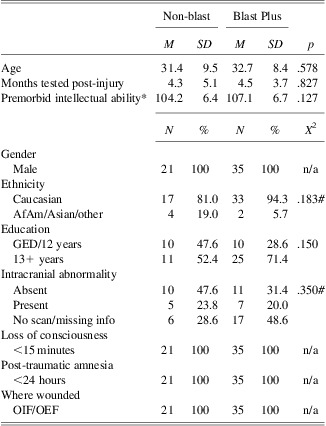
Patients were categorized in the Blast Plus group if they sustained a MTBI as a result of exposure to an explosive device (e.g., RPG, IED). Service members in this group may have sustained a brain injury as a result of primary (e.g., blast wave), secondary (e.g., hit by shrapnel), and/or tertiary (e.g., thrown/blown into object) blast injuries. Common mechanisms of injury in this group were as follows: (a) thrown against a wall due to blast exposure, (b) motor vehicle crash due to hitting IED on road, (c) fall from a building due to RPG attack, (d) stepping on an IED, (e) RPG attack in open space, or (f) gunner in turret of motor vehicle that hit an IED without rollover. Descriptive statistics and injury characteristics of the groups are presented in Table 1.
Demographic and injury severity characteristics

Note. N = 56 (21 Non-blast, 35 Blast Plus).
*Wechsler Adult Test of Reading.
#Fisher exact test interpreted due to small sizes of some cells.
GED = General Education Diploma; OIF = Operation Iraqi Freedom; OEF = Operation Enduring Freedom; AfAm = African-American.
Participant Selection
Participants were selected from a larger sample of 662 U.S. military service members who were evaluated at WRAMC between February 2002 and January 2009 following a suspected or confirmed TBI, and who had agreed to the use of their clinical data for research purposes. All patients had been referred to the TBI Service at WRAMC for further evaluation following a confirmed TBI. All patients undertaking a neuropsychological evaluation are administered a core battery of tests (approximately 6 hr) aimed at documenting current neurocognitive abilities and neurobehavioral functioning. Patients were only included in the selected sample if they: (a) had sustained a closed TBI (n = 577; 87.2% of sample), (b) had completed a core neuropsychological test battery (n = 448; 67.7% of sample), (c) had been administered the Word Memory Test (n = 562; 84.9% of sample) and scored above the recommended cutoff score for providing adequate effort (n = 406; 61.3% of sample), (d) had been administered the Personality Assessment Inventory (n = 512; 77.3% of sample) and had a valid and interpretable clinical profile (n = 443; 66.9% of sample), (e) had sufficient information available that could confidently classify severity of brain injury as mild (n = 276; 41.7% of sample), (f) had been assessed by the TBI Service within 14 months of injury (n = 533; 80.5% of sample), (g) were injured while deployed in OEF/OIF (n = 442; 74.8% of sample], and (h) were male (n = 615; 92.9% of sample). The mean time tested post injury was 4.4 months (SD = 4.1). The breakdown of time tested post-injury was as follows: 15 days–3 months (61.0%), 4–6 months (13.6%), 7–9 months (10.2%), and 10–14 months (15.3%). Information regarding previous MTBI history was not available.
Diagnosis of TBI was based on a routine comprehensive clinical screening evaluation undertaken by medical/health-care professionals at WRAMC. As part of the standard clinical pathway, all patients treated at WRAMC who are considered to be “at risk” for TBI undertake a TBI evaluation. A low threshold is purposely used to classify patients “at risk” for TBI. Typically, patients are considered “at risk” for TBI if they sustained an injury to any part of their body above the shoulders during a battle or non-battle related event, or are injured in any way by an event such as a blast, assault, MVA, or fall. For the large majority of patients, these evaluations are completed by a Physician's Assistant who is trained to evaluate the presence of TBI. In some cases, evaluations are also completed by other health-care professionals such as Neuropsychologists, Social Workers, and Nurses who are trained to evaluate TBI. TBI evaluations typically include (a) a patient interview, (b) a medical chart review including the review of in-theater medical records when available, (c) case conferencing, and (d) family interview and gathering of other collateral information (if available). Diagnosis and severity of TBI is based on the presence and duration of loss of consciousness (LOC), presence and duration of post-traumatic amnesia (PTA), duration of alteration of consciousness, neuroradiological scans, and Glasgow Coma Scale (GCS) scores (if available). Self-reported symptoms are routinely obtained during the TBI evaluation but are not used for diagnostic or classification purposes.
Classification of brain injury severity was based primarily on duration of LOC and PTA. GCS scores are not consistently available shortly after combat-related injuries and were not available for use. MTBI was defined as follows: (a) the presence of PTA<24 hr, and (b) LOC from 0 to <15 min. It was our preference to use a LOC criterion of <30 min consistent with commonly used military and civilian diagnostic criteria (Carroll, Cassidy, Holm, Kraus, & Coronado, Reference Carroll, Cassidy, Holm, Kraus and Coronado2004; Managment of Concussion/nTBI Working Group, 2009; Mild Traumatic Brain Injury Committee, American Congress of Rehabilitation Medicine, & Head Injury Interdisciplinary Special Interest Group, 1993). However, the available information regarding LOC was limited to categorical data that did not allow us to differentiate between LOC greater or lower than 30 minutes (i.e., available data = LOC<15 min and LOC 16–59 min).
Information regarding intracranial abnormality (based on computed tomography [CT] or magnetic resonance imaging [MRI] scans undertaken within the first few days and/or weeks post-injury) was available for some, but not all participants (12.8% missing; 24.4% no scan). For those patients with LOC/PTA in the mild range, a classification of MTBI was assigned regardless of the absence or presence of intracranial abnormality. It is acknowledged that this practice is incongruent with the Department of Defense clinical guidelines (Managment of Concussion/mTBI Working Group, 2009) that recommends classifying any patient with intracranial abnormality as having a “greater than mild injury” (p. 16). However, for the purposes of research, our preference is to classify those patients with evidence of intracranial abnormality and LOC/PTA in the mild range as having a “complicated MTBI” (rather than moderate TBI). The importance of the distinction between complicated and uncomplicated MTBI has been discussed by one of the authors elsewhere (Iverson, Lange, Gaetz, & Zasler, Reference Iverson, Lange, Gaetz and Zasler2007). In this sample, many patients with LOC/PTA in the mild range also had missing CT/MRI scan information (38.4%). For the purposes of this study, patients were classified as sustaining a MTBI regardless of CT/MRI scan results, or availability of CT/MRI scan information (41.9% uncomplicated MTBI, 17.4% complicated MTBI, 40.7% unclassified MTBI).
The protocols under which these data were collected were approved by the Institutional Review Board of WRAMC, Washington, DC. This study was completed in accordance with the guidelines of the Helsinki Declaration.
Measures and Procedure
Measures were selected from a larger neuropsychological test battery (approximately 6 hr) designed to provide objective documentation of neurocognitive and psychological functioning. Measures of psychological functioning included the Personality Assessment Inventory (PAI; Morey, Reference Morey1991). The PAI generates four validity scales, 18 clinical scales, and 31 clinical subscales. Of these, measures of interest included 14 of the 18 clinical scales (see Table 4). Participants were not included if their T-scores exceeded the recommended cutoff on any of the four validity scales. For some analyses, clinical scale elevations were classified into dichotomous categories based on T-scores cutoff in the manual. For the clinical scales, 60 T or higher was classified as “mild or higher,” and 70 T of higher was classified as “moderate or higher.”
Neurocognitive measures included the (a) Trail Making Test (TMT; (Reitan, Reference Reitan1992)): Part A and Part B; (b) California Verbal Learning Test-2nd Edition (CVLT-II; Delis, Kramer, Kaplan, & Ober, Reference Delis, Kramer, Kaplan and Ober2000): Total Trials 1–4 and Free Recall Long Delay; (c) Conner's Continuous Performance Test-2nd Edition (CPT-II; Conners, Reference Conners2002): Omissions, Commissions, and Reaction Time; and (d) selected subtests from the Wechsler Adult Intelligence Scale-Third Edition (Wechsler, Reference Wechsler1997): Similarities, Letter-Number Sequencing, Digit Symbol-Coding, Block Design, and Matrix Reasoning. As part of the standard test battery, patients also completed the Wechsler Test of Adult Reading (The Psychological Corporation, 2001) to estimate premorbid intellectual ability, and the Word Memory Test (WMT; Green, Reference Green2003) to evaluate their level of effort during testing. Patients were classified as having provided “poor effort” when their performance on the WMT fell below the cutoff scores recommended in the manual.
For all neurocognitive measures, raw scores were converted to standard scores (e.g., Z-scores, T-scores, scaled scores) using the following published norms: (a) TMT Part A and B completion time normative data by Heaton and colleagues (Heaton, Miller, Taylor, & Grant, Reference Heaton, Miller, Taylor and Grant2004), (b) WAIS-III manual for selected subtests (Wechsler, Reference Wechsler1987), (c) CVLT-II manual for total and delay scores (Delis et al., Reference Delis, Kramer, Kaplan and Ober2000), (d) CPT-II manual for Omissions, Commissions, and Reaction Time (Conners, Reference Conners2002). With the exception of the WAIS-III subtests, all standard scores were converted to T-scores (M = 50; SD = 10) where necessary. Scaled scores (M = 10; SD = 3) on the WAIS-III subtests were retained unmodified.
Results
Demographics and Injury Characteristics
Descriptive statistics of demographic and injury characteristics by group are presented in Table 1. There were no significant main effects for age (p = .578), months tested post injury (p = .827), premorbid intellectual ability (p = .127), ethnicity (p = .183), education (p = .150), or intracranial abnormality (p = .350).
Neurocognitive Measures
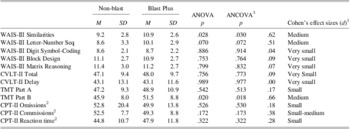
Descriptive statistics, group comparisons (ANOVA), and effect sizes (Cohen, Reference Cohen1988) for the 12 cognitive measures, by group, are presented in Table 2. It is acknowledged that the probability of Type 1 error increases when multiple statistical comparisons are made and a more conservative p value of <.01 might be typically used. However, the small sample size reduces statistical power and the application of a p value of <.01 was considered too stringent. Thus, it was decided to apply a more liberal statistical approach by interpreting findings using p < .05.
Descriptive statistics4, group comparisons, and effect sizes by group: Neurocognitive measures

Note. N = 56 (21 Non-blast, 35 Blast Plus).
1Cohen's effect sizes: small (0.2), medium (0.5), large (0.8).
2High T-scores indicate worse performance on this test.
3Months tested post injury was used as a covariate in these analyses.
4All scores are T-scores (M = 50, SD = 10) with the exception of the WAIS-III subtests which are scaled scores (M = 10, SD = 3); All scores are presented as unadjusted mean scores.
TBI = traumatic brain injury; WAIS-III = Wechsler Adult Intelligence Scale-III; CVLT-II = California Verbal Learning Test-II; TMT = Trail Making Test; CPT = Conner's Continuous Performance Test-II.
There were no significant main effects for the majority of the measures (range: p > .05), with the exception of WAIS-III Similarities (p = .028; d = .62, medium effect size) and TMT Part B (p = .020; d = .66, medium effect size). On these measures, the Non-blast group performed significantly worse compared to the Blast Plus group. There were no other significant differences between groups for the remaining measures. There was however a medium effect size (d = .51) noted for WAIS-III Letter Number Sequencing subtest. For this measure, the Non-blast group again performed worse compared to the Blast Plus group.
Given the known relation between time post-injury and outcome from TBI, the influence of months tested post-injury on the neurocognitive variables was examined using Pearson Correlation and ANCOVA. There were no significant correlations between months tested post-injury and any of the 12 neurocognitive variables (all p > .05). Group comparison of the Blast Plus and Non-blast group using ANCOVA with time tested post-injury as a covariate again revealed no significant main effects for the majority of the measures (range: p > .05), with the exception of WAIS-III Similarities (p = .030) and TMT Part B (p = .018).
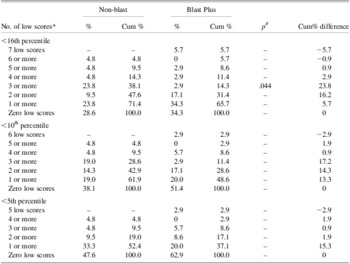
Comparison of the prevalence of the number of low scores was undertaken by considering all 12 measures simultaneously. The cumulative percentages of the number of low scores (using <5th, <10th, <16th percentile as cutoff scores) by group is presented in Table 3. Using Chi Square analyses, there were no significant differences in the percentage of patients that had multiple low scores across groups, with the exception of one comparison: 38.1% of the Non-blast group had three or more low scores <16th percentile compared to 14.3% of the Blast Plus group (p = .044; 23.8% difference). There were, however, some substantial differences between groups that were not statistically significant. Overall, there was a trend toward a higher percentage of patients from the Non-blast group to have multiple low scores compared to the Blast Plus group. For example: (a) 47.6% of the Non-blast group had two or more scores <16th percentile compared to 31.4% of the Blast Plus group [p > .05; 16.2% difference], and (b) 28.6% of the Non-blast group had three or more scores <10th percentile compared to 11.4% of the Blast Plus group (p > .05; 17.2% difference). Nonetheless, given the large number of comparisons above, these nominally significant p-values should be interpreted cautiously.
Number of low neurocognitive test scores by group

Note. N = 56 (21 Non-blast, 35 Blast Plus).
TBI = traumatic brain injury.
*Max of 12 measures.
#Chi-square statistics were interpreted when appropriate. When cell sizes were too small, Fisher exact test statistics were used.
Psychological Measures
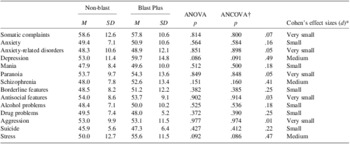
Descriptive statistics, group comparisons (ANOVA), and Cohen's effect sizes for the 14 PAI clinical scales by group are presented in Table 4. There were no significant main effects for all PAI scales (range: p > .05). Of note however, although not significantly different (likely due to small sample sizes), medium effect sizes were found for the Depression (p = .086; d = .49) and Stress scale (p = .092; d = .47). On these scales, there was a trend for the Blast Plus group to report a higher number of symptoms compared to the Non-blast group. Further comparison of the proportion of individuals with elevated scores on these scales revealed no significant differences between groups when using a cutoff score of (a) mild scale elevation or higher (Stress: p = .254, Blast Plus = 25.7%, Non-blast = 14.3%; Depression: p = .215, Blast Plus = 40.0%, Non-blast = 23.8%) or (b) moderate scale elevation or higher (Stress: p = .470, Blast Plus = 14.3%, Non-blast = 9.5%; Depression: p = .056, Blast Plus = 31.4%, Non-blast = 9.5%). However, a slightly higher proportion of the Blast Plus group did elevate the Depression scale when compared to the Non-blast group (i.e., mild or higher = 16.2% difference; moderate or higher = 21.9% difference).
Descriptive statistics, group comparisons, and effect sizes by group: Personality Assessment Inventory clinical scales

Note. N = 56 (21 Non-blast, 35 Blast Plus).
*Cohen's effect sizes: small (0.2), medium (0.5), large (0.8).
†Months tested post-injury was used as a covariate in these analyses.
ANOVA = analysis of variance; ANCOVA = analysis of covariance.
The influence of time tested post-injury on the PAI scales was examined using Pearson Correlation and ANCOVA. There were no significant correlations between months tested post-injury on any of the PAI scales (all p > .05), with the exception of the Anxiety-related Disorders scale (r = .29; p = .030). For this scale, as months post-injury increased, T-scores on these scale also increased. However, the strength of this relation was weak. Further comparison of the two groups using ANCOVA with time tested post-injury as a covariate again revealed no significant main effects for all of the measures (range: p > .05).
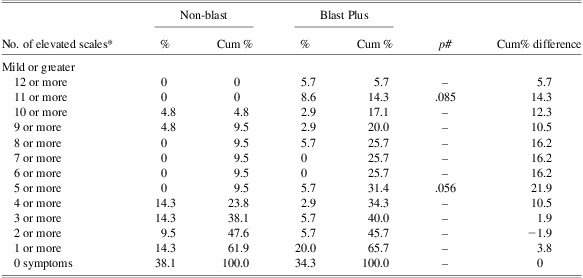
The cumulative percentages of the number of elevated PAI scales as “mild or greater” and “moderate or greater” in each group are presented in Table 5. Using χ 2 analyses, there were no significant differences in the percentage of patients that had multiple low scores across groups (all p > .05). There was however two comparisons where there was a trend toward a higher percentage of participants from the Blast Plus who had multiple elevated scales endorsed as mild or higher compared to the Non-blast group. For example (a) 31.4% of the Blast Plus group had five or more elevated scales at a mild level or higher compared to 9.5% of the Non-blast group (p = .056, 21.9% difference), and (b) 14.3% of the Blast Plus group had 11 or more elevated scales endorsed at a mild level or higher compared to 0% of the Blast Plus group (p = .085, 14.3% difference). Nonetheless, given the large number of comparisons above, these nominally significant p-values should again be interpreted cautiously.
Number of elevated Personality Assessment Inventory clinical scales by group

Note. N = 56 (21 Non-blast, 35 Blast Plus).
*Max of 14 measures (validity scales were excluded).
#Chi-square statistics were interpreted when appropriate. When cell sizes were too small, Fisher Exact Test statistics were used.
Personality and Neurocognitive Measures
To explore the influence of personality variables on neurocognitive test performance, a series of four ANCOVAs were undertaken by comparing the blast/non-blast groups on those cognitive variables that had significant main effects (from Table 2) (i.e., WAIS-III Similarities and TMT Part B) using selected PAI scales as covariates. Only those PAI scales that had Cohen's effect sizes greater than d = .45 (from Table 4) were included as covariates (i.e., Depression and Stress scales). When statistically controlling for personality variables using the two PAI scales separately, there were no significant main effects for TMT Part B when using the Depression (p = .143) or Stress scales (p = .181) as a covariate. Similarly, there were no significant main effects for WAIS-III Similarities subtests when using the Depression (p = .131) or Stress scales (p = .138) as a covariate.
Discussion
The purpose of this study was to examine the influence of deployment-related blast versus non-blast mechanism of injury on neuropsychological test performance following MTBI in US military service members. Our hypotheses were two-fold. First, those service members who sustained an MTBI resulting from a blast related mechanism of injury (i.e., primary plus secondary/tertiary injuries) would have worse neurocognitive test performance compared to those injured as a result of a non-blast mechanism of injury (i.e., MVA, fall, assault). Second, self-reported symptoms (as measured by a personality inventory) following blast-related MTBI would be higher than following non-blast MTBI. Overall, support for these hypotheses was mixed.
Inconsistent with the first hypothesis, there was no significant relation between blast/non-blast mechanism of injury (i.e., Blast Plus vs. Non-blast) for any of the individual neurocognitive measures, with the exception of only a handful of measures (i.e., WAIS-III Similarities and TMT Part B; Non-blast<Blast Plus). Of particular mention, these differences were in the opposite direction of the hypothesis (i.e., Non-blast > Blast Plus). However, the differences noted between groups on these measures are likely influenced by psychological distress, rather than blast/non-blast mechanism. When these measures were further compared by taking into account the influence of psychological distress (i.e., using ANCOVA), differences between these two groups were no longer apparent. It is important to note however that the potential influence of psychological distress on these measures is somewhat counter intuitive. Typically, psychological distress has a negative influence on cognitive test performance. However, the opposite was true in this sample. The Blast Plus group reported higher levels of psychological distress, yet paradoxically, this group had higher scores on these neurocognitive variables.
Nonetheless, these results demonstrate a lack of association between blast/non-blast mechanism of injury and the neurocognitive measures which is consistent with previous research that has also generally found little to no differences between blast/non-blast groups using a brief traditional neurocognitive battery following mild to severe TBI (Belanger et al., Reference Belanger, Kretzmer, Yoash-Gantz, Pickett and Tupler2009), or a brief computerized neurocognitive test battery following MTBI (Luethcke et al., Reference Luethcke, Bryan, Morrow and Isler2011). Of particular interest, however, in the study by Belanger and colleagues Reference Belanger, Kretzmer, Yoash-Gantz, Pickett and Tupler(2009), these authors did note some isolated differences between blast/non-blast groups on a measure of visual memory and learning. Better performances were associated with blast exposure in those patients who had sustained a MTBI (Blast Plus > Non-blast), but the opposite was true in those patients who had sustained a moderate to severe TBI (Non-blast > Blast Plus). Nonetheless, the relation between mechanism of injury and cognitive performance was variable and considered weak at best.
Somewhat contrary to the second hypothesis, blast/non-blast mechanism of injury was not strongly associated with symptom reporting following MTBI. On the PAI, there were few differences in symptom reporting between groups, with the exception of the Blast Plus group that had a tendency to have a higher number of symptoms on the Depression scale. When considering the cumulative percentages of the number of elevated PAI scales, there was also a tendency for the Blast Plus group to elevate more scales than the Non-blast group, but only for scales elevated at a mild level or higher, and not for scales elevated at a moderate level or higher. It is important to highlight however that all group comparisons were not significantly different and again clearly suggest only a weak relation between blast/non-blast mechanism of injury and symptom reporting at best.
When compared to past research focusing on symptom reporting following blast/non-blast TBI, these results are both consistent and inconsistent with previous studies. Consistent with previous research, these results demonstrated only a weak relation between blast-related TBI and a broad range of self-reported symptoms. Previous studies (Belanger et al., Reference Belanger, Proctor-Weber, Kretzmer, Kim, French and Vanderploeg2011; Lippa et al., Reference Lippa, Pastorek, Benge and Thornton2010; Luethcke et al., Reference Luethcke, Bryan, Morrow and Isler2011; Wilk et al., Reference Wilk, Thomas, McGurk, Riviere, Castro and Hoge2010) have generally found no differences between blast and non-blast TBI on a range of symptoms such as depression, alcohol, happiness, vigor, fatigue, restlessness, anxiety, anger, and postconcussion symptoms. Although, some studies have shown a relation between blast related injury and PTSD symptom reporting (Belanger et al., Reference Belanger, Kretzmer, Yoash-Gantz, Pickett and Tupler2009, Reference Belanger, Proctor-Weber, Kretzmer, Kim, French and Vanderploeg2011; Kennedy et al., Reference Kennedy, Leal, Lewis, Cullen and Amador2010; Lippa et al., Reference Lippa, Pastorek, Benge and Thornton2010; Sayer et al., Reference Sayer, Chiros, Sigford, Scott, Clothier, Pickett and Lew2008).
When the results of this study are compared to previous research however, there are two inconsistencies that warrant discussion. First, these results demonstrated a relation between blast-related TBI and depression symptom reporting (albeit a weak association). Overall, the Blast Plus group had a tendency to have a greater number of depression symptoms compared to the Non-blast group. For example, when comparing the number of service members with scale elevations on the Depression scale, 31.4% of the Blast Plus group had scores on the Depression scale that was moderately elevated or higher, compared to only 9.5% of the Non-blast group (21.9% difference). In contrast, past research by Luethcke et al. (Reference Luethcke, Bryan, Morrow and Isler2011) found no differences between blast/non-blast groups on the Depression scale of the ANAM. However, an important methodological difference between the two studies relates to the time in which patients were evaluated post-injury. In the current study, patients were evaluated on average 4 months post-injury. In the study by Luethcke and colleagues, patients were evaluated within 72 hr post-injury. It is likely that the onset of depression symptoms manifests later in the recovery trajectory and account for these discrepancies. In contrast to this hypothesis, however, Wilk and colleagues Reference Wilk, Thomas, McGurk, Riviere, Castro and Hoge(2010) found no differences between blast/non-blast groups on the Depression module of the Patient Heath Questionnaire many months after injury. However, it is important to appreciate that the service members in this study were evaluated 3–6 months after returning from a 12-month deployment to Iraq and had not been medically evacuated for their injuries. All service members in the study were included based solely on a self-reported concussion.
Second, these results failed to demonstrate a relation between blast-related TBI and PTSD symptom reporting (Belanger et al., Reference Belanger, Kretzmer, Yoash-Gantz, Pickett and Tupler2009, Reference Belanger, Proctor-Weber, Kretzmer, Kim, French and Vanderploeg2011; Kennedy et al., Reference Kennedy, Leal, Lewis, Cullen and Amador2010; Lippa et al., Reference Lippa, Pastorek, Benge and Thornton2010; Sayer et al., Reference Sayer, Chiros, Sigford, Scott, Clothier, Pickett and Lew2008). There were no differences between blast/non-blast groups (i.e., very small effect size) on the Anxiety Related Disorders scale of the PAI – a scale designed to evaluate PTSD related symptomatology (Morey, Reference Morey1991). However, it is important to appreciate several points in this regard. First, not all previous research has found a relation between blast-TBI and PTSD symptoms (Luethcke et al., Reference Luethcke, Bryan, Morrow and Isler2011; Wilk et al., Reference Wilk, Thomas, McGurk, Riviere, Castro and Hoge2010). Of the eight studies available, two studies have failed to find a relation between PTSD and blast-TBI. It is possible that the failure of one of these studies to support the relation between PTSD and blast-TBI might be due to the fact that service members were evaluated within the acute stages of recovery (i.e., within 72 hr; Luethcke, et al., Reference Luethcke, Bryan, Morrow and Isler2011) and PTSD symptoms had not yet manifested for some patients. However, this was not the case for the study by Wilk and colleagues who evaluated service members 3–18 months post-injury (Wilk et al., Reference Wilk, Thomas, McGurk, Riviere, Castro and Hoge2010). Second, of those studies that have supported the relation between PTSD and blast-related TBI, the strength of this relation varies across studies. Using the available data in the literature (i.e., M, SD, and sample size), we calculated Cohen's (Cohen, Reference Cohen1988) effect sizes for PTSD scores between groups. When all studies are compared (including this study), Cohen's effect sizes for mean scores on PTSD measures ranged from very small (current study), small (Belanger et al., Reference Belanger, Proctor-Weber, Kretzmer, Kim, French and Vanderploeg2011; Kennedy et al., Reference Kennedy, Leal, Lewis, Cullen and Amador2010), medium (Belanger et al., Reference Belanger, Kretzmer, Yoash-Gantz, Pickett and Tupler2009), to very large (Lippa et al., Reference Lippa, Pastorek, Benge and Thornton2010). As such, the consistency and strength of the relation between PTSD and blast-TBI is variable.
This study has several methodological limitations. First, the timing of the collection of outcome measures in this Army Medical Center was influenced by clinical and administrative factors. This resulted in several subjects from the larger sample not meeting inclusion criteria. Second, the accurate identification of MTBI in combat-injured polytrauma cases is complex—and it is possible that we have included a small number of patients who did not sustain an obvious MTBI and a few who might have sustained a more serious injury. Further research into the accurate diagnosis of MTBI in a polytrauma population seems needed. Third, information regarding compensation status or external incentives was not available in this sample. Although it is common for service members to have external incentives at the time of testing (e.g., avoiding being deployed again, obtaining a disability pension, or other financial incentive), this information was not available and we could not evaluate the influence of external incentives on test performance. Fourth, only a single measure of cognitive effort (i.e., WMT) was used to exclude subjects from the study. One of the limitations of this practice is that some of the people included in this study may have been misidentified as providing adequate effort, when in fact they provided inadequate effort. However, we included people in this study only if they were identified as having provided adequate cognitive effort on the WMT in addition to being identified as not providing exaggerated symptom reporting (i.e., PAI Validity Scales). Although it is possible that some patients in our sample may have been misidentified, the combination of measures has reduced the likelihood of misidentification and we do not believe that these factors would have changed the overall results of the study. Fifth, these data may not generalize to the larger MTBI population. This sample included 21% of participants who had intracranial abnormality and 41% without neuroradiological investigations completed or missing information. It is possible that the presence/absence of intracranial abnormality may have influenced the findings which cannot be determined here due to missing information. However, recent research using the same patient population found no differences between complicated and uncomplicated MTBI groups (Anderson-Barnes et al., Reference Anderson-Barnes, Lange, Pancholi, Brickell, Bhagwat, Iverson and French2011) and is unlikely to be a confounding variable. Sixth, no information was available regarding history of previous TBI.
In summary, the results from this study found only a weak association between deployment-related blast/non-blast mechanism of injury and symptom reporting on a personality inventory and neurocognitive test performance. Despite the weak association between blast/non-blast mechanism of injury, it is important to highlight that some differences in psychological distress were noted in this study. In particular, individuals who were exposed to blast related injury had a tendency to report more symptoms of depression. However, the significance of this finding is considered meager at best. Rather, these findings provide little evidence to suggest that blast exposure plus secondary blunt trauma results in worse cognitive or psychological recovery than blunt trauma alone.
Acknowledgments
Portions of these data were presented at the International Neuropsychological Society annual conference, Boston, Massachusetts, USA: February 2010. The views expressed in this article are those of the authors and do not necessarily reflect the official policy or position of the Department of the Navy, Army, or Air Force, the Department of Defense, nor the U.S. Government. For all authors, there are no financial conflicts of interests or other relationships that could be interpreted as a conflict of interest affecting this manuscript. The information in this manuscript and the manuscript itself has never been published either electronically or in print. No financial support was received for the completion of this manuscript.