Introduction
Growth within the poultry sector can contribute to enhanced nutrition and poverty reduction in India, because a large share of the rural poor are dependent on poultry for food and income, due to widespread protein-energy and micronutrient malnutrition, and as the demand for animal source food – including milk, meat and eggs – is increasing massively in South Asia. Market and institutional problems and failures, however, constrain the sector from more effectively serving as a means for reducing malnutrition and poverty in India. Currently, only large commercial producers benefit from the expanding demand for animal protein and the landless, marginal and small landholders are unable to participate in the lucrative poultry market (Ali, Reference ALI2007; GoI, Reference GoI2002).
The Government of India recognizes that growth in the poultry sector has so far only marginally contributed to poverty reduction and improved nutrition. The overall objective of the Eleventh Five Year Plan (2007-2012) is:
‘to ensure that future growth (in agriculture) is more efficient, sustainable and inclusive’
and
‘For growth to be at all inclusive, the agricultural strategy must focus on the 85 percent of farmers who are marginal, increasingly female, and who find it difficult to access inputs, credit, and extension or to market their output’ (GoI, Reference GoI2007a).
This paper reviews the major pathways through which poultry sector growth can contribute to accelerated poverty reduction and improved nutrition in the India population. In contrast to the prevailing literature on poultry sector development and poverty reduction, which largely focuses on poultry farming (Dolberg, Reference DOLBERG2003; Mack et al., Reference MACK, HOFFMAN and OTTE2005; Permin et al., 2001), this paper endeavours to consider the entire poultry supply chain, from day-old chick to the final meal on a plate. Included in the review are recent growth trends in the Indian poultry sector; the potential linkages between poultry farming and farmer livelihoods, employment along the poultry value chain, and consumption of poultry meat and eggs.
Poultry sector trends in India
In the last few decades livestock has been one of the fastest growing sectors in Indian agriculture, currently accounting for about 25 percent of the agricultural GDP as compared to less than 14 percent in 1980 (GoI, Reference GoI2006b). Both demand and supply factors underlie the growing importance of livestock in Indian agriculture. These drivers include income growth and urbanisation, advances in production and processing technology and improvements along the supply chain (Khan and Bidabadi, Reference KHAN and BIDABADI2004; Narrod et al., Reference NARROD, PRAY and TIONGCO2008; Pingali, Reference ALI2007).
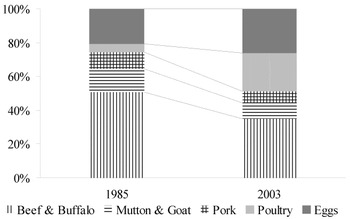
Within the livestock sector, poultry has been the fastest growing sub-sectors: between 1985 and 2005 poultry meat and egg production grew by 5 percent per year, compared to an annual growth rate of 1.5 to 2.0 percent for beef, milk and mutton and lamb. At present, with an average annual consumption of 1.5 kg of poultry meat and 1.8 kg of eggs (35-40 eggs) per person, exclusive of milk though, poultry meat and eggs contribute almost 50 percent to the per capita consumption of animal protein (Figure 1) (GoI, Reference GoI2006b).
Growth in India's poultry sector stems mainly from growth of a limited number of large commercial producers, which have been expanding rapidly in Southern India, where climatic conditions are mild, and at a slower pace in the Western and Eastern States (Mehta and Nambiar, Reference MEHTA and NAMBIAR2007; Mehta et al., Reference MEHTA, NAMBIAR, DELGADO and SUBRAMANYAM2003; Rabobank, Reference RABOBANK2008). According to USDA, the commercial poultry sector grew at 18.6 percent per year in the period 1997 to 2002 and is anticipated to continue its fast growth in the coming years (Landes et al., Reference LANDES, PERSAUD and DYCK2004; Dastagiri, Reference DASTAGIRI2004; FAO, Reference FAO2008; FAPRI, Reference FAPRI2008; Mohanty and Rajendran, Reference MOHANTY and RAJENDRAN2003). The OECD-FAO Agricultural Outlook 2008-2017, which offers the most comprehensive assessment of trends in agricultural markets in both developed and developing countries, estimates that Indian demand for, and supply of, poultry products will grow at 4.8 and 5.2 percent per year over the decade, faster than for any other type of meat or for milk (OECD-FAO, Reference FAO2008).
Per capita consumption of livestock products (%), India, 1985-2003.
Source: www.faostat.fao.org

The Government of India is well aware of the growth opportunities of the national poultry sector, and the Eleventh Five Year Plan 2007-2012 sets a target growth rate for the sector at 10 percent per year, which is above the envisaged 9 percent annual growth rate for total GDP (GoI, Reference GoI2007a). However, the government also recognises that ‘the poultry production model en vogue (high input-high output, using commercially developed strains of birds) ... is successful mainly in large-scale units (more than 1,000 units of birds)’ (GoI, Reference GoI2002) and ‘bypasses the landless (<0.002 ha), marginal (0.002 – 1 ha) and small scale (1 ha – 2 ha) farmers, who raise the largest share of the country's poultry stock’ (GoI, Reference GoI2006a). The Eleventh Five Year Plan 2007-2012, therefore, urges that ‘the benefit of [livestock sector] growth should be equitable, benefiting mainly the small and marginal farmers and landless labourers’. The latter could contribute to and derive benefit from growth of the poultry sector through three major avenues:
1. enhanced productivity and returns to their poultry birds;
2. employment along the poultry value chain and
3. greater availability and affordability of animal protein.
Poultry farming: a pathway out or emblem of poverty
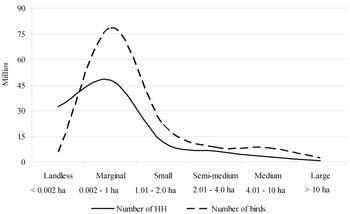
According to the 2006 National Sample Survey (NSS) Report on Livestock Ownership (GoI, Reference GoI2006a), the landless, marginal and small scale farmers, which account for about 90 percent of the 107 million agricultural households in India, keep about 85 percent of the poultry stock of the country (Figure 2).
Distribution of poultry birds among Indian rural households, 2003.
Source: GoI (Reference GoI2006a)

Statistically, a landless, marginal or small-scale agricultural household keeps an average flock size of 8 to 9 birds. Such backyard flocks only make a very minor contribution to rural livelihoods, as the net income per bird per month ranges from Rs 4 to 13 (US$0.10 to 0.30), vis-à-vis a rural poverty line set by the Government of India at Rs 356 per month (US$8.2) (Ahuja et al., Reference AHUJA, DHAWAN, PUNJABI and MAARSE2008; Gawande et al., Reference GAWANDE, KALITA, BARUA and SAHARIA2007; GoI, Reference GoI2007b; NABARD, Reference NABARD2005; Shrivastava et al., Reference SHRIVASTAVA, GUPTA and MISHRA2002; Upton and Otte, Reference UPTON and OTTE2004). Increasing the productivity of and returns from poultry, therefore, does not represent a pathway out of poverty for a typical rural farmer, unless flock size is significantly increased. Mehta et al. (Reference MEHTA, NAMBIAR, DELGADO and SUBRAMANYAM2002) reported that units below 20,000 birds are too small to generate enough income to sustain a family, although units with some hundreds of birds can be financially viable and can significantly contribute to the support of rural livelihoods (PRADAN, Reference PRADAN2008). However, overall, the ability of the traditional backyard poultry systems to expand production is limited by the availability of the scavenge-based feed resource (Otte et al., Reference OTTE, HINRICHS, RUSHTON, ROLAND-HOLST and ZILBERMAN2008).
Even though the ownership of a few birds does not contribute substantially to rural livelihoods, it provides a mechanism to improve nutrition (particularly important in children) and alleviate credit constraints faced by the majority of the rural poor. On the one hand, when rural food markets are imperfect, and the availability and prices of grains and animal proteins at marketplaces are unpredictable, poultry farming serves as an inexpensive device for households to generate highly nutritious food items at minimal cost, because of the low input requirements and the low opportunity cost of family labour allocated to poultry care. On the other hand, where financial markets are imperfect, which is often the case in rural areas, the sale of birds helps cover recurrent minor expenditures, such as school fees, and unexpected costs, such as medical fees.
Investment in backyard poultry farming could thus enhance human nutrition and reduce the vulnerability of landless, marginal and small-scale farmers, but does not appear to be a promising strategy to achieve widespread poverty reduction and stimulate equitable growth in rural areas. Of course, during the process of development, some backyard poultry keepers will transform into medium and large-scale market-oriented farmers, but this is not feasible for all or even the majority. If each backyard poultry keeper expanded the flock to say 100 birds – a size which is insufficient to sustain the needs of a rural family – the total poultry population of India would exceed 9 billion birds vis-à-vis 0.5 billion birds today, input costs would skyrocket, output prices would plummet and the profitability of poultry farming would be negative. This scenario is a typical case of ‘fallacy of composition’: what works for one backyard poultry keeper does not necessarily work for all of them.
Employment opportunities along the poultry value chain
Given that landless, marginal and small scale farmers lack the resources, including poultry birds, to ‘farm their way out of poverty’, they depend heavily on earnings from supplying unskilled wage labour to other farm or non-farm enterprises. ‘The ability to generate an adequate number of productive employment opportunities will [therefore] be a major factor on which the inclusiveness of growth will be judged’ (GoI, Reference GoI2007a).
The Government of India estimates that about two million people are employed, fully or partly, in the poultry value chain and that an increase in annual per capita availability of one egg or 50 g of poultry meat generates about 20,000 to 25,000 full time jobs (GoI, Reference GoI2005). This translates into different levels of incremental labour demand, depending on anticipated consumption trends. For instance, the baseline scenario of the IFPRI IMPACT model predicts that about 35,500 and 30,000 jobs will be created along the poultry meat and egg value chains between 1997 and 2020 (Rosegrant et al., Reference ROSEGRANT, PAISNER, MEIJER and WITCOVER2001). The OECD-FAO COSIMO model concludes that about 27,000 additional broiler-related jobs will be generated between 2008 and 2017 (OECD-FAO, Reference FAO2008). The FAPRI International Livestock Model estimates an additional demand for 22,000 full time workers along the broiler value chain between 2007 and 2017 (FAPRI, Reference FAPRI2008). Whatever demand projection may prove most accurate, the predicted growth of the poultry sector, even if very rapid, will not generate significant employment opportunities for the 423 (898) million Indians living on less than US$1 a dayFootnote 1 (Ravallion et al., 2007).
Even though poultry production as such does not exhibit major economies of scale because of the highly divisible nature of both inputs and outputs, there are economies of scale in both input and output markets (unit costs of credit, feed, transport and processing decline as the size of the operation increases), which are better captured by large commercial firms. In general, the latter contract a number of relatively well-off poultry farmers to rear day-old chicks and directly run capital-intensive and labour-saving hatcheries, feed mills, slaughter and processing plants, thereby generating limited employment opportunities along the poultry value chain (Mehta et al., Reference MEHTA, NAMBIAR, DELGADO and SUBRAMANYAM2003; Ollinger et al., Reference OLLINGER, MACDONALD and MADISON2005). For instance, Suguna Poultry Farm Ltd, the largest broiler producer in India, only employs a total of 4,500 staff but has established contracts with 15,000 small-scale poultry growers (www.sugunapoultry.com).
In addition, because of the low unitary value of inputs and services to poultry farmers – which reflects the low unitary value of poultry birds – the provision of services and inputs to smallholder poultry producers does not create significant full-time job opportunities. As an example, Haryana-based Kegg Farms has developed a dual purposed, hardy village bird, which was more productive than the local Desi breed. The company then established an innovative smallholder-based supply chain to deliver the birds for a profit to rural households in Northern and Eastern India. The company sells day-old-chicks to independent Mother Units, which rear between 50 to 2,000 chicks for about three weeks, and then sell them to pheriwallas (vendors), who travel to villages and sell the three-week-old chicks to rural households (Ahuja et al., Reference AHUJA, DHAWAN, PUNJABI and MAARSE2008; www.keggfarms.com). Kegg Farms, which epitomises the ‘bottom of the pyramid’ approach as it sells to the poor through the poor, provides birds to about 800,000 village households, but generates employment for less than 4,000 people, i.e. about 500 affiliated independent dealers, 1,500 Mother Units and 1,500 chick vendors (Kapur, Reference KAPUR2008).
Finally, even though the poultry and egg markets are dominated by small retailers – in India over 99 percent of food and grocery is sold by traditional retailers (kirana stores, street hawkers, and wetmarket stall operators) and only 5% of all poultry products are marketed in processed form (Reardon and Gulati, Reference REARDON and GULATI2008; Traill, Reference TRAILL2006) – few jobs are created downstream along the poultry supply chain. At Gazipur wholesale poultry market in New Delhi, India's biggest, in a usual business day about 80 to 100 trucks – each carrying 90 to 100 crates containing eight to fifteen birds from the 32 poultry farms located around Delhi as well as from farms in Haryana, Uttar Pradesh, Punjab and Rajasthan – deliver between 80,000 to 100,000 poultry birds to around 90 wholesalers who, in turn, sell them to thousands of small retailers (The Times of India, Reference THE TIMES OF INDIA2006). Assuming that the wholesale-retail marketing margin is about Rs 15/kg (US$0.35/kg) live weight – in the first months of 2009 the live weight price for broilers ranged between 45 and 55 Rs/kg (US$1-1.25/kg) in Gazipur wholesale market and was about 60-65 Rs/kg (US$1.40-1.50/kg) for final consumers in Delhi (DAMB, Reference DAMB2009; DNA, Reference DNA2009) – between 9,000 to 12,000 individuals could earn the minimum wage of a semi-skilled worker, which is set at Rs 3,799/month (US$97/month) by the Delhi authority (GNCT, Reference GNCT2008), through selling poultry birds in Delhi, a city with over 15 million inhabitants.
Poultry meat and egg consumption
The majority of rural households in India are net buyers of food. De Janvry and Sadoulet (Reference DE JANVRY and SADOULET2008), based on data from the 59th NSS Survey, estimated that about 74 and 53.7 percent of the marginal and small farmers respectively, and most probably a higher proportion of rural landless, are net buyers of food. But the average food intake is largely insufficient to provide adequate nourishment to all family members: according to a World Bank Report, in India the majority of pre-school children experience protein-energy malnutrition and micronutrient deficiencyFootnote 2 (World Bank, Reference WORLD BANK2005). Amongst the animal-derived foods, which are a major source of proteins and micronutrients, poultry meat and eggs provide more proteins than swine, cow milk, beef and lamb per unit of intake (GoI, Reference GoI2005). Thus, greater availability and affordability of poultry meat and eggs would contribute to enhanced nutrition (and poverty reduction), given that rural and urban households allocate more than 15 and 19 percent or their food expenditure to animal source food respectively, although primarily to milk and dairy products (GoI, Reference GoI2008).
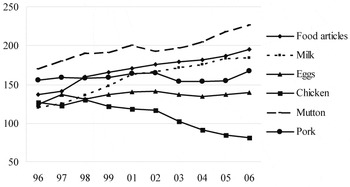
Poultry meat and eggs are currently two of the cheapest available sources of animal protein for urban Indian consumers because large commercial integrators, which are primarily responsible for the fast growth of the Indian poultry sector, provide low priced poultry products: between 1996 and 2006, the wholesale prices for poultry meat and eggs have been declining or remained constant respectively, whereas they have increased for all other livestock commodities (Figure 3). This suggests that supply-side factors are stronger determinants of the recent trends in the consumption of poultry products in India than demand-side factors (GoI, Reference GoI2006b; Pica et al., 2008; Rabobank, Reference RABOBANK2008).
However, large commercial integrators are unable to consistently supply rural areas because live-bird sales dominate the poultry market in India and moving live birds over long distances is prohibitively costly due to transport, shrinkage, and mortality costs (Landes et al., Reference LANDES, PERSAUD and DYCK2004; Mehta and Nambiar, Reference MEHTA and NAMBIAR2007). Low prices for poultry from large commercial integrators primarily benefits urban consumers, which in India include about 107 million people living on less than US$1 a day or about 229 million people living on less than US$2 a day (Ravallion et al., 2007). As a result, urban consumers eat 2.8 and 4.5 times more eggs and poultry meat than their rural counterparts (Mehta et al., Reference MEHTA, NAMBIAR, DELGADO and SUBRAMANYAM2003).
Improved infrastructure, availability of cold chain facilities, and changing consumer preferences, away from whole fresh chickens, could contribute to increasing the supply of ‘affordable’ processed poultry products in rural areas, for the benefit of the 316 million poor Indian rural consumers living below the international poverty line of US$1 a day, or the 668 million rural poor living on less than US$2 a day (Rabobank, Reference RABOBANK2008; Ravallion et al., 2007). But this transition will occur only in the longer term, as live markets will continue to dominate rural India for several decades: it has been projected that food sales in the formal retail sector will grow at 20 percent a year for 20 years to just reach a 20 percent market share (Tschirley, Reference TSCHIRLEY2007).
Wholesale prices for selected food products, India, 1996-2006 (93-94=100).
Source: GoI (Reference GoI2006b)

For the time being, current experience in rural India suggests that small-scale rural poultry farmers, keeping on average a few hundred birds, can be as efficient in production as large commercial integrators, and more efficient than the latter in supplying rural areas with low priced poultry products, provided that they cooperate so as to achieve economies of scale both in input and output markets (World Bank, Reference WORLD BANK1999). An example is the smallholder broiler farming model which PRADAN, a major Indian NGO, has developed, tested and implemented in several Indian States:
1. predominantly female self-help-groups are trained in poultry production/economics/management and supported to establish and properly manage a broiler cooperative;
2. each member of the co-operative invests about Rs. 60,000 (US$1,380), obtained through bank loans and subsidies, to build sheds, buy poultry feeders/water dispensers and other equipment necessary to raise 300 to 500 birds per production cycle (four to five weeks);
3. the co-operative takes responsibility for the provision of quality chicks, feed, animal health services as well as collection and marketing of broilers;
4. the cooperative sells about 75 to 80% of broilers in small rural markets, at a price which is 20-25% lower than the retail price in major urban markets throughout India;
5. each member of the co-operative earns between Rs 9.000 to Rs. 15,000 (US$207 to US$345) per year (PRADAN, Reference PRADAN2008).
The smallholder broiler farming model developed by PRADAN – which has so far supported the establishment of 16 co-operatives (5,306 members) with a total annual turnover of over Rs 270 million (US$6.2 million) – has been replicated by other NGOs in Madhya Pradesh, Chattisgarh and Jharkhand. Its replication has also been supported by the Government of Madhya Pradesh, where this poultry development model now represents the largest commercial poultry production system in the State.
The ‘PRADAN’ smallholder broiler farming model has been appreciated because of its financial viability (the initial one-off investment of self-help-group members is recovered in few years) and for the direct benefits it generates for smallholder poultry producers (Conroy, Reference CONROY2004; PRADAN, Reference PRADAN2008; SA-PPLPP, Reference SA-PPLPP2008). However, since the number of rural households which can become small-scale intensive producers is limited – estimated at 85,000 by PRADAN given the Indian market for broilers – the promotion of smallholder-centred poultry production models cannot be a universally applicable strategy to directly contribute to broad-based poverty reduction.
The real value of smallholder poultry farming models lies in their contribution to reducing malnutrition through increased availability and affordability of animal protein (and with these, micro-nutrients) for rural households, which comprise 668 million rural poor living on less than U$2 a day. To our knowledge, however, there are no comprehensive evaluations looking at the impact of such models on household food intake in India. As a second round effect, improved nutrition is anticipated to translate into enhanced productivity, and in the medium to long-term the greater availability and affordability of food are expected to contribute to lower real wages – because of reduced food prices – and hence to encourage expansion of output and employment in other sectors.
Conclusions
This paper endeavoured to explore the major linkages between poultry sector development, human nutrition, and poverty reduction in India by assessing the potential role of poultry farming, employment along the poultry supply chain, and increased consumption of poultry meat and eggs.
The promotion of backyard poultry farming does not appear a promising strategy for broad-based poverty reduction, because of the small average flock size kept by the large majority of rural households in India. Nevertheless, backyard poultry farming remains important for rural households, as it ensures a steady flow of high quality food and, through cash income, reduces vulnerability. Policies targeting backyard poultry keepers, therefore, may be an efficient way to support livelihoods and mitigate malnutrition, but are unlikely to significantly contribute to poverty reduction and economic growth.
The majority of the poor have limited capital assets and usually depend heavily on earnings from supplying unskilled wage labour to other farm or non-farm enterprises for their livelihoods. The development of the poultry sector is unlikely to generate a large number of full time jobs along the supply chain, not only because of economies of scale in both input and output markets, but more fundamentally because of the low unitary value of poultry birds, which makes upstream and downstream support services financially profitable only if carried out on a relatively large scale.
The majority of the poor in India are net buyers of food and protein-energy and micronutrient malnutrition are widespread in the country. Consequently, increased availability and affordability of animal source food would contribute to improving health and livelihoods. Large-scale commercial poultry integrators are supplying urban consumers with low-priced poultry meat and eggs but, given that live bird markets dominate, and will continue to be pervasive in rural India for the coming decades, they are and will remain unable to provide affordable animal source food to rural households. Small-scale, rurally-based, and market-oriented poultry farmers, which can be as efficient in poultry production as large scale producers, thus have comparative advantages in supplying rural consumers with low-priced broiler meat and eggs.
Policies which support smallholder-centred, but market-oriented, poultry production systems in rural areas appear the most promising option of promoting a ‘pro-poor’ development of the poultry sector, as this development path may potentially benefit an estimated 668 million poor consumers living on less then US$2 in rural India through increased availability and affordability of nutrient-dense animal source food.