Through history, individuals care has been provided primarily by the self and the family in all societies. As defined by the World Health Organization, “self-care in health refers to the activities individuals, families and communities undertake with the intention of enhancing health, preventing disease, limiting illness, and restoring health” (WHO, 1983, p. 181).
A review of the self-care literature undertaken during the last decades indicates that studies carried on the self-care arena are mainly focused on two areas: chronic and common illnesses self-care (Khagram, Martin, Davies, & Speight, Reference Khagram, Martin, Davies and Speight2013). However, self-care is also outstanding in general population’s everyday health needs (White et al., Reference White, South, Bagnall, Forshaw, Spoor, Marchant and Witty2012), and the development of self-care skills that lead the general public to adopt more healthy lifestyles starts to be the core of several policies and projects. At this point, special attention deserves the role of self-care in professionals who deal with stressful events, as it is the case of health professionals.
When compared to other professionals, health care workers present higher rates of stress-related sickness, together with other health problems, such as somatic and mental complaints, due to the increased clinical demand, long workdays, and lack of colleagues support (Gibb, Cameron, Hamilton, Murphy, & Naji, Reference Gibb, Cameron, Hamilton, Murphy and Naji2010). Together with all these circumstances, coping with death on a daily basis must be added in the concrete case of palliative care professionals.
Among health professionals, those working in the scope of death and dying are even more exposed to matters of existential character, facing psychological challenges and frequently experiencing emotional distress. The risks of working in this context are well documented, and may lead to burn out (Peters et al., Reference Peters, Cant, Sellick, O'Connor, Lee, Burney and Karimi2012), compassion fatigue and poor quality of care (Kearney, Weininger, Vachon, Harrison, & Mount, Reference Kearney, Weininger, Vachon, Harrison and Mount2009). In the palliative care framework, mindful awareness is thought to enhance professionals’ ability to engage in the rest of protective practices, in concrete, in self-care activities (Harrison & Westwood, Reference Harrison and Westwood2009). Regarding the relation between coping with death and self-care, many authors have found that self-care activities have a positive effect on palliative care practice. For example, Shanafelt et al. (Reference Shanafelt, Novonty, Johnson, Zhao, Steensma, Lacy and Sloan2005) found that oncologists with greater work satisfaction were those who used wellness strategies in caring for themselves. As regards inner self-care, spirituality has traditionally been seen as a way for clinicians to reconnect with their roots and serve those suffering (Puchalski & Guenther, Reference Puchalski and Guenther2012). Social self-care has been also related to well-functioning, in the form of peer support or stable personal relationships (Barnard, Street, & Love, Reference Barnard, Street and Love2006). And most of the literature relates self-care, and specifically physical self-care (i.e., healthy diet, regular exercise) to professional well-being (Harrison & Westwood, Reference Harrison and Westwood2009). In general, self-care has arisen as a predictor of coping with death, being then an indirect key to avoid compassion fatigue or burnout, as recognized in previous literature (Aycock & Boyle, Reference Aycock and Boyle2009). Finally, self-care has also been positively related to compassion satisfaction, and negatively to compassion fatigue and burnout (Harr, Reference Harr2013). In particular regarding social self-care, professionals without an adequate social support become more vulnerable to burnout and compassion fatigue (Adams, Figley, & Boscarino, Reference Adams, Figley and Boscarino2008).
Among the measures used to assess self-care in general population, stands out the Health- Promoting Lifestyle Profile II, developed by Pender (Reference Pender1996), which is developed following her self-care model. According to Pender, health-promoting behaviors are measured as an expression of health, including the areas of health responsibility, physical activity, nutrition, interpersonal relations, spiritual growth, and stress management. Each area represents a subscale on the Health- Promoting Lifestyle Profile II. There is also the Self-Care Assessment (Saakvitne & Pearlman, Reference Saakvitne and Pearlman1996), an instrument that evaluates five facets of the self-care using 55 items: physical, psychological, emotional, spiritual, and workplace self-care. Overall, taking into account these and other self-care instruments, it can be concluded that most of them assess three dimensions of self-care: a dimension related to physical health, an inner dimension (psychological, emotional, spiritual…)and another one based on social care (relationships with family, friends, or colleagues) (Richards, Campenni, & Muse-Burke, Reference Richards, Campenni and Muse-Burke2010).
Most of the instruments measuring self-care suffer from some of these limitations: its specific design (addressed to a concrete population), its extensive length, the lack of proper validations. Furthermore, almost any has been used in a broader international palliative care context, none in Spanish population.
The new scale is based on the World Health Organization (WHO) definition of health, as the ‘state of complete physical, mental and social well-being and not merely the absence of disease or infirmity’ (WHO, 1948), and on the dimensions hitherto reported: physical, inner, and social self-care. Physical care has been traditionally understood as the incorporation of physical activities to daily life. A recent study on 249 Portuguese workers offered evidence of how an exercise program can improve, not only physical functioning or bodily pain, but also general health, social functioning, and mental health (Mesquita, Ribeiro, & Moreira, Reference Mesquita, Ribeiro and Moreira2012). Although in palliative care professionals results are not so clear, practicing exercise has been positively related to stress management, control, and social support (Rodrigues, Carneseca, Paiva, & Ribeiro, Reference Rodrigues, Carneseca, Paiva and Ribeiro2014). Inner care, in turn, has been defined as having care of the own inner world (Reference O’ConnorO’connor, 2001). This dimension also includes spirituality components, such as meditation (Schure, Christopher, & Christopher, Reference Schure, Christopher and Christopher2008). Yong, Kim, Park, Seo, and Swinton (Reference Yong, Kim, Park, Seo and Swinton2011), for instance, found that practicing meditation during five weeks improved palliative care professionals’ spiritual well-being and leadership, and diminished their stress. Finally, social care comes both from personal (family and friends) and professional systems (Richards et al., Reference Richards, Campenni and Muse-Burke2010). An example of social care benefits for palliative care professionals can be found in Penderell and Brazil’s (Reference Penderell and Brazil2010) study, in which most of these professionals highlighted the importance of having emotional, social and spiritual support from those with whom they shared their experiences, that is, their colleagues.
Current study presents a new instrument to measure professionals’ self-care in palliative caregivers. They often work in emotionally demanding, very stressful conditions that could affect their quality of life. To approach this research problem a holistic approximation is applied (Čančer & Žižek, Reference Čančer and Žižek2015).
Methods
Development of the scale
A focus groups of health and palliative care experts developed the questions of the new measurement instrument, based on: 1) the WHO’s holistic definition of health; 2) previous measurement instruments (specifically, the classic one by Pender, Reference Pender1996); and 3) an integrative review of the scarce literature on professionals’ self-care (gathering main three dimensions from research evidence). Taking all this information into account and the core idea of creating a brief instrument, the focus group proposed a nine-item scale (see Annex I). These items were all positively worded as recommended by latest applied psychometric studies (Dalal & Carter, Reference Dalal, Carter, Lance and Vandenberg2015; Tomás, Oliver, Galiana, Sancho, & Lila, Reference Tomás, Oliver, Galiana, Sancho and Lila2013).
In a first pilot testing, a group of 15 palliative care professionals, including medical doctors, nurses, and psychologists, were surveyed, and only a problem of linguistic comprehension arose. It was solved and current research was undertaken.
Design, procedure and sample
This study is a cross-sectional survey of Spanish palliative care professionals. Participants were sampled from the list of members of the list of members of Spanish biggest and most representative association of professionals of palliative care, that is, the Spanish Society of Palliative Care (SECPAL). Professionals were asked to complete a survey of about thirty minutes, which included demographic data and scales on several constructs related to quality of life, awareness, and coping with death and burn out. The surveys were completed using an online survey accessed through an email link.
A maximum of 1309 professionals were emailed through SECPAL organization nationwide divisions and invited to participate. Because of data protection, researchers had no access to those emails list, there was no report on the out of order or send back emails. In consequence, the rate of response was a very conservative estimation of 33.07% (433 respondents gathering professionals, chaplains and volunteers), 385 of whom were professionals of palliative care. 77.5% were women. As regards the profession: 40.3% were doctors, 33.1% nurses, 14.2% psychologists, 4.8 nursing assistants, and 4.8% had other professions or more than one of these. About their palliative work units, 21.9% worked in a hospital units of palliative care, 20.1% in home-based palliative care, 11.9% in social-health center units of palliative care, 9.8% in a hospital support team, 1.5% in hospices, and 1.3% in pediatric units of palliative care.
Instruments
In addition to socio-demographic data, information on several variables was collected:
Self-care scale
The Professional Self-Care Scale (PSCP) assesses professionals’ self-care in three areas: physical self-care, which refers to the implication in activities that helps to maintain a healthy body; inner self-care, which is related to activities that help to keep a healthy mind; and social self-care, regarding to activities related to social activities that help the individual to maintain social health. The three dimensions create an overall factor of self-care. The instrument is composed of nine items on a 5-point Likert scale (from 1, “totally disagree”, to 5, “totally agree”). Examples of these questions are “I do exercise regularly” (physical self-care dimension), “My self-care includes getting involved in spiritual practice via meditation, prayer, other mindful practice…” (inner self-care), or “I believe that my family relationships are satisfactory” (social self-care). The complete scale is showed in Annex I, and its psychometric properties are detailed in the Results section.
Awareness
This variable was measured with the Mindful Attention Awareness Scale (MAAS; Cebolla, Luciano, DeMarzo, Navarro-Gil, & Campayo, Reference Cebolla, Luciano, DeMarzo, Navarro-Gil and Campayo2013). This is a 15-item instrument that measures the general tendency to be aware and conscious of the own experiences of daily life. It has a 6-point Likert scale format, form 1 (“almost always”) to 6 (“almost never”). Examples of items are: “I could experience an emotion and not be conscious of it until later” or “I find it difficult to stay focused on what is happening in the present”. The internal consistency of the measure was .90.
Coping with Death competence
It was measured with the Coping with Death Scale (Bugen, 1980–1981). This scale measures professionals’ mastery when facing death. It is composed of 30 items, scoring in a 7-point Likert type scale, form 1 (“totally disagree”) to 7 (“totally agree”). Examples of items are: “I have a good perspective of death and the dying process” or “I’m used to the arrangements prior to funeral”. The internal consistency of the measure was .89.
Quality of life
Measured with the Professional’s Quality of Life measure (Stamm, Reference Stamm2010), which is formed by three subscales: compassion satisfaction, secondary trauma, and burnout. While compassion satisfaction is the positive side of helping others, burnout and secondary trauma are defined as the two components of compassion fatigue, the negative part of it. Each dimension is represented in the scale by 10 items scoring in a 6-point Likert scale (from 0, “never”, to 5, “always”). The internal consistency of the dimensions was .77 for compassion satisfaction, .78 for secondary trauma, and .54 for burnout scale.
Data analyses
Construct (factorial) validity of the scale was assessed via confirmatory factor analysis (CFA). The a priori model of the questionnaire structure was based on theoretical reasons and advocated for a three-factor structure, with physical, inner, and social self-care, explaining the nine items of the questionnaire. The CFA was estimated using maximum likelihood with Satorra-Bentler robust corrections for the standard errors and fit indices, for ordinal and non-normal data (Finney & DiStefano Reference Finney, Di Stefano, Hancock and Mueller2006).
In order to assess model fit, several fit criteria were used, as recommended in the literature (Hu & Bentler, Reference Hu and Bentler1999): (a) chi-square statistic, with significant test statistic casting doubt on the model specification; (b) the comparative fit index of more than .90 (and, ideally, greater than .95); (c) the root mean squared error of approximation (RMSEA) of .05 or less; (d) the Goodness of Fit Index (Jöreskog & Sörbom, Reference Joreskog and Sorbom1986), with values of more than .90; (e) the standardized root mean squared residuals (SRMR) of .08 or less as indicative of adequate fit.
Additionally, analyses included internal consistency estimates for items and scale (Cronbach’s alpha, Rho, GLB, items’ homogeneity, alpha if item deleted, and inter-item correlations). Alpha is the most used index, with values from .70 to .79 interpreted as moderate, and estimations of .80 or highest considered indicators of high reliability (Cicchetti, Reference Cicchetti1994). However, alpha is influenced by the scale’s length (it has to be borne in mind that current scale only has nine items) and it is only appropriate for tau-equivalent items, being a lower bound for true reliability (Raykov, Reference Raykov2004). Thus, Rho and GLB, indices offered in the structural equation model framework and preferred for their robustness (McDonald, Reference McDonald1999), were also estimated.
External evidence validity was obtained relating self-care and its dimensions to variables pointed out in the literature: awareness, coping with death, and professionals’ quality of life (Kearney et al., Reference Kearney, Weininger, Vachon, Harrison and Mount2009; Reference Sansó, Galiana, Oliver, Pascual, Sinclair and BenitoSansó et al., in press). For this purpose, Pearson’s correlations were calculated. Pearson’s coefficient varies between -1 and 1. Values of r = .10 are indicative of small effects (relations); r = .30 of moderate; and r = .50 or superior of big (Cohen, Reference Cohen1988, Reference Cohen1992).
Finally, two multivariate analyses of variance (MANOVA) were used to test the main effects of gender and discipline on three dependent variables: physical self-care, inner self-care and social self-care. First, MANOVA tests mean differences on dependent variables. The most robust criterion, Pillai’s criterion, was used (Tabachnick & Fidell, Reference Tabachnick and Fidell2007). Secondly, and if the overall F-test show means differences, post-hoc univariate analyses of variance (ANOVA) are used to determine which means are statistically different from others. Partial eta-squares were also estimated. Correlations between the dimensions of self-care and professionals’ age, years of professional experience in health, and years of professional experience in palliative care were also calculated.
Results
Confirmatory factor analysis
A theoretical structure of three factors was specified, estimated and evaluated with this a priori structure. Overall fit indices mainly supported the one factor structure of the scale: χ2(24, N = 385) = 140.66, p < .01; CFI = .91; GFI = .93; SRMR = .09; and RMSEA = .10. Altogether, the indexes assessed the model as an adequate representation of the observed data, with the exception of the RMSEA, that probably penalized the model because of the little number of indicators.
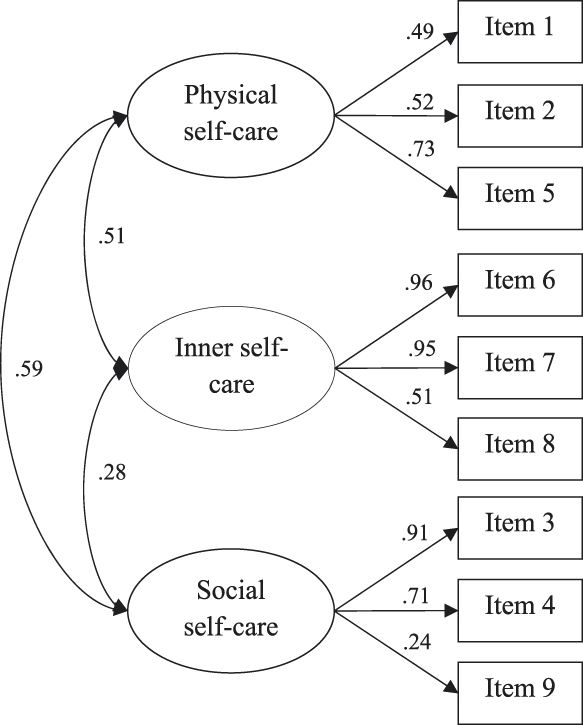
A detailed examination of the factor loadings gives an idea of the model analytical fit, complementing the overall fit information. All indicators significantly loaded in the hypothesized factors (p < .01), giving support to the adequacy of the three-factor structure. The standardized factor loadings for the physical self-care factor were within a minimum of .49 (item 1, “I do exercise regularly”) and a maximum of .73 (item 5, “I practice activities that help me to relax”), between .51 (item 8, “When I feel emotionally overloaded I try to find time for my own care”) and .96 (item 6, “My self-care includes getting actively involved in spiritual practice, meditation, oration…”) for inner self-care and from .24 (item 9, “When I feel overwhelmed by a clinical situation I feel that I can support on my team in order to elaborate this experience”) to .91 (item 3 “I believe that my relations outside work are satisfactory”) for social self-care, as it is shown in Figure 1. All factor loadings were well above the values considered indicative of an adequate consistency, except for item 9, which factor loading was, nevertheless, statistically significant at .01 level.
Analytical fit of the CFA
Note: All factor loadings and correlations were statistically significant (p < .01). For the sake of clarity, standard errors are not showed.

Internal consistency
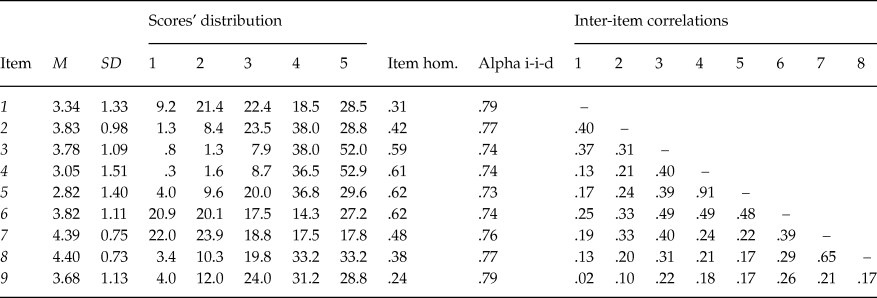
Regarding reliability, Cronbach’s alpha was computed for the 3-item length dimensions of self-care, with a value of .62 for the physical self-care factor, .84 for the inner self-care and .53 for the social self-care. Rho and GLB were also calculated, with values of .64 for the physical self-care dimension, .90 for inner self-care, and .57 for the social dimension. Descriptive statistics, scores’ distribution, item homogeneity, alpha if-item-deleted, and inter-item correlations are presented in Table 1. Means are about the mid-point of the items scale in all cases, with no apparent floor or ceiling effects.
Means, standard deviations, scores’ distribution, item homogeneity, alpha if item deleted, and inter-item correlations for the items of the Professional Self-Care Scale

Notes: M = Mean; SD= Standard deviation; Item hom. = Item homogeneity; Alpha i-i-d = Alpha if item delated.
External evidence of validity
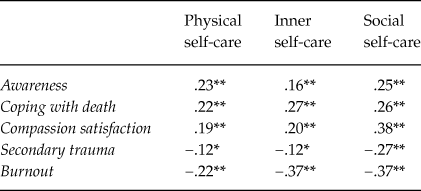
Validity was established by correlating the three dimensions of self-care with constructs referred in the palliative care literature. Specifically, the dimensions were related to awareness, coping with death, compassion satisfaction, compassion fatigue and burnout. Results were consistent with previous literature, and a pattern of positive relationships was found among the three dimensions and awareness (Harrison & Westwood, Reference Harrison and Westwood2009), coping with death (Shanafelt et al., Reference Shanafelt, Novonty, Johnson, Zhao, Steensma, Lacy and Sloan2005), and compassion satisfaction (Harr, Reference Harr2013), whereas negative relationships were found among self-care dimensions and secondary trauma and burnout (Adams et al., Reference Adams, Figley and Boscarino2008; Harr, Reference Harr2013), consistently with literature. Relations were between small and medium, with higher values for social self-care. Results are provided in Table 2.
Correlations among self-care dimensions and related variables in the palliative care context

Notes: *p < .05; **p < .01.
Self-care in Spanish palliative care professionals
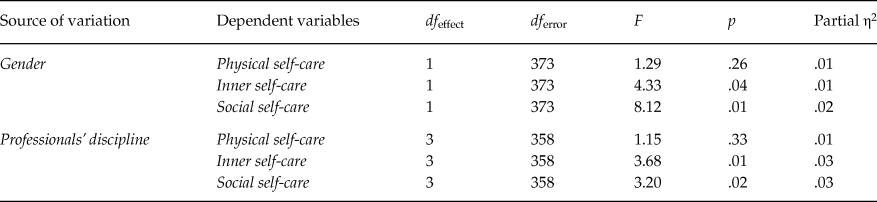
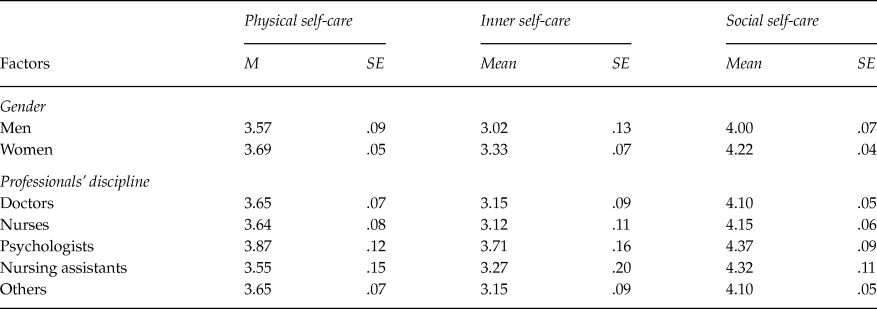
A first MANOVA was performed on three dependent variables: physical self-care, inner self-care, and social self-care. Independent variable was gender (women and men). With the use of Pillai’s criterion, the combined dependent variables were significantly affected by gender (F(3, 371) = 3.19, p = .02). Results reflected a small association between gender and the combined dependent variables, with a partial η 2 = .03. To investigate the impact of independent variable effect on the individual dependent variables, univariate ANOVAs were performed (Table 3). The effect of gender was statistically significant in inner and social care. Women reported higher inner and social care than men (see Table 4).
Follow-up ANOVAs

Means and standard errors of the dependent variables on each group of the socio-demographic factors

Notes: M = Mean; SE = Standard Error.
The second MANOVA was performed on the same dependent variables, with the discipline of professionals as independent variable (doctors, nurses, psychologists, nursing assistants and others). Following Pillai’s criterion, the combined dependent variables were significantly affected by discipline of professionals (F(9, 1074) = 2.00, p = .04). Again, results reflected a small association between professionals’ discipline and the combined dependent variables, with a partial η 2 = .02. Univariate ANOVA showed that professionals’ discipline was statistically significant in inner and social care (see Table 3). Psychologists reported higher levels of inner care than doctors and nurses, and higher levels of social care than doctors (see Table 4).
Correlations between the dimensions of self-care and professionals’ age, years of professional experience in health, and years of professional experience in palliative care were also calculated. No statistically significant relations were found.
Discussion
As noted along the text, self-care is a key element in palliative care professionals’ well-being and work development, and thus, although being an old problem, its answer is an emerging area of scientific research (Kearney et al., Reference Kearney, Weininger, Vachon, Harrison and Mount2009). In this context, and moved by the necessity of brief measures with clinical applicability and adequate psychometric measures, the aim of this research was to develop and present a new self-care measurement instrument, the Professional Self-Care Scale, while exploring self-care behaviors in Spanish palliative care professionals.
First, factorial validity of the scale was tested using structural equation modeling techniques. Results of the CFA, with a three-factor structure based on health dimensions as defined by the WHO (1948), showed overall adequate fit indexes with no estimation problems. As regards analytical fit, the smallest factor loading was for item 9 (“When I feel overwhelmed by a clinical situation I feel that I can support on my team in order to elaborate this experience”). Although its small factor loading, it was statistically significant. Additionally, substantive reasons led to keep it in the model. Colleagues’ support generally is an important face of social health and well-being (Stansfeld, Shipley, Head, Fuhrer, & Kivimaki, Reference Stansfeld, Shipley, Head, Fuhrer and Kivimaki2013), and specifically in the palliative context is an essential indicator of it (Alkema, Linton, & Davies, Reference Alkema, Linton and Davies2008).
As regards the scale reliability, taking into account there were just three items per factor, results were appropriate for the physical and inner dimensions of self-care, and not as good as expected for the social dimension. This was probably due to the low correlations between item 9 and items 3 and 4 (regarding social relations outside work and family relations, respectively). However, it has to be borne in mind that Cronbach’s alpha is sensitive to the number of items, that is to say, the shorter number of items, the lower value for alpha (Santor et al., Reference Santor, Haggerty, Lévesque, Burge, Beaulieu, Gass and Pineault2011). Thus, and guided by the usefulness principle that focuses on items’ adequate representativeness of the construct (Messick, Reference Messick1998), the item was retained.
This study also provides external evidence of the validity of the scale. Criterion-related validity was established relating self-care dimensions to awareness, coping with death, and quality of life (compassion satisfaction, secondary trauma, and burnout). All the correlations were consistent with literature (Adams et al., Reference Adams, Figley and Boscarino2008; Aycock & Boyle Reference Aycock and Boyle2009; Barnard et al., Reference Barnard, Street and Love2006; Harr, Reference Harr2013; Harrison & Westwood, Reference Harrison and Westwood2009; Puchalski & Guenther, Reference Puchalski and Guenther2012; Shanafelt et al., Reference Shanafelt, Novonty, Johnson, Zhao, Steensma, Lacy and Sloan2005), which demonstrates both the validity of the scale and that the relationships among the constructs that have been found in international samples of palliative care professionals are also working in the Spanish case.
Finally, levels of self-care in the sample of Spanish palliative care professionals were examined. Whereas professionals’ age, years of professional experience in health, and years of professional experience in palliative care had no effect on professionals’ self-care, which may point an independence between age and self-care, both gender and profession made the difference. Women reported higher levels of inner and social self-care compared to men and also did psychologists when compared to doctors and nurses. These results should help in guiding the implementation of programs for professionals’ health behaviors.
Although some works pointed even our under estimation of 33% response rate raised as acceptable for this context (Aitken, Power, & Dwyer, Reference Aitken, Power and Dwyer2008). The response rate, together with the cross-sectional design, could be seen as limitations.
In closing, the Professional Self-Care Scale has shown adequate psychometric properties, except for the reliability problem with the item related to support in the work environment, which could be due to the particularities of palliative care professionals and future studies in different populations should address. Moreover, external evidence presented in this work supports the role of self-care in the context of professionals’ well-being. This is a matter of concern, as although it seems that a change in public awareness of hospice and palliative care in Spain has been produced, the fact is that this has been mainly focused in the attention provided to patients and families. Studies on palliative care professionals are still few and, thus, future research on professionals’ well-being would be welcome.
Appendix I
English (roman) and Spanish (italics) versions of the Professional Self-Care Scale