Behavioral inhibition (BI) is a temperament trait that is characterized by the tendency to be unusually shy and to respond to unfamiliar social and nonsocial situations with extreme apprehension, fearfulness, and withdrawal (Hirshfeld-Becker, Biederman, & Rosenbaum, Reference Hirshfeld-Becker, Biederman, Rosenbaum, Morris and March2004). Approximately 15% of children exhibit this trait (Kagan, Reznick, Clarke, Snidman, & Garcia-Coll, Reference Kagan, Reznick, Clarke, Snidman and Garcia-Coll1984), which has a genetic basis (Robinson, Kagan, Reznick, & Corley, Reference Robinson, Kagan, Reznick and Corley1992) and shows moderate to considerable stability over childhood (e.g., Biederman et al., Reference Biederman, Rosenbaum, Bolduc-Murphy, Faraone, Chaloff and Hirshfeld1993; Hirshfeld et al., Reference Hirshfeld, Rosenbaum, Biederman, Bolduc, Faraone and Snidman1992; Kerr, Lambert, Stattin, & Klackenberg-Larsson, Reference Kerr, Lambert, Stattin and Klackenberg-Larsson1994; Prior, Smart, Sanson, & Oberklaid, Reference Prior, Smart, Sanson and Oberklaid2000; Reznick, Gibbons, Johnson, & McDonough, Reference Reznick, Gibbons, Johnson, McDonough and Reznick1989; Scarpa, Raine, Venables, & Mednick, Reference Scarpa, Raine, Venables and Mednick1995). Research shows that BI children, and in particular the ones who show stable high BI during childhood (e.g., Hirshfeld et al., Reference Hirshfeld, Rosenbaum, Biederman, Bolduc, Faraone and Snidman1992), are at heightened risk for developing an anxiety disorder in general, and especially social phobia (e.g., Biederman et al., Reference Biederman, Rosenbaum, Bolduc-Murphy, Faraone, Chaloff and Hirshfeld1993; Hudson, Dodd, Lyneham, & Bovopoulous, Reference Hudson, Dodd, Lyneham and Bovopoulous2011; Muris, Van Brakel, Arntz, & Schouten, Reference Muris, Van Brakel, Arntz and Schouten2011).
However, despite the established link between BI and the development of childhood anxiety disorders, many BI children do not go on to develop an anxiety disorder later in life (Biederman et al., Reference Biederman, Rosenbaum, Bolduc-Murphy, Faraone, Chaloff and Hirshfeld1993; Prior et al., Reference Prior, Smart, Sanson and Oberklaid2000). Moreover, not all individuals suffering from anxiety disorders were BI as children (Turner, Beidel, & Wolff, Reference Turner, Beidel and Wolff1996). This raises the question: under what conditions do BI children develop anxiety disorders? Various authors have proposed that BI serves as a vulnerability factor for anxiety within a diathesis–stress model (Biederman, Rosenbaum, Chaloff, & Kagan, Reference Biederman, Rosenbaum, Chaloff, Kagan and March1995; Muris, Merckelbach, Schmidt, Gadet, & Bogie, Reference Muris, Merckelbach, Schmidt, Gadet and Bogie2001; Turner et al., Reference Turner, Beidel and Wolff1996). This model presumes that, owing to an endogenous vulnerability factor (e.g., BI), some children are more susceptible to the adverse effects of negative experiences and exposures (e.g., stressful life events; Belsky & Pluess, Reference Belsky and Pluess2009). That is, the temperament of the child interacts with negative experience (i.e., stress) in the onset of psychopathology. In the case of anxiety disorders, Turner et al. (Reference Turner, Beidel and Wolff1996) suggested that BI children are more likely than behaviorally uninhibited (BUI) children to respond intensely to anxiety-provoking events and are therefore more vulnerable to the development of anxiety problems.
Currently, there is increasing evidence that difficult temperament such as BI or certain gene polymorphisms that have been associated with this temperamental trait (e.g., serotonin transporter linked polymorphic region short alleles) not only make children most adversely affected when confronted with negative environments and stressors but also make them benefit most from positive environments (Belsky, Bakermans-Kranenburg, & van IJzendoorn, Reference Belsky, Bakermans-Kranenburg and van IJzendoorn2007; Belsky & Pluess, Reference Belsky and Pluess2009). For example, while it is not surprising that children with difficult/fearful temperament show the greatest escalation of problem behaviors in negative environments (i.e., harsh and controlling parenting) compared to children with easy temperaments, difficult/fearful temperament children also show the least increase in problem behaviors when reared in positive environments (i.e., warm and sensitive parenting; e.g., Bradley & Corwyn, Reference Bradley and Corwyn2008; Lengua, Reference Lengua2008; Pluess & Belsky, Reference Pluess and Belsky2010; Stright, Gallagher, & Kelley, Reference Stright, Gallagher and Kelley2008; van Aken, Junger, Verhoeven, van Aken, & Deković, Reference van Aken, Junger, Verhoeven, van Aken and Deković2007). The diathesis–stress model cannot explain these finding because it does not include variation in responses to positive experiences. If anything, this viewpoint suggests that there should be no differences between vulnerable and resilient children in the absence of negative experiences (Pluess & Belsky, Reference Pluess and Belsky2012). An alternative model has been proposed to explain the findings on positive environment. The model is called the differential susceptibility hypothesis. This model presumes that some children are more responsive to their environment than other children. That is, they stand to benefit most from positive environments but are also most vulnerable to the negative effects of adverse experiences and exposures (Belsky & Pluess, Reference Belsky and Pluess2009). Differential susceptibility is, however, ideally based on investigating contextual conditions that range from positive to negative. However, some research findings suggest that this assumption also has its limitations. For example, children with a high IQ are highly responsive to supportive environments (Reference SameroffSameroff, 2000), but they are also unresponsive to and protected from aversive environments (e.g., Reference RutterRutter, 1987). Therefore, Pluess and Belsky (Reference Pluess and Belsky2012) have proposed an additional model called “vantage sensitivity” to characterize variability in response to exclusively positive experiences as a function of individual endogenous characteristics. Thus far, no study has explicitly looked at the interaction among BI, negative but also positive life events, and anxiety; and it is unknown which of these models best describes the interaction between BI and life events in predicting anxiety problems early in life.
Negative life events have been shown to play a role in the development of childhood anxiety disorders (Allen, Rapee, & Sandberg, Reference Allen, Rapee and Sandberg2008; Boer et al., Reference Boer, Markus, Maingay, Lindhout, Borst and Hoogendijk2002; Edwards, Rapee, & Kennedy, Reference Edwards, Rapee and Kennedy2010; Eley & Stevenson, Reference Eley and Stevenson2000; Goodyer, Wright, & Altham, Reference Goodyer, Wright and Altham1990; Rapee & Szollos, Reference Rapee and Szollos2002; Tiet et al., Reference Tiet, Bird, Hoven, Moore, Wu and Wicks2001). More specifically, research has revealed that anxious children experience a larger number (Allen et al., Reference Allen, Rapee and Sandberg2008; Boer et al., Reference Boer, Markus, Maingay, Lindhout, Borst and Hoogendijk2002; Eley & Stevenson, Reference Eley and Stevenson2000; Goodyer et al., Reference Goodyer, Wright and Altham1990; Rapee & Szollos, Reference Rapee and Szollos2002) and greater impact of negative life events (Boer et al., Reference Boer, Markus, Maingay, Lindhout, Borst and Hoogendijk2002; Gothelf, Aharonovsky, Horesh, Carty, & Apter, Reference Gothelf, Aharonovsky, Horesh, Carty and Apter2004) than do nonanxious control children. It has been difficult for researchers to ascertain whether life events play a causal role in the development of anxiety disorders, at least in part because of the chronic nature of anxiety, which makes it difficult to establish the exact onset of an anxiety disorder. Nevertheless, one study has shown that anxious children report a higher number of negative life events in the year preceding anxiety onset compared to nonanxious children, suggesting that life events may affect anxiety over time (Allen et al., Reference Allen, Rapee and Sandberg2008). Furthermore, most studies have focused on negative life events only and do not distinguish between life events that partly related to the children's own behaviors (behavior-dependent events), such as conflicts with parents or peers, and those that are independent of children's behavior (e.g., natural disasters). However, there is some initial evidence that anxious children might experience more behavior-dependent negative life events and fewer behavior-dependent positive life events (Allen & Rapee, Reference Allen and Rapee2009), as well as more behavior-independent negative life events (Allen et al., Reference Allen, Rapee and Sandberg2008; Eley & Stevenson, Reference Eley and Stevenson2000). Some researchers have proposed that the distinction between behavior-dependent and behavior-independent negative life events might be important because anxious children may behave in a manner that can wholly or partially perpetuate negative life experiences, which in turn can maintain ongoing anxiety problems (Sandberg, McGuinness, Hillary, & Rutter, Reference Sandberg, McGuinness, Hillary and Rutter1998). Furthermore, it is essential to also consider variations between individuals in response to positive events, because results of previous studies suggest that positive life events directly influence children's anxiety by decreasing distress and/or indirectly act as a buffer against the impact of negative life events (Garnefski, Kraaij, & Spinhoven, Reference Garnefski, Kraaij and Spinhoven2001; Shahar & Priel, Reference Shahar and Priel2002). Initial evidence suggests that anxious children experience fewer behavior-dependent positive life events (Allen & Rapee, Reference Allen and Rapee2009), perhaps because they are less likely to initiate positive experiences (e.g., new friendships or participating in team sports and activities) because of their anxiety and associated avoidance.
To date, the influence of life events, as well as BI, on anxiety has primarily been assessed in a main-effects model, instead of in a diathesis–stress/vantage-sensitivity or differential-susceptibility model. Only three studies are available that have assessed the role of BI together with stressful life events in the development of anxiety problems, with mixed results (Brozina & Abela, Reference Brozina and Abela2006; Edwards et al., Reference Edwards, Rapee and Kennedy2010; Muris et al., Reference Muris, Van Brakel, Arntz and Schouten2011). Muris et al. (Reference Muris, Van Brakel, Arntz and Schouten2011) and Edwards et al. (Reference Edwards, Rapee and Kennedy2010) showed that BI and negative life events were independent predictors of anxiety symptoms, but neither found support for negative life events moderating the relationship between BI and anxiety (i.e., BI interacting with negative environments to lead to onset of anxiety). In contrast, Brozina and Abela (Reference Brozina and Abela2006) found support for such a relationship: children with high levels of BI showed increased anxiety levels at 6-week follow-up when they experienced high levels of stress caused by negative life events. Differences in results between these studies could have been due to methodological differences (e.g., use of different measures to assess life events) or differences in the length of follow-up. These studies have also focussed on the development of anxiety symptoms, but no studies to date have used diagnostic measures to assess the development of childhood anxiety disorders. In addition, these studies did not differentiate between behavior-dependent and behavior-independent life events and did not include assessment of positive life events.
With these issues in mind, the current study will assess the longitudinal relationship between life events, BI, and anxiety in a sample of young children over a 5-year period. The study will include not only include a measure of anxiety symptoms as an outcome measure but also a diagnostic interview to check for the presence of actual anxiety disorders. Furthermore, a differentiation will be made between behavior-dependent and behavior-independent life events as well as positive and negative life events, and the impact of the life events. Based on the literature described above, a number of hypotheses were tested. First, we predicted that higher numbers of negative life events and higher impact of negative life events will predict more anxiety at 5-year follow-up, whereas higher numbers of positive life events and higher impact of positive life events will predict less anxiety. Second, consistent with findings in anxious children, BI children will display higher levels of negative, behavior-dependent and behavior-independent, life events and fewer positive life events than will BUI children. Third, consistent with the diathesis–stress and the differential susceptibility models, BI will interact with number of negative life events or impact of negative life events to predict anxiety over time. Fourth, consistent with the vantage-sensitivity and the differential-susceptibility models, BI will also interact with the number and impact of positive life events such that BI children will display lower levels of anxiety over time. No further hypotheses were tested regarding the distinction between behavior-dependent or behavior-independent events in predicting the onset of anxiety problems given the lack of empirical evidence on this issue. However, the role of these different types of life events will also be explored in the current study.
Methods
This research is part an extensive ongoing longitudinal research project following a sample of BI and BUI children and their parents. A detailed description of the sample and measures from previous data waves (i.e., baseline and 2-year and 5-year follow-up) can be found in earlier publications (Hudson & Dodd, Reference Hudson and Dodd2012; Hudson, Dodd, & Bovopoulous, Reference Hudson, Dodd and Bovopoulos2011; Hudson, Dodd, Lyneham, et al., Reference Hudson, Dodd, Lyneham and Bovopoulous2011).
Participants
There were 202 children (102 BI and 100 BUI; M age = 48.21 months, SD = 4.25) participating in this study. They were recruited from local preschools and via an advertisement in a free parenting magazine, and participated in the baseline assessment of this study. In total 2,182 screening questionnaires were distributed, and 567 (26%) were returned. Children scoring 1 SD above or below the normative mean score of the approach subscale of the mother-reported Short Temperament Scale for Children (STSC; Sanson, Smart, Prior, Oberklaid, & Pedlow, Reference Sanson, Smart, Prior, Oberklaid and Pedlow1994) were classified as BI or BUI, respectively (N = 317). Subsequently, these children were invited to participate in the full study, and 202 (64%) agreed. Children who had a developmental disorder or had parents who were unable to read a standard English newspaper were excluded from the study. Eighty-eight percent of these children participated in the 2-year follow-up (87 BI and 91 BUI), and 79% (71 BI and 89 BUI) participated in the 5-year follow-up. In general, at baseline, most children lived with both parents (88.6%), and families had average to above average incomes (29.1% and 58.7%, respectively). The majority of the sample was of OceanicFootnote 1 ethnicity (64.7%), whereas the remainder of the sample predominantly was from European (18.9%) or Asian (10.0%) ethnicity. Finally, most mothers finished postschool qualifications (84.5%) and either worked part-time (42.3%) or stayed home by choice (49.3%). There were no significant differences between families that participated and dropouts in demographics, except that dropouts were more likely to have been classified as BI, χ2 (1) = 11.53, p = .001, and were more likely to meet the criteria for an anxiety disorder at baseline, χ2 (1) = 7.93, p = .005.
At baseline, BI and BUI groups did not differ on age, gender, family income and structure, number of siblings, birth order, maternal age, or maternal education (for more details about the sample at baseline see (Hudson & Dodd, Reference Hudson and Dodd2012; Hudson, Dodd, & Bovopoulous, Reference Hudson, Dodd and Bovopoulos2011; Hudson, Dodd, Lyneham, et al., Reference Hudson, Dodd, Lyneham and Bovopoulous2011). The only difference between the BI and the BUI groups was that BI children were more likely of Asian ethnicity, χ2 (5) = 11.871, p = .04.
Measures
BI
At baseline, BI was assessed with the STSC approach subscale scores as rated by the mother. This STSC approach subscale contains of seven items covering the tendency to approach versus withdrawal from novel social and nonsocial situations. The STSC displays good reliability and adequate validity (Sanson et al., Reference Sanson, Smart, Prior, Oberklaid and Pedlow1994). At baseline, the internal consistency for the STSC approach scale in the current sample was α = 0.92.
Next to mother report, BI was also assessed using a series of laboratory observation tasks (Kagan, Reznick, & Gibbons, Reference Kagan, Reznick and Gibbons1989). Children's responses to various novel social (masked experimenter dressed in a strange suit and same-sex peer) and nonsocial situations (room and toy) were observed. The following behavior domains were rated: (a) time spent proximal to mother, (b) amount of time staring at peer, (c) time spent talking, (d) number of approaches to stranger, and (e) number of approaches to peer. A predetermined cutoff (i.e., displaying inhibition in three or more of these five domains) was used to categorize children as BI or BUI based on observation (Rapee, Kennedy, Ingram, Edwards, & Sweeney, Reference Rapee, Kennedy, Ingram, Edwards and Sweeney2005). Interrater reliability was determined based on a second trained coder's independent judgment of 25% of the videotaped sessions. The interrater reliability of the number of domains that children displayed inhibited behaviors on (or number of cutoffs exceeded) was intraclass correlation (ICC) = 0.91 and κ = 0.79 for the overall BI classification.
Child anxiety
Mothers completed the 32-item Preschool Anxiety Scale, an age-downward adaptation of Spence Children's Anxiety Scale (PAS; Spence, Rapee, McDonald, & Ingram, Reference Spence, Rapee, McDonald and Ingram2001) at baseline, and the 40-item Spence Children's Anxiety Scale (SCAS; Nauta et al., Reference Nauta, Scholing, Rapee, Abbott, Spence and Waters2004) at 5-year follow-up. In this study, the total scales of these questionnaires are used as a measure of child anxiety symptoms. The PAS and SCAS total scales have satisfactory reliability and validity in preschool and school-aged samples (Broeren & Muris, Reference Broeren and Muris2008; Nauta et al., Reference Nauta, Scholing, Rapee, Abbott, Spence and Waters2004; Spence et al., Reference Spence, Rapee, McDonald and Ingram2001). Internal consistency for the PAS and SCAS scales was 0.93 at baseline and 5-year follow-up.
In addition, the Anxiety Disorders Interview Schedule for DSM-IV, parent/child version (Silverman & Nelles, Reference Silverman and Nelles1988) was used to check for the presence of a clinical anxiety disorder and number of anxiety diagnoses at baseline and 5-year follow-up. At baseline, diagnoses were only based on parent report, whereas at 5-year follow-up both parent and child were interviewed and both responses were used to obtain composite diagnoses. Trained graduate psychologists unaware of the child's BI group membership assigned diagnosis and Clinical Severity Ratings (CSRs). Diagnoses were only considered clinical if the CSR was 4 or greater (on a 0–8 scale).
To assess interrater reliability, a second graduate psychologist coded 20% of the videotaped interviews. Satisfactory interrater reliability was found for presence of a clinical anxiety diagnosis (baseline κ = 0.86, 5-year follow-up κ = 0.85) and number of anxiety diagnoses (baseline ICC = 0.90, 5-year follow-up ICC = 0.90).
Stressful life events
At 2-year follow-up mothers completed the Child and Adolescent Survey of Experiences (CASE-P; Allen et al., Reference Allen, Rapee and Sandberg2012). In this measure, mothers indicate whether each of 38 life events occurred to their child in the 12-month period prior to completion. When a life event had occurred, mothers were asked to provide a rating for how good or bad the event was for their child (impact) using a 6-point scale (1 = really good, 6 = really bad). This rating was used to categorize events as positive or negative (on an individual basis). Furthermore, the distinction between dependent and independent life events was based on the categorization that Allen and Rapee (Reference Allen and Rapee2009) made based on consensus judgment by the authors and past research (see Allen & Rapee, Reference Allen and Rapee2009, for a more thorough description). These classifications were then used to calculate the number of each type of life event the child had experienced. Two items from the original CASE-P were changed for our sample to make them more age appropriate (“New boyfriend or girlfriend” and “Broke up with a boyfriend or girlfriend” were replaced by “Friend moved away” and “A close friend changed school”). The final questionnaire included 12 behavior-dependent (e.g., positive: “Did well in an important test or exam”; negative: “Failure of a grade”) and 22 independent events (e.g., positive: “Parent started a new job”; negative: “Death of Family member”). The number of life events per subscale was calculated by summing up the relevant items per category, whereas an impact score was calculated by summing the impact scores of the negative and positive life events separately per child. The following subscales were included in this study: number of positive life events, number of negative life events, number of negative/dependent, negative/independent, positive/dependent, and negative/independent life events, and the impact of the negative and positive life events. The CASE-P displays satisfactory test–retest and interrater reliability and validity (Allen & Rapee, Reference Allen and Rapee2009; Allen et al., Reference Allen, Rapee and Sandberg2012).
Procedure
Macquarie University's Human Ethics Committee approved this study. After the initial screening (STSC approach subscale), BI and BUI children were invited to take part in this longitudinal study. Mothers provided written informed consent for their family's participation in the study and visited the university for a test session five times: twice at baseline, twice at 2-year follow-up, and once at 5-year follow-up. Assessments as outlined above, and additional measures not described here, were completed. The test sessions lasted for approximately 2 hr. Families received $50 and a small gift for the child after completing each test session.
Data preparation and statistical analyses
All analyses including BI were conducted based on parent-reported BI, but because the agreement between parent-reported and observed BI was not perfect (74%), analyses were also repeated using only consistently categorized children (n = 150). In most cases, results of both sets of analyses were similar, and therefore only results based on parent report were reported. Where differences in significance were found, these are reported. PAS/SCAS total scores and CASE-P subscale scores were positively skewed and, therefore, transformed to approximate normality using a square root transformation. Owing to technical problems with recording equipment and missed responses in questionnaires, there was a small amount of missing data (all <5%). Analyses are conducted with all available data.
A multimethod approach was taken to analyze both the direct relationships between the variables and the interplay between these variables. First, we explored whether children who were classified as BI at baseline were more likely to experience certain types of life events or higher impact of these events compared to BUI and/or children without an anxiety disorder by means of independent t tests. Second, hierarchical multiple regression analyses were used to explore the interplay among BI, life events, and anxiety. Five-year follow-up anxiety (SCAS anxiety symptom scores, presence of an anxiety disorder, and number of anxiety disorders subsequently) was the dependent variable in the model. Because the presence of an anxiety disorder is a dichotomous variable, logistic regressions were used for this outcome variable. For the number of anxiety disorders, negative binomial regressions were used, because this variable conformed to a negative binomial distribution. Predictors were added to the model in the following order: baseline anxiety was entered in the first step to control for initial differences in anxiety at baseline; life events were added in the second step; BI status was entered in the third step; and the interactions between BI and life events were included in the final step to assess whether the interaction between BI and life events had additional explaining value over and above the main effects of BI and life events on anxiety. All variables were centered before interactions were calculated and analyses were run. Because preliminary analyses did not show significant relationships between ethnicity and anxiety, ethnicity was not included in these models.
Results
Preliminary findings
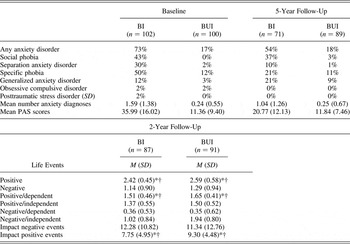
Table 1 shows the means and standard deviations of the CASE-P scores at 2-year follow-up separately for children that were categorized as BI and BUI at baseline. Independent t tests showed that children who were categorized as BI at baseline were less likely to experience positive life events, t (179) = 2.35, p < .05, and more specifically, fewer positive/dependent life events, t (179) = 2.21, p < .05, than were BUI children. The impact of these positive life events was also lower in BI children than in BUI children, t (199) = 2.34, p < .05. Preliminary analyses also showed that comorbidity (i.e., having a clinicial, nonanxiety disorder diagnosis of CSR of 4 or above) was associated with increased rates of negative life events and its impact (all ts > 2.03, ps < .05).Footnote 2
Prevalence rates and comparison of BI and BUI groups on number of anxiety diagnoses, anxiety scores, and life events at baseline and follow-up

Note: BI, behaviorally inhibited; BUI, behaviorally uninhibited; PAS, Preschool Anxiety Scale.
†Nonsignificant when analyses were run with only consistently categorized BI children.
*p < .05.
Multiple regression analyses
To examine the interplay among BI, dependent, and independent life events (at 2-year follow-up), interactions between BI and life events, and anxiety (at 5-year follow-up), hierarchical multiple regression analyses were run. Separate models were tested for negative, positive, and the impact of life events.
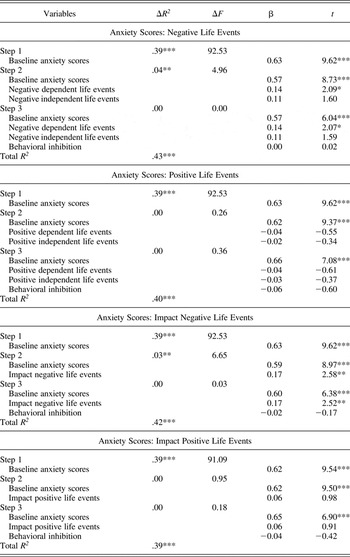
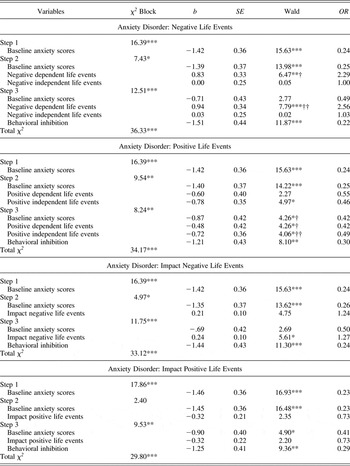
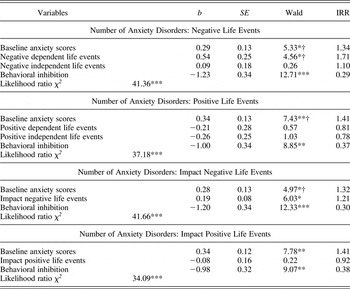
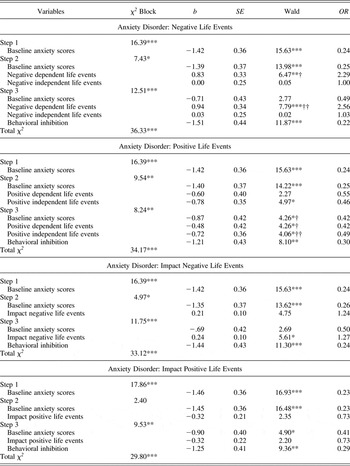
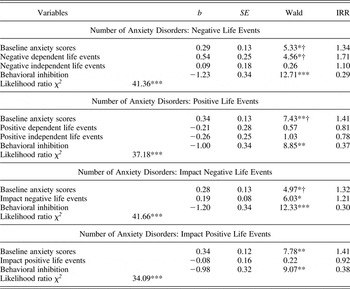
Initial analyses showed that none of the interactions between BI and life events were significant predictors of anxiety outcomes. Therefore, we decided to test a more parsimonious model excluding these interactions, in line with recommendations of various authors (e.g.,Judd & Kenny, Reference Judd and Kenny1981; Meyers, Gamst, & Guarino, Reference Meyers, Gamst and Guarino2006). As can be seen in Table 2, Table 3, and Table 4, across most models (and as we have reported elsewhere; Hudson & Dodd, Reference Hudson and Dodd2012; Hudson, Dodd, & Bovopoulous, Reference Hudson, Dodd and Bovopoulos2011; Hudson, Dodd, Lyneham, et al., Reference Hudson, Dodd, Lyneham and Bovopoulous2011), baseline anxiety and BI were significantly related to anxiety at 5-year follow-up.
Final multiple hierarchical regression models for behavioral inhibition, life events, and anxiety scores

Note: Behavioral inhibition is coded 0 = uninhibited, 1 = inhibited.
*p < .05. **p < .01. ***p < .001.
Final multiple hierarchical logistic regression models for behavioral inhibition, life events, and presence of an anxiety disorder
Note: Behavioral inhibition is coded 0 = uninhibited, 1 = inhibited.
†Nonsignificant when analyses are run with only consistently categorized behaviorally inhibited children.
††Borderline significant when analyses are run with only consistently categorized behaviorally inhibited children.
*p < .05. **p < .01. ***p < .001.
Final multiple negative binomial regression models for behavioral inhibition, life events, and number of anxiety disorders
Note: Behavioral inhibition is coded 0 = uninhibited, 1 = inhibited.
†Nonsignificant when analyses are run with only consistently categorized behaviorally inhibited children.
*p < .05. **p < .01. ***p < .001.
Negative life events and the impact of negative life events
Dependent negative life events at 2-year follow-up were significantly associated with increases with all anxiety outcomes at 5-year follow-up (i.e., anxiety symptoms, anxiety diagnosis, and number of anxiety diagnoses, even after controlling for baseline anxiety). Negative independent life events were not a significant predictor of anxiety problems at follow-up. Furthermore, a higher reported impact of negative life events at 2-year follow-up was consistently linked to worse anxiety outcomes at 5-year follow-up (i.e., increased anxiety symptoms, an anxiety diagnosis, and increased number of anxiety diagnoses, even after controlling for baseline anxiety).
Positive life events and the impact of positive life events
Positive independent life events were predictive of having an anxiety disorder (after controlling for baseline anxiety), with lower numbers of reported positive life events being linked to an increased chance of having an anxiety disorder. This finding was not replicated for the other anxiety outcome variables. The number of positive dependent life events or the impact of positive life events was not a significant predictor of anxiety psychopathology.
Although there was no evidence of the hypothesized moderation of the relation between BI and anxiety outcomes by positive life events (i.e., none of the interactions between BI and life events predicted anxiety at 5-year follow-up), a relation was found between BI and positive life events on the one hand and positive life events and anxiety disorder status on the other hand. This could suggest mediation is present. Therefore, we explored whether positive life events mediated the relation between BI and anxiety disorder status at 5-year follow-up. The hypothesized mediation model was estimated using regression analyses in combination with a bootstrapping procedure. BI was used as the independent variable, positive dependent and independent life events were the mediators, and anxiety disorder status (i.e., having an anxiety disorder or not) was the dependent variable in the model. The analysis was conducted with and without including baseline anxiety disorder status as a covariate. Furthermore, the regression weights and standard errors for the direct effects (i.e., between the independent and dependent variable) were estimated in the usual way, that is, by means of regression analyses. However, this was not possible for the indirect effects (i.e., the links between the independent variable and the mediators, and between the mediators and the dependent variable), because these effects have to be calculated from the product of two direct effects and the distribution of this product cannot be assumed to be normal (Preacher & Hayes, Reference Preacher and Hayes2008). This nonnormality is particularly problematic when the sample size is moderate, as was the case in the present study (i.e., N = 202). In addition, it should be mentioned that the Sobel test, which is commonly used to examine indirect effects and mediation hypotheses, also requires a normal distribution of the variables involved. Because of the relatively moderate sample size and the intention to test the effects of two mediators simultaneously, the Sobel test would not be appropriate. To explore the indirect effects and to test the mediation hypotheses, we employed Preacher and Hayes's (Reference Preacher and Hayes2008) bootstrapping procedure by means of a special macro that was programmed in Statistical Package for the Social Sciences. This macro was used to estimate a 95% (bias-corrected) confidence interval for the total and the specific indirect effects of the mediators. Results of the multiple mediation analyses, however, showed no evidence of positive life events mediating the relation between BI and anxiety disorder status. That is, although the total indirect effect from BI through positive dependent and independent life events to anxiety disorder status at 5-year follow-up was significant, 95% confidence interval (CI; 0.003–0.53) and 95% CI (0.005–0.52), after controlling for baseline anxiety disorder status), none of the specific indirect effects reached significance (all 95% CIs included 0).
Discussion
The current study assessed the longitudinal relationships among BI, life events, and anxiety in a sample of young children. To our knowledge, this is the first study on this topic to include diagnostic interviews to establish clinical anxiety disorders next to measures of anxiety symptoms; examine these relationships over an extended period of time; and make a distinction between different types of life events. In line with our hypotheses, more negative life events, and negative behavior-dependent life events in particular, as well as the impact of negative life events predicted more anxiety symptoms, increased likelihood of having an anxiety disorder diagnosis, and a greater number of anxiety diagnoses 3 years later. Experiencing more positive behavior-independent life events, by contrast, decreased the likelihood of an anxiety disorder diagnosis but was not linked with anxiety symptoms or the number of anxiety disorders. Differences were also found in life events between BI and BUI children. That is, BI children experienced fewer positive events, especially behavior-dependent positive life events. The impact of positive life events was also lower in BI children than in BUI children. However, it is worth noting that this result was not replicated in analyses that only included consistently categorized children. Finally, BI did not interact with life events in the prediction of anxiety problems as hypothesized. Therefore, this study does not provide evidence for the diathesis–stress, the vantage-sensitivity, or the differential–susceptibility account, but it seems to indicate that BI and life events function as additive risk factors in the development of anxiety problems.
The relationships found between negative life events and anxiety is consistent with previous research showing that negative life events and their impact on children's lives are associated with increased anxiety in children (Allen et al., Reference Allen, Rapee and Sandberg2008; Boer et al., Reference Boer, Markus, Maingay, Lindhout, Borst and Hoogendijk2002; Edwards et al., Reference Edwards, Rapee and Kennedy2010; Eley & Stevenson, Reference Eley and Stevenson2000; Goodyer et al., Reference Goodyer, Wright and Altham1990; Gothelf et al., Reference Gothelf, Aharonovsky, Horesh, Carty and Apter2004; Rapee & Szollos, Reference Rapee and Szollos2002; Tiet et al., Reference Tiet, Bird, Hoven, Moore, Wu and Wicks2001). The findings are also consistent with a previous cross-sectional study by Allen and Rapee (Reference Allen and Rapee2009), which showed that anxious children experienced more negative behavior-dependent life events. This current study extends this knowledge by providing longitudinal evidence for the contribution of negative behavior-dependent, but not negative behavior-independent, life events, and the impact of negative life events on childhood anxiety. However, the pattern of findings also appears inconsistent with evidence from another study by Allen et al. (Reference Allen, Rapee and Sandberg2008). That study showed that severe negative independent life events and chronic adversities were also associated with the onset of clinical episodes of anxiety in children. This inconsistency may be due to differences in assessment tools selected to measure life events. Allen et al. (Reference Allen, Rapee and Sandberg2008) used an investigator-based life events interview, the Psychosocial Assessment of Child Experiences (PACE), to evaluate and record life events. In contrast, the current study as well as the Allen et al. (Reference Allen and Rapee2009) paper used the CASE checklist. The PACE is considered a “gold standard” for evaluating life stress, given that it can provide a more in-depth assessment of the independence of life events from the child's behavior and assess the contextual impact of life events in addition to their subjective impact. Therefore, the PACE may have been more sensitive in detecting the impact of severe life events, given that another study also showed a significant association between severe life events and onset of childhood psychiatric disorder (Sandberg, Rutter, Pickles, McGuinness, & Angold, Reference Sandberg, Rutter, Pickles, McGuinness and Angold2001). Despite moderate to substantial agreement on the number and impact of life events documented between checklist and interview method, previous research also suggests that the CASE checklist may be more sensitive to the detection of the relationship between life events and psychopathology than the PACE interview (Allen et al., Reference Allen, Rapee and Sandberg2012). Future studies may need to consider the inclusion of both measures to determine the relative strengths of each measure in documenting early life stress and its association with the onset of childhood anxiety disorders.
When focusing on negative behavior-dependent life events and their role in child anxiety, our study showed that experiencing more negative dependent life events predicted higher anxiety symptoms and increased risk of developing anxiety disorders. This is in line with models of anxiety development that consider negative life events as a risk factor for the development of anxiety problems, through the formation and reinforcement of cognitive vulnerability (e.g., Hudson & Rapee, Reference Hudson, Rapee, Heimberg, Turk and Mennin2004; Rapee, Reference Rapee, Vasey and Dadds2001). However, these models do not distinguish between behavior-dependent and behavior-independent life events. To date, it remains unclear why anxiety is only predicted by behavior-dependent negative life events. One possibility is that anxiety and negative-dependent life events are caused by the same shared source, for example, genetics or a vulnerable temperament, negative family environment, parental modeling, or an adverse social environment. Although more research is needed to clarify the process by which negative dependent life events precipitate anxiety in children, our study suggests that the temperamental trait of BI is unlikely to be the shared cause. That is, BI was not linked to negative life events in this study (i.e., no differences were found between children categorized as BI and BUI at baseline in subsequent negative life events). One possibility is that perceived responsibility for negative life events (e.g., I am being bullied because I am no good) produces negative mood or emotion and significant distress within the child, which in turn puts the child at risk for developing anxiety problems. Therefore, future studies are needed to assess the subjective behavior dependence or independence of life events and children's cognitions around these life events, to try to clarify how behavior-dependent life events lead to increased childhood anxiety. Differences between BI and BUI children were found on positive life events, with BI children experiencing fewer positive and behavior-dependent positive life events at 2-year follow-up. The impact of these positive life events was also lower in BI children than in BUI children. This suggests that BI children seem to miss out on positive life events, especially when these events depend on their behavior (e.g., making a new friend). This is in line with research on anxious children, which showed that anxious children experience fewer behavior-dependent positive life events (Allen & Rapee, Reference Allen and Rapee2009). This strongly suggests a vicious cycle in which the fearfulness and apprehension experienced by BI children in novel situations makes them more likely to avoid these positive situations, thus causing them to miss out on various positive life experiences. The lack of positive life events in turn could increase the vulnerability of BI children to anxiety problems by limiting opportunities to develop and practice their social and coping skills (Lyneham & Rapee, Reference Lyneham, Rapee and Schneider2004). However, in our sample, neither independent nor dependent positive life events mediated the relationship between BI and anxiety diagnosis status, which limits the contribution of positive life events to the onset of anxiety disorders for BI children. However, positive life events may act as a protective factor in the development of child anxiety. Results of this study seem to support this notion. That is, when children experienced more positive behavior-independent life events, this decreased their risk of being diagnosed with an anxiety disorder. This suggests that theoretical models on childhood anxiety not only should include negative behavior-dependent life events but also need to consider the role of positive life events in the development of anxiety.
Finally, our hypothesis that BI and life events would interact in a way consistent with the diathesis–stress, the vantage sensitivity, or the differential susceptibility models was not supported. No interaction was found between BI and life events in the prediction of anxiety. However, BI and life events did act as independent predictors of the development of anxiety. Although inconsistent with the results of Brozina and Abela (Reference Brozina and Abela2006), who found support for a diathesis–stress account, these results are consistent with findings by Edwards et al. (Reference Edwards, Rapee and Kennedy2010) and Muris et al. (Reference Muris, Van Brakel, Arntz and Schouten2011), who also only found evidence for BI and life events acting as independent predictors of anxiety problems in children. Taken together, it seems that BI, as well as higher numbers of negative (behavior-dependent) life events and higher negative impact of negative life events, and a lack of positive (behavior-independent) life events put children at risk for the development of anxiety problems in late childhood. Future research should examine whether specific events and stressors (e.g., social versus nonsocial) are most important in the development of these anxiety problems.
It is also worth noting that in this study, we assessed stressful life events over a 12-month period, when the children were approximately 6 years of age. Our results may differ when negative life events are assessed during different periods of development. For instance, while negative life events do not interact with temperament during childhood to predict anxiety, this may not be true for BI individuals who encounter negative life events during adolescence. Negative life events in adolescence may be quite different from events encountered in childhood given that adolescents are more able to influence their environment, and thus contribute more actively to the occurrence of dependent life events. However, adolescents may experience increased risk for negative life events given that they will have greater exposure to deleterious factors such as alcohol and drug use. Therefore, adolescents may be subject to more independent (e.g., peers and friends affected by drug-related accidents) as well as dependent negative life events (e.g., taking up drugs and alcohol). Future studies examining this issue in other age groups will provide important clues on the qualitative and relative contribution of negative life events, and their relationship to temperament in predicting anxiety and mood disorders across development.
Limitations
Several limitations of this study need to be considered when interpreting these findings. First, only extreme groups (i.e., BI and BUI) were used, which means that the findings for this study may not be applicable to the general population. However, when looking at anxiety and its disorders, it seems probable that these extreme groups are the most likely to develop these problems. Examining extreme groups (i.e., children scoring 1 SD above and below the normative mean) is further supported by Moehler et al. (Reference Moehler, Kagan, Oelkers-Ax, Brunner, Poustka and Haffner2008), who have suggested that BI and BUI children belong to distinctive and discrete categories produced by different biological factors, based on the rationale that different phenotypes are often the result of distinct genotypes (see Mervielde & De Pauw, Reference Mervielde, De Pauw, Zentner and Shiner2012). Therefore, the long-term psychological outcomes for BI and BUI groups are important and informative.
It must be noted that the results described were based on parent report of BI, and although the agreement is good between parent and observer when rating BI, some of our significant results became nonsignificant after rerunning the analyses with only the consistently categorized BI and BUI children. One potential explanation for this change is the decreased power to detect significant differences owing to the decreased sizes for the consistently categorized groups. For instance, while negative dependent life events predicted anxiety diagnoses when we included all children, this effect became nonsignificant when we included only consistently classified children. However, our power was reduced by 18% for this predictor (negative dependent life stress) when the data was reanalyzed with a smaller sample size (Hsieh, Block, & Larsen, Reference Hsieh, Block and Larsen1998). This is an example of a substantial drop in power and may explain the nonsignificant findings reported in our study with the reduced sample size. Another explanation is that parents who over- or underreport their child's BI may also show a bias in a similar direction for life events. However, it is most likely that this would affect the reported impact rating more than it would impact the report of whether specific events did or did not happen, and thus not affect the number of positive or negative life events reported. Because the alternative analyses mainly show differences in significance level on the number of life events, and even on behavior-independent life events (e.g., items such as parents getting a divorce; pet dying, getting sick, lost, or injured; or person in the family being really sick or injured), it seems more likely that another factor, such as decreased power, caused these differences.
Second, this study relied on subjective parent report of life events, their impact, and valence. Thus, biases caused by parent's current mood or stress levels may have played a role (e.g., Cohen, Towbes, & Flocco, Reference Cohen, Towbes and Flocco1988). Some researchers therefore suggest the concurrent use of interviews (e.g., Monroe & Roberts, Reference Monroe and Roberts1990) and objective raters to remedy such biases (i.e., positive or negative; Williamson, Birmaher, Dahl, & Ryan, Reference Williamson, Birmaher, Dahl and Ryan2005). However, although future studies could benefit from a multiple methods and informants approach, other studies have shown moderate to substantial agreement on the number of life events and impact between checklists and interview measures of positive and negative life events (Allen et al., Reference Allen, Rapee and Sandberg2012; Wagner, Abela, & Brozina, Reference Wagner, Abela and Brozina2006). Moreover, it seems that neither depressive nor anxiety symptoms led to overreporting of events on checklists compared to interview measures (Wagner et al., Reference Wagner, Abela and Brozina2006). In addition, it must be kept in mind that, although the distinction between behavior-dependent and behavior-independent events in this study has been made based on previous research (Allen & Rapee, Reference Allen and Rapee2009), it is possible that if more information about the specific life events in a family were made available, some of these events may have been categorized differently. In addition, there is a lack of clarity regarding whether these behavior-dependent events were driven by anxious behaviors or behaviors unrelated to anxiety, which future studies will need to address.
Third, we recognize that our sample has several characteristics that may not make them representative of BI and BUI children from the general population. There is considerable evidence that poverty confers a wide array of physical and socioemotional stresses on the child, which can alter their developmental trajectory, including elevated vulnerability to psychopathology (Evans & Kim, Reference Evans and Kim2013). The majority of children in our sample, however, were from two-parent, middle-income, and educated families. Therefore, we are lacking important information from disadvantaged children in our sample. We recommend that future studies examine the relationship between BI and negative life events in socioeconomically disadvantaged groups of children.
In addition, there was a differential rate of dropouts between BI and BUI children, with greater attrition in the former group. This could have led to some bias in our results because these children and families may have possessed specific characteristics that made them more likely to drop out of the study. For instance, these children and families may have experienced more severe anxiety or life adversities combined with BI that impeded attendance at the research sessions. This limits the generalizability of our results. Moreover, it could have impacted on the power to detect true interaction effects between BI and life events. Future studies may need to consider focusing on the retention of BI families as an important priority for longitudinal research in this area.
Conclusion
To conclude, this study shows that BI and life events act as additive risk factors in the development of anxiety problems. It specifically showed that number of negative behavior-dependent life events and impact of negative life events can increase the risk of developing anxiety symptoms and anxiety disorders. In addition, this study demonstrated a protective role for positive behavior-independent life events in the development of child anxiety. These findings may have implications for clinical practice. For instance, within cognitive behavior therapy, clinicians often discuss how events trigger thoughts, which then lead to feelings of anxiety in children and associated unhelpful behaviors (i.e., avoidance). However, the events described are often articulated as independent of the child, and thus, it is not surprising that within a clinical setting children and families often report feeling a lack of control over stressful events. One possible solution, based on the current findings, is to increase awareness that the child's behavior can drive future negative events. For example, a child who continues to turn down party invitations because of excessive shyness will eventually be left off the invitation list and feel excluded from friendship circles (i.e., negative dependent life events). Helping families and children to understand this cycle may allow them to reduce negative dependent life events and increase their motivation to engage in therapeutic techniques that break this cycle. In summary, the current study elucidates an important role for life events and BI in predicting childhood anxiety disorder, and it has the potential to inform frameworks for interventions that could interrupt the chronic course of anxiety disorders early in life.