Introduction
The Manihot genus includes 98 species distributed through the Neotropic (Rogers and Appan, Reference Rogers and Appan1973). In Colombia, the wild species Manihot brachyloba Müll.Arg., Manihot carthaginensis (Jacq.) Müll.Arg., Manihot tristis Müll.Arg. are known to occur alongside cultivated cassava (Manihot esculenta Crantz). Cassava is an allogamous species native to South America (Allem, Reference Allem1994; Olsen and Schaal, Reference Olsen and Schaal1999). It ranks fourth among the principal carbohydrate sources in the tropic, and is the sixth most important crop for the human diet, providing food to approximately one billion people from 105 countries. The wide distribution and importance of this crop relates to its resilience to abiotic stress factors and the low requirements for its production, allowing its cultivation in low-fertility soils (Food and Agriculture Organization (FAO), 2008; Montagnac et al., Reference Montagnac, Davis and Tanumihardio2009).
The combination of cassava's adaptive traits, its importance in terms of food security of rural populations around the world, and its promising industrial applications, have attracted attention to the generation of genetically modified varieties with beneficial traits, from high β-carotene content to the quality of the starch (Ihemere et al., Reference Ihemere, Arias-Garzon, Lawrence and Sayre2006; Sayre et al., Reference Sayre, Beeching, Cahoon, Egesi, Fauquet, Fellman, Fregene, Gruissem, Mallowa, Manary, Maziya-Dixon, Mbanaso, Schachtman, Siritunga, Taylor, Vanderschuren and Zhang2011). While research in Colombia on the development of genetically modified (GM) cassava is ongoing, no variety has been released in the country to date. However, if GM cassava were to be released in Colombia there is high probability of introgression of genetically modified organisms (GMO) genes into its wild relatives and traditional cultivars through gene flow, owing to the crop's predominant allogamous nature with pollination mediated by insects (Kawano, Reference Kawano, Fehr and Hadley1980), high outcrossing rates from 60 to 100% (Kawano, Reference Kawano, Fehr and Hadley1980; Meireles da Silva R et al., Reference Meireles da Silva, Bandel and Martins2003), and the possibility of producing interspecific hybrids (Nassar, Reference Nassar2003). To allow the development of a proper risk management strategy, the establishment of a genetic baseline of the wild relatives of cassava in Colombia is indispensable. The characterization of species at a molecular level is an essential step of programmes aimed at developing conservation and use strategies of biological resources. Just as artificial selection has played a key role in the transformation of wild plants into their cultivated forms, similarly the introduction of GM varieties, could through gene flow and introgression of alien genes, influence the evolutionary and population dynamics of their wild relatives and traditional cultivated forms. Determining where and how (ex situ or in situ) to conserve is crucial to maintain the genetic variation of the species. In this study, ten simple sequence repeat (SSR) markers were used to assess the genetic diversity and population structure of the Colombian species M. brachyloba, M. carthaginensis, M. tristis and M. esculenta.
Materials and methods
Plant material
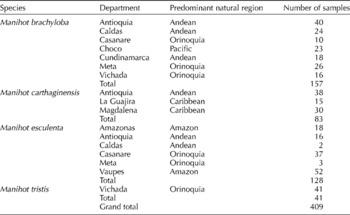
A total of 409 samples were collected over a period of three years (2009–2011) for the four taxa, taking into consideration previous reports on the distribution of Manihot species in Colombia, and ecological niche modelling (potential distribution) based on those reports. The geographical coverage included 12 of the 32 departments of Colombia (Table 1).
Location and number of samples of Manihot species collected in Colombia

For the study, 180 controls provided by the Genetic Resources Unit of the International Center for Tropical Agriculture (CIAT) were used, corresponding to: 31 of M. esculenta ssp. flabellifolia and 32 of M. tristis from Brazil; 18 of M. carthaginensis of Colombia; and 99 of M. esculenta from 13 countries of Latin America, Africa and Asia. The high number of controls was used to confirm the taxonomic status of the collected samples and to identify possible hybrids.
DNA extraction and SSR amplification
DNA extraction from leaf tissue was carried out using the DNeasy® Plant Mini Kit system from QIAGEN (Germantown, Maryland, USA). Total DNA quality was verified through visualization by electrophoresis in 0.8% agarose gels stained with SYBR® Safe, Life Technologies (Carlsbad, California, USA). DNA concentration was determined by quantification using the BioPhotometer Eppendorf® (Hamburg, Germany) spectrophotometer.
The samples were genetically characterized by means of the following ten SSRs developed and studied by Mba et al. (Reference Mba, Stephenson, Edwards, Melzer, Mkumbira, Gullberg, Apel, Gale, Tohme and Fregene2001) and Raji et al. Reference Raji, Anderson, Kolade and Ugwu(2009a): SSRY164, SSRY161, SSRY59, SSRY21, SSRY175, SSRY5, SSRY20, C283Y, MEESR15, and MEESR60. Amplification of the SSRs was carried out using a PTC-100TM thermal cycler (Programmable Thermal Controller; Bio-Rad Laboratories, Inc. (Hercules, California, USA)). The PCR profile included a first cycle of denaturation at 94°C for 5 min, followed by 35 cycles at 94°C for 30 s, annealing T° (specific for each pair of primers) for 25 s, and 72°C for 30 s, and a final extension cycle at 72°C for 10 min. The reaction mixture, with a final volume of 13 μl, contained 20 ng of DNA of the sample, 1X buffer (Tris–HCl 100 mM, KCl 500 mM), 1.5 mM of MgCl2, 0.18 mM of each deoxynucleoside triphosphate (dNTP), 0.24 μM of each primer, and 0.5 U of Taq polymerase. The PCR products were visualized in 6% acrylamide gels, 7.5 M of urea, stained with silver nitrate (Bassam et al., Reference Bassam, Caetano and Gresshoff1991). Allele sizes were visually determined through comparison with the 10 bp DNA ladder (Invitrogen™ Corporation, Carlsbad, CA, USA).
Statistical analysis
Principal Coordinate Analyses (PCoA) based on the Nei genetic distance matrices were undertaken with the cmdscale function available in version 1.3 of the gstudio package (Dyer, Reference Dyer2014) for R software for statistical computing version 3.1 (R Core Team, 2014). Hierarchical cluster analysis was carried out with the hclust function using the unweighted pair group method with arithmetic mean. We used the Kelley–Gardner–Sutcliffe penalty function (KGS) (Kelley et al., Reference Kelley, Gardner and Sutcliffe1996) for hierarchical trees implemented in the kgs function of the maptree package (White and Gramacy, Reference White and Gramacy2012) to suggest the optimal number of clusters or populations in the data set.
The FSTAT program version 2.9.3 (Goudet, Reference Goudet2001) was used to calculate genetic diversity parameters, average number of alleles per locus (A), observed heterozygosity (H O), expected heterozygosity or average genetic diversity (H E), total heterozygosity (H T), coefficient of differentiation (G ST and F ST) and inbreeding coefficient (F IS).
Analysis of the distribution of variation at different levels within the data set of each species was calculated with the ARLEQUIN program version 3.5 (Excoffier and Lischer, Reference Excoffier and Lischer2010) using the analysis of molecular variance (AMOVA) with 1000 permutations. Likewise, correlations between genetic (F ST) and geographical distance (calculated from the geographical coordinates) matrices of the populations of the species were assessed using ARLEQUIN by means of Mantel tests with 10,000 permutations.
We calculated an indirect estimate of gene flow based on the equation N m= (1 − G ST)/4G ST (Slatkin and Barton, Reference Slatkin and Barton1989), where N m is the estimated number of migrants per generation.
Polymorphism information content (PIC) values (Botstein et al., Reference Botstein, White, Skolnick and Davis1980), as a measure of the informativeness of a genetic marker, were calculated for each locus according to the following formula:
 $$\begin{eqnarray} PIC = 1 - { \sum _{ i = 1}^{ n } }\, P _{ i }^{2} - 2{ \sum _{ i = 1}^{ n - 1} }\,{ \sum _{ j = i + 1}^{ n } }\, P _{ i }^{2} P _{ j }^{2}, \end{eqnarray}$$
where P i = allele frequency of the marker and n= number of different alleles.
Results
The ten SSRs used in this study, across all 409 samples, registered a very high (0.816) average value of PIC, ranging from 0.629 (MEESR60) to 0.903 (SSRY161). Lower values were obtained at individual species level (Supplementary Table S1, available online). M. esculenta showed the highest average PIC value (0.622), with values of individual loci ranging between 0.221 (C283Y) and 0.868 in (SSRY175). The PIC values for M. brachyloba ranged between 0.090 (MEESR15) and 0.911 (SSRY5), with an average of 0.569. M. carthaginensis yielded an average value of 0.420 and a range between 0.060 (MEESR15) and 0.785 (SSRY21). The lowest average PIC value of 0.233 was obtained for M. tristis, which relates to the low number of alleles per locus observed in the species: in four cases only one allele was found, resulting in a PIC value of 0. Nevertheless, the highest value was 0.806 for locus SSRY5 with 12 alleles.
Genotyping of all 409 individuals with the ten SSRs yielded a total of 195 different alleles, with an average of 19.5 alleles per locus. The lowest number of alleles (10) was observed for locus MEESR60, and the highest number (31) for locus SSRY161. At species level (Supplementary Table S1, available online), highest allele richness was observed for M. esculenta (107 alleles; range from 6 (C283Y) to 18 (SSRY175)). Followed by M. brachyloba (95 alleles; range from 2 (SSRY21) to 22 (SSRY5)) and M. carthaginensis (67 alleles; range from 2 (MEESR15) to 13 (SSRY161)). Lowest alleles richness was found for M. tristis with a total of 34 alleles, ranging from 1 (SSRY59, SSRY175, SSRY20, C283Y) to 12 (SSRY5).
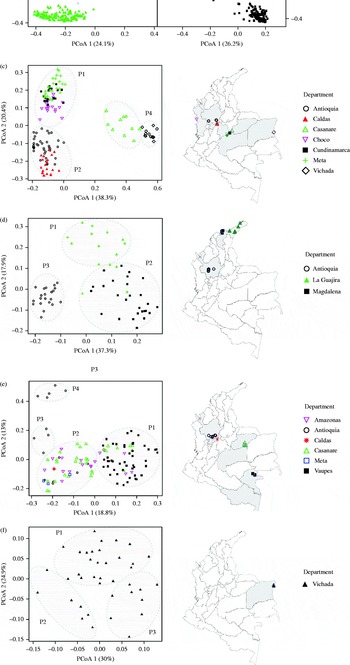
To explore the relationships among the different Manihot species considered in this study, we first carried out a PCoA based on all individuals, including the control samples. The first axis (PCoA 1) of Fig. 1(a), explaining 24.1% of the total variation in data, separates the different species relatively well. However, there is a clear overlap between the projection of individuals pertaining to M. esculenta ssp. flabellifolia (controls), M. esculenta (samples and controls) and M tristis samples from Brazil (controls). Also the separation of cultivated and wild species was relatively well marked, with a tendency for cultivated species to be projected on the right and wild on the left hand side of the graph. The wild species studied are separated along the second axis (PCoA 2), which explains 19.4% of the total genetic variation. In a PCoA scatterplot without control samples (Fig. 1(b)), the samples are clearly divided into four discrete groups, corresponding to the species studied.
Principal Coordinate Analysis (PCoA) and sample distribution of the Manihot species studied. (a) All species+controls. Controls of the species studied in grey colour, (b) Manihot species of Colombia, (c) Manihot brachyloba, (d) Manihot carthaginensis, (e) Manihot esculenta and (f) Manihot tristis. Shaded areas in the graph indicate populations suggested by the KGS analysis.

At the species level, the KGS analysis suggested the separation of the M. brachyloba individuals in four clusters (Fig. 1(c)): the first one composed of samples from the departments of Choco, Cundinamarca and Meta (P1); the second one of samples from Antioquia and Caldas (P2); the third one of individuals from Casanare (P3); and the fourth one of specimens from Vichada department (P4). The first PCoA axis, explaining 38.3% of the total genetic variation, differentiates the ensemble of populations P1 and P2 from both populations P3 and P4. The differentiation of populations P1 and P2 is apparent along the second axis, which explained 20.4% of the total genetic variation.
For M. carthaginensis, the KGS analysis identified three clusters (Fig. 1(d)): a first group composed of samples from the department of Guajira (P1), a second one of individuals from Guajira and Magdalena (P2), and a third one of samples from Antioquia (P3). Populations P1 and P2 are separated from population P3 along the first PCoA axis, which explained 37.3% of the total variation. Separation of populations P1 and P2 is evident along the second axis, which explains 17.9% of the total variation.
The M. esculenta were grouped into four clusters (Fig. 1(e)) but unlike the two previous species, clear separation of the individuals according to their department of origin was not observed. Population P1 included individuals from Amazonas, Casanare and Vaupes; P2 individuals from Antioquia, Amazonas, Caldas, Casanare and Meta; and P3 and P4, samples from Antioquia. The first PCoA axis explains 18.8% of total genetic variation and differentiates population P1 from the remaining ones, while the latter ones are separated along the second axis, explaining 13% of total variation.
Three populations were identified in the M. tristis samples, all originating from the department of Vichada (Fig. 1(f)). Total variation explained by the first and second PCoA axes was 30 and 24.9%, respectively.
Of all species studied, M. esculenta showed the highest average values of observed (H O= 0.564), expected (H E= 0.603) and total heterozygosity (H T= 0.792). The different populations identified in this species showed no major differences in H E scores, which ranged from 0.554 (P1) to 0.693 (P3). Accordingly, high genetic diversity levels were detected for all the loci, ranging between 0.375 (C283Y) and 0.789 (SSRY164). For M. brachyloba average H O, H E and H T were 0.255, 0.406 and 0.708, respectively (Supplementary Table S1, available online). Within populations, average H E ranged between 0.261 (P4) and 0.493 (P3); and within loci, it varied between 0.105 (MEESR15) and 0.574 (SSRY5). In M. carthaginensis, average H O, H E and H T values were 0.244, 0.355 and 0.511. Population P1 was least diverse (H E= 0.215) and population P3 was most diverse (H E= 0.463). H E per locus ranged between 0.663 (C283Y) and 0.056 (MEESR15). Compared with the other species studied, M. tristis evidenced the lowest values of diversity parameters, with average values for H O, H E and H T of 0.191, 0.212 and 0.258, respectively. These low scores are mainly because four of the ten SSR markers were monoallelic, and because two additional markers detected variability only in one of the three populations. Hence, only four markers revealed heterozygosity in all the populations established. The highest H E value was found for SSRY5 (0.783). P3 was the most diverse population (H E= 0.252), while P2 was the least diverse (0.172).
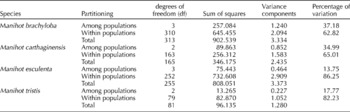
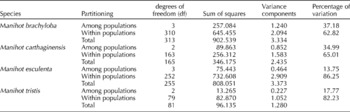
With respect to genetic structure, for M. brachyloba (Table 2) the results of an AMOVA indicated that most of the genetic variation (62.8%) occurred within the populations identified with KGS analysis, and 37.2% among them. The high F ST value (0.372) (Supplementary Table S1, available online) suggested large genetic variation between the populations considered. Similarly, a high and positive F IS value was observed (0.437). The value of the estimated migrants (N m) was low (0.337), which could be related to isolation by distance, as confirmed by the strong and significant correlation between genetic and geographical distance (r= 0.71, P= 0.04) calculated by a Mantel test. Also for M. carthaginensis, most of the genetic variation was found within the populations (65.0%; Table 2), but still more than one third (35.0%) of the variation was attributed to the differentiation among populations. A high and positive F IS value (0.358) (Supplementary Table S1, available online) and a low N m (0.567) were also observed. While the Mantel test indicated a very strong correlation between genetic and geographic distance (r= 0.99), it was not significant (P= 0.16); hence, there was no isolation effect derived from distance. With respect to M. esculenta, only a minor of genetic variation (13.8%; Table 2) was observed among populations, and the large majority within populations (86.3%). The average F IS for this species was low (0.049) (Supplementary Table S1, available online) and the N m was higher (1.059), compared with the previous species. A Mantel test showed a very weak and non-significant correlation (r= − 0.02, P= 0.36) between the genetic and geographical distances of the populations. For M. tristis, moderate genetic differentiation among populations was noticed (F ST= 0.178) (Supplementary Table S1, available online). Most of the genetic variation (82.23%; Table 2) was found within populations. As for M. esculenta, F IS observed in M. tristis was low (0.085) (Supplementary Table S1, available online) while the N m was the highest (1.703) among all the species, which could be associated with the geographical closeness of the populations.
AMOVA results for individuals of Manihot species based on ten SSR
Discussion
Overall, the markers used in this study evidenced high PIC values, demonstrating their ability to discriminate among species and populations at intraspecific level. In the specific case of M. esculenta, the PIC values obtained here (0.221 (C283Y)–0.868 (SSRY175),
 $$\bar {>X} $$
= 0.622) are within the range of previous studies. In a study of cassava germplasm, Kawuki et al. (Reference Kawuki, Ferguson, Labuschagne, Herselman and Kim2009) reported PIC values within a range of 0.358–0.759 with an average of 0.571. Similarly, Turyagyenda et al. (Reference Turyagyenda, Kizito, Ferguson, Baguma, Harvey, Gibson, Wanjala and Osiru2012) found an average PIC value of 0.611 for cassava landraces from Uganda.
Relationship of control samples and Manihot species of Colombia
The PCoA carried out with the four species analysed, along with the controls (Fig. 1(a)), showed a trend of wild species samples from Colombia to form discrete groups, while the cultivated one was grouped with control samples corresponding to the wild species M. esculenta ssp flabellifollia and M. tristis from Brazil. A clearer separation of all the four Colombian Manihot species was observed in the PCoA without the controls (Fig. 1(b)), confirming their status as separate species. Similar observations of wild Manihot species showing a tendency to separate from cultivated varieties have been made in previous studies (Roa et al., Reference Roa, Maya, Duque, Tohme, Allem and Bonierbale1997; Elias et al., Reference Elias, Panaud and Robert2000, Reference Elias, Santos Mühlen, McKey, Roa and Tohme2004). This pattern is consistent with the hypothesis of a limited, or even unique, domestication event in a restricted area, followed by the dispersion of cultivated phenotypes (Elias et al., Reference Elias, Panaud and Robert2000). Phylogenetic studies conducted by Schaal et al. (Reference Schaal, Carvalho, Prinzie, Olsen, Hernandez, Cabral and Moeller1997), Olsen and Schaal, Reference Olsen and Schaal1999, Reference Olsen and Schaal2001) and Olsen (Reference Olsen2004) have confirmed Allem's (1994) hypothesis that suggests M. esculenta ssp. flabellifolia occurring in southern Amazonia, as the wild progenitor of cultivated cassava. The close relationship observed between the species M. esculenta and M. esculenta ssp. flabellifolia in this study supports this hypothesis.
The clustering of M. tristis control samples from Brazil with those of M. esculenta and M. esculenta ssp. flabellifolia suggests that the M. tristis specimens from Colombia and Brazil may be different enough to be classified as two different species, or at least as two distinct sub-species. On the other hand, according to Allem (Reference Allem1994) and Allem et al. (Reference Allem, Mendes, Salomão and Burle2001), the M. tristis species from the Brazilian region is considered a synonym of M. esculenta ssp. flabellifolia placing it in the M. esculenta complex, in agreement with what was observed in the PCoA (Fig. 1(a)).
Genetic diversity and gene flow
We found high levels of intraspecific genetic diversity for all the species studied. While the lowest scores of all genetic diversity parameters were observed for M. tristis (H E= 0.212, H T= 0.258, A = 3.4), these may still be considered high when taking into account the number of samples studied, which was the lowest of all species here considered. The considerably high H E value (0.603) obtained for M. esculenta, the highest of all species analysed, is in agreement with previous findings by Kawuki et al. (Reference Kawuki, Ferguson, Labuschagne, Herselman and Kim2009) who studied germplasm from Asia, Africa and America and found a H E value of 0.615 for samples from the Americas. Another study on germplasm from different countries in Africa yielded a similar H E value of 0.630 (Raji et al., Reference Raji, Fawole, Gedil and Dixon2009b). Similarly, Turyagyenda et al. (Reference Turyagyenda, Kizito, Ferguson, Baguma, Harvey, Gibson, Wanjala and Osiru2012) reported an average H E value of 0.661 in landrace varieties from Uganda. The average number of alleles per locus in cassava obtained in this study (10.7) was higher than that of previous studies. Montero-Rojas et al. (Reference Montero-Rojas, Correa and Siritunga2011) reported 7.15 alleles per locus in a study on cassava from Puerto Rico. Fregene et al. (Reference Fregene, Suarez, Mkumbira, Kulembeka, Ndedya, Kulaya, Mitchel, Gullberg, Rosling, Dixon and Kresovich2003) found alleles number equivalent to 6.0 and 5.2 for landraces of Colombia and Brazil, respectively. Likewise, Turyagyenda et al. (Reference Turyagyenda, Kizito, Ferguson, Baguma, Harvey, Gibson, Wanjala and Osiru2012) observed an average number of 5.9 alleles per locus in landrace varieties from Uganda. The foregoing evidences a high allelic richness in the loci sampled within the Colombian populations.
Regarding the population structure of M. brachyloba and M. carthaginensis observed in the PCoA (Fig. 1(c and d)), samples tended to group according to their geographical origin and their relative proximity. The congruence between the geographical distribution of populations and their genetic differentiation is generally related to constrained gene flow between them (Schaal et al., Reference Schaal, Hayworth, Olsen, Rauscher and Smith1998). M. brachyloba displayed a highly significant pattern of isolation by distance, meaning that the reduced or almost inexistent gene flow between populations at larger distances may have led to the stochastic differentiation among them due to a genetic drift (Ellstrand and Elam, Reference Ellstrand and Elam1993). The high F ST value, along with the low gene flow (N m), observed in M. brachyloba, is consistent with the possibility that genetic drift has been the main modelling force of the current genetic structure of the species. In the case of M. carthaginensis, although the strong correlation (r= 0.99) between the geographical and genetic distances of the populations was not significant, similar F ST and N m values were found as for M. brachyloba, which could suggest that the process of genetic differentiation by distance of M. carthaginensis populations is still ongoing. Despite the fact that F IS values were high and positive for the previous two species, indicating high levels of inbreeding within the populations identified by the KGS analysis, it is important to take into account that many of the individuals within these groups were separated by long distances, in some cases hundreds of kilometres. However, if there were no gene flow between individuals of M. brachyloba and M. carthaginensis it probably would have an impact on the heterozygosity of these; nevertheless, they were high for both species. Our results would suggest the occurrence of gene flow among individuals of previous species but at a much smaller scale than the proposed for the analysis, occurring mainly between neighbouring individuals, thus implying the predominance of an open reproductive system in these crop wild relatives.
Originating from more compact, geographically closer populations, the M. tristis samples seemed to be well connected by gene flow both among and within populations, as suggested by the high number of migrants (N m= 1.703) and the low level of inbreeding (F IS= 0.085) observed, respectively. To assess the effect of geographic distance of individuals within populations on F IS estimator, we calculated anew the inbreeding coefficient for M. brachyloba and M. carthaginensis, this time establishing populations based on their geographical origin and closeness. Results revealed a decrease in the F IS value, obtaining 0.244 and 0.265, respectively. These results suggest that the relationships among individuals and populations of species, mediated by gene flow, may show different patterns depending on the spatial scale they are assessed.
In M. esculenta, the heterozygotic nature of the species and its elevated levels of gene flow among and within the populations were confirmed by the F ST, F IS, and N m values, consistent with observations in the PCoA scatter plot (Fig. 1(e)), where projections of samples from different regions of the country tended to cluster together, without forming apparent sub-populations. The existence of elevated gene flow in cassava has been previously demonstrated in genetic diversity studies conducted in different countries around the world, (Fregene et al., Reference Fregene, Suarez, Mkumbira, Kulembeka, Ndedya, Kulaya, Mitchel, Gullberg, Rosling, Dixon and Kresovich2003; Siqueira et al., Reference Siqueira, Queiroz-Silva, Bressan, Borges, Pereira, Pinto and Veasey2009; Montero-Rojas et al., Reference Montero-Rojas, Correa and Siritunga2011; Kawuki et al., Reference Kawuki, Herselman, Labuschagne, Nzuki, Ralimanana, Bidiaka, Kanyange, Gashaka, Masumba, Mkamilo, Gethi, Wanjala, Zacarias, Madabula and Ferguson2013). The high variability and gene flow in cassava could be associated mainly with two factors. First, there is the allogamous nature of the species. Even though cassava varieties are essentially vegetatively propagated, the production of voluntary seedlings generated from sexual reproduction is frequently incorporated by farmers in their crop gene pool, thus favouring the recombination and production of new genotypes which are subsequently subjected to natural and artificial selection pressures. This traditional practice helps to maintain genetic diversity and counters genetic erosion (Elias et al., Reference Elias, Penet, Vindry, McKey, Panaud and Robert2001; Pujol et al., Reference Pujol, David and McKey2005). Second, there is the exchange of cassava varieties among local farmers, which can play a key role in promoting and preserving the genetic variability of cassava populations. This factor has been shown to have a strong impact on the diversity of landraces, as has been reported in previous studies with different ethnic groups (Salick et al., Reference Salick, Cellinese and Knapp1997; Elias et al., Reference Elias, Panaud and Robert2000; Sambatti et al., Reference Sambatti, Martins and Ando2001). In addition, the great interest of local farmers to acquire new landraces and the fact that they seldom discard unproductive varieties with the argument that these may have a higher productivity in other environments, leads to a high varietal diversity on their farms (Elias et al., Reference Elias, Panaud and Robert2000). Clearly, the exchange of varieties and the incorporation of volunteer seedlings strongly contribute to maintain and augmenting genetic variability among and within crops on smallholder farmers’ fields.
GM cassava and the conservation of landraces and wild relatives
The potential impact of transgene introgression on the genetic structure and population dynamics of wild relatives, if GM cassava cultivated were to be permitted in Colombia, would be determined essentially by time, since the effect and the level of fixation of genes in populations are related to the adaptive advantage they confer to the species. According to the results of our study, the gene flow between genetically improved cassava varieties and wild relatives is a feasible event. Although little scientific information exists about the exchange of genes among species in the Manihot genus, many plant breeders have shown that cassava can be crossed with several of its wild congeners, thus overcoming reproductive barriers (Rogers and Appan, Reference Rogers and Appan1973; Byrne, Reference Byrne1984; Asiedu et al., Reference Asiedu, Hahn, Bai, Dixon, Akoroda and Arene1992; Wanyera et al., Reference Wanyera, Hahn, Aken'ova and Akoroda1992; Blair et al., Reference Blair, Fregene, Beebe, Ceballos and Guimaraes2007). In addition, based on molecular evidence, Duputié et al. (Reference Duputié, David, Debain and McKey2007) confirmed the existence in nature of fertile hybrids between cassava and its wild relative M. esculenta ssp. flabellifolia at several locations in French Guiana. In the case of M. carthaginensis, a frequently used species in cassava breeding (Chavarriaga et al., Reference Chavarriaga, Prieto, Herrera, López, Bellotti, Tohme, Alves and Tohme2004), natural hybrid populations of both species have been found in Africa, based on morphological and isozyme marker studies (Wanyera et al., Reference Wanyera, Hahn, Aken'ova and Akoroda1992; Lefevre and Charrier, Reference Lefevre and Charrier1993). The uncertainty associated with the possibility of gene flow from GM cassava to its wild relatives and the potential effect thereof, calls for the development of strategies to preserve the current gene pool of wild Manihot species in Colombia if GM cassava were to be released. To achieve this establishing the genetic diversity and population structure of wild species, which we have attempted to do in this study, is an indispensable step. Our results indicate the existence of high genetic diversity in wild Manihot species in Colombia, which are significant taking into consideration the small size of the populations. Aside from potential future threats of pollution with transgenes, also the current population sizes of the wild species make them more sensitive to losing genetic variation, e.g. through the effects of the random genetic drift and natural selection (Milligan et al., Reference Milligan, Leebens-Mack and Strand1994). Thus, actions should be undertaken in the short-term in order to preserve these species’ genetic resources.
Finally, the practice of exchange of cassava landraces among local farmers, combined with the allogamous nature of the species, could itself constitute an effective mechanism to facilitate gene flow, not only within populations but also among populations separated by large distances. This may be an efficient manner to maintain the variability within the species. However, within a biosafety context this practice may also bear risks since it could be the ideal mean for the dispersion of transgenes. In addition, the absence of a genetic barrier between GM cassava and traditional landraces, along with the wide distribution of the latter, are factors that may increase the risk of contact between wild and landrace populations contaminated with transgenes.
Supplementary material
To view supplementary material for this article, please visit http://dx.doi.org/10.1017/S1479262115000246
Acknowledgements
The authors wish to thank the Ministry of the Environment and Sustainable Development, the International Center for Tropical Agriculture (CIAT), and the Alexander von Humboldt Biological Resources Research Institute, for their cooperation and support to the Biosafety Line in Colombia. The authors express sincere gratitude to Evert Thomas for reviewing and improving substantially the text, and for his useful comments and suggestions. We are also grateful to Francisco Castro for his great cooperation during the expeditions carried out. A grateful acknowledgement is given to Myriam Cristina Duque and Juan Guillermo Perez for their valuable cooperation during the development of the study. And we thank all those who, in one way or another, contributed to this study.
Conflict of interest
The authors declare that they have no conflict of interest.