INTRODUCTION
Penaeid prawns are highly prized seafood harvested from coastal tropical and subtropical waters throughout the world (Gulland & Rotschild, Reference Gulland and Rotschild1981), accounting for 20% of internationally traded fishery products (FAO, 2007). One of the most common problems related to prawn trawling is the associated discard, with numerous studies having identified and quantified the types and levels of by-catch in several fisheries worldwide (Gulland & Rotschild, Reference Gulland and Rotschild1981; Alverson et al., Reference Alverson, Freeberg, Murawski and Pope1994; Hall, Reference Hall1999; EJF, 2003; Eayrs, Reference Eayrs2007). Damage caused by prawn trawling has been previously compared to clear-cutting forests, disrupting trophic interactions and reducing diversity in a marine environment (EJF, 2003). However, unlike deforestation, the impacts of prawn fisheries are only beginning to receive international attention (Eayrs, Reference Eayrs2007), and the use of satellite images has demonstrated the scale of disturbance caused by prawn-trawling (Van Houtan & Pauly, Reference Van Houtan and Pauly2007).
Artemesia longinaris Bate, 1888 is a penaeid prawn, commercially exploited along its distribution area, being used for human feeding as well as bait in recreational fishery (Boschi, Reference Boschi1969). In southern Brazil the species is also a target of a commercial artisanal fishery that operates with two different fishing gears, the stationary and trawl nets. The former fishing gear is used by fishermen in shallow waters (1–2 m) along the shoreline of Rio Grande do Sul State, while the trawl fishery is restricted to the surrounding area of Barra de Rio Grande (Rio Grande do Sul, Brazil), where it is performed in shallow waters (2–15 m) near to the beach. The fishing season extends from autumn to spring, seasons in which the enforced closed season of the pink-shrimp (Farfantepenaeus paulensis) fishery takes place. The incidental catch of the Argentinean prawn fishery in southern Brazil has been previously investigated regarding the by-catch composition of trawling performed on-board of a research vessel (Ruffino & Castello, Reference Ruffino and Castello1993), and regarding the by-catch from the industrial commercial fleet (Haimovici & Mendonça, Reference Haimovici and Mendonça1996a, Reference Haimovici and Mendonçab). However, the incidental catch originated from the artisanal trawling in the surrounding area of the Patos Lagoon Estuary, targeting mainly A. longinaris and the prawn Pleoticus muelleri to a lesser extent, has never been investigated. The former paper described the variation in by-catch composition during trawls performed on-board of a research vessel (‘Lancha Oceanográfica Larus’—LOc. Larus), while the second paper analysed the by-catch from a double-rig commercial fleet. As this fishery is performed in nursery and spawning areas for several fish (Vieira et al., Reference Vieira, Castello, Pereira, Seeliger, Odebrecht and Castello1998) and crustaceans (D'Incao, Reference D'Incao, Buckup and Bond-Buckup1999), information on the effects of trawling in these ecosystems is needed. Recently, much interest has been shown related to the ecosystem-based management, which is intended to evaluate the effects of fishing on the entire community and not only on the target species (Vasconcellos & Gasalla, Reference Vasconcellos and Gasalla2001; Hall & Mainprize, Reference Hall and Mainprize2005; Zeller & Pauly, Reference Zeller and Pauly2005; Worm et al., Reference Worm, Barbier, Beaumont, Duffy, Folke, Halpern, Jackson, Lotze, Micheli, Palumbi, Sala, Selkoe, Stachowiczm and Watson2006). The eco-based management approach has shown that fishing effort required to keep target species biomass above the sustainable level is often higher than the value needed to maintain by-catch species at a sustainable level (Hall, Reference Hall1999; EJF, 2003).
This is more evident when one considers a prawn species, since they are thought to be resilient to fishing pressure presenting high growth rate, egg production and short lifespan (Gulland & Rotschild, Reference Gulland and Rotschild1981; King, Reference King1997). Thus, an important issue to manage a fishery ecologically is to obtain quantitative and qualitative descriptions of the species caught incidentally (Hall, Reference Hall1999). In this regard, this paper aims to analyse the incidental catch of artisanal trawling for A. longinaris in two discrete fishing seasons, comparing the by-catch between a wet and a dry year. The subject of this investigation was brought to our attention by the local artisanal fishermen (‘Fórum Lagoa dos Patos’, a co-management meeting) (D'Incao & Reis, Reference D'Incao and Reis2002), who were demanding a scientific assessment of the by-catch of trawling nets as a requirement to enforce any further regulation based upon the ecological impacts of this fishery.
MATERIALS AND METHODS
Study area
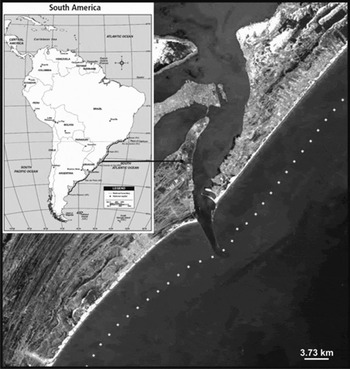
The surrounding area of Barra de Rio Grande is highly influenced by freshwater discharge from Patos Lagoon Estuary (Ciotti et al., Reference Ciotti, Odebrecht, Fillman and Moller1995). This estuary is located at the coastal plain of Rio Grande do Sul State, Brazil (32°S 49°W) and is the largest choked lagoon in the world, encompassing an area of 10,360 km2. Its drainage basin covers an area of 201,626 km2 (Asmus, Reference Asmus, Seeliger, Odebrecht and Castello1996) and pluvial intensity as well as wind direction play an important role in water circulation. Seasonal freshwater discharge presents great variability (30,300–47 m3s−1) and during El Niño Southern Oscillation (ENSO) events runoff is significantly higher than mean values estimated (Garcia, Reference Garcia, Seeliger, Odebrecht and Castello1996) (Figure 1).
South-western Atlantic Ocean highlighting the estuarine and surrounding areas of Patos Lagoon, where sampling for Artemesia Longinaris took place.

Field sampling and laboratory procedures
Fishing took place in the surrounding area of Barra do Rio Grande on a monthly basis. Sampling was carried out during the fishing season (April–December) always on-board of the same artisanal trawl boat in two discrete years, 2002 and 2004. The boat chosen was a typical artisanal otter trawler, a wooden boat, 7.6 m long, 2.20 m wide with a 24 hp central engine. The net used was also typical of this fleet, with 16 mm mesh size (opposing knots). Tow time ranged from a few minutes to 1 hour, but the duration of most of trawls was approximately 30 minutes. A researcher was on-board to avoid loss of information due to discards made by the fishermen. After analysis of each fishing station salinity and temperature of water were recorded using a thermosalinometer. Fishermen were not influenced by researchers to operate in a predetermined fishing site, neither to determine the duration of trawling, in order to describe the fishery by-catch as close as possible to the actual fishing activity. Samples were taken to the laboratory for analysis, which consisted of sorting fish and crustaceans to the species level and to measure (nearest 0.1 mm) and to weigh (nearest 0.01 g) all individuals. Daily rainfall (mm3) data were obtained from Estação Agrometeorológica da Universidade Federal de Pelotas and the intensity of ENSO was obtained by the Multivariate ENSO Index (MEI), which includes atmospheric and oceanographic parameters (Wolter & Timlin, Reference Wolter and Timlin1993).
Data analysis
Organisms were classified according to taxonomic and life history criteria. Life history classification was also performed to compare community composition during the analysed years. Classification was based on Garcia et al. (Reference Garcia, Vieira and Winemiller2003), as follows: (a) marine, species inhabiting the marine environment which do not depend on the estuarine region either for growth or reproduction; (b) estuarine-dependent, species inhabiting the marine environment, but which depend on the estuarine region either for growth or reproduction; and (c) estuarine-resident, species inhabiting the estuarine region, but which have a marine phase (e.g. spawning).
To estimate discard ratios, monthly catch values (in weight and number) of all species were transformed in relative abundance values (CPUE), and a seasonal mean CPUE (months pooled by season) was calculated for each species (Andrew et al., Reference Andrew, Jones, Terry and Pratt1995). The effort unity adopted was 30 minutes of trawling. Overall discard ratio was obtained dividing the total amount of by-catch by the amount of target species in the year. Catch in numbers was seasonally analysed, and it was only used to estimate the total discard ratios.
Normality and homogeneity of variance were tested prior to performing the mean CPUE comparison (t-test) of estuarine-related species (resident and dependent) between both years analysed. Since normality was not attained, a Kruskal–Wallis test was performed to compare pairwise median CPUEs, but only mean and standard error values are presented in the text.
Ecological parameters
The number of species caught per season was analysed and considered as a direct measure of richness. Species caught were also categorized according to trophic level, based on Vasconcelos & Gasalla (2001): herbivores, detritivores and omnivores (2–3) (HDO); mid-level carnivores (3.1–3.7) (MLC); and high-level carnivores and top-predators (3.8–4.3) (TPR). The weighted mean trophic level (TrLm) was estimated for each year analysed, multiplying the relative abundance of each species by its trophic level and dividing for the total amount of catch obtained during this period (Milessi et al., Reference Milessi, Arancibia, Neira and Defeo2005).
Catch probability and size composition of catches (P50)
To estimate the length at which the probability of catch is 50% (P50), a logistic model was fitted to the cumulative length–frequencies of the most important commercial fish and crustaceans in the by-catch. To explore potential effects of the artisanal trawling on juvenile of fish and crustaceans, e.g. growth overfishing (EJF, 2003), the estimate of P50 was compared to figures reported in the literature of the size at the onset of maturity (LM) of each species.
RESULTS
Environmental parameters
Anomalies in MEI rank (Wolter & Timlin, Reference Wolter and Timlin1993, Reference Wolter and Timlin1998) allowed the identification of discrete situations among studied years, since 2002 presented values above the neutral limit during approximately all the fishing season (April–October). Conversely, 2004 was considered as a neutral to moderate ENSO year, presenting lower or threshold MEI rank values (NOAA, 2007).
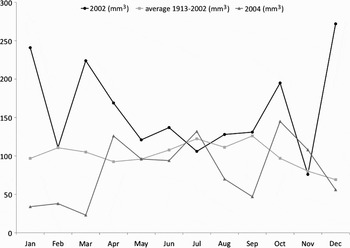
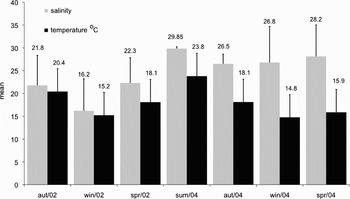
As a likely consequence of a more intense ENSO, significantly higher rainfall (P = 0.001) was observed during 2002 (monthly mean = 159.2 mm3/day), exceeding by far the mean for 2004 (monthly mean = 80.7 mm3/day) and the 1913–2006 average for the city of Rio Grande (monthly mean = 101.2 mm3/day) (Figure 2). The influence of freshwater discharge from Patos Lagoon Estuary on the sampling area during 2002 is clearly marked, since salinity values were permanently lower, especially in winter (Figure 3).
Monthly rainfall (mm3) for the city of Rio Grande, Rio Grande do Sul, Brazil, containing the values recorded in 2002, 2004 and the mean values between 1913 and 2006.

Seasonal variation of salinity and temperature in the surrounding area of Patos Lagoon for both years analysed (2002–2004). Mean ± standard errors are shown.

Discard composition and seasonal variation of catches
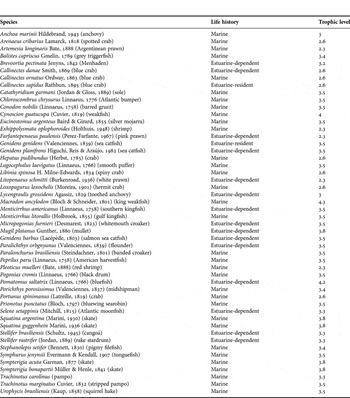
A total of 84 trawls were performed on-board of the artisanal fleet. Thirty-eight and twelve species of fish and crustaceans were caught, respectively (Table 1). The highest richness was observed in autumn (2002, 25 species; 2004, 36 species) while the lowest were found in winter (2002, 17 species; 2004, 22 species). The number of species caught in spring varied from 20 in the wet year (2002) to 27 in the dry year (2004).
List of species caught in trawling for marine prawns in the surrounding area of Patos Lagoon, containing life history classification (marine, estuarine-dependent and estuarine-resident) and trophic level suggested (Vasconcellos & Gasalla, Reference Vasconcellos and Gasalla2001).

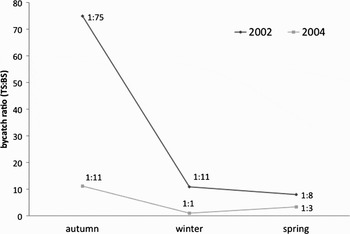
The overall discard ratio estimated in weight was 1:5.3 (target species:by-catch). During the wet fishing season (2002) discard ratio was 1:13, contrasting with 2004 when a much lower ratio (1:2.6) was recorded. The by-catch ratio was remarkably variable, presenting the highest values in autumn (2002 = 1:74; 2004 = 1:11.3), while the most striking inter-annual difference (over 11 fold) was recorded in winter, when the lowest discard was recorded (2002 = 1:10.85, 2004 = 1:0.97). The overall discard ratio in numbers was 1:1.3, ranging from 1:2.24 in 2002 to 1:0.5 in 2004 (Figure 4).
Seasonal trends in discard ratio in weight (target species (TS):by-catch (BS)) from artisanal trawling for marine prawns in the surrounding area of Patos Lagoon (Rio Grande do Sul, Brazil) for both years analysed (2002–2004).

Crustaceans accounted for approximately 17% of incidental catch and the blue crab C. sapidus was the third most abundant species in the catches (8% of total discard). Five species comprised 50% of the by-catch, as follows: banded croaker (P. brasiliensis = 18%), followed by salmon sea catfish (G. barbus = 14.22%), the blue crab (C. sapidus = 8.19%), the withemouth croaker (M. furnieri = 8%) and the cangoá (S. brasiliensis = 7%).
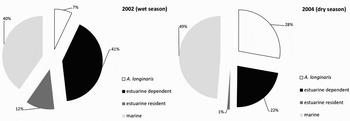
Relative abundance (g/30 min) and percentage of incidental catch were greatly influenced by estuarine-dependent and estuarine-resident species during 2002 (Figures 5 & 6). The Kruskal–Wallis test showed that CPUE of these species was significantly higher in the catches during the wet year (2002 = 240.00 ± 125.00; 2004 = 37.55 ± 31.45; P = 0.03) as well as its relative frequency (Figure 5). Conversely, when the mean CPUE of marine species was compared between 2002 and 2004, a higher CPUE, but not significantly different, was observed in the dry year (2002 = 140.00 ± 136.00; 2004 = 220.30 ± 220.00; P = 0.70), which was also confirmed by the relative frequency of this category (40% in 2002 and 49% in 2004) (Figure 5). This result suggests that the higher abundance of fish in the by-catch of 2002 was mainly influenced by the elevated biomass of estuarine related species in the surrounding area of the Patos Lagoon mouth.
Relative frequency of species with three categories of life history caught in trawling for marine prawns in the surrounding area of Patos Lagoon Estuary (Rio Grande do Sul, Brazil).

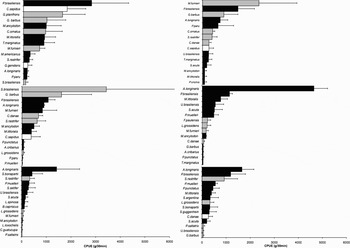
Seasonal trends in relative abundance (g/30 min) of species caught in trawling for marine prawns in the surrounding area of Patos Lagoon Estuary, Rio Grande do Sul, Brazil.

Among the estuarine-dependent fish species caught in autumn 2002, the most abundant in weight were the sea catfish (G. planifrons 1549.00 ± 895.00), salmon sea catfish (G. barbus 930.00 ± 747.00) and whitemouth croaker (M. furnieri 638.00 ± 210.00). Estuarine-resident species were mainly represented by the blue crab (C. sapidus)—the second most abundant species in autumn samples—while the highest CPUE of a marine species was annotated for the banded croaker (P. brasiliensis, 2702.00 ± 4411.00). Artemesia longinaris showed very low abundance (152.00 ± 142.00), while Pleoticus muelleri was absent in the by-catch (Figure 6).
A similar scenario was observed in winter 2002. However, the cangoá (S. brasiliensis 3312.00 ± 2890.00), an estuarine-dependent species, was the most abundant fish in the surrounding area of Patos Lagoon, followed by salmon sea catfish (G. barbus 1550.00 ± 1182.00) and whitemouth croaker (M. furnieri 803.00 ± 561.00). The blue crab (C. sapidus 357.00 ± 348.00) was the most abundant estuarine-resident species, in spite of its reduced abundance when compared to the previous season. Banded croaker (P. brasiliensis 1028.00± 267.00) showed a decreasing abundance during winter; but it was still the most abundant marine species. Relative abundance of A. longinaris (863.00 ± 26.00) was even smaller during winter and P. muelleri (13.00 ± 8.00) showed a slight increase in CPUE during this season (Figure 6).
Artemesia longinaris (1420.00 ± 931.00) and Pleoticus muelleri (301.00 ± 227.00) presented an abundance increase only in spring 2002. The blue crab (C. sapidus 1675.00 ± 1129.00) also showed an increasing CPUE after winter, being the most abundant estuarine-resident species. An elevated CPUE was estimated for G. barbus (3557.00± 2397.00) during this period, being markedly the most abundant estuarine-dependent species in samples. The banded croaker (P. brasiliensis 1861.00 ± 626.00) was the most abundant marine species during spring 2002, followed by bluewing robin (P. punctatus 1180.00 ± 544.00) and the gulf kingfish (M. littoralis 856.00 ± 531.00). It is worth noticing that ray species, such as S. bonapartii (425.00 ± 380.00) and S. acuta (158.00 ± 94.00), were not caught along the year, except in spring when very low abundance of these species was observed (Figure 6).
The by-catch composition and abundance showed a different pattern in the dry year. Lower abundances of fish and crustaceans were observed in autumn. During this season, the relative abundance index estimated for A. longinaris (707.00 ± 304.00) was considerably higher than in the previous autumn (2002). No estuarine-resident species was observed, moreover, the abundance of estuarine dependent species was also very low (G. barbus 97.00 ± 7.00 and M. furnieri 72.00 ± 8.00) (Figure 6). The presence of marine crustaceans in samples was noticed, represented by the crab H. pudibundus, the shrimp E. oplophoroides and the prawn L. schmitti. A marked increase in CPUE of A. longinaris (4476.00 ± 456.00) was recorded in winter 2004, when the highest abundance level was observed. Pleoticus muelleri (467.00 ± 317.00) also presented an increase in abundance during winter. Among the estuarine dependent species, pink prawn (F. paulensis 212.00 ± 179.00) was the most abundant, followed by the toothed anchovy (Lycengraulis grossidens 198.00 ± 125.00) and whitemouth croaker (M. furnieri 159.00 ± 145.00). Marine species were mainly represented by the banded croaker (P. brasilensis 1094.00 ± 952.00), gulf kingfish (M. littoralis 740.00 ± 203.00), the squirrel hake (Urophycis brasiliensis 523.00 ± 271.00) and the ray Sympterygia acuta (489.00 ± 337.00). No estuarine-resident species was caught during this period (Figure 6). During spring (2004), a decrease in A. longinaris (1659.00 ± 495.00) CPUE was observed; on the other hand, P. muelleri (556.00 ± 80.00) presented its highest abundance index. As in the other seasons during this year, marine species predominated in samples (P. brasiliensis 1190.00 ± 614.00, P. punctatus, 457.00 ± 265.00 and M. littoralis, 394.00 ± 165.00), while few estuarine-dependent species were caught and no estuarine-resident species were observed (Figure 6).
Ecological parameters
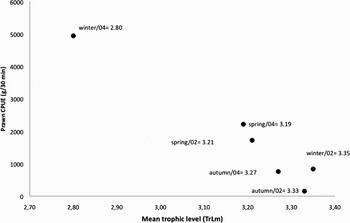
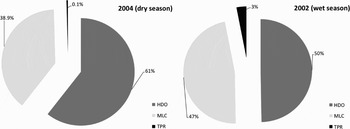
The mean trophic level of catches (TrLm) was negatively affected by the abundance of marine prawns (A. longinaris and P. muelleri) (r = 0.97), being consistently lower during the dry fishery season (2004) (Figure 7). During 2004, a higher percentage of trophic level HDO herbivores, detritivores and omnivores (HDO) and mid-level carnivores (MLC) species was observed. Conversely, 2002 showed a more even distribution of catches among trophic levels, presenting a higher percentage and abundance of top-predators (TPR) (Figure 8). Pairwise comparison between both years showed significant differences in mean relative abundance of top-predators (g/30 min), with higher values obtained during the wet fishery season (2002 = 381.00 ± 203.44; 2004 = 143.00 ± 47.03, P = 0.03). The mean relative abundance of HDO species in the catch was higher in 2004, but no significant differences were observed (2002 = 437.00 ± 98.90; 2004 = 533.00 ± 99.90; P = 0.50). As it was observed for top-predators, mean biomass per trawl of MLC species was significantly higher in the wet fishery season (2002, 604.00 ± 112.60; 2004, 300.00 ± 74.40; P = 0.02).
Correlation obtained from prawn CPUE (g/30 min) and mean trophic level estimated from prawn trawling in the surrounding area of Patos Lagoon Estuary (Rio Grande do Sul, Brazil) for each season and year analysed. The correlation coefficient (r) estimated was 0.97.

Relative frequency of each trophic level previously established to classify catches obtained from prawn trawling in the surrounding area of Patos Lagoon, Rio Grande do Sul, Brazil. HDO, herbivores, detritivores and omnivores; MLC, mid-level carnivores; TPR, top-predators.

Catch probability and size structure of commercial by-catch species
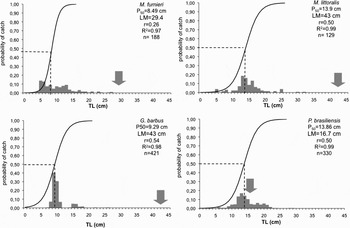
The probability of catch per length-class was estimated for the four most important commercial finfish (P. brasiliensis, G. barbus, M. littoralis and M. furnieri) and shellfish (C. sapidus, P.muelleri, C. danae and F. paulensis) species. Total length (TL) of whitemouth croaker (M. furnieri) varied between 4.00 and 27.00 cm, with polymodal distribution and higher frequencies among 4 and 6 cm. Probability of catch (P50 = 8.49 cm) estimated was much lower than the size at first maturity (LM) suggested in the literature (20.50 cm) for the estuarine population (Castello, Reference Castello1986), meaning that catches are mainly composed of immature juveniles. The same scenario was observed for the gulf kingfish (M. littoralis), with sizes ranging between 5 and 33 cm and P50 (13.90 cm) lower than the LM suggested in the literature (43.00 cm) (Vazzoler et al., Reference Vazzoler, Zaneti and Kawakami1973) (Figure 9).
Probability of catch estimated for the main commercial fish species caught in artisanal trawling for prawns in the surrounding area of Patos Lagoon Estuary (southern Brazil). The dashed line indicates the length at which probability of catch is 50% (P50), the grey arrows indicate the length at first maturity (LM) estimated for females, r is the slope of logistic curve and n is the number of individuals measured.

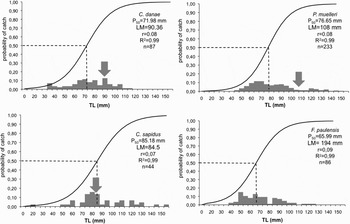
Probability of catch estimated for the main commercial crustacean species caught in artisanal trawling for prawns in the surrounding area of Patos Lagoon Estuary (southern Brazil). The dashed line indicates the length at which probability of catch is 50% (P50), the grey arrows indicate the length at first maturity (LM) estimated for females, r is the slope of logistic curve and n is the number of individuals measured.

The length–frequency of salmon sea catfish (G. barbus) presented a well marked peak around 10.00 cm with another modal value around 15.00 cm. All individuals caught were smaller than LM (43.00 cm) estimated in the literature (Reis, Reference Reis1986a) and consequently lower than P50 (9.29 cm). Among the fish species, only the banded croaker (P. brasiliensis) presented similar P50 (13.86 cm) and LM (16.70 cm) values (Vazzoler et al., Reference Vazzoler, Zaneti and Kawakami1973). Length composition of P. brasiliensis varied between 7.00 and 26.00 cm and it was composed mostly of juveniles (Figure 9).
Size probability of catch (P50) estimated for C. danae (71.98 mm) was below the size at maturity (90.36 mm) suggested in the literature (Baptista-Metri et al., Reference Baptista-Metri, Pinheiro, Blankensteyn and Borzone2005). The pattern observed for C. sapidus, which had an estimated P50 (85.18 mm), was similar to the size at first maturity (84.50 mm) estimated elsewhere (Oliveira, Reference Oliveira2005). Pink prawn presented a wide range of size distribution with polymodal shape, varying from 30 to 120 mm with higher frequencies between 50.00 and 80.00 mm. As one may expect, no mature prawns were observed in the area. The red shrimp (P. muelleri) size ranged from 40.00 to 150.00 mm, however P50 estimated (76.65 mm) was lower than the LM (108.00 mm) (Dumont & D'Incao, unpublished data). It is important to stress that this species presents a marked sexual dimorphism related to size and LM was estimated only for females (Figure 10).
DISCUSSION
Environmental parameters
Discrete environmental conditions were observed during both years analysed. The 2002/2003 El Niño was considered as a moderate event, comparable to other years such as 1951/1952, 1976/1977 and 1963/1964 (NOAA, 2007). During 2004, MEI ranks indicated a neutral to weak El Niño year. Despite being a neutral year, 2004 presented a very low precipitation ratio, which was a result of a northwards displacement of the Convergence Zone of the Atlantic, reducing rainfall in the south and increasing in rainfall in the south-east (CPTEC, 2004).
Rainfall exceeded the monthly mean value for the region during 2002, increasing estuarine runoff and lowering salinity in the coastal area. Similar effects of increased discharges from Patos Lagoon have been reported during periods of ENSO (Lima et al., Reference Lima, Garcia and Möller1996; Garcia et al., Reference Garcia, Vieira and Winemiller2003). Consequently, hydrological processes that are responsible for regulating water exchange between estuarine and coastal zones (Lima et al., Reference Lima, Garcia and Möller1996), as well as transporting organisms were markedly discrete in the analysed fishery seasons, influencing salinity, temperature and causing marked changes in by-catch abundance and composition.
Discard composition and seasonal variation of catches
The main factors affecting the by-catch ratios are the strength of recruitment of the target species, changes in fishing practices, and variation of the environmental parameters. All these factors may vary significantly even within the same geographical area (Hall, Reference Hall1999). For instance, discards recorded for Caribbean prawn fisheries range from 1:3 to 1:20 (Alverson et al., Reference Alverson, Freeberg, Murawski and Pope1994). The by-catch ratio estimated for prawn trawling in Brazil is 1:9.5, however the composition and the amount of species caught incidentally varies according to oceanographic conditions, season and latitude (Alverson et al., Reference Alverson, Freeberg, Murawski and Pope1994).
Remarkable variations in by-catch rates have also been reported for prawn-trawling in Brazil. Branco (Reference Branco2001) observed that the incidental catch of Xiphopenaeus kroyeri fishery in southern Brazil was 1:17 (kg), while Damasceno & Evangelista (Reference Damasceno and Evangelista1991) studied the incidental catch of Penaeus subtilis fishery in the northern region of Brazil and verified a discard ratio of 1:15 (kg). A lower discard ratio of 1:10 has also been reported for pink prawn commercial fishery in south-eastern Brazil (Vianna & Almeida, Reference Vianna and Almeida2005). The lowest discard reported for commercial prawn trawling is 1:0.31, resulting from A. longinaris fishery in southern Brazil (Haimovici & Mendonça, Reference Haimovici and Mendonça1996b).
It is important to stress that the by-catch quantified by Haimovici & Mendonça (Reference Haimovici and Mendonça1996b) only considered the landed catch. Therefore, a higher ratio would be expected, since a portion of the catch (e.g. some crustaceans) is discarded back to the sea during fishing operations, and another portion is landed along with prawns. Since this fishery demands high operational costs, considering an artisanal fishery standard, trawlers operate only in those years when abundance of prawns is high, which explains the very low discards estimated. Additionally, these species present a very patchy distribution (Dumont & D'Incao, Reference Dumont and D'Incao2008) resulting in very low discards during years of elevated abundance.
Macrodon ancylodon, U. brasiliensis and P. brasiliensis were the most discarded fish by industrial double-rig trawlers (Haimovici & Mendonça, Reference Haimovici and Mendonça1996b), while the most discarded fish recorded in the present investigation were P. brasiliensis, G. barbus and M. furnieri. Commercial trawlers for A. longinaris and P. muelleri operate in shallow marine waters, mainly from 5 to 40 m in depths outside the surf zone (2–10 m), where artisanal trawling takes place. The surf zone of sandy beaches can be considered as semi-closed ecosystems, and therefore may present slightly different fish and crustacean assemblages (Borzone & Gianuca, Reference Borzone and Gianuca1990), resulting in different incidental catch composition and ratio. Commercial trawling for marine prawns takes place mainly in summer, which is also reflected in catch composition. Skates for instance, gather in shallow waters during summer for breeding (Vooren & Klippel, Reference Vooren and Klippel2005) and therefore, represent a considerably higher fraction of catches in commercial trawling (1.6%) (Haimovici & Mendonça, Reference Haimovici and Mendonça1996b) than in artisanal fishery (0.18% in 2002 and 0.40% in 2004).
A previous investigation based on the catch obtained during scientific cruises, in similar fishing grounds, estimated a discard ratio, for a three year-round analysis, of 1:4.5 in 1979, 1:12.7 in 1980 and 1:0.5 in 1990 (Ruffino & Castello, Reference Ruffino and Castello1993). However, when the same authors considered by-catch ratios for the periods sampled during the three years investigated (autumn and winter), these values rise to 1:40 in 1979, 1:34 in 1980 and 1:2.39 in 1990. In the present investigation, the highest discard ratios were also observed in autumn, especially in the wet year (1:75). Conversely, during winter 2004 the lowest discard ratio (1:0.97) was recorded which is likely related to the combined factors of high abundance of A. longinaris and low abundance of estuarine-related fish and crustaceans in the surrounding area of Patos Lagoon Estuary.
The overall discard pattern observed for both years (1:5.6) is inferior to the value suggested by Alverson et al. (Reference Alverson, Freeberg, Murawski and Pope1994) for prawn fishery on the Brazilian coast (1:9) and very close to the value suggested by Andrew & Pepperel (Reference Andrew and Pepperell1992) for worldwide prawn fishery in temperate and sub-tropical zones (1:5). Therefore, the first conclusion is that by-catch of artisanal trawling for A. longinaris is extremely variable and highly dependent on recruitment patterns and oceanographic conditions in the studied area. Thus, it is important to stress that interannual comparison of by-catch composition in prawn fisheries must be performed on a long-term basis, providing a better understanding of the complex interactions regulating discards (Ambrose et al., Reference Ambrose, Solarin, Isebor and Williams2005).
The presence of an observer during sampling in artisanal fishing cruises avoided the selection effect usually performed by fishermen at sea. Therefore, it was possible to assess the relative importance of the crustaceans, as well as the quantitative and qualitative information regarding the partial use of the by-catch. In agreement with previous investigations concerning the artisanal fishery in Third World countries (Hall et al., Reference Hall, Alverson, Metuzal and Sheppard2000), the utilization of fish incidentally caught is despicable, and just a few large individuals (usually around 30 cm total length) of traditionally marketable species (M. furnieri, M. littoralis and U. brasiliensis) are selected for the subsistence of the fishermen and their families. Due to the low commercial value of the by-catch, the quantification of this category can be considered as non-existent. Conversely, landings from commercial trawling for marine prawns in southern Brazil include some fish species, such as scianids and flat fish that account for 2.5% of the total catch (Haimovici & Mendonça, Reference Haimovici and Mendonça1996b).
The by-catch ratio, in terms of numbers, showed a different pattern when compared to estimates obtained in weight. High relative abundance in numbers can be explained by the wide reproduction period and fast growth pattern, resulting in high numerical abundance and small size of individuals (Ruffino & Castello, Reference Ruffino and Castello1992). Even in nursery areas, where small and numerous fish and crustaceans were expected to occur (Garcia & Gianuca, Reference Garcia, Gianuca, Seeliger, Odebrecht and Castello1998), the numerical abundance of A. longinaris was higher then by-catch during the dry year. The results confirm that, under favourable environmental conditions, this is one of the dominant species of coastal waters and can provide 30% of biomass predated by fish inhabiting marine shallow waters in southern Brazil (Capitoli et al., Reference Capitoli, Bager and Ruffino1994).
Our observations are in agreement with empirical knowledge of artisanal fishermen, who perform this fishery only during those years of successful recruitment of prawns. Due to reduced commercial value of marine prawns (when compared to pink prawns, for instance), no fishing is performed during low recruitment years, since trawling is usually not profitable under this condition, which was also reported for commercial fishery (Haimovici & Mendonça, 1996a). This regime tends to preserve the stock since it provides an opportunity for biomass recovery in subsequent years. Conversely, during elevated rainfall periods, the abundance of prawns is reduced in the area, reflecting the reduction in salinity values. In this case, alternative species such as whitemouth croaker (M. furnieri), squirrel hake (U. brasiliensis) and more recently the blue crab (C. sapidus), are targeted by this fleet with different fishing gears (personal observation).
As observed in the present investigation, fish abundance tends to be higher in the area surrounding the Patos Lagoon during elevated rainfall, highly influenced by a significant increase of estuarine-dependent and estuarine-resident species. High precipitation occurring on its drainage basin increases the freshwater flow outside the estuary, resulting in higher transport of nutrients and causing environmental eutrophication of the coastal zone (Ciotti et al., Reference Ciotti, Odebrecht, Fillman and Moller1995). Thus, coastal water enrichment, due to high nutrient and primary production outflow, would sustain an elevated production of estuarine-related and marine fish in the area. It would explain the higher by-catch observed during 2002, even though the abundance of marine prawns was reduced.
Ecological facilitation due to habitat expansion plays an important role in abundance of euryhaline species, since salinity in the surrounding area of Patos Lagoon Estuary is markedly changed during high precipitation periods. A similar pattern was observed during the 1997–1998 El Niño inside the estuary, when freshwater species took advantage of reduced salinity to expand their habitat. Because geographical habitat extension occurred during elevated rainfall, many estuarine-dependent or estuarine-resident species are involuntarily transported outside the Patos Lagoon Estuary, increasing biomass of fish (Garcia et al., Reference Garcia, Vieira and Winemiller2003) and crustaceans in coastal zone.
Ecological parameters
Recent experiments showed that ecosystems presenting higher diversity have more ability to withstand environmental disturbances and to recover from unfavourable events (Worm et al., Reference Worm, Barbier, Beaumont, Duffy, Folke, Halpern, Jackson, Lotze, Micheli, Palumbi, Sala, Selkoe, Stachowiczm and Watson2006). In general, sub-tropical and temperate trawling for prawns, are less damaging to the ecosystem then tropical ones (Hall, Reference Hall1999). Temperate seas tend to support large numbers of comparatively few species, while tropical seas contain many species in smaller numbers (Lalli & Parsons, Reference Lalli and Parsons2006).
In spite of trawling for A. longinaris having been performed in nursery areas, where richness is high (Garcia & Gianuca, Reference Garcia, Gianuca, Seeliger, Odebrecht and Castello1998), a lower number of species (38 fish and 12 crustacean species) was found when compared to previous investigations in the same area (47 fish species) (Ruffino & Castello, Reference Ruffino and Castello1993). It may be explained by slightly different sampling depths, different fishing gears used and the inclusion of summer months in the analysis. Lower richness of fish in incidental catch was recorded in a higher latitude (San Jorge Gulf, 46°S, Argentina) trawling for red prawn (P. muelleri), summing 32 species (Pettovello, Reference Pettovello1999). Conversely, the number of species discarded in tropical fisheries (e.g. Northern Prawn Fishery in Australia) is remarkably high, typically hundreds of species caught from targeted prawns (Gulland & Rotschild, Reference Gulland and Rotschild1981).
Analysis of richness and mean trophic level of the catches leads us to postulate that the higher estuarine runoff may have increased the concentration of nutrients in the adjacent area of Patos Lagoon and the primary production (Ciotti et al., Reference Ciotti, Odebrecht, Fillman and Moller1995), resulting in a higher trophic level of catches as well as supporting a greater abundance of top-predators and a lower number of species. Conversely, in the dry year, the mean trophic level was reduced, significantly influenced by elevated abundances of marine prawns in the area. The greater number of species caught is explained by the presence of more diverse marine fauna, such as strictly marine crustaceans (e.g. C. ornatus and E. oplophoroides).
During high estuarine runoff, lower salinity water was found in the surrounding area of Patos Lagoon, disrupting the entrance of larvae and juveniles, involuntarily transporting estuarine-dependent or estuarine-resident species outside the estuary (Garcia et al., Reference Garcia, Vieira and Winemiller2003) and increasing nutrient outflow (Ciotti et al., Reference Ciotti, Odebrecht, Fillman and Moller1995). As a result, higher abundance indices were estimated, influenced by estuarine-dependent (G. barbus, G. planifrons and M. furnieri), estuarine-resident (C. sapidus and G. genidens) as well as the expected marine species (P. brasiliensis and T. marginatus).
The whitemouth croaker (M. furnieri) was more abundant during the wet year. This scianid species spawns in coastal areas under the influence of freshwater outflow, explaining higher biomass recorded in 2002. The stripped pampo (T. marginatus) is also a marine species that tolerates changes in salinity and inhabits the surf zone surrounding estuarine mouth (Vieira et al., Reference Vieira, Castello, Pereira, Seeliger, Odebrecht and Castello1998). Despite being more frequent during the dry year, higher biomass recorded during the wet year (2002) suggests that food availability can be quite important, especially for euryhaline species that are capable of tolerating trends in salinity.
Additionally, P. brasiliensis, a marine species, also showed higher biomass values in the wet year taking advantage of nutrient-rich water outflow. The king weakfish (M. ancylodon) was also more abundant in this period and associations of this species with P. brasiliensis have been previously reported (Araújo, Reference Araújo1984). These associations are mainly explained by predation, since adults of M. ancylodon have the juveniles of P. brasiliensis as one of their main food items. Juveniles of catfish (G. barbus) start to gather in the surrounding area of Patos Lagoon Estuary in late summer, where they feed on C. sapidus pereiopods (Araújo, Reference Araújo1984). The presence of C. sapidus in areas outside the estuary in late summer would be explained by the migration of berried females for spawning (Oliveira, Reference Oliveira2005).
Therefore, while high rainfall has been reported as having a negative effect on production inside the estuary (Garcia et al., Reference Garcia, Vieira and Winemiller2003), the adjacent zone takes advantage of greater nutrient volume flushed out, resulting in higher biomass production, sustaining a higher mean trophic level, higher biomass of top-predators and resulting in a lower number of species. Estuarine discharge has been previously reported as a key factor regulating communities and food-web structure (Livingston et al., Reference Livingston, Niu, Lewis and Woodsum1997), which is likely to be occurring in the studied area.
Probability of catch (P50) and size composition
The analysis of catch probability and the size composition of the most important fish showed that the trawl net caught mainly individuals that did not reach the mean length at first maturity. An exception is P. brasiliensis (banded croaker) and the blue crabs (C. danae and C. sapidus) that presented similar LM and P50 values. Hence, it is not recommended to manage this fishery simply by estimating intraspecific parameters, such as MSY. Ecological degradation, caused by trawling in elevated rainfall seasons, will probably occur, since many species of fish and crustaceans are discarded dead back to the sea and most of the catch is composed of juveniles.
In some areas where prawn trawling has been occurring for several decades, high by-catch levels have had very obvious effects (EJF, 2003). In the Gulf of Mexico, for instance, the by-catch ratio has actually been declining since the 1970s. Rather than being a sign that the ecological impacts of trawling are decreasing, it shows that by-catch species have been significantly depleted. Croakers (Sciaenidae) are about 40% less abundant than they were twenty years ago, which is a result of high fishing pressure (Eayrs, Reference Eayrs2007).
A similar phenomenon seems to be occurring in southern Brazil, caused not only by prawn trawling, but by a combination of different fishing gears catching individuals in different phases of their life cycle (Haimovici et al., Reference Haimovici, Umpierre, Kotas and Rahn1993; Haimovici & Mendonça, Reference Haimovici and Mendonça1996b; Vieira et al., Reference Vieira, Vasconcellos, Silva and Fischer1996). Ruffino & Castello (Reference Ruffino and Castello1993) observed that whitemouth croaker (M. furnieri) was the dominant species in catches during late 1970s. However, a new scenario was observed in the 1990s, when abundance of P. brasiliensis surpassed the former species (Haimovici et al., Reference Haimovici, Umpierre, Kotas and Rahn1993; Ruffino & Castello, Reference Ruffino and Castello1993). The present study verified that M. furnieri accounted for 8% of the captures in weight in 2002, being just the fourth more important species in catches.
Previous assessment estimated that 199.8 t/year of M. furnieri and 82.5 t/year of G. barbus are caught incidentally in pink prawn (F. paulensis) trap fishery inside the estuary. In numbers, values estimated are around 4.2 millions of M. furnieri and 2.7 millions of G. barbus caught. Moreover, it was noticed that the fishing pressure was quite accentuated on the individuals that did not reach the mean length at sexual maturity (Vieira et al., Reference Vieira, Vasconcellos, Silva and Fischer1996), which was also confirmed by the present study for the surrounding area of Patos Lagoon Estuary.
The incidence of fishing mortality is even more harmful for K-strategist species (Alverson, et al., Reference Alverson, Freeberg, Murawski and Pope1994), such as sea catfish (G. barbus) and skates (S. bonapartii, S. acuta, S. argentina and S. guggenhein). The sea catfish is also a long-lived species (it can reach 23 years old) presenting slow growth, late sexual maturity (reached when 7 years old) and low fecundity (32–272 oocytes per female) (Reis, Reference Reis1986a, Reference Reisb), making it more susceptible to recruitment and growth overfishing.
Whereas prawns tend to fall towards the r end of the spectrum, many of the other species caught alongside it are K species (Gulland & Rotschild, Reference Gulland and Rotschild1981; EJF, 2003). Because prawn fisheries capture such a broad range of species, it is impossible to hold fishing pressure at different levels for different species. Fishing pressure is therefore set high to get maximum productivity from shrimp stocks, to the disadvantage of those K species caught as by-catch (EJF, 2003; Vooren & Klippel, Reference Vooren and Klippel2005; Eayrs, Reference Eayrs2007).
Among K-strategist species, skates seem to be the most threatened ones (Vooren & Klippel, Reference Vooren and Klippel2005). Four ray species were captured in the present study (S. bonapartii, S. acuta, S. argentina and S. guggenhein) while in the study developed by Ruffino & Castello (Reference Ruffino and Castello1993) five species were caught. It is important to point out that these authors performed a year round sampling and higher concentrations of skates in coastal area for spawning are reported during summer. Several authors suggest that elasmobranch species migrate to shallow waters for reproduction (e.g. Vooren & Klippel, Reference Vooren and Klippel2005), where they are explored by different fishing gears, other than the prawn otter-trawling. Nevertheless, relative abundance of rays was markedly low, and decreasing densities have been previously reported (Ruffino & Castello, Reference Ruffino and Castello1993; Vooren & Klippel, Reference Vooren and Klippel2005). In the early 1980s high densities of these resources were recorded (e.g. in 1981 S. guggenhein was caught in 90% of fishing stations), showing first signs of declining in the early 1990s until some species of rays can be considered as at extinction risk in the 2000s (Vooren & Klippel, Reference Vooren and Klippel2005).
While the effects of trawling on fish have been extensively discussed, the crustacean composition in trawling for prawns is poorly understood, since some are of low commercial value or inedible as well as of low densities (EJF, 2003). The main crustacean species caught was C. sapidus, followed by C. danae and P. muellerii. Size composition of blue crab (C. sapidus) in samples reflects the reproductive biology of this species, since mature females migrate to the surrounding area of Patos Lagoon for spawning (Oliveira, Reference Oliveira2005). Therefore, similar values of P50 and LM observed for C. sapidus do not reduce the impact of prawn fishery on this species, since recruitment overfishing may occur, resulting from an excessive fishing effort selectively driven to the spawning area.
On the other hand, CPUE of blue crab was reduced and concentrated in summer during the dry year (data not shown), minimizing the impact of trawling activity on this species. One factor that contributes to high mortality levels of the crustaceans and skates captured incidentally is the selection method performed on-board. The amount of dead blue crabs and skates could be reduced if the fishermen returned the individuals back to the sea while they are still alive. Many individuals stay on the deck during the whole day of fishing, being discarded dead back to the sea. Studies showed that survival rate, of crabs (Hill & Wassenberg, Reference Hill and Wassenberg1990) and skates (Cedrola et al., Reference Cedrola, González and Petovello2005), is high if they are immediately returned to the sea.
Conclusions and recommendations
Trawling for prawns has been considered as a low selective as well as damaging activity, compared to bulldozing a forest to catch song birds (EJF, 2003). The Magnuson–Stevens Fisheries Conservation and Management Act of 1996, aims to reduce impacts of fishery on an ecosystem, suggesting that conservation and management measures shall minimize by-catch and, to the extent by-catch cannot be avoided, minimize the mortality of such by-catch (NOAA Fisheries, 2007). Education of fishermen to release crabs and skates back to the water quickly could significantly reduce mortality, especially of spawning females of C. sapidus.
Low prawn production and high by-catch ratio (mainly composed of juveniles) suggest that trawling for prawns in the surf zone, during low salinity years, must not be sustained. On the other hand, during dry years, high salinity favours marine prawns, especially in winter, and therefore, relative abundance of by-catch species is reduced. Reduction in by-catch ratios has been extensively discussed (Brewer et al., Reference Brewer, Heales, Milton, Dell, Fry, Venables and Jones2006; Eayrs, Reference Eayrs2007; Hannah & Jones, Reference Hannah and Jones2007) and solutions such as increased mesh size and the adoption of by-catch reduction devices (BRDs) have been proposed. Increased mesh size, has been previously reported as non-viable, since yields can be dramatically reduced, resulting in fishing effort increments to compensate it (Haimovici & Mendonça, Reference Haimovici and Mendonça1996a). On the other hand, BRDs could provide a profit increase and an easier operation on the deck as well as improving product quality and consequently its price (Eayrs, Reference Eayrs2007). According to the FAO Code of conduct for responsible fisheries (1995), BRDs must be implemented in prawn fisheries, particularly targeting the most susceptible species such as rays, catfish and turtles. Artisanal trawling in the studied region represents an important economic activity for local fishermen. However, regulations to decrease the by-catch ratio, for instance the implementation of BRDs and fishing season restricted to winter, would attenuate ecological impacts of trawling.