INTRODUCTION
The Baltic prawn, Palaemon adspersus Rathke, 1837, occurs along the coasts of the North Sea, Baltic Sea, Mediterranean Sea and the Black Sea (d'Udekem d'Acoz, Reference d'Udekem d'Acoz1999). The shrimp is especially associated with Cymodocea nodosa, Zostera marina, and Zostera noltii beds as well as rockpools (Berglund, Reference Berglund1980, Reference Berglund1982; Guerao & Ribera, Reference Guerao and Ribera1995; Manent & Abella-Gutiérrez, Reference Manent and Abella-Gutiérrez2006; Schaffmeister et al., Reference Schaffmeister, Hiddink and Wolff2006; Bilgin et al., Reference Bilgin, Ozen and Ates2008). It has a wide tolerance range for temperature and salinity and is commonly distributed in shallow waters, often in estuarine conditions (Berglund, Reference Berglund1980, Reference Berglund1982, Reference Berglund1985; Berglund & Bengtsson, Reference Berglund and Bengtsson1981). Palaemon adspersus are omnivorous, and feed on small crustaceans such as ostracods, copepods and nauplii as well as polychaetes, algae and detritus (Berglund, Reference Berglund1980).
Palaemon species play an essential role in the food chain of the aquatic ecosystem and are reported in diets of many fish and cephalopods. Palaemon spp. have been recorded in the diet of young sea bass, Dicentrarchus labrax (Linnaeus, 1758), in the Tagus estuary (Cabral & Costa, Reference Cabral and Costa2001) and in Scorpaena species in seagrass beds near Marseilles (Harmelin-Vivien et al., Reference Harmelin-Vivien, Kaimmalka, Ledoyer and Jacobabraham1989). Cephalopods such as Sepia officinalis (Linnaeus, 1758), were found to feed on P. adspersus in Morbihan Bay (Blanc & Daguzan, Reference Blanc and Daguzan2000).
Baltic prawn is commercially captured in small-scale fishery in many areas (Holthuis, Reference Holthuis1980; Guerao et al., Reference Guerao, Pérez-Baquera and Ribera1994; Manent & Abella-Gutiérrez, Reference Manent and Abella-Gutiérrez2006) and is also known to be commercially cultivated in some regions. According to the statistics of the FAO, the aquaculture production of P. adspersus was about 3.5 tons in the Ukraine between 2001 and 2003 (FAO, 2007).
The growth and reproduction biology of P. adspersus was investigated in the shallow waters of the North Sea (Berglund, Reference Berglund1984; Berglund & Rosenqvist, Reference Berglund and Rosenqvist1986), in the Mediterranean (Conides et al., Reference Conides, Tsevis and Klaoudatos1992a, Reference Conides, Tsevis and Yannopoulosb; Guerao et al., Reference Guerao, Ribera and Castelló1992; Guerao & Ribera, Reference Guerao and Ribera1995; Manent & Abella-Gutiérrez, Reference Manent and Abella-Gutiérrez2006), and Atlantic Ocean (Figueras, Reference Figueras1986). Three species of the genus Palaemon exist in the Black Sea: P. elegans Rathke, 1837, P. serratus Pennant, 1777, and P. adspersus (Bilgin & Gönlügür Demirci, Reference Bilgin and Gönlügür Demirci2005). In addition, a new distribution record of a single specimen of P. longirostris H. Milne-Edwards, 1837 was recently reported for the Black Sea (Sezgin et al., Reference Sezgin, Aydemir, Ateş, Katağan and Özcan2007). However, no population dynamics information exists for these unexploited Palaemon species inhabiting the Black Sea. The aim of this study was to investigate growth and reproduction biology of P. adspersus in the southern Black Sea. In addition, seasonal growth pattern, very common in many other decapod crustaceans, was investigated in detail for the Baltic prawn.
MATERIALS AND METHODS
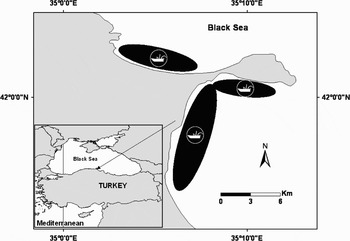
Specimens were collected monthly between February 2002 and January 2004 from the Sinop Peninsula, Black Sea where no shrimp fishery exists (Figure 1). All individuals were captured with a beam trawl of 3 m length, 30 cm height and a codend of 10 mm stretched mesh size. A total of 119 hauls was conducted during the study period. Towing speed ranged between 1.3 and 2.2 knots. Depending on the bottom structure and sea conditions, sampling duration ranged between 10 and 30 minutes per haul. Bottom structure included seagrass beds, bare sandy bottoms, and muddy habitats. Surface water temperatures were obtained from a simultaneously ongoing study in the same area (Bat et al., Reference Bat, Kıdeyş, Oğuz, Beşiktepe, Yardım, Gündoğdu, Üstün, Satılmış, Şahin, Birinci and Zoral2005).
Study site in Sinop Peninsula, Black Sea. Shaded areas indicate the sampling sites.

Water depth distribution of P. adspersus was investigated between water depths of 1 and 30 m. Since water depths varied during the trawl operation, water depths were grouped as follows: 5 m (included water depths between 1 and 5 m; a total of 26 hauls), 10 m (included water depths between 6 and 10 m; a total of 48 hauls), 20 m (included water depths between 11 and 20 m; a total of 35 hauls) and 30 m (included water depths between 21 and 30 m; a total of 10 hauls).
Samples were preserved in 4% formaldehyde for a day and then transferred to 70% ethanol for storage. The presence (males) or absence (females) of an appendix masculina on the second pleopod was the criterion used for sex determination (Berglund, Reference Berglund1981). Small individuals that could not be sexed were regarded as juvenile. The total body length (TL) of each specimen was measured from the tip of the rostrum to the posterior end of the telson (excluding spines) with an accuracy of 1 mm. The carapace length was measured from the posterior margin of the orbit to the mid-dorsal posterior edge of the carapace. Specimens were weighed (wet weight) on a balance with a sensitivity of 0.001 g.
Catch per unit effort (CPUE) was calculated as the number of individuals divided by the hauling time in minutes (min). Since hauling time was different among samplings, weighted mean of CPUE was used in the mean CPUE analysis. CPUE for the Baltic prawn was used for the comparison of density distributions among seasons and depth groups.
Mean total length was compared among depth groups for males, females and juveniles. Analyses of variance were performed with Proc mixed procedure in SAS 8.2 (SAS Institute, Inc, Cary, NC).
The weight–length relationship was estimated using log transformed weight and length data as:

where W is the body weight (g), TL is the total length (mm), a is the intercept, and b is the slope of the regression line.
The von Bertalanffy growth (VBG) equation Lt = L∞ [1−e−K(t−to)] predicts length as a function of age and is used when growth has a non-seasonal pattern. Seasonal growth was described using the Hoenig & Hanumara (Reference Hoenig and Hanumara1982) version of the VBG equation:

where, Lt is length at age t, L∞ is the asymptotic length to which the shrimps grow, K is the growth-rate parameter, t0 is the nominal age at which the length is zero, C is the relative amplitude (0 ≤ C ≤ 1) of the seasonal oscillations, tS is the phase of the seasonal oscillations (−0.5 ≤ ts ≤ 0.5) denoting the time of year corresponding to the start of the convex segment of sinusoidal oscillation.
The time of the year when the growth rate is slowest, known as the winter point (WP), was calculated as:

Seasonal VBG curves were fitted to the length distributions after first indicating a range of values of L∞ and K and reducing iteratively the range to maximize the goodness of fit (Rn) of the curves to the data. Rn was calculated as:

where ASP is the available sum of peaks, computed by adding the best values of the available peaks, and ESP is the explained sum of peaks, computed by summing all the peaks and troughs hit by the VBG curve. Analysis of the length data were fitted to length–frequency distributions grouped in 2 mm total length size-classes using the ELEFAN procedure in the PC-based computer package Version 5.0 of Length–Frequency Distribution Analysis (LFDA; Kirkwood et al., Reference Kirkwood, Aukland and Zara2001).
Growth performance comparisons were made using the growth performance index (Φ') which is preferred rather than using L∞ and K individually (Pauly & Munro, Reference Pauly and Munro1984) and is computed as:

Maximum age for females and males were calculated using the empirical equation proposed by Taylor (Reference Taylor1958) as:
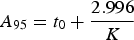
where A95 is the life span to attain 95% of L∞, calculated from the VBG equation.
For each female, the maturity of the ovary was determined within five categories, based on morphological characteristics of the ovaries (Guerao & Ribera, Reference Guerao and Ribera1995): (1) immature: ovary thin and translucent; (2) developing: ovary light green and opaque; ovary occupying one-quarter of the cephalothorax volume; (3) early mature: ovary occupying one-half of the cephalothorax volume; (4) nearly mature: ovary occupying three-quarters of the cephalothorax volume; and (5) ripe: ovary occupying almost all of the cephalothorax, i.e. the pre-spawning stage.
Embryonic development (egg stages) was divided into three stages (Guerao & Ribera, Reference Guerao and Ribera1995): stage 1, vitellus filled more than one-half of the egg volume, non-eyed eggs; stage 2, vitellus occupying no more than one-quarter of the egg volume, non-eyed eggs; and stage 3, eyed eggs. Vitellus occupying less than one-quarter of the egg volume, and decreasing progressively until hatching.
Size at sexual maturity was determined from females by calculating the proportion of mature females in 2 mm size-classes in the breeding period. Ovigerous females and individuals that passed stage 3 in the ovarian development stage were considered to be mature. The proportion of mature females by size was fitted to the logistic equation:
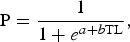
where P is the proportion of mature females, a and b are the coefficients of the equation, and TL is the total length. Size at sexual maturity (TL50), corresponding to 50% sexually mature females, was calculated from -(a/b). Pseudo-R2 was calculated from the corrected total sum of squares (SS) for the nonlinear regression line as Pseudo-R2 = 1−SS(Residual)/SS(TotalCorrected).
Statistical analyses were considered significant at α = 0.05 level.
RESULTS
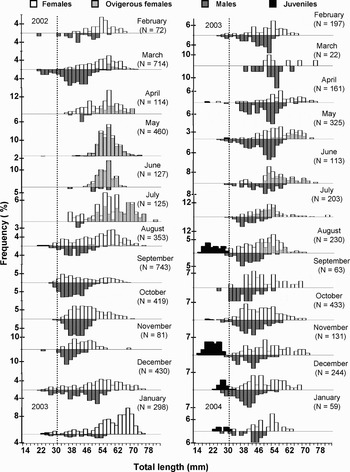
A total of 6117 Baltic prawns (3614 females, 2393 males and 110 juveniles) were sampled between February 2002 and January 2004. The total length ranged between 23 and 82 mm (mean 47.74±0.16 mm) for the females, between 21 and 70 mm (mean 41.43±0.15 mm) for the males, and between 16 and 33 mm for the juveniles (mean 23.61±0.37) (Figure 2). Size–frequency distributions were significantly different between females and males (Kolmogorov–Smirnov two-sample test; d = 0.513, P < 0.001). Female mean total length was significantly greater than male mean total length (U-test: 1.586E06, df = 1, P < 0.001).
Length–frequency distribution (in percentages) of females, ovigerous females, males, and juveniles of Palaemon adspersus between February 2002 and January 2004. Dotted line at 30 mm was drawn for illustration purposes of juvenile and recruitment of small individuals to the population.

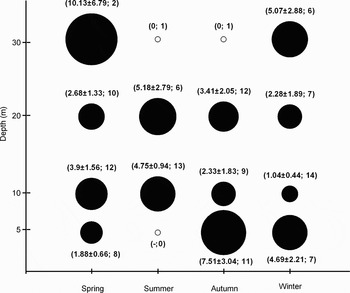
CPUEs of Palaemon adspersus were not statistically significant (P > 0.05) among depth groups and seasons (Figure 3). The sampling procedure focused mainly on the 10 m and 20 m depth groups and P. adspersus were sampled in all seasons in these depth groups. Palaemon adspersus were observed in all four depth groups in winter and spring. No individual was observed in the 30 m group in summer and autumn, but only one sampling was conducted in each of these two groups.
Seasonal mean catch per unit effort (CPUE) of Palaemon adspersus at different depth groups. Sizes of the dots are proportional to CPUE (mean CPUE±standard error; number of sampling occasions).

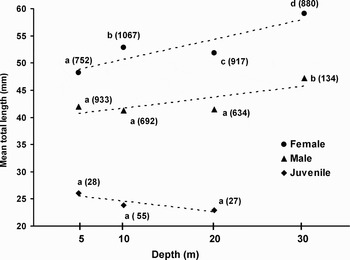
Within each water depth, mean total lengths of females were significantly greater than males (ANOVA, F = 271.70, P < 0.001; Figure 4). Mean total lengths were significantly different (P < 0.001) among water depths in females (see Figure 4). In males, mean total length was significantly (P < 0.001) greater in 30 m water depth compared to the other shallower water depths.
Mean total lengths of females and males across depth zones. Within each sex group, total length means with different letters are significantly different (P < 0.05).

Length–weight relationships were significantly different between sexes (ANCOVA, P < 0.001). The relationship for males was:

and for females it was:

Each slope of the regression lines was significantly different than the isometric growth curve slope of 3 (ANCOVA, P < 0.001).
Comparison of the length–weight relationship between ovigerous and non-ovigerous females revealed that the relationship was significantly different (P < 0.001) between these two groups. The relationships were as:

for ovigerous females and

for non-ovigerous females.
Total length–carapace length (CL) relationships were not significantly different between sexes (ANCOVA, P > 0.05). The relationship of total length–carapace length was:

Total length–carapace length relationships were significantly different (ANCOVA, P < 0.001) between ovigerous and non-ovigerous females.
Total length–carapace length relationship for ovigerous females was:

and for non-ovigerous females it was:

The difference of the carapace length–total length relationship between ovigerous and non-ovigerous was probably due to the difficulty in measuring ovigerous females. Ovigerous females were bent over their abdomen and thus measurement error probably occurred while trying to straighten the specimen for measuring. Note that the R2 for the carapace length–total length linear regression line of the ovigerous females was much lower than of the non-ovigerous females.
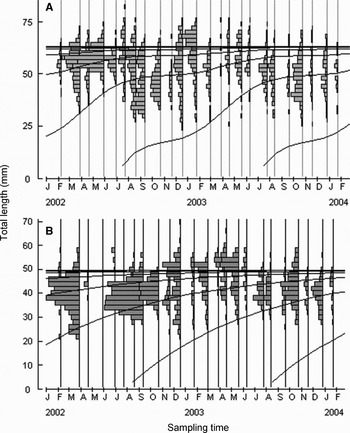
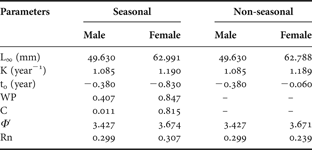
The seasonal and non-seasonal von Bertalanffy growth parameters obtained from the LFDA for each sex are summarized in Table 1. The LFDA analyses showed that females had higher L∞ and K values (L∞ = 62.991 mm TL, K = 1.190 year−1) compared to the values of males (L∞ = 49.630 mm TL, K = 1.085 year−1). Females had greater growth rate at age than males (Figure 5A, B). Seasonal variation of growth for females (C = 0.815) was stronger than it was for males (C = 0.011). The start of the slow growth period was at the end of October for females (WP = 0.847; Figure 5). For males, however, the slow growth period started in May (WP = 0.407). The Rn value of the non-seasonal growth curve for males did not improve when a seasonal growth curve was fitted (Table 1), suggesting that, at least for our data, males do not exhibit a seasonal growth pattern. This was also apparent in Figure 5A where no sinusoidal pattern could be observed in the seasonal von Bertalanffy growth curve. In females, on the other hand, the Rn value of the non-seasonal VBG curve improved by 28.5% after fitting a seasonal VBG curve (Table 1).
Length–frequency distribution with seasonal von Bertalanffy growth curves for males (A) and females (B) of Palaemon adspersus.

Seasonal and non-seasonal von Bertalanffy growth parameters estimated from length–frequency distribution analysis for males, females, and pooled data. L∞, asymptotic total length (mm); K, growth coefficient (year−1); to, age at zero length; WP, winter point; C, amplitude of growth oscillation; Rn, goodness of fit index; Φ′, growth performance index.
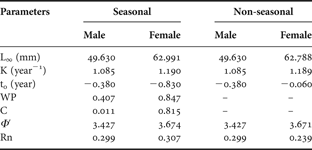
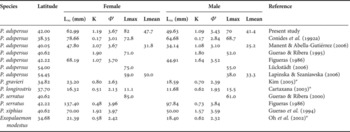
The growth performance index (Φ′; Table 1) of females (3.67) was greater than it was for males (3.43). The relationship between Φ′ and latitude, compiled from different studies (Table 2; Figure 6), was significant for males (P = 0.003) and had a positive slope. This relationship, however, was not statistically significant (P > 0.05) for females.
Relationship between growth performance index (Φ′) and latitudinal gradients for males (dots) and females (circles) of Palaemon adspersus. Data were compiled from different studies (see Table 2).

Comparison of growth and sizes between studies of palaemonid shrimps (Palaemonidae) from different latitudes. L∞, asymptotic length (mm); K, growth rate (year−1); Φ', growth performance index; Lmax, maximum length (mm); Lmean, mean length (mm).

*, studies that measured length from carapace length.
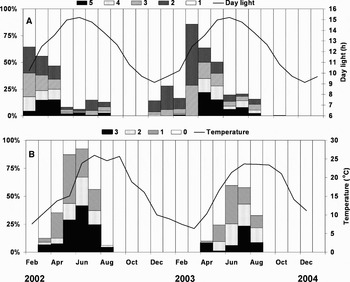
Female maturity began in December in 2002, corresponding to the start of photoperiod increase (i.e. 21 December, the winter solstice), and females with the ovary in the latest stage (stage 5) of maturity appeared in February 2003 (Figure 7A). Ovigerous females with stage 3 (eyed eggs) were observed between March and August in 2002 and between April and August in 2003 (Figure 7B). The onsets of ovigerous females were parallel to the rise in water temperature in both years (Figure 7B). Analyses of length–frequency distributions of 2 mm size-class showed that recruitment of juveniles to the sampling gear started in August and continued with varying magnitudes until spring, when the ovigerous females started to appear in the population (Figure 2).
(A) Monthly proportion of ovarian stages (1, immature; 2, developing; 3, early mature; 4, nearly mature; 5, ripe) in female Palaemon adspersus and daylight (hours); (B) monthly proportion of different embryonic stages (1, non-eyed egg with vitellus more than half of the egg volume; 2, non-eyed egg with vitellus less than one-quarter of the egg volume; 3, eyed egg) in ovigerous females and water temperature (°C).

Size at sexual maturity was estimated from 1800 females of which 1088 were mature. Total length of mature females ranged between 40 and 82 mm. The relationship between total length and proportion of mature females was calculated as:

From this, the estimated size for 50% sexual maturity for females was mm TL (Figure 8). The smallest ovigerous female sampled was 41 mm TL.
Logistic function fitting the proportion of mature females to total length (mm). TL50 corresponding to proportion of 50% of females that are mature.

DISCUSSION
Seasonal growth pattern was reported for different Palaemonidae species such as P. xiphias (Risso, 1816) (Guerao et al., Reference Guerao, Pérez-Baquera and Ribera1994), P. gravieri (Yu, 1930) (Kim, Reference Kim2005), Exopalaemon modestus (Heller, 1862) (Oh et al., Reference Oh, Suh, Park, Ma and Lim2002), and as well as for P. adspersus (Berglund, Reference Berglund1981; Baden & Pihl, Reference Baden and Pihl1984; Manent & Abella-Gutiérrez, Reference Manent and Abella-Gutiérrez2006). However, no study investigated the seasonal growth oscillation and VBG parameters for P. adspersus. When there is a seasonal growth pattern for a particular species in the temperate or the northern region, the estimations of L∞ and K may differ significantly between the seasonal and non-seasonal models. A pronounced increase in the Rn values, suggested that a seasonal VBG curve fits to our female total length data in a more appropriate way than the non-seasonal VBG curve. Our LFDA of the seasonal VBG analyses suggested that female P. adspersus exhibited seasonal growth pattern with a reduction in growth of 81.5% (Table 1; Figure 5). While the period of the slowest growth rate (WP) of female Baltic prawns occurred in October, the decrease in the growth rate of the female population started to decrease earlier than the WP (i.e. breeding period). However, no obvious conclusion can be made from our data about the main factors determining the period of the slowest growth period for the female Black Sea P. adspersus population. The seasonal growth pattern in females could be attributed to the energy input into reproduction during the breeding season (Hartnoll, Reference Hartnoll and Wenner1985). During the breeding period females that carry eggs cannot moult and therefore growth is inhibited (Oh et al., Reference Oh, Ma, Hartnoll and Suh2003). Guerao et al. (Reference Guerao, Pérez-Baquera and Ribera1994) reported slow growth of P. xiphias females in the breeding season, probably due to the energy investment in reproduction. Similarly, Oh et al. (Reference Oh, Suh, Park, Ma and Lim2002) claimed that the decrease in the female growth rate of Exopalaemon modestus during the maturation and spawning period was due to the ovarian maturation and egg care in addition to the cessation of moulting during the spawning period.
Seasonal growth reduction in males, on the other hand, was less pronounced (a growth reduction of 1%); analyses of the Rn values revealed only a slight improvement when fitting a seasonal VBG curve instead of a non-seasonal VBG curve. Whilst keeping in mind that no pronounced seasonal growth for males was evident, the winter point for males occurred in May, when water temperatures were relatively high. Other studies, on the other hand, found seasonal growth pattern for other palaemonid shrimps. Kim (Reference Kim2005), for example, found that males of P. gravieri had higher seasonal oscillation rate (C) than females in the coastal region of Namhae, Korea, and attributed this difference of seasonal oscillation rate between sexes to water temperature. Similarly, males' growth rate decrease of E. modestus was related to low water temperature during winter (Oh et al., Reference Oh, Suh, Park, Ma and Lim2002).
LFDA is a useful tool for analysing size–frequency distributions and has extensively been used in many crustacean population growth analyses (Tuck et al., Reference Tuck, Chapman and Atkinson1997; Oh et al., Reference Oh, Hartnoll and Nash1999; Chatzinikolaou & Richardson, Reference Chatzinikolaou and Richardson2008). Although, powerful and flexible, results obtained from LFDA should always be interpreted with caution (Grant et al., Reference Grant, Morgan and Olive1987) and additional data or assumptions are required to obtain coherent results (Hartnoll, Reference Hartnoll2001). For example, Chatzinikolaou & Richardson (Reference Chatzinikolaou and Richardson2008) compared LFDA and modal progression analysis and found a different estimation of the seasonal VBG curve parameters for the gastropod Nassarius reticulates (Linnaeus, 1758). They concluded that LFDA may not be appropriate for populations where large variations in annual recruitment can occur.
Growth performance index is a good tool for averaging growth parameters of a particular species (Sparre & Venema, Reference Sparre and Venema1992) and useful for evaluation of growth under a variety of environmental stresses (Pauly, Reference Pauly1991). The growth performance indices, calculated from different studies (Table 2), for females were always greater than for males for the Palaemonidae, indicating that females grew relatively faster and reached a larger asymptotic length at age compared to males. When studies from different latitudes were compared, Φ′ of P. adspersus was highest on the Spanish Atlantic coast (Figueras, Reference Figueras1986). Our results of Φ′ were very close to those of Figueras (Reference Figueras1986); both studies were conducted at about the same latitude (42° N). In the lowest latitude, at which population dynamic study for P. adspersus was conducted (Conides et al., Reference Conides, Tsevis and Klaoudatos1992a), Φ′ was relatively lower than the values observed for further northern latitudes. A linear regression applied to Φ′ from these different population studies (Figueras, Reference Figueras1986; Guerao & Ribera, Reference Guerao and Ribera1995; Manent & Abella-Gutiérrez, Reference Manent and Abella-Gutiérrez2006) combined with this present study, results in a significant positive relationship for males (Figure 6). However, these results were obtained from only four different studies and should be interpreted with caution. Future studies from different latitudes should be incorporated in this relationship for more reliable comprehension of growth performance and latitude. Latitude is probably not the only factor affecting growth performance of palaemonid shrimps; many other biotic (e.g. prey availability, predators and genetic variation) and abiotic factors (e.g. salinity and habitat structure) may influence growth. In addition, in order to discuss and compare population dynamic parameters from different regions in a more efficient way, the calculations of the parameters should be clearly described in the methodology and statistics such as L∞, K, mean length, and maximum length should be reported.
Longevity, as well as growth, of shrimps is mainly affected by latitude and local environmental conditions (Guerao et al., Reference Guerao, Pérez-Baquera and Ribera1994; Oh et al., Reference Oh, Suh, Park, Ma and Lim2002). Longevity of P. adspersus was estimated as 30 months for females and 29 months for males. These findings were similar to the results of Figueras (Reference Figueras1986) who found longevity of 34 months for females and 21 months for males on the Spanish Atlantic coast, conducted on about the same latitude as this study. In lower latitude, Ebro Delta western Mediterranean (Guerao & Ribera, Reference Guerao and Ribera1995), longevity of P. adspersus was estimated to be less than 20 months for females and 13 months for males; similar results of P. adspersus longevity were reported by Manent & Abella-Gutiérrez (Reference Manent and Abella-Gutiérrez2006) from about the same latitude.
Depth distribution of P. adspersus has not been exclusively investigated in previous studies. Palaemon adspersus has been reported to inhabit mainly shallow waters, ranging between 0.5 and 6 m, covered with seagrass (Berglund, Reference Berglund1981; Berglund & Bengtsson, Reference Berglund and Bengtsson1981; Berglund, Reference Berglund1984; Guerao & Ribera, Reference Guerao and Ribera1995; Guerao & Abello, Reference Guerao and Abello1996). Lapińska & Szaniawska (Reference Lapińska and Szaniawska2006) sampled bare and sandy seabeds at water depths up to 10 m and found 18 individuals of P. adspersus at water depths of 0.5–1.0 m. Our study demonstrated that both sexes of P. adspersus inhabited water depths between 1 and 30 m with larger individuals inhabiting deeper waters (Figure 4); bottom types were variable in the sampling areas and included seagrass beds, bare sandy bottoms, and muddy habitats. It is very likely that P. adspersus extends its habitat to deeper water depths than sampled in this study. Hagerman & Østrup (Reference Hagerman and Østrup1980) speculated that, P. adspersus lives in shallow waters in summer and migrates during autumn to deeper waters where it spends the winter, and returns to the shallow water in spring. However, we were unable to detect such a seasonal migration pattern between the depth zones in the southern Black Sea. In addition, many ovigerous females carrying eyed eggs (stage 3), were found in water depths as deep as 30 m during the spawning periods in the southern Black Sea, suggesting that P. adspersus may have reproduced in deeper waters than previously reported by other authors.
Sexual dimorphism in size was evident, females being larger than males, for the Black Sea population of P. adspersus, corroborating previous studies conducted in different P. adspersus populations (Berglund, Reference Berglund1981; Guerao & Ribera, Reference Guerao and Ribera1995; Manent & Abella-Gutiérrez, Reference Manent and Abella-Gutiérrez2006). Sexual dimorphism in size was evident in other studies of Palaemon genus such as P. xiphias (Guerao et al., Reference Guerao, Pérez-Baquera and Ribera1994), P. serratus (Figueras, Reference Figueras1986), P. gravieri (Kim, Reference Kim2005), P. longirostris (Cartaxana, Reference Cartaxana2003) and P. peringueyi (Stebbing, 1915) (Bernard & Froneman, Reference Bernard and Froneman2005). This pattern was also found in some penaeid shrimps (Cha et al., Reference Cha, Oh, Hong and Park2002; Yamada et al., Reference Yamada, Kodama, Yamakawa, Horiguchi and Aoki2007).
The major environmental factors affecting the reproductive cycle of crustaceans were reported to be photoperiod, water temperature, and food condition (Sastry, Reference Sastry, Vernberg and Vernberg1983). In this study, the ovary development of P. adspersus started with the increase in the daylight time (Figure 7A), whereas the appearance of ovigerous females in the population corresponded to the increase in the water temperature (Figure 7B). In Alfacs Bay, where the water temperatures were relatively higher than in the Black Sea, the ovigerous period of P. adspersus lasted about eight months (Guerao et al., Reference Guerao, Ribera and Castelló1992; Guerao & Ribera, Reference Guerao and Ribera1995) compared to six months in our study. In further northern latitude, a shorter ovigerous period, about 4 months, was reported from the Swedish west coast (Berglund, Reference Berglund1984).
Size at sexual maturity of female (TL50) was estimated as 53.6 mm TL in the southern Black Sea Baltic prawn population. Similarly, TL50 of P. adspersus was reported as 54.3 mm from Alfacs Bay (Guerao et al., Reference Guerao, Ribera and Castelló1992). In another Palaemon species, P. xiphias, TL50 occurred at a somewhat bigger size, 55.2 mm TL, in Alfacs Bay (Guerao et al., Reference Guerao, Pérez-Baquera and Ribera1994). Variation in TL50 was documented for other species of Caridea, such as Crangon crangon (Oh & Hartnoll, Reference Oh and Hartnoll2004). However, the variation of TL50 could also be the result of applying different criteria used for determining size at maturity. Some studies estimated maturity only from the presence of ovigerous females which could introduce bias by excluding non-ovigerous females that are clearly mature on the basis of their ovarian condition or the form of the appendages. In addition, variation of the TL50 may be the result of differences in sampling procedure such as sampling gear and location (Oh et al., Reference Oh, Hartnoll and Nash1999).
ACKNOWLEDGEMENTS
We thank İsmail Karakan, Süleyman Özdemir, Çetin Sümer, and E. Şanver Çelik for their help in the field work. We also thank Emerson C. Mossolin, Alexis J. Conides, and two anonymous referees for their valuable comments on earlier drafts of this manuscript.