INTRODUCTION
Reef environments are one of the most diverse habitats in the world (Reaka-Kudla, Reference Reaka-Kudla, Reaka-Kudla, Wilson and Wilson1997), where many intriguing ecological relationships are observed. Among those relationships, cleaning mutualism is defined as the interaction between the ‘cleaner’ which removes parasites, dead skin, scales and mucus from the body surface of its ‘clients’, which include fishes, turtles, marine iguanas, whales and octopuses (Feder, Reference Feder and Henry1966; Sazima & Moura, Reference Sazima and Moura2000; Grutter, Reference Grutter2002; Sazima et al., Reference Sazima, Krajewski, Bonaldo and Sazima2004, Reference Sazima, Grosman and Sazima2010; Floeter et al., Reference Floeter, Vázquez and Grutter2007a). Cleaning is considered disproportionately important in reefs, with very few species and individuals acting as cleaners but affecting a much larger fraction of client species (Grutter et al., Reference Grutter, Murphy and Choat2003; Floeter et al., Reference Floeter, Krohling, Gasparini, Ferreira and Zalmon2007a).
According to Côté (Reference Côté2000), about 130 species of fish and crustaceans are known to be cleaners, the majority are facultative cleaners (organisms that rely only in small part on cleaning as a source of food), but some are obligate cleaners, which clean during their entire lifetime. Cleaning events may occur up in the water column or close to the substratum (Darcy et al., Reference Darcy, Maisel and Ogden1974). Frequently, these interactions happen in fixed sites, such as massive coral colonies, sponges or large rock formations called ‘cleaning stations’ (Feder, Reference Feder and Henry1966; Losey, Reference Losey1974; Côté, Reference Côté2000; White et al., Reference White, Grigsby and Warner2007), which can be occupied by a variable number of individuals from one or more species of cleaners (Johnson & Ruben, Reference Johnson and Ruben1988; Wicksten, Reference Wicksten1998).
Cleaning stations are described as an important factor affecting the small-scale distribution and density of fish populations on a given reef, because clients tend to aggregate at or near cleaning stations searching for the cleaner's ‘services’ (Slobodkin & Fishelson, Reference Slobodkin and Fishelson1974; Grutter et al., Reference Grutter, McCallum and Lester2002, Reference Grutter, Murphy and Choat2003; Whiteman & Côté, Reference Whiteman and Côté2002; Waldie et al., Reference Waldie, Blomberg, Cheney, Goldizen and Grutter2011).
Cleaning interactions are well studied in many places in the Indo-Pacific (e.g. Grutter & Poulin, Reference Grutter and Poulin1998; Côté, Reference Côté2000), Caribbean (e.g. Johnson & Ruben, Reference Johnson and Ruben1988; Arnal et al., Reference Arnal, Côté, Sasal and Morand2000, Côté, Reference Côté2000) and south-western Atlantic (e.g. Sazima et al., Reference Sazima, Gasparini and Moura1998, Reference Sazima, Moura and Sazima1999, Reference Sazima, Sazima, Francini-Filho and Moura2000; Francini-Filho et al., Reference Fracini-Filho, Moura and Sazima2000; Sazima & Sazima, Reference Sazima and Sazima2001; Gasparini et al., Reference Gasparini, Luiz and Sazima2008; Coni et al., Reference Coni, Nunes, Ferreira, Maia-Nogueira, Medeiros and Sampaio2011). However, little is known about cleaning mutualism in the Tropical Eastern Atlantic. This study is the first to address the diversity of reef fish clients and cleaners, and the frequency of interactions in two oceanic islands from the Tropical Eastern Atlantic: Santa Luzia Island in the Cape Verde Archipelago and São Tomé Island. We also present the first records of three cleaner fish species and cleaner shrimps for this region.
MATERIALS AND METHODS
Fieldwork was carried out in the island of São Tomé (0°00′N 7°24′W; located ~250 km off the African coast) in February 2006 summing up ~135 hours of underwater activities and the island of Santa Luzia (Cape Verde Archipelago; 16°45′N 24°23′W, ~560 km off the African coast) in September 2009 summing up ~60 hours of underwater activities.
These islands are characterized by volcanic rocky reefs with the presence of sparce hard corals. All the work was conducted from 10:00 to 16:00 h in relatively shallow waters at 3 to 20 m depth. Replicated underwater visual censuses (N = 198) of 20 × 2 m (see Floeter et al., Reference Floeter, Krohling, Gasparini, Ferreira and Zalmon2007b for details of the method) were used to assess the reef fish community at Santa Luzia Island.
Cleaning associations were recorded from direct observations, and digital images and videos obtained during two expeditions aimed at documenting the marine biota from both islands. All instances of cleaning observed were recorded at stations or in the water column, but only a fraction of the time spent underwater was used for this, so calculation of the cleaning rate per unit time was not possible.
RESULTS
Santa Luzia Island, Cape Verde Archipelago
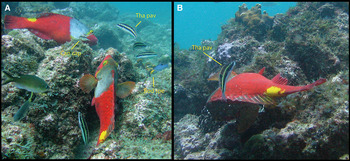
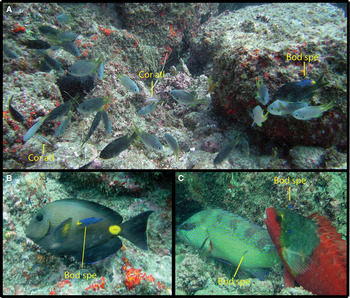
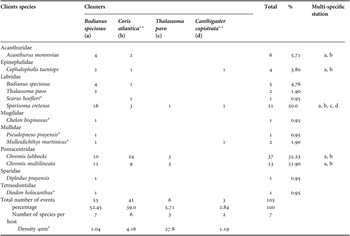
Four fish species were recorded as cleaners in Santa Luzia Island (Table 1). Two of them were responsible for almost all (~91%) interactions (Table 1): Bodianus speciosus (52% of cleaning events) (Figures 1A & 2A, B, C), and Coris atlantica (39%), the latter recorded as a cleaner for the first time (Figure 2A). Bodianus speciosus and C. atlantica were found together tending multi-specific cleaning stations in eight out of 12 observations. Bodianus speciosus was recorded cleaning alone on three occasions (25%), and C. atlantica was never observed cleaning without B. speciosus in the same station. Thalassoma pavo (6%) (Figure 1A, B) and Canthisgaster capistrata (3%; also recorded as a cleaner for the first time, Figure 1A) were recorded in only 9% of all events, and always in multi-specific stations. Each cleaning station ocuppied an area around 2 to 4 m2, with clients posing to solicit inspection. Sparisoma cretense usually laid down in the reef to elicit cleaning (Figure 1A, B). In 8% of the encounters, the clients initiated the cleaning event, and in half of the events clients changed colour to bring attention of the cleaners. Clients were inspected in all body parts, but in many instances cleaners concentrated around the gills (Figures 1A & 2C).
Cleaning interactions at a multi-specific cleaning station at about 10 m deep in Santa Luzia Island, Cape Verde Archipelago, September 2009: (A) Bodianus speciosus, Canthigaster capistrata and Thalassoma pavo cleaning two Sparisoma cretense; (B) T. pavo interacting with S. cretense laying down to solicit inspection.

Cleaning interactions at a multi-specific cleaning station from 6 to 10 m deep in Santa Luzia Island, Cape Verde Archipelago, September 2009: (A) Bodianus speciosus and Coris atlantica cleaning client species Chromis lubbocki and C. multilineata; (B) B. speciosus cleaning Acanthurus monroviae; (C) B. speciosus cleaning Cephalopholis taeniops and Sparisoma cretense.

Number and proportion of cleaning events involving clients with more than one recorded interaction in the island of Santa Luzia, Cape Verde Archipelago. Families are disposed alphabetically. Taxonomy follows that of Nelson (Reference Nelson2006) except for Epinephelidae (Craig et al., Reference Craig, Sadovy de Mitcheson and Heemstra2011) and Labridae (Cowman et al., Reference Cowman, Bellwood and van Herwerden2009).

*, species recorded in only one event; **, new record of facultative cleaner.
Sixty-seven reef fish species were recorded as potential clients but only 13 species in eight families were recorded as clients in Santa Luzia (Table 1). Six of these (Chelon bispinosus, Diodon holocanthus, Diplodus prayensis, Mulloidichthys martinicus, Pseudupeneus prayensis and Scarus hoefleri) were recorded interacting only once (<1%), what may be considered an indication of the low frequency of such events. We observed 98 cleaning events for the remaining seven species. The most common clients were of the genera Chromis (Pomacentridae, 57.1% of cleaning events) and Sparisoma (Labridae, 27.6%) (Table 1).
São Tomé Island
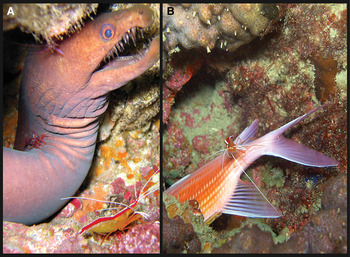
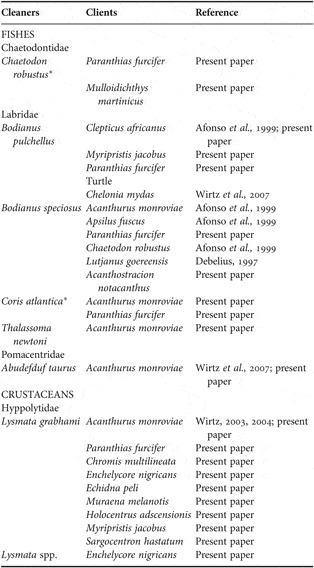
Six fishes and two crustaceans were recorded as cleaners in São Tomé Island (Table 2). The shrimp Lysmata spp. had most clients, eight (38% of all clients) from three families of fish and one crustacean (Figure 3A, B). The wrasse Bodianus speciosus, had six clients (23% of all clients) from five families (Figure 4B), while B. pulchellus had three fish clients (Figure 4C). Other than the two Bodianus, two other species of the family Labridae were observed in cleaning activities: Coris atlantica and Thalassoma newtoni. In total, cleaner fishes of the family Labridae were observed cleaning 50% of all client species. Differently from Santa Luzia, no multi-specific cleaning stations were found in São Tomé. From the 66 species of reef fish observed during this expedition, a total of 16 (from 11 different families) were recorded as clients, as well as the green turtle C. mydas (Table 2).
Cleaning by shrimps under a reef structure at about 12 m deep in São Tomé Island, February 2006: (A) Lysmata spp. cleaning Enchelycore nigricans; (B) Lysmata grabhami interacting with Sargocentron hastatum.

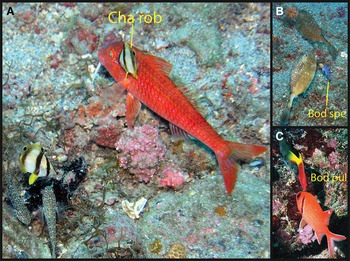
Cleaning activity by fishes over rodolith beds at about 15 m deep in São Tomé Island, February 2006: (A) new record of the cleaner Chaetodon robustus, interacting with Mulloidichthys martinicus changing its predominant colour pattern; (B) Bodianus speciosus cleaning Acanthostracion notacanthus; (C) Bodianus pulchellus interacting with Myripristis jacobus.

Marine species reported as cleaners and clients in the islands of São Tomé and Príncipe.

*, new record of facultative cleaner.
We also report for the first time ‘facultative' cleaning behaviour by the eastern Atlantic endemic butterflyfish (Chaetodontidae) Chaetodon robustus. It was observed cleaning the creole fish Paranthias furcifer and the goatfish Mulloidichthys martinicus (Figure 4A).
DISCUSSION
According to Côté (Reference Côté2000) all eight cleaner species found in the present study are considered facultative cleaners (i.e. species that do not rely on cleaning activities as a substantial part of their diets). The lack of specialized cleaner fishes (i.e. Elacatinus spp. and Labroides spp.) in the Tropical Eastern Atlantic is intriguing and is most probably related to biogeography and evolution of these lineages, restricted to richer coral reef regions. The most observed cleaner fishes in both islands are the labrids Bodianus, Coris and Thalassoma.
In Santa Luzia, we observed an atypically high occurrence of multi-specific cleaning stations (more than half of the stations). Despite reports of mixed stations in the western Atlantic (e.g. Elacatinus evelynae and juveniles of Bodianus rufus by Johnson & Ruber (Reference Johnson and Ruben1988) for the Caribbean, and Elacatinus figaro and juveniles of Pomacanthus paru in Abrolhos reef, Brazil by Sazima et al. (Reference Sazima, Sazima, Francini-Filho and Moura2000)), in many reefs around the world, multi-specific cleaning stations are not that common (e.g. less than 10% of the stations are multi-specific in most reef areas in Brazil, in the west Pacific and in the Tropical Eastern Pacific; authors, personal observations).
The important functional role of the obligate (Côté, Reference Côté2000) cleaner shrimps of the genus Lysmata spp. is evident in São Tomé. These species were involved in 56% of all reported clients (Table 2). Interestingly, only four species of clients (~25%) were shared between fish and shrimps (Acanthurus monroviae, Paranthias furcifer, Chromis multilineata and Myripristis jacobus). Moreover, moray eels were clients exclusively of shrimps, as both prefer to live in refuge holes in the reef, which facilitates the interaction. The other two client species were Holocentrus adscensionis and Sargocentron hastatum which are predominantly nocturnal, but also stay in or close to refuge holes during the day. This behaviour may facilitate the interaction between the clients and the shrimps.
Cleaners of the family Labridae (wrasses) are important in the studied sites, responsible for cleaning of all the client species in Cape Verde and half of the clients in São Tomé. The wrasse Bodianus speciosus is the most important cleaner fish in both islands and may be playing a similar role in the Tropical Eastern Atlantic as its western Atlantic congener B. rufus in the Caribbean and Tropical South-Western Atlantic (Johnson & Ruben, Reference Johnson and Ruben1988; Feitoza & Correia, Reference Feitoza and Correia2003; Sazima et al., Reference Sazima, Grosman and Sazima2010; Coni et al., Reference Coni, Nunes, Ferreira, Maia-Nogueira, Medeiros and Sampaio2011). Cleaning events by Bodianus pulchellus are rarely observed because this species prefers deeper parts of the reef (Sazima et al., Reference Sazima, Grosman and Sazima2010). In São Tomé, B. pulchellus was found cleaning in shallow waters (5 to 15 m deep), as also noted by Luiz et al. (Reference Luiz, Carvalho-Filho, Ferreira, Floeter, Gasparini and Sazima2008) on the south-eastern coast of Brazil.
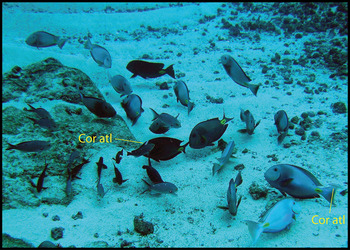
Coris atlantica was the second most important cleaner in Santa Luzia, and was seen in large cleaning stations (Figure 5) in São Tomé. This new record adds to the list of facultative cleaners of the genus Coris. Its sister-species, Coris julis is reported to be a cleaner in the Mediterranean Sea (Zander & Sötje, Reference Zander and Sötje2002) and in the Azores islands (Bertoncini et al., Reference Bertoncini, Machado, Barreiros, Hostim-Silva and Verani2009). Cleaners of the genus Thalassoma have been traditionally considered as common cleaners that interact with a broad number of clients in reef environments (Johnson & Ruben, Reference Johnson and Ruben1988). Thalassoma pavo and T. newtoni, however, were observed interacting in relatively low frequency, differently from other species of the genus Thalassoma in the western Atlantic (Johnson & Ruben, Reference Johnson and Ruben1988; Francini-Filho et al., Reference Fracini-Filho, Moura and Sazima2000; Sazima et al., Reference Sazima, Krajewski, Bonaldo and Sazima2005).
Cleaning station tended by Coris atlantica in a sand patch at about 18 m deep, involving clients Acanthurus monroviae and Paranthias furcifer changing colour while being cleaned or inspected (São Tomé Island, February 2006).

The new record of Canthisgaster capistrata in Santa Luzia as a facultative cleaner adds to the list of cleaners of the genus Canthisgaster. Previously, only two other species from this genus were recorded (Côté, Reference Côté2000).
The Pomacentridae Abudefduf taurus was an occasional cleaner in São Tomé (Wirtz et al., Reference Wirtz, Ferreira, Floeter, Fricke, Gasparini, Iwamoto, Rocha, Sampaio and Schliewen2007). This behaviour has been observed in its congener A. troschelii from the Tropical Eastern Pacific (McCourt & Thomson, Reference McCourt and Thomson1984). Abudefduf saxatilis (juvenile) is recorded as occasional cleaner in the western Atlantic (Whiteman et al., Reference Whiteman, Côté and Reynolds2002), but was not observed cleaning in the studied islands.
Floeter et al. (Reference Floeter, Vázquez and Grutter2007a) found a strong correlation between abundance of a given fish in an assemblage and its tendency to be cleaned. In Santa Luzia, the high frequency of cleaning events involving Chromis as a client may be due to its high abundance (48% of all individuals counted in visual censuses are Chromis). Moreover, in São Tomé, the highly abundant Paranthias furcifer was cleaned by five out of eight observed cleaners, thus indicating the same trend. Quantitative data in the understudied Tropical Eastern Atlantic are needed for a comprehensive understanding of the role of cleaning mutualism in a relatively species-poor region that lacks obligate cleaners.
ACKNOWLEDGEMENTS
We thank CNPq Pro-Africa for grant No. 490531/2007-5 to C.E.L.F. (PI) to work in Cape Verde and the National Geographic Society for research grant No. 7937-05 to S.R.F. (PI) to work in São Tomé. We are greatful to the staff from Universidade de Cabo Verde for support and guidance in the field, everyone at Direcção de Pescas de São Tomé e Príncipe and Angus Gascoigne (in memoriam) for permits and logistics, Jean Louis and all the crew of ‘Club Maxell', Nacho from Gandu Diving, Nora Rizzo, Flavia Nunes, Nancy Knowlton, and the people of Cabo Verde and São Tomé e Príncipe for wonderful times. We also thank Peter Wirtz and Osmar Luiz for comments on earlier drafts.