

1. Introduction
Wars and armed conflicts are characterized by extreme aggression, destruction, and mortality. In this paper, we examine the impact of a civil conflict between the Nepali state and Maoist rebels that occurred between 1996 and 2006. During this conflict, both sides adopted intimidation and terror tactics, but unlike many civil wars did not aim to kill many civilians.Footnote 1 We focus on the impact on two interrelated outcomes – the decision by women whether and when to have children and the early childhood development of children who grow up during civil conflict (in particular, their height). We highlight that these two outcomes are likely to be highly interrelated as changes in fertility impact how household resources can be divided among different members [Becker and Lewis (Reference Becker and Lewis1973)].
We combine nationally representative survey data from three waves of the Nepal Demographic Health Survey with digitized village-level micro data on conflict from annual reports of the Informal Sector Service Center to examine the impact of violent conflict on both adult fertility decisions and the well-being of young children. Identification comes from spatial and temporal variation in the conflict, which left some villages completely unaffected. We exploit that villages affected by the conflict had the same trend in fertility as non-affected villages prior to the onset of conflict and employ a difference-in-differences (DiD) estimator to examine the impact of this conflict on fertility outcomes and the selection of women into childbearing. We then use an extended DiD estimator that also controls for birth year fixed effects to examine the impact of the conflict on the height of children born both prior to when a particular village was first affected and those born after conflict started in a village.
We find that women in affected villages increased their fertility over the 5 year period between 2001 and 2006 by 0.14 children (or a 19% relative to women in non-conflict villages), that this increase was entirely intended, and that there was no change in the composition of women having children. Conflict could cause the demand for children to go up for several reasons. One possibility is to replace children who died as a result of the conflict (either via direct exposure or indirect pathways). We find some evidence for this possibility as conflict increased the number of children who ever died by 0.10. Other possible reasons could be that the increased uncertainty caused by conflict may intensify the long-run view of children as a type of income diversification and old-age support [Leibenstein (Reference Leibenstein1957); Neher (Reference Neher1971); Leibenstein (Reference Leibenstein1975); Nugent (Reference Nugent1985); Zhang and Nishimura (Reference Zhang and Nishimura1993)] or, related, individuals may increase fertility to strengthen their own group in turbulent times [Goldscheider and Uhlenberg (Reference Goldscheider and Uhlenberg1969)]. More generally, if children are inferior goods, as is often the case in developing countries, and conflict causes a reduction in income, then demand will rise [Becker (Reference Becker1991)]. Finally, specific to Nepal, the general fear of abduction and extortion by Maoists led the general public in the affected areas to reduce their time outside the home. This increased leisure time could have led to increase demand for children. In our analysis, we are not able to cleanly disentangle these specific causal channels, but we suspect that each plays a role in our findings.
Our analysis of post-conflict data shows that effect on fertility is just a tempo effect. Five years after the end of the conflict, actual and desired fertility levels in treated and non-treated villages are the same. Despite the temporary nature of this effect on the quantity of children, we find a permanent impact on the quality of the children born during the conflict, as well as for their slightly older siblings. Young children in treated villages conceived before the conflict started as well as those conceived during the conflict are 10% shorter than children born at the same time in non-conflict villages. As we do not find evidence for a changing composition of women having children, neither selection into fertility nor into migration appears to be a channel for these impacts.
Examining the possible mechanisms for this reduction in height, we find little evidence that it is caused by direct inputs such as prenatal or postnatal care. On the other hand, changes in indirect inputs, such as mother's education, body mass index (BMI), and smoking, and household resources explain around 23% of the impact of conflict on children born after conflict started and 11% of the impact on children less than age 3. Since changes in inputs explain only a minority of the impact of conflict on child height for age, we hypothesize that the main channel for this impact is a reduction in the resources available for each child in the household because of increased fertility, i.e., because there are more mouths to feed. Consistent with this, we find that the negative impacts of conflict on child height are three to four times larger for girls as for boys and that there are very limited impacts on first-born boys. Also supporting this hypothesis, we find that once the conflict ends and fertility returns to it's previous equilibrium in conflict villages, outcomes for newly born children also no longer differ.
The main contribution of our paper is to the literature examining the quantity–quality trade-off. Becker and Lewis (Reference Becker and Lewis1973) first pointed out the trade-off between the quantity and quality of children. Our paper is fairly unique in examining how conflict jointly impacts the fertility decisions by women and the early childhood development of children born to these women. The conflict in Nepal is ideal for examining the link between these two outcomes because it had limited direct impacts on civilians. Consistent with previous evidence focusing on other types of shocks, we find that increased fertility leads to worse outcomes for children. In our case, this occurs even though the reduction in fertility is, in the end, only temporary.Footnote 2
We also contribute to two additional strands of literature. First, we add to the literature studying the effect of armed conflicts on fertility. Existing empirical evidence on the effect of armed conflicts on fertility is mixed. Many studies find evidence for fertility reductions during periods of conflicts, but others put forward a positive effect or no significant relationship at all.Footnote 3 The variation in findings may be explained by the circumstances of the respective conflicts or the use of different empirical methodologies.Footnote 4 Many of the previous studies rely on cross-sectional comparisons and hence struggle to cleanly identify the causal impact of conflict on fertility [Hill (Reference Hill2004)]. Our paper, by exploiting the spatial variation in the Nepali civil conflict and using a DiD methodology, is able to construct a valid counterfactual for what fertility rates would have been in each village without the onset of conflict. Furthermore, our data from the Nepal Demographic and Health Survey allow us to examine the timing of fertility decisions, child mortality, and desired fertility in the same empirical framework, and the timing of the surveys enables us to examine fertility catch-up after the end of the conflict. This gives us better identification of the impact of conflict on fertility than most previous papers.
Second, we contribute to the literature on the impact of conflicts on child outcomes. This literature generally uses more sophisticated methodologies than the fertility literature and our analysis follows suit using a similar methodology. Previous studies provide robust evidence for the detrimental effects of the pre- and post-natal exposure to conflicts on health and education outcomes.Footnote 5 However, despite the size of this literature, very little is known about the specific mechanism that links conflict and child outcomes, as well as the behavioral adaptations that parents adopt in response to conflict [Akresh (Reference Akresh2016)]. Our primary contribution to this literature is to highlight the so far overlooked, but important nexus, between child outcomes and fertility decisions and also to examine this in conjunction with other possible mechanisms causing worse child outcomes. While our findings could be particular to the context of the Nepali conflict, it is quite possible that this channel is also important for explaining the negative impacts of civil conflict on child outcomes found in other studies.
Our paper is closely related to Phadera (Reference Phadera2021) which uses an across-cohort DiD design to examine the impact of the Nepal civil war on outcomes 20 years later of women born before the war started, as well as outcomes for their children. In contrast, we examine outcomes for women and their children during the civil war using repeated cross-sections of prospective data. As we observe multiple cohorts of children born in the same villages before, during, and after the war, we can have a strong identification strategy that includes controls for birth year fixed effects (in other words, we focus on within cohort differences). While our main findings on the impact on children are similar, our paper is able to go beyond Phadera (Reference Phadera2021) to examine various mechanisms that can explain the changes in child height that we observe among women having children during the civil war. Beyond this, Phadera (Reference Phadera2021) can only examine the impact of the conflict on fertility among the children born during the civil war (i.e., fertility among the next generation), not among women directly affected. He finds using census data that there is no effect of the conflict on total fertility, but cannot observe the intended temporary increase in fertility which is one of the main findings of our paper.
2. The Nepal Maoist conflict
Nepal is a small landlocked Himalayan country in South Asia sandwiched between India and China. It has a population of 26.4 million and a GDP per capita of USD 2500 (measured at PPP, 2016). It has three distinct agro-climatic regions: the fertile and flat Terai Belt in the south, which is well connected by roads; a largely sloped middle region defined by rugged hills, valleys, rivers, cliffs, and forests; and a high-altitude mountain region in the north without much road connectivity.
It experienced a civil conflict between the state and Maoist rebels between 1996 and 2006 that varied over time in intensity. The conflict had political origins. The country was an absolute monarchy until 1990, with political parties banned. A year-long political demonstration, coordinated by underground political parties, forced the king to accept a constitutional monarchy in 1991. Amid political instability and widespread dissatisfaction with the new democratic system's ability to meet the rising economic and social needs and expectations of the citizenry, the Communist Party of Nepal (Maoist Centre) launched the People's War in February 1996 [Hachhethu (Reference Hachhethu2000); Sharma (Reference Sharma2006)]. The major aim of the Maoist conflict was to capture state power and replace the parliamentary system with a “new people's democracy” the intention of which was to redistribute wealth from the rich to the poor [Group (Reference Group2005)].Footnote 6 The attributes of the Maoist conflict were common to many other civil wars [Blattman and Miguel (Reference Blattman and Miguel2010)], but it draws the closest resemblance to the two-decades-long Maoist conflict in Peru [Klaren (Reference Klaren2000)].
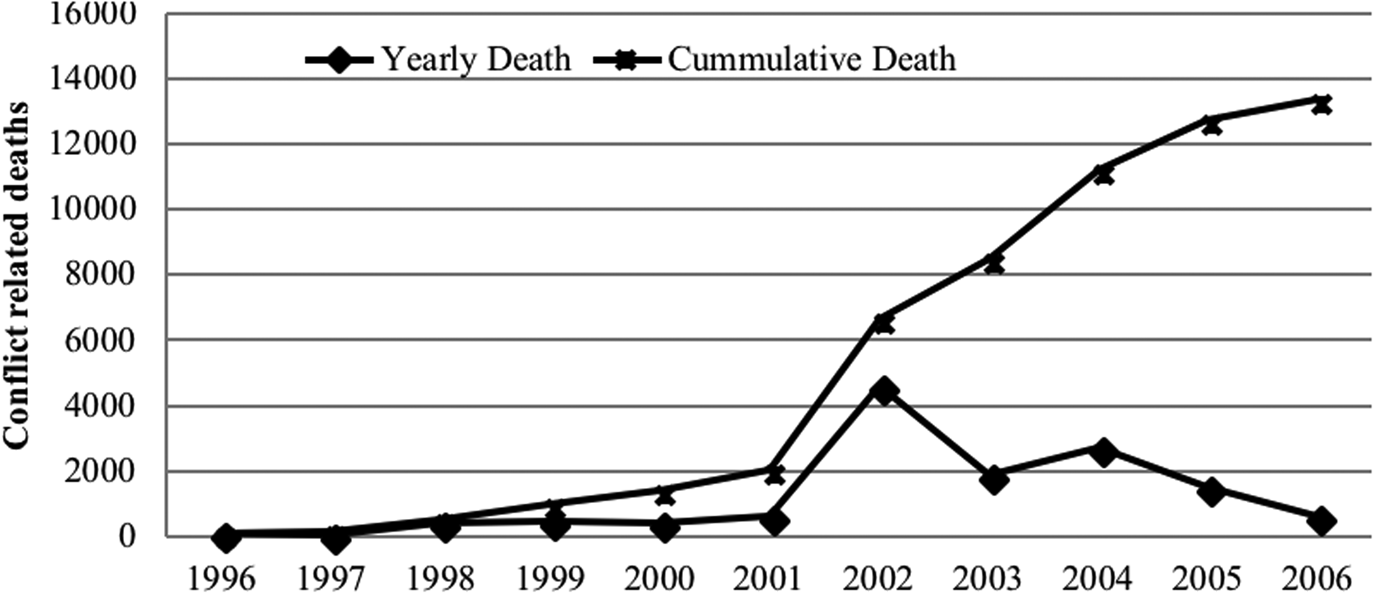
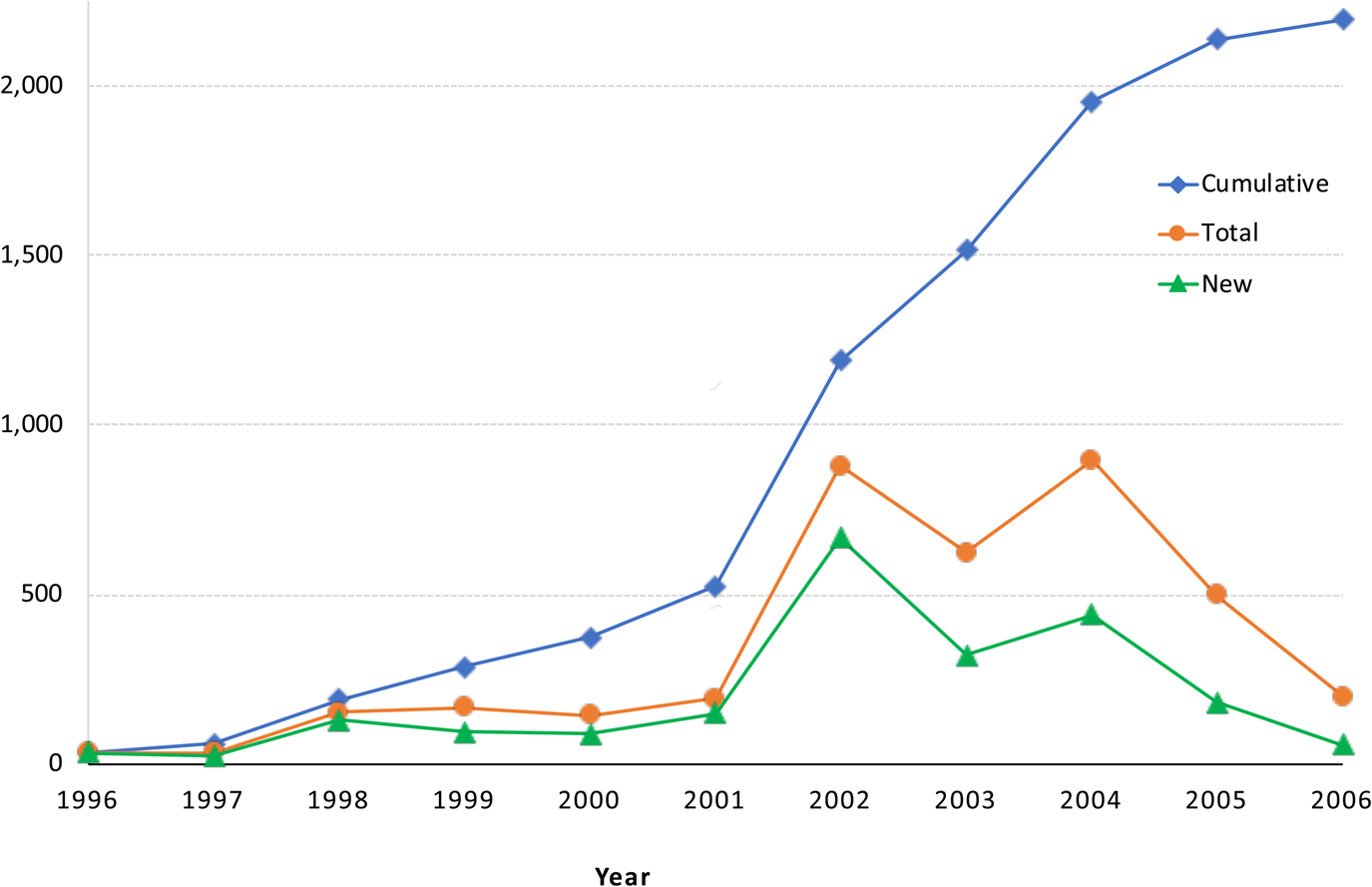
Similar to the Peruvian conflict [Fielding and Shortland (Reference Fielding and Shortland2012)], the Maoist conflict in Nepal was mainly a low-key, law-and-order situation at first. The epicenter of the Maoist People's War was in the remote hill district of Rolpa in mid-western Nepal which had no road connectivity.Footnote 7 From February 1996 to November 2001, the majority of the country was untouched by the conflict and only approximately 15% of the 13,000 total conflict-related deaths occurred (see Fig. 1).Footnote 8 During the next 3 years, the conflict escalated and spread rapidly from the mid-west to other parts of Nepal.Footnote 9 Figure 2 shows the spatial distribution of the intensity of violence as measured by the number of conflict-related deaths across 75 administrative districts.Footnote 10 Approximately 69% of the total conflict-related deaths occurred between 2002 and 2004 alone, and 73 out of 75 districts were affected by the conflict by 2004. However, not all villages within these districts were affected; in total, only about 2,200 out of some 4,000 villages were ever affected by the conflict. Figure 3 shows the spread of violence across the villages of Nepal. The conflict ended in November 2006 with the signing of the Comprehensive Peace Accord between the government and the Maoists. The country entered into a new republican era in 2008 when it elected a constitutional assembly to write a new constitution. The CPN-Maoists emerged as the largest political party.
Conflict-related deaths during Nepal's Maoist conflict (1996–2006). Notes: Conflict-related deaths were highest in 2002. Source: INSEC's aggregate conflict data.

Total number of people killed in each district during 1996–2006 Maoist people's war. Notes: This figure shows the total conflict-related deaths between 1996 and 2006. The darker area represents higher conflict intensity. Source: GIS map was created by the author using district-level conflict data that INSEC collected.

Spread of violence across the villages of Nepal (1996–2006). Notes: The number of new villages affected by the conflict is the highest in 2002. Between 2002 and 2003, villages experienced intense fighting between the state army and the rebel forces. “Affected villages” means villages hit by the conflict. Source: INSEC Annual Reports (1997–2007).

During this conflict, both sides adopted intimidation and terror tactics. The Maoists adopted the policy of forced recruitment and abduction of villagers during the insurgency to increase their strength and influence, and also damaged several bridges and administrative buildings located in villages as well as in district headquarters [INSEC (1996–2006); Eck (Reference Eck2007)]. Security forces retaliated by arresting and torturing villagers suspected of being supporters or sympathizers of the Maoists, and displaced several health service facilities to set up their camps [Dhungana (Reference Dhungana2006)]. Thus, there were a number of channels through which the conflict could have directly impacted child health; including food shortages caused by damage to infrastructure and regular closure of markets, increased stress during pregnancy, and reduced access to health facilities. Obviously, many of these channels would have also affect fertility decisions and access to contraception.
3. Data
This paper relies on two sources of data. Our main data source is the 2001, 2006, and 2011 Nepal Demographic and Health Survey (henceforth NDHS).Footnote 11 Each NDHS is sampled independently and designed to be nationally representative. Households are selected using multi-stage stratified random sampling and the sample observations are clustered at the village level [Ministry of Health and Population (MOHP)].Footnote 13 Different villages are surveyed in each NDHS, but all 75 districts are surveyed in each round. It is important to remember this aspect of the survey design, when we discuss our empirical methods. The NDHS collects extensive information on female fertility and marriage decisions, as well as some outcomes data for children and fairly limited socioeconomic information for each household along with some community attributes.Footnote 14
Fertility information is collected in each wave from ever married women aged 15–49.Footnote 15 We examine the impact of the conflict on six fertility-related outcome variables. Specifically, we look at (i) the total number of children ever born, (ii) the number of children who ever died, (iii) the number of children currently alive, (iv) the number of children born during the last 5 years, (v) the ideal number of desired children, and (vi) whether women are currently using contraceptives. The first three outcomes allow us to examine the impact on total fertility and whether compensating for child mortality is an important behavior. The fourth outcome allows us to evaluate whether impacts are permanent or temporary in nature. The fifth and sixth outcomes allow us to judge whether any changes are likely to be voluntary or involuntary.
The 2001 and 2006 NDHS collected anthropometric information for all children in each household less than 60 months old. The 2011 NDHS did the same for a random 50% sample of households (hemoglobin levels were collected from the other half of households).Footnote 16 We examine the impact of the conflict on child height standardized by age in months and sex. The NDHS data include the Z-scores of eligible children in standard deviation units from the sex-specific median of an international reference population recommended by the World Health Organization (henceforth WHO). The child height-for-age Z-score (HAZ) measures linear growth retardation and cumulative growth deficit and is the standard outcome variable examined in the literature on early life child outcomes [WHO Working Group (1986)]. A child with a HAZ two standard deviations below the median of the reference population (HAZ <−2) is considered stunted, which is a serious health issue since child growth retardation is irreversible. Child height is generally known to be a sensitive indicator to the quality of economic and social environments [Steckel (Reference Steckel1995)]. Environmental factors are especially important determinants of child height in early childhood. Therefore, the WHO recommends focusing analysis of height measures on 0–5 year-olds [WHO Working Group (1986)]. Relevant to our paper, the stature of infants and young children has been found to be particularly vulnerable to nutritional stresses.
The conflict data for this research were assembled by hand from the nine volumes of the Human Rights Yearbooks (1997–2007) published by a national human rights organization, the Informal Sector Service Center (henceforth INSEC).Footnote 17 INSEC collected the conflict-related casualties data from each Nepali village using its nationwide network. The INSEC annual reports include narratives about the types of incidents and the number of deaths that occurred in various places, along with the number of people arrested by the security forces, kidnapped by the Maoists, and tortured from both sides in the villages. The geographic data available in the NDHS allow us to merge the conflict data with household in all three rounds based on their village of residence.
In our main analysis, we define any of the 694 villages surveyed in the three waves of the NHDS as being a “conflict village” if at any point between 1996 and 2006 a death occurred in that village. Note that this is a static concept and is used to divide all villages in each NDHS wave into treatment villages (e.g., those ever affected by violence) and control villages (e.g., those never affected violence) allowing us to use a DiD approach to examine the impact of conflict on fertility and child height.Footnote 18 As discussed, further in the next section, we use the timing of the conflict onset in Nepal to define the pre- and post-treatment periods when examining the impact on fertility outcomes. On the other hand, when we examine the impact on child HAZ, we can extend the DiD methodology by using the timing of conflict onset in each village relative to childbirth to define pre- and post-treatment periods separately for each sample child.
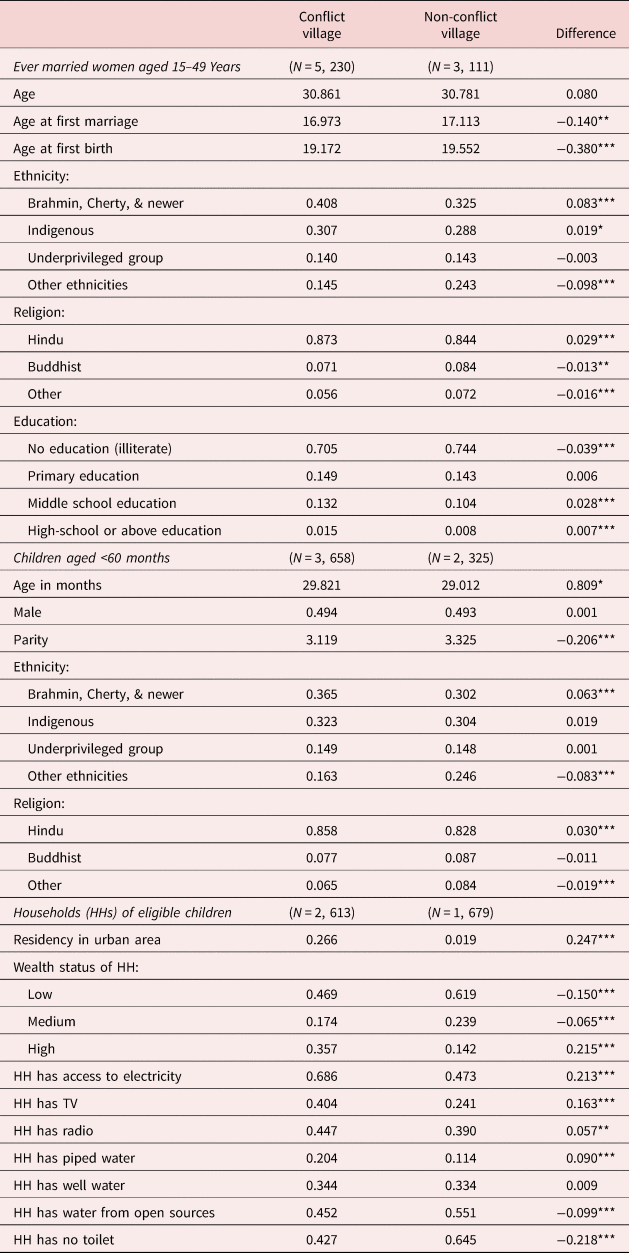
In Table 1, we present characteristics of (i) eligible sample women; (ii) eligible sample children; and (iii) the households of eligible sample children in 2001 stratified by whether individuals live in a conflict village.Footnote 19 We also present the difference between each figure for conflict and non-conflict villages and test whether they are significant. As the conflict was at a very low intensity prior to 2001, we consider this the pre-treatment period in terms of measuring counterfactual fertility outcomes in affected villages. At the time of the 2001 NDHS, around 450 villages out of 3,914 overall and 12% of the surveyed villages were already affected by the conflict but less than 5% had more than one conflict-related death up to that point in time.Footnote 20
Child and household characteristics in 2001 by villages conflict experience

Notes: The difference column shows the mean values for conflict villages minus the mean values for non-conflict villages in each year.
***p < 0.01, **p < 0.05, *p < 0.1.
The data show a general pattern of conflict villages being initially relatively better off. In particular, the women and children in these villages are more likely to be of a higher caste and to be Hindu, while the mothers of sample children are more educated, and the households these children live in are more likely to be urban, are wealthier (based on the ownership of different assets), have better access to clean water, and are more likely to have a TV, radio, and a toilet. While the conflict started in a poor isolated area of Nepal, research has suggested that inequalities in resources and opportunities were the main drivers of the conflict and that this led it to spread into more affluent areas of the country [Murshed and Gates (Reference Murshed and Gates2005); Bundervoet et al. (Reference Bundervoet, Verwimp and Akresh2009); Macours (Reference Macours2011); Nepal et al. (Reference Nepal, Bohara and Gawande2011)]. Unlike in some other parts of South Asia, sex selectivity of children is not common in Nepal [Valente (Reference Valente2014)], and female children are slightly more common as should be the case biologically. The average age of women in our sample is the same in conflict and non-conflict villages, which is important for making fertility comparisons.
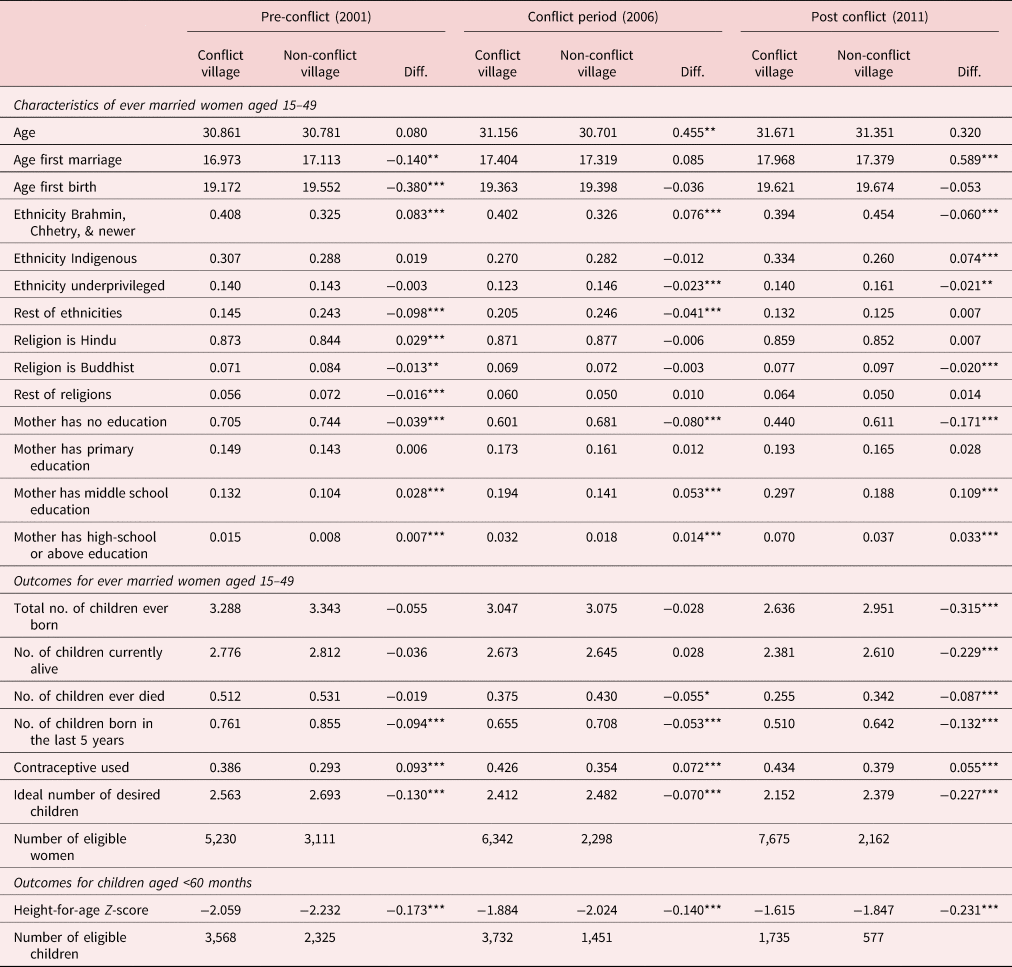
In Table 2, we present means of the sociodemographic characteristics of women, the six outcome variables for women and HAZ scores for children stratified by whether a women or child lives in a conflict village and by survey year. Again, the differences between conflict and non-conflict villages are also presented. Overall fertility and child mortality rates are similar in 2001 in conflict and non-conflict villages, but as might be expected because of the higher levels of wealth and more educated women in conflict villages, both recent and desired fertility are lower in conflict villages in 2001 and, consistent with this, contraceptive use is higher. While Nepali children are more than 2 standard deviations below the median height of a representative sample of comparable Western children and hence are considered stunted, again consistent with the villages being richer, we find that children are less worse off in conflict villages prior to the intensification of the conflict.Footnote 21
Mothers’ characteristics and their fertility decisions by conflict and non-conflict villages

Notes: The columns termed “Diff.” show the mean values for conflict villages minus the mean values for non-conflict villages in each year.
***p < 0.01, **p < 0.05, *p < 0.1.
Examining outcomes in 2006 gives us some indication of the impact of the conflict on fertility and child outcomes as by then all conflict villages had experienced conflict. For both recent and desired fertility, we see a convergence in outcomes between conflict and non-conflict villages, which suggests that the conflict caused fertility to increase in conflict villages relative to non-conflict villages. A similar result is seen for child height-for-age suggesting that conflict had a negative impact on child height-for-age in conflict villages relative to non-conflict villages. Turning to the data for 2011, which covers the period after the conflict had ended in all villages, here we see a reemergence and increase in the differences originally found in 2001 between conflict and non-conflict villages. This suggests that the positive impact of the conflict on fertility and negative impact on child height-for-age were both temporary in nature.
These comparisons are equivalent to a simple DiD estimate of the impact of the conflict. However, there are three reasons why it is sensible to extend upon this analysis in a regression framework. First, a casual look at the outcome data for non-conflict villages shows a strong downward trend in fertility rates and upward trend in child height-for-age.Footnote 22 It is natural to think that these trends could be different for conflict villages even in the counterfactual state where a conflict never occurred as they already had better outcomes in 2001. In fact, it is quite possible that outcomes were improving at different rates in different places in Nepal due to the large differences in accessibility and population density seen across the country. For this reason, we incorporate in our regression analysis, by including district-year fixed effects, differential patterns in outcomes for all 75 districts.Footnote 23 Second, in particular for the analysis of child outcomes, the composition of women having children could be affected by the conflict and hence it could be important to control for this if these characteristics are related to child outcomes. Third, also particular for the analysis of child outcomes, we are able to take advantage of the temporal variation in the onset of conflict across different villages to better identify the impacts on children by measuring conception relative to the onset of conflict. In the next section, we discuss in detail how our regression models incorporate these points.
4. Empirical models and results
4.1. Impacts on fertility, child mortality, and fertility planning
We begin by examining the impact of the conflict on fertility, child mortality, and fertility planning. As discussed above, we look at the impact on the total number of children ever born, the number of children who ever died, the number of children currently alive, the number of children born during the last 5 years, the ideal number of desired children, and whether women are currently using contraceptives. Since these outcomes are referenced to the interview date and all interviews occur in the first half of a particular year (2001, 2006, or 2011), it is not possible to use variation in the onset of conflict across villages to improve model identification. Instead, we rely on a traditional DiD estimator where 2001 is considered the pre-treatment period, 2006 covers the conflict period and 2011 captures post-conflict outcomes.Footnote 24 As the length of exposure to conflict in 2006 varies from 1 to 5 years across conflict villages, this approach estimates the average impact of the conflict across all affected villages.
Specifically, we estimate the following regression model:

where Y ivdt is a fertility outcome for mother i in village v in district d at time t, CV v is an indicator variable for whether a village ever experienced violent conflict from 1996 to 2006 (i.e., is a conflict village), D06t (D11t) is an indicator variable for data coming from the 2006 (2011) NDHS, α dt are district-year fixed effects, X ivdt are controls for a limited set of fixed characteristics (age, ethnicity, religion, and urban/rural), and e ivdt is standard error term that is potentially correlated between individuals in the same village regardless of time period (in other words, we allow for clustering at the village level).Footnote 25
Our focus is on the parameters γ 1 and γ 2, which indicate whether outcomes have changed in conflict villages during the conflict or after the conflict ended, respectively; relative to changes over the same time period in non-conflict villages and after controlling for potential level differences and differential trends in outcomes at the district level. District fixed effects account for any remaining time-invariant unobserved heterogeneity, such as migration networks and institutional and health service delivery differences among the districts of Nepal.
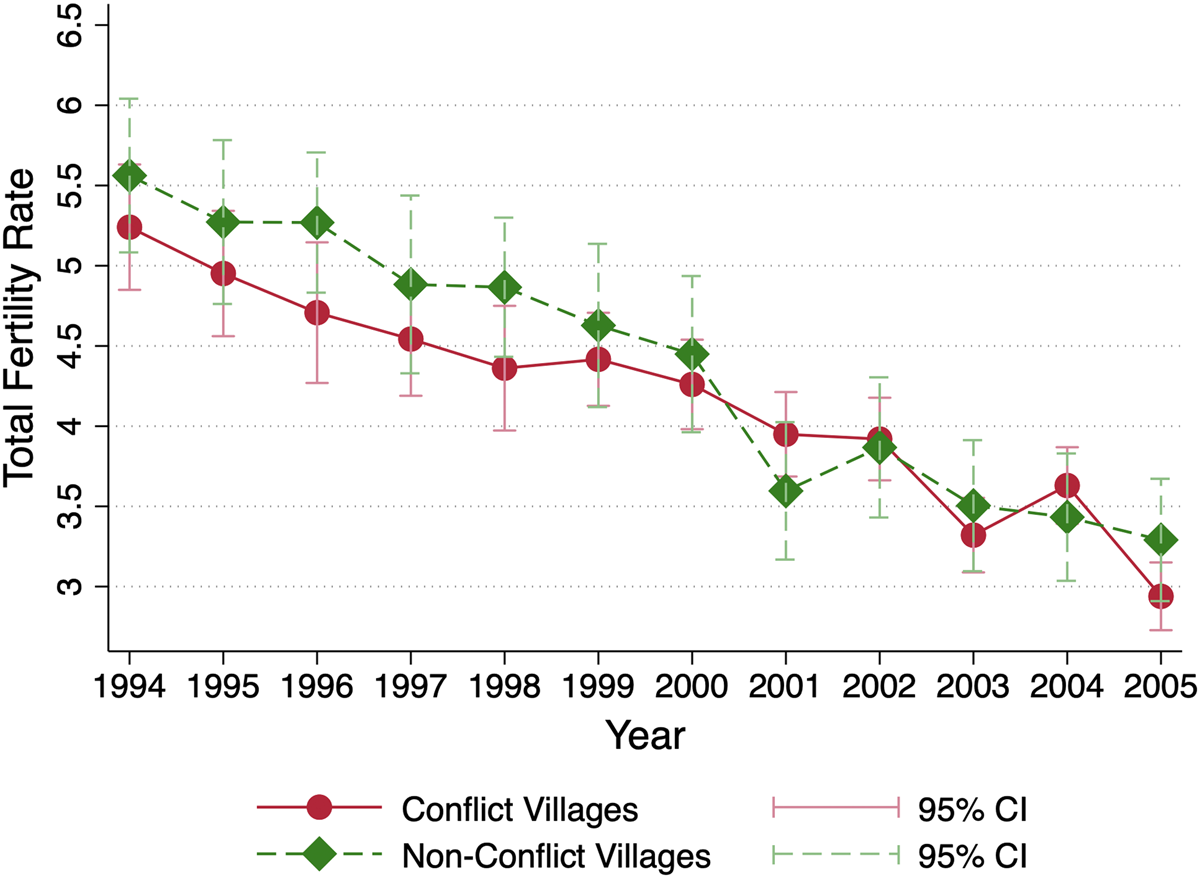
The key assumption identifying the causal impact of conflict in this model is that, in the absence of the conflict, fertility rates would have followed the same temporal pattern as in the villages not affected by the conflict. While this so-called parallel-trend assumption is untestable, it is instructive to examine whether conflict and non-conflict villages have common trends in the pre-treatment period. We use the comprehensive fertility history information collected in the 2001 and 2006 NDHS to construct total fertility rates (TFRs) for all villages in each year of the pre-treatment period starting in 1994.Footnote 26 Figure 4 contrasts the average TFR in conflict and non-conflict villages in the period between 1994 and 2005. This figure confirms what is seen in Table 2, fertility was somewhat higher in non-conflict villages prior to the conflict. More importantly, we see that TFRs have been declining over time in an almost identical parallel trend in conflict and non-conflict villages prior to the onset of conflict. In each year, the 95% confidence intervals are overlapping. This provides strong support for our identification strategy.
Total fertility rates among conflict and non-conflict villages (1994–2005). Notes: The TFRs are estimated using individual record files of all women aged 15–49 from the NDHS 2001 and 2006 using Schoumaker (Reference Schoumaker2013).

After conflict starts, we see the TFR in conflict villages starts to decrease at a slower rate than in non-conflict villages. In the next section, we will use a DiD analysis to examine the impact of conflict on fertility in more detail. Our results will confirm that the conflict lead to a relative increase in short-run fertility in conflict villages.
A secondary concern with our identification strategy is whether there is selective out-migration from conflict villages by women of childbearing age. This could bias our results in either direction depending on whether women who are more or less likely to give birth are those that are more or less likely to leave a conflict village. Unfortunately, the 2001 NDHS did not collect detailed information on migration histories so we are not able to look directly at the impact of the conflict on migration. However, the 2001 and 2006 NDHS both ask households how long they have been resident in a particular village. Hence, we use the same DiD framework as for the fertility variables to examine whether conflict has had an impact on household mobility. In unreported results, we find no evidence of differential changes in mobility in conflict and non-conflict villages. We can also see in Table 2 that the pre-determined characteristics (ethnicity, age, education) of women in conflict villages have not changed during the conflict relative to the changes in non-conflict villages. Finally, in results which we discuss in more detail below, we show that women with children in conflict villages are statistically indistinguishable from women who had children at the same time in non-conflict villages relative to the pre-existing differences between these villages. In other words, conflict also had no impact on the composition of women giving birth. Taken together, this evidence shows that selective out-migration is unlikely to affect our estimates of the impact of the conflict on fertility decisions.
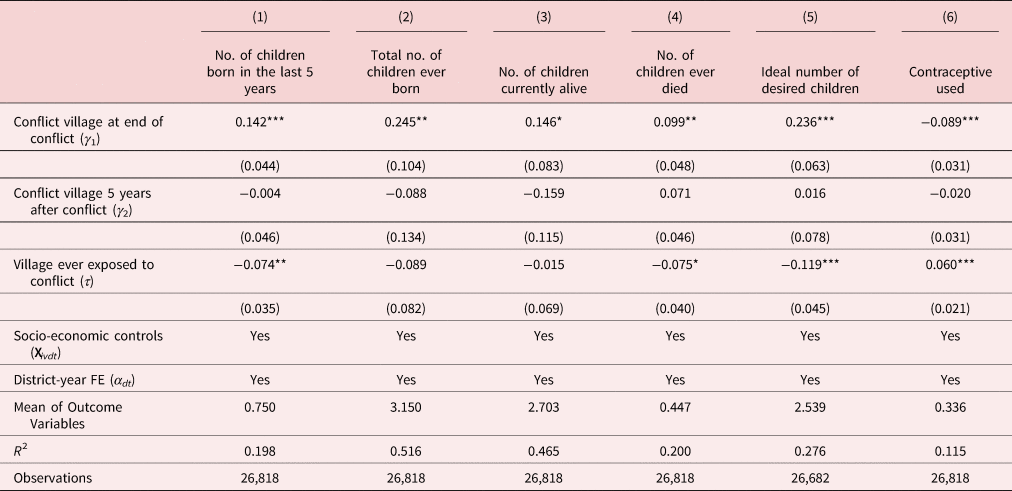
In Table 3, we present the results from estimating the above model for each outcome. We only show the main coefficients of interest and the conflict village dummy variable as the year indicator variables are uninformative because of the inclusion of the district-year fixed effects. We also present the mean of each outcome variable in non-conflict villages to provide a reference for the size of any impacts. The coefficients on the conflict village dummy variables (in the third row) show, consistent with the descriptive statistics, that women in conflict villages have lower fertility rates, desire less children, and are more likely to use contraception.
Impact of the conflict on fertility, child mortality, and fertility planning

Notes: The sample is all ever married women between 15 and 49 years of age.
Standard errors which account for clustering at the village level are in parenthesis. The socio-economic control variables comprise information on the mother's age, ethnicity, religion and place of residence (urban vs. rural). All models include district-year fixed effects. The mean of each outcome is for the subsample of non-conflict villages.
***p < 0.01, **p < 0.05, *p < 0.1.
Turning to our main results, looking across the first row of the table, we see that being exposed to conflict led women to increase their fertility over the 5 year period between 2001 and 2006 by 0.14 children (or a 18.9% relative to women in non-conflict villages) and this translated to an extra 0.25 children being ever born to these women (or an 7.9% increase) at that point in time. One potential reason why women exposed to conflict might increase their fertility is to replace children who have died as a result of the conflict (either via direct exposure or indirect pathways, such as malnutrition or inaccessible health services). We find some evidence for this possibility as conflict increased the number of children who ever died by 0.10. Finally, the results in the last two columns indicate that women who were exposed to conflict desired to have an extra 0.24 children (or a 9.3% increase) and reduced their use of contraception accordingly (by over 25%).
These results tell a consistent story of exposure to conflict leading to an increase in desired fertility, less use of contraception, and a corresponding increase in realized fertility. Overall, there is strong evidence that this was a voluntary response to conflict, not due to rape or other forms of involuntary sex (which potentially increased during the conflict) or an involuntary reduction in contraception use because of reduced access to health care facilities. One possible reason for this increased fertility was to replace prior children that had died. Other possible reasons could be that the increased uncertainty caused by conflict along with the breakdown of the functions of the state may intensify the long-run view of children as a type of income diversification and old-age support or, related, individuals may increase fertility to strengthen their own group in turbulent times. More generally, if children are inferior goods, as is often the case in developing countries, and conflict causes a reduction in income, then demand will rise.Footnote 27 Finally, specific to Nepal, the general fear of abduction and extortion by Maoists led the general public in the affected areas to reduce their travel, work, and general outside activities. This increased leisure time could have led to increased demand for children. Unfortunately, there is no obvious identification strategy to evaluate the relative importance of these different channels.
Examining the second row of Table 3 reveals whether the changes that occurred during the conflict persisted after the conflict ended. They did not. Looking at 2011, we find no evidence that women in conflict villages had more children in the past 5 years or an increase in the total number ever born. We also find that the desired number of children is now the same in conflict and non-conflict villages. All evidence here points to the increase fertility found during the conflict as being purely a tempo effect. In other words, women in conflict villages ended up bringing forward their childbearing, but not increasing their total fertility. This is consistent with each of the pathways discussed in the previous paragraph, since once the conflict ended, these reasons for having more children dissipated as well. It is important to note that overall fertility was declining rapidly in Nepal during the period we examine, hence it does not seem surprising that, once the conflict ended, affected women adjusted back to previous trends. Obviously, if the period of intense conflict lasted longer, this would have been more difficult to do and we would have likely found a permanent increase in fertility as well.
4.2. Impacts on selection into childbearing
Before presenting our main results on the impact of conflict on child height-for-age, we examine directly whether conflict has affected the composition of women having children. We do this by extending equation (1) to include an interaction between each of the year indicator variables with an indicator variable for whether a woman has had child in the last 5 years. We also include the main effect of having a child less than 5 as a control. In other words, we estimate a triple-difference model and ask the question whether women having children in conflict villages are different than those having children in non-conflict villages relative to women, who did not recently have children in these villages relative to the same differences prior to the start of conflict.
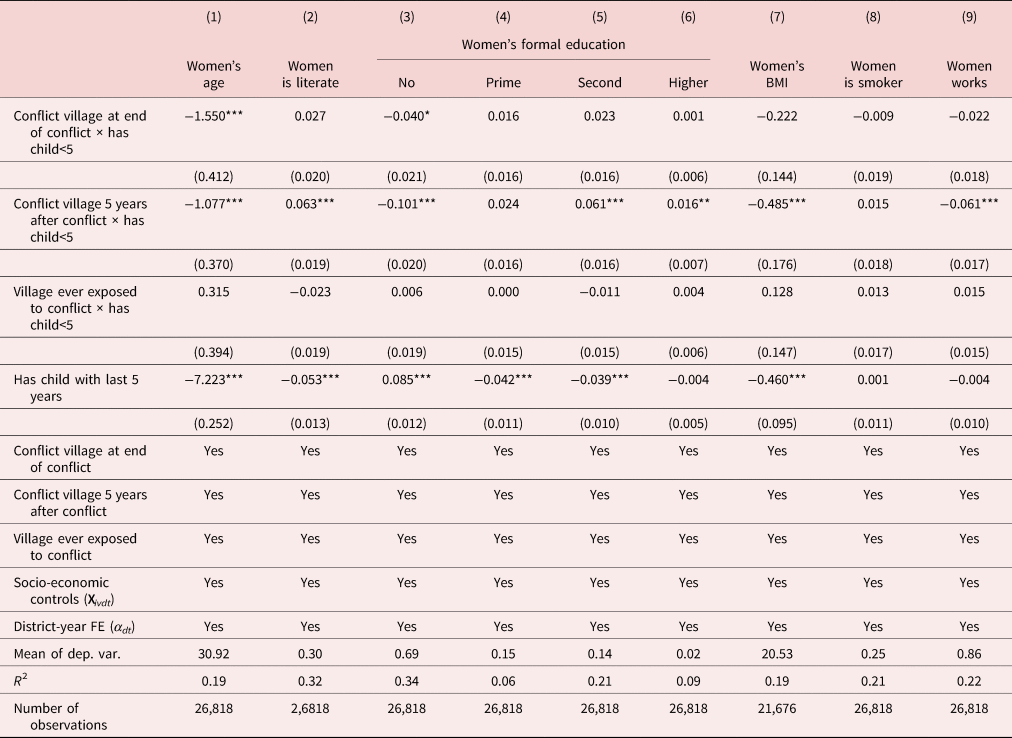
In Table 4, we examine differences in the age, education, health, and work status of women. Perhaps surprisingly, the only strongly statistically difference we find at the end of the conflict is that women who had children during the conflict in conflict villages are relatively younger by 1.55 years. This is consistent with our already discussed finding that fertility temporarily increased among women in conflict villages during the conflict. We find larger differences if we look at villages 5 years after conflict ended. However, as discussed below, we do not find any long-run impacts of conflict on child height for age making this less concerning.
Impact of the conflict on the selection into fertility, women's characteristics

Notes: The sample is all ever married women between 15 and 49 years of age.
Standard errors which account for clustering at the village level are in parenthesis. The socio-economic control variables comprise information on the mother's age, ethnicity, religion and place of residence (urban vs. rural). All models include district-year fixed effects. The mean of each outcome is for the subsample of non-conflict villages.
***p < 0.01, **p < 0.05, *p < 0.1.
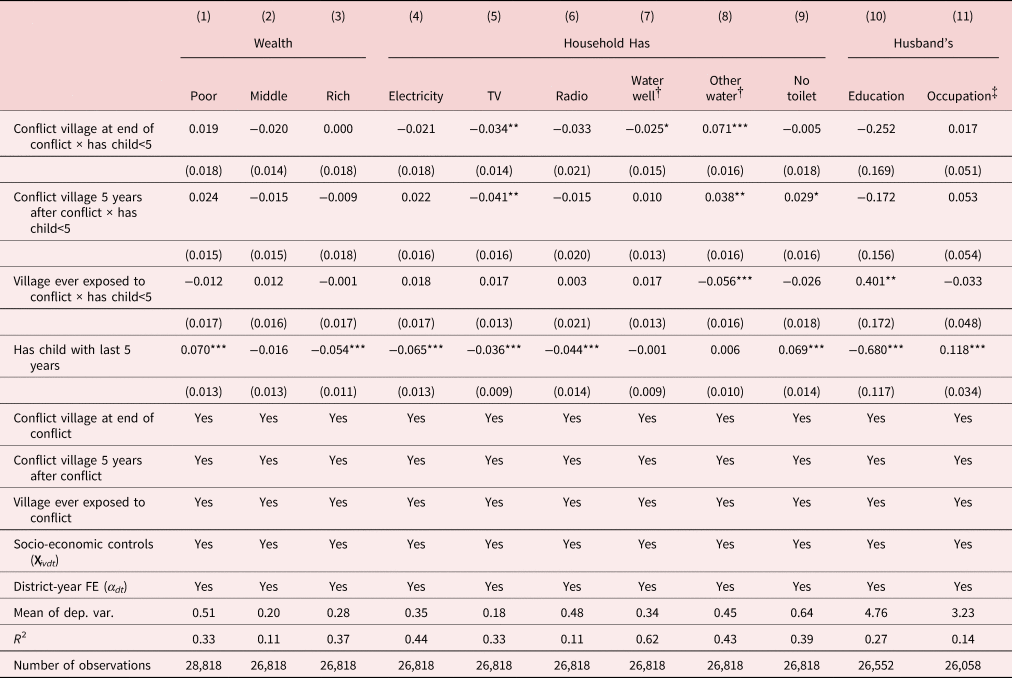
In Table 5, we use the same approach to examine differences in household wealth, household infrastructure, and husband's characteristics. Again, we find limited evidence for differential selection into motherhood for women in conflict villages during the conflict. The only significant differences we find are that women with young children in conflict villages are 3.4 percentage points less likely to live in a household with a TV and 7.1 percentage points more likely to live in a household without piped or well water. However, we find no difference in the overall wealth of the households in which women having children under 5 reside.
Impact of the conflict on the selection into fertility, household-level, and husband's characteristics

Notes: The sample is all ever married women between 15 and 49 years of age.
Standard errors which account for clustering at the village level are in parenthesis. The socio-economic control variables comprise information on the mother's age, ethnicity, religion, and place of residence (urban vs. rural). All models include district-year fixed effects. The mean of each outcome is for the subsample of non-conflict villages.
***p < 0.01, **p < 0.05, *p < 0.1.
$^{\dagger}$ Base group: piped water.
$^\ddag$ Measured on an ordinal scale.
Summarizing, we find very little evidence of differential selection of women having children in conflict villages vs. those having children in non-conflict villages during the time of the conflict. Across 20 characteristics of women, their husbands, and their households, we only find three that are significant at a 5% level. We also examine below whether controlling for these endogenous pathways explain the relationship between experiencing conflict and child height-for-age.
4.3. Impacts on child height-for-age
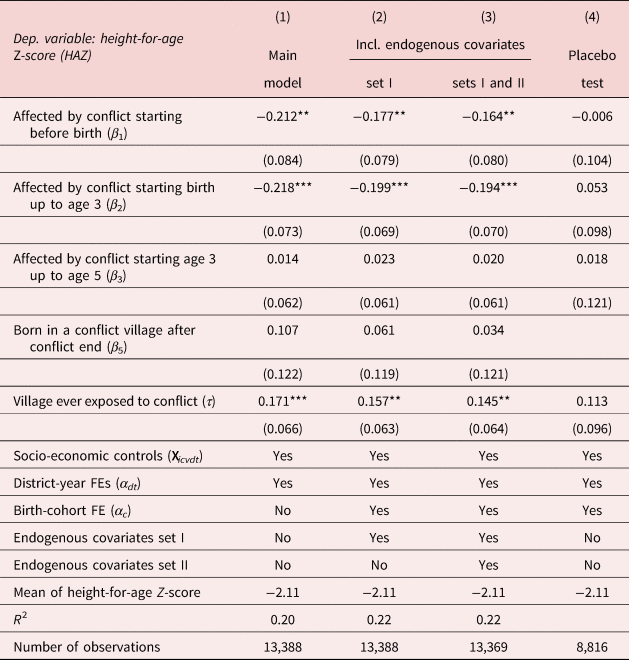
We next examine the impact of conflict on child height-for-age. As opposed to fertility, we know precisely each child's conception date relative to the onset of conflict in a particular village. Hence, we can now exploit both spatial and temporal variation in whether a child is exposed to conflict. We now define three separate treatment effects: (i) children who were conceived in conflict villages after conflict started and hence exposed to it already in utero (CF 1); (ii) children that were alive and less than age 3 when conflict started in their village (CF 2); and (iii) children that were between age 3 and 5 when conflict started in their village (CF 3). We distinguish between the second and third groups because epidemiological studies suggest that height, except in the case of famines and other types of extreme hardship, is only sensitive to inputs in the first 3 years of life [The World Bank (2011)]. Finally, we define a post-treatment group of children born in conflict villages after 2006 when the conflict ended (CF 4).
In all regressions, we also control for child birth-year and district-year fixed effects. Hence, children in the different treatment groups are always directly compared to children born at the same time in a non-conflict village in the same district controlling for any pre-conflict differences between conflict and non-conflict villages and level differences between districts in a particular year. Specifically, we estimate the following regression model:

where HAZ icvdt is the height-for-age Z-score for child i born in year c in village v in district d measured at time t, $CF_{ivd}^j$ for j = 1–4 indicate whether a child is in one of the three treatment groups or post-treatment group defined above, α c are birth-year fixed effects, and all other variables are defined the same as in equation (1).
The four βs are our main coefficients of interest and are separately identified along with the conflict village dummy and the birth-year fixed effects because there are multiple cohorts of children born in non-conflict villages, as well as children observed in conflict villages before the conflict started in a particular village. This model closely resembles that used in Akresh et al. (Reference Akresh, Lucchetti and Thirumurthy2012) and Minoiu and Shemyakina (Reference Minoiu and Shemyakina2012), except that we are able to control for a finer breakdown of child birth cohorts and examine whether any differences in child height persist after the conflict has ended. To be precise, our four treatment effects are defined as the difference in child height for age among children born in conflict villages either (i) 3–5 years before conflict started, (ii) 0–3 years before conflict started, (iii) after conflict started but before it ended, and (iv) after conflict ended in 2006, relative to children born in non-conflict villages in the exact same years compared to the differences in child height for age among children born in conflict villages more than 5 years before the conflict started relative to children born in non-conflict villages in the same years, also controlling for district-year fixed effects.
Initially, we only include among the Xivdt variables that are exogenous to the conflict, but potentially related either directly to child height or to the composition of women choosing to have children. In particular, we control for the sex, age, religion, and ethnicity of the child, the total number of children in the household, and whether the village of the household is rural. Religion and ethnicity maybe be particularly important to control for as these variables jointly affect whether individuals experience conflict and child HAZ as Nepalese families with different ethnicities and religions have different attitudes and food habits that affect child growth.Footnote 28
We then extend the model to include covariates which are potentially affected themselves by the conflict. We split these into two categories: (i) human capital and household resources: the mother's age and education, the household's wealth status, and the availability of electricity, TV, radio, water, and sanitation for the household; and (ii) child inputs: the mother's BMI and smoking status, and the use of prenatal and postnatal care, and of vitamin A supplements. These two specifications with endogenous variables allow us to judge the extent to which mother's characteristics and child inputs explain the impact of conflict on child height-for-age.
We now present our main results on the impacts on children. In the first column of Table 6, we present the treatment effects from estimating equation (2) including only exogenous covariates. We also present the average height-for-age Z-score among children under 5 in non-conflict villages (−2.11) to allow one to judge the relative size of the impacts. In line with the descriptive evidence, we find that children in conflict villages prior to the onset of conflict are taller than those in non-conflict villages. However, being born during the conflict or having the conflict start while being less than 3 years old (including being in utero) has negative consequences for children. Specifically, children who were exposed to the conflict already in utero are 0.21 standard deviations (or 10.0%) shorter than comparable children conceived in villages with no conflict. For those who started to be exposed between 0 and 3 years, we find quite comparable effects of −0.22 standard deviations (or −10.3%). Consistent with the epidemiological evidence, we find no impact on the height of children that were already over 3 years old when the conflict started in their village. We also find no evidence for impacts on children born in conflict villages after the conflict ended.
Impact of the conflict on the height for age of under 5 children

Notes: Standard errors which account for clustering at the village level are in parenthesis. The socio-economic controls (included in all regressions) comprise controls for child gender, age, religion, and ethnicity. In addition, the second specification includes controls for mother's age, education, household's wealth status, parity, number of children, and the availability of electricity, TV, radio, water, and sanitation for the household. In the third specification, includes in addition controls for mothers’ BMI, mothers’ smoking status (0/1), prenatal care (0/1), postnatal care (0/1), and vitamin A supplements (0/1). In the fourth specification, the timing of conflict is randomly assigned to earlier dates in conflict villages and coefficients and standard errors are bootstrapped at the village level with 99 replications. Children born after actual conflict started in each village are dropped from the placebo analysis. The mean of height-for-age Z-score is for the subsample of non-conflict villages.
***p < 0.01, **p < 0.05, *p < 0.1.
In the second column, we present the results with the addition of controls for some of the potential channels through which conflict could have impacted children. Adding in these controls leads to a small reduction in the estimated impact of conflict on child height; the impact on children born after the conflict started is reduced by 16.5% relative to the main model while that for children under 3 when the conflict started by 6.1%. Further controlling for child inputs that are known to be important for child development on further reduces the estimates by a further 6.1% for children born after the conflict started and 4.9% for children under 3 when the conflict started. Overall, endogenous inputs account for around 23% of the impact of conflict on children born after conflict started and 11% of the impact on children under 3. The overall impacts of conflict are still large with the first group of children 0.16 standard deviations (or 7.8%) shorter and the second group 0.19 (or 9.2%) shorter.
In the next section, we will examine the direct impact of conflict on these inputs to further gauge which are potentially important for explaining the reductions in child height discussed here. Since changes in inputs explain only a minority of the impact of conflict on child height for age, we hypothesize that the main channel for this impact is a reduction in the resources available for each child in the household because of increased fertility, i.e., because there are more mouths to feed. This is also consistent with our finding that once the conflict ends and fertility returns to it's previous equilibrium in conflict villages, outcomes for newly born children also no longer differ. Below we also examine whether differential impacts by gender and parity are also consistent with this hypothesis.
In the fourth column, we further validate our identification strategy by summarizing the results from an in-time placebo test. For this test, we randomly assign, for each conflict village, an earlier start date of the conflict.Footnote 29 Children born after actual conflict started in each village are dropped from this analysis. The coefficients and standard errors are bootstrapped at the village level with 99 replications. We do not find any statistically or economically significant coefficients. This provides strong support for the identification strategy used to examine the impact on child height, e.g., no systematic differences in child height prior to the onset of conflict in conflict villages.
4.4. Potential mechanisms
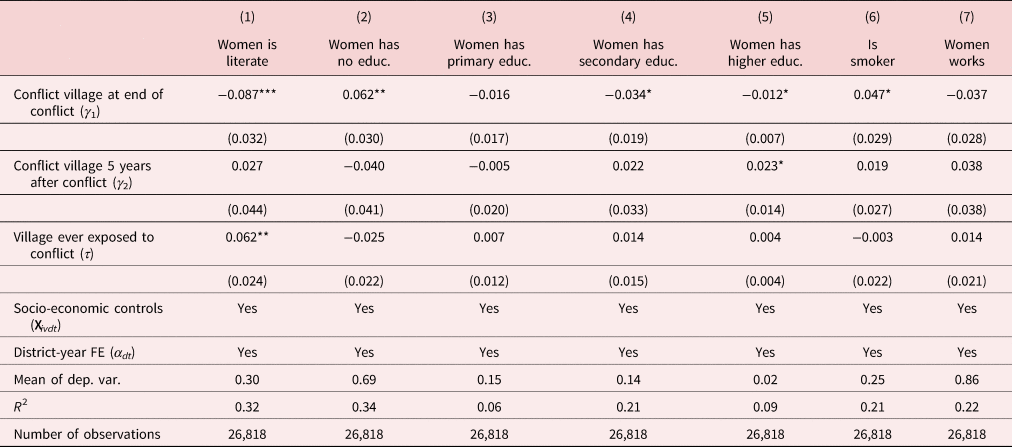
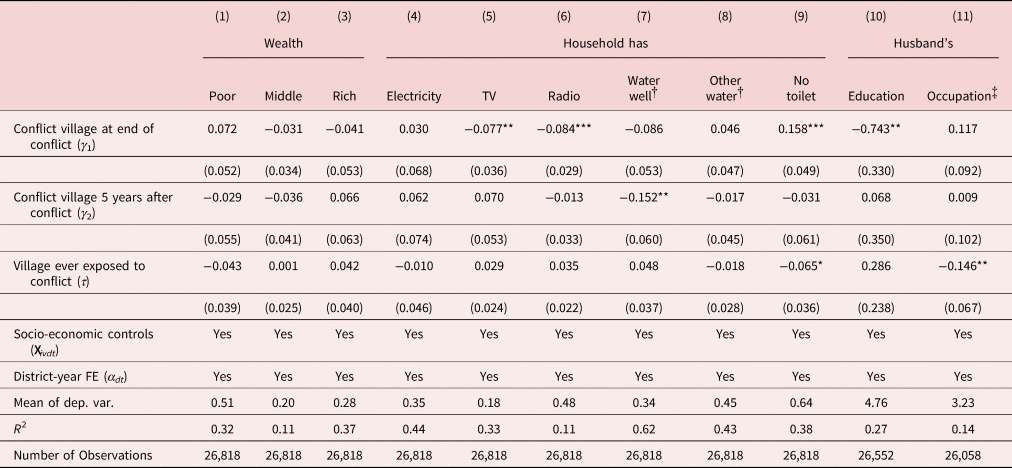
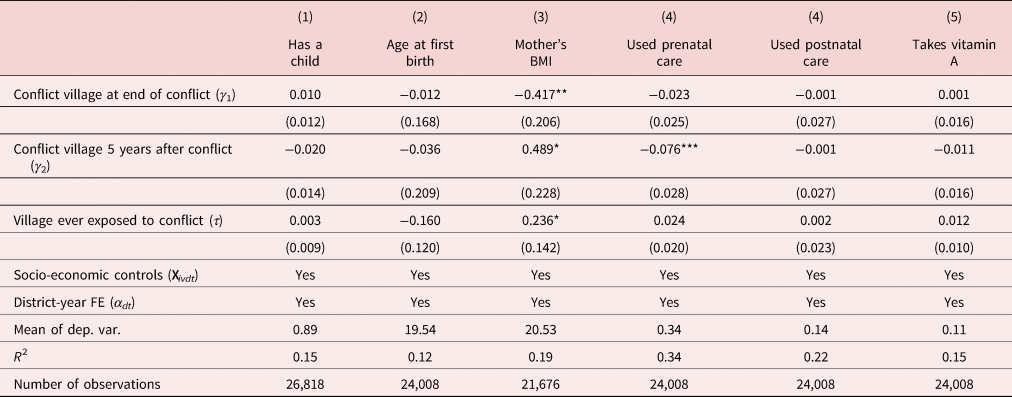
To further understand possible mechanisms leading conflict to impact women and their children, we now examine directly the impact of conflict on the characteristics of women (Table 7), their households and their husbands (Table 8) and, in case of mothers, child inputs (Table 9). We do this by estimating the same DiD model used to examine the impact of conflict on fertility, e.g., equation (1).
Impact of the conflict on women's characteristics

Notes: The sample is all ever married women between 15 and 49 years of age.
Standard errors which account for clustering at the village level are in parenthesis. The socio-economic control variables comprise information on the mother's age, ethnicity, religion, and place of residence (urban vs. rural). All models include district-year fixed effects. The mean of each outcome is for the subsample of non-conflict villages.).
***p < 0.01, **p < 0.05, *p < 0.1.
Impact of the conflict on household and husband's characteristics

Notes: The sample is all ever married women between 15 and 49 years of age.
Standard errors which account for clustering at the village level are in parenthesis. The socio-economic control variables comprise information on the mother's age, ethnicity, religion, and place of residence (urban vs. rural). All models include district-year fixed effects. The mean of each outcome is for the subsample of non-conflict villages.
***p < 0.01, **p < 0.05, *p < 0.1.
$^{\dagger}$ Base group: piped water.
$^\ddag$ Measured on an ordinal scale.
Impact of conflict on child inputs

Notes: The sample is all ever married women between 15 and 49 years of age.
Standard errors which account for clustering at the village level are in parenthesis. The socio-economic control variables comprise information on the mother's age, ethnicity, religion, and place of residence (urban vs. rural). All models include district-year fixed effects. The mean of each outcome is for the subsample of non-conflict villages.).
***p < 0.01, **p < 0.05, *p < 0.1.
We find that women in conflict villages during the conflict are less likely to be literate, have lower levels of formal education, have less educated husbands, and are more likely to live in households that do not have a TV, radio, or toilet. All of these characteristics could play a role in explaining why fertility increases (i.e., income and wealth have declined and children are an inferior good in Nepal) and also why children born during or before the conflict have lower height-for-age. We also find that conflict led to increased smoking and reduced BMI among mothers, although, perhaps surprisingly, no significant impact on age at first birth, use of prenatal care, use of postnatal care, and whether mothers take vitamin A after giving birth. However, as shown in the previous section, collectively these characteristics explain at most 23% of the relationship between conflict and height-for-age.
4.5. Heterogeneity by birth order and sex
We next examine whether the impact of conflict on children differs by either the child's position in the birth order and/or their sex. Importantly, if the negative impacts we have found on child height-for-age are primarily driven by a quantity–quality trade-off induced by the temporary increase in fertility in conflict villages, we should find that the impacts on height are larger for girls than for boys as previous evidence from South Asia suggests that girls are particularly disadvantaged in when households reallocate resources in response to increased demand [Behrman (Reference Behrman1988); Behrman and Deolalikar (Reference Behrman and Deolalikar1990)].Footnote 30 We should also expect to see larger impacts on higher parity children as resource trade-offs are less intensive for first-born children.
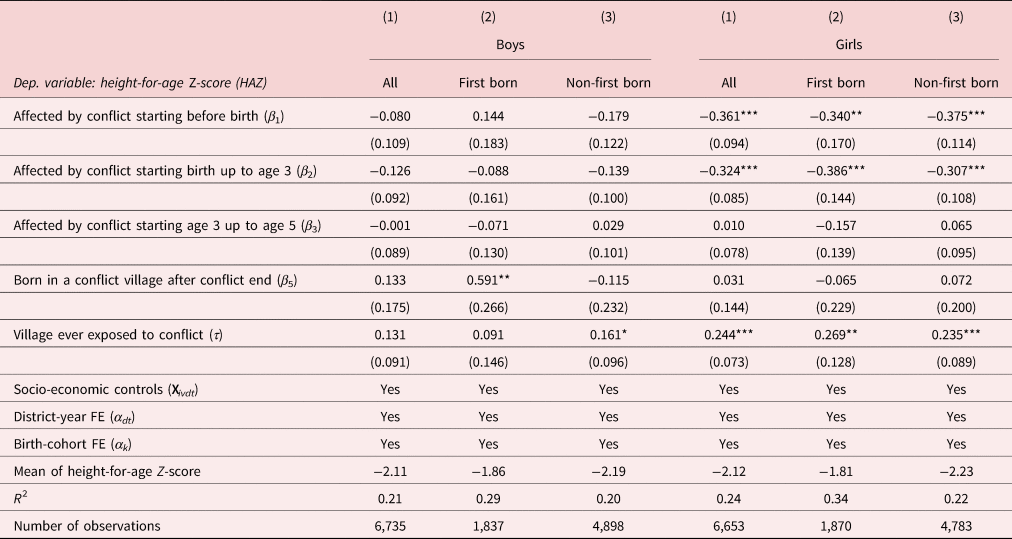
In Table 10, we present the results from this exercise with the first three columns showing the estimated impacts for boys, where we distinguish between the full sample of boys, the sub-sample of first-born, and the sub-sample of higher birth-order boys (i. e., non-first-born). The remaining three columns consider the equivalent samples for girls. A comparison of estimates across columns reveals two important dimensions of treatment effect heterogeneity. First, we find that the negative impacts of conflict on child height are three to four times larger for girls as for boys. Second, conflict has very limited impacts on first-born boys. These findings support our interpretation that the increased quantity of children is the major causal driver of the negative effect of the conflict on child height-for-age and that girls suffer significantly more from the increased intrahousehold competition for resources.
Impact of the conflict on the height for age by birth order and sex of under 5 children

Notes: Standard errors which account for clustering at the village level are in parenthesis. All regressions include controls for child's sex, age, religion, and ethnicity, child birth year fixed-effects, whether the village of the household is rural, and district-year fixed effects. The mean of each outcome is for the subsample of non-conflict villages.
***p < 0.01, **p < 0.05, *p < 0.1.
5. Conclusion
In this paper, we examine the impact of a 10-year-long civil conflict in Nepal on fertility decisions and child well-being. We exploit spatial and temporal variation in the conflict, which left some areas of the country completely unaffected to identify the causal impact of conflict in a DiD framework. Previous research has independently examined the impacts of conflict on fertility and on child well-being, but we are the first, to our knowledge, to examine the interdependence between the two, typically known as the child quantity–quality trade-off. This is potentially important as an exogenous shock that changes fertility decisions likely affects the resources that are then available for individual children.
We find that the exposure to war-related violence increases the quantity of children temporarily, with permanent negative consequences for the quality of the current and previous cohort of children. Women in villages affected by civil conflict relative to those in other villages increased their actual and desired fertility during the conflict, while child height-for-age declined. Supporting evidence suggests that the temporary fertility increase was the main pathway leading to reduced child height, as opposed to direct impacts of the conflict. This likely occurred because there were more mouths to feed in these households. Conflict could cause the demand for children to go up for several reasons; including replacement fertility, increased uncertainty; reduced income; more leisure time; and a desire to increase one's own group. In our analysis, we are not able to cleanly disentangle these specific causal channels, but we suspect that each plays a role in our findings. We also find evidence, in particular, that impacts are larger for girls and non-significant for first-born boys, that is consistent with idea that households in Nepal experiencing conflict choose to have a higher quantity of children with the consequence that they could invest less in each particular child.
Overall, our paper makes three contributions to the literature. First, we provide one of the best identified estimates of the causal impact of civil conflict on fertility. By exploiting the spatial variation in the Nepali civil conflict and using a DiD methodology, we are able to construct a valid counterfactual for what fertility rates would have been in each village without the onset of conflict. Furthermore, we are able to examine the timing of fertility decisions, child mortality, and desired fertility in same empirical framework and examine fertility catch-up after the end of the conflict. Second, we provide additional evidence on the negative consequences of civil conflicts on child outcomes. While this literature is well developed, most of the previous papers are on African countries and very little is known about the specific mechanism that links conflict and child outcomes. Our primary contribution to this literature is to highlight the so far overlooked, but important nexus, between child outcomes and fertility decisions. This leads to our third contribution. We are the first to highlight the trade-off between the quantity and quality of children in the context of civil conflict. While our findings could be particular to the context of the Nepali conflict, it is quite possible that this channel is also important for explaining the negative impacts of civil conflict on child outcomes found in other studies.
Supplementary material
The supplementary material for this article can be found at https://doi.org/10.1017/dem.2023.28
Acknowledgements
For helpful comments we thank the editor Sébastien Schillings and two anonymous referees, David A. Jaeger, Peter Kuhn, Shelly Lundberg, Heidi Riley, and seminar participants at the University of California, Santa Barbara; University College Dublin; the University of the Balearic Islands; ETH Zurich, and the University of Otago for their constructive feedback. This paper originated as a chapter in the PhD dissertation of Apsara Karki Nepal. She acknowledges the University of Otago for generously supporting her PhD studies.