Introduction
On December 31, 2019, Chinese authorities reported to the World Health Organization (WHO) the occurrence of novel coronavirus pneumonia cases in Wuhan, Hubei Province, China, which was first referred to as 2019-nCoV and then termed COVID-19. By May 23, 2020, the rapid spread of the virus had infected more than 5.3 million people and killed over 340 thousand worldwide from January to May 2020. 1
Increasing cases and deaths posed major public health challenges. Considering the absence of a specific cure or vaccine at the start of the epidemic, the authorities implemented unprecedented mandatory quarantine in Hubei Province for infection source isolation and transmission chain interruption. Reference Shih, Lynch, Denyer and Shammas2 Outside of Hubei province, the exits and entries into other cities were also strictly restricted and supervised. In order to control large-scale population flow and avoid further viral spread, the authority announced extending the Spring Festival holiday. The public was required to stay home and avoid unnecessarily going out. The unknown and potential risks of the pandemic associated panic in public, which led to hospitals in Wuhan and other cities in Hubei province struggling to cope with the influx of infected patients. Hospitals in other provinces across the country focused on the screening of fever cases and identifying the virus-infected people for early isolation. Reference Cheng, Wong, To, Ho and Yuen3 The unified and centralized resource allocation system seemingly has the advantage of solving temporary difficulties, however, hospitals, doctors and routine patients faced a dilemma. Hospitals worried about the risk of in-hospital virus cross-infection, and patients were reluctant to visit the hospital. It is unclear what the impact was on routine medical service and non-nCoV patients under this circumstance. In this paper, the authors investigated the potential impact COVID-19 had on patient flow and use of emergency medical services.
Setting
The Sichuan University West China Hospital is located in Chengdu, Sichuan Province, which borders adjacent to the Hubei Province. As the capital city, Chengdu has more than 16 million inhabitants, accounting for a fifth of the province’s population. The hospital offers 24/7 support for all specialties and is the biggest 1 in this city. In 2018, the Emergency Department (ED) saw 266800 patients, and the outpatient department saw more than 5 million cases.
Patients visiting ED will be triaged into 4 groups according to a 4-level category scale, in which patients in triage level of 1 or 2 will be seen by an acute care team in the rescue and resuscitation area, while patients in triage levels 3 and 4 are stable and will be assigned to ‘fast-track.’
Following the official announcement of a novel Coronavirus viral pneumonia in Wuhan, our hospital initiated the epidemic prevention and control measures on January 16, 2020. On January 21, the first imported novel coronavirus pneumonia case was confirmed in Sichuan Province, and in the next 2 months, a total of 550 cases were identified in Sichuan province and 155 of them were in Chengdu city.
Methods
Sample and data collection
We performed a retrospective cohort study at Sichuan University West China Hospital ED. Patient data were collected from electronic medical charts. All available records during an 8-week period from January 1, 2019 to February 25, 2020 were reviewed. In the Chinese Lunar calendar, the Chinese New Year is always within this 2-month period, which was special in 2020 because the COVID-19 pandemic outbreak began towards the end of January which was around the Chinese New Year Eve.
We obtained data on ED workload, including the number of patient visits and emergency blood transfusion volume. Patient demographic characteristics, clinical data and outcomes were descriptively and comparatively analyzed. Medical records of those patients pronounced dead in the ED during the study period were reviewed to compare the APACHE-II score and the elapsed time calculated using arrival time and time of death. Ethical approval for this study was provided by the Institutional Research Ethics Committee of West China Hospital (No. 20200571).
Data analysis
Means and standard deviations (SD), or medians and inter-quartile ranges (IQR) were used for continuous variables. Categorical variables were reported as frequencies and percentages. The Student t-test was used to identify differences in normally distributed continuous variables and the Mann–Whitney U test was used for non-normally distributed variables. A chi-squared test was used to compare categorical data. Statistical significance was set at P value < 0.05. Analyses were performed using SPSS version 25.0 for Windows (IBM Corp., Armonk, New York).
Results
Demographic characteristics
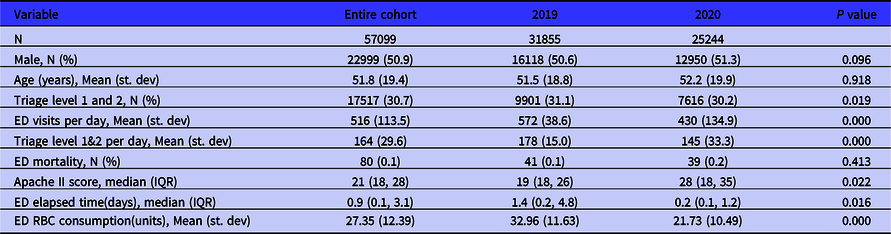
A total of 57099 visits were recorded in the selected periods. The mean age of the entire cohort of patients was 51.8 years, with 50.9% males, and there was no significant difference in gender or ages between the study periods in 2019 and 2020. Of these, 30.7% (n = 17517) were triage level 1 and 2 patients. See Table 1 for complete data.
Demographic characteristics and clinical data comparison between 2 cohort study periods

ED throughput and clinical characteristics
The average ED visits in 2020 were significantly less than that in 2019, which were 430 ± 134.9 and 572 ± 38.6 respectively (P = 0.00). Meanwhile, the number of triage level 1 and 2 cases declined in 2020 compared with that in 2019, from 178 ± 15.0 to 145 ± 33.3 (p = 0.00) (Table 1).
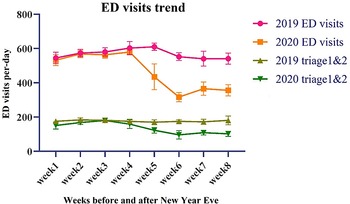
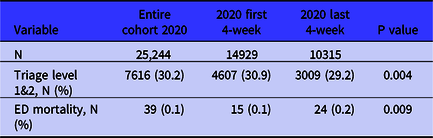
Further analysis of the emergency visits trend on a weekly basis found that ED visits and the number of triage level 1 and 2 cases remained steady during the whole study period in 2019 and the first 4 weeks in 2020, but decreased abruptly from the fifth week in 2020 once the COVID-19 outbreak began (Figure 1). In 2020, the number of visits during the second half of the 8-week study dramatically dropped. The proportion of triage level 1 and 2 cases during the last 4 weeks of the study period in 2020 (29.2%, n = 3009) was lower than that of the previous 4 weeks of the same study period in 2019 (30.9%, n = 4607) (P = 0.004) (See Table 2).
The trend of daily ED visits and numbers of triage level 1&2 cases during the 8-weeks study periods in 2019 and 2020.

Clinical data comparison between first 4-week and last 4-week periods in 2020

Red Blood Cells (RBC) consumption
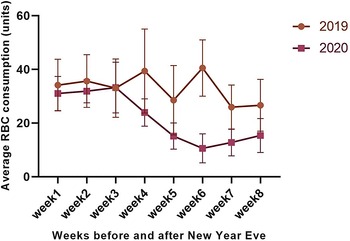
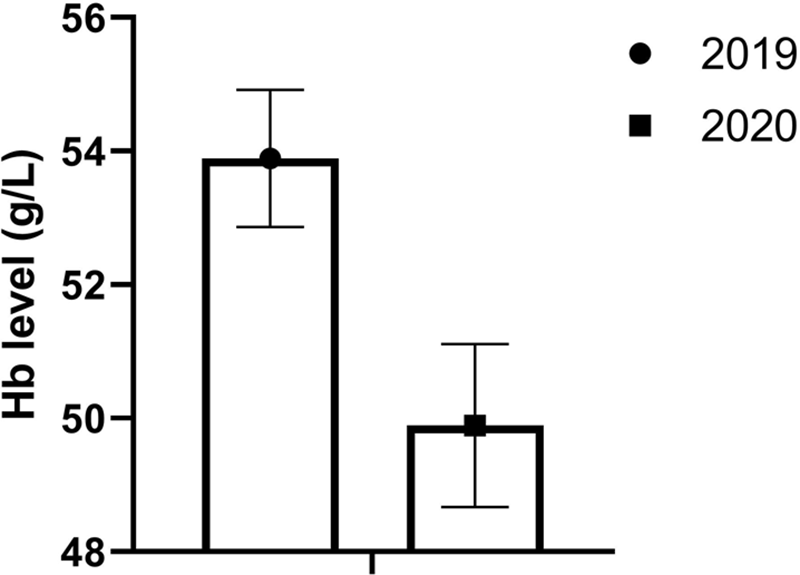
In accordance with ED visits decreasing, the RBC consumption declined apparently in 2020 (Table 1) and especially dropped quickly during the last 4 weeks (Figure 2). Furthermore, the mean hemoglobin level of patients before receiving RBC transfusion was significantly lower in 2020 than that in 2019 (Figure 3), which were 49.9 ± 11.9g/L and 53.9 ± 14.1 g/L (P = 0.00) respectively.
The trend of daily RBC use in ED during the 8-weeks study periods in 2019 and 2020.

Comparison of hemoglobin levels in patients undergoing emergency blood transfusions during the study periods.

Clinical characteristics of ED death
The total ED death incidence was 0.1% (n = 80) during these 2 selected periods. The death incidence in 2020 was higher than in 2019, but there was no significant difference (0.2% versus 0.1%, P = 0.413) (Table 1). The following subgroup analysis revealed that the ED mortality of the last 4-week period was significantly higher than that of the first 4-week period in 2020, which were 0.2% (n = 24) versus 0.1% (n = 15) (P = 0.009) (Table 2).
We further analyzed the clinical data of the patients who died in the ED. The APACHE II score of patients who died in the 2020 study period was slightly higher compared with that of 2019, which were 28 (IQR 18 - 35) and 19 (IQR 18 - 26) respectively (P = 0.022). Whereas, the ED elapsed time dropped from 1.4 (IQR 0.2 - 4.8) days in 2019 to 0.2 in 2020 (IQR 0.1 - 1.2) (P = 0.016) (Table 1).
Discussion
The sudden outbreak of COVID-19 pandemic has caused tremendous challenges to the medical system around the world. Reference Armocida, Formenti, Ussai, Palestra and Missoni4–Reference Poveda6 Because of the rapidly and universally emerging viral pandemics; health care facilities had to face the imbalance between supply and demand for medical resources in many countries. The uncertain situation and potential risks of the pandemic have caused panic among the population, which led to hospitals in Wuhan and other cities in Hubei Province struggling to cope with the influx of infected patients and damaged the medical service functions.
Some strategies were implemented to “flatten the curve” of the pandemic to preserve capacity and not outpace the availability of precious health care resources. Reference Wu and McGoogan7,Reference Shaker, Oppenheimer and Grayson8 In China, the authorities have taken robust measures to curb the spread of COVID-19. The Chinese government imposed a mandatory quarantine in Hubei Province. Medical resources, including personal protective equipment (PPEs), Intensive Care Unit beds, and ventilators, were centralized and allocated to keep up with projected demands. For example, our hospital restricted routine outpatient clinics and suspended all elective operations to decrease the patient’s flow and cope with the shortage of protective supplies for controlling the epidemic. These unprecedented interventions and control measures substantially mitigated the epidemic, Reference Kraemer, Yang and Gutierrez9–Reference Pan, Liu and Wang11 but there is less attention given to the need for sufficient clinical capacity to deliver care to routine emergency patients during the pandemic.
Many health centers have reported reductions in the number of people admitted with acute coronary syndromes and injuries during the COVID-19 pandemic. Reference Christey, Amey, Campbell and Smith12,Reference De Filippo, D’Ascenzo and Angelini13 Meanwhile, research from Italy revealed an increase of out-of-hospital cardiac arrests within the first 40 days of the outbreak than in the same period in the previous year. Reference Baldi, Sechi and Mare14 In our research, we found the routine emergency visits and ED triage level 1 and 2 cases decreased dramatically in our hospital in 2020 once the outbreak of COVID-19 began in China. Additionally, during the study period in 2020, individuals who experience emergencies had more severe conditions upon arrival with a shorter time interval between admission and death, and the ED mortality was higher than in 2019.
Many researchers have discussed the COVID-19 pandemic effect on the global mental health of the general population worldwide, regardless of age, gender, race, culture, or occupation. Reference Han, Zheng and Agostini15–Reference Wang, Pan and Wan19 Although we cannot yet determine whether these psychological changes directly affect the public’s visit behavior, many studies have found a shift in public behavior with anxiety over attending hospitals during the pandemic and associated with a significant reduction in ED presentations. Reference Yao, Lin and Liu20–Reference Leung, Lau, Kwan and Chang24 From the above data, we can conclude that the pandemic has changed people’s behavioral patterns, especially the process of seeking medical care. These similar phenomena indicated that people might keep avoiding the hospital to the detriment of their health.
Panic among the public also impacted essential medical functions such as blood donation and blood supply, which posed as a potential threat to the routine medical care. Given the risk of in-hospital virus cross-infection, hospitals were strictly controlled, and most of the routine and elective care was paused. These strategies helped to reduce blood demands, however, due to the COVID-19 pandemic, the number of blood donors dropped dramatically, which caused a shortage of blood supply. Reference Wang, Han and Pan25,Reference Raturi and Kusum26 In our study, the RBC consumption declined in the 2020 pandemic period, interestingly, the mean hemoglobin value for RBCs transfusion in 2020 was lower as compared to the same period in 2019. This phenomenon reflected the real-time situation of blood shortage. Although China has a well-developed medical system, the surge capacity for emergency care will be limited during a public health disaster.
In order to tackle the COVID-19 pandemic and maintain the function of the medical system to avoid secondary disasters, we should implement new and constructive strategies including reasonable public control, effective medical preparation and responses, precise resources rationing and allocation, expanded use of telemedicine, and collaborative efforts with colleagues and government in reaching solutions. Although crafting rules about rationing would be difficult and the rationing criteria are controversial, reasonable medical resources arrangement and patient-flow management strategy may help to reduce the possible impact on the medical system. Reference Li, Zhang, Li and Nie27–Reference Bledsoe, Jokela, Deep and Snyder Sulmasy31 Furthermore, telemedicine was demonstrated to be a feasible and effective solution for both public health emergencies and routine medicine, and has significantly improved health care outcomes. Reference Hong, Li and Li32 Public messages from healthcare professionals can help control public anxiety and sustain trust in the healthcare profession. In addition, governments and hospitals should raise resources and mount a trace, test, and treat strategy for immigration control or lockdown. Reference Park, Choi and Ko33
Our study has several limitations. First, this was a retrospective study conducted in a single hospital and selection bias could exist. Second, the duration of the study was relatively short and the number of deaths included was limited. So the impact of the pandemic on mortality needs further study. Third, the data for the retrospective study period came from electronic medical records, which did not include post-discharge data. The follow-up information would have been useful to see the further impact of the epidemic on public health.
Conclusion
The COVID-19 pandemic had posed tremendous challenges to the medical system. It changed the patient’s behavioral pattern regarding seeking routine emergency services which brought apparent impact or even potential damages on health care function and clinical results.
Data availability statement
Please contact author for data request.
Acknowledgements
The authors acknowledge all the coordinators in West China Hospital of Sichuan University, including physicians, nurses and other staff.
Funding statement
The study was funded by the Scientific and technological project of new coronavirus pneumonia, 2019 (HX-2019-nCoV-026), West China Hospital, Sichuan University.
Author contribution
Hu N designed the study. Lianjing L, Zhuo Z and Ping L collected the data. Shanshan W and Hu N analyzed the data. Hu N prepared the manuscript and provided study supervision. All authors read and approved the final manuscript.
Ethics standards
The study protocols were approved by West China Hospital Human Research Ethics Committee and were carried out in accordance with relevant guidelines and regulations. Informed consent was obtained from all patients or their legal surrogates.