INTRODUCTION
Options for the control of Neospora caninum have been explored, discussed and reviewed over a number of years (Thurmond and Hietala, Reference Thurmond and Hietala1995; Baillargeon et al. Reference Baillargeon, Fecteau, Paré, Lamothe and Sauve2001; Nishikawa et al. Reference Nishikawa, Mikami and Nagasawa2002; Reichel and Ellis, Reference Reichel and Ellis2002, Reference Reichel and Ellis2009; Dubey et al. Reference Dubey, Schares and Ortega-Mora2007). Hope had been expressed that efficacious and economically viable vaccines would become available for the control of N. caninum infections and abortions when, in addition to a commercially available inactivated vaccine (Neoguard™), highly efficacious live vaccine candidates showed promise (Williams et al. Reference Williams, Guy, Smith, Ellis, Björkman, Reichel and Trees2007; Weber et al. Reference Weber, Jackson, Sobecki, Choromanski, Olsen, Meinert, Frank, Reichel and Ellis2013). However, these vaccine candidates may yet be a few years from reaching the market place.
In addition, the more recent withdrawal of Neoguard™, despite its shortcomings as an efficacious vaccine (Weston et al. Reference Weston, Heuer and Williamson2012), from global sales has further reduced the available options for the control of N. caninum and a re-evaluation of the possibilities for the management of this parasite seems warranted, particularly in those countries that had been able to use Neoguard™ in the past.
The majority of recent work on the control of N. caninum has focused on vaccine approaches, including inactivated whole vaccines (Rojo-Montejo et al. Reference Rojo-Montejo, Collantes-Fernandez, Regidor-Cerrillo, Rodriguez-Bertos, Prenafeta, Gomez-Bautista and Ortega-Mora2011), the use of sub-unit native (Moore et al. Reference Moore, Echaide, Verna, Leunda, Cano, Pereyra, Zamorano, Odeon and Campero2011; Mansilla et al. Reference Mansilla, Franco-Mahecha, Lavoria, Moore, Giraldez, Iglesias, Wilda and Capozzo2012) and recombinant N. caninum antigens (Hemphill et al. Reference Hemphill, Debache, Monney, Schorer, Guionaud, Alaeddine, Mueller and Mueller2013; Uchida et al. Reference Uchida, Nagashima, Akatsuka, Murakami, Ito, Imai and Ike2013) and live vaccine approaches with a naturally attenuated isolate of N. caninum (Williams et al. Reference Williams, Guy, Smith, Ellis, Björkman, Reichel and Trees2007; Rojo-Montejo et al. Reference Rojo-Montejo, Collantes-Fernandez, Perez-Zaballos, Rodriguez-Marcos, Blanco-Murcia, Rodriguez-Bertos, Prenafeta and Ortega-Mora2013; Weber et al. Reference Weber, Jackson, Sobecki, Choromanski, Olsen, Meinert, Frank, Reichel and Ellis2013). Prophylactic treatment with monensin (Vanleeuwen et al. Reference Vanleeuwen, Haddad, Dohoo, Keefe, Tiwari and Scott2010, Reference VanLeeuwen, Greenwood, Clark, Acorn, Markham, McCarron and O'Handley2011) to reduce the risk of abortion has also been investigated. Little, if any, recent work has focused upon management techniques designed to reduce parasite transmission, using knowledge of the life cycle and transmission mode of the parasite, or the pivotal role of canids as definitive hosts to control or reduce the contribution of N. caninum to bovine abortions.
There has been an overall, seemingly sharp decline in the number of publications in recent years dealing with ‘Neospora’, ‘cattle’ and ‘control’, with a reduction of five papers each year in a PubMed search of the past 3 years. Just on 55% of publications in the past 5 years using the above search terms are dealing with vaccines and immunogenicity – while vaccines appear to hold out the greatest promise for controlling N. caninum infections and abortions (Williams et al. Reference Williams, Guy, Smith, Ellis, Björkman, Reichel and Trees2007; Weber et al. Reference Weber, Jackson, Sobecki, Choromanski, Olsen, Meinert, Frank, Reichel and Ellis2013), they may yet be at least 10 years from reaching the market (Reichel and Ellis, Reference Reichel and Ellis2009). In the meantime, we hope that at least some of the other half of that work could be spent on trying to produce the evidence to support some of the recommendations that are being made in the current manuscript.
Background
Neospora caninum infection occurs worldwide, affecting mostly cattle and resulting in abortions (Dubey et al. Reference Dubey, Schares and Ortega-Mora2007; Dubey and Schares, Reference Dubey and Schares2011). These events may take the form of sporadic or low-level endemic occurrences of abortion (Hall et al. Reference Hall, Reichel and Ellis2005), or be of epidemic, ‘storm-like’ proportions. By definition, these abortion storms affect large proportions of the at-risk (i.e. pregnant) cow population (usually more than 12·5%) (Thornton et al. Reference Thornton, Gajadhar and Evans1994; Wouda et al. Reference Wouda, Bartels and Moen1999a ; Pfeiffer et al. Reference Pfeiffer, Williamson, Reichel, Wichtel and Teague2002) and cause large economic losses.
Worldwide distribution
In the most recent economic analysis of losses incurred by the cattle industries due to N. caninum (Reichel et al. Reference Reichel, Alejandra Ayanegui-Alcerreca, Gondim and Ellis2013), publications from just ten countries met the inclusion criteria. In that paper, records for N. caninum affecting cattle from a further 45 countries were noted, but did not meet the criteria for inclusion in the subsequent analysis. Thus it is evident that N. caninum abortions appear to be widespread and likely to occur wherever ruminants (Barr et al. Reference Barr, Anderson, Woods, Dubey and Conrad1992; West et al. Reference West, Pomroy, Collett, Hill, Ridler, Kenyon, Morris and Pattison2006; Bishop et al. Reference Bishop, King, Windsor, Reichel, Ellis and Slapeta2010; Nasir et al. Reference Nasir, Ashraf, Khan, Yaqub, Javeed, Avais and Akhtar2011, Reference Nasir, Ashraf, Khan, Javeed, Yaqub, Avais and Reichel2012a ; see also Dubey et al. Reference Dubey, Schares and Ortega-Mora2007 for a review) and canids reside.
Economic impact
The economic impact of N. caninum had been assessed by some as early as 1999 (Dubey, Reference Dubey1999). He estimated that N. caninum was costing the Californian dairy industry US$ 35 million per annum. Ellis (1997, as cited by Reichel, Reference Reichel2000) estimated that N. caninum abortions were incurring losses in excess of AU$ 100 million per year in Australia. Also, more recently in Argentina, the annual losses due to N. caninum were estimated to be as high as, on average, US$ 50 million (Moore et al. Reference Moore, Reichel, Spath and Campero2013), with a higher risk of abortion observed in dairy cattle compared with beef cattle (Moore et al. Reference Moore, Perez, Agliano, Brace, Canton, Cano, Leunda, Odeon, Odriozola and Campero2009). This agrees with the observation in the global review (Reichel et al. Reference Reichel, Alejandra Ayanegui-Alcerreca, Gondim and Ellis2013) that dairy cattle generally show a 40% higher rate of infection with N. caninum than beef cattle.
In Switzerland, the losses due to N. caninum abortions have been estimated by economic modelling to be € 9·7 million per annum (Häsler et al. Reference Häsler, Regula, Stärk, Sager, Gottstein and Reist2006) and in New Zealand on average at NZ$ 28·4 million (Reichel and Ellis, Reference Reichel and Ellis2006).
In the recent review and economic analysis by Reichel et al. (Reference Reichel, Alejandra Ayanegui-Alcerreca, Gondim and Ellis2013), the impact of N. caninum abortions in just ten countries (with the major cattle industries of the world represented) was estimated to be on average US$ 1 billion, possibly ranging up to US$ 2·4 billion a year. Two thirds of the average costs, more than US$ 800 million per year, are incurred by the dairy industries in just ten countries. Also approximately two thirds of the known costs are borne by the cattle industries (beef and dairy, together) of North America. Obviously, with records of N. caninum affecting cattle in at least a further 45 countries, the worldwide total of economic losses can be expected to be considerably higher than these above-mentioned figures.
CLINICAL MANIFESTATIONS AND BIOLOGY OF N. CANINUM INFECTION
Although many other species are, either naturally or experimentally, susceptible to infection (Dubey et al. Reference Dubey, Buxton and Wouda2006) N. caninum infection causes primarily abortions in cattle and disease (with a range of clinical presentations) in dogs.
Dogs and N. caninum
Dogs can be both definitive and intermediate hosts of N. caninum – the reasons that determine which role a particular dog assumes when infected are not understood, nor are those that determine whether a dog will progress to clinical disease or not. In a number of case reports on clinical canine neosporosis, some infected litter mates progress to severe clinical manifestation, while others remain healthy (Reichel et al. Reference Reichel, Thornton, Morgan, Mills and Schares1998).
Disease in dogs caused by N. caninum was first diagnosed in Norway (Bjerkås et al. Reference Bjerkås, Mohn and Presthus1984) and thereafter has been reported around the world (Gasser et al. Reference Gasser, Edwards and Cole1993; Ruehlmann et al. Reference Ruehlmann, Podell, Oglesbee and Dubey1995; Barber and Trees, Reference Barber and Trees1996; Reichel et al. Reference Reichel, Thornton, Morgan, Mills and Schares1998).
Clinical reports in dogs, however, seem to be the exception rather than the rule. Dogs may suffer from a variety of clinical manifestations of N. caninum infection (ranging from dermatitis to pneumonia), but as in cattle, abortions, stillbirths and neonatal deaths are more frequent occurrences (Barber and Trees, Reference Barber and Trees1996), while an ascending paralysis of the hindlegs is almost pathognomonic in puppies less than 6 months of age (Ruehlmann et al. Reference Ruehlmann, Podell, Oglesbee and Dubey1995; Reichel et al. Reference Reichel, Ellis and Dubey2007).
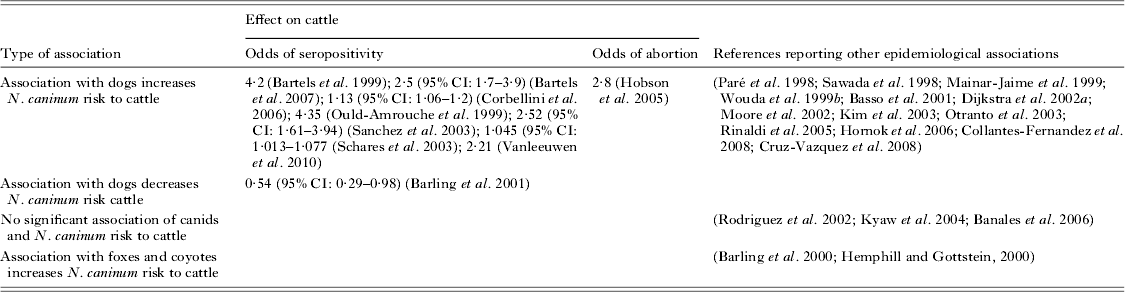
In 1998, dogs were also shown to be a definitive host in the life cycle of N. caninum (McAllister et al. Reference McAllister, Dubey, Lindsay, Jolley, Wills and McGuire1998) and subsequently other canids, such as coyotes (Gondim et al. Reference Gondim, McAllister, Pitt and Zemlicka2004c ), dingoes in Australia (King et al. Reference King, Šlapeta, Jenkins, Al-Qassab, Ellis and Windsor2010) and grey wolves (Dubey et al. Reference Dubey, Jenkins, Rajendran, Miska, Ferreira, Martins, Kwok and Choudhary2011). Foxes (Vulpes vulpes) have also been suggested as definitive hosts (Wapenaar et al. Reference Wapenaar, Jenkins, O'Handley and Barkema2006) and identified as a risk factor associated with infection/abortion in cattle (Wouda et al. in Hemphill and Gottstein, Reference Hemphill and Gottstein2000) (for further details see also Table 1).
Reports for an epidemiological association of Neospora caninum infection and/or abortion with canids (dogs/foxes/coyotes) (odds ratios and other reported epidemiological associations)

Canids are infected through the consumption of infected bovine tissues and start excreting oocysts about 1 week after infection (Gondim et al. Reference Gondim, Gao and McAllister2002). The numbers of oocysts produced by dogs may vary, depending on the tissue consumed that initially harboured the tissue cysts, with bovine or buffalo tissue-derived cysts resulting in higher numbers being shed than when N. caninum cysts were derived from experimentally infected mice (Gondim et al. Reference Gondim, Gao and McAllister2002; Rodrigues et al. Reference Rodrigues, Gennari, Aguiar, Sreekumar, Hill, Miska, Vianna and Dubey2004). The oocysts need to sporulate first to become infective (McAllister et al. Reference McAllister, Dubey, Lindsay, Jolley, Wills and McGuire1998). The proportion of dogs shedding oocysts at any one time may be small, as only 7 in >24 000 dogs coprologically examined in a large-scale study in Germany were found to be shedding N. caninum (Schares et al. Reference Schares, Pantchev, Barutzki, Heydorn, Bauer and Conraths2005). Puppies tend to produce more oocysts than adults (Gondim et al. Reference Gondim, McAllister and Gao2005), and this experiment, albeit with a small number of dogs, also suggested that following the initial infection dogs may become refractory to oocyst shedding for a period of between 8 to 18 months.
The seroprevalence reported from dogs varies across countries and continents (Barber et al. Reference Barber, Gasser, Ellis, Reichel, McMillan and Trees1997; Reichel, Reference Reichel1998; Ortuño et al. Reference Ortuño, Castella and Almeria2002; Andreotti et al. Reference Andreotti, Oliveira, Silva, Oshiro and Matos Mde2006; Collantes-Fernandez et al. Reference Collantes-Fernandez, Gomez-Bautista, Miro, Alvarez-Garcia, Pereira-Bueno, Frisuelos and Ortega-Mora2008; Dubey et al. Reference Dubey, Stone, Kwok and Sharma2008; Ploneczka and Mazurkiewicz, Reference Ploneczka and Mazurkiewicz2008; Sharma et al. Reference Sharma, Bal, Meenakshi, Kaur, Sandhu and Dubey2008; King et al. Reference King, Brown, Jenkins, Ellis, Fleming, Windsor and Šlapeta2012). However, dogs do not always seroconvert soon after infection and may also revert back to seronegative status, despite the shedding of oocysts (McAllister et al. Reference McAllister, Dubey, Lindsay, Jolley, Wills and McGuire1998; Cavalcante et al. Reference Cavalcante, Monteiro, Soares, Nishi, Alves Neto, Esmerini Pde, Sercundes, Martins and Gennari2011), thus these estimates probably underestimate the true prevalence of infection. In summary, the presence of canids is a risk factor for infection of cattle. Many epidemiological studies show a strong statistical correlation between the presence and density of dogs and seroprevalence and probability of abortion in cattle (Table 1).
Abortions and disease in cattle
The observation that N. caninum causes abortions in cattle was first made in the late 1980s in the USA (Thilsted and Dubey, Reference Thilsted and Dubey1989), only a few years after clinical disease was first described in dogs. There are earlier reports of congenital infections in calves (O‘Toole and Jeffrey, Reference O'Toole and Jeffrey1987; Parish et al. Reference Parish, Maag-Miller, Besser, Weidner, McElwain, Knowles and Leathers1987). Observations in other countries soon followed, and particularly in countries such as Australia and New Zealand where bovine brucellosis was eradicated, neosporosis quickly became the most often diagnosed infectious cause of abortions in cattle (Thornton et al. Reference Thornton, Thompson and Dubey1991; Obendorf et al. Reference Obendorf, Murray, Veldhuis, Munday and Dubey1995). In New Zealand, it remains the most commonly diagnosed cause of abortion, at around 20% of abortions, according to information collated from veterinary diagnostic laboratories (Bingham et al. Reference Bingham, Rawdon and Watts2012).
In experimental models, cattle abort from about 3 weeks after infection (Williams et al. Reference Williams, Guy, Smith, Ellis, Björkman, Reichel and Trees2007) when infected with intravenously applied doses of N. caninum tachyzoites at 70 days of gestation. In challenge trials that used the (more realistic) infection route of an oral application of oocysts, abortions occurred later, about 6 weeks after infection (Gondim et al. Reference Gondim, McAllister, Anderson-Sprecher, Björkman, Lock, Firkins, Gao and Fischer2004a ; McCann et al. Reference McCann, McAllister, Gondim, Smith, Cripps, Kipar, Williams and Trees2007). These trials also give an estimate of the infective dose of N. caninum capable of effecting abortion, which, in the McCann trial, was estimated to be as low 127 viable N. caninum oocysts.
Under field conditions, cows appear to abort generally in mid-term, at 5–7 months of gestation (Dubey et al. Reference Dubey, Buxton and Wouda2006).
Infection of the foetus later in gestation, in the third trimester, more often than not results in the subclinical infection of the offspring, which is born clinically normal, but congenitally infected (Pereira-Bueno et al. Reference Pereira-Bueno, Quintanilla-Gozalo, Seijas-Carballedo, Costas and Ortega Mora2000; Quintanilla-Gozalo et al. Reference Quintanilla-Gozalo, Pereira-Bueno, Seijas-Carballedo, Costas and Ortega Mora2000; Williams et al. Reference Williams, Guy, McGarry, Guy, Tasker, Smith, MacEachern, Cripps, Kelly and Trees2000; Innes et al. Reference Innes, Andrianarivo, Björkman, Williams and Conrad2002; Gondim et al. Reference Gondim, McAllister, Anderson-Sprecher, Björkman, Lock, Firkins, Gao and Fischer2004a ).
Life cycle
Dogs (canids) are at the heart of the epidemiology of N. caninum infections and abortions, closing the part of the life cycle that includes sexual replication in canids, and subsequent infection of cattle. However there is another life cycle that just involves cattle, and which relies on the efficient vertical transmission of the parasite from chronically infected dams to their offspring (Paré et al. Reference Paré, Thurmond and Hietala1996; Schares et al. Reference Schares, Peters, Wurm, Barwald and Conraths1998; Hall et al. Reference Hall, Reichel and Ellis2005). Even though some reports claim that transmission is close to 90–100% efficient (see Transmission), theoretical modelling suggests that both parts of the life cycle are necessary to maintain N. caninum in cattle populations (French et al. Reference French, Clancy, Davison and Trees1999). The literature provides strong evidence that the presence of dogs/canids is associated with infection with N. caninum in cattle (Table 1).
Transmission
An important aspect of the parasite is its ability to observe two modes of transmission in cattle.
Post-natal transmission
Dogs shed the oocyst stage of the parasite (McAllister et al. Reference McAllister, Dubey, Lindsay, Jolley, Wills and McGuire1998), which after sporulation becomes infective for cattle (Gondim et al. Reference Gondim, McAllister, Anderson-Sprecher, Björkman, Lock, Firkins, Gao and Fischer2004a ; McCann et al. Reference McCann, McAllister, Gondim, Smith, Cripps, Kipar, Williams and Trees2007). There is ample evidence in peer-reviewed papers that oral transmission to pregnant cows appears to be responsible for abortion events, ‘storm-like’ epidemic abortions (McAllister et al. Reference McAllister, Huffman, Hietala, Conrad, Anderson and Salman1996, Reference McAllister, Björkman, Anderson-Sprecher and Rogers2000; Jenkins et al. Reference Jenkins, Caver, Björkman, Anderson, Romand, Vinyard, Uggla, Thulliez and Dubey2000). On New Zealand dairy farms experiencing an abortion outbreak, post-natal transmission is frequently observed (Schares et al. Reference Schares, Conraths and Reichel1999; Pfeiffer et al. Reference Pfeiffer, Williamson, Reichel, Wichtel and Teague2002). A study in the Netherlands followed up on 12 dairy herds with evidence of predominantly post-natal transmission of the parasite; another study examined 18 such herds with similar conclusions (Dijkstra et al. Reference Dijkstra, Barkema, Eysker and Wouda2001a , Reference Dijkstra, Barkema, Eysker, Hesselink and Wouda2002a ).
Vertical/congenital transmission
An intriguing aspect of the life cycle of this parasite is the very high efficiency of its vertical transmission, congenitally from dam to offspring during gestation. That efficiency of transmission is often quoted as high as 90–100% (Paré et al. Reference Paré, Thurmond and Hietala1996; Schares et al. Reference Schares, Peters, Wurm, Barwald and Conraths1998; Davison et al. Reference Davison, Otter and Trees1999b ; Hall et al. Reference Hall, Reichel and Ellis2005), but also by others as low as ∼40% (Schares et al. Reference Schares, Conraths and Reichel1999; Moré et al. Reference Moré, Bacigalupe, Basso, Rambeaud, Beltrame, Ramirez, Venturini and Venturini2009). It is accepted that, for the parasite to be able to survive in populations of cattle, the occasional ‘top-up’ through post-natal infection (from dogs) is required (French et al. Reference French, Clancy, Davison and Trees1999). This (vertical) transmission pattern is recognized to be usually associated with ‘endemic’, usually low-level, abortion events.
Endogenous vs exogenous transmission
Foetuses may be infected in utero by N. caninum life stages that originated from an already existing, chronic infection of the foetus’ dam with the parasite, which recrudesced, usually in the final trimester of gestation (Williams et al. Reference Williams, Guy, McGarry, Guy, Tasker, Smith, MacEachern, Cripps, Kelly and Trees2000). It was suggested that this be termed endogenous transplacental infection (TPI) and the use of that terminology is becoming commonplace in the literature. Another route would see infection originate from outside the dam (hence exogenous infection), first infecting the dam during pregnancy, and subsequently crossing the placenta to infect the foetus (Trees and Williams, Reference Trees and Williams2005).
There appears to be a majority opinion that congenital infection, possibly because it is highly efficient in transmitting the parasite from one generation to the next (see above), must be the predominant route of transmission. The efficiency of vertical transmission is generally quoted as high, while the rate of post-natal transmission is invariably quoted as low, often less than 5% of cows per annum (Paré et al. Reference Paré, Thurmond and Hietala1996; Davison et al. Reference Davison, Otter and Trees1999b ; Hietala and Thurmond, Reference Hietala and Thurmond1999; Hall et al. Reference Hall, Reichel and Ellis2005; Bartels et al. Reference Bartels, Huinink, Beiboer, van Schaik, Wouda, Dijkstra and Stegeman2007). The relative importance of the two, or predominance of one over the other, however, is not clearly demonstrated in peer-reviewed literature.
A study by Davison et al. (Reference Davison, Otter and Trees1999b ), based on six British herds, shows a predominance of congenital transmission. Equally, a study in Sweden supports the dominance of vertical transmission (Frössling et al. Reference Frössling, Uggla and Björkman2005). In two studies in Australia, vertical transmission was the predominant route of infection (Atkinson et al. Reference Atkinson, Cook, Reddacliff, Rothwell, Broady, Harper and Ellis2000; Hall et al. Reference Hall, Reichel and Ellis2005), while another demonstrates both modes of transmission to be in operation in Queensland (Landmann et al. Reference Landmann, Gunn, O'Donoghue, Tranter and McGowan2011). Another serological study of 14 British herds also supports the importance of congenital transmission, possibly because the study was biased towards herds where a majority displayed a pattern of endemic abortions (Davison et al. Reference Davison, French and Trees1999a ).
A Dutch study of over 100 dairy herds (Bartels et al. Reference Bartels, Huinink, Beiboer, van Schaik, Wouda, Dijkstra and Stegeman2007) quantifies the probability of vertical transmission at ∼45% in randomly selected herds, and the incidence of post-natal infection at 4·5%. The presence of dogs on the farms increased the probability of post-natal transmission marginally and it was higher in herds with a higher within-herd seroprevalence.
Another study of a beef herd over a period of 3 years provides evidence for 85% vertical transmission, as well as an annual mean of 22% post-natal transmission (Björkman et al. Reference Björkman, McAllister, Frössling, Naslund, Leung and Uggla2003).
Others provide evidence, however, that the presence, or indeed introduction of dogs and hence post-natal infection is instrumental in N. caninum abortion events in cattle (Dijkstra et al. Reference Dijkstra, Barkema, Hesselink and Wouda2002b ) (see also Table 1). In seven of eight herds studied there was evidence of a point-source introduction of N. caninum, with a dog introduced within 18 months prior to the abortion events commencing. As all herds also had evidence of vertical transmission of the parasite, the authors hypothesized that the dog got infected on the farms from exposure to infective bovine material.
Other risk factors
Wild and domestic birds have been shown to be able to be infected with N. caninum experimentally and in field observations (Baker et al. Reference Baker, Morishita, Brooks, Shen, Lindsay and Dubey1995; McGuire et al. Reference McGuire, McAllister, Wills and Tranas1999; Costa et al. Reference Costa, Santos, Uzeda, Pinheiro, Almeida, Araujo, McAllister and Gondim2008; Mineo et al. Reference Mineo, Carrasco, Marciano, Werther, Pinto and Machado2008). Epidemiologically, the presence of poultry has been linked with N. caninum sero-positivity (Otranto et al. Reference Otranto, Llazari, Testini, Traversa, Frangipane di Regalbono, Badan and Capelli2003) and abortions (Bartels et al. Reference Bartels, Wouda and Schukken1999). Wild rodents have been shown to be infected with N. caninum (Huang et al. Reference Huang, Yang, Watanabe, Liao and Ooi2004; Barratt et al. Reference Barratt, Al Qassab, Reichel and Ellis2008) and dogs will shed oocysts after the feeding of experimentally N. caninum infected mice (Gondim et al. Reference Gondim, Gao and McAllister2002), but the biological significance of these observations has not been established. Pond water as a source of water supply was also identified as a risk factor for seropositivity, as was the presence of ducks and rabbits (Ould-Amrouche et al. Reference Ould-Amrouche, Klein, Osdoit, Mohammed, Touratier, Sanaa and Mialot1999).
Other domestic ruminants
A number of other species have been reported to be susceptible to N. caninum infections and they might potentially act as reservoirs of continued infection – most commonly sheep and goats are reported as infected. The reported seroprevalences for small ruminants appear to be low in Australia and New Zealand (Reichel et al. Reference Reichel, Ross and McAllister2008; Bishop et al. Reference Bishop, King, Windsor, Reichel, Ellis and Slapeta2010) and parts of South America such as Argentina (Hecker et al. Reference Hecker, Moore, Manazza, Unzaga, Spath, Pardini, Venturini, Roberi and Campero2013a ), but also occasionally higher in other parts of that continent, for example in Brazil (Figliuolo et al. Reference Figliuolo, Kasai, Ragozo, de Paula, Dias, Souza and Gennari2004). In Spain, the presence of N. caninum and Toxoplasma gondii infections in abortion cases in small ruminants submitted for diagnosis has been recently studied. Lesions suggestive of protozoal infection were observed in 10·8% (8/74) and 15·4% (4/26) of ovine and caprine abortions respectively. Neospora caninum and T. gondii infection was detected by PCR in 6·8% (5/74) and 5·4% (4/74) of sheep foetuses, respectively, of which five showed protozoal-associated lesions. Neospora caninum DNA was detected in 11·5% (3/26) of goat foetuses, of which two showed protozoal-associated lesions, whereas T. gondii DNA was detected in one goat foetus with no lesions. The simultaneous presence of N. caninum and T. gondii DNA was detected in one sheep foetus with severe lesions (Moreno et al. Reference Moreno, Collantes-Fernandez, Villa, Navarro, Regidor-Cerrillo and Ortega-Mora2012).
As their risk to cattle is mediated through the completion of the life cycle in dogs, similar measures should be limiting a dog's ability to complete the N. caninum life cycle through ingestion of ovine or caprine tissues. An added bonus of this approach would be the control of other parasites, some of which have zoonotic potential, such as the cestode Echinococcus granulosus (Barnes et al. Reference Barnes, Deplazes, Gottstein, Jenkins, Mathis, Siles-Lucas, Torgerson, Ziadinov and Heath2012).
Wildlife and other bovids
There is strong evidence that N. caninum is a common parasite of wildlife, with a major sylvatic life cycle in wild canids and ruminants (Gondim, Reference Gondim2006; King et al. Reference King, Jenkins, Ellis, Fleming, Windsor and Šlapeta2011a ). In North America, high seroprevalence has been documented in white tailed deer (Odocoileus virginianus), moose (Alces alces), wolves (Canis lupus) and coyotes (Canis latrans) (Gondim et al. Reference Gondim, McAllister, Mateus-Pinilla, Pitt, Mech and Nelson2004b ). Neospora caninum has been isolated from deer tissues and dogs shed N. caninum oocysts after ingestion of infected deer tissue (Gondim et al. Reference Gondim, McAllister, Mateus-Pinilla, Pitt, Mech and Nelson2004b ). Similarly, coyotes shed oocysts after ingestion of infected bovine tissues (Gondim et al. Reference Gondim, McAllister, Pitt and Zemlicka2004c ). Oocysts have also been observed in faeces of wild wolves (Dubey et al. Reference Dubey, Jenkins, Rajendran, Miska, Ferreira, Martins, Kwok and Choudhary2011) and wild red foxes (Wapenaar et al. Reference Wapenaar, Jenkins, O'Handley and Barkema2006). In several studies from North America, up to half of deer samples had antibodies to N. caninum (Dubey et al. Reference Dubey, Hollis, Romand, Thulliez, Kwok, Hungerford, Anchor and Etter1999; Lindsay et al. Reference Lindsay, Little and Davidson2002). Wolves have a seroprevalence among the highest of any studied canine population (Gondim et al. Reference Gondim, McAllister, Mateus-Pinilla, Pitt, Mech and Nelson2004b ), suggesting that a sylvatic life cycle of N. caninum and its potential spill over into cattle is a concern (Rosypal and Lindsay, Reference Rosypal and Lindsay2005). Additional life cycles are also possible, for example feral and wild rodents have been found to harbour N. caninum as detected by PCR (Ferroglio et al. Reference Ferroglio, Pasino, Romano, Grande, Pregel and Trisciuoglio2007; Jenkins et al. Reference Jenkins, Parker, Hill, Pinckney, Dyer and Dubey2007; Barratt et al. Reference Barratt, Al Qassab, Reichel and Ellis2008) and also by isolation in vivo (Huang et al. Reference Huang, Yang, Watanabe, Liao and Ooi2004). The suspected involvement of red fox would most likely necessitate smaller infected prey such as rodents or birds. Small Australian marsupials, such as the fat-tailed dunnart (Sminthopsis crassicaudata), are exquisitely susceptible to N. caninum infection and produce large numbers of tissue cysts (King et al. Reference King, McAllan, Spielman, Lindsay, Hurkova-Hofmannova, Hartigan, Al-Qassab, Ellis and Šlapeta2011b ), which in turn might infect canid predators that could perpetuate the N. caninum life cycle.
CONTROL OPTIONS
There appears to be a number of strategies that rely on knowledge of the life cycle and epidemiology of the parasite that can be used for the control of N. caninum infection or to achieve a reduction in the number of abortions experienced.
The ‘Do nothing’ option
Low levels of infection with N. caninum may well make the identification/control of the infected animals (veterinary and laboratory testing costs) or eradication from the herd (replacement cost of seropositive animals, loss of calves) more expensive than the economic losses incurred by the disease (abortion, early culling, possibly loss in milk yield etc.). For example, in South Australia, less than 5% of beef and dairy cattle appear to be infected across the state (Nasir et al. Reference Nasir, Lanyon, Schares, Anderson and Reichel2012b ), and very few farms demonstrate a within-herd seroprevalence of greater than 15%. Economic modelling (Reichel and Ellis, Reference Reichel and Ellis2006) has previously suggested that it may be the preferred course of action in such herds to ‘live with the disease’, as long as the within-herd prevalence remains below a threshold of 18–21%. The cost of identifying those few infected individual animals (professional veterinary and diagnostic testing cost, replacement of infected individuals) will exceed the benefit (reduction in abortions, stillborn and congenitally defected calves, improved milk yield).
In other states of Australia, particularly on the Eastern seaboard, the prevalence of N. caninum infection appears to be higher than this threshold, at ∼20–30% (Hall et al. Reference Hall, Reichel and Ellis2006; Landmann et al. Reference Landmann, Gunn, O'Donoghue, Tranter and McGowan2011). Even in New Zealand, where the national seroprevalence of dairy cattle appears to be generally below 10% (Reichel, Reference Reichel1998), and less than 5% in beef cattle (Tennent-Brown et al. Reference Tennent-Brown, Pomroy, Reichel, Gray, Marshall, Moffat, Rogers, Driscoll, Reeve, Ridler and Ritaven2000), the within-herd N. caninum prevalence on infected dairy farms generally exceeds 30% (Thornton et al. Reference Thornton, Gajadhar and Evans1994; Cox et al. Reference Cox, Reichel and Griffiths1998; Schares et al. Reference Schares, Conraths and Reichel1999; Pfeiffer et al. Reference Pfeiffer, Williamson, Reichel, Wichtel and Teague2002), making eradication economically attractive. Provided that vertical transmission is the predominant route of transmission and that risk from postnatal (exogenous) transmission is negligible, then a significant reduction of N. caninum-infected cattle or eradication from the herd is achievable if economically feasible by not retaining replacement breeding heifers from seropositive dams (Hall et al. Reference Hall, Reichel and Ellis2005; Landmann et al. Reference Landmann, Gunn, O'Donoghue, Tranter and McGowan2011).
It seems that breaking the life cycle of N. caninum at any one or several points should lead to a reduction of infection with (and thus abortion from) N. caninum in cattle.
Efforts can be aimed at either reducing endogenous transmission and/or at preventing exogenous transmission, depending on the presumed predominant mode of transmission (Fig. 1). However, veterinarians should emphasize to clients that no matter what approaches may be employed, there will always be some risk of future reintroduction of infection via ingestion of contaminated pastures, feedstuffs, or water. The goal is risk reduction, but complete risk elimination will seldom be feasible.
General schematic for approaches to the control of N. caninum infections and abortions. Pathways showing ways for the reduction of the number of N. caninum-infected cows (largely controlling endogenous infection) and pathways showing ways for managing exposure to dogs and canids (managing exogenous infection) and preventing transmission of N. caninum to cattle.

PREVENTION OR REDUCTION OF EXOGENOUS INFECTION
Strategies that are aimed at reducing or preventing infection in cattle (Fig. 1) from exogenous sources would aim to minimize the exposure of cattle to the potentially infected definitive (canid) host. In the long-term, vaccination would ideally prevent infection of naïve cattle in the first place, but no vaccine is currently available.
Managing exposure of cattle to canids – enhanced biosecurity measures
Reichel et al. (Reference Reichel, Alejandra Ayanegui-Alcerreca, Gondim and Ellis2013) estimate that globally only 16·1% of dairy and 11·5% of beef cattle are already N. caninum infected. Thus the use of gates, doors, containers and fences to prevent dogs from having access to (and potentially contaminating) feedstuffs is probably the biggest risk-mitigation strategy for preventing point-source transmission.
As dogs and other canids (coyotes, dingoes, gray wolves, but possibly also foxes) are identified as definitive hosts, it would seem prudent to reduce their ability to ingest domestic ruminant (and cervine) tissue material or to contaminate cattle feed (pasture or otherwise) with oocysts. This could include measures such as the limiting/preventing domestic dogs and wild canids gaining access to domestic ruminant material (muscle, foetal material, placenta and colostrum; Uggla et al. Reference Uggla, Stenlund, Holmdahl, Jakubek, Thebo, Kindahl and Björkman1998), and the heat or freezing treatment of dog food that has been prepared from raw domestic ruminant tissue. All domestic ruminant tissues, also those derived from adults, must be assumed to be potentially N. caninum-infected, as the predilection sites for N. caninum encystation are not well known. Ruminant brain, placenta, skeletal muscle, heart and liver tissue, however have been demonstrated to harbour sufficient tissue cysts in infected cattle to infect dogs and result in oocyst shedding (Dijkstra et al. Reference Dijkstra, Eysker, Schares, Conraths, Wouda and Barkema2001b ; Cavalcante et al. Reference Cavalcante, Monteiro, Soares, Nishi, Alves Neto, Esmerini Pde, Sercundes, Martins and Gennari2011). Stray dogs should be controlled.
Although this may be uncommon, dogs may shed oocysts for protracted periods of time (McGarry et al. Reference McGarry, Stockton, Williams and Trees2003) and as such all dog faeces might potentially be a source of infection to cattle. On the other hand, there is evidence that shedding by experimentally infected dogs usually only lasts for about a week (Gondim et al. Reference Gondim, Gao and McAllister2002; Rodrigues et al. Reference Rodrigues, Gennari, Aguiar, Sreekumar, Hill, Miska, Vianna and Dubey2004) and thus this risk period might be short. Nevertheless, it seems prudent to avoid whelping dogs or raising pups near pregnant cattle.
Although the sylvatic cycles are noteworthy, this knowledge does not easily lead to practical control measures for cattle. Some risk of infection of cattle is inherent when grazing fields or drinking from ponds – thus complete eradication of neosporosis is an unlikely and questionable goal. However, a few practical steps can be taken to limit the access that wildlife has to stored feedstuffs, particularly those that will be used in mixed rations. Also, farms should have animal carcass disposal practices that do not give wild carnivores ready access to freshly dead stock or offal. In both instances, the primary protective measure may simply be careful attention to the placement and design of fences and gates.
Water buffalo (Bubalus bubalis) appear to be quite susceptible to infection with N. caninum, and high infection rates are being reported from a number of countries (Guarino et al. Reference Guarino, Fusco, Savini, Di Francesco and Cringoli2000; Gennari et al. Reference Gennari, Rodrigues, Viana and Cardoso2005; Meenakshi et al. Reference Meenakshi, Sandhu, Ball, Kumar, Sharma, Sidhu, Sreekumar and Dubey2007; Nasir et al. Reference Nasir, Ashraf, Khan, Yaqub, Javeed, Avais and Akhtar2011). Particular care should be taken in managing buffalo–dog interactions, especially as dogs fed water buffalo-derived tissue cysts appear to shed large number of oocysts (and thus presumably are in turn more likely to infect water buffalo again) (Rodrigues et al. Reference Rodrigues, Gennari, Aguiar, Sreekumar, Hill, Miska, Vianna and Dubey2004). In comparison, it is reported that dogs shed lower numbers of oocysts when fed murine or bovine tissue-derived cyst material (Gondim et al. Reference Gondim, Gao and McAllister2002). That particular study, however, did not directly compare the relative oocyst output of dogs derived from buffalo vs cattle sources.
Because they have been shown to be intermediate hosts of N. caninum infection, the control of rodents and poultry (and thus prevention of the infection of dogs) might also be beneficial in reducing the risk of post-natal infection of cattle.
MANAGING ENDOGENOUS TRANSMISSION
Managing endogenous transmission relies on knowledge of the N. caninum infection status of cattle. In order to be assured that all N. caninum-infected cattle are identified and can be successfully managed, possibly excluded/removed from the herd, cut-off thresholds in serological assays may need to be adjusted (generally lowered) to maximize for diagnostic sensitivity (Reichel and Pfeiffer, Reference Reichel and Pfeiffer2002).
There are, albeit rare, reports of cattle presenting as seronegative in antibody detection assays, which can be shown by PCR to be infected with N. caninum (Sager et al. Reference Sager, Fischer, Furrer, Strasser, Waldvogel, Boerlin, Audige and Gottstein2001; McInnes et al. Reference McInnes, Ryan, O'Handley, Sager, Forshaw and Palmer2006). On these rare occasions, this might have the potential to undermine eradication efforts from a herd, or to jeopardize the attempt to prevent infected animals from joining the herd.
Monitoring/testing herds and introductions
If the transmission from one generation of cattle to the next can be prevented (i.e. endogenous transmission), future generations of cattle will be uninfected and should have a reduced risk of abortion provided that further exposure to oocysts can be prevented (see above).
Neospora caninum-infected cattle are assumed to be infected for life and infected cattle are at about three times increased risk of abortion (Paré et al. Reference Paré, Thurmond and Hietala1997; Moen et al. Reference Moen, Wouda, Mul, Graat and van Werven1998); even their seropositive offspring are at continued increased risk of abortion (Thurmond and Hietala, Reference Thurmond and Hietala1997; Wouda et al. Reference Wouda, Moen and Schukken1998). Testing for N. caninum antibodies will allow for the monitoring of replacement heifers; if possible, offspring should only be retained from seronegative cows. Introductions of new stock can be tested and seropositive animals excluded.
Embryo transfer
Embryo transfer (ET) has been shown to be highly effective in breaking the life cycle of N. caninum transmission. Harvesting and transplanting uninfected embryos from seropositive dams has been highly successful (Baillargeon et al. Reference Baillargeon, Fecteau, Paré, Lamothe and Sauve2001; Landmann et al. Reference Landmann, Jillella, O'Donoghue and McGowan2002; Campero et al. Reference Campero, Moore, Lagomarsino, Odeon, Castro and Visca2003) and could provide an avenue for cattle of high genetic value, where the high cost of ET would not matter. It should be remembered though that the valuable offspring is still susceptible to post-natal infection.
Selective breeding
As vertical transmission is cited as highly efficient, it also provides an opportunity to predict the outcome of a gestation – heifer calves from seropositive dams are likely to be infected themselves, and rather than breeding from them (and continuing the life cycle), they could be used for meat production. It might not be economical to test all female offspring of seropositive dams (which would have to be done pre-colostrally or 6 months after birth) to identify those (often few) that are seronegative.
‘Test-and-cull’
Eliminating individual females that test positive should decrease the risk of abortion occurring in a herd and also have the potential to break endogenous transmission of the parasite, potentially reducing/eliminating the infection from the herd (Hall et al. Reference Hall, Reichel and Ellis2005). This should, if complemented by enhanced biosecurity measures (see above) reduce the risk of abortions occurring (Frössling et al. Reference Frössling, Uggla and Björkman2005).
There is good evidence that selectively excluding N. caninum-seropositive, infected dams can quickly reduce the within-herd prevalence of infection (Hall et al. Reference Hall, Reichel and Ellis2005; Landmann et al. Reference Landmann, Gunn, O'Donoghue, Tranter and McGowan2011). The former study reduced the within-herd prevalence by more than 50% in a year, the latter by ∼80% over a 9-year period. A long-term Swedish study showed the potential for pro-active management (culling of seropositive cattle in low-prevalence herds, not retaining, for breeding, the offspring from seropositives in other herds) to reduce infection rates in infected herds over a 2–3 year period (Frössling et al. Reference Frössling, Uggla and Björkman2005). Equally, not retaining the offspring of seropositive cows should reduce the prevalence of infection in herds where the vertical transmission pattern is predominant.
Others (Innes et al. Reference Innes, Buxton, Maley, Wright, Marks, Esteban, Rae, Schock and Wastling2000; McAllister et al. Reference McAllister, Björkman, Anderson-Sprecher and Rogers2000) have presented evidence that already infected dams are at reduced risk of abortion in the event of repeated environmental exposure (essentially ‘naturally’ vaccinated, analogous to the live vaccination mentioned above). There might thus be a case for retaining these cattle in the herd – there is evidence that the risk of abortion in infected animals reduces over time (Thurmond and Hietala, Reference Thurmond and Hietala1997; Stahl et al. Reference Stahl, Björkman, Emanuelson, Rivera, Zelada and Moreno-Lopez2006), however the relative risk (compared with seronegative animals) still remains above 1. These dams are also likely to pass on their infection vertically, thus maintaining infection in a herd, and deferring the risk of abortion to the next generation (Thurmond and Hietala, Reference Thurmond and Hietala1997). Congenitally affected calves may also be affected clinically (Barr et al. Reference Barr, Conrad, Breitmeyer, Sverlow, Anderson, Reynolds, Chauvet, Dubey and Ardans1993), although this may be more common in exogenous outbreaks. Regardless of the cause, there are good management arguments to cull any aborting cow from a commercial herd following good sanitary practices in order to minimize pathogen pollution, or the perpetuation of low reproductive performance.
Reducing concomitant infections
Both infectious bovine rhinotracheitis (IBR) and bovine viral diarrhoea (BVD) (or ‘bovine pestivirus’; Lanyon et al. Reference Lanyon, Hill, Reichel and Brownlie2014) and mycotoxins may exert immune-suppressive effects in cattle that are already infected with N. caninum, which is hypothesized to lead to subsequent recrudescence of the parasite and vertical transmission, and/or abortion. The absence of at least BVD infection has been shown to have a protective effect against N. caninum infection (Vanleeuwen et al. Reference Vanleeuwen, Haddad, Dohoo, Keefe, Tiwari and Scott2010). Control of rodents, while hypothesized to reduce transmission risks of Neospora, will also reduce risks from leptospirosis and salmonellosis, and reduce loss of feedstuffs. Thus control practices for one problem may yield additional benefits. Observations from Switzerland, where bovine neosporosis, on the one hand, is notifiable, and secondly, BVD has recently essentially been eradicated (Presi et al. Reference Presi, Struchen, Knight-Jones, Scholl and Heim2011), should provide evidence soon on whether an absence of BVD infection impacts positively on a reduction in N. caninum abortions. This should also provide evidence on whether vaccination for concomitant infections is not only good husbandry practice but would also make a positive contribution towards N. caninum abortion risk management.
Anti-coccidial treatment
In vitro screening has identified a number of compounds as efficacious against N. caninum (tachyzoites) in cell culture (Lindsay and Dubey, Reference Lindsay and Dubey1989; Lindsay et al. Reference Lindsay, Butler, Rippey and Blagburn1996, Reference Lindsay, Butler and Blagburn1997). Sulphadiazine has also had some effect experimentally in mice (Lindsay and Dubey, Reference Lindsay and Dubey1990) and potentiated sulphonamides and clindamycin remain the drugs of choice in the treatment of clinical cases of neosporosis in dogs (Ruehlmann et al. Reference Ruehlmann, Podell, Oglesbee and Dubey1995; Barber and Trees, Reference Barber and Trees1996; Reichel et al. Reference Reichel, Thornton, Morgan, Mills and Schares1998, Reference Reichel, Ellis and Dubey2007).
Treatment with a coccidiostat (toltrazuril) was successful at eliminating an intravenous, experimental infection with N. caninum tachyzoites in calves when they were treated immediately after infection (Kritzner et al. Reference Kritzner, Sager, Blum, Krebber, Greif and Gottstein2002). This approach has also been found to be an economically viable option in modelling carried out in Switzerland (Häsler et al. Reference Häsler, Regula, Stärk, Sager, Gottstein and Reist2006), requiring low cost inputs, returning the highest positive cost-benefit ratio and high net present value. The authors concluded, however, that considerations regarding food residues and unknown safety profile of the coccidiostat might make it difficult to find acceptance in the general public (or with regulatory authorities). The efficacy of this treatment in the field still needs to be proven. This hypothetical method is aimed at preventing new infections, and would not likely clear established infections.
Treatment with monensin in Canada was identified as being negatively associated with N. caninum seropositivity (Vanleeuwen et al. Reference Vanleeuwen, Haddad, Dohoo, Keefe, Tiwari and Scott2010) in a large-scale epidemiological study of 240 dairy herds, but not statistically associated with better outcomes in a randomized, clinical trial (VanLeeuwen et al. Reference VanLeeuwen, Greenwood, Clark, Acorn, Markham, McCarron and O'Handley2011).
Effective treatment of field infections hence is yet to be demonstrated, and the regulatory hurdles for treatment in a food-producing animal, as much as the need to demonstrate efficacy of such treatment may make this avenue impossible to achieve.
Vaccination
Vaccination with a range of products derived from N. caninum has been trialled for 15 years – early promise came from a crude lysate administered in mice that appeared to prevent completely infection of the offspring (Liddell et al. Reference Liddell, Jenkins, Collica and Dubey1999). This was closely followed by the application in cattle (Choromanski and Block, Reference Choromanski and Block2000). This ultimately led to the commercialization of the only ever registered vaccine for N. caninum (based on inactivated tachyzoites of N. caninum), Neoguard®, that was recently withdrawn from worldwide sales. The limited commercial success may well be attributed to the low efficacy of the vaccine, recently estimated to be as low as 25% (Weston et al. Reference Weston, Heuer and Williamson2012).
Live vaccine approaches have shown promise and higher efficacy, up to 100% in experimental infections (Williams et al. Reference Williams, Guy, Smith, Ellis, Björkman, Reichel and Trees2007; Rojo-Montejo et al. Reference Rojo-Montejo, Collantes-Fernandez, Perez-Zaballos, Rodriguez-Marcos, Blanco-Murcia, Rodriguez-Bertos, Prenafeta and Ortega-Mora2013; Weber et al. Reference Weber, Jackson, Sobecki, Choromanski, Olsen, Meinert, Frank, Reichel and Ellis2013), but have not yet become commercially available because of perceived difficulties with distribution and product stability. Some live vaccine trials, while demonstrating protection of cattle from abortions, have however shown that transmission to the foetus may still be possible (Hecker et al. Reference Hecker, Moore, Quattrocchi, Regidor-Cerrillo, Verna, Leunda, Morrell, Ortega-Mora, Zamorano, Venturini and Campero2013b ). Sub-unit vaccines have been trialled in mouse models (for details see the reviews by Reichel and Ellis, Reference Reichel and Ellis2009; Hemphill et al. Reference Hemphill, Debache, Monney, Schorer, Guionaud, Alaeddine, Mueller and Mueller2013), but have not yet shown efficacy in cattle trials.
There are thus, at the present moment, no commercial vaccines available for the prevention of infection with, or abortion by N. caninum.
Ideally a vaccine for the prevention of N. caninum infection and/or shedding in dogs is needed and should be sought, rendering dogs ‘safe’. Some attempts at producing a vaccine for N. caninum in dogs have been reported earlier (Nishikawa et al. Reference Nishikawa, Ikeda, Fukumoto, Xuan, Nagasawa, Otsuka and Mikami2000a , Reference Nishikawa, Kousaka, Fukumoto, Xuan, Nagasawa, Igarashi, Fujisaki, Otsuka and Mikami b ), but thus far have not produced a viable vaccine. Rendering dogs ‘safe’ would allow them to resume their other important functions on farms, such as warding of wild canids, thus reducing the possibility of infection from the sylvatic part of the life cycle.
MANAGEMENT MEASURES IN PRACTICE: THE EXAMPLE OF NEOSPOROSIS CONTROL PROGRAMMES IN EUROPE
Since the description of N. caninum as an abortifacient in cattle in 1989 in New Mexico (USA), an increased number of studies have reported the relevance of this parasite as a cause of reproductive failure in dairy and beef cattle in Europe. The seroprevalence of N. caninum infection in cattle in this continent indicates that there are significant differences among countries, within countries and between regions. As an example, Bartels et al. (Reference Bartels, Arnaiz-Seco, Ruiz-Santa-Quitera, Björkman, Frössling, von Blumroder, Conraths, Schares, van Maanen, Wouda and Ortega-Mora2006), in a well-designed study using randomized samples and enzyme-linked immunosorbent assays (ELISAs) that were previously standardized among laboratories, found that prevalences were lower in countries from Northern Europe (Sweden) compared with those located in Central (Germany and the Netherlands) and Southern Europe (Spain). Thus, a general strategy to control neosporosis is not applicable in Europe because of regional differences and it is prudent to thoroughly study the local epidemiology of neosporosis before embarking on a control programme. For example, an evaluation in Spain of a very large study involving 37 090 dairy and 20 206 beef cattle, showed a marked increase in prevalence with age in this geographical area. In this study, seroprevalences in dairy cattle were: 10·4% in 12–24 months old, 14·1% in 25–36 months old and 24·6% in >36 months old; similar increases were seen in beef cattle (12·9%, 15·3% and 31·8% in the three age groups, respectively). These data indicated significant post-natal transmission in the area under examination (Eiras et al. Reference Eiras, Arnaiz, Alvarez-Garcia, Ortega-Mora, Sanjuanl, Yus and Dieguez2011) and this fact must be carefully considered when designing control programmes for this particular region.
As far as N. caninum-associated abortions in cattle are concerned, figures of 10–20% of abortions have been described in Western Europe and the disease is considered to have a very high impact on herd productivity (Dubey et al. Reference Dubey, Schares and Ortega-Mora2007; Dubey and Schares, Reference Dubey and Schares2011). Starting in the late 1990s, control programmes at the regional and farm levels have been developed in different European countries (Conraths and Ortega-Mora, Reference Conraths and Ortega-Mora2005). Considering the absence of effective treatments and vaccines, strategies to control infection have been based on minimizing vertical and horizontal transmission: in N. caninum-free herds, prevention of the introduction of the infection through standard biosecurity measures has been the primary goal, whereas in N. caninum-infected herds, control programmes have been based on decreasing the vertical transmission in a herd by reduction of the number of seropositive cattle and/or decreasing the risk of horizontal transmission of N. caninum principally by controlling the definitive host population as a source of oocyst contamination (Conraths and Ortega-Mora, Reference Conraths and Ortega-Mora2005; Dubey et al. Reference Dubey, Schares and Ortega-Mora2007). The availability of efficient diagnostic tools and procedures has been very relevant for the relative success of these programmes decreasing the prevalence of the infection (Ortega-Mora et al. Reference Ortega-Mora, Gottstein, Conraths and Buxton2007). A few examples summarizing the situation of neosporosis control programmes in Western Europe are described below.
The Netherlands
The Netherlands was a pioneer country in implementing control programmes for neosporosis in dairy herds with reproductive problems. In 2005, an estimate of 3000 farmers used serological testing of aborting cows and regular bulk milk screening (three times per year) as tools in the control programmes. In herds with a positive bulk milk test (validated to over 15% within-herd seroprevalence) and abortion problems, seropositive dams were selected based on a whole herd blood screening and herd-specific measures were adopted. In herds with a negative bulk milk test but with abortion problems, selective culling of heifer calves of seropositive dams was done through testing the relatives of seropositive aborting cows. Finally, herds with a negative bulk milk test with no abortion cases or seronegative aborting cows, were advised to test purchased animals in the future. Results on high seroprevalence herds showed a reduction of seroprevalence from 38·2% to 24·4% in a 3-year period (Dijkstra et al. Reference Dijkstra, Bartels and Wouda2005).
Spain
In Spain, control programmes for neosporosis have been conducted on a voluntary basis through the livestock producer health groups (Agrupaciones de Defensa Sanitaria Ganadera, ADSG) and developed at a regional level. ADSG extended its reach from 2003–2004 mainly in the northern parts of the country (Galicia, Asturias and Santander), which have a high percentage of the Spanish dairy cattle population. Initially, efforts were focused on (1) establishing the epidemiological situation of the different regions and herds involved, to establish guidelines for herd monitoring, by means of serological analysis, (2) providing training programmes for veterinarians and farmers and (3) the control of all traded cattle. In addition to neosporosis, the Health Programme included also other relevant diseases of cattle that impact production, such as IBR, BVD and paratuberculosis. From an economical point of view, and as far neosporosis is concerned, the subsidy scheme consisted of: (a) support for the recruitment of veterinarians responsible for the programmes and (b) a reduction in the prices of laboratory tests. This was the basis for achieving a gradual reduction in the prevalence of N. caninum, by gradually removing seropositive cattle and replacing them with seronegative animals. As an example of the success of these programmes, individual prevalences have been reduced in cattle belonging to ADSG from 16·2% and 12·5% in 2003 to 8·5% and 9·2% in 2010 in the Spanish regions of Galicia and Asturias, respectively (Ortega-Mora et al. Reference Ortega-Mora, Aguado-Martínez, Rojo-Montejo and Alvarez-García2010). However, there are no data regarding any concomitant reduction in the number of N. caninum abortions.
Portugal
In Portugal, a privately funded programme promoted by farmers, veterinarians and some pharmaceutical companies was initiated in 2009 and involved more than 250 herds and 23 000 animals (Bovicontrol®). At the starting point of the programme, more than 80% of the herds had seropositive cattle and within-herd seroprevalences were as high as 80%. This programme follows the same basic scheme described above for Spain and also includes neosporosis along with paratuberculosis, IBR and BVD (Niza Ribeiro et al. Reference Niza Ribeiro, Pereira, Afonso and Pacheco2011).
Belgium
In Belgium, the two livestock producer health groups (ARSIA; l'Association Régionale de Santé et d'Identification Animales and DGZ; Dierengezondheidszorg Vlaanderen) also include neosporosis together with IBR, BVD and paratuberculosis in their herd health schemes (Cantaloube, Reference Cantaloube2010). Support for the laboratory diagnosis of abortion events (including neosporosis) is given to farmers and veterinarians.
Switzerland
Finally, in a country such as Switzerland where bovine neosporosis has been a notifiable disease since 2001, no national control programme has been established so far. As Häsler and coworkers pointed out, resources for these initiatives are limited and it is necessary first to fully understand the population dynamics and economic consequences of control options to support the decision making process of policy makers (Häsler et al. Reference Häsler, Regula, Stärk, Sager, Gottstein and Reist2006).
CONCLUSIONS
Even with the present lack of vaccination options, reasonable and practical steps can be taken for the control of N. caninum infection and mitigation of its impact on cattle populations. The overall goal is a reduction of infection prevalence in each breeding herd, but complete eradication may not always be achievable, due to the cost of such an endeavour and the lack of complete accuracy of the diagnostic tests.
The role of the dog and other canids is pivotal for long-term maintenance and spread of bovine neosporosis. For intensively managed breeding herds, a critical control strategy is to limit the access that dogs and canids have to stored feedstuffs that will be used in cattle rations. This should reduce the odds of large-scale or frequent exposure events in the herd. This can be accomplished with carefully designed fences, automatic gates and storage facilities, and does not necessarily mandate confinement or removal of all dogs from farms. The number of dogs on premises, however, should be restricted to the minimum necessary for efficient farm operations, and whelping dogs near cattle should be avoided.
In both intensively and extensively raised cattle, contamination of water by canid faeces should be prevented (e.g. by using troughs instead of ponds). Reduced oocyst contamination in feedstuffs and water, in turn, will gradually reduce infection rates in cattle. When practical, prompt removal or isolation of cattle carcasses, offal and placentas could further assist control measures by reducing the opportunities for farm dogs to become infected and to shed oocysts. Lines of cows can be tested for their N. caninum infection status and then, if desired, offspring of seropositive cows may be excluded from the breeding herd in order to more rapidly reduce herd seroprevalence.
While our recommendations are based on the life cycle of the parasite, empirical evidence will need to be gathered about the efficacy of these suggested control measures. There are a few papers in the literature that have reported on the success of some of the approaches discussed here, such as the ‘test and cull’ approach to rapidly reduce the number of infected cattle in a herd (Frössling et al. Reference Frössling, Uggla and Björkman2005; Hall et al. Reference Hall, Reichel and Ellis2005).
In addition to targeting neosporosis, the following control measures should also mitigate against the transmission of other pathogens:
-
• fences with automatic gates, and/or use of silos, barns and other containers should be employed to reduce the risk of contamination of cattle feed with canid feces;
-
• water sources should also be protected from canid faecal contamination;
-
• dead stock and placentas from all domestic ruminants should be isolated to reduce the risk and potential for transmission of N. caninum to dogs;
-
• selective retention of breeding stock only from seronegative tested dams can be used if endogenous abortion is a problem and rapid reduction of the level of N. caninum infection in the herd is desired.
Education of the farming community through outreach programmes should be aiming to disseminate that information and to ensure such practices are implemented. The above recommendations should result in a reduction of the risk of exposure of cattle to oocyst-contaminated feedstuffs or water and also to a reduction of N. caninum-exposed farm dogs. These options can be implemented now, in the absence of vaccine options, and should show demonstrable benefits.