Introduction
The red turpentine beetle (RTB), Dendroctonus valens LeConte (Coleoptera: Scolytidae), is a type of tree trunk borer that is a secondary pest in its continent of origin, North America (Cibrian-Tovar et al., Reference Cibrian-Tovar, Mendez-Montiel, Campos Bolans, Yates and Flores Lara1995). In some areas, the beetle damages all Pinus spp., and the RTB occasionally damages Picea, Larix, Pseudotsuga, and some Abies spp. (Furniss & Carolin, Reference Furniss and Carolin1977; Zhang et al., Reference Zhang, Chen, Hao and Zhang2004). In China, the RTB damaged large numbers of Pinus tabulaeformis, and Pinus bungeana, Pinus armandii, and Picea meyeri as well (Zhang et al., Reference Zhang, Chen and Zhang2002). The RTB primarily has one generation per year, although some populations have one generation per 2 years. The larvae and adults feed on the bast layer, which eliminates the supply of water and nutrients and results in the death of the tree (Wang et al., Reference Wang, Wang, Han, Liu and Liu2002; Zhang et al., Reference Zhang, Chen and Zhang2002). RTB was first found in Shanxi Province in 1998 from which the beetle has spread rapidly to become a lethal pest of P. tabulaeformis. From 1999 to 2001, RTB spread from Shanxi Province to the Hubei, Henan, and Shaanxi Provinces (Liu, Reference Liu2003). By 2000, the area infested with RTB reached 250 km2, and the affected area encompassed 1290 km2 in which the beetle caused the death of about 3.52 million Pinus tabuliformis trees aged >20 years (Yao et al., Reference Yao, Zhang and Yu2008). After 15 years of comprehensive treatment, the population density of RTB was reduced, and the beetle has not spread to any other provinces, although the tendency to proliferate remains (Liu & Sun, Reference Liu and Sun2008).
To prevent the future spread of RTB, the areas that might be suitable for its spread must be identified. Meteorological data (often historical climate data) are a key factor in predicting suitable distributions, but the use of future climate-forecasting data to predict potential suitable areas for pests is a new area of research (Stephens et al., Reference Stephens, Kriticos and Leriche2007; Mika et al., Reference Mika, Weiss, Olfert, Hallett and Newman2008; Mika & Newman, Reference Mika and Newman2010; Ni et al., Reference Ni, Chen, Qu, Wan, Mei, Pu and Li2010). Because greenhouse gases are correlated with global warming, scenarios for greenhouse gas emissions were considered in simulations of a future climate. In the IPCC Fourth Assessment Report, there were four emission scenarios: A1, A2, B1, and B2. The A1 story line and scenario family describe a future world of very rapid economic growth, a global population that peaks in mid-century and declines thereafter, and the rapid introduction of new and more efficient technologies. The A1 scenario family develops into three groups that describe alternative directions of technological change in the energy system. The three A1 groups are distinguished by their technological emphasis: fossil energy intensive (A1FI), nonfossil energy sources (A1T), or a balance across all sources (A1B). The A2 story line and scenario family describe a very heterogeneous world. The underlying theme is self-reliance and preservation of local identities. The fertility patterns across regions converge very slowly, which results in a continuously increasing population. Economic development is primarily regionally oriented, and per capita economic growth and technological change are more fragmented and slower than in the other story lines. The B1 story line and scenario family describe a convergent world with the same global population that peaks in mid-century and declines thereafter, as in the A1 story line, but with rapid change in economic structures towards a service and information economy, reductions in material intensity, and the introduction of clean and resource efficient technologies. The emphasis is on global solutions for economic, social, and environmental sustainability, including improved equity, but without additional climate initiatives. The B2 story line and scenario family describe a world in which the emphasis is on local solutions for economic, social, and environmental sustainability. The B2 story line is a world with a continuously increasing global population, at a rate lower than in the A2 story line, intermediate levels of economic development, and less rapid and more diverse technological change than in the B1 and A1 story lines. Whereas the B2 scenario is also oriented towards environmental protection and social equity, the focus is on the local and regional levels (IPCC, 2007).
Global climate warming will lead to the expansion of areas with suitable climates for insects, increasing their geographical distributions (Chen & Ma, Reference Chen and Ma2010). Previous research was conducted on the suitable areas for RTB in China based on historical climate data (Wang et al., Reference Wang, Zhang, Kong, Liu and Shen2007). In this study, the potential distributions of RTB in China were predicted with CLIMEX 3.0 based on historical climate data (1971–2000) and on future climate data (2010–2039) with a climate-warming scenario. These results will help to identify potential changes in the areas with a suitable climate for RTB and, thus, will provide theoretical reference and practical guidance to facilitate the effective quarantine, prevention, and control measures for the RTB.
Materials and methods
Study software
CLIMEX software
This study used CLIMEX 3.0 (Hearne Scientific Software Company, Melbourne, VIC, Australia) and the function template ‘Compare the Location’ (one species).
ArcMap software
ArcMap 9.3 (Environmental Systems Research Institute Inc., Redlands, CA, USA) was used to perform the layer analysis with the CLIMEX results.
Climate data
Historical Chinese climate data
The CLIMEX 3.0 weather data set included the monthly average maximum and minimum temperatures, rainfall and relative humidity (RH). There were 85 meteorological stations of China in the soft ware from 1961 to 1990. Based on the China Meteorological Data Sharing Service System (http://cdc.cma.gov.cn/), the China Surface Climate Monthly Standard Values Data set (1971–2000) was downloaded according to the requirements of the CLIMEX format in which the meteorological data were sorted for 741 stations throughout the entire country. The China Surface Climate Monthly Standard Values Data set included two ’.txt’ files: one file stored the geographic information of the station, including station name, longitude, latitude, and altitude, and the other file stored the climate data for the station. CLIMEX uses two fixed format files, ’.loc’ and ’.met’, to store the geographic information and the climate data of a station, respectively, and thus ’.loc’ and ’.met’ files must be created before importing new data into the software. The two raw ’.txt’ files with the station geographic information and climate data were separately converted into ’.loc’ and ’.met’ files, respectively, with the assistance of a professional computer programmer who wrote a conversion program in the C# language. Then, the converted new climate data sets were automatically transferred into CLIMEX from its menu ‘Met manager’.
Chinese climate data for the next 30 years (2010–2039) with a climate-warming scenario
The Climatic Research Unit at the University of East Anglia (http://www.cru.uea.ac.uk/cru/data/hag/) provided various simulated global climate data sets. Thus, the TYN SC2.0 data set was downloaded based on the specific requirements of this study. The data set has very high resolution (0.5° × 0.5°), including 67,420 global land grid points. The TYN SC2.0 data set can be used to simulate future meteorological data for 2001–2100, including the average monthly temperature, diurnal temperature range, precipitation, vapour pressure, and cloudiness. The simulated climate data came from five primary climate-coupling models: HadCM3 (British), PCM (American), CGCM2 (Canadian), CSIRO2 (Australian), and ECHAM4 (German).
A suitable model, emissions scenario and simulation time must be selected to use the TYN SC2.0 data set. Wang & Xiong (Reference Wang and Xiong2004) recommended the German ECHAM4 prediction model. The most extreme emissions scenario, A1F1, was selected to simulate a worst-case scenario of the suitable climatic areas for the RTB, which would lead to subsequent implementation of more sufficient control measures. In general, 30 years is the standard period used to analyse climate, and the next 30 years (2010–2039) were selected for the simulation, which used the average meteorological data for this 30 year period.
The climate data in the TYN SC2.0 data set could not be used directly with CLIMEX and were converted to include average maximum daily temperature (Tmax), average minimum daily temperature (Tmin), average monthly rainfall (Prec), average daily RH at 9 a.m. (Hum9) and average daily RH at 3 p.m. (Hum15). The data of Tmax and Tmin were calculated with the TMP and DTR of TYN SC2.0 (Stephens et al., Reference Stephens, Kriticos and Leriche2007). The data for RH were obtained from the equation RH (%) = 100 × (e a÷e 0 (T)), where e a represents the measured vapour pressure at the temperature T, namely, the VAP data of TYN SC2.0. The e 0 (T) represents the saturation vapour pressure that was calculated from the equation e 0 (T) = 0. 6108 exp[17. 27T/(T + 237.3)] (Allen et al., Reference Allen, Pereira, Raes and Smith1998). The RH calculated with the first equation was regarded as the Hum15, and the Hum9 was obtained after Hum15 was divided by 85% (Mika et al., Reference Mika, Weiss, Olfert, Hallett and Newman2008). After the data were transformed, the meteorological stations located in China were included for analysis.
Overall analytical process
Based on the biological data for RTB and the template data in CLIMEX, the initial parameters for RTB were established to predict its current distribution according to its known distribution throughout the regions of North America. The parameters were modified until the prediction for North America was consistent with the actual data, which yielded the final parameters. Using the final parameters set for RTB, the ecoclimatic index (EI) values were calculated for each station in China based on the historical climate and on a future climate-warming scenario. After importing the EI values into ArcGIS9.3 and applying an inverse distance-weighted interpolation analysis, the maps with areas of distribution in China with suitable climates for RTB were generated based on the historical climate and on a future climate-warming scenario.
Fitting parameters
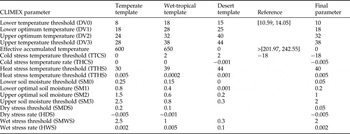
The biological data were incomplete for RTB; therefore, the parameters were established with both published data and the relative template data included in CLIMEX. Currently, RTB is native to Canada, the USA, and Mexico (www.cabi.org/cpc) and lives primarily in temperate and tropical climatic conditions but also survives in a tropical desert climate. The final parameters are listed in Table 1. The specific methodology was as follows.
CLIMEX parameter values for Dendroctonus valens.

Miao et al. (Reference Miao, Zhou, Fan, Wang, Zhao and Lu2002) determined that the effective accumulated temperatures for eggs and pupae of the RTB were 77.59 ± 5.27 and 144.67 ± 15.02 degree-days, respectively. However, RTB occurs in frigid zones such as Alaska and can take 2–3 years to complete a single life cycle (Pan et al., Reference Pan, Wang, Wen, Luo and Zong2011); therefore, the PDD (Parameter of Degree-Days, means minimum degree-days above DV0 necessary to complete a generation. ) was regarded as negligible and was set to 0.
The parameter settings for the lower temperature threshold (DV0) were set with reference to Miao et al. (Reference Miao, Zhou, Fan, Wang, Zhao and Lu2002) who determined the developmental threshold temperatures for the eggs and pupae as 14.86 ± 0.61 and 12.32 ± 1.73°C, respectively. In the present study, RTB was assumed to have properties of the species in both temperate and tropical zones, and thus the lower optimum temperature (DV1), the upper optimum temperature (DV2) and the upper temperature threshold (DV3) were set with reference to temperate and tropical templates. Zhao et al. (Reference Zhao, Yang and Jean-Claude2009) determined that the lowest mean super-cooling point for overwintering RTB larvae was −11.98 ± 2.55°C, and that the lowest extreme temperature that RTB could withstand was −23.5°C. However, the cold stress temperature thresholds were set with reference to the field observation data of Wu et al. (Reference Wu, Zhao, Zhang, Guo, Li, Niu, Li and Lu2002), who found that the larvae and adults could not overwinter in tree trunks at temperatures below −18°C. The RTB primarily occurs in temperate and tropical grasslands, with some distributed in tropical deserts. Thus, the heat tolerance of the RTB was between the individual tolerances in tropical grasslands and deserts.
Many studies indicated that RTB preferred drought-prone environments. High temperatures and droughty conditions increased the number of RTB adults in flight and were conducive to the infestation and damage from RTB. However, high humidity, particularly continual rainfall, could affect the development of the eggs and larvae; the adults and larvae were more likely to die from disease caused by entomopathogens when soil moisture was high (Miao et al., Reference Miao, Zhou, Huo, Wang, Fan and Zhao2001; Wu et al., Reference Wu, Zhao, Zhang, Guo, Li, Niu, Li and Lu2002; Liu et al., Reference Liu, Wen, Zhao, Wan, Li, Li and Guo2004). However, the studies were qualitative without accurate experimental data. The RTB survives in temperate and tropical desert environments based on actual distribution records, and therefore, the humidity indices were set with reference to the desert and temperate templates.
Classification of EI values
The CLIMEX uses the EI value to assess the potential suitability of a species to a specific location. The EI scale ranges between 0 and 100: 0 indicates that the location is not favourable for the long-term survival of a species, EI > 30 represents a highly favourable climate for a species, and EI = 100 is achievable only in constant and ideal conditions such as in experimental incubators (Sutherst et al., Reference Sutherst, Maywald and Kriticos2007).
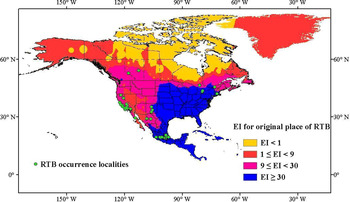
The longitude and latitude of 72 county-level locations that were affected by D. valens were acquired from the GBIF (http://data.gbif.org/search/Dendroctonus%20valens) and the State Forestry Administration of China. Twenty-two sites were in China, 23 were in the USA, 21 were in Mexico, and 6 were in Canada. After the parameters of the RTB for CLIMEX were determined, the ArcGIS software was used to process the forecasted outcomes with IDW (inverse distance to power) to form a graph of EI values that was then overlapped with the current distributions and the predicted information for RTB. After statistical analysis, the EI values of the 72 locations of actual distribution ranged from 7 to 69. Of the collection localities, 31 (37.5%) were in the regions with 7 ≤ EI < 30, and 45 were (62.5%) areas in the range of EI ≥ 30. In China and Mexico, which are severely damaged by RTB, most collection localities (21/22 and 18/21, respectively) were in the regions of EI ≥ 30. Additionally, regions with values of EI < 1 were not concluded in the range of the actual distribution (figs 1 and 2). Thus, we concluded that RTB could barely survive in habitats with EI values less than 1, whereas they could easily survive in habitats in which the EI value was higher than 30. Based on several studies, the northernmost limit of the distribution of RTB was in Alaska, USA, from which it was inferred that Alaska was the fringe region suitable for survival of the RTB. Because the estimated EI value in this region of Alaska was below 9, it was concluded that the EI values for suitable fringe habitat were 1 ≤ EI < 9, and the EI values for intermediate suitable habitats were 9 ≤ EI < 30. Therefore, we classified the suitability of areas for the RTB into four levels: Class 1 (EI < 1) indicated that the location was not suitable; Class 2 (1 ≤ EI < 9) indicated marginal zones; Class 3 (9 ≤ EI < 30) indicated areas suitable for survival; and Class 4 (EI ≥ 30) indicated locations with high suitability for survival.
Predicted distribution and actual distribution of Dendroctonus valens in North America.

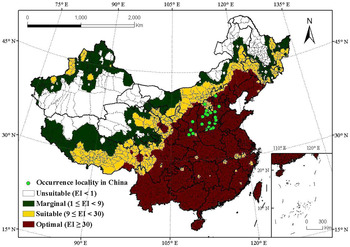
Potential areas with suitable climates for Dendroctonus valens based on historical climate data (1971–2000).

Results
Potential distribution predicted for RTB based on historical climate conditions
The areas with a suitable climate for RTB in China, based on the historical climate, are shown in fig. 2. A wide range of areas had a suitable climate, i.e., about 7.17 million km2 in total, or ca. 75% of the total land area, and every province in China contained suitable habitat for RTB. The northern limit of the distribution was predicted to be Yakeshi and Elunchun in Inner Mongolia. The area with the optimal climate (Class 4, EI ≥ 30) was approximately 3.5 million km2, or ca. 36% of the total land area. This area was concentrated primarily in east-central China, with a boundary that reached from Tibet to Jilin in a northeast direction and in which the southeast areas within the boundary were the most suitable. The area with a moderately suitable climate (Class 3, 9 ≤ EI < 30) was smaller than the class 4 area at approximately 1.62 million km2 and was concentrated primarily in a long and narrow area along the boundary of the highly suitable areas in the northwest. The area with a less suitable climate (Class 2, 1 ≤ EI < 9) was slightly larger than the class 3 area at approximately 2.04 million km2 and was distributed primarily in specific areas in the west and in the northeast.
Potential distribution predicted for RTB under an extreme climate-warming scenario
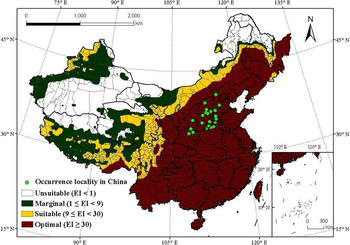
Fig. 3 shows the future areas of China with a climate suitable for RTB under an extreme climate-warming scenario in the next 30 years (2010–2039). Compared with the suitable areas predicted from the historical climate data, the potential areas with high suitability in a global-warming scenario extended further to the northeast. The total suitable area increased by more than 0.23 million km2 in a global-warming scenario for a total of approximately 7.4 million km2, i.e., 77% of the total land area. The increase in the highly suitable areas was most significant, with the increases occurring primarily in the northwest and in the northeast. The highly suitable area increased by 0.83 million km2 and reached to 4.33 million km2. In Northeastern China, the boundary of the optimal distribution moved northward and reached to Jilin and southern Heilongjiang Province. In the southwest, the areas of optimal distribution in Sichuan and Qinghai Provinces extended further to the northeast. The moderately suitable areas also tended to extend further to the northeast and northwest compared with the historical climate results, but the total moderately suitable area in a global-warming scenario decreased by approximately 0.32 million km2. Compared with the historical climate results, the area with less suitable climate decreased by approximately 0.28 million km2. The overall situation was almost unchanged.
Potential areas with suitable climates for Dendroctonus valens based on a climate-warming scenario (2010–2039).

Discussion
Will global warming reduce climatic restrictions on conditions for potential survival of RTBs in China?
The predicted suitable distribution with the historical climate data set showed that China had not only large areas with suitable climate for survival of RTBs but also some unsuitable areas. We found that two limited climate factors restricted the potential distribution of RTBs: low temperature and drought. In both the southwest and northeast regions of China, the primary restriction was low temperature. The southwestern provinces of Qinghai and Tibet, with plateau alpine climates, could prevent the vertical distribution of RTBs. In the northeastern regions at high latitudes, including Inner Mongolia and Heilongjiang Provinces, with frigid weather, the distribution of RTBs was limited to those latitudes. The northwestern region of China, including Xinjiang, Inner Mongolia, and Gansu Provinces, has serious desertification, and the severe drought conditions would prevent the survival of RTBs. If the climate-warming scenarios proposed in this study are accurate, the limitations imposed by low temperatures and drought would be reduced, and the suitable area for RTBs in China would expand to the north and to the west. After statistical comparison between the historical climate and the simulated climate data sets, we found that the average annual maximum temperature in China would increase from 17 to 19.8°C, the average annual minimum temperature would increase from 6.2 to 6.9°C, and the average annual rainfall would increase from 67.5 to 75.2 mm in the next 30 years (2010–2039). Corresponding to these climatic changes, the suitable area for RTBs using simulated climate data would increase by 0.23 million km2.
Assumptions about the survival and spread of RTBs according to the predicted distribution of suitable areas
According to the 2013 data set from The National Forestry Protection Station, the major areas of distribution of RTB in China were Shanxi, Shaanxi, Henan, and Hebei Provinces, including 22 counties/cities (figs 2 and 3), for a total area of 562.6 km2. By contrasting the actual distributions and the suitable areas predicted under both the historical climate and the climate-warming scenario data sets, we found that the recorded distributions of RTB were within the range of suitable habitats predicted based on both the historical data (fig. 2) and the future scenario (fig. 3). The predicted results from the historical climate data showed that the actual distribution sites were all consistent with the regions of highly suitable habitats, and the suitability of these habitats would increase under the extreme climate-warming scenario. However, if the climate continues to warm rapidly, the damage caused by RTB in the infected areas would worsen, and thus local forestry protection would have a difficult task. Currently, the actual distribution of RTB in China is sporadic compared with the potential suitable regions available with many more habitats for the RTBs to survive. Regarding the direction of spread of this species, the current distribution zone of RTB is a central core from which this species would spread, with the beetle radiating from this heartland. If the climate continues to warm, more areas would become highly suitable for this species, which would help to spread RTB in China indirectly.
In the climates suitable for RTB, the dominant factor affecting the spread of the beetle in China is host plants. The host plants of RTB in China include P. tabuliformis, P. bungeana, P. armandii, Pinus sylvestris var. mongolica, Larix principis rupprechtii, and P. meyeri, among others. P. tabuliformis is the major host tree species, and this species is distributed across northeastern, northwestern, central and southwestern China. Combining the tendency of RTB to spread, the variation in suitable habitats under the extreme climate-warming scenario, and the multiple geographical elements of China, we assumed that within the next 30 years RTB would spread towards the northeast, northwest, and central regions of China. Of these directions of spread, the tendency to spread into the northeast and central China was much more apparent. Currently, the tendency for RTB to spread towards northeast areas is apparent. Based on the predicted results from the historical climate data, the RTB has invaded into the fringe region of highly suitable habitats. With the trend in future climate change, the area of suitable habitat and the level of suitability would continue to increase in northeast China. In central China, geographically close to the zone infected with RTB, it is highly possible that RTBs would infect the surrounding areas. In northwest China, because of the severe situation with desertification and the lack of continually available host plants, the species might spread along the north region of the Qinling Mountains and then enter into Gansu Province. In southwest China, blocked by the Qinling Mountains, which run from east to west, a natural RTB invasion towards Southwestern China in a short time would be difficult.
Advice to prevent the spread of RTB
Based on the global-warming and historical climate data sets, the suitable areas predicted for RTB indicate that currently the pest has not yet extended beyond the edge of these suitable areas. Emergency management measures prevented the ulterior spread of RTB temporarily, but the dispersal ability of RTBs is high (Zhang et al., Reference Zhang, Chen and Zhang2002). To reduce the damage from RTB, precaution and control measures should be implemented in synchrony. First, employ different measures to control the spread of RTB according to the degree of damage in different regions. Second, conduct investigations of RTB to strengthen monitoring and forecasting capabilities. Thus, it is very important to prevent any further increase in the range of the beetle. The predicted results could help the affected departments to adjust to the specific measures, particularly to increase the monitoring of the regions in the direction of the spread. Additionally, the forestry department should cooperate with other departments (such as the Department of Environmental Protection) to determine the effects on the environment. In Northern China, particularly in the northeast, the production mode of heavy industry development has had a large effect on the environment, and this type of production has an important role in causing global warming and in other serious environmental problems, such as the haze that has appeared in recent years. The change in climate is a direct factor of influence on the potential distribution of an insect, but the activities of humans and the environment are also fundamental factors. Therefore, the spread of RTB should be avoided with specific control measures, but measures to protect the ecological environment should also be considered. Practically, the affected departments should improve the economic mode of production and should strengthen the environmental management to decrease the rate of climate warming to control the spread of RTB.
Acknowledgements
The Fundamental Research Funds for the Central Universities (grant no. TD2011-06) supported this research. For helping to extract and transfer climate data into the standard form of CLIMEX, thanks are offered to the professional computer programmer, Bao Tingfang.