Introduction
As populations age, it is increasingly important to understand drug use and safety in the elderly. Sedative–hypnotic drugs are the most widely prescribed psychotropic drugs around the world for treating symptoms common in geriatric patients (Linden and Barnow, Reference Linden and Barnow1997; Glass et al., Reference Glass, Lanctot, Herrmann, Sproule and Busto2005; Taipale et al., Reference Taipale, Bell, Gnjidic, Sulkava and Hartikainen2011; Dell'osso and Lader, Reference Dell'osso and Lader2013). According to the Center for Substance Abuse Treatment (1998), elderly people account for a larger proportion of sedative–hypnotic users than any other age group. Prevalence of sedative–hypnotic drug use in elderly persons aged 65 years and over is approximately 10–42% worldwide (Aparasu et al., Reference Aparasu, Mort and Brandt2003; Glass et al., Reference Glass, Lanctot, Herrmann, Sproule and Busto2005). In Taiwan, the one-year prevalence rates of sedative–hypnotic use among elderly outpatients ranged from 8% to 43% (Su et al., Reference Su, Huang and Chou2004; Cheng et al., Reference Cheng, Huang, Lin and Shih2008; Hsiao et al., Reference Hsiao, Hsieh and Gau2013). Different estimates resulted from differences in the study designs, the accessibility of and regulations on sedative–hypnotic drugs in different regions, and characteristics of the target populations (e.g. age groups) (Zandstra et al., Reference Zandstra, Furer, van de Lisdonk, Bor, Zitman and van Weel2002).
Elderly people may experience additional severe side effects associated with the use of psychotropic drugs, such as lower metabolic rates and increased sensitivities to neurotransmitters in aging brains. Over the past decade, sedative–hypnotic medication use has been associated with several severe adverse events (AEs) and risks (Fick et al., Reference Fick, Hodo, Lawrence and Inouye2007), including mortality (Drummer et al., Reference Drummer2004), dementia (Verdoux et al., Reference Verdoux, Tournier and Cougnard2005; Wu et al., Reference Wu, Wang, Cheng and Gau2011; Billioti de Gage et al., Reference Billioti de Gage2012), traffic accidents (Barbone et al., Reference Barbone1998), mobility limitations (Taipale et al. Reference Taipale, Bell, Gnjidic, Sulkava and Hartikainen2011), hip fractures (Schneeweiss and Wang, Reference Schneeweiss and Wang2005), and falls (Hoque and Chesson, Reference Hoque and Chesson2009). Additionally, use of sedatives and hypnotics is associated with age, female gender, white race, high school educations, low-to-normal body mass indices (BMIs), and symptoms such as insomnia, anxiety, depression, mental disease, cardiovascular disease (CVD), cancer, multiple chronic diseases, or arthritis, and former users of sedative–hypnotic (Fourrier et al., Reference Fourrier, Letenneur, Dartigues, Moore and Bégaud2001; Hoque and Chesson, Reference Hoque and Chesson2009). However, correlations among AEs, clinical and sociodemographic characteristics, and drug use have been inconsistent.
Most associations found in previous studies were based on health claims data, which are great sources for rare events (e.g. hip fracture) and for avoiding the bias of selecting healthier samples (Schneeweiss and Wang, Reference Schneeweiss and Wang2005). It is possible, though, that the limited number of diagnostic codes and lack of information on potential sociodemographic information in claims data may lead to over- or underestimation of correlations between drug use and AEs (Schneeweiss and Wang, Reference Schneeweiss and Wang2005; Cheng et al., Reference Cheng, Huang, Lin and Shih2008). Although the clinical characteristics related to sedative–hypnotic use have been documented, little is known about how the roles of sociodemographic characteristics, such as socioeconomic status, social support, quality of life, and adverse life events, affect the likelihood of sedative–hypnotic use.
The National Health Insurance (NHI) program in Taiwan provides universal health insurance coverage that makes high-quality medical care accessible at relatively low cost. Because greater access to quality healthcare also increases accessibility to restricted medications (e.g. sedatives and hypnotics), concerns about drug use safety is a growing issue. Cheng and colleagues (Reference Cheng, Huang, Lin and Shih2008) using the NHI dataset found that 43% elderly registered in the NHI program received at least one prescription of sedative or hypnotics. While the medical world is still debating on the tradeoff between the side-effect and treatment of using them in the elderly, elderly people are more likely to receive prescriptions for sedatives and hypnotics from multiple physicians managing coexisting geriatric symptoms.
Therefore, the present study aims to evaluate the use of sedatives and hypnotics among community-dwelling elderly individuals aged 65 years and over in Taiwan. Additionally, this study aims to assess the characteristics associated with the use of sedatives and hypnotics based on data collected from nationally representative samples of elderly individuals who were enrolled in the Healthy Aging Longitudinal Study in Taiwan (HALST) from 2009 to 2013.
Methods
Data
This study was conducted using data from HALST. A total of 5,664 elderly adults aged 55 years and over living within a 2-km radius of eight collaborated hospitals in representative cities across Taiwan were enrolled. By using systematic sampling methods, researchers ensured the HALST cohort representing the population norms in terms of age, gender, and education levels. Further details of the sampling frame, demographic of the sample, training of interviewers and field quality control are described elsewhere (Hsu et al., Reference Hsu2017). Sociodemographic, health professional-diagnosed, and self-reported data on health and sedative–hypnotic use were collected. Analyses of the prevalence of and characteristics associated with sedative–hypnotic use were conducted specifically with participants aged 65 years and over (n = 3,978).
Measures
Participants completed a comprehensive questionnaire administered by trained research assistants. The survey assessed demographic characteristics, such as age, sex, location, marital status, living arrangement, employment, and education level. The number of diseases was calculated based on self-reported medical conditions (e.g. hypertension, heart disease, Parkinson disease, hypercholesterolemia, and cancer), which had been previously diagnosed or lasted for a period of time. Chronic diseases were subdivided into CVDs and non-CVDs. Mental illness was calculated independently as a separate variable based on self-reported histories of mental disorders and dementia.
Mini-Mental State Examination (MMSE) was used to test mental abilities, including memory, attention, and language. The maximum score on the MMSE is 30 points, with a general cutoff of ≥24 points being considered normal (Folstein et al., Reference Folstein, Folstein and McHugh1975). The Center of Epidemiologic Studies-Depression (CES-D) scale was used to screen mood disorders. Subjects scoring ≥16 points of 20 questions (range: 0–60 points) were conventionally considered depressive (Radloff, Reference Radloff1977).
Physical functioning was assessed by the Barthel Index of Activities of Daily Living scale (ADL; range: 0–100 points) (Kane, Reference Kane and Kane2000) and the Lawton-Brody instrumental Activities of Daily Living scale (IADL; range: 0–23 points) (Lawton and Brody, Reference Lawton and Brody1969). In both scales, higher scores indicate better physical functioning. Geriatric assessments of falls were recorded as: ever = 1 or never = 0. Pain in different parts of body was scored as 0 for no pain at all or 1 for pain in at least one part of the body. Sleep problems were assessed based on self-reports of daytime sleepiness, midnight wakefulness, early wakefulness, and insomnia. Scores for sleep problems ranged from 0 to 16, with a score ≥ 4 representing poor sleep quality.
Six questions used to evaluate social networking (range: 0–27, higher scores represent stronger social networking) are as follows: (1) How often do you interact with neighbors? (2) How friendly do you feel about your neighbors? (3) Do you participate in any kind of community activities? (4) Do you live with your family? (5) In the past year, how often do you meet your relatives, other than family members in your household? (6) How often do you meet your close friend? The questionnaire was adapted from the National Health Interview Survey in Taiwan (NHIS) conducted in 2005.
A total of 25 questions on the following life events within the past year was solicited from participants and used in analysis: being a victim of a catastrophe or crime, change in economic status (including retirement, unemployment, and financial crisis), change in health status (including new diagnosis of diabetes or cancer), death of a family member or friend, increased care burden on family, residential move, and relationship problems (including divorce, separation, and conflict with family member or neighbor) (Wu et al., Reference Wu, Yu, Lee, Tseng, Chiu and Hsiung2017). Impact of adverse life-changing events (range: 0–100, higher scores represent greater impact) as well as social networking were evaluated as risk factors for chronic diseases in NHIS questionnaires (NHIS Working Group, 2005).
BMI was calculated by dividing the subject's body weight (in kg) by their height squared (in m2). Using the traditional Chinese criteria, we considered BMI ≤ 18.5kg/m2 to be underweight and BMI ≥ 24 kg/m2 to be overweight. Three items on the questionnaire addressed healthy lifestyle: current (active) and/or past smoking status, betel nut consumption, and alcohol consumption in the past year.
Assessments of sedative–hypnotic use included the following questions: (1) In the past month, did you take sleeping pills? (2) In the past month, did you take a sedative? and (3) Did you use it with or without a prescription from a doctor? Responses were not limited to any specific sedatives or hypnotics. Analyses included self-reported responses for use with or without prescriptions. Interviewers recorded detailed medical prescription information from participants’ prescription bags (including Western and Chinese herbal medicines), as well as over-the-counter (OTC) drugs, if available. Collected information, included drug names, methods of administration, doses, sources, clinical uses, and durations of treatment. Data cleaning process involved one pharmaceutical expertise who helped us identify sedatives and hypnotics use with all pieces of information and resources available. According to clinical guidelines, prescriptions with clinical uses as sedatives or hypnotics were selected for the current analysis, including Triazolam, Flurazepam, Estazolam, Midazolam, Zolpidem hemitartrate, Zopiclone, Flunitrazepam, Fludiazepam, Diazepam, Alprazolam, Oxazolam, Clobazam, Lorazepam, and Bromazepam.
Statistical analysis
All analyses were performed using SAS version 9.3 (SAS Institute, Inc., Cary, NC). Wilcoxon or χ 2 test was used to compare baseline characteristics among sedative–hypnotic users (self-reported only, medicine bag information only, and both reports) and non-users. Logistic regression modeling was used to evaluate the odds ratios (ORs) and corresponding 95% confidence intervals (CIs) of sedative–hypnotic use across various sociodemographic characteristics, self-reported number of diseases, mental illness, depression, physical functioning, social networking, adverse life events, and quality of life, after adjusting for potential confounders, such as age and sex. The significance threshold was set at 0.05. Ethics approval was granted by the National Health Research Institutes Office of the Institutional Review Board.
Results
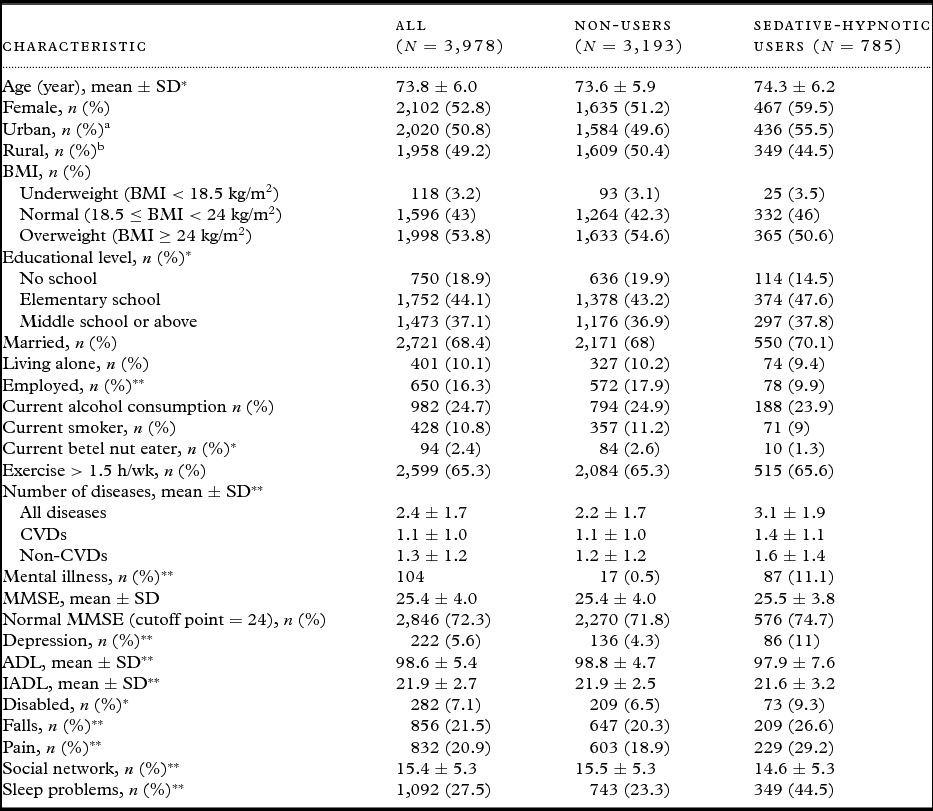
Both prescription bags and self-report data added important pieces of information on the use of sedative and hypnotics. Before we reached the final estimation of prevalence rate, the consistency between the two reported sources was considered. As displayed in (see Table S1, available as supplementary material attached to the electronic version of this paper at www.journals.cambridge.org/jid_IPG) 431 users (54.9%) provide consistent report of self-reported use and prescription bags; 66 subjects (8.4%) reported no use of medication, but there were records of drug use on the prescription bags; and 288 subjects (36.7%) reported use of medication, but without available corresponding prescription bag information for confirmation. We regrouped these three groups (see Table S1) into sedatives and hypnotics medication use. Drug users were identified either through their prescription bags (n = 497) or through self-reported use of sedatives and hypnotics (n = 719), leading to a total of 785 sedative–hypnotic users among the elderly whom were included in the subsequent analyses (Table 1). Among them, 35 subjects (35/785 = 4.5%) reported use of sedatives or hypnotics without a doctor's prescription.
Baseline characteristics of elderly persons, categorized by drug use

BMI = body mass index; SD = standard deviation; CVD = cardiovascular disease; MMSE = Mini-Mental State examination; ADL = Barthel Index of Activities of Daily Living scale; IADL = Lawton-Brody Instrumental Activities of Daily Living scale.
Wilcoxon or χ 2 test was conducted to detect differences between groups (sedative-hypnotic users vs. nonusers).
*p < 0.05.
**p < 0.001.
a Taipei, Changhua, Kaohsiung, or Hualien.
b Miaoli, Yangmei, Shoufeng, or Chiayi.
The overall prevalence of sedative–hypnotic use was 19.7% (n = 785) in elderly individuals aged 65 years and over. We found that 4.5% of elderly people reported the use of sedatives, 9.9% reported the use of hypnotics, and 3.7% reported the use of both sedatives and hypnotics (Table S2). Differences between sedative–hypnotic users and non-users in terms of baseline sociodemographic characteristics and clinical data are described in Table 1. Older age, female gender, residence in city areas, higher education levels (elementary school and above), unemployment, no betel nut chewing, higher numbers of diseases (CVDs and non-CVDs), mental illness, depression, lower physical functioning scores (ADL and IADL), falls, pain, low social networking levels, and sleep problems were factors associated with greater likelihood of sedative–hypnotic use.
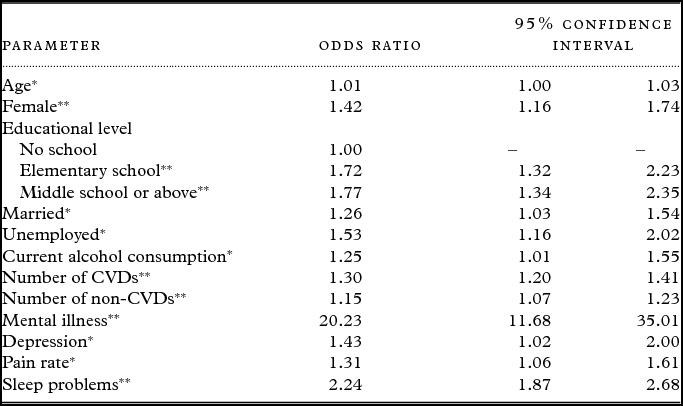
Logistic regression analysis on sedative–hypnotic use (Table 2) revealed that older age (OR 1.02; 95% CI =1.00–1.03) and female gender (OR 1.42; 95% CI = 1.16–1.74) were predictive risk factors for increased sedative–hypnotic use. Compared to uneducated individuals, subjects who had elementary school education (OR 1.72; 95% CI = 1.32–2.26), middle school education and above (OR 1.77; 95% CI = 1.34–2.35), were married (OR 1.26; 95% CI = 1.03–1.54), or had current alcohol consumption (OR 1.25; 95% CI = 1.01–1.55) were more likely to use sedatives or hypnotics. Unemployment (OR 1.53; 95% CI = 1.16–2.02) was associated with greater drug use, as were the number of CVDs (OR 1.30; 95% CI = 1.20–1.41), number of non-CVDs (OR 1.15; 95% CI =1.07–1.23), mental illness (OR 20.23; 95% CI = 11.68–35.01), depression (OR 1.43; 95% CI =1.02–2.00), pain (OR 1.31; 95% CI = 1.06–1.61), and sleep problems (OR 2.24; 95% CI = 1.87–2.68).
Factors associated with sedative-hypnotic use

CVD = cardiovascular disease.
*Statistically significant covariates with p < 0.05.
**Statistically significant covariates with p < 0.001.
Discussion
In this study, we examined the prevalence of and factors associated with sedative–hypnotic use among community-dwelling elderly individuals aged 65 years and over in Taiwan with the goal of identifying target audiences for further intervention on drug use safety. We found the prevalence of sedative–hypnotic use was 19.7%, suggesting one in five community-dwelling elderly uses sedatives or hypnotics. Despite their regulation as controlled substances, 4.5% of sedatives or hypnotics uses were without a doctor's prescription.
The inconsistency between self-reported drug use and prescription data warrants further investigation. Furthermore, up to 8.4% of our participants who reported no use of sedatives or hypnotics held relevant prescription records or medication bags. This suggested that they did not realize they were using sedatives and/or hypnotics. Furthermore, the fact that 36.7% (Table S1) of those reporting drug use could not retrieve formal prescriptions also suggests possible misuse of hypnotics or sedatives among this group, while 4.5% users reported that they used mediation without a doctor's prescription.
The overall prevalence of sedative–hypnotic use in our study is similar to those observed in other countries, such as Canada, Spain, and Australia (15–20%) (Lagnaoui et al., Reference Lagnaoui2004; Windle et al., Reference Windle, Elliot, Duszynski and Moore2007; Sonnenberg et al., Reference Sonnenberg, Bierman, Deeg, Comijs, van Tilburg and Beekman2012). The prevalence is slightly higher than that reported for individuals aged 65 years and over in the USA (13.3%) (Paulose-Ram et al., Reference Paulose-Ram, Safran, Jonas, Gu and Orwig2007; Gallacher et al., Reference Gallacher, Elwood, Pickering, Bayer, Fish and Ben-Shlomo2012), and for women aged 70 years and over in Japan (14.3%) (Kageyama et al., Reference Kageyama1998).
We sought to measure the actual use of sedatives and hypnotics among elderly people by including sources of both self-reported questionnaires and medicine bags. Overall, the observed variations in prevalence of drug use seemed to depend greatly on the sampling method, survey years, and definition of medication use. For example, around 15% of our participants had used hypnotics in the past year, which was less than that was found in a previous NHI database study, reporting 43% of the elderly received at least one prescription of hypnotics in the past year (Cheng et al., Reference Cheng, Huang, Lin and Shih2008). However, our result was comparable to a survey study in 2004, which found self-reported 8.4% hypnotic use among the interviewed community-dwelling elderly (Su et al., Reference Su, Huang and Chou2004).
Nevertheless, the current prevalence of sedative–hypnotic use observed in this study might still be underestimated. Because of the longitudinal follow-up nature of our study, our participants tended to be healthier, cognitively and mentally unimpaired, and willing to actively participate in hours of face-to-face interviews. These characteristics may result in lower rates of medication use compared to findings from, for example, claims data, particularly for participants who suffer from insomnia. Furthermore, it is possible that claims data are only a proxy for drug use and do not reflect actual consumption of filled prescriptions (Cheng et al., Reference Cheng, Huang, Lin and Shih2008).
Benzodiazepines are controlled medications that are only available with a doctor's prescription in Taiwan. Despite the relatively low proportion of patients using benzodiazepines (5%), the OTC release of these medications without prescriptions should be further audited. Although the current study was not intended to directly study OTC use of sedatives and hypnotic, such information is still valuable for raising awareness that effective enforcements of drug use regulations are needed. To our knowledge, this study is the first to report the rate of sedative–hypnotic use without a prescription.
Factors associated with sedative–hypnotic use
The current study facilitated evaluation of the effects of understudied characteristics, such as geographic disparities and sociopsychological factors, on the use of sedatives and hypnotics. Consistent with previous studies, subjects with chronic and mental illnesses, depression, sleep problems, and pain were more likely to use sedative–hypnotic medications (Morgan et al., Reference Morgan, Dallosso, Ebrahim, Arie and Fentem1988; Mayer-Oakes et al., Reference Mayer-Oakes1993; Gleason et al., Reference Gleason1998; Su et al., Reference Su, Huang and Chou2004; Cheng et al., Reference Cheng, Huang, Lin and Shih2008; Hsiao et al., Reference Hsiao, Hsieh and Gau2013). Individuals who had previously been diagnosed with a mental illness were 20 times more likely to use sedative–hypnotic drugs. These clinically-relevant variables are common comorbidities in geriatric patients. Moreover, we found that alcohol consumption was significantly associated with drug use. If taken together, either accidentally or deliberately, the effects of the drugs may be multiplied, which greatly increases the risk of death.
Low BMI was previously associated with higher benzodiazepine exposure among elderly persons aged 65 years and over (Gray et al., Reference Gray, Eggen, Blough, Buchner and LaCroix2003). In contrast, other reports observed a U-shaped distribution for the association between BMI and drug use in individuals across the general adult population, aged 18 years and over (Vozoris and Leung, Reference Vozoris and Leung2011). In contrast to previous studies, we found that BMI was not associated with drug use using the standard categorical BMI criteria in Taiwan. Additionally, no significant increases in the likelihood of sedative–hypnotic use were found among subjects with cognitive malfunction, disabilities, or greater incidence of falls, as found by Wu and colleagues (Reference Wu, Wang, Cheng and Gau2011) based on health insurance data.
A case-control study using health insurance data in Taiwan (Wu et al., Reference Wu, Wang, Cheng and Gau2011) has documented the increased risks of dementia and falls in chronic sedative–hypnotic users. We did not find such correlations in our cohort. It is possible that short-term sedative–hypnotic use can be helpful for people who suffer from sleep problems, stress, and anxiety, which may, in turn, lead to improvements in health. Alternatively, the current study may have a bias, since persons who were disabled or had an MMSE score ≤ 16 before the interviews were excluded in the current study. Inconsistency might be partially explained by the cognitively and physically healthier state of our cohort, and the fact that data on the duration of drug use and dosage of drugs, which moderated the effects of drug use, were missing in our cohort.
Factors relevant to drug use, such as health issues and sleep problems, could either be the causes or the effects of unemployment and retirement. Our findings were similar to one study in 2013, which found that retirees tended to use more hypnotics compared to non-retired subjects of the same age (Meng et al., Reference Meng, Wu and Lin2013). This result implies that retirement may not have positive impacts on mental health as measured by sedatives and hypnotics use. Nevertheless, the associations between employment and drug use should be interpreted with caution and take various risk and protective factors into consideration, such as personality traits, any health-related reasons for retirement, etc.
Being married was associated with benzodiazepine use. This finding is consistent with previous studies, which showed that persons living with someone else are more likely to be benzodiazepine users than those who live alone (Ried et al., Reference Ried, Johnson and Gettman1998). Ried et al. noted that benzodiazepine users who lived with someone else had lower scores for functional status and implied their dependence on others for ADLs. Other possible explanations for these observations, include distress from unhappy marriages or pressure from family members urging individuals to seek medical treatment.
Education levels correlated with differences in sedative–hypnotic use. Educated elderly people might be more aware of their health status and, thus, more willing to seek professional help and utilize medical services when needed. This finding, however, might be cofounded with age in our cohort. Participants born before 1939 (70 years and older at the time of our interview) might have had little or no education because the 6-year compulsory education rule has only been enforced in Taiwan since 1945.
A particular concern was raised with the finding of possible concomitant use of alcohol and sedatives/hypnotics use, which is notoriously risky for accidental injuries among the elderly.
The current study has no sufficient information to determine the simultaneous use of alcohol and drug use, but more investigation on concomitant use of alcohol and drug, especially sedatives and hypnotics, is definitely warranted for future investigations.
Whereas single-point cross-sectional and trend studies of medication use with claims data are well documented in Taiwan, longitudinal follow-ups with a study population known to increase its use of sedatives and hypnotics with time, particularly among the community-dwelling elderly, have yet to be fully investigated. Given the longitudinal design of HALST, where the second wave follow-up data will be available in 2020, future studies may improve our knowledge on the nature and mechanisms of the physical and mental declines associated with sedative–hypnotic use.
In summary, benzodiazepine users are more likely to be older, female, more educated, married, unemployed, and current alcohol consumers. Additionally, they tend to have comorbid mental and psychiatric diseases, pain symptoms, and sleep problems. Clarification of the potential cause-and-effect relationships between drug use and these factors warrants further investigation.
Study limitations
Several epidemiological methods for evaluating drug use are available, including field surveys and reviews of claims data. Although field surveys are the most direct method for pharmaco-epidemiological study, recall bias and incomplete information limit the accuracy of this method. Even though combining self-reported questionnaires and medicine bags information helped improve data accuracy, inconsistency between obtained self-report data and prescriptions remained limited the optimal estimation of drug use. Future research would benefit greatly from efforts to improving literacy on medications and even prescription compliance, which are, undoubtedly, alarmingly important for drug use safety concerns as well.
Conclusion
This study is one of the largest pioneer studies to date to survey sedatives–hypnotics use among community-dwelling elderly individuals. One in five community-dwelling older adults reported sedative–hypnotic drugs use in Taiwan and about 5% sedative and/or hypnotics use were without a doctor's prescription. Several sociodemographic characteristics associated with sedative–hypnotic use could be further applied to help researchers identify potential factors associated with medication use and adverse health events. Findings could also be helpful for intervention programming in geriatric clinics in identifying target population who are at higher risk of downstream harm associated with sedative–hypnotic use in geriatric patients.
Conflict of interest
None.
Description of authors’ roles
HY Tseng performed data acquisition and interpretation and wrote the manuscript. SH Yu carried out data acquisition, study concept and design, and data interpretation. CY Lee carried out data analysis and interpretation. WH Huang and SL Huang carried out data acquisition. CS Wu was involved in study concept and design and manuscript preparation. YF Chiu was involved in study concept and design, data analysis and interpretation, and manuscript preparation. CA Hsiung obtained funding and data acquisition.
Acknowledgments
HALST was funded by the National Health Research Institutes (NHRI) of Taiwan (PH-97-106-SP-01 and PH-101-106-PP-04). NHRI had no role in the design, methods, subject recruitment, data collections, analysis or writing of this paper. We are grateful to HALST participants and to all investigators and advisory board members for their valuable professional help.
Supplementary material
To view supplementary material for this article, please visit https://doi.org/10.1017/S1041610217002940