Policy performance and party competence reputations are important prerequisites for electoral success, with issue-by-issue party and candidate ratings forming central components of electoral campaigns.Footnote 1 The competence, handling and trust ratings of parties and candidates on issues represent an electoral battleground.Footnote 2 Stokes argued that on issues such as economic growth, management of services, reducing crime – those issues which do not divide candidates and citizens – vote choice is based upon which candidate or party will be most likely to deliver: on competence.Footnote 3
Despite the importance of these theories, there is a gap in our understanding of how public ratings of party issue competence vary over time, and how voters formulate evaluations on competence. This article proposes a mechanism through which public issue handling evaluations can be understood and analysed. An example serves to illustrate the point. Prior to 11 September 2001 (9/11) President George W. Bush had a positive rating on foreign affairs of 54 per cent (July 2001, Gallup). In a subsequent poll, in October, those ratings had increased to 81 per cent (also Gallup). However, Bush's ratings also increased, in significant measure, on social security (41 per cent to 54 per cent), on the economy (54 per cent to 72 per cent), on federal budget handling (46 per cent to 59 per cent), and on the environment (50 per cent to 54 per cent). Voters used their general evaluation of President Bush, and his handling of the terror attacks, to inform their evaluation of his policy competence on other issues. In this article we suggest that when voters make a judgement about a candidate or party's rating on one issue they ‘transfer’ that rating to other issues, via the transmission of useful and relevant information onto other issues, or via an information short-cut or heuristic. We theorize that events and economic shocks lead to changes in competence ratings across issues, via this process of transfer, and incumbent parties incur costs of governing across the issue domain during their period in office. Furthermore, if voters form a generalized rating of party competence across many issues, this broad evaluation should have implications for vote choice. Common movement is indicative of an important tide, or mood, in public opinion.
Data scarcity has made the analysis of public opinion on policy competence problematic until now. In this article, party issue competence evaluations are analysed over time in Britain using data collated from a wide range of polling and election study sources, providing measures spanning from 1950 to 2008, comprising 2,383 issue competence questions in total. Stimson's dyad ratios algorithm is employed to estimate the proportion of variation in competence ratings explained by a dominant dimension of common variation in issue competence, or ‘macro-competence’.Footnote 4 The method allows us to extract a longitudinal measure of issue competence for the first time. This dimension is subjected to scrutiny in the article by a variety of means. We explore the degree to which macro-competence is driven by leader ratings, by events, economic shocks and evaluations, the costs of governing, and by partisanship, and analyse the substantive effect of introducing macro-competence into vote choice models, controlling for existing aggregate-level covariates. The findings are consistent with the proposed theoretical mechanisms, and highlight the potential application of the concept and measure of macro-competence in Britain, and potentially beyond.
The potential applications of macro-competence are four-fold. (i) Estimation of a consistent index of issue competence provides an empirical opportunity to explain variation in party competence, with contextual variation by party and by time. (ii) The finding and concept of common variation in issue competence ratings may revise our understanding of political opportunities for candidates and parties. If issue competence ratings vary in common, we may usefully consider party opportunities as a function of broad competence ratings, rather than issue-specific evaluations. (iii) Macro-competence may exhibit important interactions with other indicators, such as spatial variables, partisanship and so on, offering a range of new theoretical and empirical questions to be explored. (iv) The estimation of macro-competence may offer a new explanatory variable in aggregate level models of vote choice. This article thereby offers a measure of competence which extends existing analysis, and offers new theoretical insights into public opinion about competence.
Issues, campaigns and competence
Scholars acknowledge that parties and candidates should prime voters to cast their votes on the basis of their most advantageous issues, via weighting of these issues in the electoral calculation. Conversely, parties should diminish the salience of issues on which an opponent holds an advantage.Footnote 5 Parties and candidates have different utilities which vary by party and which vary by policy issue. The received wisdom implies, therefore, that voters judge parties and candidates on different issues in different ways, according to whether those issues and utilities are positive or negative for the party and the voter. The characteristics of an advantageous issue may relate to spatial proximity,Footnote 6 or to competence, trust, delivery and commitment.Footnote 7 The latter features are particularly salient when valence issues dominate the agenda.Footnote 8 Another facet of competence relates to ‘ownership’.Footnote 9 The concept of ownership refers to associations of parties with issues, generated via long-term commitments and reputations. Therefore, the weighting of issues to the vote depends on whether spatial, valence or ‘owned’ issues dominate the agenda. These theories overlap with work on the electoral effects of the state of the economy,Footnote 10 and with retrospective voting models.Footnote 11 If a candidate has a positive track record on the economy and the economy is performing well, an incentive exists to prime the issue in campaigns. The economy, and other issues, will therefore be weighted in the vote calculation if the issue is (a) salient to voters, and (b) given prominence to the vote choice. Studies have also analysed the salience of issues such as foreign policy, and its effects on presidential approval,Footnote 12 the electoral consequences of presidential handling of war,Footnote 13 and crime levels and economic mismanagement upon trust in government.Footnote 14 For recent British elections, Clarke et al. report the effects of a broad spectrum of issues upon vote choice.Footnote 15 Their theory combines performance ratings with experience of various policies and services and with emotions towards those experiences.
Each of these literatures provides valuable insights into issue proximity, issue competence and issue priming or weighting and their implications for different parties’ incentives. However, none considers the relationships of performance ratings between issues, and whether performance judgements on one issue may contaminate judgements on others. Work on economic voting has not, to our knowledge, explicitly considered the effects of economic downturns upon broader competence ratings on different issues, and the consequences of such a transfer of information. Studies of presidential performance in foreign affairs and in war have not yet considered the effects of these factors upon how a president is rated on the economy, or other issues, and whether these considerations are relevant. It is plausible, we suggest, that these relationships and evaluations are inexorably connected. We know that publics lack information about politics and yet still make coherent political judgements via the use of heuristics and short-cuts.Footnote 16 According to Campbell et al. the vast majority of voters rely on general judgements of which party will be dependable or capable, and do not form independent evaluations of candidates on individual policies.Footnote 17 We suggest here that performance on one issue provides a heuristic to form competence evaluations on others. Heuristics are at the heart of mass belief systems and we similarly expect them to drive evaluations of government and opposition party performance.
A theory of macro-competence
Forming reliable judgements about specific issue and policy performance, delivery and likely handling of different parties, places particularly high cognitive demands upon voters. If voters are asked to evaluate the incumbent on different policy areas it must be questionable whether they always answer with respect to performance and success on one individual issue, or whether they rely upon other heuristics and cues. This must be particularly true for opposition parties, where handling judgements are based upon hypothetical evaluations in the future or performance in the past.Footnote 18
We suggest two routes through which competence judgements are formed. First, we expect that experience with an issue and performance of the government will guide voters on some issues, but these experiences and judgements will be transferred to expectations and ratings on others. Transfer of competence judgements may occur when salient events or economic shocks alter public perceptions of party or candidate competence. A major event such as an economic shock or an unpopular war will introduce performance ratings into the public's mind, providing a heuristic with which to judge the party on many other issues. Secondly, we expect that these ratings accumulate with time in office, and so the costs of government accentuate the effect of heuristics for the incumbent party or candidate.
The Transfer of Competence Ratings across Issues
Research in social psychology reveals the way citizens form their opinions about politics, via the use of heuristics.Footnote 19 Heuristics represent the short-cuts or cues voters use to overcome cognitive burdens of information. Zaller and Feldman note, ‘the making of these judgements requires an aggregation of one's feelings across frequently diverse concerns’.Footnote 20 Heuristics may be particularly useful for evaluating performance. Voters undoubtedly have informed experiences and perceptions of policy outcomes, and their success (or failure) on a number of policy issues. However, it must be doubted whether voters possess information to evaluate government or potential party performance across all areas of policy, or instead whether evaluations represent ‘an aggregation of one's feelings’ about a party's ability to govern.
If we assume that voters exhibit opinions about party handling and competence on a range of issues, even those on which they may be poorly informed, individuals may acquire these judgements using information about high profile issues, using issues salient to them, or issues on which a party has a strong reputation. The British Labour government's decision to enter the war in Iraq and the controversy over its judgement eroded trust in the broader agenda of the government among large numbers of voters.Footnote 21 As other issues rise in salience, voters are provided with high profile cues to signal the competence of the government. The economy is a classic example. Economic shocks may be relatively short-lived, moving issue handling judgements in the short term. Other shocks may introduce considerable persistence and long-term memory into ratings of issue competence and offer voters reliable information about competence on other issues. When the British Conservative government presided over the Exchange Rate Mechanism crisis (in September 1992) the party lost its reputation for economic competence for more than a decade. Its issue handling ratings declined across the issue agenda.Footnote 22 Such ‘extraordinary’ events can have fundamental consequences for competence evaluations.Footnote 23 The effect of shocks on competence evaluations can either persist indefinitely or decay over time and political judgements tend to exhibit at least some long-term persistence.Footnote 24 Economic crises may also have the psychological effect of biasing respondent judgements of parties, punishing an incumbent across a range of evaluations, as well as at the ballot box. Voters may use information about long-standing party reputations to inform their evaluations. If a left-of-centre party is more trusted on welfare issues, unemployment and public services, and a right-of-centre party is more trusted on crime, immigration and the economy, those associations may provide information to voters about new and other issues. If a party loses ownership of an issue on which it is trusted, it could be more severely rated on other issues as well.Footnote 25 Thus, we suggest that voters use cues on certain issues to inform their ratings on others. These processes of issue transfer could arise from rational inference, whereby voters come to a considered conclusion of generalized competence based on high profile policy failure or success and the signal this provides about trust and competence, or they could arise from cognitive economies, whereby voters use information to decide whether a party is trustworthy and a good manager, and assume this is true across the policy domain. Issue transfer is particularly likely considering the agenda-shaping nature of political communications. Candidates and parties focus on their own positive records but they highlight the weaknesses of their opponents, accentuating differences with respect to trust and competence. These messages may be particularly influential among voters who hold less information about politics or who are more receptive and attentive to information about a party.Footnote 26 Public opinion on issue competence can also be led through strategic action of elites, where issue evolution leads to partisan realignment or change.Footnote 27
The implication of these expectations is that variability in how individuals view party competence should be similar across diverse policy issues.Footnote 28 When ratings of a party decrease or increase on one issue, they should increase or decrease on others, even issues we might not expect to be related. Therefore, evaluations of party competence should show significant correlations across issues, indicative of an underlying factor or dimension of public opinion. This expectation is expressed in Hypothesis 1:
HYPOTHESIS 1: Issue competence ratings exhibit common variation across diverse policy concerns.
The implication of issue transfer and costs of governing is that a generalized issue competence evaluation underlies different performance judgements on issues. However, issue handling ratings could themselves be proxies for other known and measured evaluations of candidates and parties: such as leader evaluations, party identification and prospective as well as retrospective economic evaluations. These indicators also serve as powerful heuristics to voters, and will inform competence ratings on issues. Therefore, we expect leader ratings, party identification and economic evaluations to exert powerful effects on broad issue competence evaluations. However, if issue competence ratings are also derived from high profile performance failures (and successes), and there is a general tide in competence evaluations unique to policy issues, then this movement in competence ratings should not be synonymous with these. We therefore further expect to find differences in the co-variation of issue competence ratings, leader ratings, economic ratings and party identification, and expect issue competence to exert a distinct impact upon party choice. These questions are explored in this article.
The Costs of Governing upon Issue Competence Evaluations
If common variation in issue competence evaluations is predicted by heuristics and the transferring of information about performance, then the costs of governing should predict a decline in generalized competence levels with time in office. ‘Disappointment is the universal malady … It is also a basic spring of political change’.Footnote 29
The costs of being in government have increasingly negative effects on incumbent party vote shares.Footnote 30 These patterns lead to findings of cyclical patterns in public opinion over time, as governments alternate and public opinion reacts in a similar fashion.Footnote 31 Incumbents often benefit from high ratings when they enter government, which decline with time. A honeymoon period arises as voters discount responsibility in the first months of office, when a new government cannot be held to account for the performance of the previous incumbent. From there on the electorate is more likely to blame an incumbent for its mistakes than to reward it for its successes,Footnote 32 and this dynamic of public opinion offers a mechanism specific to incumbents and time in office. Campbell et al. argue:
As long as public affairs go well, there is little to motivate the electorate to connect events of the wider environment with the actors of politics … but when events of the wider environment arouse strong public concern the electorate is motivated to connect them with the actors of politics, typically, with the incumbent party.Footnote 33
Downs argues that incumbents are tested more severely for their reliability and responsibility.Footnote 34 The costs of governing and the costs of disappointment should reinforce the effects of contamination and heuristics whereby the public lack information about many aspects of performance but derive ratings from a general perception of declining competence, alternating with the party or candidate in office. These costs of governing are particularly relevant to issue competence or policy competence.Footnote 35 This informs our expectation of a downward trend in policy or issue competence ratings across issues when parties are in power. Their combined force enhances the heuristic of translating general competence ratings across issues. They also suggest that governing parties may be more vulnerable to events and informational shocks than opposition parties, although public knowledge regarding opposition parties will be sufficiently low that heuristics should also be employed. The cost of governing argument does not require parties’ issue handling ratings to change in their distribution but to change in level. Ceteris paribus, we expect that a party's competence ratings will decline in office, and this will be common across issues.
HYPOTHESIS 2: Governing parties experience a decline across common issue competence evaluations with length of time in office.
From Micro-Level Foundations to Macro-Level Mood
If individuals react to events and broad performance cues and to the costs of governing, transferring their evaluations between issues, we would expect common variation in competence evaluations among the wider electorate. Such an idea of a prevailing sentiment in public opinion is implicit to the understanding of mass opinion.
The idea goes by different names – the national mood, the climate in the country, changes in public opinion, or broad social movements. But common to all of these labels is the notion that a rather large number of people out in the country are thinking along certain common lines, that this national mood changes from one time to another in discernible ways.Footnote 36
The macro-level consequences of the theory of macro-competence give rise to the concept of a mood in competence ratings, or ‘macro-competence’. Macro-competence implies the existence of a general sentiment in public opinion towards the activities of parties and candidates manifested in common variation in public evaluations of competence across a range of issues. The national mood, where this refers to ‘macro-competence’, arises because events, salient issues, economic shocks and costs of governing shape performance ratings for large numbers of individuals in a common direction. Just as the idea has been applied to left–right preferences,Footnote 37 we propose that competence judgements move in a way consistent with a general mood, akin to the concept of ‘parallel publics’.Footnote 38 The work of Tversky and Kahneman on framing likewise suggests that individuals’ judgements are often reducible to a single, dominant consideration.Footnote 39 This is the psychological, micro-level basis for the macro-level concept of mood:Footnote 40 changes in individual attitudes drive trends in macro-level opinion – whether or not these shifts in public opinion are heterogeneous or homogeneous.Footnote 41 If change occurs at random, those variations are cancelled out through sampling and measurement over time. Noise, response instability and individual errors are, therefore, removed through aggregation.Footnote 42 Furthermore, the effect of short-term shocks or contamination between issues can accumulate and persist in macro-level processes such as macro-competence, where these belong to a class of ‘combined’ time-series processes. Changes persist for some individuals and decay for others.Footnote 43 Even if the competence judgements of just a small number of individuals are persistent in future time periods (i.e. are long-memoried), there is also persistence at the macro-level – as shocks accumulate and as variance expands over time. The concept of macro-competence, therefore, represents a combination of change and persistence in the competence evaluations of individuals, expressed at a macro-level of aggregation where persistence indicates the extent to which people do – and do not – discount the past in their evaluations.
The measurement of macro-competence
The examination of variation in issue competence evaluations is based on data collated in Great Britain. With respect to external validity, the British case is one where we would expect parties to have reputations on issues, similar to other countries in which issue ownership theories have been explored.Footnote 44 Strong reputations may lead to lower common variation – providing a strict test of the hypotheses. Great Britain has also informed the pioneering studies in this field.Footnote 45 The British case offers a range of data sources that can be compared across the longest possible time period, between 1950 and 2008. Since 1950 the British polling industry has collectively fielded a range of issue questions, by topic and by wording, relating to handling, competence, performance, effectiveness, trust or delivery. The British Election Study also provides several measures, but no study series has fielded a consistent survey item, and time variant analysis of issue competence has, therefore, not been possible. Time-series data are, however, also available in Britain on party identification, leader ratings, and subjective or objective measures of economic performance, allowing us now to examine the degree to which variation in issue competence is unique to macro-competence.
Stimson's dyad ratios algorithm is used to extract a global dimension of competence evaluations using survey questions from the earliest surveys in Britain in 1950 to the most recent surveys released in 2008.Footnote 46 The algorithm offers a way of examining the conceptual assumptions of the common movement of issue competence as a generic latent construct. Stimson's dyad ratios algorithm also offers a solution to the problem of missing data – in circumstances where 85 per cent of all possible values are missing and where the distribution of data is irregular, and this is therefore ideally suited to issue competence data which has not been collated continuously.Footnote 47
The dyad ratios algorithm calculates macro-competence as an average of the available observations of positive evaluations of a given party's competence in handling a particular issue (for example, the percentage of respondents rating a party as best to handle the economy or the percentage of respondents rating a party as doing ‘quite well’ or ‘very well’ in handling education), at time period t, through recursive estimation of dyad ratios (where the dyad ratio is estimated for each pair of cases in which there is an observation of competence evaluation at two points in time), weighted for the degree of common variance of each evaluation with macro-competence itself. This is expressed in the form:

where i = 1, n is all available issues on which the public rates a particular party positively on their competence; where j = 1, t is all available dyadic comparisons for competence evaluations on an issue i; b is the base period for the recursive metric; Mb is the value of the metric for period b; and  is an estimated weight for the common variance of competence evaluations, xi, and macro-competence mood (which is the squared correlation for each issue with the latent dimension, providing an estimate of indicator validity). The index is then smoothed with an exponential algorithm,
 , to dampen the volatility of random errors from sampling fluctuations. This calculates macro-competence (yt) as a weighted moving average of past (xt −1) and future values (xt) of the raw series. The dyad ratios procedure is used here to generate annual estimates of macro-competence for Labour, the Conservatives and the Liberals for the period between 1950 and 2008 (N = 59) and also quarterly estimates for the period between 1979 and 2008 (N = 118).Footnote 48
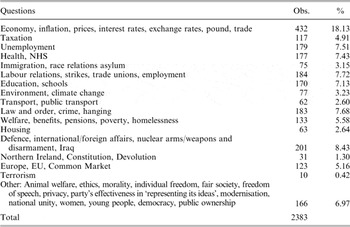
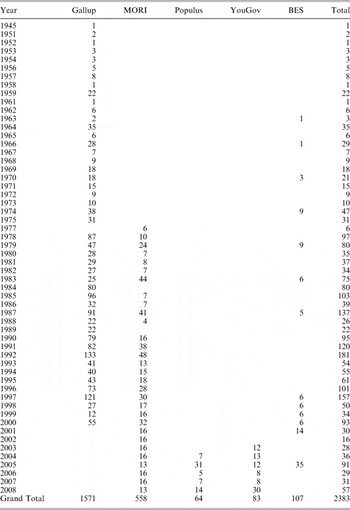
The analyses are based upon a total of 2,383 administrations of 184 different questions by five survey organizations (Gallup, Ipsos-MORI, Populus, YouGov and the British Election Study) about evaluation of party competence to handle particular issues or problems (for a summary see Appendix, Table A1).Footnote 49 For a question to be included in the mood index it must be asked at least twice. The mean number of question administrations is equal to 13.2 (with a standard deviation of 16.2). Most of the questions require respondents to choose between Labour, the Conservatives or (in the majority of instances) the Liberals/Liberal Democrats, with the option of a non-response (‘none’ or ‘don't know’).Footnote 50 A small number (N = 104) of questions from the British Election Study refer to the issue competence of a single political party (typically that in government). Overall, a good proportion of the competence questions (728) relate to the economy (30.6 per cent, of which 179 concern unemployment, 117 taxation and 432 the economy in general). However, the majority of the questions are non-economic (69.4 per cent).
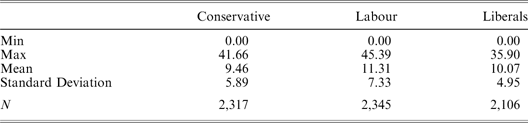
The questions do not stimulate pure partisan responses since competence questions from the same month can diverge from vote intention by as much as up to 45 per cent (see Table 1). For example, in September 2007 just 5 per cent of respondents named the Conservatives as the party with the best policies to handle animal welfare (with 66 per cent answering ‘don't know’). It is, therefore, possible for competence evaluations to tend towards zero despite partisan bias. (The possibility of partisan bias is also dealt with further in a later section of this article).
Summary Statistics of Net Difference between Survey Questions on Competence and Monthly Vote Intention (Absolute Values)
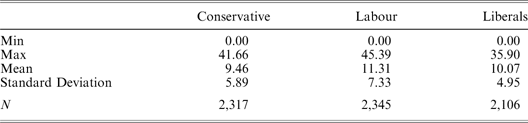
The mean difference between issue competence ratings and vote intention in a given month is equal to 9.5 per cent for the Conservatives, 11.3 per cent for Labour and 10.1 per cent for the Liberals. Using the recursive dyad ratios algorithm we explore three questions.
First, we ask, what proportion of variance is explained by the extraction of macro-competence mood? Stimson's algorithm extracts two dimensions, a first dimension (which we name macro-competence) and a second dimension, and calculates the proportion of variance explained by each.Footnote 51 In this analytical step, we provide illustrative evidence of movements in macro-competence, by party, over the time frame between 1950 and 2008.
Secondly, disaggregating macro-competence mood, we ask, do all issues load similarly onto macro-competence and by party? This is central to our argument regarding issue transfer, which predicts that different issues will form a generalized competence rating, since they share common ratings and variation, even across diverse policy issues.Footnote 52 We compute, essentially, issue ‘sub-moods’ using the same technique by issue area, to extract a longitudinal value of party competence on each issue category over time. This provides an average competence value, by party, for eight issue categories,Footnote 53 and enables us to explore whether there is transfer across issues.
We then seek to account for what moves macro-competence, to test our theoretical expectations regarding events, economic shocks and costs of governing, and also to question the degree to which macro-competence is a unique and distinct measure, rather than a proxy for leader evaluations, economic evaluations or party identification. We exploit a range of analyses to evaluate the extent to which macro-competence is distinct to partisanship, leader ratings and the economy, and to verify whether the extracted measure is biased due to question composition. Finally, we examine the statistical power of macro-competence in a vote model which includes a range of aggregate variables known to move vote intention.
Results: macro-competence in the United Kingdom, 1950–2008
The application of the dyad ratios algorithm suggests that there is a strong underlying latent dimension in the public's evaluations of issue competence. The method extracts the central tendency of survey items relating to competence, analogous to a principal components approach. For each item, the algorithm calculates how much variance is shared with the latent dimension and the strength of its loading onto each possible dimension of macro-competence. This loading is interpretable as a factor score. The first dimension of macro-competence explains 63 per cent of all variance in the observed public ratings of issue competence of the Conservatives, 54 per cent for Labour and 70 per cent for the Liberals. Given that poll data on issue competence are drawn from right across the issue spectrum, this is a noteworthy finding.
The second dimension of macro-competence explains a far smaller proportion of common movement in issue ratings: with 13 per cent of variance explained for the Conservatives, 18 per cent for Labour and 10 per cent for the Liberals. The first dimension represents, therefore, the greatest proportion of common variance, and is large in comparison with other similar indices. Bartle et al. find a first dimension of left–right preferences in Britain accounting for around 48 per cent variance, with 5 per cent on the second.Footnote 54 Stimson's analysis of left–right mood in the United States found a first dimension accounting for 27 per cent of the variance, and 14 per cent of variance for the second.Footnote 55
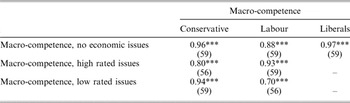
We note that the proportion of variance in competence ratings explained by macro-competence is robust to the issues used to estimate the index. For example, if we remove all economic issues from macro-competence, the proportion of variance accounted for is equal to 61 per cent for the Conservatives, 54 per cent for Labour and 68 per cent for the Liberal Democrats. If we remove just those issues which are more highly rated on average for Labour or the Conservatives, respectively (excluding the Liberals who do not have a higher rating on any issue), then the proportion of variance accounted for is equal to 75 per cent for the Conservatives and 56 per cent for Labour. Conversely, for issues on which these two parties are more negatively rated on average, the proportion of variance accounted for by macro-competence is equal to 68 per cent for the Conservatives and 65 per cent for Labour. These tests suggest that the common transfer of issue competence ratings is present between more positively and negatively rated issues, and is not simply attributable to perceptions of the economic competence of parties.Footnote 56
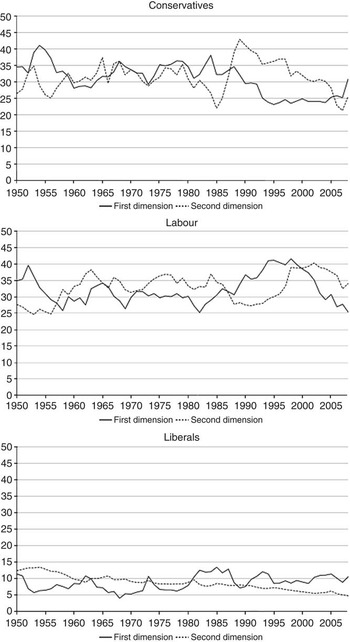
Table 2 presents the correlations of our overall construct of macro-competence, which includes all available issues, with these alternative specifications, and Figure 1 displays the pattern of the first and second dimensions of macro-competence for each party in the United Kingdom between 1950 and 2008.
Correspondence between Alternative Specifications of Macro-Competence, 1950–2008

*p ≤ 0.05, **p ≤ 0.01, ***p ≤ 0.001.
Macro-competence in the Britain, 1950–2008

The fluctuations displayed in Figure 1 offer plausible relationships with the events and outcomes of British politics. The Conservatives’ macro-competence index shows a relatively consistent value prior to the 1990s, although with fluctuations, such as prior to election losses in the mid 1960s, and again in 1974, and also in the early 1980s prior to the Falklands War. There is a clear and sustained drop in macro-competence in the early 1990s – the period following Britain's withdrawal from the European Exchange Rate Mechanism (ERM), and internal dissent over the Maastricht Treaty, as well as the replacement of Prime Minister Margaret Thatcher by John Major. It is only in the final data points that macro-competence moves in a clear upwards direction, as David Cameron neared the general election of 2010. The second dimension mirrors the first for the most part, but appears to diverge during the 1980s and drop more slowly following the Conservative party's difficulties in the 1990s. As Conservative popularity declined under Margaret Thatcher and then John Major, its second dimension, accounting for a small amount of variation, performed relatively better than the first. For Labour the macro-competence index reveals sharp drops in 1968 (prior to the Conservative Edward Heath gaining power) and between 1983 and 1987, when the Labour party split and the party was led by Michael Foot. The party's competence index reaches an all-time high in the period preceding Labour's landslide victory in 1997, and subsides under Gordon Brown in the latter time points. The second dimension for Labour corresponds closely with the first, appearing to improve more slowly for the party during the 1990s, therefore representing a converse trend for the Conservatives during this period. The macro-competence index is interesting and intuitive for the Liberal Democrat party. Macro-competence is consistently low and there is little variation in the second dimension other than exhibiting a gradual decline over time. There is a peak in the first dimension during the 1983 to 1987 period when the Social Democrat Party (the break-away party from Labour) and the existing Liberals formed the SDP–Liberal Alliance.
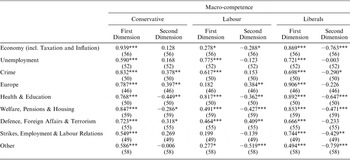
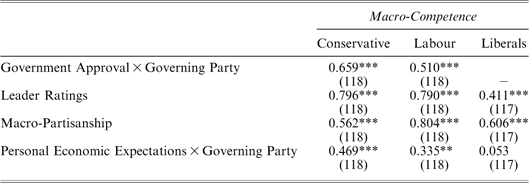
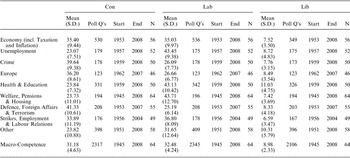
We examine the loading of issues onto both dimensions. This provides substantive interpretation of the indices, and of the first and second dimensions, and allows us to ascertain whether there is common variation across a range of issues relating to each dimension, which would be consistent with transfer, or common variance arising from generalized competence heuristics. Issue competence ratings are broken down into issue categories using the dyad ratios algorithm. The categories are aggregated thematically to allow for sufficient sample sizes. Summary statistics for the competence ratings comprising each category are presented in the Appendix in Table A3. Pairwise correlations of issue subcategories with macro-competence are presented in Table 3. These correlations are interpretable as a factor loading onto the underlying mood construct.Footnote 57 The correlations reveal the degree to which the prevailing public mood about party competence is linked to competency ratings on different issues.
Factor Loadings of Competence on Specific Issues on Macro-CompetenceFootnote †

† N in parentheses. *p ≤ 0.05, **p ≤ 0.01, ***p ≤ 0.001.
The factor loadings for all categories load onto the first dimension for at least one party, and a diverse range of issues load strongly across each party. These findings provide support for our expectation that variation in competence ratings will be common across diverse issues, as predicted by the first hypothesis. The strongest loading items for the Conservatives are the economy, crime, welfare, pensions and housing, health and education, and Europe. The evaluation of Conservative competence on the first dimension, therefore, draws upon issues from a wide spectrum, including issues with which it might be expected to be strongly associated, such as Europe and crime, and issues which the party may not be thought typically to ‘own’, such as health and education. The strongest factor loadings for Labour are unemployment, crime, and health and education. These issues include those on which Labour might be expected to have a stronger reputation for competence, such as unemployment and public services, but also includes an issue that is typically recognized as being strong for the Conservatives, crime. The factor loadings onto the first dimension for the Liberal Democrats are very high across all issues, suggesting that heuristics are particularly useful for third parties, for whom knowledge of competence is less readily available. For all parties some issues drive overall competence ratings to a greater degree than others. Parties may have greater incentives to manage their evaluations on these issue categories. However, there is strong evidence of a common underlying dimension in public ratings of party competence.
There is not as much common variance across issues upon the second dimension. In general the loadings are less strong, and they include positive and negative loadings onto macro-competence. It is notable that all loadings are negative for the Liberal Democrat second dimension. There is some evidence pointing to correspondence of the second dimension of macro-competence with issues a party traditionally owns,Footnote 58 particularly since the Liberals would not be considered to own specific issues ahead of other parties. The Conservative second dimension exhibits positive loading for issues on which it has a reputation for competence, Europe, crime, and defence (and foreign affairs and terrorism), and negative ratings on typical ‘Labour issues’, health, education, welfare, pensions and housing. However, this interpretation does not hold for the loadings of issues onto the second dimension for Labour, where there is a similar, though not identical, pattern of loadings as for the Conservatives. The loading of competence ratings is positive for Labour on Europe, defence, foreign affairs and terrorism, and negative for its traditionally owned issues, such as welfare, pensions, housing, health and education. The loading of economic issues is also negative, which is more consistent with the traditional disadvantage of Labour on managing the economy. These loadings may arise because the salience and strategic benefit of issues change over the time period, because these issues represent a foreign versus domestic issues dimension, or the second dimension may capture additional variation that is specific to each party.
Overall, the findings reveal a dominant underlying first dimension in competence evaluations which is driven by ratings on many issues, for all three main parties, suggesting that a relatively small proportion of variation, a second dimension, is driven by issue-specific strengths and weaknesses. Public ratings of party competence exhibit common variation for the most part, indicative of the mechanism of heuristics and transfer of ratings across issues.
We next turn to the question of what moves the dominant first dimension of macro-competence for each party, and seek to determine the degree to which this common variation supports the theoretical hypotheses as well as the degree to which macro-competence is distinct from other political dispositions or judgements.
Results: what moves macro-competence?
The micro-foundations of macro-competence – the accumulation of issue competence ratings across issues (transfer), in response to shocks and over time in office – all suggest that there is persistence in underlying dimensions of political judgements about the competence of political parties, at the aggregate level. Persistence represents the rate at which competence evaluations return to their long-term equilibrium in response to disturbances.Footnote 59 We examine the temporal structure and the costs of governing for annual estimates of macro-competence over the full period between 1950 and 2008.
Costs of Governing
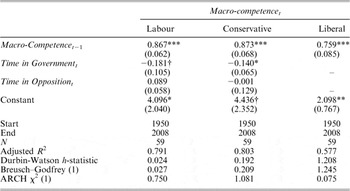
In order to first test the long-term persistence of macro-competence on a year-by-year basis, we estimate an autoregressive distributed lag (ADL) model. This specification measures the overall degree of persistence of macro-competence, controlling for the cost of governing, where macro-competence in a given year (COMPETENCEt) is estimated as a function of its value in the previous year (COMPETENCEt −1), and a pair of count variables control for the number of years the party is in government (TIME IN GOVt) or the number of years in opposition (TIME IN OPPt). This count variable is coded as 0 during the first year of office of a government (opposition) and after this adds 1 for each successive year of government (opposition), reset to 0 when a party is voted out of office (voted into power). The ADL takes the form:

The results of this model are presented in Table 4.
An Autoregressive Distributed Lag Model of Macro-Competence and the Costs of Governing, 1950-2008

*p ≤ 0.05, **p ≤ 0.01, ***p ≤ 0.001, †p ≤ 0.1.
Parties’ ratings for competence in handling issues are highly persistent, as suggested by the autoregressive character of macro-competence. The lagged value of macro-competence indicates that around 85 per cent of last years’ value is carried forward to the following year (this is rather lower for the Liberals, at around 75 per cent). Substantively, if Labour or the Conservatives achieve a 1 per cent boost in their competence ratings, 0.44 per cent remains some five years later.Footnote 60 There is long-term memory, then, in macro-competence for all parties. The coefficient is lower for the Liberals, as might be expected, but is also indicative of persistence.
The results indicate that time in government has a negative and significant effect upon macro-competence, as hypothesized, which is significant at the 95 per cent level for the Conservatives (and at the 90 per cent level for Labour). For each year the Conservatives are in government they lose 0.14 points from their macro-competence rating. Their mean level of macro-competence over the entire period is 31.2 (see Table A3), equating to around 0.5 per cent of their average level, amounting to a 2.5 per cent drop over the course of a full five year parliament. Time in opposition is not significant, indicating that the costs of governing upon macro-competence are not symmetrical for governing and opposition parties. This is a substantively interesting finding and one which warrants further research. For the purposes of this article, the finding provides support for the theoretical mechanism hypothesized of the common decline in competence over time, across a broad spectrum of policy issues.
Events as Competence Information
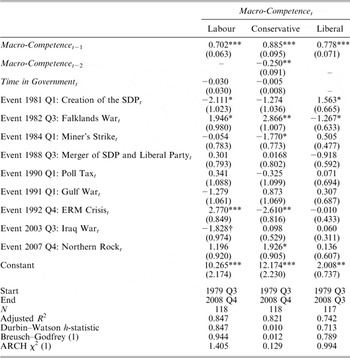
Political and economic events provided another mechanism through which we argued that informational shocks facilitate the common transfer of competence evaluations. We therefore consider the effects on macro-competence of a selection of important events in British politics from past studies of vote choice and those we suggest may influence perceptions of competence.Footnote 61 These are the founding of the Social Democratic Party (SDP) in 1981, the Falklands War in 1982, the miners’ strikes of 1984, the merger of the SDP and Liberal Party in 1988, the poll tax riots in March 1990, the commencement of Operation Desert Storm during the Gulf War in 1991, the Exchange Rate Mechanism crisis in September 1992, the Iraq War in 2003 (when evidence for weapons of mass destruction was discredited) and the run on the Northern Rock bank in 2007, which signalled the start of the financial crisis in Britain. In order to estimate the effects of events, we use quarterly data. There are insufficient underlying poll data to produce reliable estimates of macro-competence at monthly intervals, so our analyses cannot detect the effect of events with the precision that is possible using monthly data, but quarterly data are clearly preferable to annual for the analysis of events. The analysis spans the third quarter of 1979 and the fourth quarter of 2008. The ADL model takes the general form:

The effects of events on macro-competence are estimated as a step interventionFootnote 62 and we omit the term for time in opposition in light of the earlier results. The model also includes the second lag of macro-competence (COMPETENCEt −2) to control for serial autocorrelation in the Conservative model.Footnote 63 The results are reported in Table 5.
An Autoregressive Distributed Lag Model of Macro-Competence, the Costs of Governing and Events, 1979–2008

*p ≤ 0.05, **p ≤ 0.01, ***p ≤ 0.001, †p ≤ 0.1.
There is again a considerable degree of persistence in issue competence ratings, with the positive and significant effect of the first lag equal to 0.70 for Labour, 0.89 for the Conservatives and 0.78 for the Liberals. This indicates that the shocks to macro-competence accumulate and are persistent even in the short term, using quarterly data. The second lag is negative and significant for the Conservatives, indicating a cyclical dynamic affecting macro-competence at this level of temporal aggregation, offsetting the initial persistence. Substantively, there is a stronger reaction to an initial shock of macro-competence as it tends back towards its longer-term equilibrium level, consistent with the findings for the annual level. Also, the cost of governing variable is no longer significant, suggesting that at least to some extent costs of governing are represented by major events of the period.
The results are consistent with our expectations regarding the way in which macro-competence – the shared variation in issue competence ratings – responds to important political events. The Falklands War had a positive and significant effect on Conservative macro-competence, while the Miners’ Strike of 1984 and the ERM crisis of November 1992 each had a negative and significant effect on Conservative competence (at the 90 per cent and 95 per cent confidence levels, respectively). The ERM crisis also had a positive effect on Labour's macro-competence, benefiting the party's recovery prior to the 1997 election. In similar fashion, the run on Northern Rock in 2007 had a positive effect on macro-competence for the Conservative opposition. Creation of the SDP in 1981 resulted in an increase in competence evaluations of the party to emerge from the formation and alliance with the Liberals, the Liberal–SDP Alliance, at the same time as resulting in a significant decrease in Labour macro-competence. Important salient events can have immediate and lasting effects on the competence ratings of parties across the issue spectrum.
Macro-Competence and Its Correlates
We next examine the relationship between macro-competence and other important indicators of party support, namely leader ratings, economic expectations and partisanship, used in leading studies of macro-level determinants of the vote (leader ratings,Footnote 64 personal economic expectationsFootnote 65 and macro-partisanshipFootnote 66). We expect these variables to be associated with macro-competence but we also crucially expect the persistence of macro-competence to remain significant, even controlling for them. Within the running tally view of party identification, macro-competence may offer an indicator of variations in party identification.Footnote 67 We seek to explore the degree to which macro-competence tells us something unique about public opinion which cannot be encapsulated by existing measures. The data is again at a quarterly level, between 1979 and 2008. The additional covariates are based upon data collated as follows.
Prime ministerial and leader approval
A number of overlapping measures are combined using the dyad ratios algorithm to control for house sampling or question wording effects in different data sources.Footnote 68 Public opinion about satisfaction with the performance of prime ministers and opposition leaders has been measured in regular surveys by both Gallup and Ipsos-MORI. For example, Ipsos-MORI asks the questions: ‘Are you satisfied or dissatisfied with the way X is doing his/her job as Prime Minister?’ and ‘Are you satisfied or dissatisfied with the way X is doing his/her job as leader of the Conservative/Labour/Liberal Party?’ Each series has a factor loading of 0.99 onto the combined measure.
Macro-partisanship
The analyses employ an annual measure of macro-partisanship, estimated once again using the dyad ratios algorithm. The data were compiled by Bartle et al. and have been supplemented by us here.Footnote 69 The data represent the percentage of respondents indicating political affiliation to Labour, the Conservatives, Liberals and other parties. For example, the British Election Study asks, ‘Generally speaking, do you see yourself/think of yourself as Labour, Conservative (etc.), or what?’
Personal economic expectations
The analyses employ a range of measures, again combined using the dyad ratios algorithm. For example, the feel-good factor question, or personal economic expectations (PEXP), was surveyed from 1974 by Gallup and asked about expectations for the household: ‘Do you consider the financial situation of your household in the next 12 months is likely to …’, with responses ‘get a lot better’, ‘a little better’, etc. Personal economic expectations have been an important staple of numerous studies in Britain.Footnote 70 Gallup ceased asking this question in 2001 and, following Sanders,Footnote 71 we use YouGov data to complete the series. Using the dyad ratios algorithm, each series has a factor loading of 1.00 onto the combined measure. The analyses are also cross-checked using objective economic conditions. These are the economic misery index, equal to the national rate of inflation plus the rate of unemployment, and the Conference Board leading and coincident economic indicators.
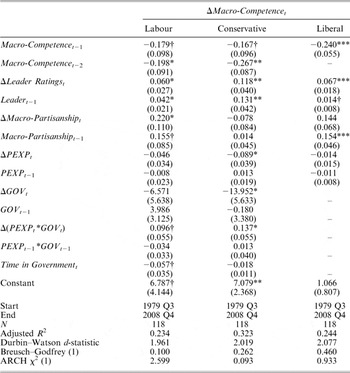
The dynamic effect of these predictors upon macro-competence is estimated using an error-correction model (ECM). While error-correction is isomorphic with the concept of cointegration,Footnote 72 the model specification is appropriate for modelling short-run and long-run relationships in the context of stationary as well as non-stationary data.Footnote 73 An ECM simply represents a linear reparameterization of the ADL model, used earlier, but allows us to more readily model how the relationship responds to disequilibrium. ECMs are well established in models of dynamics of party support in Britain.Footnote 74 The model allows us to test the persistence in macro-competence when these covariates are included, and to estimate their relative effects upon variation in macro-competence. This is represented in the form of a single equation ECM. In the single equation ECM, the lagged value of the dependent variable, macro-competence (COMPETENCEt −1), measures the rate of re-equilibration in response to shocks to its long-run equilibrium. If the error-correction parameter (β 1) is equal to −0.5, 50 per cent of an initial shock to the previous year's level of macro-competence persists in the subsequent year, 25 per cent in the year after that (0.5 × 0.5), and so on. The higher the rate of error-correction, the more persistent ratings of macro-competence are in the long term in response to shocks. The model is represented in the following equation:

Short-run changes in macro-competence (ΔCOMPETENCEt) are estimated as a function of short-run changes in leader ratings (ΔLEADERt), macro-partisanship (ΔPARTY IDt) and personal economic expectations (ΔPEXPt), and lagged long-run values of each of the independent variables (LEADERt −1, PARTY IDt −1, PEXPt −1). The second lag of macro-competence (COMPETENCEt −2) is included in the error-correction model for Labour and the Conservatives to remove serial autocorrelation, also capturing re-equilibration in response to shocks. The model includes the short-run and long-run interaction term of personal economic expectations with party control of government (Δ(PEXPt*GOVt), PEXPt −1*GOVt −1) with the constitutive terms (ΔGOVt, GOVt −1). The constitutive term is a dichotomous variable (GOVt), coded as 1 when a party is in government and coded as 0 when it is in opposition. As such, the short-run effect (ΔGOVt) tests whether a party's macro-competence decreases when it enters office, while the long-run effect (GOVt −1) tests whether there is a systematic difference between the level of macro-competence for a party when it is in government compared to the level when it is in opposition. We would expect voters to reward (punish) governing parties for any improvements (deteriorations) in their personal economic circumstances, and hence the model estimates the effect of economic conditions for parties in government.
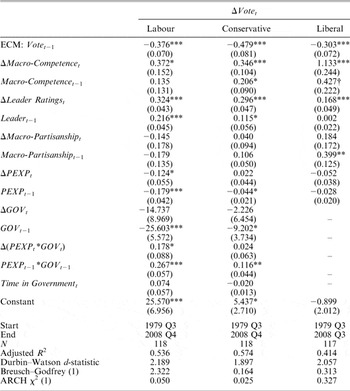
The results of this ECM model of macro-competence are reported in Table 6. The error-correction component is negative and significant for the second lags for Labour and the Conservatives (and for the first lag at the 90 per cent confidence level) and for the first lag for the Liberals.Footnote 75 Macro-competence ratings last quarter have an equilibrating impact on macro-competence ratings today, controlling for other covariates in the model. The parameters indicate that the rate of correction is relatively weak in response to shocks, but this is not surprising given the inclusion of a number of covariates both with positive and significant short-run and long-run effects. The findings denote a systematic degree of persistence in macro-competence. The accumulation of issue competence ratings across issues remains significant, suggesting that macro-competence captures variation over time that is not reducible to other measures of public opinion and partisan support.
An Error-Correction Model of Macro-Competence

*p ≤ 0.05, **p ≤ 0.01, ***p ≤ 0.001 †p ≤ 0.1.
The effects of leader ratings are positive and significant in both the short run and long run for all three parties, and particularly strong for the Conservatives. Leader evaluations are, therefore, important, demonstrating a significant short-run and long-run effect on macro-competence. However, the macro-competence term exhibits persistence alongside these effects, which suggest that evaluations of party leaders are an important predictor of variation in general issue competence evaluations, but they are not a substitute.
Effects of macro-partisanship on macro-competence are significant for Labour and for the Liberals. The measure is constructed from sparser underlying data, which may explain its weaker statistical power in the Conservative model. It is, however, possible that Conservative macro-competence is more strongly related to leader evaluations than to partisan identification during the period between 1979 and 2008. The significance of macro-partisanship in both the Labour and Liberal models provides evidence of the expected relationship between macro-partisanship and macro-competence. Overall, these findings suggest that macro-competence is not simply capturing partisan bias in ratings of which party is best on a range of policy issues.
There is a substantively significant short-run effect of incumbency upon Conservative macro-competence, which may account for the non-significance of time in government in the Conservative model. We find that Labour's macro-competence declines with the period of time in office but only at the 90 per cent confidence level. Furthermore, the interaction of personal economic expectations and party control of government is significant and positive in the short run for the Conservatives, suggesting that economic downturns impact governing party competence ratings, and this is significant for Labour at the 90 per cent confidence level. Overall, the relatively low value of the adjusted R 2 for each of the parties provides further evidence of the exogeneity of macro-competence to these covariates.
The analysis thus far demonstrates that macro-competence exhibits long-term persistence, robust to the inclusion of other variables. Indeed, it is striking that macro-competence remains robust to the inclusion of the full range of control variables in Table 6.
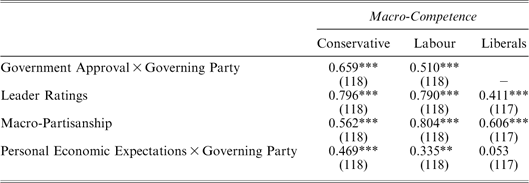
The unique variation attributable to macro-competence can be explained and accounted for using a simple comparison of the correlations between variables. If macro-competence were simply a proxy for macro-partisanship (for example, resulting from partisan bias driving the first dimension of competence ratings, or representing a running tally measure of party identification)Footnote 76 these measures would correlate extremely highly. This could give rise to problems of multicollinearity. In Table 7, we present pairwise correlations of macro-competence with a number of other political and economic evaluations that are possible proxies (government approval,Footnote 77 leader ratings, macro-partisanship, personal economic expectations).
Correlations of Macro-Competence with Other Covariates
*p ≤ 0.05, **p ≤ 0.01, ***p ≤ 0.001, †p ≤ 0.1.
Note: Correlations are tested for interaction of governing party with government approval and personal economic expectations.
The correlations presented in Table 7 confirm that while there is some common variance between macro-competence and government approval, leader ratings, macro-partisanship and personal economic expectations, in no case are correlations greater than 0.8. The correlation of macro-partisanship with Labour macro-competence is greater than it is for the Conservatives, a finding that accounts for the significant effect of macro-partisanship in the Labour model in Table 6 but not in the Conservative model. The correlation of leader approval is comparable for both Labour and the Conservatives, and weaker for the Liberals. These correlations denote that while there is likely to be a partisan element to macro-competence (or a macro-competence element to partisanship), and a relationship of leader evaluations to macro-competence, the measures are also conceptually and empirically distinct. The relatively low correlations between macro-competence and the other covariates, personal economic expectations and government approval, suggest that while these constructs are related, they are an important but not sufficient explanation of variations in the ratings of parties on policy issues, as with partisan affiliation and leader evaluations.
We proceed to consider the effect of macro-competence upon vote intention, taking the above covariates into account. If macro-competence reflects a meaningful tide in public opinion, its behavioural consequences will be significant. Furthermore, if we examine the effects of macro-competence alongside other macro-level vote predictors, we gain further purchase upon the unique variance attributable to macro-competence when these predictors are taken into account.
Results: macro-competence as a predictor of vote
The dynamic short-run and long-run effects of a number of predictors of vote intention are again estimated using a single equation ECM framework for the period between 1979 and 2008. The model is represented by the following equation:

Short-run changes in party support (ΔVOTEt) are estimated as a function of short-run changes in macro-competence (ΔCOMPETENCEt), leader ratings (ΔLEADERt), macro-partisanship (ΔPARTY IDt) and personal economic expectations (ΔPEXPt), and lagged, long-run values of each of the independent variables (COMPETENCEt, LEADERt −1, PARTY IDt −1, PEXPt −1). The model again includes the interaction term of personal economic expectations with party control of government (Δ(PEXPt*GOVt), PEXPt −1*GOVt −1). In this one-step estimation method the lagged value of the dependent variable, party support (VOTEt −1), measures the rate of re-equilibration in response to shocks to its long-run equilibrium. The results of this model are reported in Table 8.
An Error-Correction Model of Party Support

*p ≤ 0.05, **p ≤ 0.01, ***p ≤ 0.001, †p ≤ 0.1.
The results reveal the substantive and statistical effect of macro-competence on party support.Footnote 78 The estimates confirm that the error-correction component (VOTEt −1) is negative and significant for each of the parties. This indicates that the rate of correction in response to shocks is of a similar order. Furthermore, macro-competence has a positive and significant short-run effect for each of the parties, and the long-run effect is also positive and significant for the Conservatives (and significant at the 90 per cent confidence level for the Liberals). While the size of effect is of a similar order for Labour and the Conservatives, it is considerably higher for the Liberals, reflecting the fact that Liberal competence evaluations tend, on average, to be well below their party support. Small shifts in issue competence can lead to much larger movements in Liberal support.
The models confirm that there remain positive and significant short-run and long-run effects of leader evaluations on party support for both Labour and the Conservatives, as we would expect. The short-run effect for the Liberals is rather lower, consistent with previous findings on leader effects for the Liberal Democrats.Footnote 79 Likewise, personal economic expectations have a positive long-run effect on support for governing parties,Footnote 80 captured through the interaction term, though greater for Labour than for the Conservatives. The effect of personal economic expectations is significant and negative in both the short run and long run for Labour when out of power, and in the long run for the Conservatives when out of power, indicating that the feel-good factor adversely affects support for both parties when in opposition. Macro-partisanship has a positive and significant long-run effect for the Liberals, but not for the Conservatives or Labour. The effect of time in government over the period between 1979 and 2008 is not significant for Labour or for the Conservatives, most likely because the costs of governing are transmitted through competence evaluations. All these findings for the covariates are consistent with our expectations, but the inclusion of macro-competence in a predictive model of party support provides additional explanatory power. Controlling for additional explanatory variables, the effect of a one-point increase in macro-competence leads to a 0.4 per cent increase in party support in the short run for Labour and 0.3 per cent for the Conservatives (note that this results in more than a 1 per cent increase for the Liberals). These results are substantively significant. They are of a similar magnitude to the effect of leader evaluations (with a one-point increase also leading to a 0.3 per cent increase in party support for Labour and the Conservatives), and stronger in magnitude than the effect of personal economic expectations for governing parties (leading to a 0.3 per cent increase for Labour and a 0.1 per cent increase for the Conservatives). The estimates suggest that macro-competence helps to inform models of party choice, and offers a useful measure to understand a significant element of public opinion, with behavioural consequences for party choice in Britain.Footnote 81
Conclusions
The national mood regarding the competence of parties and candidates is something that people in and around politics and government may sense, talk about and act upon. This general mood arises, we argue, via a process of transfer from one issue judgement to others and via the deployment of heuristics. It is enhanced by events, economic shocks and the costs of governing for incumbent parties. Using Stimson's dyad ratios algorithmFootnote 82 this article identified a dominant dimension of macro-competence, reflecting a general mood among voters in their evaluations of which party is most competent, explaining between 50 per cent and 70 per cent of public issue competence ratings of parties, based on an exhaustive compilation of 2,383 survey administrations between 1950 and 2008 in Britain. While these broad movements in the public mood are affected by leader evaluations, partisan identification, events, economic shocks and time in office, the reputation of political parties for competence across issues are persistent and distinct from leader, partisan and economic effects. Macro-competence also exerts a significant effect upon vote intention in the British electorate.
The measure of macro-competence holds the potential to provide a new empirical opportunity. It overcomes a considerable difficulty, to date, in estimating voters’ evaluations of policy competence. While scholars agree that competence, or valence, is highly important, the lack of consistent measurement has meant that these effects have been largely considered through the lens of economic effects, the evaluations of candidates and leaders, and specific effects of individual issues in models of vote choice. The construct may also be estimated in other countries. Combining additional measures of competence, and comparatively, would provide a more comprehensive analysis of constructs of valence and competence.
The findings suggest that we may need to revise conceptions of party incentives and how voters evaluate political parties on competence. Rather than viewing issue strengths as stable, and as separate and distinct variables, we can instead expect a large degree of common variation. These observations may provide fruitful areas for examining the incentives of political elites, most notably the instances of issue dialogue, trespassing or convergence.Footnote 83 We also note that parties may have incentives to campaign on a range of issues because these issues load significantly onto their overall competence evaluations. Macro-competence may, therefore, allow hypotheses to be generated about the degree to which parties wish to maximize their generalized ratings of competence, as well as their issue specific evaluations.
This article has focused upon revealing common variance in issue evaluations. Future work may use the measure as an independent or dependent variable, to explore a number of important research questions. For example, how might political parties improve their competence evaluations? Is there a relationship between spatial policy position and movement of macro-competence? Are there effects of macro-competence on left–right shifts of public opinion over time? Macro-competence exhibits an incumbency effect, and may therefore also help elucidate important cycles of incumbency and party support over time.
The history of British politics is littered by parties’ mishandling of policy issues that have led them to irreparably lose reputations for competence across the board, despite the specificity of most of these failures. The construct of macro-competence can contribute to our understanding of the public's evaluations of political parties and their ability to handle the issues of the day.
Questions

Number of Competence Poll Questions Per Year

Summary Statistics of Issue Competence Ratings and Macro-Competence

Appendix
Sample questions:
Q. If Britain were in economic difficulties, which party do you think could handle the problem best – the Conservatives or Labour?
Q. Which party do you think can best handle the problem, or isn't there much to choose between them, on the issue of full employment, short-time working?
Q. I am going to read out a list of problems facing the country. Could you tell me for each of them which political party you personally think would handle the problem best? [Pensions]
Q. Irrespective of your own preferences, which party do you think would be most likely to look after Britain's pensioners?
British Election Study 2001 and 2005 Campaign Studies
2001: How many marks out of 10 would you give the Government for its performance in each of the following areas? (the NHS/taxation/education/the level of crime in Britain)
How do you think a Conservative Government would handle each of the following issues? (the NHS/taxation/education/the level of crime in Britain)
2005: Q. How well do you think the present government has handled (How well do you think a Conservative government would handle): crime in Britain/the number of asylum seekers coming to Britain/the National Health Service/the risk of terrorism in Britain/the economy in general/the level of taxation?