Introduction
Dementia is one of the world's most common diseases among the elderly. In the USA, it is estimated that 5–10% of people aged 65 years and above have dementia (US Department of Health and Human Services, 1996). This estimate corresponds to prevalence rates of 6.1% in Hong Kong (HK) and around 400,000 people suffering from dementia in HK, a city in southern China (Chiu et al., Reference Chiu1998). In China, the elderly population has been estimated at 143 million, accounting for one-fifth of the world's total (People's Daily Online, 2006).
There are valid instruments for clinically diagnosing Alzheimer's disease (AD), such as the Clinical Dementia Rating Scale, but they do not give a neuropsychological profile of the person's cognitive function. The Consortium to Establish a Registry for Alzheimer's Disease (CERAD) can offer information on the clinical diagnosis of AD and give a profile of cognitive functioning. CERAD's Neuropsychological Assessment Battery (CERAD-NAB) includes subtests to assess the specific cognitive deficits that appear in patients with AD, such as memory impairment, disorientation, loss of expressive and receptive language, and dyspraxia (Morris et al., Reference Morris, Mohs, Rogers, Fillenbaum and Heyman1988). It has also been proven to have good inter-rater reliability (0.92 ~ 1.0), test-retest reliability (0.5 ~ 0.8) and psychopathological validity (Welsh-Bohmer and Mohs, Reference Welsh-Bohmer and Mohs1997). Therefore, the major standardized instruments developed by CERAD-NAB are now used by various AD research centers across different countries, by physicians in clinical practice and in population-based surveys (Morris et al., Reference Morris1993; Welsh et al., Reference Welsh, Butters, Hughes, Mohs and Heyman1991). However, there is no Chinese-Cantonese version of the CERAD-NAB, even though Cantonese is a major dialect used in the southern China.
Previous studies in Korea (Lee et al., Reference Lee2004), the UK (Stewart et al., Reference Stewart, Richards, Brayne and Mann2001) and the USA (Welsh et al., Reference Welsh, Butters, Hughes, Mohs and Heyman1991) reported that demographic variables such as age, gender and education level have significant effects on participants' performance on many subtests in the battery. Therefore, this study investigated the effects of age, education and gender on participants' performance on eight subtests in the Cantonese version of CERAD-NAB.
Methods
Study population
We recruited 187 healthy community-dwelling adults aged 60 years or above whose first language was Cantonese from the senior citizens activity centers in Hong Kong, according to the inclusion criteria. Their registered nurses, social workers or occupational therapists reviewed their recent medical record. Participants were excluded if they suffered from dementia or mild cognitive impairments, neurological diseases (e.g. Parkinson's disease), stroke, psychiatric illnesses (e.g. depression), or significant impairment of vision or hearing.
Instrument
The CERAD Assessment Packet for Probable Alzheimer's disease – Revised in September 2002 (Protocol 5) – was used in this study. On average, the CERAD-NAB takes about 30 minutes to administer. It consists of eight subtests: Verbal Fluency (J1), Boston's Naming (J2), Mini-Mental State Examination (MMSE, J3), Word List Memory (J4), Constructional Praxis (J5), Word List Recall (J6), Word List Recognition (J7) and Recall of Constructional Praxis (J8).
Procedure
A professional translator translated the English version of the CERAD-NAB into Cantonese. The translated version was then evaluated by a seven-member panel for semantic equivalence and fluency on a five-point rating scale. Another six-member expert panel was invited to evaluate the content validity of the Cantonese version of the CERAD-NAB. All of the panel members were healthcare professionals who had more than ten years of clinical experience with the elderly population in Hong Kong. The panel members included three occupational therapists, two social workers and one clinical psychologist. They rated the items in the Cantonese version on a five-point scale according to the relevance and representativeness of the items to the Chinese elders. In both panel reviews, items scoring below 3 were taken out for members to comment upon and to suggest changes.
Demographic data on age, gender and years of education of the participants were collected. Raters, including an occupational therapist and six trained research assistants collected all the data. The raters underwent a training session on the assessment procedures of the Cantonese version of the CERAD-NAB.
Statistical analysis
A separate stepwise multiple linear regression analysis was performed to assess the relative contribution of age (60–74 and 75–94 years old), education (0–3 = early primary school level; 4–14 years = primary to tertiary school level) and sex (female and male) to each CERAD-NAB test score. The criteria for the entry and removal of variables in the stepwise multiple linear regression were p < 0.05 and p < 0.10, respectively.
Results
Content validity and reliability
With the seven-member panel, modification was made to improve the semantic equivalence and fluency of the translated Cantonese version. For the content validity of the Cantonese version of the CERAD-NAB, all the subtests were found to be relevant to and representative of the neuropsychological function in Chinese older people. Several modifications were made in the words used in J2 and J4 subtests to address issues of cultural relevance. In J2 Boston's Naming subtest, the elaboration on the different types of harmonica was deleted. In J4 Word List Memory subtest, the word “land” was changed to “shore” in Cantonese.
The inter-rater reliability was found with intra-class correlation coefficient ICC (2, 1) of 0.857–0.994.
Demographic characteristics
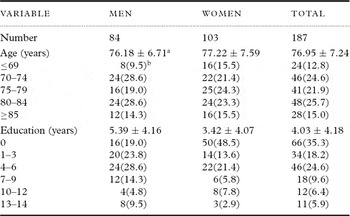
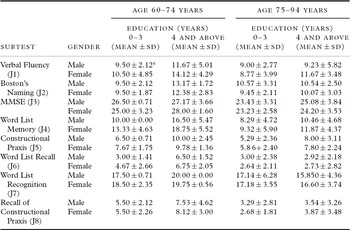
The demographic characteristics and the results of the 187 participants who completed the CERAD-NAB are shown in Tables 1 and 2. The mean age of the male participants (76.2 years) was comparable to that of the female participants (77.1 years); the t-test showed no significant difference between the mean age of male participants and female participants (p = 0.71). The average number of years of education was higher in the male group (5.4 years) than in the female group (3.4 years), but there was no significant difference (p = 0.08).
Demographic characteristics of the participants
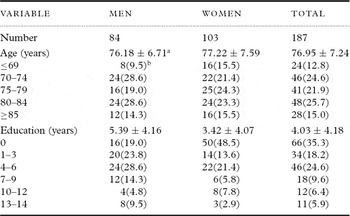
a M ± SD
b Number (%)
Results of the CERAD-NAB
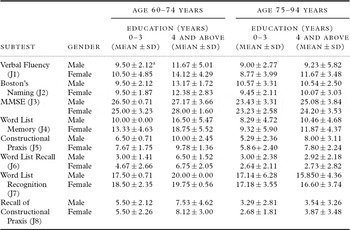
CERAD-NAB = Cantonese version of the Consortium to Establish a Registry for Alzheimer's Disease Neuropsychological Assessment Battery.
Results of the sample
The above results for the effects of the demographic variables indicated that education level needed to be taken into account for an accurate interpretation of the CERAD-NAB subtests. Therefore, the whole dataset was divided into two age groups (60–74 years, 75–94 years), separately for males and females, and two strata of education levels (0–3 years and ≥4 years). The educational strata were determined by the results from the post-hoc contrasts among the groups with 0–3 years, 4–6 years and ≥7 years of education, respectively. Since there was no significant difference between the two groups with higher education levels (4–6 years and ≥7 years), these two education groups were merged together to form one strata of education level (≥4) for the analysis.
Effects of age, education and gender on the CERAD-NAB
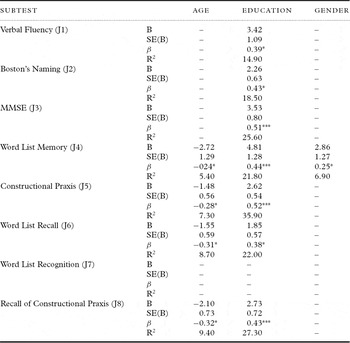
Stepwise multiple regression analyses revealed that performances on seven out of eight subtests in the CERAD-NAB were significantly influenced by education level (Table 2); the exception was the performance on the Word List Recognition (J7). In general, younger participants performed better than the older ones. For the criteria of education level, participants with higher education performed better than those with lower education on all subtests.
Four out of eight subtests were influenced by age, namely Word List Memory (J4), Constructional Praxis (J5), Word List Recall (J6) and Recall of Constructional Praxis (J8). The other four subtests – Verbal Fluency (J1), Boston's Naming (J2), MMSE (J3) and Word List Recognition (J7) – were not significantly influenced by age.
Besides education and age, Word List Memory (J4) was also influenced by gender. This is the only subtest that shows the effect of gender.
As shown in Table 3, education was a significant predictor of performance on seven subtests, including Verbal Fluency (J1), Boston's Naming (J2), MMSE (J3), Word List Memory (J4), Constructional Praxis (J5), Word List Recall (J6) and Recall of Constructional Praxis (J8). The only exception was Word List Recognition (J7). With respect to the percentage variance explained by each significant variable (R2), which reflects the relative degree of influence by each variable, education level explained a much greater proportion of score variances than did either age or gender in most of the subtests. In the regression analysis, there was no significant correlation among age, education and sex.
Stepwise multiple linear regression of age, education and gender on the subtests in the CERAD-NAB

CERAD-NAB = Cantonese version of the Consortium to Establish a Registry for Alzheimer's Disease Neuropsychological Assessment Battery. B = regression coefficient, SE(B) = standard error of B, β = standardized regression coefficient, R 2 = percent variance explained by each variable.
Age was categorized as 60–74 years old and 75–94 years old. Education was categorized as 0–3 years and 4–14 years. Gender was categorized as male and female, respectively.
*p < 0.05; ***p < 0.0001 by stepwise multiple linear regression analysis.
Discussion
The translated CERAD-NAB was reviewed by an expert panel and found to be relevant to and representative of the neuropsychological function in Chinese older people. Since some of the subtests ask the participants to remember the names of objects, modifications were made to enhance the cultural relevance of the terms used. Excellent inter-rater reliability was also found with an ICC greater than 0.8.
As the results indicated, age is associated with performance in some of the subtests. In the CERAD–NAB, we found that age made a significant difference in performance on Word List Memory (J4), Constructional Praxis (J5), Word List Recall (J6) and Recall of Constructional Praxis (J8). In those subtests, younger participants performed significantly better than older participants. These four subtests required participants to have good short-term memory, which is a function that deteriorates with age. On the other hand, in Verbal Fluency (J1), Boston's Naming (J2), MMSE (J3) and Word List Recognition (J7), age made no significant difference on performance in this sample. This result was not consistent with the normative studies on the CERAD-NAB conducted in the USA (Ganguli et al., Reference Ganguli1991; Welsh et al., Reference Welsh1994) and in Korea (Lee et al., Reference Lee2004). Those studies found that age had an effect on most cognitive subtests. This discrepancy might be an artifact of our small sample size. Moreover, the average number of years of education of the participants in the US studies (Ganguli et al., Reference Ganguli1991; Welsh et al., Reference Welsh1994) was over 12 years; and the Korean study (Lee et al., Reference Lee2004) had a wider range of years of education (0–22 years) than the current study (0–14 years). The low education levels of the Chinese elderly in Hong Kong as reflected in this sample could create such discrepancies. In addition, the current study may suffer from a sampling bias. The sample was recruited from community centres for the elderly, which may have elderly that are more active than average. Participants might therefore have more comparable cognitive functioning across various age groups. These sampling differences may explain why this study's results are partially inconsistent with other normative studies. Attaining a larger sample size from a stratified community population is one potential solution. That said, these discrepancies in results might reflect the unique characteristics of Chinese elderly in this sample.
There was no association between gender and performance on the subtests of the CERAD-NAB except Word List Memory (J4). This result is very similar with the findings of Welsh and colleagues (Welsh et al., Reference Welsh1994) and Sosa and colleagues (Sosa et al., Reference Sosa2009). However, a prior Korean study (Lee et al., Reference Lee2004) suggested that men performed better on Recall of Constructional Praxis (J8), while women scored better on Word List Memory (J4). In our study, women also scored better on Word List Memory (J4) although no association was found between gender and other subtests.
Performances on all the subtests in the CERAD-NAB were affected by education level, except that on Word List Recognition (J7). These findings are mostly comparable to those suggested in other normative studies on the CERAD-NAB (Ganguli et al., Reference Ganguli1991; Welsh et al., Reference Welsh1994). In addition, education had less of an effect on performance on the verbal memory measures – particularly Word List Recognition (J7) (Lee et al., Reference Lee2004). Our results were comparable to those of the Korean normative study, as we also showed that the scores on Word List Recognition (J7) were not affected by education level. This might be due to an over-learning effect in Word List Recognition (J7), since participants were required to read aloud and memorize the group of words three times in Word List Memory (J4). Furthermore, participants were required to recognize words that appeared in Word List Memory (J4), so the cards in Word List Recognition (J7) also provided visual cues to them. Therefore, in our results, education level significantly affected all subtests except for the Word List Recognition subtest (J7).
The results for Verbal Fluency (J1) in this study differed from those found by Welsh and colleagues (Welsh et al., Reference Welsh1994), who reported no association between education and Verbal Fluency (J1). Our study found that education had a significant effect on Verbal Fluency (J1). This difference might be due to the difference in the range of the distribution of education level. The education level of our participants ranged from 0 to 14 years, while their education levels ranged from 5 to 21 years. The education level in this study was relatively low (35.3% of the participants had 0 years of education, and only 5.9% had 13 years of education or more), while most participants in the study by Welsh and colleagues (Reference Welsh1994) had more than 12 years of education.
In the regression analysis, there were no significant correlations among age, education and gender. This is inconsistent with the study by Lee et al. (Reference Lee2004) in which they found a significant interaction between education and gender in Boston's Naming (J2) and Constructional Praxis (J5). This education and gender interaction reflected a better performance by poorly educated elderly men. Moreover, the current study's results diverged from those of Welsh et al. (Reference Welsh1994) as they found that age and gender effects for most of the subtest measures were less evident in persons with lower levels of education. This study showed a unique result for our sample of Chinese elderly. However, further investigation with a larger sample size should be carried out to pursue these questions further and make generalization to the wider population possible.
Conclusion
Our results were obtained from a sample of healthy elderly people. In this elderly Chinese sample, both education level and age had a considerable influence on most cognitive functions assessed by the CERAD-NAB. Gender, however, had a comparatively minor effect on performance on the subtests of the CERAD-NAB. The information presented in this paper may be used as reference for future cross-cultural comparisons of the CERAD-NAB. Moreover, these data may also be useful for the preliminary clinical assessment of Chinese elderly people living in Hong Kong or in other parts of the world.
Conflict of interest
None.
Description of author's roles
Dr. Karen P.Y. Liu formulated the research idea, designed the study, supervised the data collection and statistical design and wrote the paper. Michael C.C. Kuo, Kin-chung Tang, Allison W.S. Chau, Iris H.T. Ho, Matthew P.H. Kwok, Wallis C.W. Chan, Roy H.K. Choi and Natalie C.W. Lam collected the data, carried out the statistical analysis and assisted with writing the paper. Ms. Mary M.L. Chu, Dr. Leung-wing Chu provided guidance on the design of study and assisted with writing the paper.
Acknowledgments
The work was supported by a grant from the Research Grants Council of the Hong Kong Special Administrative Region, China (Project No. PolyU 5620/07M) awarded to K. P. Y. Liu.
The authors would like to thank the healthcare professionals and colleagues of the Hong Kong Sheng Kung Hui Welfare Council and the Hong Kong Family Welfare Society for their contribution to the study. We particularly thank Ms. Katherine Wong, Ms. Rita Cheung, Ms. Becky Tsang and Ms. CY Tong and the people who volunteered to participate in this study.