That Lecture Really Dragged!
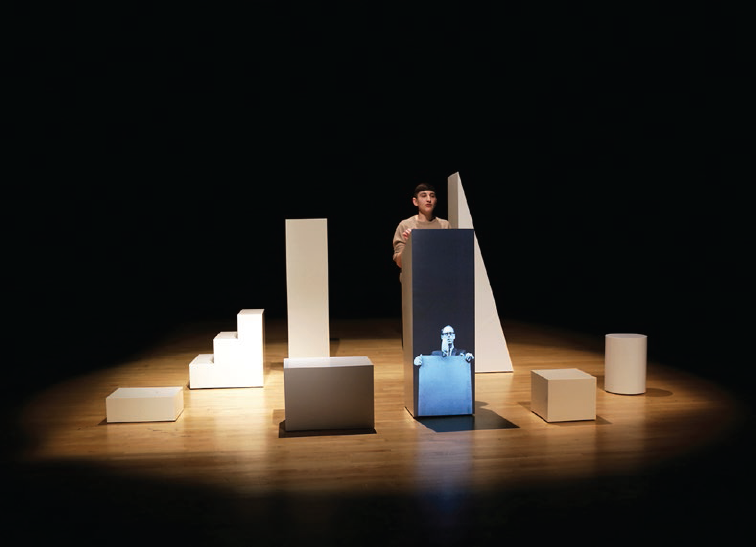
In Read me that part a-gain, where I disin-herit everybody (2014), Gordon Hall recalls a dream in which the strands of an academic argument about Maurice Merleau-Ponty became “strips of fabric that I was braiding together […,] materials that I could manipulate with my hands.” In another pedagogical recollection, this time a real address to students, Hall asks: “How is social transformation a question of materiality” and, we might add, of bodies? Read Me That Part A-Gain is a lecture performance about lecture performances that explores the history and theory of this experimental form by also enacting it. Motivated by questions about “the ways we embody knowledge and the many norms that govern its dissemination,” Hall, an artist working across sculpture, writing, and performance, taps into this material and artistic potential of lectures. The piece combines spoken text and simple choreography within a set of sculptural objects: large minimalist shapes, a cylinder, a cube, several rectangular prisms. Are they a geometric alphabet or objects performing as furniture? After all, the plinths can be and are used to sit, stand, or lean on. Through this interaction and deliberately ambiguous use, the performance has an effect on these objects, and they, in turn, affect the performer and us, the audience. Their very abstraction allows us to inhabit and imagine space, identities, and bodies in ways that differ from normative understandings and expressions.Footnote 1
→♦ Lecture performances often treat props and costumes as their materials for knowledge-making, highlighting the material basis of knowledge through movement and tactile engagement.
Projecting the poster “WORK NOT WORK” onto the central sculptural plinth, Hall reads several manifesto-like statements like this one: “Making things for which it is unclear whether they are ‘the’ work or not: lecture-performances, overly aesthetic stands and plinths, this poster” (Hall Reference Hall2014). Through a simple act of language, the “overly aesthetic stand” is reinterpreted as a surface for reading, the hierarchical distinction between process and finished product diminished. Then the lights are dimmed and turn pink and green. “We will now take a four-minute intermission,” Hall announces, then sits down, leans against one of the plinths, and together with the audience listens to the entirety of George Benson’s “Give Me the Night.” The dramatic gesture of dimming the lights is utilized in what’s often referred to as the first lecture performance: Robert Morris’s 21.3 (1964). In it, Morris lip-synchs — with deliberate delays and disruptions — to a recording of himself reading Erwin Panofsky’s lecture “Studies in Iconology” (1939), a reflection on meaning-making, based on identifying objects and events. Here Morris plays the Professor, putting words into his own mouth that aren’t his. In this visual reenactment (the dimming of lights, the gestures of a lecturer), Hall moves behind the central plinth, which thereby transforms into a lectern, to discuss Morris’s lecture performance. An image of Morris behind a similar lectern is projected onto the plinth’s front, thus creating a generic mise en abyme (fig. 1). The lectern is the lecture performance’s set piece par excellence. Although Morris presented the lecture performance at New York’s Surplus Theater in 1964 rather than in a university lecture hall, the title explicitly references a pedagogical space: 21.3 is the course number of the art history survey Morris taught at Hunter College that same year (Hall Reference Hall2014).Footnote 2
Gordon Hall, Read me that part a-gain, where I disin-herit everybody. Wood, paint, and performance-lecture with projected images and colored light, 50 min, 2014. Commissioned by EMPAC/Experimental Media and Performing Arts Center, Rensselaer Polytechnic Institute, Troy, NY. (Photo courtesy of EMPAC and Gordon Hall)

→♦ The lecture performance maintains the pedagogical imperative of the lecture but often changes its form or location.
What can the lecture performance do that a conventional lecture cannot? Etymologically, a lecture is an act of reading, either privately and silently, or publicly to an audience. First used as a synonym for a sermon, it eventually became the primary mode of instruction in a university context. The job of the religious, medieval, and early modern lecturer was to gloss a given text. A break from this tradition came in the late 18th century when the “authority of the text” was replaced by “the authority of the lecturer” (Friesen Reference Friesen2011:97–98). When I give a lecture, I certainly perform a version of authority and expertise. I perform as a professor. But who am I when, instead of my professorial outfit, I don a different sort of costume, perhaps made of paper, perhaps a flag-like fabric with screen-printed text, which becomes my script; when my set and props are not only a lectern and projector but also ribbons, wire, string? Seated between art and academia, the lecture performance creates work but also interprets it. I first encountered this hybrid genre through practice and then did my homework about its history. Experimenting with lecture performances for the first time in 2017, I became intrigued by their promise to rethink the production, dissemination, and reception of knowledge. This theoretical promise sticks to the lecture performance like a super neon gloss. Highly reflective and reflexive, the lecture performance questions the purpose and procedures of a lecture and how knowledge is conveyed.
In what ways, then, does the lecture performance play with knowledge? Primarily, through form. Lectures are already theatrical: they are live; the speaker puts on their “poet voice” or “teacher voice” and uses their body in a way that differs from their everyday speech and posture.Footnote 3
→♦ The lecture performance — all joyful artifice — highlights the performance-based nature of lectures.Footnote 4 It shows its own workings and reveals the artifice of knowledge-making.
→♦ The lecture performance draws our attention to normative and conventional structures — the signifiers “knowledge,” “lecture,” “artist,” and “professor.”
→♦ The lecture performance makes something material, gives it new shape, and as such challenges our expectations and habits. It is not resistant to all lectures but rather to the established forms and norms of the lecture.
→♦ In their relationship with traditional lectures, lecture performances are in positions of adjacency: they exist beside or alongside conventional epistemic frameworks. But it’s not necessarily a static side by side. There might be a friction that is created through resistance, friction that disrupts the supposedly smooth surface of academic criticism. I visualize this friction as a dragging in the physical sense of movement across a surface.
→♦ Historically, lectures are a drag, but just beneath the disappointment resides the hope for a renewal of their form.
While a focus on the body and experience are often markers of performance art, the lecture performance utilizes language as its primary tool. Based on artistic or academic research, the lecture performance always works with text, though that text may be improvised or scripted, formally narrative or nonnarrative, linear or nonlinear, poetic or prosaic, consistently argued or fragmented.Footnote 5 Contemporary lecture performances owe a great deal, firstly, to the textuality of conceptual art (we might think of Adrian Piper’s Food for the Spirit, 1971)Footnote 6 and gained traction in a period defined by a questioning of institutional spaces and values. Conceptual artists in the 1960s and ’70s declared language to be art, a process to be the product, or a documentation to be the event.
Because of this legacy, lecture performances usually foreground discursive elements, often in the form of a live essayistic commentary, which distinguishes them from other types of performance. Secondly, lecture performances also owe a great deal to a long history of avantgarde multimedia experiments and collaborative events.
In addition to Robert Morris, several artists experimented with the lecture performance avant la lettre.Footnote 7 John Cage’s Juilliard lecture (1952) and other Happenings in the heterodox and experimental educational context of Black Mountain College come to mind, as does the work of dance artists associated with Grand Union, such as Trisha Brown and Yvonne Rainer, who often experimented with language and self-referential commentary during their movement-work.Footnote 8 In Brown’s Accumulation with Talking Plus Watermotor (1979/1986), for example, we see Brown, surrounded by students in her Soho studio on 541 Broadway, move through the choreography of her two solos while talking.Footnote 9 During the demonstration, she shares two separate stories that interrupt the linear logic expected of both a narrative and of dance: “starting…to talk…while doing this dance…is like…opening…a front-loading…washing machine…while doing a load…of typewriters” (Brown [Reference Brown1979] 2005). Similarly, Rainer’s dances frequently featured a performer reading a text with an unemotional voice or moving with a recorded voice playing. Talking itself does not make a dance a lecture performance; there needs to be an analytical or self-referential element. Rainer incorporated both narrative and analytical speech in her dances. Between 1968 and 1970, Rainer experimented with what she called “Performance Demonstrations,” where she reworked older pieces and combined them with slides and sound ([1974] 2020:109). In one iteration at New York’s Lincoln Center, for example, two dancers move through the “Mat” section of The Mind Is a Muscle (1968), over a tape recording of Rainer reading the “omissions from this presentation as well as recent reflections about my work” (110).Footnote 10
Thanks to these important artistic forays, discursive language has become commonplace in the art world. In galleries, few audience members will bat an eyelid if an artist decides to use theory or critical language. For that reason, the lecture performance’s diversion from the norm now shows itself more explicitly in the hallowed halls of the academy than in the art gallery. In other words: the context in which a work is shown dramatically changes its reception and possible meanings. A lecture performance is therefore most distinctive or unsettling when it introduces unexpected, incongruous, nonlinguistic elements into an academic context that is traditionally concerned with the delivery of disciplinary knowledge in specific forms and modes.Footnote 11
How is an idea communicated? This is a routine scholarly and pedagogical question, but one that rarely loops back to an academic’s own writing.Footnote 12 How do I as a critic make my argument and what’s the form of my criticism? Not all lecture performances are reflexive or formally experimental (which I define quite pragmatically as a play with conventions and expectations) to the same degree. How visible or legible that experiment is at any one time, or how effective or affective, is also a question of community: how a community interprets a specific form and what political or social claims it attributes to that form.Footnote 13
→♦ Lecture performances negotiate formal questions of, for example, legibility and difficulty, order and generic disobedience, which I, as both critic and performer, can likewise ask and perform.
→♦ The lecture performance might be seen as an allegory of form, an allegory of reading, where allegory transforms abstractions into bodies that can perform on the page. In its reflexivity about language and process, the lecture performance reads itself and thus performs form.
Holding, Leaning, Thumbing
Gordon Hall’s Object Lessons
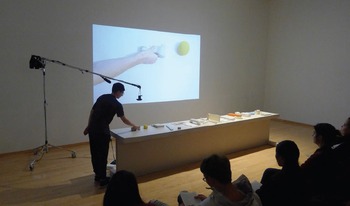
In AND PER SE AND A Lecture in 23 Tufts (2016; fig. 2), Hall arranges and rearranges variously shaped objects on a long table, while reading from a script that’s divided into 23 sections containing quotes by Hall and other artists and writers (the quotes and their sources are on a handout).Footnote 14 A camera is suspended above the small table-stage and a projection screen shows the audience a birds-eye perspective of Hall’s actions, like an omniscient narrator reporting from above. The lecture performance begins when Hall picks up a stack of cards and reads: “The…that holds together the parts of the sentence is cumulative.” I guess the gap and am primed for and, and, and, the ampersand. The result is a choreography of cumulative and “open-ended ‘object sentences,’” beginning with the title, which breaks one word (“ampersand”) into four sound-objects.Footnote 15
Gordon Hall, AND PER SE AND. Wood, joint compound, wood filler, cast cement, colored pencil, acrylic and latex paint, denim, hand dyed cotton, modeling clay, tile mosaic. Performance with projected video and sound, 58 min. 13′ × 23′ × 36′. 2016. Commissioned by Temple Contemporary, Philadelphia, PA and re-presented at Art in General, Brooklyn, NY. (Photo by Stephanie Lynn Rogers, with Drew Beck; courtesy of Gordon Hall. Video by Fred Schmidt-Arenales.)

For me, these objects are invariably more intriguing as performing objects than as static sculptures. I’m drawn to objects that look like they were used in a performance or could be. What do we see when we look at an abstract object? Or rather, how do we read it? In the sixth tableau, Hall quotes a conversation with a friend called Willy, asking:
can we talk more about
thumbing?
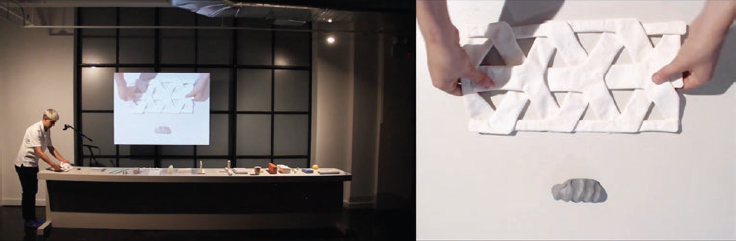
Beyond the frisson of sensuality, it’s striking that Hall describes these “handheld objects” as if thumbing the pages of a book. Thumbing, for Hall, is a tactile way of getting to know an object. In the address to Willy, we are introduced to a gray sowbug-like object that enters the scene as it slides below a white crisscross fabric-fence made of hand-dyed cotton.Footnote 16 Then the fence leaves the frame and Hall thumbs two banana-shaped objects and one orange brick, while the little sowbug keeps hanging around. When Hall reads “Like newly articulate, highly sentient beings, they begin to transform, becoming first one thing and then another,” our reading of the objects as indeterminate characters is confirmed. The line is by John McCracken as quoted by Edward Leffingwell in the catalog for McCracken’s 1986 retrospective at PS1 (Hall Reference Hall2019:36–37). I learned of this citational history only later when reading the script, printed in Hall’s Over-Beliefs: Collected Writing, 2011–2018 (2019). It’s characteristic of Hall’s work to create this citational web and it is the frequency and explicitness of citation that makes this piece a lecture performance in the first place, rather than “just” a performance.
The script also reveals what is an uncanny sense of repetition in the live performance (or in my case the video documentation): after the 23 numbered sections or monologues, the order is reversed and the texts are repeated from 23 to 1. Quotes accompany different objects — other tableaux — in the reversed ordering. The temporality set up by a live performance asks you to keep time with the performer, to follow their thinking and reasoning in real time. How I view things in documentation is another topic altogether, but my ability to stop and start, replay, pause to look something up — is of course an entirely different experience and has effects on what I know about the work and how I came to know it. For example, when I watch the video of the Art in General iteration on Vimeo, a split screen shows me Hall to the left, standing beside the table with the projection screen, and the full projection itself to the right (fig. 3). This changes the visual hierarchy of what I see, bestowing retroactive agency to the objects and their movements, away from a theatrical sensibility towards a filmic one that directs our gaze. Or maybe this magnifying glass simply allows for easier reading.
Gordon Hall, AND PER SE AND. Wood, joint compound, wood filler, cast cement, colored pencil, acrylic and latex paint, denim, hand dyed cotton, modeling clay, tile mosaic. Performance with projected video and sound, 58 min. 13′ × 23′ × 36′. 2016. Art in General, Brooklyn, NY. Video by Fred Schmidt-Arenales. https://vimeo.com/185000086 (Screenshot courtesy of Gordon Hall)

Sometimes Hall pauses, inviting us to contemplate a new arrangement; for example, two L-shaped objects, their backs turned towards one another. The piece explores these gestures of contact or asymptotic almost-contact. At other times, the tone is more confrontational, as when Hall and a shelf-like object or, depending on your perspective, a small wall, appear to be bickering:
You should have known but I didn’t know
but you should have known but I didn’t
know but you should have known but I […]
When Hall quotes Édouard Glissant’s line “We demand the right to opacity,” we witness again this performative and citational ventriloquizing, putting words into nonexistent sculptural mouths. This strengthens our sense of the objects being connected to narrative. Like language, an object is interpreted in relation to its specific context, a sculptural pragmatics that teaches us to be okay with ambiguity. But perhaps it also reveals our problematic desire to always read knowable forms into abstract shapes that are as yet or always unknowable. I wonder if the simultaneous coexistence of language with the objects makes this associative logic even more forceful. The comparison is a formal one. It happens by placing things side by side — in the lecture performance’s characteristic adjacency — where language becomes another object. I witnessed this in another sculptural reading by Hall at the Wysing Arts Centre in Cambridgeshire, UK, in May 2017, as part of the group show Mene Mene Tekel Parsin (May–July 2017), curated by Jesse Darling around the theme of (il)legibility. For U (2017), Hall had also arranged smaller objects on top of a bigger, U-shaped sculptural plinth. The opening of the show involved a reading rather than a lecture performance but the connection between language and sculpture was equally present. Similar to the thumbing-as-reading in AND PER SE AND, the objects — for example, a hand, a comma, a tilde — were small enough to be held in or told by our hands.
What becomes clear in Hall’s rearrangement of objects in AND PER SE AND (especially in the second half of the performance, when the texts are quoted in reverse order) is their essential modularity. This question of modularity has propelled engagement with props in my own performance practice: How can abstract objects mean different things depending on their use? How could not just costumes but also language become modular? The fixedness of a script and the printed page usually prohibit such modularity.
It’s only at the end of the video that I notice a short delay in Hall’s hands placing or removing an object before their appearance on the screen. This technological delay between the live performance and the camera transmitting the movement to the projection screen is apt as an accidental metaphor for reading: the split second it takes our eyes to see and our brain to process something. Hall elaborates elsewhere that an object might be “compelling to me as well, insofar as it encourages me to read more slowly. It makes me want to see it as more than one thing at once, or as many different things in quick succession” (2019:10). Specifically, Hall is fascinated with the “slant step,” an almost mythic found object suggestive of an ordinary step stool but unusable as such in its tilted, slippery form. “Looking to the slant step as a teacher,” Hall muses, “I want to learn what it seems to already know — I can’t always know what I am looking at. […] This slowness to assign identification in the moment of encounter lies at the heart of the slant step’s curious appeal” (10).Footnote 17 In the end, the lecture performance is a demonstration of Hall’s practice of this slow reading of objects — which accepts ambiguity, not-knowing, and moves away from any stable categorization.
Sculptures, and by extension lecture performances are, in Hall’s words, “a form of embodied pedagogy.” Can we see “sculptures as dance teachers? As gym coaches? As lovers?” (Hall Reference Hall2016). Hall writes in their lecture and essay “Object Lessons: Thinking Gender Variance through Minimalist Sculpture”: “I see sculpture as occupying a unique place to learn about and transform our experiences of the gendered body, not primarily because of what we see in the sculptures, but because of how they might enable us to see everything else” (Hall Reference Hall2013:47). “Object Lessons” refers to, as Hall writes, “a methodology in which we might understand our lived experiences of sculptural works as capable of teaching us conceptual frameworks through which to recognize new or different genders, in one another and in ourselves.” Hall goes on: “Might it be enough to let the blank surfaces of a wide variety of Minimalist sculptures teach us how to see bodies without demanding explanations of them? To pause before we expect a narrative of all gendered bodies, resisting our imperative to decipher where they came from and where they are going?” (Hall Reference Hall2013:47, 51). In AND PER SE AND, Hall cites an audience member who remarked on the minimalist objects’ implicit eroticism, an eroticism that doesn’t obey the markers of stereotypical identity. Hall’s sculptures and lecture performances drag furniture, usable objects, gender-nonconforming bodies, and queerness across the floor and into abstract shapes, or rather: they move us to see and read beyond representation, beyond symbolic legibility.
Much of Hall’s work makes me wonder whether the sculptures perform or if Hall as performer becomes a sculpture. In this type of work, the sculpture is, as Hall puts it, “dancerly.” And as dance, the object makes “room for a different kind of intimacy” because the object is “functioning more like a body would” (Hall Reference Hall2018). In a 2018 group show at David Zwirner Gallery called This Is Not a Prop, many of Hall’s works lean or hold themselves up. This also applies to other works. When frozen in a photograph objects and performers appear more sculptural, gestures are emphasized.
Hold.
Okay. (Hall Reference Hall2012)Footnote 18
The word “hold” has long fascinated me. To hold a pose, a note, a body. In a recently commissioned public art project in the form of a billboard, Hall asked “What held your body?” — inviting the drive-by audience to consider “bodily vulnerability” and the many “infrastructures that do and don’t support us,” like chairs, benches, assistive technologies, wheels, ramps, objects, and other bodies (Hall Reference Hall2020). But “hold,” as Hall acknowledges, also means constraint.Footnote 19
When an anchor drags, it fails to hold, causing a ship to drift.
Adrift
Danielle Dean’s Cardboard Colonial Castle
Committed to taking the lecture performance seriously as a creative medium and to experimenting with its form, Hall founded the itinerant Center for Experimental Lectures (CEL) in 2011, which since 2016 has been co-run with the curator Joseph Lubitz. The Center has so far commissioned about 37 new lecture performances and presented them at a variety of venues, ranging from outdoor spaces like Shandaken Projects’ residency on the grounds of the Storm King Art Center in upstate New York to such institutions like MoMA PS1 and the Whitney Museum in New York City, as well as radio lectures in collaboration with the digital radio station Montez Press Radio. The website hosts videos, photos, and sometimes written scripts. Recent CEL commissions were hosted online during the Covid-19 lockdown in May 2020, and in one case used the medium-specific context of Zoom as a creative constraint, where collaborative and simultaneous performance is possible by utilizing the platform’s “gallery view.” Ditching traditional intros of reading the artist’s biography and various accolades, the CEL introduces every presenter through a short extract related to their work. For Martine Syms, Hall read from Ursula Le Guin’s “Telling Is Listening,” while Naama Tsabar was introduced with an extract from Pauline Oliveros’s “Some Sound Observations,” thus establishing the citational and relational context that comes with research.
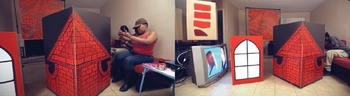
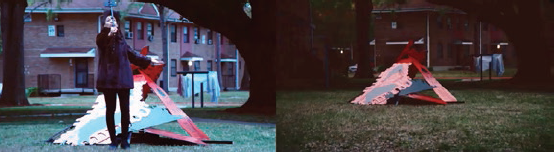
Danielle Dean’s CEL lecture performance Castling (fig. 4), first presented at the BAM Fisher Lower Lobby as part of Wendy’s Subway Reading Room, in December 2017, takes as its subject Elmina Castle in Ghana, which was set up as a Portuguese colonial trading post in 1482 and by the 17th century had become a Dutch holding depot for the Atlantic slave trade. Elmina Castle was also the first prefabricated European structure to be built in sub-Saharan Africa. Dean’s lecture performance draws on this history and quotes Jeremy Bentham, Stuart Hall, as well as media theorists Marshall McLuhan, Friedrich Kittler, and Bernhard Siegert. Alongside images of contemporary Elmina Castle as a tourist destination, there are scenes from Dean’s video work True Red Ruin (2016/2017), set in the affordable housing community Cuney Homes in Houston, Texas, and which features Dean’s sister and her friends as residents (fig. 5). In this way, the “castle” becomes abstracted, fragmented, and transplanted, establishing a link between historical imperialism and contemporary capitalism and gentrification. Colonialism continues, the lecture performance suggests without explicitly saying so, in racialized profit-based architecture, technology, and the “castling” of poorer communities. In the video, Dean and the other performers/residents discuss the arrival and development of the castle, a reconstructed Elmina version made of cardboard. The use of flimsy material with its association of childhood crafts projects adds some dark humor but also adequately serves as a reminder of how the surface of material might hide its history of labor and ideological severity. The cardboard replica shows in miniature that the idea of the castle is easily replicable in other shapes and forms, and historically also was copied in other fortresses along the Gold Coast.
Danielle Dean, Castling, lecture performance, commissioned by the Center for Experimental Lectures and re-presented by the Museum of Contemporary Art Detroit (MOCAD), March 2018. https://www.youtube.com/watch?v=xCOcGdAtroo (Screenshot courtesy of Danielle Dean)

Danielle Dean, Castling, lecture performance, commissioned by the Center for Experimental Lectures and re-presented by the Museum of Contemporary Art Detroit (MOCAD), March 2018. https://www.youtube.com/watch?v=xCOcGdAtroo (Screenshot courtesy of Danielle Dean)

Dean as property mogul and the castle’s site manager opines in a dispassionate voice “we could look at the castle as an invention in media, like a phone or a shoe or a stereotype.” And further: “the castle was a storage device,” first of gold and eventually also of enslaved people, “like goods to be stored.” She then quotes Kittler who defined media as storing and transmitting information. This discussion is prepared and interspersed with residents filming themselves on their phones and a recording of Stuart Hall describing media representation, stereotypes (as originating in printing, an early medium of representation), and Jeremy Bentham’s design of the panopticon.
→♦ A lecture performance often illustrates at oblique angles. So when Dean mentions the etymology of culture as land being worked on, we see tractors ploughing the field. Rows upon rows. A stereotype is made through repetition.
Often a lecture performance uses the well-timed slide change for comedic or dramatic effect to coincide with a particular line or pause or movement.Footnote 20 Whatever is shown on the projection often exists in a relation to the text that is somewhat aslant rather than a pure illustration of content as one might expect from a traditional academic lecture or artist talk. Peripheral vision, the half-heard, is as important as the frontal view. The lecture performance (just like the artist talk) allows you to show cat pics or silly memes to your heart’s content. What would seem unserious or far-fetched in an academic article can be used imaginatively in the live context of the lecture performance. Whereas an academic lecture usually proceeds methodically, logically, and in a linear fashion, the lecture performance follows other routes and argumentative structures. Fragments might replace full-fledged arguments; visuals might serve as illustration or counterpoint, and distraction is a welcome technique.Footnote 21
→♦ The lecture performance sometimes even offers alternative logics that take us beyond the opposition between fragment and whole.
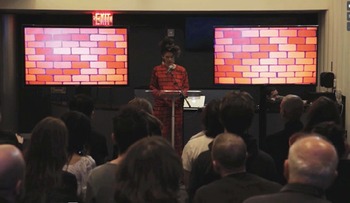
The castle, as Dean says, is “a technology for producing a boundary, a surveillance machine, like being watched by the red of the brick wall.” At CEL, Dean’s body, flanked by two projection screens (initially showing seemingly endless brick walls), became part of the set by being the missing brick in the façade (fig. 6). Suitably, Dean, as the company’s supposed site manager, wore a castle track suit — a nonverbal visualization and embodiment of Foucault’s idea of punitive measures becoming part of our bodies; whereby policing and punishment have become internalized (1975:201–03). The body has become a castle. After all, Dean began the lecture performance with a declaration of identity: “I am here as a representative of the castle and I’m here to discuss castling,” which, she qualifies, is “in all of us.”
Danielle Dean, Castling, lecture performance, commissioned and presented by the Center for Experimental Lectures at the Wendy’s Subway Reading Room for BAM’s Next Wave Festival, December 2017. http://experimentallectures.org/index.php?q=lecture&id=38 (Screenshot courtesy of Danielle Dean)

In her own description of the video piece, on which this lecture performance is based, Dean explains that it all began with Nike’s 2003 “True Red” release, marketed as the vampire sneaker. Her research led her to castles, and eventually to Elmina Castle, whose brick shares the bright red color with the sneaker. Dean’s wider project includes the videos True Red (2015), True Red Ruin (Elmina Castle) (2016/2017), A Portrait of True Red (2016), and the solo exhibitions A Shoe, A Phone, A Castle at Commonwealth & Council LA (2017) and True Red Ruin at the Museum of Contemporary Art Detroit (2018).
→♦ The lecture performance, whether as a stand-alone piece or a supplement to another work, highlights its field of relations, like a slant step, as a deliberately slippery ladder towards other voices.
Pulling on the Attached Strings
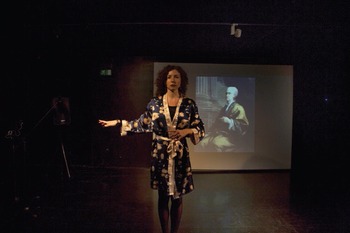
Since 2017, I have written and performed several lecture performances. The first one I described as “an essay but not in the form of an essay, a thinking through of ideas in language, a dialogue” (Seita and Spittle Reference Seita and Spittle2017). It was based on My Little Enlightenment Plays, a multiyear, multidisciplinary project of imaginary and translational tête-a-têtes with Enlightenment thinkers, writers, and (pseudo)scientists (fig. 7). The lecture performance was a mix of fictocriticism, reenactments of some scenes from plays I’ve written, quotations from and responses to other source materials, and lastly, a performative uncovering of my process. I first presented it as part of the 2017 Cambridge Festival of Ideas in an installation I devised with my friend, the curator and writer Yates Norton, as a visual and spatial response to my text.Footnote 22 Transforming the little black box drama studio in Cambridge into an absurdist salon, Norton’s miniature cardboard theatres sidled up to shredded paper that was piled everywhere; prints hung on clotheslines to partially obscure, partially reveal the “stage”; and colorful strings of lights festooned the space. A student played Lully on a borrowed spinet, while Norton and the poet and dancer Erin Robinsong handed out Turkish delight to the expectant audience, against a backdrop of two projections. The first video looped a scene of the Drottningholm Theatre in Stockholm (the oldest European theatre still using its original stage mechanics) opening and closing its curtain, with an electronically détourned Lully piece by Rhodri Karim (previously used in my performance Les Bijoux Indiscrets, or, Paper Tigers [2017]) and some overlaid coffeehouse chatter. The second projector showed a series of flickering images that included Madame de Pompadour, book pages, precariously slanted furniture, ornamental sketches, and details of rococo design and drapery. The flickering mimicked the visual effect of papillotage, an 18th-century concept that was denounced for drawing attention to detail, dispersing focus away from the whole towards its fragments. My lecture performance tried to reclaim the fluttering effects and ornamental frivolity of papillotage arguing that a reflexive materiality and high artifice still allowed for wonder, thus bypassing transparency flirtatiously.
Sophie Seita, My Little Enlightenment Plays, lecture performance, Arnolfini, Bristol, August 2017. (Photo by Lua Ribeira; courtesy of Sophie Seita)

The lecture performance and my Enlightenment project more broadly toyed with the Enlightenment’s obsession with (scientific) truth, rationality, empiricism, categorization, and our inheritance of these forms of knowledge and their dissemination. I was motivated by the politics of attention and a curiosity of how to make historical material contemporary in a way that acknowledges its specific problematics along the axes of gender, sexuality, race, and class. Why did I pick the Enlightenment? Enlightenment texts and ideas have often been taken as the foundations of the humanities. The Enlightenment’s values of universality, progress, and individualism, as well as its commitment to progress and expanding knowledge, have shaped our own values and our understanding of the rights of individuals and groups. But the same ideas and practices were also used to justify colonialism, gender and racial hierarchies, and the exploitation of the planet.
→♦ Through the lecture performance’s practice-as-research we might explore specific histories and ideas performatively.
→♦ The lecture performance can make something abstract more tangible but not necessarily more palatable.
That would be my academic answer, my reasonable explanation. But really what attracted me to the Enlightenment was its camp style, or my reading camp into it, which allowed me to be camp. The lecture performance as a format suited my desire to play, to be a little silly and confidently nonchalant, after all that serious and anxious laboring over Scholarship with a capital S. (It turns out I labor just as much over a lecture performance but the point is: I allow myself some pleasure.)
→♦ Unlike the lecture, the lecture performance does not profess expertise. It does not need to exhaust a subject. It can dabble and suggest, celebrate passionate amateurism.
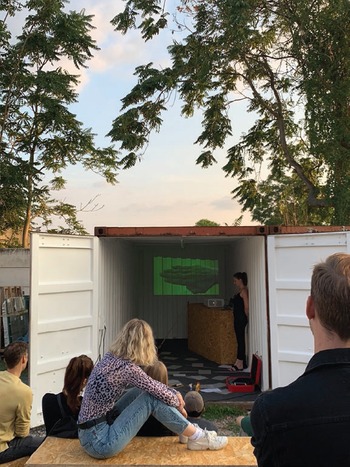
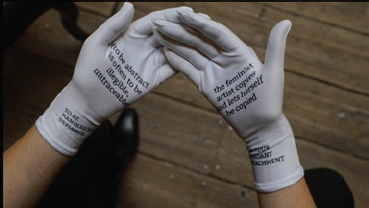
There’s pleasure to be had in playing with knowledge and that’s the key. My lecture performance Vulva’s School: A F*cking Didactic Take on Experimental Feminist Performance Art, or, How to Read (2018–2020)—takes its title from Carolee Schneemann’s vision of an antipatriarchal pedagogy in her performance Vulva’s School (1995) and Hito Steyerl’s faux-didactic video essay How Not to Be Seen: A Fucking Didactic Educational.MOV File (2013) (fig. 8). My piece is about pinched nerves as feminist symptoms, intentionality, serious copying, an addiction to professional slickness, and the bravery to get lost. It’s in creative conversation with artists Hito Steyerl and Maya Deren, theorists Jack Halberstam, Sianne Ngai, Eve Kosofsky Sedgwick, and Sara Ahmed, and poets Lisa Robertson and Gertrude Stein. My lecture performances are all meditations on reading and learning—bibliophilic memoirs in performance. In retrospect, I would say that what’s going on is connected to what Elizabeth Freeman calls the “temporal drag” of performative modes and models of the past, “the pull of the past upon the present,” which aligns with my understanding of the avantgarde’s movable contemporaneity (2010:64, 62).Footnote 23 The citationality in both Vulva’s School and My Little Enlightenment is allegorical, it retells an older tale—e.g., the tale of Schneemann’s “vulvic space” (Schneemann Reference Schneemann1991b:33) and the tale of an Enlightenment-inspired utopian knowledge community—not out of parody but perhaps a sincere over-identification, even anachronism, or a strange blend of both: “the story is neither one of continuity nor one of complete repudiation but instead a story of disjunctive, sticky entanglements and dissociations” (Freeman Reference Freeman2010:70)—and, I would add, theoretically infatuated associations. Theory can be a safety blanket, a transitional object outside the academy. Given that Vulva’s School was a lecture performance about the passing on of knowledge and conceptually very much located within the setting of “school,” my materials for learning included: tracing paper, pen, notebooks, rulers, books, a briefcase, and Tipp-ex correction fluid. What counter-history did such a performative school offer me? Perhaps one that did not insist on “firsts”—the avantgarde’s obsession with originality—but one that listens to many voices and acknowledges their hold on you: “The feminist artist always copies and lets herself be copied” (Seita Reference Seita2020) (fig. 9).
Sophie Seita, Vulva’s School: A F•cking Didactic Take on Experimental Feminist Performance Art, or, How to Read, Florens Cargo, Darmstadt, lecture performance with projected video and sound, August 2019. (Photo by Laura Cobb; courtesy of Sophie Seita)

Sophie Seita, Vulva’s School: A F•cking Didactic Take on Experimental Feminist Performance Art, or, How to Read, video, WIP/Queer Art Projects, 2020. (Video still courtesy of Sophie Seita)

As I’ve said elsewhere, there is a delicate balance between showing and offering up for experience, on the one hand; and explaining and somewhat determining the experience, on the other (2019a:16). Most knowledge, just like performance, is shared through documentation, and documentation, as media historian Lisa Gitelman reminds us, is etymologically connected to pedagogy:
The word “document” descends from the Latin root docer, to teach or show; […] documenting is an epistemic practice: the kind of knowing that is all wrapped up with showing, and showing wrapped [up] with knowing. (2014:1)
How do I write about the lecture performance as someone who’s pretty wrapped up in it? At the risk of reenacting, repeating myself, I would ask along with Sedgwick, “What does knowledge do—the pursuit of it, the having and exposing of it, the receiving again of knowledge of what one already knows? How, in short, is knowledge performative, and how best does one move among its cause and effects?” (2003:124). If straightforward transmission is impossible, we might want to move in tangents, curves, slopes, and angles. Ideally, lecture performances don’t assume full possession of knowledge. But perhaps no matter how experimental, there is no escaping some verticality or hierarchy between performer and audience. Even if the mode of transmission avoids logocentrism, the speaker/listener dynamic is not necessarily disrupted. In establishing its experimental form, the lecture performance reinforces the binary it seeks to subvert. It needs the binary to continue to exist for its critique to work.
The lecture performance is intimately tied to the so-called educational turn in the art world (see Frank Reference Frank2013). The educational turn, usually dated around the mid-1990s and then again in the mid-2000s, describes the expansion of art galleries’ public programming and artists and curators engaging in explicitly pedagogic projects as art, e.g., lecture series, seminars, workshops, poetry readings, and reading rooms. At the time of writing (2021), art institutions continue to be seen as alternative learning spaces and there’s been a marked increase in participatory public art projects (increasingly so during the Covid-19 pandemic), joined recently by publications on the subject.Footnote 24 There have been alternatives to the MFA in the form of artist development programs, summer schools, and peer-led self-organized art education, such as Constellations run by UP Projects and Flat Time House (London), School of the Damned (nomadic, online), Wysing’s Syllabus (Cambridge, UK), The Summer Writing Program at Naropa’s Jack Kerouac School of Disembodied Poetics (Boulder, CO), and Rupert’s Alternative Education Programme (Vilnius, Lithuania), to name only a few. These alternatives respond to both the aggressive marketization of education and an explicit need for education outside the formal structures of a degree.
The current educational turn also coincides with an increase in practice-based research, outreach, and public-facing humanities in university settings, rooted in a belief in the democratization of art and education (authentically so or as lip service). Audiences are expected to behave like students, or better still, as coproducers of meaning (a favorite phrase of new public-engagement funding guidelines). While this sounds promising, it is also potentially flawed, as Claire Bishop points out:
When artistic practice claims to be pedagogic, it immediately creates conflicting criteria in my mind: art is given to be seen by others, while education has no image. Viewers are not students, and students are not viewers, although their respective relationships to the artist and teacher have a certain dynamic overlap. (2012:241)
Bishop reminds us that artists’ practice of institutional critique in the 1960s emerged at a time when education, too, put itself under scrutiny, most notably in Paulo Freire’s Pedagogy of the Oppressed ([1970] 2018), Augusto Boal’s Theatre of the Oppressed ([1979] 2019), and, I would add, when black feminists such as bell hooks worked to reorient education towards nonhierarchical dialogue, collectivity, and consciousness raising (see e.g., hooks Reference hooks1994). So the lecture performance might fit in the scenario outlined by Bishop (for the participatory art she discusses): “a single artist (teacher) allows the viewer (student) freedom within a newly self-disciplined form of authority” (2012:267).
The question always is: Who is this work really for? Who wants to know something? At this point the little girl with ants in her pants is practically toppling over from all that keen hand-raising: Me, Me, Me! What do we tell her? And what do we tell the one who’s sitting beside her, excelling in performing boredom, making small gum sculptures under the desk? (In Rancière’s [1991] dyadic model of schoolmaster and ignoramus, the student is invariably female.) Learning, supposedly the flipside of teaching, is also a performance. You perform a search, a quest. You perform for the teacher, the test. When you find yourself transformed from student into teacher, who do you try to please? What do you need to prove?
(→♦ The lecture performance has an awful lot of rhetorical questions up its sleeve.)
One thing I both love and resent about good critical writing and serious research is that it is humbling. Someone’s been there already, has confronted the conundrum, and has found some answers. An idea that was still loosely floating around in the amniotic chaos of your brain already occurred to someone else and they have prepared the path and left for you a network of footnotes to follow. Academic footnotes are drags, they drag us into the dregs; they are hooks to the past…and we need them. One thing I both love and resent about performance and poetry is that I do not need to abide by the academic rulebook and its references, I mean reverences; that almost anything can be interesting and made into a subject; and that everything gets the personal spin.
To conclude, I’ve listed some more of the lecture performance’s provisional characteristics, which might include contradictions that can simultaneously be true:
→♦ The lecture performance exists intriguingly between the primary work and the secondary source.
→♦ The lecture performance is playful.
→♦ The lecture performance revels in ambiguity, it yelps joyous multiplicity!
→♦ If dragging something describes a process of unsettling and shifting, then the lecture performance repeats in drag what is sedimented academically but in a different key.
→♦ The lecture performance diverts us from following straight lines of direction, and static/stable identities.
→♦ The lecture performance tries to be research, where “tries” captures the notion of “attempt” in the essai.
→♦ The lecture performance tries very hard to avoid being “just a lecture.”
→♦ The lecture performance is not “just a performance,” though it is a subcategory of performance art.
→♦ The language of the lecture performance is often reminiscent of or borrows directly from theory or critical prose.
→♦ Even when scripted, the lecture performance is live thinking, unfolding over time, which is its medium-specific affordance. It presents thinking that is absorbed aurally and visually at the same time.
→♦ The lecture performance has at its core a desire to educate, to lecture on something, even if that something has not yet or cannot be worked out.
→♦ The lecture performance is different from, say, Bertolt Brecht’s Lehrstücke (learning plays) and epic theatre, in that Brecht’s plays are didactic in their appeal for an audience’s moral conscience but do not use the language of (pedagogical) criticism.
→♦ If performance is either fiction or autobiography, then the lecture performance is creative nonfiction but live.
→♦ Where the lecture celebrates abstraction, specialization, depth, and length, and the TED talk (a late-20th century version of the lecture) favors brevity, surface, clarity, memoir, storytelling, punchlines, and broad appeal, the lecture performance might lean on or dangle between these two poles, but with its own intentions, intended audience, and institutional contexts.
→♦ If the projector is the lecture performance’s easel, layering, associational logic, and juxtaposition are its procedures.
→♦ The lecture performance often subverts conventional epistemic practices and offers alternatives: the associative, the speculative, the mystical, the nonlinear, the visual, the aural, the experiential, the sensual, the sensorial, the embodied.
→♦ The lecture performance costumes knowledge—makes it wearable and movable. The lecture performance stages knowledge.
→♦ The frequent dryness of academic research can be contrasted with the lecture performance’s liquidity: to be moved, perhaps to tears, perhaps to dance.
Anything that follows a list, its performative and declarative surety, ought to introduce some doubt, some ambiguity, some play. The lecture performance, which is under the clumsy siege of words, which is both abstract and insistently material, cocks its head cheekily and curiously—not knowing but pretending to, or pretending not to but knowing deep down that all exercise requires repetition.Footnote 25