

On February 23, 1933, Minnesota’s governor Floyd B. Olson addressed thousands of angry farmers from the steps of the state capitol. Citing the economic emergency and the mounting threat of armed resistance to foreclosure sales, Olson announced a moratorium on mortgage foreclosures until May 1 of that year. He declared: “If the legislature … does not make ample provision for the sufferers in this State … I shall invoke the powers that I hold. I shall declare martial law” (Prosser Reference Prosser1933, 355). This executive proclamation, coupled with increasing pressure from the farmers that supported it, prompted the legislature to pass a law validating all postponements made in compliance with the governor’s moratorium and authorizing sheriffs to adjourn foreclosure sales until May 1, 1933. It allowed local courts to extend the time available to borrowers to repay their mortgage debts, though borrowers who received this relief were required to pay a reasonable part of the rental value of the property while they remained in possession. The constitutionality of this mortgage moratorium would become the subject of the 1934 US Supreme Court case Home Building & Loan Association v. Blaisdell.
Blaisdell upheld Minnesota’s relief law, and its opinion hinged on the meaning of the Contracts Clause of the Constitution, which prevents states from “impairing the obligations of contract.” The court had long held that states possessed constitutional authority to regulate in ways that would affect contracting. Beginning in 1827, the Supreme Court determined that the Constitution allowed states to regulate the terms on which people could forge private contracts. In fact, it asserted that the states would never have ratified the Constitution if they had understood it to deprive them of this power.Footnote 1 In the decades that followed, the Supreme Court affirmed that the states possessed at least some authority to regulate private contracts if those contracts affected public order and welfare, and it formalized this understanding by classifying all such legitimate regulatory powers as “states’ reserved police powers” (Olken Reference Olken1993, 543).
Blaisdell is generally treated as a landmark case, one that signaled a dramatic transformation in law.Footnote 2 In deciding that Minnesota was allowed to intervene in existing debt contracts, Blaisdell arguably dispensed with the remaining constraints on state governments (Mason and Stephenson Reference Mason and Stephenson2015, 304–5). Although the Supreme Court had allowed for a great deal of state regulation of contracts well before Blaisdell (Olken Reference Olken1993), the kind of emergency debt relief law that Minnesota passed (often known as a “stay law”) had long been the paradigmatic example of a Contracts Clause violation. Justice George Sutherland’s dissent in Blaisdell (1934, 449–50) accused the majority of turning its back on this long-accepted meaning of the Contracts Clause: “A provision of the Constitution, it is hardly necessary to say, does not admit of two distinctly opposite interpretations. It does not mean one thing at one time and an entirely different thing at another time.”Footnote 3
This article argues that no matter what effect it had on federal constitutional doctrine, as a matter of lived experience, Blaisdell did not mark the end of a golden age of contract enforcement because no such golden age had ever existed. Instead, the state-level practice of passing debt relief laws had proved quite durable even in the face of the judicial rulings that nullified these laws as violations of the Contracts Clause. Despite Contracts Clause doctrine, states’ legislative intervention on behalf of debtors had been a standard feature of nineteenth-century politics. Mobilized debtors consistently demanded legislative relief during economic crises, and state legislatures so frequently complied with these demands that the federal doctrine invalidating states’ emergency relief laws never managed to stamp out states’ practice of passing them. From this vantage, the court’s acceptance of Minnesota’s statute in Blaisdell has come to seem like judicial acquiescence to the way states had always behaved.
Perhaps one of the reasons that federal doctrine has received more emphasis than states’ legislative practices is that the politics of subnational debt relief are difficult to study, especially over long time periods. State codes were compiled somewhat sporadically throughout the nineteenth century, and states’ relief legislation was typically designed to be temporary. Since neither the US Supreme Court nor state high courts maintain separate records of their exercise of judicial review, it is also difficult to track the fate of these laws as they were subjected to constitutional scrutiny (Whittington Reference Whittington2015). Using state session laws for every existing state, I created an original dataset of states’ emergency-relief legislation passed between 1819 and 1934 as well as an original dataset of state high court cases reviewing these state statutes.
Drawing on this original dataset, along with local newspapers from this period, this article focuses on the existence of a long-standing mismatch between Contracts Clause doctrine and state legislative practice. I argue that the regional politics of debt made it particularly easy for debtors to convince their state legislatures to enact relief laws, while, at the same time, the delays associated with judicial review muted the threat of judicial nullification. The combination left state legislatures relatively undeterred from passing relief legislation, though legislatures did strive to pass laws that would stand a chance of surviving judicial review. As a result of these dynamics, debtors were able to secure protection from their state governments, despite the fact that, until Blaisdell was decided in 1934, those protections stood on shaky constitutional ground.
Blaisdell is generally discussed as part of the larger New Deal transformation in constitutional meanings, during which New Dealers struggled to accommodate the constraints of the US Constitution to the economic realities of the twentieth century’s Great Depression (White Reference White2000; Levinson Reference Levinson2005). Much of the scholarship on Blaisdell, therefore, emphasizes the long history of courts invalidating emergency relief statutes before this ruling (see, for example, Kmiec and McGinnis Reference Kmiec and McGinnis1987, 534). In their comprehensive monograph on Blaisdell, for instance, John A. Fliter and Derek Hoff (Reference Fliter and Hoff2012, 36) note: “Every remedy proposed by the Minnesota Legislature in 1933 … had at one point been held unconstitutional by state or federal courts. … All of these precedents assumed a forceful Contract Clause.”
By emphasizing the vigorous judicial defences of the Contracts Clause before Blaisdell, the scholarly literature can create the impression that courts and the Constitution actually governed states’ intervention in contracts between debtors and creditors.Footnote 4 Even Fliter and Hoff (Reference Fliter and Hoff2012, 35), who note the long history of state-level debt relief, approvingly cite a 1933 study stating that the long history of nullified debt relief statutes reflected the fact that, before Blaisdell, “the contracts clause ha[d] withstood the attack” from the states (citing Prosser Reference Prosser1933, 358). This emphasis on a forceful Contracts Clause, vigorously defended from the states by a string of judicial rulings, tends to obscure the fact that, long before Blaisdell, debtors and state legislatures had mounted a successful resistance to federal Contracts Clause doctrine.
By foregrounding the success of debtors’ movements in securing emergency relief laws throughout the nineteenth and early twentieth centuries, even in the face of judicial hostility, this article shows that it was the state practice of intervening in private contracts that “withstood attack” from the Contracts Clause, not the other way around. As a matter of actual practice, states’ ability to modify existing contracts between debtor and creditor survived the Contracts Clause. Even as the federal courts established doctrine to protect private contracts, states developed a tradition of intervening in these bargains. Though most studies of Blaisdell ask whether or why the US Supreme Court relaxed its accustomed opposition to emergency debt relief in this case, a focus on the long-term success of debtors’ demands suggests a different question: Why were debtors able to secure so many relief laws during a time when the courts had rendered these laws constitutionally suspect?
The first section of this article describes the long-standing mismatch between federal Contracts Clause doctrine and states’ debt relief practices, highlighting the persistent and widespread state practice of passing relief laws of questionable constitutionality. The next two sections describe the sources of debtors’ legislative clout, explaining why debtors were able to shape the law in their favor despite federal doctrine that was largely at odds with their aims. The second section explains how the regional dimensions of debt relief politics enabled debtors to succeed in state legislatures, and the third section illustrates that emergencies were frequently critical to the passage and survival of these statutes. Whatever Blaisdell meant as a matter of doctrine, therefore, we should also understand this case as evidence of a durable, state-level commitment to protecting debtors from the potentially ruinous consequences of private economic bargains.
THE MISMATCH BETWEEN DOCTRINE AND PRACTICE
The US Constitution’s Contracts Clause was, at least in part, a response to the framers’ fear that debtors would use state legislatures to deprive creditors of their property—an elite attempt to stop state legislatures from intervening in existing contracts on debtors’ behalf. Those who favored the creation of a new constitution and strong central government feared that the states’ already-frequent interventions between debtor and creditor would inhibit the growth of national markets. The specter of revolutionary-era debtors’ movements figured prominently in the constitutional convention (Beaumont Reference Beaumont2014, 74–85). Advocates of the new Constitution pointed to the violent opposition to debt collection in Western Massachusetts known as Shays’ Rebellion, warning that each state had “its Shays, who either with their pens—or tongues—or offices—[were] endeavoring to effect what Shays attempted in vain with his sword” (Alexander Reference Alexander1990, 180). Under the new Constitution, the national government would take on responsibility for debtor-creditor relations, and states would cease to intervene in existing debt contracts. The Contracts Clause delineated a clear boundary between the authority of these two layers of government and established a new constraint on state legislatures (Ely Reference Ely2016a, 14).
From the outset, courts interpreted this new constitutional provision as a constraint on the regulatory powers of state governments. As James Ely (Reference Ely2016a, 1) notes in his comprehensive history of the Contracts Clause, this provision “rapidly became a primary vehicle for federal review of state legislation … [and was] one of the most litigated provisions of the Constitution throughout the nineteenth century.” As early as 1819, the US Supreme Court declared that the Contracts Clause was a ban on state governments’ provision of emergency debt relief. This opinion in Sturges v. Crowninshield (1819, 205–7) cited the framers’ animosity toward states’ retrospective debt relief measures and noted that one aim in designing this constitutional provision had almost certainly been to limit the state practice of relieving debtors by modifying contracts into which debtors and creditors had already entered. By the late nineteenth century, the Supreme Court began to allow more state regulation of private economic activities, including contracts. Yet, the Supreme Court reiterated the constitutional prohibition on retrospective forms of debt relief even into the twentieth century.Footnote 5
Since emergency relief was designed to assist debtors suffering under existing contracts, it was typically backward looking (or retrospective) in operation, and it was the retrospective nature of emergency relief measures that rendered them constitutionally suspect. For example, the Iowa legislature passed a law in 1860 preventing property from being sold under execution unless that property had been appraised and was being sold for at least two-thirds of its appraised value. In reviewing this law, the Iowa Supreme Court concluded that there was “no room to doubt that the legislature intended to give it the effect and operation of a retrospective law” (Rosier v. Hale et al. 1860, 484). Iowa’s highest court then went on to explain that, since the law was clearly intended to apply to contracts already in existence at the time of its passage, one of two things must have happened: either the state legislature had overlooked the Contracts Clause and its prohibitions on retrospective relief, a point of constitutional law that it described as “fully settled by the courts of the country,” or else the Iowa legislature had meant simply to “meet the exigencies of the times, and leave [the statute’s] validity in the keeping of the courts” (484). The opinion then lamented the fact that Iowa’s highest court had already nullified a similar law, noting that “this important duty was performed once before by this court, with reference to the constitutionality of the appraisement law of 1848, as a retrospective act.” Therefore, the court explained, “we might have been spared the responsibility of exercising so delicate a power the second time” (484). Citing a string of Supreme Court cases, the Iowa court declared this statute impaired the obligation of contract.Footnote 6
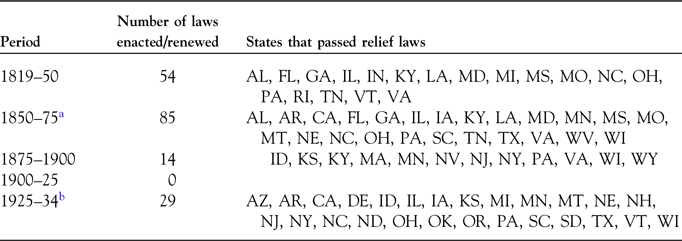
Despite the Contracts Clause, state legislatures regularly acquiesced to debtors’ demands for emergency relief, passing retrospective relief laws with remarkable frequency. Between Sturges (1819) and Blaisdell (1934), state legislatures either passed or renewed such laws 184 times (Table 1). Debtors frequently pointed to the passage of previous debt relief laws to argue that legislatures should enact new ones. For instance, one Minnesota stay law advocate in 1878 asked: “Would it not be just and expedient for the State Legislature to enact a stay-law? This was done a few years ago when the times were not nearly so hard as they are now, and that legislation worked most beneficially for all concerned.”Footnote 7 Several decades later, a Texas newspaper made the same observation and asked the same question: “A stay law in many states is humanely enacted in times of stringency and distress like these. … Why not have such in Texas?”Footnote 8 These laws were, in other words, a standard feature of nineteenth-century state governance.
Retrospective relief laws enacted by state legislatures

Notes:
a All of the confederate states (except Tennessee, which passed its stay law right before seceding) passed at least one retrospective relief law during this period. Although the Constitution of the Confederate States had its own Contracts Clause, worded identically to the Contracts Clause in the US Constitution, it is important to note that the Confederate States did not feel themselves bound by the US Constitution at this point and that the stay laws they passed in this period, therefore, are not evidence of the same kind of gap between federal doctrine and state practice. I have nonetheless included these laws here to demonstrate how widespread, and even routine, the practice of passing retrospective relief laws really was. As Table 1 demonstrates, southern states passed emergency relief laws not only in rebellion but also before and after the Civil War.
b Only includes states that passed a relief statute before Blaisdell was decided (January 1934).
In addition to stay laws, retrospective relief measures included: installment laws, which extended the period of time over which debts could be repaid; appraisal laws, requiring appraisals of debtor’s property and forbidding its sale at too great a discount from their former or true value; and laws requiring creditors to accept payment in depreciated currency or other commodities. State legislatures also passed “redemption laws,” extending the period available to debtors to buy back their mortgaged property once it had entered foreclosure, and laws that abrogated the gold clauses in private contracts, and some even closed their courts temporarily to prevent them from issuing judgments against debtors. States combined these types of protections in different ways, returning to them in successive economic crises (Coleman Reference Coleman1999). Forty-two of the forty-eight states that existed by the end of this period had passed some form of retrospective debt relief law at least once before Blaisdell.Footnote 9
What can we make of this enduring state practice of passing retrospective relief laws similar, or even functionally identical, to those that courts had already nullified as unconstitutional? In one account, which was frequently offered by the opponents of such statutes, these relief measures represented lawlessness, the mob’s triumph over the Constitution.Footnote 10 Indeed, the indebted farmers who so often demanded these laws sometimes resorted to violence as a means of resisting debt collection, even as they also pursued protective legislation to ameliorate the effects of crises. When the leader of a local chapter of the Kansas Farmers’ Alliance was unable to pay his mortgage and consequently lost his farm, for instance, local farmers gathered at the farm, forcibly removed the new tenant, and placed the original owner back in possession.Footnote 11 Some members of the Farmers’ Alliance also resisted foreclosure by physically disrupting foreclosure sales, and some Farmers’ Alliance members promised to resist the sale of mortgaged property by force until the legislature passed such a law.Footnote 12 Some of the relief law’s advocates even explicitly advocated the passage of a law whether or not it could withstand judicial review. As one pro-debtor newspaper in Kansas urged, “enact this stay law … if in the opinion of the supreme court is should prove unconstitutional, no harm will have been done. Why is there so much fear of an enactment that might prove unconstitutional? Legislatures have passed unconstitutional laws before.”Footnote 13
Despite the explicit rejection of constitutional constraints that surfaced in some campaigns for debt relief, the advocates of emergency relief did not generally announce that they planned to ignore the Contracts Clause or the US Supreme Court’s interpretation of it. On the contrary, they claimed that they could pass retrospective relief laws that would not violate the Constitution. This hope was grounded in a doctrinal ambiguity. Although the Supreme Court consistently nullified the retrospective relief statutes that it reviewed over the course of the nineteenth century, it developed a somewhat enigmatic doctrine permitting states to make certain kinds of adjustments to the laws of debt collection. Beginning with its ruling in Sturges (1819), the court distinguished between impairing the obligations of a contract (which was clearly unconstitutional) and merely affecting the remedies available to enforce it (which was constitutionally acceptable).
Though courts’ determinations about the constitutionality of retrospective relief hinged on the distinction between obligations and remedies, they struggled to identify the difference between them. As Ely (Reference Ely2016a, 62) explains in his constitutional history of the Contracts Clause, “courts continued to wrestle with the baffling inquiry of what the ‘obligation of contract’ was and how the obligation differed from the remedy for nonperformance. Both courts and commentators expressed frustration with this inquiry.” Because this doctrinal distinction proved particularly ambiguous and indeterminate, the proponents of relief laws often declared that it was possible to craft a retrospective statute that courts would deem to be a permissible alteration of creditors’ remedies rather than an unconstitutional impairment of contractual obligations, and many state legislatures seem to have tried to maximize the chances that their debt relief laws would fall on the right side of the rights/remedies distinction. For instance, after the judiciary committee of the 1890 Kansas House of Representatives determined that a stay law would likely be declared unconstitutional, debtors began to urge the passage of a redemption law instead, arguing that a redemption law was more likely than a stay law to pass constitutional muster. One advocate of this redemption law explained: “In passing any bill the one that will stand the test of the courts the best should be passed.”Footnote 14
Indeed, some state high courts did uphold debt relief statutes on the grounds that these laws were merely adjustments to the remedies available to creditors. State high courts were twice as likely to strike down relief laws as they were to uphold them (and even elected judges seemed quite willing to strike down these popular statutes), but this does mean that about one-third of the time (thirteen of the twenty-five cases), debt relief statutes survived review by their state’s highest courts (see Table 2). Two more cases held the laws constitutional in part and unconstitutional in part (not included in Table 2).Footnote 15 Even as it demonstrates a pronounced judicial skepticism of retrospective debt relief, this record demonstrates that there was reason to hope that relief laws might survive review in state court.
State high court rulings by judiciary type (1819–1934)

Note: This dataset of state high court cases was compiled using the set of retrospective debt relief laws described in Table 1 and searching LexisNexis for a high court ruling on each law. These searches were restricted to cases in the relevant state for the year in which the law was passed and five years afterwards, for a total of six years, using the following keyword search term: “‘obligation of contract’ OR ‘obligation of contracts’ OR ‘obligation of the contract’ OR ‘obligation of the contracts’ OR ‘obligation of a contract’ AND debt.” From these results, it was possible to identify cases reviewing emergency debt relief laws. If secondary sources mentioned cases not identified through the Lexis Nexis search, they were added to the dataset.
The proponents of relief laws did take cues from courts when they drafted legislation. Minnesota provides an excellent example. In 1862, the state legislature enacted a stay law, which suspended debt collection suits, actions, and judicial proceedings “during the continuance of the rebellion” for the use or benefit of all persons supporting the confederacy. Later that year, the state high court struck down the stay law as a violation of the Contracts Clause and explained that “suspending of the right for so indefinite a period … is equivalent to denying it altogether.”Footnote 16 In 1877, Minnesota passed another retrospective debt relief law, but this law only allowed for a stay of six months. This law too was overturned as a violation of the Contracts Clause.Footnote 17 During the twentieth century’s Great Depression, the Minnesota legislature passed another stay law (this one would become the subject of Blaisdell), and this time the architects of the law worked with the state’s attorney general to maximize the chances that the law they drafted would survive judicial review. They added features to protect the financial interests of creditors, establishing that the law would expire in 1935 and requiring that debtors who took advantage of the redemption law to stay in their homes nonetheless pay a fair market rent to their creditors. When the records of their own court were not encouraging, proponents of relief laws looked to other states’ high courts, expressing the hope that, in light of these promising examples, their courts would be more sympathetic to these statutes than they had proven in past cases.Footnote 18
Even though state legislatures modified their statutes in response to doctrine, it is critical that they never simply stopped passing retrospective relief laws. Instead, they continued to put pressure on US Supreme Court doctrine by passing laws that might squeak through judicial review but that searched for the outer boundaries of their constitutional authority, time and again risking the determination that they had overstepped. This relationship between constitutional courts and legislatures is certainly familiar from other policy domains. However, the long duration of debtors’ state-level pressure on federal constitutional doctrine meant that private contracts had always been vulnerable to state legislatures’ emergency interventions.
For well over a century, debtors continued to demand that state governments protect them from the consequences of contracts that would ruin them, and state legislatures continued to comply. As one political scientist commented in 1933,
the imposing number of the remedial measures enacted and introduced in legislatures convened during the present year indicates unmistakably that a concerted effort has again been made to relieve the large number of citizens who, by reason of a depression, have involuntarily become members of the debtor class. Such movements are not new to the United States. … But what is even more impressive than the recurrence of such a movement is the fact that the legislative devices now being employed to relieve our debtors are substantially identical with those invented and utilized in previous economic emergencies. (Small Reference Small1933, 184)
This was not an isolated flurry of resistance to a particular ruling nor a recalcitrant region of the country that could not be brought into line with the others but, rather, a routine, widespread state response to economic emergencies—one that predated (and arguably necessitated) the Contracts Clause itself. Long before Blaisdell, the states’ habitual passage of emergency debt relief laws had established their practical ability (if not their constitutional authority) to intervene between debtors and creditors. The result was an enduring tension between federal doctrine and state legislative practice. In Blaisdell, the court formally endorsed an authority to protect indebted citizens that states had long claimed for themselves and had repeatedly exercised. In other words, even when relief measures did not stand a strong chance of withstanding a constitutional challenge, states had still enacted them.
REGIONAL POLITICS AND DEBTORS’ LEGISLATIVE CLOUT
It is somewhat surprising that debtors possessed the political influence to secure so many relief laws, especially since these laws stood such a strong chance of being overturned in court. Affluence and influence tend to be tightly linked in American politics (Gilens Reference Gilens2012), and insolvent debtors (by definition) have few monetary resources to devote to politics. Indeed, debtors’ movements often emphasized their modest means, their small homes, and their humble farms.
The United States’s federal structure offers one explanation for debtors’ success in their state legislatures: their creditors were often located in other states. Especially as the nineteenth century wore on, private debt was strongly associated with farming and, therefore, with agrarian states. To be sure, northeastern states, even those containing large financial centers (like Boston, New York, and Philadelphia) did sometimes pass retrospective relief laws. New York passed an emergency relief law in 1877 and another in 1933, and Pennsylvania, with its large and influential agrarian sector, passed eleven such laws. In 1878, Massachusetts passed a rather unusual “stay law” that allowed the boards of commissioners of savings banks to limit payments to depositors if they judged such an action necessary to protect the depositors’ “security and welfare.” Yet, for some periods of American history, emergency relief laws were a largely sectional phenomenon.
At the end of the nineteenth century, in particular, it was widely understood that eastern banks and private citizens of eastern states held the mortgages on western farms. One Kansas newspaper colorfully explained:
The west is the debtor—the east the creditor … the west is trying to pay off its debt. But while it wrestles in the very throes of a life and death struggle, the placid east seems quietly to be tightening the rope about our necks … the young giant of the west struggles bravely on … only to be met at every glance by the unrelenting unpitying, and contemptuous glance of the gold worshippers of the east.”Footnote 19
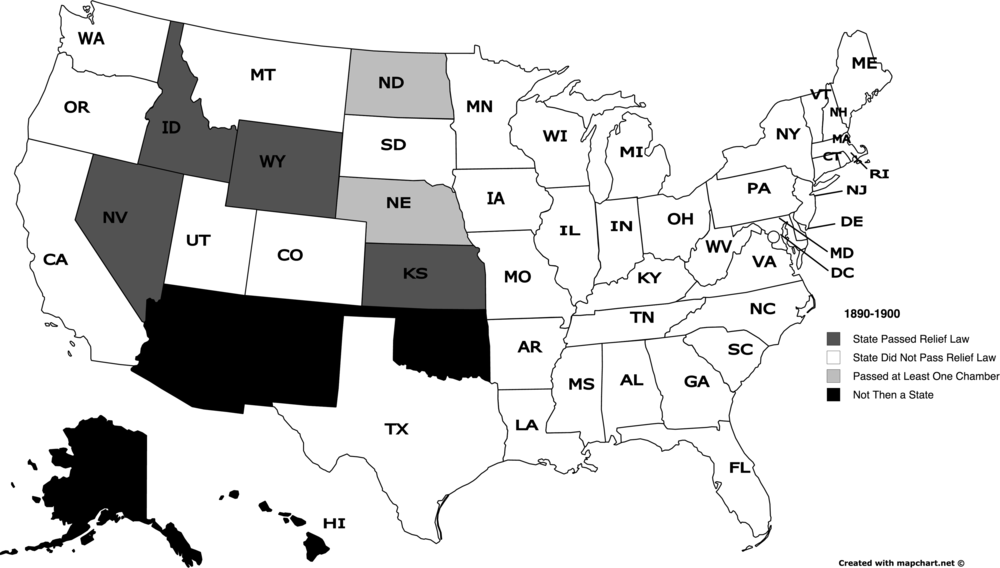
Given this political economy, it is easy to understand why western state legislatures were inclined to pass laws that redistributed money from creditors to debtors. In the last decade of the nineteenth century, only western state legislatures debated, passed, or renewed these laws (see Figure 1).
Stay laws passed or renewed from 1890 to 1900.

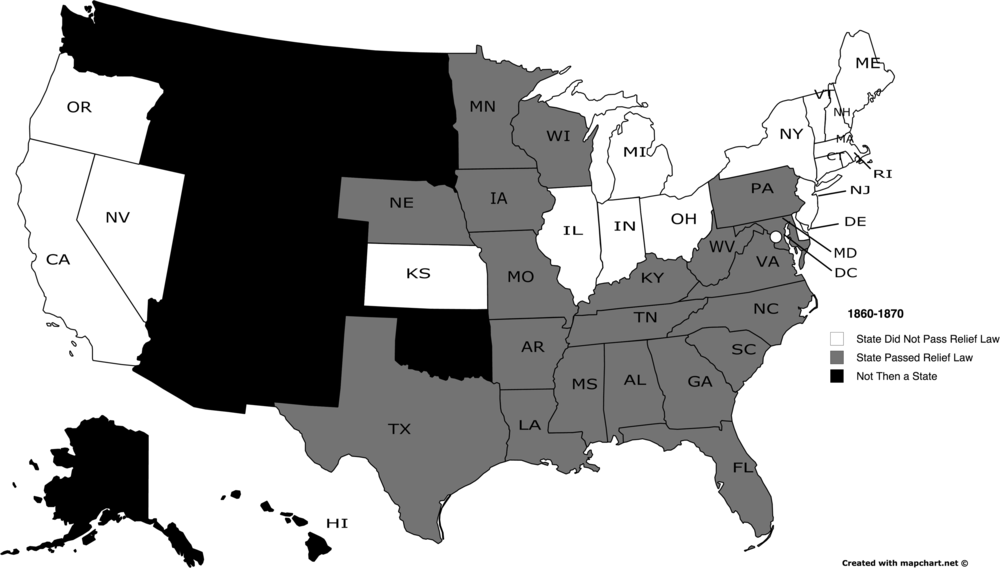
A similar pattern occurred during the Civil War and its immediate aftermath, when debtors of southern states typically owed money to creditors in the North. In these years, emergency relief legislation was largely restricted to the South and the West (see Figure 2).
Stay laws passed or renewed from 1860 to 1870.

Southern state legislatures passed retrospective debt relief laws both during and immediately after the Civil War (Figure 2). These laws were generally designed to protect the state’s debtors from out-of-state creditors and, in this way, were quite similar to relief laws passed in the wake of the Revolutionary War (Ely Reference Ely2016b). For instance, one article originally published in the New Orleans Star and reprinted in a Missouri newspaper was quite explicit in its explanation that southern stay laws were aimed at northern creditors: “A stay law will be avoided as long as possible; it would be avoided entirely if Northern creditors would use the same wise forbearance that home creditors are now manifesting.”Footnote 20 Creditors may have been more powerful than debtors in the national arena, but where (and when) major creditors lived in different states from debtors, debtors were able to exert significant power in their state legislatures. Of course, this was exactly the problem that the framers had anticipated when they drafted the Contracts Clause. Yet the practice of passing emergency relief laws proved impossible to eradicate.
EMERGENCY POLITICS AND DEBTORS’ LEGISLATIVE CLOUT
Not only did the federal structure of the United States facilitate the enactment of relief laws, but the institutional capacities of courts and legislatures also rendered this practice durable. Emergency debt relief laws were typically designed to be fast acting and temporary, and the speed with which they appeared and operated proved too much for the relatively slow process of judicial review to counter. Appeal to federal courts could be a time-consuming prospect. Relief laws’ advocates emphasized that debtors needed only temporary protection from their creditors and that once the existing emergency had abated, farmers would again be able to function normally with respect to their contracts.Footnote 21 As a result, the fact that courts were likely to nullify these laws a year or two after their passage was of relatively little consequence to the debtors who demanded them. As one critic of these relief laws complained (even as early as 1829), “until these statutes have been declared unconstitutional by some competent tribunal, their operation is the same as if their validity were unimpeachable…. And new statutes can be passed much faster than the old ones can be declared unconstitutional.”Footnote 22
Some advocates of these laws even urged legislatures to pass stay laws so that they could operate in the period before courts struck them down. Early in the nineteenth century, Kansas witnessed a particularly heated controversy over debt relief legislation. Legal experts questioned whether a retrospective relief law could be constitutional, but some advocates noted that even an unconstitutional law could still offer relief. Even if the law was eventually struck down, one explained, “the time required in testing it is sufficient to prevent the creditor class from ruining the debtor class and then themselves by the same means.”Footnote 23 Another hoped that “the hard times might be over before a decision was rendered.”Footnote 24 Yet another argued for the moral need to pass a law that would operate until the court struck it down: “Such a law then … should be operative until reversed by the Supreme Court. The debtor has generally been distressed by a combination of circumstances beyond his control. The Constitution assumes to protect the interests of all classes.”Footnote 25
Not only were courts institutionally ill-equipped to quash legislatures’ provision of emergency debt relief, but relief statutes also required very little capacity for state legislatures to enact and implement. In fact, emergency debt relief policies were a rare instance in which political intervention to protect vulnerable citizens required less, rather than more, governmental activity. The emergency relief policies that debtors demanded required neither money nor administrative state building from their legislators, merely votes. These laws, after all, generally involved changes to the rules governing debt repayment and were often simply suspensions of the legal processes for collection.Footnote 26 Since they did not require the creation of a new infrastructure or state capacities, these stoppages could be established relatively quickly, even in the midst of a crisis. This kind of protective policy was therefore not only particularly challenging for courts to eliminate but also especially easy for state legislatures to put into effect.
In addition, economic panics created ideal conditions under which political scientists would expect to find groups mobilized to secure legislative policies. It is particularly easy to generate support for a policy that will have a large and direct, or “early-order,” impact on groups of citizens concentrated in a geographic area (Arnold Reference Arnold1990, 29), and these debt crises were generally so severe that, within the geographic areas they affected, they created large and mobilized constituencies for immediate relief. Scholars of Gilded-Age economics, for instance, have demonstrated that foreclosures tended to be geographically concentrated and that, even when foreclosure rates were relatively low, indebted farmers would have been made aware of the danger of foreclosure through the experience of their foreclosed-upon neighbors (Stock Reference Stock1984, 95–96). Emergencies consistently mobilized debtors to demand protection from the state in organized movements.
Public justifications for relief laws emphasized that states could either worsen or ameliorate debtors’ suffering and that, by enforcing contracts in times of economic disaster, governments would be choosing the former over the latter course. Some proponents of relief laws argued that states’ primary obligation during times of economic crisis was to offer protection, not to enforce contracts. An 1890 issue of the Hutchinson News, for instance, explained that regardless of the Constitution’s commitment to the sanctity of contracts, debtors must have the right to the state’s protection:
It is not sufficient to say that the man who makes a contract should stand by its provisions. He should do this if the terms of that contract and workings of the law under which it was made are fair and reasonably just. But where the contract becomes a robbery, and the state through unwise legislation … is made a party to such robbery, then the people have a right to demand protection.
The article went on to argue that the need to affirm the equal rights of debtors ought to trump the restrictions of the Contracts Clause: “The Constitution may be unbending in its provisions concerning repudiation of contracts. But it is even more uncompromising in its guarantee of justice and equal rights to all people.”Footnote 27
The advocates of legislative relief for debtors regularly insisted that the primary function of a state government was to protect the vulnerable from disaster. As one Iowa newspaper asserted in arguing for debt relief legislation at the end of the nineteenth century, “when a mortgage can be paid off at once without undue hardship and sacrifice it should be done. But beyond this the rights of home and family and the safety, prosperity, and wellbeing in the state come into consideration.” The economic ruin that would result from the approaching foreclosures, the column declared, “must be met by the power of the state which is the very purpose of its organization to protect rather than destroy its own citizens.”Footnote 28
Advocates of debt relief laws frequently argued that economic crises not only threatened to ruin individual families but also posed genuine threats to public order, health, and safety. In 1874, for instance, Mississippi advocate for a stay law wrote to his local newspaper saying: “I am no prophet, but mark what I say to you, if this relief is not extended, such ruin, such distress and suffering [will arrive as] were never experienced by any people in this country.”Footnote 29 It was not only debtors’ suffering that figured in the public justifications for relief laws but also the threat of violent unrest. For instance, in an open letter asking the governor of Oregon in 1893 to call the legislature into session so that it could pass a stay law, one farmer wrote that if creditors attempted to collect on their debts, “anarchy, riot, and murder will follow.”Footnote 30
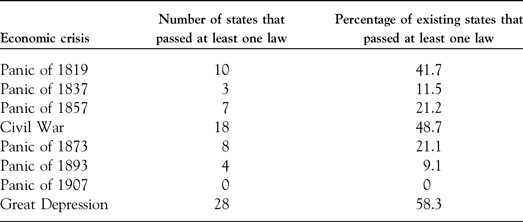
Although these arguments emphasized the immediate crises and their potentially catastrophic consequences, it is important to recognize that states’ emergency relief laws were not exceptional reactions to unprecedented situations. Instead, as Kim Scheppele (Reference Scheppele2005) has argued in a broader context, emergencies actually served as the building blocks of constitutional practice. Nowhere is this more true than in the area of debt relief. The long nineteenth-century economy was characterized by periods of deep and potentially ruinous deflation, during which debtors repeatedly clamored for relief from the terms of their contracts. Table 3 shows how widespread the practice of passing these laws was in the wake of national economic crises and how enduring this state response to economic crises proved to be.Footnote 31
Retrospective relief laws passed in the wake of national economic crises

After the Panic of 1819, ten of the twenty-four states passed debt relief laws (Bolton and Rosenthal Reference Bolton and Rosenthal2002, 1107–8). A former US senator described the situation: “Stop laws, property laws, replevin laws, stay laws, loan office laws, the intervention of the Legislature between the creditor and the debtor—this was the business of the Legislatures in three-fourths of the states of the Union. … DISTRESS, the universal cry of the people: RELIEF, the universal demand thundered at the doors of all legislatures, state and federal” (Benton Reference Benton1854, 5–6). In Kentucky, which was particularly hard hit by the economic downturn, one member of the press predicted that the controversy over debt relief would escalate into violent conflict or civil war (Thies Reference Thies2009).
Following the Panic of 1837, Alabama and Illinois passed stay laws, and Virginia forced creditors to choose between repayment with depreciated bank notes or a delay in repayment. Ohio, Indiana, Michigan, Mississippi, and Illinois passed appraisal laws, barring the forced sale of property at prices too far below the appraised value (Rezneck Reference Rezneck1953). State legislatures also extended the time available for the redemption of mortgages (Warren Reference Warren1935, 87–88).
The economic downturn of 1857 and the devastation of the Civil War again created mobilized constituencies of debtors devoted to securing relief legislation. Both during and after the war, states passed a slew of emergency relief laws. Some state legislatures even postponed the sessions of state courts, thereby preventing courts from issuing judgments against debtors (Thompson Reference Thompson2004, 17). Just as in earlier crises, local newspapers attested to the presence of concentrated groups of debtors who would benefit from an immediate stay of judicial proceedings against them. The Brownlow’s Knoxville Whig, for example, reported in 1865 that a stay law would “afford relief to the debtor class of the people, a class largely in the majority. Even one-half of the lands in Davidson County are at this day under levy of execution.” The paper warned: “Very soon, as the courts progress, the dockets of the courts in all the counties will exhibit the same sad condition of affairs.”Footnote 32
Economic emergencies remained a consistent feature of life throughout the rest of the nineteenth century, and these crises continued to galvanize debtor protest. In the 1870s, state-level campaigns for stay laws often linked their demands for state-level relief from the deflationary crises to their complaints about the gold standard. In fact, Populist politicians and newspapers argued that national deflationary policy necessitated state-level stay laws. In an article entitled “Silver and Gold and a Stay Law,” the Austin Weekly Statesman explained that if the national government persisted “in its policy of contraction and in this mad sacrifice of popular interests … it only remains for Texas to prevent the absolute ruin of the people by suspending the operation of laws for the collection of debts or to enact a law scaling debts.”Footnote 33
In the last quarter of the century, mortgage foreclosures became a particularly important issue for influential Populist organizations, like the Grange and the Farmers’ Alliance, particularly in the plains states. State chapters of these groups organized a great deal of their political action around economic emergencies and the foreclosures they caused. For instance, in response to two successive years of crop failures, the Kansas chapter of Farmers’ Alliance called on the governor to convene a special session of the legislature so that it might enact a relief law and made the enactment of one a central plank of its 1890 platform.Footnote 34 When that did not work, the Farmers’ Alliance elected its own slate of representatives to the state legislature, promising that one of its first legislative goals would be the passage of a relief statute, finally securing several relief laws in 1893.
The Great Depression generated another wave of debtor protest and of legislative response (see Table 3). These twentieth-century movements looked much like their predecessors, not only in their high degree of organization and in the particulars of their legislative demands but also in their threats of violent action. In Iowa, indebted farmers formed an organized network to disseminate news about foreclosure sales and, when necessary, to assemble to stop them. On several occasions, this group employed physical intimidation, suggesting at one point that they were willing to retaliate against judges who issued foreclosure decrees.Footnote 35 The political backdrop to Minnesota’s mortgage foreclosure moratorium (the stay law that the Supreme Court would review in Blaisdell) also included widespread unrest and fears of violent upheaval (Fliter and Hoff Reference Fliter and Hoff2012, 49). These twentieth-century demands for relief were part of a very old tradition of debtor activism in times of economic emergency. The mobilizing effects of periodic emergencies, the regional politics created by federalism, and the relative slowness of litigation all help to explain the enduring success of debtors’ demands.
CONCLUSION
This state-level history of debtors’ successful movements for legislative relief highlights a dramatic difference between state and federal constitutional practices. Federalism, in other words, not only figured into Contracts Clause doctrine (as the Supreme Court sought to identify the limits on states’ reserved powers), but it also shaped the way that doctrine worked on the ground. State legislatures attended to Supreme Court doctrine as they drafted laws that might arguably conform to it, but they also pushed against its constraints. Throughout the nineteenth and early twentieth centuries, therefore, an established state-level practice of protecting debtors by intervening in private economic bargains persisted alongside a federal jurisprudence that, far more often than not, characterized these interventions as unconstitutional.
Neither state relief laws nor their proponents’ arguments were sufficient to shift the Supreme Court’s reading of the Contracts Clause, but they were necessary to enable that shift. Had states not continued to push against a generally unfavorable judicial climate, the idea that states had reserved the power to relieve debtors when they entered the Union would have been implausible. Charles Evans Hughes’s majority opinion in Blaisdell (1934, 426) famously included the lines: “Although an emergency may not call into life a power which has never lived, nevertheless emergency may afford a reason for the exertion of a living power already enjoyed.” Since state legislatures had been exercising this power for more than a century, the ability to pass retrospective debt relief laws was, as a matter of practice, “a living power already enjoyed” by state legislatures.
The federal structure of America’s government clearly mattered here. Debtors did not need to attempt to shape federal constitutional understandings by changing the minds of federal government officials. Instead, they used state governments to put pressure on federal doctrine. This federal dynamic, in many ways, is consistent with the work of political scientists in the field of American political development who have long recognized that many of the federal government’s New Deal programs grew out of state policies and relied on states’ existing administrative capacities (Mettler Reference Mettler1998; Johnson Reference Johnson2007). In fact, Susan Sterett (Reference Sterett2003) has demonstrated that nineteenth-century state-level battles about the constitutionality of public pensions, and the meaning of work, dependency, and public purposes created an ideational foundation upon which the New Deal court would eventually build defenses of the national welfare programs. The history of states’ emergency stay laws reveals a similar phenomenon in that national constitutional understandings were built upon state-level norms.
In other ways, however, this story is quite different from standard accounts of the role of state governance in making the New Deal. State legislatures did not craft debt relief policies that would later be adopted by the federal government nor were states developing institutional capacity that the federal government would later exploit to administer federal programs. Instead, each layer of the US government reflected a different history and set of concerns, and each developed in its own direction (Broschek Reference Broschek2011, 543). Because the federal Constitution was erected atop an already-crowded landscape of states’ legislative and constitutional activities, (at least) two conflicting legal orders came to govern the contracts between creditors and debtors—one based around the centralizing Contracts Clause of the US Constitution and one rooted in states’ traditional legislative practices. As states repeatedly intervened in private contracts to protect debtors, they developed a robust legal tradition that was in tension with the US Constitution. Even as federal doctrine offered a consistent defense of creditors’ contractual rights that was grounded in federal constitutional text, state law continued to embody an older tradition of intervention and regulation on debtors’ behalf.
State laws embodied protective commitments that stood in direct opposition to those announced in federal Contracts Clause doctrine, and this opposition endured until the federal doctrine gave way. As Jessica Bulman-Pozen (Reference Bulman-Pozen2014, 1946) has argued, states can “instantiate competing views of national politics,” serving as vehicles through which the critics of existing national policies can “[align] themselves with certain federal actors to oppose others” (1920). She urges scholars to understand contemporary federalism not through questions about the degree of autonomy that states possess or the nature of states’ distinctive interests but, rather, as a system in which states serve as additional sites of national political action. The politics of debt relief demonstrate that states have long served this function, reshaping national norms as those who opposed federal constitutional readings used the machinery of state government to realize and sustain their political visions.