


INTRODUCTION
Estuaries are among the most modified and threatened environments of the world (Blaber et al. Reference BLABER, ALBARET and CHONG2000). They are prone to multiple violent disturbances caused by extreme environmental conditions resulting from factors such as sudden temperature changes (Gilmore et al. Reference GILMORE, BULLOCK and BERRY1978), large annual variation in rainfall or river discharge due to climatic fluctuations (Garcia et al. Reference GARCIA, VIEIRA and WINEMILLER2001), excessive contaminant loading (Marchand et al. Reference MARCHAND, CODLING, DRAKE, ELLIOTT, PIHL, REBELO, Elliott and Hemingway2002) or natural catastrophic events like cyclones (Greenwood et al. Reference GREENWOOD, STEVENS and MATHESON2006). When major storms make landfall on or near an estuary, their effects can be considerable, at least in the short term. Wind and storm surge may cause inundation of sediment, removal of submersed aquatic vegetation, formation of devastating turbulence that can create short-term anoxic or hypoxic conditions (Mallin et al. Reference MALLIN, POSEY, SHANK, McIVER, ENSIGN and ALPHIN1999). Estuaries can even undergo changes in geomorphology (i.e. inlet formation or closure), which can disrupt their ecological structure and function (Day et al. Reference DAY, HALL, KEMP and YÁŃEZ-ARANCIBIA1989). Cyclonic winds can also defoliate or uproot trees and produce up to twice the annual mean litter fall into the water (Lodge & McDowell Reference LODGE and McDOWELL1991), which elevates the nutrient level (Lodge et al. Reference LODGE, SCATENA, ASBURY and SANCHEZ1991, Mallin et al. Reference MALLIN, POSEY, McIVER, PARSONS, ENSIGN and ALPHIN2002, Schaefer et al. Reference SCHAEFER, McDOWELL, SCATENA and ASBURY2000). The rainfall associated with a slow-moving storm leads to increased inflow into the estuarine water and results in decreased salinity, increased nutrient input and severe run-off pollution (Mallin et al. Reference MALLIN, POSEY, SHANK, McIVER, ENSIGN and ALPHIN1999). As a result, an area of bottom-water hypoxia is created (Paerl et al. Reference PAERL, BALES, AUSLEY, BUZZELL, CROWDER, EBY, FEAR, GO, PEIERLS, RICHARDSON and RAMUS2001).
These large and sudden fluctuations in physico-chemical parameters in estuaries can adversely affect fish assemblages (Almirón et al. Reference ALMIRÓN, GARCÍA, MENNI, PROTOGINO and SOLARI2000, Galacatos et al. Reference GALACATOS, BARRIGA-SALAZAR and STEWART2004). The severity of the disturbance, species composition, size and structure of the assemblage determine the degree of response. Connell & Slatyer (Reference CONNELL and SLATYER1977) have found that moderate or severe hurricanes can shift the fish assemblage composition. Under some circumstances, hurricanes can cause massive mortalities in fish, destruction of their habitats (Tabb & Jones Reference TABB and JONES1962), social/reproductive abnormalities, export and loss of eggs and larval stages together with rise in the incidence of fish disease (Mallin et al. Reference MALLIN, POSEY, SHANK, McIVER, ENSIGN and ALPHIN1999, Paerl et al. Reference PAERL, BALES, AUSLEY, BUZZELL, CROWDER, EBY, FEAR, GO, PEIERLS, RICHARDSON and RAMUS2001). Jung & Houde (Reference JUNG and HOUDE2004) have noticed a faunal shift due to the loss of most abundant fish species.
A cyclone (Aila) passed over the eastern coast of India and Bangladesh on 25 May 2009 and affected a major part of the Sundarban Delta with great devastation. Parallel to the terrestrial agricultural land, the riverine system was affected by rainwater inflow and uprooting of terrestrial and submersed vegetation. Before the onset of the event, a long-term study of the changes in fish assemblages of a tidal river of the Sundarban Delta was being conducted and pre-Aila data were thus obtained. The present study was based on the hypothesis that the catastrophic cyclone had an adverse effect on the estuarine ichthyofaunal assemblages. Fish of the Matla River were sampled over 1 y after the cyclone and were compared with the recorded data prior to Aila already available with us. Therefore, the study was aimed to (1) detect changes in water quality and fish assemblages of the Matla River following the passage of the cyclone, (2) identify species which are principally responsible for the change and (3) explore possible reasons behind the change from the changing water quality perspective.
STUDY AREA
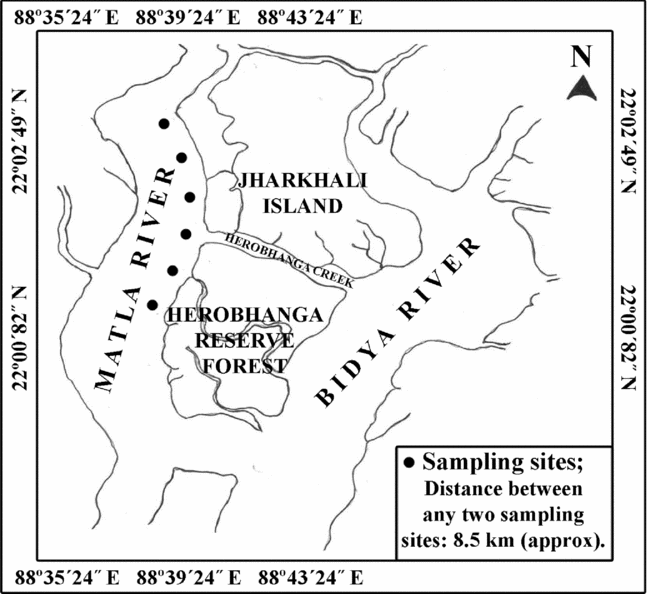
The Sundarban Delta, formed at the estuarine phase of the Ganges-Bramhaputra River system, is the largest mangrove forest in the world. For its rich faunal diversity, this area was declared a world heritage site by the IUCN in 1987. The area experiences a subtropical monsoon climate with an annual rainfall of about 1600–1800 mm (Manna et al. Reference MANNA, CHAUDHURI, BHATTACHARYYA and BHATTACHARYYA2010) and several cyclonic storms. Two tidal rivers, namely the Matla and the Bidyadhari, constitute the major riverine system of the Sundarban estuary. The present study was conducted in the middle part of the Matla River (22°00′82.86″–22°02′49.18″N, 88°37′24″–88°38´24″E) alongside Jharkhali Island. The main channel of the river has a total length of more than 200 km between its source in Purandar and its mouth into the Bay of Bengal. The freshwater connection and discharge to this river have decreased in recent times due to which salinity of the river water is relatively high (Manna et al. Reference MANNA, CHAUDHURI, BHATTACHARYYA and BHATTACHARYYA2010) and varies seasonally. A preliminary study carried out over the entire study area indicated no significant spatial variation in sample parameters. Therefore, six replicate sites of nearly equal distance along a stretch of approximately 50 km in length and 200 km2 in area, located on the main channel of the river, were selected for sampling (Figure 1).
Map showing the location of the Matla River stretch in and around Jharkhali Island. The dots indicate the sampling sites. Distance between any two sampling sites was approximately 8.5 km.
METHODS
Fish sampling design
To compare the seasonal fish assemblages following Aila with those preceding the cyclone, the monthly sampling data were grouped into seasonal periods commencing in July and ending in June. Thus, July 2008–June 2009 was considered as pre-Aila and July 2009–June 2010 was considered as the post-Aila period. To test seasonal variation of species abundance and environmental variables, seasons were aggregated into ‘4-mo’ groups: south-west monsoon (July–October), north-east monsoon or post-monsoon (November–February) and pre-monsoon (March–June). At each sampling site, 100–150-m stretches of the river were covered for detailed sampling. Two gill nets, each of 20-m length and 1-cm spacing between adjacent knots were placed simultaneously at different directions from a centre point located at the middle of the river (about 0.75 km from the bank) at each sampling site. The gill-nets were placed at the onset of high tide and kept for approximately 6 h in order to ensure maximum fish catch per unit effort during high tide. The replicate sites were sampled simultaneously and for the same tenure to minimize the sampling errors (two replicates from each site, i.e. 12 replicates per month). The nets were released from the water when the tidal current was low and fish abundance data (number of individuals per species per gill net) were recorded. A representative specimen from each species was retrieved and identified following Day (Reference DAY1958), Shaw & Shebbeare (Reference SHAW and SHEBBEARE1937) and Talwar & Jhingran (Reference TALWAR and JHINGRAN1991). Although gill-net abundance data do not provide an unbiased estimate of species-relative density because of the possible effects of seasonality such as tidal fluctuation, variation in mean size of individuals and activity patterns (e.g. migration or nesting), standardized samples can be compared within and between years because the same biases can be assumed to operate at each sampling (Saint-Paul et al. Reference SAINT-PAUL, ZUANON, CORREA, GARCIA, FABRE, BERGER and JUNK2000, Silvano et al. Reference SILVANO, AMARAL and OYAKAWA2000, Tejerina-Garro & De Merona Reference TEJERINA-GARRO and DE MÉRONA2001). Because we mainly aimed at investigating inter-annual variation in fish assemblage composition and kept the sampling method and period constant through consecutive years, we have no reason to suspect that the result would be influenced by the biases mentioned above.
Quadrat sampling of mudskippers
Boleophthalmus boddarti (Pallas, 1770) and Periophthalmus novemradiatus (Hamilton, 1822) (Perciformes; Gobidae) are the two dominant mudskipper species residing on the intertidal mudflats along the bank of the Matla River. Being amphibious, they are uniquely adapted to intertidal habitats; they survive the retreat of the tide by hiding under wet seaweed or in tidal pools and show fair activity when they are out of water. Their abundance pattern is sensitive to environmental alteration and thus can be used as indicator of the changing environment. In the present study, seasonal changes in density of the mudskippers were assessed using a visual survey technique. Four temporary 20-m transects were established randomly on selected mudflats on each sampling occasion. The number of Boleophthalmus boddarti and Periophthalmus novemradiatus were recorded during low tide from 20 2 × 2-m quadrats within the transects (five quadrats per transect). This technique has been widely adapted to obtain accurate abundance estimates of animals that are highly sensitive to disturbances (Tytler & Vaughan Reference TYTLER and VAUGHAN1983) and also minimizes the impact of the survey on the animal population.
Water sampling design
Subsurface river water samples were collected every month simultaneously with fish sampling from a depth of 25–30 cm at the midpoint of the rivers at respective sampling sites. Altogether 13 hydrological variables were measured. Air temperature and water temperature were measured on the spot with a mercury thermometer with 0.1 °C graduations. Dissolved oxygen was measured on the site using a Dissolved Oxygen Meter, Lutton, DO-5509. Electrical conductivity and pH were also recorded in the field using portable testers (Eutech instrument, cyber scan). For analysing the rest of the hydrological parameters, water samples were collected in amber-coloured, labelled glass bottles. Samples were preserved at 4 °C without freezing and taken to the laboratory within 3 h of collection for analysis as per standard methods (APHA 1998). In the laboratory, salinity was measured in practical salinity units (PSU) by the Knudsen argentometric method (Strickland & Parsons Reference STRICKLAND and PARSONS1972). Total alkalinity was measured following the acid titrimetric method, using H2SO4 as titrant and methyl orange as an indicator. Total acidity was assayed following alkaline titrimetric method using NaOH as titrant and phenolphthalin as indicator. Total hardness was determined by EDTA titrimetric method. Inorganic phosphate, reactive silicate, nitrate-nitrogen and nitrite-nitrogen were estimated with a UV spectrophotometer following standard sea water analysis methods (Grasshoff Reference GRASSHOFF, Grasshoff, Ehrhardt and Kremling1983, Grasshoff et al. Reference GRASSHOFF, EHRHARDT and KREMLING1983, Strickland & Parsons Reference STRICKLAND and PARSONS1972).
Data analysis
A general linear model for repeated measures was used (Zar Reference ZAR1999) using SPSS (version 11.0) software to compare the effect of the cyclone on each hydrological variable (between-year analysis). Shannon–Weaver index (H′) (Shannon & Weaver Reference SHANNON and WEAVER1949) was assessed on the basis of the fish abundance data to test the seasonal and inter-annual variability in fish diversity. Seasonal and inter-annual variations in the ichthyofaunal assemblages were analysed by performing hierarchical agglomerative cluster analysis of their abundance. The tests were based on a Bray–Curtis similarity matrix calculation. Prior to the analysis, the abundance data were standardized by logarithmic transformation (log10 (x+1)) (Underwood Reference UNDERWOOD1997) to meet the standard assumptions. Results were displayed using multidimensional scaling (MDS) plots, on which percentage similarity levels were assigned based on hierarchical cluster analysis (group-average linkage). The resulting ordination reflects the relative similarity of species composition, among samples (Clarke Reference CLARKE1993). The significance of inter-annual trends in the structure of the assemblage was determined by ANOSIM (one-way analysis of similarity) using the PRIMER (version 6.0) software. For carrying out the analysis, average abundance data of the ichthyofaunal assemblages from 12 gill-net sets was considered as a single monthly data, considering season and year as separating factors. Similarity percentages (SIMPER) were used to identify the species principally responsible for the average dissimilarity of fish assemblage structure between two successive years and reveal their percentage contribution to it.
RESULTS
Altogether 10 312 fish from 63 species under 39 families were collected in the pre-Aila year. Among them, 16 species were not available in the year after the cyclone. However, 12 new species were added to the list in the post-Aila year during which a total of 33 868 individuals belonging to 59 species from 35 families were recorded. The seasonal pattern of abundance of the inhabitants also differed between the two years (Appendix 1).
A significant difference (R = 0.396, P = 0.001) was found in fish assemblage structure between the two years as was revealed from analysis of similarity (ANOSIM). This was confirmed by the Bray–Curtis similarity index, which revealed low similarity in fish assemblage composition between any two similar seasons of two consecutive years. The result was represented by the MDS ordination (Figure 2). The ordination also confirmed negligible spatial variation in fish assemblage structure among the sampling sites.
Multidimensional scaling ordination of seasonal fish assemblages of the Matla River based on fish abundance data. The percentage similarity levels were assigned by hierarchical cluster analysis, based on Bray–Curtis similarity matrix. The hollow symbols represent the data obtained after the cyclone and solid symbols represent the pre-cyclone data. Sampling sites (represented by similar symbols), clustered within a single circle did not show significant spatial variation (P > 0.05).

Throughout the sampling tenure, fish assemblages of the Matla River were found to be dominated by only 16 species accounting for 91.9% of the total fish catch. Most of them showed significant variation (P < 0.05) in percentage abundance between the two years. The resultant average dissimilarity between two consecutive years contributed 90.6% to the total dissimilarity of the fish assemblage structure of the Matla River (Table 1). Amongst all, the average percentage abundance of Coilia ramcarati (12.3% in pre-Aila year and 32.4% in post-Aila phase) contributed most (21.9%) to the dissimilarity. Likewise, significant dissimilarity in the relative abundance of Harpadon nehereus (15.5) was noted, which contributed 19.5% to the total dissimilarity. Some other species such as Pseudapocryptes elongatus, Liza parsia, Mystus gulio, Setipinna taty, Tenualosa ilisha, Lates calcarifer and Bregmaceros mcclellandi showed higher abundance in the post-Aila year and cumulatively contributed to 24.9% to the total dissimilarity. In contrast, the relative abundance of Gudusia chapra was markedly reduced after the cyclone (from 25.2% in pre-Aila year to 0.61% in post-Aila survey), contributing 8.14% to the dissimilarity. Similarly, some species including Coilia neglecta, Escualosa thoracata, Trichiurus gangeticus, Nemapteryx nenga, Setipinna phasa and Himantura walga showed lower abundance after the cyclone and contributed 16.0% cumulatively to the dissimilarity in the fish assemblage structure between the two years. This variation in assemblage structure was associated with lowering of species diversity in the year following the cyclone as was confirmed by Shannon–Weaver index (Figure 3).
Average percentage abundance and species per cent contribution of 16 species, which contributed most to the dissimilarity of fish assemblage of the Matla River in pre- and post-implication sampling period. Cut-off for low contributions is 90%. Diss = Dissimilarity. Diss/SD = Dissimilarity/Standard deviation. The significant test values (F) of the abundance are indicated by asterisks.

Seasonal comparison of species diversity of fish assemblage of the Matla River in the pre-Aila and post-Aila surveys.

Boleophthalmus boddarti and Periophthalmus novemradiatus did not show much variation in population density in successive years except during post-monsoonal months where there was a stark decline in the population density of both the fish species after the cyclone attack (Figure 4).
Seasonal comparison of population density (mean ± SE) of the mudskippers (Periophthalmus novemradiatus and Boleophthalmus boddarti) as estimated by visual counting in quadrats set up along transects on the mudflat during pre-Aila and post-Aila surveys.

Most of the hydrological variables of the Matla River showed significant differences between the two years as was revealed from a general linear model for repeated-measures (Table 2). Interestingly, the concentrations of certain nutrients (inorganic phosphate, nitrate-nitrogen and nitrite-nitrogen) showed a considerable surge in the post-Aila year. The salinity value was significantly reduced following floods associated with the cyclone but returned to a higher value during the dry season. The value of the dissolved oxygen content, conductivity and acidity also decreased in the post-Aila period.
Seasonal mean and SE of hydrological variables of two successive years in the Matla River along with their F-values of repeated-measures analysis between two years. The parameters with significant test values (F) are indicated by asterisks.

DISCUSSION
Cyclones can severely disturb estuarine systems and change the community structure of resident animals through increased mortality, displacement, changes in recruitment or habitat structure (Bythell et al. Reference BYTHELL, HILLIS-STARR and RODGERS2000, Greenwood et al. Reference GREENWOOD, IDELBERGER and STEVENS2007, Hutchinson & Williams Reference HUTCHINSON and WILLIAMS2003, Jury et al. Reference JURY, HOWELL and WATSON1995). During these events, rainfall and freshwater inflow can be particularly acute in terms of reduced salinity and dissolved oxygen, increased organic matter and nutrients as happened in the Herbert River after Cyclone Sadie (Mitchell et al. Reference MITCHELL, BRAMLEY and JOHNSON1997), in Charleston Harbor after Hurricane Hugo (Van Dolah & Anderson Reference VAN DOLAH, ANDERSON, Finkl and Pilkey1991), in Charlotte Harbor after Hurricane Charley (Greenwood et al. Reference GREENWOOD, IDELBERGER and STEVENS2007) and in the Cape Fear River after Hurricane Fran (Mallin et al. Reference MALLIN, POSEY, SHANK, McIVER, ENSIGN and ALPHIN1999). The benthic communities are mostly affected with increased mortality of sessile animals due to low dissolved oxygen or salinity stress (Paerl et al. Reference PAERL, BALES, AUSLEY, BUZZELL, CROWDER, EBY, FEAR, GO, PEIERLS, RICHARDSON and RAMUS2001). Even in the more mobile sectors of the community, the degree of freshwater inflow may cause mortality and displace many taxa (Litaker & Tester Reference LITAKER, TESTER, Valette-Silver and Scavia2003, Paperno et al. Reference PAPERNO, TREMAIN, ADAMS, SEBASTIAN, SAUER and DUTKA-GIANELLI2006).
The structure of fish assemblages of the Matla River changed significantly after Cyclone Aila. Fewer species were available in the catchment areas and the species diversity declined markedly. The observation confirmed the previous findings (Menge & Sutherland Reference MENGE and SUTHERLAND1976). The species that were more abundant after Aila included those often associated with a non-vegetated bottom such as Glossogobius giuris and Cynoglossus lingua (prefers rock, gravel or sand bottoms) or could be found in the water column viz. Tenualosa ilisha, Harpadon nehereus, Setipinna taty and Coilia ramcarati. The uprooting of submersed aquatic vegetation might have led to higher predation risk for others and adversely affected the fish assemblage structure (Greenwood et al. Reference GREENWOOD, STEVENS and MATHESON2006). A few species which were less abundant might have moved into the damaged shorelines, presumably to take advantage of detritus-based foods associated with the defoliation of the mangroves.
The observed inter-annual variation in assemblage structure could be explained by the substantially longer period of floodplain inundation caused by the heavy local rainfall during Aila, which favoured recruitment of a large number of fishes (North & Houde Reference NORTH and HOUDE2003) in the post-Aila year. Noticeable increase in the abundance of prey species (e.g. Harpadon nehereus) and juveniles (e.g. Coilia ramcarati, Setipinna taty and Liza parsia) after the cyclone could be attributed to availability of refuge and nursery habitats increasing their chances of survival (Agostinho & Zalewski Reference AGOSTINHO and ZALEWSKI1995, Lowe-McConnell Reference LOWE-McCONNELL1987). Extended periods of inundation on the other hand were presumed to have affected predator survival negatively by decreasing or delaying their foraging opportunities (Agostinho & Zalewski Reference AGOSTINHO and ZALEWSKI1995).
The uprooted trees and large amount of riparian defoliation created debris dams within the water column of the Matla River. These dams were observed in other streams after major storms like hurricanes (Covich et al. Reference COVICH, CROWL, JOHNSON, VARZA and CERTAIN1991, Dolloff et al. Reference DOLLOFF, FLEBBE and OWEN1994) with leaf litter created by the storm. Detritivores thrived in these conditions (Waide Reference WAIDE1991) and the increased microbial activity and respiration led to reduced dissolved oxygen (Hill et al. Reference HILL, HERLIHY, KAUFMANN and SINSABAUGH1998). Another probable cause of lowering of dissolved oxygen content was increased nutrient load (Paerl Reference PAERL1988). The Matla River showed a clear short-term pulse in the concentration of nutrients such as nitrate-nitrogen, nitrite-nitrogen and inorganic phosphate from the storm surge, which corroborated with previous findings (Tomasko et al. Reference TOMASKO, CORBETT, GREENING and RAULERSON2005). The possible reason might be nitrification of remineralized nitrogen in the flood-derived organic matter. However, other possibilities such as wind-driven upwelling or agricultural run-off (Shiah et al. Reference SHIAH, CHUNG, KAO, GONG and LIU2000) due to heavy rainfall could not be ruled out. The increased load of nutrients created bottom hypoxia in the aquatic system. Those species which were intolerant to low dissolved oxygen concentration might have been forced to migrate by the depleted dissolved oxygen (Lowe-McConnell Reference LOWE-McCONNELL1987). Subsequently an increase in the abundance of those species that could tolerate low dissolved oxygen was a foregone conclusion. Those species could also occupy habitats with large concentrations of organic debris. These species were Tenualosa ilisha, Harpadon nehereus, Panna microdon, Pampus argenteus, Cynoglossus lingua, Toxotes chatareus, Callionymus sagitta and Liza parsia. The ecosystem productivity was likely to be enhanced due to a surge in nutrient concentration (McPherson & Miller Reference McPHERSON and MILLER1994). Therefore, the fish species that could tolerate low dissolved oxygen seemed to benefit from higher production and increased in abundance.
The marked decrease in salinity soon after the cyclone due to the heavy and prolonged rain shifted the composition of fish assemblages of the Matla River with higher abundance of freshwater species such as Mystus gulio and Glossogobius giuris. The result corroborated with previous reports (Paperno et al. Reference PAPERNO, TREMAIN, ADAMS, SEBASTIAN, SAUER and DUTKA-GIANELLI2006, Vrancken & O'Connell Reference VRANCKEN and O'CONNELL2010).
However, along with the inter-annual variation, a seasonal pattern was evident in the assemblage structure which reflected the different recruitment period of different species, as was observed in other intertidal areas (Amara & Paul Reference AMARA and PAUL2003, Beyst et al. Reference BEYST, HOSTENS and MEES2001, Gibson et al. Reference GIBSON, ANSELL and ROBB1993, Reference GIBSON, ROBB, BURROWS and ANSELL1996). The subsequent decrease in numbers and species diversity might be the result of a variety of factors, including predation or declining temperature (Amara & Paul Reference AMARA and PAUL2003, Beyst et al. Reference BEYST, HOSTENS and MEES2001, Ribeiro et al. Reference RIBEIRO, BENTES, COELHO, GONÇALVES, LINO, MONTEIRO and ERZINI2006). Year-to-year variation in densities of dominant species due to variable recruitment success is not infrequent (Clark et al. Reference CLARK, BENNETT and LAMBERTH1996, Jones & Clare Reference JONES and CLARE1977). Therefore, we could not confirm that the observed inter-annual variation in fish assemblages was entirely due to the cyclone. In general, it is suggested that estuarine communities are quite resilient to salt-water storm surges and exhibit rapid recovery to pre-impact conditions (Greenwood et al. Reference GREENWOOD, IDELBERGER and STEVENS2007, Hutchinson & Williams Reference HUTCHINSON and WILLIAMS2003, Paperno et al. Reference PAPERNO, TREMAIN, ADAMS, SEBASTIAN, SAUER and DUTKA-GIANELLI2006, Stevens et al. Reference STEVENS, BLEWETT and CASEY2006). In an earlier report (Mallin et al. Reference MALLIN, POSEY, McIVER, PARSONS, ENSIGN and ALPHIN2002), no long-term decline in species richness following a hurricane was observed. However, following local short-term losses in diversity of the benthic communities, it is suggested that the community can withstand periodic storm events. The changing physico-chemical conditions of the estuary with changing global scenario with regards to altered salinity, temperature and nutrient concentrations have more pronounced and long-term impacts on the piscine community than do severe but temporary natural disturbances (Hutchinson & Williams Reference HUTCHINSON and WILLIAMS2003). The evident rise in salinity with concomitant increase of temperature in the later phase of the study period explains the noticeable decrease of the freshwater species (e.g. Gudusia chapra). It also suggests the probable cause of the shift of the fish assemblage composition. Therefore, an understanding of the role of changing environment in structuring the estuarine fish assemblages in the long term is of more significance in the conservation and management of aquatic resources.
ACKNOWLEDGEMENTS
The authors are thankful to the local fishermen of Sundarbans, and the Head of the Department of Zoology, University of Calcutta, India for the facilities provided. Financial support from UGC-UPE and UGC-RFSMS project are gratefully acknowledged.
Recorded fish species from the Matla River with seasonal relative abundance and their individual code. Seasons are abbreviated as Mo: Monsoon; Po: Post-monsoon; Pr: Pre-monsoon.



