THE ACADEMIC GENDER GAP: EXAMINING EXCLUSION AND INCLUSION
In 1996, Margaret Thornton’s Dissonance and Distrust provided the first in-depth investigation of the position of women within the Australian legal profession. Her analysis included an examination of the position of female academics in Australian law schools. Thornton’s analysis provides a stark example of the academic gender gap, which refers to the systematic disadvantage experienced by female academics relative to their male colleagues (Baker Reference Baker2012). While women are formally included within academia, their inclusion has not challenged the patriarchal structure of universities:
within the university, the key decision makers, or gatekeepers, … are invariably men—white Anglo-Celtic, heterosexual, able-bodied, middle-class men. I term them Benchmark Men because they constitute the standard against which women and others are measured. In determining who should occupy positions of authority, Benchmark Men tend to favour those who most look like themselves. That is, they have historically constituted themselves as the standard. (Thornton Reference Thornton1996, 370)
Thornton describes male legal academics as the “knowers” of law who possess the authority to determine the meaning of law (1996). Female legal academics are seen as merely the “teachers” of law, and their role is largely restricted to inculcating students into the ethos of corporatism that dominates Australian law schools.
Thornton’s work highlights that women have traditionally experienced professional closure from the legal profession, including legal academia (1996). Witz (Reference Witz1992, 45) describes the “professional project” as being gendered, and notes that women have faced two types of professional closure. First, interprofessional closure occurs when a dominant social group maintains a monopoly over the credentials and skills deemed essential for entry into the profession. Professional closure can also be intraoccupational, in that some social groups are excluded from the profession.
These forms of gendered professional closure are evident within the legal profession. Interprofessional closure is demonstrated in the initial exclusion of women from the legal profession simply because of their gender. For instance, Australia’s first female law graduate, Ada Emily Evans (1872–1947), enrolled in law school at the University of Sydney in 1899. Evans enrolled while the dean, Pitt Cobbett, was absent and was allegedly told afterward that Cobbett would have blocked her enrollment as the legal profession did not admit women. Upon his return, Cobbett apparently attempted to dissuade Evans from continuing her studies, stating that she did not have the physique for law and that she should consider medicine instead. Evans persisted; however, her application to register at the Supreme Court of New South Wales as a student-at-law was rejected due to lack of precedent of women being admitted to legal practice (Kirk Reference Kirk1995, 76).
Witz (Reference Witz1992, 47) describes intraoccupational closure as the encircling of women into related, but distinct, spheres of competence. The sphere predominantly occupied by women is subordinated to the dominant male group. Brockman (Reference Brockman1996) demonstrates intraoccupational closure in relation to the legal profession by examining the demarcation between lawyers, who occupy a professional group that privileges male power, and paralegals, who are largely women. Lawyers must hold university qualifications, and some jurisdictions require additional entry standards such as accreditation examinations or apprenticeships, whereas there are no formal credential requirements for paralegals. Paralegals must work under the supervision of a qualified lawyer, and thus occupy a subordinated position that is controlled by the dominant professional group.
The professional closure achieved by the legal profession, however, has been challenged. Women now make up more than half of practicing solicitors in Australia (Urbis 2019, 7). In addition, the professional privilege and autonomy enjoyed by the legal profession has been reliant on state support, which has been rolled back in recent years. Consequently, the legal profession has lost much of its monopoly over determining the nature of legal work and who can perform that work. The unitary nature of the profession has also broken down, and there is a growing heterogeneity of service providers who can deliver legal work outside the control of the legal profession (Sommerlad Reference Sommerlad1995; Kay Reference Kay2004).
The mass entry of women into the legal profession has raised questions about whether the profession will undergo feminization. Sommerlad (Reference Sommerlad1994, 31) uses the term “feminization” to mean the inclusion of women within a professional group in such a way that it heralds “a permanent and significant change to the gendered character … of the legal profession.” However, while there was optimism that female lawyers would finally break the glass ceiling, gender inequalities would be eliminated, and “soft skills” purportedly possessed by female legal practitioners would transform legal practice, these predictions have not come to fruition (Bolton and Muzio 2008). Feminization requires more than simple numerical equality, but also requires the removal of barriers to women’s full participation in the profession.
Witz argues that women can challenge professional closure through inclusionary strategies, which she defines as “the upwards, countervailing exercise of power by a social group which is hit by exclusionary strategies, but which, in its turn, seeks inclusion within the structure of positions from which its members are collectively debarred” (1992, 48). Inclusionary strategies are not necessarily aimed at achieving “revolutionary usurpation,” in that they are not intended to change the gendered structure of the professional group itself but rather to allow women simply to achieve inclusion.
The inclusion of women into the legal profession has not produced gender equality. Instead, the labor of female lawyers has predominantly benefited male elites. As women have moved into the legal profession, the profession has become segmented along gender lines. Vertical stratification has allowed men to hold the most prestigious positions as senior partners within law firms, while women are relegated to lower-paid and less prestigious positions. The profession is also stratified horizontally, with women overrepresented in lower-status areas of legal practice (Bolton and Muzio 2007, 2008). Recent research demonstrates that female lawyers continue to face gendered inequalities, including the limiting of women’s careers due to taking on family responsibilities, discrimination against female lawyers who work part-time, and gender bias in recruitment and promotion practices (Law Council of Australia 2019; Bromwich Reference Bromwich, O’Reilly and Fiona2021; Schultz et al. Reference Schultz, Gisela, Margaret and Rosemary2021).
Feminization processes have served to undermine, rather than expand, professional projects. The legal profession remains conceptualized as one practiced by men and sustained by patriarchal beliefs and cultural practices (Sommerlad Reference Sommerlad1994, 34; Tancred Reference Tancred1999; Bolton and Muzio 2007, 2008). The bolstering of patriarchy by the mass entry of women into professions is also not limited to legal practice. Bolton and Muzio (2008) demonstrate that the inclusion of women into management and teaching has served the interests of male elites. Research into feminization within other professions, such as accounting and health care, has reached similar conclusions (Adams Reference Adams2010; Almer, Lightbody, and Single Reference Almer, Margaret and Louise2012; Lupu Reference Lupu2012).
Our article investigates whether legal academia has become feminized. We argue that women have been included within legal academia, but not on their terms. Whereas other occupational groups within the legal profession have been extensively studied, legal academia has received much less attention, especially in Australia. We examine the ways in which women have been included into legal academia and how continuing strategies of exclusion are gendered. We do this by first reviewing previous research into the position of women in legal academia in Australia. Second, we compare historical data concerning the position of women in Australian law schools to our own biographical data relating to seven hundred Australian legal academics. Thornton’s groundbreaking work (1996) provided only a brief examination of Australian legal academia, and much has changed since. At the time of Thornton’s research (1996), female legal academics were underrepresented within Australian law schools. However, our data reveals that women now make up approximately half of Australian legal academics. Their inclusion, however, has come at a cost, and we also reveal that the gender gap within Australia law schools is deeply entrenched and that female academics continue to face gendered barriers.
Whereas previous research has largely focused on lawyers as a gendered professional project, we feel that it is essential to also examine the gendered hierarchy of legal academia. McGlynn (Reference McGlynn1999) warns that gender exclusion within legal academia has serious implications for law schools, the legal profession, and law itself. Law schools produce the next generation of legal professionals, and as Zenoff and Lorio warn, if gender inequalities within law schools are normalized then “[w]ill not both women and men law students expect and accept the same hierarchy in private practice, government service, and the judiciary?” (1983, 902). To eradicate gender discrimination within law schools would centralize rather than marginalize feminist legal issues. The production of law graduates with an awareness and concern about structural inequalities would improve the quality of justice, give the public greater confidence in the legal system, and improve the delivery of legal services to all clients (Zenoff and Lorio Reference Zenoff1983, 902; Collier Reference Collier1989, Reference Collier2002; West Reference West2018).
Universities are also sites for production of knowledge, and legal academics construct rather than just teach the law. For Thornton (Reference Thornton1996, Reference Thornton2003, Reference Thornton2013), gender discrimination within legal academia supports the construction of law around technocratic and masculine norms. Legal norms are constituted around the “benchmark male,” with the legal subject uncritically assumed to be a rational, autonomous individual, who lacks emotion and is both physically and economically sustained by women in the private sphere (Thornton Reference Thornton1996, Reference Thornton2013; Lacey Reference Lacey1998; Naffine Reference Naffine2003). The law then reflects this normative standard, and consequently the law effaces the experiences of women, including their experiences of gender discrimination and violence (Naffine Reference Naffine1990).
THE ACADEMIC GENDER GAP IN LAW SCHOOLS
There have been only a few studies into the position of women in Australian law schools, and the work that has been done consists either of small-scale qualitative studies that have relied on unrepresentative and potentially biased samples, or studies that have had specific and thus narrow aims. Thornton’s Dissonance and Distrust (1996), which remains the most comprehensive study of women within the Australian legal profession, including legal academia, also has its limits. Thornton (Reference Thornton1996, 6) conducted over one hundred interviews with women in the legal profession, including female academics at different levels within law schools. She explains that the women involved in the study were “selected” without detailing the basis of their selection.
While Thornton’s (1996) selective sample is unrepresentative, it does have some strengths. Selective samples are generally used to access hard-to-reach populations and when researching sensitive issues (for example, Faugier and Sargeant Reference Faugier and Mary1997). For many women within the legal profession, discussing gender discrimination would involve being critical of employers and institutions, as well as being open about highly personal issues, and Thornton (Reference Thornton1996) has taken a sensitive approach. Ramshaw and Pue (Reference Ramshaw and Wesley Pue1997, 170) argue that to focus on Thornton’s (1996) use of a selected sample risks further devaluing the views of female academics: “But these are only labels [bias] which, cast about carelessly or with malice, permit us to repudiate without hearing the opinion of these women who Thornton asks us, for once, to take seriously.”
The other qualitative studies on the position of women within Australian law schools rely on personal reflections about being a female legal academic in a male-dominated field (Wells Reference Wells2001), most notably Nicole Watson’s (2005) powerful and damning account of being an Indigenous woman in a law school. In addition, in 1994 the Australian Law Reform Commission’s Inquiry into Equality before the Law examined the position of women in the Australian legal profession, including in law schools. The commission invited interested parties to make a submission, and most submissions reported systematic discrimination, although some asserted that women experience little direct discrimination. The inquiry heard that sexist comments and stereotypes were used in class examples and examinations, women’s perspectives were lacking in teaching materials, and women’s views were dismissed in the classroom. Teachers struggled to raise feminist issues in courses, and those who did were stigmatized by both male colleagues and male students. The position of female academics, however, was somewhat an aside to the work of the inquiry, and only two pages of commentary from its two reports focused on legal academia.
The only other studies into the position of women within the Australian legal academy include Hunter’s (Reference Hunter, Schultz and Shaw2003, 99) one-page update of statistics provided by Thornton (Reference Thornton1996) on the profile of women within Australian law schools. In addition, Smyth (Reference Smyth2012) examined scholars who publish in the top Australian law journals, finding that men are more prolific authors than women. Thus, the research that has been done on Australian legal academia is limited. The qualitative studies have used small (or unspecified), unrepresentative, and possibly biased samples. The prior quantitative research, with the exception of Smyth (Reference Smyth2012), has not focused specifically on legal academia, and Smyth’s only reports on the relationship between gender and research productivity.
The limits of Australian research are also made apparent when compared to US studies. In the United States, there is a considerable body of research into women within law schools. These studies use both qualitative and quantitative methodologies, investigate a range of ways in which gender differences and discrimination manifest, and also recognize the additional vulnerability of minority groups. Institutional gender bias within US legal academia commences with the hiring process and continues throughout the course of a law professor’s career, with grave consequences for diversity within law faculties (Deo Reference Deo2014). Studies show that female legal academics are appointed at a lower level than male legal academics and obtain tenure at a slower rate than men (Fossum Reference Fossum1980; Zenoff and Lorio Reference Zenoff1983; Rosenfield and Jones Reference Rosenfield1987; Merritt, Reskin, and Fondell Reference Merritt, Reskin and Michelle1993; Merritt 1995; Merritt and Reskin Reference Merritt and Reskin1997; Gaber Reference Gaber1998; Angel Reference Angel2000; Neumann Reference Neumann2000; Durako Reference Durako2000, Reference Durako2004; McBrier Reference McBrier2003; Stanchi Reference Stanchi2004) even if they hold comparable qualifications (Merritt and Reskin Reference Merritt and Reskin1992, Reference Merritt and Reskin1997). Women are less likely to hold an appointment in an elite law school (Chused 1988; Farley Reference Farley1996), they publish less (Kotkin Reference Kotkin2010; Cotropia and Petherbridge Reference Cotropia2017), and they receive lower salaries (Seibel Reference Seibel1996). Relative to their male counterparts, female legal academics have lower levels of job satisfaction, perceive tenure decisions as unfair (Barnes and Mertz Reference Barnes and Elizabeth2018), and have higher levels of attrition (Merritt 2000).
Female legal academics in the United States are more likely to teach topics that are labor intensive and require considerable student pastoral care (Merritt and Reskin Reference Merritt and Reskin1997). They teach lower-status topics that offer fewer chances at promotion (Merritt 1995, 98–100; Merritt and Reskin Reference Merritt and Reskin1997; Levit Reference Levit2000; Kornhauser Reference Kornhauser2004), as well as spending more time on administrative tasks that do not necessarily contribute to career advancement (Levit Reference Levit2000, 785). Students also evaluate law teachers differently according to gender (Farley Reference Farley1996), with male legal academics evaluated positively for assertive behavior such as controlling students in class, whereas female academics receive negative evaluations when they exhibit the same behavior. In a study of diversity in US law faculties, Deo (Reference Deo2015, 15) found that women of color were treated particularly harshly, with feedback often focused on professors’ appearance and demeanor rather than the substance of their teaching. Deo’s (Reference Deo2015) research also demonstrates the greater concern in the United States about the differences between female academics, including the ways in which women people of color and LGBT women are expected fit into the role of law professor (see also Chang and Davis Reference Chang and Davis2010; Morrison Reference Morrison2010; Arriola Reference Arriola2014).
METHODS
Our research is based on a sample of 700 legal academics from 38 Australian law schools. This allows us to provide a broad-strokes picture of women in legal academia and avoids the problem of sample selectivity. This approach also has its weaknesses, and quantitative analysis tends to provide more descriptive data rather than deeper explanations of the lived experiences of female legal academics. Thornton’s (1996) work is pioneering, and since then there has been a growing body of research into women in the legal profession more generally, women in academia, as well as women in legal academia. Our quantitative analysis provides an overall picture of women in Australian legal academia, but then engages with these bodies of knowledge to provide a deeper level of explanation of the patterns in our data.
Most quantitative studies into the gender gap within legal academia have traditionally relied on survey data, which is then subject to the problems of low response rates (Cooray, Verma, and Wright Reference Cooray, Reetu and Lynne2014); however, increasingly researchers have been drawing on academics’ online profiles. Smyth and Mishra (Reference Smyth and Vinod2014, 591) collected basic data from academics’ online profiles from 2011 and then completed their dataset by administering a survey. We have relied entirely on data taken from academics’ online profiles. Academics are increasingly expected by their institutions to develop and maintain an online presence. Our sample consists of all legal academics with teaching and research responsibilities from seventeen of Australia’s thirty-eight law schools. The data was collected from January 2018 to August 2018, and at the time Australia had thirty-eight law schools. Law schools were selected so that the sample included schools located in urban centers and regional cities, schools across all Australian states, schools across the full range of research rankings and size, and schools that are well-established and relatively new.
We were able to extract data concerning gender, position, research interests, highest qualification, and professional experience. Most of this data was available from academics’ online profiles hosted on their university websites, although in some instances we also extracted data from LinkedIn, ResearchGate, academia.edu, blog sites, conference biographies, and press releases. Previous research that has attempted to draw on data from academics’ online profiles has noted that while universities provide website space for their academics to publish their profiles, the use of this space is haphazard (Barbour and Marshall Reference Barbour and David2012). However, we found that there is considerable information about individual academics available online. In total, 702 academics were listed on their university staff pages as being employed in our sample of law schools. We excluded two academics as their online profiles listed only their name and no other information. We were able to determine the gender of all seven hundred academics in our sample; some data was missing in relation to the following variables: academic rank (seven instances of missing data), highest qualification (five missing), and research interests (three missing). We were unable to ascertain whether an academic had been professionally employed outside of Australia in forty-two instances and whether they had practitioner experience in forty-three instances. This suggests that most academics now have a significant digital presence and reflects the importance of having an online presence as a means of enhancing the reputation of universities and an individual academic’s career (Barbour and Marshall Reference Barbour and David2012; Samkin and Schnider Reference Samkin and Annika2014, 84).
We also measured the status of an academic’s institution in two ways. First, we examined whether they worked in a Group of Eight (Go8) university or not. Second, we used ratings for the 2015 Excellent Research in Australia (ERA) exercise as a measure of the status of law schools, as Go8 ratings refer to universities rather than individual departments or disciplines. The Go8 refers to a coalition of research-intensive Australian universities consistently ranked within the top 150 institutions worldwide in the Academic Ranking of World Universities from Shanghai Jiao Tong University, the Times Higher Education World Rankings, and the QS World University Rankings. The Go8 consists of University of Melbourne, Australian National University, University of Sydney, University of Queensland, University of Western Australia, University of Adelaide, Monash University, and University of New South Wales (UNSW). The ERA is an evaluation conducted by the Federal Australian Government via the Australian Research Council, which is the main government funding body for university-based research. The ERA involves rating universities and disciplines according to research outputs, research income, and reputation (Australian Research Council 2015). While there is overlap between law schools’ ERA performance and the Go8 designation, there is not an exact match.
Finally, we measured academics’ research output by using an academic’s h-index score according to their Google Scholar citations. The h-index accounts for both the number of papers an academic has published and the number of citations, rather than being limited to a single measure. Thus, it is a measure of both quantity and quality of research productivity (Inanc and Tuncer 2011, 889). The h-index works best for comparing research productivity within the same field (Hirsch Reference Hirsch2005) and is more appropriate for examining research outputs of academics working in law compared to other indices. Google Scholar citations were preferred over Scopus or Web of Science, as these indices are more attuned to the “hard” sciences and thus there is too little variation between citations to produce useful data. In addition, Google Scholar citations provides a more accurate measure of research productivity for Australian legal academics than US-based databases such as Westlaw and Lexis (Smyth and Mishra Reference Smyth and Vinod2014).
Our measure of research productivity has several limitations. Smyth and Mishra (Reference Smyth and Vinod2014) have also examined the research productivity of Australian legal academics. They surveyed academics, rather than relying on profiles, and were able to control for a greater range of variables that may influence productivity, such as grant history. They employed a robust method for measuring research productivity, consisting of a combination of the quality of publication according to the ERA ranking, number of citations, and citation index including both the h-index (Hirsch Reference Hirsch2005) and the g-index (Egghe Reference Egghe2006) produced by Google Scholar. In comparison, we only use one measure of productivity, which is not as robust as the use of multiple measures. In addition, only 38 percent (n = 266) of legal academics in our sample have Google Scholar accounts, although not having a Google Scholar account did not correlate with gender.
We included all academics employed at lecturer position or above but did not include sessional staff as often there is little or no biographical information available on law school websites for sessional staff. Australian academics are usually appointed to “balanced” roles, meaning that their workload is split between teaching, research, and administration. In recent years, however, universities in Australia and elsewhere have introduced new roles (Probert Reference Probert2013; Locke Reference Locke2014). These include “teaching-only” and “teaching-focused” academics who are expected to take on a high teaching workload and administration with lower expectations concerning research output. Some academics are also dedicated to research, such as postdoctorate researchers who are usually attached to a funded research project, but universities also have strategic research posts such as research professors who have little or no teaching duties. Some universities also have a designated “solicitor” or “practitioner” roles, with staff specifically appointed to clinical legal education positions. We have only included academics in so-called balanced roles and have excluded practitioners and those occupying teaching/research-only or teaching/research-focused positions. We have also excluded visiting academics, adjuncts, emeritus, and honorary staff.
The focus on staff with permanent contracts rather than sessional staff has important implications for the study of women in legal academia, as does the exclusion of teaching-only staff. Casual academics make up the majority of the academia teaching workforce in Australia, as well as in the United Kingdom (Burgess et al. Reference Burgess, Julia, Colin and Richard2006), Canada (Dobbie and Robinson Reference Dobbie and Ian2008), and the United States (Curtis and Jacobe Reference Curtis and Monica2006; Levinson and Young 2010). In the course of the past two decades, there has been significant academic casualization across Australian universities (Ryan et al. Reference Ryan, John, Julia and Egbert2013). Academic casuals conduct the majority of undergraduate teaching at Australian universities (May, Strachan, and Peetz Reference May, Glenda and David2013). Casual academics have indicated that they feel marginalized and excluded; they receive limited time for preparation and marking and have a lack of development opportunities (Ryan et al. Reference Ryan, John, Julia and Egbert2013). Casual academics are more likely to be women, and the increasing move toward corporate managerialism within Australian universities means that overall female academics are concentrated in the lowest-paid and least secure positions (Lafferty and Fleming Reference Lafferty and Jenny2000; White Reference White, Bagilhole and White2011; May, Strachan, and Peetz Reference May, Glenda and David2013). These problems extend to casuals employed in Australian law schools (Cowley Reference Cowley2010), and female casual academics working in law schools report experiencing greater issues relating to the provision of facilities and support than their male colleagues (May, Strachan, and Peetz Reference May, Glenda and David2013, 12). Women are also overrepresented in nontenured posts in law schools outside of Australia, which has the consequence of women often working for significantly lower salaries in precarious positions with little chance of tenure (Neumann Reference Neumann2000, 323).
The exclusion of teaching-only and teaching-focused staff also has important implications, including the rise of a new form of stratification. Women are overrepresented in teaching-focused positions and underrepresented in research-only posts (Marchant and Wallace Reference Marchant and Michelle2013, 64). While academics in teaching-focused positions have reported feeling satisfied with their teaching roles, they also report dissatisfaction with high administrative loads, heavy workloads, poor management, and concern about job insecurity (Darabi, Macaskill, and Reidy Reference Darabi, Ann and Lisa2017). Thus, labor within universities is highly segmented along gender lines, and it needs to be remembered that while gains have been made by women who have permanent posts and the capacity to undertake research, most female academics are not located in these roles.
Our research also only investigates academics. Professional staff within Australian universities also face gender disparities. Women make up a majority of professional staff; however, Strachan et al. (Reference Strachan, Janis, Michelle and Carolyn2013, 228) describe the career trajectories of female administrators as a “squeezed pipeline.” Women are more likely to be initially appointed at a lower level than men, and female administrative staff continue to be underrepresented in senior positions. Female professional staff in Australian universities have reported experiences of gender discrimination, lack of support to deal with career responsibilities, and limited opportunities for career advancement (Wallace and Marchant Reference Wallace and Marchant2011).
THE ENCROACHMENT OF FEMALE ACADEMICS INTO AUSTRALIAN LAW SCHOOLS
In Australia, the closure of legal academia to women was first breached by Enid Mona Campbell, the first female law professor and dean of an Australia law school. Campbell graduated in law from the University of Tasmania in 1955, completed PhD studies at Duke University in the United States, and then returned to Australia in 1959 to teach at Monash University (Grimshaw and Francis Reference Grimshaw, Rosemary, Damousi, Rubenstein and Tomsic2014, 209).
Campbell’s presence hardly opened the floodgates for women in Australian legal academia. When the gender composition of Australian academia was first examined in the mid-1980s, women made up around 20 percent of academia (Winchester and Browning Reference Winchester and Lynette2015). Traditionally, women have also been underrepresented in legal academia. Referring to 1994 data, Thornton states that “[w]hile the number of women law students has increased significantly, the number of women faculty, particularly at the more senior levels, has not seen a comparable increase” (1996, 109). Thornton reported that 39 percent of academics in Australian law schools were women (109). This proportion had not changed at all in 1999, when Hunter observed that “the overall proportion of women has remained static for the past five years” (2003, 99).
Our dataset indicates that the gender composition of Australian legal academics has now reached parity. Just over half (51.2 percent) of the academics in our dataset are women. This is slightly less than the proportion of all permanent Australian academic staff. In 2017, 43.5 percent of all academic staff with ongoing positions were male, and 56 percent were female (Department of Education, Skills and Employment 2017). These changes cannot be attributed to the “trickle up” effect of an increasing number of women studying law. As Schultz (Reference Schultz, Schultz and Shaw2003, 277) states in relation to female legal academics in Germany: “The growth in the number of women students has had little effect on the number of university law teachers.” Instead, the increase of women within academia only became apparent after the implementation of antidiscrimination workplace legislation and proactive initiatives to support women within academia (Winchester and Browning Reference Winchester and Lynette2015; Thornton 2021, 457; Reference Thornton2015, 315).
Sommerlad (Reference Sommerlad1994, 33) argues that is it difficult to establish the point at which women are included into a profession. For many, the starting point is to compare the numerical participation of men and women. In terms of Australian universities, women have entered higher education in large numbers in Australia since the 1970s (Forsyth Reference Forsyth2015), and this increase has been accompanied by the slow rise in the proportion of female academics working (Probert Reference Probert2005; Marchant and Wallace Reference Marchant and Michelle2013, 62; Winchester and Browning Reference Winchester and Lynette2015). In Australia, gender parity was reached in terms of the proportion of male and female students enrolled at university in 1987 and was achieved in terms of university staff (academic and professional) in 2001 (Marchant and Wallace Reference Marchant and Michelle2013, 63). In the mid-1980s, women only made up 6 percent of academic staff appointed in senior positions (above senior lecturer) in Australian universities (Winchester and Browning Reference Winchester and Lynette2015, 269). Since then, however, the proportion of women in the higher ranks of academia has changed significantly across universities generally (Winchester and Browning Reference Winchester and Lynette2015, 269). Thus, it seems that for Australian academics overall, women have made gains in the university hierarchy, and this is also the case in other jurisdictions (Probert Reference Probert2005; West and Curtis Reference West2006, 11; Nakhaie Reference Nakhaie2007; Toutkoushian, Bellas, and Moore Reference Toutkoushian, Bellas and Moore2007; Monroe et al. Reference Monroe, Saba, Ted and Amy2008; White Reference White, Bagilhole and White2011).
Sommerlad however, warns that an approach to understanding women’s position within the professions that relies simply on numerical participation “tends to unravel on closer inspection” (1994, 33). Similarly, Bolton and Muzio describe feminization as both an empirical and a cultural process and show that women’s mass entry into the legal profession has failed to eliminate gender inequalities (2008, 282). Even after women’s explicit exclusion from a profession is broken, the beliefs and cultural practices that underpin professional closure remain. The level at which female legal academics are appointed is just one indicator that suggests that while women are formally included within the Australian law schools, or at least they are not explicitly excluded, their inclusion is still constrained by the patriarchal structures and norms that characterize higher education.
LEVEL OF APPOINTMENT
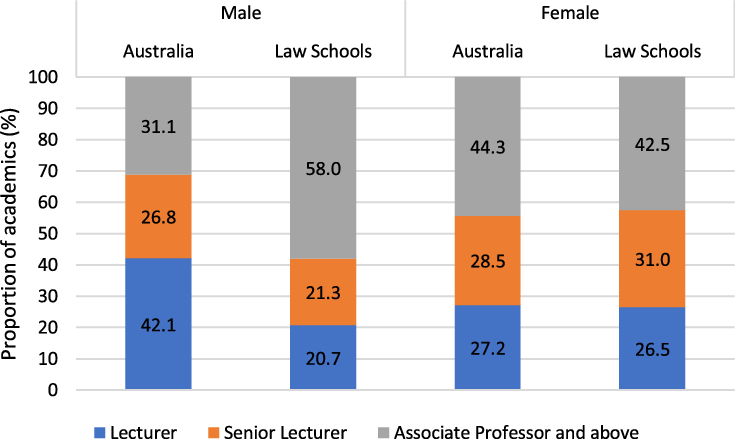
The most frequently commented on feature of the academic gender gap is the relative lack of female academics in senior posts. Figure 1 shows the proportion of legal academics by gender within the categories of lecturer, senior lecturer, and associate professor/professor combined. In 2018, 20.7 percent of male legal academics were appointed at the lecturer level compared to 26.5 percent of female legal academics. A higher proportion of female legal academics (31.0 percent) were appointed at the senior lecturer level compared to male legal academics (21.3 percent). Female legal academics continue to be underrepresented in the highest posts, with male legal academics being significantly more likely than female legal academics to be appointed as associate professors and above (χ2 = 19.291, df = 3, p < 0.001). Less than half of female legal academics (42.5 percent) are appointed at the associate professor or professor level, compared to 58.0 percent of male legal academics.
Level of Appointment of All Australian and Legal Academics, 2018.

Figure 1 also compares the breakdown of academic positions within Australian universities overall to the proportions within Australian law schools. Overall, women are underrepresented in the most senior positions within Australian universities (Winchester et al. Reference Winchester, Shard, Lyn and Colleen2006; Strachan et al. Reference Strachan, Kay, Gillian, David and Janis2011, 318); however, this pattern is more acute within the law schools. In 2018, 42.1 percent of all male academics were appointed at the position of lecturer, which is considerably higher than the proportion of male legal academics who were (20.7 percent). Overall, 26.8 percent of all male academics were appointed at the senior lecturer level, compared to 21.3 percent of male legal academics. Thus, it appears that male legal academics are underrepresented within the lower ranks of law schools. Just under a third (31.1 percent) of male academics overall were appointed at the associate professor or professor level, and 44.3 percent of female academics overall held the position of associate professor or professor. This suggests that overall women in Australian universities are now taking on senior academic positions. However, in contrast to Australian universities overall, law schools are top-heavy with a higher proportion of academics in senior posts compared to the overall profile of Australian academics. In addition, women continue to be underrepresented at the highest level. Over half of all male legal academics (58.0 percent) are appointed at the associate professor or professor level, whereas as 42.5 percent of female legal academics are appointed to these posts.
The underrepresentation of women within senior legal academic posts is consistent in other jurisdictions. Historically, there have been very few women in full professorships or deanships in law schools in the United Kingdom (McGlynn Reference McGlynn, Schultz and Shaw2003; Wells Reference Wells, Schultz and Shaw2003, 238), the United States (Borthwick and Schau Reference Borthwick and Schau1991, 200–01; Bhandari, Cafardi, and Martin Reference Bhandari, Cafardi and Matthew1998; Neumann Reference Neumann2000, 234; Kotkin Reference Kotkin2010, 415–16), New Zealand (Murray Reference Murray, Schultz and Shaw2003), Canada (Carasco Reference Carasco, Elizabeth and McIntyre2006), and Germany (Schultz Reference Schultz, Schultz and Shaw2003, 279).
Generally, the underrepresentation of women in the higher ranks of academia has been explained as reflecting gender discrimination in promotion decisions. Female academics in Australia have reported barriers to promotion (Probert Reference Probert2005; Winchester et al. Reference Winchester, Shard, Lyn and Colleen2006; Winchester and Browning Reference Winchester and Lynette2015). Thornton (Reference Thornton1996) argues that female academics are more likely than their male colleagues to take on the pastoral care of students, formal administrative caring roles such as being responsible for addressing student complaints and problems, and institutional caring roles such as conference organization. These roles reflect the stereotype of women as docile, nurturing, and self-sacrificing, and as these positions are not well valued by their institutions, women’s promotional opportunities are curtailed.
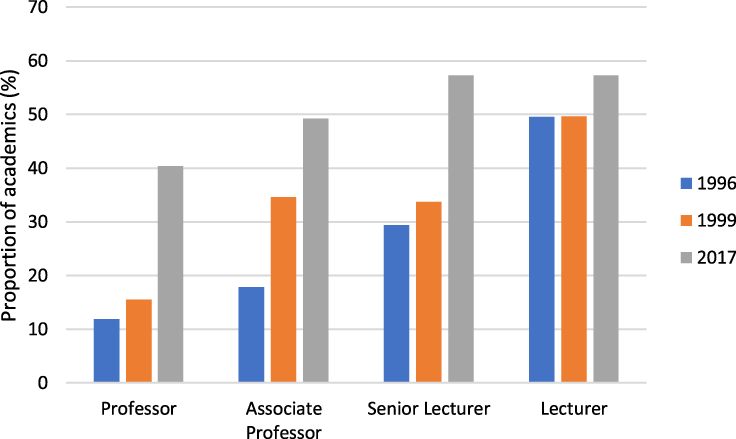
There is, however, some indication of change both within Australia law schools and elsewhere (Cooper Reference Cooper2016). Thornton (Reference Thornton, Schultz, Shaw, Thornton and Auchmuty2021, 457) reported that only three female professorial chairs in law were appointed from 1967 to 1987. A further twenty female law professors, many of whom identified themselves as feminist, were appointed to professorial positions from 1998 to 2008 (Thornton Reference Thornton, Schultz, Shaw, Thornton and Auchmuty2021, 457–58). Figure 2 shows the proportion of women in each academic level for 1996 (Thornton Reference Thornton1996, 293), 1999 (Hunter Reference Hunter, Schultz and Shaw2003, 99), and 2018 (our own data). While there were still only a few women appointed as professors in 1996 and 1999, by 2018 this had changed considerably. This rate of change is more pronounced for women within the lower ranks of legal academia. For female early career scholars, a proliferation of new law schools in the 1990s also saw increased opportunities for female academics to secure lectureships (Thornton Reference Thornton, Schultz, Shaw, Thornton and Auchmuty2021, 462). Thornton describes this period as being pivotal for the development of feminist legal scholarship in the academy and a focus on “contextual, critical and interdisciplinary perspectives” (Thornton Reference Thornton, Schultz, Shaw, Thornton and Auchmuty2021, 461).
Profile of Female Legal Academics in Australian Law Schools, 1996–2018.

This trend suggests that women’s inclusion is becoming more than just numerical parity and that women are gaining a greater presence within the highest ranks of legal academia. However, the breakdown of explicit exclusion does not mean that women are entirely included within legal academia.
QUALIFICATIONS
One of the reasons given for the increased proportion of women in the higher ranks of Australian academia has been the increase in women obtaining doctorate qualifications (Probert Reference Probert2005); however, a gender gap remains. Women’s participation in higher education has been labeled a “leaky pipe” (Berryman Reference Berryman1983). In Australia, White (Reference White2004) demonstrates that the proportion of women in undergraduate studies is high, but at each transition stage from commencing postgraduate study through to obtaining a full professorship, women are more likely to drop out of academia compared to men. The point at which there is the greatest attrition is prior to women commencing doctorate studies. For women, barriers to continuing into postgraduate study include a lack of family role models, opposition from family members and employers, isolation and a lack of a critical mass of female researchers, lack of departmental and financial support, and problems attempting to juggle study with family responsibilities (White Reference White2004, 232). In addition, female PhD students in Australia have reported more negative research environments, having less opportunities to develop research skills, being less enthusiastic about their research, and being less likely to publish their work compared to male PhD students (Asmar Reference Asmar1999, 263). The lower proportion of women holding postgraduate qualifications has further detrimental consequences. Women who do not hold doctorate qualifications are more likely to enter academia at a lower level or in a casual position, they are often trying to hold an academic post while simultaneously completing their studies, and they tend to focus more on teaching than research (White Reference White2004).
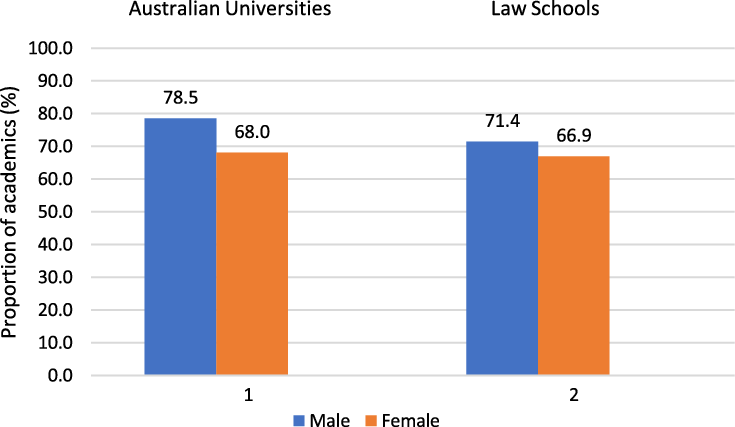
Overall, the gender gap in the conferring of PhDs is closing, however, and since 2009, at least half of all conferred PhDs in Australia have been awarded to women (Dodson Reference Dodson2012). However, the gender gap is wider in law schools. Figure 3 shows the proportion of all academics in Australian law schools from our sample and the proportion of all Australian full-time and fractional full-time academics who hold doctorate qualifications. A total of 71.4 percent of male legal academics held a doctorate qualification in 2018, compared to 66.9 percent of female legal academics, showing that there is still a gender gap. This gap is even wider for academics across Australian universities generally. Of all male academics generally, 78.5 percent had obtained doctorate qualifications, compared to 68.0 percent of all female academics.
Percentage of Academics Holding Doctorate Qualifications within Australian Law Schools and All Australian Universities, 2018.

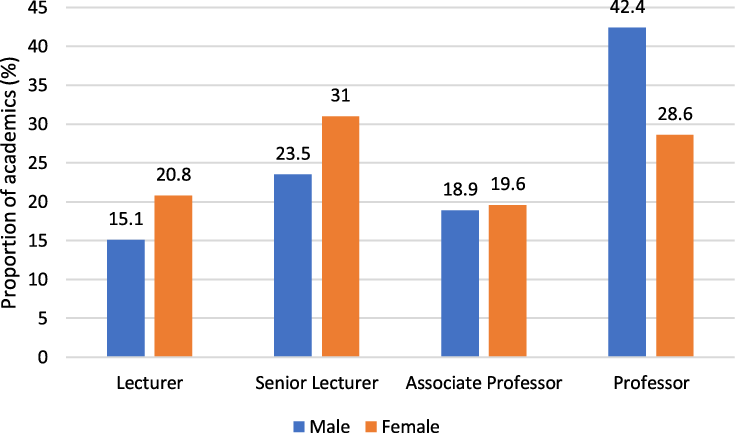
In addition, Figure 4 shows that male law professors are more likely to hold doctorate qualifications than female law professors. This may be a historical artifact, reflecting that, traditionally, male academics were more likely to have completed doctorate studies than female academics. In addition, female legal academics appointed at lower levels within the academic hierarchy are more likely to hold doctorate qualifications than male legal academics. These differences are also statistically significant (χ2 = 11.36, df = 3, p = 0.01).
Proportion of Legal Academics with Doctorate Qualifications by Academic Rank, 2018.

We cannot decisively account for this difference, although in the United States, Merritt, Reskin, and Fondell (Reference Merritt, Reskin and Michelle1993, 397) find that male legal academics were appointed at a higher starting position compared to female legal academics. In addition, Haveman and Radic (Reference Haveman2017) show that in the United States male legal academics without PhDs are significantly more likely to be hired by a prestigious law school than women without PhDs. It is also possible that male academics use their doctorate qualifications as a negotiation chip to achieve a higher position, or that women are expected to bring “more” in order to obtain an entry-level lecturer position or to gain promotion at the initial stages of their careers (Steinpreis, Anders, and Ritzke 1990).
Formal qualifications are not the only qualifications that an academic may possess. Female legal academics (n = 239, 71.1 percent) are more likely to have worked previously in professional practice than male academics (n = 197, 61.4 percent) and this difference is also statistically significant (χ2 = 7.006, df = 1, p < 0.01). This difference may be expected if female academics have been appointed due to professional experience rather than formal qualifications. However, just under a third of the female academics who do not hold PhDs (32.4 percent) have practice experience. In contrast, almost a quarter (23.6 percent) of male legal academics without a PhD have practice experience. This finding supports the conclusion that to be included within legal academia, female academics must do “more” than their male colleagues. To be considered the equivalent to their male counterparts, female academics may need to hold both higher academic and higher professional qualifications.
Another possible explanation is that female legal practitioners may be more likely to turn to academia to find a better work-life balance compared to their male counterparts, and thus academia is a second or third career. The Australian legal profession has a high attrition level, and women are more likely to leave the profession than men (Charlesworth and Campbell 2010, 8; Wallace et al. Reference Wallace, Chloe, Lee, Suzie and Diane2014, 84). The lack of flexible working arrangements has been identified as the main driver of the high proportion of female practitioners exiting the profession, along with workplace culture, allocation of tasks without intrinsic interest, and lack of mentoring opportunities. The women who were considering leaving the profession entirely, or those that had already left, felt pushed by the lack of a work-life balance, limited flexibility, and stress, and these problems also acted as barriers against women returning to the profession (Wallace et al. Reference Wallace, Chloe, Lee, Suzie and Diane2014, 84). Hiring practices, however, do not necessarily take into consideration previous careers, and lawyers who have moved from practice into academia may face additional barriers (Dash Reference Dash, Padró, Erwee, Harmes, Harmes and Danaher2018). Second-career academics have reported that despite their external experience, their lack of research publications and teaching experience means that they are often expected to start at the lowest rung on the academic hierarchy. They may feel abandoned, isolated, and unappreciated by their institutions and struggle to meet performance criteria (Dash Reference Dash, Padró, Erwee, Harmes, Harmes and Danaher2018).
RESEARCH PRODUCTIVITY
As female academics are still less likely than their male counterparts to hold doctorate qualifications, they may also be less productive; however, we found that there was no correlation between gender and research productivity measured as an academic’s h-index score. However, controlling for level of appointment, male legal academics are significantly more likely to score higher on the h-index than female legal academics (Pearsons, p < 0.05, r = 0.842, df = 259). In addition, whereas h-index also significantly correlated with an academic holding PhD qualification, and working within a Go8 university or a law school with a high ERA ranking, level of qualification had the highest correlation (Pearsons, p < 0.01, r = 0.681, n = 262). Thus, it appears that women publish less than men, but the effect for gender is indirect.
Previous studies have also shown that female academics are less productive compared to male academics. These findings are consistent across jurisdictions (Aiston and Jung Reference Aiston and Jisun2015), including Australia (Asmar Reference Asmar1999; Bentley Reference Bentley2012), as well as disciplines (Kyvik and Teigen Reference Kyvik and Mari1996; Kaya and Weber Reference Kaya and Margaret2003; Symmonds et al. Reference Symmonds, Gemmell, Braisher, Gorringe and Elgar2006; Potter, Higgins, and Gabbidon Reference Potter, Higgins and Gabbidon2011). In an investigation of research productivity within Australian law schools, Smyth (Reference Smyth2012) found that there were only a few female academics among the most prolific publishers in top Australian law journals. Women also publish less in elite US law reviews compared to men and are less likely to coauthor (Kotkin Reference Kotkin2010; Cotropia and Petherbridge Reference Cotropia2017). However, these findings should be interpreted with some caution.
Cotropia and Petherbridge (Reference Cotropia2017) show that while women may publish less in elite journals, they are more cited than male authors. There is also evidence that the gender gap in productivity between male and female academics in Australia has been closing in recent years (Bentley Reference Bentley2012). Most studies also examine the correlation between gender and research productivity without controlling for other variables and consequently findings may be misleading (Burton Reference Burton1997, 24). Studies that have controlled for other factors show that gender has no or little direct effect. Academic rank, rather than gender, is the strongest determinant of research productivity, although other factors such as doctorate qualifications, international research collaboration, and research funding all contribute (Ramsden Reference Ramsden1994; Xie and Shauman Reference Xie and Kimberlee1998; Teodorescu Reference Teodorescu2000; Leahey Reference Leahey2006). These factors are highly gendered (Bentley Reference Bentley2012) and suggest the influence of structural factors in explaining the gender gap in research productivity (Cole and Zuckerman Reference Cole1984; Xie and Shauman Reference Xie and Kimberlee1998).
Exactly how these structural factors influence women’s research productivity is not entirely clear. Some authors argue that women lose time to research activities due to family responsibilities (Kyvick and Teigan Reference Kyvik and Mari1996; Fox Reference Fox2005; Rothausen-Vange, Marler, and Wright Reference Rothausen-Vange, Marler and Wright2005), although others have shown that this is not an important factor (Bentley Reference Bentley2012; Aiston and Jung Reference Aiston and Jisun2015). It has also been asserted that women have fewer networks and coauthorship opportunities (Long Reference Long1992) and are not as proactive in trying to publish in the top journals (Niederle and Vesterlund Reference Niederle and Lise2007). Thornton (Reference Thornton1996, 199–200) argues that male legal academics in Australia have more time to conduct research and that the knowledge that they produce is given greater legitimacy, whereas female legal academics are less productive, less cited, and often absent from the law school curriculum and law library collections. This marginalization is even more acute for feminist legal scholars.
Thornton (Reference Thornton1996, 117) also claims that male academics are more likely to specialize in commercial law, whereas female academics teach and research in “soft law” topics such as family law, social security law, and human rights. Thornton then argues that as commercial law is attractive to students and the profession, it provides a stronger pathway to academic promotion, with universities prepared to offer financial incentives to attract the “best people” in the topic. As commercial law is male dominated within universities, the privileging of commercial law also serves to privilege male academics. Likewise, Sachs (Reference Sachs2006) argues that corporate and commercial law are seen to be rigorous and technical, and therefore masculine, whereas topics that address personal issues are considered more appropriate to be taught by female academics (see also Zenoff and Lorio Reference Zenoff1983; Kornhauser Reference Kornhauser2004).
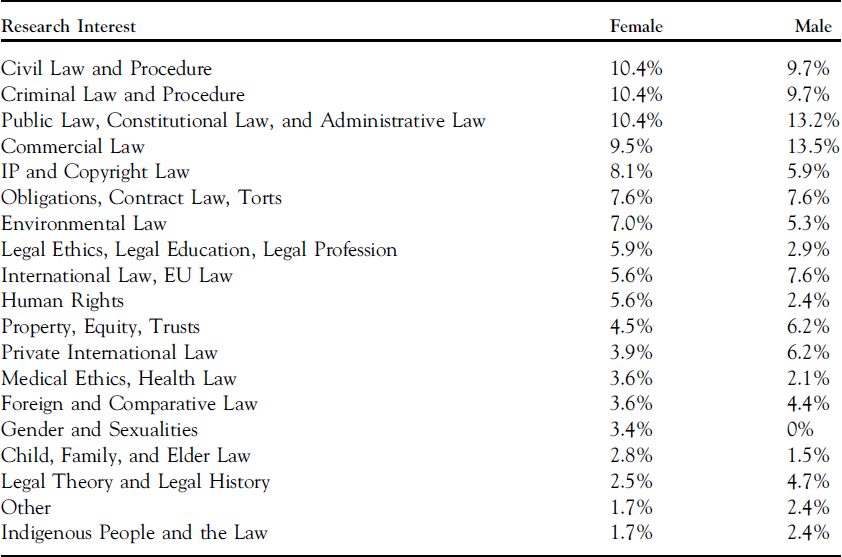
We tested whether research interests are gendered. Most academics listed several research interests on their profiles, allowing us to examine gender differences in research specializations. The research specializations of academics have received limited attention, although it may be an important variable in explaining female academics’ lower level of research productivity (Leahey Reference Leahey2006). We recorded each academic’s main research interest based on their research profile. This does not mean that academics do not necessarily have research interests in other fields. We then coded research interests into the Priestley topics. In Australia, the Priestley topics refer to eleven areas of legal knowledge that are required to be passed by law students in order for them to qualify for legal practice. The topics are: administrative law, civil procedure, company law, contracts, criminal law and procedure, equity (including trusts), ethics and professional responsibility, evidence, federal and state constitutional law, property, and torts. We also added legal history and legal theory as these did not clearly fit within any of the Priestley topics.
The results of our analysis are shown in Table 1. We found no significant differences in terms of the main research interests of male and female academics. Instead, the difference in research productivity may reflect the way in which research written by male and female authors is published and cited. Kotkin (Reference Kotkin2010) found that articles published by female authors in the top ten US law reviews were concentrated within the fields of critical theory, IP/cyberlaw, and labor and employment law. Only 5 percent of articles written by women focused on constitutional and public law and 15 percent of articles were on business law. Kotkin (Reference Kotkin2010) explains that constitutional law is considered to be highly prestigious within legal academia, is favored by law reviews, and is seen to provide opportunities for academics to raise their profile through being cited in judgments and government inquiries.
Research Interests of Female and Male Legal Academics, 2018

In Australia, Barnett’s (2019, 267) analysis of cited academic works in High Court judgments between 2015 and 2017 found that women appear to be disadvantaged, with it “more likely for a deceased, English male professor from Oxbridge to be cited by the High Court than a living, Australian female academic, particularly if she is of low rank and has no association with a prestigious university.” Yet, universities increasingly evaluate the “impact” of cited works, without fully understanding how implicit and unconscious biases operate against female legal academics. Barnett (Reference Barnett2019, 268) suggests that universities should treat “impact” with caution and that a “focus on citations as the ultimate indicator of academic influence is misguided.”
MOBILITY
Our data suggests that female legal academics are less mobile relative to male legal academics. We examined the number of previous institutions in which academics had been employed as detailed on their professional profiles. Female academics listed a mean of 0.34 previous institutions, which is significantly lower than the 0.47 previous institutions listed by male academics (t = -1.996, df = 698, p < 0.001, 2-tailed). In addition, female academics were significantly more likely to be employed at the university at which they had received their highest qualification (χ2 = 4.368, df = 1. p < 0.05). We also found that male academics were significantly more likely than female academics to have obtained their first (χ2 = 30.268, df = 1. p < 0.001) or highest degree outside Australia (χ2 = 13.799, df = 1, p < 0.001).
These findings suggest that female academics face constrained mobility. Several US studies have shown that the mobility of female legal academics is constrained largely due to their need to take on family responsibilities (Fossum Reference Fossum1980; Rosenfeld and Jones Reference Rosenfield1987; Merritt and Reskin Reference Merritt and Reskin1992; Merritt, Reskin, and Fondell Reference Merritt, Reskin and Michelle1993; McBrier Reference McBrier2003, 1209). Constrained mobility is not just a feature of the careers of female legal academics. In academia more broadly, women are less able to relocate in order to support their careers compared to men due to the need to take on family responsibilities (Rosenfeld and Jones Reference Rosenfield1987). Female academics who are unable to move due to family responsibilities risk being seen to have chosen their personal life over their career and thus face the perception that they are less committed relative to a male counterpart who does not face the same constraints (Kauffman and Perry Reference Kauffman and Perry1980). When female academics do move, they often do so as “tied movers” or “trailing spouses,” meaning that they relocate in order to support their male partner or spouse’s career rather than their own (Shauman and Xie Reference Shauman and Xie1996). Female academics who move to enhance their own careers have reported needing to sacrifice their marriages and families to relocate (McElrath Reference McElrath1992; Ackers Reference Ackers2004).
DIVERSITY
It is difficult to directly measure the social background of legal academics, and our data does not provide any demographic information other than gender. However, legal academics must first have achieved legal qualifications, and data is available on the demographic profile of Australian law graduates. Indigenous students are underrepresented (Devonshire Reference Devonshire2014; Melville 2017b), as are students from lower socioeconomic groups (Melville Reference Melville2014). This suggests that legal academics, who are drawn from the pool of successful law graduates, will be predominantly white and middle-class.
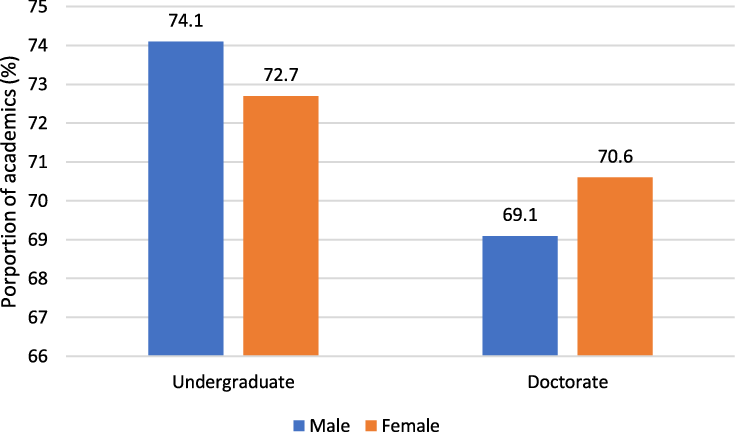
In addition, our data also suggests that a high proportion of legal academics hold qualifications from one of the Go8 universities. The proportion of male and female legal academics with undergraduate and doctorate qualifications from Go8 universities is shown in Figure 5. We identified 513 legal academics as holding undergraduate qualifications from an Australian university, and of these, 74.1 percent of male academics and 72.7 percent of female academics had obtained these qualifications from a Go8 university. Of the 326 legal academics who had obtained a PhD from an Australian university, 69.1 percent of men and 70.6 percent of women had studied at a Go8 university.
Percentage of Legal Academics with Qualifications from Go8 Universities, 2018.

This suggests that the majority of legal academics in Australia have similar backgrounds in legal education, as most have studied at a small number of law schools. At the time that our data was collected, Australia had thirty-eight law schools, and yet approximately 70 percent of legal academics overall have studied within only eight law schools. In addition, the constrained mobility of female academics appears to increase the likelihood of female academics having studied at an elite institution compared to that of male academics. Women are significantly more likely to be employed in a Go8 university if their first qualifications are from the same university (Pearsons, p < 0.005, r = 0.153, n = 352). Likewise, female academics are more likely to be employed in a law school with a high ERA ranking if their first qualifications are from the same law school (Pearsons, p < 0.005, r = 0.155, n = 347). These correlations only held for female academics, and there was no relationship between institutional status and initial qualifications for male academics.
There results may reflect that Australia’s oldest law schools are located within Go8 universities. Many Australian law schools were established after 1987, following a major restructuring of the higher education sector (Melville 2017a, 210). Post-1987 law schools would have taken time to establish PhD programs, and so it is likely that a smaller proportion of legal academics will hold postgraduate qualifications from the newer law schools than from those with long-established programs. In addition, the Go8 universities are located in the state capital cities, whereas some of the non-Go8 universities are located in regional centers. It may also be likely that law schools located in the major urban centers attract more postgraduate students as they have a much greater pool of potential candidates living within close proximity.
The disproportionate number of legal academics with qualifications from elite law schools is not limited to Australia. US and Canadian law schools predominantly hire graduates from a small number of elite law schools (Fossum Reference Fossum1980, 508; Bair and Boor Reference Bair and Boor1991; Bair, Boor, and Montalvo Reference Bair, Myron and Alfredo1999; Eisenberg and Wells Reference Eisenberg and Wells2000; Leiter Reference Leiter2006, Reference Leiter2019; Campos Reference Campos2012; George and Yoon Reference George2014). Redding (Reference Redding2003, 607) also demonstrates that the trend for US law schools to hire faculty from elite institutions is increasing and concludes that “[i]t may be a de facto prerequisite for a faculty appointment to have graduated from a top law school, for almost all law professors have done so.” Wells (Reference Wells2001, 173) observes that in England, female law academics are highly homogeneous and that they largely share similar social professional and social backgrounds. Very few had come from working-class families, and most had attended private or selective schools before completing their first degree in law at the “Golden Triangle” of Oxford, Cambridge, or UCL.
The practice of hiring legal academics who have predominantly studied at elite law schools is potentially problematic. Redding (Reference Redding2003) warns that this practice can entrench elitism at the expense of merit. In addition, this level of homogeneity risks producing law graduates who possess a narrow set of perspectives and skills (Campos Reference Campos2012, 5). If prospective lawyers are predominantly taught by academics who have only studied at elite institutions, then there is also the risk of producing lawyers who cannot respond fully to the diversity of level clients and legal problems (Fossum Reference Fossum1980; Glickstein Reference Glickstein1985, 57).
DISCUSSION
Since Margaret Thornton published Dissonance and Distrust in 1996, the position of women within Australian law schools has changed. In 1994, 39 percent of legal academics in Australia were women, whereas our data shows that by 2018, approximately half of Australian legal academics are women. The proportion of female legal academics in senior posts has also increased, although male legal academics are still more likely to hold associate professor or professor posts. Female academics are increasingly likely to have obtained doctorate qualifications, although there is still a gap between female and male legal academics holding PhDs. These improvements attest to the gains won by antidiscrimination legislation and gender equity initiatives that support women within academia (Thornton Reference Thornton2015). Prior to the implementation of reforms intended to improve the position of women within the workplace, the number of female academics in Australian law schools overall, as well as within senior positions, had plateaued and did not reflect the growing number of women studying law (Thornton Reference Thornton2015, Reference Thornton, Schultz, Shaw, Thornton and Auchmuty2021). Since these reforms, women within Australian law schools have made considerable progress.
These improvements, however, do not tell the entire story. Thornton (Reference Thornton1996, 112) argues that the acceptance of women into legal academia is qualified and that the standard of the “benchmark male” remains intact, and our findings reinforce her conclusions. Women continue to be underrepresented within the highest ranks for Australian law schools. They are less likely than their male colleagues to hold a PhD. Female legal academics are more likely to have come from previous professional careers than male legal academics. Prior professional experience, however, is not necessarily valued, and second-career academics face additional barriers fitting into academic culture. Female academics do not publish as much as their male counterparts, and their work potentially has less impact. They have less career mobility, including fewer opportunities to study and work internationally. Thus, our data show that women may have achieved some level of inclusion but that a gender gap persists within legal academia.
In addition, the position of women within legal academia may have become more challenging since the collection of our data due to the impact of the COVID-19 pandemic. At the time of writing this article, the COVID-19 pandemic has caused widespread disruption globally, and the university sector has also been substantially affected. The gendered impacts of the pandemic are already surfacing and existing inequalities are deepening (Workplace Gender Equality Agency 2020). Globally, as states have imposed lockdowns, female academics with caring responsibilities have had to juggle home schooling along with work commitments (Minello Reference Minello2020), and academic casuals (the majority of whom are women) have lost employment. Early research also indicates that women academics are submitting fewer articles due to the pandemic and are less likely to embark on new research projects (Viglione Reference Viglione2020), which will potentially affect women’s advancement and career progression not only during the pandemic but in subsequent years.
Our data also suggest that legal academia is characterized by intraoccupational closure as conceptualized by Witz (Reference Witz1992), rather than feminization. Female legal academics are predominantly white, middle-class women (Watson Reference Watson2005), many of whom have studied at elite institutions. According to Witz (Reference Witz1992), once a social group has succeeded in breaching professional closure, they then engage in strategies to prevent other subordinated social groups from doing the same, and this is demonstrated in Australian law schools by a lack of inclusion of Indigenous academics or people with lower socioeconomic status (Melville Reference Melville2014). In addition, the legal academics that we have studied are those with permanent contracts, rather than sessional staff. A new line of demarcation has formed between permanent and sessional academics, with permanent staff having much greater access to resources and power than those in precarious employment. Thus, even with the growing number of women within legal academia, gendered barriers to achieving full inclusion remain.
CONCLUSION
Our data demonstrate that the position of female academics within Australia law schools has changed since women first started to study law in large numbers in the 1970s. The number of female legal academics holding PhD qualifications, having gained permanent contracts, and being promoted to senior positions have all increased in recent years. This suggests that women have achieved at least some level of inclusion within legal academia.
This does not mean, however, that legal academia has feminized, and our data shows that gendered exclusionary strategies remain entrenched within Australian law schools. In precarious times, it is also likely that the position of female academics in universities will only worsen. This finding has serious implications for women attempting to negotiate a work environment structured around male norms and beliefs and that provides men with greater access to resources and power. It also has serious implications for the nature of legal profession and even the law itself. As law schools provide the gateway into the legal profession, the privileging of male normative standards in legal academia is likely to flow into the profession. Sommerlad (Reference Sommerlad1994) argues that while women have been included within the legal profession, the failure of the profession to become feminized means that the masculine norms on which the profession, but also the law, is founded remain unchallenged. This allows legal academia, the legal profession, and legal norms and discourses to continue to be conceptualized as being embedded in patriarchal beliefs, cultural practices, and norms.