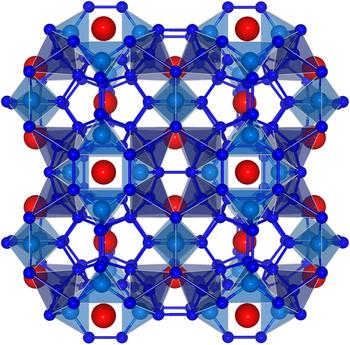
Thermal conductivity is one of the dominant parameters for efficiency optimization in a vast range of devices. It plays an important role in energy conversion, transfer and storage applications. Understanding of thermal transport properties in complex nanomaterials can lead to the design of many modern devices such as thermoelectric,[Reference Snyder and Toberer1, Reference Mingo, Hauser, Kobayashi, Plissonnier and Shakouri2] optoelectronic,[Reference Witanachchi, Hyde, Beekman, Mukherjee, Mukherjee and Nolas3, Reference Cahill, Ford, Goodson, Mahan, Majumdar, Maris, Merlin and Phillpot4] photovoltaics[Reference Witanachchi, Hyde, Beekman, Mukherjee, Mukherjee and Nolas3, Reference Goetzberger and Hebling5] and storage devices.[Reference Zalba, Mar´ın, Cabeza and Mehling6] The ability to optimize the thermoelectric performance of materials by minimizing its lattice thermal conductivity opens for the fabrication of a much larger category of efficient thermoelectric materials. There is a close relation between the complexity of the crystal structure and the thermal conductivity. Thermal conductivity is directly related to the phonon velocities in the system, which in turn can be strongly anisotropic depending on the crystal structure.[Reference Kaur, Chakraverty, Ganguli and Bera7] The anharmonic scattering rates also depend intricately on the crystal structure and constituent atoms.[Reference Bjerg, Iversen and Madsen8] Besides the intrinsic properties, alloying, substitution, and nano-structuring have been found to be very effective in controlling the thermal conductivity of large range of materials. For thermoelectric application, a semi-conducting material with low (lattice) thermal conductivity and high electrical conductivity is a long-standing quest. Clathrates are one type of compounds which show such behavior and have been reported as potential efficient thermoelectric materials due to their very low thermal conductivity.[Reference Beekman and VanderGraaff9–Reference Yang, Cheng and Hu12] Clathrates are made up of a guest-host assembly with a complex crystal structure (Fig. 1), and the anharmonicity of the atoms depends on the chemical bonding between the different atoms. The vibrations of the guest atoms depend on their position in the clathrate cage[Reference Christensen, Schmkel, Borup, Madsen, McIntyre, Capelli, Christensen and Iversen13] as off-center and on-center vibrations of the guest atoms will be very different. Type-I and II clathrate structures with the general formulas A8E46 and AxE136 (0 < x < 24) (where “A” belongs to alkali or alkaline earth metals and “E” belongs to group 14 of the periodic table), both have tetrahedral bonded networks as host structures. Type-II clathrates have partially filled cages in contrast to the completely filled type-I clathrates. Type-I and II clathrates exhibit a comparable lattice thermal conductivity. However, most of the type-II fully filled clathrate structures are metallic and have a low Seebeck coefficient. On the other hand, type-I clathrate compounds are generally narrow band gap semiconductors. Due to this, they have desirable electronic properties to fall in the category of potential thermoelectric materials.[Reference Takabatake, Suekuni, Nakayama and Kaneshita14–Reference Nolas, Vanderveer, Wilkinson and Cohn16]
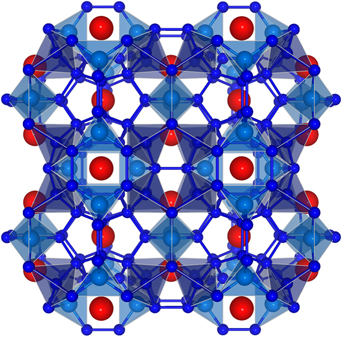
Ba8Cu6Si40 clathrate where red atoms are Ba, dark blue atoms are Si, and light blue atoms are Cu.

Clathrates have a complex structure where a cage-like structure hosts looser bound atoms which are usually heavier in mass and have very low-energy optical modes, also known as rattler modes. These low-energy localized modes can give rise to acoustic phonon scattering, thus reducing the thermal conductivity. In Ref. Reference Madsen, Katre and Bera17, it has been observed that the complex crystal structure and rattler atom both contribute to reducing the lattice thermal conductivity by increasing anharmonicity by a factor of six and reducing sound speed by a factor of two as compared with diamond-Si structure. Recently, it has been reported that the guest atom significantly increases the anharmonic scattering and very high scattering rate in the type-I Ba8Si46 structure compared with Si46.[Reference Euchner, Pailh`es, Giordano and de Boissieu18] The inclusion of Ba and Cu also modifies the electronic transport, as the Ba guest atoms provide valence electrons and fill the bands of the covalent network, whereas the inclusion of Cu atoms also helps in tuning the cage electronic structure.[Reference Takabatake, Suekuni, Nakayama and Kaneshita14]
We have studied the thermal properties of clathrate alloys with special focus on type-I silicon containing clathrates which are potentially useful for application in silicon-based technology. Furthermore, the effect of nano-structuring on this complex structure has been investigated for further optimization of thermoelectric efficiency. The lattice thermal conductivity is calculated based on a model approach to the relaxation time approximation (RTA) for phonon transport. We have included anharmonic scattering, alloy scattering, and boundary scattering for the relaxation time calculation. In the next section, we have discussed the theoretical method to calculate thermal conductivity. Afterwards, we have displayed the obtained results in different type-I clathrates.
The phonon dispersion of the type-I clathrates Ba8Cu6Si40, Ba8Cu6Ge40, and diamond-Si structures has been calculated using the frozen phonon approach as implemented in PHONOPY.[Reference Togo, Oba and Tanaka19] The forces are calculated on the atoms using 54-atom unit cells using VASP.[Reference Kresse and Joubert20] The forces on all atoms are calculated using the PBE-GGA functional and a 300 eV cut-off energy. Unit-cell relaxation is given in the Supplementary material. The forces on all the atoms in both Ba8Cu6Si40 and Ba8Cu6Ge40 clathrates are calculated with symmetry-reduced atomic displacement of 0.03 Ǡ and the volume derivatives for the Grüneisen parameter are calculated using a volume range of ±1%. A k-grid of size (4 × 4 × 4) is used for calculating the forces. The dynamical matrix calculations are done on denser k-point mesh (20 × 20 × 20). Similarly, for the diamond-Si structure, the Grüneisen parameter and thermal properties are calculated and compared with the clathrate structure.
Lattice thermal conductivity of a material is related to how the energy is being transferred across the whole lattice by each phonon mode. The phonon band structures of Ba8Cu6Si40 and Ba8Cu6Ge40 are shown in Supplementary material (Fig. S1). The acoustic modes of both Ba8Cu6Si40 and Ba8Cu6Ge40 clathrates have similar slopes. However, the Ba8Cu6Ge40 has much lower energy optical phonon modes and the bands are flatter compared with Ba8Cu6Si40.
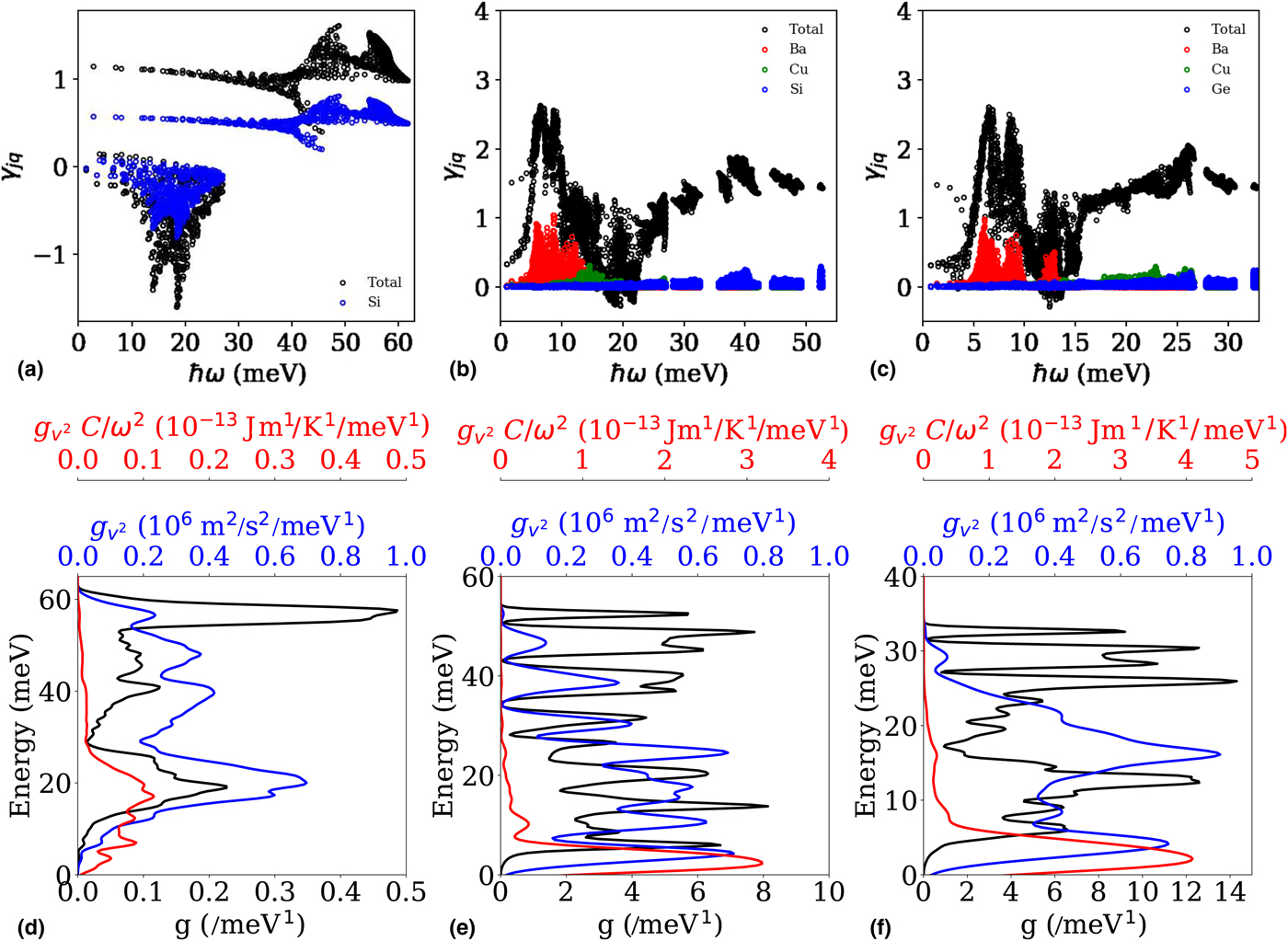
From the calculation of atomistic contribution of the Grüneisen coefficient of diamond-Si [Fig. 2(a)], Ba8Cu6Si40 clathrate [Fig. 2(b)], and Ba8Cu6Ge40 clathrate [Fig. 2(c)] by its constituent atoms, it is found that in Ba8Cu6Si40 and Ba8Cu6Ge40, the Ba atoms have the largest contribution to Grüneisen parameter in lower energy phonon modes. The Ba atoms contribution is ~10 times higher as compared with Si atoms and ~3 times higher as compared with the Cu atoms in both the clathrate structures. Contributions from the framework atoms to the Grüneisen coefficient in both Ba8Cu6Si40 and Ba8Cu6Ge40 are very similar (see Fig. 2). The thermal conductivity due to phonons is calculated from the RTA as,
 $$\kappa _{{\rm ph}}(T) = \displaystyle{1 \over 3}\mathop \sum \limits_j \int \displaystyle{{{\rm d}{\bi q}} \over {8\pi ^3}}v_{{\rm j}{\bf q}}^2 \tau _{{\rm j}{\bf q}}C_{{\rm j}{\bf q}},$$
where the phonon bands ranging from acoustic to optical are being summed up and the q-points are integrated over the first Brillouin zone. Every phonon mode has a band index and q-dependent group velocity v jq and specific heat capacity contribution C jq. The C jq furthermore depends on the temperature, T. The phonon relaxation time, τ jq, is calculated considering anharmonic, alloy, and boundary scattering mechanisms. The anharmonic scattering is calculated following Ref. Reference Madsen, Katre and Bera17,
 $$\tau _{\rm U}^{ - 1} = p\omega ^2\displaystyle{T \over {{\tilde \theta} _{\rm D}}}e^{ - {\tilde \theta} _{\rm D}/3T},$$
where p is calculated as in Ref. Reference Madsen, Katre and Bera17. The calculated value of p for Ba8Cu6Si40 is 351 × 10−18 s and for Ba8Cu6Ge40 is 405 × 10−18 s and Debye's temperature for these two clathrates is 128 and 83 K, respectively. The  $\bar \gamma ^2$ for the Ba8Cu6Si40 and Ba8Cu6Ge40 are 1.92 and 1.89. The transport mode distribution, (g v2C/ω 2), and velocity distribution in Ba8Cu6Si40, Ba8Cu6Ge40, and diamond-Si [Figs. 2(d)–2(f)] are calculated following Ref. Reference Bjerg, Iversen and Madsen8. Due to the strong anharmonicity at low energy due to the guest Ba atom, Ba8Cu6Si40 has a sharp decrease in transport mode distribution. In diamond-Si, a broad energy mode contributes in thermal transport, these modes sharply decrease in the clathrates due to anharmonicity of Ba atoms.
Atomistic contribution of Grüneisen parameter in (a) diamond-Si, (b) Ba8Cu6Si40, and (c) Ba8Cu6Ge40, and phonon DOS (black line), velocity density distribution (blue line), and transport distribution (red line) in (d) diamond-Si, (e) Ba8Cu6Si40, and (f) Ba8Cu6Ge40.

The total anharmonic scattering rate, τ UT−1 for an alloy is calculated as
 $$\tau _{{\rm UT}}^{ - 1} = \displaystyle{x \over {\tau _{{\rm UA}}}} + \displaystyle{{1 - x} \over {\tau _{{\rm UB}}}},$$
where A and B are the two components in the alloy and x is the fractional concentration of A in the alloy. Alloy scattering is incorporated in phonon transport by atomistic mass difference in the alloy. The scattering rate due to alloy scattering is calculated as[Reference Klemens21, Reference Abeles22]
 $$\tau _{\rm A}^{ - 1} = \displaystyle{{\omega ^4\delta ^3\Gamma} \over {4\pi v^3}},$$
where v is the phonon velocity in the alloy. The calculated speed of sound is 2872 ms−1 for the Ba8Cu6Si17Ge23 clathrate alloy, whereas the speed of sound in the pure compounds Ba8Cu6Si40 and Ba8Cu6Ge40 is calculated as 3297 and 2559 ms−1, respectively. δ 3 is the atomic volume of an alloy given as
 $$\delta ^3 = xV_{\rm A} + {\rm (}1 - x{\rm )}V_{\rm B},$$
where V A and V B are the atomic volumes of the components A and B and Γ is the scattering cross-section Γ = x(1 − x) (ΔM/M)2, where ΔM = M A − M B and M = x M A + (1 − x) M B where M A and M B are the masses of the components A and B in the alloy.
Boundary scattering is incorporated using a diffusive model,  $\tau _b^{ - 1} \sim v/{\rm \Lambda} $ where Λ is the mean free path (MFP) of the phonons. Such a model has been shown to predict the thermal conductivity of Si nanowires[Reference Chen, Hochbaum, Murphy, Moore, Yang and Majumdar23] and Si1−xGex alloy nanostructure[Reference Bera, Soulier, Navone, Roux, Simon, Volz and Mingo24, Reference Minnich, Lee, Wang, Joshi, Dresselhaus, Ren, Chen and Vashaee25] accurately for nanostructure with sizes larger than 20 nm.[Reference Mingo26]
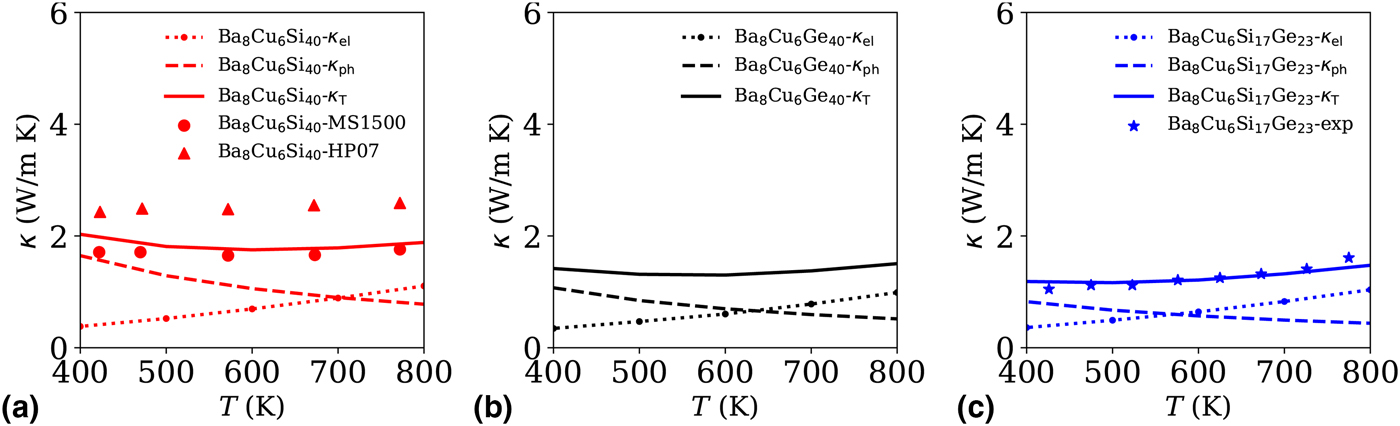
The total thermal conductivity (κ T) due to phonons and electrons (see supplementary material for calculation of electronic transport using BoltzTraP[Reference Madsen and Singh27]) is plotted for Ba8Cu6Si40, Ba8Cu6Ge40, and Ba8Cu6Si17Ge23 in Fig. 3 with the experimental data from Refs. Reference Yan, Falmbigl, Laumann, Grytsiv, Bauer, Rogl and Paschen28 and Reference Yan, Chen, Laumann, Bauer, Rogl, Podloucky and Paschen29. The experimental data include both lattice and electronic transport. The electronic conductivity is fitted with the experimental data and the fitted value of electronic relaxation time is ~1.8 × 10⁻¹⁵ s. The electronic thermal conductivity of Ba8Cu6Si17Ge23 clathrate alloy is calculated as,
 $$\kappa _{{\rm el}} = x(\kappa _{{\rm elA}}) + (1 - x)\,(\kappa _{{\rm elB}}),$$
where κ elA and κ elB are the electronic thermal conductivities of two compounds A, B. The total thermal conductivity for pure and alloy compounds is calculated as κ T = κ ph + κ el, where κ ph and κ el are phonon and electronic thermal conductivities, respectively, of pure compounds Ba8Cu6Si40, Ba8Cu6Ge40, and Ba8Cu6Si17Ge23 clathrate alloy. The plotted data are sufficiently capturing the transport of heat in the pure clathrate Ba8Cu6Si40 and Ba8Cu6Si17Ge23 clathrate alloy.
Thermal conductivity of (a) Ba8Cu6Si40, (b) Ba8Cu6Ge40, and (c) Ba8Cu6Si17Ge23 alloy due to phonons (dashed line) and electrons (dotted line) with temperature along with experimental data from Refs. Reference Yan, Falmbigl, Laumann, Grytsiv, Bauer, Rogl and Paschen28 and Reference Yan, Chen, Laumann, Bauer, Rogl, Podloucky and Paschen29. Solid lines are for total thermal transport due to both phonons and electrons transport.

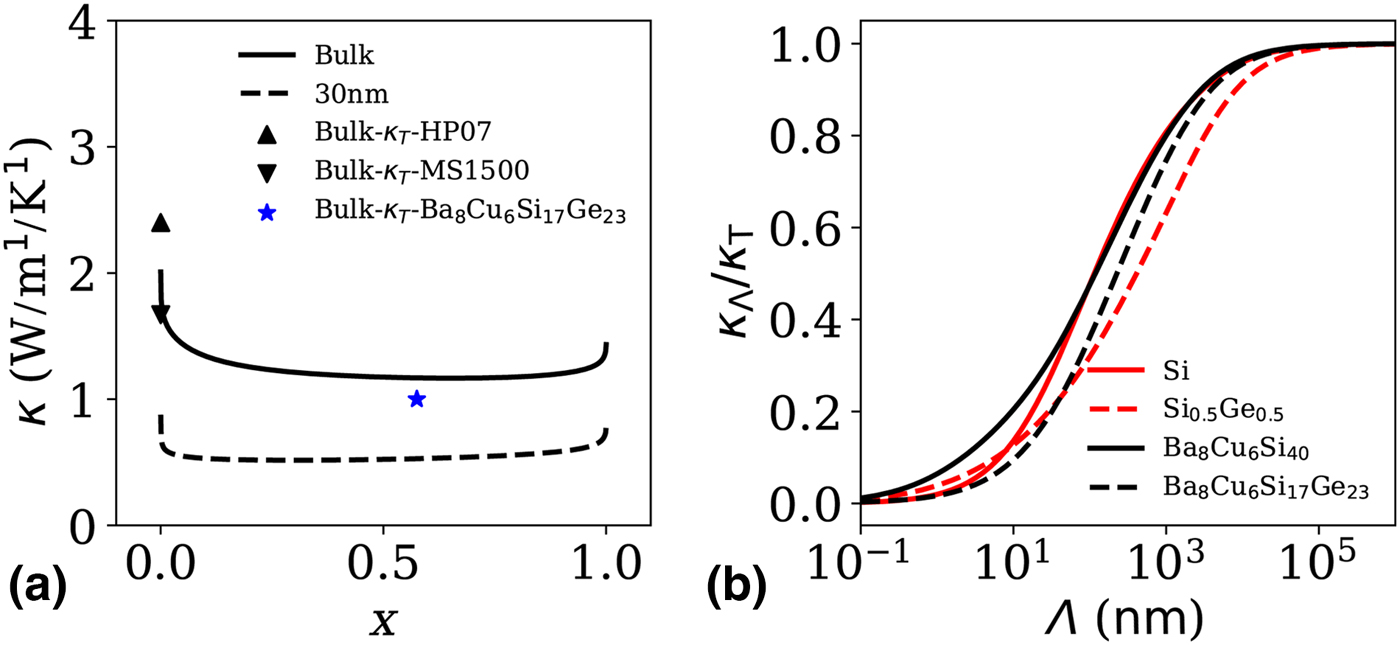
The total thermal conductivity of the Ba8Cu6Si40(1−x)Ge40x clathrate is calculated by tuning alloying and nano-structuring. The total thermal conductivity of Ba8Cu6Si40(1−x)Ge40x is plotted for varying alloy concentration at temperature 400 K in Fig. 4(a) and it is observed that the value of the pure Si-clathrate Ba8Cu6Si40 is reduced by 40% when the alloying concentration is ~50%. This reduction is mainly due to a 50% reduction of the phonon lattice thermal conductivity from 1.64 to 0.80 W/m-K. The theoretical values for the total lattice thermal conductivity is in good agreement with the experimental values for pure Si-clathrate Ba8Cu6Si40 and Ba8Cu6Si17Ge23 clathrate alloy.[Reference Yan, Falmbigl, Laumann, Grytsiv, Bauer, Rogl and Paschen28, Reference Yan, Chen, Laumann, Bauer, Rogl, Podloucky and Paschen29]
(a) Total thermal conductivity of Ba8Cu6Si(1−x)40Ge40x clathrate alloy (bulk) and clathrate alloy nanowire at 400 K along with the experimental data (Refs. Reference Yan, Falmbigl, Laumann, Grytsiv, Bauer, Rogl and Paschen28 and Reference Yan, Chen, Laumann, Bauer, Rogl, Podloucky and Paschen29) and (b) cumulative contribution of phonon lattice thermal conductivity by phonon mean free path.

The clathrate lattice thermal conductivity can be further reduced by around ~90% by nano-structuring compared with the pure Ba8Cu6Si40 clathrate. The phonon lattice thermal conductivity (κ ph) of Ba8Cu6Si17Ge23 clathrate alloy nanowire with a diameter 30 nm is found to be 0.15 W/m-K. The total thermal conductivity, κ T for the Ba8Cu6Si17Ge23 clathrate alloy nanowire is ~0.50/m-K. Experimentally, the thermoelectric figure of merit, zT, of type-I Ba8Cu6Si40 clathrate is reported as 0.07 with a total thermal conductivity of 2.40 W/m-K at 400 K.[Reference Yan, Chen, Laumann, Bauer, Rogl, Podloucky and Paschen29] The reported zT of Si clathrate is low compared with other Si-based materials. The zT values can be further optimized to ~0.39 for Ba8Cu6Si17Ge23 clathrate alloy nanowire (diameter 30 nm) with the calculated total thermal conductivity 0.50 W/m-K and considering electronic properties [electrical conductivity (σ) (0.022 × 10⁶ S/m), Seebeck coefficient (S) (159 µV/K)] as calculated in the supplementary material. For the electronic properties, there are minimal effects of alloying[Reference Kaur and Bera30] and nano-structuring and the predicted zT for clathrate alloy nanowire is encouraging for further experimental investigation of this system. The cumulative thermal conductivity is plotted for the MFP range in different compounds Fig. 4(b). It has been seen that as the wavelength of the heat-carrying phonons decreases, the cumulative contribution sharply decreases for both pure diamond-Si and type-I Ba8Cu6Si40. The behavior of Ba8Cu6Si17Ge23 clathrate alloy and Si0.5Ge0.5 alloy is similar. Alloy scattering due to atomistic mass difference strongly reduces the heat transport by short wavelength phonon. Therefore, thermal conductivity in both the simple Si1−xGex alloy and Ba8Cu6Si40(1−x)Ge40x clathrate alloy is reduced as compared with the pure materials. A large reduction in thermal conductivity is also possible in the complex structure like clathrates by increasing the atomistic mass difference. The thermal conductivity profile of diamond-Si and Si-clathrate Ba8Cu6Si40 is quite similar at large phonon wavelength but as the wavelength of phonon decreases, the effect of the clathrate structure starts impinging. As the phonon wavelength for Si-clathrate Ba8Cu6Si40 decreases, the heat conduction also reduces which is indicative of the complex structure. Nano-structuring has different effect for pure diamond-Si and Ba8Cu6Si40 clathrate. We can see here that the alloying decreases the phonon lattice thermal conductivity by 50% and nano-structuring reduces the same by ~90% with ultra-low values near 0.15 W/m-K [Fig. 4(a)]. The scattering rates of the nanostructure are determined by its dimension. For clathrates, more than 90% of heat is carried by the phonons having wavelength more than 10 nm [see Fig. 4(b)]. Nano-structuring can block these heat-carrying phonons very effectively. Hence, we observe a large reduction in thermal conductivity in nanostructure clathrates alloy and found an ultra-low thermal conductivity in semiconducting materials.
In conclusion, we have found a significant reduction in the lattice thermal conductivity of type-I Si-clathrate Ba8Cu6Si40 by introducing alloy and boundary scattering. Alloy scattering has been shown to reduce the lattice thermal conductivity of pure Si-clathrate Ba8Cu6Si40 from 1.64 to 0.80 W/m-K in Ba8Cu6Si17Ge23 clathrate alloy at 400 K. Furthermore, the effect of boundary scattering is calculated and there has been seen a reduction of the clathrate lattice thermal conductivity to 0.15 W/m-K in case of 30 nm-sized Ba8Cu6Si17Ge23 clathrate alloy nanowire. Such reduced values of the nanostructured clathrate alloy can direct to make good performing Si-based thermoelectric. Si1−xGex alloy has very low zT ~ 0.1 at room temperature. A nanowire Ba8Cu6Si17Ge23 clathrate alloy with zT ~ 0.40 around room temperature can be useful for micro refrigeration in Si-chips. It can also be very useful for heat barrier application in nanoelectronics.
Supplementary material
The supplementary material for this article can be found at https://doi.org/10.1557/mrc.2018.242
Acknowledgments
The authors thank DST (INT/AUSTRIA/BMWF/P-02/2018) and the DFG within the SPP1386 (DFG: MA 5487/2-1) for financial support. The authors acknowledge NPSF PARAM Yuva-II HPC for the computational facility.