

An increasing amount of research is being carried out on the meaning and importance of social relations and social interaction among workplace actors, such as the worker on sickness absence, colleagues of the absent worker and supervisors (Dunstan & MacEachen, Reference Dunstan and MacEachen2013a; Kosny et al., Reference Kosny, Lifshen, Pugliese, Majesky, Kramer, Steenstra and Carrasco2013; Tjulin, MacEachen, & Ekberg, Reference Tjulin, Maceachen and Ekberg2010b). Findings imply that support from colleagues towards the re-integration of workers on sick leave depends on social relations at the workplace (Tjulin, MacEachen, & Ekberg, Reference Tjulin, Maceachen and Ekberg2010a). The following factors seem to be of importance: the social climate, attitudes towards work and sick leave, pre-existing social relationships, how long social support is required after return to work, communication within the workgroup (Tjulin, MacEachen, Stiwne, & Ekberg, Reference Tjulin, MacEachen, Stiwne and Ekberg2011), the type of disability, and the perceived fairness of adjustments made (Dunstan & MacEachen, Reference Dunstan and MacEachen2013a). Work environment characteristics and how work tasks are organised, with regard to job security (Kosny et al., Reference Kosny, Lifshen, Pugliese, Majesky, Kramer, Steenstra and Carrasco2013), pace of work and workforce size (Lysaght, Fabrigar, Larmour-Trode, Stewart, & Friesen, Reference Lysaght, Fabrigar, Larmour-Trode, Stewart and Friesen2012; Lysaght & Larmour-Trode, Reference Lysaght and Larmour-Trode2008), affect social relations in return to work. Findings imply that there is a need to progress from individual-based interventions to workplace-based interventions involving several stakeholders involved in a return-to-work process, such as the health care, the social insurance agency, (van Oostrom et al., Reference van Oostrom, Driessen, de Vet, Franche, Schonstein, Loisel and Anema2009), and workplace actors, such as the worker on sickness absence, the colleagues and the supervisor (Tjulin et al., Reference Tjulin, Maceachen and Ekberg2010b).
The return-to-work process can be seen as a dynamic problem-solving process (Coutu, Baril, Durand, Cote, & Rouleau, Reference Coutu, Baril, Durand, Cote and Rouleau2007), and as a change process (Franche & Krause, Reference Franche and Krause2002; Young et al., Reference Young, Roessler, Wasiak, McPherson, van Poppel and Anema2005) for the actors involved in the work context. In considering return to work as a temporal and social problem-solving process, based on an individual change process for the workplace actors involved, the present study explores how individual learning, as a prerequisite for a change process, is experienced in return to work. The concept of learning is viewed as a change in the preconceptions, experience or competence of the individual, based on the interaction between the individual and his/her social environment (Billett, Reference Billett2006, Reference Billett2009; Ellström, Reference Ellström2001; Illeris, Reference Illeris2007, Reference Illeris2011; Wenger, Reference Wenger2002). Changes in preconceptions, experience or competence for one or several of the actors might in turn lead to changed conceptions regarding opportunities for return to work; but this is not necessarily the case, since learning takes place in the interaction between the individual and the social context (Billett, Reference Billett2006, Reference Billett2009; Illeris, Reference Illeris2007, Reference Illeris2011). The literature on learning underpins the view of the workplace as a social system where people meet and interact as an important prerequisite for collective learning at work (Le Clus, Reference Le Clus2008), which in this context would be seen as an important goal for work disability management. Through participation in the social learning system at work, so-called communities of practices can emerge, where informal learning, creation of new knowledge and problem-solving activities can take place in day-to-day interaction among workplace actors, and provide a foundation for sharing knowledge (Wenger, Reference Wenger2002) regarding the prerequisites for a successful return-to-work process. Learning within communities of practices is seen as a social process which can include or exclude individuals due to the level of trust among the participants (Li et al., Reference Li, Grimshaw, Nielsen, Judd, Coyte and Graham2009); for example, tight social relationships among colleagues can become excluding and turn into a challenge for a sick absent worker's re-integration (Dunstan & MacEachen, Reference Dunstan and MacEachen2013a; Kosny et al., Reference Kosny, Lifshen, Pugliese, Majesky, Kramer, Steenstra and Carrasco2013; Tjulin et al., Reference Tjulin, MacEachen, Stiwne and Ekberg2011) (Dunstan & MacEachen, Reference Dunstan and MacEachen2013a; Kosny et al., Reference Kosny, Lifshen, Pugliese, Majesky, Kramer, Steenstra and Carrasco2013; Tjulin et al., Reference Tjulin, MacEachen, Stiwne and Ekberg2011). Workplaces and organisations are viewed as a dynamic setting with changing social interactions and relations between workplace actors. Individuals who work together in organisations have a variety of experiences, personalities and skills; they therefore have different perceptions of workplace conditions depending on their social location (Tjulin et al., Reference Tjulin, Maceachen and Ekberg2010b).
The objective of this article was to explore how individual learning emerges among workplace actors during the return-to-work process, and whether prerequisites for collective learning at the workplace are present and managed by the actors.
Method
With the overall purpose of investigating different aspects of early social contact in return to work among workplace actors, a mixed methods study was designed (using a survey and individual interviews) and conducted in Sweden in 2012 to 2013. In this article, a qualitative methodology (Patton, Reference Patton2002) was used to expand the minimal knowledge base about learning in relation to return to work.
Research Setting
The study was conducted in Sweden. Sickness insurance in Sweden is based on the principle that as many people as possible should provide for themselves through their own work, as this will increase employment and decrease alienation from the labour market (Finansdepartementet, 2008). The political aim of the strategy is to promote a faster return to work to the individual's previous workplace, or to find a suitable job on the labour market at an early stage (Organisation of Economic Co-operation and Development, 2009). The Social Insurance Agency decides whether the worker on sickness absence is entitled to sickness benefits.
Data Sample and Collection
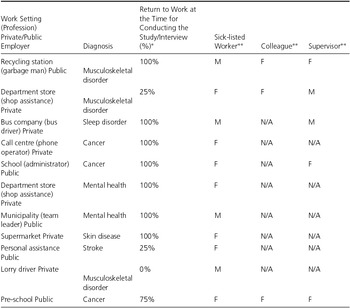
The main criterion for selection of participants was their direct experience of return to work. Potential participants were selected through the survey conducted in 2012 to 2013, in which there was a space on the form for the participants to write their name and phone number. The researchers selected 50 sick-listed individuals at random, made a phone call and asked if they wished to participate in individual interviews. The purpose of the study was presented and they were invited to participate in the study. Thirty individuals declined to participate in the study due to lack of time and not being interested in sharing their experience in a research context. Dates and times were set for interviews with the individuals who gave their consent to participate. The interviews were conducted face-to-face or by phone. A total of 11 workplaces were represented in the study and 19 individuals participated in the interviews (11 sick-listed individuals, 5 supervisors and 3 colleagues). Participants were workers on sickness absence, their colleagues and their supervisor. See Table 1 for a more detailed description of the data sample. During the interviews the researcher asked the absent individuals if they gave their consent for interviews to be conducted with a colleague and their supervisor. Those who declined to allow the participation of a colleague and supervisor in the study did so due to integrity issues as not feeling comfortable to have others talk about their specific return-to-work process, or change of workplace after their return to work.
Sample of Participants With Direct Experience of the Return-to-Work Process

Note:
* According to Swedish regulations, an individual can return to work after sick leave and work 25%, 50%, 75% or 100% of working hours.
** M = male; F = female
In total, nine in-person/face-to-face open-ended interviews and ten open-ended telephone interviews were conducted. The interviewers began by asking participants about their professional and private background, and getting them to describe what they did during a working day. Overarching questions about experiences in the return-to-work process in relation to social contact guided the interview. Several topics were covered, such as how/if they kept in contact with their workplace when they were on sick leave, how the colleagues and supervisor kept contact during sickness absence, how they experienced the contact, who initiated the contact, how they viewed the responsibility of contact, and how they viewed their own role in the return-to-work process. The interview questions facilitated an analysis of how individual learning emerged in the return-to-work process. The interviews were audiotaped and transcribed verbatim by a professional transcriptionist.
Data Analysis
The analysis was carried out simultaneously with data collection, through a back-and-forth inductive content analysis of the interviews (Elo & Kyngas, Reference Elo and Kyngas2008; Patton, Reference Patton2002). In the first step of the analysis the interview transcripts were read and condensed independently by the first author (ÅT) and second author (UM), to get a sense of the data as a whole. Throughout the analysis, memos, analysis notes and diagrams were used to keep track of emerging ideas and analytical discussion.
An initial analysis of the interview transcripts yielded descriptive themes regarding how the workplace actors talked about social relations and social contacts at the workplace during return to work, as well as how actions were taken at the workplace to facilitate a return-to-work process. The next step of the analysis was interpretative constant comparison (Patton, Reference Patton2002) and analytical reflexivity (Srivastava & Hopwood, Reference Srivastava and Hopwood2009). At this stage, the main author and second author interacted regularly to systematically discuss and compare broader analytical findings. An overarching ordering of analytical themes and concepts was formed that linked and contextualised descriptive findings into an explanatory scheme. The data were broken down into individual narratives by each informant, and into small cases of informants related to each workgroup (in cases where the data had several informants from the same workplace/group; see Table 1). Similarities and differences across individual narratives and cases were explored to understand the opportunities and challenges in individual learning. Prominent themes in the data became visible, about earlier experience, communication, changed work distribution, and the need for competence and learning development.
Ethical Considerations
The Regional Ethics Committee at Linkoping University approved the study. Informed consent was obtained from all participants before conducting the interviews. Participants were assured that their identity would remain anonymous and that their statements would be treated confidentially. When writing up the results, the researchers considered how to display the statements and quotes so that the possibility to identify the participants would be minimised. All participants were informed that they could withdraw from the study at any time without giving any explanation.
Results
The experiences shared in the individual interviews are displayed in relation to how individual learning opportunities (through dialogue, communication and trust, awareness incidents) and learning challenges (such as need for competence and development) emerged in the return-to-work process. The findings are presented as illustrative, separate narratives from small cases (workgroups) and individual informants.
Learning Opportunities Through Dialogue
One of the workers who had previously been sick-listed, Catherine, expressed disappointment over the fact that no one from the workplace called her during her sick leave. Catherine was the one who phoned her supervisor, and came to visit the workplace when she was on sick leave. She drew on her own experience and talked about a situation when one of her colleagues was ill. On that occasion, she had contacted the colleague on her own initiative, an effort that was well received by the sick-listed colleague. After Catherine's own period of sick leave she reflected on this issue of contact and decided to go to her supervisor and raise the question of whose responsibility it was to get in touch. Concurrently, during the interview with her supervisor, John, he reflected on the same issue of contact and expressed that he regretted having had a passive attitude when it came to getting in touch with Catherine during her sick leave. John felt he should have handled the process in another manner and would certainly act differently (i.e., be more active in contacting the person, if another colleague fell ill).
No, it . . . I mean it's perhaps more the fact that as a manager you — at least I — should be better at keeping in touch during a long period of sick leave. It's very easy to end up in an everyday situation where things are just running as usual, and then perhaps you think you ought to phone the person who's on sick leave, but something else comes up, or you get a question, or a customer — and then it's gone from your head and it's another three days before you think about it again.
. . . But I mean during the period she has actually come here on her own initiative, and she might come with a bag of buns or something like that, but if you really think about it, it should bloody well be the other way around. I should have been the one to phone and say, ‘Look, can you come in on Friday and join us for the afternoon coffee break’ or something like that. That's the way it should have been, instead of her just standing here and saying hello — ‘Oh, hi there!’; Yes, really. (John)
The narrative shows that learning opportunities are created through the individual's own experience of illness and return to work, in conjunction with social interaction. Catherine created an opportunity for her supervisor John to learn. Through her own engagement in her return-to-work trajectory, combined with social interaction and experience of how to deal with illness, she gave her supervisor John a learning opportunity through her social competence. John responded to the learning opportunity given; he reflected on the fact that other work tasks were given priority and this was the reason he did not follow up the contact with his employees during sick leave. He stated that he would change his behaviour in forthcoming periods of employees’ sick leave. Thus, it is suggested that individual learning occasions create learning at the workplace.
Learning Opportunities Through Communication and Trust
Anna, a supervisor, reflected on the return-to-work process of a former sick-listed employee, Karl. She compared the current return-to-work process with his return from a previous period of sick leave and identified critical issues that might arise. During the previous sick leave, Anna had had the impression that Karl felt lost and that the return was painful for him. Karl had not participated in developments at the workplace, and so many changes had been made during his absence. When Karl was faced with the current period of sick leave he chose another strategy to prevent a similar situation occurring. Anna described how Karl prepared her as a supervisor with information about his operation and period of sick leave, by telling her how long he would be off work, how he would keep in touch with the workplace by daily visits; in sum, Karl had a plan for his return to work. Anna said she had faith in him and went along with his plan since she realised he needed to be in control of his own situation. Karl confirmed his need to keep in touch with the workplace and said he participated in meetings during sick leave since he did not want to miss out on information. Moreover, if any changes were made, his colleague called to let him know. Sara, one of Karl's colleagues, took over his work tasks during his sickness absence.
I mean he really kept us in the picture, so to speak, so we had a really close dialogue, and that time he told me exactly . . . and also that he was going to be on sick leave for quite a long time. He prepared us for that early on. And I mean that was positive in many ways, not least for the sake of the work situation, and it was really good that we knew how to . . . it didn't take long before we had a plan for how we were going to cover it. I mean, it wasn't that good because we're one man short, but still. (Anna)
Sara and Karl had continuous contact during his absence, discussing both work-related issues that turned up and private matters concerning his health. She described Karl as a positive and social individual and when he was on sick leave she missed the positive atmosphere he created in the workgroup.
The openness in communication, the individual's own trust, as well as the capital of trust they build within their workgroup, in solutions for the return-to-work process and continuous social interaction among the workplace actors show how earlier opportunities in learning formed new prerequisites for Karl to manage his return-to-work process in a way that worked best for him. Anna and Karl drew on earlier experiences with regard to Karl's present return-to-work situation, and through their social interaction they facilitated inclusive participation for all workplace actors involved in return to work.
Learning Opportunities Through Critical Incidents
You don't know what you've got ‘til it's gone. (Beth)
This quote illustrates how Beth came to understand just how much her colleague Sally actually did during a working day. Beth had experienced an increased workload in administration tasks over a period of time. However, it was not until Sally was on sick leave and not at the workplace that she realised how much she asked Sally for assistance and help. She reflected on how her behaviour increased the workload for Sally, using her as a source of knowledge even though Sally had not been assigned time for helping out with the administrative questions that arose on a daily basis during a working day. During the period of sick leave Beth came to realise that she and her colleagues could not ‘turn to’ Sally for advice about how to deal with every single task they were uncertain about. During a workgroup conversation they reflected on their own responsibility and the need to learn the administrative routines to decrease Sally's workload. At the same time Beth mentioned that Sally had also changed her role in the workgroup when she returned to work. According to Beth, Sally had become better at saying no to colleagues who asked for help, setting her own limits more strictly concerning the work tasks she was actually assigned to do.
Through Sally's absence from work, Beth showed how the entire workgroup had to change their engagement in work tasks and find alternative strategies for learning. Before the sickness absence, Beth and her colleagues relied on Sally and her social competence to take care of tasks they thought they could not manage. The return-to-work process provided Beth with a learning opportunity and insight. Further, both the workgroup and Sally came to put their new insights into practice in relation to the distribution of work and their work tasks.
Something Kent learned from his own absence was to draw on his own experience of being on sick leave and how to deal with colleagues on sick leave. He mentioned that he was not afraid to ask questions about other people's health, even though it might be cancer, an illness others might feel uncomfortable to talk about. Kent had also developed his own strategy for preventing occurrence of sickness absence for himself; he had learned to question whether new work tasks and private tasks were something he could manage in his daily life.
And I've realised that now . . . that's never my attitude to taking on board new things. I'm more careful, I want to find out much more about the implications of various things and I've learnt to stand up to the manager. I'm sort of . . . I don't chicken out — I actually dare to say, ‘What the hell is all this now, tell me!’. (Kent)
Kent saw his own return-to-work process as an opportunity to learn and he changed his own preconceptions about how to deal with ill health at the workplace. Kent developed his own strategy for preventing a recurrence of sick leave by using a changed communication strategy towards his supervisor.
Learning Challenges as a Need for Competence Development
Caroline reflected on the lack of knowledge about illness and sickness absence her supervisors had shown during her period of sick leave. Her narrative displays a need for competence development at the workplace. She experienced the lack of knowledge in two ways: (1) there was a constant change of supervisors, and she had three to four different supervisors during her absence; and (2) the supervisors were young and immature in their role as supervisors. None of her supervisors got in touch with her during her absence; she thought this was due to their age, and felt they were too young to handle the responsibility of dealing with sick-listed employees. She described the supervisors as being afraid and uncertain about how to handle the situation, even though there was a formal return-to-work policy to guide them, and this caused frustration.
Well, I don't suppose I would have . . . I don't really feel the need to talk to them. But it's just that there are so many plans for how you're supposed to act at different stages, and that as a manager you're supposed to phone the group and so on. It's all there on paper, what work tasks are included if . . . but anyway, different points that you're supposed to go through when someone is away . . . and this is where nothing happens and that's what really irritates me. (Caroline)
Kent, a former sick-listed worker, reflected on his return-to-work process and identified different challenges for his return to work. One challenge related to his feeling that the supervisor lacked knowledge regarding how to handle the return-to-work process and Kent´s diagnosis of mental disorder. The supervisor appeared to experience Kent's sick leave and the whole situation as an extra uncomfortable burden in his daily work. Kent found his own solution to the problem: he asked for help from the Occupational Health Service (OHS). Through the OHS, and therapeutic conversation over a period of time, he found time to reflect on what had caused his sick leave and learned to find his own strategies to enable him to return to work. In addition, Kent's own reflection and experience of ill health gave rise to thoughts about how employers deal with sickness absence. He mentioned situations where colleagues and supervisors had experienced ill health a long time before the individual worker became sick-listed. He further identified a need for an open attitude towards ill health in the workgroup and a need to dare to talk about ill health at the workplace before sick leave. Kent's own reflections led to thoughts about formal training, for both colleagues and supervisors, in how to deal with ill health at the workplace.
Yes, I mean, if you do something while it's actually going on so to speak, before people start being away . . . well, I suppose it's a question of trying to be a bit more open and talking to people. We've had a few people here who've had alcohol problems and so on, and unfortunately it's like this, that it gets to the point where everything goes to hell, and that's the first time anyone starts to get to grips with it.
. . . No, it's not good — you should get to grips with it straight away. And that's something I think managers and supervisors, and also the rest of us, could do with – some kind of training, yes, learn how you can deal with another person when you can see things are going badly for them. And it's not just alcohol problems, it could be drugs, or it could be problems with children and well. (Kent)
The lack of skills displayed by supervisors could be a challenge for the learning potential of a return-to-work process at the workplace. In both narratives above, Caroline and Kent expressed frustration over the fact that their supervisors had not been present during the return-to-work process. Caroline perceived the formal return-to-work policy as a learning opportunity for the supervisor to handle the return-to-work process. However, none of the supervisors she had during her return-to-work process seem to have acknowledged this opportunity, which in turn led to challenges in relation to learning about return to work. Kent on the other hand found support through the assistance of the OHS, which in turn provided a learning opportunity for him in terms of time to reflect on his current situation at work in relation to his own health. The narratives of the sick-listed individuals show that they identify a need for competence development at the workplace, in order to promote learning about return to work beyond the individual level.
Discussion
The objective of this article was to explore how individual learning emerges among workplace actors during the return-to-work process, and whether prerequisites for collective learning at the workplace are present and managed by the actors. The results illustrate how social prerequisites for individual learning and learning at the workplace are formed during sickness absence. The findings of this study suggest that social interaction between individuals plays a mediating role in how, when, what and who learns from a return-to-work situation (Billett, Reference Billett2009). Learning opportunities can be described in terms of social affordances (Billett, Reference Billett2009; Le Clus, Reference Le Clus2008). For example, the dialogue between the sick-listed worker (Catherine) and the supervisor (John) regarding early contact in the return-to-work process. Here, the supervisor perceived the learning opportunity as a social affordance and showed interest in changing his personal competence (Billett, Reference Billett2009). The learning experience was facilitated through their shared social environment, their workplace, where the interplay between their own social competence and individual experience shaped a new common understanding of early contact (Wenger, Reference Wenger2002). A prerequisite for learning at the workplace, not solely on an individual level, would have occurred if the supervisor had questioned the existing organisational disability management regarding early contact. Not only his own management of the contact. This line of reasoning about individual learning at the workplace could be described as learning through participation in contrast to learning as acquisition. Knowledge is shaped and continually reconstructed through the relationship and interactions between individuals, rather than as an objective which is acquired, internalised and owned (Lee et al., Reference Lee, Fuller, Ashton, Butler, Felstead, Unwin and Walters2004). Inclusion and participation within the social environment at the workplace are essential factors for collective learning (Lukic, Margaryan, & Littlejohn, Reference Lukic, Margaryan and Littlejohn2010).
The findings also suggest how workplace actors display challenges for individual learning in the return-to-work process. For example, Kent and Caroline experienced frustration over the fact that no one took charge of the return-to-work process, even though there were formal organisational policies to support the situation at the workplace. These challenges can be considered social constraints (Billett, Reference Billett2009; Le Clus, Reference Le Clus2008), and are identified to inhibit learning through lack of social interaction and openness to differences in opinions and attitudes which constrain workgroup dynamics at the workplace. The workplace affords opportunities to learn and individuals choose to engage or not (Billett, Reference Billett2006). A prerequisite for workplace learning, in the narratives illustrated by Kent and Caroline, would have been that the workers on sickness absence had raised these questions at the workplace. This indicates that it is necessary to create opportunities for a mutual dialogue between the various workplace actors during the sick-leave process in order to enable learning at the workplace.
Social affordances (Billett, Reference Billett2006; i.e., identified learning opportunities in the results) are seen as prerequisites for individual workplace actors to learn, and prerequisites for learning at the workplace during the return-to-work process. Identified learning challenges in terms of social constraints (Billett, Reference Billett2006) are seen as counter-conducive conditions for individual workplace actors to learn and may inhibit learning at the workplace during the return-to-work process. The results of earlier studies stress the importance of creating and implementing interventions that take into account the broader complexities of work re-integration, such as workplace-based approaches as opposed to individually targeted approaches (Coutu et al., Reference Coutu, Baril, Durand, Cote and Rouleau2007; Noordik et al., Reference Noordik, van der Klink, Geskus, de Boer, van Dijk and Nieuwenhuijsen2013; van Oostrom et al., Reference van Oostrom, Driessen, de Vet, Franche, Schonstein, Loisel and Anema2009). In addition, it is proposed that social relational aspects (Tjulin et al., Reference Tjulin, Maceachen and Ekberg2010b), and learning aspects suggested in the findings of this study, are considered in future workplace-based interventions. Studies about workplace learning (Barley & Kunda, Reference Barley and Kunda2001; Brown & Duguid, Reference Brown and Duguid1991) and the social organisation of return to work (Tjulin et al., Reference Tjulin, Maceachen and Ekberg2010b) have shown that actions taken by workplace actors often take place in an unplanned and unofficial way ‘behind the scenes’ and are invisible in the accounts of other actors. There can be drawbacks in learning at the workplace if learning opportunities are not conscious or recognised (Nilsen, Nordström, & Ellström, Reference Nilsen, Nordström and Ellström2012).
Studies have shown that for learning to occur, the management team has to be active, and support and encourage novel solutions that challenge existing conditions and practices (Fenwick, Reference Fenwick2003). At an individual level, learning did emerge; the narratives of Beth and Sally serve as examples of how individual prerequisites and preconceptions can change during a return-to-work process when work distribution and work tasks are altered at the workplace. Their narrative can be seen as an example of tacit knowledge, where practice-based knowledge serves to find quick solutions to solve day-to-day activities at work and is conveyed through action rather than words (Nilsen et al., Reference Nilsen, Nordström and Ellström2012) that could contribute to a learning opportunity for the whole workgroup. Earlier studies have also shown that ad hoc solutions are found and accommodations are made by colleagues in day-to-day activities when a former sick-listed worker comes back to the workplace (Tjulin et al., Reference Tjulin, MacEachen, Stiwne and Ekberg2011). However, it is recognised that if tacit knowledge is left unseen at the workplace, this constitutes a potential challenge for workplace (or shared) learning to emerge. Hence, the impact of individual learning cannot contribute to learning at the workplace because there is a lack of recognition and reflection about what learning could contribute to the return-to-work process, not only to day-to-day solutions at work. Tactic knowledge is often found within social situations, dependent on social relations between colleagues; however colleagues may not recognize that learning occurs (Le Clus, Reference Le Clus2008). In relation to return to work, the tactic learning may be unseen due to a biomedical management of return to work at the workplace. There is an advocacy for ecological and biopsychosocial management of work re-integration, where workplace actors need to be seen in their social relational context. It has been shown that the prerequisites for understanding, goodwill, acceptance, engagement and innovative solutions to work re-integration can be created by building trust, transparency and perception of fairness of the return-to-work process in the entire workgroup through communication (Dunstan & MacEachen, Reference Dunstan and MacEachen2013a, Reference Dunstan and Maceachen2013b; Kosny et al., Reference Kosny, Lifshen, Pugliese, Majesky, Kramer, Steenstra and Carrasco2013; Tjulin et al., Reference Tjulin, Maceachen and Ekberg2010b). The identified social relational factors may also be key aspects for collective learning to take place within the return-to-work process.
Methodological Discussion
The strengths of this study include the multiple data sources through the accounts of different types of participants (sick-listed workers, colleagues and supervisors), across work units and employers in both the private and the public sector. All data were gathered and analysed in a systematic way by an experienced research team, and the analytical process was strengthened by the authors’ multidisciplinary perspectives. The study has not been designed to provide an understanding of how objective prerequisites, such as how work is organised and distributed, the size of the workforce and the pace of work, influence workplace learning in the return-to-work process. This study is set in a Swedish jurisdictional context, and it is possible that the prerequisites for learning in connection with return to work may differ across jurisdictions.
Conclusions
Our findings identify how social interactions at the workplace influence individual learning in the return-to-work process. However, there is a need for competence development in how individual learning can be advanced in order to achieve collective workplace learning. A greater knowledge of social relational factors that contribute to workplace learning could facilitate biopsychosocial and ecological return-to-work interventions. Further, interventions related to workplace learning might allow workplace actors to draw on previous experience from one return-to-work process to another. Thus, the prerequisites for learning beyond the simple occurrence of individual learning in the return-to-work process need to be further investigated and acknowledged.
Acknowledgements
Financial support was provided under AFA Insurance Research Grant, Sweden (Dnr 090306) for all authors. The authors declare no conflict of interest.