INTRODUCTION
The existing information on the fauna of Ophiuroidea of Brazil is sparse compared to that available for the Caribbean region (Hendler et al., Reference Hendler, Miller, Pawson and Kier1995). However, even for Caribbean reefs, specific studies on the Ophiuroidea are few (Hadel et al., Reference Hadel, Monteiro, Ditadi, Tiago, Tommasi, Migotto and Tiago1999; Abreu-Pérez et al., Reference Abreu-Pérez, Solís-Marín and Laguarda-Figueras2005; Laguarda-Figueras et al., Reference Laguarda-Figueras, Solís-Marín, Durán-González, Ahearn, Buitrón-Sánchez and Torres-Vega2005; Borrero-Pérez et al., Reference Borrero-Pérez, Benavides-Serrato, Solano and Navas2008). Studies on the Ophiuroidea from the Brazilian coast were initiated by Tommasi and collaborators (1970, 1999) who carried out several surveys, including the description of new species, as well as observations of ecological aspects and mapping of geographical distributions. According to Borges et al. (Reference Borges, Monteiro and Amaral2002), about 100 species belonging to Ophiuroidea are recorded for the Brazilian coast.
On the Brazilian north-eastern coast, the first survey of Echinodermata, including representatives of Ophiuroidea, was conducted by Lima-Verde (Reference Lima-Verde1969), who identified specimens collected along a stretch extending from the Parnaiba River in the State of Piauí, to the São Francisco River in Alagoas. Albuquerque (Reference Albuquerque1986) studied the biogeography and described the ophiuroid species that were known at that time on the continental shelf of northern and north-eastern Brazil. In the State of Bahia, some studies of the class Ophiuroidea were carried out on the Salvador coast (Alves & Cerqueira, Reference Alves and Cerqueira2000) and in Camamu Bay (Manso, Reference Manso2004). The ophiuroids along the north-eastern coast were associated with octocorals (Neves et al., Reference Neves, Lima and Pérez2007) and different soft-bottom substrates (Manso et al., Reference Manso, Alves and Martins2008). In Cabo Branco, State of Paraíba, 32 species of Echinodermata, including 13 Ophiuroidea were found associated with the phytal, rubble and sand (Gondim et al., 2008). In addition, 15 ophiuroid species were reported for 31 localities along the coast of the State of Pernambuco (Lima & Fernandes, Reference Lima and Fernandes2009). Gondim et al. (Reference Gondim, Manso and Alonso2010) reported a new record of an ophiuroid for the north-eastern Brazilian coast.
Few studies have been conducted on the Echinodermata of Alagoas, and on the Ophiuroidea in particular. The fauna associated with different phytal assemblages was characterized by Santos & Correia (Reference Santos and Correia1994), who subsequently studied the Halimeda opuntia phytal of coral reefs of Ponta Verde and Pajuçara on the coast of the city of Maceió (Santos & Correia, Reference Santos and Correia1995, Reference Santos and Correia2001). In these three studies, the authors reported representatives of the class Ophiuroidea among the numerically dominant taxa, which motivated further studies focused on this class.
The environmental aspects that influence the coral distribution along the Alagoas coast also influence all the benthic fauna on the reef ecosystems, as described by Correia & Sovierzoski (Reference Correia and Sovierzoski2009). The diversity of macrobenthic organisms on five coral reefs on the urban coast of Maceió was characterized with regard to different human impacts, by semi-quantitative estimates of the abundance of live specimens, including Echinodermata (Correia & Sovierzoski, Reference Correia and Sovierzoski2010).
The present report characterizes aspects of the distribution and ecology of Ophiuroidea species in the shallow waters of Maceió, Alagoas, on the reef coast of north-eastern Brazil.
Study area
The coast of Alagoas State in north-eastern Brazil is part of the reef coast. This coast, named by Laborel, extends for approximately 600 km from Natal (approximately 6°S) to the mouth of the São Francisco River (approximately 10°S) (Castro & Pires, Reference Castro and Pires2001).
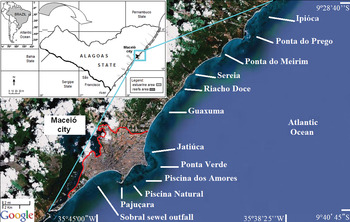
The study was carried out on the coast of Maceió, which is located in the central part of Alagoas, bordered on the north by the Sauaçuí River and on the south by the Mundaú/Manguaba Estuarine Lagunar Complex (09°28′40″–09°42′49″S and 35°33′56″–35°38′25″W). The coast of Maceió has numerous reef ecosystems, including coral and sandstone reefs, where most of the specimens were collected. Additional samples were obtained from the fouling community on the Sobral sewer outfall piers (Figure 1).
Map of the study areas on the coast of Maceió, Alagoas, Brazil.

The reef ecosystems on the coast of Maceió have two distinct geological origins. Coral reefs are predominant on the northern and central coast, with banks near the beach line and distributed along the coastline, with many platform surfaces emerging during low tide. The few sandstone reefs were formed by old sand banks solidified through sedimentation, starting from chemical reactions with calcium carbonate or iron oxide from the Quaternary period. These reefs are generally in rows parallel to the coastline and near the outlets of rivers and estuaries (Correia & Sovierzoski, Reference Correia and Sovierzoski2009; Correia, Reference Correia2011).
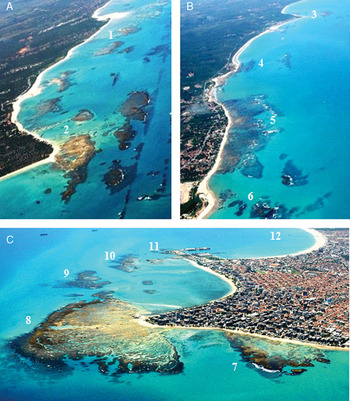
This study was carried out on ten reefs, including the coral reefs at Ipioca (9°29′55″S–35°33′50″W), Ponta do Prego (9°31′48″S–35°35′30″W), Ponta do Meirim (9°32′37″S–35°36′52″W), Riacho Doce (9°34′55″S–35°39′25″W), Jatiúca (9°39′12″S–35°41′46″W), Ponta Verde (9°39′56″S–35°41′30″W), Piscina dos Amores (9°40′39″S–35°42′10″W), Piscina Natural (9°40′49″S–35°42′40″W) and Pajuçara (9°41′06″S–35°43′22″W); as well as the sandstone reefs at Sereia (9°34′04″S–35°38′46″W) and Guaxuma (9°35′33″S–35°39′54″W); and also on the Sobral sewer outfall piers (9°40′45″S–35°45′00″W) (Figure 2).
Reefs on the coast of Maceió, Alagoas, Brazil: (A) North coast: (1) Ipioca; (2) Ponta do Prego. (B) Central coast: (3) Ponta do Meirim; (4) Sereia; (5) Riacho Doce; (6) Guaxuma. (C) Urban coast: (7) Jatiúca; (8) Ponta Verde; (9) Piscina dos Amores; (10) Piscina Natural; (11) Pajuçara; (12) Sobral sewer outfall.

MATERIALS AND METHODS
Collections were made in the summers of 2000 and 2009 by wading at low tide and snorkelling in the intertidal zone and the shallow littoral down to 5 m depth, where ophiuroids were observed and whenever possible photographed. The distribution of species was ranked according to percentage of occurrence, using 1-m2 as the sampling area.
The specimens were packed and anaesthetized with seawater and magnesium chloride crystals, and then transported to the laboratory. Subsequently, individuals were fixed in 10% formaldehyde for 48 hours and then transferred to 70% ethanol for long-term storage. All specimens were identified following Hendler et al. (Reference Hendler, Miller, Pawson and Kier1995) and Tommasi (Reference Tommasi1999) and then deposited in the collections of the Setor de Comunidades Bentônicas, Universidade Federal de Alagoas. Aerial, underwater photographs and photomicrographs were taken during the summer months by M.D. Correia.
RESULTS
Members of the class Ophiuroidea recorded from the shallow waters of Maceió included 16 species, of nine genera in seven families. All these species had their distributions expanded to the State of Alagoas, with three endemic species from Brazil and four new records north of the mouth of the São Francisco River, on the Brazilian north-eastern reef coast.
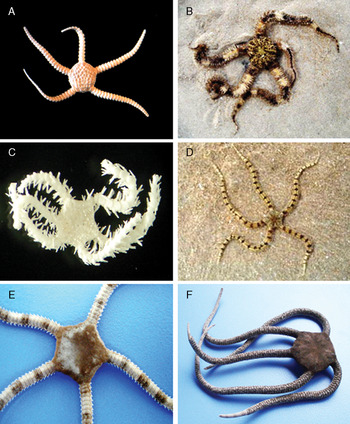
Ophiuridae species
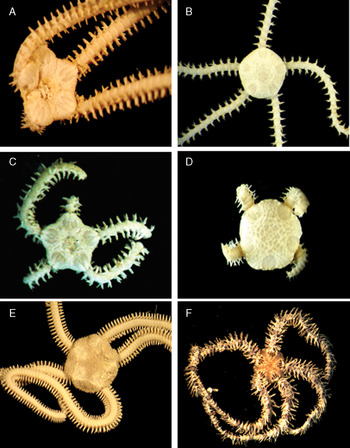
Ophiuridae: (A) Ophiolepis paucispina; Ophiocomidae. (B) Ophiocoma echinata; (C) Ophiocomella ophiactoides; Ophionereididae. (D) Ophionereis reticula; Ophiodermatidae. (E) Ophioderma appressa; (F) Ophioderma cinerea.

REMARKS
This species occurs associated with different types of substrates, which may be composed of sand, rocks, reefs, calcareous algae, and remains of macroalgae and seagrasses, and is generally hidden or buried under the substrate. The distribution on the Brazilian coast was previously known from the States of Bahia to Rio de Janeiro, including Trindade Island (Tommasi, Reference Tommasi1970; Hendler et al., Reference Hendler, Miller, Pawson and Kier1995). Now this species is extended to Alagoas, on the Maceió coast with records from the Ponta do Prego and Ponta Verde coral reefs. It was found on the reef platform, in areas that contained some water during low tide, such as small tide pools, associated with calcareous and other macroalgae, mainly Amphiroa fragilissima (Linnaeus) and Dictyota cervicornis Kutzing.
REMARKS
Observed in the subtidal zone on the reef platforms, occurring in tide pools and along the reef edges during low tide, where robust specimens were collected. This species inhabits different substrates including sand with rubble, corals, sponges, seagrasses, and algae. On the Brazilian coast, this species is also found in limestone, in mangroves, in areas with sand and gravel bottoms, on the coasts of Ceará, Paraíba, Pernambuco and Bahia (Tommasi, Reference Tommasi1970; Albuquerque, Reference Albuquerque1986). On seven coral reefs along the Maceió coast specimens were found, including Ipióca, Ponta do Prego, Ponta do Meirim, Riacho Doce, Jatiúca, Ponta Verde and Pajuçara. The disc shows dark lines interspersed with light lines, according to the description by Hendler et al. (Reference Hendler, Miller, Pawson and Kier1995) who mentioned a granule-covered disc.
REMARKS
Occurs in reef ecosystems, in sheltered areas on the reef platform, associated with algae and other ophiuroid species that also undergo fission. This species occur on the Brazilian coast (Tommasi, Reference Tommasi1999). On the Maceió coast, it was found on the Ponta do Meirim and Ponta Verde coral reefs, associated with the reef substrate as well as with calcareous and other macroalgae, mainly A. fragilissima, D. cervicornis and Caulerpa racemosa (Forsskål) J. Agardh. The present records extend its distribution to Alagoas.
REMARKS
Present in shallow water in reef ecosystems, underneath or among rocks and coral, associated with algae and seagrasses, buried in sand and mud, and also sometimes along with polychaetes. Specimens were very common in small tide pools on the reef platforms, showing tolerance to high temperatures and desiccation. This behaviour is associated with the habit of digging a hole in the sand during the day, leaving some arms out to produce a stream of water carrying small food particles into its refuge (Tommasi, Reference Tommasi1970; Hendler et al., Reference Hendler, Miller, Pawson and Kier1995). Ophionereis reticulata is omnivorous and is known to consume polychaetes, also green and red algae (Yokoyama & Amaral, Reference Yokoyama and Amaral2008). Its distribution in Brazil includes the coasts of Maranhão, Paraíba, Pernambuco, and Bahia to São Paulo (Tommasi, Reference Tommasi1970; Albuquerque, Reference Albuquerque1986; Amaral et al., Reference Amaral, Rizzo and Arruda2006; Gondim et al., 2008; Lima & Fernandes, Reference Lima and Fernandes2009). This species was collected on seven coral reefs at Maceió coast, including Ipióca, Ponta do Prego, Ponta do Meirim, Riacho Doce, Jatiúca, Ponta Verde and Pajuçara, also on the Sereia sandstone reef, on the reef substrate, among calcareous and macroalgae, most commonly in A. fragilissima.
REMARKS
This species occurs in the intertidal areas of the reef ecosystems, with algal bottoms. This species can occur with other species of the same genus on the Brazilian coast, distributed from Paraíba to São Paulo, and Trindade Island (Tommasi, Reference Tommasi1970; Hendler et al., Reference Hendler, Miller, Pawson and Kier1995; Lima & Fernandes, Reference Lima and Fernandes2009). In Maceió reef ecosystems, specimens were very common and numerous, always collected on the reef substrate, on all the eight coral reefs, including Ipióca, Ponta do Prego, Ponta do Meirim, Riacho Doce, Jatiúca, Ponta Verde, Piscina dos Amores and Pajuçara, and also on the Sereia sandstone reef. All the specimens were of a uniform type, with a brown disc with arm-patches of contrasting white and brown. According to Hendler et al. (Reference Hendler, Miller, Pawson and Kier1995), its coloration is quite varied, but can be divided into two patterns that they called ‘buffoon’ and ‘uniform’.
REMARKS
Species inhabit all areas on reef ecosystems, occurring in the subtidal zone in tide pools and along reef edges. This species was very common, and numerous individuals showed a dark-brown disc and arms banded from light to dark brown. During low tide, robust specimens were observed in holes, on sand, also associated with sponges, corals and calcareous algae, and between macroalgae. They were commonly associated with C. racemosa. Preferences for other substrates such as organic sediments, gravel, mangroves, and seagrasses have been mentioned by various authors. On the Brazilian coast, this species occurs from Ceará to São Paulo, including the Fernando de Noronha Archipelago (Tommasi, Reference Tommasi1970; Albuquerque, Reference Albuquerque1986; Hendler et al., Reference Hendler, Miller, Pawson and Kier1995; Amaral et al., Reference Amaral, Rizzo and Arruda2006; Lima & Fernandes, Reference Lima and Fernandes2009). On the coast of Maceió, specimens were found on all of the eight coral reefs, including Ipióca, Ponta do Prego, Ponta do Meirim, Riacho Doce, Jatiúca, Ponta Verde, Piscina dos Amores and Pajuçara, as well as on the Sereia sandstone reef and associated with Chlorophyta algae.
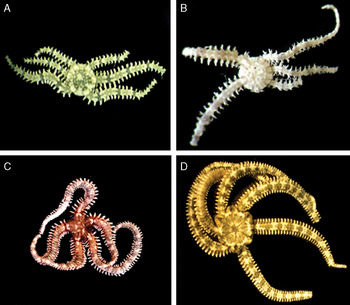
Ophiactidae: (A) Ophiactis brasiliensis; (B) Ophiactis lymani; (C) Ophiactis quinqueradia; and (D) Ophiactis savignyi.

REMARKS
Endemic species on the Brazilian coast. The individuals were small, with six arms banded with dark and pale green. Different habitats and substrata had been mentioned for this species, such as muddle, cnidarians, algae from shallow water and along the continental shelf of the south-east Brazilian coast, where it had been collected at 163 m depth (Manso, Reference Manso1988; Borges et al., Reference Borges, Monteiro and Amaral2002; Lima & Fernandes, Reference Lima and Fernandes2009). The species was known from Rio Grande do Sul to Bahia (Manso, Reference Manso1988; Manso et al., Reference Manso, Alves and Martins2008). This species was collected on the reef substrate, and was also associated with the macroalga D. cervicornis on four localities on the Maceió coast, including Ponta do Meirim, Ponta Verde, Piscina dos Amores and Pajuçara coral reefs. The present records extend the distribution to Alagoas State.
REMARKS
Observed in the subtidal zone on reefs, where it occurs on sand bottoms and associated with different organic habitats including sponges, corals, polychaetes and algae. On the Brazilian coast, Tommasi (Reference Tommasi1970) reported this ophiuroid from the coast of Santos, State of São Paulo, on sand and mud bottoms in low salinities. Albuquerque (Reference Albuquerque1986) found it from shallow waters to 84 m deep along the continental shelf of northern and north-eastern Brazil, on quartz sand and bioclastic substrates with calcareous algae, gravel, and mud. Borges et al. (Reference Borges, Monteiro and Amaral2002) cited it from the south-eastern continental shelf of Brazil, with specimens collected at 314 m depth. This species probably occurs along almost the entire coast of Brazil, with records from Pará, Maranhão, Ceará, Paraíba, Pernambuco, Bahia and São Paulo (Tommasi, Reference Tommasi1970; Albuquerque, Reference Albuquerque1986; Borges et al., Reference Borges, Monteiro and Amaral2002; Amaral et al., Reference Amaral, Rizzo and Arruda2006; Neves et al., Reference Neves, Lima and Pérez2007; Gondim et al., Reference Gondim, Lacouth, Alonso and Manso2008; Manso et al., Reference Manso, Alves and Martins2008; Lima & Fernandes, Reference Lima and Fernandes2009). At Maceió, this species was collected in the subtidal zone on the reef platforms of only two coral reefs, at Ponta do Meirim and Ponta Verde. Specimens were found on the reef substratum, and also associated with the macroalga A. fragilissima and the sponge Amphimedon viridis Duchassaing & Michelotti, 1864.
REMARKS
This species occurs in the sublittoral in tide pools on the reef platform, and is commonly associated with sponges. According to Hendler et al. (Reference Hendler, Miller, Pawson and Kier1995), this species can live as an endocommensal with sponges and corals, because it feeds on suspended particles collected by extending the arm out of the biological substrate. Tommasi (Reference Tommasi1970) associated this species with gravel, mud, and sand bottoms on the Brazilian south-eastern coast. Albuquerque (Reference Albuquerque1986) recorded its presence on various types of bottoms including calcareous, gravelly and organogenic, at depths of 35–83 m on the northern and north-eastern continental shelf. For Brazil, it is recorded from the coast of Maranhão to Espírito Santo (Tommasi, Reference Tommasi1970; Albuquerque, Reference Albuquerque1986). This species occurred along the Maceió coast on the Ponta do Prego, Ponta do Meirim, Jatiúca and Ponta Verde coral reefs, and it was found inside and outside different sponges, mainly on A. viridis.
REMARKS
Species found in the subtidal zone, from all areas of coral reefs, mangroves, and associated with fouling communities, with a preference for algae and sponges. Circumtropical species with wide geographical distribution. In Brazil from the coast of Amapá, Maranhão, Paraíba, Pernambuco and Bahia, to the coast of São Paulo (Tommasi, Reference Tommasi1970; Albuquerque, Reference Albuquerque1986; Hendler et al., Reference Hendler, Miller, Pawson and Kier1995; Borges et al., Reference Borges, Monteiro and Amaral2002; Netto et al., Reference Netto, Hadel and Tiago2005; Amaral et al., Reference Amaral, Rizzo and Arruda2006; Neves et al., Reference Neves, Lima and Pérez2007; Lima & Fernandes, Reference Lima and Fernandes2009). The species occurred on calcareous algae, sand, mud, and bioclastic bottoms of the northern and north-eastern continental shelf (Albuquerque, Reference Albuquerque1986), and also on the south-east continental slope down to 147 m (Borges et al., Reference Borges, Monteiro and Amaral2002) and reaching 518 m (Tommasi, Reference Tommasi1970; Hendler et al., Reference Hendler, Miller, Pawson and Kier1995). At Maceió, specimens were most common and identified on six coral reefs, including Ponta do Meirim, Riacho Doce, Jatiúca Ponta Verde, Piscina dos Amores and Pajuçara, and also on the Sereia sandstone reef. In these reef ecosystems, specimens were found associated with different substrates including the algae Amphiroa fragilissima, C. racemosa, D. cervicornis and Halimeda opuntia (Linnaeus) Lamouroux, and also within the sponges Amphimedon viridis and Haliclona melana Muricy & Ribeiro, 1999. Many individuals were found associated with the fouling community on the Sobral sewer outfall piers.
Amphiuridae: (A) Amphipholis januarii; (B) Amphipholis squamata; (C) Amphiura kinbergi; (D) Ophiocnida loveni; and (E) Ophiocnida scabriuscula; Ophiotrichidae; (F) Ophiothrix angulata.

REMARKS
This species occurs in tide pools of reef ecosystems, where the bottom is fine sand and silt with low hydrodynamic forces. According to Hendler et al. (Reference Hendler, Miller, Pawson and Kier1995), individuals occur in algae, under rocks, in cracks of rocks, corals, and bryozoans, with phanerogams such as Thalassia sp. and on soft bottoms on the continental slope (Tommasi, Reference Tommasi1970; Albuquerque, Reference Albuquerque1986). In Brazil this species occurs along the northern and north-eastern continental shelf from Pará through Ceará, Paraíba and Bahia (Albuquerque, Reference Albuquerque1986; Gondim et al., Reference Gondim, Lacouth, Alonso and Manso2008; Manso et al., Reference Manso, Alves and Martins2008), and also on the southern coast, off Rio de Janeiro and São Paulo (Tommasi, Reference Tommasi1970; Amaral et al., Reference Amaral, Rizzo and Arruda2006). On the Maceió coast, specimens were collected only from the Jatiúca and Ponta Verde coral reefs, on the reef substrate and associated with the alga Amphiroa fragilissima.
REMARKS
A cosmopolitan species, present in various marine ecosystems such as coral reefs, estuaries and mangroves, associated with sponges, bryozoans and marine plants, and from the sublittoral to 1330 m depth, with a wide distribution both geographically and bathymetrically, absent only from the Polar Regions (Hendler et al., Reference Hendler, Miller, Pawson and Kier1995). On the Brazilian coast, this species was recorded on organogenic bottoms, with gravel, quartz sand and mud. Specimens have been collected between 21 and 52 m on the northern and north-eastern continental shelf from Pará, Ceará and Bahia (Albuquerque, Reference Albuquerque1986; Manso et al., Reference Manso, Alves and Martins2008) and from 147 m on the south-eastern coast (Borges et al., Reference Borges, Monteiro and Amaral2002; Amaral et al., Reference Amaral, Rizzo and Arruda2006). On the coasts of Paraíba, Bahia and São Paulo, specimens were also collected in shallow water (Tommasi, Reference Tommasi1970; Netto et al., Reference Netto, Hadel and Tiago2005; Gondim et al., 2008). The species occurred in the subtidal zone, in tide pools and along the reef edges, where there are calcareous and other macroalgae. This is a common species on the Maceió coast, where it was collected on six coral reefs, including Ponta do Prego, Ponta do Meirim, Riacho Doce, Jatiúca, Ponta Verde and Pajuçara coral reefs, and also on Sereia sandstone reef. It occurred on the reef substrate, with many specimens associated with different macroalgae such as Amphiroa fragilissima, C. racemosa, D. cervicornis, and Halimeda opuntia, and the sponge Amphimedon viridis. Many individuals were also found in the fouling community on the Sobral sewer outfall piers.
REMARKS
Endemic species on the Brazilian coast, with its neotype designated and deposited in the Museu Nacional, Federal University of Rio de Janeiro (Brazil) (Thomas, Reference Thomas1965). This species is very common on the Brazilian continental shelf, on soft bottoms with sand and calcareous algae. On the Brazilian coast, the species occurs on the northern and north-eastern continental shelf off Pará, Maranhão and Ceará (Albuquerque, Reference Albuquerque1986), and also on the south-eastern coast from São Paulo to Santa Catarina (Tommasi, Reference Tommasi1970; Amaral et al., Reference Amaral, Rizzo and Arruda2006; Manso et al., Reference Manso, Alves and Martins2008). On the coast of Maceió, few specimens were collected, and only in association with the fouling community on the Sobral sewer outfall piers.
REMARKS
Endemic species on the Brazilian coast and was found on soft bottoms with different substrates. The species was previously reported from the southern coast of the State of Rio de Janeiro (Tommasi, Reference Tommasi1970), from Todos os Santos Bay (Bahia) Manso et al., Reference Manso, Alves and Martins2008) and from the coast of Pernambuco (Lima & Fernandes, Reference Lima and Fernandes2009). At Maceió, individuals were collected in tide pools in the subtidal reef zone, only on the Jatiúca and Ponta Verde coral reefs. In these areas, where hydrodynamic action was low, the sediment was composed primarily of sand with calcareous fragments. Some individuals were also observed associated with the alga H. opuntia. The present records extend its distribution to Alagoas.
REMARKS
Species found in shallow coastal areas, living on different substrates including seagrass, sediments, corals, rocks, gravel, and sand mixed with rubble and stones. On the Brazilian coast, specimens have been recorded from the north-east to the south regions, from the States of Maranhão to Paraíba, Bahia and Paraná (Tommasi, Reference Tommasi1970; Albuquerque, Reference Albuquerque1986; Amaral et al., Reference Amaral, Rizzo and Arruda2006; Godim et al., 2008; Manso et al., Reference Manso, Alves and Martins2008). On reef ecosystems, specimens were collected on the substrate, in areas in the tide pools at the reef edge. On the Maceió coast, this species occurred in three coral reefs: Ponta do Meirim, Jatiúca and Ponta Verde.
REMARKS
A common and opportunistic species in shallow coastal areas, living on reefs, corals, seagrass, sponges, in sand and gravel bottoms, in swamps, on oyster banks, among others, with a wide tolerance to variations in temperature and salinity, and a wide range of depths (Tommasi, Reference Tommasi1970; Hendler et al., Reference Hendler, Miller, Pawson and Kier1995). On the Brazilian coast, this species was recorded from the sublittoral zone down to 120 m, along the northern and north-eastern continental shelf from the States of Amapá to Bahia (Albuquerque, Reference Albuquerque1986; Gondim et al., 2008; Manso et al., Reference Manso, Alves and Martins2008; Lima & Fernandes, Reference Lima and Fernandes2009), and on the south-eastern and southern continental shelf of the State of Santa Catarina, as deep as 540 m (Tommasi, Reference Tommasi1970; Borges et al., Reference Borges, Monteiro and Amaral2002; Amaral et al., Reference Amaral, Rizzo and Arruda2006). This species was collected on the substrate of all coral reefs and sandstone reefs studied on the Maceió coast, and also in the fouling community on the Sobral sewer outfall piers. It was commonly associated with macroalgae such as Amphiroa fragilissima, C. racemosa and Halimeda opuntia, and with the sponges Amphimendon viridis and Haliclona melana.
Spatial distribution
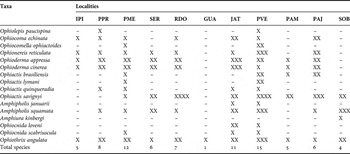
In this study, 16 species of ophiuroids were found in the shallow waters off the Maceió coast. The striking habitat preferences were observed for 15 species for coral reefs, whereas on sandstone reefs only six species were found. The number of ophiuroid species was highest on the Ponta Verde coral reef, with a total of 15 species, in contrast to the Guaxuma sandstone reef with only Ophiothrix angulata, which was found in all reef ecosystems. Ophioderma appressa and O. cinerea were also common on many coral reefs. However, on the Piscina Natural coral reef, localized on the urban coast of Maceió, no ophiuroids were found. Only four species were found on the Sobral piers associated with fouling communities, and Amphiura kinbergi occurred only in this spot (Table 1).
Distribution of the Ophiuroidea species on the Maceió coast, Alagoas, Brazil. IPI, Ipióca; PPR, Ponta do Prego; PME, Ponta do Meirim; SER, Sereia; RDO, Riacho Doce; GUA, Guaxuma; JAT, Jatíuca; PVE, Ponta Verde; PAM, Piscina dos Amores; PAJ, Pajuçara; SOB, Sobral piers; XXXX, <75%; XXX, 75% < × 50%; XX, 50% < × < 25%; X, 25% < × < 1%, −0%.

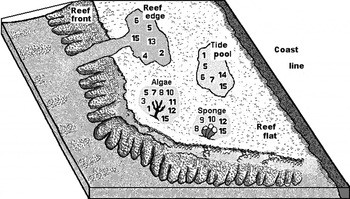
Many differences in the substrate distribution of the ophiuroid species were observed in the localities studied with microhabitat preferences. Some of them preferred sand and gravel bottoms in tide pools, while others were found on reef edges. Ophioderma appressa, O. cinerea and Ophiothrix angulata were more common in the intertidal zone on the reef edges and tide pools on the coral reef platform, with few individuals on the sandstone reefs. Nine species were associated with algae exhibiting different morphologies, and five species with sponges, where Ophiactis lymani and Ophiatis savignyi were common to both substrates (Figure 6).
Distributions of Ophiuroidea species on the Maceió reefs: (1) Ophiolepsis paucispina; (2) Ophiocoma echinata; (3) Ophiocomella ophiactoides; (4) Ophionereis reticulata; (5) Ophioderma appressa; (6) Ophioderma cinerea; (7) Ophiactis brasiliensis; (8) Ophiactis lymani; (9) Ophiactis quinqueradia; (10) Ophiactis savignyi; (11) Amphipholis januarii; (12) Amphipholis squamata; (13) Ophiocnida loveni; (14) Ophiocnida scabriuscula; and (15) Ophiothrix angulata.

DISCUSSION
The recorded fauna in the shallow waters off Maceió is composed of 16 species of Ophiuroidea associated with the reef substrate, algae, sponges, and fouling communities. Many of the species reported here were mentioned by Hendler et al. (Reference Hendler, Miller, Pawson and Kier1995), who noted similarities in the distributions of ophiuroid species between the Caribbean and Brazil. However, recent studies have found some differences in the richness of ophiuroid species assemblage between both these biogeographical regions (Abreu-Pérez et al., Reference Abreu-Pérez, Solís-Marín and Laguarda-Figueras2005; Laguarda-Figueras et al., Reference Laguarda-Figueras, Solís-Marín, Durán-González, Ahearn, Buitrón-Sánchez and Torres-Vega2005; Borrero-Pérez et al., Reference Borrero-Pérez, Benavides-Serrato, Solano and Navas2008).
Ophiactis species presented some differences and occurred on different substrata along the Brazilian coast. Ophiactis lymani had a disc with large scales, disc spines absent, oral interbrachial area with four spines, one oral papilla, three arm spines, aboral arm plates fan shaped and oral arm plate pentagonal (Tommasi, Reference Tommasi1970). Unlike O. brasiliensis, an endemic species, that had a disc with large and small scales, disc spines absent, oral interbrachial area with small spines, one oral papilla, four arm spines, aboral arm broadly oval and oral arm plate pentagonal (Manso, Reference Manso1988). The other six-armed Ophiactis from the Caribbean could be confused with this species (Hendler et al., Reference Hendler, Miller, Pawson and Kier1995).
All the shallow water species of Ophiuroidea found in this study are new records for the Maceió coast and for the State of Alagoas. Three species, including two endemics, Ophiocnida loveni and Ophiactis brasiliensis, had their distributions expanded to Alagoas, as they had been previously known only from the coast of Bahia (Manso, Reference Manso1988, Reference Manso2004; Alves & Cerqueira, Reference Alves and Cerqueira2000).
Of the 16 species found in the shallow coastal and reef ecosystems at Maceió, four species included Ophiactis quinqueradia, Ophiactis lymani, Ophiactis savignyi and Ophiothrix angulata were reported previously from the continental shelf off Alagoas by Albuquerque (Reference Albuquerque1986), but these species were collected at depths greater than 20 m, on substrates ranging from gravel to sand and mud. Eight species reported in this study were also collected in soft bottoms in Todos os Santos Bay on the coast of Bahia (Manso et al., Reference Manso, Alves and Martins2008). Nine other ophiuroid species were previously recorded from the soft bottom on the continental shelf off Pernambuco (Lima & Fernandes, Reference Lima and Fernandes2009).
Information about ophiuroid species of Brazilian reef ecosystems is scarce. Some species were found on the reefs of Cabo Branco in Paraíba, under rocks or attached to macroalgae (Gondim et al., Reference Gondim, Lacouth, Alonso and Manso2008). Some species were associated with different substrates on the reefs of Maceió. Santos & Correia (Reference Santos and Correia1994, Reference Santos and Correia1995) reported that ophiuroids were a numerically common taxon in the phytal of Halimeda opuntia. Hendler et al. (Reference Hendler, Miller, Pawson and Kier1995) reported the presence of large numbers of Ophiactis savignyi associated with sponges. Four species were found associated with the octocoral Carijoa riisei, with O. savignyi and Ophiactis lymani dominating (Neves et al., Reference Neves, Lima and Pérez2007). During settlement, some species of ophiuroids search for sponges as a shield, and feed on suspended particles in the inhalant currents of the sponges; however, it is believed that ophiuroids seek shelter in sponges probably because of the chemical defence that they provide against predators (Henkel & Pawlik, Reference Henkel and Pawlik2005). In this study, different species were found on various substrates such as corals and rocks with nine species associated on algae and five species with sponges, including Ophiactis savignyi and Ophiactis lymani as the most common in both these associations.
Ophiuroids were found on eight coral reefs and two sandstone reefs, probably related to the richness of available habitats on the coast of Maceió, which contribute to increasing the diversity of Ophiuroidea when compared to records in Paraíba (Gondim et al., Reference Gondim, Lacouth, Alonso and Manso2008). This is interesting because echinoderms are strictly marine invertebrates, and the sandstone reefs are located near the mouths of rivers, which discharge large volumes of fresh water, especially during the rainy months (in winter) when the salinity decreases. The salinity variations in coastal waters directly influence the reproduction and consequently distribution of echinoderm species (Mladenov et al., Reference Mladenov, Emson and Colpit1983). However, Hendler et al. (Reference Hendler, Miller, Pawson and Kier1995) mentioned a few species of Ophiuroidea that live near the substrates of mangrove ecosystems, as well as in estuarine areas and river mouths.
The absence of ophiuroids from the Piscina Natural coral reef was probably caused by human impact. Similarly, Correia & Sovierzoski (Reference Correia and Sovierzoski2010) demonstrated that the absence of different benthic organisms, including some echinoderm species, was caused principally by tourism activities.
ACKNOWLEDGEMENTS
Our thanks to the biologists Álvaro Guilherme Altenkirch Borba Junior and Anderson Luiz Silva Miranda of the Federal University of Alagoas, for their assistance during fieldwork and sorting the material; and to Dr Janet W. Reid, Research Associate, Virginia Museum of Natural History who revised the English text.