Introduction
Since the 1960s, global environmental problems have become increasingly prominent and pose a grave threat to human survival and development. A wave of promoting a coordinated development of economy, resources and environment is sweeping across the world. Issues about environmental protection and sustainable development have become hot topics discussed by governments and people worldwide. Organic agriculture and organic food have attracted increasing attention as being environmentally soundReference Cobb, Feber, Hopkins, Stockdale, O'Riordan, Clements, Firbank, Goulding, Jarvis and Macdonald1. Organic agriculture originated from a notion of ‘working with natural systems rather than seeking to dominate them’Reference Lampkin and Measures2. According to EU regulations organic farming entails significant restrictions on the use of fertilizers and pesticides which may have detrimental effects on the environment or result in the presence of residues in agricultural produce3. It advocates safety, pollution-free and environmental protection and seeks harmonious coexistence between humans and nature, not simply placing emphasis on efficiency and effectiveness. So it is often viewed as a superior system for the environment, soil, livestock and the humans who work in itReference McEachern and Willock4 and as an alternative production system by conventional farmersReference Fairweather5. Organic food is the product of organic farming and perceived as being healthier and less damaging to the environment. Organic food's quality is high. According to the Food and Agriculture Organization (FAO), food quality refers to positive attributes (e.g., nutritional values, origin, color, flavor, texture and production/processing method) that influence a product's value to the consumer and the absence of negative attributes (e.g., spoilage, contamination with filth, discoloration and off-odors). Over the past few years, some developed countries, European countries in particular, have paid much attention to organic agriculture and organic food, and created a series of preferential policies to encourage conventional farmers to change toward organic production. In 1972, the International Federation for Organic Agriculture Movements (IFOAM), the biggest and most authoritative organization of organic agriculture in the world, was set up. IFOAM has been committed to protecting ecosystems and developing healthy and safe food, greatly promoting the development of the organic food industry. In recent years, some highly publicized outbreaks of food-borne diseases, such as mad cow disease and H5N1 killer flu have brought food safety and associated issues to the forefront of societal concernsReference Sofos6. Under these circumstances, people attached more importance to organic food because of its pollution-free, safe and healthy properties. Today, organic food is developing very rapidly in developed countries and has become a trend of food for the future.
Green food is a kind of food featuring pollution-free, safety, high-quality and nutritious contentReference Shan, Zhang and Wu7. The development of China's green food is the outcome of actively exploring new ways of food production and consumption based on China's national conditions and in line with the international trend of sustainable development. Since the 1980s, increasing environmental pressure has posed serious challenges to China's agriculture as a result of population growth and agricultural expansionReference Gan8. Influenced by the thought of sustainable development widespread in the world, the Chinese government began to pay attention to sustainability of agro-ecosystems. The agricultural policies and production process in China gradually changed and attached more importance to environmental protectionReference Hu9. Meanwhile, with the rapid growth of China's economy and the improvement of living standards, the Chinese people have shown more and more interest in food qualityReference Zhang, Li and Zhang10. Against this background, the Ministry of Agriculture (MOA) began in 1990 to develop green food throughout the country. In the same year, the MOA initiated the Green Food Program and in 1992 established the China Green Food Development Center (CGFDC) responsible for national green food development. Over the past 10 years or so, consumption demand for green food in China has been growing steadily; in particular, the frequent outbreaks of food safety incidents in recent years have made the urgent need for more green food evident and accelerated green food developmentReference Bai, Ma, Gong and Yang11. The fundamental objectives of developing green food are to protect ecological environments and enhance food quality and safety. Besides, in China, green food bears the additional expectation of promoting the development of rural economy and increasing farmers' incomeReference Liu and Yang12. China is a large agricultural country with a dominant rural population. Many rural people, little arable land, comparatively inadequate per capita share of natural resources plus a relatively backward agricultural productivity—these features spell out China's basic national conditions. Now, China is still economically backward in many rural areas and the proportion of poverty-stricken people in the total rural population is still high. So, promoting all-round development of rural economy, increasing the income of farmers and reducing the rural poor population are always the substance of China's rural policies. The development of green food has provided opportunities for the solution of China's rural problems. The development of a green food industry in China has played an important role in increasing agricultural productivity as well as the Chinese farmers' income, fostering agricultural restructuring and speeding up the construction of comparatively well-off villagesReference Sai and Yu13. According to statistics, the per capita income of rural people in Heilongjiang Province will grow by 1% when the total output of green food increases by 10%. In 2004, the per capita income from green food was 866 RMB yuan, accounting for 29% of per capita income of rural people of the whole provinceReference He14. Many local governments have regarded the green food industry as a new economic growing point and formulated relevant policies to encourage farmers and food enterprises to develop green foodReference Liu and Cai15.
Today, China's green food industry has already entered a fast-growth stage, but there are some problems still restraining the industry from further development, weakening its international competitiveness and negatively affecting rural development, such as unreasonable product structure and enterprise structure, certification system not conforming to international standards, incomplete distribution channels and people's lack of awareness. The aim of this paper is to make a further study of these problems and discuss reasonable solutions. This paper gives a specific and thorough introduction to China's green food industry, and then makes an in-depth analysis of the factors impeding the development of the green food industry. Finally, suggestions on optimizing product structure, intensifying publicity, widening marketing channels, improving the standard system, increasing support for policy and funds and promoting enterprise combinations are also put forward.
About Green Food
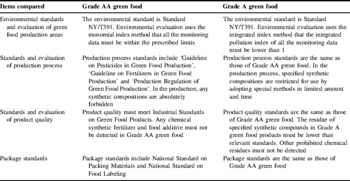
According to LiuReference Liu16, green food can be defined as ‘unpolluted, safe, high grade and nutritious food that is produced by adopting special production methods in line with the principle of sustainable development, and is certified and approved by special institutions to use the green food logo’. Here ‘green’ figuratively represents the properties of pollution-free, safety and healthiness. The fundamental objectives of developing green food are to enhance food quality and safety, to promote consumers' health, to protect ecological environments for sustainable development and to enhance the international competitiveness of Chinese agricultural produce. Quality control of green food is very strict. First, the production areas of green food must have favorable ecological environments. An area can be selected as a production base of green food only when it and its surroundings are evaluated to be safe and unpolluted after strict environmental monitoring; second, a quality standards system from farm to table has been established. The quality of products and production will be strictly inspected and controlled according to relevant quality standards. The green food logo is a specific identifying tag, only used by those green food products having green food certificates. This is a registered trademark protected by Trademark Law of the People's Republic of China and under the unified supervision of CGFDC. In China, green food has been classified into Grade A and Grade AA since 1996. The definition of Grade AA green foodReference Zhang and Shun17 is as follows: it is a kind of food that is certified and approved by special institutions to use the logo of Grade AA green food; environmental quality of its production area meets the requirements of environmental standard and all chemical synthetic compositions, such as chemical synthetic fertilizers, pesticides, veterinary drugs, additives and other substances harmful to health and environment, are prohibited form use in the production process; it is produced by adopting organic production methods and the product quality meets the standard on green food product. For the production of Grade A green food, the use of chemical compositions is extremely restricted. The quality standards of Grade AA conform to those of organic food completely, so the Chinese Grade AA green food is equivalent to organic food in the international market. Table 1Reference Lou, Zhao and He18 shows a comparison between Grade AA and Grade A green food. The aim of this graded certification system is to provide a transition pathway for farmers to move from chemical farming to a certified reduced chemical input regime of Grade A, and then to meeting international standards for organic certificationReference Paull19.
Comparison between Grade AA green food and Grade A green foodReference Lou, Zhao and He18.

Green Food Industry in China
Administration and policies
CGFDC is the authoritative administration responsible for national development and management of green food, established by MOA in 1992. Over the past decade and a half, CGFDC has been committed to formulating policies, regulations and standards, authentication as well as quality control. It has made a great contribution to the development of green food. After years of development, CGFDC has established a nationwide working network, composed of 42 provincial and municipal branch agencies, 38 quality inspection stations and 71 environmental monitoring branches20.
Since the 1990s, the Chinese government has paid much attention to the development of the green food industry. Up to now, a series of regulations and policies for stimulating the development of green food industry have been issued and implemented. In 1994, the words of ‘to develop ecological agriculture and to adopt sustainable agricultural scientific technologies’ were written down in China's Agenda 2121. In 2002, the Ministry of Science and Technology promulgated the Science and Technology Outline for Sustainable Development, pointing out that food safety is a key area of implementing the strategy of sustainable development22. In 1999, the State Economic and Trade Commission, together with seven other state agencies initiated the ‘Three Green Project’, with the main tasks of establishing ‘green channel’, promoting ‘green market’ and advocating ‘green consumption’Reference Fang and Ma23. The implementation of the Three Green Project has improved people's knowledge about green food and greatly promoted the development of the green food industry. In 2001, MOA started to carry out an Action Plan for Pollution-free Food, anticipating that all edible agricultural produce in China will be non-polluted within 8–10 years, and in 2003 released Suggestions on Promoting Action Plan for Pollution-free Food and Simulating the Development of Green Food. In the past few years, the local governments have provided great support to the green food industry. More than 20 provinces have formulated Measures for Green Food Management24 and Measures for Administration of Green Food Labeling25, such as Heilongjiang, Liaoning and Guangdong. Many other local governments have also issued a series of preferential policies and award measures to promote its further development; for example, Urumqi has established funds to support the development of leading green food enterprises and green food production bases.
Growth rate and scale of green food industry
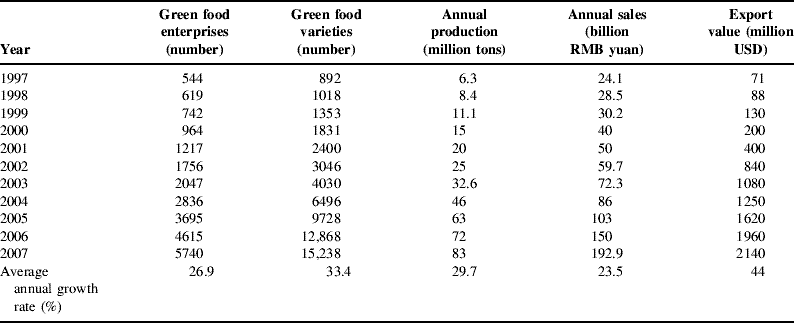
The green food industry of China has been developing rapidly over the past decade. Today, it has reached a considerable scale and expanded rapidly. As shown in Table 226, the five basic statistical indicators of green food industry all rose remarkably. In 1997, the number of green food enterprises, the varieties of green food products, annual production, annual sales and export value were merely 544, 892, 6.3 million tons, 24.1 billion RMB yuan and 71 million USD, respectively; however, the corresponding data in 2007 rose to 5740, 15,238, 83 million tons, 192.9 billion RMB yuan and 2140 million USD, respectively. From 1997 to 2007, the average annual growth rate of the five indicators reached up to 26.9, 33.4, 29.7, 23.5 and 44%, respectively. The industrial development continues to show an upward tendency and the industrialization process of green food accelerates obviously.
Basic statistical indicators of the Chinese green food industry from 1997 to 2007 (Adapted from China Statistic Yearbook of Green Food (1997–2007)26).
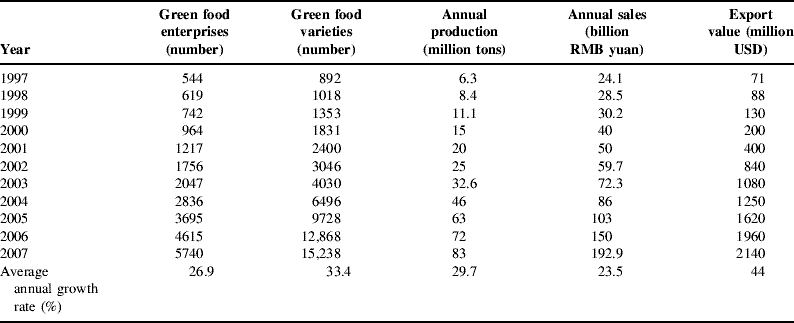
Although the green food industry of China has made great progress, the total output of green food is still low, far from meeting the growing demand of safe agricultural products in the home and overseas markets. In 2007, the total output of green food was 83 million tons, accounting for less than 7% of the total food agricultural products of the whole country. Since the 1990s, green food consumption in developed countries has been rising rapidly, with an annual growth rate of 20%Reference Yu27. The global consumption expenses for organic food in 2007 exceeded 40 billion USDReference Yu27. The market demand is huge; however, the export value of the Chinese green food was only about 2 billion USD in 2007 (Table 2) and China's green food enterprises merely had 5% share of the global market, far behind other developed countries. So, the production scale of China's green food is still very small and needs to be further enlarged.
Regional distribution of green food production
Presently, green food production has covered nearly all parts of the country. On the whole, it develops more rapidly in northern, central and eastern China than in western and southern China. By 2007, the provinces where the number of green food enterprises exceeded 400 were all northern, central and eastern provinces, among which there were 462 green food enterprises in Heilongjiang, 417 in Liaoning, 713 in Jiangsu, 502 in Zhejiang, 418 in Shandong and 445 in Hubei26, altogether accounting for 51.5% of the total number of the whole country; so were the provinces where the green food varieties exceeded 1000. Among those provinces, there were 1065 varieties in Heilongjiang, 1090 in Liaoning, 1924 in Jiangsu, 1053 in Shandong and 1559 in Hubei26, altogether making up 43.9% of the total varieties of the whole country. The distribution of the main production areas of major green food has the same feature. Take green rice for instance, in 2006 there were six provinces in which the output of green rice exceeded 500,000 tons. They were Heilongjiang, Jilin, Liaoning, Jiangsu, Anhui and Hubei, among which three were northern provinces, two central provinces and one eastern province. The total output of the six provinces accounted for 82.2% of the total of the whole country. In particular Heilongjiang produced 2,497,500 tons26, accounting for 31.3% of the total of the whole country. Besides, some advantageous industrial clusters have been established, such as industrial clusters of green dairy products in Inner Mongolia and Heilongjiang, and industrial clusters of green tea in Hunan and Jiangxi.
Generally, the industrial development is unbalanced between different areas in China. The industrial development in northern, central and eastern provinces has more remarkable regional advantages, while green food development in western and southern China is still backward. Western China includes 12 provinces, cities and municipalities, such as Sichuan, Guangxi, etc., covering 71.4% of the whole national territory. It is affluent in natural resources and its development potential of green food is very large. Meanwhile, it is also facing serious crises of the agricultural ecological environment, such as increase of soil and water loss and land desertification. Presently, western China is still backward in economy, especially western rural areas. Promoting green food development in western China will not only help to protect and improve the environment but will also have a great effect on the rural economic development of western ChinaReference Lv28. Presently, green food development in western China is still backward when compared with northern, central and eastern provinces and needs further support of policies.
Products and marketing
Along with continuous growth in industrial scale, green food is improving both in variety and quality. The green food varieties rose from 892 in 1997 to 15,238 in 2007, covering all the categories in China Classification Standards on Agricultural Products. Most of the Chinese green food products are primary products and primarily processed products with low technology content. That is, they do not need very high production technology, so their added value and prices are comparatively low. In 2007, the total output of green food was 83 million tons, among which about 70% were primary products and primarily processed products and about 30% were further-processed products26.
Presently, the domestic market is the biggest market for green food and about 90% of green food products are sold in the home market. In the past few years, since people's living standards have continuously improved and the general public have a higher awareness of food safety, more and more Chinese consumers have accepted green food and its domestic demand has shown a distinct upward trendReference Wang29. In many large cities, such as Beijing, Shanghai, Tianjin, Harbin, Nanjing and Shenzhen, green food products are sold through various distribution channels, including specialized shops, specialized counters in large supermarkets, specialized wholesale markets and specialized supermarkets. Pukang Supermarket for Green Farm Produce in Zhongshan City and AIDI Green Food Concourse in Shenzhen have set successful examples in this area. The Chinese government has also provided great support to the development of the green food market by holding various forms of activities, like lectures, forums and regional trade fairs, further guiding green consumption and promoting the green food trade.
Meanwhile, green food export has been expanding constantly. The export value increased from 71 million USD in 1997 to 2140 million USD in 2007, with an average annual growth rate of 44% (Table 2). In the early 1990s, green food was mainly exported to Europe, America and Japan. Today, more international markets have been opened and many green food products have been successfully exported to some countries in Asia, South America, Oceania, northern and eastern Europe. About 90% of the export is Grade AA green food. This is sold as organic food in importing countries since its quality is equivalent to that of organic food. The prices of Grade AA green food are generally higher than those of the same kind of conventional foods in the international market, but remarkably lower than those of organic food. So the Chinese Grade AA green food has obvious advantages of price in the international marketReference Zhang30. Grade A green food export is relatively low, although its output accounts for 90% of the total green food product. The main reason is that Grade A green food is allowed to use chemical compositions in production and is not accepted by foreign countries. The market demands of green food differ in different countries: the American market mainly imports coarse cereals; the countries of the EU often import minor grain crops (such as adzuki bean, millet, etc.), vegetables, honey products, tea and nuts; the Japanese market mainly imports rice, coarse cereals, vegetables, honey products, nuts, tea, potherbs, etc.Reference Zhang30. Chinese green rice is mainly exported to Japan, Russia and East and South Asia; green vegetables are mainly exported to Japan, America and the EU; green tea is mainly exported to Japan, America, Russia and countries of the EU. Global demand for Chinese green food is increasing year by year and the supply of some green food, such as rice, vegetables, tea, coarse cereals and honey products, always falls short of demand in the international market. However, up to now, the share of green food in the global market is still comparatively low and more efforts should be made to expand the international green food trade.
Certification and standards
The green food certification system and quality standards are the foundation for developing green food. In China, green food certification is under the administration of the CGFDC. Presently, the CGFDC has established a working network covering the whole country and its major task is to carry out the work of certification. In recent years, in order to boost its international prestige, make the Chinese green food gain more international acceptance and promote international green food trade, CGFDC has spared no effort to implement an internationalization strategy and develop international certification. In 1993, CGFDC joined IFOAM, laying the foundation of international exchanges and cooperation with relevant international organizations. Subsequently, in 2003, CGFDC established cooperative relations with several famous international certification bodies, such as SGS in Switzerland and OMIC and JONA in Japan, and initiated international certification in 2004. Now, CGFDC has established business relations with over 90 countries and about 500 international agencies.
The green food certification system of China is a two-tier system. Since 1996, green food has been divided into Grade A and Grade AA. For Grade A, limited chemical compositions can be used while for Grade AA, any chemical compositions are absolutely forbidden can be used. The quality standards of Grade AA are formulated based on related regulations and standards of IFOAM, the EU, America and Japan, and they are completely in accordance with those of organic food in the international market. Besides, a series of quality standards have been established and implemented, mainly including environmental quality standards, production process standards, food quality and hygienic standards, package and label standards, storage and transportation standards and other production materials standards, such as fertilizer standards, pesticide standards and feedstuff and additive standards, etc. Up to now, 337 sector standards and norms for green food have been promulgated by MOA and local governments31. A from-farm-to-table standards system has been set up.
Major Problems
Product structure needs optimization
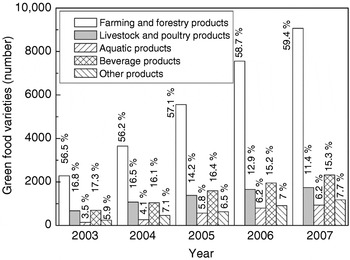
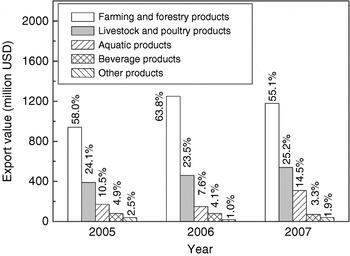
The product structure of green food is not reasonable and needs to be optimized. First, green food can be divided into five categories, including farming and forestry products, livestock and poultry products, aquatic products, beverage products and other products. Of all the categories, the percentage of farming and forestry products is relatively high, while the percentage of livestock and poultry products is relatively low. As shown in Figure 126, from 2003 to 2007, the percentage of the varieties of farming and forestry products in total green food varieties exceeded 56% each year, far higher than those of the other categories. As Figure 226 shows, from 2005 to 2007, farming and forestry products dominated in the green food export and the export value shared about 60% of that of the total green food products. Such a product structure is not in accordance with the food consumption pattern of developed countries featuring food of high protein and animal origin. Based on the above-mentioned national conditions of China, the existing product structure needs further adjustment. The output of livestock and poultry products needs to be raised to a proper extent so as to conform to the dietary habits of customers in developed countries, thus more market chances can be taken.
Product structure of green food from 2003 to 2007 (adapted from China Statistic Yearbook of Green Food (2003–2007)26). Note: the percentages are for the number of varieties of each category of green food proportional to the total green food varieties.

Green food export from 2005 to 2007 (adapted from China Statistic Yearbook of Green Food (2005–2007) 26). Note: the percentages are for the export value of each category of green food proportional to that of the total green food.

Possible trade-offs between economic and other sustainability goals is an important problem. Current production methods for animal products will lead to much higher greenhouse gas emissions, much higher water footprints and lower resource use efficiency, and diets high in animal products will lead to poor health; however, based on China's national conditions, it is hard for farmers in China to realize the environmental goals by reducing animal production at present. Adjusting the product structure and increasing the proportion of animal products is not a best choice presently, but perhaps a relatively appropriate choice for China's green food industry, because that can help increase green food export and add to farmers, income, thus further inspire the Chinese farmer's passion for more green food. If the green food industry develops more rapidly, it will contribute to the realization of environmental goals better, although not to a great degree. In spite of that, speeding up the scientific research on new production methods for animal products is the most fundamental way.
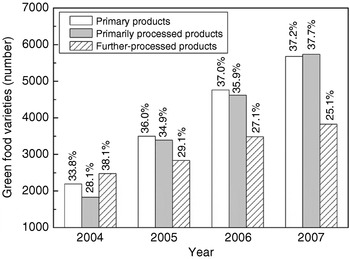
Second, the percentages of primary products and primarily processed products with low technology content and added value are comparatively high, while the percentage of further-processed products is relatively low. As shown in Figure 326, from 2004 to 2007, the first two categories dominated in the green food production, while the percentage of further-processed products was around 30% each year and showed a downward trend. Such a product structure has weakened the whole competitiveness of green food in home and foreign markets. On the one hand, green food products cannot compete with the conventional ones in domestic market due to unitary variety; on the other hand, lack of further-processed products and lack of diversification has become a main barrier to the green food export. Now China has the special need to develop further-processed products and increase the added value of green food. That can help to increase green food export, enhance the international competitiveness of green food, foster agricultural restructuring and increase farmers' income. That is consistent with China's agricultural development goals.
Product structure of green food from 2004 to 2007 (adapted from China Statistic Yearbook of Green Food (2004–2007)26). Note: the percentages are for the number of varieties of each category of green food proportional to the total green food varieties.

Too many small-sized enterprises and lack of leading enterprises
The structure of green food enterprises is not reasonable because there are too many small-sized enterprises and quite few leading enterprises. Although there are a large number of green food enterprises, they are generally small and there are very few enterprises whose output value can exceed a 100 million RMB yuan. In 2006, there were 4615 green food enterprises, among which there were only 240 national leading enterprises, merely accounting for 5.2%32. In 2007, on average, the green food varieties, annual production and annual sales of each green food enterprise were merely 2650 and 14,500 tons and 33.6 million RMB yuan, respectively. Obviously, the average scale of green food enterprises was very small. Moreover, the average scale is gradually decreasing. According to the data in Table 226, from 1997 to 2007, the number of green food enterprises increased from 544 to 5740, with an average annual growth rate of 26.9%; the annual sales increased from 24.1 billion RMB yuan to 192.9 billion RMB yuan, with an average annual growth rate of 23.5%, which is lower than 26.9%, that is to say, the average enterprise scale is decreasing in essence although the number of enterprises is increasing rapidly. The main reason is that the number of small-sized enterprises is increasing too quickly.
According to ZhaoReference Zhao33, there are two reasons for the rapid increase of small-sized enterprises: one reason is that comparatively low industrial threshold, high profitability of green food industry and preferential policies from the Chinese government have attracted more and more small-sized enterprises to enter this industry. The other reason is that some small-sized enterprises which should have been eliminated still have some living space because of local protectionism. The rapid increase of small-sized enterprises will bring about two consequences: on the one hand, inspectors and monitoring equipment would possibly be inadequate so that it is hard to ensure the quality of green food products; on the other hand, most small-sized enterprises focus on the middle and low-end market and their capability of market exploitation, scientific and technological innovations and cultivating famous brands is relatively low, so the rapid increase of small-sized enterprises will be unfavorable for the increase of industrial overall competitiveness.
Relatively low quality weakens international competitiveness
Although the green food industry is growing rapidly, the quality of green food is still relatively low. As we all know, China's green food is classified into Grade A and Grade AA and only the latter reaches the international standards of organic food. At present, less than 10% of green food enterprises have been approved to produce Grade AA green food. The output of Grade AA is also very low. In China, Grade AA green food only shares 10% of the total green food. Take Heilongjiang Province as an example, its green food industry ranking top in China, according to Statistic Yearbook of Heilongjiang Province, in 2005, the products of Grade A reached up to 5.598 million tons while the products of Grade AA were merely 44,000 tons, and honey products were the only one meeting international organic standardsReference Liu and Cai15. The output of Grade AA is so low chiefly because of the fairly strict production conditions and high production costs. Since only the products conforming to the international standards can enter into the international market, a low percentage of Grade AA will lower the international competitiveness of the whole green food industry and bring a negative impact on the export of green food.
High prices, lack of awareness, as well as incomplete distribution channels hinder the development of green food markets
Presently, although a specialized sales network has been established initially in big cities and the domestic green food market has shown a distinct rising trend, it is still a common problem that green food producers find it hard to sell their products. Price is a main reason to cause the sluggish market sales. In China, consumers purchasing green food products are much concerned about their prices. The prices of green food products are generally set very high in the supermarkets and specialized shops. According to CGFDC's market survey of 154 large supermarkets in 28 provinces of China, the prices of green food products are generally 30% higher than those of the same kind of conventional ones, some even around 1–3 times higher than those of conventional ones32. Meanwhile, effective demand is still insufficientReference Wang34. For the low- and middle-income customers in China, green food products are still luxuries, while for the high-income consumers who have buying ability for green food, steady awareness of food safety has not yet been established and most of them know little about green food due to a lack of effective publicity, even including some people with high academic qualificationsReference Wang34, Reference Zhang35. Besides, a small variety, a small output and unitary product structure make it difficult to set up stores specialized in green food and distribution channels reaching a considerable scale. Most producers and operators lack experience in marketing and have not yet set up efficient linkage between production and consumption, thus many people who can afford green food are unable to find what they want. Today, although green food markets have been initiated in big cities, lack of effective publicity and convenient distribution channels, as well as prices that are too high, hinder the development of green food markets in the other cities of China.
Backward certification standards hinder green food export
As described previously, China has initially established a two-tier green food certification system and a series of certification standards have been formulated and implemented. However, the green food standards have not been completely accepted by developed countries because some differences still exist between the Chinese green food standards and the common international standards for organic food. The Chinese green food enterprises often meet a handicap of cognition in the international trade. They often need to explain to their buyers that the Chinese Grade AA green food matches organic food in the international market. For Grade A, its standards are lower than common international ones, and the emphasis is put on the testing of finished products while strict technology and management standards for the production process, package and transportation have not been established entirely. This is the main problem hindering green food export.
Suggestions
Intensifying the readjustment of product structure
The existing product structure of green food is not reasonable, so it is necessary to intensify the readjustment of product structure and develop different grades of green food products to meet the diversified and multi-level consumption demands of domestic and international markets. First, the production of vegetables, fruits and livestock and poultry products should be appropriately enhanced to fit in with the demand of developed countries. Meanwhile, it is essential to increase added value of green food and upgrade the industry to increase the competitiveness of green food in export. The production of further-processed products and Grade AA green food needs more encouragement and support of policies. The Chinese government can increase investments in developing value-added products, or support Grade AA green food production through paying part of the certification fee for green food producers and providing organic fertilizer and bio-pesticide free of charge or at a low price. These measures have been adopted by a few local governments and can act as a model for other local governments.
Second, green food enterprises must strengthen market research and raise their capacity for product development and technological innovation. Green food enterprises should have a full understanding of the features of the market and appropriately adjust their production to adapt themselves to the changes of demand. They should also attach more importance to the development of those green food products with Chinese cultural characteristics and resource advantages so as to improve the international competitiveness of their products. Finally, enterprises should draw on the successful experience of other countries in the process of the readjustment.
Further promoting the combination of enterprises
At present, most green food enterprises of China are small and poor in capital, technologies and brands. There are few leading enterprises and famous brands. So the whole competitiveness of the Chinese green food industry is not strong. In order to improve the competitiveness in domestic and international markets, the Chinese green food enterprises should conduct collective, industrialized and integrative management and carry out famous brand strategy. On the one hand, government can support leading enterprises with coordinated and complementary products and technologies to establish large enterprise groups through conducting trans-regional and inter-departmental strategic reorganization; on the other hand, small-sized enterprises can set up enterprise groups through combination and cooperation so as to extend their brands and enhance their ability to resist risks. The optimized modes of industrialization will be production–research, planting–breeding–processing and trade–industry–agricultureReference Liu and Cai15. They respectively refer to integration of production enterprises and research institutions, integration of planting bases, breeding bases and processing enterprises, and integration of commercial enterprises, industrial enterprises and agricultural enterprises. The important causes of adopting these integrative operation modes are integrating various resources having complementary advantages, sharing market resources, reducing information cost and transaction cost, developing scale economy and obtaining maximal return, big enterprise driving and so on. The government may as well issue favorable industrial policies, such as providing low-interest loans or financial subsidies to support the development of leading enterprises, increasing investments in key projects to accelerate the combination of enterprises and so on.
Intensifying publicity to increase public awareness
The increase of public awareness is a huge driving force for the increase of market demand. The administrative departments and enterprises should intensify their publicity and promotion efforts to create a favorable social environment and to enhance people's awareness of food safety and green consumption. Regular publicity, education and consultation activities concerning green food should be conducted through public media, special information consulting firms or other popular means to create a good atmosphere of green food consumption gradually. Through various forms of knowledge popularization, customers will have a thorough understanding of green food. Also they will know the importance of green food for promoting good health and protecting the ecological environment; moreover, the differences among green food, pollution-free food and healthy food would be obvious. With the change of public awareness, a large market demand will be created. Additionally, in order to improve the production capacity to assure sufficient supply of green food, more publicity and guidance are needed to give to the farmers and food producers through various media to encourage them to enhance green food production. Leaders' understanding is also important, so it is essential to provide more information about green food and green food industry for the principal leaders of governments at various levels so that they would actively support the development of the green food industry.
Widening marketing channels and actively participating in international competition
Along with economic development and wide public concern about food pollution, more and more customers opt for green food. Today, China's green food has a huge market potential in both domestic and international markets, but incomplete marketing channels are still a barrier. So enterprises should strive to broaden marketing channels and more vigorously explore markets. They can use such forms as chain operation, agency systems, material distribution and electronic commerce, and give full play to the active role of modern selling methods in opening up markets. Choosing an appropriate marketing channel is very important for increasing the market share of green food. Now the customer group of green food is mainly in big cities, so green food enterprises can set up specialized counters in supermarkets, specialized stores or chain stores in big cities to occupy more market. Big cities have convenient transportation, so various types of wholesale markets and distribution centers can be established to form a nationwide sales network system. Distribution channels should be shortened as far as possible for perishable foods, such as vegetables and fruits. Direct marketing may be a good way, which can reduce intermediate links in circulation, avoid environmental pollution, lower the green food's price and increase sales.
In order to further expand green food export and increase the share in international markets, export enterprises might perform an internationalized marketing strategy. Presently, the major export markets of green food are Europe, America and Japan. The food market access systems of these countries are very strict so that the Chinese green food enterprises often encounter difficulties and risks in export. Under these circumstances, export enterprises can implement the strategy of gaining a larger market share by first-rank quality and a strategy of market diversification. On the one hand, what they could do is to further improve the export and marketing service system according to international standards, improve the export mix and expedite the export of high value added and high-grade products; on the other hand, choosing proper target markets is also very important. It would be better for small- and medium-sized enterprises with low competitiveness to choose developing countries as their major target markets for Grade A green food since the markets of developing countries are easier to access than those of developed countries. Localization is necessary for implementing the strategy of internationalization. So export enterprises should strengthen market research on local living habits and consumption styles and achieve localization of production through establishing overseas branches for product development and special industrial zones for green food. Besides, establishing good cooperative relationships with leading distributors of target markets is also an effective way to improve internationalized sales channels.
The high prices and need for more market penetration are a dilemma in all parts of the world. China's green food is not an exception. In China, green food is divided into Grade AA and Grade A. The Grade A green food products are mainly sold in the domestic market. Their prices are generally higher than those of the same kind of conventional products and much lower than those of Grade AA green food, so they are more acceptable to domestic customers and also provide a transition pathway for China's customers to accept Grade AA green food having a much higher price. The Grade AA green food products are mainly sold in the international market. Their prices are generally higher than those of the same kind of conventional products in the international market, but remarkably lower than those of organic food. So the Chinese Grade AA green food has obvious advantages of price in the international market. Despite that, green food producers still find it hard to sell their products for many reasons, such as price, awareness, distribution channels, etc. They should make more efforts as described above.
Improving certification system and standardizing certification bodies
Quality certification in accordance with international standards is a necessary condition for green food enterprises to enter into the international market. To heighten China's international prestige of food quality certification, the administrative department must conduct extensive exchange and cooperation with relevant international organizations in quality standards, technical norms, certification management, trade rules and other fields. It is important to formulate and revise existing certification standards and technical norms for green food according to international standards, and to strengthen food safety legislation to ensure the legal status of the standards system. In order to standardize the work of certification bodies and ensure a fair evaluation of the production process and quality of green food, the administrative department should strengthen supervision through setting up an effective supervision system and improving rules and regulations on certification management, and it would be better to establish an independent third-party quality certification body in China. In addition, certification bodies must pay great attention not only to the process of certification but also to supervision and inspection after certification, thus helping to avoid a situation where some products can gain certificates but they cannot meet the quality standards when sold in market.
The government should provide more support and create a favorable policy environment
China's green food industry is still backward and it needs more support of government. The Chinese government should create a more favorable policy environment and give full support to the development of the green food industry. The policies should focus more on the following aspects. First, increasing financial support. The Chinese government should increase financial input for the introduction of new technologies, the development of new products, establishment and revision of standards, marketing and certification. Preferential industrial policies for the green food industry should be formulated and implemented to guide the application of the agricultural funds of the state toward the green food industry. Local governments can support green food production through various forms of preferential and subsidizing policies, e.g., paying part of the certification fee for green food producers, providing financial subsidies for the enterprises taking part in fairs and exhibitions, providing organic fertilizer and bio-pesticide free of charge or at a low price, or by way of agricultural projects. Government should encourage more farmers and enterprises to engage in green food production through favorable tax and loan policies. Additionally, more financial support should be provided for export enterprises, small-sized enterprises and enterprises in backward areas through reducing taxes and providing low-interest loans.
Second, attaching more importance to the development of food technology. The technology content of green food determines its added value and price, so the government should increase investments in developing new products and increase cooperation with relevant research institutions and universities so as to push the technological development of green food industry. The government should also give more support to technology innovations in leading enterprises through providing low-interest loans to new projects and increasing investments in the construction of production bases.
Third, strictly standardizing the market. Facing the problems of disorderly competition and the act of counterfeiting, the government should strengthen legislation and improve the supervision of law enforcement. It should also increase the investigation and penalty for producing and selling counterfeit and shoddy goods, so as to create a good market environment for green food.
Conclusion
Based on analyzing the status of the Chinese green food industry, this paper mainly discussed the major problems holding back its further development from the aspects of product structure, enterprise structure, public awareness, market and certification system. Suggestions on product structure, enterprise structure, publicity, market, certification system and governmental policies were put forward finally.
In order to stimulate the further development of the Chinese green food industry, enterprises and the government need to make more effort to solve the problems described previously. On the one hand, it is important for green food enterprises to enhance their international competitiveness continuously. They should spare no effort to strengthen market research, widen marketing channels and improve their capacity for product development and technological innovation; on the other hand, the push of the government is also a huge driving force. The key to solving many existing problems, such as the readjustment of product structure, the improvement of the certification system and the creation of policies and regulations, lies in the government's decisions. A favorable policy environment is fairly important. Therefore, in order to speed up the development of the Chinese green food industry, the Chinese government needs to make a greater effort.
Besides, based on China's national conditions, developing green food is of help to environmental protection to a certain extent, such as reducing the use of chemical synthetic compositions, but some deeper environmental goals are difficult to realize at present. Some hot topics, such as possible trade-offs between economic and other sustainability goals discussed in the ‘Major Problems’ section, value for domestic markets even if products are not compatible with export specifications and triple-bottom-line accounting, are all important problems for green food development. With the further development of China's green food industry, these problems are worthy of deep consideration and some deeper environmental goals need to be realized in China.
Acknowledgements
We gratefully acknowledge the financial support from the Science and Technology Innovation Foundation of Huazhong Agricultural University (No. 2006-23). We thank Wei Lin at South-Central University for Nationalities and Dr Xi'an Fan at Wuhan University of Technology, for providing good suggestions for the completion of the article.