Local public health agencies (LPHAs) are central to the public health emergency preparedness system.Reference Altevogt, Pope and Hill 1 Thus, local public health workers play an essential role throughout all phases of the disaster life cycle, including recovery. Related to but distinct from disaster response, the process of recovery comprises a longer-term set of post-disaster activities for public health and other response agencies. The distinguishing features of disaster recovery (DR) are reflected in the Federal Emergency Management Agency (FEMA) National Disaster Recovery Framework (NDRF), which depicts DR as a continuum of efforts for public health and other entities that can span years following an event. 2 Examples of recovery efforts for public health within the NDRF include surveillance, information dissemination, continuity of care assurance activities, and longer-term implementation of mitigation strategies. 2 Hurricane Sandy, which made landfall in New Jersey as a post-tropical cyclone on October 29, 2012, resulted in nearly $50 billion in estimated US damage and 147 direct deaths (including 72 in the mid-Atlantic and Northeastern United States),Reference Blake, Kimberlain and Berg 3 provides an optimal opportunity to describe the role of LPHA workers in DR and determinants of their willingness to participate (WTP) in future DR efforts.
Despite LPHAs’ critical involvement in DR, these agencies saw a nearly 15% workforce reduction between 2008 and 2013, as the total number of LPHA employees decreased during this period from 190,000 to 162,000. 4 Reductions in the workforce have coincided with lower funding for emergency preparedness at the federal level, including a 44% decrease in federal dollars from 2010 to 2013 alone. 4 Most alarmingly, as the workforce has contracted and funding has been cut, global disasters have increased in both frequency and severity. 5
Recently, response-phase-focused research has demonstrated that deficits in willingness of LPHA workers to respond in the event of a disaster pose a serious threat to all-hazards response capacity and health security.Reference Barnett, Thompson and Errett 6 Self-efficacy, defined as the belief in one’s own ability to meaningfully contribute to an effort or situation, has also been cited as an important determinant of behaviors in the context of obstacles and challenges.Reference Bandura 7 Additional research has demonstrated a positive association between self-efficacy and superior performance in difficult situations.Reference Bronson, Faircloth and Valentine 8 These findings have pointed to the utility of a threat- and efficacy-based behavioral model—Witte’s Extended Parallel Process ModelReference Witte 9 (EPPM)—in disaster response-focused research.Reference Barnett, Balicer and Thompson 10 Well-validated across a variety of national, health care, and cultural contexts,Reference Witte and Allen 11 the EPPM characterizes people’s behavior in the face of uncertain risk as a dynamic interplay between their perceived threat of a given hazard and their perceived efficacy toward that hazard. The model’s threat component comprises perceived severity of and susceptibility toward a given hazard, whereas perceived efficacy consists of self-efficacy (a sense of confidence in one’s ability to perform effectively in the face of the hazard) and response efficacy (the sense that one’s behaviors make a meaningful difference in addressing that hazard). In this model, perceived threat can motivate proactive behaviors in the face of risk uncertainty, when accompanied by a sense of perceived efficacy.Reference Witte 9
However, to the best of our knowledge, there has yet to be any explicitly quantitative data-driven assessments in the peer-reviewed literature regarding the perceptions of public health workers of their roles in DR. Given this paucity of research, the current study aimed to apply Witte’s EPPM to quantitatively assess public health workers’ sense of threat and efficacy and their related attitudes and beliefs toward DR role expectations among jurisdictions in New Jersey and Maryland affected by Hurricane Sandy.
METHODS
Sampling and Recruitment
The research team fielded an online survey, the Johns Hopkins~Disaster Recovery Infrastructure Survey Tool (JH~DRIST), to assess LPHA workers’ sense of threat, efficacy, and related attitudes/beliefs toward their roles in DR activities. Purposive sampling was used for LPHA recruitment, based on previously identified professional contacts from LPHAs in Maryland and New Jersey impacted by Hurricane Sandy. Primary contacts were asked to identify and invite neighboring LPHAs in these states to consider participation in the project via a snowball sampling approach.
Contents of the Survey
The survey consisted of (1) demographic questions; (2) attitudinal statements about their knowledge of, and efficacy in, DR roles in 3 recovery phases (days to weeks, weeks to months, and months to years); (3) attitudinal statements about perceptions of efficacy and WTP in future DR activities and modifiers of WTP based on potential types of support; (4) identification of LPHA training activities that would aid in LPHA workers’ performance of DR efforts; and (5) activities in which LPHA workers actually participated during the 3 DR phases. 2 , 12 , 13 The survey was expected to take about 20 minutes to complete. Witte’s EPPM, described above, underpinned the JH~DRIST Survey as a relevant framework to gauge respondents’ perceptions toward threat and efficacy dimensions of fulfilling public health DR roles.
Administration of the Survey
The survey was fielded from March 31, 2014, to April 30, 2014. On the date of the survey launch, LPHA contacts were sent an e-mail that they forwarded to their employee e-mail list announcing the start of the survey. In the e-mail, employees were asked to click on an embedded link that took them to a registration site independent of the data collection/analysis process. The registration site required them to create an account and set up a username and password, which then generated a personalized link containing a unique, randomly created identifier to Survey Monkey (SurveyMonkey.com, Portland, OR) for completion of this survey. This unique identifier helped mitigate duplication of surveys in instances where an employee only partially completed the survey in a session and provided user anonymity during the survey.
Categorization of Demographics and Likert Statements for Analysis
The demographic questions included confirmation of their LPHA, their professional classification (8 categories used in previous cohort analyses: public health official, clinical staff, public health communicable disease staff, environmental health staff, lab professional, public information staff, technical support staff, and other public health staff)Reference Balicer, Omer and Barnett 14 and sex. Additional questions referred to their pre-Hurricane Sandy experience in their current LPHA. These included (1) length of time working at their LPHA before Hurricane Sandy (<1 year, 1-5 years, 6-10 years, >10 years, only after Hurricane Sandy), (2) level of participation in their LPHA’s DR activities (number of disasters: 0, 1-2, 3-4, 5-6, and ≥7), (3) how well they knew what their DR job duties would be after a major disaster, (4) participation in disaster preparedness exercises in their LPHA, (5) participation in workplace training regarding DR role-specific responsibilities in their LPHA, and (6) ability to apply training to Hurricane Sandy recovery efforts. The attitudinal statements allowed the respondent to identify their level of agreement on a 9-point Likert scale from strongly agree (1) to strongly disagree (9) with a neutral category (5) and options for “don’t know” or “not applicable.” The responses to these statements were then dichotomized into categories of agree (1-4) and disagree (5-9) for analysis and excluded the “don’t know” and “not applicable” responses. The “not applicable” option for the future attitudinal questions was stated as “not having a role in the DR activities.”
Statistical Analysis
Summaries of responses to the demographic questions were performed across all LPHAs combined. Depending on the question, the responses were summarized across all employees or across post-Hurricane Sandy hires and pre-Hurricane Sandy hires. Analysis of the attitudinal perceptions in the 3 recovery phases was performed for pre-Hurricane Sandy employees only, using general linear logistic regression, adjusting for respondent demographics, and accounting for within-LPHA correlation of responses. The demographics consisting of more than 2 categories were dichotomized as professional classification (clinician vs other) and LPHA work duration (≥5 years vs <5 years). Analysis of the attitudinal perceptions in the future, including perceptions of future support and their relationship to WTP, was performed for all employees, using the same general linear logistic regression approach. LPHA work duration was extended to include a third category for post-Hurricane Sandy employees. The analyses were performed by using STATA version 13.1 (STATA Corporation, 2015, College Station, TX).
This study was reviewed and approved by the Johns Hopkins Bloomberg School of Public Health Institutional Review Board (IRB) and the Uniformed Services University of the Health Sciences IRB, which determined that this study did not meet the criteria defining human subjects’ research. The Maryland Department of Health and Mental Hygiene IRB also reviewed and approved this study and determined it to be exempt research.
RESULTS
Eight LPHAs (5 in Maryland, 3 in New Jersey), whose jurisdictions were impacted by Hurricane Sandy, participated in the JH~DRIST survey from March 31, 2014, to April 30, 2014. There were 1047 potential respondents across the 8 LPHAs in both states, and 669 provided usable responses, for a 63.9% response rate.
Demographics
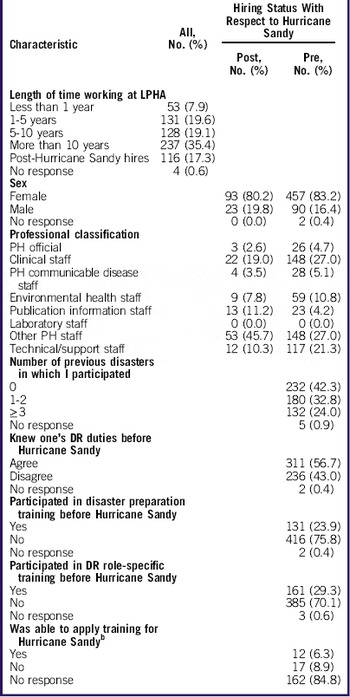
The demographic characteristics of the respondents are shown in Table 1. The majority of the respondents (55%) had been employed in their LPHA for more than 5 years (pre-Sandy hires), 28% had worked less than 5 years (pre-Sandy hires), and 17% were post-Sandy hires. The 4 respondents who did not provide employment status were excluded from subsequent summaries and analyses. The distribution of sex between post- and pre-Sandy hires was comparable. The largest differences in the professional classifications was for other public health staff (46% post-Sandy hires vs 27% pre-Sandy hires).
Characteristics of JH-DRIST Survey RespondentsFootnote a

a Abbreviations: DR, disaster recovery; JH~DRIST, Johns Hopkins ~ Disaster Recovery Infrastructure Survey Tool; LPHA, local public health agency; PH, public health.
b Based on employees hired before Hurricane Sandy and having specified participation in training.
For employees who were pre-Sandy hires, only 24% and 29% participated in LPHA-provided disaster-preparedness activities or in DR training regarding role-specific responsibilities following a major disaster, respectively. Of those participating in such activities or DR training, only 6% indicated that they were able to apply that training to Hurricane Sandy recovery efforts. The questions regarding past experience with major disasters and their knowledge about their job duties following such a disaster were both found to be highly correlated with work duration (employment status; data not shown) and were not included in the subsequent analyses.
Perceptions Toward Recovery Phases
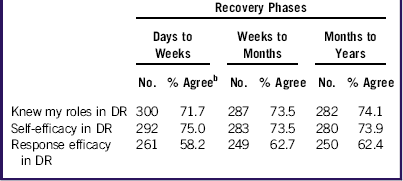
Three attitudinal statements were considered for pre-Sandy employees in each of the 3 recovery phases: (1) Did they know their roles and responsibilities for the DR activities in their LPHA (knew DR roles)? (2) Were they confident in their ability to successfully perform their role-specific DR duties (self-efficacy)? and (3) Did they perceive that the performance of their DR duties made a big difference in the success of the LPHA’s recovery efforts (response efficacy)? Across all 3 recovery phases (Table 2), the level of agreement for knowing their DR roles was 72% to 74% (n=282 to 300); for self-efficacy it was 73% to 75% (n=280 to 292). The level of agreement for response efficacy was slightly lower, ranging from 58% for the days-to-weeks phase to 63% for the weeks-to-months phase (n=249 to 261, respectively). There were no significant differences in agreement between phases for these statements. The only demographic that showed any significant relationship with these statements was participation in workplace training regarding their role-specific responsibilities in DR activities with the statement of knowing their DR roles. For the weeks-to-months phase, respondents participating in preparedness training had a higher odds (odds ratio [OR]: 2.8, 95% confidence interval [CI]: 1.3-6.0, n=284) of knowing their roles than those not participating in the training. Similarly, for the months-to-years phase, those participating in preparedness training had a higher odds of knowing their roles (OR: 3.3, 95% CI: 1.5-7.4, n=276).
Perceptions of Efficacy-Related Constructs in Hurricane Sandy Recovery Phases for Respondents Hired Before Hurricane SandyFootnote a

a Abbreviation: DR, disaster recovery.
b Based on Likert scale responses, where agree is based on scores 1-4, and disagree is based on scores 5-9.
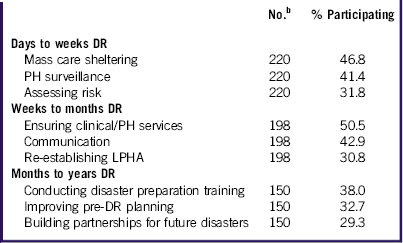
Participation in DR activities was also elicited by using prespecified lists 2 , 12 , 13 in each recovery phase. For pre-Hurricane Sandy hires, participation in any recovery activity was 40%, 36%, and 25% for the days-to-weeks, week-to-months, and months-to-years phases, respectively. Across the 3 phases, of the minority of staff participating, 24% to 26% were involved in 3 or more activities, 21% to 26% were involved in 2 activities, and 51% to 53% were involved in only 1 activity. Post-Hurricane Sandy hires had rates of any participation across the 3 phases of 6% to 16%. For all respondents, those who participated in any activity in a given phase were tabulated; the activities in which approximately 30% or more participated are noted in Table 3.
Leading Activities in Which Respondents Participated by Disaster Recovery PhaseFootnote a

a Abbreviations: DR, disaster recovery; LPHA, local public health agency; PH, public health.
b Number of respondents participating in any activity in the phase.
Future Perceptions of Statements
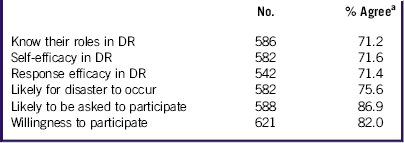
All respondents were included in the analyses of the future attitudinal statements: (1) knowing their DR roles, (2) self-efficacy, (3) response efficacy, (4) likelihood of a major disaster occurring in their region, (5) likelihood of being asked to participate in recovery activities in the event of a major disaster, and (6) WTP in future DR efforts in their LPHA (Table 4). The level of agreement for the first 3 statements ranged from 71% to 72% (n=542-586). The level of agreement for the last 3 statements was 76% (n=582), 87% (n=588), and 82% (n=621), respectively. Of the respondents who considered they would likely be asked to participate in DR activities for a future disaster (n=499), 90% indicated a WTP. Of the respondents who did not think it likely they would be asked to participate (n=70), 39% indicated a WTP.
Future Perceptions of Efficacy-Related Constructs in Disaster Recovery (DR) for all Respondents

a Based on Likert scale responses, where agree is based on scores 1-4, and disagree is based on scores 5-9.
Clinicians had significantly higher odds than other professional classifications of agreeing with the statements regarding response efficacy (OR: 1.9, 95% CI: 1.2-3.0, n=526), being asked to participate (OR: 2.9, 95% CI: 1.4-6.1, n=573), and WTP (OR: 2.3, 95% CI: 1.3-4.2, n=603). Female staff had significantly higher odds than males of knowing their DR roles (OR: 2.2, 95% CI: 1.3-3.9, n=569) and in self-efficacy (OR: 2.4, 95% CI: 1.3-4.2, n=568). Similarly, participants with workplace training regarding role-specific responsibilities had significantly higher odds than nonparticipants of knowing their DR roles (OR: 2.2, 95% CI: 1.2-3.8, n=569) and in self-efficacy (OR: 2.6, 95% CI: 1.5-4.6, n=568).
Future Perceptions of Available Support
The respondents were asked about their perceptions of support in future disasters: (1) liability protection, (2) compensation, (3) psychological support, (4) safety at work, (5) training, (6) praise from leadership, and (7) personal support. The level of expected support in terms of compensation and personal support was 69% each (n=573 and 554, respectively). The level of other expected types of support ranged from 77% to 81% (n=521-597). Staff participating in workplace training on role-specific responsibilities had significantly higher odds than those not participating in expecting training (OR: 3.4, 95% CI: 1.9-6.2, n=580), praise from leadership (OR: 2.4, 95% CI: 1.4-4.1, n=578), and personal support (OR: 2.0, 95% CI: 1.2-3.4, n=540). All types of expected support had significant relationships with WTP. Training had the strongest relationship (OR: 10.5, 95% CI: 5.9-18.6, n=562). The next strongest relationships were for safety at work (OR: 5.2, 95% CI: 3.1-8.9, n=563), psychological support (OR: 4.9, 95% CI: 2.9-8.3, n=541), and liability protection (OR: 4.3, 95% CI: 2.4-7.5, n=494).
DISCUSSION
Although the existing literature has explored attitudinal determinants of LPHA worker WTP in disaster response activities,Reference Barnett, Thompson and Errett 6 , Reference Barnett, Balicer and Thompson 10 , Reference Balicer, Omer and Barnett 14 - Reference Errett, Barnett and Thompson 16 to the best of the authors’ knowledge this is the first quantitative study to report LPHA workers’ WTP in DR activities. Whereas 86.9% of respondents reported that they were likely to be asked to participate in future DR efforts, 82% reported WTP. Assurance of WTP in recovery activities among all LPHA workers is of paramount importance. Prior research among 8 clusters of LPHA workers across the United States found that 92.7% of respondents reported that they were willing to respond to a weather-related disaster if required by their employer.Reference Barnett, Thompson and Errett 6 It is essential that the marked difference in WTP in recovery activities compared to response activities be understood and the gap closed. Potential explanations may include emotional or psychological fatigue associated with the prolonged nature of the recovery process or lack of understanding of recovery activities. For instance, only a minority of relevant workers indicated that they participated in any recovery activity (40% in the days-to-weeks phases, down to 25% for the months-to-years phases). Published in 2011, the NDRF is a relatively new doctrine with which LPHA workers without preparedness-specific job functions may be unfamiliar. In addition, DR activities may be less explicit compared to disaster response activities and may mimic everyday activities. For instance, health and human services-related DR activities include situational awareness and food, animal, water, and air safety assessments. These critical activities for returning a community to steady-state operations also occur every day. In a perhaps unconscious streamlining of activities, the DR component of the activity may be executed as part of existing frameworks and systems and not delineated as a separate “recovery task.” Additional education on the NDRF and the associated role of LPHA workers may facilitate LPHA workers’ ability to distinguish that the activities they performed were in fact related to DR and may modify the perceptions reported herein.
Our findings indicate that the availability of specific types of support during future DR activities influences LPHA workers’ WTP in these efforts. Prior research has found that over 75% of LPHA workers would be more willing to respond across a range of emergency scenarios if they were guaranteed access to personal protective equipment (PPE).Reference Rutkow, Vernick and Thompson 17 The availability of PPE helps to ensure safety at work, and effective use of PPE depends upon proper training. Similarly, our study found that provision of training and perceived safety at work were both associated with a significantly greater odds of LPHA workers’ WTP in DR efforts. Thus, our study’s results regarding perceptions of training and safety at work are consistent with prior research and reinforce the importance of maintaining safe LPHA work environments before, during, and after an emergency.
In addition to worker safety and training, LPHA respondents expressed favorable views about the presence of liability protections in the context of DR. Liability protections offer assurance that LPHA workers will not be held personally responsible for most harms that occur in the course of their duties. Previous studies have confirmed that LPHA workers are concerned about whether liability protections will be available to them and how these and related protections will be applied in the context of an emergency response.Reference Botoseneanu, Wu and Wasserman 18 Our finding that the presence of liability protections is also associated with a significantly greater odds of WTP in DR underscores the value of these protections to LPHA workers. It also highlights the need to ensure that workers understand at what point following a disaster’s onset these protections will become available and to clarify whether these protections will last into the recovery stage.
Self-reported WTP in future DR activities may be scenario-specific. This study was expressly linked to Hurricane Sandy and participants may have expressed WTP in future DR efforts on the basis of their experience with or understanding of activities or conditions associated with a Sandy-like event. This study may not be representative of WTP in, or understanding of, DR activities in other types or magnitudes of disaster scenarios. Prior research has shown scenario-specificity among levels of, and attitudinal and belief determinants to, willingness to respond to disaster events among 8 clusters of LPHA workers.Reference Barnett, Thompson and Errett 6 Future research should seek to determine if and how scenario-type or magnitude influences self-reported WTP in future DR activities.
Approximately 40% of LPHA workers hired before Hurricane Sandy did not think their DR duties significantly contributed to the LPHA’s success in performing recovery activities (self-efficacy). Furthermore, nearly 30% of all respondents felt that their participation in future DR activities would not make a meaningful difference in the success of the LPHA’s recovery activities (response efficacy). Companion qualitative findings found that DR-related sense of one’s role-importance may be enhanced through strong leadership, perceived appreciation by leadership, and perceived public benefit of participation.Reference Errett, Egan and Garrity 19 Demonstrated leadership support for DR activities (eg, through thank you letters and on-site participation) may provide a low cost mechanism for enhancement of DR-related WTP.
Companion qualitative findings also identified perceptions of sufficient training, safety, family preparedness, policies and planning, and efficacy as facilitators of LPHA worker performance of recovery activities.Reference Errett, Egan and Garrity 19 Yet, between 19.7% and 31.4% of these survey respondents did not have a perception of available support in DR activities for training, safety at work, personal support, liability protection, compensation, self-efficacy, or response-efficacy. In addition, 28.8% percent of the respondents did not feel they know their DR roles for future events. Companion qualitative findings suggest training (eg, role-specific training, incident command training, and interjurisdictional training) could enhance LPHA worker performance of recovery activities, and concurrently increase levels of self-efficacy.Reference Errett, Egan and Garrity 19 Moreover, curricular interventions using an EPPM framework have been shown to significantly enhance response willingness among LPHA workers.Reference Barnett, Thompson and Semon 15 Recovery-focused curricular interventions using an EPPM framework have the potential to enhance WTP in DR among LPHA workers.
The research team attempted to minimize limitations by study design; however, self-reported survey data are subject to recall bias among respondents. Self-reported data rely on respondent understanding of survey questions, interpretation of rating scales, and candor of responses. Moreover, the study design is subject to selection bias as it is possible that respondents may have had systematic differences compared to those who chose not to respond. Findings may also not be generalizable beyond the geographic areas examined. Finally, respondents’ self-reported behavior may not necessarily be reflective of actual behavior in disaster contexts.
CONCLUSION
This study underscores the need for enhanced training and agency-based support to improve LPHA workers’ WTP in DR, knowledge of the LPHA role in DR, self-efficacy in DR, and response efficacy in DR. While this study provides valuable insights into LPHA workers’ perceptions and related gaps toward DR activities, additional research is necessary. Prior research has demonstrated scenario-, demographic-, and context-specific rates and determinants of disaster response willingness among LPHA workers.Reference Barnett, Thompson and Errett 6 , Reference Barnett, Balicer and Thompson 10 Additional exploration of the public health workforce’s willingness to fulfill varied DR activities is required to understand community resilience in the intermediate- and longer-term aftermath of disasters, as well as in different disaster scenarios. In light of the relevance of this type of DR research to community resilience perspectives, future investigations of non-public-health professionals’ WTP in DR activities is warranted. Specifically, other professional cohorts having responsibilities under the NDRF’s Health and Human Services Recovery Support Function, and that accordingly would be suitable populations for future such studies, include hospital employees and emergency medical services workers.
Acknowledgment
This work was supported by the Centers for Disease Control and Prevention Cooperative Agreement 1U01TP000576-01. The authors also wish to acknowledge the Johns Hopkins Center for Public Health Preparedness (PERRC; CDC/grant 1P01tP00288-01; grant 104264). The funders had no role in the decision to publish or in manuscript preparation.
Disclaimer
The views expressed are those of the authors and do not reflect the official policy or position of the Uniformed Services University of the Health Sciences, the Department of Defense, or the United States Government.