Introduction
The transformation of the international system is increasingly defined by the weaponization of economic interdependence, where states leverage financial flows, trade networks, and infrastructure investments as instruments of strategic influence. Nowhere is this phenomenon more pronounced than in China’s BRI – a comprehensive geoeconomic framework that transcends infrastructure development to function as a mechanism for reconfiguring global power structures, recalibrating regional alignments, and contesting hegemonic influence. While much of the existing literature frames the BRI within traditional economic development paradigms, its strategic implications remain under-theorized, particularly concerning how middle powers navigate and adapt to its evolving geopolitical architecture.
Iran’s engagement with the BRI epitomizes this strategic recalibration. Facing severe US-led economic sanctions, financial isolation, and security pressures, Iran has turned to China as a crucial partner to mitigate systemic constraints, enhance economic resilience, and secure alternative pathways to global integration. However, despite the rhetoric of strategic convergence, the Sino-Iranian partnership remains highly asymmetrical, shaped by structural constraints, competing geopolitical imperatives, and China’s cautious hedging strategy. While Iran seeks deeper integration to circumvent Western containment, China remains strategically ambivalent, balancing its engagement with Iran against broader regional and global priorities, including its relations with the US and Gulf states.Footnote 1 This raises fundamental questions about the depth, sustainability, and strategic logic of the Sino-Iranian alignment under the BRI framework.
Despite the growing body of scholarship on China’s geoeconomic strategies, existing analyses often fail to account for the intricate interplay between economic connectivity, systemic constraints, and strategic agency. Much of the literature either overemphasizes the cooperative dimensions of economic interdependence, as seen in liberal institutionalist interpretations, or reduces state behavior to deterministic power hierarchies, as exemplified in traditional neorealist frameworks. This study advances a more nuanced theoretical model that integrates neorealist insights with structural economic statecraft and relational power dynamics to interrogate the mechanisms through which states leverage economic interdependencies as instruments of strategic recalibration. By conceptualizing the BRI as a dynamic site of geopolitical contestation rather than a mere developmental initiative, this research challenges prevailing assumptions about the nature of economic statecraft and its implications for regional and global power configurations.
This study engages two interrelated hypotheses to explain the strategic logic underpinning the Sino-Iranian partnership within the BRI framework. First, the self-fulfilling prophecy of conflict hypothesis posits that economic engagements, though initially framed as cooperative, may escalate into security rivalries as states preemptively react to perceived risks within an anarchic international system. This suggests that economic statecraft, rather than mitigating geopolitical tensions, can in certain circumstances reinforce strategic distrust, blurring the distinction between economic and security domains. Second, the institutional adaptation beyond traditional power hierarchies hypothesis contends that middle powers, such as Iran, can leverage economic connectivity not merely to reinforce their subordination to great powers but to strategically recalibrate their agency by prioritizing trade, resilience, and technology over direct military confrontation. These hypotheses jointly illustrate how BRI-driven economic maneuvers function as both instruments of geopolitical change and mechanisms for state adaptation to systemic constraints.
Methodologically, this study employs a rigorous mixed-methods approach, synthesizing quantitative economic network analysis, qualitative discourse examination, and comparative institutional assessment to construct a multidimensional framework for analyzing the Sino-Iranian partnership. This analytical model unfolds in three interrelated phases: first, it systematically evaluates the geoeconomic logics underpinning China’s strategic engagement with Iran; second, it critically examines the geopolitical ramifications of this partnership within the broader Middle Eastern security architecture; and third, it assesses the extent to which economic statecraft enables states to circumvent systemic constraints and reshape regional power asymmetries.
By questioning the intersection of economic statecraft, geopolitical strategy, and systemic adaptation, this study offers a theoretically sophisticated contribution to the field of international relations (IR). It extends neorealist theory by illustrating how economic instruments – rather than solely military capabilities – serve as primary vectors of power projection in the contemporary international system. Furthermore, this study foregrounds the role of middle powers such as Iran in navigating and contesting global power structures, thereby providing a more granular understanding of the strategic calculations underpinning China’s global economic initiatives. As the international system transitions toward a more fragmented and multipolar order, this research provides a critical examination of the mechanisms through which economic connectivity reshapes global hierarchies, while simultaneously recognizing the fragilities, asymmetries, and strategic contradictions that define the Sino-Iranian relationship within the BRI framework.
Neorealism: Foundations and relevance for analyzing strategic partnership
Neorealism, or structural realism, as proposed by Kenneth Waltz, remains a central theoretical approach to understanding state behavior within an anarchic international system. Structural realism asserts that the structure of the international system is shaped by power distribution among states. The anarchic nature of the system – defined by the absence of supernational authority – compels states to prioritize survival, security, and power as a means to these ends.Footnote 2 Unlike classical realism, which attributes state behavior to human nature and individual motivations, neorealism shifts the analytical focus to systemic constraints and the distribution of material capabilities.Footnote 3 Waltz argues that the anarchic structure of the international system creates a competitive environment where power distribution, or polarity, shapes state interactions and determines global stability. By framing state actions as responses to structural pressures, neorealism explains recurring competition and alliance formation patterns, highlighting systemic forces’ enduring influence over individual state choices.Footnote 4
In IR, neorealism offers a critical lens for examining China’s BRI as a strategic mechanism of power projection and structural transformation. From this perspective, the BRI emerges not merely as an economic endeavor but also a calculated geopolitical strategy designed to enhance China’s regional and global influence. The initiative embodies the core neorealist principles of power accumulation and systemic survival, where economic investments serve as sophisticated instruments of structural integration and strategic leverage. From an offensive realist standpoint, the BRI represents a systematic approach to expanding China’s geopolitical foothold. Scholars such as Mearsheimer argue that the initiative is likely to instigate intense security competition with the US and regional states.Footnote 5
This perspective interprets the BRI as more than an infrastructure project – it is a calculated mechanism for increasing China’s strategic depth and economic resilience. Some analysts draw parallels between the BRI and the Marshall Plan, positioning the initiative as China’s contemporary geopolitical blueprint for Eurasian influence. However, the neorealist interpretation of the BRI is not without nuanced complications. While power and security remain ontological priorities, the approach risks generating a self-fulfilling prophecy of conflict. As quoted in Zhaohui’s work, former Malaysian Prime Minister Mahathir provocatively highlighted this danger, asserting that preemptively identifying a country as an enemy can transform potential cooperation into an inevitable confrontation.Footnote 6 The very act of perceiving the BRI as a purely antagonistic strategy may precipitate the security competition that offensive realists predict.
This tension reveals the potential limitations of a strictly power-centric analysis. By framing IR exclusively through the lens of potential conflict, neorealists might inadvertently contribute to escalating the tensions they seek to explain. As Kirshner critically notes, Mearsheimer’s predictive logic and prescriptive recommendations can be analytically problematic, potentially oversimplifying the complex dynamics of international interactions.Footnote 7
Consequently, while neorealism offers valuable insights into the strategic calculations behind China’s BRI initiatives and Sino-Iranian partnerships, it has limitations. For instance, material capabilities have long been the cornerstone of neorealist analysis, presenting power as a quantifiable, tangible construct measurable through military strength and economic resources. Nevertheless, this perspective fundamentally misunderstands the multidimensional nature of international engagement. Initiatives like the BRI prove that state behavior emerges from a complex interplay of material and non-material factors – cultural narratives, historical relationships, and shared developmental aspirations that cannot be reduced to mere economic calculus.
The Western-centric orientation of structural neorealism represents another critical theoretical constraint. This approach systematically marginalizes non-Western perspectives and relational dynamics crucial to understanding contemporary global interactions by privileging a singular interpretative lens. In regions such as Central Asia and the Middle East, international partnerships are deeply embedded in intricate networks of cultural exchange, historical connections, and localized strategic considerations that transcend the simplistic power calculations of traditional realist frameworks.
Structural determinism represents perhaps the most significant theoretical limitation of neorealism. The paradigm’s assumption of a relatively static international system fails to account for the transformative potential of strategic initiatives that actively reshape global structures. The BRI exemplifies this limitation: it is not merely a response to existing systemic constraints but also a proactive mechanism for creating new economic dependencies, reconfiguring trade routes, expanding China’s influence in the region, and fundamentally altering regional alignments.
Economic statecraft: Extending neorealism with economic strategies
The limitations of structural neorealism necessitate a more advanced theoretical framework capable of capturing the complex dynamics of contemporary IR. Economic statecraft emerges as a vital theoretical extension, offering a deeper understanding of how economic initiatives function as sophisticated instruments of geopolitical transformation.Footnote 8 More specifically, structural economic statecraft reinterprets economic exchanges as both transactional acts and strategic mechanisms of power projection. In contrast to traditional neorealist approaches that prioritize military capabilities, this framework positions economic initiatives as dynamic tools for reshaping global power distributions and influencing state behavior.
In this context, states – particularly emerging powers such as China – leverage economic projects as both commercial endeavors and deliberate instruments of statecraft. These projects are designed to foster strategic dependencies, expand influence in targeted regions, and reshape institutional frameworks, all of which align with broader geopolitical objectives.Footnote 9 Through such initiatives, states can recalibrate the global balance of power and transform existing political and economic structures in their favor.
The Sino-Iranian partnership exemplifies economic statecraft, as economic engagements serve strategic ends beyond traditional cooperation. China leverages this relationship to increase its regional influence, while Iran gains economic resilience against sanctions. These dynamics challenge conventional neorealist perspectives, highlighting how economic initiatives secure trade pathways, enhance regional leverage, and foster long-term strategic alignments – albeit with constraints compared to Iran’s neighbors within the broader BRI framework.Footnote 10 By integrating economic initiatives with political strategy, economic statecraft extends neorealism to encompass trade networks, infrastructural investments, and economic resilience in shaping power dynamics.
For instance, Qin’s relational theory shifts focus from abstract structures to inter-state relationships, arguing that state behavior is shaped not only by material capabilities but also diplomatic interactions, norm-building, and shared strategic goals.Footnote 11 In the context of the BRI, this perspective underscores the role of historical ties and ideological affinities in shaping alliances. The Sino-Iranian partnership, for example, is not solely driven by material interests; it also reflects a shared opposition to Western hegemony and a history of cooperation under external pressures. The theory further posits that power extends beyond relative capabilities to the depth and quality of state relationships.Footnote 12 The BRI, therefore, is more than an infrastructure initiative, as it serves as a platform for reshaping the global order through China’s relational ties, particularly with the Global South.
Hypothesis: Economic statecraft and strategic partnerships
This research proposes the following hypotheses to demonstrate how economic statecraft provides a more comprehensive explanation for state behavior than traditional neorealist approaches.
H1 – Self-fulfilling prophecy of conflict: Preemptive antagonistic perceptions of economic initiatives can, in an anarchic international system, transform potential cooperative mechanisms into inevitable security competitions. States’ strategic interpretations of economic partnerships will generate predictive dynamics that may precipitate the very conflicts they seek to anticipate or prevent.
H2 – Institutional adaptation beyond traditional power dynamics: Strategic economic partnerships will emerge as mechanisms that challenge traditional neorealist assumptions about power distribution and state interactions. These partnerships will demonstrate state capacities to create alternative networks of economic cooperation that effectively circumvent systemic structural constraints, prioritizing mutual economic survival over conventional military balancing strategies.
Structural constraints and state behavior
Waltz’s neorealist theory posits that states operate within a constraining global political system characterized by structural determinism, where actions that transgress systemic boundaries inevitably provoke systemic responses. The international response to Iraq’s invasion of Kuwait in 1990 provides a paradigmatic example of this theoretical proposition.Footnote 13 In the post-Cold War international system, the dynamics of power configuration have increasingly validated Kenneth Waltz’s structural realist framework.Footnote 14 Rather than witnessing a smooth transition to unipolar American dominance, the global landscape has been characterized by complex systemic responses to potential hegemonic consolidation.
The initial US strategic vision of a unipolar world order encountered sophisticated counterbalancing mechanisms that emerged through multiple channels. Russia’s geopolitical resurgence under Vladimir Putin represents one such strategic recalibration. Simultaneously, China’s methodical approach – combining economic expansion with strategic military modernization – created alternative power centers that challenged traditional hegemonic assumptions. The emergence of multilateral institutions such as BRICS further illustrates how states collectively construct mechanisms to resist unilateral global power structures. These developments empirically substantiate Waltz’s core theoretical proposition: that the international system inherently generates equilibrating mechanisms to prevent any single state from achieving absolute dominance.
However, the BRI presents a more intricate challenge to structural realism. Unlike overt territorial transgressions that trigger immediate balancing, the BRI operates as a subtler mechanism of systemic transformation through economic and infrastructural integration. This raises critical theoretical considerations: Does the BRI represent an unprecedented form of systemic intervention that existing paradigms struggle to conceptualize? Or does it signify an adaptive evolution in statecraft, where systemic reconfigurations occur without provoking conventional counterbalancing mechanisms?
While empirical evidence supports Waltz’s assertion that systemic constraints shape state behavior, it also reveals the limitations of purely structural interpretations. The BRI emerges as a strategic mechanism through which China seeks to redefine systemic boundaries, creating alternative structural realities that other states must strategically navigate. This approach challenges the notion of an immutable international structure, suggesting instead a dynamic, dialectical interplay between state agency and structural constraints. Iran’s engagement with the BRI, BRICS, and Shanghai Cooperation Organization (SCO) illustrates how middle powers leverage emergent structural opportunities to circumvent traditional geopolitical limitations, thereby demonstrating the fluidity and adaptability of international order.
Geopolitical realignment: the Sino-Iranian strategic partnership and counterhegemonic impacts
The Sino-Iranian strategic partnership is often framed as a convergence of historical narratives, with both states invoking a shared legacy of Western marginalization to justify their alignment.Footnote 15 While this rhetoric highlights their mutual opposition to US hegemony, a more rigorous analysis reveals that China’s engagement with Iran is driven primarily by pragmatic geopolitical and geoeconomic considerations rather than ideological affinities.Footnote 16 In this context, the partnership, while framed as counterhegemonic, operates within a broader geopolitical realignment that reflects shifts in global power dynamics and systemic constraints.
As the international system is increasingly defined by debates over state sovereignty, governance legitimacy, and regional security, both Beijing and Tehran share a strategic commitment to protect their distinct political systems from external pressures, particularly from US-led unipolarity.Footnote 17 From a neorealist perspective, this alignment can be seen as a calculated response to the global power shifts that challenge the existing order. However, the partnership’s counterhegemonic narrative is tempered by China’s own geopolitical realities. Despite providing diplomatic and economic support to Tehran, China’s broader strategy in the Middle East – focused on regional stability and economic expansion – necessitates careful navigation of its relations with Saudi Arabia, Israel, and ongoing efforts to maintain stable relations with the US.Footnote 18
This asymmetry characterizes the Sino-Iranian relationship. China’s diplomatic and economic support for Iran, while conditioned by broader foreign policy objectives, highlights Iran’s distinctive role. Despite China’s more active engagement with Gulf states, Iran remains a critical element of Beijing’s strategy to counter Western influence. The partnership between the two states is not a straightforward counterhegemonic alliance, but rather a complex blend of ideological opposition and pragmatic limitations. Economic statecraft – through diplomatic support, robust trade relations, and institutional cooperation – serves as Beijing’s primary mechanism for bolstering Iran’s position in the face of US pressure. China’s support for Iran manifests through three interconnected dimensions.
Diplomatic legitimation: In 2019, amid escalating US-Iran tensions, President Xi Jinping pledged to deepen China’s strategic partnership with Iran, signaling steadfast support despite shifting global dynamics.Footnote 19 China’s diplomatic protection extends robustly to multilateral forums. In May 2019, Beijing firmly opposed the US labeling Iran’s Islamic Revolutionary Guard Corps as a terrorist group, warning that such a move risked destabilizing the region. Likewise, after the 2020 US drone strike killed General Qassim Soleimani, Foreign Minister Wang Yi publicly denounced the act, framing the US as an aggressor overstepping its authority.Footnote 20
Economic resilience: China’s sustained importation of Iranian petroleum – averaging 585,000 barrels per day in 2021 and exceeding one million barrels in 2023 – functions as a lifeline against US sanctions.Footnote 21 This trade undermines the efficacy of Western isolation efforts, yet its strategic depth is contested. Iranian skepticism toward China’s economic motives, including concerns over market dominance and substandard infrastructure projects, alongside volatile investment patterns post-sanctions, highlights the partnership’s fragility.Footnote 22
Strategic institutionalization: The 25-year Sino-Iranian strategic partnership agreement heralds Iran’s pivotal role in shaping a resilient future, securing economic gains on its own terms. Within the BRI, Iran asserts its strategic value, outmaneuvering regional rivals such as Pakistan and Turkey through its critical geography and resources. Scholars note the BRI’s flexibility, but Iran transforms this adaptability into leverage, compelling China to prioritize Tehran’s integration and bolster its regional clout against Western pressures with unwavering resolve.Footnote 23
These dimensions underscore how China’s economic statecraft reinforces Iran’s strategic resilience, leveraging Iran’s geographical location and resources. However, Beijing’s broader foreign policy priorities – particularly its relationships with Saudi Arabia, the Gulf States, and the US – place constraints on the counterhegemonic potential of the Sino-Iranian partnership. Iran’s domestic instability and growing apprehension over China’s intentions, including concerns about market dominance and infrastructure quality, further complicate this asymmetrical yet mutually beneficial relationship. In response to US sanctions and international isolation, Iran has increasingly relied on China’s diplomatic and economic support to diversify its alliances and mitigate Western pressure. Within the BRI, the expansion of trade and energy ties enhances Tehran’s regional standing, allowing it to navigate a hostile global environment while safeguarding its sovereignty. This dynamic persists despite Beijing’s need to balance its regional priorities and strategic interests across multiple fronts.
Eastern alliance: Political dynamics of the Sino-Iranian strategic partnership
The Sino-Iranian partnership provides a pivotal framework for analyzing the complex interplay between structural determinants and state agency within a neorealist paradigm, offering profound insights into the mechanisms of power consolidation in an anarchic international system. Anchored in historical contingencies and driven by immutable geopolitical imperatives, this bilateral alignment has evolved through distinct phases, each underscored by the tension between systemic constraints and intentional agency-driven efforts to recalibrate power structures. This relationship exemplifies the strategic calculus of both states as they navigate and exploit the dynamics of an evolving global order, characterized by multifaceted competition, shifting alliances, and the recalibration of hegemonic power.
In its nascent stage during the 1950s, Sino-Iranian engagement defied simplistic neorealist assumptions. Iran’s alignment with the Baghdad Pact and recognition of Taiwan coexisted with China’s covert support for Tehran’s 1951 energy nationalization – a seemingly paradoxical stance that foreshadowed deeper strategic convergences.Footnote 24 This early interaction reveals a sophisticated geopolitical calculus, navigating a multipolar regional subsystem rather than adhering to hegemonic dictates. The 1971 diplomatic shift under the Pahlavi regime, followed by China’s calculated interventions during the Iran-Iraq War (1980–1988), marked a structural realignment.Footnote 25 These actions transcended mere bilateral support, aiming to reshape regional power architecture – an empirical challenge to offensive realism that underscores how Global South states exploit great-power rivalries to bolster their systemic standing.Footnote 26
This strategic convergence finds an ideological antecedent in China’s pre-1979 backing of Iranian Maoist factions, as Figueroa elucidates, suggesting an initial revolutionary impulse.Footnote 27 Yet, Beijing’s muted response to the 1979 Islamic Revolution – favoring stability over ideological exportation – underscores a pragmatic pivot. This restraint cautions against overstating early cohesion, revealing a partnership tempered by situational adaptability rather than transformative zeal. Collectively, these phases delineate a Sino-Iranian relationship marked by a sophisticated interplay of ambition and caution, leveraging both structural opportunities and ideological openings to assert agency within a contested global order.
The historical evolution of the Sino-Iranian partnership provides a critical context for understanding its contemporary dynamics, particularly China’s adept navigation of US sanctions on Iran. In the wake of the US withdrawal from the Joint Comprehensive Plan of Action (JCPOA) in 2018, Beijing’s response highlighted its strategic agility – a balancing act that sought to support Tehran while safeguarding China’s broader global interests. Initially, China scaled back its investments in Iran, notably falling short of the ambitious trade targets set in 2016. Rasanah notes that a proposed USD 400 billion trade target was significantly moderated under US pressure, exposing the limits of China’s commitment to Iran within the broader context of its global economic imperatives.Footnote 28
This cautious partnership reflects a broader strategic pattern in which China leverages its economic and political ties to navigate complex international pressures, demonstrating a commitment to pragmatic flexibility over ideological alignment. However, this strategic hedging reveals significant limitations: as Garver argues, China’s reluctance to fully commit to Iran amid escalating US pressure reflects a prioritization of its global economic interests over regional solidarity.Footnote 29 This dynamic underscores a potential overestimation of the partnership’s depth when analyzed through a systemic lens, with China seeking to avoid entrenching a regional bloc that could jeopardize its broader geopolitical calculations.
Further emphasizing this strategic balancing, Scita characterizes China’s approach as a “wait-and-see” strategy, echoing its cautious posture during the 1990s. In this context, China’s dealings with Iran are framed not as an alliance but as a maneuver within the broader US-China-Iran triangle; one that seeks to manage the rivalry with the West without fully aligning with Iran.Footnote 30 This approach is evidenced by the unmet USD 400 billion trade target, which not only underscores the limits of China’s commitment to Iran but also highlights China’s broader regional pragmatism.Footnote 31 The modest scale of China’s oil imports from Iran – amounting to approximately 4% of its total oil imports from 2019–2020 – further exemplifies this strategic hedging.Footnote 32 Although these economic ties provide Iran with essential support, they also reflect the opportunistic nature of the relationship, driven more by geopolitical pragmatism than by any transformational shift in the regional order.
The 2016 comprehensive strategic partnership marks a significant evolution in Sino-Iranian relations, but also challenges binary distinctions between structure and agency in IR theory. Iran’s Look East policy, which reflects Tehran’s deliberate pivot toward non-Western powers, underscores the mutual dependence between the two states: Iran benefits from China’s political and economic support, while China enhances its regional influence and secures vital energy resources. Despite these mutual benefits, the sustainability of this partnership remains fraught with uncertainty. Iran’s growing domestic skepticism regarding Chinese intentions – stemming from concerns over product quality, market monopolization, and uneven infrastructure projects – reveals underlying tensions that underscore the fragility of this cooperation amid external pressures.
As Harold and Nader observe, Iran’s strained relations with Gulf Cooperation Council (GCC) states, which are key Chinese partners, force Beijing to temper its support for Tehran to preserve ties with these regional economic heavyweights.Footnote 33 Moreover, Baghernia’s analysis of China’s role in mediating between Iran and Saudi Arabia further underscores Beijing’s regional balancing act, revealing its preference for stability in the Gulf and its tilt toward Riyadh’s economic weight.Footnote 34
Theoretical analysis of Sino-Iranian relations both supports and challenges traditional neorealist balance-of-power theory. Iran’s growing integration into China’s strategic orbit – through initiatives such as the BRI, SCO, and BRICS – illustrates how economic statecraft can transform power dynamics, extending beyond conventional military metrics. In the context of intensifying US-China competition, this partnership functions as a counterbalance to American hegemony, positioning itself as a significant element in the transition to a multipolar world order. By incorporating Iran into the geospatial framework of the BRI, China strategically manipulates systemic constraints, redistributing geopolitical capital through economic and non-material means.
For instance, China’s consistent opposition to unilateral sanctions on Iran and its pivotal role in the 2015 JCPOA negotiations underscore the complex interplay between material power and ideational strategies. These actions reveal a sophisticated blending of relational and structural economic theories, challenging existing international hierarchies through targeted economic interventions.Footnote 35 The strategic depth of this partnership becomes evident in its multidimensional approach to geopolitical repositioning. Infrastructure investments in energy corridors, technology transfer mechanisms, and regional connectivity projects demonstrate a comprehensive strategy beyond traditional bilateral economic cooperation.Footnote 36 This alliance thus constitutes a critical intervention in IR scholarship, exposing the limits of realist paradigms while offering a dynamic model of state agency. It underscores the transformative potential of economic interdependence, not merely as a bilateral arrangement, but as a deliberate strategy for systemic reconfiguration in an evolving global landscape.
Silk and oil: Post-1979 Sino-Iranian trade and economic relations
The Sino-Iranian economic relationship serves as a critical case study for examining how states strategically employ economic interdependence as a tool within an anarchic international system. Far surpassing a mere exchange of goods, this partnership has transformed into a multifaceted strategy, propelled by imperative geopolitical considerations. It strategically harnesses bilateral trade, infrastructure investment, and technological collaboration to circumvent systemic constraints, particularly those imposed by the US. Both nations have endeavored to strengthen their regional and global standings, maneuvering within an asymmetrical yet mutually advantageous dynamic, underpinned by a shared opposition to Western hegemony.Footnote 37
Following Iran’s 1979 Islamic Revolution, economic ties with China emerged as a diplomatic instrument to address Tehran’s vulnerabilities and elevate Beijing’s role in a multipolar order. The revolution isolated Iran from Western markets, creating an economic vacuum that China astutely filled.Footnote 38 The Iran-Iraq War marked a critical juncture, with China stepping in as a vital partner. By supplying arms and facilitating technological transfers, Beijing demonstrated an adaptability that transcended conventional trade, underscoring the strategic depth of this alignment. Empirical evidence substantiates the depth of this engagement: approximately 16% of Iran’s total arms imports during this period – estimated at USD 7 billion – originated from China.Footnote 39 This period laid the groundwork for a partnership that would grow in scope and ambition over subsequent decades.
China’s wartime support during the Iran-Iraq War exemplifies the intersection of economic statecraft and geopolitical recalibration. Beyond conventional arms transfers, Beijing supplied critical materials such as uranium hexafluoride (UF6) and nuclear technology – actions that transcended transactional aid and actively reshaped regional power dynamics.Footnote 40 These strategic maneuvers positioned China as a pivotal actor in the Middle East, leveraging Iran’s international isolation to expand its strategic footprint. While Tehran gained essential wartime assistance, the asymmetry of this relationship was evident: China’s long-term geopolitical calculus far exceeded Iran’s immediate survival imperatives, embedding their cooperation within a broader framework of strategic realignment.
By the 1990s, as China’s industrial and economic ambitions accelerated, securing stable energy supplies and trade networks became paramount. Sino-Iranian trade surged to USD 4 billion annually, reflecting a deepening interdependence that extended beyond commerce to infrastructural entrenchment. Investments in ports, transportation corridors, and energy pipelines forged direct linkages between Central Asia, the Middle East, and East Asia, reinforcing China’s emergence as a regional trade hub.Footnote 41 These initiatives were not merely ad hoc responses to Iran’s economic challenges but integral components of Beijing’s long-term vision for an interconnected geoeconomic framework – one that safeguarded its energy security while increasing its regional influence. For Iran, this partnership provided an economic lifeline amid intensifying Western sanctions; for China, it secured critical resource access while entrenching the country’s influence in a strategically vital region.
The formalization of this partnership gained momentum with the launch of the BRI, which significantly reshaped the trajectory of Sino-Iranian ties by extending beyond bilateral trade to promote regional integration. The 2016 strategic cooperation agreement, reportedly valued at USD 400 billion over 25 years – though widely contested by scholars for its exaggerated scale –embodies the ambition of both states to reconfigure regional power dynamics and challenge US-led hegemonic structures.Footnote 42 By embedding Iran within its expansive economic architecture, China orchestrates a multidimensional strategy that simultaneously addresses energy security, geopolitical positioning, and infrastructural connectivity.
The durability of Sino-Iranian trade relations, despite sustained external pressures, underscores the adaptive capacity of structural economic statecraft in circumventing systemic constraints. Following the US’s unilateral withdrawal from the JCPOA in 2018, Sino-Iranian economic engagement did not diminish but rather underwent a strategic recalibration, shifting toward clandestine trade mechanisms, diversified financial conduits, and alternative logistical frameworks.Footnote 43 China’s covert importation of Iranian oil, facilitated through non-dollar transactions, offshore intermediaries, and rerouted maritime logistics, highlights the sophisticated economic countermeasures employed to sustain bilateral trade while minimizing exposure to secondary sanctions. In parallel, the expansion of alternative trade corridors, including regional free trade zones, shadow banking networks, and state-backed barter systems, reveals the extent to which Beijing and Tehran leverage economic statecraft as a tool of counterhegemonic resilience.Footnote 44
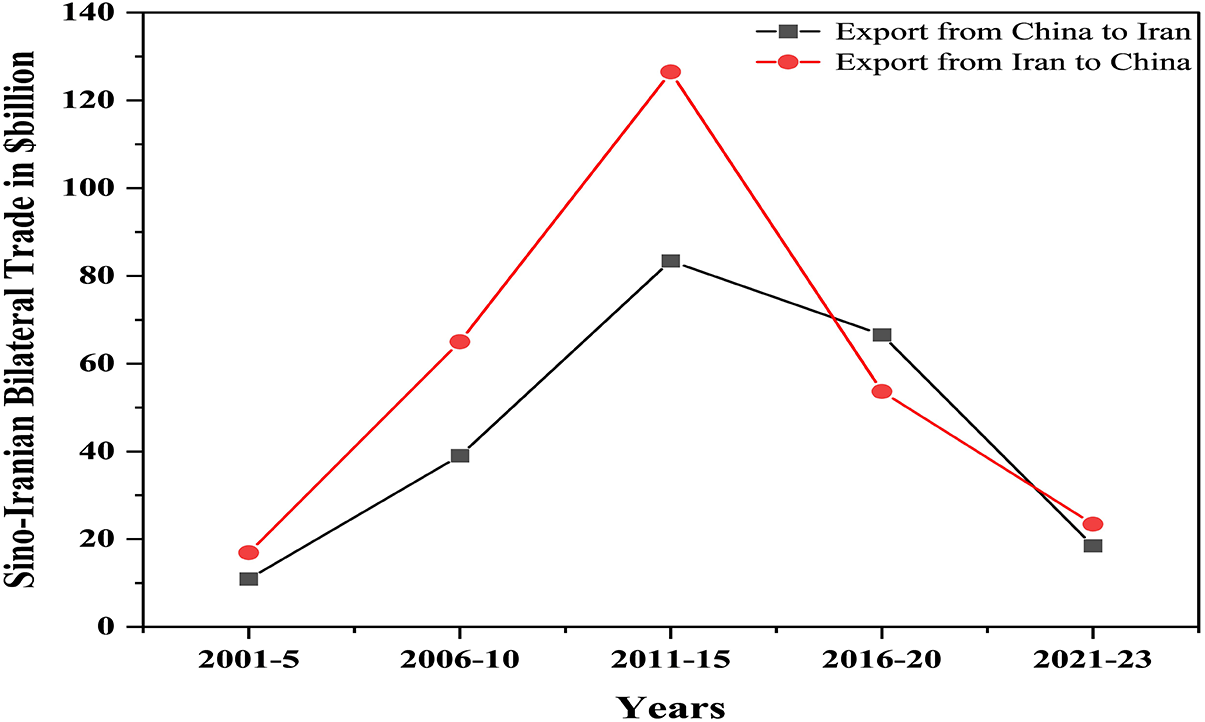
For instance, between 2016–2020, significant trade exchanges underscored the resilience of Sino-Iranian economic relations. During this period, China exported goods to Iran worth approximately USD 67.8 billion, while imports from Iran totaled around USD 53.67 billion, despite substantial challenges posed by sanctions and global disruptions.Footnote 45 In 2022, the total trade volume between the two countries was approximately USD 15.97 billion, with Iran’s exports to China accounting for USD 6.5 billion and China’s exports to Iran contributing USD 9.47 billion. Similarly, in 2023, China’s exports to Iran reached USD 10.7 billion, while imports from Iran amounted to USD 4.58 billion, bringing the total trade volume to USD 14.6 billion. Figure 1 illustrates the trade values between Iran and China from 2001–2023.Footnote 46
Sino-Iranian bilateral trade in USD billion

The bilateral economic relationship between China and Iran exemplifies a sophisticated model of asymmetric economic interdependence, where targeted investment strategies and nuanced trade exchanges serve both immediate economic needs and broader geopolitical objectives. The targeted investment approach – amounting to USD 618 million between 2018–2022 and representing 7.5% of total foreign direct investments – demonstrates China’s adaptive economic engagement and ability to leverage economic diplomacy to secure strategic footholds under conditions of geopolitical contestation.Footnote 47
A critical yet underexamined dimension of Sino-Iranian economic entanglement lies in its differential strategic calculus, wherein the partnership functions as a hedging mechanism against US-led containment strategies rather than a conventionally balanced economic alliance. Despite Iran’s geopolitical significance, its economic weight within China’s broader Middle East strategy remains marginal, especially when juxtaposed with Beijing’s expansive engagements with GCC states such as Saudi Arabia and the UAE. However, this asymmetry does not negate strategic utility; rather, it reveals a nuanced dynamic in which Iran’s economic survival remains disproportionately tethered to China, while Beijing capitalizes on the relationship to diversify its energy security, expand regional influence, and insulate itself from Western-imposed economic shocks.
This paradox of geoeconomic interdependence – wherein a weaker state seeks to mitigate its vulnerability through asymmetric economic alignments, while the stronger state instrumentalizes the relationship for strategic flexibility – extends beyond traditional neorealist calculations of power. It necessitates a reconceptualization of geoeconomic asymmetry, providing empirical insight into how smaller states leverage imbalanced economic dependencies to safeguard sovereignty, while major powers sustain engagement without overcommitment. Iran, despite its structural disadvantages, exploits its geostrategic centrality and resource leverage to maintain relevance within China’s regional calculus, even as Beijing carefully calibrates its involvement to avoid jeopardizing ties with wealthier Gulf states and the broader international system.
Strategic realignment: Analyzing balancing interests on the Belt and Road
The Sino-Iranian strategic partnership serves as a compelling case study of the intersection of structural economic statecraft and relational geoeconomics, offering a sophisticated framework for analyzing global power reconfiguration in an increasingly multipolar order. Conventional neorealist paradigms, with their emphasis on static power distributions and military capabilities, fail to account for the dynamic interplay of economic instruments, strategic interdependencies, and systemic recalibrations that define contemporary alignments. The evolving nature of Sino-Iranian relations reflects a broader geoeconomic transformation in which economic statecraft operates as a primary mechanism for shaping global influence, transcending traditional notions of coercion and hard power.
China’s engagement with Iran is not merely transactional but represents a strategic calculus designed to embed influence within critical geopolitical fault lines. Unlike direct economic coercion, structural economic statecraft functions by fostering financial and infrastructural dependencies that gradually shape the strategic choices of partner states.Footnote 48 The BRI epitomizes this approach, orchestrating a network of economic interdependencies that reconfigures regional power structures. Within this framework, Iran emerges as a crucial yet asymmetric partner, leveraging its engagement with China to mitigate Western-imposed constraints while offering Beijing access to vital energy corridors. This relationship is neither static nor purely bilateral; rather, it is embedded in a broader matrix of power recalibration that encompasses China’s parallel engagements with other regional actors, including the GCC states, Russia, and South Asia.
Unlike conventional alliances, which assume fixed commitments and uniform strategic priorities, the Sino-Iranian partnership exemplifies adaptive balancing – a fluid and issue-specific approach to cooperation that maximizes strategic flexibility. While Tehran views Beijing as an essential economic lifeline, China calibrates its engagement to preserve its broader regional interests, ensuring that its commitments to Iran do not jeopardize critical partnerships elsewhere.Footnote 49 This pragmatic balancing is evident in China’s simultaneous deepening of ties with Saudi Arabia and the UAE, reflecting an overarching strategy that prioritizes geoeconomic leverage over rigid geopolitical alignments. By maintaining diversified engagements, China positions itself as an indispensable economic actor capable of influencing regional dynamics without being constrained by traditional alliance structures.
The emergence of economic coalitions such as the China-Russia-Iran-North Korea (CRNK) axis further disrupts neorealist assumptions, underscoring the role of domestic political economies in shaping international alignments. While neorealism posits that states are uniform units primarily motivated by security imperatives, the CRNK coalition demonstrates how economic resilience and strategic interdependence function as instruments of power projection. China’s economic diplomacy provides authoritarian regimes with alternative financial instruments, trade networks, and technological cooperation, enabling them to withstand Western economic pressures while reinforcing their strategic autonomy.Footnote 50 Iran’s state-controlled economy, for instance, facilitates the targeted channeling of Chinese investments into critical infrastructure sectors, ensuring that external economic engagements align with Tehran’s broader security imperatives. In turn, China’s state-capitalist model fosters asymmetric dependencies that consolidate Beijing’s long-term influence while enhancing the resilience of its strategic partners.Footnote 51
Consequently, systemic economic resilience has become a defining feature of global power competition, reflecting the capacity of states to adapt to external pressures and reconfigure strategic trajectories in response to shifting economic landscapes. Iran’s ability to circumvent US-led sanctions through yuan-denominated trade, alternative payment mechanisms, and covert oil exports to China exemplifies the evolving nature of economic resistance strategies. These adaptations reveal the extent to which the BRI is not merely a commercial initiative but a structural mechanism for geopolitical realignment, systematically challenging the existing architecture of global financial governance. By embedding alternative financial infrastructures within global markets, China facilitates a gradual erosion of Western economic hegemony, replacing it with a more fragmented and decentralized system of economic interdependence.
Relational geoeconomics offers a critical departure from neorealism’s rigid, state-centric assumptions by emphasizing the interactive dynamics that define contemporary strategic behavior.Footnote 52 The Sino-Iranian relationship is not characterized by static hierarchies but by a constant process of recalibration in response to evolving geopolitical conditions. Unlike traditional balancing, which assumes fixed adversarial blocs, this partnership operates through a framework of strategic pragmatism, where cooperation is pursued selectively and contingently rather than as a long-term binding commitment. While both states share an interest in countering US influence, their collaboration remains carefully managed to avoid overextension and strategic entrapment. This flexible alignment reflects a broader transformation in global power structures, where economic entanglements replace rigid security pacts as the primary instruments of strategic influence.Footnote 53
The broader implications of this dynamic extend beyond the Sino-Iranian partnership itself, offering insight into how emerging powers navigate an era of weaponized interdependence.Footnote 54 The ability to withstand economic coercion and sustain long-term strategic objectives increasingly depends on the capacity to restructure financial and trade architectures in ways that insulate states from external vulnerabilities. Iran’s integration into China-led economic frameworks such as the China International Payment System (CIPS) exemplifies how financial innovations are being deployed as tools of resistance against Western-dominated financial institutions.Footnote 55 Simultaneously, China’s engagement strategy reveals a sophisticated approach to influence projection – one that does not rely on direct military intervention but instead leverages economic statecraft to shape global alignments over the long term.
Ultimately, the Sino-Iranian economic-security nexus encapsulates the complexities of contemporary multipolarity, highlighting how economic statecraft, adaptive balancing, and systemic resilience are redefining the logic of international power. This partnership is not a rigid anti-Western bloc but a pragmatic alignment shaped by evolving interests and strategic contingencies. While trade and investment volumes between China and Iran remain modest compared to Beijing’s engagements with other regional states, their partnership carries profound geostrategic significance, reflecting a broader trend in which economic networks replace traditional security alliances as the dominant mechanisms of global influence. By integrating structural economic statecraft with relational geoeconomics, this analysis advances a more comprehensive understanding of modern international alignments, moving beyond the limitations of neorealist thought to capture the fluid and multidimensional realities of contemporary power politics.
Iran’s strategic interests in China’s BRI: A critical perspective
Iran’s engagement with China’s BRI represents a strategic response to its enduring economic and geopolitical challenges, particularly the impact of international sanctions. Over the past two decades, sanctions targeting critical sectors of Iran’s economy – including energy, finance, and logistics – have sought to isolate the country from the global economic system. Notably, United Nations Security Council resolutions (e.g., UNSC Res. 1737, 1747, 1803, and 1929) and unilateral measures by the US have created systemic barriers, such as Iran’s exclusion from the SWIFT financial network, disrupting global market access.Footnote 56 Nevertheless, Iran’s alignment with China and participation in the BRI provide a strategic avenue to substantially circumvent these constraints and further its national interests.
The BRI provides Iran with concrete mechanisms to counteract Western sanctions. By integrating into China’s expansive trade network, Iran can diversify its economic partnerships and reduce dependence on Western-dominated financial systems. Strategic infrastructure projects are key to this transformation, with railway developments connecting Iran to Central Asia and China and port modernizations at Chabahar and Bandar Abbas positioning the country as a pivotal regional transit hub. These projects not only enhance Iran’s trade volume but also reinforce its economic connectivity with Asian and Eurasian markets, directly addressing the economic restrictions imposed by international sanctions.
Infrastructure investments through the BRI contribute to Iran’s long-term economic development and technological advancement. Projects such as the Tehran-Mashhad railway and proposed energy pipelines to China illustrate a dual-purpose strategy: mitigating external economic pressures while fostering new development pathways.Footnote 57 By securing alternative trade routes and financial channels, Iran utilizes the BRI to build economic resilience and transform the risks of isolation into opportunities for strategic repositioning in the global economic system.
China’s strategic engagement with Iran underscores a direct challenge to Western sanctions regimes and the established global financial order.Footnote 58 Empirical data underscores this defiance: the Congressional Research Service reports that China continues to import Iranian crude oil at a sustained level of approximately 1.5 million barrels per day (mbpd), despite US sanctions.Footnote 59 This persistent trade underscores a fundamental shift in economic power dynamics, wherein major economies selectively contest the enforcement mechanisms of unilateral sanctions.
Beyond energy trade, alternative financial mechanisms – such as China’s CIPS and Russia’s System for Transfer of Financial Messages (SPFS) – reflect a broader strategy to circumvent US financial hegemony.Footnote 60 Iran’s trade with Russia, which exceeded USD 5 billion in 2022, highlights the emergence of trade and financial networks that operate outside of SWIFT-dominated structures.Footnote 61 While these systems remain limited in scale, they signal a gradual shift toward decentralized global financial governance, aligning with Iran’s broader resistance economy strategy focused on domestic production and trade diversification.
From a structural realist perspective, the Sino-Iranian partnership exemplifies adaptive strategies under systemic constraints. This dynamic reflects a broader evolution of state behavior in the international system, where economic resilience and structural economic statecraft are critical components of survival. Several key principles of enhanced neorealism emerge from this analysis.
1. The primacy of survival remains central, but states now pursue this goal through multifaceted strategies that intertwine economic and security considerations.
2. Relative gains are crucial, yet their scope has expanded beyond military capacity to include economic resilience and strategic connectivity.
3. States maneuver within systemic constraints but actively seek to reshape these constraints through structural economic initiatives such as the BRI.
4. While anarchy remains a defining characteristic, the emergence of alternative financial mechanisms and regional cooperation creates pockets of order within the competitive global system.
Iran’s adaptive strategy within this framework is evident in its industrial resilience. Despite comprehensive sanctions, Iran’s automotive sector experienced a 19.1% production increase in 2020, underscoring the country’s capacity for self-reliance and internal industrial innovation.Footnote 62 This aligns with broader neorealist predictions that middle powers – rather than being passive actors in great power politics – are increasingly capable of recalibrating systemic constraints to their advantage. Iran’s trade diversification with China, Russia, Turkey, and South and Central Asian states further corroborates this argument, demonstrating a shift from dependence on Western-centric financial systems to a more decentralized economic framework.
Consequently, the Sino-Iranian partnership highlights a broader phenomenon: middle powers can leverage systemic dynamics to resist the influence of established great powers rather than merely being passive subjects of great power interactions. The partnership reveals that economic resilience and strategic autonomy are now critical determinants of state survival. These states create parallel economic ecosystems that effectively neutralize traditional geopolitical constraints through non-dollar transaction systems, technological cooperation, and long-term infrastructure development.
While the BRI offers Iran enhanced infrastructure development, increased trade connectivity, and access to key energy corridors, thereby strengthening its strategic position and providing economic opportunities despite ongoing sanctions, it also entails significant risks. Overreliance on China could limit Iran’s foreign policy autonomy and increase vulnerability to shifts in Beijing’s strategic priorities. Moreover, alternative financial systems such as CIPS and SPFS, while symbolically important, lack the scale and liquidity to fully replace SWIFT-based networks. This reliance on nascent financial infrastructures poses long-term challenges for Iran’s economic security. Iran’s internal economic capacity also faces structural weaknesses, despite its resilience strategies. For instance, while Iran achieved an increase in automotive production in 2020 despite sanctions, broader economic challenges such as inflation and limited foreign investment remain persistent vulnerabilities. Furthermore, the modest scale of BRI-related investments in Iran, relative to other regional partners, suggests that China may prioritize more politically stable environments for larger capital commitments.
China’s strategic interests in Iran
China’s engagement with Iran under the BRI contests the structural neorealist prioritization of military power, underscoring the potency of economic statecraft in reconfiguring regional and global power dynamics. This approach, grounded in China’s longstanding adherence to non-interference and respect for national sovereignty, resonates with developmental peace theory, which asserts that economic development, infrastructural integration, and trade interdependence serve as stabilizing forces that diminish the likelihood of conflict.Footnote 63 Within the Sino-Iranian partnership, these tenets are operationalized through targeted investments that enhance regional connectivity, simultaneously advancing China’s enduring geopolitical objectives while bolstering Iran’s economic resilience.
Although China’s methodology departs from traditional neorealist prescriptions, its ultimate objectives align with the power-maximization logic. Both Beijing and Tehran operate within systemic constraints that shape strategies for survival and influence. For China, integrating Iran into its economic network under the BRI advances key strategic goals: diversifying energy supply chains, countering US hegemony, and establishing a strategic foothold in a geopolitically pivotal region. This economic approach challenges the foundational premise of structural neorealism, which posits that power is primarily exercised through military capabilities. Instead, it demonstrates how China utilizes economic instruments to foster geopolitical stability and bolster its global standing.
China’s investments in Iran’s infrastructure, facilitated through the BRI, extend beyond conventional bilateral trade, strategically embedding Iran within a sophisticated regional economic framework. These initiatives – such as the electrification of the Tehran-Mashhad railway and port modernizations at Chabahar – systematically integrate Iran into China’s Eurasian connectivity networks, linking it with Europe, the Gulf, and South Asia. This approach marks a sharp departure from traditional bilateralism, positioning Iran as a critical node in Beijing’s expansive geoeconomic strategy.Footnote 64 Through advanced trade mechanisms, including yuan-denominated oil contracts, and pivotal infrastructure projects, China sustains and amplifies its economic engagement with Tehran, systematically undermining US-led economic coercion. This commitment constitutes an essential pillar of China’s broader strategy to counterbalance US influence in the Middle East, reinforcing Beijing’s leverage through economic rather than military means.Footnote 65
China’s economic-centric approach extends beyond Iran, capitalizing on geopolitical opportunities arising from US retrenchment across the region. For instance, China’s USD 540 million investment in Afghanistan’s Amu Darya oil extraction projects and its pursuit of Afghanistan’s estimated USD 1 trillion lithium reserves exemplify Beijing’s ambition to secure enduring economic and geopolitical advantages.Footnote 66 These initiatives illustrate how China deploys economic cooperation as a robust mechanism of influence, forging interdependent networks that transcend traditional military alliances. In the Sino-Iranian context, China views Iran as more than an energy supplier –it serves as a strategic gateway to a Eurasian-centric economic order. This relational economic strategy diverges from neorealist hard power paradigms, embedding Iran within international frameworks to bolster Beijing’s geopolitical stature. China’s mediation of the Iran-Saudi Arabia rapprochement further underscores this diplomatic finesse, prioritizing economic and strategic alignment over militarized power projection.Footnote 67
However, rather than directly challenging Western hegemony through military means, China adopts a strategy of relative gains, leveraging economic partnerships and diplomatic support to enhance its position in the global power structure.Footnote 68 For instance, the persistence of the Sino-Iranian oil trade despite US sanctions demonstrates the alliance’s efficacy in countering economic coercion. Iranian oil exports to China have remained substantial, averaging 692,000 bpd in 2017–2018, increasing to 585,000 and 766,000 bpd in 2021 and 2022, respectively, and reaching a peak of 1.7 million bpd in 2024. This steady growth reflects the enduring strategic commitment on both sides to bypass restrictions and capitalize on shared interests. China’s assertion of this trade’s legality underscores the partnership’s capacity to resist US-led systemic constraints.Footnote 69 These dynamics challenge Waltz’s neorealist proposition that actions exceeding systemic boundaries trigger self-regulatory responses to maintain balance.Footnote 70 While the US has initiated countermeasures, including blacklisting Chinese entities involved in Iranian oil imports and sanctioning companies supplying components for Iranian drones, these efforts have largely failed to deter China’s engagement with Iran.Footnote 71
The ineffectiveness of US countermeasures can be attributed to two critical factors that expose limitations in structural neorealist theory.
1. China’s extensive global trade network, including significant economic ties with the US, complicates the implementation of effective systemic responses. The economic interdependence between China and many countries, including the US itself, creates a scenario in which imposing sanctions risks self-harm, challenging neorealist assumptions about the efficacy of balancing behavior.
2. Geopolitical considerations constrain US and allied actions due to the potential ramifications of escalating conflict with China. This scenario highlights a limitation in Waltz’s theory: it struggles to fully account for the complexities of global politics when confronted with an economic powerhouse like China.
China’s significant global economic influence renders it less susceptible to traditional systemic responses, challenging the self-regulatory mechanism Waltz describes. This situation underscores more nuanced theoretical frameworks to interpret contemporary IR, particularly when dealing with economically influential actors that can resist conventional balancing forces. The Sino-Iranian partnership thus exemplifies how structural economic statecraft can be employed to reshape the international order. It demonstrates that, in an era of complex economic interdependence, traditional notions of power balancing and systemic self-regulation may be insufficient to explain or predict state behavior.
However, this partnership is ultimately dictated by China’s strategic interests. While Iran remains economically dependent on China to circumvent US sanctions, Beijing’s engagement is fundamentally pragmatic – driven by energy security, trade expansion, and the broader objective of challenging US financial dominance. China leverages Iran as a strategic asset but remains cautious, carefully managing its regional ties by deepening relations with Gulf states to avoid over-commitment to Tehran’s geopolitical uncertainties. This calculated approach underscores Beijing’s broader geoeconomic strategy: maximizing influence without becoming entangled in regional conflicts that could disrupt its global economic ambitions.
Yet, despite the risks, Iran cannot afford to lose its most crucial economic partner, and China continues to benefit from Iran’s defiance of Western sanctions, vast energy reserves, and role in China’s effort to reshape the global financial architecture. While Beijing’s engagement remains selective and transactional, the structural realities of the international system ensure that both sides remain economically intertwined. Iran’s isolation leaves it with limited alternatives, while China sees in Tehran a valuable node in its multipolar economic vision – one that, despite its political volatility, serves a functional purpose in reducing dependency on Western-controlled trade and financial systems.
The relationship remains one of strategic necessity rather than ideological alignment – fragile, transactional, yet indispensable for both. Whatever the constraints, Iran needs China, and China, in pursuit of its long-term geoeconomic ambitions, still finds Iran too valuable to abandon. As long as US sanctions persist and China continues to challenge Western financial hegemony, this partnership – however uneven – will endure.
Discussion
Iran’s sustained economic exclusion, primarily driven by US sanctions, has forced the Islamic Republic to recalibrate its geopolitical and economic strategies, with China emerging as its most critical economic partner. The Sino-Iranian relationship, framed within the BRI, extends beyond conventional trade exchanges, encompassing oil transactions, infrastructure investments, and financial workarounds aimed at mitigating the effects of Western economic coercion. However, while the BRI is often framed as an instrument of transformation, this analysis challenges the notion that it fundamentally alters Iran’s geopolitical and economic trajectory. Instead, this article underscores the asymmetrical nature of the partnership, shaped more by China’s strategic imperatives than Iran’s developmental aspirations. Rather than a monolithic alignment, Sino-Iranian relations reflect a deliberate balancing act by Beijing, one that is defined by pragmatic economic interests, strategic flexibility, and calculated engagement rather than long-term ideological or security commitments.
Oil trade is central to this partnership, with China as Iran’s main energy customer and economic lifeline. Iran’s crude oil exports, which reached a five-year high of 1.7 million barrels per day in 2024, are largely absorbed by China, with over 60% of Iranian exports directed toward the Chinese market.Footnote 72 While this trade is essential for Tehran’s economic survival, it is important to contextualize China’s interest in Iranian oil within its broader energy strategy, which prioritizes diversification rather than dependency. Beijing continues to maintain and expand its energy relations with Saudi Arabia, Russia, and other major suppliers, ensuring that Iran remains just one component of a larger portfolio rather than an indispensable partner. This reality underscores the transactional nature of the relationship – Iran needs China far more than China needs Iran.
Furthermore, the opaque nature of these oil transactions, facilitated through shadow tankers, yuan-denominated settlements, and alternative financial mechanisms, reflects the structural constraints imposed by sanctions.Footnote 73 While these financial workarounds allow both parties to bypass SWIFT and reduce exposure to secondary sanctions, they also introduce vulnerabilities. The reliance on informal trade networks and restricted liquidity channels increases Iran’s long-term economic risks, reinforcing its dependence on an uncertain and asymmetric financial arrangement that is subject to shifts in Beijing’s strategic calculus.
Simultaneously, China’s investments in Iranian infrastructure through the BRI have fallen short of their initial projections. The 2021 Sino-Iranian 25-year cooperation agreement, initially framed as a USD 400 billion investment package, has failed to materialize at the expected scale, with estimates indicating that actual Chinese investments by 2024 remain below USD 20 billion. This discrepancy underscores the practical limitations of integrating Iran into the BRI, as sanctions, regulatory risks, and Tehran’s economic volatility deter large-scale commitments from Chinese state-owned enterprises. Unlike Pakistan’s Gwadar port, where China has invested heavily due to the port’s direct strategic utility for Beijing, Iran’s infrastructure projects remain secondary priorities, reinforcing the notion that China engages Iran opportunistically rather than as a core BRI pillar.
Despite these limitations, Iran remains structurally dependent on China for both economic survival and geopolitical positioning. While Beijing’s engagement is shaped by strategic calculations that prioritize stability, resource security, and financial autonomy, Iran’s geopolitical maneuvering is defined by necessity – the absence of viable alternatives forces Iran into a cooperative framework with China, despite the relationship’s inherent asymmetries. Iran’s economic isolation and constrained diplomatic options leave it with little leverage, compelling it to accept Beijing’s selective and transactional engagement. This underscores a fundamental characteristic of the partnership: while both states benefit from economic cooperation, China dictates the terms.
Geopolitically, China’s engagement with Iran is less about strategic alignment with Tehran and more about broader regional positioning. As the Middle East accounted for 53% of China’s crude oil imports in 2022, Iran’s strategic relevance is functional rather than foundational to Beijing’s energy security strategy. China’s mediation in the Iran-Saudi rapprochement further reflects its regional balancing approach, wherein China seeks economic and diplomatic leverage over multiple actors rather than deep entrenchment with any single partner.Footnote 74 Unlike the US, which remains militarily embedded in the region, China’s influence is exercised through economic interdependencies rather than direct security commitments – a strategy that enhances its geopolitical flexibility while avoiding excessive exposure to regional conflicts.
These dynamics directly support H1: the self-fulfilling prophecy of conflict. In an anarchic international system, where no supranational authority governs state behavior, the preemptive securitization of Sino-Iranian economic relations has intensified rather than mitigated security competition. The US sanctions regime, designed to isolate Iran and curtail its economic ties with China, exemplifies antagonistic perceptions transforming potential cooperation into conflict. For instance, the US withdrawal from the JCPOA in 2018 and subsequent sanctions on Iran’s oil exports were partly motivated by fears of China’s growing economic foothold in the Middle East. Paradoxically, these measures strengthened Sino-Iranian ties, accelerating alternative financial mechanisms such as yuan-denominated oil trade (e.g., China’s imports of Iranian oil rose to over 1.7 million barrels per day by 2024 despite sanctions) and the CIPS. This deepened interdependence enabled both states to resist Western pressure, but it also escalated tensions – evidenced by US naval deployments in the Persian Gulf in 2023 to counter Iran’s emboldened posture.Footnote 75 This pattern of mistrust, competition, and retaliation underscores the self-fulfilling prophecy: US efforts to preserve dominance precipitated regional instability, such as Iran’s increased support for proxies such as the Houthis, aligning with the very threats it sought to prevent.
Further supporting H2 – institutional adaptation beyond traditional power dynamics – the Sino-Iranian partnership challenges neorealist assumptions, namely that state interactions prioritize zero-sum military balancing over mutual gains. China’s investments in Iran’s infrastructure prioritize economic statecraft over conventional power projection. Projects such as the Tehran-Qom-Isfahan high-speed rail and Chabahar port development exemplify how economic integration fosters durable influence, enhancing regional connectivity and trade (e.g., Iran’s trade with China grew to USD 14.6 billion in 2023).Footnote 76 By operationalizing financial adaptation – shifting from SWIFT to CIPS – and technological collaboration (e.g., 5G networks), this partnership cultivates a resilient network that counters US sanctions and Western financial dominance.Footnote 77 This prioritizes mutual economic survival – China securing oil, Iran gaining investment – over military escalation, circumventing anarchy’s constraints through interdependence.
Neorealists might argue that this is merely China extending power differently, not transcending power dynamics, as Iran remains asymmetrically dependent. Yet, the partnership’s longevity (e.g., sustained trade growth despite sanctions) and Iran’s strategic leverage (e.g., controlling Hormuz Strait access) suggest a cooperative framework that defies traditional hierarchies. Unlike neorealist predictions of inevitable military rivalry, no significant Sino-Iranian arms race has emerged, in contrast with US-Russia dynamics in Syria. Thus, these alternative networks demonstrate states adapting beyond structural constraints, redefining influence through economic resilience.
The Sino-Iranian partnership exemplifies the operationalization of economic statecraft as a tool of geopolitical influence, challenging traditional neorealist assumptions that emphasize military power as the primary mechanism of systemic control. This case study demonstrates that financial engineering, infrastructure entrenchment, and trade networks can serve as effective instruments of influence, yet also reveals the limitations of economic interdependence in the absence of deep structural integration. While Iran remains an important component of China’s geoeconomic strategy, it is neither irreplaceable nor central to Beijing’s long-term vision.
Ultimately, this study underscores the paradox of the Sino-Iranian relationship: it is at once indispensable and disposable, strategic yet constrained, cooperative yet asymmetrical. While Iran remains reliant on China, China’s engagement is dictated by self-interest, not strategic loyalty. The persistence of this partnership is thus less about ideological alignment or shared grand strategy and more about mutual necessity within systemic constraints. Whatever the risks, Iran still needs China – and for now, China still finds Iran useful. Yet, as China’s global influence expands and alternative energy and trade configurations evolve, the sustainability of this relationship will ultimately be determined not by Tehran’s needs, but by Beijing’s strategic calculus.